Posted tagged ‘Germany’

Salafists in Germany Increase 25% in 2015; Unprecedented Rate

November 23, 2015

Salafists in Germany Increase 25% in 2015; Unprecedented Rate, The Clarion Project, November 23, 2015

GermanySalafistKoranCampaignIP_0In 2012, Salafists in Germany launched a campaign to place a Quran translated into German in every home in the country. (Photo: © Reuters)

Salafism is a form of Islam that seeks to bring the religion’s practice back to its original form as delineated by the first Muslims in the seventh century. While not all Salafists are violent, those that are support bringing the world under a global caliphate ruled by sharia (Islamic) law.

The Islamic State, al-Qaeda and most of the world’s Islamist terror organizations practice Salafist Islam.

***********************

Salafism has increased dramatically in Germany in 2015, according to a survey commissioned by German security services.

The report, conducted by Focus Online, showed that between January and June of 2015, there has been a 25 percent increase in German Muslims identifying themselves as Salafists. This unprecedented jump compares to the usual annual increase of about six percent.

As of June, estimates show that 7,900 people identify as Salafists, versus 6,300 at the beginning of the year.

Salafism is a form of Islam that seeks to bring the religion’s practice back to its original form as delineated by the first Muslims in the seventh century. While not all Salafists are violent, those that are support bringing the world under a global caliphate ruled by sharia (Islamic) law.

Salafists also believe, among other anti-Western doctrines, that democracy must be eradicated, because it is a man-made form of government.

The Islamic State, al-Qaeda and most of the world’s Islamist terror organizations practice Salafist Islam.

Last month, the head of Germany’s intelligence services warned Germany’s Salafists were aggressively recruiting migrants who have arrived in Germany by the hundreds of thousands.

“We have in recent weeks increasingly seen attempts by Salafists to register as workers in refugee camps,” he said at the time.

Germany’s domestic intelligence agency, the Bundesamt für Verfassungsschutz (BfV), regards the Salafist groups as a threat to German security. However, Salafists have had a free reign in the country, even though Salafist preachers are known regularly to preach hatred against the West in mosques and prayer centers across Germany.

Salafists have also been at the forefront of conversion and recruitment campaigns in Germany, a phenomenon documented over recent years.

In 2012, Salafists launched an unprecedented nationwide campaign called Project “Read!” to distribute 25 million free copies of the Quran translated into German. The goal was to place one Quran into every household in Germany.

In 2014, it was reported that at least 25 schools across Hamburg had been infiltrated by Salafists and other fundamentalist Muslim groups, according to German media reports.

Germany: Migration Crisis Becomes Public Health Crisis

November 8, 2015

Germany: Migration Crisis Becomes Public Health Crisis, The Gatestone InstituteSoeren Kern, November 8, 2015

  • German hospitals are increasing security to protect doctors and nurses from violent attacks by migrants who are unhappy with the medical treatment they are receiving.
  • Critics are warning that German taxpayers will end up paying billions of euros to provide healthcare for a never-ending wave of asylum seekers. This is in addition to the billions of euros already being spent to provide newcomers with food, clothing and shelter.
  • In addition to the massive economic and social costs, as well as the burden of increased crime, including a rape epidemic, Germans are now facing the risk of being exposed to exotic diseases — and tuberculosis.
  • Roughly 5% of asylum seekers are carrying resistant germs. In real numbers, this works out to around 75,000 newcomers with highly infectious diseases. — Dr. Jan-Thorsten Gräsner, director of the Institute for Rescue and Emergency Medicine.
  • Twenty types of vaccines are now in short supply, and 16 others are no longer available at all. Because of production bottlenecks, some vaccines will not become available until 2017.
  • Muslim women refuse to be treated by male doctors, and many Muslim men refuse to be treated by females. — Max Kaplan, director of the Bavarian Medical Board.
  • German media outlets are downplaying the extent of the healthcare problem, apparently to avoid spreading fear or provoking anti-immigrant sentiments.

The influx of more than one million asylum seekers from Africa, Asia and the Middle East is placing unprecedented strain on Germany’s healthcare system.

Hospitals, clinics and emergency rooms across Germany are being filled to capacity with migrants suffering maladies of all kinds, and medical personnel, including thousands of volunteers, are increasingly complaining of burnout.

Diseases are also reappearing that have not been seen in Germany for years. German public health officials are now on the lookout for Crimean Congo hemorrhagic fever, diphtheria, Ebola, hepatitis, HIV/AIDS, malaria, measles, meningitis, mumps, polio, scabies, tetanus, tuberculosis, typhus and whooping cough. As refugee shelters fill to overflowing, doctors are also on high alert for mass outbreaks of influenza and Norovirus.

Compounding the challenge, tens of thousands of migrants arriving in Germany — particularly migrant children — have not been immunized, and German doctors are finding that needed vaccines are not readily available due to a lack of supply. Some German parents are panicking that there are not enough vaccines to immunize their own children.

Many migrants are also suffering from a host of traumas and mental illnesses. According to the Chamber of German Psychotherapists (Bundespsychotherapeutenkammer), at least half of all migrants arriving in Germany have psychological problems, including post-traumatic stress disorder and depression, and roughly 40% have contemplated suicide.

German hospitals are also being forced to hire a virtual army of interpreters so that doctors can communicate with asylum seekers, who speak dozens of languages, dialects and variants.

At the same time, German hospitals are increasing security to protect doctors and nurses from violent attacks by migrants who are unhappy with the medical treatment they are receiving.

Critics are warning that German taxpayers will end up paying billions of euros to provide healthcare for a never-ending wave of asylum seekers. This is in addition to the billions of euros already being spent to provide newcomers with food, clothing and shelter.

Many say the German government failed fully to consider the unforeseen consequences of opening the door to so many migrants. In addition to the massive economic and social costs, as well as the burden of increased crime, including a rape epidemic, Germans are now facing the risk of being exposed to exotic diseases.

German media outlets are downplaying the extent of the healthcare problem, apparently to avoid spreading fear or provoking anti-immigrant sentiments. But a growing number of German healthcare professionals are sounding the alarm.

In an interview with Die Welt, Dr. Michael Melter, the chief physician at the University Hospital Regensburg, said that migrants are arriving at his hospital with illnesses that are hardly ever seen in Germany anymore. “Some of the ailments I have not seen for 20 or 25 years,” he said, “and many of my younger colleagues have actually never seen them.”

Marc Schreiner, director of international relations for the German Hospital Federation (Deutschen Krankenhausgesellschaft), has echoed Melter’s concerns:

“In the clinics, it is becoming increasingly common to see patients with diseases that were considered to have been eradicated in Germany, such as scabies. These diseases must be reliably diagnosed, which is a challenge.”

Schreiner said that in cases of highly contagious diseases, including tuberculosis, patients must be quarantined, an expensive procedure, the costs of which are paid for by German taxpayers.

According to Schreiner, about 15% of the newly arriving migrants require immediate medical treatment. With 1.5 million asylum seekers expected to arrive in Germany in 2015, this means that 225,000 migrants will have an urgent need for medical attention.

Siegfried Hasenbein, director of the Bavarian Hospital Association (Bayerische Krankenhausgesellschaft), estimates that in 2015, between 25,000 and 30,000 migrants will be treated in Bavarian hospitals alone. In addition, this year between 75,000 and 90,000 migrants will receive ambulatory or outpatient care.

According to Hasenbein, these numbers appear insignificant when compared to the three million hospital visits that normally occur in Bavaria every year. The problem arises in that the migration crisis is straining the Bavarian healthcare system unevenly, with hospitals in migrant “hotspots” such as Deggendorf, Ingolstadt and Passau bearing the brunt of medical care.

Markus Beier, director of the Bavarian Association of Family Physicians (Bayerischer Hausärzteverband), says that doctors in areas with large concentrations of asylum seekers are being called upon all hours of the night and day, making it impossible for them to provide anyone with superior levels of care.

Max Kaplan, director of the Bavarian Medical Board (Bayerische Landesärztekammer), says that the challenges associated with medical treatment for migrants are exacerbated by language and cultural barriers, which are “tiresome, time consuming and sometimes impossible to overcome.” Adding insult to injury, he says, many Muslim women refuse to be treated by male doctors, and many Muslim men refuse to be treated by females.

In an effort to prevent diseases from spreading, Kaplan has called on German public health officials to order medical exams for all asylum seekers at the initial point of entry into Germany, before they are sent to different parts of the country. “This is in the best interest of the refugees, and also of the native population,” he said.

In a November 2 interview with Spiegel TV, Dr. Ralf Mütterlein, director of the Pulmonary Clinic (Klinik für Lungen- und Bronchialheilkunde) in Parsberg, estimated that between 8,000 and 10,000 asylum seekers in Germany have tuberculosis, but only a small fraction these are currently in quarantine.

Migrants who are taken to Mütterlein’s clinic are held in quarantine for up to 18 months at a time to prevent the disease from spreading to the population at large. The costs to German taxpayers are astronomical: Between 10,000 and 12,000 euros per migrant per month. Over 18 months, the total cost often exceeds 200,000 euros per migrant.

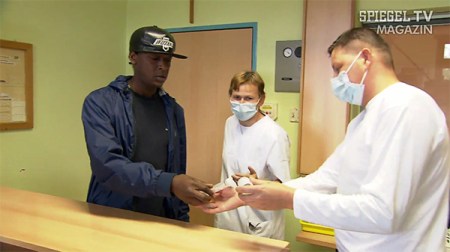
1333A migrant from Africa is shown in a Spiegel TV news segment from this month, being treated in a special unit for the involuntary quarantine of tuberculosis patients, at Parsberg District Hospital #1, in Bavaria.

Meanwhile, a report by Die Welt describes efforts by German health officials to contain the spread of so-called resistant germs:

“Physicians are currently on high alert, because with the arrival of hundreds of thousands of refugees, infectious diseases could enter the country. This is not hysteria. It is simply a challenge our healthcare system has not faced for many decades.

“There is a danger that a refugee is ‘colonized’ — as doctors call it — with dangerous germs. Every person carries bacterial germs in and on the skin. For healthy people they are harmless. They become a problem when they spread among critically ill and immunocompromised patients in a clinic.

“The problem: In the refugees’ countries of origin, resistant germs may spread more often than in Germany. So a refugee is immediately tested upon admission to a German clinic. Only when it is certain that there is no danger, it the patient moved to a shared room.”

Dr. Jan-Thorsten Gräsner, director of the Institute for Rescue and Emergency Medicine (Institut für Rettungs- und Notfallmedizin), estimates that roughly 5% of asylum seekers are carrying resistant germs. In real numbers, this works out to around 75,000 newcomers with highly infectious diseases.

The Berlin-based Robert Koch Institute, a key governmental agency for the safeguarding of public health in Germany, has advised healthcare professionals, as well as those who are working as volunteers in refugee shelters, to update their immunizations.

But the Federal Institute for Vaccines and Biomedicines (Paul-Ehrlich-Institut), an agency of the Federal Ministry of Health, has warned that 20 types of vaccines are now in short supply, and 16 others are no longer available at all. Because of production bottlenecks, some vaccines will not become available until 2017.

Stefan Derix, director of the Chamber of Pharmacists North Rhine (Apothekerkammer Nordrhein), said the shortage of vaccines is due to the massive influx of asylum seekers. He said the Ministry of Health normally orders vaccine supplies one year in advance, and that no one in the government had anticipated that Germany would be taking in so many migrants this year.

Dr. Wolfram Hartmann, president of the Cologne-based Professional Association of Pediatricians (Berufsverband der Kinder- und Jugendärzte), has warned that many of the vaccines needed to immunize both native German children and migrant children for diphtheria, polio, tetanus and whooping cough are not available, neither in Germany nor in any other European country. He also said that basic vaccines against measles, mumps, rubella and varicella are in short supply.

In a statement, Hartmann wrote:

“We cannot provide native German children and refugees alike with the basic vaccines. The vaccine shortage, which is the responsibility of the pharmaceutical companies, must urgently be made a top priority of the Health Minister! Children have a right to vaccinations, especially for chronically ill children who need timely vaccinations against flu, especially if they are housed in communal accommodations.

“The federal government must now act urgently and enforce the right of children to vaccination. The vaccine supply is just as much of a national responsibility as is the supply of physicians.”

Kordula Schulz-Asche, a politician with the Greens Party, warned against holding migrants responsible for the vaccine shortage. “The current tense vaccine situation must not be misused to stir up public opinion against refugees,” she said.

In North Rhine-Westphalia, hospitals are requiring their personnel to attend courses on how to treat patients with exotic illnesses hardly ever seen in Germany. Hospital workers in Bielefeld and Siegburg are said to be groaning under the strain of having to examine up to 80 migrants a day for tuberculosis. “The workload has increased tremendously,” a worker told Westdeutscher Rundfunk, a public broadcaster. Other hospitals in the state lack sufficient personnel and equipment, including the x-ray machines needed to examine patients with tuberculosis.

In Lower Saxony, public health officials, fearful of a mass outbreak of influenza, are struggling with the logistics of vaccinating tens of thousands of asylum seekers housed in refugee shelters across the state. With more than 1,000 new migrants arriving in Lower Saxony every day, initial medical exams of newcomers are backlogged by weeks, a period during which undetected diseases can spread.

In Berlin, police were forced to apologize for recommending that asylum seekers suffering from scabies, a highly contagious skin disease, be required to wear armbands to distinguish them from migrants who are healthy. The plan was for them to wear armbands with the capital letter ‘K’ forKrätze (German for scabies); their immediate family were to have worn armbands with the capital letter ‘A’ for Angehörigen (German for next of kin).

Meanwhile, reports of health-related scares, especially those involving tuberculosis, have become a daily occurrence in Germany.

In Krefeld, a city in North Rhine-Westphalia, a 27-year-old migrant was diagnosed withtuberculosis. He was being held in quarantine at a local pulmonary clinic. In Lünen, also in North Rhine-Westphalia, four migrants were diagnosed with tuberculosis.

In Nattheim, a town in Baden-Württemberg, asylum seekers at a refugee shelter underwent mass immunization after a child at the shelter fell ill with chickenpox. In Ellwangen, also in Baden-Württemberg, an asylum seeker diagnosed with tuberculosis escaped from a hospital. He remains at large.

In Gransee, a town in the eastern state of Brandenburg, a migrant was diagnosed with tuberculosis.

In Würzburg, more than 400 asylum seekers were mass immunized for chicken pox, diphtheria, measles, mumps, polio and tetanus. In Heidenheim, a town in Baden-Württemberg, public health officials are preparing for potential outbreaks of influenza and Norovirus at local refugee shelters this winter.

In Cologne, police cordoned off a refugee shelter housing more than 1,000 migrants in the Chorweiler district after a male refugee from Africa showed symptoms of Ebola. The man, who was coughing up blood for more than three days before anyone called a doctor, was rushed to a local hospital, where he was diagnosed with a gastrointestinal illness. Earlier, the same refugee shelter was the scene of an E. coli scare potentially affecting 800 migrants.

In Bochum, a 16-year-old migrant from Guinea showing symptoms of Ebola was placed in quarantine. In Saxony, public health officials are now testing all incoming asylum seekers forEbola.

In Düsseldorf, a 30-year-old migrant from Algeria was diagnosed with tuberculosis and was being held in quarantine at a local hospital. Municipal health officials say that in 2014, there were 50 confirmed cases of tuberculosis in the city. In 2015, that number was surpassed in August, before migrants began arriving en masse in September and October.

In Tegernsee, a town in Bavaria, a 23-year-old migrant from Eritrea who was diagnosed with tuberculosis escaped from a refugee shelter. Local officials failed to inform the public about the incident for nearly one month, until they were confronted by a local newspaper, the Münchner Merkur. Wolfgang Rzehak, a local politician with the Greens Party, justified the media blackout: “We have to find a middle road between informing the public and not becoming a panic machine.”

In Frankfurt, a 33-year-old migrant from Bulgaria who was diagnosed with tuberculosis escaped from a hospital and remains at large. Again, local officials kept quiet about the incident, until someone leaked information about it to the German newspaper, Bild.

In Berlin, a schoolteacher in the Steglitz-Zehlendorf district was diagnosed with tuberculosis; doctors say he was probably infected by one of his students. Also in Berlin, security guards at a refugee shelter in the Lichterfelde-Süd district locked nearly a dozen migrants in a bathroom after they were suspected of having tuberculosis. They were later transferred to a local hospital.

In Hamburg, public health officials quarantined a refugee shelter in the Jenfeld district after an outbreak of scabies. Also in Hamburg, a 17-year-old migrant from Sierra Leone was rushed to a local hospital and quarantined on suspicion that he had Ebola — just three days after arriving in Germany. Separately, at a refugee shelter in the Bahrenfeld district of Hamburg, firefighters wearing head-to-toe Ebola protection suits escorted migrants suspected of having Ebola to a local hospital.

In Bremen, after an asylum seeker was diagnosed with tuberculosis and doctors warned of the risk of contagion, all 200 migrants housed at refugee shelter on Steinsetzer Straße underwent chest x-rays to test for the disease.

In Munich, health officials are expecting more than 350 new cases of tuberculosis in 2015. The increase is being attributed to the large number of asylum seekers arriving in the city.

In Stuttgart, an average of 145 asylum seekers housed at the city’s convention center seek medical attention every day. Common maladies include measles, chickenpox, flu infections, dysentery and scabies caused by mites.

In Rheingau-Taunus, a district in the state of Hesse, public health officials say they need more money and medical personnel to deal with the influx of migrants at 60 local refugee shelters. The health department expects to treat more than 1,500 newcomers this year, including a large number of children who lack proper immunization. The department has reported 60 cases of scabies and tuberculosis. According to Monika Merkert, a local health inspector: “The newly arriving asylum seekers bring diseases that occur only rarely in Germany.”

German village of 102 getts 750 illegal Muslim migrants

November 1, 2015

German village of 102 getts 750 illegal Muslim migrants, Front Page Magazine, Daniel Greenfield, November 1, 2015

syrian_refugees (1)

Halloween is scarier in Germany and the Trick or Treaters are much older and much less friendlier. They won’t settle for candy. They want the full Hertz welfare state.

This bucolic, one-street settlement of handsome redbrick farmhouses may for the moment have many more cows than people, but next week it will become one of the fastest growing places in Europe. Not that anyone in Sumte is very excited about it.

In early October, the district government informed Sumte’s mayor, Christian Fabel, by email that his village of 102 people just over the border in what was once Communist East Germany would take in 1,000 asylum seekers.

His wife, the mayor said, assured him it must be a hoax. “It certainly can’t be true” that such a small, isolated place would be asked to accommodate nearly 10 times as many migrants as it had residents, she told him. “She thought it was a joke,” he said.

But it was not. Sumte has become a showcase of the extreme pressures bearing down on Germany as it scrambles to find shelter for what, by the end of the year, could be well over a million people seeking refuge from poverty or wars in Africa, Syria, Iraq, Afghanistan and elsewhere.

The technical term for this is “invasion”. But the Merkel regime was reasonable and cut down 1,000 illegal Muslim migrant invaders… to a mere 750.

In a small concession to the villagers, Alexander Götz, a regional official from Lower Saxony, told them this week that the initial number of refugees, who start arriving on Monday and will be housed in empty office buildings, would be kept to 500, and limited to 750 in all.

Sumte has no shops, no police station, no school. The initial number of arrivals was, in fact, reduced to avoid straining the local sewage system and give time for new pumps to be installed.

“We have zero infrastructure here for so many people,” Mr. Fabel, the mayor, said.

Somehow I think the migrants will not be dependent on the sewage system.

 He said he realized that there was no point in trying to block the plan when, at the initial meeting, he asked Mr. Götz, the regional official in charge of finding places for migrants, whether Sumte had any choice. “You have two options,” he said he was told. “Yes, or yes.”

Isn’t the technical term for that fascism? The New York Times story plays up the Nazi angle, but the local coverage showsa quite different picture.

Citizens have come because they want to vent their frustration. From the hairdresser to bicycle retailers…

“Those are all Muslims, and do not like us,” says a woman in the audience. “I have two daughters, what should I do now?”

Germany: “20 Million Muslims by 2020”

November 1, 2015

Germany: “20 Million Muslims by 2020” The Gatestone InstituteSoeren Kern, November 1, 2015

  • “We are importing Islamic extremism, Arab anti-Semitism, national and ethnic conflicts of other peoples, as well as a different understanding of society and law.” — From a leaked German intelligence document.
  • “We need to be clear that there must be limits and quotas for immigration — we cannot save the whole world.” — Markus Söder, Finance Minister of Bavaria.
  • “The migration crisis has the potential to destabilize governments, countries and the whole European continent. … What we have been facing is not a refugee crisis. This is a migratory movement composed of economic migrants, refugees and also foreign fighters” — Hungarian Prime Minister Viktor Orbán.
  • “Meanwhile, refugees are still heading into Germany — at a rate of around 10,000 a day. … The decade after Ms. Merkel first came to power in 2005 now looks like a blessed period for Germany, in which the country was able to enjoy peace, prosperity and international respect, while keeping the troubles of the world at a safe distance. That golden era is now over.” — Gideon RachmanFinancial Times.

Germany’s Muslim population is set to nearly quadruple to an astonishing 20 million within the next five years, according to a demographic forecast by Bavarian lawmakers.

The German government expects to receive 1.5 million asylum seekers in 2015, and possibly even more in 2016. After factoring in family reunifications — based on the assumption that individuals whose asylum applications are approved will subsequently bring an average of four additional family members to Germany — that number will swell exponentially. This is in addition to the 5.8 million Muslims already living in Germany.

According to the president of the Bavarian Association of Municipalities (Bayerische Gemeindetag), Uwe Brandl, Germany is now on track to have “20 million Muslims by 2020.” The surge in Germany’s Muslim population represents a demographic shift of epic proportions, one that will change the face of Germany forever, “but we are just standing by, watching it happen.”

Addressing an expo in Nuremburg on October 14, Brandl warned that untrammeled migration will entail heavy costs for German taxpayers and may also lead to social unrest. He said:

“A four-member refugee family receives up to 1,200 euros per month in transfer payments. Plus accommodation and meals. Now go to an unemployed German family man who has worked maybe 30 years, and now with his family receives only marginally more. These people are asking us whether we politicians really see this as fair and just.”

Brandl said this also applies to the electronic health card, which provides asylum seekers with the same benefits as Germans who have paid into the health insurance system for many years. To criticize this as unfair has “nothing to do with racism or right-wing extremism.”

Brandl’s concerns are echoed in a leaked intelligence document, which warns that the influx of more than one million migrants from the Muslim world this year will lead to increasing political instability in Germany.

The document — portions of which were published by Die Welt on October 25 — reveals growing alarm within the highest echelons of Germany’s intelligence and security apparatus about the consequences of Chancellor Angela Merkel’s open-door immigration policy.

The so-called non-paper (the author of the document remains anonymous) warns that the “integration of hundreds of thousands of illegal migrants will be impossible given the large numbers involved and the already-existing Muslim parallel societies in Germany.” The document adds:

“We are importing Islamic extremism, Arab anti-Semitism, national and ethnic conflicts of other peoples, as well as a different understanding of society and law. German security agencies are unable to deal with these imported security problems, and the resulting reactions from the German population.”

An unidentified high-ranking security official told Die Welt:

“The high influx of people from other parts of the world will lead to the instability of our country. By allowing this mass migration, we are producing extremists. Mainstream society is radicalizing because the majority does not want migration, which is being forced by the political elites. In the future, many Germans will turn away from the constitutional state.”

The warnings come amid mounting criticism of Merkel, whose September 4 decision to open the door to migrants in Hungary exacerbated the crisis.

The Minister-President of Bavaria, Horst Seehofer, who also heads the Christian Social Union (CSU), the sister party to Merkel’s Christian Democratic Union (CDU), has emerged as one of Merkel’s most vocal critics. “I am convinced that the chancellor has chosen another vision for Germany,” he said. “This has been a mistake that will occupy us for a long time. I see no way of putting the genie back into the bottle,” he added.

In an interview with Bild, Seehofer said:

“We explicitly believe that immigration must be controlled and limited if Germany wants to cope with it. The seriousness of the situation is becoming clearer every day. The population does not want clever sayings or inconclusive site visits. It wants action!”

After months of attacking critics of Merkel’s immigration policies as right-wing xenophobes, Vice Chancellor Sigmar Gabriel and Foreign Minister Frank-Walter Steinmeier conceded that the migration crisis risks tearing German society apart. In a joint essay published by Der Spiegel, the two wrote: “We cannot indefinitely absorb and integrate more than one million refugees each year.”

Bavarian Finance Minister Markus Söder said: “We need to be clear that there must be limits and quotas for immigration — we cannot save the whole world. The refugee influx will not be stopped unless we secure our borders and send a clear signal that not everyone can come to Germany.”

Former Interior Minister Hans-Peter Friedrich (CSU) described Merkel’s immigration policy as an “unprecedented political blunder” that will have “devastating long-term consequences.” He said the job of politics is to think beyond the present and make decisions for the future. In view of the massive flows of migrants into Germany without any police checks, Friedrich concluded: “We have lost control.” He added:

“It is totally irresponsible that tens of thousands of people are flowing into the country uncontrolled and unregistered, and we can only unreliably estimate exactly how many of them are Islamic State fighters or Islamist sleepers. I am convinced that no other country in the world would be so naive and starry-eyed to expose itself to such a risk.”

CDU lawmaker Michael Stübgen said: “The disagreement [with Merkel] is fundamental. Our capacities are exhausted and there is concern that the system will implode if we do not regain control of our borders. But the chancellor disagrees and so the conflict is unsolved.”

On October 21, more than 200 mayors in North-Rhine Westphalia signed an open letter to Merkel, in which they warned they were no longer capable of taking in any more migrants. The letter states:

“We are seriously concerned for our country and the cities and towns we represent. The reason: the massive and mostly uncontrolled flow of migrants to Germany and our cities and towns.

“All available housing possibilities are exhausted, including tents and shipping containers. Managing the migrant shelters is so time intensive that our personnel can no longer attend to other municipal responsibilities.”


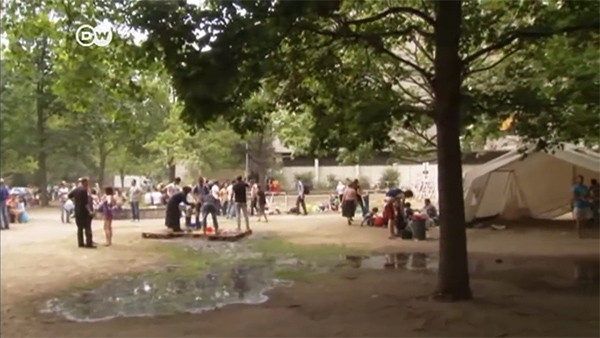
1229 (1)According to a report by German public broadcaster Deutsche Welle, the Berlin refugee center pictured here received up to 2000 applications for asylum per day in August — before the migrant flow increased substantially. (Image source: Deutsche Welle video screenshot)

Speaking at an October 22 gathering of the European People’s Party in Madrid, Hungarian Prime Minister Viktor Orbán warned of the consequences of Merkel’s immigration policies. He said:

“We are in deep trouble. The migration crisis has the potential to destabilize governments, countries and the whole European continent….

“What we have been facing is not a refugee crisis. This is a migratory movement composed of economic migrants, refugees and also foreign fighters. This is an uncontrolled and unregulated process…. I also want to underline that there is an unlimited source of supply of people, after Syria, Iraq, Pakistan, Afghanistan, Africa is now also on the move. The dimension and the volume of the danger is well above our expectations….

“Our moral responsibility is to give back these people their homes and their countries. It can’t be our objective to provide them with a new European life. Right to human dignity and security are basic rights. But neither the German, Austrian nor the Hungarian way of life is a basic right of all people on the Earth. It is only a right of those ones who have contributed to it. Europe is not able to accept everyone who wants a better life. We have to help them to get back their own lives with dignity and we have to send them back to their own countries….

“We cannot avoid speaking about the quality of our democracies. Is it freedom of information and speech when the media usually show women and children while 70% of the migrants are young men and they look like an army? How could it happen that our people feel that their opinion is not being taken into consideration? And we have to address the question of whether our people want what has been happening. Did we get authorization from them to allow millions of migrants to enter our continent? … No, distinguished delegates, we did not.

“We cannot hide the fact that the European left has a clear agenda. They are supportive of migration. They actually import future leftist voters to Europe hiding behind humanism. It is an old trick but I do not understand why we have to accept it. They consider registration and protection of borders as bureaucratic, nationalist and against human rights. They have a dream about the politically constructed world society without religious traditions, without borders, without nations. They attack core values of our European identity: family, nation, subsidiarity and responsibility.”

In an October 26 column for the Financial Times, titled “The End of the Merkel Era is Within Sight,” Gideon Rachman wrote:

“The refugee crisis that has broken over Germany is likely to spell the end of the Merkel era. With the country in line to receive more than a million asylum-seekers this year alone, public anxiety is mounting — and so is criticism of Ms. Merkel, from within her own party. Some of her close political allies acknowledge that it is now distinctly possible that the chancellor will have to leave office, before the next general election in 2017. Even if she sees out a full term, the notion of a fourth Merkel administration, widely discussed a few months ago, now seems improbable…

“The trouble is that Ms. Merkel’s government has clearly lost control of the situation. German officials publicly endorse the chancellor’s declaration that ‘We can do this’. But there is panic just beneath the surface: costs are mounting, social services are creaking, Ms. Merkel’s poll ratings are falling and far-right violence is on the rise.

“As the placid surface of German society is disturbed, so arguments about the positive economic and demographic impact of immigration are losing their impact. Instead, fears about the long-term social and political effect of taking in so many newcomers — particularly from the imploding Middle East — are gaining ground. Meanwhile, refugees are still heading into Germany — at a rate of around 10,000 a day. (By contrast, Britain is volunteering to accept 20,000 Syrian refugees over four years.)…

“Some voters seem to have concluded that Mutti [a German familiar form of ‘mother’] has gone mad — flinging open Germany’s borders to the wretched of the earth…

“The refugee crisis marks a turning point. The decade after Ms. Merkel first came to power in 2005 now looks like a blessed period for Germany, in which the country was able to enjoy peace, prosperity and international respect, while keeping the troubles of the world at a safe distance. That golden era is now over.”

Germany: Asylum Seekers Make Demands

October 23, 2015

Germany: Asylum Seekers Make Demands, Gatestone InstituteSoeren Kern, October 23, 2015

(How long can parasites survive when they demand more blood than their hosts can provide? —  DM)

  • “Human traffickers and the media in their home countries are making promises that do not correspond to reality.” — Hans-Joachim Ulrich, regional refugee coordinator.
  • The migrants said they were angry they were being asked to sleep in a huge warehouse rather than in private apartments. Hamburg officials say there are no more vacant apartments in the city. “The city lied to us. We were shocked when we arrived here,” said Syrian refugee Awad Arbaakeat.
  • “One of the men, who spoke broken German, said they [a family of asylum seekers from Syria] were not interested in viewing the property because I am a woman… I was taken aback. You want to help and then are sent away, unwanted in your own country.” — Aline Kern, real estate agent.
  • “A constitutional state cannot allow itself to be blackmailed.” — Marcel Huber, Bavarian politician.
  • “I man. You woman. I go first.” — Muslim male with a full shopping cart at the supermarket.
  • An asylum seeker from Somalia successfully sued the German Agency for Migration and Refugees for taking too long to process his application — 16 months. The agency said it currently has a backlog of 250,000 unprocessed applications.
  • Seventy percent of migrants from Afghanistan, Iraq and Syria who were offered apprenticeships fail to complete them. According to the director of the Munich Chamber of Trade, many young migrants believe apprenticeships are beneath them.

Asylum seekers are increasingly using tactics such as hunger strikes, lawsuits and threats of violence in efforts to force German authorities to comply with an ever-growing list of demands.

Many migrants, unhappy with living conditions in German refugee shelters, are demanding that they immediately be given their own homes or apartments. Others are angry that German bureaucrats are taking too long to process their asylum applications. Still others are upset over delays in obtaining social welfare payments.

Although most asylum seekers in Germany have a roof over their head, and receive three hot meals a day, as well as free clothing and healthcare, many are demanding: more money, more comfortable beds, more hot water, more ethnic food, more recreational facilities, more privacy — and, of course, their own homes.

Germany will receive as many as 1.5 million asylum seekers in 2015, including 920,000 in the last quarter of 2015 alone, according to government estimates. This figure is nearly double the previous estimate, from August, which was 800,000 for all of 2015. By comparison, Germany received 202,000 asylum seekers in all of 2014.

With refugee shelters across the country already filled to capacity, and more than 10,000 new migrants entering Germany every day, Germany is straining to care for all the newcomers, many of whom are proving to be ungrateful and impatient guests.

In Berlin, 20 asylum seekers sued the State Agency for Health and Social Welfare (Landesamt für Gesundheit und Soziales, Lageso) in an effort to force local authorities to speed up their welfare payments.

Berlin expects to receive 50,000 asylum seekers in 2015. German taxpayers will spend 600 million euros ($680 million) this year to pay for their upkeep.

Also in Berlin, more than 40 migrants, mostly from Pakistan, seized control over the observation deck of the city’s television tower and demanded stays of deportation, jobs, and exemptions from mandatory residence (Residenzpflicht), a legal requirement that asylum seekers reside within certain boundaries defined by local immigration authorities. More than 100 police were deployed to the tower to remove the protesters. After a brief questioning, they were set free. Police said no crime had been committed because the migrants had purchased tickets to the observation deck, some 200 meters (650 feet) above the Berlin.

In the Kreuzberg district of Berlin, more than 400 migrants, mostly from Africa, occupied an abandoned school because they no longer wanted to live in tents in a nearby square. When 900 police arrived to clear the building, some migrants poured gasoline inside the structure and threatened to set themselves on fire, while others threatened to jump off the roof of the building. “We are currently negotiating with local authorities about how to proceed,” a Sudanese migrant named Mohammed said. “We will not leave until our demands [amending German asylum laws so they can remain in the country] are met.”

In Dortmund, 125 migrants complained about the “catastrophic conditions” at the Brügmann sports facility, which now serves as a refugee shelter. The list of complaints included: bad food, uncomfortable beds and not enough showers.

Just hours after arriving in Fuldatal, 40 asylum seekers from Afghanistan, Pakistan and Syria complained about conditions at a refugee shelter there and demanded that they be given their own homes. The regional refugee coordinator, Hans-Joachim Ulrich, said that migrants are coming to Germany with unrealistic expectations. “Human traffickers and the media in their home countries are making promises that do not correspond with reality,” he said.

In Hamburg, more than 70 asylum seekers went on a hunger strike in an effort to pressure local authorities to provide them with better housing. “We are on a hunger strike,” said Syrian refugee Awad Arbaakeat. “The city lied to us. We were shocked when we arrived here.” The migrants said they were angry they were being asked to sleep in a huge warehouse rather than in private apartments. Hamburg officials say there are no more vacant apartments in the city, the second-largest in Germany.

Also in Hamburg, more than 100 migrants gathered in front of the city hall to protest the lack of heating in their tent shelters. City officials said they were caught off guard by the early frost and that all tents would have heating before the winter sets in. According to Hamburg Mayor Olaf Scholtz, some 3,600 migrants would be spending the coming winter in tents due to the lack of alternative housing in the city.

According to Hamburg officials, 35,021 migrants arrived in the city during the first nine months of 2015. During this same period, Hamburg police were dispatched to the city’s refugee shelters more than 1,000 times, including 81 times to break up mass brawls, 93 times to investigate physical and sexual assaults, and 28 times to prevent migrants from committing suicide.

Meanwhile, a confidential document that was leaked to the German newspaper Bild reveals that the Hamburg transit authority (Hamburger Verkehrsverbund, HVV) has ordered ticket inspectors to “look the other way” whenever they encounter migrants who are using public transportation without a ticket. The move ostensibly aims to protect the HVV against “bad press.”

According to the leaked document, ticket inspectors should be lenient with asylum seekers because many migrants are “the victims of professional counterfeit ticket scammers” and many others have “barely comprehensible knowledge” of the HVV’s tariff structure.

The CDU’s transportation expert, Dennis Thering, said the HVV’s policy cannot be left unchallenged. “This ‘look-the-other-way’ policy must be withdrawn. In Hamburg there is the opportunity to purchase discounted HVV tickets, explicitly also for persons who receive benefits under the Asylum Seekers Benefits Act.” Every newly arrived refugee receives 149 euros in pocket money every month. This includes 25.15 euros that have been earmarked for the purchase of transport tickets.

In Halle, four security guards were injured when they tried to stop a mob of asylum seekers from Africa and Syria from entering the city’s social welfare office before opening hours. The migrants, who were there to pick up their welfare payments, became angry when it appeared to them as though some migrants cut in front of the line. It later turned out that some migrants were there for other business, and thus were not required to stand in line.

In Munich, 30 migrants went on a hunger strike to protest shared accommodations in refugee shelters. Two of the men were rushed to the hospital after losing consciousness. “A constitutional state cannot allow itself to be blackmailed,” Bavarian politician Marcel Huber said. “We have zero tolerance for this action.”

In Nürnberg, six migrants from Afghanistan, Ethiopia and Iran went on a hunger strike to protest the rejection of their asylum applications. The men, who are living in a tent in downtown Nürnberg for several months, demanded to speak to local authorities. The asylum applications were rejected six years ago, but the men are still living in Germany.

In Osnabrück, an asylum seeker from Somalia successfully sued the German Agency for Migration and Refugees (Bundesamt für Migration und Flüchtlinge, BAMF) for taking too long to process his application. A judge ordered the BAMF to make a decision on his application within three months or provide him with financial compensation.

The man said he had been waiting for 16 months to get an answer from the BAMF. In its defense, the BAMF said it currently has a backlog of 250,000 unprocessed applications, and this number is expected to skyrocket as more asylum seekers arrive in Germany.

A spokesperson for the court said the ruling set a precedent, and that many more asylum seekers likely would file lawsuits against the BAMF in the near future.

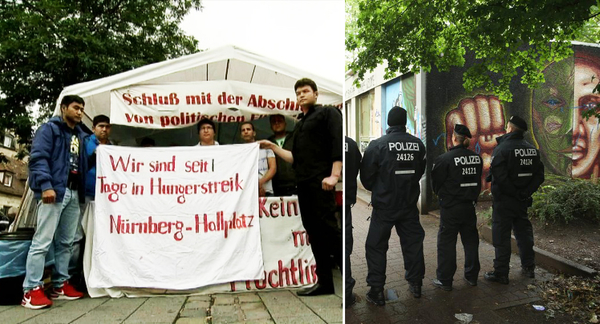
1312Groups of migrants across Germany have been launching hunger strikes, demanding more money, more comfortable beds, more hot water, more ethnic food, more recreational facilities, and their own homes. In Berlin (right), 900 police were needed to remove more than 400 migrants who had occupied an abandoned school.

In Walldorf, a town in the state of Baden-Württemberg, a group of migrants demanded that local authorities immediately provide them with private apartments because they were tired of living in a refugee shelter with 200 other asylum seekers. The leader of the group, a 46-year-old refugee from Syria, said he expected more from Germany. It was high time for Germans to begin to “treat us like human beings,” he said.

Following up on the complaints, state and local authorities inspected the shelter and found that conditions there were “absolutely acceptable,” with cubicles for privacy and plenty of food and clothing.

In Wetzlar, a city in the state of Hesse, migrants threatened to go on a hunger strike in an effort to force local authorities to move them into permanent housing. Local authorities said they delays were due to a quarantine after several migrants were found to be infected with Hepatitis A.

In Zweibrücken, 50 asylum seekers from Syria went on a hunger strike to protest the slow pace of the application approval process. “We can accept the living conditions in the refugee camp, but we need hope,” one of the men said. Local officials said the process has collapsed because of the large number of applicants.

Asylum seekers have also gone on hunger strikes in Birkenfeld, Böhlen, GelsenkirchenHannover, Walheim, and Wittenberg.

Meanwhile, teachers at Gemeinschaftsschule St. Jürgen, a grade school in the northern German city of Lübeck, ordered eighth graders to spend a morning at a local refugee shelter and “actively help” the migrants by making their beds, sorting their clothing and working in the kitchen.

Some parents complained that their children are also being asked to bring gifts and food for the migrants, who are already receiving handouts financed by German taxpayers. A woman wrote: “Sometimes I do not even know how I am going to put food on my own table.”

Another woman wrote: “This is going too far. Students are supposed to make beds and do cleaning work at a refugee shelter. My friend’s 14-year-old son is being asked to do this!!! I am not an agitator and I am tolerant, but this is going way too far. Is there now a new course in Lübeck schools called: Slavery???

The school’s principal, Stefan Pabst, said the negative reaction was a “catastrophe.” He said that having the children work in a refugee shelter was the best way for them to “understand social behavior.” The German newsmagazine, Stern, complained that the dissenting parents belonged to “right-wing circles” and are “spreading their stupid slogans.”

In Bad Kreuznach, a family of asylum seekers from Syria made an appointment to view a four-room rental property but refused to view the house because the real estate agent was female. According to real estate agent Aline Kern:

“One of the men, who spoke broken German, said they were not interested in viewing the property because I am a woman, I am blonde, and because I looked the men into their eyes. This was inappropriate. My company should send a man to show the property.

“I was taken aback, annoyed. One wants to help and then are sent away unwanted in your own country.”

In Idar-Oberstein, a town in the German state of Rhineland-Palatinate, an imam at a refugee shelter refused to shake the hand of Julia Klöckner, a visiting dignitary, because she is a woman. After Klöckner, the vice-chairwoman of the Christian Democratic Union (CDU), shared her experience with the German newsmagazine Focus, she received more than 800 emails from women across the country describing how they, too, have been mistreated by Muslim migrants.

One woman described how Muslim men repeatedly cut in front of her at the supermarket checkout line. “Twice while shopping at a German supermarket I was shown that I am a second-class citizen,” she wrote. In one instance, an adult Muslim male with a full shopping cart cut in front of her. In broken German, he said: “I man. You woman. I go first.” In another instance, a young Muslim male elbowed the woman while cutting in front of her. “When I said that I would let him go ahead of me if he asked me for permission, I was instructed by his sister that boys do not need to ask, they just demand.”

A teacher at a vocational school wrote: “The most problematic students are Muslim males, who do not acknowledge the authority of female teachers and who disrupt the classes.”

A mother reported that during a visit to her daughter’s school, she approached a fully-veiled female refugee and asked her if she could be of help to her. “A man with a fancy suit and a three-day beard, he seemed like out of a Hugo Boss fashion magazine, said: ‘My wife does not speak the language of the unclean.’ When I asked him who here was unclean, he said I was. I asked him what that means. He said it was nothing against me personally, because all German women are unclean, and that his wife should not speak the language of the unclean, so that she can remain clean.”

Klöckner is now calling for Germany to pass a new law that requires migrants and refugees to integrate into German society. She said: “We need an integration law. We are a liberal and free country. If we give up the foundations of our liberality, we will wake up in a different country.”

Klöckner insists that migrants must be informed about German “rules of the game” from the first day they arrive in the country. “The people who want to stay here must, from the first day, accept and learn that in this country religions coexist peacefully and that we cannot use force to resolve conflicts,” she said.

In Berlin, more than 150 migrant youths from North Africa and Eastern Europe are occupied as full-time purse-snatchers and pickpockets. Also known as the klau-kids (thief kids), they post their plunder (smart phones, laptops, designer sunglasses) on the Internet to taunt police. A 16-year-old known as Ismat O. has been detained more than 20 times on suspicion of theft, but each time he has been released, only to continue his trade. Walid K. has been arrested more than 10 times, and is also free.

According to the director of the police union in Berlin, Bodo Pfalzgraf, “it is incomprehensible that such serial offenders do not remain in pre-trial detention.” Police say the youths are released because German judges are not prepared to issue arrest warrants for so-called petty crimes such as purse-snatching. The youths can only be deported if they have been sentenced to at least three years in prison.

In Bavaria, the Munich Chamber of Trade (Handwerkskammer München und Oberbayern)reported that 70% of migrants from Afghanistan, Iraq and Syria who have been offered apprenticeships fail to complete them. The normal washout rate is 25%. According to the director of the chamber, Lothar Semper, many young migrants believe the apprenticeships are beneath them. “We have to make a tremendous effort to convince young people that they should even begin an apprenticeship,” he said. “Many have the expectation of quickly earning a lot of money in Germany.”

Germans plan “new Aleppo” Muslim city built around a mosque

October 22, 2015

Germans plan “new Aleppo” Muslim city built around a mosque, Front Page Magazine, Daniel Greenfield, October 22, 2015

(If, consistently with Palestinian demands, Jews are driven out of Israel, will Germany build a small scale Jerusalem for them, complete with a synagogue? Or will one of Germany’s old death camps suffice? — DM)

hell

In classic colonialism, the colonized didn’t roll out the welcome wagon for their colonizers. But the Muslim colonization of Europe is certainly going that way. Here’s a German architect’s plan, laid out in the Die Welt newspaper, for building a New Aleppo. (Because battling Muslim gangs shot the old one up.)

Now most refugees are still living in shelters. But soon they will need their own apartments. Planners are already developing concepts – up to an entire city with a mosque in the center.

Because having a mosque in the center is why the old Aleppo is on fire. So let’s learn nothing from history.

Manfred Osterwald is an architect and general planner. He has experience designing entire cities in China, in Iran, in Lebanon. And now he has the vision to build a new home for refugees in Germany. “Smart Home City” he calls his idea… Osterwald thinks big, very big.

The city for Refugees will be equipped with everything a city can offer its inhabitants: apartments, supermarkets, schools and hospitals, sports facilities, cinemas and shops, greenery and especially a central square with a mosque.

How much would this utopia cost? A pittance. A mere 567 million dollars. For 30,000 Muslim migrants.

Bright and colorful, with architectural elements from the homeland of the residents – so that they will find their identity, he says.

You wouldn’t want them integrating or anything.

Meanwhile some refugees are threatening to set fire to their tents. They already wrecked the real Aleppo. The New Aleppo will be a hellhole before you can shout Allahu Akbar.

But some enterprising folks are flooding Muslim colonist settlements as soon as they’re built.

In Erfurt, a block of flats meant to house migrants was flooded in the latest act of sabotage against planned refugee shelters.

Looks like the natives are restless.

Sweden Close to Collapse

October 17, 2015

Sweden Close to Collapse, Gatestone InstituteIngrid Carlqvist, October 17, 2015

  • If the wave of migrants keeps coming, in 10-15 years, Swedes will be a minority in their own country. That there is, in fact, an exchange of populations going on, should be clear in any sober assessment.
  • The final consequence of… Sweden’s immigration policy is that the economy will collapse — because who is going to pay for it all? And economic breakdowns, once they happen, always happen very fast.” — Lars Hedegaard.
  • In the last two weeks, more than 1,000 “unaccompanied refugee children” have arrived from Germany via ferry; more than half of them have now vanished and are listed as missing.
  • For the last few weeks, the central train station in Sweden’s third largest city, Malmö, has been overrun with migrants; the volunteers that for the first few days showed up with food, water and clothes now seem to have lost interest.
  • It will not be long until the Swedes realize that the state will not look after them. The country that just 20 years ago was considered one of the safest and most affluent in the world, is now in danger of becoming a failed state.

Sweden is fast approaching a complete collapse. More and more municipalities are raising the alarm that if the migrants keep coming at this pace, the government can no longer guarantee normal service to its citizens. In addition, ominous statements from government officials have left Swedes in fear of what tomorrow may bring. If the migrant wave keeps coming, in 10-15 years, Swedes will be a minority in their own country.

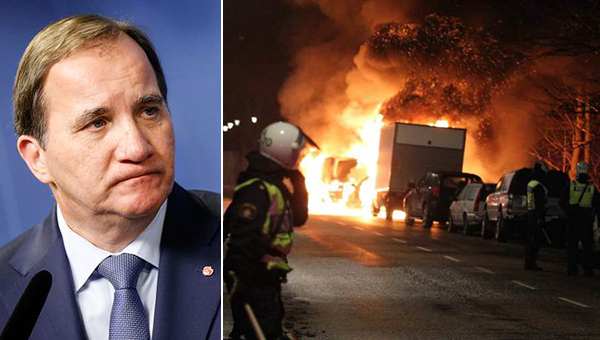
At a press conference October 9, Prime Minister Stefan Löfven said that Sweden is in a state of crisis. However, when asked to clarify what he meant by this, Löfven was unable to produce a single coherent sentence.

Three ministers appeared by the Prime Minister’s side at the hastily summoned press conference, which came on the heels of an extraordinary government meeting. The purpose of the press conference seems to have been to convey two messages:

  1. To explain to the world and the Swedish people that Sweden is facing “one of the largest humanitarian efforts in Swedish history.”
  2. That there is no more housing available, and migrants should be prepared to live in tents.

During the question period after the ministers’ speeches, journalist Tomas Ramberg of EkotPublic Radio asked: “You say that Sweden is preparing for a crisis situation, what do you mean by those dramatic words?”

Stefan Löfven’s reply was incomprehensible:

“Yes, well first of all we, we are in the middle of what I mean seriously when I’m saying, when I express a, a big thank you to all the people doing such a great job, because it is a humanitarian effort, it’s just as the Minister for Justice and Migration just said. What we are actually doing is that we are saving lives when people who come from bombs, from, from killing, from oppression, their lives are shattered. We, we help them and that is a, that is a great humanitarian effort, and of course now that we can see the number of people who need it, that are seeking protection, then it is one of the greatest humanitarian efforts. And that we are facing a crisis situation, that is in part why I, we are outlining today that we are also preparing for a situation where we may need to house people in tents, because we stand up with the humanitarian refugee policy, right of asylum, but we can now also see that we cannot close our eyes to the fact that there are more coming than ever in such a short time, and we need to provide a roof over their heads. Then it is — other things may be required.”

However, the fact that the government is now talking about housing migrants in tents, may be a signal that Sweden, despite everything, may not want to be on the front lines of the “humanitarian” battle anymore, after all. The prospect of spending an ice-cold Swedish winter in a tent may make migrants choose countries other than Sweden. If not, a complete collapse of the Swedish system is imminent.

In 2014, the Danish historian and social commentator Lars Hedegaard prophetically remarked in the book “Farliga ord“(Dangerous Words), that the economic breakdown of a nation always happens quickly and unexpectedly:

“If there is any lesson to be drawn from history, it is that what you do not think will happen, does. Time and again. The final consequence of the West and, above all, Sweden’s immigration policy is that the economy will collapse — because who is going to pay for it all? And economic breakdowns, once they happen, always happen very fast.”

Right now, the Swedish government is borrowing money abroad to pay for immigration. But that amount is not enough. On October 8, the Swedish Association of Local Authorities and Regions (SKL) warned that municipalities need to increase the tax rate by 2%. The average municipal income tax is already 32%, on top of which many Swedes also pay a federal income tax. A 2% rise in the tax rate would mean 15,000 kronor ($1,825) more in taxes each year for the average household.

High-ranking politicians and officials are also saying the situation is extremely grim. On October 1, Minister for Home Affairs Anders Ygeman said that the current wave of immigrants will lead to “huge economic strains;” and a few days later Immigration Service Director General Anders Danielsson explained that “within the framework of the system we all know, we are now approaching the end of the road.” Statements such as these have never been heard before in Sweden, especially in connection with the “sacred” issue of migration. Until now, Swedes have perpetually been told that we live in a rich country that has no problem handling all asylum seekers who want to come here.

1305Swedish Prime Minister Stefan Löfven (left) said last week that Sweden is in a state of crisis. Pictured at right, the results of rioting in a Stockholm suburb, December 2014.

In the shadow the 1.5 million migrants expected to arrive this year in Germany, the EU’s largest country (population 81 million), migrants are also pouring into a rather smaller Sweden. Geographically Sweden is large, but consists mainly of forests and wilderness, and fewer than 10 million people live in the country. Until 2010, Sweden took in about 25,000 migrants a year. However, in 2010, then Prime Minister Fredrik Reinfeldt made a deal with pro-immigration Green Party, (Miljöpartiet) — by his own admission to punish voters for allowing the anti-mass-immigration Sweden Democrats party (Sverigedemokraterna) into parliament.

Reinfeldt’s deal opened the immigration floodgates. In 2014, 81,000 people sought asylum in Sweden; and 33,500 were granted asylum. However, as many of the immigrants subsequently brought over their relatives, that figure substantially increased. Last year, 110,000 people were granted residency status in Sweden. One should add to this figure an unknown number of illegal aliens.

There is now talk of 180,000 asylum seekers coming to Sweden in 2015. That number is more than twice as many as the year before. If half of them are granted asylum, and they each bring over three relatives, we are talking about 270,000 new immigrants to Sweden — within one year. Over 8000 people arrived just last week, 1,716 of whom were so-called “unaccompanied refugee children.”

Swedes who only follow the mainstream media get the impression that all the migrants arriving are war refugees from Syria, but the number of Syrians is actually less than half of the total: 2,864 people last week claimed to be from Syria. 1,861 claimed to be from Iraq, and 1,820 from Afghanistan. Clearly, many people from countries that are not at war are taking their chances and applying for asylum in Sweden; but this is something about which the mainstream media does not see fit to inform its followers.

That there is an exchange of populations going on, should be clear in any sober assessment. The Swedish economist Tino Sanandaji (of Iranian-Kurdish descent, and therefore tougher than most Swedes, who, if they criticize the immigration policy, are immediately accused of racism) writes on his blog that Swedes could soon be in the minority in their own country:

“1,000-1,500 asylum seekers a day for 15 years equals 5.5 to 8.2 million asylum seekers. At the end of 2014, the Statistical Central Bureau, SCB, calculated that 21.5% of the Swedish population were of foreign descent: 2.1 million, out of 9.7 million. The number of people of Swedish descent — born in Sweden with two parents born in Sweden — has been stable at about 7.7 million and is expected to remain stable or increase slightly due to birth surplus. If those of foreign descent increase their number by about 5.6 million, they will become the majority.”

One of the municipalities that has been flooded with migrants is Trelleborg (population 43,000), located on Sweden’s southernmost coast. Over 100 “unaccompanied refugee children” arrive from Germany via ferry on a typical day. During the last two weeks, more than 1000 such youths have been registered; more than half of them have now vanished and are listed as missing. No one knows why, or where they have gone. Add to this 13,000 adult asylum seekers.

Impromptu temporary lodgings have been created in sports centers, ice rinks, and at the Sturup airport hotel, to name a few.

Trelleborg has written a desperate letter of appeal for help to the government, just as, a few weeks ago, the Örkelljunga municipality did in vain. The mayor and the Municipal Director of Trelleborg, who signed the letter on October 1, wrote:

“In the past, many asylum seekers have taken the route through Denmark to Malmö, but this changed about two weeks ago. From September 10 until the morning of October 1, 14,100 asylum seekers arrived in Trelleborg by ferry. There is no indication that the pace is slowing; if anything it is continuously increasing. On Tuesday, September 22, Trelleborg received word from the Immigration Service that the municipality where children and young people arrive is by law the authority that is required to provide housing, care and living expenses, until such time as the Immigration Service decides upon a designated municipality. … Trelleborg has quickly ended up in a situation where the regular services to the community are at great risk of being affected. … By writing this letter, we would like to bring to your attention the enormous strain we now find ourselves under.”

Apparently, the Minister for Justice and Migration, Morgan Johansson, has since been in contact with Trelleborg’s mayor via telephone to discuss possible solutions. On October 9, the Immigration Service decided that Trelleborg should be exempt as a designated municipality for unaccompanied children. However, it is unclear how this will alleviate Trelleborg’s plight as far as the new arrivals go. The only concrete help so far has come from some of the neighboring municipalities, who have opened up facilities to house some of the Trelleborg migrants.

Malmö, about 18 miles from Trelleborg, is also in dire straits. For the last few weeks, the central train station in Sweden’s third largest city has been overrun with migrants, and the volunteers that showed up for the first few days with food, water and clothes now seem to have lost interest. The daily Sydsvenska Dagbladet summed up the desperate situation in Malmö, where even the city’s empty jail was considered (and rejected) as possible housing for refugee children. It now looks more like a possibility for adult refugees.

The Social Democratic mayor of Filipstad, Per Gruvberger, also recently raised the alarm that his municipality of 6,000 people will not be able to provide schooling and childcare for the 1,100 asylum seekers now assigned to his municipality.

The reply of the Minister for Justice and Migration, Morgan Johansson, to this cry for help was: “If need be, Filipstad will just have to expand its operations.”

This insensitive statement from Johansson caused the Mayor of neighboring Årjäng, Daniel Schützer, to go ballistic. He wrote about his fellow party member on Facebook:

“Pardon my French, but Morgan Johansson is totally f—ing stupid. ‘Expand,’ he says. It is not f—ing bricks and planks that we are lacking, it is teachers!!!!”

The Immigration Service, which is tasked with reviewing the asylum seekers’ reasons for immigrating, is understandably swamped with work. Even before the latest “refugee crisis” — and despite 1,200 new employees being hired last year — its staff is struggling. The employees’ union is now raising the alarm, concerning more and more incidents of violence, vandalism and suicide attempts — this year (up to August), 1,021 such incidents were reported.

“The work situation for the entire authority is very strained. The pressure is enormous. The work environment has deteriorated severely,” said Sanna Norblad, local chairperson of the ST union, to daily Norrköpings Tidningar.

While all this plays out, large portions of the Swedish people watch in horror from the sidelines and wonder when the unavoidable collapse will occur. At the same time, a surprisingly large portion of the citizenry still overconfidently believe that “Daddy State” will make everything all right. This a very Swedish view, like the wishes of children, that Peter Santesson, head of polling institute Demoskop, wrote about on the website Dagens Opinion. Santesson states that the Swedes have an unusually high level of trust in the social order, and that they are convinced that “somewhere higher up, there is always someone smarter and more informed, taking responsibility and making sure everything works.” If the government officials turn out to be incapable of handling the refugee chaos they themselves have created, it could be disastrous. Santesson continues,

“Responsible decision makers need to ponder the trust the people have now bestowed on them, and they need to handle this trust with care in this difficult crisis. If the people’s confidence is betrayed by them turning out not to be able to handle the situation – if ‘Sweden’ turns out to be insufficient as a miracle cure and the crisis becomes too much to handle — the outcome could be political and social consequences reaching far beyond the issue of immigration.”

The blogger Johan Westerholm, a Social Democrat who is critical of the government, points out in an October 7 titled “System infarction in the Immigration System,” that in addition to those who are already in Sweden, we need to add those who are not granted asylum in Norway and Finland, and will therefore be sent back to the last country they were in — Sweden. Considering that Finland rejects 60% of asylum applications, it is fair to assume that during the coming weeks, the chaos will only escalate.

Westerholm writes that the situation in Malmö is “out of control,” and states that we do not have any idea who those arriving in Sweden are:

“A very large group of administrators [at the Immigration Service] do not even know the designated terror organizations, and then there are the sympathizers — people who, on principal, would never file a report to the Immigration Service security department, for ideological reasons. A large group consists of those who are scared into silence. In an organization characterized by fear and stress, to do nothing is a surefire way to keep your job. If a report of suspicion is filed anyway, typically nothing happens. If the life and health of the terrorist is threatened, as is often the situation, the person gets to stay. Initially he is given a temporary residence permit, but in practice, this turns out to be permanent.”

The 152 asylum seekers reported to the Security Service so far this year as possible threats to national security, are thus most likely just the tip of the iceberg.

The Swedes who have already lost faith in the authorities and the politicians are now preparing for the unthinkable — that their once so secure society is about to collapse. On the website 72timmar.se, the Civil Contingencies Agency informs the public on “our five most basic needs: Water, food, heat, sleep and security.” The readers are told to keep water and canned goods at home, and make sure they can stay warm.

“Prepping” is becoming more common in Sweden. Last summer, the daily Svenska Dagbladetran a story on the first Swedish online store for preppers, and that interest was huge. According to the polling institute Sifo, until recently, seven out of ten Swedes have been completely unprepared for a crisis that knocks out the power supply and thereby the infrastructure. The owner of the online store, Fredrik Qvarnström, told the paper that, in his estimation, the Swedes are the worlds most poorly prepared for a crisis:

“There is lot of talk about the greenhouse effect and economic crisis. People seem to be aware that there are problems, but I do not think they know how vulnerable we really are. We rely on the state to take care of us, as it has in the past.”

It will not be long until the Swedes realize that the state will not look after them. The country that just 20 years ago was considered one of the safest and most affluent in the world, is now in danger of becoming a failed state.

How 200,000 invaders turns into 2,000,000 in the blink of an eye

October 11, 2015

How 200,000 invaders turns into 2,000,000 in the blink of an eye, American ThinkerCarol Brown, October 11, 2015

(Please see also, Germany: Migrant Crime Wave, Police Capitulate. — DM)

If you think 200,000 invaders imported into the United States is appalling, consider this: Once they settle here, they bring their family. The Australian reported on a leaked document that reveals how this results in the base number of invaders expanding almost overnight. Although the article is about the situation in Germany, the point applies to the United States (or any country accepting these conquerors).

Chancellor Angela Mer­kel is facing open dissent from members of her coalition government amid predictions that the number of migrants arriving in Germany this year could reach 1.5 million. (snip)

The new estimate of 1.5 million came in a confidential government paper leaked to the newspaper Bild. It is widely believed the source of the leak was the interior ministry.

The secret document said each refugee had a “family factor” of four to eight people, meaning they could be expected to arrange for up to eight relatives to join them once settled in….

The “family factor.”

So when Obama says we should accept 200,000 “refugees,” what that really means (as if 200,000 isn’t awful enough) is that we are accepting as many as 1,600,000 invaders. If you factor in the high likelihood that many of these families will continue to have children once they’re here, the number easily reaches 2 million.

Two million (more) Muslims, few of whom speak English, many of whom are uneducated, a large number of whom are unemployable or who won’t want to work, many if not most of whom will never integrate into our culture, the majority of whom will come “clinging to their religion” (to use a misdirected phrase in the proper context), and Lord knows how many of whom will inflict harm.

Why are we doing this? Oh, yes. I forgot. The fundamental transformation of America.

In this case, the particular pathway to said transformation has several options and can move pretty rapidly (the left’s favorite pace).

There are as many as three avenues for bringing family members once a refugee is admitted, with an I-730 application being the most common. Eligible family members are those considered “immediate family,” such as spouses (multiple?), children, and/or parents. Cousins, for example, do not qualify. However, in light of how common inbreeding is in Islamic culture, these relationships may be difficult to tease apart.

The timeline for approval is relatively fast. Once an application is submitted, the average processing time (based on global stats) is a year to a year-and-a-half.

Imagine that. You are admitted into the United States and as soon as a year later your entire family may be imported as well. That is how fast 200,000 invaders becomes well over a million and a half. And counting.

So when you educate people and speak out against this madness, be aware that the dangerously high numbers of “refugees” Obama wants to admit is actually much higher. And the higher it goes, the harder we fall.


Germany: Migrant Crime Wave, Police Capitulate

October 11, 2015

Germany: Migrant Crime Wave, Police Capitulate, Gatestone InstituteSoeren Kern, October 11, 2015

  • According to a classified document, the German government now estimates that Germany will receive as many as 1.5 million asylum seekers in 2015, including 920,000 in the last quarter of 2015 alone. With family reunifications, the actual number of asylum seekers could swell to more than 7 million. Separately, German authorities now estimate that at least 290,000 migrants and refugees have entered the country without being registered.
  • “The behavior of these highly delinquent youths towards police officers can be characterized as aggressive, disrespectful and condescending. … When they are arrested, they resist and assault [police officers]. The youths have no respect for state institutions.” — Confidential report, leaked to Die Welt.
  • In Berlin, a classified police report revealed that a dozen Arab clans hold reign over the city’s criminal underworld. The report says the clans, which are dedicated to dealing drugs, robbing banks and burglarizing department stores, run a “parallel justice system” in which they resolve disputes among themselves with mediators from other crime families. If the state gets involved, the clans use cash payments or threats of violence to influence witnesses.
  • “For years the policy has been to leave the population in the dark about the actual crime situation… The citizens are being played for fools.” — André Schulz, head of the Association of Criminal Police.
  • According to the President of the German Police Union, “In Berlin or in the north of Duisburg there are neighborhoods where colleagues hardly dare to stop a car — because they know that they’ll be surrounded by 40 or 50 men.” These attacks amount to a “deliberate challenge to the authority of the state — attacks in which the perpetrators are expressing their contempt for our society.”

Asylum seekers are driving a surge in violent crime in cities and towns across Germany. German authorities, however, are downplaying the lawlessness, apparently to avoid fueling anti-immigration sentiment.

A confidential police report leaked to a German newspaper reveals that a record-breaking 38,000 asylum seekers were accused of committing crimes in the country in 2014. Analysts believe this figure — which works out to more than 100 a day — is only the tip of the iceberg, as many crimes are either not resolved or not reported.

The current spike in crime — including rapes, sexual and physical assaults, stabbings, home invasions, robberies, burglaries and drug trafficking — comes amid a record-breaking influx of refugees from Africa, Asia, the Middle East and the Western Balkans.

According to a classified document obtained by the German newspaper, Bild, the government now estimates that Germany will receive as many as 1.5 million asylum seekers in 2015, including 920,000 in the last quarter of 2015 alone. This figure is nearly double the previous estimate, from August, which was 800,000 for all of 2015. By comparison, Germany received 202,000 asylum seekers in all of 2014.

The document warns that with family reunifications, the actual number of asylum seekers could swell to more than seven million, based on the assumption that individuals whose applications are approved will bring between four and eight additional family members to Germany.

Separately, German authorities now estimate that at least 290,000 migrants and refugees have entered the country without being registered and whose whereabouts are unknown.

1250 (1)According to the latest UN figures, of the 579,617 refugees/migrants who have entered the EU by sea so far this year, 69% have been adult men. Above, some of the hundreds of migrants who arrived in Munich on September 12, 2015.

With more than 10,000 new migrants entering Germany every day, observers warn that crime in the country is sure to snowball. Experts say that many of the migrants will never be integratedinto German society because they lack even the most basic skills to find work in the country. Some are warning of the establishment of parallel societies across Germany in which shiftless migrants are sustained by a volatile mix of taxpayer-funded social welfare handouts and crime.

Migrants are becoming increasingly unruly in their disrespect for German law. On September 11, for example, two asylum seekers from Libya attempted to shoplift items from a Netto-Markt grocery store in Freiberg, a town in the state of Saxony. After the men were caught with the merchandise by a security guard, they became violent and managed to escape.

A short while later, the men returned to the store with a machete and pepper spray, and began threatening the employees. When police arrived at the scene, the men attacked the officers, who fired warning shots into the air. One of the migrants was arrested; the other escaped.

Within hours, the detained man — a 27-year-old being housed at taxpayer expense in a refugee shelter in Freiberg — was released without charge. The next morning, the two men returned to the grocery store, pulled a knife and threatened to behead the employees.

According to local media, public prosecutors instructed police to release the men because they did not use force during the initial act of shoplifting. “The deeds could not be classified under the offense of robbery or predatory theft because the accused did not use violence or the threat of violence to carry out their act,” a spokesperson said. In any event, he added, the men do not need to be detained because, as asylum seekers, they do not pose a significant risk of flight from justice.

Freiberg Mayor Sven Krüger, of the center-left Social Democrats, publicly denounced the judicial inaction. “Words fail me,” he said. “I have no comprehension of our justice system; it released the offender. Yesterday he threatened employees and police. We cannot protect our citizens in this way, and the work of the police is wasted effort.”

Local media report that the incident at the Netto-Markt is not an isolated event: that acts of shoplifting committed by migrants are becoming a fact of daily life in Freiberg, and the shoplifters seldom face consequences.

In early September, a supermarket cashier in the town was punched in the face by migrants after she tried to stop a brawl between asylum seekers inside her store. The manager of another store said that he has been verbally abused and spat at by migrants, and has been forced to hire a private security service to reduce losses from shoplifting by migrants.

In Hamburg, the second-largest city in Germany, police say they are helpless to confront a spike in crimes committed by young migrants from North Africa. Hamburg is now home to more than 1,000 so-called unaccompanied minor migrants (minderjährige unbegleitete Flüchtlinge, MUFL), most of whom live on the streets and apparently engage in all manner of criminal acts.

A confidential report, leaked to the German newspaper, Die Welt, reveals that Hamburg police have effectively capitulated to the migrant youths, who outnumber and overwhelm them. The document states:

“Even the smallest issue can quickly lead to aggressive offensive and defensive behavior. The youths come together in groups to stand up for each other and also to fight each other…

“When dealing with others, the youths are often irreverent and show a lack of respect for local values ​​and norms. The youths congregate mainly in the downtown area, where they can be seen almost every day. During the daytime, they hang out mostly in the St. George district, but in the evenings they carry out their activities in the Binnenalster, Flora- and Sternschanzenpark and St. Pauli [all across central Hamburg]. They usually appear in groups; up to 30 youths have been observed on weekend nights in St. Pauli. The behavior of these highly delinquent youths towards police officers can be characterized as aggressive, disrespectful and condescending. They are signaling that they are indifferent to police measures…

“The youths quickly become conspicuous, mainly in the domains of pickpocketing or street robbery. They also break into homes and vehicles, but the crimes are often reported as trespassing or vandalism because the youths are just looking for a place to sleep. Shoplifting for obtaining food is commonplace. When they are arrested, they resist and assault [the police officers]. The youths have no respect for state institutions.”

The paper reports that German authorities are reluctant to deport the youths back to their countries of origin because they are minors. As a result, as more unaccompanied minors arrive in Hamburg each day, the crime problem not only persists, but continues to grow.

Meanwhile, in a bid to save the city’s tourism industry, Hamburg police have launched a crackdown on purse-snatchers. More than 20,000 purses — roughly 55 a day — are stolen in the city each year. According to Norman Großmann, the director of the federal police inspector’s office in Hamburg, 90% of the purses are stolen by males between the ages of 20 and 30 who come from North Africa or the Balkans.

In Stuttgart, police are fighting a losing battle against hundreds of asylum seekers from Gambia who are openly trafficking drugs on the city’s streets. At the same time, migrant gangs from North Africa are dedicated to the fine art of pickpocketing. Police say that one out of four migrants housed at a refugee shelter in nearby Remstal have been accused of theft.

In Dresden, migrants from Algeria, Morocco and Tunisia have effectively taken control over the iconic Wiener Platz, a large public square in front of the central train station. There they sell drugs and pickpocket passersby, usually with impunity. Police raids on the square have become a game of whack-a-mole, with a never-ending number of migrants replacing those who have been arrested.

A local newspaper editorial expressed shock at the state of affairs in downtown Dresden:

“The central train station is normally a city’s business card, at the same time it is also a magnet for dubious activities…

“But a visit to the site yesterday leaves one shuddering: desperate businesses, intimidated employees, shocked passersby — dealers selling their drugs in front of their eyes. This has created a climate of fear — and it must be swiftly countered.

“It cannot be that a gang of young men lays claim to an entire area to operate their illegal business. The Wiener Platz is a major entry point to Dresden…. Thousands of people — commuters and tourists — walk along there every day. They should be able to feel safe…

In Berlin, a classified police report leaked to the German newspaper, Bild, revealed that a dozen Arab clans hold reign over the city’s criminal underworld. The report says the clans, which are dedicated to dealing drugs, robbing banks and burglarizing department stores, run a “parallel justice system” in which they resolve disputes among themselves with mediators from other crime families. If the German state gets involved, the clans use cash payments or threats of violence to influence witnesses.

Separately, a politically incorrect police report leaked to the German newspaper, Der Tagesspiegel, revealed that more than 80% of the violent crimes registered in Berlin are committed by non-Germans.

At the same time, thousands of police officers in Berlin are no longer being allowed to carry guns because of cuts to the budget for mandatory firearms training.

In Duisburg, spiraling levels of violent crime perpetrated by immigrants from the Middle East and the Balkans are turning parts the city into “areas of lawlessness” — areas that are becoming de facto “no-go” zones for police, according to a confidential police report leaked to the German newsmagazine, Der Spiegel.

Duisburg, a key industrial city that has a total population of around 500,000, is home to an estimated 60,000 Muslims, mostly from Turkey. This total makes it one of the most Islamized cities in Germany. In recent years, however, thousands of Bulgarians and Romanians (including Sinti and Roma “gypsies”) have flocked to Duisburg. This combination has been creating a volatile ethno-religious cauldron.

According to Der Spiegel:

“There are districts where immigrant gangs are taking over entire metro trains for themselves. Native residents and business people are being intimidated and silenced. People taking trams during the evening and nighttime describe their experiences as ‘living nightmares.’ Policemen, and especially policewomen, are subject to ‘high levels of aggressiveness and disrespect.’

“In the medium term, nothing will change, according to the report. The reasons for this: the high rate of unemployment, the lack of job prospects for immigrants without qualifications for the German labor market and ethnic tensions among migrants. The Duisburg police department now wants to reinforce its presence on the streets and track offenders more consistently.

“Experts have warned for some time that problem neighborhoods could become no-go areas. The president of the German Police Union, Rainer Wendt, told Spiegel Online years ago: ‘In Berlin or in the north of Duisburg there are neighborhoods where colleagues hardly dare to stop a car — because they know that they’ll be surrounded by 40 or 50 men.’ These attacks amount to a ‘deliberate challenge to the authority of the state — attacks in which the perpetrators are expressing their contempt for our society.'”

The steady flow of leaked police reports seems to indicate that police are losing patience with the state-sponsored multicultural policies that are making Germany increasingly more unsafe.

German authorities have repeatedly been accused of underreporting the true scale of the crime problem in the country. For example, according to the head of the association of criminal police (Bund Deutscher Kriminalbeamter, BDK), André Schulz, up to 90% of the sex crimes committed in Germany in 2014 do not appear in the official statistics. He said:

“For years the policy has been to leave the [German] population in the dark about the actual crime situation… The citizens are being played for fools. Rather than tell the truth, they [government officials] are evading responsibility and passing blame onto the citizens and the police.”

Schultz also warned that, based on past experience, fully 10% of the migrant population will end up being involved in criminal activity, including theft, assault or drugs. This implies that with the massive influx of migrants in 2015, Germany is effectively importing 100,000 additional criminals into the country.

Meanwhile, crime reports use all manner of politically correct euphemisms to describe foreign suspects without using the terms “migrant” or “Muslim migrant.”

On October 7, for example, an 86-year-old woman had her purse stolen by a man with “dark hair” (dunklen Haaren) in Bad Urach. Also on October 7, three “southerners” (Südländer) robbed a clothing store in Fellbach.

On October 6, an 89-year-old woman in Darmstadt was robbed by two men who spoke German with an “Eastern European accent” (osteuropäischem Akzent). On October 5, a 72-year-old man was robbed by three people with a “brownish skin” (bräunliche Haut) in Stuttgart.

On October 2, a 64-year-old woman had her purse stolen by two women with “black hair” (schwarze Haare) in Gießen. On October 1, a 24-year-old man was robbed at knifepoint by two “dark skinned” (dunkelhäutig) men in Wiesloch.

On September 11, a 16-year-old girl was raped by a man with “a dark skin type” (dunklem Hauttyp) close to a refugee shelter in the Bavarian town of Mering. On August 30, a 21-year-old man was robbed by two men speaking “broken German” (gebrochenem Deutsch) in Karlsruhe.

On August 30, a 24-year-old man was assaulted by a man with a “southern appearance” (südländischem Aussehen) at a gas station in Ludwigsburg. On August 30, a 33-year-old man was attacked with pepper spray and robbed by two men with a “southern appearance” (südländisches Erscheinungsbild) in Stuttgart. On August 29, four Germans were assaulted by a man with “short dark hair, dark eyes, southern appearance” (südländisches Aussehen) in Überlingen, a city on the northern shore of Lake Constance.

On August 29, a 21-year-old man was robbed by two men with “brown skin color” (braune Hautfarbe) in Heidelberg. On August 28, a woman with “long black hair” (schwarzen langen Haaren) stole 1,000 euros from a 95-year-old man and a 93-year-old woman in Sigmaringen, a town in Baden-Württemberg.

On June 5, a 30-year-old Somali asylum seeker called “Ali S” was sentenced to four years and nine months in prison for attempting to rape a 20-year-old woman in Munich. Ali had previously served a seven-year sentence for rape, and had been out of prison for only five months before he attacked again. In an effort to protect the identity of Ali S, the newspaper, Münchner Abendzeitung, referred to him by the more politically correct “Joseph T.”

In a book titled, “The End of Security: Why the Police Can No Longer Protect Us,” author Franz Solms-Laubach writes that German police are becoming increasingly demoralized in the face of spiraling crime. He blames German policymakers for budget cuts and staff reductions that are making it impossible for the police to do their job, namely to protect German citizens and their property.

According to Solms-Laubach, non-Germans make up roughly 10% of the German population, but they commit more than 25% of the crimes. The only solution, he argues, is that migrants must understand that if they commit crimes in Germany, they will be deported.

Off Topic | We’re living in a German-dominated Europe of Disharmony – UKIP Leader Nigel Farage

October 9, 2015

We’re living in a German-dominated Europe of Disharmony – UKIP Leader Nigel Farage via You Tube, October 7, 2015


• European Parliament, Strasbourg, 7 October 2015

• Nigel Farage MEP, Leader of the UK Independence Party (UKIP), Co-President of the Europe of Freedom and Direct Democracy (EFDD) Group in the European Parliament – http://www.nigelfaragemep.co.uk@Nigel_Farage

• Debate: Current situation in the European Union
– Statements by Mr François Hollande, President of the French Republic, and Ms Angela Merkel, Chancellor of the Federal Republic of Germany
[2015/2878(RSP)]

Transcript:

Thank you.

Nobody in their right minds would not agree that it was a sensible thing to do to get France and Germany together, round the table, to break bread with each other, to have a trade deal with each other back in the 1950’s and to work as sovereign, democratic, nations together for peace. All of that was absolutely right and high minded.

Sadly, the whole thing has become corrupted. Tony Blair said, “the EU today is no longer about peace, it is about power” and how right he was and how that power has shifted. When Kohl and Mitterand came here, representing their countries 25 years ago it was a partnership of equals but no longer. France is now severely diminished, trapped inside a currency from which frankly she can’t recover and the French voice in this relationship and in Europe is little more now frankly than a pipsqueak.

It’s an irony isn’t it, that the project that was designed to contain German power has now given us a totally German-dominated Europe. Just look at the euro, Germany has a currency that is undervalued by twenty percent, a growing and massive trade surplus and most growth in the German economy since the collapse of 2008 has indeed been in exports to other Eurozone countries such as your very big arm sales to countries like Greece.

And when we have a General Election that says a country like Greece wants to change direction, well I’m sorry but that now must be brushed aside because the Germans don’t want it. And in what must count as perhaps the worst piece of public policy seen in modern Europe for half a century, when you compounded the already failed and flawed EU Common Asylum Policy by saying to the whole world please come to Europe, and we saw frankly, virtually a stampede and we learnt that eighty percent of those that are coming are not Syrian refugees, in fact what you’ve done is to open the door to young, male, economic migrants. Many of whom I have to say behave in a rather aggressive manner, quite the opposite to what you would ever expect to see from any refugee, and yet when that failure is met by objections from countries like Hungary their opinions are crushed.

This isn’t a Europe of peace, it’s a Europe of division, it’s a Europe of disharmony, it’s a Europe that is a recipe for resentment. And yet faced with all this failure, both of you said the same thing today. You said Europe isn’t working so we must have more Europe. More of the same failing, well there is I think a bright star on the horizon. It’s called the British referendum and given that none of you want to concede Britain the ability to take back control of her own borders a Brexit now looks more likely than at any point in modern time and I hope and pray that Britain voting to leave the European Union will be the beginning of the end of a project, however noble its original intentions, has gone wrong.
………………..
• Video: EbS (European Parliament)
…………………………….

• EU Member States:
Austria, Belgium, Bulgaria, Croatia, Cyprus, Czech Republic, Germany, Denmark, Estonia, Spain, Finland, France, Greece, Hungary, Ireland, Italy, Latvia, Lithuania, Luxembourg, Malta, Netherlands, Poland, Portugal, Romania, Slovakia, Slovenia, Sweden, United Kingdom