Posted tagged ‘Gaza’

Palestinian Islamic Jihad, Iran’s ‘Preferred Proxy,’ Arming in Gaza

June 5, 2017

Palestinian Islamic Jihad, Iran’s ‘Preferred Proxy,’ Arming in Gaza, Investigative Project on Terrorism, Yaakov Lappin, June 5, 2017

Iran provides PIJ with both “military and financial support,” ITIC noted in its report.

“PIJ is the preferred organization for Iran, due to the problematic nature of the relationship between Iran and Hamas,” ITIC Director Col. (ret.) Reuven Erlich, told the Investigative Project on Terrorism.

Although Iran continues to fund Hamas’s military wing, relations between Shi’ite Tehran and the Sunni Islamist rulers of Gaza have been unstable since 2012, when the two found themselves on opposite sides of the sectarian war raging in Syria.

PIJ has around 5,000 members in its armed wing, the Quds Brigades. The organization has its own Gazan rocket production industry, and PIJ possesses the second largest arsenal of projectiles in Gaza, thanks to Iranian manufacturing knowledge. The organization has been working on improvements to its rocket launch systems. It also digs combat tunnels.

***************************************

Palestinian Islamic Jihad (PIJ), the second largest terrorist army in Gaza, recently issued a video threat about its willingness to end the three-year truce in place with Israel.

“If the Israeli enemy continues its normal game and plays with the lives of the Palestinian people, we will break the cease-fire,” PIJ leader Ramadan Shallah says in the video, according to an Algemeiner report.

The footage is laced with images of gunmen in camouflage, rising out of the ground, moving through tunnels, and watching areas of southern Israel near the Gaza border. It is interspersed with scenes from a rocket factory, and a close up shot appears of a senior Israel Defense Forces (IDF) officer, who is placed in crosshairs, before a bullet is loaded into a rifle.

“Don’t try to test the resistance,” says the video’s last message.

PIJ remains Iran’s favored proxy in the Strip as relations between Tehran and Hamas continue to fluctuate.

The Gaza-based Al-Ansar charity, a Palestinian branch of the Iranian Martyrs Foundation, announced May 21 that it would provide financial grants to “families of martyrs” whose relatives were killed between 2002 and 2014.

A parallel Iranian funding channel is in place for families of “martyrs” killed in the 2014 conflict with Israel.

The Al-Ansar charity is “affiliated with PIJ,” according to a report released by the Tel Aviv-based Meir Amit Intelligence and Terrorism Information Center (ITIC).

Iran provides PIJ with both “military and financial support,” ITIC noted in its report.

“PIJ is the preferred organization for Iran, due to the problematic nature of the relationship between Iran and Hamas,” ITIC Director Col. (ret.) Reuven Erlich, told the Investigative Project on Terrorism.

Although Iran continues to fund Hamas’s military wing, relations between Shi’ite Tehran and the Sunni Islamist rulers of Gaza have been unstable since 2012, when the two found themselves on opposite sides of the sectarian war raging in Syria.

Thus, Iran does not currently fund Hamas’s non-violent operations, including the salaries for tens of thousands of Hamas government employees.

In recent days, a Hamas senior official even took the trouble to flatly deny Arabic media reports that Iran had resumed full-scale funding for his regime, describing the claims as “fake news.”

PIJ, which plays no governmental role, has no such issues with Iran, and it continues to enjoy a high level of Iranian financial support.

A snapshot of that support can be seen in the estimated $8.7 million that was transferred from the Iranian Martyrs Foundation to Gaza over the last three years. Not all the money went to families of those killed in conflict with Israel. “We can assume that some of that money also went towards financing groups like PIJ,” Erlich said.

The Al-Ansar charity is used by the Iranian Martyrs Foundation “as a pipeline to funnel funds into the Gaza Strip, in indirect support of terrorism. The money also serves to increase Iran’s influence among the Palestinian people, and sends a message to the Sunni Arab world, that it is Iran which is supporting the Palestinians in their struggle against Israel,” the ITIC report said.

The Al-Ansar charity is fed with cash by a branch of the Iranian Martyrs Foundation in Lebanon. A second branch of the foundation in Lebanon supports Hizballah.

In 2007, the U.S. Department of Treasury designated the Iranian Martyrs Foundation and its branches in Lebanon as sponsors of terrorism. Israel banned the Al-Ansar charity in 2003, but it reestablished itself in Gaza after the Israeli withdrawal in 2005.

The reelection of Iranian President Hassan Rouhani to a second term is unlikely to dent Iranian funding for terror groups like PIJ, as Supreme Leader Khamanei, who is committed to arming and financing jihadists intent on fighting Israel, continues to exercise control over foreign affairs and military policies.

PIJ has around 5,000 members in its armed wing, the Quds Brigades. The organization has its own Gazan rocket production industry, and PIJ possesses the second largest arsenal of projectiles in Gaza, thanks to Iranian manufacturing knowledge. The organization has been working on improvements to its rocket launch systems. It also digs combat tunnels.

PIJ is a quarter of the size of Hamas’s 20,000 armed operatives, but that did not stop it from having numerous past run-ins and power struggles with Hamas.

Since the end of the 2014 conflict with Israel, however, Hamas has improved its ability to coordinate and control the other armed factions operating in its territory.

It remains unclear whether the latest PIJ threat to violate the ceasefire represents a warning of a possible split with Hamas’s leadership.

“What matters most is the ideological distinction between the PIJ and Hamas,” said Ely Karmon, a senior research scholar at the International Institute for Counter-Terrorism in Herzliya.

“While Hamas, [which is] the Palestinian Muslim Brotherhood, has a strategic cooperation with Iran, PIJ has a religious affinity with the Khomeinist doctrine and regime, since their [former] leaders Fathi Shaqaqi and ‘Abd al-‘Aziz ‘Odah, from the inception of their group, acknowledged the importance of the Iranian revolution and its influence,” Karmon told the IPT.

“Sheikh Ahmed Yassin, the Hamas leader,  wrote nothing on religious matters (and did not write about any other issues either),” Karmon noted. “Shaqaqi wrote 5 books in which he praised the Iranian revolution.”

“In this sense, the PIJ is the real proxy of Iran, and not Hamas,” he added.

PIJ leaders integrated themselves into the Iranian-Hizballah camp when Israel expelled them to Lebanon in 1988, Karmon noted. Then, PIJ leader Fathi Shaqaqi was assassinated in Malta in 1995, representing a dramatic blow to the organization.

It took his successor, Ramadan Abdullah Shallah, who is still the current leader, five years following Shaqaqi’s assassination to build up the group’s infrastructure, with the aid of “major Iranian financial and military support,” Karmon said.

“Ironically, Shallah, who spent five years at Durham University [in Britain] writing a thesis on Islamic banking in Jordan, was called to lead the PIJ from the U.S., where he taught at the University of South Florida,” Karmon added.

When Hamas released a document that represented an update to its policies last month, feigning a softer stance and a willingness to accept a Palestinian state on the 1967 borders, PIJ’s response was unequivocal.

“As partners with our Hamas brothers in the struggle for liberation, we feel concerned over the document,” said Islamic Jihad’s deputy leader, Ziad Al-Nakhala.

“We are opposed to Hamas’s acceptance of a state within the 1967 borders and we think this is a concession which damages our aims,” Al-Nakhala said, in comments posted on PIJ’s website.

Accepting a state on the 1967 borders would “lead to deadlock and can only produce half-solutions,” Al-Nakhala added.

Ultimately, the dispute between PIJ and Hamas is one over tactics, not strategy. In light of its acute isolation, Hamas is seeking to rebrand itself somewhat, without any intention of giving up its long-term goal of destroying Israel.

PIJ, enjoying firm Iranian backing, and lacking all of Hamas’s dilemmas of sovereignty, rejects the very idea of a rebranding. It insists on openly advertising its jihadist, Iranian-influenced ideology. Hoisted on Iran’s shoulders, PIJ prepares for the next round of fighting with Israel.

Yaakov Lappin is a military and strategic affairs correspondent. He also conducts research and analysis for defense think tanks, and is the Israel correspondent for IHS Jane’s Defense Weekly. His book, The Virtual Caliphate, explores the online jihadist presence.

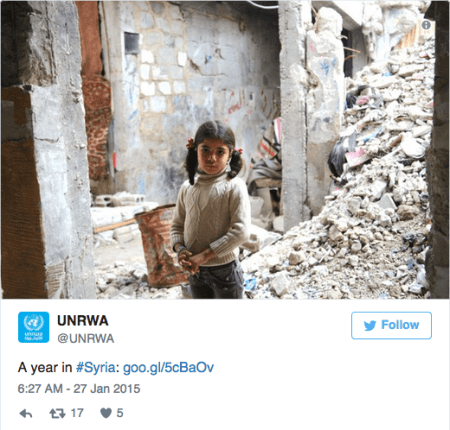
UNRWA recycles image of Syrian girl, now claims she is Gazan victim of Israel in fundraising campaign

June 3, 2017

UNRWA recycles image of Syrian girl, now claims she is Gazan victim of Israel in fundraising campaign, Jihad Watch, June 2, 2017

(The UN Rocket Warehousing Agency strikes again. Please see also, Gaza on the Brink. — DM)

Notice also that not only do they cynically reuse the photo, but they make up a whole tear-jerking story about little “Aya,” victim of Israeli oppression. Three years ago they used the identical picture as a girl standing in bombed-out Damascus.

Two primary lessons:

  1. The UNRWA is a viciously corrupt and dishonest organization, bent on enabling the jihad against Israel and willing to lie brazenly in the process.
  2. There is so little actual oppression of the “Palestinians” that images from elsewhere have to be used to demonize the Israelis.

Nikki Haley, Trump’s ambassador to the United Nations, said that the U.S. would fight against the demonization of Israel at the UN. Why is the UN receiving even a penny of U.S. funding at this point?

“UNRWA fakes Gaza girl campaign with image of bombed-out Damascus,” UN Watch, June 2, 2017 (thanks to The Religion of Peace):

GENEVA, June 2, 2017 – UN Watch today demanded that UNRWA chief Pierre Krahenbuhl apologize for using fake images of a girl in a bombed-out Syria building in a major global campaign to raise money for the organization by pretending the girl is a Gaza victim of Israeli actions.

UNRWA is now running the above photo on Facebook and Twitter ads. It is also now UNRWA’s cover image.

Imagine being cut off from the world – for your whole life. That’s reality for children like Aya. The blockade of Gaza began when she was a baby, the occupation in the West Bank before her parents were born. Now she is eleven, and the blockade goes on.

Aya’s childhood memories are of conflict and hardship, walls she cannot escape, and the fear that the only home she knows, however tiny, could be gone when she returns from school.

This Ramadan, please help support children like Aya who have known nothing but conflict and hardship. Donate here: http://buff.ly/2qgsP0Y#forPalestinerefugees

Yet neither the girl nor the bombed-out building are in Gaza; it’s an old photo from Syria, dating apparently to 2014.

Here is UNRWA tweeting the original image in a January 2015 story on Syria:

The photo also appeared on other UNRWA Syria pages, here, here, and here, an UNRWA report in which the caption reads:

A young girl stands in the rubble of Qabr Essit, near Damascus. In 2014, UNRWA was able begin rebuilding facilities within the neighbourhood, including a school and community centre © 2014 UNRWA Photo by Taghrid Mohammad

Gaza on the Brink

June 3, 2017

Gaza on the Brink, Commentary Magazine, June 2, 2017

in Gaza City, Monday, April 17, 2017. (AP Photo/Adel Hana)

The testimony of these Gazan refugees in Greece provides a rare opportunity to hear what Palestinians say when they’re out of reach of their own repressive governments and can speak freely. It thereby offers a glimpse at the true source of much Palestinian suffering – and a rebuke to all the journalists, diplomats, and NGOs who have collaborated with both Palestinian governments to hide this truth from the world.

******************************

If you ask Palestinians in either Gaza or the West Bank who’s responsible for their suffering, most would probably say Israel. But what would they say if they were safely overseas and no longer needed to fear their own governments? That’s not a question reporters, diplomats, or nongovernmental organizations usually bother asking. We now have an answer to it, at least with regard to Palestinians who fled Gaza. They left not because of anything Israel did, but because of persecution by Gaza’s Hamas-run government

Their testimony was brought by Haaretz reporter Zvi Bar’el, who went to Greece in search of Syrian refugees but accidentally stumbled instead on Palestinians from Gaza–thousands of them, by their own count. One Gazan refugee estimated there were about 6,000 Palestinians from Gaza in Athens alone. The Badil Resource Center for Palestinian Residency and Refugee Rights says the real figure is probably higher.

And that’s just those who have been able to leave. Many would like to but are stuck in Gaza because the border crossing to Egypt is open only a few days per month. Even when it’s open, only a few hundred people per day can leave. Osama, one of the Palestinians Bar’el interviewed, said that when he left Gaza (via a cross-border smuggling tunnel) over 25,000 people were on the waiting list to leave via the official border crossing.

And why have so many Gazans fled or tried to flee? The Palestinians Bar’el met had a uniform answer: Hamas. Not a single one of them even mentioned Israel in their responses.

“There’s a Palestinian doctor here who came with his wife and three children,” Osama told Bar’el. “Imagine, a doctor, a respectable person with a profession, has to flee Gaza only because he was suspected of disloyalty to Hamas.”

Ayman, who has been listening to the conversation in silence, joins in. “I’m a cartoonist, an artist, and I’ve had exhibitions in Gaza. Hamas didn’t like my cartoons and they forbade me to draw, and they also arrested me. After I spent time in a Hamas prison I decided to escape,” he says.

“They tied my hands and feet, they beat me, and after I was injured from the blows they transferred me to a hospital where I was for more than a month. In the meantime they also arrested my brother to get information out of him about me.”

Naji, another Gazan, showed Bar’el a deep scar on his leg that he said came from being tortured in a Hamas prison.

“One day I even tried to commit suicide. I slammed my head hard against a windowpane and put my neck up against the broken glass. But they pulled me back and I wasn’t successful,” he says, pointing to an ugly scar on his neck. “I’m telling you, Gaza is on the brink of civil war and no one knows what’s happening there. No one is interested.”

There are numerous UN agencies ostensibly devoted exclusively to helping the Palestinians, while human rights groups allocate disproportionate attention to this issue. In both cases, their only real interest in Palestinian suffering is finding some way to blame Israel for it. They couldn’t care less about protecting Palestinians from the abuses of their own government. That’s why they keep issuing reports accusing Israel of being the “key cause” of Palestinian suffering, as one UN agency put it this week, despite all evidence to the contrary.

Yet their blatant bias often obscures a larger problem that affects even well-meaning journalists, NGOs, diplomats and almost everyone else involved in telling the world about what’s happening in the West Bank and Gaza–a failure to understand the way fear affects what people say in nondemocratic societies. For Palestinians, blaming anyone other than Israel for their problems risks serious repercussions from either their own governments or vigilante groups affiliated with both governments. And that’s true not just in Hamas-run Gaza, as people like Ayman and Naji discovered to their sorrow, but also in the Fatah-run West Bank, where journalists, businessmen, and Palestinian security officers have all suffered arrest and financial sanctions for daring to criticize the Palestinian Authority or its president, Mahmoud Abbas. Blaming Israel is always the safest solution, even in cases where it’s patently untrue.

Responsible journalists, NGOs, and diplomats would take this fear factor into account and try to dig a little deeper to try to get at the truth. They would also recognize that the very fact that Israel is the one party no Palestinian fears to criticize is in itself a potent refutation of Palestinian claims that Israel is an oppressive regime. People who truly live under an oppressive regime are generally afraid to go on record criticizing it.

Instead, these opinion shapers take everything they hear from Palestinians in the West Bank and Gaza at face value and parrot it uncritically. That does nothing to better the Palestinians’ lot, but a great deal to bolster the Palestinians’ own repressive governments by absolving them of all scrutiny and pressure to reform.

The testimony of these Gazan refugees in Greece provides a rare opportunity to hear what Palestinians say when they’re out of reach of their own repressive governments and can speak freely. It thereby offers a glimpse at the true source of much Palestinian suffering – and a rebuke to all the journalists, diplomats, and NGOs who have collaborated with both Palestinian governments to hide this truth from the world.

Palestinians: Israel’s Goodwill Gestures Send Wrong Messages

June 2, 2017

Palestinians: Israel’s Goodwill Gestures Send Wrong Messages, Gatestone InstituteBassam Tawil, June 2, 2017

Here is what is being said on the Palestinian street: Today Israel runs away from the West Bank or the Gaza Strip; tomorrow Israel will run away from Ashkelon, then from Tel Aviv and from there to the sea, and we have achieved our goal of destroying Israel. Therefore, we need to continue attacking Israel.

As with the Gaza Strip, the withdrawal from Lebanon taught the Palestinians that terrorism could drive Israelis out of their country.

Never have the Palestinians given Israel credit for its goodwill steps. On the contrary, they scoff at these moves and describe them as “cosmetic changes”. The Palestinian line is that Israel’s steps are “insufficient” and “unhelpful.” Its concessions are regarded as gestures of a terrified people and as the rightful reward for terrorism. Far from satiating the appetite of the terrorists, such steps prompt them to step up their attacks against Israelis.

The West suffers under a major misconception concerning the Israeli-Palestinian conflict: that “goodwill gestures” and territorial concessions on the part of Israel boost the prospects of peace in the Middle East. The facts, however, suggest that precisely the opposite is true.

Last week, Israel’s Channel 10 television station reported that the U.S. administration was pushing Israel to transfer parts of Area C — areas under full Israeli security and civilian control in the West Bank — to the control of Mahmoud Abbas’s Palestinian Authority (PA). According to the report, the U.S. believes that the transfer of the territory to the PA would be a “goodwill step” towards the Palestinians, paving the way for the revival of the stalled peace process with Israel.

This assumption, of course, has already proven wrong. The experiences of the past few decades have shown clearly that Israeli concessions have always sent the wrong message to the Palestinians.

In fact, Palestinians read Israeli goodwill steps as signs of weakness and retreat. This misinterpretation on the part of the Palestinians then leads to more violence against Israel. It would be hard for anyone not to conclude that if pressure works, keep on pressuring.

The past 24 years are littered with examples of how the Palestinians react to Israeli concessions.

The Oslo Accords that were signed between Israel and the PLO in 1993 were seen by Palestinians as a first step by Israel towards total capitulation.

The accords, which brought the PLO from several Arab countries to the West Bank and Gaza Strip, came after five years of the first Palestinian Intifada. By allowing the PLO to assume control over large parts of the West Bank and Gaza Strip, Israel sent a message that it was caving in to the violence and terrorism of the First Intifada.

Barely a breath after Oslo, Israel was again asked to conciliate the Palestinians: this time, hundreds of prisoners, many with Jewish (and Arab) blood on their hands, were released from Israeli prison in order to create an atmosphere “conducive” to the peace process.

Instead of viewing the prisoner release for what it was, namely a generous gesture, many Palestinians considered it a “victory” for terrorism and violence. Worse, it was not long before many of the released prisoners were rearrested for their role in further terrorism against Israel. The release of prisoners also sent a message of recidivism to Palestinians: terror does indeed pay! A short stint in an Israeli prison is sure to lead to release in some Israeli “confidence-building measure” or other.

According to statistics, at least half of released Palestinian prisoners have returned to terrorism.

Despite the grim statistics, the international community regularly demands that Israel release more convicted terrorists as a “gesture” towards Mahmoud Abbas and other Palestinians.

RAMALLAH, WEST BANK – OCTOBER 30: Released Palestinian prisoners stand on a sage as they arrive to the Mukata Presidential Compound in the early morning hours on October 30, 2013 in Ramallah, West Bank. The 26 Palestinian prisoners were released by Israel as part of the terms of renewed U.S.-brokered peace talks. (Photo by Oren Ziv/Getty Images)

Since 1993, Israel has complied again and again with such international pressure, only to reinforce the message to Palestinians: terrorism is indeed worth the trouble.

Let us consider, for a moment, Gaza. In 2005, Israel unilaterally withdrew from the Gaza Strip, after destroying 21 Jewish settlements and expelling more than 8,000 Jews from their homes there.

In Palestinian eyes, however, the Israeli “disengagement” from the Gaza Strip was anything but an olive branch of peace. The withdrawal came after five years of the bloody Second Intifada, when Palestinians waged a massive campaign of suicide bombings and rocket attacks against Israelis.

Thus, for Palestinians, Israel was once again retreating in the face of unremitting bloodshed.

Here is what is being said on the Palestinian street: Today Israel runs away from the West Bank or the Gaza Strip, tomorrow Israel will run away from Ashkelon, then from Ashdod and Tel Aviv and from there to the sea, and we have achieved our goal of destroying Israel. Therefore, we need to continue attacking Israel.

Moreover, it was also precisely the Israeli pullout from Gaza that launched Hamas to its current pinnacle of popularity among Palestinians. Hamas took credit for expelling the Jews from the Gaza Strip through terrorism. A few months later, Hamas even won the Palestinian parliamentary election because Palestinians gave Hamas total credit for driving Israel out of the Gaza Strip.

The Israeli pullout told Palestinians in no uncertain terms: Why bother negotiating when terror will do the trick?

Five years earlier, the Israeli withdrawal from southern Lebanon also had the same effect: it emboldened the Iranian-backed Hezbollah terror group. As with the Gaza Strip, the withdrawal from Lebanon taught the Palestinians that terrorism could drive Israelis out of their country.

In the past few years, additional Israeli goodwill gestures, such as removing security checkpoints and the easing travel restrictions in the West Bank, led to yet more violence, claiming the lives of yet more Israelis.

Abbas and his top officials have always responded to Israeli gestures with cynicism. Never have they given Israel credit for its goodwill steps. On the contrary, they scoff at these moves, and describe them as “cosmetic changes aimed at beautifying Israel’s ugly face” or as public-relations stunts.

For the sake of clarity, let us say it clearly: handing over areas in the West Bank to the Palestinian Authority, and the release of convicted murderers, does not contribute to any sort of “peace process;” it only contributes to the death of more Israelis.

The Palestinian line is that Israel’s steps are “insufficient” and “unhelpful.” Its concessions are regarded as gestures of a terrified people and as the rightful reward for terrorism. Far from satiating the appetite of the terrorists, such steps prompt them to step up their attacks against Israelis. The next time Americans and Europeans think of asking Israel to cede yet more to the Palestinians, let them consider what Israel might be receiving in return, other than the spilling of more Jewish blood.

Bassam Tawil is a Muslim based in the Middle East.

The Agenda for the Trump-Abbas Meeting

April 27, 2017

The Agenda for the Trump-Abbas Meeting, Front Page MagazineCaroline Glick, April 27, 2017

Originally published by the Jerusalem Post

The day after Israel celebrates its 69th Independence Day, US President Donald Trump will greet PLO chief Mahmoud Abbas at the White House. The date of their meeting, May 3, is notable not least for its timing.

The timing of the meeting presumes a linkage between the establishment of Israel and the establishment of a Palestinian state. This is not merely obnoxious, it is also blind to reality.

In reality, an independent state of Palestine has existed for the past 12 years in Gaza. Rather than build that up and declare independence, Abbas and his comrades surrendered Gaza to Hamas in 2007.

Hamas, in turn, transformed independent Palestine into a base for jihad.

Abbas’s failure to declare independence in 2005 – and the subsequent failure of his US-trained forces to defend their control over Gaza in June 2007 from Hamas terrorists – is generally overlooked. But it is critical that Trump understand the significance of his behavior before he meets with Abbas.

Since the inception of the peace process between Israel and the PLO in 1993, the professed goal of the PLO has been to establish an independent Palestinian state on any territory over which it was able to take control from Israel. Yet 12 years ago, when Israel withdrew its citizens and military from Gaza, the PLO refused to take responsibility for the area insisting ridiculously that Gaza was still controlled by Israel.

Then 10 years ago, US-trained PLO forces fled to Israel rather than defend their control of Gaza when Hamas took up arms against them.

There are, it seems, two main reasons for Abbas’s behavior. The first is directly related to how he understood Israel’s decision to withdraw.

In December 2003, then-prime minister Ariel Sharon stunned the country when he adopted the platform of the Labor Party – which he had just massively defeated in the general elections – and removed all Israeli communities and military installations from Gaza, including from the border with Egypt, by the end of 2005.

Israeli society was nearly torn apart in the one year and eight months between Sharon’s surprise announcement and the expulsion of Gaza’s Jews in August 2005. The media hemorrhaged with continuous propaganda that demonized the Israeli residents of Gaza and the religious Zionist community in general.

A reminder of that toxic period came earlier this month, when Haaretz published a column by veteran reporter Yossi Klein in which he alleged that religious Zionists posed a graver danger to the State of Israel than Hezbollah.

Abbas and his lieutenants viewed the domestic chaos that engulfed Israel at the time as proof of Israel being on its way off the stage of history.

If this was how Israelis reacted to the destruction of 21 communities in Gaza (and four in northern Samaria) and the dispossession of 10,000 Israelis, it was clear to Abbas and his comrades that Israeli society would collapse if Sharon carried out his plan to reenact the Gaza withdrawal tenfold in Judea and Samaria after the 2006 elections.

Why accept Gaza if all of Israel was about to be destroyed – by its own hand? The second reason that Abbas didn’t declare independence in Gaza, is because he had no interest in being held accountable for his behavior – as leaders of independent states are. If he accepted sovereign power, then the Palestinians as well as Israel and, presumably, the rest of the world would be able to hold him to account for what happened within the territory he controlled. His ability to blame Israel for his failures would be diminished, at least in theory.

Far better, Abbas concluded, to pretend that Israel’s withdrawal was meaningless and blame Israel for his failure to govern his own territory.

Both reasons for Abbas’s rejection of responsibility over Gaza are important because they also reflect the views of the Palestinians as a whole.

Dan Polisar, from Shalem College, summarized in a recent article in the online magazine Mosaic, his study of more than 400 public opinion surveys of the Palestinians in Judea, Samaria and Gaza taken by professional pollsters over the past 23 years.

Like Abbas in 2005, the overwhelming majority of Palestinians believe that Israel isn’t long for this world.

In one 2011 survey, for instance, a mere 23% of Palestinians said they were certain that Israel will continue to exist 25 years hence. 44% were certain it would not.

The fact that more than three quarters of Palestinians are uncertain if Israel will survive is not only a function of Israel’s own self-destructive behavior – it is premised as well on Palestinian ideology.

The vast majority of Palestinians reject Israel’s right to exist. Indeed, a mere 12% of Palestinians believe that Jews have ties to the land of Israel.

Polisar showed that, whereas a plurality to a bare majority of Palestinians accepts the premise of a twostate solution, the overwhelming majority reject any deal that would leave Israel intact as a viable state capable of defending itself. Equally importantly, 68% of Palestinians believe that even if a Palestinian state is established in Gaza, Judea and Samaria with Jerusalem as its capital, they should continue to aspire to Israel’s destruction.

In other words, even if the PLO signs a deal with Israel that says the conflict has been resolved, for 68% of Palestinians the conflict will continue. They oppose ending the education of their children to seek Israel’s destruction and accepting Israel as a peaceful neighbor.

This then, brings us to Trump’s visit with Abbas, the day after Israel’s 69th birthday.

What does he intend to discuss with Abbas? From media reports, it appears that Trump intends to discuss the Palestinian Authority’s subsidization of terrorism to the tune of $300 million each year, which it pays out as salaries to terrorists in Israeli prisons and as stipends to their families.

In an interview with Sean Hannity on Fox News earlier this week, Prime Minister Binyamin Netanyahu urged Trump to hold Abbas to account for his massive budgetary outlays to terrorists and their families. He asked that Trump demand as well that Abbas stop the PA ’s indoctrination of the Palestinians to seek the annihilation of Israel and the murder of its citizens.

This is well and good. But it seems a bit beside the point. The point is that 69 years ago, the Jews established our state. A Palestinian state was not established then or since, not because Israel was unwilling for such a state to come into being, but because the Palestinians refuse to accept Israel’s right to exist.

If any good is to come from Trump meeting with Abbas – on May 3 or at any other time – then he should send the following message to Abbas and to the rest of the world.

To date, the US has supported the goal of Palestinian statehood, because it convinced itself that the Palestinians were interested in a state that would live at peace with Israel. The US pressured Israel to make concessions to the Palestinians in order to encourage them to accept Israel. And the US funded the PA thinking that doing so would advance the cause of peace. It trained and armed PA security forces for the same reason.

To date, the Palestinians, the PLO and the PA have not lived up to their side of the bargain – on anything.

They have not come to terms with Israel’s existence; they have not abjured terrorism; and they have not accepted responsibility for the areas under their control, either in Gaza, or in Judea and Samaria.

Since his is a new administration, Trump is willing to give Abbas the benefit of the doubt for three months. In that time Abbas needs to stop all financial transfers to terrorists and their families – in and out of prison; he needs to change the names of all the public sites now named after terrorists; and he needs to purge all anti-Jewish content from his PA -controlled media and mosques.

If Abbas fails to do all of these things by August 3, then the Trump administration will abandon its support for Palestinian statehood and its recognition of the PLO .

Hamas commander assassinated in Gaza

March 25, 2017

According to a statement from Hamas’ military wing, the terror organization is holding Israel responsible for the attack which claimed the life of one of its commanders; Mazan Fukha was released by Israel in 2011 as part of the Gilad Shalit prisoner exchange deal.

Elior Levy|Last update:  25.03.17 , 14:00

Source: Ynetnews News – Hamas commander assassinated in Gaza

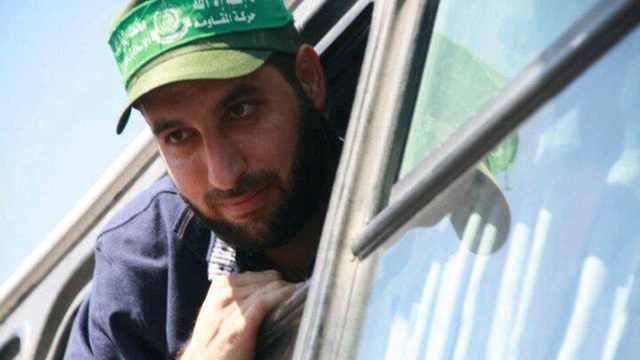
Unknown assailants gunned down Hamas operative Mazan Fukha Friday night outside his home in Tel al-Hawa, in the Gaza Strip.According to Hamas’ military wing, Fukha, who was released in a prisoner exchange deal for captured IDF soldier Gilad Shalit, was shot in the head  four times with a silenced weapon by unknown attackers who fled the scene.

Mazan Fukha after his release from Israeli prison

Mazan Fukha after his release from Israeli prison

Fukha, who was deported to Gaza as part of the Shalit deal, was responsible for planning terror attacks in the West Bank.

In a statement, Hamas’ military wing blamed Israel for Fukha’s death and described him as a commander in the organization.

Husam Badran, Hamas’ international spokesman, issued a statement on Twitter, saying, “The occupation is responsible for this assassination. Netanyahu knows this will not pass quietly.”

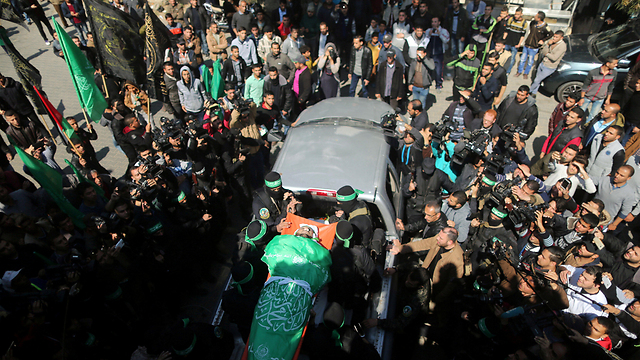
Hamas gunmen during the funeral procession (Photo: Reuters) (Photo: Reuters)

Hamas gunmen during the funeral procession (Photo: Reuters)

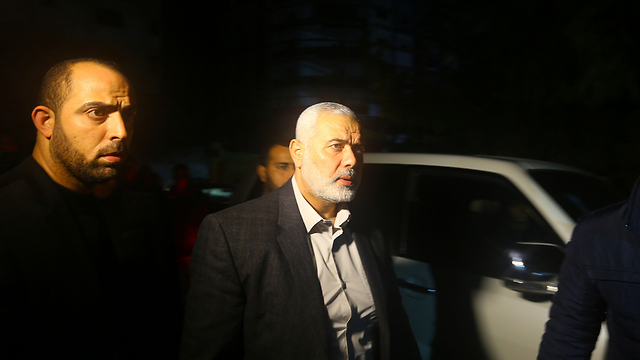
Ismail Haniyeh following news of the assassination (Photo: AFP) (Photo: AFP)

Ismail Haniyeh following news of the assassination (Photo: AFP)

Ismail Haniyeh, Yahya Sinwar and Khalil al-Khayeh accompanied Fukha’s body at Shifa Hospital in the Gaza Strip and later during his funeral procession in Gaza on Saturday, attended by thousands of mourners.

Fukha, originally from Tubas, was sentenced to nine life sentences in 2003 by Israel for his role in the planning and execution of a suicide bombing on a bus near Safed, which killed nine people.

Fukha's funeral procession in Gaza on Saturday (Photo: Reuters) (Photo: Reuters)

Fukha’s funeral procession in Gaza on Saturday (Photo: Reuters)

Mourners in Tubas

Mourners in Tubas

Fukha’s father, who still lives in Tubas in the northern West Bank, also accused Israel of the assassination, saying, “Israeli intelligence officers came to our house many times and gave us messages that Mazen would be liquidated if he continued with his actions.”

Fukha was released from prison in 2011 as part of the Gilad Shalit prisoner exchange deal and was deported to the Gaza Strip.

After his release, Fukha returned to terrorist activities and helped found Hamas’ West Bank headquarters and manage it from Gaza under the command of Saleh al-Arouri. In addition to Fukha, the operation also included Abd al-Rahman Ghanimat, another terrorist who had been released as part of the Shalit deal.

 Together, the three men helped organize and conduct terror attacks against Israelis from the Gaza Strip.

(Translated and edited by Fred Goldberg)

First published: 25.03.17, 09:56

WATCH: 2,000 reservists train for war in Gaza with surprise drill

March 22, 2017

Four reserve brigades given 24 hours notice for largest exercise of its kind this year; army says it’s unrelated to tensions on the border

March 21, 2017, 9:04 pm

Source: WATCH: 2,000 reservists train for war in Gaza with surprise drill | The Times of Israel

ome 2,000 reserve soldiers were called up this week to simulate war in the Gaza Strip, as part of the military’s largest planned exercise of 2017, the army said.

The surprise drill began on Sunday. It was conducted by the Sinai Division, the Southern Command’s reserve division. The exercise included four reserve brigades — two infantry and two armored brigades.

 The soldiers simulated war in Gaza, including a ground invasion into the Hamas-run coastal enclave.

IDF Chief Gadi Eisenkot visited the exercise in order to “assess the preparedness of the division for emergency,” the army said.

IDF Chief of Staff Gadi Eisenkot, right, visits a surprise exercise led by Brig. Gen. Sa'ar Tzur, left, on March 21, 2017. (IDF Spokesperson Unit)

IDF Chief of Staff Gadi Eisenkot, right, visits a surprise exercise led by Brig. Gen. Sa’ar Tzur, left, on March 21, 2017. (IDF Spokesperson Unit)

“We have put preparedness at the top of the IDF’s list of priorities. This is evident from the increased training program,” Eisenkot told the reservists.

In war, the army chief said, “cunning is what makes the difference — and that’s what we need to get, with the understanding that if there is a need for another [military] campaign, we will know how to surprise in every way, to prevent enemy achievements.”

In that way, Eiesnkot said, the army will be able to make the next operation “as short as possible.”

Israel has fought three major rounds of conflict with Hamas since the Islamist terror group seized control of Gaza from Mahmoud Abbas’s Fatah in 2007. The most recent such conflict, Operation Protective Edge, saw 50 days of fighting, including a ground offensive. In all, 74 Israelis were killed, 68 of them soldiers. Thousands of rockets and mortar shells were fired by Hamas and other Islamic terror groups at Israeli towns and cities, where damage was limited by Israel’s Iron Dome missile defense system. Hamas also utilized tunnels dug under the border to carry out attacks. The UN and Palestinians said 2,251 Palestinians, including 551 children, died in Gaza, where Israel’s counterstrikes caused widespread devastation. Israel said that up to half of those killed on the Palestinian side were combatants, and blamed the civilian death toll on Hamas for deliberating placing rocket launchers, tunnels and other military installations among civilians.

Israel says Hamas, which avowedly seeks Israel’s destruction, has since rebuilt larger rocket arsenals capable of hitting the entire country, and is again digging attack tunnels.

Israel is now drawing up contingency plans to evacuate up to a quarter-million civilians from border communities to protect them from attacks from Hamas, Hezbollah or other terror groups, it was reported Tuesday.

The reservists were given 24 hours notice ahead of this week’s exercise. Eight percent of those called up did not attend, the army said.

Brig. Gen. Sa’ar Tzur, the head of the Sinai Division, oversaw the exercise, which also included artillery, combat intelligence and combat engineering elements.

A tank takes part in an IDF drill on March 21, 2017. (IDF Spokesperson Unit)

A tank takes part in an IDF drill on March 21, 2017. (IDF Spokesperson Unit)

The surprise drill was in addition to a smaller exercise conducted by the IDF’s Home Front Command in southern Israel this week.

As part of the the Home Front Command exercise, the incoming missile alert system in southern Israel was tested on Tuesday morning.

The IDF spokesperson said the exercises were planned in advance and not tied to recent tensions with Gaza and jihadists in Sinai.

On Saturday, two rockets were launched from the Gaza Strip toward Israel. One exploded near the city of Ashkelon, north of Gaza, causing no casualties or damage. The second apparently fell inside Palestinian territory.

The Israel Defense Forces responded with tank fire and air strikes at several Hamas targets in the Strip. There were no reports of casualties.

Two days before, a rocket fired from the Gaza Strip struck in an empty field in the Sdot Negev Regional Council near Netivot.

In response, Israeli jets struck two Hamas installations in the north of the Gaza Strip.

Living in Sderot: Ten seconds to save your life

March 13, 2017

Living in Sderot: Ten seconds to save your life, Rebel Media via YouTube. March 13, 2017

The blurb beneath the video states,

Less than 1 km from Gaza and the target of over 10,000 rockets, Mayor of Sderot, Alon Davidi, tells Sheila Gunn Reid why he stays in what he describes as “the front line in the battle against evil”.

Hizballah lists targeted Israeli “nuclear sites”

March 4, 2017

Hizballah lists targeted Israeli “nuclear sites”, DEBKAfile, March 3, 2017

targetshizballah_480eng

Our military and counterterrorism sources draw a straight line from Hizballah’s latest stance and the newfound aggressiveness displayed this week by the Palestinian extremist Hamas which rules the Gaza Strip.

****************************

Hizballah’s latest round of threats against Israel reached a new peak Thursday, March 2, with the release of a videotape claiming to expose nine locations allegedly tied to the production and assembly of Israel’s nuclear weapons, DEBKAfile reports. The Lebanese Shiite terror organization said it possessed precise missiles for wiping out Israel’s nuclear infrastructure and attached addresses to all its targets.

Five locations topped the list, starting with the nuclear reactors at Dimona in southern Israel and Nahal Soreq on the Mediterranean coast. “Revealed” next are three secret locations for the production, assembly and storage of nuclear missiles and warheads. Kfar Zacharia near Beit Shemesh in the Jerusalem Hills, defined as the main depot for the Jericho Series I, II and III, of three-stage ballistic missiles, which can reach ranges of up to 6,000 km.

Two others were a factory in Beer Yaakov near the central Israeli town of Ramleh, the alleged production site for nuclear warheads; and the “Galilee Wing-20” plant at the Tefen Industrial Park, 17km from the town of Carmiel, a facility where the Rafael Advanced Defense System Authority was said to mount nuclear warheads on ballistic missiles and prepare them for launching.

The video stresses that Hizballah now possesses precise missiles able to pinpoint and destroy every single facility.

Just two weeks ago, Nasrallah “advised” Israel in an aggressive speech, to dismantle its large ammonia tank in Haifa and the nuclear reactor in Dimona before they were hit by Hizballah rockets and caused massive casualties. He and his associates have repeatedly warned in recent weeks that their Lebanese terrorist group has acquired weapons capable of deterring Israel as well as the capability to catch Israeli intelligence unawares by “surprises.”

In previous articles, DEBKAfile accounted for the heightened bellicosity of Hizballah’s leaders by the permission Bashar Assad recently granted Hizballah to launch missiles against Israel from Syrian soil as well as from Lebanon.

Our military and counterterrorism sources draw a straight line from Hizballah’s latest stance and the newfound aggressiveness displayed this week by the Palestinian extremist Hamas which rules the Gaza Strip.

Thursday, March 2, Hamas spokesmen stated that the group would no longer exercise restraint in responding to the heavy Israeli air and artillery strikes that are conducted in retaliation for rocket fire from the Gaza Strip. Henceforth, it would conduct a policy of “military position for military position” – meaning that for every Hamas position destroyed by Israel, the Palestinian extremists would swipe at a comparable Israeli military site.

The new Hamas posture challenged Defense Minister Avigdor Lieberman”s strategy of holding the Hamas government of Gaza responsible for any attacks coming from the Palestinian enclave – whether the work of Hamas or the extremist Salafis running loose there.

On Feb. 27, the Israeli Air Force smashed five Hamas targets in the northern, central and southern regions of the enclave after a rocket from Gaza exploded in Israel. The IDF did not respond to the rocket fired subsequently at the Hof Ashkelon region. But then, after a round of fire from Gaza to shoot up IDF military engineering equipment, the IDF knocked over two small Hamas look-out positions in the north.

Hamas had in fact given the defense minister an ultimatum:  either exercise restraint, or continue the policy of massive retaliations for every rocket coming from the Gaza Strip – at the risk of a fresh round of fighting with Hamas. Lieberman appears to have settled for the first option for the time being.

Bernie Sanders to Friedman: Should Some Israel Funds go to Gaza?

March 3, 2017

Bernie Sanders to Friedman: Should Some Israel Funds go to Gaza?, Jerusalem Post, March 2, 2017

(Why shouldn’t we give everything to the IRGC, Al Qaeda and the Taliban instead? Aren’t they our allies in fighting the non-Islamic State.– DM)

bsandersBernie Sanders speaking at an event in Phoenix, Arizona.. (photo credit:GAGE SKIDMORE)

Washington (JTA) — Sen. Bernie Sanders asked David Friedman, President Donald Trump’s nominee to be ambassador to Israel, whether he would back using funds earmarked for assistance to Israel to help rebuild the Gaza Strip.

Sanders in a letter he handed Friedman after they met Wednesday also asked whether he thinks the tax-exempt status of groups that fundraise for settlers should be reviewed. JTA obtained a copy of the letter on Thursday.

The questions in the letter are significant as they suggest the path forward for Israel policy among progressive Democrats.

Sanders has emerged as a de facto leader of progressives following his insurgent but unsuccessful campaign last year for the Democratic presidential nomination. In perhaps the best-received speech over the weekend at the annual conference of J Street, the liberal Middle East policy group, Sanders pushed the theme that pro-Israel Jews need not hesitate to criticize Israeli government policies.

His letter outlines three questions for Friedman: whether he supports a two-state outcome to the Israeli-Palestinian conflict; the appropriateness of an ambassador having deep involvement in the settler movement as a fundraiser and advocate, as Friedman does; and regarding Israeli assistance.

Two states has long been Democratic policy and for 15 years was official U.S. policy until Trump retreated into agnosticism on the issue when he met last month with Israeli Prime Minister Benjamin Netanyahu.

The second two points, however, venture into areas that Democrats have yet to embrace.

“As ambassador, would you take steps to end the flow of donations to illegal settlements, perhaps by supporting the re-examination [of] their tax-exempt status?” Sanders asked.

J Street has advocated for withdrawing tax-exempt status for groups that fundraise for settlements. Other pro-Israel groups – including some of J Street’s allies on the left – oppose the position, in part because it could trigger far-reaching consequences for all nonprofits on the left and right while turning tax-exempt status into a political battlefield.

Sanders also asked Friedman whether “a portion” of the $38 billion in defense aid to Israel over the next 10 years under an agreement signed last year by former President Barack Obama “should be directed toward measures that would facilitate a much greater flow of humanitarian and reconstruction materials” to Gaza.

Aid to Israel in Congress and the pro-Israel community has been sacrosanct, and no president has seriously proposed cutting it since Gerald Ford in the mid-1970s. Subsequent presidents used short delays in delivery of assistance and the amount that the United States guarantees Israel’s loans as means of leveraging pressure on Israel, but assistance has been untouched.

Sanders cast the proposal in part as one that would help secure Gaza by stabilizing the strip. But it comes at a time that Republicans in Congress are proposing cutting assistance to the Palestinians as a means of pressuring them into direct talks with Israel and pushing the Palestinian Authority to end subsidies for the families of jailed or killed terrorists.

Friedman, a longtime lawyer to Trump, did not reply to a request for comment. His ambassadorship is controversial in Congress and in the Jewish community because of his past involvement with settlers, and because of the rhetoric he has used to describe Jews who disagree with him.