Posted tagged ‘Foreign Policy’

On moral blindness

February 27, 2015

On moral blindness, Israel Hayom, Dror Eydar, February 27, 2015

1. Scholars who study our civilization a hundred years in the future will be able to point out the key geopolitical shifts in the Middle East, the collapse of the geographical nations and the return to the ancient social borders, and the rise of radical Islam. They will describe how the Islamic Republic of Iran took over countries like Yemen, Iraq, Syria and Lebanon, its tentacles of terrorism reaching every corner, including Gaza, Judea and Samaria.

They will study the Iranian nuclear issue and be able to quote hundreds of instances in which Iranian leaders vowed to destroy the Jewish state. But when they begin studying the Israeli society of our time, they will encounter a failure of logic. Amid a virtual consensus on preventing an Iranian nuclear bomb, they will not be able to understand the Israeli focus on bottles recycled by the prime minister’s wife, the electrician the prime minister hired and the frivolous reports that grabbed massive headlines while world powers were busy leaving Iran with the ability to manufacture a bomb. They will have trouble understanding what the Jews were arguing about while facing such an obvious threat.

In an effort to solve this mystery, the scholars will turn to historians who studied the 1930s in Europe: Western leaders’ willful blindness to Hitler’s explicit threats; Europe’s desperate longing for reconciliation with the fuhrer. They will review the history of France, which was warned in those years but failed to prepare an army. They will review Neville Chamberlain’s declaration of “peace for our time” while waving a worthless piece of paper. They will examine the history of European Jewry, which failed to accurately read the political map. Among other things, they will look at U.S. Jewry in the 1940s. They may read the memoirs of Rebecca Kook, the daughter of Hillel Kook, a prominent member of the Irgun.

2. In 1940, the members of the Irgun arrived in the U.S. at the behest of Ze’ev Jabotinsky, to recruit a Hebrew army to fight the Nazis alongside the allied forces. In 1942, when the extermination of Europe’s Jewry began to emerge, the delegation changed course and devoted themselves to saving Jewish lives. They had the nerve to challenge the official stance adopted by the Roosevelt administration — accepted with little opposition by the Jewish leaders of the United States — that the only way to save the Jews was to win the war.

The Irgun members pressured the leaders of the free world to make saving Jewish lives a goal of equal importance to winning the war, and to dedicate special resources to making it happen. They focused their efforts on campaigning in the media, among intellectuals, in the U.S. Congress and to the administration. They convinced then-President Franklin D. Roosevelt to establish the War Refugee Board — an executive agency created to save Jews. It is estimated that the board was responsible for saving 200,000 Jewish lives.

The future scholars will delve deep into the battle waged by the Jewish leadership in America against the Irgun’s delegation. The mudslinging campaign against them was not led by the administration. It was spearheaded by House Foreign Affairs Committee Chairman Sol Bloom — a New York Jew, Rabbi Stephen Samuel Wise and Nahum Goldmann of the American Jewish Congress and other Jewish leaders.

Every effort made by the Irgun delegation was met with criticism and active sabotage efforts. They claimed that their activity was too political, too vocal, too aggressive, and that in fact they did not represent anyone. Hundreds of letters were sent to senators and representatives and Jewish leaders. The letters said that the Irgun members were part of a fascist terrorist outfit from Palestine. Jewish activists handed out pamphlets warning that the delegation would bring catastrophe and destruction on the Jewish people.

Several explanations were provided for this hostile behavior. The main explanation was that Jewish leadership’s fear of tarnishing the image of the Jewish community. In a secret British Foreign Office document, Nahum Goldmann was quoted as saying that just as Hitler brought anti-Semitism to Europe, Hillel Kook would bring anti-Semitism to the U.S.

At the end of the 19th century, Germany’s Jews were also fearful of Zionism. It made them susceptible to accusations of dual loyalty, and labeled them as belonging in Palestine. That is why they resisted the Zionist movement and made extra efforts to be even more German than the rest of the Germans.

3. For the last 20 years, Prime Minister Benjamin Netanyahu has been warning anyone who would listen of Iran’s perilous ambitions. Much like Nazi Germany, Iran and radical Islam do not threaten only Israel but the entire free world. But the left-wing liberal mindset, inspired by U.S. President Barack Obama, complacently dismisses these warnings, often with a side of disrespect.

Over the last month, the White House and a long line of cultural figures and politicians have been confronting a far greater threat: Netanyahu’s upcoming speech at the U.S. Congress. The future historians will note the American Jews who disrespected the Israeli prime minister for fighting for the safety of his people. They will add to that list a number of Israelis who took pains to undermine Netanyahu’s legitimacy and sabotage his address.

One of these critics, Peter Beinart, recently slammed Nobel Peace Prize laureate Elie Wiesel for urging Obama to join him at Netanyahu’s address.

“Wiesel is acutely, and understandably, sensitive to the harm Jews suffer. Yet he is largely blind to the harm Jews cause,” Beinart wrote. Cause to whom? To the Palestinians, of course. The American Left is stuck in its 1980s elitist morality that refused to see that the reality has changed.

There is no occupation anymore, Mr. Beinart. Certainly not in the way that you and your friends make it out. The Arabs of Judea and Samaria enjoy expanded autonomy — a de facto state with a national anthem, a flag, a government and enormous budgets. It is true that the IDF is present on the outskirts, because we do not trust our neighbors. But incidentally, they, too, do not trust themselves to ward off Hamas and the radical Islamists. Israel in fact protects the lives of the Palestinian leadership and population from the perils of the Islamic caliphate, which has the ability to turn the lives of these Arabs into a hell devoid of human rights, and heads.

4. This blindness is not just geopolitical, but it is also moral. We are students of the great teacher Rabbi Akiva, who in the second century classified the commandment to “love your neighbor as you love yourself” (Leviticus 19:18) as a great principle of the Torah (Genesis Rabbah 24:7). In this he built on the work of Hillel the Elder who in the first century B.C.E. placed the entire Torah upon the foundation of this dictum (Babylonian Talmud: Tractate Shabbat 31a).

But the same Rabbi Akiva taught us that in the event of a conflict between your life and your neighbor’s life, “your brother shall live with you.” Namely, your own life comes first (Babylonian Talmud: Tractate Baba Mezi’a, 62a). That is the proper way to approach altruistic love. If you do not love your own life, or the lives of your own people, more than the lives of others, especially those who are hostile toward you, then you do not truly possess a moral understanding, but rather a nihilistic intellectualism that plays pretend in living rooms across the east and west coasts of the U.S.

Next Tuesday, truth seekers will be called upon to support Netanyahu when he addresses a joint session of Congress. The State of Israel needs your courageous support.

Andrew Klavan: Good News, Beheaded Christians

February 27, 2015

Andrew Klavan: Good News, Beheaded Christians, Truth Revolt, Andrew Klavan via You Tube, February 26, 2015


Special Report: How Iran’s military chiefs operate in Iraq

February 25, 2015

Special Report: How Iran’s military chiefs operate in Iraq, Reuters, February 24, 2015

File photo of a tank belonging to the Shi'ite Badr Brigade militia taking position in front of a gas station in Suleiman Beg, northern IraqA tank belonging to the Shi’ite Badr Brigade militia takes position in front of a gas station in Suleiman Beg, northern Iraq in this September 9, 2014 file photo. CREDIT: REUTERS/AHMED JADALLAH/FILES

The face stares out from multiple billboards in central Baghdad, a grey-haired general casting a watchful eye across the Iraqi capital. This military commander is not Iraqi, though. He’s Iranian.

*********************

(Reuters) – The face stares out from multiple billboards in central Baghdad, a grey-haired general casting a watchful eye across the Iraqi capital. This military commander is not Iraqi, though. He’s Iranian.

The posters are a recent arrival, reflecting the influence Iran now wields in Baghdad.

Iraq is a mainly Arab country. Its citizens, Shi’ite and Sunni Muslims alike, have long mistrusted Iran, the Persian nation to the east. But as Baghdad struggles to fight the Sunni extremist group Islamic State, many Shi’ite Iraqis now look to Iran, a Shi’ite theocracy, as their main ally.

In particular, Iraqi Shi’ites have grown to trust the powerful Iranian-backed militias that have taken charge since the Iraqi army deserted en masse last summer. Dozens of paramilitary groups have united under a secretive branch of the Iraqi government called the Popular Mobilisation Committee, or Hashid Shaabi. Created by Prime Minister Haider al-Abadi’s predecessor Nuri al-Maliki, the official body now takes the lead role in many of Iraq’s security operations. From its position at the nexus between Tehran, the Iraqi government, and the militias, it is increasingly influential in determining the country’s future.

Until now, little has been known about the body. But in a series of interviews with Reuters, key Iraqi figures inside Hashid Shaabi have detailed the ways the paramilitary groups, Baghdad and Iran collaborate, and the role Iranian advisers play both inside the group and on the frontlines.

Those who spoke to Reuters include two senior figures in the Badr Organisation, perhaps the single most powerful Shi’ite paramilitary group, and the commander of a relatively new militia called Saraya al-Khorasani.

In all, Hashid Shaabi oversees and coordinates several dozen factions. The insiders say most of the groups followed a call to arms by Iraq’s leading Shi’ite cleric Grand Ayatollah Ali al-Sistani. But they also cite the religious guidance of Ayatollah Ali Khamenei, the supreme leader of Iran, as a key factor in their decision to fight and – as they see it – defend Iraq.

Hadi al-Amiri, the leader of the Badr Organisation, told Reuters: “The majority of us believe that … Khamenei has all the qualifications as an Islamic leader. He is the leader not only for Iranians but the Islamic nation. I believe so and I take pride in it.”

He insisted there was no conflict between his role as an Iraqi political and military leader and his fealty to Khamenei.

“Khamenei would place the interests of the Iraqi people above all else,” Amiri said.

FROM BATTLEFIELD TO HOSPITAL

Hashid Shaabi is headed by Jamal Jaafar Mohammed, better known by his nom de guerre Abu Mahdi al-Mohandis, a former Badr commander who once plotted against Saddam Hussein and whom American officials have accused of bombing the U.S. embassy in Kuwait in 1983.

Iraqi officials say Mohandis is the right-hand man of Qassem Soleimani, head of the Quds Force, part of Iran’s Revolutionary Guard. Mohandis is praised by some militia fighters as “the commander of all troops” whose “word is like a sword above all groups.”

The body he heads helps coordinate everything from logistics to military operations against Islamic State. Its members say Mohandis’ close friendships with both Soleimani and Amiri helps anchor the collaboration.

The men have known each other for more than 20 years, according to Muen al-Kadhimi, a Badr Organisation leader in western Baghdad. “If we look at this history,” Kadhimi said, “it helped significantly in organizing the Hashid Shaabi and creating a force that achieved a victory that 250,000 (Iraqi) soldiers and 600,000 interior ministry police failed to do.”

Kadhimi said the main leadership team usually consulted for three to four weeks before major military campaigns. “We look at the battle from all directions, from first determining the field … how to distribute assignments within the Hashid Shaabi battalions, consult battalion commanders and the logistics,” he said.

Soleimani, he said, “participates in the operation command center from the start of the battle to the end, and the last thing (he) does is visit the battle’s wounded in the hospital.”

Iraqi and Kurdish officials put the number of Iranian advisers in Iraq between 100 and several hundred – fewer than the nearly 3,000 American officers training Iraqi forces. In many ways, though, the Iranians are a far more influential force.

Iraqi officials say Tehran’s involvement is driven by its belief that Islamic State is an immediate danger to Shi’ite religious shrines not just in Iraq but also in Iran. Shrines in both nations, but especially in Iraq, rank among the sect’s most sacred.

The Iranians, the Iraqi officials say, helped organize the Shi’ite volunteers and militia forces after Grand Ayatollah Sistani called on Iraqis to defend their country days after Islamic State seized control of the northern city of Mosul last June.

Prime Minister Abadi has said Iran has provided Iraqi forces and militia volunteers with weapons and ammunition from the first days of the war with Islamic State.

They have also provided troops. Several Kurdish officials said that when Islamic State fighters pushed close to the Iraq-Iran border in late summer, Iran dispatched artillery units to Iraq to fight them. Farid Asarsad, a senior official from the semi-autonomous Iraqi region of Kurdistan, said Iranian troops often work with Iraqi forces. In northern Iraq, Kurdish peshmerga soldiers “dealt with the technical issues like identifying targets in battle, but the launching of rockets and artillery – the Iranians were the ones who did that.”

Kadhimi, the senior Badr official, said Iranian advisers in Iraq have helped with everything from tactics to providing paramilitary groups with drone and signals capabilities, including electronic surveillance and radio communications.

“The U.S. stayed all these years with the Iraqi army and never taught them to use drones or how to operate a very sophisticated communication network, or how to intercept the enemy’s communication,” he said. “The Hashid Shaabi, with the help of (Iranian) advisers, now knows how to operate and manufacture drones.”

A MAGICAL FIGHTER

One of the Shi’ite militia groups that best shows Iran’s influence in Iraq is Saraya al-Khorasani. It was formed in 2013 in response to Khamenei’s call to fight Sunni jihadists, initially in Syria and later Iraq.

The group is responsible for the Baghdad billboards that feature Iranian General Hamid Taghavi, a member of the Iranian Revolutionary Guard. Known to militia members as Abu Mariam, Taghavi was killed in northern Iraq in December. He has become a hero for many of Iraq’s Shi’ite fighters.

Taghavi “was an expert at guerrilla war,” said Ali al-Yasiri, the commander of Saraya al-Khorasani. “People looked at him as magical.”

In a video posted online by the Khorasani group soon after Taghavi’s death, the Iranian general squats on the battlefield, giving orders as bullets snap overhead. Around him, young Iraqi fighters with AK-47s press themselves tightly against the ground. The general wears rumpled fatigues and has a calm, grandfatherly demeanor. Later in the video, he rallies his fighters, encouraging them to run forward to attack positions.

Within two days of Mosul’s fall on June 10 last year, Taghavi, a member of Iran’s minority Arab population, traveled to Iraq with members of Iran’s regular military and the Revolutionary Guard. Soon, he was helping map out a way to outflank Islamic State outside Balad, 50 miles (80 km) north of Baghdad.

Taghavi’s time with Saraya al-Khorasani proved a boon for the group. Its numbers swelled from 1,500 to 3,000. It now boasts artillery, heavy machine guns, and 23 military Humvees, many of them captured from Islamic State.

“Of course, they are good,” Yasiri said with a grin. “They are American made.”

In November, Taghavi was back in Iraq for a Shi’ite militia offensive near the Iranian border. Yasiri said Taghavi formulated a plan to “encircle and besiege” Islamic State in the towns of Jalawala and Saadiya. After success with that, he began to plot the next battle. Yasiri urged him to be more cautious, but Taghavi was killed by a sniper in December.

At Taghavi’s funeral, the head of Iran’s Supreme National Security Council, Ali Shamkhani, eulogized the slain commander. He was, said Shamkhani, one of those Iranians in Iraq”defending Samarra and giving their blood so we don’t have to give our blood in Tehran.” Both Soleimani and the Badr Organisation’s Amiri were among the mourners.

A NEW IRAQI SOUL

Saraya al-Khorasani’s headquarters sit in eastern Baghdad, inside an exclusive government complex that houses ministers and members of parliament. Giant pictures of Taghavi and other slain al-Khorasani fighters hang from the exterior walls of the group’s villa.

Commander Yasiri walks with a cane after he was wounded in his left leg during a battle in eastern Diyala in November. On his desk sits a small framed drawing of Iran’s Khamenei.

He describes Saraya al-Khorasani, along with Badr and several other groups, as “the soul” of Iraq’s Hashid Shaabi committee.

Not everyone agrees. A senior Shi’ite official in the Iraqi government took a more critical view, saying Saraya al-Khorasani and the other militias were tools of Tehran. “They are an Iranian-made group that was established by Taghavi. Because of their close ties with Iranians for weapons and ammunition, they are so effective,” the official said.

Asarsad, the senior Kurdish official, predicts Iraq’s Shi’ite militias will evolve into a permanent force that resembles the Iranian Revolutionary Guard. That sectarian force, he believes, will one day operate in tandem with Iraq’s regular military.

“There will be two armies in Iraq,” he said.

That could have big implications for the country’s future. Human rights groups have accused the Shi’ite militias of displacing and killing Sunnis in areas they liberate — a charge the paramilitary commanders vigorously deny. The militias blame any excesses on locals and accuse Sunni politicians of spreading rumors to sully the name of Hashid Shaabi.

The senior Shi’ite official critical of Saraya al-Khorasani said the militia groups, which have the freedom to operate without directly consulting the army or the prime minister, could yet undermine Iraq’s stability. The official described Badr as by far the most powerful force in the country, even stronger than Prime Minister Abadi.

Amiri, the Badr leader, rejected such claims. He said he presents his military plans directly to Abadi for approval.

His deputy Kadhimi was in no doubt, though, that the Hashid Shaabi was more powerful than the Iraqi military.

“A Hashid Shaabi (soldier) sees his commander … or Haji Hadi Amiri or Haji Mohandis or even Haji Qassem Soleimani in the battle, eating with them, sitting with them on the ground, joking with them. This is why they are ready to fight,” said Kadhimi. “This is why it is an invincible force.”

Jury Finds Palestinian Authority Liable for Intifada Terror

February 23, 2015

Jury Finds Palestinian Authority Liable for Intifada Terror, Investigative Project on Terrorism, February 23, 2015

The judgment comes at a particularly difficult time for the Palestinian Authority, already strapped for cash and hoping to secure a place in the International Criminal Court to pursue war crimes charges against Israelis.

****************

Palestinian Authority (PA) policies, including direct financial support to employees convicted by on terrorism charges, and payments to families of those killed waging terrorist attacks, make it liable for damages in attacks which killed wounded Americans, a New York jury decided Monday.

Jurors awarded $218.5 million in damages to the victims and their families. Provisions in the U.S. Anti-Terrorism Act triple that to $655.5 million.

The jury’s award “will not bring back these families’ loved ones, nor heal the physical and psychological wounds inflicted upon them, but it truly is an important measure of justice and closure for them after their long years of tragic suffering and pain,” said Nitsana Darshan-Leitner of Israel’s Shurat HaDin law center, said after the jury award was announced. Darshan-Leitner has helped bring numerous civil cases against sponsors of terrorist attacks, saying the aim here, as in the other cases is “making the defendants pay for their terrorist crimes against innocent civilians and letting them know that there will eventually be a price to be paid for sending suicide bombers onto our buses and into our cafes.”

The judgment comes at a particularly difficult time for the Palestinian Authority, already strapped for cash and hoping to secure a place in the International Criminal Court to pursue war crimes charges against Israelis.

The jury received the case late Thursday, after about six weeks of testimony. They heard from survivors and eyewitnesses to the attacks, which included shooting sprees on Jerusalem streets, suicide bombings and the bombing of a Hebrew University cafeteria. Those attacks killed 33 people and wounded hundreds more.

Targeting civilians was “standard operating procedure” for the Palestine Liberation Organization, its Fatah military wing and the Al Aqsa Martyrs Brigade, plaintiffs’ attorney Kent Yalowitz told jurors when the trial began. Yasser Arafat, the PLO’s longtime chairman and the PA’s president, controlled all those entities.

Arafat’s handwritten consent appears on PA documents detailing the payments to the terrorists and their families that later were seized by Israeli military forces. Those records became key evidence showing the PA’s knowledge and support for the bloody wave of attacks. One 2002 report sent to the PA’s General Intelligence Service chief praised a West Bank squad for its “high quality successful attacks.”

The squad’s “men are very close to us (i.e. to the General Intelligence) and maintain with us continuous coordination and contacts,” the report said.

Many of the attackers and their accomplices were PA employees. Those who were sent to Israeli prisons remained on the PA payroll, with periodic raises depending on the length of their sentences.

Palestinian officials promise to appeal.

Defense attorneys maintained that the terrorists acted on their own and that the PA could not be responsible for the actions of all of its employees. In his closing argument, Yalowitz asked jurors to consider the outrageous nature of such communication.

“If you have a policy that says: If you commit a terrorist act, you keep your job,” gain promotions and keep your pay while serving a prison sentence, “that says something about who you are and what you believe in.”

The Islamic ‘Ghosts on the Roof’

February 23, 2015

The Islamic ‘Ghosts on the Roof’, Front Page Magazine, February 23, 2015

lk-450x296

Chambers’ warnings were largely ignored by Western leaders whose willful blindness to the true nature of communism sealed the fate of millions behind the iron curtain in Europe, in China, Korea, Cuba, Vietnam, Cambodia, and elsewhere.

Today, perhaps the ghosts of Mehemed II and Sulieman the Magnificent are looking down and smiling as Western leaders fecklessly attempt to negotiate with the Iranian mullahs and search for “root causes” of ISIS terror and aggression. The Muse of History would understand, and her sister Melpomene, unfortunately, still has work to do.

*********************

Seventy years ago, Winston Churchill, Franklin Roosevelt, and Joseph Stalin met at Yalta to lay the foundations of the post-World War II world order. Less than one month after their historic meeting,TIME magazine on March 5, 1945, published an unsigned article entitled “Ghosts on the Roof.” The article was written by Whittaker Chambers, then TIME’s foreign news editor and formerly a member of a Washington, D.C.-based Soviet espionage ring. Chambers broke with communism in the late 1930s and in doing so remarked to his wife that they were joining the “losing side” in the great world struggle between communism and the West.

Chambers’ repeated efforts during the late 1930s and early 1940s to alert the State Department and the FBI to communist penetration of our government and the existence and activities of the espionage ring fell on deaf ears, so he used his position at TIME to attempt to warn the American public about the true nature of communism and the goals of Stalin’s Soviet Union.

The Yalta Conference, which took place during February 4-11, 1945, was immediately heralded as foreshadowing a peaceful postwar world order. Chambers, having been in the belly of the beast, knew better. He showed “Ghosts on the Roof” to T.S. Matthews, TIME’s associate executive editor, but doubted thatTIME would publish it. According to Chambers’ biographer Sam Tanenhaus, Matthews showed it toTIME’s owner Henry Luce who called it “a forceful piece of journalism” but was otherwise non-committal on publishing it. Other TIME staffers urged Matthews not to publish the piece fearing that it would poison relations between the wartime allies. With some hesitation, and characterizing it as a “political fairy tale,” Matthews decided to publish it.

Chambers’ story has the ghosts of the murdered Russian Tsar Nicholas II and his family descend on the roof of the Livadia Palace, their former estate and the site where the “big three” allied war leaders negotiated the fate of the world. Clio, the Muse of History, greets them and discusses with Nicholas and Alexandra what just occurred there. Nicholas, the Tsarina remarks, is fascinated by Stalin. “What statesmanship! What vision! What power!,” says Nicholas. “We have known nothing like this since my ancestor, Peter the Great, broke a window into Europe by overrunning the Baltic states in the 18th century. Stalin has made Russia great again.”

“It all began with the German-Russian partition of Poland,” Chambers has Alexandra say, reminding readers that the Second World War was started by Hitler and Stalin. “Stalin,” says the Tsar, “is magnificent. Greater than Rurik, greater than Peter! . . . Stalin embodies the international social revolution . . . the mighty new device of power politics which he has developed for blowing up other countries from within.” The Royal couple then lists the countries conquered by Stalin—Rumania, Bulgaria, Yugoslavia, Hungary, Poland—and those soon to be conquered because of Western appeasement. The Tsarina marvels at Stalin’s ability to persuade Churchill and Roosevelt solve the issues of Central and Eastern Europe to Stalin’s liking in a friendly fashion, remarking that “even peace may be only a tactic of struggle.”

At the end of the tale, the Muse of History foresees the consequences of Yalta as “more wars, more revolutions, greater proscriptions, bloodshed and human misery.” If you can foresee such troubles, the Tsarina asks Clio, why don’t you prevent them. The Muse of History replies that she must leave something for her sister Melpomene, the Muse of Tragedy, to do.

Readers reacted negatively to the piece. TIME’s Moscow correspondent lost his access to Kremlin officials. Chambers, some said, was zealously trying to destroy U.S.-Soviet collaboration that was so essential to world peace. TIME’s own editors noted in a subsequent issue that they did not believe that U.S.-Soviet relations were doomed to failure.

History vindicated Whittaker Chambers. His courageous efforts to reveal the truth about communism and Stalin’s intentions are not unlike the current efforts by writers—several associated with this journal—to alert the United States and the world to the true nature and goals of Islamic jihadists.

In Chambers’ time, the West was confronted by a murderous, expansionist secular totalitarian ideology whose leaders sought a communist world empire. Today, the West is confronted by a murderous, expansionist religion-based totalitarian ideology whose leaders seek a world caliphate where all must submit to Allah or be eradicated.

Chambers’ warnings were largely ignored by Western leaders whose willful blindness to the true nature of communism sealed the fate of millions behind the iron curtain in Europe, in China, Korea, Cuba, Vietnam, Cambodia, and elsewhere.

Today, perhaps the ghosts of Mehemed II and Sulieman the Magnificent are looking down and smiling as Western leaders fecklessly attempt to negotiate with the Iranian mullahs and search for “root causes” of ISIS terror and aggression. The Muse of History would understand, and her sister Melpomene, unfortunately, still has work to do.

Does Obama Love America or Islam?

February 23, 2015

Does Obama Love America or Islam? Front Page Magazine, Daniel Greenfield, February 23, 2015

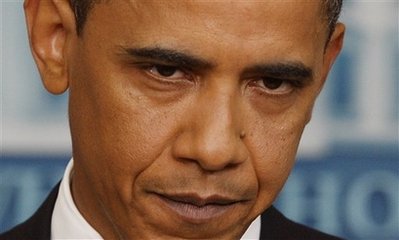
Barack Obama

What are the things that Obama is passionate about?

In his first days in office, he signed a number of executive orders. Of his first five orders, three involved Muslim terrorists captured and held in Gitmo. His third executive order was about the “humane” treatment of terrorists. His fourth executive order sought to close Gitmo. Like the man who can’t wait to get away from his wife so he can call his mistress, Obama made his priorities clear from the start.

It took Obama a month to set up the Economic Recovery Advisory Board. It took him two days to set up a Special Interagency Task Force on Detainee Disposition to free Gitmo terrorists.

Obama prioritized helping Muslim terrorists over the economic recovery. Why? Because that was a subject he was passionate about.

People will always prioritize what they are passionate about over what they aren’t. It’s easy to look at a mission shift and see the choice that has been made.

For example, is Obama passionate about space exploration? He told the head of NASA that his “foremost” priority was making Muslims feel good about themselves.

Obama is more passionate about Muslim self-esteem than he is about visiting other planets.

Is he passionate about god and religion? That depends on which god and which religion.

******************

Walk into a store and you’ll see piles of red and pink in the Clearance box. Everything from heart-shaped cards and boxes of chocolate candy to plastic flowers and teddy bears clutching plush red hearts will be 50 percent off because Valentine’s Day comes but once a year. And Valentine’s Day is over.

Obama’s love for America also comes but once a year. He tosses it into a speech in the Midwest when his poll numbers are down and then it goes into the clearance box where you can buy his love and his patriotism for 50 percent off. And it’s still expensive at the price because the heart-shaped box is empty.

Greeting card sentiments come easily to the man who will say anything. Obama promised to eliminate income tax for seniors making less than $50,000, vowed transparent open government and promised that you could keep your doctor. His words were empty promises.

Love, of a person or of a country, is not judged by what we say. It is judged by what we do.

Every politician with ambition claims to love America. Most only love themselves. Some love other things. No one can know what is it in Obama’s heart, which is why the media’s shrill demands that Scott Walker affirm Obama’s love for America are silly and cynical, but we can certainly follow his passions.

We show our passions in the things that we really care about. We all have our duties and obligations. Obama’s obligations include delivering speeches praising America, occasionally placing his hand on his heart during the pledge of allegiance (when he can find it) and badly saluting soldiers with a latte cup.

But are these the things he loves and cares about?

We can follow Obama’s passions the way that an adulterer’s trail to his mistress can be followed no matter how many cards or stuffed bears he gives to his wife.

What are the things that Obama is passionate about?

In his first days in office, he signed a number of executive orders. Of his first five orders, three involved Muslim terrorists captured and held in Gitmo. His third executive order was about the “humane” treatment of terrorists. His fourth executive order sought to close Gitmo. Like the man who can’t wait to get away from his wife so he can call his mistress, Obama made his priorities clear from the start.

It took Obama a month to set up the Economic Recovery Advisory Board. It took him two days to set up a Special Interagency Task Force on Detainee Disposition to free Gitmo terrorists.

Obama prioritized helping Muslim terrorists over the economic recovery. Why? Because that was a subject he was passionate about.

People will always prioritize what they are passionate about over what they aren’t. It’s easy to look at a mission shift and see the choice that has been made.

For example, is Obama passionate about space exploration? He told the head of NASA that his “foremost” priority was making Muslims feel good about themselves.

Obama is more passionate about Muslim self-esteem than he is about visiting other planets.

Is he passionate about god and religion? That depends on which god and which religion.

Obama left out “Under God” when reciting the Gettysburg Address. The DNC’s platform initially left out “God” and booed the reinsertion. Obama’s invocation at his inauguration also dropped “Under God”.

However Obama cheerfully recited “Allahu Akbar”, the opening of the Islamic supremacist call to prayer, and called it “one of the prettiest sounds on Earth.” He had a man jailed for making a YouTube video attacking Mohammed and blamed him for Muslim acts of terror against America.

Obama’s religious beliefs, such as they are, remain locked in his head. But there is only one religion that he is passionate enough to protect by imprisoning those who blaspheme against it.

He may botch salutes and the pledge of allegiance, but he has retained the ability to chant “Allahu Akbar” with a “first-rate accent”.

He may think that the “good book” says “don’t throw stones in glass houses”, but he accurately quotes the Koran. The things that we remember are the ones that we really care about.

Obama has an obligation to reference the Gettysburg Address, to wait out the pledge of allegiance and to praise America. He has no obligation to quote the Koran or chant “Allahu Akbar”. These are things that he does because he wants to do them. They are the things that he is actually passionate about.

Does he love them more than he loves America? No one can know what is in another person’s heart.

There are married couples who have lived together for decades only to discover that the love of their life had been cheating on them all along. And who is to say that the adulterer doesn’t love? We can’t pass a final verdict on his feelings. But we can know his faithlessness by his deeds.

We can say of him and of Obama that they broke faith with the covenant that they had entered into. We can say that they betrayed those who trusted them, lied to them, used and abused them, and then feigned outrage when their actions were questioned.

Can the media’s furious talking heads denouncing Giuliani deny that Obama lied to Americans? Can they deny that he harmed them? Can they deny that he refused to take responsibility for his actions?

The facts are clear. Only the interpretation is in doubt. And the interpretation is what we are debating.

Does Obama lie to Americans because he loves them? Does he weaken America abroad because he loves it? And if Obama loves America, what does he love about it and how does he show that love? Does he love the Constitution? If he did, he wouldn’t constantly violate it. Does he love Americans? Which Americans? The ones whose health plans he took away for ObamaCare or the ones whose jobs he took away to legalize illegal aliens? The ones whose votes and wishes he ignores and snidely mocks?

Is it the Americans who no longer believe in the future under his rule that he loves? Is it the unemployed Americans he loves? Is it the Americans he jailed under his new laws and regulations that he loves?

If Obama loves Americans, then it’s a clear case of hurting the ones you love.

And if Obama doesn’t love Americans, what America does he love; the rock band or the Walt Whitman poem, the town America in the Netherlands or the Neil Diamond song?

Questioning Obama’s love for America is alleged to be unacceptable gutter politics, but accusing his critics of being racists is a standard debating tactic for those same outraged media talking heads.

It wasn’t gutter politics when Obama claimed that the national debt under Bush was “unpatriotic”. Is Obama at least as “unpatriotic” for increasing the debt by 70 percent? Is it possible that his spending spree proves that he doesn’t love America? Or is indebting our children the way that he shows his love?

Can we question the patriotism of a man who frees terrorists or only of a man who locks them up?

Is asking whether Obama loves America an unacceptable question because the answer is obvious or because it isn’t?

Obama will go on making speeches in which he claims to love America while making the country poorer, more dangerous and weaker. He will also go on making speeches praising Islam while increasing the power, influence and wealth of Muslims in America and around the world.

As the clearance box after Valentine’s Day shows, anyone can buy a card or a teddy bear. It’s the actions that count. It’s not what we say that shows love. It’s what we do that shows what we truly care about.

Hero of the Middle East: Abdel Fattah el-Sisi

February 23, 2015

Hero of the Middle East: Abdel Fattah el-Sisi, The Gatestone InstituteBassam Tawil, February 23, 2015

(Please see also Obama kept reform Muslims out of summit on extremism. — DM)

The courageous, historic speech yesterday by the Grand Imam of al-Azhar University, the seat of Sunni Islam, calling for the reform of Islam, was the result of the even more courageous, historic speech delivered a few weeks ago by Egypt’s devoutly Muslim President, Abdel Fattah El-Sisi.

The Muslim Brotherhood, the current American administration’s great friend, is the poison tree whose fruit is the Islamist terrorism embodied by the ISIS, Al-Qaeda, Hamas, Palestinian Islamic Jihad, Al-Nusra Front, Boko Haram and others.

Apparently some of the Sunni Arab States have not yet realized that their own national security, and ability to withstand Iran, depend on how strong Egypt is.

It is possible, in fact, that U.S. policy is to weaken the Sunni world seeking to unite under el-Sisi’s flag of modernity. With European complicity, the U.S. Administration is trying to defraud the Arabs and turn the Israel-Palestine conflict into a center of Middle Eastern chaos, in order to hide the nuclear deal they are concocting with Iran.

The treachery of the U.S. Administration is the reason why Egypt’s faith in the United States, which is supposed to defend the Arabs against a nuclear Iran, has effectively evaporated.

And now the greatest American insanity of all time: America and Turkey are arming and training Islamist terrorist operatives in Turkey, on the ground that they are “moderates” opposed to Bashar Assad’s regime in Syria. They either ignore or are unaware that there is no such thing as a moderate Islamist terrorist. The other name of the “moderates” opposing Assad is ISIS.

The Muslim Brotherhood, in effect, runs Turkey. According to recent rumors, Turkey is also planning to build a nuclear reactor, “for research and peaceful purposes.”

Sheikh Dr. Ahmed al-Tayyeb, the Grand Imam of Cairo’s Al-Azhar University, the seat of Sunni Islam, yesterday delivered a courageous, historic speech in Mecca, Saudi Arabia, urging reform in religious education to curb extremism in Islam. Al-Tayyeb’s address was the result of an even more courageous and historic speech, delivered a few weeks ago by Egypt’s devoutly Muslim President, Abdel Fattah el-Sisi, at Al-Azhar University.

El-Sisi’s monumental statement, truly worthy of a Nobel Prize, is having a seismic result. Al-Sisi directed his remarks, about the ills of Islam to Islamic clerics in Egypt and around the world. It was enormously brave of him. He did not single out radical Islam, but he did call on all Muslims to examine themselves, carry out a religious revolution and renew their faith.

El-Sisi, a man of monumental courage, urged Muslims not to behave according to the ancient, destructive interpretations of the Qur’an and Islam that make the rest of the world hate them, destroy Islam’s reputation and put Muslim immigrants to Western countries in the position of having to fight their hosts. He claimed that it is illogical for over a billion Muslims to aspire to conquer and subdue six billion non-Muslims.

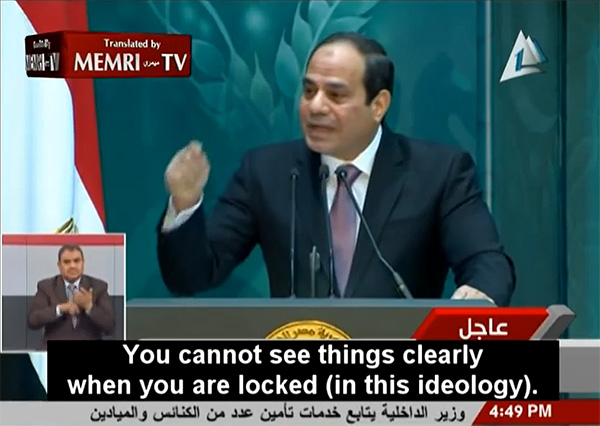
949 (1)Egypt’s President, Abdel Fattah el-Sisi, delivered a historic speech to top Islamic scholars and clergy at Al-Azhar University in Cairo, December 28, 2014. (Image source: MEMRI)

Islam deals in depth with uniting the Muslim nation (umma) and mutual responsibility among Muslims, as though they were one entity. The Prophet Muhammad (S.A.A.W.) said that every drop of Muslim blood is more precious than the entire Kaaba. Thus the liberty ISIS took upon itself to burn alive a Jordanian pilot and 45 Egyptians, to spread terrorism throughout Syria, Iraq and Egypt and to kill other Muslims in various locations around the globe, claiming they were “infidels,” is heresy in and of itself.

The calls for the deaths of “a million shaheeds” and the killing of Jews for the sake of Al-Aqsa mosque in Jerusalem, as was done by Arafat in the past, and is being done now by his heirs in the Palestinian Authority and Hamas, are a crime; they are extremist incitement that is opposed to the forgiving and compromising spirit of Islam. The murder and terrorism carried out by terrorist organizations such as ISIS, Hamas, Palestinian Islamic Jihad [PIJ] and other Islamist organizations against Jews, Christians and other non-Muslims is contrary to the modern Islam needed in the contemporary era.

El-Sisi was correct that the Muslim Brotherhood’s Sunni ideology, which drives most of the extremist Islamist organizations around the world, preaches forced conversion of “infidels” to Islam at any price, or death. Some of the “infidels” are supposed to join Islam of their own accord(targ’ib), out of self-serving interest, and some not of their own accord (tarhib), out of fear and death threats. Such conversions are also contrary to the original Islam, which states that no one is to be forced to convert to Islam and that a calm religious dialogue should be held.

However, a few days after President el-Sisi’s speech, which attempted to unify Muslims and Christian Copts, the Muslim Brotherhood and their affiliated terrorist organizations increased their attacks on Egyptian civilians and security forces throughout Egypt and the Sinai Peninsula, as well as murdering 21 Egyptian Christian Copts in Libya. The Muslim Brotherhood knows that behind the scenes, U.S. President Obama supports the movement, especially the branch in Egypt seeking to overthrow President Sisi. This approval from the U.S. encourages the Muslim Brotherhood to be even more determined to subvert and undermine Egypt’s stability, sabotage its economic rehabilitation and destroy the el-Sisi regime.

In this atmosphere of American support, the Ansar Bayt al-Maqdis terrorist group in the Sinai Peninsula operates under Muslim Brotherhood protection. It recently changed its name to the “Sinai Province” of the Islamic State and swore allegiance to the “Caliph,” Abu Bakr al-Baghdadi. It is currently working hand-in-hand with Hamas in the Gaza Strip to weaken el-Sisi’s Egyptian forces in the Sinai Peninsula.

Other Islamist terrorist organizations also kill Egyptian civilians and security forces with bombs and assault rifles. In the name of the Muslim Brotherhood’s ideology, they indiscriminately attack people on public transport, in airports and in public places, with the intent of retaking control of Egypt.

For this reason, an Egyptian court recently designated Hamas a terrorist organization, along with its military wing, the Izz al-Din al-Qassam Brigades, and outlawed both of them. In response, Qatar, a slippery agent in the service of America but also, treacherously, in the service of Iran, allowed armed Izz al-Din al-Qassam Brigades operatives to be interviewed by its Al-Jazeera TV. The operatives called the Egyptian president a traitor to the Islamic-Arab cause and to those seeking to “liberate Palestine.”

At the same time, Qatar continues to use its Al-Jazeera TV to broadcast hate propaganda targeting the el-Sisi regime, to disseminate videos and to fabricate insulting quotes intended to cause friction between el-Sisi on one side and the leaders of the Arab world and the Gulf States on the other — and to keep them from giving hungry Egyptians economic aid.

As the date for the economic conference in Sharm el-Sheikh (in the Sinai Peninsula) nears, Al-Jazeera’s propaganda machine has moved into ever-higher gear. Apparently, some of the Sunni Arabs states have not yet realized that their own national security and ability to withstand Iran depend on how strong Egypt is.

The U.S. Administration could easily halt the subversion of Egypt, but not only does it turn a blind eye, it suffers from a peculiar form of ignorance that makes it fight ISIS while at the same time supporting the Muslim Brotherhood, the hothouse of most Islamic terrorist organizations, including ISIS. The damage done to Egypt and the cracks in the weak Sunni Muslim ranks in the Middle East will eventually harm American interests and expose the Gulf States to the increasing Iranian threat.

The Muslim Brotherhood, the current American administration’s great friend, is the poison tree whose fruit is the Islamist terrorism embodied by ISIS, Al-Qaeda, Hamas, Palestinian Islamic Jihad, Al-Nusra Front, Boko Haram and others. This linkage has become obvious to all the Arab states, while the U.S. and Europe steadfastly ignore the danger to their own survival, and refuse to outlaw them.

It is possible, in fact, that U.S. policy is to weaken the Sunni world that is seeking to unite under el-Sisi’s flag of modernity. With European complicity, the U.S. Administration is trying to defraud the Arabs and turn the Israeli-Palestinian conflict into a center of Middle Eastern chaos, in order to hide the nuclear deal they are concocting with Iran. That is why the West does not really want to rehabilitate the Palestinian refugees by settling them in the Arab states, and why the West continues to nourish false Palestinian hopes that perpetuate this conflict.

The treachery of the U.S. Administration is the reason why Egyptians’ faith in America, which is supposed to defend the Arabs against a nuclear Iran, has effectively evaporated.

In the meantime, Iran’s Houthi proxies have taken over Yemen, threatening the entire Persian Gulf from the south. The el-Sisi regime is currently in the market for new allies, such as Russian President Vladimir Putin. Putin recently paid a visit to Egypt to examine the possibilities of building a nuclear reactor, sounding the first chord of a regional nuclear arms race.

The problems of the Middle East begin in the United States: that was the claim of participants in the Al-Jazeera TV show, “From Washington.” They described American policy towards Egypt as hesitant, indecisive and undemocratic. They claimed that the U.S. Administration had not yet decided whether or not to support el-Sisi, who heralded change and the willingness to fight radical Islam (a fight America used to participate in) or to remain neutral and waffle, in view of Egypt’s presumed instability. The Americans seem to be putting their all money on the extreme Islamists, who they seem to think will eventually win the bloody conflict currently being waged in Egypt.

The Americans have forgotten that under Mubarak, the regime turned a blind eye to attacks against Israel that were carried out by the Muslim Brotherhood and their carefully fostered agents. Unfortunately, since el-Sisi was elected, Egypt itself has become a victim of radical Islamic terrorism. The U.S. Administration, however, appears clearly to hate el-Sisi, and seems to be doing its utmost to undermine him and see him thrown out.

Under ousted President Mohamed Morsi, Egypt was tolerant and patient toward the U.S. Administration’s best friends, the Muslim Brotherhood, as well as Islamist and Palestinian terrorist organizations such as Hamas, Ansar Bayt al-Maqdis, Al-Qaeda, and Palestinian Islamic Jihad, all of which set up camp in the Sinai Peninsula. These terrorist groups smuggled weapons in from Iran, Sudan, Libya and Lebanon; dug smuggling and attack tunnels; developed missiles and carried out terrorist attacks “only” against Israel, the current U.S. Administration’s other apparent enemy, even though so many American Jews foolishly voted for them.

Now those same Islamist and Palestinian terrorist organizations are striking a mortal blow to the security or Egypt, and killing its civilians and security personnel.

The Muslim Brotherhood, mindful of America’s pro-Islamist policy toward it, is deliberately indulging in a wave of terrorism in Egypt and the Sinai Peninsula. Muslim Brotherhood operatives there are targeting civilians, public transport, airports and natural gas pipelines, all to undermine Egypt’s internal security and bring down el-Sisi’s regime in favor of extremist Islamists and a nuclear-threshold Iran.

In the current international situation, the U.S. Administration has apparently finally cut a deal with Turkey — which will be flimsy and ethereal — that allows Turkey to do the only thing it really cares about: to bring down the regime of Syria’s President, Bashar al-Assad.

The U.S. is also trying to cut a deal with Qatar, which along with Turkey openly supports the Muslim Brotherhood and its terrorist proxies in Egypt, Gaza, Syria and Iraq, who in general work against Western interests.

The ironic result is that Turkey plays host to both NATO and senior Hamas figures, while it deliberately ignores the slaughter by ISIS of Kurds and other ethnic minorities in Iraq and Syria. The Muslim Brotherhood, in effect, actually rules Turkey. Turkey’s President Recep Tayyip Erdogan and his AKP party make it easy for foreign fighters to cross the Turkish border into Syria and join the ranks of ISIS. Meanwhile, the Turkish government wages a diversionary propaganda war against Israel. According to recent rumors, Turkey is also planning to build a nuclear reactor, “for research and peaceful purposes.”

Another surreal result is that Qatar hosts the U.S. military bases, while it finances and encourages terrorist organizations operating against Israel and the Egypt. It also panders to Sheikh Yusuf al-Qaradawi, the spiritual mentor of the Muslim Brotherhood, an Islamist terrorist who issues fatwas permitting the murder of civilians and approves death sentences for apostasy.

And now the greatest American insanity of all time: the U.S. and Turkey are arming and training Islamist terrorist operatives in Turkey, on the grounds that they are “moderates” opposed to Bashar Assad’s regime in Syria. They either ignore or are not aware that there is no such thing as a moderate Islamist terrorist.

The other name of the “moderates” opposing Bashar Assad is ISIS; Iran’s Supreme Leader, Ali Khamenei and Hezbollah’s Hassan Nasrallah are now even saying that the U.S. is arming ISIS.

In the meantime, the Egyptian army continues its struggle against Islamist terrorist targets in the Sinai Peninsula and Libya, unaided, and even undermined, by the U.S.

In view of the U.S. Administration’s collaboration with the Muslim Brotherhood and terrorist organizations in the Gaza Strip, I am persuaded that in the near future it will be possible to find a joint Egyptian-Israeli-Palestinian formula for eradicating the Hamas-PIJ enclave of terrorism, this time by Arabs.

Most ironically of all, in the shadow of American zigzagging, a joint Arab-Israeli front is developing against Sunni and Shi’ite radicalism, and the Palestinians can only profit from it. Thus el-Sisi, who, with towering vision and courage, dares to speak openly about the poison tree of radical Islam and its fruit, when others are afraid, is a truly great Islamic hero.

Obama kept reform Muslims out of summit on extremism

February 21, 2015

Obama kept reform Muslims out of summit on extremism, Washington ExaminerCharles Hoskinson, February 21, 2015

Some of the most prominent reformers have argued for years that the ideological and theological roots of Islamist extremism must be addressed, but administration officials carefully avoided exactly that subject during Obama’s three-day summit.

The White House is also undermining its own efforts by working with people who sympathize with the goals of violent extremist groups, if not their methods, the reformers say.

*****************

The White House excluded members of a prominent group of reformist Muslims from its terror summit this week, apparently because President Obama rejects their argument that such groups as Islamic State of Iraq and Syria are actually motivated by Islam.

A group of 23 prominent Muslim reformers signed a full-page ad in the Sunday New York Times on Jan. 11 asking “What can Muslims do to reclaim their ‘beautiful religion’?”

But Obama and officials throughout his administration deny any connection between Islam and the terrorists beheading and burning their victims in a reign of terror in the Middle East.

Muslim reformers say the administration is ignoring them because they disagree with Obama’s refusal to acknowledge the Islamic roots of the extremists’ ideology.

Some of the most prominent reformers have argued for years that the ideological and theological roots of Islamist extremism must be addressed, but administration officials carefully avoided exactly that subject during Obama’s three-day summit.

The White House is also undermining its own efforts by working with people who sympathize with the goals of violent extremist groups, if not their methods, the reformers say.

“We have to own the issue of extremist Islamic theology in order to defeat it and remove it from our world. We have to name it to tame it,” Muslim journalists Asra Nomani and Hala Arafa wrote in an essay published Friday by the Daily Beast.

“Among Muslims, stuck in face-saving, shame-based cultures, we need to own up to our extremist theology instead of always reverting to a strategy of denial, deflection and demonization.”

Nomani, a former Wall Street Journal reporter, was close friends with her colleague Daniel Pearl, who was kidnapped and beheaded by Islamist extremists in Pakistan in 2002.

At the summit, Obama and other officials insisted there is no link between Islam and the Islamist extremist groups that have been at the forefront of a dramatic spike in terrorist violence worldwide.

“Al Qaeda and [the Islamic State] and groups like it are desperate for legitimacy. They try to portray themselves as religious leaders — holy warriors in defense of Islam,” Obama said Wednesday.

“We must never accept the premise that they put forward, because it is a lie. Nor should we grant these terrorists the religious legitimacy that they seek. They are not religious leaders — they’re terrorists. And we are not at war with Islam. We are at war with people who have perverted Islam.”

The summit aimed at empowering community leaders to help Muslims resist the extremists’ message and improved strategies to communicate a more moderate message. But the administration’s refusal to identify the threat — and the exclusion of those who do from the conversation — works against meeting those goals, reformers said.

Maajid Nawaz, a former Islamist radical andone of those who signed the Times advertisement, is co-founder of the Quilliam Foundation, an anti-extremist British think-tank. The refusal of Obama and his officials to name their real enemy is referred to among reformers as the “Voldemort effect,” after the villain in the Harry Potter books whose name could not be mentioned.

Nawaz told CNN on Wednesday that refusing to address the Islamist ideology directly puts all Muslims at risk of being blamed for the actions of a tiny minority — the exact opposite effect of what Obama intended by his approach.

“When the president said there’s a poisonous ideology that needs to be refuted by Muslim clerics, the average everyday non-Muslim, the only word they know for that is the religion of Islam and they will think that the ideology we are referring to is the faith of Islam itself and thereby they would end up blaming all Muslims,” Nawaz said.

“Islam is a religion like any other with all the various sects and denominations. Islamism is a desire to impose Islam over society. And that is a very theocratic extremist desire. It can manifest itself violently. When it does, I call it jihadism. But it can also manifest itself politically. It’s still a problematic ideology because any desire to impose anyone’s faith over anyone else is inherently flawed and must be challenged,” he said.

“Al Qaeda didn’t inspire extremism. It was this extremist Islamist ideology that inspired al Qaeda. And unless and until we recognize the problem isn’t these Mafiosi-style groups that we can just take out by taking out their leaderships, but it’s the ideology that inspires them, we’ll have a new [Islamic State] tomorrow.”

The ad, by the Gatestone Institute, states, “If Islam is a religion that stands for justice and peaceful coexistence, then the quest for an Islamic state cannot be justified as sanctioned by a just and merciful creator. It is the duty of us Muslims to actively and vigorously affirm and promote universal human rights, including gender equality and freedom of conscience.”

One of the 23 signatories, Tarek Fatah, is a columnist for the Toronto Sun in Canada, and has noted the lack of response from administration officials and journalists.

“Instead of engaging with these progressive Muslims and supporting their call for reform, not only did the White House ignore them, but every media outlet I saw other than Fox News did as well,” he wrote on Feb. 3.

Instead, the White House and many in the mainstream media work with Muslim leaders who sympathize with the extremists, says Zuhdi Jasser, a doctor and former Navy officer who leads the American Islamic Foundation for Democracy.

“This is a Muslim problem that needs a Muslim solution,” he told the Washington Examiner in November. “You can’t just say it’s about violence. You need sermons that call upon America as the leading force for goodness in the world.”

Jasser’s activism against Islamist theocracy recently landed him a prominent role in what the left-wing Center for American Progress calls the “Islamophobia network.” In a report released Feb. 11, the group said Jasser “promotes conspiratorial claims that America is infiltrated by radical Muslims.”

But many so-called mainstream Muslim groups that Jasser has criticized have documented extremist ties. Sympathies with the Muslim Brotherhood, an Egypt-based Islamist movement, landed two U.S. groups, the Council on American-Islamic Relations and the Muslim American Society, on the list of terrorist organizations banned by the United Arab Emirates.

Though both groups vigorously deny extremist sympathies or ties, there is ample evidence that CAIR was founded by supporters of Hamas, the Brotherhood’s Palestinian branch and a banned terrorist organization in the United States, and that the Muslim American Society is the Brotherhood’s U.S. branch.

Ayaan Hirsi Ali: Obama Must Confront the Threat of Radical Islam

February 21, 2015

Ayaan Hirsi Ali: Obama Must Confront the Threat of Radical Islam, Time, Ayaan Hirsi Ali, February 20, 2015

ISIS is recruiting young Muslims from around the globe to Jihad, and the White House apparently doesn’t understand why.

Aiding Islamic Terrorists Is Our Foreign Policy

February 20, 2015

Aiding Islamic Terrorists Is Our Foreign Policy, Front Page Magazine, Daniel Greenfield, February 20, 2015

s3tttf7n-14138040081-370x350

In the White House, Obama has tried to shape an Islamist future for the Middle East, favoring Islamist governments in Turkey and Islamist movements such as the Muslim Brotherhood. He saw his role as paving the way for the next generation of regional regimes that would be explicitly Islamist.Obama’s foreign policy in the region has been an elaborate exercise in trying to draw up new maps for a caliphate. The inclusion of terrorist groups in this program isn’t a mistake. It’s not naiveté or blindness. It’s the whole point of the exercise which was to transform terrorist groups into governments.

Obama’s foreign policy in the region has been an elaborate exercise in trying to draw up new maps for a caliphate. The inclusion of terrorist groups in this program isn’t a mistake. It’s not naiveté or blindness. It’s the whole point of the exercise which was to transform terrorist groups into governments.

******************

Obama says that we are not fighting a war on Islam. What he leaves out is that under his administration the United States is fighting in a civil war that is taking place within Islam.

It’s not a conflict between the proverbial moderate Muslim and the raging fanatic. That was an outdated Bush era notion. Instead Obama has brought us into a fight between Muslim governments and Muslim terrorists, not on the side of the governments we were allied with, but on the side of the terrorists.

It’s why Egypt is shopping for French planes and Russian nukes. Yemen’s government was run out of town by Obama’s new Iranian friends in a proxy war with Saudi Arabia. And the Saudis are dumping oil.

Iran and Qatar are the regional powers Obama is closest to. What these two countries have in common, is that despite their mutual hostility, they are both international state sponsors of Islamic terrorism.

Obama’s diplomats will be negotiating with the Taliban in Qatar. Among the Taliban delegation will be the terrorist leaders that Obama freed from Gitmo. And Iran gets anything it wants, from Yemen to the bomb, by using the threat of walking away in a huff from the hoax nuclear negotiations as leverage.

In Syria and Iraq, Obama is fighting ISIS alongside Islamic terrorists linked to Al Qaeda and Iran. In Libya, he overthrew a government in support of Islamic terrorists. His administration has spoken out against Egyptian air strikes against the Islamic State Jihadists in Libya who had beheaded Coptic Christians.

At the prayer breakfast where he denounced Christianity for the Crusades was the foreign minister of the Muslim Brotherhood government of Sudan that has massacred Christians. Unlike Libya, where Obama used a false claim of genocide to justify an illegal war, Sudan actually has committed genocide. And yet Obama ruled out using force against Sudan’s genocide even while he was running for office.

The United States now has a strange two-tier relationship with the Middle East. On paper we retain a number of traditional alliances with old allies such as Egypt, Israel and Saudi Arabia, complete with arms sales, foreign aid and florid speeches. But when it comes to policy, our new friends are the terrorists.

American foreign policy is no longer guided by national interests. Our allies have no input in it. It is shaped around the whims of Qatar and Iran; it’s guided by the Muslim Brotherhood and defined by the interests of state sponsors of terror. Our foreign policy is a policy of aiding Islamic terrorists.

It’s only a question of which terrorists.

Obama’s familiar argument is that ISIS and Al Qaeda fighters shouldn’t be called Islamic terrorists. Not even the politically correct sop of “Radical Islam” is acceptable. The terrorists are perverting Islam, he claims. The claim was banal even before September 11, but it bears an entirely new significance from an administration that has put Muslim Brotherhood operatives into key positions.

The administration is asserting the power to decide who is a Muslim. It’s a theological position that means it is taking sides in a Muslim civil war between Islamists.

This position is passed off as a strategy for undermining the terrorists. Refusing to call the Islamic State by its name, using the more derogatory “Daesh,” denying that the Islamic terrorists are acting in the name of Islam, is supposed to inhibit recruitment. This claim is made despite the flood of Muslims leaving the West to join ISIS. If any group should be vulnerable to our propaganda, it should be them.

But that’s not what this is really about.

According recognition to a state is a powerful diplomatic tool for shaping world politics. We refuse to recognize ISIS, as we initially refused to recognize the USSR. Obama resumed diplomatic ties with Cuba. His people negotiate and appease the Taliban even though it was in its own time just as brutal as ISIS.

Obama is not willing to recognize ISIS as Islamic, but he does recognize the Muslim Brotherhood as Islamic. Both are violent and murderous Islamists. But only one of them is “legitimate” in his eyes.

Those choices are not about terrorist recruitment, but about building a particular map of the region. Obama refuses to concede that ISIS is Islamic, not because he worries that it will bring them more followers, this is a tertiary long shot at best, but because he is supporting some of their rivals.

The White House Summit on Countering Violent Extremism has brought a covert strategy out into the spotlight. Despite its name, it’s not countering violence or extremism.

The new director of the Center for Strategic Counterterrorism Communications, the axis of Obama’s CVE strategy, is Rashad Hussain who appeared at Muslim Brotherhood front group events and defended the head of Islamic Jihad. In attendance was Salam Al-Marayati of the Muslim Public Affairs Council, yet another Muslim Brotherhood linked group, who had urged Muslims not to cooperate with the FBI and defended Hamas and Hezbollah.

In Syria, the United States is coordinating with Assad and backing the Syrian rebels, who have their own extensive ties to the Muslim Brotherhood and even Al Qaeda. This could be viewed as an “enemy of my enemy” alliance, but this administration backed the Brotherhood before it viewed ISIS as a threat. Top Democrats, including Nancy Pelosi and John Kerry, had focused on outreach to Assad under Bush.

They’re not allying with Assad and the Brotherhood to beat ISIS. They’re fighting ISIS to protect the Brotherhood and their deal with Iran.

In the White House, Obama has tried to shape an Islamist future for the Middle East, favoring Islamist governments in Turkey and Islamist movements such as the Muslim Brotherhood. He saw his role as paving the way for the next generation of regional regimes that would be explicitly Islamist.

The Arab Spring was a deceptive code name for a clean sweep that would push out the old leaders like Mubarak and replace them with the Muslim Brotherhood and other likeminded Islamists. Islamic terrorism, at least against the United States, would end because their mission had been accomplished.

Stabilizing unrest by putting the destabilizers in charge wasn’t a new idea. Carter helped make it happen in Iran. And the more violent an Islamic terrorist group is, the more important it is to find a way to stop the violence by putting them in charge. The only two criteria that matter are violence and dialogue.

So why isn’t Obama talking to ISIS? Because ISIS won’t talk back. It’s impossible to support a terrorist group that won’t engage in dialogue. If ISIS were to indicate any willingness to negotiate, diplomats would be sitting around a table with headchoppers in less time than it takes a Jordanian pilot to burn.

And that still might happen.

Obama isn’t trying to finish off ISIS. He’s keeping them on the ropes the way that he did the Taliban. Over 2,000 Americans died on the off chance that the Taliban would agree to the negotiations in Qatar. Compared to that price in blood, the Bergdahl deal was small potatoes. And if Obama is negotiating with the Taliban after all that, is there any doubt that he would negotiate to integrate ISIS into Iraq and Syria?

Obama’s foreign policy in the region has been an elaborate exercise in trying to draw up new maps for a caliphate. The inclusion of terrorist groups in this program isn’t a mistake. It’s not naiveté or blindness. It’s the whole point of the exercise which was to transform terrorist groups into governments.

Stabilizing the region by turning terrorists into governments may sound like pouring oil on a fire, but to progressives who believe in root causes, rather than winning wars, violence is a symptom of discontent. The problem isn’t the suicide bomber. It’s our power structure. Tear that down, as Obama tried to do in Cairo, and the terrorists no longer have anything to fight against because we aren’t in their way.

Bush tried to build up civil society to choke off terrorism. Obama builds civil society around terrorists.

Obama does not believe that the terrorists are the problem. He believes that we are the problem. His foreign policy is not about fighting Islamic terrorists. It is about destroying our power to stop them.

He isn’t fighting terrorists. He’s fighting us.