Posted tagged ‘Foreign Policy’

Hizballah set to fight ISIS for Euphrates Valley

June 17, 2016

Hizballah set to fight ISIS for Euphrates Valley, DEBKAfile, June 17, 2016

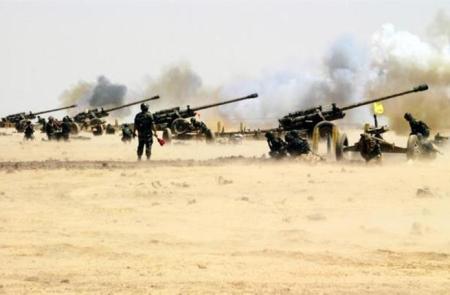
Hezbollah_Zabadani_12.8.15Hizballah artillery in action in Syria

Hizballah this week ordered a general military call-up for their biggest combat mission in the Syrian war since their forces began fighting in support of the Assad regime in 2013, DEBKAfile military forces report.

Iran’s Lebanese proxy has been assigned the task of expelling the Islamic State from broad areas it occupied in the Deir ez-Zor region of eastern Syria and, in particular, the Euphrates River valley which connects eastern Syria and western Iraq.

This Hizballah offensive is designed to open the way for the pro-Iranian Shiite Popular Mobilization Forces and the Badar Forces militias which entered the ISIS-held Iraqi town of Fallujah Friday June 17 to move west and up the Iraqi side of the valley. The two militias spearheaded the Fallujah operation under the command of Iran’s Maj. Gen. Qassem Soleimani of the Revolutionary Guards and Ground Corps Brig. Gen. Mohammad Pakpour.

The plan is for Hizballah forces to meet these pro-Iranian militia forces on the Syria-Iraq border and so gain control over the most important strategic land pass between Iraq and Syria.

Whereas the pro-Iranian militias in Iraq are fighting under US air cover, Hizballah is assured of Russian air support in Syria. And so, for the first time in the Syria conflict and its own history, Hizballah will receive air cover from both the US and Russia, the two superpowers now coordinating their military moves in Syria and Iraq.

This strategy, which essentially connects the Syrian and Iraqi campaigns against ISIS, was charted on June 9, at a secret meeting in Tehran of the Russian, Iranian and Syrian defense chiefs.

DEBKAfile military sources in Washington say that the operation’s plan was put before President Barack Obama and he sanctioned it as part of the war on ISIS.

In the run-up to the Syrian segment of the plan, Hizballah is transferring substantial combat strength from Lebanon into Syria, and emptying its other Syrian fronts, especially around Aleppo, for the large-scale concentration around Palmyra.

The Hizballah force will start out by targeting the Syrian town of Al-Sukhna, 63km south of Palmyra and 136km north of Deir ez-Zor, thus gaining command of M20, the main highway link between northern to eastern Syria.

DEBKAfile military sources say that this military offensive by Hizballah against ISIS, with combined US-Russian support, threatens to transform a terrorist organization dedicated to fighting Israel in the service of Iran into one of the most powerful armies in the Middle East. Israel cannot stop this happening. The former Israel defense ministers who harangued this week against the Netanyahu government’s alleged “scaremongering” willfully ignored this dangerous development. They must also be held at least partly accountable for the failure of Israel’s air raids over Syria to diminish Hizballah’s military capabilities.

Obama and the Moderate Muslims

June 17, 2016

Obama and the Moderate Muslims, Front Page MagazineCaroline Glick, June 17, 2016

Imam Obama on Islam

On Wednesday Goldberg wrote that in Obama’s view, discussing radical Islam is counterproductive because it harms the moderates who need to stand up to the radicals.

How can enforcing ignorance of a problem help you to solve it? How does refusing to call out the Islamic extremists that Islamic moderates like the Green revolutionaries and Sisi risk their lives to fight weaken them? How does empowering jihad apologists from CAIR and MPAC help moderate, anti-jihad American Muslims who currently have no voice in Obama’s White House?

************************

Originally published by the Jerusalem Post

As far as the White House is concerned, Jeffrey Goldberg, The Atlantic’s top reporter, is President Barack Obama’s unofficial mouthpiece.

This was one of the many things we learned from The New York Times in David Samuels’s profile of Deputy National Security Adviser Ben Rhodes.

In the course of explaining how Rhodes was able to sell Obama’s nuclear deal with Iran, despite the fact that it cleared Iran’s path to a nuclear arsenal while giving the world’s leading state sponsor of terrorism more than a hundred billion dollars, Samuels reported that “handpicked Beltway insiders like Jeffrey Goldberg of The Atlantic… helped retail the administration’s narrative.”

Given his White House-assigned role, Goldberg’s explanation of Obama’s refusal to discuss radical Islam is worthwhile reading. It reflects what Obama wants the public to believe about his position.

On Wednesday Goldberg wrote that in Obama’s view, discussing radical Islam is counterproductive because it harms the moderates who need to stand up to the radicals.

“Obama,” he wrote, “believes that [a] clash is taking place [not between Western and Muslim civilization but] within a single civilization, and that Americans are sometimes collateral damage in this fight between Muslim modernizers and Muslim fundamentalists.”

Pointing out that there are Muslim fundamentalists, Obama has argued to Goldberg, will only strengthen them against the modernizers.

Over the past week, prominent conservative commentators have agreed with Obama’s position.

Eli Lake from Bloomberg and Prof. John Yoo writing in National Review, among others, criticized presumptive Republican presidential nominee Donald Trump for speaking openly radical Islam. Like Goldberg, they argued that Trump’s outspokenness alienates moderate Muslims.

But what moderate Muslims is Obama trying to help? Consider his treatment of Egyptian President Abdel Fattah al-Sisi.

Sisi is without a doubt, the most outspoken and powerful advocate of a moderate reformation of Islam, and of Islamic rejection of jihad, alive today.

Sisi has staked his power and his life on his war to defeat the Muslim Brotherhood, Islamic State and jihadist Islam in general.

Sisi speaks openly about the danger of jihadist Islam. In his historic speech before the leading Sunni clerics at Cairo’s Al-Azhar University on January 1, 2015, Sisi challenged the clerics to reform Islam.

Among other things he said, “I address the religious clerics. We have to think hard about what we are facing…. It is inconceivable that the thinking that we hold most sacred should cause the entire Islamic nation to be a source of anxiety, danger, killing and destruction for the rest of the world.

Impossible! “That thinking – I am not saying ‘religion,’ but ‘thinking’ – that corpus of texts and ideas that we have held sacred over the years, to the point that departing from them has become almost impossible, is antagonizing the entire world!…

“Is it possible that 1.6 billion people [Muslims] should want to kill the rest of the world’s inhabitants – that is 7 billion – so that they themselves may live? Impossible! “I say and repeat again that we are in need of a religious revolution. You imams are responsible before Allah. The entire world, I say it again, the entire world is waiting for your next move…because this Islamic nation is being torn, it is being destroyed, it is being lost – and it is being lost by our own hands.”

Certainly since September 11, 2001, no Muslim leader has issues a clearer call for moderation in Islam than Sisi did in that speech. And he has continued to speak in the manner ever since.

No other Muslim leader of note has put everything on the line as Sisi has to defeat the forces of jihad both on the field and in the mosques.

Moreover, Sisi has put his anti-jihadist belief into action by expanding security cooperation between Egypt and Israel and by bringing the Gulf states into his undeclared alliance with the Jewish state.

He has also acted to end the demonization of Israel in the Egyptian media.

Obviously, supporting Sisi is a no-brainer for a leader who insists that his goal is to empower moderate Muslims. And yet, far from being Sisi’s greatest supporter, Obama opposes him.

Since Sisi led the Egyptian military in overthrowing the Obama-backed Muslim Brotherhood regime as it was poised to transform Egypt into a jihadist terrorist state, Obama has worked to undermine him.

Obama has denied Sisi weapons critical to his fight with ISIS in Sinai. He has repeatedly and consistently chastised Sisi for human rights abuses against radical Islamists who, if permitted to return to power, would trounce the very notion of human rights while endangering the US’s key interests in Middle East.

Then there is Iran.

If Obama fears radical Islam, as Goldberg insists that he does, why did he turn his back on the Green Revolution in 2009? Why did he betray the millions of Iranians who rose up against their Islamist leaders in the hopes of installing a democratic order in Iran where women’s rights, and minority rights are respected? Why did he instead side with the radical, jihadist, terrorism-supporting, nuclear weapons-developing and -proliferating ayatollahs? And why has Obama striven to reach an accommodation with the Iranian regime despite its continued dedication to the destruction of the US? Goldberg’s claim that Obama is interested in empowering Muslim moderates in their fight against radicals doesn’t pass the laugh test.

Obama’s actual schemes for relating to – as opposed to acknowledging, fighting or defeating – the forces of jihad involve empowering those forces at the expense of the moderates who oppose them.

Yes, there are exceptions to this rule – like Obama’s belated assistance to the Kurds in Syria and Iraq. But that doesn’t mean that empowering Islamic jihadists at the expense of moderate Muslims is not Obama’s overarching strategy.

In the case of the Kurds, Obama only agreed to help them after spending years training Syrian opposition forces aligned with the Muslim Brotherhood. It was only after nearly all of those forces cut contact with their American trainers and popped up in al-Qaida-aligned militias that Obama began actively supporting the Kurds.

Then there is his behavior toward American jihadists.

Almost every major jihadist attack on US soil since Obama took office has been carried out by US citizens. But Obama has not countered the threat they pose by embracing American Muslims who reject jihad.

To the contrary, Obama has spent the past seven- and-a-half years empowering radical Muslims and Islamic groups like the pro-Hamas terrorism apologists from the Council on American-Islamic Relations (CAIR) and the Muslim Public Affairs Council (MPAC).

This week The Daily Caller reported that MPAC President Salam al-Marayati, is serving as an adviser to the US Department of Homeland Security.

Marayati accused Israel of responsibility for the September 11 attacks on the US, and has called on Muslims not to cooperate with federal counter-terrorism probes. According to the report, Marayati has visited the White House 11 times since 2009.

The Daily Caller also reported that a Syrian immigrant to the US was hired to serve as a member of Obama’s task for on “violent extremism” last year.

Laila Alawa, who joined the task force the day she received US citizenship, referred to the September 11 attacks as an event that “changed the world for good.”

According to the Daily Caller, her task force called for the administration to avoid using the terms “jihad” and “Shari’a” in discussing terrorism – as if Obama needed the tip.

So far from helping Muslim moderates, Obama’s actual policy is to help radical Muslims. In stark opposition to his talking points to Goldberg, since he entered office, Obama has worked to empower radical Muslims in the US and throughout the Middle East at the expense of moderates. Indeed, it is hard to think of an anti-jihad Muslim leader in the US or in the Middle East whom Obama has supported.

The victims in Orlando, San Bernadino, Garland, Amarillo, Boston and beyond are proof that Obama’s actual policies are not making America safer. The rise of ISIS and Iran makes clear that his actual policies are making the world more dangerous.

Maybe if his actual policies were what he claims they are, things might be different today. Maybe White House support for anti-jihadist Muslims combined with a purge of all mention of jihad and related terms from the federal lexicon would be the winning policy. But on its face, it is hard to see how forbidding federal employees from discussing jihadists in relevant terms makes sense.

How can enforcing ignorance of a problem help you to solve it? How does refusing to call out the Islamic extremists that Islamic moderates like the Green revolutionaries and Sisi risk their lives to fight weaken them? How does empowering jihad apologists from CAIR and MPAC help moderate, anti-jihad American Muslims who currently have no voice in Obama’s White House? Eli Lake argued that it was by keeping mum on jihad that then-president George W. Bush and Gen. David Petraeus convinced Sunni tribal leaders in Iraq to join the US in fighting al-Qaida during the surge campaign in 2007-2008.

The same leaders now support ISIS.

A counter-argument to Lake’s is that Bush’s policy of playing down the jihadist doctrine of the likes of al-Qaida had nothing to do with the Sunni chieftains’ decision to side with the US forces.

Rather, they worked with the Americans first because the Americans paid them a lot of money to do so. And second, because they believed the Americans when they said that they would stay the course in Iraq.

They now side with ISIS because they don’t trust America, and would rather live under ISIS rule than under Iranian rule.

In other words, for them, the question wasn’t one of political niceties, but of financial gain and power assessments. And that remains the question that determines their actions today.

In the 15 years since September 11, first under Bush, and since 2009, to a more extreme degree under Obama, the US has refused to name the enemy that fights America with the expressed aim of destroying it.

Maybe, just maybe, this is one of the reasons that the Americans have also failed to truly help anti-jihadist – or moderate – Muslims. Maybe you can’t help one without calling out the other.

State Department Funds Televised Call for Boycotting Israel; The New York Times Is Amused

June 7, 2016

State Department Funds Televised Call for Boycotting Israel; The New York Times Is Amused, Algemeiner, Ira Stoll, June 6, 2016

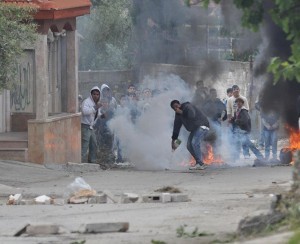
Palestinian-riots-300x244Palestinian rioters. Photo: Wikipedia.

The State Department is using American taxpayer dollars to finance Palestinian Arabs celebrating violent attacks on Israelis and advocating a boycott of Israel and the division of its capital city.

Where’s the outrage?

Not in the New York Times, which treats the topic as subject for a light-toned feature article about what it describes as a Palestinian “reality television show.”

The show features contestants who “run” for the job of Palestinian president. TheTimes article reports that “the three finalists all had similar platforms: Boycott Israel. Designate East Jerusalem as the capital of Palestine.”

Later, the Times reports, almost in passing, that the television program “broadcast on the Maan satellite network to large audiences in Gaza, the West Bank and elsewhere in the Arab world — was funded mostly by a State Department grant.”

The dollar amount of the grant is unreported by the Times. Also unreported by the Times is what the members of Congress who hold the spending power under the Constitution think about the idea of having taxpayer money used to broadcast, across the Middle East, calls to boycott Israel.

An NBC news article on the program quoted one of the contestants celebrating the role of women in the “revolution and resistance — they were throwing stones.” The NBC article also included a contestant’s call for a “’right of return,’ or the right for Arabs driven from their communities in 1948 when the State of Israel was established to go back.” Never mind that some of those Arabs left of their own free will or at the urging of neighboring Arab states, or that their “return” would, as a practical matter, be a way of destroying the Jewish state.

The Algemeiner did what the New York Times did not do, which is contact a major American Jewish organization for its view on the wisdom of spending taxpayer dollars to spread this message.

The president of the Zionist Organization of America, Morton Klein, told The Algemeiner that he found the State Department funding for the television program “astonishing,” and “shocking.” He said that if the State Department were found to be funding an Israeli television program advocating extremist views, there would be an uproar. In this case, however, “not a peep — the only peep is from Ira Stoll.”

“Where is the media and Congress screaming about this?” Mr. Klein asked.

It’s a good question, and one in which the Times shows a disappointing lack of interest in answering, or even in asking.

Hillary’s Libya: The Second Time as Farce

June 4, 2016

Hillary’s Libya: The Second Time as Farce, PJ MediaRoger L Simon, June 3, 2016

(Please see also, The Benghazi Cover Up. — DM)

Amidst the welter of commentary on Hillary Clinton’s June 2 foreign policy speech in which she allegedly eviscerated Donald Trump as the most unreliable leader since Caligula (projection?), I couldn’t avoid thinking of Karl Marx’s oft-quoted line from The 18th Brumaire of Louis Napoleon: “History repeats itself, first as tragedy, then as farce.”

I’m no Marxist, but there’s no question the bearded Prussian inadvertently was accurately describing not Trump’s erratic remarks but Hillary Clinton’s actual outrageous actions regarding Libya when writing, in 1852, of Louis-Napoleon’s coup of the previous year.

What Hillary instigated in that North African country, with the obvious acquiescence of Barack Obama, is the most absurd American foreign policy blunder of my lifetime from which the damaging fallout (thousands of drowning refugees in recent weeks, a possible ISIS takeover of that now essentially lawless country, replete with beheadings of Christians, etc.) is just beginning.  Only our complaisant media could conclude anything but the obvious — that the perpetrator of such a disaster should be totally disqualified as president of the United States.

But let’s go back to 2002 or so during the ramp-up to the Iraq War to see how Hillary’s Libya became the “second time as farce,” both tragedy and farce, in this case. Back then Mrs. Clinton — unlike Donald Trump, who waffled — was among the clear majority of American decision-makers of both political parties who favored the war.  Many criticize that position now, but in those days immediately post-9/11 it made considerable sense.  Something had to be done about the Middle East, which was stuck in that other middle (the Middle Ages or earlier ) when it came to social development and even a semblance of modernity. Those benighted lands were now bringing their unremitting primitivism, violently, to our shores.  (Unfortunately, they still are.)

Forget the existence or not of weapons of mass destruction, dominating most everyone’s hearts and minds at that time was the hope that we could — with minimal force if possible — overthrow the execrable Saddam, bring modern democracy to Iraq and — who knows — by example to other countries in the region.

It was a burst of idealism. Remember the slogan “Democracy! Whiskey! Sexy!”? Even the New York Times approved of it. Much as it saddens me to admit because I went eagerly along, we were all dead wrong. We hadn’t reckoned on that cocktail of tribalism and Islamic ideologies, Sunni and Shiite, that makes those cultures so intransigent and resistant to change.  And we weren’t ready to “go to the mattress,” killing hundreds of thousands as we had in Germany and Japan, to overcome that resistance. And even if we had, who knows if it would have worked with those backward lands?  It’s no easy thing.

But that didn’t stop Hillary Clinton from trying it again a few years later, in Libya, against Muammar Gaddafi, an admittedly crazy despot but one who had agreed to abjure nuclear weapons because of Iraq.  (Ironically, Gaddafi was the only serious victory from the whole thing.) Acting partly under the advice of the sniveling sycophant Sidney Blumenthal (paying attention to Blumenthal should disqualify anyone from anything), Hillary decided to push for a second go-round of a failed policy before the first failure had even come close to resolution.  Talk about the second time as farce. Result?  As Colin Powell said, you break it, you own it.

Hillary Clinton broke Libya.

So this is the person who is now telling us that Donald Trump is dangerous. Well, it makes sense, because this is the same person who told the parents of the Benghazi victims at their children’s funeral that their sons died because of the response to some amateur YouTube video nobody watched and not from an organized terror attack by an al Qaeda affiliate — in other words, an absolutely immoral liar.

Whether Trump would be a great leader on the international stage is impossible to say because it always is before that person is in that leadership position.  That’s the inconvenient truth of foreign policy, which, with notable exceptions, is more often about situational reactions than about planning in the great, ahem, laboratories of the State Department.

We do know, however, how Hillary Clinton would perform. We have already seen it.  And not just in the emails or the opera bouffe of the Russian reset or the backing of Islamists like Erdogan and Morsi or the horrifying mess of Syria or the even more horrifying, non-existent Iran deal, but, most of all, in Libya.  That was her baby.

h/t: Hugh Hewitt

How Hilary’s foreign policy ‘succeeded’ for Iran

June 4, 2016

How Hilary’s foreign policy ‘succeeded’ for Iran, DEBKAfile, June 4, 2016

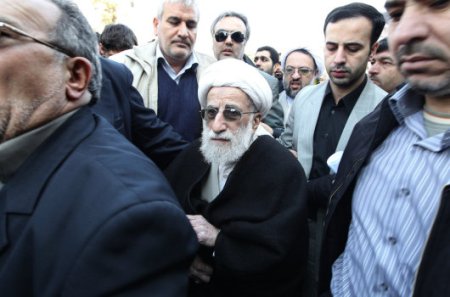
6Hardline Ayatolla Ahmad Janati

Hillary Clinton, the Democratic presidential frontrunner, declared Thursday June 2 in a major foreign policy address: ‘We are now safer than we were before this agreement (the International-Iran nuclear deal).”

A short while before her speech, the State Department, published its yearly report on world terror, and determined, as in past years, that Iran remains “the leading state sponsor of terrorism, on account of its support for designated terrorist groups and proxy militias in Lebanon, Syria, and Iraq.”

Three days earlier, on May 31, scientists at the Institute for Science and International Security, published an extensive analysis of the second report of the IAEA in Vienna, whose job it is to monitor the Iranian nuclear program and establish whether Tehran’s is complying with its commitments.

Their report is titled: IAEA’s Second JCPOA Report: Key Information Still Missing.

The American scientists found oversights in the international watchdog’s report, suggesting collaboration between the Obama administration and the IAEA to conceal Iranian violations.

The scientists offered some examples of these omissions:

Data is lacking on the number of centrifuges, including advanced models, operating in Natanz enrichment facilities as well as the Fordo underground plant. There is no information on what happened to the 20 percent-enriched uranium still remaining in Iran.

Another example is the lack of information on the Iran’s heavy water which is provisionally stored in Oman. Who does it belong to and who oversees it?

These are just a few examples of the blanks in the promised oversight over Iran’s nuclear program, not to mention Iran’s banned ballistic missile program which is geared to design missiles able to reach the US.

The Obama administration had based his detente with Tehran, capped by the nuclear deal, on producing a breakthrough in US-Iran relations. It was intended to strengthen the moderate, reformist and liberal political elements in Iran. ButDEBKAfile sources and Iranian experts report that the exact opposite happened, as is evident in two important elections held in Iran in the past two weeks.

In the elections to the Assembly of Experts, the body which chooses Iran’s top leader, the 91-year-old Ayatollah Ahmad Janati was elected. He is one of the most extreme hardliners in Iran.

A few days later, Ali Larijani was re-elected as Speaker of the Iranian Parliament. Larijani is close to Ayatollah Ali Khamenei. He won by a land slide over the reformist candidate put forward by President Hassan Rouhani.

Five months ago, when the first results of the Iranian elections to the Majlis and to the Assembly of Experts came in, there were cries of joys in the Obama administration. US Secretary of State John Kerry and Iranian Foreign Minister Muhammad Jawad Zarif proclaimed it at the time a victory for the moderates.

Where did these ‘moderates’ disappear in the interim and how did they become supporters of the extremists?

On Friday, June 3, less than 24 hours after Clinton’s foreign policy speech, Iran’s leader Ayatollah Khamenei celebrated his victory over American policy saying: Iran has many small and big enemies, but foremost among them are America and Britain. “Any cooperation with the US,” he stressed, “is an act against Iran’s independence.”

Iran’s Chess Board

June 3, 2016

Iran’s Chess Board, Front Page MagazineCaroline Glick, June 3, 2016

official_photo_of_hassan_rouhani_7th_president_of_iran_august_2013

Even if Obama’s successor disavows his actions, by the time Obama leaves office, America’s options will be more limited than ever before. Without war, his successor will likely be unable to stem Iran’s rise on the ruins of the Arab state system.

********************

Reprinted from jpost.com.

Strategic thinking has always been Israel’s Achilles’ heel. As a small state bereft of regional ambitions, so long as regional realities remained more or less static, Israel had little reason to be concerned about the great game of the Middle East.

But the ground is shifting in the lands around us. The Arab state system, which ensured the strategic status quo for decades, has collapsed.

So for the first time in four generations, strategy is again the dominant force shaping events that will impact Israel for generations to come.

To understand why, consider two events of the past week.

Early this week it was reported that after a two-year hiatus, Iran is restoring its financial support for Islamic Jihad. Iran will give the group, which is largely a creation of the Iranian Revolutionary Guard Corps, $70 million.

On Wednesday Iranian media were the first to report on the arrest of a “reporter” for Iran’s Al-Alam news service. Bassam Safadi was arrested by Israel police in his home in Majdal Shams, the Druse village closest to the border with Syria on the Golan Heights. Safadi is suspected of inciting terrorism.

That is, he is suspected of being an Iranian agent.

There is nothing new about Iranian efforts to raise and run fronts against Israel within its territory and along its borders. Iran poses a strategic threat to Israel through its Hezbollah surrogate in Lebanon, which now reportedly controls the Lebanese Armed Forces.

In Gaza, Iran controls a vast assortment of terrorist groups, including Hamas.

In Judea and Samaria, seemingly on a weekly basis we hear about another Iranian cell whose members were arrested by the Shin Bet or the IDF.

But while we are well aware of the efforts Iran is making along our borders and even within them to threaten Israel, we have not connected these efforts to Iran’s actions in Iraq and Syria. Only when we connect Iran’s actions here with its actions in those theaters do we understand what is now happening, and how it will influence Israel’s long-term strategic environment.

The big question today is what will replace the Arab state system.

Syria, Iraq, Lebanon, Yemen and Libya no longer exist. On their detritus we see the fight whose results will likely determine the fates of the surviving Arab states, as well as of much of Europe and the rest of the world.

Israel’s strategic environment will be determined in great part by the results of Iran’s actions in Iraq and Syria. While Israel can do little to affect the shape of events in these areas, it must understand what they mean for us. Only by doing so, will we be able to develop the tools to secure our future in this new strategic arena.

Until 2003, Saddam Hussein was the chief obstacle to Iran’s rise as the regional hegemon.

US forces in Iraq replaced Hussein until they left the country in 2011. In the meantime, by installing a Shi’ite government in Baghdad, the US set the conditions for the rise of Islamic State in the Sunni heartland of Anbar province on the one hand, and for Iran’s control over Iraq’s Shi’ite-controlled government and armed forces on the other.

Today, ISIS is the only thing checking Iran’s westward advance. Ironically, the monstrous group also facilitates it. ISIS is so demonic that for Americans and other Westerners, empowering Iranian-controlled forces that fight ISIS seems a small price to pay to rid the world of the fanatical scourge.

As former US naval intelligence analyst J.E. Dyer explained this week in an alarming analysis of Iran’s recent moves in Iraq published on the Liberty Unyielding website, once Iranian- controlled forces defeat ISIS in Anbar province, they will be well placed to threaten Jordan and Israel from the east. This is particularly the case given that ISIS is serving inadvertently as an advance guard for Iran.

In Syria, Iran already controls wide swaths of the country directly and through its surrogates, the Syrian army, Hezbollah and Shi’ite militias it has fielded in the country.

Since the start of the war in Syria, Israel has repeatedly taken action to block those forces from gaining and holding control over the border zone on the Golan Heights.

Prime Minister Benjamin Netanyahu’s surprising recent announcement that Israel will never relinquish control over the Golan came in response to his concern that in exchange for a cease-fire in Syria, the US would place that control on the international diplomatic chopping block.

A week and a half ago, Iran began its move on Anbar province.

On May 22, Iraqi forces trained by the US military led Iraq’s offensive to wrest control over Fallujah and Mosul from ISIS, which has controlled the Sunni cities since 2014. Despite the fact that the lead forces are US-trained, the main forces involved in the offensive are trained, equipped and directed by Iran.

As Iraqi forces surrounded Fallujah in the weeks before the offensive began, Qassem Soleimani, the commander of the Revolutionary Guards’ Quds forces, paid a public visit to the troops to demonstrate Iran’s dominant role.

The battle for Fallujah is a clear indication that Iran, rather than the US, is calling the shots in Iraq. According to media reports, the Pentagon wanted and expected for the forces to be concentrated in Mosul. But at the last minute, due to Soleimani’s intervention, the Iraqi government decided to make Fallujah the offensive’s center of gravity.

The Americans had no choice but to go along with the Iranian plan because, as Dyer noted, Iran is increasingly outflanking the US in Iraq. If things follow their current course, in the near future, Iran is liable to be in a position to force the US to choose between going to war or ceasing all air operations in Iraq.

On May 7, Asharq al-Awsat reported that the Revolutionary Guards is building a missile base in Suleimaniyah province, in Iraqi Kurdistan.

A senior IRGC general has made repeated visits to the area in recent weeks, signaling that the regime views this as an important project. The report further stated that Iran is renewing tunnel networks in the region, built during the 1980-88 Iran-Iraq War.

Dyer warned that depending on the type of missiles Iran deploys – or has deployed – to the base, it may threaten all US air operations in Iraq. And the US has no easy means to block Iran’s actions.

To date, commentators have more or less agreed that US operations in Iraq and Syria make no sense. They are significant enough to endanger US forces, but they aren’t significant enough to determine the outcome of the war in either territory.

But there may be logic to this seemingly irrational deployment that is concealed from view. A close reading of David Samuels’s profile of President Barack Obama’s Deputy National Security Adviser Ben Rhodes published last month in The New York Times, points to such a conclusion.

Samuels described Rhodes as second only to Obama in his influence over US foreign and defense policy. Rhodes boasted to Samuels that Obama’s moves toward Iran were determined by a strategic course he embraced before he entered office.

A fiction writer by training, Rhodes’s first “national security” job was as the chief note taker for the Iraq Study Group.

Then-president George W. Bush appointed the group, jointly chaired by former secretary of state James Baker and former congressman Lee Hamilton, in 2006, to advise him on how to extricate the US from the war in Iraq.

In late 2006, the ISG published its recommendations.

Among other things, the ISG recommended withdrawing US forces from Iraq as quickly as possible. The retreat was to be enacted in cooperation with Iran and Syria – the principle sponsors of the insurgency.

The ISG argued that if given the proper incentives, Syria and Iran would fight al-Qaida in Iraq in place of the US. For such action, the ISG recommended that the US end its attempts to curb Iran’s nuclear program.

Responsibility for handling the threat, the ISG recommended, should be transferred to the US Security Council.

So, too, the ISG recommended that Bush pressure Israel to withdraw from the Golan Heights, Jerusalem and Judea and Samaria in the framework of a “peace process.”

Such action too would serve to convince Iran and Syria that they could trust the US and agree to serve as its heirs in Iraq.

Bush of course, rejected the ISG’s recommendations.

He decided instead to sue for victory in Iraq. Bush announced the surge in US forces shortly after the ISG published its report.

But now we see, that through Rhodes the Iraq Study Group’s recommendation became the blueprint for a new US strategy of retreat and Iranian ascendance in Iraq and throughout the Middle East.

The chief components of that strategy have already been implemented. The US withdrawal from Iraq in 2011 left Iran as the new power broker in the country. The nuclear pact with Iran facilitated Iran’s transformation into the regional hegemon.

Against this strategic shift, the US’s minimalist campaigns in Iraq and Syria against ISIS make sense.

The US forces aren’t there to defeat ISIS, but to conceal Iran’s rise.

When ISIS is defeated in Anbar and in Raqqa in Syria, its forces are liable to turn west, to Jordan.

The US is currently helping Jordan to complete a border fence along its border with Iraq. But then ISIS is already active in Jordan.

And if events in Iraq and Syria are any guide, where ISIS leads, Iran will follow.

Iran’s strategic game, as well as America’s, requires Israel to become a strategic player.

We must recognize that what is happening in Iraq is connected to what is happening here.

We need to understand the implications of the working alliance Obama has built with Iran.

Even if Obama’s successor disavows his actions, by the time Obama leaves office, America’s options will be more limited than ever before. Without war, his successor will likely be unable to stem Iran’s rise on the ruins of the Arab state system.

In this new strategic environment, Israel must stop viewing Gaza, Judea and Samaria, the Golan Heights and Lebanon as standalone battlefields. We must not be taken in by “regional peace plans” that would curtail our maneuver room. And we must bear in mind these new conditions as we negotiate a new US military assistance package.

The name of the game today is chess. The entire Middle East is one great board. When a pawn moves in Gaza, it affects the queen in Tehran.

And when a knight moves in Fallujah, it threatens the queen in Jerusalem.
The Benghazi Cover Up

June 3, 2016

The Benghazi Cover Up, Front Page Magazine, June 3, 2016

Hill and Barry

Editor’s note: The following video was produced by journalist Lee Stranahan and exposes the coordinated campaign between Hillary Clinton, Barack Obama and the media to conceal the truth about the Benghazi terrorist attack until after the 2012 presidential election. The video sequence is featured in Stranahan’s film “The Caliphate.”

https://www.youtube.com/watch?v=1pwZvZGQfbg


John Kerry, The Islamic Republic’s New Lobbyist

June 2, 2016

John Kerry, The Islamic Republic’s New Lobbyist, Front Page MagazineAri Lieberman, June 2, 2016

(Please see also, Is Obama’s Iran Deal a ‘Dhimmi’ Contract? — DM)

john_kerry_senator_from_ma-2 (2)

Iran, the nation that has built a well-deserved reputation as the world’s premier state-sponsor of terrorism has a new lobbyist and he is none other than U.S. Secretary of State John Kerry. Since the Obama administration inked the Joint Comprehensive Plan of Action in January, Kerry has been busying himself with ensuring that European banks start doing business with the Iranians. Yes, you read that correctly. Not only has the United States and its European allies agreed to lift sanctions against the Islamic Republic, the administration is now encouraging the private banking sector to do the same. It appears however, that their intense lobbying efforts are being received with a healthy dose of skepticism.

HSBC’s chief legal officer, Stuart Levey confirmed that Kerry had requested that HSBC start opening its banking doors to the Iranians and transact business with them. Levey criticized Kerry’s misguided initiative noting that the U.S. still maintains other non-nuclear related sanctions against the Islamic Republic and that doing business with Iran runs the risk of running afoul of those sanctions. HSBC has had prior negative experience with the U.S. Treasury and Justice departments. In 2012, the bank was forced to fork over $1.9 billion to U.S. authorities to settle allegations involving money laundering for Mexican drug barons.

Levey also noted that the Iranian Revolutionary Guard Corps, which controls large swaths of the Iranian economy, has been slapped with sanctions by both the U.S. and Europe because of the central role it plays in illicit regional and international activities. Doing business with Iran will almost certainly result in facilitating IRGC operations. Adding to the uncertainty, Iran has over the years developed a penchant for hiding money, engaging in shady deals and money laundering thus making it difficult, if not impossible for banking institutions to engage the Iranians in legitimate business transactions without being complicit in their illegal dealings.

Kerry has assured the banks that they have nothing to fear if they perform their due diligence but banking representatives have expressed other legitimate concerns. Iran is one of the most corrupt nations on the planet and ranks poorly in the categories of transparency and ease of doing business. Banking institutions and large businesses are naturally reluctant to deal with such an opaque entity.

Practical matters and banking concerns aside, it is disturbing to witness the zeal in which Kerry is conducting his lobbying campaign on behalf of an enemy country whose national pastime involves chants of “Death to America” and “Down, Down U.S.A.” Even more disturbing is the fact that despite signing the JCPOA, Iran continues to act in defiance of United Nations Security Council resolution 2231 which calls on Iran to cease all research and testing activities relating to its ballistic missile program.

Since the conclusion of the Iran deal, the Islamic Republic has test-fired eight ballistic missiles. The Iranians boasted that some of their missiles were capable of reaching targets 1,200 miles away. Israel is only 1,000 miles away from Iran placing it well within the target radius. Emblazoned on the side of at least one test-fired missile was an ominous threat; “Israel must be wiped out from the face of the earth.”

The Iranians are continuously attempting to increase the range and accuracy of their ballistic missiles. Iran’s illicit ballistic missile program has only one aim, to deliver weapons of mass destruction (WMDs). That apocalyptic prospect does not seem to worry Kerry who seems more interested in propping up the Islamic Republic rather than ensuring that it lives up to its international obligations and stops behaving like a pariah state. Indeed, in an effort to prevent derailment of the JCPOA, the administration asked the Iranians not to publicize their launches. Iran’s illicit ballistic missile program doesn’t seem to bother the Obama administration so long as the Iranians keep their activities below the radar.

Iran’s nefarious undertakings extend far beyond its illicit ballistic missile program. The IRGC, the group that runs Iran in partnership with the ayatollahs, represents the life-blood of Hezbollah. Both Hezbollah and the IRGC are engaged in a full-fledged operation to destabilize the region. From Syria to Yemen, Iranian and Hezbollah operatives are fomenting chaos and bloodshed with the aim of establishing a Shiite arc extending from Iran through Syria and Lebanon as well as securing control of two of the region’s most important chokepoints, the Strait of Hormuz and the Bab-el-Mandeb Strait.

Hezbollah’s main source of funding comes from Iran, which trains, arms and pays the salaries of its operatives. Its other sources, though minor in comparison to Iranian assistance, include drug trafficking and extortion. Last week, Adam Szubin, the acting Treasury undersecretary for terrorism and financial intelligence, noted that Hezbollah was “in its worst financial shape in decades.” It’s hard to take that near-comical boast seriously in light of the $150 billion cash infusion the Obama administration injected into the anemic Iranian economy. It’s hard to imagine that Iran will spend any of that money on improving the quality of life of its citizens and promoting human rights. Iran will almost certainly channel a large portion of those funds to its proxy stooges in Syria, Lebanon, Iraq, Yemen and elsewhere.

Kerry’s lobbying efforts on behalf of Iran in connection with the banking industry will make Iran’s ability to transfer funds to these terrorist groups less difficult. The lengths to which the Obama administration will go to indulge the Iranians is beyond shocking, it’s frightening. But we should expect no more from an administration that expressed gratitude to the Islamic Republic after its naval pirates kidnapped and humiliated 10 American sailors when their craft encountered mechanical difficulties in the Arabian Gulf. Sadly, the Obama administration continues to lose the trust of its allies, while emboldening its enemies and has given new meaning to the term appeasement.

Enemies, Foreign and Domestic

May 30, 2016

Enemies, Foreign and Domestic, Front Page MagazineMark Tapson, May 30, 2016

Enemies

Enemies, Foreign and Domestic: A SEAL’s Story is a new book by former Navy SEAL Carl Higbie. Higbie was on the Navy SEAL assault team that in the summer of 2007 captured the most wanted man in the Middle East (apart from Osama bin Laden) – Ahmed Hashim Abd Al-Isawi, known as the Butcher of Fallujah. But afterward, Higbie and others in his unit were charged with prisoner abuse when Al-Isawi alleged that they had bloodied his lip.

Suddenly, the “mission accomplished” became a much more challenging ordeal as Higbie et al were threatened with courts-martial over supposedly roughing up a ruthless terrorist. When he went public with his account of what happened, the Navy pushed back hard to save face and protect careers. But Higbie pushed back harder.

Higbie, also the author of Battle on the Home Front: A Navy SEAL’s Mission to Save the American Dream, became a SEAL in 2003 and deployed twice in support of Operation Iraqi Freedom. He is now a political commentator in national media including the Fox News Channel, Wall Street Journal, The Washington Post, The Daily Caller, and Breibart. He graciously agreed to answer a few questions for FrontPage Mag about his lates book, Enemies, Foreign and Domestic.

Mark Tapson:         About the mission to capture and extract this high-value target, the Butcher of Fallujah. You and your unit accomplished the mission, handed him over, and all seemed good – but then what happened afterward?

Carl Higbie: After turning over custody to the Master at Arms (MP), the MP admittedly left his post. During this time the prisoner bit his lip (as testified by an oral surgeon) and spit blood on his clothing. Out of fear for his own career, the MP concocted a story that he saw many of us abuse the prisoner. This story was fabricated, as was apparent from his numerous changes in his official statement.

MT:     The accusation should have been cleared up quickly, but instead, the Navy did its best to break you and the other suspects down and get confessions out of you. Tell us what happened.

CH:     Initially we were investigated by NCIS and their investigation made the recommendation to not charge us. It was our Commanding officer along with General Cleveland that decided to proceed despite the facts. Because of the lack of evidence, they wanted to proceed “general’s mast” where there is no need for evidence and a punishment can be issued arbitrarily. They were doing to his to save face and “make an example” out of us.

We all requested a courts-martial so we would have a fair trial and be able to present evidence in our favor. The command tried to talk us out of this because they knew they would lose. They separated us and threatened us with all kinds of punishments, but we held strong and forced the courts-martial.

MT:     Why do you think this guy made such a serious accusation about some of his fellow soldiers, and why do you think the higher-ups weren’t more supportive of the accused, especially considering that the so-called victim was a terrorist?

CH:     The higher-ups were afraid of simple allegations, how that would affect their careers. They lost sight of the mission and their duty to their men. They put politically correct public image in front of their oath. They had us pegged for guilty from day one despite ALL the evidence. So much for “innocent until proven guilty.”

MT:     What’s your opinion of the Rules of Engagement our warriors were bound by which were so strict that merely bloodying a terrorist’s nose could get you court-martialed? Do you think those ROE are proper or are they hindering our men in the field and perhaps even endangering them?

CH:     Rules of engagement are different from guidelines for treating prisoners. I think the Rules of Engagement are atrocious. You cannot have one side playing by a set of rules that does not apply to the other side. War is not a moral endeavor, it is people killing each other; therefore you must be willing to be as ruthless as your enemy.

As for prisoner handling, we should never have stood any discipline after NCIS cleared us and recommended not going forward. This is what investigations are for and they should not be overstepped by a commander who has no knowledge of the situation. Moreover, who cares if a terrorist that we had legal authority to kill had a bloody lip?

MT:     After you were eventually cleared, you wrote a book – as a private citizen, not as a SEAL – called Battle on the Homefront based on your experiences, in which you complained about various ways in which Americans are failing to live up to our country’s own exceptionalism. But the Navy brass gave your manuscript the runaround and did their best to suppress publication. Why do you believe they did that, particularly since many of them privately agreed with what you wrote?

CH:     I spent almost two years, 24 times the length of time the DOD has allowed by their own standards for the review. At every corner, they stonewalled me, refusing even to conduct a review. I had been consulting an attorney throughout the process who was dumbfounded, as we had continuously jumped through hoops to accommodate their ever-changing requirements.

The book was controversial and no one wanted to review it because they were concerned about how it would affect their careers if they were the ones with the approval stamp on it. The military spent more resources trying to bury it than it would have taken to conduct the review. After a review from NCIS on security, and under advice from my attorney, we published without command approval since they had failed to comply with their own rules.

MT:     Since leaving the Navy, you’ve pursued a path as a political commentator in the media. Is that another way you feel you can best serve your country? Do you have political ambitions in the future as well? Tell us about what you’re doing to help reinvigorate the American Dream.

CH:     I have pursued the political route because I believe that to be the root of the problem today. I am unsure whether I will run again but I am heavily involved with this presidential race and many other races as well. If we want to fix this nation we have to start at the top.

That Kissinger Promise and Obama’s Fulfillment

May 30, 2016

That Kissinger Promise and Obama’s Fulfillment, The Jewish PressVic Rosenthal, May 30, 2016

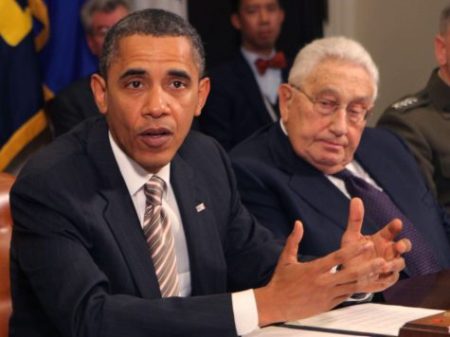
Obama-Kissinger-e1464550543436Pres. Obama seated with Henry Kissinger

{Originally posted to the author’s website, Abu Yehuda}

Old realpolitiker Henry Kissinger was in the news recently when he sat down with Donald Trump, to give him the benefit of his experience. It brought to mind Kissinger’s numerous attempts to get Israel out of the territories it conquered in 1967, before, during and – especially – after the Yom Kippur War.

Kissinger went to Iraq in December of 1975 to try to wean the regime away from the Soviet Union and improve relations with the US. In a discussion with Sa’dun Hammadi, the Iraqi Foreign Minister, Kissinger suggested that American support for Israel was a result of Jewish political and financial power, promised that the US would work to force Israel back to pre-1967 boundaries, and indicated that while the US would not support the elimination of Israel, he believed that its existence was only temporary. Here is an excerpt (the whole thing is worth reading):

I think, when we look at history, that when Israel was created in 1948, I don’t think anyone understood it. It originated in American domestic politics. It was far away and little understood. So it was not an American design to get a bastion of imperialism in the area. It was much less complicated. And I would say that until 1973, the Jewish community had enormous influence. It is only in the last two years, as a result of the policy we are pursuing, that it has changed.

We don’t need Israel for influence in the Arab world. On the contrary, Israel does us more harm than good in the Arab world. You yourself said your objection to us is Israel. Except maybe that we are capitalists. We can’t negotiate about the existence of Israel, but we can reduce its size to historical proportions. I don’t agree that Israel is a permanent threat. How can a nation of three million be a permanent threat? They have a technical advantage now. But it is inconceivable that peoples with wealth and skill and the tradition of the Arabs won’t develop the capacity that is needed. So I think in ten to fifteen years, Israel will be like Lebanon—struggling for existence, with no influence in the Arab world.  [my emphasis] …

Kissinger also promised that aid to Israel, which he presented as a result of Jewish political influence, would be significantly reduced. He indicated that legal changes in the US – he must have been referring to the creation of the Federal Electoral Commission in 1974 to regulate campaign contributions – would attenuate Jewish power and therefore American support for Israel. Naturally, he didn’t foresee the Israel-Egypt peace agreement, which permanently established a high level of military aid to both countries.

He further promised that the US would support a PLO-run Palestinian state if the PLO would accept UNSC resolution 242 and recognize Israel. This of course is what (supposedly) happened in the Oslo accords.

Kissinger insisted that “No one is in favor of Israel’s destruction—I won’t mislead you—nor am I.” But his hint that a smaller Israel might not survive is clear. Surely he understood that a pre-1967-sized Israel (within what Eban called “Auschwitz lines”) would have no chance of surviving, simply because of the strategic geography of the area.

Kissinger was wrong about the Arabs developing the capability to challenge Israel, but their place has been taken by soon-to-be-nuclear Iran and its proxies, who are significantly more dangerous than the Arab states ever were.

US policy, however, has kept more or less the same shape, except that the hypocrisy of insisting that the US supports the existence of Israel but in a pre-1967 size is even more glaring. The substitution of the PLO for the Arab states as the desired recipient of the land to be taken from Israel has barely made a ripple either in America or among the Arabs, suggesting that the policy is more about Israel giving up land than about the Arabs getting it.

The original motivation for Kissinger’s promises was supposedly the desire of the US to replace the Soviet Union as the patron of the Arab states. After the collapse of the USSR and the end of the Cold War in 1991, however, there was no change in policy. Although the Oslo Accords were initiated by left-wing Israelis, the US eagerly embraced them, and the so-called ‘peace process’ became a permanent stick to beat Israel with.

President Obama is especially adept at emphasizing support for Israel’s existence while at the same time demanding that Israel make concessions that would make her continued existence impossible. Apparently agreeing with Kissinger about Jewish power, Obama has worked to reduce the pro-Israel influence of American Jews in numerous ways, such as by providing access to the White House for groups like J Street and the Israel Policy Forum, while marginalizing traditional Zionist organizations like ZOA.

Kissinger’s almost anti-Semitic claim that US support for Israel is bought with Jewish money was probably untrue in 1975 and is even less so today, when a large proportion of American Jews, including wealthy ones, have chosen their liberal or progressive politics over Zionism. The coming struggle over the introduction of a pro-Palestinian plank into the Democratic platform is an indication that the party and with it, many of its Jewish supporters, is moving toward Obama’s position.

The Obama Administration’s program to extricate itself from the Middle East by empowering Iran as the new regional power has given a new impetus to the policy of shrinking Israel. Iran sees Israel as a major obstacle to its hegemony, for both geopolitical and religious/ideological reasons, and is committed to eliminating the Jewish state. Obama found it necessary to restrain Israel from bombing Iran’s nuclear facilities at least once (in 2012), and seems to be prepared to sacrifice Israel in order to achieve his goal of establishing Iranian regional dominance.

Some would go even further and say that Obama’s primary ideological goal is to eliminate Israel and the Iranian gambit is a means to this end, but that is highly speculative! Or maybe it’s a matter of two birds with one stone.

Henry Kissinger didn’t do us any favors, but I think the anti-Israel thread in American policy would have been strong enough without him, running from Truman’s Secretary of State George C. Marshall all the way to Obama’s stable of anti-Zionists like Rob Malley and Ben Rhodes.

Today Israel is long gone from the Sinai, more recently from Gaza, and probably only thanks to the disintegration of Syria, still holding the Golan Heights. I would like to believe that PM Netanyahu was correct when he said that Israel will never leave the Golan. Regarding Judea, Samaria and Jerusalem, I expect that we are about to begin a very difficult time, as the Obama Administration is likely to mount a campaign in its last days to fulfill Kissinger’s promise to the Arabs at long last.