Posted tagged ‘Foreign Policy’

Saudi air chief killed in Yemeni rebel Scud attack on Khamis Mushayt air base

June 12, 2015

Saudi air chief killed in Yemeni rebel Scud attack on Khamis Mushayt air base, DEBKAfile, June 12, 2015

General_Mohammed_bin_Ahmed_Al-Shaalan_AF-commander_10.6.15Saudi Air Force Commander Lt. Gen. Muhammad bin Ahmed Al-Shaalan slain by Yemeni Scud

The Saudi Air Force Commander Lt. Gen. Muhammad bin Ahmed Al-Shaalan was killed in a Scud missile cross-border attack by Yemeni Houthi rebels on the big King Khalid Air Base at Khamis Mushayt in the southwestern Asir region of Saudi Arabia, DEBKAfile reports. The attack took place on June 6, but his death was concealed under a blanket of secrecy until Wednesday, June 10.

The largest Saudi air base, it is from there that the kingdom has for last two and a half months waged its air campaign to end the Yemeni insurgency. Saudi and coalition air strikes, directed against the Iranian-backed Houthi rebels, their allies from the Yemeni army and from local tribes, have killed an estimated 2,000 people, some of them civilians, including women and children.

DEBKAfile’s military sources in the Gulf remarked that even the tardy official disclosure of Gen. Al-Shaalan’s death Wednesday left more questions than answers. The terse three-line announcement said: “The Commander of Saudi Royal Air Forces Lieutenant General Mohammed bin Ahmed Al-Shaalan died Wednesday during a working trip outside the kingdom from a heart attack.”

No information was provided about the nature of his putative “working trip,” its destination and purpose – or even the date of his funeral.

Our military sources report that the Houthis’ Scud attack caught the Saudis unawares. The only reaction from the air base came from the American teams operating Patriot counter-missile batteries. They tried to shoot down the incoming missiles and managed to intercept only two or three out of a barrage of 15.

The US has deployed Patriots at Khamis Mushayt to shield the special operations units and drones fighting Al Qaeda in Arabia (AQIP). But since the start of the Yemen civil war, American drones have been feeding the Saudi Air Force with intelligence about Houthi targets and movements.

The Yemen assault on the Saudi air base represented a major escalation in the Yemeni war, with effect on the complex US relationship with Iran in the context of the Yemen conflict.

DEBKAfile’s military sources assert that the Houthi Scud crews undoubtedly received precise data from Iranian intelligence about the whereabouts of Gen. Al-Shalaan and his top staff on the day of their attack. With this information, they were able to time their attack for 3 am before dawn and target the base’s living quarters and aircraft hangars.

Tehran most likely put the Houthis up to the Scud attack, both to damage the base from which air strikes are launched against them and as payback for the intelligence US drones are providing for those strikes.

Riyadh concealed the circumstances of the air chief’s death to avoid affecting the morale of Saudi combatants taking part in the Yemen war. The Obama administration also had in interest in drawing a discreet veil over the incident so as not to jeopardize the nuclear negotiations with Iran as they enter the final lap before the June 30 deadline.

Is Obama Supporting a Shiite ISIS?

June 12, 2015

Is Obama Supporting a Shiite ISIS?, Front Page Magazine, Daniel Greenfield, June 12, 2015

Asaib-ahl-alhaq_logo-450x300Asaib Ahl al-Haq logo.

Obama had campaigned vocally against the Kyl-Lieberman Amendment which designated Iran’s Revolutionary Guard, the hidden force behind Asaib Ahl al-Haq and much of the Shiite terrorist infrastructure, a terrorist organization. He had accused its sponsors of “foolish saber rattling.”

While we focused on ISIS, its Shiite counterparts were building their own Islamic State by burrowing from within to hollow out the Iraqi institutions that we had put into place. ISIS is a tool that Iran is using to force international approval of its takeover of Iraq and its own nuclear program.

Like ISIS, its Shiite counterparts envision an apocalyptic struggle in which the other branch of Islam will be destroyed, along with all non-Muslims, leading to regional and global supremacy. Iraq is only one of the battlefields on which this war is being fought and Obama’s inept mix of appeasement and regime change, abandoning allied governments while aiding enemy terrorists has helped make it possible.

*********************

Staff Sgt. Ahmed Altaie was the last American soldier to come home from Iraq. His body was turned over by Asaib Ahl al-Haq or The League of the Righteous; a Shiite terrorist group funded and trained by Iran.

Altaie had been kidnapped, held for ransom and then killed.

It was not Asaib Ahl al-Haq’s only kidnapping and murder of an American soldier. A year after Altaie’s kidnapping, its terrorists disguised themselves as Americans and abducted five of our soldiers in Karbala. The soldiers were murdered by their Shiite captors after sustained pursuit by American forces made them realize that they wouldn’t be able to escape with their hostages.

Asaib Ahl al-Haq’s obsession with American hostages was a typically Iranian fixation. Iran’s leaders see the roots of their international influence in the Iran hostage crisis. Its terrorist groups in Lebanon had abducted and horrifically tortured Colonel William R. Higgins and William Francis Buckley.

Higgins had been skinned alive.

Most Americans have never heard of Asaib Ahl al-Haq, sometimes referred to as the Khazali Network after its leader, even though it has claimed credit for over 6,000 attacks on Americans. Its deadliest attacks came when the Democrats and their media allies were desperately scrambling to stop Bush from taking out Iran’s nuclear program. Asaib Ahl al-Haq’s ties to Iran were so blatant that the media could not allow it to receive the kind of coverage that Al Qaeda did for fear that it might hurt Iran.

Obama had campaigned vocally against the Kyl-Lieberman Amendment which designated Iran’s Revolutionary Guard, the hidden force behind Asaib Ahl al-Haq and much of the Shiite terrorist infrastructure, a terrorist organization. He had accused its sponsors of “foolish saber rattling”.

Nancy Pelosi joined the Democratic Party’s pro-Iranian turn, rejected a vote on the amendment and sneered that if the kidnapping and murder of American soldiers was “a problem to us and our troops in Iraq, they should deal with it in Iraq.” Earlier that year, she had visited Syria’s Assad to stand with him against President Bush even while Assad was aiding the terrorists massacring American soldiers.

Once Obama took power, coverage of the war was scaled down so that Americans wouldn’t realize that the rising power of ISIS and Asaib Ahl al-Haq were already making a mockery of his withdrawal plans.

But Asaib Ahl al-Haq was not merely an anti-American terrorist group; it was an arm of the Shiite theocracy. As a Shiite counterpart to what would become ISIS, it had most of the same Islamic goals.

While Obama was patting himself on the back for the end of the Iraq War and gay rights, Asaib Ahl al-Haq was throwing those men and women it suspected of being gay from the tops of buildings.

When buildings weren’t available, it beat them to death with concrete blocks or beheaded them.

Its other targets included shelters for battered women, which the Islamist group deemed brothels, men who had long hair or dressed in dark clothing. And even while its Brigades of Wrath were perpetrating these atrocities, Obama and the Shiite Iraqi government embraced the murderous terrorist group.

Qais al-Khazali, the leader of Asaib Ahl al-Haq, and his brother Laith al-Khazali along with a hundred other members of the terror group were freed during Obama’s first year in office. (But to provide equal aid and comfort to the other side, Obama also freed the future Caliph of ISIS in that same year.)

“We let a very dangerous man go, a man whose hands are stained with US and Iraqi blood. We are going to pay for this in the future,” an unnamed American officer was quoted as saying. “This was a deal signed and sealed in British and American blood.”

“We freed all of their leaders and operatives; they executed their hostages and sent them back in body bags.”

The releases were part of Obama’s grand strategy of reconciliation for Iraq. The miserable reality behind the upbeat language was that Obama was handing over Iraq to ISIS, Iran and its Shiite militias.

Last year, Maliki had made Asaib Ahl al-Haq and other Shiite terror groups into the Sons of Iraq that were to protect and defend Baghdad. Asaib Ahl al-Haq and its leader were now the Iraqi security forces. The Shiite death squads were in charge even while they continued carrying out ISIS-style massacres.

Obama belatedly decided to respond to ISIS, but his war strategy depends on Asaib Ahl al-Haq.

Officially his strategy is to provide training and air support for the Iraqi military. But the Iraqi military’s Shiite officers conduct panicked retreats in the face of ISIS attacks while abandoning cities and equipment. The goal of these retreats is to make Asaib Ahl al-Haq and other Shiite militias into the only alternative to ISIS for the United States. Even though he pays lip service to Sunni and Kurdish resistance to ISIS, Obama shows that he has accepted Iran’s terms by refusing to arm and support them.

While we focused on ISIS, its Shiite counterparts were building their own Islamic State by burrowing from within to hollow out the Iraqi institutions that we had put into place. ISIS is a tool that Iran is using to force international approval of its takeover of Iraq and its own nuclear program.

An Iraqi official last year was quoted as saying that Asaib Ahl al-Haq’s men give orders to the police and military. “Before they were just around, now they are high-ranking officers in the military.”

Some defense experts wonder if the Iraqi military even exists. The bulk of the forces in Tikrit were Shiite Jihadists and they are armed with American weapons that they receive from the Iraqi government. Asaib Ahl al-Haq boss Qais al-Khazali claims that soldiers and Shiite militia members both wear Iraqi military uniforms.

The capture of Tikrit became an opportunity for the Shiite terrorist groups and Qasem Soleimani, their Iranian terror boss, to boast about their victory and loot and terrorize the local Sunni residents.

Obama’s official plan to arm and train the Iraqi military and security forces is a dead end because like the mythical moderate Syrian rebels, they are fronts for moving money and weapons to Jihadists. We are arming ghost armies and funding fake political institutions and the money and weapons end up going to bands of Islamic terrorists, militias and guerrillas that are actually calling the shots.

By aiding Shiite militias in Iraq and Sunni militias in Syria, we’re backing both sides of an Islamic civil war.

Obama turned over Iraq to the Shiites and then backed the Muslim Brotherhood’s efforts to force the Shiites out of power in Syria. The Sunni-Shiite civil wars tearing the region apart were caused by those two decisions. His solution to the wars is to continue backing the same forces responsible for them.

Despite assorted denials, Obama’s real ISIS strategy is to have Iran do the fighting for him in Iraq.

But Obama is backing one ISIS against another ISIS. Why is a Shiite Islamic state that kidnaps and kills Americans, throws gays off buildings and massacres women better than a Sunni Islamic state that does the same things? Not only is the Obama strategy morally dubious, but it’s also proven to be ineffective.

The rise of ISIS has helped Iran tighten its hold on Shiite areas in Iraq and Syria. Iran does not need to beat ISIS. Its interests are best served by maintaining a stalemate in which ISIS consolidates Sunni areas while Iran consolidates Shiite areas. The more Obama aids Iran and its terrorist forces as a counterweight to ISIS, the more Iran sees keeping ISIS around as being vital to its larger strategy.

By aiding Iran, Obama is really aiding ISIS.

Despite depending on our air support, Asaib Ahl al-Haq and its leaders are threatening to attack American planes and soldiers making it clear that they view the fight against ISIS and for Assad as part of a larger struggle for achieving Iran’s apocalyptic Shiite ambitions for the region and the world.

Iran’s Supreme Leader, Ayatollah Ali Khamenei recently gave a speech in which he warned that, “We must prepare the country’s conditions, the region’s conditions, and, Allah willing, the world’s conditions for the reappearance [of Imam Mahdi] will spread justice.”

Like ISIS, its Shiite counterparts envision an apocalyptic struggle in which the other branch of Islam will be destroyed, along with all non-Muslims, leading to regional and global supremacy. Iraq is only one of the battlefields on which this war is being fought and Obama’s inept mix of appeasement and regime change, abandoning allied governments while aiding enemy terrorists has helped make it possible.

Time wars

June 12, 2015

Time wars, Israel Hayom, Judith Bergman, June 12, 2015

Perhaps one of the greatest, yet least spoken of, misconceptions of the West concerning the ‎Middle East is its failure to understand the radically different concept of time on which it ‎operates. While Israel predominantly ticks on a Western — if Mediterranean — linear clock, ‎which puts a premium on speed and efficiency, this is overwhelmingly not the case in Arab ‎culture. For Muslims in particular, time is the domain of Allah and from this belief follows a ‎fatalism and an immense patience, which could almost be mistaken for resignation, that in ‎time Allah will see to all things.

There could be no greater contrast to the West, which is impatient to the point of ‎hyperventilation, wishing to solve problems that are not always solvable as fast as possible ‎– and preferably yesterday

***********************

In his speech at the 15th annual Herzliya Conference on Tuesday, Prime Minister Benjamin ‎Netanyahu reaffirmed his commitment to a demilitarized Palestinian state that recognizes the ‎Jewish state. Much more important than this reaffirmation, however, was the prime minister’s ‎subsequent realistic estimation of the actual possibility of establishing such a demilitarized ‎state.

Netanyahu described how he had attempted in vain to talk to Palestinian ‎Authority President Mahmoud Abbas over the course of six and a half years. When he finally met him, in Sharm el-Sheikh, they spoke ‎for six hours and the only thing that Abbas had to say during this session was a demand that ‎Israel extend the freeze on settlement construction.‎

‎”So I again call on Abbas to return to the negotiating table without preconditions,” said the ‎prime minister, “but I also know he has very little reason to talk. Why should he talk? He can ‎get by without talking. He can get by with an international community that blames Israel for failing to hold talks. In other words, the Palestinians run from the table. … But the Palestinians have a ‎nifty trick up their sleeve: They refuse to negotiate and then get international pressure, ‎sanctions, boycotts on Israel for there not being negotiations. It’s a perfect catch-22. And there ‎are those who attempt to impose terms on Israel in the U.N. Security Council, because there are ‎no talks, and some of them pretend that the dangers we face are not real dangers at all.”

In fact, the ability of the international community — particularly that of its European members — to ‎willfully close its eyes to the dangers and to the complicated geopolitical circumstances that ‎Israel continues to finds itself in, particularly now, is boundless. The catalogue of malicious ‎actions on the part of the international community, most particularly its European members, to ‎force Israel into acquiescing to concessions is expanding. At the same time, its inability to understand the geopolitical realities of the Middle East grows.‎

Perhaps one of the greatest, yet least spoken of, misconceptions of the West concerning the ‎Middle East is its failure to understand the radically different concept of time on which it ‎operates. While Israel predominantly ticks on a Western — if Mediterranean — linear clock, ‎which puts a premium on speed and efficiency, this is overwhelmingly not the case in Arab ‎culture. For Muslims in particular, time is the domain of Allah and from this belief follows a ‎fatalism and an immense patience, which could almost be mistaken for resignation, that in ‎time Allah will see to all things.

There could be no greater contrast to the West, which is impatient to the point of ‎hyperventilation, wishing to solve problems that are not always solvable as fast as possible ‎– and preferably yesterday. ‎

It is this impatience, bordering on panic, that characterizes the current efforts of the U.S. and ‎the EU to reach a deal with Iran, rushed even more, of course, by U.S. President Barack Obama’s ego-driven ‎desire to have a deal with Iran as part of his legacy.‎

The Western impulse to solve problems that may turn out to be unsolvable, especially ‎according to a Western time schedule, and the impatience that accompanies repeated failures ‎to solve said problems, is nowhere more prevalent than concerning the question of Israel and ‎the Palestinians. In fact, the very actions of the international community create a false sense of ‎urgency that would not necessarily exist among the parties if the West did not insist on ‎constantly meddling in the process.

Yet, the conflicts of the Middle East — and the Israeli-Arab conflict is no different in this respect ‎‎– will not be solved with Western quick fixes, express shuttle diplomacy and emergency ‎meetings in the Security Council, only because the West wishes it to be so. While Israel’s clock ‎may tick on a Western time continuum, its security does not, because its security is tightly ‎connected to its Arab and Persian neighbors, who operate on a ‎different time continuum. During a lecture about the Islamic State group, Dr. Eitan Azani, ‎deputy executive director of the Institute for Counter-Terrorism at the IDC Herzliya, mentioned ‎that this organization — which contrary to popular belief is highly organized, with former Iraqi ‎colonels and intelligence officers at the top — operates under a 100-year plan.

One example of a centuries old conflict in the Middle East, which continues unresolved without ‎enjoying a fraction of the sense of urgency that the West bestows on the Israeli-Palestinian ‎conflict, is the persecution of Christians in the Muslim world, including the PA-controlled ‎territories, where their numbers have dwindled dramatically since the Oslo Accords. Most ‎urgent in this respect is the ethnic cleansing of Christians going on in Iraq, which until now has ‎barely caused Western powers to bat an eye.

Similarly, the Yazidis, an ancient people who live in northern Iraq, have suffered persecution ‎throughout their history, but the current ethnic cleansing of the group by Islamic State has not created any sense of ‎urgency in the West, to put it mildly.

Another example is the persecution of the Kurds, an ancient nation comprising roughly 30 million people, and the blatant denial of national self-‎determination for them. Western ‎powers brutally let them down in their quest for national self-determination after World War I ‎and subsequently conveniently ignored them, as if they had disappeared from history ‎altogether. Instead, Arab, Turkish and Persian rulers have persecuted them, most infamously ‎perhaps Saddam Hussein, who used chemical weapons against them. In the Kurds’ ‎current battle against Islamic State, the West has not exactly been rushing to aid them. ‎

Finally, the internal Muslim conflict between Shiites and Sunnis is also one that has existed for ‎centuries and will probably continue for centuries to come. The West has never felt any urge to ‎resolve this bitter conflict, not when the Sunni Saddam was murdering Shias in the south of Iraq ‎and not now, when Sunni Islamic State murders Shias — and also any Sunnis who do not adhere to its ‎particular teachings of Islam.‎

Only one conflict out of the many currently burning in the Middle East has been specifically selected for ‎intense scrutiny and resolution by the West — the Israeli-Palestinian conflict. Further, as the ‎prime minister said, it is Israel, not the Palestinians, that is blamed for not resolving this ‎conflict, despite the fact that the Palestinians have run away from every negotiation table that ‎they have ever seen. This should have caused great concern and outrage among ‎decent people a long time ago and a public debate about the rationale for such skewed and ‎slanted Western policies, but the world remains silent and unquestioning on this and instead ‎rages with fury at Israel.

Israel does not have the luxury of dealing with the rose-tinted, imaginary Middle East of the ‎West, where everybody would get along just fine, swaying to the tune of John Lennon’s ‎‎”Imagine,” if only Israel would give in to every single demand. Israel must stick to the harsh ‎realities on the ground and deal with the region, as tough, difficult and dangerous as it actually ‎is. This is the important message that the prime minister communicated in his speech, and it ‎would be most helpful if the West would listen — for once.

Islamic State at Israel’s Gate

June 12, 2015

Islamic State at Israel’s Gate, Front Page Magazine, June 12, 2015

(According to Israel National News

Late on Thursday night “color red” rocket sirens were sounded in the southern coastal city of Ashkelon, as well as throughout the Ashkelon Coast regional council.

At least one rocket was identified as having been fired from Gaza, but IDF officials said it is believed the rocket exploded inside Gaza. No rockets were found in Israeli territory.

— DM)

ISIS-in-Gaza-404x350

All this is happening while the Obama administration, by the president’s own admission, has no clear strategy to defeat ISIS. At the same time, President Obama’s “strategy” to deal with Iran is to make concession after concession in order to secure any nuclear deal he can, including the possibility of providing Iran with relief from sanctions that were imposed for non-nuclear related reasons such as Iran’s support for terrorist activities

In short, Israel is facing Iran-backed Hamas from the south, Iran-backed Hezbollah from the north, and an expanding Islamic State presence north and south of Israel and within Israel itself. And that is before Iran gets its hands on a nuclear bomb and the Islamic State has enough radioactive material to build its own weapons of mass destruction.

*****************

Jihadists affiliated with the Islamic State (also known as ISIS or ISIL) are carrying on the rocket war against Israeli civilians from where Hamas left off. Following several rocket attacks in the last several weeks for which the Islamic State has taken credit, rockets launched from Gaza Thursday night exploded in the Ashkelon area.

Israel is still holding Hamas responsible for the attacks as the governing authority in Gaza.

“The IDF understands that Hamas wants quiet and is making an effort to prevent the shooting, but the State of Israel still sees Hamas as responsible for what happens in Gaza,” said Sami Turgeman, head of IDF’s Southern Command.

The Israeli military responded with measured attacks on Hamas facilities, while at the same time trying to avoid setting off a wider war at this time.  But Israel’s hand is being forced by the Islamic State, which is evidently working assiduously to supplant Hamas as the authoritative Islamic power in Gaza. The Gaza branch calls itself the Sheikh Omar Hadid Brigade. It is cooperating with another ISIS-affiliated group operating in the Sinai Peninsula, which calls itself Ansar Bayt al-Maqdis.

According to a June 8th report by Debkafile, “Islamic State operatives in the Gaza Strip have been helping themselves to Hamas rockets in recent weeks after furtively penetrating the factory teams operating the group’s production and assembly lines… The jihadis then secretly passed the stolen rockets to their squads for launching against Israel.”

On June 7th Debkafile noted in more general terms Hamas’s loss of control in Gaza in the face of Islamic State infiltration: “The terror infrastructure Hamas built over many years in Sinai has been taken over by ISIS, and its control of the Gaza Strip is slipping, as yet more radical and violent organizations eat away at its authority and seize control of the rocket offensive against Israel.”

Thus, even as Hamas remains committed to the destruction of Israel and is trying to re-build its arms stockpiles with Iran’s help, it is engaged simultaneously in its own battles with the Islamic State. Hamas has arrested some ISIS supporters and bulldozed a Sunni mosque believed to have been used by ISIS affiliated jihadists, while Hamas’s own facilities have come under attack by ISIS affiliated jihadists. Hamas also claimed in a message to Israeli authorities, routed through an Egyptian intermediary, that jihadists affiliated with the Islamic State were deliberately trying to spark a renewed war between Israel and Hamas.

The Islamic State is also trying to position itself to challenge Israel from the north. Israeli TV Channel 2 reported last week that the Islamic State is moving forces in the direction of the Golan Heights and the Israeli border.

Moreover, ISIS is developing an increasing presence within Israel itself. Recruits, influenced by ISIS’s slick social media promotions, are attracted to ISIS’s self-declared purer Islamic ideology. Hamas is apparently too “moderate” for these jihadists’ tastes.

“Dozens of Israeli Arabs and Palestinians have travelled to Syria and Iraq to join insurgent groups.” Israel’s Shin Bet domestic intelligence agency said in a statement released last January 4th. Israel had announced that it managed to crack one Islamic State cell on its soil and arrested its alleged members. An Israeli security official described the cell as “just the tip of the iceberg.”

Last July, the Islamic State previewed its intentions in a statement that it issued regarding jihad against Israel:

As for the massacres taking place in Gaza against the Muslim men, women and children, then the Islamic State will do everything within its means to continue striking down every apostate who stands as an obstacle on its paths towards Palestine. It is only [a] matter of time and patience before it (Islamic State) reaches Palestine to fight the barbaric Jews and kill those of them hiding behind the gharqad trees – the trees of the Jews.

Arutz Sheva reported that a spokesperson for the Islamic State, Nidal Nuseiri, urged patience as the Islamic State wanted first to consolidate its control over Arab Muslim lands, but “reaffirmed that conquering ‘Bayt el-Maqdis’ (Jerusalem) and destroying the State of Israel is central to the group’s jihad.” Thanks to President Obama’s dithering, the Islamic State is well on its way to achieving such consolidation in Iraq and Syria, while spreading to Libya.

At least three questions arise from the emergence of ISIS as a direct threat to Israel. Will Israeli military and security forces, either on their own or in concert with Jordan and Egypt, take on ISIS directly, including going after ISIS’s command and control centers with far more firepower than the Obama administration has used thus far?

To what extent will Israel be willing to outsource military operations against ISIS affiliates in Gaza to Hamas, much as it has outsourced some security operations to the Palestinian Authority in the West Bank? Major-General Turgeman tried to cast Hamas as the lesser of two evils, since, he claimed, “Israel and Hamas have shared interests, including in the current situation, which is quiet and calm and growth and prosperity.” Hamas “does not want global jihad,” he added. This is a truly incredible assertion coming from an Israeli military leader about a group willing to put its own citizens and their homes in harm’s way in order to launch their own thousands of rockets against Israel. What happened to Israeli Prime Minister Benjamin Netanyahu’s concise description of Hamas and the Islamic State as “branches of the same poisonous tree?” This just further demonstrates how completely insane the Middle East has become.

Finally, how successful will Iran be in exploiting the chaotic situation in Gaza, positioning itself as it has in Iraq as an enemy of ISIS, while further bolstering Hamas to Israel’s detriment?

All this is happening while the Obama administration, by the president’s own admission, has no clear strategy to defeat ISIS. At the same time, President Obama’s “strategy” to deal with Iran is to make concession after concession in order to secure any nuclear deal he can, including the possibility of providing Iran with relief from sanctions that were imposed for non-nuclear related reasons such as Iran’s support for terrorist activities.

In short, Israel is facing Iran-backed Hamas from the south, Iran-backed Hezbollah from the north, and an expanding Islamic State presence north and south of Israel and within Israel itself. And that is before Iran gets its hands on a nuclear bomb and the Islamic State has enough radioactive material to build its own weapons of mass destruction.

Today in appeasement

June 11, 2015

Today in appeasement, Power LineScott Johnson, June 11, 2015

So on one side the US is strengthening Lebanese institutions that insulate Hezbollah from the consequences of its Syria warfighting. On the other side – this is the WSJ scoop – the US is kneecapping organizations inside Lebanon that are trying to wrest control of those very institutions away from Hezbollah. The combination can’t help but feed regional fears that Washington is realigning with Tehran, and that the US’s traditional Arab allies have to go it alone.

********************

Omri Ceren writes to draw attention to Jay Solomon’s Wall Street Journal article “U.S. Strategy in Lebanon Stirs Fears.” Omri writes:

Hayya Bina is a Beirut-based civil society NGO that – among other things – works to craft and promote an alternative Shiite identity in in opposition to Hezbollah. The WSJ reported yesterday that the State Department has just cut some of its funding. Not all of its funding, which would make sense if the organization was inefficient or corrupt.

The administration only cut the funding for programs – and this is a direct quote from a State Department letter viewed by the WSJ – “intended [to] foster an independent moderate Shiite voice.” Regional actors and folks in town are drawing the straightforward conclusion:

[T]he U.S. move feeds into an increasingly alarmed narrative held by many Arab leaders who say that U.S. and Iranian interests appear increasingly aligned—at their expense. Both Washington and Tehran are fighting Islamic State forces in Iraq and Syria, with U.S. conducting airstrikes against the militants, but notably not against Mr. Assad’s Iran-backed regime… Some pro-democracy activists in Washington also voiced concern that cutting Hayya Bina’s funding will send a message that the U.S. is tacitly accepting Hezbollah in an effort to appease Iran. “At best, the decision shows poor political judgment,” said Firas Maksad, director of Global Policy Advisors, a Washington-based consulting firm focused on the Middle East. “Coming on the heels of an expected deal with Iran, it is bound to generate much speculation about possible ulterior motives.”… the Obama administration has also cooperated with Lebanese institutions—including the armed forces and an intelligence agency—that are considered close to Hezbollah and combating Islamic State and Nusra Front, an al Qaeda-affiliated militia in Syria.

That last part of the excerpt – about the Obama administration’s cooperation with Lebanese institutions controlled by Hezbollah – has separately been getting a lot of play lately. Last week the Pentagon quietly posted a news release announcing “the State Department has made a determination approving a possible Foreign Military Sale to Lebanon for AGM-114 Hellfire II missiles” (I haven’t seen this one reported out, incidentally [1]). Yesterday State Department Press Office Director Jeff Rathke confirmed that the US will be delivering TOW missiles to the Lebanese Armed Forces (LAF) and is contemplating the delivery of six A29 aircraft [2].

That’s just since June began. The problem is that the LAF’s operations are objectively oriented toward shoring up Hezbollah’s position in Lebanon, more or less serving as a rear guard while Hezbollah fights in Syria. Hezbollah and the LAF have been fighting alongside one another on the Lebanese-Syrian border for months [3]. Inside Lebanon top politicians have long accused Hezbollah of using Lebanese security institutions to prevent blowback from Syria [4].

Tony Badran from the Foundation for Defense of Democracies already published a kind of canonical piece on how the LAF has become a domestic tool for Hezbollah last year in English-language Lebanese media [5]. The punchline on the new A29 delivery is that the administration says it’s aimed in part at helping the LAF “enforce United Nation’s security council resolutions 1559 and 1701″ [6]. Those resolutions call on the LAF to act against Hezbollah. Except the LAF doesn’t so much disrupt Hezbollah these days as de facto back its play in Syria.

So on one side the US is strengthening Lebanese institutions that insulate Hezbollah from the consequences of its Syria warfighting. On the other side – this is the WSJ scoop – the US is kneecapping organizations inside Lebanon that are trying to wrest control of those very institutions away from Hezbollah. The combination can’t help but feed regional fears that Washington is realigning with Tehran, and that the US’s traditional Arab allies have to go it alone. Remember that in a little over two weeks the Arab countries will be making those calculations with an Iran deal in the background that puts the Iranians on a 10 year glide path to a nuclear weapon.

________________

[1] http://www.dsca.mil/major-arms-sales/lebanon-agm-114-hellfire-ii-missiles
[2] http://www.state.gov/r/pa/prs/dpb/2015/06/243337.htm#LEBANON
[3] http://www.dailystar.com.lb/News/Lebanon-News/2015/Feb-03/286269-hezbollah-army-pound-militant-hideouts-along-syria-border.ashx
[4] http://www.dailystar.com.lb/News/Lebanon-News/2015/Jan-26/285359-hezbollah-exploiting-armys-anti-jihad-campaign-rifi.ashx
[5] https://now.mmedia.me/lb/en/commentary/540966-the-sum-of-its-parts
[6] http://www.flightglobal.com/news/articles/us-approves-possible-462m-a-29-super-tucano-sale-to-413350/

Death by Lashing: Saudi Arabia

June 11, 2015

Death by Lashing: Saudi Arabia, The Gatestone InstituteSalim Mansur, June 11, 2015

  • Nothing could uplift the universal image of Saudi Arabia and King Salman more than if today he issued a pardon. World leaders, including U.S. President Barack Obama, who has so far been silent on the issue, should immediately speak out — as should the media and human rights groups.
  • There was no insult of Islam, of the prophet, or of the Quran, in what Badawi wrote; and, truth be told, God, Islam and the prophet are all beyond insults, and beyond the reach of profanity that occasionally spills forth from the bigoted or tortured minds of individuals.
  • The treatment of Raif Badawi stands out, not merely for its cruelty, but how it has come to symbolize the grotesquely repulsive nature of the Saudi kingdom and what it represents behind the mask of religious austerity.

Tomorrow, Friday, the virtual death sentence by 1000 lashes, delivered “very harshly” according to the flogging order, fifty at a time, might continue for Raif Badawi, a 31-year-old Saudi blogger and father of three, for allegedly “insulting Islam.”

The flogging sentence, plus ten years in prison, was upheld last week by Saudi Arabia’s supreme court, and can now only be overturned by a pardon from King Salman.

Although Badawi, who is ill and frail, would most certainly perish, in Saudi justice there is little concern for sentences to be proportionate to the crimes for which the accused are found guilty, or for adequate legal representation. Badawi’s lawyer, Walid Abu al-Khair, was also jailed, effectively for the crime of representing him.

Badawi was accused of insulting Islam in his blog posts. In a country where thinking is forbidden, Badawi had expressed forbidden thoughts by questioning the nature of his society and going public with them.

Badawi, for instance, had written, “Muslims in Saudi Arabia not only disrespect the beliefs of others, but also charge them with infidelity — to the extent that they consider anyone who is not Muslim an infidel. They also, within their own narrow definitions, consider non-Hanbali [the Saudi school of Islam] Muslims as apostates. How can we be such people and build… normal relations with six billion humans, four and a half billion of whom do not believe in Islam?”

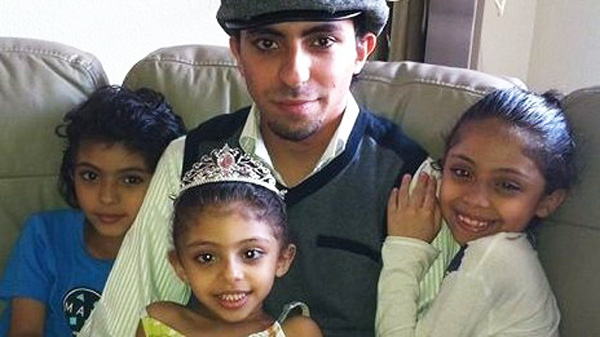
1106Raif Badawi and his children, before his 2012 arrest.

There was naivety in putting such thoughts in writing, as Badawi did, and drawing the attention of Saudi thought police. In another post, Badawi suggested, “Secularism respects everyone and does not offend anyone… Secularism is the practical solution to lift countries (including ours) out of the third world and into the first world.”

It appears Badawi wrote in the first blush of what seemed to have been a breath of fresh air, characterized as the “Arab Spring,” that wafted across the politically bleak landscape of the Arab world in early 2011. There had come news of a Tunisian vendor who had put lit himself on fire protesting police brutality, and had died as a result; his death sparked a movement against Arab despots.

The anguish of the Tunisian vendor, Mohammed Bouazizi, was genuine. His tragic death brought people into the streets, and the Tunisian strongman, Zine el-Abidine Ben Ali, eventually fled into exile in January 2011. The Tunisian protest stirred Egyptians to rise against their strongman, President Hosni Mubarak, and succeed in toppling him in February 2011.

The “Arab Spring,” for those brief few weeks in early 2011, held forth the promise of change for better across the Arab world. And young men like Raif Badawi could be forgiven for imagining that they, too, in Saudi Arabia, could no longer be denied freedom, democracy, and secularism — the accepted norms in the West.

But the hard realities of the Arab world turned the promise of the “Arab Spring” into the nightmare of religious terror and counter-terror. Saudi Arabia is the incubator and citadel of Islamic fascism, otherwise known as Wahhabism. And here in the land of the two holy cities of Islam — Mecca and Medina — religion and politics are inseparable, and anyone who trespasses either does so at the risk of losing his head — literally — in the public beheadings that are the hallmark of the Saudi kingdom.

Raif Badawi was arrested, and has been held in prison in Jeddah since June 2012. The arrest of Badawi and Souad al-Shammari came after they together set up the web site called Saudi Liberal Network. It was promptly closed by the authorities when Badawi posted criticism of the Saudi religious police.

The initial sentence for Badawi by the Criminal Court in Jeddah for mischief and subverting public order was for 600 lashes and seven years in prison. He appealed, and the court returned the verdict by raising the sentence to 1000 lashes and 10 years in prison. The Saudi supreme court has upheld this sentence.

In the interim Badawi was given 50 lashes in a Jeddah public square in January of this year, while further lashings were suspended on medical grounds. Badawi’s wife, Ensaf Haidar, fears the lashings will resume — according to court order the 1000 lashes are to be completed in 20 sessions in front of a mosque — and could be fatal for her husband.

* * *

There is very little the outside world can do to change the nature of the Saudi regime, or for that matter the regime in Iran, which is indistinguishable from the Saudi regime in terms of tyranny and the cruelty to which, in both countries, dissidents are subjected.

After Raif Badawi was arrested, Ensaf Haidar and her children found refuge in Quebec, Canada. Across Quebec there has been heartfelt popular support expressed for Raif Badawi, and condemnation of his punishment. Quebec has officially protested Badawi’s sentence, while demanding his release from Saudi Arabia so that he might join his family where they have settled.

In response to a Quebec National Assembly resolution, passed unanimously in February, condemning Badawi’s lashings in Jeddah in January 2015, the Saudi ambassador to Canada wrote a letter to the Quebec politicians. The same letter was also sent to the Canadian government in Ottawa.

The letter, signed by the Saudi ambassador, Naif Bin Bandir Alsudairy, was obtained by the Canadian Broadcasting Corporation (CBC). It states, “The Kingdom does not accept at all any attack on it in the name of human rights especially when its constitution is based on Islamic law, which guarantees the rights of humans and preserves his blood, money, honour and dignity.”

The stand taken by the Quebec government apparently rattled the Saudi kingdom sufficiently to have its ambassador write a letter addressed to members of a provincial legislature.

* * *

It is one of the anomalies of our age that when, by a fluke of nature, large deposits of fossil fuels are discovered in a country, as in Saudi Arabia, it is accorded attention and respect by other countries in excess of anything it has done, or achieved, or by the record of its conduct in human affairs.

Apart from the oil reserves of the kingdom, the House of Saud is indistinguishable from the House of Kim ruling North Korea, and it is as deserving of the same contempt.

Oil has not only made the difference for Saudi Arabia, it has also made the West complicit in the evil that Saudi Arabia does at home and perpetrates abroad: spreading its pre-modern and perverted culture as Islam or, more appropriately, Wahhabism; and funding terror as jihadism.

The treatment of Raif Badawi stands out, not merely for its cruelty, but how it has come to symbolize the grotesquely repulsive nature of the Saudi kingdom and what it represents behind the mask of religious austerity.

Saudi Arabia is possessed with the opposite of the “Midas touch”: wherever its money buys influence, there, the natural goodness in society is stained and corroded by its touch.

The tragedy surrounding Raif Badawi is both the savage treatment meted out to a young man by the Saudi regime for simply expressing his thoughts, and of how innocence, when it goes against the culture of Saudi intolerance, is mocked, abused, and strangled.

Raif Badawi is also the face of why “official” Islam — the one portrayed by Saudi Arabia and the other OIC member states, and to which the West routinely defers – is so terribly retarded. Freedom of thought is anathema to “official” Islam and its defenders, as it once was in the former Soviet Union; it is the defining characteristic of a closed, totalitarian society.

Raif Badawi is a young man, and the thoughts he expressed were the unsullied thoughts of the young that are at once universal in expectations and desires, as they are innocent and unburdened by the hardness of life’s experiences.

There was no insult of Islam, of the prophet, or of the Quran, in what Badawi wrote; and truth be told, God, Islam, and the prophet are all beyond insults, and beyond the reach of profanity that occasionally spills forth from the bigoted or tortured minds of individuals.

“Official” Islam is an insult to Muslims and non-Muslims alike — for “official” Islam is politics devoid of any redeeming quality found in faith, which nourishes the spiritual yearning of people and uplifts them in a broken world. Through betrayal and hypocrisy, “official” Islam insults God, Islam, and the prophet, every minute of each day, and has become a torment to Muslims.

It is “official” Islam, and Wahhabism in its most perverted expression among Sunni Muslims, that has turned God — Allah in Arabic — repeatedly invoked in the Quran as the “Most Beneficent, the Most Merciful,” into a vengeful and capricious deity.

The Quran states that on the Day of Reckoning the prophet will speak forth, “O my Lord! Lo! mine own folk make this Qur’an of no account” (25:30). In another verse, the Quran instructs the prophet to tell the wandering Arabs of the desert that they have merely submitted, but they have no belief “for the faith hath not yet entered into your hearts” (49:14). And then there is the verse stating categorically, “There is no compulsion in religion” (2:256).[1]

When religion is reduced to politics then it is the logic of politics, hence power and coercion, that takes precedence. In Albert Camus’s striking formulation, “Politics is not religion, or if it is, then it is nothing but the Inquisition.”[2] In Saudi Arabia, religion is a daily dose of inquisition, and the executioner with his sword is both the reality and the symbol of the vengeful deity that bears little resemblance to the merciful and compassionate God of the Quran.

Raif Badawi’s innocence betrayed him. Age and experience would have taught him the hard reality of his culture, veiled by the mask of “official” Islam. This hard reality of Arab culture has been best understood by Arab poets through the years of Arab and Muslim history. Here is one example of a poet’s disgust with the hard reality of his country’s culture and politics. These are lines from a poem of Nizar Qabbani (1923-98), a much-loved Syrian-Arab poet:

When a helmet becomes God in heaven
and can do what it wishes
with a citizen – crush, mash
kill and resurrect
whatever it wills,
then the state is a whorehouse,
history is a rag,
and thought is lower than boots.

When a breath of air
comes by decree
of the sultan,
when every grain of wheat we eat,
every drop of water we drink
comes only by decree
of the sultan,
when an entire nation turns into
a herd of cattle fed in the sultan’s
shed, embryos will suffocate
in the womb, women will miscarry
and the sun will drop
a black noose over our square.[3]

The Sultan’s power is vainglorious, whimsical, easily insulted, and secured by perpetrating fear, and the realm he rules by decree is by necessity a slaughterhouse.

If Raif Badawi survives the thousand lashes in the slaughterhouse that is the Kingdom of Saudi Arabia, it will be a testimony of how an individual’s courage, born of innocence, might well defy the Sultan’s decree.

Nothing could uplift the universal image of Saudi Arabia or King Salman more than if today he issued a pardon.

World leaders, including U.S. President Barack Obama, who has so far been silent on the issue, should immediately speak out — as should the media and human rights groups.

________________________

[1] Verses quoted from the Quran are from The Meaning of the Glorious Koran, translated by Mohammed Marmaduke Pickthall (New York: Alfred A. Knopf and Everyman’s Library, 1930, 1992).

[2] A. Camus, The Rebel (New York: Vintage Books, Random House, 1956), p. 302.

[3] Nizar Qabbani, “From The Actors” in Salma Khadra Jayyusi (editor), Modern Arabic Poetry: An Anthology (New York: Columbia University Press, 1987), pp. 378-379.

Nuclear Negotiations At An Impasse

June 11, 2015

Nuclear Negotiations At An Impasse, MEMRI, A. Savyon and Y. Carmon, June 11, 2015

Leader Khamenei Rejects Agreement Reached On Token Inspection Of Military Sites And Questioning Of Scientists; U.S. Willing To Close IAEA Dossier On Iranian PMD, To Settle For Inspecting Declared Nuclear Sites Only, And To Rely On Intelligence; EU Objects.

Introduction

This past week, members of Iran’s nuclear negotiating team revealed details about the Iran-U.S. nuclear negotiations. The negotiations were dealt a blow when Iranian Supreme Leader Ali Khamenei rejected an agreement reached by the two sides concerning a token inspection of military facilities and questioning of several nuclear scientists and “military personnel”; these were to be the response to the IAEA’s open dossier on possible military dimensions (PMD) of Iran’s nuclear program to which Iran has so far refused to respond.

Iranian reports on these developments show that in order to arrive at a comprehensive agreement, the U.S. is willing to forgo actual inspection of Iranian military facilities and to settle for inspection of declared nuclear facilities only, as set forth under the Additional Protocol, while the ongoing monitoring of Iran’s nuclear program will be left to intelligence elements.[1]

Thus, at this stage, there is a deadlock: Iran is refusing both to respond to the IAEA dossier on its PMD, and to allow actual inspection of facilities that are not declared nuclear facilities.

Furthermore, the EU has announced its objections to a comprehensive agreement with Iran in the absence of satisfactory answers from it regarding the IAEA dossier on its PMD. It said that the IAEA investigation of the PMD “will be essential” to a nuclear deal.[2] IAEA Director-General Yukio Amano has also linked the investigation of Iranian PMD to the attainment of such an agreement.

The Issue: Inspection Of Iranian Military Sites, Questioning Of Iranian Scientists

On May 25, 2015, in an Iranian television interview, Iranian Deputy Foreign Minister and head negotiator Abbas Araghchi disclosed that this issue had been agreed upon, but that when the Iranian team returned to Tehran for Khamenei’s approval, Khamenei had rejected this agreed solution out of hand (see MEMRI TV Clip No. 4928, Top Iranian Nuclear Negotiator Abbas Aragchi: We Reached Solution with P5+1 on Site Inspection, But Khamenei Rejected It, May 25, 2015 and Appendix I).[3]

It was evident also from Aragchi’s statements that after Khamenei rejected the agreed solution, Iran even reneged from what had been agreed as part of the Additional Protocol, and is now insisting that limitations and restrictions that are part of the Protocol be implemented in a way that will make future inspections difficult. As part of Iran’s backpedaling, Araghchi repeatedly emphasized that “so far, nothing has been concluded” regarding the issue of the inspections.[4]

U.S. Willingness To Disregard IAEA PMD Dossier

Statements by negotiating team member Hamid Baidinejad show that in return for willingness on Iran’s part to sign a comprehensive agreement, the U.S. was willing to forgo actual investigation of the IAEA’s open PMD dossier on Iran and instead to conduct a token inspection of military sites and questioning of Iranian nuclear scientists and military personnel. The U.S. asked Iran to carry out a number of specific steps, thereby paving the way to a comprehensive solution for this issue. These steps included inspections at several points in Iran, including two military facilities, and questioning several senior military officials and scientists (see Appendix II).

Iranian Negotiators’ Two Versions Of Events

An analysis of these statements by the Iranian negotiators shows that there are two different versions of what took place in the negotiations. According to Araghchi, the Iranian team agreed to the U.S.’s demand for a token inspection, but when the team returned to Tehran, Khamenei completely rejected this token inspection. Aragchi’s disclosure that the Iranian negotiators had arrived at an agreement with the Americans that was subsequently rejected by Khamenei caused an uproar in the Iranian political system, triggering harsh criticism against both the negotiators and the leaders of the pragmatic camp, and even leading to a public confrontation between Khamenei and pragmatic camp leader Hashemi Rafsanjani.[5]

The second version of events emerged after the uproar sparked by Aragchi’s revelations. Another negotiator, Baidinejad, in an attempt to correct Araghchi’s claim, stated that the Iranian negotiators had rejected the U.S. demands, even the demand for token inspection, but that the Americans had pressed them to present the demand to Khamenei anyway; when they did so, at the Americans’ urging, Khamenei rejected it outright.

Conclusion

Iran’s reneging on its consent to the U.S. demand for token inspections of its military facilities and questioning of some of its scientists and military personnel in exchange for the closing of the IAEA’s PMD dossier on it places President Obama in a difficult situation, and brings the negotiations to an impasse. This is because along with Khamenei’s rejection, the EU and the IAEA director-general both oppose closing Iran’s dossier in order to arrive at a comprehensive agreement.

It was apparently under these circumstances that CIA director John Brennan was secretly dispatched in early June to Israel, in order to persuade Israel, and, via Israel, the EU, that intelligence monitoring of any Iranian PMD was a satisfactory solution and that actual investigation of the PMD, which Khamenei rejected, could be waived. To this end, Brennan also underlined,on May 31, 2015 on CBS’s Face the Nation, the close U.S.-Israel security cooperation.[6]

In light of this situation, Iranian Foreign Minister Javad Zarif said on May 31, 2015 that with regard to inspection, “other solutions must be discussed.”[7]

Appendix I: Aragchi’s Version Of Events

In an interview that aired May 25, 2015 on Iran’s Channel 2 TV,Araqchi said [8]: “[Our] red lines may change under certain circumstances. This is another issue. We may change some of our red lines for a certain period of time. This is not a problem. The [leader] will give us new instructions, and the team will act accordingly. We have acted within this framework, and we will do so in the future. We will not let ourselves go beyond this framework…

“The Additional Protocol, which is the internationally accepted [control] regime, was not a red line for us. As I said before, our [negotiating] team does not determine those red lines. From the very beginning – and given that the Additional Protocol is [internationally] accepted – we were given permission to accept it during the negotiations. So far, it has not been accepted – we do not have an agreement yet – but it is one of the issues that the negotiating team has been given instructions to accept. As I said, the red lines may or may not be changed in due course, and the Additional Protocol may or may not be accepted at some point, but so far, this has not happened, and our instructions have not changed…

“If the military officials, the relevant officials, the Iranian parliament or the council appointed by Khamenei reach the conclusion that the access provided for in the Additional Protocol comes under the same category as the inspections that Khamenei banned, we will obey and will categorically not allow ‘managed access…’

“The ‘Possible Military Dimension’ [PMD] has always been a strong pretext for the [West]. We have to take this pretext away from them. We have created conditions that will enable us, within the framework of reaching the final nuclear agreement, to resolve the issue of PMD. This is possible now. In the negotiations, we discussed and reached several possible solutions, but these were not accepted in Tehran. These include [allowing the IAEA] to interview several [nuclear scientists], and allowing access to several facilities. They gave us a list and said: ‘If you let us have access to these people and these facilities, we will end the issue of PMD.’ This, however, was not accepted by Tehran, and Khamenei decisively and courageously rejected it..”

Appendix II: Baidinejad’s Version Of Events

In June 1, 2015 statements on his Instagram account that were quoted by the Iranian news agency Fars, negotiating team member Hamid Baidinejad said:[9] “One of the first principles agreed upon, already at the start of the Iran-P5+1 negotiations, was that in a future nuclear agreement, Iran would implement the Additional Protocol on a temporary and voluntary basis until the Majlis decides whether to ratify it and takes into account the other side’s implementation of its obligations…

“It is natural that after a comprehensive nuclear agreement is signed, Iran would be expected to revert to its previous decision – that is, temporarily and voluntarily implementing the Additional Protocol… Without the implementation of the Additional Protocol, even if it is on a temporary basis, the IAEA will not be able to confirm that Iran’s nuclear program is civilian, and that would mean that the process for resolving the nuclear issue will have failed…

“In no way does the Additional Protocol include a clause regarding an obligation on the part of the member states to agree to inspection of their military facilities or investigation of their nuclear scientists. The only thing that the Additional Protocol does make possible is controlled access to non-nuclear facilities, for taking [soil] samples for proving that there is no nuclear activity at facilities that are not declared [to be nuclear sites]…

“Should there be evidence of nuclear material at undeclared sites, whether they are military or civilian, the IAEA will be able to demand controlled access to them [but] only by means of a specific procedure already set out, so that an [Additional Protocol] member state will agree to the sampling in order to prove that it is not conducting nuclear activity in undeclared facilities…

“The Additional Protocol is not a special agreement between the international community and Iran; it is an important international document. Over 120 states are currently members of this protocol, and some have signed it and implemented it temporarily. Therefore, the attempt to interpret it in a way that will include an obligation on the part of [member]states to undergo inspection at [their] military facilities or to allow investigation of [their] nuclear scientists is completely mistaken…

“The discussion on the issue of [Iran’s] PMD, [that is,] Western countries’ claim that Iran has a military nuclear program for producing nuclear weapons, is historically rooted in the years prior to 2003. In recent years, U.S. and Western intelligence services have said that before 2003, Iran’s military wing – commanded by specific commanders in the country – engaged in an extensive clandestine project for producing nuclear weapons. To prove their mistaken claim, [the West] presented intelligence based on their intelligence agencies; however, Iran considers all this intelligence [data] to be faked… There is no doubt that these false accusations against Iran can only be resolved with a political agreement. Discussion of this issue, no matter how lengthy, will not remove these accusations…

“[That is why] the Iranian negotiating team proposed during the talks that Iran and the P5+1 resolve this issue, because they [i.e. the P5+1] would like, along with reaching an agreement, that the issue of the accusations [that Iran] attempted to obtain nuclear weapons will be resolved. They proposed that Iran take several specific steps and thus pave the way to a comprehensive solution to the issue… Iran announced that it considers this dossier faked… But an agreement on it depends on what steps Iran will be asked to take [in order to close the dossier]. They announced that they will discuss the issue on level of the P5+1 [alone] because of its special sensitivity, and will submit their final opinion to Iran at the appropriate time.

“In the round [of talks] that preceded the [April 2015] press release in Lausanne, the P5+1 countries presented Iran with a program that includes inspection at a few points, including two military facilities, and questioning of several senior military officials and nuclear experts whose names were noted in the IAEA reports both directly and indirectly. They claimed that [if they] were allowed access to these sites, and the IAEA was permitted to question these people, that would be the end of the matter of the [PMD] accusations against Iran. As soon as this insulting proposal was raised, Iran rejected it unequivocally… At the same time, the P5+1 asked the Iranian representatives to present the P5+1’s opinion to officials in Iran, despite their express opposition, [for the officials’ approval].

“Leader [Khamenei’s] harsh response rejecting the demand by these countries to inspect military facilities and question nuclear scientists was a completely correct and accurate response. The nuclear negotiations team is proud of having expressed the exact same position [as Khamenei] three months ago, thanks to its complete grasp of the position of the regime and of the leader… Unfortunately, there were some in Iran who were not updated on the details of this issue… and instead of praising the Iranian negotiating team, took the opportunity, while being unaware of the process by which the issue was brought up for discussion – which was reported in full to top regime officials – to launch extremely harsh attacks on the Iranian negotiating team, to plan protests, and to demand a halt to the negotiations…

“These objections and accusations will not last long, but airing these concerns to public opinion can cast doubt on the regime’s main institutions. Everyone is expected to understand Iran’s critical circumstances, and, in this Year of Empathy Between the Government and the People they must join hands in defending Iran’s basic principles and rights and must unite with senior officials in order to efficiently promote the sensitive stage of the nuclear negotiations under the guidance of top senior officials in the regime of the Islamic Republic – and especially by Leader [Khamenei] who is very closely overseeing the negotiations. This way, if an agreement is reached, it will guarantee the preservation of the great Iranian nation’s basic principles.”

Endnotes:

[1] Under the Additional Protocol, the clarification of PMDs at facilities that are not declared nuclear facilities is subject to the consent of the member state under investigation; thus, such sites in fact cannot be inspected.

[2] AP, June 8 2015.

[3] In the interview, Aragchi said that the NPT’s Additional Protocol was not a red line for the Iranian team, and that the team had in fact beeninstructed to accept it. He explained that Iran could always harden its position on these issues. See MEMRI TV Clip No. 4928, “Top Iranian Nuclear Negotiator Abbas Araqchi: We Reached Solution with P5+1 on Site Inspection, But Khamenei Rejected It,” May 25, 2015. It should be mentioned that under former Iranian president Mahmoud Ahmadinejad, IAEA questioning of Iranian scientists was permitted, and two visits to theParchin military facility were allowed. The Iranian team’s acceptance of this demand by the international community was presumably based on this precedent.

[4] Irib (Iran), June 4, 2014.

[5] Senior figures in Iran’s ideological camp hastened to obscure Araghchi’s statements, and to correct them. Majlis speaker for national security affairs Alaa Al-Boroujerdi stated that Aragchi’s words were untrue, and added: “Aragchi only discussed the major issues, and did not say that Iran had consented to inspection of military facilities… Khamenei announced that we will not allow any talks with Iranian scientists, after he noticed that we were under threat by terrorists. The arrest of several who murdered our nuclear scientists revealed that these [perpetrators] were linked to the Mossad. We have red lines, and we will implement them. ISNA, Iran, May 25, 2015. The Javandaily, which is affiliated with Iran’s Islamic Revolutionary Guards Corps (IRGC), also denied Aragchi’s statements regarding the red lines: “In a television interview, top Iranian negotiation [Aragchi] referred to a particular point, and this issue should be addressed. He said: ‘…Perhaps under certain conditions our red lines will change, and the work [of the negotiations] will proceed according to instructions.’ This declaration regarding the possibility of changes to the red lines under certain circumstances is mistaken, for several reasons… As is evident from their names, the red lines are borders that define the basic framework of the negotiations, and without them the negotiations will reach undesirable and unexpected results.” Javanalso warned the Iranian negotiating team about deviating from the red lines: “The Iranian nation supports its negotiating team as long as it operates to realize its rights in the framework of the national interests and preserves national honor. Any withdrawal from this basis, and acceptance of being forced into humiliation by the enemy side, will be met with a popular response from the nation, and will undoubtedly go down in history as a dark and negative point.” Javan, Iran, May 26, 2015. A new website affiliated with the extremist ideological camp called on May 26, 2015 on Khamenei to fire Foreign Minister Zarif and his negotiating team for their “American tendencies.” Amanpress.ir, May 26, 2015.

[6] Haaretz (Israel), June 9, 2015.

[7] Mehr (Iran), May 31, 2015.

[8] See MEMRI TV Clip No. 4928, Top Iranian Nuclear Negotiator Abbas Aragchi: We Reached Solution with P5+1 on Site Inspection, But Khamenei Rejected It, May 25, 2015.

[9] Fars (Iran), June 1, 2015.

North Korea’s Serious New Nuclear Missile Threat

June 11, 2015

North Korea’s Serious New Nuclear Missile Threat, The Gatestone InstitutePeter Huessy, June 11, 2015

China . . . seems to want to curry favor with Iran because of its vast oil and gas supplies, as well as to use North Korea to sell and transfer nuclear technology to both North Korea and Iran, as well as other states such as Pakistan. As Reed again explains, “China has catered to the nuclear ambitions of the Iranian ayatollahs in a blatant attempt to secure an ongoing supply of oil”.

***********************

  • China continues to transfer, through its own territory, nuclear weapons technology involving both North Korea and Iran.
  • In April, North Korea launched a ballistic missile from a submerged platform. The North Korean underwater launch test was closely related to the further development of a missile-firing submarine capable of hitting the U.S. — “a first step,” according to Uzi Rubin, “in achieving a very serious and dangerous new military capability… it will take many years to build up the missile defenses, so we had better use the time wisely.”
  • Although the Chinese profess to be against nuclear proliferation, documented evidence illustrates just the opposite — as a means of asserting Chinese hegemony, complicating American security policy and undermining American influence.
  • Unfortunately, no matter how attractive a strategy of diplomatically ending North Korea’s nuclear program might look, it is painfully at odds with China’s established record of supporting nuclear proliferation with such collapsed or rogue states as Iran, Syria, Pakistan, North Korea and Libya.
  • China’s nuclear assistance to Pakistan did not stay just in Pakistan.

North Korea appears to have made significant progress in extending its capability as a nuclear-armed rogue nation, to where its missiles may become capable of hitting American cities with little or no warning.

What new evidence makes such a threat compelling?

North Korea claims to have nuclear warheads small enough to fit on their ballistic missiles andmissiles capable of being launched from a submerged platform such as a submarine.

Shortly after North Korea’s April 22, 2015 missile test, which heightened international concern about the military capabilities of North Korea, U.S. Secretary of State John Kerry urged China and our regional allies to restart the 2003 “six-party talks” aimed at eliminating nuclear weapons from the Korean peninsula and reining in North Korea’s expanding nuclear missile program.

There are some “experts,” however, who believe that North Korea’s threat is highly exaggerated and poses no immediate danger to the United States. Consequently, many believe that, given China’s oft-repeated support for a “nuclear weapons free” Korean peninsula, time is on America’s side to get an agreement that will guarantee just such a full de-nuclearization.

But, if North Korea’s technical advances are substantive, its missiles, armed with small nuclear weapons, might soon be able to reach the continental United States — not just Hawaii and Alaska. Further, if such missile threats were to come from submarines near the U.S., North Korea would be able to launch a surprise nuclear-armed missile attack on an American city. In this view, time is not on the side of the U.S. Submarine-launched missiles come without a “return address” to indicate what country or terrorist organization fired the missile.

The implications for American security do not stop there. As North Korea is Iran’s primary missile-development partner, whatever North Korea can do with its missiles and nuclear warheads, Iran will presumably be able to do as well. One can assume the arrangement is reciprocal.

Given recent warnings that North Korea may have upwards of 20 nuclear warheads, the United States seems to be facing a critical new danger. Would renewed negotiations with China, Japan, South Korea and North Korea really be able to address this threat?

Two years ago, Andrew Tarantola and Brian Barrett said there was “no reason to panic;” that North Korea was “a long way off” — in fact “years” — before its missiles and nuclear weapons could be “put together in any meaningful way.”

At the same time, in April 2013, an official U.S. assessment by the Defense Intelligence Agency stated the U.S. had “moderate” confidence that “North Korea had indeed developed a nuclear device small enough to mount on a ballistic missile.”

That was followed up two years later, on April 7, 2015, when the commander of Northcom, Admiral Bill Gortney, one of the nation’s leading homeland security defenders, said the threat was considerably more serious. He noted that, “North Korea has deployed its new road-mobile KN-08 intercontinental ballistic missile and was capable of mounting a miniaturized nuclear warhead on it.”[1]

At a Pentagon press briefing in April, Admiral Cecil Haney, Commander of the US Strategic Command and America’s senior military expert on nuclear deterrence and missile defense, said it was important to take seriously reports that North Korea can now make small nuclear warheads and put them on their ballistic missiles.[2]

And sure enough, in April, North Korea launched a ballistic missile from a submerged platform. Media reaction to the North Korean test has been confused. Reuters, citing the analysis of two German “experts,” claimed the North Korean test was fake — a not-too-clever manipulation of video images.

The Wall Street Journal, on May 21, 2015, echoed this view, noting: “[F]or evidence of North Korea’s bending of reality to drum up fears about its military prowess,” one need look no further than a consensus that North Korea “doctored” pictures of an alleged missile test from a submarine. This, they claimed, was proof that the “technology developments” by North Korea were nothing more than elaborately faked fairy tales.

However, Israeli missile defense expert Uzi Rubin — widely known as the “father” of Israel’s successful Arrow missile defense program — explained to this author that previous North Korean missile developments, which have often been dismissed as nothing more than mocked-up missiles made of plywood, actually turned out to be the real thing — findings confirmed by subsequent intelligence assessments.

Rubin, as well as the South Korean Defense Ministry, insist that on April 22, the North Korean military did, in fact, launch a missile from a submerged platform.[3]
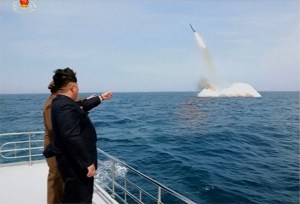
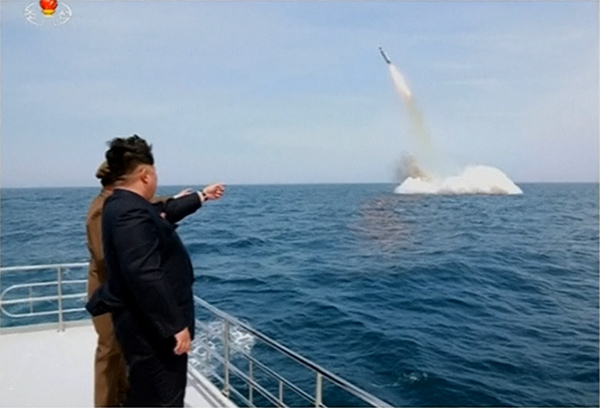
1104Kim Jong Un, the “Supreme Leader” of North Korea, supervises the April 22 test-launch of a missile from a submerged platform. (Image source: KCNA)

What gave the “faked” test story some prominence were the misunderstood remarks of the Vice Chairman of the Joint Chiefs of Staff, Admiral James Winnefeld. He had said, on May 19, that the North Korean missile launch was “not all” that North Korea said it was. He also mentioned that North Korea used clever video editors to “crop” the missile test-launch images. Apparently, that was exactly what the editors did. The Admiral, however, never claimed in his speech at the Center for Strategic and International Studies there had been no successful missile test.[4]

The same day, a high-ranking State Department official, Frank Rose — Assistant Secretary of State for Arms Control, Verification, and Compliance — told a Korean security seminar on Capitol Hill that North Korea had successfully conducted a “missile ejection” test, but from an underwater barge rather than a submarine.[5]

To confuse matters further, additional pictures were released by the South Korean media to illustrate stories about the North Korean test. Those pictures, however, were of American missiles, which use both solid and liquid propellant; as a result, one photo showed a U.S. missile with a solid propellant smoke trail and one, from a liquid propellant, without a smoke trail. These photographs apparently befuddled Reuters’ “experts,” who may have jumped to the conclusion that the photos of the North Korean test were “faked,” when they were simply of entirely different missile tests, and had been used only to “illustrate” ocean-going missile launches and not the actual North Korean test.[6]

According to Uzi Rubin, to achieve the capability to eject a missile from an underwater platform is a significant technological advancement. The accomplishment again illustrates “that rogue states such as North Korea can achieve military capabilities which pose a notable threat to the United States and its allies.”

Rubin also stated that the North Korean underwater launch test was closely related to the development of a missile-firing submarine, “a first step in achieving a very serious and dangerous new military capability.”[7]

Admiral Winnefeld and Secretary Rose, in their remarks, confirmed that the North Korean test was not the “dog and pony show” some have claimed. In other words, the U.S. government has officially confirmed that the North Koreans have made a serious step toward producing a sea-launched ballistic missile capability.

While such an operational capability may be “years away,” Rubin warns that “even many years eventually pass, and it will also take many years to build up the missile defenses, so we had better use the time wisely.”[8]

Will diplomacy succeed in stopping the North Korean threats? U.S. Secretary of State John Kerry seemed to think it worth a try; so he began the push to restart the old 2003 “six-party” talks between the United States, North Korea, Russia, China, South Korea and Japan, to bring North Korea’s nuclear weapons under some kind of international control and eventual elimination.

After all, supporters of such talks claim, similar talks with Iran appear to be leading to some kind of “deal” with Tehran, to corral its nuclear weapons program, so why not duplicate that effort and bring North Korea back into the non-nuclear fold?

What such a “deal,” if any, with Iran, will contain, is at this point unknown. Celebrations definitely seem premature. If the “deal” with North Korea is as “successful” as the P5+1’s efforts to rein in Iran’s illegal nuclear weapons program, the prognosis for the success of diplomacy could scarcely be more troubling.

Bloomberg’s defense writer, Tony Carpaccio, reflecting Washington’s conventional wisdom, recently wrote that of course China will rein in North Korea’s nuclear program: “What might be a bigger preventative will be the protestations of China, North Korea’s primary trade partner and only prominent international ally. Making China angry would put an already deeply impoverished, isolated North Korea in even more dire straits.”

Unfortunately, no matter how attractive a strategy of diplomatically ending North Korea’s nuclear program might look on the surface, it is painfully at odds with China’s established and documented track record in supporting and carrying out nuclear proliferation with such collapsed or rogue states as Iran, Syria, Pakistan, North Korea and Libya, as detailed by the 2009 book The Nuclear Express, by Tom C. Reed (former Secretary of the Air Force under President Gerald Ford and Special Assistant to the President of National Security Affairs during the Ronald Reagan administration) and Daniel Stillman (former Director of the Lawrence Livermore National Laboratory).

Far from being a potential partner in seeking a non-nuclear Korean peninsula, China, say the authors, has been and is actually actively pushing the spread of nuclear weapons to rogue states, as a means of asserting Chinese hegemony, complicating American security policy and undermining American influence.

The problem is not that China has little influence with North Korea, as China’s leadership repeatedly claims. The problem is that China has no interest in pushing North Korea away from its nuclear weapons path because the North Korean nuclear program serves China’s geostrategic purposes.

As Reed and Stillman write, “China has been using North Korea as the re-transfer point for the sale of nuclear and missile technology to Iran, Syria, Pakistan, Libya and Yemen”. They explain, “Chinese and North Korean military officers were in close communication prior to North Korea’s missile tests of 1998 and 2006”.

Thus, if China takes action to curtail North Korea’s nuclear program, China will likely be under pressure from the United States and its allies to take similar action against Iran and vice versa. China, however, seems to want to curry favor with Iran because of its vast oil and gas supplies, as well as to use North Korea to sell and transfer nuclear technology to both North Korea and Iran, as well as other states such as Pakistan. As Reed again explains, “China has catered to the nuclear ambitions of the Iranian ayatollahs in a blatant attempt to secure an ongoing supply of oil”.

North Korea is a partner with Iran in the missile and nuclear weapons development business, as Uzi Rubin has long documented. Thus, it is reasonable to believe that China may see any curtailment of North Korea’s nuclear program as also curtailing Iran’s access to the same nuclear technology being supplied by North Korea. Any curtailment would also harm the Chinese nuclear sales business to Iran and North Korea, especially if China continues to use the “North Korea to Iran route” as an indirect means of selling its own nuclear expertise and technology to Iran.

It is not as if Chinese nuclear proliferation is a recent development or a “one of a kind” activity. As far back as 1982, China gave nuclear warhead blueprints to Pakistan, according to Reed. These findings indicate that China’s nuclear weapons proliferation activities are over three decades old.[9]

Reed and Stillman also note that nearly a decade later, China tested a nuclear bomb “for Pakistan” on May 26, 1990, and that documents discovered in Libya when the George W. Bush administration shut down Libyan leader Muammar Kaddafi’s nuclear program revealed that China gave Pakistan the CHIC-4 nuclear weapon design.

Unfortunately, China’s nuclear assistance to Pakistan did not stay just in Pakistan. The nuclear technology made its way from Pakistan to North Korea. For example, high explosive craters, construction of a 50 megawatt nuclear reactor (finished in 1986) and a secret reprocessing facility begun in 1987 all were done in North Korea with major Pakistani help from the A.Q. Khan “Nukes R Us” smuggling group, as Reed and Stillman document in their book.

Reed and Stillman write that when, amid disclosures in 2003 of a major Libyan nuclear weapons program, the U.S. government sought help in shutting down the Khan nuclear smuggling ring, “Chinese authorities were totally unhelpful, to the point of stonewalling any investigation into Libya’s nuclear supply network.”

More recently, Chinese companies have now twice — in 2009 and 2011 — been indicted by the Attorney for the City of New York for trying to provide Iran with nuclear weapons technology.

The indictments document that Chinese companies were selling Iran steel for nuclear centrifuges and other banned technology. A leaked State Department cable, discussing the indictments at the time, revealed “details on China’s role as a supplier of materials for Iran’s nuclear program,” and that “China helped North Korea ship goods to Iran through Chinese airports.”

And more recently, in April 2015, the Czech government interdicted additional nuclear technology destined for Iran — the origin of which remains unknown — in violation of current sanctions against Iran.

From 1982 through at least the first part of 2015, the accumulation of documentary evidence on nuclear proliferation reveals two key facts:

First, despite literally hundreds of denials by Iran that it is seeking nuclear weapons, and amid current negotiations to end Iran’s pursuit of nuclear weapons, there is solid evidence that Iran still seeks nuclear weapons technology; and that North Korea has nuclear weapons and is advancing their capability.

Second, China continues to transfer, through its own territory, nuclear weapons technology involving both North Korea and Iran.

Although the Chinese profess to be against nuclear proliferation, their track record from the documented evidence illustrates just the opposite.

In summary, it is obvious North Korea’s nuclear weapons and ballistic missiles are a serious threat to America and its allies. And China, from its proliferation record for the past three decades, is making such a threat more widespread.

In this light, is dismissing North Korea’s advances in military technology and ignoring China’s record of advancing its neighbors’ nuclear weapons technology really best for U.S. interests?

_______________________

[1] The Washington Post, May 20, 2015, Anna Fifield, “North Korea says it has technology to make mini-nuclear weapons“; and Admiral Bill Gortney, US NORAD Commander, quoted in “NORAD commander: North Korean KN-08 Missile Operational“, by Jon Harper, in “Stars and Stripes”, of April 7, 2015; the Admiral said: “Our assessment is that they have the ability to put a nuclear weapon on a KN-08 and shoot it at the homeland.” He said “Yes sir” when asked if the U.S. thinks North Korea has succeeded in the complicated task of miniaturizing a warhead for use on such a missile. North Korea has conducted three nuclear tests since 2006.

[2] Department of Defense Press Briefing by Admiral Cecil Haney, Commander, U.S. Strategic Command, March 24, 2015.

[3] Personal communication with Uzi Rubin, President of Rubincon, May 21, 2015.

[4] Admiral James Winnefeld, Remarks at the Center for Strategic and International Studies (CSIS) Briefing on Missile Defense, May 20, 2015.

[5] U.S. Department of State, Daily Digest Bulletin, Frank Rose, Remarks on “Missile Defense and the U.S. Response to the North Korean Ballistic Missile and WMD Threat”, May 20, 2015.

[6] Explanation provided by Israel missile expert Uzi Rubin, personal communication, May 20, 2015.

[7] Ibid.

[8] Ibid.

[9] According to Reed and Stillman, in “The Nuclear Express,” none of China’s nuclear help to Pakistan and Iran could have been possible without China’s transfer of the nuclear technology through Chinese airspace.

Iran satellite launches tied to ballistic missile program, UN experts say

June 10, 2015

Iran satellite launches tied to ballistic missile program, UN experts say, Fox News, June 10, 2015

Both of those actions, the majority concluded in 2012, were violations of U.N. sanctions resolutions that explicitly forbade any Iranian activity “related to ballistic missiles capable of delivering nuclear weapons, including launches using ballistic missile technology.”

The experts’ more diffident reference to Iran’s renewed program of  launches over the next year gives Iran much greater benefit of the doubt this time.

***************

EXCLUSIVE: Iran has launched a space satellite using  technology that could “contribute to” the development of a ballistic missile capable of delivering nuclear weapons, according to a United Nations-appointed panel of experts monitoring the issue.

Tehran intends to launch more such satellites,  the panel said.

The most recent  launch came last February 15, the experts noted, adding that the Iranian government has already announced plans to conduct three additional satellite launches before March 2016.

The vehicle used in the February launch—from a military base in northern Iran– was based on a “space launch vehicle” that is  variant of Iran’s Shahab-3 ballistic missile, which has a range of about 1,000 miles. The Shahab-3 is one of two Iranian missiles that the experts say  “are believed to be potentially capable of delivery of nuclear weapons.”

The experts noted that the future satellites will be boosted aloft “from more powerful launchers and on the back of bigger carriers.”

Iran’s missile development—peaceful or not– is one of the murkier and more contentious  issues surrounding the ongoing negotiations between the Islamic Republic and the world’s major powers—precisely because ballistic missiles have been shunted to the side of a  potential deal centered on nuclear enrichment activities that the Obama Administration is pushing hard to conclude by June 30.

U.N. Security Council resolutions that have sanctioned Iran for its nuclear weapons development have also banned Iranian work on ballistic missile programs that could deliver the weapons. But missiles were not mentioned in the interim deal between Iran and the P5+1 powers struck last November, which has so far unfrozen billions in Iranian assets and which is supposed to be turned into a final agreement by June 30.

Last year, Supreme Leader Ayatollah Ali Khamenei called  any Western expectations that Iran would restrain its missile development program “stupid and idiotic,” and called for the country to mass produce such weapons.

Even so, a 7-member U.N. expert panel which is monitoring Iran’s behavior on the proliferation issue while negotiations continue noted in its June 1, 2015 report that Iran’s officials and news media “have not been reporting any new ballistic missile developments” such as the “unveiling or testing of new types of ballistic missiles,” or tests of medium-range missiles it is already known to possess.

Satellite  launches, however,  are another matter. The experts noted that the February 15 satellite payload weighed 110 lbs. and was designed for “collecting imagery.” It was only a limited success:  the satellite fell back into the earth’s atmosphere after just 23 days, even though it was apparently intended to stay aloft for 18 months.

CLICK HERE FOR THE EXPERT REPORT

Nonetheless, the experts added, it was Iran’s first satellite launch since two failures in 2012. They also observed cryptically that “the details of this case present similarities with the launch of another satellite by a Safir space launch vehicle in 2011” and  analyzed in one of their  previous reports.

And according to that earlier document, a majority of the expert panel concluded that “the satellite launch was related to ballistic missiles capable of delivering nuclear weapons,” and the Safir satellite launch vehicle itself “made use of ballistic missile technology.”

Both of those actions, the majority concluded in 2012, were violations of U.N. sanctions resolutions that explicitly forbade any Iranian activity “related to ballistic missiles capable of delivering nuclear weapons, including launches using ballistic missile technology.”

CLICK HERE FOR THE 2012 REPORT

The experts’ more diffident reference to Iran’s renewed program of  launches over the next year gives Iran much greater benefit of the doubt this time.

The UN’s Anti-Israel Children and Armed Conflict Report

June 10, 2015

The UN’s Anti-Israel Children and Armed Conflict Report, Front Page Magazine, June 10, 2015

(Please see also, Legal Experts Slam IDF for Over-Warning Gazans. — DM)

UN_Secretary-General_Ban_Ki-moon_-_Flickr_-_The_Official_CTBTO_Photostream_13-431x350

According to the New York Times, citing unnamed diplomats, United Nations Secretary General Ban Ki-moon bowed to “unusual pressure from Israel and the United States” in deciding not to include either Israel or Hamas on a list of “armies and guerilla groups that kill and maim children in conflicts worldwide.” The list is included in an annex to an annual report by the Secretary General entitled “Children and armed conflict,” which he just released for 2015. The list, as its title states, is intended to identify specifically the entities that “recruit or use children, kill or maim children, commit rape and other forms of sexual violence against children, or engage in attacks on schools and/or hospitals in situations of armed conflict.”

Ban Ki-moon considered the recommendation of his special representative for children and armed conflict, Leila Zerrougui, to include both Israel and Hamas on this list as a reflection of their actions and the deadly consequences to children arising from the Gaza conflict last summer. The list already includes such Islamic jihad terrorist groups as the Islamic State, the al-Nusra Front, Boko Haram, the Taliban, Al Shabaaba, Al-Qaida in the Arab Peninsula and the Houthis, as well as government forces of the Syrian regime, Yemen, Sudan and Afghanistan.

While the Secretary General rejected his special representative’s recommendation, leaving both the terrorist jihadist group Hamas and Israel off the list in a display of moral equivalence, the body of the report is far more condemnatory of Israel than of Hamas or other Palestinian militants. There were more than three times as many paragraphs devoted to alleged Israeli violations of children’s rights relating to the Gaza war than devoted to the actions of Hamas or other Palestinian terrorists. When there was any criticism of Palestinian actions, it was stated in the mildest of terms. Israel, on the other hand, received the full brunt of the Secretary General’s censure:

“I am deeply alarmed at the extent of grave violations suffered by children as a result of Israeli military operations in 2014. The unprecedented and unacceptable scale of the impact on children in 2014 raises grave concerns about Israel’s compliance with international humanitarian law, notably the principles of distinction, proportionality and precaution in attack, and respect for international human rights law, particularly in relation to excessive use of force.” (Paragraph 110)

Nevertheless, Riyad Mansour, Permanent Observer of the State of Palestine to the United Nations, was not satisfied. He issued a blistering statement declaring that “It is without doubt that Israel, the occupying Power, flagrantly, systematically and grossly commits human rights violations against Palestinian children constituting grave violations that qualify it for such a listing in the annex to the Annual Report on Children and Armed Conflict. The UN’s inaction, submitting to the inordinate pressures exerted, sends a most regrettable signal that the same criteria do not apply in all situations for all children, undermining the credibility of the UN system as a whole…”

As usual, Mr. Mansour stands the truth on its head. Indeed, Ban Ki-moon should have accepted his special representative’s recommendation to include Hamas on the annex list. Hamas and its other jihadist allies, not Israel, belong on the list alongside their Islamic State and al Qaeda brethren. They use children as human shields, deliberately store weapons in schools, homes hospitals and mosques where they know children are likely to be, and recruit children for jihad including the establishment of youth military training camps. They prepare children for the glory of martyrdom, extolling the virtues of suicide bombings that kill Jews.

Ban Ki-moon properly rejected his special representative’s recommendation to include Israel on the annex list. Israel does not belong on the same list as non-state and state entities that deliberately kill children with abandon, recruit children as soldiers, abduct and rape little girls, and kill their parents before their very eyes. To the contrary, the Israeli armed forces took great pains to minimize civilian casualties. It took the unprecedented step of warning civilians in advance of impending attacks on facilities that Hamas was using as launching pads from which to fire rockets at Israeli population centers and from which they were building their terrorist tunnels to sneak their fighters into Israel for the purpose of killing Israeli civilians, including women and children.

However, putting the annex list aside, Mr. Mansour should have been happy that the Secretary General reflected the institutional bias of the United Nations against Israel in the body of his report. In a crucial paragraph urging corrective actions to remedy the report’s catalogue of alleged violation of children’s rights – mostly said to be committed by Israel – the report focused solely on what Israel should do:

“I urge Israel to take concrete and immediate steps, including by reviewing existing policies and practices, to protect children, to prevent the killing and maiming of children, and to respect the special protections afforded to schools and hospitals. An essential measure in this regard is ensuring accountability for perpetrators of alleged violations. I further urge Israel to engage in a dialogue with my Special Representative and the United Nations to ensure that there is no recurrence in grave violations against children.” (Paragraph 111)

As usual, nothing is asked of the Palestinians. They are not urged to stop storing weapons in schools and hospitals. They are not asked “to protect children, to prevent the killing and maiming of children,” which they could begin to do by not using children as human shields, and not deliberately conducting rocket attacks against Israeli civilians including children and conducting other military activities from areas where they know Palestinian children are likely to be. They are not asked to close the youth military training camps or stop the online propaganda that indoctrinates Palestinian children into believing that martyrdom through jihad against Jews is the way to paradise.

We should not be surprised. Such anti-Israel bias is par for the course at the United Nations. Its Human Rights Council passes more resolutions condemning Israel than all of the other 192 member states combined. The Human Rights Council’s agenda item 7 requires that Israel’s – and only Israel’s – record of human rights be debated at every session. Investigations launched by the Human Rights Council and the UN Secretary General of alleged human rights and other international law violations in Gaza during the repeated wars there initiated by Hamas’s terrorist attacks against Israeli civilians are blatantly one-sided against Israel.

Israel was the only country in the world to be named as a violator of “health rights” during the UN World Health Organization’s annual assembly in May 2015. Never mind about Syria, Iran, Iraq, Libya, or North Korea where basic medical care and health services are scarce, if existent at all. Israel facilitates the delivery of humanitarian aid and takes care of the sick and injured, whether they be Palestinians or not. The Syrian regime prevents humanitarian aid including medical supplies from reaching besieged civilians, including Palestinian children trapped in Yarmouk. Yet the World Health Organization chose to ignore all this and adopt a resolution focusing solely on health conditions in the occupied Palestinian territory, including East Jerusalem, and in the Golan Heights, for which Israel is held responsible.

The UN Commission on the Status of Women, whose latest annual meeting concluded on March 20, 2015, marched to the same anti-Israel tune. The only country it condemned for its women’s rights record was Israel, presumably because of its alleged treatment of Palestinian women.

“If anyone had any doubt that there was demonization of Israel at the United Nations, here is the entire truth before our eyes,” said Israel’s Ambassador to the UN, Ron Prosor. “There are 193 member states in the UN, and they include countries that butcher men and women, jail both male and female journalists, execute female oppositionists and legislate laws against women. All of these countries receive immunity in the UN. The UN Commission on the Status of Women is itself comprised of some of the worst violators of women’s rights, including Iran and Sudan, two of the more moderate members by comparison.”

Every day it seems that there is new proof of the demonization and attempts to delegitimize the Jewish state of Israel at the United Nations. Secretary General Ban Ki-moon’s report on “children and armed conflict” is but the latest example. There will certainly be more to come.