Posted tagged ‘Foreign Policy’

CAIR, Awad Continue Aggressively Shilling for Turkey

September 10, 2016

CAIR, Awad Continue Aggressively Shilling for Turkey, Investigative Project on Terrorism, September 9, 2016
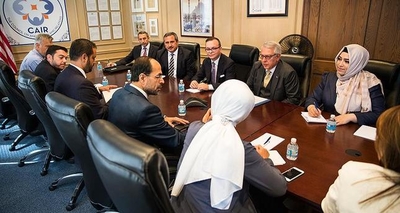
1822Parliamentarians from Turkey’s AK Party meet with CAIR officials earlier this week.

Awad was interviewed by Turkey’s Andolu news agency after this week’s meeting, which he called important in expressing “the support of the Muslim community for democracy and the rule of law in Turkey,” an IPT translation of his remarks shows.

**********************

A delegation from Turkey’s parliament came to Washington this week to make the case for extraditing Fethullah Gülen, an opposition figure living in self-imposed exile in Pennsylvania.

The Turkish government alleges Gülen was behind July’s failed coup attempt and President Tayyip Recep Erdoğan describes his extradition as a “priority.” Gülen denies any role in the coup and U.S. officials have said the Turkish evidence presented so far is not persuasive.

According to a Turkish press account, the delegation’s second meeting was with the Council on American-Islamic Relations (CAIR) and its executive director, Nihad Awad.

CAIR is a tax-exempt charity which presents itself as an American Civil Liberties Union devoted to protecting American Muslims from discrimination in housing, employment and other civil rights.

The visit from the Justice and Development Party (AKP) delegation, however, shows CAIR’s significant emphasis on influencing American foreign policy. CAIR is not a registered lobbying organization and isn’t registered as a foreign agent. Federal law requires registration by people or groups “before performing any activities for the foreign principal.”

CAIR routinely inserts itself into political debates on behalf of foreign entities, including a full campaign aimed at criticizing Israel during the 2009 and 2014 Gaza wars while staying silent about Hamas. Its Detroit director told a rally that being “defenders of the Palestinian struggle” was part of CAIR’s mission.

Awad was interviewed by Turkey’s Andolu news agency after this week’s meeting, which he called important in expressing “the support of the Muslim community for democracy and the rule of law in Turkey,” an IPT translation of his remarks shows.

“We believe in the need for more Turkish visitors and delegations to come to the United States to talk about their experiences and explain their views,” Awad said, “because there is a view against them and a pathological fear of Turkey here. The Turkish government must be aware of the need to employ more efforts to explain what is happening (in) Turkey to American public opinion.”

There’s something pathological at play here, but it isn’t some imaginary fear of Turkey. This is CAIR, an Islamist group created as part of a Muslim Brotherhood network in America, officially rushing to the aid of Turkey’s Islamist and increasingly authoritarian government, a government that itself has been increasingly aligned with the Muslim Brotherhood and Hamas.

In his comments, Awad publicly acknowledges what he advised an official Turkish government delegation in private to get the desired political outcome.

We previously reported on the immediate support American-Islamists organized for Erdoğan’s AKP immediately after the failed coup. While Erdoğan’s dedicated followers inside CAIR may be comfortable with his crackdown on dissent, a recent New York Times editorial hints many U.S. policy leaders are not.

They believe “that Mr. Erdogan’s roundup of coup plotters looks like an attempt to silence any opposition, that Turkey has behaved outrageously in failing to stop conspiracy theories depicting the United States as a co-conspirator in the coup attempt, that Turkey has produced little evidence to warrant Mr. Gulen’s extradition and that Mr. Erdogan’s autocratic behavior is making him an unreliable ally.”

He has proven unreliable in the fight against ISIS, too. He failed to stop the flow of foreign fighters using Turkey as a way-station to join ISIS and places his fight against pro-Western Kurds above the global threat posed by ISIS.

Erdoğan’s post-coup attempt arrest record, along with a media crackdown and allegations of torture, speak for themselves, if that’s what Awad thinks is part of the “pathological fear of Turkey.”

What it has to do with CAIR’s charitable mission is much murkier.
A Big Blast in North Korea, and Big Questions on U.S. Policy

September 9, 2016

A Big Blast in North Korea, and Big Questions on U.S. Policy, New York Times

GENEVA — North Korea’s latest test of an atomic weapon leaves the United States with an uncomfortable choice: stick with a policy of incremental sanctions that has clearly failed to stop the country’s nuclear advances, or pick among alternatives that range from the highly risky to the repugnant.

A hard embargo, in which Washington and its allies block all shipping into and out of North Korea and seek to paralyze its finances, risks confrontations that allies in Asia fear could quickly escalate into war. But restarting talks on the North’s terms would reward the defiance of its young leader, Kim Jong-un, with no guarantee that he will dismantle the nuclear program irrevocably.

For more than seven years, President Obama has sought to find a middle ground, adopting a policy of gradually escalating sanctions that the White House once called “strategic patience.” But the test on Friday — the North’s fifth and most powerful blast yet, perhaps with nearly twice the strength of its last one — eliminates any doubt that that approach has failed and that the North has mastered the basics of detonating a nuclear weapon.

Despite sanctions and technological backwardness, North Korea appears to have enjoyed a burst of progress in its missile program over the last decade, with experts warning that it is speeding toward a day when it will be able to threaten the West Coast of the United States and perhaps the entire country.

“This is not a cry for negotiations,” said Victor Cha, who served in the administration of President George W. Bush and now is a North Korea expert at the Center for Strategic and International Studies in Washington. “This is very clearly a serious effort at amassing real nuclear capabilities that they can use to deter the U.S. and others.”

Mr. Cha said the usual response from Washington, Seoul and Tokyo — for another round of sanctions — was not likely to be any more successful at changing the North’s behavior than previous rounds. That means Mr. Obama’s successor will confront a nuclear and missile program far more advanced than the one Mr. Obama began grappling with in 2009.

Mr. Obama has refused to negotiate with the North unless it agrees first that the ultimate objective of any talks would be a Korean Peninsula without nuclear arms. But Mr. Kim has demonstrated, at least for now, that time is on his side. And as he gets closer to an ability to threaten the United States with a nuclear attack, and stakes the credibility of his government on it, it may be even more difficult to persuade him to give up the program.

 In a statement Friday, Mr. Obama condemned the North’s test and said it “follows an unprecedented campaign of ballistic missile launches, which North Korea claims are intended to serve as delivery vehicles intended to target the United States and our allies.”

“To be clear, the United States does not, and never will, accept North Korea as a nuclear state,” he said.

Many experts who have dealt with North Korea say the United States may have no choice but to do so.

“It’s too late on the nuclear weapons program — that is not going to be reversed,” William Perry, the defense secretary under President Bill Clinton during the 1994 nuclear crisis with North Korea, said in August at a presentation in Kent, Conn. The only choice now, he argued, is to focus on limiting the missile program.

Yet the latest effort to do that, an agreement between the United States and South Korea to deploy an advanced missile defense system in the South, has inflamed China, which argues the system is also aimed at its weapons. While American officials deny that, the issue has divided Washington and Beijing so sharply that it will be even more difficult now for them to come up with a joint strategy for dealing with the North.

China has been so vocal with its displeasure over the deployment of the American system that Mr. Kim may have concluded he could afford to upset Beijing by conducting Friday’s test.

Fueling that perception were reports that a North Korean envoy visited Beijing earlier this week.

“North Korea almost certainly sees this as an opportunity to take steps to enhance its nuclear and missile capabilities with little risk that China will do anything in response,” Evans J.R. Revere, a former State Department official and North Korea specialist, said in a speech in Seoul on Friday.

The breach between China and the United States was evident during Mr. Obama’s meeting with President Xi Jinping last week. “I indicated to him that if the Thaad bothered him, particularly since it has no purpose other than defensive and does not change the strategic balance between the United States and China, that they need to work with us more effectively to change Pyongyang’s behavior,” Mr. Obama said, referring to the Terminal High Altitude Area Defense system, as the advanced missile defense project is known.

But Mr. Obama noted that sanctions had failed at having much effect. That is largely because the Chinese have left open large loopholes that have kept the North Korean economy alive and, by some measures, enjoying more trade than anytime in years.

In a recent paper, two researchers concluded that sanctions so far “have had the net effect of actually improving” North Korea’s procurement capabilities for its weapons program. To evade sanctions, the North’s state-run trading companies opened offices in China, hired more capable Chinese middlemen and paid higher fees to employ more sophisticated brokers, according to Jim Walsh and John Park, scholars at M.I.T. and Harvard respectively.

The sanctions, Mr. Cha noted, “are supposed to inflict enough pain so the regime comes back to the negotiation table, and that’s clearly not working; or it’s supposed to collapse the regime until it starves, and that’s not working either.”

“Unless China is willing to cut off everything, which they don’t appear willing to do, the sanctions may be politically the right thing to do and a requisite response, but they are not the answer to the problem,” he said.

That means the choices facing Mr. Obama’s successor will be stark. One option is to choke off all trade, in part by telling banks that conduct transactions with North Korea that they will be shut out of dealing in dollars around the world — an effective tactic against Iran before last year’s nuclear deal. But that would enrage the Chinese, and probably cut into cooperation on other issues.

At the same time, an attempt to intercept all shipping could quickly escalate into a full-blown conflict, something neither Mr. Obama nor the South Koreans and Japanese have been willing to risk.

On the other hand, reopening negotiations, which Donald J. Trump has indicated he is willing to consider, could mean paying North Korea again to freeze nuclear activities that the Bush administration and the Clinton administration had already rewarded them for stopping years ago.

The nuclear program dates back to Mr. Kim’s grandfather, Kim Il-sung, the country’s founder, who emerged from the Korean War more than 60 years ago mindful that the United States had considered using nuclear weapons in that conflict and determined to get his own arsenal.

The missile program also has a long history, mostly to deliver conventional arms. But now the two are converging, as the North races to develop a weapon small, light and durable enough to be launched into space and survive re-entry into the atmosphere.

The explosive energy unleashed during the test on Friday, estimated at 10 to 12 kilotons of TNT, was nearly twice that of the North’s last test, conducted in January, said Yoo Yong-gyu, a senior seismologist at South Korea’s National Meteorological Administration.

And the fact that North Korea’s fifth test came only eight months after its fourth is another indication that it is making fast progress toward fitting its ballistic missiles with nuclear warheads, said Choi Kang, a senior analyst at the Asan Institute. The North had waited about three years between each of its previous tests.

North Korea’s advances have unnerved its neighbors in South Korea and Japan, and Mr. Trump’s suggestion that the two nations should pay more for the United States to defend them has not helped.

In both South Korea and Japan, a small but increasingly vocal minority hasbegun to advocate developing nuclear weapons to counter the North instead of relying on the United States.

Cheong Seong-chang, a senior analyst at the Sejong Institute in Seongnam, south of Seoul, argued that a South Korean nuclear program might distract the North from its efforts to build a long-range missile capable of delivering a nuclear warhead to the mainland United States.

“If South Korea arms itself with nuclear weapons, North Korea will regard the South Korean nuclear weapons, not the distant American nukes, as the most direct threat to its security,” Mr. Cheong said.

House passes bill to let 9/11 families sue Saudi Arabia

September 9, 2016

House passes bill to let 9/11 families sue Saudi Arabia, Washington ExaminerSusan Ferrechio, September 9, 2016

The House on Friday cleared a Senate-passed bill that would make it easier for the families of the Sept. 11 terror attack victims to sue the Saudi Arabian government, which some suspect enabled the perpetrators.

The bill was approved by voice-vote, sending a strong signal toPresident Obama that votes are there to override a threatened veto.The House vote comes four months after House Speaker Paul Ryan, R-Wis., signaled it might not make it to the House floor because he disapproved of the bill. GOP aides said they decided to change course after consideration of the legislation and support for it by House lawmakers.

The vote occurred two days before the 15th anniversary of the attacks, which falls on Sunday this year.

The Senate passed the bill in May by voice vote, a signal that not one senator in the chamber opposed the bill.

Obama said he believes the bill would damage relations with the Saudis, who are key Middle East allies.

But with wide bipartisan support and sponsorship by the the top Democrat and Republican leaders in the Senate, Obama may lose this one.

The bill was authored by Sen. Majority Whip John Cornyn, R-Texas and Sen. Charles Schumer, D-N.Y., the No. 3 Democrat who is expected to become party leader in the Senate next year.

“We would easily get [the two-thirds majority] should the president veto it,” Schumer said when the Senate passed the bill.

Senate aides say the Obama administration has already tried lobbying Democrats to oppose the bill but has not switched a single vote.

Donald Trump Hillary Clinton Commander in Chief Forum 9/7/16 NBC September 7, 2016

September 8, 2016

Donald Trump Hillary Clinton Commander in Chief Forum 9/7/16 NBC September 7, 2016, via YouTube

https://www.youtube.com/watch?v=THPVoGTEGVk


Serving Muslim Interests with American Foreign Policy

September 2, 2016

Serving Muslim Interests with American Foreign Policy, Front Page MagazineJoseph Klein, September 2, 2016

see my hands

A Hillary Clinton presidency would likely continue along the pro-Islamist foreign policy arc that both her husband’s administration and the Obama administration have developed.

President Bill Clinton committed U.S. military resources to help Muslims during the so-called “humanitarian” intervention in Bosnia. However, he chose to turn a blind eye to the genocide that swamped Rwanda during his administration. As G. Murphy Donovan wrote in his American Thinker article “How the Clintons Gave American Foreign Policy its Muslim Tilt,” “Muslim lives matter, Black Africans, not so much.” Noting that “it was Muslim unrest that precipitated Serb pushback, civil war, and the eventual collapse of Yugoslavia,” Donovan added, “Bosnians are, for the most part, Muslims with a bloody fascist pedigree.” Nevertheless, with no strategic U.S. national interest at stake, Bill Clinton tilted American foreign policy in favor of the Muslim side in the Bosnia conflict. We are now reaping the lethal consequences of that tilt. Donovan points out in his article that, on a per capita basis, Bosnia Herzegovina is the leading source of ISIS volunteers in all of Europe.

President Obama, along with then Secretary of State Hillary Clinton, took the side of Islamist “rebels” against the secular authoritarian regimes in Egypt, Libya and Syria that had managed to keep the lid on jihadist terrorism for many years. These Islamists included members of al Qaeda as well as the Muslim Brotherhood.

In Libya, Hillary Clinton was the leading voice pressing for military intervention against Col. Muammar el- Qaddafi’s regime. She did so, even though, according to sources cited in a State Department memo passed on to Hillary by her deputy at the time, Jake Sullivan, in an e-mail dated April 1, 2011, “we just don’t know enough about the make-up or leadership of the rebel forces.”  In fact, as subsequently reported by the New York Times, the only organized opposition to the Qaddafi regime that had developed underground during Qaddafi’s rule were the Libyan Islamic Fighting Group, a terrorist group, and the Muslim Brotherhood.  The author of the State Department memo had acknowledged the Libyan Islamic Fighting Group’s terrorist past but said they “express a newfound keenness for peaceful politics.” Was Hillary Clinton relying on such assurances of a reformed “peaceful” Islamic group fighting against Qaddafi, even though it had been on the State Department’s terrorist list since 2004 and one of its leaders, Abdel-Hakim al-Hasidi,  praised al Qaeda members as “good Muslims” in a March 2011 interview?  If so, that is just another indication of her bad judgment.

As for Egypt, Hillary was informed by her outside adviser and confidante Sid Blumenthal, in an e-mail dated December 16, 2011, that the Muslim Brotherhood’s intention was to create an Islamic state. Moreover, the relationship between the Muslim Brotherhood, al-Qaeda and other radical groups was “complicated,” Blumenthal quoted a source “with access to the highest levels of the MB” as saying. Blumenthal also reported, based on a confidential source, that Mohamed Morsi, who was then leader of the Muslim Brotherhood’s Freedom and Justice Party, believed that “it will be difficult for this new, Islamic government to control the rise of al Qa’ida and other radical/terrorist groups.”

Nevertheless, the Obama administration supported the Muslim Brotherhood in its bid to seek power in Egypt through a shaky electoral process. After Morsi’s election to the presidency, Hillary visited Egypt where Morsi warmly welcomed her and she expressed strong support for Egypt’s “democratic transition.” However, the only real transition Morsi had in mind was to impose sharia law on the Egyptian people, the very antithesis of true democratic pluralism. Yet the Obama–Clinton gravy train of military aid to the Muslim Brotherhood-backed Islamist regime continued without any preconditions. Hillary Clinton herself and her State Department referred to the importance of the U.S.’s “partnership” with the Muslim Brotherhood-backed regime.

When Morsi was removed from power, after millions of Egyptians had taken to the streets to protest the increasingly theocratic regime, the Obama administration decided to suspend aid to the more secular successor military regime. The “partnership” was no more once the Islamists were swept out of office.

While Morsi was still president, the Clinton Foundation, which has taken millions of dollars in donations from Muslim majority governments and affiliated groups and individuals, invited Morsi to deliver a major address at the Clinton Global Initiative. This invitation was extended just a month after an individual named Gehad el-Haddad, who was working simultaneously for the Muslim Brotherhood and the Clinton Foundation in Cairo, left his Clinton Foundation job to work for Morsi and the Muslim Brotherhood full time. Fortunes changed for this individual, however, when, after Morsi was overthrown, Haddad was arrested for inciting violence and given a life sentence.

The Obama administration, while Hillary Clinton was Secretary of State, also cooperated with the 57-member Organization of Islamic Cooperation (OIC) to pass and implement a United Nations resolution that was intended to curb speech considered Islamophobic. Clinton, in full spin mode, insisted that the new UN resolution was totally consistent with the free speech protections of the First Amendment, as opposed to the “defamation of religions” resolutions that the OIC had sponsored in the past but was willing to have replaced. The truth, however, is that all we were seeing was old wine in new bottles. To make sure that the OIC was comfortable regarding the Obama administration’s intentions, Clinton assured the OIC that she was perfectly on board with using “some old-fashioned techniques of peer pressure and shaming, so that people don’t feel that they have the support to do what we abhor.” She was trying to publicly assure American citizens that their First Amendment rights to freedom of speech and press were safe, while working behind the scenes with her OIC partners to find acceptable ways to stifle speech offensive to Muslims.

The signs of Hillary Clinton’s Islamist tilt as she runs for president include the sweepingly general and demonstrably false assertion in her tweet last November that Muslims “have nothing whatsoever to do with terrorism.”  She has obviously learned nothing from her disastrous tenure as Secretary of State. Neither is she willing to acknowledge that the terrorists whom she has called a “determined enemy” are jihadists animated by an ideology rooted in core Muslim teachings of the Koran and the Hadith (Prophet Muhammad’s sayings and actions).  Is there something about the word “Muslim” in the Muslim Brotherhood and “Islamic” in the Islamic State that she is having problems understanding?

Perhaps, it is Hillary’s close association with Huma Abedin, her top campaign aide and confidante, who has had questionable links to Muslim Brotherhood-affiliated organizations, which explains Hillary’s denial of the truth. If someone as close to Hillary as Huma Abedin, whom she apparently trusts with her life, is a Muslim, then how could any Muslim possibly have anything to do with terrorism?

Then again, perhaps Hillary’s willingness to give Islamists the benefit of the doubt is all the money that the Clintons have received over the years from foreign donors in Muslim majority countries, including the Saudi government and affiliated groups and individuals. Hillary Clinton has also reached out for campaign donations from a pro-Iranian lobby group, the National Iranian American Council. Whatever human rights abuses are inflicted on people in these countries, it would be counterproductive to bite the hand that feeds you, in the Clintons’ way of thinking.

Finally, the Democratic Party itself has moved much further to the Left since the days of Bill Clinton’s presidency, which has led to the broadening out of the pro-Islamist bias that began to take shape with Bill Clinton’s intervention in Bosnia. As David Horowitz wrote in a January 8, 2016 article published by National Review:

“Leftists and Democrats have also joined the Islamist propaganda campaign to represent Muslims — whose co-religionists have killed hundreds of thousands of innocents since 9/11 in the name of their religion — as victims of anti-Muslim prejudice, denouncing critics of Islamist terror and proponents of security measures as ‘Islamophobes’ and bigots. Led by Hillary Clinton and Barack Obama, Democrats have enabled the Islamist assault on free speech, which is a central component of the Islamist campaign to create a worldwide religious theocracy.”

For a variety of reasons, Hillary Clinton as president can be expected to move the United States towards an even more accommodative stance than her predecessors with Islamists who mean to do us harm.

What if Chaos Were Our Middle East Policy?

August 31, 2016

What if Chaos Were Our Middle East Policy? Front Page Magazine, Daniel Greenfield, August 31, 2016

isis-caliphate

Sum up our failed Middle East policy in a nine-letter word starting with an S. Stability.

Stability is the heart and soul of nation-building. It’s the burden that responsible governments bear for the more irresponsible parts of the world. First you send experts to figure out what is destabilizing some hellhole whose prime exports are malaria, overpriced tourist knickknacks and beheadings. You teach the locals about democracy, tolerance and storing severed heads in Tupperware containers.

Then if that doesn’t work, you send in the military advisers to teach the local warlords-in-waiting how to better fight the local guerrillas and how to overthrow their own government in a military coup.

Finally, you send in the military. But this gets bloody, messy and expensive very fast.

So most of the time we dispatch sociologists to write reports to our diplomats explaining why people are killing each other in a region where they have been killing each other since time immemorial, and why it’s all our fault. Then we try to figure out how we can make them stop by being nicer to them.

The central assumption here is stability. We assume that stability is achievable and that it is good. The former is completely unproven and even the latter remains a somewhat shaky thesis.

The British wanted stability by replicating the monarchy across a series of Middle Eastern dependents. The vast majority of these survived for a shorter period than New Coke or skunk rock. Their last remnant is the King of Jordan, born to Princess Muna al-Hussein aka Antoinette Avril Gardiner of Suffolk, educated at the Royal Military Academy, Sandhurst, and currently trying to stave off a Muslim Brotherhood-Palestinian uprising by building a billion dollar Star Trek theme park.

The British experiment in stabilizing the Middle East failed miserably. Within a decade the British government was forced to switch from backing the Egyptian assault on Israel to allying with the Jewish State in a failed bid to stop the Egyptian seizure of the Suez Canal.

The American experiment in trying to export our own form of government to Muslims didn’t work any better. The Middle East still has monarchies. It has only one democracy with free and open elections.

Israel.

Even Obama and Hillary’s Arab Spring was a perverted attempted to make stability happen by replacing the old Socialist dictators and their cronies with the political Islamists of the Muslim Brotherhood. They abandoned it once the chaos rolled in and stability was nowhere to be found among all the corpses.

It might be time to admit that barring the return of the Ottoman Empire, stability won’t be coming to the Middle East any time soon. Exporting democracy didn’t work. Giving the Saudis a free hand to control our foreign policy didn’t work. Trying to force Israel to make concessions to Islamic terrorists didn’t work. And the old tyrants we backed are sand castles along a stormy shore.

Even without the Arab Spring, their days were as numbered as old King Farouk dying in exile in an Italian restaurant.

If stability isn’t achievable, maybe we should stop trying to achieve it. And stability may not even be any good.

Our two most successful bids in the Muslim world, one intentionally and the other unintentionally, succeeded by sowing chaos instead of trying to foster stability. We helped break the Soviet Union on a cheap budget in Afghanistan by feeding the chaos. And then we bled Iran and its terrorist allies in Syria and Iraq for around the price of a single bombing raid. Both of these actions had messy consequences.

But we seem to do better at pushing Mohammed Dumpty off the wall than at putting him back together again. If we can’t find the center of stability, maybe it’s time for us to embrace the chaos.

Embracing the chaos forces us to rethink our role in the world. Stability is an outdated model. It assumes that the world is moving toward unity. Fix the trouble spots and humanity will be ready for world government. Make sure everyone follows international law and we can all hum Lennon’s “Imagine”.

Not only is this a horrible dystopian vision of the future, it’s also a silly fantasy.

The UN is nothing but a clearinghouse for dictators. International law is meaningless outside of commercial disputes. The world isn’t moving toward unity, but to disunity. If even the EU can’t hold together, the notion of the Middle East becoming the good citizens of some global government is a fairy tale told by diplomats while tucking each other into bed in five-star hotels at international conferences.

It’s time to deal with the world as it is. And to ask what our objectives are.

Take stability off the table. Put it in a little box and bury it in an unmarked grave at Foggy Bottom. Forget about oil. If we can’t meet our own energy needs, we’ll be spending ten times as much on protecting the Saudis from everyone else and protecting everyone else from the Saudis.

Then we should ask what we really want to achieve in the Middle East.

We want to stop Islamic terrorists and governments from harming us. Trying to stabilize failed states and prop up or appease Islamic governments hasn’t worked. Maybe we ought to try destabilizing them.

There have been worse ideas. We’re still recovering from the last bunch.

To embrace chaos, we have to stop thinking defensively about stability and start thinking offensively about cultivating instability. A Muslim government that sponsors terrorism against us ought to know that it will get its own back in spades. Every Muslim terror group has its rivals and enemies waiting to pounce. The leverage is there. We just need to use it.

When the British and the French tried to shut down Nasser, Eisenhower protected him by threatening to collapse the British pound. What if we were willing to treat our Muslim “allies” who fill the treasuries of terror groups the way that we treat our non-Muslim allies who don’t even fly planes into the Pentagon?

We have spent the past few decades pressuring Israel to make deals with terrorists. What if we started pressuring Muslim countries in the same way to deal with their independence movements?

The counterarguments are obvious. Supply weapons and they end up in the hands of terror groups. But the Muslim world is already an open-air weapons market. If we don’t supply anything too high end, then all we’re doing is pouring gasoline on a forest fire. And buying the deaths of terrorists at bargain prices.

Terrorism does thrive in failed states. But the key point is that it thrives best when it is backed by successful ones. Would the chaos in Syria, Nigeria or Yemen be possible without the wealth and power of Saudi Arabia, Qatar and Iran? Should we really fear unstable Muslim states or stable ones?

That is really the fundamental question that we must answer because it goes to the heart of the moderate Muslim paradox. Is it really the Jihadist who is most dangerous or his mainstream ally?

If we believe that the Saudis and Qataris are our allies and that political Islamists are moderates who can fuse Islam and democracy together, then the stability model makes sense. But when we recognize that there is no such thing as a moderate civilizational Jihad, then we are confronted with the fact that the real threat does not come from failed states or fractured terror groups, but from Islamic unity.

Once we accept that there is a clash of civilizations, chaos becomes a useful civilizational weapon.

Islamists have very effectively divided and conquered us, exploiting our rivalries and political quarrels, for their own gain. They have used our own political chaos, our freedoms and our differences, against us. It is time that we moved beyond a failed model of trying to unify the Muslim world under international law and started trying to divide it instead.

Chaos is the enemy of civilization. But we cannot bring our form of order, one based on cooperation and individual rights, to the Muslim world. And the only other order that can come is that of the Caliphate.

And chaos may be our best defense against the Caliphate.

The China Test

August 26, 2016

The China Test, Washington Free Beacon, August 26, 2016

U.S. Secretary of State Hillary Clinton, left, prepares to shake hands with China's Vice President Xi Jinping during a meeting at Diaoyutai State Guesthouse in Beijing, Thursday, May 3, 2012. (AP Photo/Jason Lee, Pool)

U.S. Secretary of State Hillary Clinton, left, prepares to shake hands with China’s Vice President Xi Jinping during a meeting at Diaoyutai State Guesthouse in Beijing, Thursday, May 3, 2012. (AP Photo/Jason Lee, Pool)

TOKYO—Anyone paying even passing attention to the news from East Asia knows that the rise of China has taken a bad turn in recent years, and that our closest allies in the region feel threatened by the increasingly belligerent policies of President Xi. It’s not clear, however, that even well informed Americans realize how dire the situation is. It’s time they paid better attention, because China’s lawless pursuit of resources and territory is coming to resemble nothing else so much as the behavior of the Japanese empire before World War Two—a disconcerting comparison I have heard more than once from analysts and government officials here, where I have been traveling with a group of journalists and policy experts on a trip arranged by the country’s Ministry of Foreign Affairs.

Xi’s strategic vision holds that much of the western Pacific—the area within the so-called “first island chain” that stretches south from the Japanese archipelago through the Philippines and Malaysia, and which includes the Yellow Sea, the East China Sea, and the South China Sea—is effectively a Chinese lake. The other sovereign countries that border this critical part of the world reside, in this view, within a Chinese version of Putin’s “near-abroad.” They must be taught to accept Chinese hegemony, and interlopers like the United States must be compelled to retreat to the “second island chain,” which stretches south from Japan through the Mariana Islands, which include Guam.

This deeply illiberal vision isn’t just talk. China is taking step after aggressive step to turn it into a de facto reality. In the East China Sea, China in 2013 declared an Air Defense Identification Zone that includes Japan’s Senkaku islands—a small chain to which China laid a belated claim after undersea natural resources were discovered nearby in the seventies. The U.S. government does not take a position on which country exercises sovereignty over the islands, but has made clear that because the islands are under Japanese administrative control, America is obligated to join its ally Japan in defending them.

Since the air defense zone has been declared, incursions by fleets of Chinese fishing boats—some of which appear to be crewed by ad hoc Chinese maritime militiamen—accompanied by armed vessels of the Chinese coast guard have skyrocketed in number. In the first week of this August alone, there were 18 intrusions into Japan’s territorial waters around the Senkakus by Chinese coast guard vessels, according to figures provided by the Japanese government.

In the South China Sea, Beijing has been more aggressive, seizing disputed islands and reefs, expanding its footprint with land reclamation projects, and building military installations atop the artificial terrain. Having learned a lesson by declaring an air defense zone in the East China Sea before they had the capacity to enforce it, the Chinese have held off with that step in this region. But that won’t last if China proceeds as expected with seizing and building a military facility atop Scarborough Shoal, an uninhabited piece of key terrain that, once built up, will complete a triangle of such installations in the area. After that, an enforceable air defense zone would likely be declared, assets of the U.S. military would operate at greatly increased risk, and Chinese ballistic missile submarines would sail with a lowered threat of U.S. monitoring, armed with missiles that could strike the U.S. mainland.

Everywhere that China is operating, affairs trend in the wrong direction for a rules-based international order. China’s goal is hegemony in the western Pacific. Once the U.S. is forced from the region and China’s neighbors have accommodated Beijing, it is not too hard to imagine that the People’s Republic will look to seize Taiwan.

Such developments are still in the future, but the coming year will be especially dangerous. Even though the Chinese military cannot yet defeat America in a conflict, China’s politburo is about to undergo a reshuffle. The possible instability incentivizes Chinese leaders to be provocative, in order to harness nationalist sentiment and stave off domestic threats to the regime. Moreover, the Chinese are very much aware that the Obama administration has little appetite for confrontation, and also that a new president, if tested aggressively shortly after taking office, could easily fail her exam.

The good news is that it is still not too late for China to be stopped without a war. The bad news is that this result will require unfaltering American resolve and leadership. Though America’s friends in the region have been pleased with the idea of the so-called “rebalancing” of U.S. military forces to reinforce assets in the Asia Pacific, they have been dismayed by how long it has taken the Obama administration to get serious about the Chinese test—and are worried that the White House itself still may not be serious enough to pass it. That President Obama has been considering declaring a policy of “No First Use” for America’s nuclear weapons dismays even the current leaders of Japan, who guide a country with a deeply ingrained anti-nuclear tradition but one that also relies on the U.S. nuclear umbrella for its survival.

China has a habit of testing American presidents soon after they take office. George W. Bush faced the issue of an American surveillance plane being forced down on Hainan Island in 2001, and Obama had to deal with an attempt by Chinese ships to block the passage of the U.S.S. Impeccable in international waters in 2009. The next president will certainly face another provocation in 2017, and a robust menu of responses must be planned now, before the crisis arrives.

There is a long list of American policies that stop short of armed action but that could also impose pain on the Chinese government and—most importantly—cause it to lose face before its own population, a matter of great concern to Chinese leaders. These could include U.S. recognition of Japan’s sovereignty over the Senkakus and allowing American general officers to travel to Taiwan, which is currently forbidden in an effort to avoid offending Beijing.

Most importantly, the next president must be prepared to draw the line on Chinese territorial expansions, none of which can now be rolled back, but which cannot be allowed to grow. A bold move worth considering is informing China that any effort to reclaim land on Scarborough will trigger a U.S. blockade of the shoal.

If the new administration passes its test and succeeds in deterring the Chinese from further expansionism in the short term, its long term strategy should focus on strengthening the network of America’s regional allies, building up their militaries, and encouraging them to work with one another—a devilishly complex task given the difficult and painful historical disputes among these countries. All of this will be difficult, and some of it quite risky, but the cost of inaction will be the dismantling of the international liberal order and its replacement by a new age of empires. The next American president will decide what the future holds.

Syrian Kurds clash with Turkish forces

August 26, 2016

Syrian Kurds clash with Turkish forces, DEBKAfile, August 26, 2016

(Please see also, Biden Gushes to Erdoğan That American People ‘Stand in Awe’ of Turkish ‘Courage’ — DM)

Tanks_invading_Syria_B_24.8.16

Just a few days ago, the Americans were speaking highly of Kurds as the sharpest sword in the coalition’s arsenal for vanquishing the jihadists. Since Biden’s deal with Erdogan on Wednesday, Washington can forget about the Syrian Kurdish PYG or the Iraqi Kurdish Pershmerga as spearheads of the campaigns to liberate Raqqa in Syria and Mosul in Iraq for ISIS.

*****************************

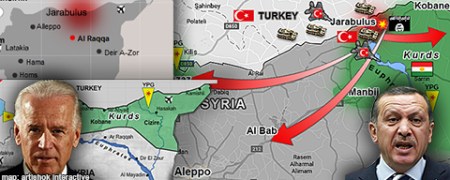
Syrian Kurdish militia commanders are flouting the ultimatum US Vice President Joe Biden handed them Wednesday, Aug. 24 to retreat to east of the Euphrates or else forfeit US support.  Instead, DEBKAfile’s military sources report, they decided to stand their ground and fight it out with the Turkish army.

The first clash occurred Thursday overnight, when Kurdish forces from Manbij attacked the positions taken by Turkish tanks in Jarablus, hours after Islamic State forces were put to flight from this border town.

The battles continued into Friday morning, Aug. 26.

The US ultimatum to the Kurds was the outcome of understandings US Vice President Joe Biden reached with Turkey’s President Tayyip Erdogan in Ankara on Wednesday, hours after the Turkish army crossed into northern Syria.

“Syrian Kurdish forces will lose US support if they don’t retreat to east bank of Euphrates,” the US vice president stated at a news conference.

Yet Thursday night, Turkish officials made an effort to counteract the impression that their military intervention in Syria was coordinated with the United States. They announce that Russian chief of staff Gen. Valery Gerasimov would be arriving in Ankara Friday for talks with his Turkish counterpart, Gen. Hulusi Akar.

The US commander of American troops in Iraq and Syria, Lt. Gen. Stephen Townsend, had meanwhile instructed all US Special Operations personnel to withdraw from Syrian-Kurdish YPG militia units, and return to the N. Syrian Rmeilan airfield near Hassaka. This is reported from DEBKAfile military and intelligence sources.

The US general also stopped artillery ammo supplies to the Kurdish militia and the transfer of field intelligence from the fighting in areas newly occupied by the Turkish army.

These measures were temporary, the US officers informed Salih Muslim, Syrian Kurdish Democratic Union Party (PYD) leader, and would be lifted after his YPG militia was instructed to pull back from northern Syria and head east of the Euphrates.

Only last week, the Syrian Kurdish militia was riding high, covered in praise for its feat in capturing Manbij with the assistance of US Special Forces.

Their comedown after the US decided to jump aboard the Turkish invasion would be complete, if they complied with the Biden ultimatum. They would forfeit all their hard-won gains from years of combat against the Islamic State, and have to forget their dream of a Kurdish state linking their enclaves along the 900km Syrian-Turkish border.

A stream of information and misinformation is meanwhile muddying the waters as the Kurds in Syria and Iraq absorb the shock of the American turn against them.

The Ministry of Foreign Affairs in Ankara said Thursday that US Secretary of State John Kerry had informed the Turkish Foreign Minister Mevlut Cavusoglu that the US-backed Syrian Kurdish militias had begun their retreat to the eastern bank of the Euphrates River.


ManbijKoteret480

US sources qualified this claim, confirming only that a ‘main element’ of the Kurds has retreated, but not the entire force. The Kurds were evidently in no hurry to take any marching orders either from Turkey or the United States.

A short Kurdish statement claimed that their forces had indeed withdrawn to the eastern bank of the Euphrates River, but DEBKAfile’s military sources military sources say that a large body of Kurdish fighters is still in place west of the river. Indeed our sources found Kurdish PYG officers adamant in their determination to stay put and take on the Turkish army.

After the Turkish invasion Wednesday, Kurdish leader Salih Muslim declared, “Turkey will be defeated in Syria along with the Islamic State.”

Kurdish units also took up positions on the roads leading to the US base at Rmeilan, ready enforce a blockade. A Kurdish food convoy due at the base Thursday did not arrive.

In Iraq, there is word of a Kurdish Peshmerga mutiny against US instructors at the bases where they are training for the offensive to recapture Mosul from the ISIS.

However, the events of this week around northern Syria have dealt a major setback to the US-led war on ISIS.

Just a few days ago, the Americans were speaking highly of Kurds as the sharpest sword in the coalition’s arsenal for vanquishing the jihadists. Since Biden’s deal with Erdogan on Wednesday, Washington can forget about the Syrian Kurdish PYG or the Iraqi Kurdish Pershmerga as spearheads of the campaigns to liberate Raqqa in Syria and Mosul in Iraq for ISIS.

What’s the Plan for Winning the War?

August 25, 2016

What’s the Plan for Winning the War?, Counter Jihad, August 25, 2016

Who is even thinking about how to win the war?  Will the legacy of the Obama administration be a shattered NATO, a Turkey drawn into Russia’s orbit, an Iranian hegemony over the northern Middle East, and a resurgent Russia?  It certainly looks to be shaping up that way.  Russia is playing chess while the US is playing whack-a-mole.  The absence of a coherent governing strategy is glaring.

**********************

Michael Ledeen makes a clever observation:

Everyone’s talking about “ransom,” but it’s virtually impossible to find anyone who’s trying to figure out how to win the world war we’re facing.  The two keystones of the enemy alliance are Iran and Russia, and the Obama administration, as always, has no will to resist their sorties, whether the Russians’ menacing moves against Ukraine, or the Iranians’ moves against us.

The moves are on the chessboard, sometimes kinetic and sometimes psychological warfare.  Like a chess game, we are in the early stages in which maneuver establishes the array of forces that will govern the rest of the game.  Russia’s deployment of air and naval forces to Syria stole a march on the Obama administration.  Its swaying of Turkey, which last year was downing Russian aircraft, is stealing another.  Its deployment of bombers and advanced strike aircraft to Iran is another.  That last appears to be in a state of renegotiation, as Ledeen notes, but that too is probably for show.  The Iranians have too much to gain in terms of security for their nuclear program, at least until they’ve had time to build their own air force.

Iran is making strategic moves as well.  Ledeen notes the “Shi’ite Freedom Army,” a kind of Iranian Foreign Legion that intends to field five divisions of between twenty and twenty-five thousand men each.  Overall command will belong to Quds Force commander Qassem Suliemani, currently a major figure in the assault on Mosul, having recovered from his injury in Syria commanding Iranian-backed militia in the war there.  The fact of his freedom of movement is itself a Russian-Iranian demonstration that they will not be governed by international law:  Suliemani is under international travel bans for his assassination plot against world diplomats, but was received in Moscow and now travels freely throughout the northern Middle East.

Turkey, meanwhile, has been effectively cut off by Iran’s and Russia’s success in the opening game of this global chess match.  As late as the Ottoman Empire, the Turks looked south through Iran and Iraq to power bases as far away as Arabia.  Now the Ayatollahs are going to control a crescent of territory from Afghanistan’s borders to the Levant, leaving the Turks locked out.  One might have expected the Turks to respond by doubling their sense of connection to Europe and NATO.  Instead, the purge following the alleged coup attempt is cementing an Islamist control that leaves the Turks looking toward a world from which they are largely separated by the power of this new Russian-Iranian alliance.  The Turks seem to be drifting toward joining that alliance because being a part of that alliance will preserve their ties to the Islamic world.

For now, the Obama administration seems blind to the fact that these moves are closing off America’s position in the Middle East.  This is not a new policy.  Eli Lake reports that the Obama administration told the CIA to sever its ties to Iranian opposition groups in order to avoid giving aid to the Green revolution.  Their negotiation of last year’s disastrous “Iran deal” has led to Iran testing new ballistic missiles and receiving major arms shipments from Russia.  Yet while all these moves keep being made around them, the Obama administration proceeds as if this were still just an attempt to crush the Islamic State (ISIS).  The commander of the XVIIIth Airborne Corps has been given a task that amounts to helping the Iranians win.  Our incoherent policy has left us on both sides in Syria.  Our only real ally in the conflict, the Kurds, stand abandoned by America.

Who is even thinking about how to win the war?  Will the legacy of the Obama administration be a shattered NATO, a Turkey drawn into Russia’s orbit, an Iranian hegemony over the northern Middle East, and a resurgent Russia?  It certainly looks to be shaping up that way.  Russia is playing chess while the US is playing whack-a-mole.  The absence of a coherent governing strategy is glaring.

Anti-Israel Double Standards Enable Assad’s Brutality

August 23, 2016

Anti-Israel Double Standards Enable Assad’s Brutality, Investigative Project on Terrorism,  Noah Beck,August 23, 2016

1789

Syria’s civil war claimed 470,000 lives since it started in March 2011, the Syrian Centre for Policy Research announced in February. That’s an average of about 262 deaths per day and 7,860 per month. The carnage has continued unabated, so, applying the same death rate nearly 200 days after the February estimate, the death toll is over 520,000.

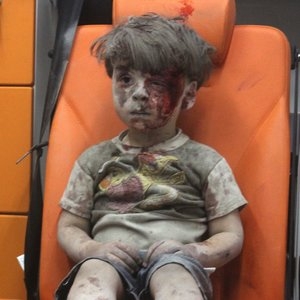
Such numbers are staggering, even by Middle East standards. However, the violence has become so routine that it only occasionally captures global attention, usually when a particularly poignant moment of human suffering is documented. The most recent example is Omran Daqneesh, a 5-year old Syrian boy who was filmed shell-shocked, bloody, and covered in dust after the airstrike bombing of his Aleppo apartment block.

The tragic image of Omran caused outrage around the world, as did the image of Aylan Kurdi, the drowned Syrian boy whose body washed up last September on a beach in Turkey. Yet Omran’s plight demonstrates that, nearly a year after the last child victim of Syrian horrors captured global sympathy, nothing has changed.

If anything, the violence in this multi-party proxy war seems to be getting worse. Since Aylan Kurdi’s drowning, Russia began blitz-bombing Syria in support of the Assad regime. The Syrian Observatory for Human Rights (SOHR) estimates that nine months of Russian airstrikes have killed 3,089 civilians – a toll that is greater, by some estimates, than the number of civilians killed by ISIS. By contrast, Syrian civilian deaths caused by U.S. airstrikes are probably in the hundreds (over roughly twice as much time, since U.S. airstrikes began in the summer of 2015).

But Syrian airstrikes are responsible for the bulk of civilian deaths in Syria. The Assad regime killed 109,347 civilians between March 2011 and July 2014 (88 percent of the total casualties at the time), according to estimates by the Syrian Network for Human Rights. That works out to about 91 civilian deaths per day. More recently, the SOHR documented 9,307 civilian deaths from 35,775 regime airstrikes over a 20-month period running from November 2014 through June 2016. Thus, roughly one innocent Syrian was killed every hour, during the 20 months that the SOHR documented civilian casualties caused by Russian and Syrian airstrikes.

Compare those figures to the number of innocent Palestinians killed by Israel from 2011 to 2014. According to Human Rights Watch (HRW), which has been accused of anti-Israel bias, 37 Palestinians were killed in 2011, 103 in 2012, 15 in 2013 and 1,500in 2014 – the year when Hamas fired rockets at Israel from highly populated Gazan areas. That’s a four-year total of 1,655. During roughly the same four-year period, the number of Syrian civilian deaths was about 76 times greater than the HRW total of Palestinian civilian casualties.

Yet the European Union singles out Israel for conflict-related consumer labels without any similar attempt to warn European consumers about goods or services whose consumption in any way helps the economies of countries responsible for the Syrian bloodshed, including Syria, Russia, and Iran. Human rights lawyer Arsen Ostrovsky has highlighted how none of those countries is targeted by those advocating a boycott of Israel out of a purported concern for human rights. Even more absurd, most of the results produced by a Google search for “academic boycott of Syria” or “academic boycott of Iran” concern academic boycotts of Israel. That asymmetry precisely captures the problem.

In addition to supporting the Assad regime in Syria and contributing to the violence there, Iran executes people for everything from drug offenses to being gay.

Indeed, the global outcry over Syrian suffering is embarrassingly weak when compared to reactions to Israel’s far less bloody conflict with the Palestinians. Imagine if Omran Daqneesh had been a Palestinian boy hurt by an Israeli airstrike on Gaza. College campus protests, the media, NGOs, and world bodies around the planet would be positively on fire. Israeli embassies would be attacked, French synagogues would be firebombed (eight were attacked in just one week during Israel’s 2014 war with Gaza), Jews around the world would be attacked, and condemnations would pour in from the EU, the United Nations, and the Obama administration. UN resolutions and emergency sessions would condemn the incident. International investigations would be demanded. Global blame would deluge Israel, regardless of whether Hamas, a terrorist organization, actually started the fighting or used human shields to maximize civilian deaths. Israel would be obsessively demonized despite any risky and unprecedented measures the Israeli military might have taken to minimize civilian casualties.

Moreover, when an occasional Syrian victim captures global attention, the protests are generally for some vague demand for “peace” in Syria, rather than blaming and demanding the punishment of Syria, Iran, and Russia, even though those regimes are clearly responsible for the slaughter. The starkly different reactions to Israel and Syria are even more shocking when it comes to the United Nations.

From its 2006 inception through August 2015, 62 United Nations Human Rights Council resolutions condemned Israel, compared to just 17 for Syria, five for Iran, and zero for Russia, according to the watchdog group UN Watch. The lopsided focus on Israel is equally appalling at the UN General Assembly, as UN Watch has highlighted. In each of the last four years, as the Syrian bloodbath claimed hundreds of thousands of lives, there were at least five times as many resolutions condemning Israel as those rebuking the rest of the world:

2012: 22 against Israel, 4 for the rest of the world

2013: 22 against Israel, 4 for the rest of the world

2014: 20 against Israel, 3 for the rest of the world

2015: 20 against Israel, 3 for the rest of the world

A corollary of the anti-Israel bias ensures that no Israeli victim will ever enjoy the kind of global sympathy expressed for Omran Daqneesh or Aylan Kurdi. When a Palestinian man enters the bedroom of a 13-year old girl and stabs her to death in her sleep,Obama says nothing even though she was a U.S. citizen and the world hardly notices. By contrast, imagine if the Israeli father of Hallel Yaffa Ariel had decided to take revenge by entering a nearby Palestinian home to stab a 13-year old Palestinian girl to death in her sleep. The global anger would be deafening.

Why do Israeli lives matter so much less? And why do student activists, the UN, the EU, the media, and the rest of the world focus so much more on alleged Palestinian civilian deaths than on Syrian civilian deaths? Doing so is woefully unjust to Syrians. It is also deeply unfair to Israel, which has endured terrorist attacks on its people throughout its existence as a state. It is the one country that, according to Col. Richard Kemp, former commander of British forces in Afghanistan, has done more to protect civilians during war than any other in the history of war.

The global obsession with condemning Israel not only defames a beleaguered democracy doing its best, it also enables the truly evil actors like the Assad regime and Hamas, by giving them a pass on some of the world’s worst crimes.