Posted tagged ‘Foreign Policy’

The Great Western Retreat

May 4, 2016

The Great Western Retreat, Gatestone InstituteGiulio Meotti, May 4, 2016

♦ Of all French soldiers currently engaged in military operations, half of them are deployed inside France. And half of those are assigned to protect 717 Jewish schools.

♦ This massive deployment of armed forces in our own cities is a departure from history. It is a moral disarmament, before a military one.

♦ Why does anyone choose to fight in a war? Civilized nations go to war so that members of today’s generation may sacrifice themselves to protect future generations. But if there are no future generations, there is no reason whatever for today’s young men to die in war. It is “demography, stupid.”

On March 11, 2004, 192 people were killed and 1,400 wounded in a series of terrorist attacks in Madrid. Three days later, Spain’s Socialist leader, José Luis Rodríguez Zapatero, was elected prime minister. Just 24 hours after being sworn in, Zapatero ordered Spanish troops to leave Iraq “as soon as possible.”

The directive was a monumental political victory for extremist Islam. Since then, Europe’s boots on the ground have not been dispatched outside Europe to fight jihadism; instead, they have been deployed inside the European countries to protect monuments and civilians.

Opération Sentinelle” is the first new large-scale military operation within France. The army is now protecting synagogues, art galleries, schools, newspapers, public offices and underground stations. Of all French soldiers currently engaged in military operations, half of them are deployed inside France. And half of those are assigned to protect 717 Jewish schools. Meanwhile, French paralysis before ISIS is immortalized by the image of police running away from the office of the satirical magazine Charlie Hebdo during the massacre there.

1578French soldiers guard a Jewish school in Strasbourg, February 2015. (Image source: Claude Truong-Ngoc/Wikimedia Commons)

You can find the same figure in Italy: 11,000 Italian soldiers are currently engaged in military operations and more than half of them are used in operation “Safe Streets,” which, as its name reveals, keeps Italy’s cities safe. Italy’s army is also busy providing aid to migrants crossing the Mediterranean.

In 2003, Italy was one of the very few countries, along with Spain and Britain, which stood with the United States in its noble war in Iraq — a war that was successful until the infamous US pull-out on December 18, 2011.

Today, Italy, like Spain, runs away from its responsibility in the war against the Islamic State. Italy’s Defense Minister Roberta Pinotti ruled out the idea of Italy taking part in action against ISIS, after EU defense ministers unanimously backed a French request for help.

Italy’s soldiers, stationed in front of my newspaper’s office in Rome, provide a semblance of security, but the fact that half of Italy’s soldiers are engaged in domestic security, and not in offensive military strikes, should give us pause. These numbers shed a light not only on Europe’s internal terror frontlines, from the French banlieues to “Londonistan.” These numbers also shed light on the great Western retreat.

US President Barack Obama has boasted that as part of his legacy, he has withdrawn American military forces from the Middle East. His shameful departure from Iraq has been the main reason that the Islamic State rose to power — and the reason Obama postponed a military withdrawal from Afghanistan. This US retreat can only be compared to the fall of Saigon, with the picture of a helicopter evacuating the U.S. embassy.

In Europe, armies are no longer even ready for war. The German army is now useless, and Germany spends only 1.2% of GDP on defense. The German army today has the lowest number of staff at any time in its history.

In 2012, Germany’s highest court, breaking a 67-year-old taboo against using the military within Germany’s borders, allowed the military to be deployed in domestic operations. The post-Hitler nation’s fear that the army could develop again into a state-within-a-state that might impede democracy has paralyzed Europe’s largest and wealthiest country. Last January, it was revealed that German air force reconnaissance jets cannot even fly at night.

Many European states slumber in the same condition as Belgium, with its failed security apparatus. A senior U.S. intelligence officer even recently likened the Belgian security forces to “children.” And Sweden’s commander-in-chief, Sverker Göranson, said his country could only fend off an invasion for a maximum of one week.

During the past ten years, the United Kingdom has also increasingly been seen by its allies — both in the US and in Europe — as a power in retreat, focusing only on its domestic agenda. The British have become increasingly insular – a littler England.

The UK’s armed forces have been downsized; the army alone is expected to shrink from 102,000 soldiers in 2010 to 82,000 by 2020 – its smallest size since the Napoleonic wars. The former head of the Royal Navy, Admiral Nigel Essenigh, has spoken of “uncomfortable similarities” between the UK’s defenses now and those in the early 1930s, during the rise of Nazi Germany.

In Canada, military bases are now being used to host migrants from Middle East. Justin Trudeau, the new Canadian prime minister, first halted military strikes against ISIS, then refused to join the coalition against it. Terrorism has apparently never been a priority for Trudeau — not like “gender equality,” global warming, euthanasia and injustices committed against Canada’s natives.

The bigger question is: Why does anyone choose to fight in a war? Civilized nations go to war so that members of today’s generation may sacrifice themselves to protect future generations. But if there are no future generations, there is no reason whatever for today’s young men to die in war. It is “demography, stupid.”

Spain‘s fertility has fallen the most — the lowest in Western Europe over twenty years and the most extreme demographic spiral observed anywhere. Similarly, fewer babies were born in Italy in 2015 than in any year since the state was founded 154 years ago. For the first time in three decades, Italy’s population shrank. Germany, likewise, is experiencing a demographic suicide.

This massive deployment of armed forces in our own cities is a departure from history. It is a moral disarmament, before a military one. It is Europe’s new Weimar moment, from the name of the first German Republic that was dramatically dismantled by the rise of Nazism. The Weimar Republic still represents a cultural muddle, a masterpiece of unarmed democracy devoted to a mutilated pacifism, a mixture of naïve cultural, political reformism and the first highly developed welfare state.

According to the historian Walter Laqueur, Weimar was the first case of the “life and death of a permissive society.” Will Europe’s new Weimar also be brought down, this time by Islamists?

Britain’s “Routine and Commonplace” Anti-Semitism

May 2, 2016

Britain’s “Routine and Commonplace” Anti-Semitism, Gatestone Institute, Richard Kemp and Jasper Reid, May 2, 2016

♦ Each of these politicians accused of anti-Semitism was voted into power by an electorate who knew exactly what their views were. Had they not held these views, they would not have been elected.

♦ “Anti-Semitism isn’t just tolerated in some sections of the British Muslim community; it’s routine and commonplace.” — Mehdi Hasan, British Muslim political journalist.

♦ The consequences of Western politicians’ continued weakness and appeasement are far greater than encouraging anti-Semitism and undermining the State of Israel. It is the fatal and irreversible descent of their own countries.

Battle-hardened British soldiers were moved to tears by the horrors they witnessed at the Nazi charnel house of Bergen-Belsen when they liberated the concentration camp in April 1945. Yet seventy years after thousands of troops fought and died to destroy the regime that murdered six million Jews, the scourge of anti-Semitism is again on the march across Europe.

In just one week, a British student leader, a Labour Party constituency MP, a London council leader, a member of Labour’s National Executive Committee and even Labour leader Jeremy Corbyn have all been accused of being mired in Jew-hatred.

It is the tip of the iceberg. Each of these people was voted into power by an electorate that knew exactly what their views were. Had they not held these views they would not have been elected.

All are on the political left, but the problem does not stop there. The cancer of Jew-hatred today spreads from right to left throughout European nations and in all supranational bodies including the European Union and the United Nations. It is led by politicians, human rights groups and the media, whose contorted worldview has contaminated ordinary people on a scale unimaginable possibly even to the arch-propagandist Dr. Josef Goebbels himself.

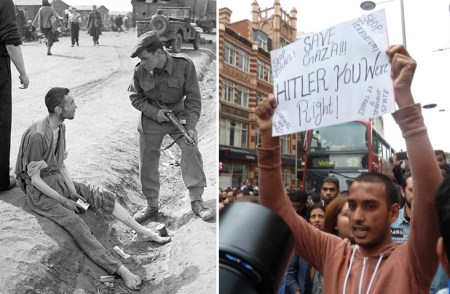
1575Seventy years after thousands of British troops fought and died to destroy the regime that murdered six million Jews, the scourge of anti-Semitism is again on the march. Left: A British soldier talks to an emaciated prisoner after the liberation of Bergen-Belsen in April 1945. Right: An anti-Israel protestor in London holds up a sign saying “Hitler you were right,” in July 2014.

In the 21st Century, outside the Middle East, it is hard to express hatred of Jews publicly. So Jew-haters everywhere have adopted a proxy: the Jewish state. Israel is the acceptable target of their hate. That is why Labour MP Naz Shah’s “solution,” with chilling echoes of Reinhard Heydrich, was to “transport” all the Jews out of Israel, with the obvious implication that this would be done forcibly and violently.

It is why National Union of Students President Malia Bouattia advocated violence against Israel and accused the international media of being “Zionist-led.” It is why Muhammed Butt, a London Labour council leader, shared a Facebook post denouncing Israel as “a terrorist state like ISIS.” It is why former London Mayor and Labour National Executive member Ken Livingstone sought to discredit Zionism by his assertion that Hitler supported it.

Where does all this hatred come from? Its long lineage begins with the Muslim prophet Muhammed and its modern form pre-dates Hitler. Back in the 1920s and 30s, murderous Arab gangs attacked Jewish communities in post-Ottoman, British Mandated Palestine and tried to drive them into the sea. They were stopped by Britain’s Captain Orde Wingate, who taught the Jews to defend themselves, fighting alongside British troops.

A few years later Amin al-Husseini, Grand Mufti of Jerusalem, made a deal with Hitler to bring the final solution to the Middle East, but the German advance was halted in its tracks at El Alamein by General Montgomery’s Eighth Army. As soon as the State of Israel was established, 68 years ago this month, by resolution of the United Nations, five Arab armies fell on her with the intent of annihilation. They failed, and ever since have been trying to destroy the Jewish state by military assault and terrorism in all its forms.

Recognizing their collective inability to eliminate Jews from their historic homeland by force, the Arabs have waged a pernicious and all-pervading propaganda war to demonize the Jewish State. Their lies have included the blatant falsehoods that Jewish communities in Judea and Samaria are illegal under international law; that the Israeli government operates an oppressive apartheid state; that the IDF is strangling Gaza under an unprovoked and illegal siege; that successive Israeli administrations have been the sole obstacle to peace in the Middle East; and that Israeli security forces deliberately murder innocent Palestinians in Gaza and the West Bank.

Understanding that the might of the pen is magnified by the flash of the sword, the Palestinian leadership and their Iranian paymasters have frequently used violence to seize international attention. Provoking the Israelis into killing Palestinian people to ensure global condemnation was the true purpose behind the Gaza rocket wars and the recent wave of murderous knife attacks and car-rammings.

Why does the West pander to this religiously inspired hatred and bigotry? There are three fundamental reasons. First, Europe especially is consumed by imperial guilt. Those that are seen to have been historically oppressed and exploited can today do no wrong; Westerners must prostrate themselves at their feet.

Second, every European country depends on Arab oil for its continued existence and relishes the return of its petrodollars through arms sales and massive investment into their economies.

Third, Western governments understand the power of their ever-increasing Islamic populations. They fear the extremism of those who reject Western values and want to violently replace them with the ways of Islamic sharia law. And they calculate the mathematics of the Muslim vote at the ballot box.

They know that among these communities there is widespread and innate hatred of Jews and of Israel. Mehdi Hasan, a British Muslim political journalist, has confirmed: “anti-Semitism isn’t just tolerated in some sections of the British Muslim community; it’s routine and commonplace.” Our politicians believe that by appeasement they will satiate the blood lust of the jihadists and gain the support of Muslim voters.

This is why we see Western leaders condemning Israel for insufficient restraint while defending itself from lethal Hamas rockets, when they know full well Israel has done all it can to avoid civilian deaths. It is why not one single EU member state had the courage to vote against the false condemnation of Israel for war crimes in the UN Human Rights Council last year. It is why the British government unequivocally asserts that Jewish settlements in the West Bank are illegal when it knows they are not. It is why Prime Minister David Cameron, a friend and supporter of the Jewish state, accused Israel of turning the Gaza Strip into a ‘prison camp’ when he knew it had not.

These false and malicious condemnations fuel hatred of Israel and of Jewish people everywhere. They are driven and intensified by a media that is dominated by strident, virulent and unyielding anti-Israel bias.

What of the future? Imperial guilt in Europe shows no sign of diminishing. In fact, the ideology behind it is gaining strength as the EU seeks to undermine national identity in its drive for ever-closer union and the creation of a superstate.

Despite developing energy technologies, there is no prospect of significantly reduced dependence on Middle Eastern oil in the foreseeable future. And with the vast influx of refugees from Muslim countries into Europe, the urge to appease their anti-Semitic and anti-Israel attitudes can only increase dramatically.

This means Israel and the Jews are going to come under even more intolerable pressure, leading to a greater exodus of Jews from many Western nations and the increasing international isolation of the Jewish state.

But there is an alternative. It is that Western political leaders find the courage to reject the virulent anti-Israel prejudice. To speak what they know to be the truth about the situation in the Middle East. To stop encouraging Palestinian leaders to believe their campaign against Israel is going to achieve its goal of destroying the Jewish state. And rather than supporting Palestinian hate with Western dollars, to impose sanctions against their racist and destructive behaviour.

The consequences of Western politicians’ continued weakness and appeasement are far greater than encouraging anti-Semitism and undermining the State of Israel. It is the fatal and irreversible descent of their own countries. By allowing this anti-Semitic hatred, they are betraying the millions of citizens who have fought and died to oppose the sort of malevolent ideologies that are now incubating it.

Turkey’s Islamic Supremacist Foreign Policy

April 29, 2016

Turkey’s Islamic Supremacist Foreign Policy, Gatestone InstituteUzay Bulut, April 29, 2016

♦ “We have never been involved in an attack against Turkey … we were never involved in such an action… Davutoglu wants to pave the way for an offensive on Syria and Rojava and cover up Turkey’s relations with the ISIS which is known to the whole world by now.” — YPG (Kurdish) General Command.

♦ “Thousands of settlers from Anatolia were shipped in by the Turkish government to occupy former Greek villages and to change Cypriot demography — in the same manner the occupying Ottoman Empire once did in the 16th century.” — Victor Davis Hanson, historian.

♦ Turkey, for more than 40 years, has been illegally occupying the northern part of the Republic of Cyprus, historically a Greek and Christian nation, which it invaded with a bloody military campaign in 1974.

♦ What Turkey would call a crime if committed by a non-Turkish or a non-Sunni state, Turkey sees as legitimate if Turkey itself commits it.

Between March 29 and April 2, 2016, Turkey’s president, Recep Tayyip Erdogan, paid a visit to Washington D.C. to participate in the 4th Nuclear Security Summit hosted by U.S. President Barack Obama.

In an interview with CNN broadcast March 31, Erdogan said, “We will not allow an act such as giving northern Syria to a terrorist organization… We will never forgive such a wrong. We are determined about that.”

Asked which terror organization he was referring to, Erdogan said: “The YPG [Kurdish People’s Protection Units], the PYD [Democratic Union Party] … and if Daesh [ISIS] has an intention of that sort then it would also never be allowed.”

Erdogan was thereby once again attempting to equate Islamic State (ISIS), which has tortured, raped, sold or slaughtered so many innocent people in Syria and Iraq, with the Kurdish PYD, and its YPG militia, whose members have been fighting with their lives to defeat genocidal jihadist groups such as al-Nusra and ISIS.

The question is not why Erdogan or his government have such an intense hatred for Kurds. Turkey’s genocidal policies against the Kurds are not a secret. Turkey’s most recent deadly attacks are ongoing in Kurdish districts even now. The more important question is why Erdogan thinks that Turkey is the one to decide to whom the predominantly Kurdish north of Syria will belong — or who will not rule that part of Syria.

On February 17, Turkey’s capital, Ankara, was shaken by a car bomb that killed 28 people and wounded 61 others.

Turkey’s Prime Minister, Ahmet Davutoglu, immediately announced that the perpetrator was a Syrian national with links to the Syrian Kurdish People’s Protection Units (YPG).

“A direct link between the attack and the YPG has been established,” Davutoglu said. “The YPG attack was carried out with logistical support from the Kurdistan Workers’ Party (PKK) inside Turkey. Just as al-Qaeda or Daesh do not have seats at the table, the YPG, which is a terrorist organization, cannot have one.” He then once again refused to permit Kurdish YPG participation in U.N.-brokered Syria peace talks in Geneva.

Saleh Muslim, the head of Syria’s Kurdish Democratic Union Party (PYD), replied via Agence France-Presse: “We deny any involvement in this attack. These accusations are clearly related to Turkish attempts to intervene in Syria.”

The General Command of the YPG also denied any involvement in the attack:

“Under challenging conditions, we are protecting our people from barbaric gangs such as ISIS and Al-Nusra. Countless states and media outlets have repeatedly reported about the support Turkey has been providing to these terrorist groups. Apart from the terrorist groups attacking us, we as YPG have engaged in no military activity against the neighboring states or other forces.

“We would like to repeat our message to the people of Turkey and the world: We have no links to this incident… We have never been involved in an attack against Turkey. The Turkish state cannot possibly prove our engagement in any kind of attack on their side because we were never involved in such an action. Turkish Prime Minister Davutoglu’s remarks ‘Ankara attack was conducted by YPG’ is a lie and far away from the truth. With this statement, Davutoglu wants to pave the way for an offensive on Syria and Rojava and cover up Turkey’s relations with the ISIS which is known to the whole world by now.”

The Middle East is going through mass murders, kidnappings, rapes, the sexual slavery of women and other crimes. And Turkey’s aggressive and supremacist foreign policy, which does not respect the sovereignty of its neighbors, has played a large role in this situation.

Syria and Iraq, Turkey’s southern neighbors, are now the breeding ground of genocidal jihadist groups, foremost the Islamic State (ISIS). Many reporters, experts and eyewitnesses have revealed that Turkey has contributed to the rise of jihadist terrorists in the region — by letting ISIS members get in and out of Turkey and even by providing funds, logistics, and arms for ISIS.

Inside its own boundaries, Turkey has been engaged in an all-out war against its own Kurdish citizens since last August. Turkey has been murdering them indiscriminately and destroying their homes and neighborhoods.

Turkey’s hatred of Kurds is so intense that it also targets Kurdish defense forces in Syria.

On February 13, Davutoglu confirmed shelling the Kurdish YPG group in Syria, after the YPG advanced on the rebel-held town of Azaz in Syria. “We will retaliate against every step [by the YPG],” Davutoglu said. “The YPG will immediately withdraw from Azaz and the surrounding area and will not go close to it again.”

The rebels in Azaz and elsewhere in Syria are mostly Islamist jihadists. According to the scholar Aymenn Jawad Al-Tamimi, Azaz was mostly controlled in early 2015 by the group Liwa Asifat al-Shamal (“Northern Storm Brigade”), affiliated with the Islamic Front. Syria’s al-Qaeda affiliate Jabhat al-Nusra (“Al-Nusra Front”) also had a presence there.

“Azaz is a symbol for Turkey,” said Fabrice Balanche of the Washington Institute For Near East Policy. “Prime Minister Davutoglu fears that if the Kurds capture Azaz, they could start a big offensive from Kobane to the west and from Afrin to the east,” he told BBC.

As widely reported, the crisis in the region reached a peak when a Turkish Air Force F-16 fighter jet shot down a Russian Air Force Su-24 bomber along the Turkey-Syria border on November 24, killing the pilot, Lieutenant-Colonel Oleg Peshkov. The Turkish government tried to excuse the attack by claiming that the jet was downed after it had violated Turkish airspace for 17 seconds.

The Russia Defense Ministry, however, denied the aircraft ever left Syrian airspace, and released a video they claimed shows that the Su-24 was not in Turkish airspace when it was shot down.

Meanwhile, Turkey’s neighbor to its West, Greece, has long been a victim of Turkey’s violations of its sovereign airspace. According to data recorded by the Greek military, in 2014 alone, Turkish aircraft violated Greek airspace 2,244 times. On just one day, February 15, Turkish warplanes violated Greek airspace 22 times, according to Athens News Agency.

After Syria, Greece and Russia, Turkey’s next target was its other southern neighbor, Iraq. In December, Iraq’s President, Fuad Masum, said, “The presence of the Turkish Army Forces in Mosul Province without our permission violates international rules. I want Turkish officials to get its force out of Iraq’s territory immediately.”

Iraq’s Prime Minister Haider al-Abadi also condemned Turkey’s action: “We have not asked Turkey for any force and no one had informed us about the arrival of the force.”

Two neighbors of Turkey, Cyprus and Armenia, have also been victims of Turkish aggression — for an even longer time.

Turkey, for more than 40 years, has been illegally occupying the northern part of the Republic of Cyprus, which it invaded with a bloody military campaign in 1974. According to historian Victor Davis Hanson:

“Thousands of settlers from Anatolia were shipped in by the Turkish government to occupy former Greek villages and to change Cypriot demography — in the same manner the occupying Ottoman Empire once did in the 16th century. … The island remains conquered not because the Greeks have given up, but because their resistance is futile against a NATO power of some 70 million people. Greeks know that Turkey worries little about what world thinks of its occupation.”

Turkey has also been blockading yet another neighbor since 1993: “Turkey and Azerbaijan have effectively been exercising an illegal unilateral economic blockade against Armenia, which has hurt the latter economically,” wrote Armen V. Sahakyan, the executive director of the Eurasian Research and Analysis Institute. “Turkey and Azerbaijan are in clear violation of the Principle of Good Neighborliness, as well as all of the General Assembly resolutions condemning unilateral coercive measures.”

Turkey has been assaulting its neighbors in what appears as outbursts of Turkish Islamic supremacy. What Turkey would call a crime if committed by a non-Turkish or a non-Sunni state, Turkey sees as legitimate if Turkey itself commits it.

When Turkey invaded Cyprus, historically a Greek and Christian nation, it is not called an invasion. Turkey still refers to the 1974 military campaign as a “peace operation.” Senior politicians and military officials from Turkey also participate in the official ceremonies called “the Peace and Freedom Festival,” organized in occupied northern Cyprus on July 20 every year, to celebrate what they “achieved” more than 40 years ago — namely, an ethnic cleansing and colonization campaign that they conducted through many crimes, including mass murders, wholesale and repeated rapes, torture and inhuman treatment, plundering Cypriot cultural heritage and destroying churches, among others.

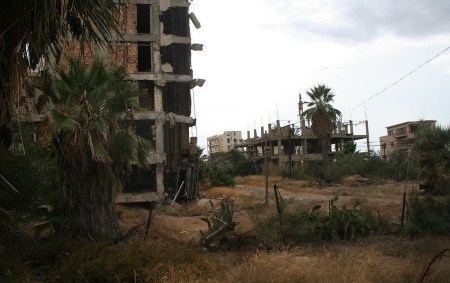
1569The crumbling buildings of the Varosha district of Famagusta, Cyprus, photographed in 2009. The area lies within Turkish-controlled northern Cyprus. The inhabitants fled during the 1974 Turkish invasion and the district has been abandoned since then. (Source: Wikimedia Commons)

If anyone blockaded another state, especially a Sunni state, Turkey would most certainly condemn it. But when Turkey itself blockades a Christian nation, it is always “justified” — most often as a response to some “unacceptable wrongdoing” by the other side.

If a non-Turkish, or non-Sunni state, treated a Turkish or Sunni minority brutally, Turkey would passionately condemn it. But Turkey sees no harm in slaughtering its own Kurdish citizens, and devastating their towns. Turkey claims this is a just way of “fighting against terrorism.”

Turkey can shoot down a Russian plane in the blink of an eye, because supposedly no one can violate Turkish airspace even for a few seconds — or even if no such violation takes place. But Turkey can violate the Greek sovereign airspace countless times as a national sport or hobby whenever it feels like it?

If Western authorities criticize Turkey for its policies, Turkey accuses them of “intervening in Turkey’s internal affairs.”

For instance, when a group of journalists close to the movement of the Islamic cleric Fethullah Gulen were detained in a mass arrest operation on December 14, 2014 in Turkey, the European Commission, in a joint statement, criticized the police raids and arrests of the media representatives.

EU foreign affairs chief Federica Mogherini and the commissioner heading EU enlargement talks also said the arrests went “against European values.”

Turkish President Recep Tayyip Erdogan responded in a public speech:

“When we take a step, someone in the European Union immediately comes up and makes a statement. According to what do you make this statement? What do you know?

“Those who have made this country wait at the gate of the European Union for 50 years, do you ever know what this [our] step is? The elements that threaten our national security — be they members of the press, or this or that — will get the required response. It is impossible for us to make them sovereign in this country.

“And when we take such a step, we do not think about ‘what will the European Union say?’ or ‘will the EU accept us [as a member]?’ We do not have such concerns. We will pull ourselves up by our own bootstraps. Please keep your intellect to yourselves.”

Erdogan also said that the detentions were not an “issue” of press freedom and claimed that the Fethullah Gulen movement was backed by Israel, which Erdogan referred to as “the country in the south that he [Gulen] loves.”

So, the European Union, of which Turkey is allegedly “striving” to be a member, cannot even issue a critical statement concerning Turkey’s policies because that would “intervene in Turkish steps for national security,” but Turkey can send jihadist fighters, arms or funds into Syria or Iraq and destroy lives and civilizations there?

Turkey seems to believe it always has to be strong and a leading force in the region. But if Kurds — an indigenous, stateless and persecuted people — are to gain a single right anywhere in the world, does Turkey find that unacceptable?

The entire history of Turkey as well as its current policies demonstrate that Turkey believes Kurds are inferior to Turks. Turkey does not even recognize the Kurds’ right to be educated in Kurdish, evidently in an attempt to separate them from their identity.

“The policy of Republican Turkey since its establishment in 1923,” wrote the author Amir Hassanpour, “is a typical case of what has been called ‘linguicide’ or ‘linguistic genocide.’ Forcing the Kurds to abandon their language and become native speakers of Turkish is the primary goal of the language policy.”

Freedom and sovereignty are for Turks only. Kurds are just to be murdered or to be Turkey’s servants. This has been the state policy of Turkey ever since it was founded in 1923.

“The master in this country is the Turk,” said Mahmut Esat Bozkurt, Turkey’s first Minister of Justice, in 1930. “Those who are not genuine Turks can have only one right in the Turkish fatherland, and that is to be a servant, to be a slave. We are in the most free country of the world. They call this Turkey.”


A Quick Reaction to Trump’s Speech

April 28, 2016

A Quick Reaction to Trump’s Speech, Front Page MagazineDavid Horowitz, April 28, 2016

Trump foreign policy

If Mitt Romney had given the speech that Donald Trump did today, and if he had followed its strategy during the third presidential debate with Obama on foreign policy, he would have won the 2012 election. Trump’s themes were straightforward: Make America strong again, put America’s interests first. The Obama-Clinton-Kerry foreign policy has strengthened our enemies, disparaged our allies, and earned us global disrespect. It has led to disasters that include the rise of ISIS and the destabilization of the Middle East. The theme of the Obama-Clinton-Kerry years has been the weakening of America – point Trump with maximum bite: “If President Obama’s goal had been to weaken America, he could not have done a better job.” And of course the Jeremiah Wright-Billy-Ayers-radical-Barack Obama did set out deliberately to do just that.  Obama’s agenda is American weakness, which leads to losing. Trump’s agenda: we must start winning.

There were specifics. First a rejection of the neo-conservative dream of democratizing the world, and in its place old-fashioned conservatism: limited foreign policy goals and stability, as the framework of peace: “We are getting out of the nation-building business, and instead focusing on creating stability in the world.” And second, a rejection of liberal internationalism, and a defense of the nation state, in particular this nation state with its unique political culture: “Under a Trump Administration, no American citizen will ever again feel that their needs come second to the citizens of foreign countries. I will view the world through the clear lens of American interests. I will be America’s greatest defender and most loyal champion. We will not apologize for becoming successful again, but will instead embrace the unique heritage that makes us who we are.” And the (accurate) justification for this nationalism: The world is most peaceful, and most prosperous, when America is strongest.”

These were reassuring clarifications by Trump about his foreign policy views and should be a step towards satisfying his conservative critics although obviously a speech can also be only that – words to pacify critics. We’ll have to wait and see how he elaborates it further in response to specific event. But this was a very good beginning.

For me the most reassuring aspect of the speech was its political toughness, an indication of what is waiting for Hillary in November should Trump win the nomination:

“After Secretary Clinton’s failed intervention in Libya, Islamic terrorists in Benghazi took down our consulate and killed our ambassador and three brave Americans. Then, instead of taking charge that night, Hillary Clinton decided to go home and sleep! Incredible. Clinton blames it all on a video, an excuse that was a total lie…. And now ISIS is making millions of dollars a week selling Libyan oil.”

Can’t wait for those Trump-Hillary debates.

Donald J. Trump Foreign Polity Speech

April 27, 2016

Donald J. Trump Foreign Polity Speech, DonaldTrump.com, April 27, 2016

Thank you for the opportunity to speak to you, and thank you to the Center for the National Interest for honoring me with this invitation.

I would like to talk today about how to develop a new foreign policy direction for our country – one that replaces randomness with purpose, ideology with strategy, and chaos with peace.

It is time to shake the rust off of America’s foreign policy. It’s time to invite new voices and new visions into the fold.

The direction I will outline today will also return us to a timeless principle. My foreign policy will always put the interests of the American people, and American security, above all else. That will be the foundation of every decision that I will make.

America First will be the major and overriding theme of my administration.

But to chart our path forward, we must first briefly look back.

We have a lot to be proud of. In the 1940s we saved the world. The Greatest Generation beat back the Nazis and the Japanese Imperialists.

Then we saved the world again, this time from totalitarian Communism. The Cold War lasted for decades, but we won.

Democrats and Republicans working together got Mr. Gorbachev to heed the words of President Reagan when he said: “tear down this wall.”

History will not forget what we did.

Unfortunately, after the Cold War, our foreign policy veered badly off course. We failed to develop a new vision for a new time. In fact, as time went on, our foreign policy began to make less and less sense.

Logic was replaced with foolishness and arrogance, and this led to one foreign policy disaster after another.

We went from mistakes in Iraq to Egypt to Libya, to President Obama’s line in the sand in Syria. Each of these actions have helped to throw the region into chaos, and gave ISIS the space it needs to grow and prosper.

It all began with the dangerous idea that we could make Western democracies out of countries that had no experience or interest in becoming a Western Democracy.

We tore up what institutions they had and then were surprised at what we unleashed. Civil war, religious fanaticism; thousands of American lives, and many trillions of dollars, were lost as a result. The vacuum was created that ISIS would fill. Iran, too, would rush in and fill the void, much to their unjust enrichment.

Our foreign policy is a complete and total disaster.

No vision, no purpose, no direction, no strategy.

Today, I want to identify five main weaknesses in our foreign policy.

First, Our Resources Are Overextended

President Obama has weakened our military by weakening our economy. He’s crippled us with wasteful spending, massive debt, low growth, a huge trade deficit and open borders.

Our manufacturing trade deficit with the world is now approaching $1 trillion a year. We’re rebuilding other countries while weakening our own.

Ending the theft of American jobs will give us the resources we need to rebuild our military and regain our financial independence and strength.

I am the only person running for the Presidency who understands this problem and knows how to fix it.

Secondly, our allies are not paying their fair share.

Our allies must contribute toward the financial, political and human costs of our tremendous security burden. But many of them are simply not doing so. They look at the United States as weak and forgiving and feel no obligation to honor their agreements with us.

In NATO, for instance, only 4 of 28 other member countries, besides America, are spending the minimum required 2% of GDP on defense.

We have spent trillions of dollars over time – on planes, missiles, ships, equipment – building up our military to provide a strong defense for Europe and Asia. The countries we are defending must pay for the cost of this defense – and, if not, the U.S. must be prepared to let these countries defend themselves.

The whole world will be safer if our allies do their part to support our common defense and security.

A Trump Administration will lead a free world that is properly armed and funded.

Thirdly, our friends are beginning to think they can’t depend on us.

We’ve had a president who dislikes our friends and bows to our enemies.

He negotiated a disastrous deal with Iran, and then we watched them ignore its terms, even before the ink was dry.

Iran cannot be allowed to have a nuclear weapon and, under a Trump Administration, will never be allowed to have a nuclear weapon.

All of this without even mentioning the humiliation of the United States with Iran’s treatment of our ten captured sailors.

In negotiation, you must be willing to walk. The Iran deal, like so many of our worst agreements, is the result of not being willing to leave the table. When the other side knows you’re not going to walk, it becomes absolutely impossible to win.

At the same time, your friends need to know that you will stick by the agreements that you have with them.

President Obama gutted our missile defense program, then abandoned our missile defense plans with Poland and the Czech Republic.

He supported the ouster of a friendly regime in Egypt that had a longstanding peace treaty with Israel – and then helped bring the Muslim Brotherhood to power in its place.

Israel, our great friend and the one true Democracy in the Middle East, has been snubbed and criticized by an Administration that lacks moral clarity. Just a few days ago, Vice President Biden again criticized Israel – a force for justice and peace – for acting as an impediment to peace in the region.

President Obama has not been a friend to Israel. He has treated Iran with tender love and care and made it a great power in the Middle East – all at the expense of Israel, our other allies in the region and, critically, the United States.

We’ve picked fights with our oldest friends, and now they’re starting to look elsewhere for help.

Fourth, our rivals no longer respect us.

In fact, they are just as confused as our allies, but an even bigger problem is that they don’t take us seriously any more.

When President Obama landed in Cuba on Air Force One, no leader was there to meet or greet him – perhaps an incident without precedent in the long and prestigious history of Air Force One.

Then, amazingly, the same thing happened in Saudi Arabia — it’s called no respect.

Do you remember when the President made a long and expensive trip to Copenhagen, Denmark to get the Olympics for our country, and, after this unprecedented effort, it was announced that the United States came in fourth place?

He should have known the result before making such an embarrassing commitment.

The list of humiliations goes on and on.

President Obama watches helplessly as North Korea increases its aggression and expands even further with its nuclear reach.

Our president has allowed China to continue its economic assault on American jobs and wealth, refusing to enforce trade rules – or apply the leverage on China necessary to rein in North Korea.

He has even allowed China to steal government secrets with cyber attacks and engage in industrial espionage against the United States and its companies.

We’ve let our rivals and challengers think they can get away with anything.

If President Obama’s goal had been to weaken America, he could not have done a better job.

Finally, America no longer has a clear understanding of our foreign policy goals.

Since the end of the Cold War and the break-up of the Soviet Union, we’ve lacked a coherent foreign policy.

One day we’re bombing Libya and getting rid of a dictator to foster democracy for civilians, the next day we are watching the same civilians suffer while that country falls apart.

We’re a humanitarian nation. But the legacy of the Obama-Clinton interventions will be weakness, confusion, and disarray.

We have made the Middle East more unstable and chaotic than ever before.

We left Christians subject to intense persecution and even genocide.

Our actions in Iraq, Libya and Syria have helped unleash ISIS.

And we’re in a war against radical Islam, but President Obama won’t even name the enemy!

Hillary Clinton also refuses to say the words “radical Islam,” even as she pushes for a massive increase in refugees.

After Secretary Clinton’s failed intervention in Libya, Islamic terrorists in Benghazi took down our consulate and killed our ambassador and three brave Americans. Then, instead of taking charge that night, Hillary Clinton decided to go home and sleep! Incredible.

Clinton blames it all on a video, an excuse that was a total lie. Our Ambassador was murdered and our Secretary of State misled the nation – and by the way, she was not awake to take that call at 3 o’clock in the morning.

And now ISIS is making millions of dollars a week selling Libyan oil.

This will change when I am president.

To all our friends and allies, I say America is going to be strong again. America is going to be a reliable friend and ally again.

We’re going to finally have a coherent foreign policy based upon American interests, and the shared interests of our allies.

We are getting out of the nation-building business, and instead focusing on creating stability in the world.

Our moments of greatest strength came when politics ended at the water’s edge.

We need a new, rational American foreign policy, informed by the best minds and supported by both parties, as well as by our close allies.

This is how we won the Cold War, and it’s how we will win our new and future struggles.

First, we need a long-term plan to halt the spread and reach of radical Islam.

Containing the spread of radical Islam must be a major foreign policy goal of the United States.

Events may require the use of military force. But it’s also a philosophical struggle, like our long struggle in the Cold War.

In this we’re going to be working very closely with our allies in the Muslim world, all of which are at risk from radical Islamic violence.

We should work together with any nation in the region that is threatened by the rise of radical Islam. But this has to be a two-way street – they must also be good to us and remember us and all we are doing for them.

The struggle against radical Islam also takes place in our homeland. There are scores of recent migrants inside our borders charged with terrorism. For every case known to the public, there are dozens more.

We must stop importing extremism through senseless immigration policies.

A pause for reassessment will help us to prevent the next San Bernardino or worse — all you have to do is look at the World Trade Center and September 11th.

And then there’s ISIS. I have a simple message for them. Their days are numbered. I won’t tell them where and I won’t tell them how. We must as, a nation, be more unpredictable. But they’re going to be gone. And soon.

Secondly, we have to rebuild our military and our economy.

The Russians and Chinese have rapidly expanded their military capability, but look what’s happened to us!

Our nuclear weapons arsenal – our ultimate deterrent – has been allowed to atrophy and is desperately in need of modernization and renewal.

Our active duty armed forces have shrunk from 2 million in 1991 to about 1.3 million today.

The Navy has shrunk from over 500 ships to 272 ships during that time.

The Air Force is about 1/3 smaller than 1991. Pilots are flying B-52s in combat missions today which are older than most people in this room.

And what are we doing about this? President Obama has proposed a 2017 defense budget that, in real dollars, cuts nearly 25% from what we were spending in 2011.

Our military is depleted, and we’re asking our generals and military leaders to worry about global warming.

We will spend what we need to rebuild our military. It is the cheapest investment we can make. We will develop, build and purchase the best equipment known to mankind. Our military dominance must be unquestioned.

But we will look for savings and spend our money wisely. In this time of mounting debt, not one dollar can be wasted.

We are also going to have to change our trade, immigration and economic policies to make our economy strong again – and to put Americans first again. This will ensure that our own workers, right here in America, get the jobs and higher pay that will grow our tax revenue and increase our economic might as a nation.

We need to think smarter about areas where our technological superiority gives us an edge. This includes 3-D printing, artificial intelligence and cyberwarfare.

A great country also takes care of its warriors. Our commitment to them is absolute. A Trump Administration will give our service men and women the best equipment and support in the world when they serve, and the best care in the world when they return as veterans to civilian life.

Finally, we must develop a foreign policy based on American interests.

Businesses do not succeed when they lose sight of their core interests and neither do countries.

Look at what happened in the 1990s. Our embassies in Kenya and Tanzania were attacked and seventeen brave sailors were killed on the USS Cole. And what did we do? It seemed we put more effort into adding China to the World Trade Organization – which has been a disaster for the United States – than into stopping Al Qaeda.

We even had an opportunity to take out Osama Bin Laden, and didn’t do it. And then, we got hit at the World Trade Center and the Pentagon, the worst attack on our country in its history.

Our foreign policy goals must be based on America’s core national security interests, and the following will be my priorities.

In the Middle East, our goals must be to defeat terrorists and promote regional stability, not radical change. We need to be clear-sighted about the groups that will never be anything other than enemies.

And we must only be generous to those that prove they are our friends.

We desire to live peacefully and in friendship with Russia and China. We have serious differences with these two nations, and must regard them with open eyes. But we are not bound to be adversaries. We should seek common ground based on shared interests. Russia, for instance, has also seen the horror of Islamic terrorism.

I believe an easing of tensions and improved relations with Russia – from a position of strength – is possible. Common sense says this cycle of hostility must end. Some say the Russians won’t be reasonable. I intend to find out. If we can’t make a good deal for America, then we will quickly walk from the table.

Fixing our relations with China is another important step towards a prosperous century. China respects strength, and by letting them take advantage of us economically, we have lost all of their respect. We have a massive trade deficit with China, a deficit we must find a way, quickly, to balance.

A strong and smart America is an America that will find a better friend in China. We can both benefit or we can both go our separate ways.

After I am elected President, I will also call for a summit with our NATO allies, and a separate summit with our Asian allies. In these summits, we will not only discuss a rebalancing of financial commitments, but take a fresh look at how we can adopt new strategies for tackling our common challenges.

For instance, we will discuss how we can upgrade NATO’s outdated mission and structure – grown out of the Cold War – to confront our shared challenges, including migration and Islamic terrorism.

I will not hesitate to deploy military force when there is no alternative. But if America fights, it must fight to win. I will never send our finest into battle unless necessary – and will only do so if we have a plan for victory.

Our goal is peace and prosperity, not war and destruction.

The best way to achieve those goals is through a disciplined, deliberate and consistent foreign policy.

With President Obama and Secretary Clinton we’ve had the exact opposite: a reckless, rudderless and aimless foreign policy – one that has blazed a path of destruction in its wake.

After losing thousands of lives and spending trillions of dollars, we are in far worse shape now in the Middle East than ever before.

I challenge anyone to explain the strategic foreign policy vision of Obama-Clinton – it has been a complete and total disaster.

I will also be prepared to deploy America’s economic resources. Financial leverage and sanctions can be very persuasive – but we need to use them selectively and with determination. Our power will be used if others do not play by the rules.

Our friends and enemies must know that if I draw a line in the sand, I will enforce it.

However, unlike other candidates for the presidency, war and aggression will not be my first instinct. You cannot have a foreign policy without diplomacy. A superpower understands that caution and restraint are signs of strength.

Although not in government service, I was totally against the War in Iraq, saying for many years that it would destabilize the Middle East. Sadly, I was correct, and the biggest beneficiary was Iran, who is systematically taking over Iraq and gaining access to their rich oil reserves – something it has wanted to do for decades. And now, to top it all off, we have ISIS.

My goal is to establish a foreign policy that will endure for several generations.

That is why I will also look for talented experts with new approaches, and practical ideas, rather than surrounding myself with those who have perfect resumes but very little to brag about except responsibility for a long history of failed policies and continued losses at war.

Finally, I will work with our allies to reinvigorate Western values and institutions. Instead of trying to spread “universal values” that not everyone shares, we should understand that strengthening and promoting Western civilization and its accomplishments will do more to inspire positive reforms around the world than military interventions.

These are my goals, as president.

I will seek a foreign policy that all Americans, whatever their party, can support, and which our friends and allies will respect and welcome.

The world must know that we do not go abroad in search of enemies, that we are always happy when old enemies become friends, and when old friends become allies.

To achieve these goals, Americans must have confidence in their country and its leadership again.

Many Americans must wonder why our politicians seem more interested in defending the borders of foreign countries than their own.

Americans must know that we are putting the American people first again. On trade, on immigration, on foreign policy – the jobs, incomes and security of the American worker will always be my first priority.

No country has ever prospered that failed to put its own interests first. Both our friends and enemies put their countries above ours and we, while being fair to them, must do the same.

We will no longer surrender this country, or its people, to the false song of globalism.

The nation-state remains the true foundation for happiness and harmony. I am skeptical of international unions that tie us up and bring America down, and will never enter America into any agreement that reduces our ability to control our own affairs.

NAFTA, as an example, has been a total disaster for the U.S. and has emptied our states of our manufacturing and our jobs. Never again. Only the reverse will happen. We will keep our jobs and bring in new ones. Their will be consequences for companies that leave the U.S. only to exploit it later.

Under a Trump Administration, no American citizen will ever again feel that their needs come second to the citizens of foreign countries.

I will view the world through the clear lens of American interests.

I will be America’s greatest defender and most loyal champion. We will not apologize for becoming successful again, but will instead embrace the unique heritage that makes us who we are.

The world is most peaceful, and most prosperous, when America is strongest.

America will continually play the role of peacemaker.

We will always help to save lives and, indeed, humanity itself. But to play that role, we must make America strong again.

We must make America respected again. And we must make America great again.

If we do that, perhaps this century can be the most peaceful and prosperous the world has ever known. Thank you.

LIVE Stream: Donald Trump Speaks on Foreign Policy in Washington, DC (4-27-16)

April 27, 2016

LIVE Stream: Donald Trump Speaks on Foreign Policy in Washington, DC (4-27-16) via YouTube, April 27, 2016

https://www.youtube.com/watch?v=XW8RqLN3Qao

US Sinai pullback payback for islands handover

April 27, 2016

US Sinai pullback payback for islands handover, DEBKAfile, April 27, 2016

RedSeaBab2

The US withdrew its forces from the Sinai Peninsula last weekend in retaliation for Egypt’s transfer of sovereignty over Tiran and Sanafir islands to Saudi Arabia, according to DEBKAfile’s military and intelligence sources. They also report that the move came after Washington protested to Egyptian President Abdel Fattah al-Sisi over its exclusion from the consultations and military coordination between Egypt, Saudi Arabia and Israel regarding the islands.

The US message was clear. Since Riyadh, Cairo and Jerusalem do not report their military steps in the Sinai Peninsula, the Gulf of Aqaba and the Red Sea to Washington, the US sees no need to inform them of its military steps in the Sinai.

That message was conveyed by the chairman of the US Joint Chiefs of Staff, Joseph F. Dunford, to the Egyptian president during their meeting on Saturday, April 23 in Cairo.

On Tuesday, DEBKAfile’s military sources reported that several days earlier the US military secretly withdrew about 100 of its officers and enlisted men from the multinational peacekeeping force in the northern part of the Sinai. As far as Riyadh, Cairo and Jerusalem are concerned, there is no doubt that it was a retaliatory measure.

US sources refused to specify the current location of the troops. The American force was withdrawn from El Gorah base, located next to the town of Sheikh Zuweid. Gen. Dunford told al-Sisi that the Obama administration is no longer willing to maintain forces in the northern Sinai following the recent shelling of the base by the ISIS affiliate in the restive area. The incident marked the terrorist organization’s first attack on US troops in the Sinai, but its second on an American force in the Middle East.

On March 19, ISIS shelled Fire Base Bell, a US marine base in Makhmur, northern Iraq, about 77 kilometers southeast of the terrorist organization’s de facto capital of Mosul. One marine was killed.

It was not by chance that shortly before he visited Cairo, Gen. Dunford made a visit lasting no more than 90 minutes to the US forward base to award purple hearts to four marines for their bravery during the ISIS shelling.

But while Washington is determined to maintain Fire Base Bell, where it has deployed HIMARS rocket launchers that can fire GPS-guided rockets known as GMLRS capable of reaching Mosul, and awards medals to soldiers serving at the base, it is not ready to treat its soldiers in the Sinai in the same manner because they have the status of multinational observers. Rather than giving out medals, it withdrew those soldiers immediately after the first ISIS attack.

At the same time, US sources launched an unprecedented personal attack on Egypt’s president over his decision to hand over the two islands to Riyadh. Articles attacking El-Sisi’s policy started to appear in the American media, with one saying “The decision to transfer the islands to Saudi Arabia may be the final nail in Sissi’s coffin.” It also described Egypt as being on the verge of a revolution against al-Sisi.

Two other Middle Eastern figures who were involved in Cairo’s decision regarding the islands were Saudi Deputy Crown Prince and Defense Minister Mohammad bin Salman and Israeli Defense Minister Moshe Ya’alon, who said recently that Cairo consulted Jerusalem regarding the transfer of the islands. However, his comment was not mentioned in US media reports, as if the development was not related to Saudi Arabia or Israel.

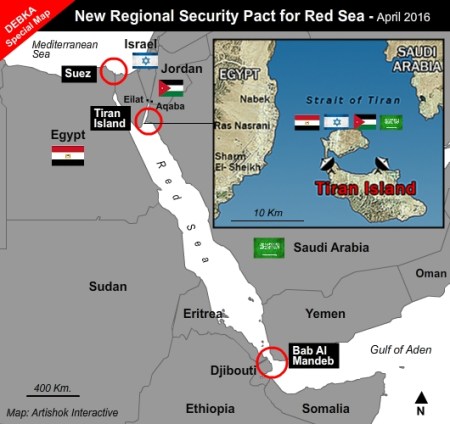
DEBKAfile’s military and intelligence sources report that one of the main reasons for Washington’s rage was the fact that Egypt, Saudi Arabia, Jordan and Israel decided to establish and coordinate by themselves a regional defense mechanism covering the Suez Canal, the gulfs of Suez and Aqaba, and the Red Sea.

The Obama administration prefers to ignore the fact that the US withdrawal of its naval and air forces from those areas over the last three years has enabled the Iranian fleet to start operating in those waters.

Obama’s Double Standard Toward Netanyahu

April 26, 2016

Obama’s Double Standard Toward Netanyahu, The Gatestone InstituteAlan M. Dershowitz, April 26, 2016

As President Obama winds up his farewell tour of Europe, it is appropriate to consider the broader implications of the brouhaha he created in Great Britain. At a joint press conference with Britain Prime Minister, David Cameron, President Obama defended his intrusion into British politics in taking sides on the controversial and divisive Brexit debate. In an op-ed, Obama came down squarely on the side of Britain remaining in the European Union — a decision I tend to agree with on its merits. But he was much criticized by the British media and British politicians for intruding into a debate about the future of Europe and Britain’s role in it.

Obama defended his actions by suggesting that in a democracy, friends should be able to speak their minds, even when they are visiting another country:

“If one of our best friends is in an organization that enhances their influence and enhances their power and enhances their economy, then I want them to stay in. Or at least I want to be able to tell them ‘I think this makes you guys bigger players.'”

Nor did he stop at merely giving the British voters unsolicited advice, he also issued a not so veiled threat. He said that “the UK is going to be in the back of the queue” on trade agreements if they exit the EU.

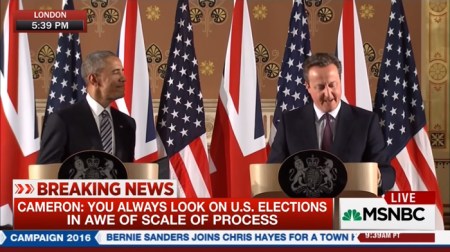
1562UK Prime Minister David Cameron and US President Barack Obama take a question at a press conference, on whether it is appropriate for Obama to say whether or not the UK should remain in the European Union, April 22, 2015.

President Obama must either have a short memory or must adhere to Emerson’s dictum that “foolish consistency is the hobgoblin of little minds.” Recall how outraged the same President Obama was when the Prime Minister of a friendly country, Benjamin Netanyahu, spoke his mind about the Iran Deal.

There are, of course, differences: first, Israel has a far greater stake in the Iran Deal than the United States has in whatever decision the British voters make about Brexit: and second, Benjamin Netanyahu was representing the nearly unanimous view of his countrymen, whereas there is little evidence of whether Americans favor or oppose Brexit in large numbers.

Another difference, of course, is that Obama was invited to speak by Cameron, whereas, Netanyahu was essentially disinvited by Obama. But under our tripartite system of government — which is different than Britain’s Unitary Parliamentary system — that fact is monumentally irrelevant. Netanyahu was invited by a co-equal branch of the government, namely Congress, which has equal authority over foreign policy with the president and equal authority to invite a friendly leader. Moreover, not only are the British voters divided over Brexit, but Britain’s Conservative Party itself is deeply divided. Indeed, the leading political figure in opposition to Britain remaining in the European Union is a potential successor to Cameron as leader of the Conservative Party. So these differences certainly don’t explain the inconsistency between Obama’s interference in British affairs and his criticism of Netanyahu for accepting an invitation from Congress to express his country’s views on an issue directly affecting its national security.

So which is it, Mr. President? Should friends speak their minds about controversial issues when visiting another country, or should they keep their views to themselves? Or is your answer that friends should speak their minds only when they agree with other friends, but not when they disagree? Such a view would skew the market place of ideas beyond recognition. If friends should speak about such issues, it is even more important to do so when they disagree.

A wit once observed that “hypocrisy is the homage vice pays to virtue.” It is also the currency of diplomacy and politics. That doesn’t make it right.

The President owes the American people, and Benjamin Netanyahu, an explanation for his apparent hypocrisy and inconsistency. Let there be one rule that covers all friends — not one for those with whom you agree and another for those with whom you disagree. For me the better rule is open dialogue among friends on all issues of mutual importance. Under this rule, which President Obama now seems to accept, he should have welcomed Prime Minister Netanyahu’s advocacy before Congress, instead of condemning it. He owes Prime Minister Netanyahu an apology, and so do those Democratic members of Congress who rudely stayed away from Netanyahu’s informative address to Congress.

A policy of hypocrisy

April 25, 2016

A policy of hypocrisy, Israel Hayom, Dr. Haim Shine, April 25, 2016

Judging by his approach to complex national and international issues, U.S. President Barack Obama is very frustrated. The frustration is natural for someone who made big promises, almost messianic ones, and is now leaving behind nothing more than a trail of shattered dreams. During his eight years in office, the United States has gone from being a leading superpower, a pillar of Western civilization, to a state that is hesitant, indecisive and alarmingly slow to respond. Its domestic economy is faltering, sowing uncertainty and insecurity among the large middle class.

Needless to say, the success enjoyed by Republican presidential candidate Donald Trump is an expression of a great number of Americans who grew up hearing about how their flag was raised on Japan’s Mount Suribachi on the island of Iwo Jima toward the end of World War II, and who are now watching with heartache as their beloved flag is being lowered to half-mast before being taken down altogether.

In an effort to gather up the pieces of his crumbling legacy, Obama set out on his final trip to the Middle East and Europe. America’s long-time allies feel betrayed. Their resentment is clear. Relationships between countries are not disposable. The Obama administration’s deference to Iran has had major implications on its ties with Saudi Arabia and the Gulf States. A divided Egypt is still paying the price for Obama’s support for the Muslim Brotherhood.

The state of Israel, which has led the struggle against a nuclear Iran for a long time, has by now come to terms with the fact that the United States was duped by the fake smiles of Iranian Foreign Minister Mohammad Javad Zarif and his friends in Tehran. Singing Passover songs in Hebrew won’t change the fact that Obama has not changed, after having sided entirely with the mendacious Palestinian narrative of victimhood.

Leaders in the Middle East cannot decide whether Obama is a naive president or one who is willing to sacrifice his fundamental values and his credibility just so he can leave behind what he sees as a positive sentence in the books of history — a sentence that will be erased with record speed.

Europe is also discouraged by the United States. Obama’s indecisiveness regarding the madness in Syria has allowed Russia to take significant steps in the Middle East and Europe. The failed efforts to confront the Syrian problem have contributed to the tsunami of migrants flooding Europe and all the resulting consequences for European society and its security. Add to this, of course, the financial crisis currently threatening to destroy the European Union, the seeds of which were sown in 1992 with the signing of the Maastricht Treaty in 1992.

It is against this backdrop that the British are expected to decide via referendum whether or not to remain a part of the European Union. During his recent visit to England, Obama spoke out strongly against Britain’s potential separation from the EU. This was a crude and disproportionate effort to meddle in another state’s affairs — an expression of his desire to evade blame for the collapse of the European Union. In his mind, British citizens are expected to forgo their opinions and best interests in favor of his legacy.

It is therefore unclear why Obama unleashed his fury at Prime Minister Benjamin Netanyahu when the latter made tireless efforts to convince Congress and the American public not be deceived by the dangerous nuclear deal. How much hypocrisy does it take to allow yourself to do things that you reprimand others for doing? Immanuel Kant saw this kind of behavior as a basic moral failure. Luckily for Britain’s citizens, Obama cannot veto their decision.

GCC leaders reject Obama’s Middle East policy

April 23, 2016

GCC leaders reject Obama’s Middle East policy, DEBKAfile, April 23, 2016

Big Bomber


DEBKAfile’s intelligence sources and its sources in the Gulf report exclusively that US President Barack Obama failed to convince the leaders of the six Gulf Cooperation Council member states, during their April 22 summit in Riyadh, to support his Middle East policy and cooperate with Washington.

Our sources also report that Saudi Arabia, with Turkey’s help, and the US carried out separate military operations several hours before the start of the summit that showed the extent of their differences.

The US on Thursday started to use its giant B-52 bombers against ISIS in an attempt to show Gulf leaders that it is determined to quash the terrorist organization’s threat to Gulf states. The bombers deployed at Qatar’s Al Udeid airbase attacked targets around Mosul in northern Iraq, but the targets were not identified.

Meanwhile, Saudi Arabia and Turkey, which recently established a bloc along with Egypt and Jordan to oppose Obama’s Middle East policy, started to infiltrate a force of 3,500 rebels back into Syria.

The force has been trained and financed by the Saudis at special camps in Turkey and Jordan. Members of the force are now fighting alongside other rebels north of Aleppo, but they are being bombed heavily by the Russian and Syrian air forces.

Riyadh sent the rebels into Syria to demonstrate to Obama that the Saudi royal family opposes the policy of diplomatic and military cooperation between the US and Russia regarding Syria that enables President Bashar Assad to remain in power in Damascus.

Since the war in Syria began in 2011, Obama has promised countless times that Washington would train and arm Syrian rebel forces outside the country, and then deploy them in Syria in order to strengthen rebel forces.

However, it has not done so except for one instance in 2015. The US infiltrated a small force consisting of no more than several dozen fighters, but it was destroyed by the Nusra Front, an affiliate of Al Qaeda, shortly after it crossed the border. The terrorist group had apparently been tipped off about the arrival of the pro-American force.

All of Washington’s efforts to recruit and train Syrian fighters, which have cost close to $1 billion, have failed.

DEBKAfile’s sources report exclusively that the leaders of the six GCC member states put their previous differences aside and presented Obama with four requests aimed at building a new joint policy regarding the region. According to our sources, these requests were:

1. Action by Washington to strengthen the Sunni majority in Iraq and facilitate representation of the Sunnis in the central government in Baghdad. The Gulf rulers told Obama that his policy of trying to win the support of Iraqi Prime MinisterHaider al-Abadi is mistaken.

They also pointed out reports by their intelligence services that al-Abadi is likely to be deposed and be replaced by a pro-Iranian prIme minister in the near future.

Obama rejected the request and said he refuses to change his Iraq policy.

2. Imposition of new US sanctions on Iran over its continuing ballistic missile tests.

On April 19, several hours before Obama’s departure for Riyadh, Iran carried out its latest act of defiance by attempting to launch a satellite into orbit using one of its “Simorgh” intercontinental ballistic missiles. The missile failed to leave the Earth’s atmosphere, fell to earth and crashed along with the satellite.

Obama turned down the Gulf leaders on new sanctions as well.

3. Provision of US-made F-35 fighter-bombers to Saudi Arabia and the UAE so they can take action against the Iranian missile threat. The US president declined the request.

4. Abandonment of Washington’s cooperation with Russia and the UN for political solution in Syria, and instead cooperate with Gulf states and Turkey to end the war and depose President Bashar Assad. Obama refused.

In other words, the summit in Riyadh, Obama’s final meeting with GCC leaders before he leaves the White House next January, ended without a single agreement.