Posted tagged ‘Foreign Policy’

Arab Culture & the Arab-Israeli Conflict

December 10, 2014

Arab Culture & the Arab-Israeli Conflict, Front Page Magazine, December 10, 2014

ac-450x337

For the Arabs, the Israelis are the ‘others’, suspected of manipulation and treachery, and a permanent adversary and enemy, as taught in the Arabic Koran.

It is essential to unlock the Arab culture code, and cease viewing the Middle East through a Western prism that leads only to delusion, disdain, and a host of ill-consequences and dashed hopes.

****************

The multi-faceted essence of the Arab-Israeli conflict and Israeli-Palestinian war is territorialpolitical, ideological, and religious – a convulsive confrontation between the mutually exclusive claims of Judaism and Islam.

But a fifth dimension of the conflict is culture – popular culture – embodied in a code of identity that differentiates one human community from another.

Culture is not negotiable or alterable: it is the texture of the life people live, and the local rhythm of things they know from their earliest memories. It is an inbred code of behavior and, as for all peoples, precedes and precludes morality, thought, and judgment.

The reason why the cultural component of the conflict is ignored stems from the fact that in order to appreciate a culture, you basically have to know it from the inside; and outsiders, non-Arabs, are ignorant of Arab culture, and haughtily assume that it has no value.

Add to this obstacle the fact that a native always behaves differently when he is with a foreigner than with a fellow-native. Surface-like conversations between people from different cultures can reveal very little. To call the Arabs rhetorically flexible is a kind way to infer their masterful command of deception.

It is Arab culture in particular, atavistic and organic, encased in the old binding from its historical origin, which must be addressed in order to better explore the intractability of the long Arab-Israeli rivalry

1

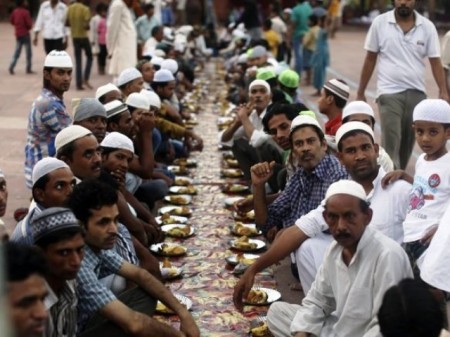
Arab culture is a family-clan-national social reality. An Arab owes absolute and blind loyalty to the group of his birth. He belongs to family and village, as a Bedouin belongs to his tribe. You can’t change your tribe, and you don’t change your family; and no other social framework demands more adhesion than blood relations. It follows from this premise that the Arab mistrusts outsiders. For the Arabs, the Israelis are the ‘others’, suspected of manipulation and treachery, and a permanent adversary and enemy, as taught in the Arabic Koran.

2

For the Arabs, language reflects culture in a way that prevents it being a vehicle for direct and clear communication. Words are used to impress, deflect intentions, disarm interlocutors, confuse listeners, and offer promises never to be fulfilled. The cultural subtext in discussions and negotiations with Arabs is often garnished in polite commitments and even written agreements. But there is little conviction to adhere to the summary accord because the culture code calls for gingerly saying what the other wants to hear; then agreeing to an appointment never to be kept, or promising a phone call that will never come. The Israelis were enthused that the Palestinians moved toward peace in the Oslo Accord, but it was followed by blood and murder, not reconciliation and brotherhood.

3

For the Arabs, the past defines the present because history is the anchor for all aspects of identity and aspirations. There is a mythological fascination with ancestors – as for the contemporary Salifiyyamovement – combined with an axiomatic belief that sees the future as necessarily emerging from and even repeating the glorious Arab past. This contributes to an iron-will and patience until victory is assured. For the Arabs – Israel beware forget any perceived ill act against them. The early Islamic days of conquest and caliphate will be renewed, even if the shift in power takes forever.

4

Arab self-consciousness, spared any identity crisis, provides a psychological foundation for imposing the collective will upon others. To be a Muslim and an Arab, as Allah’s chosen people, launches the Arab on a path of self-justification, whose flip-side is to blame the non-Arabs for all Arab misfortunes and failures. Israel is always excoriated for crimes of aggression and violence. The composed Arab never doubts that justice is on his side: he can do no wrong. Thus, all the Arab-Israeli wars since 1948 are blamed on Israel. Considering that self-criticism is an ancient Jewish practice, Arab self-justification creates an imbalanced ethical equation that demoralizes the Jews while radicalizing the Arabs. In short, the Arabs seek victory, not peace.

5

Islamic truth claims, as in Koranic deviations from Biblical narratives, do not require proof or evidence, or even common sense validity. The Arabs are not perturbed by the lack of facts; their discourse is internal and self-enclosed, as reality is in their mind and not in the external objective world. The Arab mind-set inhabits a world of entrenched fantasy or diabolical conspiracy theories. Note the revelatory comment by Anwar Sadat that ‘all life is play-acting’. He was one to know. In 1993 Arafat demonstrated his theatrical adeptness at the Oslo signing ceremony at the White House.

*

It is essential to unlock the Arab culture code, and cease viewing the Middle East through a Western prism that leads only to delusion, disdain, and a host of ill-consequences and dashed hopes.

Non-intervention with a wink

December 10, 2014

Non-intervention with a wink, Israel Hayom, Prof. Abraham Ben-Zvi, December 10, 2014

[T]he president has also indicated, with extra emphasis, that he intends to play an especially active foreign policy role, even in the twilight of his presidency, and will seek to forge a new diplomatic horizon on the Palestinian front after Israel holds its elections.

*********************

Despite unequivocal promises issued publicly by the U.S. administration just a few days ago, to refrain from intervening in the Israeli general elections campaign, it appeared the dam had already been breached on Tuesday during a speech at Bar-Ilan University by U.S. Ambassador to Israel Dan Shapiro.

Even though the message he delivered underwent a few cosmetic tweaks and was embedded in rhetoric of pleasantries and appeasement, the cellophane packaging and pastel colors were unable to blur the fundamental underlying significance. Indeed, underneath the heartwarming coating the ambassador time-traveled backward, straight to the beginning of the Obama era, a time when all the president’s men emphasized their belief in the linkage between diplomatic progress in the Israeli-Palestinian arena to the American superpower’s general array of diplomatic and strategic goals in the region.

And while the Arab spring shattered this conception on the jagged rocks of reality, the president has reverted — through his ambassador to Israel — to championing this idea; and at a politically sensitive time no less.

In essence, Obama is expanding and empowering the linkage principle, and is doing so while formulating an equation in which he has positioned the improvement of America’s status and clout as a superpower as a derivative of Israeli policies, and the extent to which those take into account American interests and goals, as opposed to strictly reflecting Israel’s immediate security needs and constraints.

By doing so the president has also indicated, with extra emphasis, that he intends to play an especially active foreign policy role, even in the twilight of his presidency, and will seek to forge a new diplomatic horizon on the Palestinian front after Israel holds its elections.

The goal of this message is obvious — the administration is looking squarely toward March 17 (the date of Israeli elections), and is clearly signaling that the political conditions it wants created as a result will ensure the continuation of the American-Israeli alliance with all the benefits and support associated with it.

From this perspective, the carrot of benefits is being waved alongside the whip of warnings and threats, functioning as a type of “guide for the Israeli voter,” who values this partnership with the American patron. This was indeed the opening salvo of the administration’s interventionism in the current political campaign.

SecDef Nominee Says Iranian Nukes ‘Most Significant Strategic Threat’

December 10, 2014

SecDef Nominee Says Iranian Nukes ‘Most Significant Strategic Threat,’ Washington Free Beacon, December 10, 2014

(If Mr. Carter fails to change his views on Iran, or at least stop talking about them, how long will he last as Obama’s Secretary of Defense? — DM)

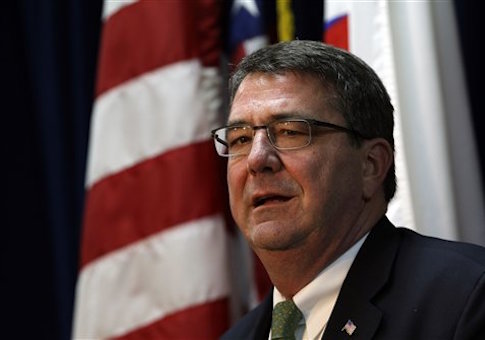
Ashton CarterAshton Carter / AP

President Barack Obama’s nominee for secretary of defense Ashton Carter has a very strong position on nuclear non-proliferation issues, the Tower reports.

Some of those positions stand in contrast with those of the Obama administration.

Politico on Tuesday described him as a “leading member of a clique of defense intellectuals long concerned with the possibility of a nuclear terrorist attack” and suggested he “could be more consequential when it comes to Obama’s plans for dealing with Iran’s nuclear program.”

Two months before President Obama’s 2008 election, Carter argued, in a paper coauthored with diplomatic heavyweights including former Special Middle East Coordinator Dennis Ross and Nonproliferation Policy Education Center Executive Director Henry Sokolski, that “Iran’s nuclear development may pose the most significant strategic threat to the United States during the next Administration.” The Times of Israel covered Carter’s nomination, noting that he was a “vocal proponent of stronger action to stymie nuclear proliferation.” Carter had visited the Jewish state in 2013, and was quoted as telling a group of Israeli soldiers that “protecting America means protecting Israel, and that’s why we’re here in the first place.”

The Jerusalem Post reported on Friday that as part of the Pentagon’s Defense Advisory Acquisition Group, Carter played an “instrumental” role in the transfer of F-35 fighter jets from the U.S. to Israel. Israel recently placed a preliminary order to purchase 25 more of the state of the art fighters. Speaking Friday to reporters at the State Department press briefing about U.S.-Israel ties, Deputy Spokesperson Marie Harf reaffirmed the closeness of the relationship, calling ties between the countries “incredibly close, essential” and “unshakable” and noting that it is “arguably the closest military-to-military relationship” the countries have ever had.

Iran Launches ‘We Love Fighting Israel’ Campaign

December 10, 2014

Iran Launches ‘We Love Fighting Israel’ Campaign, Washington Free Beacon, ,December 10, 2014

(But the humanitarian, peace-loving Islamic Republic of Iran, where sanity, good will toward all and freedom flourish, needs nukes to take its rightful place in our multicultural International Community. Right? — DM)

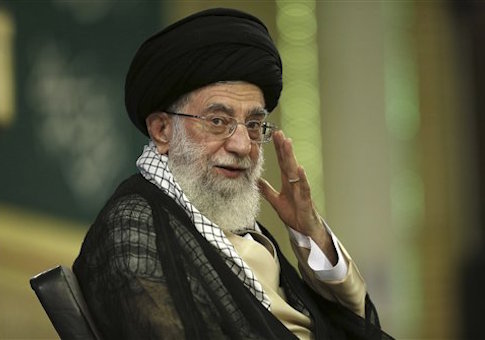
Ali KhameneiAli Khamenei / AP

The Iranian regime has launched a nationwide social media campaign called, “We Love Fighting Israel,” which encourages Iranian children, teens, and Internet users to photograph themselves alongside messages of hate for the Jewish state.

The movement has sprouted online in the last few days across social media sites such as Twitter, Instagram, and other platforms as a result of a recent call by Iranian Supreme Leader Ayatollah Ali Khamenei rallying the nation to take on Israel.

The campaign drew outrage from opponents of Iran’s hardline regime and calls for sites such as Instagram to shut it down for violating policies against hate speech.

Thousands of Iranians are reported to have already joined the electronic movement following comments by Khamenei’s outlining Iran’s goal of destroying the Jewish state.

“Our people love fighting against the Zionists and the Islamic Republic has proved this as well,” Khamenei was quoted as saying in a recent speech by the country’s state-run media. “By Allah’s Favor and Grace, we have passed through the barrier of denominational discord.”

These remarks inspired Iranian social media users to take to the Internet and launch the “We Love Fighting Israel” movement. The campaign even has spawned its own hashtag on Twitter, “#FightingtheZionists.”

The anti-Israel campaign now “has gone viral on the web,” according to Iran’s state-controlled Mehr News Agency, “getting more and more boost from individuals who post photos reading similar sentences, [and] sharing the #Fightingthezionists hash tag.”

More than 300 pictures have already been posted to an Instagram account titled, “FightingTheZionists.” The account, which had some 3,000 followers as of Tuesday evening, links to Khamenei’s personal Instagram account.

Users post pictures with messages declaring, “We love fighting against Israel,” “I love to fight Israel,” “We are lovers of fighting Israel,” and “I love fighting against Zionists,” among other similar messages.

One picture in particular has caught the eye of Iran critics on the web and prompted a harsh response to the anti-Israel campaign.

The photo shows a young child decked out in military gear and holding a sign that translates from Farsi as, “I love fighting against Zionists.”

Captioned alongside the photo is an English language message that reads: “Our people love fighting against the Zionists and the Islamic Republic has proved this as well, Ayatollah Khamenei.”

[Please see Washington Free Beacon article for a photo which I can’t reproduce here. Many other photos are available here. — DM]

It is not the only photo to depict young children as participating in the campaign to fight Israel.

The photos posted on the Instagram page depict “several groups of people including war veterans, students, journalists, and people from all walks of life joining the campaign,” according to Mehr News.

The American nonprofit group United Against Nuclear Iran (UANI), which works to prevent Tehran from obtaining a nuclear weapon, expressed disgust at the campaign on its Twitter account.

UANI lashed out at the Iranian regime for promoting “vile hate” and the “indoctrination of hate children.”

Additionally, Matan Shamir, UANI’s director of research, called on social media sites to immediately take steps to remove the Iranian campaign.

“The Iranian regime’s brazen exploitation and indoctrination of innocent children to hate and commit violence is utterly deplorable,” Shamir said. “Instagram and its parent company Facebook must enforce their own guidelines prohibiting hate speech and incitement to violence, and remove such propaganda immediately.”

Shamir went on to criticize Iran for its own domestic human rights abuses, such as preventing average citizens from accessing the Internet.

“It is intolerable that while the regime blocks its own citizens from accessing many popular social media platforms, it uses them to advance its own crude and hateful ideology,” he said.

Netanyahu’s epic understandings with Egyptian, Saudi and UAE rulers – a potential campaign weapon

December 6, 2014

Netanyahu’s epic understandings with Egyptian, Saudi and UAE rulers – a potential campaign weapon, DEBKAfile, December 6, 2014

Abdullah-al_sisiEgyptian and Saudi rulers take charge of Arab affairs

Netanyahu may or may not opt to brandish Israel’s diplomatic breakthrough to the Arab world as campaign fodder to boost his run for re-election.  Whatever he decides, the rulers of Saudi Arabia, the Arab emirates and Egypt are turning out to have acquired an interest in maintaining him in office as head of the Israeli government, in direct opposition to President Obama’s ambition to unseat him.

******************

The six Gulf Cooperation Council (GCC) rulers meet in the Qatari capital of Doha next week amid high suspense across the Arab world. Its agenda is topped by moves to finally unravel the 2010 Arab Spring policy championed by US President Barack Obama, moves that also bear the imprint of extensive cooperation maintained on the quiet between Israel and key Arab rulers.

DEBKAfile reports that the Doha parley is designed to restore Egypt under the rule of President Abdel Fatteh El-Sisi to the lead role it occupied before the decline of Hosni Mubarak. Another is to root out the Muslim Brotherhood by inducing their champion, the young Qatari ruler, Emir Tamim bin Hamad Al Thani, to drop his government’s support.

At talks taking place in Riyadh ahead of the summit, Qatari officials appeared ready to discontinue the flow of weapons, funds and intelligence maintained since 2011 to the Brothers and their affiliates across the Arab world (Libya, Egypt, Syria, Jordan and Hamas-ruled Gaza), as well shutting down the El Jazeera TV network – or at least stopping the channel’s use as the Brotherhood’s main propaganda platform.

The Doha summit is designed to crown a historic effort led by Saudi King Abdullah, UAE ruler Sheikh Mohammed bin Zayed and President El-Sisi to undo the effects of the Obama administration’s support for elements dedicated to the removal of conservative Arab rulers, such as the Brotherhood.

They have found a key ally in this drive in Israel’s Prime Minister Binyamin Netanyahu, who took advantage of the chance of an epic breakthrough in relations with the leading bloc of Arab nations, with immediate and far-reaching effect on Israeli security and its standing in the region.

Yet at the same time, Netanyahu has kept this feat under his hat – even while smarting under a vicious assault by his detractors – ex-finance minister Yair Lapid and opposition leader Yakov Herzog of Labor – on his personal authority and leadership credibility (“everything is stuck,” “he’s out of touch.”) and obliged to cut short the life of his government for a general election on March 17.

He faces the voter with the secret still in his pocket of having achieved close coordination with the most important Arab leaders – not just on the Iranian nuclear issue and the Syrian conflict, but also the Palestinian question, which has throughout Israel’s history bedeviled its ties with the Arab world.

When Yair Lapid, whom Netanyahu sacked this week, boasted, “I am talking to the Americans” while accusing the prime minister of messing up ties with Washington, he meant he was talking to the Americans close to Barack Obama, whom Egypt, Saudi Arabia and Abu Dhabi, hand in hand with Netanyahu, have judged adverse to their regimes.

This Arab-Israeli collaboration encompasses too many areas to keep completely hidden. Its fruits have begun breaking surface in a string of events.

This week, Israel apparently out of the blue, quietly agreed to Egypt deploying 13 army battalions in Sinai (demilitarized under their 1979 peace treaty), including tanks, and flying fighter jets over terrorist targets.

A joint Saudi-Israeli diplomatic operation was instrumental in obstructing a US-Iran deal on Tehran’s nuclear program.

Another key arena of cooperation is Jerusalem.

Friday, Dec. 5, Jordan announced the appointment of 75 new guards for the Al Aqsa Mosque compound on Temple Mount. The director of the mosque, Sheikh Omar al-Kiswani, said they will begin work in the coming days.

This was the outcome of Jordanian King Abdullah’s talks with the Egyptian president in Cairo Sunday, Nov. 30, in which they agreed that the Muslim Waqf Authority on Temple Mount must change its mode of conduct and replace with new staff the violent elements from Hamas, the Al Tahrir movement and Israeli Arab Islamists, which had taken charge of “security.”.

The Moslem attacks from the Mount on Jewish worshippers praying at the Western Wall below and Israeli police have accordingly ceased in the two weeks since Israel lifted its age restrictions on Muslim worshippers attending Friday prayers at Al Aqsa. Israel groups advocating the right to Jewish prayer on Temple Mount were discreetly advised to cool their public campaign.

The Palestinian riots plaguing Jerusalem for months have died down, except for isolated instances, since, as DEBKAfile revealed, Saudi and Gulf funds were funneled to pacify the city’s restive Palestinian neighborhoods.

Cairo and the Gulf emirates have used their influence with Palestinian Authority Chairman Mahmoud Abbas to get him to moderate his invective against Israel and its prime minister, and slow his applications for Palestinian membership of international bodies as platforms for campaigning against the Jewish state.

Concerned by the way the mainstream Arab world was marginalizing the Palestinian question, Hamas leader Khaled Meshaal chose his moment Friday – ahead of the White House meeting between the Jordanian monarch and President Obama – to try and re-ignite the flames of violence in Jerusalem. He went unheeded.

Netanyahu may or may not opt to brandish Israel’s diplomatic breakthrough to the Arab world as campaign fodder to boost his run for re-election.  Whatever he decides, the rulers of Saudi Arabia, the Arab emirates and Egypt are turning out to have acquired an interest in maintaining him in office as head of the Israeli government, in direct opposition to President Obama’s ambition to unseat him.

Can President Obama Pass Disraeli’s Test?

December 5, 2014

Can President Obama Pass Disraeli’s Test? American ThinkerKen Blackwell and Bob Morrison, December 5, 2014

(Please see also Reports: Obama Mulling Sanctions on Israel. — DM)

Applying the Disraeli Test to this administration, President Obama’s policies fail on every count. No wonder our present foreign policy seems to stray so far from true American principles and interests.

***************

British Prime Minister Benjamin Disraeli famously said: “The Lord deals with the nations as the nations deal with the Jews.” Winston Churchill was an avid student of Disraeli’s “Tory Democracy” and passed Disraeli’s test easily, as Steven Hayward wrote recently in the Weekly Standard.

This raises a most interesting question: How would President Obama fare on a Disraeli test? His policy toward the Jewish State of Israel leads us to question whether this outstanding student, this graduate of Columbia University and Harvard Law School, could pass a simple, three-question test suggested by one of the Nineteenth Century’s leading statesmen.

President Obama made it a point to skirt around Israel during the entire four years of his first term, while making it his point to go to Turkey, Egypt, and Saudi Arabia in those years.

First, what about Turkey? In 2009, President Obama congratulated that secular republic on its commitment to democratic rule. Turkey is the only member of NATO with a Muslim majority. As such, Turkey’s 50-year alliance with the U.S. and its longtime support for Israel — the only Muslim land in the Near East to give such support — were certainly an important factor worthy of consideration in U.S. foreign policy. But under President Recep Tayyip Erdogan, Turkey has moved farther and farther away from the United States and closer to Russia.

As to Israel, Turkey has become a leading sympathizer of the Hamas terrorist-led regime in Gaza, attempting to run the Israeli blockade of Gaza and charging Israel with violating the human rights of the Arabs of Palestine. Interestingly, while Israel formally supports the idea of statehood for Palestinian Arabs, Turkey denies statehood for its hugeKurdish minority of 20 million. In fact, the Kurds are by far the largest ethnic group in the Mideast denied a state.

Does President Obama hold the Turks to the same standard that he applies to the Israelis? Not at all. He has not begun to press the Turks on Kurdish rights. Until 2000, it was illegal for a person holding Turkish citizenship to identify himself as a Kurd. Contrast this with Israel, where Arabs not only can so identify, they actually sit in the Israeli parliament, the Knesset, as Arabs and form legal Arab political parties.

Now, what of this administration’s view of Egypt? President Obama speedily recognized the Muslim Brotherhood-dominated government in Egypt headed by Mohamed Morsi. Morsi — educated in the U.S. but strongly rejecting American principles of religious liberty and constitutional government — quickly brought Egypt to the brink of chaos. Morsi planned a visit to the U.S. — one eagerly anticipated by the Obama administration — even though Morsi announced he would press the White House to pardon a terrorist.

Morsi wanted Obama to release Sheikh Omar Abdul Rahman, in prison for his part in the first terrorist attack on the World Trade Center. That attack killed seven Americans in 1993.

National Review’s Andrew C. McCarthy provided this stunning profile of Mr. Obama’s obeisance to the Muslim Brotherhood in Egypt.

Reports that the State Department was discussing a transfer of the Blind Sheikh back to Egypt surfaced months ago, in the context of a potential swap for democracy activists the Supreme Council of the Armed Forces was then detaining. The administration then issued a visa to Hani Nour Eldin, a member of the Islamic Group — the Blind Sheikh’s terrorist organization, to which it is a felony to provide material assistance. The purpose was to invite Eldin to, yes, the White House, for consultations with top American national-security officials on prospective relations between the United States and the new, Islamist Egypt. As the administration had to know he would do, he pressed his top agenda item: The United States must return the Blind Sheikh as a “gift to the revolution.”

Fully willing to give hundreds of millions in U.S. aid to Morsi, Mr. Obama promptly yanked that aid when Egypt’s military finally pulled the plug on the Muslim Brotherhood’s misrule in Egypt.

That leaves Saudi Arabia as the final question in Mr. Obama’s “Disraeli Test.” It is illegal for a Jew to live in Saudi Arabia. Any Saudi national who converts to Judaism is beheaded for apostasy. In February, 1945, President Roosevelt appealed to Saudi Arabia’s founding monarch, Abdulazziz, for the Jewish survivors of the Holocaust. Even then, the Saudis were unyielding. FDR, hoping to touch the desert despot’s heart, told him that three million Jews had been murdered in Poland. It was one of the first confirmations by a world statesman of the plight of European Jewry. Abdulazziz’s reaction to this horrific news? There was obviously no need for a Jewish state in the Mideast since there would now be plenty of room for Europe’s surviving Jews — in Poland!

Despite this history of no peace with Israel, no recognition of Israel, no compromise with Israel, President Obama shamefully bowed to the King of Saudi Arabia. No American president had ever bowed to anyone before.

Applying the Disraeli Test to this administration, President Obama’s policies fail on every count. No wonder our present foreign policy seems to stray so far from true American principles and interests.


Is the Islamic State finding refuge in Turkey?

December 3, 2014

Is the Islamic State finding refuge in Turkey? Al-Monitor, Ahmet Insel, December 2, 2014

(Please see also The new Ottoman Emperor. — DM)

According to the Kobani watchers in Caykara [Mahzer] village, Islamic State (IS) forces crossed from Turkey and attacked the Kurdish People’s Protection Units (YPG) forces controlling the Syrian side of Mursitpinar border, crossing from the rear. IS badly wants to capture the crossing.

Did the IS car bomb attack at Mursitpinar Saturday morning [Nov. 29] originate from Turkey? Information provided by official sources about how the attack was carried out is murky. The Mahzer crowd congregating directly behind the Mursitpinar crossing insist the bomb-laden vehicle came from Turkey, broke the lock on the gate and crossed to Syria.

Even more interesting are reports that the presence of IS elements in Turkey is not confined to this attack. People who had to abandon their homes in the Mursitpinar area and settle in nearby villages because of security reasons say IS has been entering the houses they had to abandon.

Egrice [Betke] village is about a kilometer from the border. There are 18 native households plus 12 families that came over from Syria. Native villagers are also hosting a few families who had to evacuate their homes in Etmenek near Mursitpinar in Turkey. If you talk to these people from Etmenek you will hear that IS militants have been crossing the border at will and entering the abandoned buildings and even staying in them. One Etmenek villager said, “My uncle’s house is near my house. Although it is banned, we sometimes go over to our homes and then return here. When I went there last time I saw IS people in my uncle’s house.” Another villager also claimed his house was taken over by IS.

You hear similar accounts from the Caykara-Mahzer crowd who hail from Kucuk Ermenek. Some say Turkish soldiers are at one end of the village and IS militants at the other. We are talking about settlements on the Turkish side around Mursitpinar and its fringes. IS taking over Soil Products Office silos along the border and firing down on YPG forces from [inside] is not the only case of IS militarily violating the Turkish border.

At Egrice village you can see hundreds of cars Kobani refugees were not allowed to bring with them to Turkey. In the same place you also see cattle herds which are not allowed to cross to Turkey because of risk of foot and mouth disease. Villagers say the animals are slowly dying and IS elements frequently come to the car park and take any vehicle they want. Villagers say they send their children to take care of the animals and Turkey has been providing them with animal feed.

On top of the water tower you can see the IS flag. According to refugees from Kobani, the Syrian side of the border, from Mursitpinar to Akcakale, is under the control of IS.

Those who constantly watch the border from Caykara insist that IS had attacked YPG from the rear by crossing the border from Turkey. For them, the lack of intervention by the Turkish military tasked with border security is a sign that Turkey prefers to have IS control the border crossing.

But even more worrying are the allegations that IS people have been freely entering abandoned houses on the Turkish side. There is no need to elaborate what kind of security fears this causes in the region and how it amplifies the distrust felt for security forces. Contradictory statements by senior civil servants and their ignoring of eyewitness accounts only intensify people’s lack of confidence.

As much as it is important to provide a full and clear explanation of the attack at the Mursitpinar crossing, it’s vital to give proper responses to claims that IS militants are freely entering and leaving Mursitpinar and its fringes.


The new Ottoman emperor

December 3, 2014

The new Ottoman emperor, Israel Hayom, Clifford D. May, December 3, 2014

[T]here is mounting evidence that weapons and fighters are crossing from Turkey into Syria, where they are delivered to Islamic State fighters. Turkish officials are turning a blind eye, or maybe even facilitating the traffic. Stolen oil is moving in the other direction, sold to raise cash for Islamic State. Inside Turkey, as well, Schanzer and Tahiroglu write, Islamic State has “established cells for recruiting militants and other logistical operations.” Last weekend, Turkey’s main Kurdish party accused the Erdogan government of allowing Islamic State fighters to attack the Syrian Kurdish town of Kobani from within Turkey.

******************

Turkey should have been part of the solution. Instead it has become part of the problem. The problem, of course, is the spread of jihadism throughout the Middle East, North Africa and beyond.

Turkish policies have been aiding and abetting the Nusra Front, an al-Qaida affiliate; the Islamic State group, which has turned large swaths of Syria and Iraq into killing fields; the Islamic Republic of Iran, still ranked by the U.S. government as the world’s leading sponsor of terrorism and well on its way to becoming nuclear-armed; and the Muslim Brotherhood, including Hamas, the group’s Palestinian branch.

Troubling, too, is the rhetoric we’ve been hearing from Turkish leaders. Turkish Science, Industry and Technology Minister Fikri Isık claimed last week that it was Muslim scientists who first discovered that the earth is round. Two weeks earlier, Turkish President Recep Tayyip Erdogan insisted that Muslim sailors reached the Americas 300 years before Columbus — only to find that well-established Muslims in Cuba had built a beautiful mosque.

Such myth-making might be dismissed as nothing more than attempts to play to Islamic pride. Less easy to excuse is Erdogan’s increasing xenophobia. “Foreigners,” he recently observed, “love oil, gold, diamonds, and the cheap labor force of the Islamic world. They like the conflicts, fights and quarrels of the Middle East.” He added that Westerners “look like friends, but they want us dead, they like seeing our children die. How long will we stand that fact?”

If Turkey were just another tin-pot dictatorship, none of this would much matter. But Turkey is a Muslim-majority (98 percent) republic with a dynamic economy (not dependent on the extraction of petroleum), a member of NATO (making it, officially, an American ally), and a candidate for membership in the European Union (though that possibility now appears remote).

Just three years ago, U.S. President Barack Obama listed Erdogan as one of five world leaders with whom he had especially close personal ties. He regarded the Turkish leader as a moderate, his interpreter of — and bridge to — the tumultuous and confusing Islamic world.

Today, as detailed in a new report by Jonathan Schanzer and Merve Tahiroglu, my colleagues at the Foundation for Defense of Democracies, Erdogan is refusing to allow the American-led coalition formed in August to launch strikes against Islamic State from Turkish soil.

Worse, there is mounting evidence that weapons and fighters are crossing from Turkey into Syria, where they are delivered to Islamic State fighters. Turkish officials are turning a blind eye, or maybe even facilitating the traffic. Stolen oil is moving in the other direction, sold to raise cash for Islamic State. Inside Turkey, as well, Schanzer and Tahiroglu write, Islamic State has “established cells for recruiting militants and other logistical operations.” Last weekend, Turkey’s main Kurdish party accused the Erdogan government of allowing Islamic State fighters to attack the Syrian Kurdish town of Kobani from within Turkey.

The FDD report cites numerous sources alleging that Turkey also has given assistance to the Nusra Front. To be fair: The Turkish government, like the Obama administration, seeks the fall of Syrian dictator Bashar Assad, satrap of the Islamic Republic of Iran. A Turkish official is quoted as saying that Nusra fighters are essential to that effort, adding: “After Assad is gone, we know how to deal with these extremist groups.”

Do they? Hamas is an extremist group and one of its top leaders, Saleh al-Arouri, has been permitted to set up his headquarters in Turkey. In August, Israel’s Shin Bet security agency said it had thwarted a Hamas-led plot to topple Palestinian Authority President Mahmoud Abbas — and that Arouri was behind it. Arouri also claimed responsibility — in the presence of Turkey’s deputy prime minister — for the kidnapping and murder of three Israeli boys in the West Bank early last summer, an act of terrorism that led to the 50-day war between Israel and Hamas in Gaza.

There’s more: credible allegations that Turkey has helped Iran’s rulers evade sanctions; the fact that Turkey imprisons more journalists than any other country; Erdogan’s comparison of Israelis to Nazis (guess which he regards as more “barbaric”); and his pledge to “wipe out Twitter. I don’t care what the international community says. They will see the Turkish republic’s strength.”

To understand what Turkey has become, it helps to know a little about what Turkey used to be. Istanbul was once Constantinople, a Christian capital of the ancient world. In 1453, it fell to the fierce armies of the Ottoman Empire and the Islamic caliphate. Islam’s political and religious leaders soon established the Sublime Porte, the central government of their growing imperial realm.

Almost 500 years later, in the aftermath of World War I, the empire collapsed and the caliphate was dissolved. Modern Turkey arose from the ashes thanks to the leadership of Mustafa Kamal Ataturk, a visionary general who believed that progress and prosperity could be achieved only by separating mosque and state. His goal was to make Turkey a nation, one as modern and powerful as any in Europe.

A century later, the world looks rather different. There are good reasons to believe Europe is in decline and America in retreat (these are disparate phenomena). While it may be delusional to believe that Columbus encountered Muslims in the Caribbean, it is not crazy to believe that, over the decades ahead, fierce Muslim warriors will profoundly alter the world order once more.

Viewed in this light, Erdogan looks like a neo-Ottoman, one who dreams of commanding Muslims — and those who have submitted to them — in many lands. If that’s accurate, the rift between Turkey and the West can only widen.

Humor: By Executive Action, Obama’s life and glory will be soon be presented in a ballet

December 2, 2014

By Executive Action, Obama’s life and glory will be soon be presented in a ballet, Dan Miller’s Blog, December 1, 2014

(Please see also Imagine a World Without America? Obama Can — DM)

A ballet depicting the life and glory of their hero, Hugo Chavez, is the current rage among all good Chavistas. Barack Humble Obama, who has brought us greater peace, prosperity, happiness and even laughter than Chavez ever did, deserves far better.


By Presidential Memorandum released on December 1st, Obama directed:

Presidential Memorandum re. public acknowledgment  of My unsurpassed greatness, December First, Year the sixth of the reign of Obama:

By virtue of the authority vested in Me as the Dear Leader of the True American Revolution, We I hereby direct all Federal entities, and request all significant stakeholders, to collaborate in the creation of a ballet to memorialize My uniquely outstanding magnificence, particularly as shown through My numerous  successes.

To that noble end, all Federal Agencies and Departments shall first consider among themselves and, with the voluntary cooperation of all significant stakeholders — including all State and local governmental entities, non-governmental organizations and other interested parties —  shall further consider the highly treasured successes I have bestowed upon them and upon My adoring people:

♥ Vastly improved health care;

♥ Unprecedented governmental transparency;

♥ A massively stimulated national economy;

♥ Uniquely clean Government with no hint of scandal or waste;

♥ Heroic advances in social justice;

♥ Tremendously improved race and multicultural relations;

♥ Greatly diminished White privilege;

♥ My historically unique approach to foreign policy, which has united many of our allies and former enemies; and

♥ Many others which We are I am far too humble to mention here.

As soon as the ballet has been written and I have approved it, it shall be featured by all mass media outlets during prime time and performed in all cities and towns throughout My domain that have suitable facilities. Places unfortunately lacking such facilities are authorized and requested to apply promptly for appropriate Federal grants. My Department of Homeland Security, as well as all other relevant Federal departments and agencies, are directed to approve them expeditiously.

The ballet shall be presented each year on the twentieth day of January, which I shall soon declare a national holiday by Executive Order.

Upon reviewing the Presidential Memorandum with their customary diligence, MSNBC, NBC, CNN, ABC and CBS offered high praise for Obama’s grand initiative. Using a ballet to remind everyone in the United States of Obama of what He has done to for them was seen not only as a true masterstroke but as His most masterful yet, sure to win the hearts and minds of even His most obstructionist opponents.

They suggested that the construction of much needed theatrical facilities throughout the entire country, in places now sadly deprived of the cultural enrichment they bring, will further stimulate our already vastly improved economy. They also suggested that necessary funding be stripped from all warmongering activities of the U.S. military, sparing only funds needed to improve gender equality and multicultural advances.

Faux News had little to say beyond suggesting that such a ballet should be produced after, rather than during, Obama’s term of office. Republican House Speaker Boehner contended that too many horror shows featuring Obama are already broadcast on national television and cable and that, for that reason, no Federal funds should be wasted on Obama’s grand initiative. However, he stated that no shutdown of the Federal Government is now contemplated in response. Some right wing activists terrorists suggested that, as an alternative to Obama’s grand initiative, the Little Abner musical, which they had enjoyed years ago when they were children, should be presented on national television, including all cable channels.


It would be gratifying for all to learn, through the medium of ballet, that the country is now in even better hands than ever before.

Special Report: How Syria policy stalled under the ‘analyst in chief’

October 9, 2014

Special Report: How Syria policy stalled under the ‘analyst in chief, Reuters, David Rohde and Warren Strobel, October 9, 2014

(Fireman: “Chief! The firehouse is on fire. Can we hose it down” Fire Chief: “Let’s analyze this. First we need to requisition a new fire hose. The old one has holes at both ends.” Fireman: “But it needs them. Water goes in one end and out the other.” Fire Chief. “So get one closed at both ends. It will work better. Trust me on this. Wait a minute. We need to decide what color hose to requisition. We’ll need a committee for that.” Et tu, Reuters?– DM)
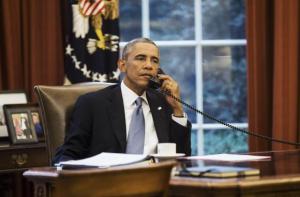
U.S. President Obama speaks on the phone with Saudi Arabia's King Abdullah from the Oval Office of the White House in WashingtonPresident Obama speaks on the phone from the Oval Office, September 10, 2014. CREDIT: REUTERS/KEVIN LAMARQUE

Decisions small as well as large are made at the White House, often with scant influence from the Pentagon and State Department and their much larger teams of analysts and advisers. Senior Cabinet officials spend long hours in meetings debating tactics, not long-term strategy, the officials said.

**********************

Throughout 2012, as signs mounted that militants in Syria were growing stronger, the debate in the White House followed a pattern. In meeting after meeting, as officials from agencies outside the executive residence advocated arming pro-Western rebels or other forms of action, President Barack Obama’s closest White House aides bluntly delivered the president’s verdict: no.

“It became clear from the people very close to the president that he had deep, deep reservations about intervening in Syria,” said Julianne Smith, who served as deputy national security advisor to Vice President Joe Biden. “And the likelihood of altering those views was low, very low.”

This summer, events overwhelmed the status quo. In June, the radical group Islamic State, after seizing wide swaths of Syria, conquered Iraq’s second largest city and threatened Baghdad as the Iraqi army collapsed. The insurgents beheaded two American journalists, increasing U.S. public support for military action. Finally, U.S. intelligence agencies detected foreign jihadists who they believe had moved to Syria to plot attacks against the United States and Europe.

The radicals had undermined the administration’s argument it had successfully ended the war in Iraq and were threatening Obama’s record of defending the homeland. The jihadists, said Smith, “turned the debate on its head.”

On September 18, Obama reversed his three-and-a-half-year opposition to military action in Syria and ordered open-ended airstrikes against militants. It wasn’t his first U-turn on Syria. In August 2012, Obama had warned President Bashar Assad that using chemical weapons was a “red line” Syria dare not cross; when evidence emerged that Damascus had gassed the rebels and civilians, Obama opted not to respond with force.

The bombing campaign, which could last for years, is a major course correction for a president with a famously cautious foreign policy.

Obama’s handling of Syria – the early about-face, the repetitive debates, the turnabout in September – is emblematic, say current and former top U.S. officials, of his highly centralized, deliberative and often reactive foreign policy.

They say Obama and his inner circle made three fundamental mistakes. The withdrawal of all American troops from neighboring Iraq and the lack of a major effort to arm Syria’s moderate rebels, they say, gave Islamic State leeway to spread. Internal debates focused on the costs of U.S. intervention in Syria, while downplaying the risks of not intervening. And the White House underestimated the damage to U.S. credibility caused by Obama’s making public threats to Assad and then failing to enforce them.

“REAL CHOKEPOINT”

This week, former Defense Secretary and CIA director Leon Panetta joined Hillary Clinton and a growing list of former cabinet members and aides who said Obama made major mistakes in the Middle East. Panetta singled out the U.S. troop withdrawal from Iraq.

“It was clear to me – and many others,” Panetta wrote in his memoir, “Worthy Battles,” “that withdrawing all our forces would endanger the fragile stability then barely holding Iraq together.”

Such arguments were rejected at the time inside the White House, where the foreign policy machine has grown dramatically in power under Obama and cabinet members and their departments have felt marginalized.

The National Security Council staff, which coordinates U.S. defense, diplomatic and intelligence policy from inside the White House, has nearly doubled in size on his watch. It has gone from about 50 under George H.W. Bush to 100 under Bill Clinton, 200 under George W. Bush and about 370 under Obama.

Decisions small as well as large are made at the White House, often with scant influence from the Pentagon and State Department and their much larger teams of analysts and advisers. Senior Cabinet officials spend long hours in meetings debating tactics, not long-term strategy, the officials said.

Robert S. Ford, the former U.S. ambassador to Damascus, recalled long meetings to debate small issues, such as which Syrian opposition members he could meet with and whether it was okay to give cell phones, media training and management classes to a local Syrian government council controlled by the opposition.

Sometimes, this more centralized White House system becomes overwhelmed.

“There’s a real choke point,” said Michele Flournoy, who served as the Under Secretary of Defense for Policy, the No. 3 Pentagon civilian, in Obama’s first term. “There’s only so much bandwidth and there’s only so much they can handle at one time. So, things start to slow down.”

Flournoy and other former officials who criticize the administration’s approach concede that the most important decisions – using military force – must ultimately be the president’s call. They argue, though, that intensified White House control has resulted in the United States being behind the curve, whether in trying to counter Russian propaganda about the Ukraine crisis or battle online recruitment by jihadists.

Syria, where the estimated death toll has topped 190,000, is cited as a prime example.

By the fall of 2012, covertly arming Syria’s rebels had been accepted by Obama’s top three national security Cabinet members – Clinton, Panetta and CIA chief David Petraeus – as the best way to slow radicalism in Syria. The president and his inner circle first rejected the advice, then mounted a small scale program to arm the rebels, and now, two years later, after Islamic State has seized swaths of Syria and Iraq, embrace the approach.

Obama’s aides say tight White House coordination is a must in an era when the United States faces threats like terrorism, which requires harnessing the capabilities of the Pentagon, the U.S. intelligence community, the State Department and other agencies. It’s the president’s duty to take ultimate responsibility for matters of war and peace, they say.

“Other than, of course, the men and women in uniform” and other officials deployed abroad, said Ben Rhodes, a White House deputy national security adviser, “only the president of the United States is assuming the risk of the cost of action.”

WHITE HOUSE CONTROL

This account of Obama’s national security decision-making is based on interviews with more than 30 current and former U.S. government officials, who have served both Democratic and Republican administrations going back to President Richard Nixon.

In some ways, Obama’s closer control and the frequent marginalization of the State and Defense departments continues a trend begun under Bill Clinton and George W. Bush.

But under Obama, the centralization has gone further. It was the White House, not the Pentagon, that decided to send two additional Special Operations troops to Yemen. The White House, not the State Department, now oversees many details of U.S. embassy security – a reaction to Republican attacks over the lethal 2012 assault on the U.S. consulate in Benghazi, Libya. A decision to extend $10 million in nonlethal aid to Ukraine also required White House vetting and approval.

On weightier issues, major decisions sometimes catch senior Cabinet officers unawares. One former senior U.S. official said Obama’s 2011 decision to abandon difficult troop negotiations with Baghdad and remove the last U.S. soldiers from Iraq surprised the Pentagon and was known only by the president and a small circle of aides.

The president, initially perceived as one of the greatest communicators of his generation, is now viewed as having done a poor job of defining and defending his foreign policy, polls indicate. A majority of Americans – 54 % – disapprove of Obama’s foreign policy performance, according to Reuters/Ipsos polling, one of the lowest ratings of his presidency.

Rhodes, one of Obama’s longest-serving national security aides, says a series of complex world crises, not policy mistakes, has driven down the president’s approval numbers. More broadly, he says, Obama has been right to be deliberative in the wake of costly wars in Iraq and Afghanistan.

“What he’s always said is that if there’s a threat against us, we will act,” Rhodes said. “But when it comes to shaping events in cultures that are foreign to the United States we have to have some degree of realism.”

Obama has had notable national security successes. His record of protecting U.S. territory from attack remains largely unblemished. Current and former officials praise his policy on nuclear talks with Iran as clear and consistent. He is building a coalition against Islamic State that includes Arab nations participating in airstrikes with the United States, Britain,France and others.

And while past presidents faced grave dangers, most notably the possibility of Cold War Armageddon, for Obama the world is very different. The decisions he must make on using U.S. military force have multiplied. This reality, supporters say, is overlooked by detractors.

Obama has launched a humanitarian military intervention in Libya; overseen counter-terrorism operations in Pakistan, Libya, Somalia, Yemen, Iraq, Afghanistan and elsewhere; moved to end his predecessor’s wars in Iraq and Afghanistan;  wrestled with lethal threats to U.S. hostages and diplomatic posts; and sent the American military to West Africa to help tackle the Ebola virus and search for kidnapped Nigerian schoolgirls.

“ANALYST IN CHIEF”

Current and former officials say the globalized world of Twitter and 24-7 news creates an expectation at home and abroad that the United States will quickly take a position on any foreign policy issue. The demand for instant American positions – and American leadership – can be overwhelming.

“One of the biggest problems in Washington,” said retired General James Jones, who was Obama’s national security advisor from 2009 to 2010, “is to find the time to think strategically, not tactically. You’d wake up and there would be a new crisis and you’d be scrambling to deal with them.”

Six years of grinding partisan warfare over foreign policy (and much else) have left Obama increasingly fatalistic about his critics.

While on vacation in Martha’s Vineyard in late August, he was widely criticized for golfing after making a condolence call to the family of murdered American journalist James Foley. Minutes after declaring Foley’s murderer – Islamic State – a “cancer” that had “no place in the 21st century,” Obama teed off with a campaign contributor, an old friend and a former NBA star.

Obama later told aides the criticism was inevitable. No matter what I do, he said, my enemies will attack me.

Far from being disengaged or indecisive on foreign affairs, as he is sometimes portrayed, Obama drives decision-making, say current and former officials.

Obama prepares thoroughly for meetings, has an encyclopedic memory and methodically dissects problems, former officials who have been with him in meetings say. The former law professor dominates foreign policy sessions, from small Oval Office gatherings to formal National Security Council meetings he chairs. Obama promoted open NSC debate, asked for dissenting opinions from cabinet members and called on junior officials who traditionally don’t speak at such meetings, they said.

Some aides complained that alternative views on some subjects, such as Syria, had little impact on the thinking of the president and his inner circle. Despite the open debate, meetings involving even Cabinet secretaries were little more than “formal formalities,” with decisions made by Obama and a handful of White House aides, one former senior U.S. official said.

Obama “considers himself to be analyst in chief, in addition to Commander in Chief,” on certain issues, according to Fred Hof, a former State Department envoy on Syria. “He comes to a lot of the very fundamental judgments on his own, based on his own instincts, based on his own knowledge, based on his own biases, if you will.”

The president’s supporters say his approach is based on principle, not bias. He ran on a platform of winding down the Iraq War and made his views crystal-clear on military action in the Middle East. Obama believed that the human and financial costs of large-scale interventions weren’t worth the limited outcomes they produced. He held that U.S. force could not change the internal dynamics of countries in the region.

THE SYRIA DEBATE

In August 2011, Obama issued a 620-word statement on Syria that his aides hoped would put him on the right side of history. After weeks of pressure from Congress, Syrian-Americans and allies in the Middle East and Europe, he called for Assad to “step aside.”

“It is time for the Syrian people to determine their own destiny,” Obama said.

Ford, ambassador to Syria from 2011 to 2014, said he supported the statement, but now regrets it because Washington didn’t back up the words with action. He said the Syria case reflects a pattern in the administration of issuing public statements without developing a clear policy.

When Assad refused to relinquish power, it became clear that the administration and its allies lacked a plan – or the political will – to forcibly remove him. American and European credibility in the region suffered.

Taking the removal of Assad into their own hands, Turkey and other Arab states overtly backed – or turned a blind eye to – the emergence of jihadist groups in Syria. American officials warned the countries that it would be impossible to control the militants, according to former U.S. officials. The Turks, according to one former official, replied that with Washington itself sitting on the sidelines, they had no choice but to back certain anti-Assad radicals.

As jihadists gained strength in the Syrian opposition in 2012, members of Obama’s first-term cabinet began to support covert U.S. action in Syria.

In the summer of 2012, three senior advisors outside the White House – Clinton, Panetta and Petraeus – proposed that the CIA train and equip the relatively moderate Syrian rebels operating as the Free Syrian Army.

At about that time, Ford said, the Free Syrian Army was warning – and U.S. officials confirmed independently – that militant groups were luring away fighters with cash. The more Western-friendly rebels had few funds to counter with.

In December 2012, Obama rejected the proposal.

Eight months later, in August 2013, U.S. intelligence concluded that Assad had used poison gas against rebels and civilians in a Damascus suburb, defying Obama’s public warning against chemical attacks. For a week, Obama appeared on the verge of launching airstrikes. After a walk with Chief of Staff and longtime aide Denis McDonough on the White House grounds, Obama changed course without consulting his national security Cabinet members and announced he would seek Congress’ approval, which never materialized. Instead, Washington and Moscow agreed on a deal to remove Syria’s chemical arms.

The missile strike reversal was widely cited by officials interviewed as the clearest example of Obama not engaging in a full Cabinet-level debate before making a strategic decision.

State Department officials warned for years that extremists would benefit from a power vacuum in Syria. “We were saying this area is going to be controlled by extremists and they’ll link up with Iraq,” said Ford. Obama made the wrong decision, Ford concludes. “It’s clear, in retrospect, that they needed more help then to counter the extremism.”

Another former official involved in Syria policy defended Obama. He said that in the early years of the Syrian conflict, with the long Iraq War fresh in their minds, Obama’s senior lieutenants struggled to find any vital national interest that would merit American intervention. Warnings of terrorism were discussed, this official said. But the White House responded that there were “more efficient and cheaper ways of dealing with the threat than intervening in Syria.”

Smith, the former NSC aide, said the Obama years hold a lesson.

“The instinct is to centralize decision-making with the hope of exerting more control,” she said. “But that often limits the U.S. government’s agility and effectiveness at a time when those two traits are most needed.”