Posted tagged ‘Erdogan’

Putin-Erdogan deal deadlocks Aleppo, Manjib frays

August 13, 2016

Putin-Erdogan deal deadlocks Aleppo, Manjib frays. DEBKAfile, August 13, 2016

n syria flashpoints

This hopeless standoff is the result of Moscow’s refusal to provide the Syrian army and its allies with enough air support to pull ahead, in the wake of President Vladimir Putin talks with Turkish President Reccep Tayyip Erdogan in St. Petersburg Tuesday, Aug. 9.

*********************

All day Friday and Saturday, Aug.11-12, fighters of Hizballah’s elite Radwan Force – 3,000 in all – streamed to the pivotal Aleppo battlefield from all parts of Lebanon and Syria. DEBKAfile’s military and intelligence sources disclose that they were following the orders of their leader Hassan Nasrallah, who was warned by Tehran that the pro-Assad army fighting for Syria’s second city was flagging in the face of rebel assaults.

The Radwan Force was called in as the only military capable of saving the day for Assad and his allies. This step had been carefully avoided by Nasrallah was required in view of the heavy losses his organization had already suffered for backing the Syrian army – some 1,500 dead in three years – and intense fallout at home.

He has now been forced to sacrifice his last remaining military asset to fight in one of the bloodiest battles ever fought in recent times in the Middle East, even though it promises a swelling procession of Hizballah coffins returning to Lebanon.

According to our military sources, the battle to wrest Aleppo from rebel control, now in its second month, has claimed some 2,000 war dead and 4,000 injured on both sides – not counting the masses of civilians.

Some units have lost more than a quarter of their combatants and dropped out.

Nasrallah knows exactly what is happening in this critical arena. He also understands that a unit which loses 30 percent of its combatants is deemed in military terms unfit to continue fighting and that the battle for Aleppo will be drawn out and bloody. Yet he is willing to commit his entire deck of military resources to keep Bashar Assad’s fighting in Aleppo.

There is no hope of an early resolution in Aleppo, because stalemate between the combatants is exceptionally complicated and thankless. Whenever one side captures terrain, it quickly discovers it was drawn into a trap and under siege.

This hopeless standoff is the result of Moscow’s refusal to provide the Syrian army and its allies with enough air support to pull ahead, in the wake of President Vladimir Putin talks with Turkish President Reccep Tayyip Erdogan in St. Petersburg Tuesday, Aug. 9.

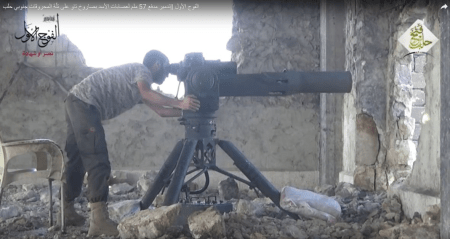
Aleppo_Rebels_ATGM-firings

Erdogan explained that if Assad’s army, along with Hizballah and Iran, defeated the Turkish-backed rebel forces holding Aleppo, he would suffer a serious knock to his prestige and setback for Syrian policy. This was more than he could sustain in the troubled atmosphere in Turkey in the wake of the failed coup against him.

He therefore asked the Russian president to abandon his Bashar Assad, Iran and Hizballah to their fate in Aleppo.

Erdogan was backed up in his request to Putin by a large Turkish military and intelligence delegation which arrived in St. Petersburg the next day to work with their Russian counterparts on setting up a joint military control center in Turkey.

DEBKAfile’s sources disclose the first two tasks assigned the new war room:

1. Russian aerial bombardments over Aleppo would not go beyond keeping the rebels from defeating Syrian and allied forces in Aleppo, but would refrain from supporting offensive action by the latter for routing the former.

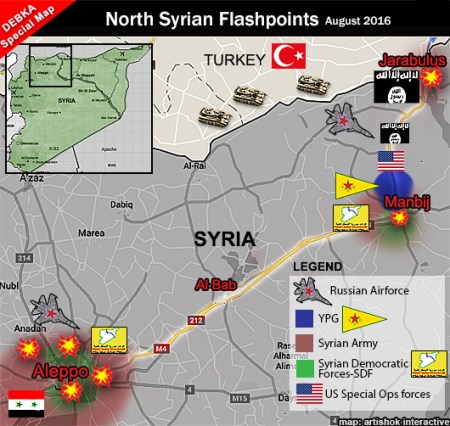
2. Turkish air and ground forces would remain in a state of preparedness to ensure that rebel Syrian Democratic Forces (SDF) and the Kurdish YPG militia never moved out of the town of Manjib, from most parts of which they ousted ISIS, to the town of Jarabulus on the Turkish border.I

ISIS had used Manjib as its primary way station for supplies from Turkey 30km to the north. (See attached map). But to drive the jihadists completely out of the Syrian-Turkish border region, the combined rebel forcesmust advance on Jarabulus and expel ISIS from there too.

However, Turkish officers in the joint command center with Russia made it clear that any Kurdish forces allowed to reach that border would come under Turkish army attack.

The Russian president complied with Erdogan’s wishes on the Manjib-Jarabulus front as well as Alepp

Turkey, Europe’s Little Problem

August 11, 2016

Turkey, Europe’s Little Problem, Gatestone InstituteBurak Bekdil, August 11, 2016

♦ Europe is giving signals, albeit slowly, that it may be waking up from the “Turkey-the-bridge” dream. Germany’s Foreign Minister Frank-Walter Steinmaier said that his country’s relations with Turkey have grown so bad the two countries have virtually “no basis” for talks.

♦ “Italy should be attending to the mafia, not my son,” said Turkish President Recep Tayyip Erdogan. Typically, he does not understand the existence of independent judiciary in a European country. He thinks, as in an Arab sheikdom, prosecutors are liable to drop charges on orders from the prime minister.

♦ “We know that the democratic standards are clearly not sufficient to justify [Turkey’s] accession [to the European Union].” — Austrian Chancellor Christian Kern.

Nations do not have the luxury, as people often do, of choosing their neighbors. Turkey, under the 14-year rule of Recep Tayyip Erdogan’s Islamist governments, and neighboring both Europe and the Middle East, was once praised as a “bridge” between Western and Islamic civilizations. Its accession into the European Union (EU) was encouraged by most EU and American leaders. Nearly three decades after its official bid to join the European club, Turkey is not yet European but has become one of Europe’s problems.

Europe’s “Turkish problem” is not only about the fact that in a fortnight a bomb attack wrecked a terminal of the country’s biggest airport and a coup attempt killed nearly 250 people; nor is it about who rules the country. It is about the undeniable democratic deficit both in governance and popular culture.

In only the past couple of weeks, Turkey was in the headlines with jaw-dropping news. In Istanbul, a secretary at a daily newspaper was attacked by a group of people who accused her of “wearing revealing clothes and supporting the July 15 failed coup.” She was six months pregnant.

Also in Istanbul, a Syrian gay refugee was murdered: he had been beheaded and mutilated. One social worker helping LGBT groups said: “Police are doing nothing because he is Syrian and because he is gay.”

Turkey is dangerous not only for gays and refugees. A French tourist was left bloodied and beaten by Turkish nationalists after he refused to hold a Turkish flag. Grisly footage shows the gang, encouraged by Erdogan to patrol the streets on “democracy watch,” telling the man “You will be punched if you don’t hold the flag.” The tourist is alone and does not appear to speak Turkish.

Meanwhile Europe is giving signals, albeit slowly, that it may be waking up from the “Turkey-the-bridge” dream. Germany’s Foreign Minister Frank-Walter Steinmaier said that his country’s relations with Turkey have grown so bad the two countries have virtually “no basis” for talks. He said that Germany has serious concerns about mass arrests carried out by Turkish officials. According to Steinmaier, Turkey and Germany are like “emissaries from two different planets.” Steinmaier is right. He is also not the only European statesman who sees Turkey as alien.

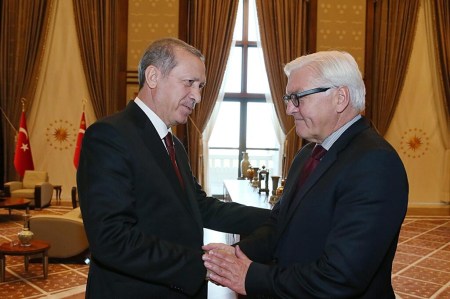
1777Germany’s Foreign Minister Frank-Walter Steinmaier (right) said that his country’s relations with Turkey under Recep Tayyip Erdogan have grown so bad the two countries have virtually “no basis” for talks.

Erdogan recently threatened Italy that its bilateral relations with Turkey could deteriorate if Italian prosecutors investigating Erdogan’s son, Bilal, for money laundering, proceeded with their probe. “Italy should be attending to the mafia, not my son,” Erdogan said. Typically, he does not understand the existence of independent judiciary in a European country. He thinks, as in an Arab sheikdom, prosecutors are liable to drop charges on orders from the prime minister.

Italy’s prime minister, Matteo Renzi, answered Erdogan in language Erdogan will probably will not understand: “Italy has an independent legal system and judges answer to the Italian constitution and not the Turkish president.”

In unusual European realism, Austrian Chancellor Christian Kern said that he would start a discussion among European heads of government to end EU membership talks with Turkey. He rightly called the accession talks “diplomatic fiction.” Kern said: “We know that the democratic standards are clearly not sufficient to justify [Turkey’s] accession.”

Even Turkish Cypriots on the divided island fear that Erdogan’s Islamization campaign may target their tiny statelet. On August 3, about 1,500 people from 80 groups spanning the political spectrum took to the streets in Nicosia to protest against “Turkey’s attempt to mold their secular culture into one that’s more in tune with Islamic norms.”

All of that inevitably makes Turkey an alien candidate waiting at Europe’s gates to join the club. According to a European survey, Turkey is the least-wanted potential EU member — even less wanted than Russia. Opposition to Turkish membership ranges from 54% (Norway) to 81% (Germany).

Celal Yaliniz, a little-known Turkish philosopher, likened Turks in the 1950s to “members of a ship’s crew who are running toward the west as their ship travelled east.” The Turks were not alone. Erdogan’s “liberal” Western supporters have been no different.

Erdogan ultimatum: ‘US has to choose between Turkey & Gulen’

August 11, 2016

Erdogan ultimatum: ‘US has to choose between Turkey & Gulen’

Published time: 11 Aug, 2016 10:39 Edited time: 11 Aug, 2016 11:03

Source: Erdogan ultimatum: ‘US has to choose between Turkey & Gulen’ — RT News

Turkish President Tayyip Erdogan © Umit Bektas / Reuters

Turkish President Recep Tayyip Erdogan has issued an ultimatum to the US, saying it must choose between Turkey and the US-based Turkish cleric Fethullah Gulen, whom Ankara believes was behind the failed July 15 coup attempt.

Sooner or later the US will make a choice […] Either the coup-plotting terrorist FETO [Gulenist Terror Organization, term used by non-Gulenists] or the democratic country Turkey. The [US] has to make this choice,” Erdogan said in a speech in Ankara on Wednesday, as quoted by the state-run Anadolu Agency.

Those who follow the Pennsylvania-based charlatan who sold his soul to the devil, or Daesh [Arabic pejorative term for Islamic State/IS], which shed Muslim blood, or the PKK that also has shed blood for 30 years to divide the country and the nation, will all lose in the end,” the Turkish leader warned.

Erdogan’s statement comes after Turkey’s repeated calls to the US for Gulen’s extradition. The 74-year-old cleric was a popular preacher and former imam before setting up his own movement. He was a firm ally of Erdogan as the Turkish leader rose to power, but the two fell out and have become bitter rivals.

Ankara claimed Gulen created a “parallel state” in Turkey in the form of a network of supporters among Turkish officials. Erdogan also accused Gulen of masterminding a corruption scandal involving senior government figures in 2013, and launched a crackdown against his organization, Hizmet. Gulen now lives in self-imposed exile in the US state of Pennsylvania, facing a life sentence back in Turkey.

Erdogan accuses Gulen of orchestrating the July 15 coup, when a faction of the Turkish military attempted to topple the government overnight, but failed. The violence left over 260 people dead and many injured. The government has responded to the coup by launching a massive purge in the country’s military and academic spheres.

Gulen has fiercely denied accusations that he was behind the coup, and has alleged that the Turkish president could have staged it himself for his own personal gain – a claim which Erdogan has called “nonsensical.”

I do not see any country that would stand behind [Gulen], this leader of the terrorist gang, especially after [the night of July 15]. The country that would stand behind this man is no friend to Turkey. It would even be a hostile act against Turkey,” Prime Minister Binali Yildirim told reporters the morning after the failed coup. The same day, President Erdogan publicly demanded Gulen’s extradition during a televised government meeting.

The US has repeatedly refused to hand over the cleric, saying Turkey would need to provide “evidence, not allegations” against Gulen in order to have him extradited.

“We fully anticipate that there will be questions raised about Mr Gulen, and obviously we invite the government of Turkey to present us with any legitimate evidence that withstands scrutiny and the United States will accept that and look at it and make judgments appropriately,” US Secretary of State John Kerry said following Gulen’s extradition demands.

The West has also been concerned with the Turkish government’s post-coup crackdown, which so far has seen some 60,000 people in the military, judiciary, civil service, and education detained, suspended or placed under investigation due to having perceived links to Gulen.

In an effort to bar people who fear prosecution on coup-related charges from fleeing the country, some 50,000 passports have been canceled by the Turkish authorities. Erdogan also signed a decree ordering the closure of hundreds of institutions associated with Gulen, or run directly by Hizmet, as well as some 130 media outlets. At the end of July he also promised to reinstate the death penalty in the country.

In response to these measures, Western politicians have warned Erdogan his attempts to make Turkey an EU member are doomed if the purges don’t stop.

No country can become an EU member state if it introduces the death penalty,” EU Foreign Policy Chief Federica Mogherini said. While EU Commission President Jean-Claude Juncker recently told broadcaster France 2 that he believes “Turkey, in its current state, is not in a position to become [an EU] member any time soon and not even over a longer period.

Turkey responded angrily to these remarks, with Foreign Minister Mevlut Cavusoglu lashing out at the EU for its reaction to the failed coup, while adding that if the West “loses” Turkey, it will be due to its own mistakes, not due to the fact that Ankara was seeking allies elsewhere, such as Russia or China.

Israel’s let-down: Putin-Erdogan hook-up with Iran

August 9, 2016

Israel’s let-down: Putin-Erdogan hook-up with Iran, DEBKAfile, August 9, 2016

2 (1)

The talks between Presidents Vladimir Putin and Reccep Erdogen in St. Petersburg scheduled for Tuesday, Aug. 9, are causing trepidation among Israel’s policy-makers and military leaders. Their summit takes place on the sidelines of the G-20 summit, concluding nine months of hostility between the two capitals that was sparked by Turkish jets shooting down a Russian SU-24 warplane over the Syrian border on Nov. 24, 2015.

The feud was put to rest on July 17 – two days after Erdogan suppressed the attempted military coup against his rule. The Turkish ruler decided there and then to exploit the episode to expand his strength and use it not only for a massive settling of accounts with his critics, but also as a springboard for parlaying his reconciliation with Moscow for a strategic pact with Russia.

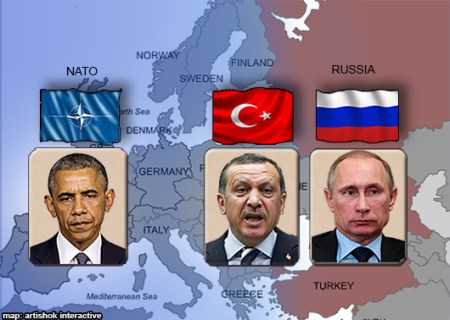
Israel, the worry is that while turning his back on the United States and NATO, Eerdogan will go all the way to bond with Russia to which Iran is also attached as a partner. Indeed, Erdogan has scheduled a trip to Tehran and a meeting with President Hassan Rouhani a few days after his talks with Putin.

The Turkish president’s latest moves look like spawning another new Middle East bloc that would consist of Turkey, Russia, Iran, Iraq, Syria and indirectly the Lebanese Hizballah terrorist group.

This prospect would upend Israel’s key policies for Turkey and Syria.

The Israeli détente with Ankara in recent months hinged on Turkey’s continuing to maintain its close military and intelligence ties with the United States and its integration in an anti-Iran Sunni alliance in partnership with Saudi Arabia, Egypt, the United Arab Emirates and Jordan.

But the Putin-Erdogan meeting Tuesday threatens to throw American, Israeli and moderate Arab rulers’ plans to the four winds. Turkey appears to have opted to line up with a Russian-Shiite front led by Tehran in preference to an anti-Iran Sunni alliance.

Therefore, the expanded military and intelligence cooperation which the Israeli-Turkish rapprochement was to have heralded will be low key at best for two reasons:

1. Israel will beware of sharing its military technology with Turkey lest it find its way to Iran. During the talks with Ankara for patching up their quarrel Israel was constantly on the lookout for indications that Turkey was prepared to break off its ties with Iran.

2. For the sake of keeping Iran and Hizballah away from its borders, Israel entered into arrangements with Russia, some of them never published, at the start of Moscow’s military intervention in Syria last September. Those arrangements included coordination of their air force operations over Syria.

Now, Israel finds itself suddenly up against a Russian-Turkish partnership aimed at strengthening Iranian domination of Syria – the exact reverse of the Netanyahu government’s objective in resolving its dispute with Ankara and forging deals with Moscow.

Erdogan-Gulen Power Struggle Divides European Turks

August 8, 2016

Erdogan-Gulen Power Struggle Divides European Turks, Investigative Project on Terrorism, August 8, 2016

(Please see also, Plotting Jihad in the Poconos—Who the Hell is Fethullah Gulen? — DM)

1167

Millions of European Turks – both immigrants and subsequent generations – ally themselves with the Gulenist movement, or Hizmet. While some call it a cult and claim it represents a zealous Islamic religious movement, others view it as a more moderate strain of Islam and praise Gulen for his interfaith initiatives, and for the hospitals, schools and universities he has founded internationally, including over 100 charter schools in the United States. But since the split between the two men, tensions have also emerged between pro-Gulen and pro-Erdogan groups that are far more virulent than the disputes between those who favor Hizmet and those who condemn it.

********************

On the night of July 15, members of the Turkish military stormed the state-run TRT news agency in Ankara and forced an anchorwoman to read a statement calling President Recep Tayyip Erdogan a “traitor.” Within moments, tanks began to drive menacingly through the streets of Ankara and Istanbul as military planes roared over Turkish skies. The Parliament was bombed. The fifth military coup in the history of modern Turkey had begun, taking even the most anti-government Turks by surprise.

But Erdogan regained complete control within hours, thanks to his fervent supporters who took to the streets in his defense. Throughout the night, pro- and anti-Erdogan military and civilians clashed across the country, leaving nearly 300 dead and 2,100 injured by morning.

The attempted coup and its aftermath, however, soon exploded into more than just a national crisis; it has had incendiary repercussions globally, particularly in the Turkish communities of Europe.

Erdogan declared a state of emergency July 16, and began cracking down on suspected members of the coup plot and their allies. By July 20, more than 45,000 people had been arrested, including 2,700 judges and 15,000 teachers. As Erdogan called for reinstating the death penalty, credible reports emerged of prisoners being tortured and raped.

In the meantime, tens of thousands of others have been fired from their jobs as the state takes over or shuts down nearly all the country’s media outlets – including three news agencies, 16 television channels, 45 newspapers and 15 magazines, Reutersreports. And on Monday, more than three weeks after the failed coup, Turkey recalled five senior diplomats from its embassy in The Hague.

All who have been sacked are accused of complicity in the coup, based on their (ostensible) ties to Fethullah Gulen, a powerful cleric now living in self-imposed exile in Pennsylvania. Once one of Erdogan’s closest allies, Gulen has become his most despised enemy in recent years, thanks in large part to Gulen’s criticism of Erdogan during the 2013 Gezi Park demonstrations. Now Turkey’s president accuses Gulen of being behind the coup attempt, demands his extradition from the United States. Meantime, he continues his crackdown on the cleric’s followers.

But those followers are not just in Turkey, and neither are Tayyip Erdogan’s. Millions of European Turks – both immigrants and subsequent generations – ally themselves with the Gulenist movement, or Hizmet. While some call it a cult and claim it represents a zealous Islamic religious movement, others view it as a more moderate strain of Islam and praise Gulen for his interfaith initiatives, and for the hospitals, schools and universities he has founded internationally, including over 100 charter schools in the United States. But since the split between the two men, tensions have also emerged between pro-Gulen and pro-Erdogan groups that are far more virulent than the disputes between those who favor Hizmet and those who condemn it.

As a result, the clashes between the conflicting sides have spilled beyond the Turkish borders into Europe, and have now exploded since the coup. Often, they have been violent, with pro-Erdogan protesters hurling stones into the windows of Gulen organizations in Gelsenkirchen, Germany and Rotterdam, Holland, or calling to set fire to a building housing a Gulenist organization in Beringen, Belgium (“Burn them alive!” the protesters shouted.). Arsonists also attacked several Gulen buildings in the Netherlands.

In other instances, the attacks are quieter but more sinister: members of 70 different Gulen-affiliated groups in the Netherlands report receiving hate messages and death threats. People believed to support the movement – or who fail to support Erdogan – report being banned from mosques and refused entry to restaurants. Dutch children have told each other “I can’t talk to you anymore.” A number of Gulen followers have gone into hiding, fearing for their safety.

And in Germany, home to Europe’s largest Turkish community, estimated at nearly 3 million, some 30-40,000 Erdogan supporters marched through Cologne on July 31. And while the demonstrations went off without incident, they represent a chasm within the country – not just between Germans and Turks, but – as in the Netherlands – among the Turks themselves. Noted Deutsch-Welle‘s Gero Schliess in an editorial, “After the coup attempt in Turkey, divisions have emerged in this country that no one had seen for a long time – or hadn’t wanted to see. The failed coup and President Erdogan’s massive onslaught against civil rights have deeply divided the Turkish community in Germany. The split runs right through families and neighborhoods, regardless of social strata or profession.”

But at least as disturbing is the idea of 30-40,000 people marching in support of the man who has led the profoundly anti-democratic crackdown in Turkey. While it may be understandable to oppose a military coup, it is something else entirely to continue marching in support in light of the abuses that have followed. Moreover, according to Politico, the situation has also “reignited a decade-long debate in Germany about the Turkish state steering public opinion within the German-Turkish community through a web of lobbying groups, religious institutions, media outlets and public figures.”

Religious groups seem to be chief among those, such as the Turkish-Islamic Union for Religious Affairs, sponsored by the Turkish state. That Turkey is therefore subsidizing mosques in Germany demonstrates the strength not only of the country’s influence on the political visions of German Turks, but on their religious ideas as well. And in an increasingly Islamist Turkey, those ideas no longer reflect the secular, humanist values of Ataturk; rather, they are based on an increasingly strict vision of Sunni Islam in which the state and the mosque are one.

Other Turkish religious groups, including Milli Gorüs, an Islamist group headquartered in Cologne, are also believed to hold sway over European Turks, particularly in the Netherlands.

Behind them all, particularly in Belgium, is the Diyanet, the official Turkish Directorate of Religious Affairs .

Ataturk created the Diyanet soon after the founding of the Turkish republic, to help ensure that imams preached moderate interpretations of Islam. They were critical to maintaining the separation between mosque and state. With the rise of Erdogan and his AK Party, however, it has served to do just the opposite: it now promotes Islamist views in Turkey and among the Turkish community abroad. As Istanbul-based journalist David Lepeska noted last year, the Diyanet‘s budget has quadrupled since 2006 to over $2 billion, with a 2015 budget allocation that was “40 percent more than the Ministry of the Interior’s and equal to those of the Foreign, Energy, and Culture and Tourism ministries combined.” In addition to presiding over Turkey’s own mosques, the directorate governs hundreds of mosques across Europe, has increased the number of religious classes in public schools, and, reports Lepeska, “runs a 24-hour television station, Diyanet television, available via satellite, cable, and YouTube, and manages a Facebook page (with nearly 230,000 fans), two Twitter accounts (more than 50,000 followers), and an Islamic lifestyle hotline.”

The result is a toxic mixture of religion and politics that could not be further from the secular ideals of the founder of modern Turkey. Add Erdogan’s and the AKP’s human rights abuses and dictatorial leanings to this and the cauldron boils hotter and more dangerous than ever. Whatever problems existed previously, the post-coup situation bears far too many parallels to the impulses and ideologies of radical Islamism: whoever does not support Erdogan becomes the enemy. And Erdogan, as the leader of Turkey, is the leader of the Diyanet.

The outcome is a kind of tribalism that already infects the rest of the Middle East: to be outside the Erdogan support core is to be outside the realm of the Diyanet – an apostate of sorts, threatened with death.

That this could become the future of Ataturk’s secular democratic republic is tragic. But there is also a very real possibility of the impulse spreading into Europe. Other events this year, such as the attacks on Dutch journalist Ebru Umar and German comedian Jan Bohmermann, both of whom criticized the Turkish president, demonstrate that many European Turks lean towards such a radicalized and tribalist vision. It is a vision Europe’s leaders would do well to extinguish while they still can.

Coup-Weary Turkey: Directionless and Insecure

August 8, 2016

Coup-Weary Turkey: Directionless and Insecure, Gatestone InstituteBurak Bekdil, August 8, 2016

♦ The more Ankara feels distant to Washington, the more it will want to feel closer to Moscow.

♦ As Western leaders call on President Erdogan to respect civil liberties and democracy, Erdogan insists he will consider reinstating the death penalty: “The people have the opinion that these terrorists [coup-plotters] should be killed. Why should I keep them and feed them in prisons for years to come?”

Turkey once boasted of having NATO’s second biggest army, equipped with state-of-the-art weapons systems. That powerful army now lacks command: After the failed coup of July 15, more than 8,500 officers and soldiers, including 157 of the 358 generals and admirals in the Turkish military’s ranks, were discharged. The top commanders who were purged had made up 44% of the entire command structure. Prime Minister Binali Yildirim said that the military’s shipyards and weapons factories will be transferred to civilian authority; military high schools and war academies have been shut; military hospitals will be transferred to health ministry; and the gendarmerie, a key force in anti-terror operations, and the coast guard will be tied to the interior ministry.

Those changes leave behind an army in deep morale shock, with political divisions and polarization. Its ranks are suffering not just trauma but also humiliation. The Turks are lucky their country was not attacked by an enemy (and they are plentiful) at a time like this. Conventional war, however, is not the only threat to Turkey’s security. The Turkish army’s worst decline in modern history came at a time when it was fighting an asymmetrical war against Kurdish insurgents inside and outside of Turkey and, as part of a U.S.-led international campaign, the Islamic State (ISIS) in neighboring Syria.

The attempted coup not only quickly discredited the Turkish military but also left the country once again directionless in foreign policy. President Recep Tayyip Erdogan has been slamming his NATO ally, the United States, almost daily. His government big guns have been implying an American hand behind the failed coup by a faction of officers they claim are linked to a U.S.-based Muslim cleric, Fethullah Gulen, once Erdogan’s best political ally. “The putschist [Gulen] is already in your country, you are looking after him. This is a known fact,” Erdogan said, addressing Washington. “You can never deceive my people. My people know who is involved in this plot, and who is the mastermind.”

The White House immediately denied Erdogan’s claim. Deputy Press Secretary Eric Schultz said the U.S. was one of the first countries to condemn the failed coup, and noted that a successful one would have put American troops serving in Turkey at risk. “It is entirely false. There is no evidence of that at all,” Schultz said. “We feel that talk and speculation along those lines is not particularly constructive.” The failed coup has become a Turkish-American dispute — with a military dimension, too.

Erdogan also criticized U.S. General Joseph Votel, who voiced concerns over “the long-term impact” of the coup on the Pentagon’s relations with the Turkish military. According to Erdogan, Votel’s remarks were evidence that the U.S. military was siding with the coup plotters. The Pentagon’s press secretary, Peter Cook, flatly denied that claim: “Any suggestion anyone in the department supported the coup in any way would be absurd.”

Erdogan probably wants to play the tough guy and is slamming Washington day after day not just to look pretty to millions of anti-American Turks but also to pressure Washington in Turkey’s quest to extradite Gulen, presently the biggest snag between the two allies.

But there is another dimension to Erdogan’s ire: He wants to mend fences with Moscow.

Turkey’s relations with Russia were frozen after Nov. 24, when Turkey, citing a brief violation of its airspace along Turkey’s border with Syria, shot down a Russian military aircraft. Russia’s President Vladimir Putting ordered punishing economic sanctions, imposed a travel ban on Russian tourists visiting Turkey and suspended all government-to-government relations. Unable to ignore the damage, a repentant Erdogan conveyed regrets to Putin; the regrets were accepted and the two leaders are scheduled to meet on August 9, when the Turks hope that relations with Russia will be entirely normalized.

Normalization, unfortunately, will not come at the price of Turkish “regrets” alone. For full normalization, Turkey will have to digest the Russian-Iranian-Syrian line in Syria’s civil war — a pact which Turkey has loudly detested ever since civil war erupted in Syria in 2011. This will be another foreign policy failure for Erdogan and an embarrassing U-turn. But the more Ankara feels distant to Washington, the more it will want to feel closer to Moscow.

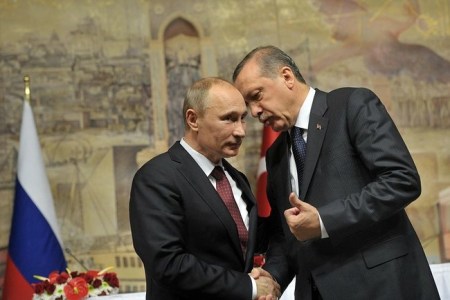
1375Turkish President Recep Tayyip Erdogan is attempting to repair badly damaged relations with Russia, even as he slams his NATO ally, the United States, almost daily, and accuses the U.S. military of supporting the coup attempt against him. Pictured: Russian President Vladimir Putin (left) with Erdogan (then Prime Minister), meeting in Istanbul on December 3, 2012. (Image source: kremlin.ru)

Meanwhile, after the coup attempt, Turkey’s troubled relations with the European Union turned even more troubled. European Commission head Jean-Claude Juncker said that the EU’s deal with Turkey on halting the flow of migrants toward the bloc may collapse. “The risk is big. The success so far of the pact is fragile. President Erdogan has already hinted several times that he wants to scrap it,” Juncker said. It is not just the migrant deal that may entirely suspend Turkey as a candidate country for the EU.

As Western leaders call on Erdogan to respect civil liberties and democracy, Erdogan insists he will consider reinstating the death penalty. “The people have the opinion that these terrorists [coup-plotters] should be killed,” Erdogan said in interview with CNN. “Why should I keep them and feed them in prisons for years to come? That’s what the people say … as the president, I will approve any decision to come out of the parliament.”

Such a move would kill Turkey’s accession process entirely. Federica Mogherini, EU’s foreign policy chief, warned that if Turkey reintroduces the death penalty, it will not be joining the European Union. “Let me be very clear on one thing,” she said; “… No country can become an EU member state if it introduces [the] death penalty.”

The attempted coup not only destabilized NATO’s second largest army and exposed it to the risk of serious operational vulnerabilities; it also left Turkey at risk of engaging in potentially dangerous liaisons with playmates of different kind — Russia and Iran & Co. — at least for now.

A Nuclear-Armed Caliphate?

August 3, 2016

A Nuclear-Armed Caliphate? Front Page MagazineWilliam Kilpatrick, August 3, 2016

nuke turkey

Reprinted from CrisisMagazine.com.

Much has been made of the Islamic State’s claim to the caliphate. But the Islamic State is fast losing ground in Syria and Iraq, and without a territorial claim, its claim to the caliphate is a shaky one. According to some sources, ISIS has already been preparing its followers for the fall of the caliphate.

Meanwhile, an Islamist power with a much better claim to the caliphate has been gathering strength. Whether the failed coup in Turkey was the real thing or whether it was staged, as some have claimed, President Erdogan’s hold over the Turkish nation has been immeasurably strengthened. As a result, he is now one giant step closer to doing what, some say, he has always wanted to do—namely, to re-establish the caliphate.

The last time the Muslim world had a caliphate, it was centered in Constantinople. The Turkish sultan (who was also the caliph) was the head of the Ottoman Empire—an empire that controlled far more territory than ISIS does or is ever likely to. Then in 1923, following the disarray left by the First World War, a secular government under the leadership of Kemal Ataturk came to power in Turkey and abolished the caliphate soon after.

To many in the Muslim world, this was a world-changing catastrophe. It flew in the face of Muhammad’s intention that mosque and state should be united, and it undermined the case for Islamic law. Moreover, the overthrow of the caliphate affected not just Turkey, but all of the Muslim world. In the late 1920s in Egypt, Hasan al-Banna founded the Muslim Brotherhood with the intention of reversing what Ataturk had done. The Brotherhood came close to doing this–at least in Egypt—in 2012 with the election of Mohamed Morsi as president. But Morsi showed his hand too early and was soon deposed by the military under General El-Sisi.

In Turkey, also, it was the military that acted as the guardian of the secular state. And so it remained until the election of President Recep Erdogan in 2002. Even then, Erdogan moved slowly in his efforts to re-Islamize Turkey. He gradually removed top military officers and replaced them with his own men; and he did the same with the police, the judiciary, and other key institutions.

By 2012, some twenty percent of the country’s generals were estimated to be behind bars. Then, with this month’s failed coup, Erdogan moved quickly to arrest some 3,000 members of the military and 3,000 members of the judiciary. In addition, his regime sacked 9,000 workers attached to the Interior Ministry. Within a week of the attempted coup, some 50,000 soldiers, police, judges, civil servants, and teachers had been suspended or arrested.

Erdogan’s power is now nearly absolute—not unlike the absolute power of a sultan. According to some, this has been his goal all along. One indication is that Erdogan has built himself a thousand-room presidential palace that is attended by guards dressed in Ottoman-era uniforms.

If Erdogan does try to establish a caliphate, where does that leave ISIS? Would they go quietly into the dark night of oblivion? Or would they find a place in the new caliphate?

As you may have noticed, alliances in the Middle East are constantly shifting. It’s not inconceivable that ISIS would someday pledge allegiance to a neo-Ottoman caliphate—although such an event might have to be preceded by the demise of their current caliph, Abu Bakr al-Baghdadi. The truth is, Erdogan has been something of a friend and benefactor of ISIS. As Caroline Glick observed in the Jerusalem Post:

Erdogan has turned a blind eye to al-Qaida. And he has permitted ISIS to use Turkey as its logistical base, economic headquarters, and recruitment center. Earlier this year, the State Department claimed that all of the 25,000 foreign recruits to ISIS have entered Syria through Turkey.

Turkey is also the gateway between Syria and Europe. It is through Turkey that the bulk of Muslim migrants flow into Europe. This gives Erdogan enormous leverage over the future of Europe—a continent which is already reeling from a flood of migrants and refugees. How is the leverage applied? In March, the European Union reached a deal with Turkey that would in essence turn Turkey into a buffer zone against further immigration. Here’s how Foreign Affairs summarized the bargain:

Turkey has agreed to act as a giant refugee holding center, keeping the millions of migrants fleeing conflict in the Middle East from reaching Europe and accepting those sent back from Greece. In exchange, the EU will pay Turkey three billion euros on top of the three billion pledged last November to help care for the refugees. It will also speed up the approval of visa-free travel to Europe for Turkish citizens and revive stalled negotiations over Turkey’s accession to the EU.

So Turkey will keep the Syrian migrants out of Europe as long as Turkish citizens are allowed almost unlimited access to Europe through visa-free travel. The net result is that the Islamization of Europe will continue. And, of course, there’s nothing to stop Turkey from opening up the refugee floodgate whenever it sees fit. Turkey’s control of Mid-East migration gives it the upper hand in its dealings with Europe.

The other part of the bargain is the revival of negotiations to admit Turkey to the EU. If Turkey is ever successful in that endeavor, it would spell game-over for Europe. If Erdogan wants to re-establish the caliphate, and if he is so keen on union with Europe, it is likely that he envisions Europe as part of the future caliphate. This is something that the Ottoman sultans dreamed of, but were never able to accomplish. But Erdogan might be able to pull it off. There is now a very large contingent of Turks in Germany who seem to bear more allegiance to him than to Germany. And all over Europe there exists a fifth column of active and potential Islamists ready to be activated. As for the other four columns, it’s worth keeping in mind that Turkey has the second largest army in NATO (the U.S. has the largest). And with many of the generals who coordinated with NATO now in jail, Turkey’s loyalty to NATO is very much in question.

There is one other factor to consider. During and after the coup attempt, Erdogan shut down Incirlik Air Base, which is home to 1,500 American soldiers as well as other NATO troops. The Turkish government cut off the base’s electricity supply, temporarily suspended flights, and arrested the base commander, General Ercan Van. The base reportedly houses 50 nuclear warheads. The bombs are controlled by the U.S. forces in Turkey, but could they by means sudden or gradual fall under the control of Turkey? And if they did, would the U.S. dare to do anything about it?

By many accounts, Erdogan is a true believer who, in his own way, is every bit as fanatical as the ayatollahs in Iran. The man who built a thousand-room palace for himself might well believe that a restored caliphate should possess all the weapons that befit a great world power. With Erdogan’s latest consolidation of power, an already dangerous world just became a lot more dangerous.


Turkey Sets Ultimatum for EU Migrant Deal

August 2, 2016

Turkey Sets Ultimatum for EU Migrant Deal, Gatestone InstituteSoeren Kern, August 2, 2016

(Europe’s assisted suicide. — DM)

♦ Turkey has threatened to back out of an agreement to stem the flow of migrants to the European Union if Turkish nationals are not granted visa-free travel to the bloc by October.

♦ Europe is trapped in a no-win situation. European officials say that although Turkey has fulfilled most of their conditions, it has failed to relax its stringent anti-terrorism laws, which are being used to silence critics of President Erdoğan, especially since Turkey’s failed coup on July 15.

♦ The German newspaper Bild recently reported a confidential plan to house all migrants arriving from Turkey on Greek islands. Public transportation between those islands and the Greek mainland would be cut off to prevent migrants from moving into other parts of the EU.

♦ “No matter how uncouth, how merciless, how unscrupulous Western countries act, they have no chance of keeping the migration flows under control.” — Turkish President Recep Tayyip Erdoğan, quoted by German journalist Wolfram Weimer.

Turkey has threatened to back out of an agreement to stem the flow of migrants to the European Union if Turkish nationals are not granted visa-free travel to the bloc by October.

Although Turkish officials have repeatedly threatened to renege on the March 18 EU-Turkey deal, this is the first time they have set a deadline.

If the EU approves the visa waiver, tens of millions of Turks will gain immediate and unimpeded access to 26 European countries. If the EU rejects the visa waiver, and Turkey retaliates by reopening the migration floodgates, potentially millions of migrants from Africa, Asia and the Middle East could begin flowing into Greece this fall. Europe is trapped in a no-win situation.

The migration deal, which entered into force on June 1, was hastily negotiated by European leaders desperate to gain control over a crisis in which more than one million migrants poured into Europe in 2015.

Under the agreement, the EU pledged to pay Turkey €3 billion ($3.4 billion), grant visa-free travel to Europe for Turkey’s 78 million citizens, and restart accession talks for Turkey to join the bloc. In exchange, Turkey agreed to take back all migrants and refugees who reach Greece via Turkey.

Turkish officials have repeatedly accused the EU of failing to keep its end of the bargain.

In a July 25 interview with the German television broadcaster ARD, Turkish President Recep Tayyip Erdoğan said that Turkey had so far received only €2 million of the promised €3 billion: “European leaders are dishonest,” he said. “We have stood by our promise. But have the Europeans kept theirs?”

The EU insists that the €3 billion must be transferred through the United Nations and other international aid agencies in accordance with strict rules on how the money can be spent: “Funding under the Facility for Refugees in Turkey supports refugees in the country,” the EU said in a statement. “It is funding for refugees and not funding for Turkey.”

In a July 31 interview with the Frankfurter Allgemeine Zeitung, Turkish Foreign Minister Mevlüt Cavusoglu stressed that the Turkish government wants the EU to set a “specific deadline” for lifting the visa requirements: “It can be early or mid-October but we are waiting for an exact date,” he said.

Cavusoglu said that his words are “not a threat,” but added that “if there is no lifting of the visa restrictions, we will be forced to abandon the agreement struck on March 18.”

Under the agreement, European officials promised to fast-track visa-free access for Turkish nationals to the Schengen (open-bordered) passport-free zone by June 30, and to restart Turkey’s stalled EU membership talks by the end of July 2016.

To qualify for the visa waiver, Turkey had until April 30 to meet 72 conditions. These include: bringing the security features of Turkish passports up to EU standards; sharing information on forged and fraudulent documents used to travel to the EU and granting work permits to non-Syrian migrants in Turkey.

European officials say that although Turkey has fulfilled most of their conditions, it has failed to comply with the most important one: relaxing its stringent anti-terrorism laws, which are being used to silence critics of Erdoğan, especially since Turkey’s failed coup on July 15.

European Commissioner Günther Oettinger recently said he did not believe the European Union would grant visa-free travel for Turkish citizens this year due to Erdoğan’s post-coup crackdown.

Turkish authorities have arrested more than 15,000 people in connection with the coup attempt, and at least 60,000 civil servants, teachers, journalists, police officers and soldiers have been fired or suspended from various state-run institutions.

Turkey’s EU accession talks also have run aground after Erdoğan threatened to reinstate the death penalty in Turkey. Oettinger said: “The death penalty is irreconcilable with our order of values and our treaties. No country can become a member state of the EU if it introduces the death penalty.”

Erdoğan has indicated he is no longer interested in EU membership: “We’ll go our way, you go yours,” he said.

Meanwhile, Greek officials report a significant increase in the number of migrants arriving in Greece from Turkey since the coup attempt. Observers say Erdoğan is using the migrant flows to pressure Greece to extradite eight Turkish officers who participated in the coup and fled across the border to Greece. Athens has refused to hand them back.

As the migrant deal unravels, European officials are discussing a “Plan B.” The German newspaper Bild recently reported a confidential plan to house all migrants arriving from Turkey on Greek islands in the Aegean Sea. Public transportation between those islands and the Greek mainland would be cut off to prevent migrants from moving into other parts of the European Union.

The plan, which Bild says is being discussed at the highest echelons of European power, would effectively turn parts of Greece into massive refugee camps for many years to come. It remains unclear whether Greek leaders will have any say in the matter.

The European Union now finds itself in a Catch-22 situation. Large numbers of Muslim migrants will flow to Europe regardless of whether or not the EU approves the visa waiver.

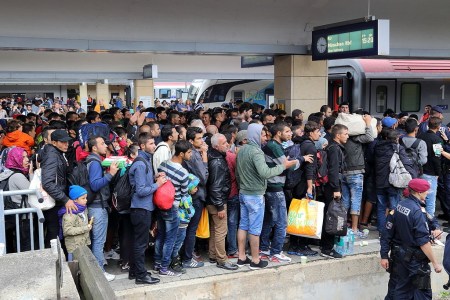
1607 (1)Thousands of newly arrived migrants, the vast majority of whom are men, crowd the platforms at Vienna West Railway Station on August 15, 2015 — a common scene in the summer and fall of 2015. (Image source: Bwag/Wikimedia Commons)

Critics of visa liberalization fear that millions of Turkish nationals may end up migrating to Europe. The Austrian newsmagazine, Wochenblick, recently reported that 11 million Turks are living in poverty and “many of them are dreaming of moving to central Europe.”

Other analysts believe Erdoğan views the visa waiver as an opportunity to “export” Turkey’s “Kurdish Problem” to Germany. According to Bavarian Finance Minister Markus Söder, millions of Kurds are poised to take advantage of the visa waiver to flee to Germany to escape persecution at the hands of Erdoğan: “We are importing an internal Turkish conflict,” he warned. “In the end, fewer migrants may arrive by boat, but more will arrive by airplane.”

In a refreshingly perceptive essay, Wolfram Weimer, a well-known German journalist, wrote that Erdoğan is exploiting Europe’s strategic weaknesses to advance Turkish imperialism and his goal of Islamizing the continent:

“A few days ago Erdoğan said: ‘No matter how uncouth, how merciless, how unscrupulous Western countries act, they have no chance of keeping the migration flows under control.’ In short, he sees mass migration as a political weapon to put Europe under pressure. In diplomatic and military circles, the word that has been circulating for months is ‘migration weapon’ because the Turkish secret service has been deliberately and massively promoting the migration of Muslims to Europe.

“Turkey now earns tremendous amounts of money on all sorts of migration services and has allowed the refugee industry to blossom. At the same time Erdoğan is openly pursuing the Islamization of Europe. With its religious authority Diyanet [a branch of the Turkish government’s Directorate for Religious Affairs that runs hundreds of mosques in Europe], Europe (and especially Germany) are being Islamized in a planned manner; the refugees play a key role, as do mosques, to give a ‘home’ to the faithful in a foreign land.

“Erdoğan’s favorite quote comes from a poem by Ziya Gökalp [1876-1924, a father of Turkish nationalism]: ‘The mosques are our barracks, the minarets are our bayonets.’ Erdoğan sees himself both domestically and internationally as a religious cultural warrior — as the patron saint of Islamist expansion.”

Far-right anti-Erdogan protest allowed to go ahead in Cologne on day of demonstrations

July 31, 2016

Far-right anti-Erdogan protest allowed to go ahead in Cologne on day of demons, Deutsche Welle, July 30, 2016

(How “far left” must Germany be when voicing displeasure with Erdogan is deemed “far right”? — DM)

Some three million people of Turkish origin live in Germany, making it the world’s largest Turkish diaspora.

***********************

A court in Münster has given permission for a far-right protest against Turkish President Erdogan to take place on Sunday in Cologne. Erdogan supporters will also be taking to the streets of the western German city.

erdogan protest

A spokesman for the Higher Administrative Court in Münster confirmed on Saturday that it had rejected an appeal by Cologne police to ban an anti-Erdogan demonstration called by the far-right political party Pro NRW for Sunday.

The court upheld an earlier decision by a Cologne court to allow the demonstration to go ahead, despite police fears that violent members of the HoGeSa (Hooligans Against Salafists) group could join in the protest.

The demonstration is to take place under the motto “No tributes to Erdogan in Germany: Stop the Islamist autocrat from the Bosporus” in response to a planned rally by up to 30,000 Erdogan supporters in the city on the same day.

No Erdogan live presentation

The Münster court, which is responsible for administrative disputes, also rejected an appeal by the organizers of the pro-Erdogan demonstration to be allowed to show the Turkish president live on a large screen during the event.

Police have voiced fears that such a presentation could cause participants to become over-excited.

Police in Cologne are planning to deploy 2,300 officers and have six water cannon on hand in case violence does break out at any of the demonstrations planned in the city on Sunday, which also include rallies by leftists and youth organizations affiliated with German parties.

fearÖzdemir warned of an “atmosphere of fear”

Erdogan critics ‘targeted’

In comments carried in the Saturday edition of the “Süddeutsche Zeitung” newspaper, Foreign Minister Frank-Walter Steinmeier called on participants in the pro-Erdogan demonstration to display moderation.

Steinmeier said it was “not permissible” to bring domestic political tensions from Turkey to Germany or to intimidate people with different political views.

The leader of the Greens, Cem Özdemir, also criticized alleged attempts at intimidation ahead of the demonstration, telling newspapers of the Funke media group that critics of President Recep Tayyip Erdogan among Germany’s Turkish community were being targeted.

Özdemir said that demonstrations for or against Turkish leaders had to take place “on the basis of the [German] legal system.”

“An atmosphere of fear must not be created,” he said.

Turkey in turmoil

Sunday’s demonstrations come as Erdogan continues with purges of the army, judiciary, the education system and the media following a failed coup on July 15.

Critics of the president fear that he might be using the coup as an excuse to increase his already tight political grip on the country.

Some three million people of Turkish origin live in Germany, making it the world’s largest Turkish diaspora.

Turkey’s Tradition of Murdering Christians

July 31, 2016

Turkey’s Tradition of Murdering Christians, Gatestone InstituteRobert Jones, July 31, 2016

(Please see also, Turkey’s Erdogan to US General: ‘Know Your Place’, which deals in large part with the U.S. relationship with Turkey. Turkey is “our” NATO ally and its membership in the European Union is still under consideration. — DM)

♦ Turkey’s countless agreements with Western organizations do not seem to have reduced the hatred for Christians there.

♦ In Turkey, it is “ordinary people” who murder or attack Christians, then the judiciary or political system somehow find a way of enabling the perpetrators to get away with the crimes. Most of these crimes are not covered by the international media and Turkey is never held responsible.

♦ While Muslims are pretty much free to practice their religion and express their views on other religions anywhere in the world, Christians and other non-Muslims can be killed in Turkey and other Muslim-majority countries just for attempting peacefully to practice their religion or openly express their views.

♦ “Multiculturalism,” which is passionately defended by many liberals in the West, could have worked wonders in multi-ethnic and multi-religious places such as Anatolia. But unfortunately, Islamic ideology allows only one culture, one religion, and one way of thinking under their rule: Islam. Ironically, this is the central fact these liberals do not want to see.

On 26 July, the northern French town of Saint-Étienne-du-Rouvray witnessed a horrific Islamist attack: Two Islamic State (ISIS) terrorists killed an 85-year-old priest, Jacques Hamel, in his church during Mass. Two nuns and two churchgoers were taken hostage.

The terrorists, who had pledged allegiance to ISIS and, shouting “Allahu Akbar”, slit the throat of the priest and captured the bloody episode on video, according to a nun who escaped the assault.

Such Islamist attacks might be new to EU member countries but not to Turkey. For decades, so many innocent, defenseless Christians in Turkey have been slaughtered by Muslim assailants.

Christians in Turkey are still attacked, murdered or threatened daily; the assailants usually get away with their crimes.

In Malatya, in 2007, during the Zirve Bible Publishing House massacre, three Christian employees were attacked, severely tortured, then had their hands and feet tied and their throats cut by five Muslims on April 18, 2007.

Nine years have passed, but there still has been no justice for the families of the three men who were murdered so savagely.

First, the five suspects who were still in detention were released from their high-security prison by a Turkish court, which ruled that their detention exceeded newly-adopted legal limits.

The trial is still ongoing. The prosecutor claims that the act “was not a terrorist act because the perpetrators did not have a hierarchic bond, their act was not continuous and the knives they used in the massacre did not technically suffice to make the act be regarded as a terrorist act.”

If the court accepts this legal opinion of the prosecutor, it could pave the way for an acquittal. However, given the many “mysterious” rulings of the Turkish judiciary system to acquit criminals, these killers could also be acquitted by a “surprise” ruling any time.

Ironically, Turkey’s President Recep Tayyip Erdogan said in March that it is necessary to redefine terrorism to include those who support such acts, adding that they could be journalists, lawmakers or activists. There was no difference, he said, between “a terrorist holding a gun or a bomb and those who use their position and pen to serve the aims” of terrorists.

In a country where state authorities are outspokenly so “sensitive” about “terrorism” and “people holding guns,” why are the murderers of Christians not in jail, and why is the prosecutor trying to portray the murders of Christians as “non-terroristic acts”?

Sadly, the three Christians in Malatya were neither the first nor the last Christians to be murdered in Turkey.

On February 5, 2006, Father Andrea Santoro, a 61-year-old Roman Catholic priest, was murdered in the Santa Maria Church in the province of Trabzon. He was shot while kneeling in prayer at his church. Witnesses heard the 16-year-old murderer shout “Allahu Akbar” (“Allah is the Greatest”) during the murder.

After the murder, a 74-year-old priest, Father Pierre François René Brunissen, from Samsun, led the next church service in Santoro’s church, which boasted barely a dozen members. Because no one volunteered to replace Santoro, Father Pierre was instructed to travel from Samsun to Trabzon each month to care for the city’s small congregation.

“This is a terrible incident,” Father Pierre said. “It is a sin to kill a person. After all of these incidents, I am worried about my life here.”

In July, 2006, he was stabbed and wounded by a Muslim in Samsun. The perpetrator, 53, said that he stabbed the priest to oppose “his missionary activities.”[1]

The attacks against the Christian culture in Anatolia continue in modern times — even after Turkey joined the Council of Europe in 1949 and NATO in 1952.

Turkey’s countless agreements with Western organizations do not seem to have reduced the hatred for Christians there. In March, 2007, as the Christian community of Mersin was preparing for the Easter, a young Muslim man with a kebab knife entered the church and attacked the priests, Roberto Ferrari and Henry Leylek.

Mersin, in southern Turkey, is home to Tarsus, the birthplace of Saint Paul, and to several churches dating from the earliest Christian era.

As the Christian roots of Anatolia weakened, so did its bonds with Western civilization. “The attack against the priest is an indicator that Ankara is not ready for Europe,” a Roman Catholic Cardinal and theologian, Walter Kasper, told the Italian newspaper, Corriere della Sera. “There is some amount of tolerance but there is not real freedom. Turkey has to change many things. This change is not about laws. A change of mentality is needed. But you cannot change mentality in one day.”

Bishop Luigi Padovese, Apostolic Vicar of Anatolia, said: “We do not feel safe. I am very worried. Fanaticism is developing in some groups. Some people want to poison the atmosphere and catholic priests are targeted. Anti-missionary films are broadcast on TV channels.”

At a commemorative ceremony for Father Santoro in February, Bishop Padovese said:

“Today, we are asking the question we asked four years ago: Why? We are also asking the same question for all other victims so unjustly murdered even though they were innocent. Why? What was it that they tried to destroy by murdering Father Andrea? Just a person or what that person represented? The aim of shooting Father Andrea was definitely to shoot a Catholic cleric. His being a Father became the reason of his martyrdom.

“The message of Christ on the cross is clear. ‘Father, forgive them, for they do not know what they do.’ Had they known, they would not have done that. It is wrong to extinguish a life to uphold an idea. It is wrong to think that a person who disagrees with us is at fault and should be destroyed. This is the fundamentalism that crumbles a society. For it wrecks coexistence. This fundamentalism — regardless of what religion or political view it belongs to — might win a few battles but it is doomed to lose the war. This is what history teaches us. I hope that this city and this country will turn into a place where people can live as brothers and sisters and unite for the common good for all. Is the Allah of all of us not the same?”

No, unfortunately, the Allah of all of us is not the same.

Just four months later, in June, 2010, it was Padovese’s turn to be murdered. This time the murderer was the Bishop’s own driver for the previous four years. The driver first stabbed the bishop, then cut his throat, while shouting “Allahu Akbar” during the attack.

At the trial, the driver said that the bishop was “Masih ad-Dajjal” (“the false messiah”), then twice in the courtroom he loudly recited the adhan (Islamic call to worship).

1737 (1)Father Andrea Santoro (left), a 61-year-old Roman Catholic priest, and 63-year-old Bishop Luigi Padovese (right), Apostolic Vicar of Anatolia, were two Christian priests murdered in Turkey in recent years.

In the territory where Christians once thrived, even converting to Christianity now creates serious problems.

“New Christians coming from Muslim families are often isolated and ostracized,” writes Carnes. “Turgay Ucal, a pastor of an independent church in Istanbul, who converted from Islam to Christianity said: “Buddhism is okay, but not Christianity. There was a history.”

And this history includes how indigenous Christians in Anatolia have been slaughtered by Muslims. [2]

The total population of Turkey is about 80 million; believers of non-Muslim faiths — mostly Christians and Jews — comprise 0.2%. Nevertheless, anti-Christian sentiment is still prevalent in much of the Turkish society. [3]

There seems to be a pattern: Murders of Christians are committed stealthily in Turkey: It is “ordinary people” who murder or attack Christians, then the judiciary or political system somehow finds a way of enabling the murderers or attackers to get away with what they have done. Sadly, most of these crimes are not covered by the international media, and Turkey is never held responsible.

Turkey, however, signed a Customs Union agreement with the European Union in 1995 and was officially recognized as a candidate for full membership in 1999. Negotiations for the accession of Turkey to the EU are still ongoing.

How come a nation that has murdered or attacked so many Christians throughout history, and which has not even apologized for these crimes, is considered even a suitable candidate for EU membership? Because of the threat of blackmail to flood Europe with Muslims? Turkey will flood Europe with them anyway. There is even a name for it: Hijrah, spreading Islam (jihad) by emigration. Exactly as Muslims have done inside Turkey.

And what kind of a culture and civilization have many Muslims built for the most part in the lands that they have conquered? When one observes the historical and current situation in Muslim-majority countries, what one mostly sees are murders, attacks and hatred: Hatred of non-Muslims, hatred of women, hatred of free thought and an extremely deep hatred of everything that is not Islamic. Many Muslims that have moved to the West have been trying to import political Islam to the free world, as well.

Muslim regimes including Turkey have not achieved civilized democratization that would enable all of their citizens — Muslims and non-Muslims — to live free and safe lives.

While Muslims are pretty much free to practice their religion and express their views on other religions or on atheism anywhere in the world, Christians and other non-Muslims can be killed in Turkey and other Muslim-majority countries just for attempting peacefully to practice their religion or openly express their views.

“Multiculturalism,” which is passionately defended by many liberals in the West, could have worked wonders in multi-ethnic and multi-religious places such as Anatolia. But unfortunately, Islamic ideology allows only one culture, one religion, and one way of thinking under their rule: Islam. Ironically, this is the central fact these liberals do not want to see.

Much of the history of Islam shows that the nature of Islamic ideology is to invade or infiltrate, and then to dominate non-Muslims.

In general, Muslims have never shown the slightest interest in peaceful coexistence with non-Muslims. Even if most Muslims are not jihadis, most do not speak out against jihadist attacks. Many thus appear quietly to support jihadis. That there are also peaceful Muslim individuals who respect other faiths does not change this tragic fact.

That is why non-Muslims in the West have every right to fear one day being exposed to the same treatment at the hands of Muslims. The fear non-Muslims have of Islamic attacks is, based on recent evidence, both rational and justified.

Given how unspeakably non-Muslims are treated in majority Muslim countries, including Turkey, who can blame them for being concerned about the possible Islamization of their own free societies?

Why does Turkey, which seems to hate its own Christians, want to have visa-free access to Christian Europe, anyway?

____________________________


[1] Christianity has a long history in Samsun – as in all other Anatolian towns. As Amisos, in Greek, it was one of the centers of the ancient Greek Pontos region, and helped spread the Christian influence in the region.

“After 1914 the Greek and Armenian populations were to dwindle considerably due to the organized death marches and other methods used by the Turks during the Greek and Armenian Genocides,” according to “Pontos World.”

Decades later, attacks against Christians are still commonplace. In December 2007, another Catholic priest, Adriano Franchini, 65, of Izmir was also stabbed and wounded during the Sunday church service by a 19-year-old Muslim.

Izmir, or Smyrna, was an ecclesiastical territory of the Ecumenical Patriarchate of Constantinople, and one of the Seven Churches of Asia mentioned by Apostle John in the Book of Revelation.

During the Ottoman era, Smyrna hosted one of the largest populations of Greeks and Armenians. Today, there is only a tiny Christian minority in the city. The devastation of the Greek culture in the city peaked during what is commonly known as the “Catastrophe of Smyrna.” The Turkish army destroyed the city in 1922, after the Great Fire of Smyrna. Turkish soldiers murdered many non-Muslim civilians, including dozens of priests and bishops, and forced countless Greek men to join labor battalions. Most Greeks fled their homes in the city to seek shelter in Greece and other states.

“The Great Fire of Smyrna,” wrote the author Ioanna Zikakou, “was the peak of the Asia Minor Catastrophe, bringing an end to the 3,000-year Greek presence on Anatolia’s Aegean shore and shifting the population ratio between Muslims and non-Muslims.”

According to the journalist Tony Carnes:

“Few nations have as rich a Christian history as Turkey. This is where Paul founded some of the earliest churches, including the church at Ephesus. Seven churches in this region were addressed in the Book of Revelation. Those in the early monastic movement found the caves of Cappadocia a near-perfect place to live out lives of prayer.

“But Christianity came under Islamic rule in Turkey in 1453 and steadily declined for centuries; the last 100 years have been the worst. In 1900, the Christian population was 22 percent. Now most experts estimate that there are fewer than 200,000 Christians nationwide, comprising less than 0.3 percent of the population.”

Today, in Islamized Anatolia, the members of the diminutive Christian minority are daily exposed to verbal or physical attacks. Kamil Kiroglu was born and raised in Turkey as a Muslim. At the age of 24, he became a Christian and served in the Turkish Church until 2009. After he became Christian, he was rejected by his family.

On January 8, 2006, Kiroglu was beaten unconscious by five young Muslim men.

“The attack followed church services,” writes the scholar John L. Allen Jr. in his book, The Global War on Christians. “Kiroglu later reported that one of the young men, wielding a knife, had shouted, ‘Deny Jesus or I will kill you now!’ Another reportedly shouted, ‘We do not want Christians in this country!’ As the attackers left, they told a friend of Kiroglu’s that they had left a gift for him. It turned out to be a three-foot-long curved knife, left behind as a further warning against Christian activity.”

“Turkey may be an officially secular state, but sociologically it’s an Islamic society. In general, the greatest threat facing Christians comes not from religiously zealous forms of Islam but from ultranationalists who see Christians as agents of the West, often accusing them of being in league with Kurdish separatists.”

In 2009, Bartholomew I of Constantinople, the Orthodox Christian Church’s Patriarch, said in aninterview with CBS that Turkey’s Christians were second-class citizens and that he felt “crucified” at the hands of Turkish state authorities.

[2] “The annihilation of the non-Turk/non-Muslim peoples from Anatolia started on April 24, 1915, with the arrest of 250 Armenian intellectuals in Istanbul,” wrote the columnist Raffi Bedrosyan.

“Within a few months, 1.5 million Armenians had been wiped out from their historic homeland of 4,000 years in what is now eastern Turkey, as well as from the northern, southern, central, and western parts of Turkey. About 250,000 Assyrians were also massacred in southeastern Turkey during the same period. Then, it was the Pontic Greeks’ turn to be eliminated from northern Turkey on the Black Sea coast, sporadically from 1916 onward.”

Orhan Picaklar, the pastor of the Samsun Agape Church, was kidnapped and threatened by Muslim locals in 2007. He said that people also tried to kidnap his 11-year-old son from his school. His church has been stoned countless times. Ahmet Guvener, the pastor of the Diyarbakir Protestant Church, said he received so many threats that he was awaiting death: “I will give a letter of attorney to a friend of mine. If I die, I want him to take care of my children.”

[3] See the yearly reports of the Association of Protestant Churches about rights abuses against Christians in Turkey.