Posted tagged ‘Erdogan’

Iran-Saudi crisis spurs Hizballah strike on Israel

January 4, 2016

Iran-Saudi crisis spurs Hizballah strike on Israel, DEBKAfile, January 3, 2016
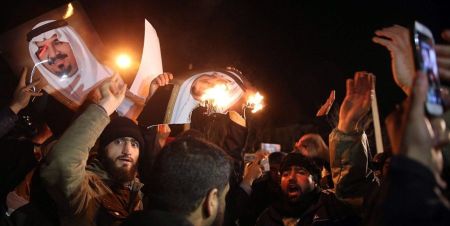
Iranian_protesters_set_fire_to_pictures_of_the_Saudi_royal_family_3.1.16

The heated verbal battle between Tehran and Riyadh over Saudi Arabia’s execution of a Shiite cleric escalated Sunday night, Jan 3, with the severance of diplomatic relations. On the broader front, the repercussions from the quarrel between the two leaders of the Muslim world’s Shia-Sunni split are widely seen in Middle East military and intelligence circles as spurring a fast-track Hizballah attack on Israel.

Among the 47 people executed by Saudi Arabia Saturday on terrorism charges was Sheikh Nimr al-Nimr, Saudi Shiite leader and a prominent Shiite cleric in the region. Put to death with him were several Saudi Shiite and Sunni activists, which enraged Iran’s supreme leader Ayatollah Ali Khamenei to the point of threatening the Saudi royal family with “divine revenge.”

From Iran’s perspective, the Saudis committed the unpardonable act of executing Shiites together with Sunni Al Qaeda and ISIS terrorists. This made the House of Saud the first ruling power ever to treat Shiite and Sunni terrorists alike. This, more than anything, incensed Iran and its Lebanese proxy Hizballah, who are deep in a bloody war against the Sunni Islamic State and the Nusra Front terrorists in Syria. Iran’s Revolutionary Guards are additionally locked in a bitter conflict with ISIS in Iraq.

The Iranian war effort is backed by the US in Iraq and by Russia in Syria.

By the mass executions of both classes of terrorist at the same time, Riyadh issued four messages:

1. Washington and Moscow are wrong. The Iranians and the forces they back in the Persian Gulf, Syria and Iraq are just as much terrorists as ISIS and Al Qaeda.

2. The House of Saud is determined to fight both with equal resolve and severity

3. Riyadh has already taken Tehran on in Yemen, and indirectly in Syria, and is now ready to take the fight against Tehran all the way to the war on terror.

4. Taking off the diplomatic gloves, Saudi Foreign Minister Adel al-Jubeir Monday night severed relations with Iran and ordered all Iranian diplomats to leave the kingdom within 48 hours. The foreign ministry said that by condemning the Nimr execution, Iran was supporting terrorism.

Saudi diplomats were already gone after protesters in Tehran torched and ransacked the Saudi embassy Saturday.

Amid all the sound and fury, Tehran’s attention was drawn to comments made by Israeli Prime Minister Binyamin Netanyahu in the light of a major terrorist attack in Tel Aviv. He pointed out that, in addition to the Palestinians, Israel is threatened by two streams of radical Islam, the Shiites and the Sunnis.

He was clearly referring to Iran and its terrorist arm, Hizballah, on the one hand, and ISIS and Al Qaeda, on the other, inspired less by the Tel Aviv outrage than by the gathering clouds of terror darkening the region, which place the Saudi royal family and Israel on the same side, sharing a similar perception of the two foes facing both countries.

Policymakers in Jerusalem noted the odd statement by Turkish President Tayyip Erdogan to reporters on Saturday, January 1 on the way home from a visit to Riyadh. After years of reviling the Jewish state, he said, “Israel is in need of a country like Turkey in the region. We have to admit that we also need Israel.”

He sounded as though he was urging the resumption of the old political and military alliance binding the two countries years ago.

DEBKAfile’s Middle Eastern sources point out that, since his comment came directly after his talks with Saudi King Salman in Riyadh, it appeared to open a path toward the possible creation of a new Middle East bloc consisting of Turkey, Saudi Arabia, perhaps Egypt, and Israel, bound by the same enemies. This grouping could serve as a counterweight against the Sunni-Shiite bloc of Iran, Iraq, Syria and Hizballah, which has the backing of the US and Russia on one hand, and fights ISIS on the other.

Iran’s leaders may curse the House of Saud without restraint, but they are canny enough not to go from words to deeds, knowing they would be on their own if they attacked the oil kingdom and earn no backing from either Washington or Moscow.

However, it might be easier for Tehran to take advantage of Netanyahu’s tough predicament in his war on terror, by sending Hizballah to strike Israel and, meanwhile, pre-empt the formation of a new anti-Tehran alliance. Speeding up Hassan Nasrallah’s promised revenge for the assassination of its master terrorist Samir Quntar would serve this purpose.

This possibility has prompted the IDF to keep artillery units pounding areas bordering on Israel during the past few days. The IDF says this action is necessary to stop Hizballah exploiting the stormy, snowy winter weather to attack Israel. Its military chiefs appear to be acting on information received of an approaching Hizballah operation as its leader has threatened.
Turkey and Israel: A Rickety Handshake

December 23, 2015

Turkey and Israel: A Rickety Handshake, Gatestone InstituteBurak Bekdil, December 23, 2015

(What benefit beyond oil sales to Turkey — a minor one that Turkey could extinguish at its pleasure — would Israel receive? — DM)

♦ It would be truly embarrassing if a Turkey-Israel normalization results in new arms shipments into Gaza and rockets over Israeli skies — with the only achievement being a temporary peace with Turkey’s Islamists, who never hide their ideological kinship with Hamas.

♦ The future Turkish and Israeli ambassadors would always have to keep their bags packed, ready to return to their own capitals at the first dispute – which could be caused by Israeli retaliation against Arab terrorism or anything that may make Erdogan roar in front of cameras.

♦ How do you shake hands with a man whom you know ideologically hates you and wishes to mess up things at his earliest convenience?

None of this happened half a century ago; the timeline here covers only a span of a year and a half: A Turkish-Kurdish pop star wrote on her Twitter account, “May God bless Hitler. He did far less [than he should have done to Jews].” The mayor of Ankara replied: “I applaud you!” Hundreds of angry Turks, hurling rocks, tried to break into the Israeli diplomatic missions in Ankara and Istanbul. The mayor of Ankara said: “We will conquer the consulate of the despicable murderers.” He blamed the Charlie Hebdo massacre in Paris on Israel’s Mossad. Islamist columnists close to the government suggested imposing a “wealth tax” on Turkish Jews (who are full citizens). A governor threatened to suspend restoration work at a synagogue. And a credible research group at the Kadir Has University in Istanbul found in a poll that Turks view Israel as the top threat to Turkey.

Against such a background, Turkish and Israeli diplomats are negotiating a historical deal that will, in theory, end Turkey’s hostility toward the Jewish state and normalize diplomatic ties between Ankara and Jerusalem.

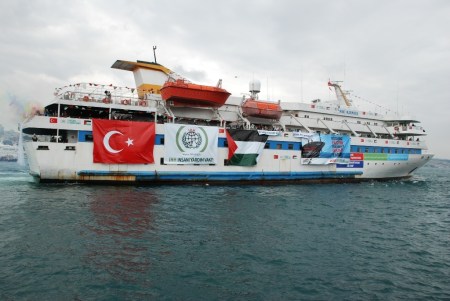
In 2010, a Turkish flotilla, led by the Mavi Marmara with hundreds of jihadists and anti-Israeli “intellectuals” aboard, sailed toward the coast of Gaza, aiming to break Israel’s naval blockade of the Hamas-run strip. Israel’s naval blockade aims to prevent weapons such as rockets being smuggled into Gaza. To stop the flotilla, naval commandos of the Israel Defense Forces boarded the vessel and, during clashes, killed nine aboard.

1080The Turkish-owned ship Mavi Marmara, which took part in the 2010 “Gaza flotilla” that attempted to break Israel’s naval blockade of Gaza. (Image source: “Free Gaza movement”/Flickr)

Since the incident, Turkey’s Islamist leaders have pledged to isolate Israel internationally and have downgraded diplomatic ties with Jerusalem. They have put forward three conditions before any normalization could take place: an Israeli apology, compensation for the families of the victims and the removal of the naval blockade on Gaza.

After President Barack Obama’s intervention, Israeli Prime Minister Benjamin Netanyahu in 2013 apologized for “any error that may have led to the loss of life.” Turkey’s two other conditions remain unfulfilled. But diplomatic teams from Ankara and Jerusalem are apparently working on a deal. There are good reasons why an accord may or may not be possible.

Since the nearest Turkish election is four years from now, neither Turkish President Recep Tayyip Erdogan nor his prime minister, Ahmet Davutoglu, has any reason to cultivate further anti-Semitism at election rallies in order harvest votes from conservative masses who are deeply hostile to Israel and Jews. These are days when Turkey’s leaders need not practice their usual anti-Israeli rhetoric.

There is another reason related to “timing” that makes a deal attainable. After pledging to isolate Israel, Turkey has become the most isolated country in the region, especially after the recent crisis with Russia that emerged after two Turkish F-16 fighters shot down a Russian SU-24 aircraft along Turkey’s Syrian border on Nov. 24.

In its region, Turkey does not have diplomatic relations with Cyprus and Armenia. It has downgraded diplomatic relations with Israel and Egypt. It is confronted by Shiite and Shiite-dominated regimes in Iran and Iraq, respectively. On top of all that, an angry Vladimir Putin, Russia’s president, curses and threatens every day to punish Turkey. Turkey buys over half of its natural gas and 10% of its oil from Russia.

Therefore, a third incentive could be a mutually beneficial future deal for Turkey to buy natural gas from Israel. If the two countries build an underwater pipeline, Turkey can compensate for the potential loss of Russian gas supplies, starting in 2019. For Israel, a pipeline to Turkey would be the most commercially feasible route to export its gas to Turkey and other potential buyers beyond.

A Turkish-Israeli handshake would also be music to ears in Washington. Deep hostility and occasional tensions between its two allies in the Middle East have always been unnerving for the U.S. administration.

The road ahead has its problems. Turkey’s second condition for normalization, compensation, is not too difficult to overcome. But the third condition, that Israel should remove the naval blockade of Gaza — and risk weapons being smuggled into the hands of Hamas (or other terrorist groups) — could be an unsafe move for Israel.

It would be truly embarrassing if a Turkey-Israel normalization results in new arms shipments into Gaza and rockets over Israeli skies — with the only achievement being a temporary peace with Turkey’s Islamists, who never hide their ideological kinship with Hamas.

If Netanyahu decides to take risks and go for a deal, he must make sure that however the naval blockade of Gaza would be eased, it does not expose Israel to the risk of new acts of terror.

Another risk is the potential psychological domino effect any deal could cause. It is certain that Turkish Islamists will portray any deal as a success story — that they were able to “bring Israel to its knees.” This message, relayed through a systematic propaganda machine, could set a dangerous precedent and potentially encourage Arab Islamists to consider more assertive policies toward Israel in the future.

The future Turkish and Israeli ambassadors would always have to keep their bags packed, ready to return to their own capitals at the first dispute – which could be caused by Israeli retaliation against Arab terrorism or anything that may make Erdogan roar in front of cameras, “Our Palestinian brothers … Those murderer Jews again … Go back to your pre-1967 borders or you’ll suffer the consequences!”

Netanyahu’s problem is that he does not trust Erdogan in the least. He is right not to trust Erdogan. But then how do you shake hands with a man whom you know ideologically hates you and wishes to mess up things at his earliest convenience?

Oh by the way, Turkey is trying to get into a war w/Iraq

December 6, 2015

Oh by the way, Turkey is trying to get into a war w/Iraq, Front Page Magazine, Daniel Greenfield, December 6, 2015

hqdefault_1

Open question: What does Turkey’s deranged Islamist leader have to do to be disavowed by NATO, Europe and the US?

Erdogan armed terrorists in Syria, but pretty much everyone is doing that. He nearly began a war with Russia. Now Iraq keeps ordering Turkish troops off its soil. But they’re there at the supposed request of Sunnis militias around Mosul. Possibly to fight ISIS. But considering Turkey’s track record and Baghdad’s protests, probably not.

It’s a given that Baghdad, which has become a puppet regime for Iran, would oppose arming Sunni militias. Its preferred means of operation is through Iranian trained Shiite militias.

Since Turkey is really in Syria to overthrow Assad, it looks like its version of the Sunni-Shiite conflict is spreading to Iraq. Essentially Turkey is advancing into a war with the Shiite axis of Iran-Syria and its Russian patron, not to mention all the various Shiite terror militias.

I won’t object if Sunni and Shiite terrorists and their state sponsors shoot and bomb each other. Especially if it’s Turkey and Iran, but as long as Turkey is in NATO, its lunatic tyrant trying to revive the Ottoman Empire has the ability to drag us into his wars.

And that’s an obvious problem.

Turkey should not be in NATO. And only a madman would consider it for EU membership.

But Erdogan’s migrant games have forced Germany to come crawling to him offering cash and EU membership acceleration.

Obama, who was once closest to Erdogan, is obviously not about to cut him off no matter what he does. But the United States is now in the strange position of having a ridiculously confused presence in a Muslim civil war.

Obama is backing Sunni Jihadists in Syria and Shiite Jihadists in Iraq. He refuses to arm Sunni militias in Iraq, but stands by while Turkey carries out what is effectively an illegal invasion of Iraq. (Remember that one the next time Kerry squeals about Jews living in Jerusalem.) He backs Kurdish militias that Turkey is bombing. He’s trying to appease Iran and Turkey at the same time and it can’t work.

The only thing Obama has managed to do is shove the United States in the middle of a Muslim civil war while making occasional noises about un-Islamic ISIS.

Russia Devouring the Eastern Mediterranean?

December 5, 2015

Russia Devouring the Eastern Mediterranean?

by Burak Bekdil

December 5, 2015 at 5:00 am

Source: Russia Devouring the Eastern Mediterranean?

  • Turkey shot down a Russian jet. No gain, but plenty of damage to its economy. Russia gave up one jet to Turkey and has made its military presence in Syria and the strategic eastern Mediterranean permanent.
  • Turkey can no longer speak to Russia about the possibility of ousting Assad.
  • Putin seems to be making sure that NATO will do nothing.

At this year’s G-20 summit in Antalya, Turkey, Russian President, Vladimir Putin, said that the radical jihadist Islamic State (IS) was being financed by donors from at least 40 countries, including some G-20 member states — clearly pointing his finger, without naming names, at Saudi Arabia and Turkey. A few days later, two Turkish F-16 jets shot down a Russian SU-24 warplane, and claimed that the Russian jet had violated Turkish airspace for 17 seconds on the country’s Syrian border — a violation Russia denies. This was the first time a Soviet or Russian military aircraft was shot down by a NATO air force since the end of WWII.

Turkey and Russia have long been in a proxy war in Syria: Russia, together with its quieter partner, China, supports the Shi’ite Iran-backed Syrian regime of President Bashar al-Assad; and Turkey explicitly supports Assad’s Sunni opponents [“moderate” jihadists] — apparently in the hope of building a Muslim Brotherhood/Hamas-type of regime in Damascus that would be friendly to its own Islamist government. After the downing of the Russian jet, the Turco-Russian proxy war has become less proxy.

No more Mr. Nice Guy.
Russian President Vladimir Putin twice refused to meet with Turkish President Recep Tayyip Erdogan on the sidelines of the Paris Climate Summit this week. Pictured: President Putin with then Prime Minister Erdogan, meeting in Istanbul on December 3, 2012. (Image source:kremlin.ru)

An angry Putin called the incident “a stab in the back.” He declined Turkish President Recep Tayyip Erdogan’s requests to discuss the issue. He twice refused to meet Erdogan on the sidelines of the Paris Climate Summit.

Russia’s foreign minister, Sergei Lavrov, quickly cancelled his official visit to Turkey — a visit that had been scheduled for the day after the downing of the Russian jet. At the outset, NATO member Turkey had taught Russia a good lesson. In reality, judging from the consequences, it all looks like a Russian gambit, with Turkey shooting itself in the foot and risking a new NATO-Russia conflict.

Russia’s ire seemingly is being expressed in economic terms:

  • Moscow said it will introduce visa restrictions for Turkish citizens, beginning Jan. 1, 2016.
  • Russian authorities detained a group of Turkish businessmen on charges of “false statements about their trip to the country.”
  • Press reports noted that Russia was considering limiting or excluding Turkish construction companies from the country, a potentially multi-billion dollar loss for the Turkish economy.
  • Moscow warned its citizens against visiting Turkey — a ban that could deal a big blow to Turkey’s lucrative tourism industry. Last year 4.5 million Russians visited Turkey, mostly its Mediterranean coast. Russian tour operators were warned to suspend business with Turkey.
  • The fate of two huge Turco-Russian energy projects remains unknown, as Russia’s energy minister, Alexei Ulyukayev, did not rule out sanctions hitting the Turkish Stream gas pipeline and a planned Russian nuclear energy plant in Turkey. Turkey buys about 55% of its natural gas from Russia. Its second largest gas supplier is Iran, Russia’s ally — and Turkey’s rival — in Syria.
  • Russia’s Minister of Agriculture, Alexander Tkachev, said that Russia would be replacing Turkish food imports with goods from Iran, Israel and Morocco.
  • Shipments of wheat to Turkey from key Russian ports were put on hold.
  • The Kremlin officially announced a wide range of sanctions on Turkey, including a ban on Turkish workers (with estimates that 90,000 will be fired by Jan. 1, 2016), restrictions on imported goods and services from Turkey and calls for “strengthening of port control and monitoring to ensure transport safety.”
  • Around 1,250 trucks carrying Turkish exports were blocked from entering Russia on Nov. 30 and were stranded at border posts, awaiting clearance.
  • Russian soccer clubs will be banned from signing Turkish players during the upcoming winter break.

All of that is commercially punitive. There is a more serious side of the Turco-Russian conflict that concerns NATO and western interests in the Middle East.

Russian Defense Minister Sergei Shoigu announced on Nov. 25 that Russia would deploy S-400 surface-to-air missile systems in its Hmeymim air base in Syria.

Turkey shot down a Russian jet. No gain, but plenty of damage to its economy. Russia gave up one jet and has made its military presence in Syria and the strategic eastern Mediterranean permanent. It has reinforced its bases in Syria and intends to build a new military base there. Turkey can no longer speak to Russia about the possibility of ousting Assad.

In a further move to escalate tensions, the Russian General Staff deployed one of its largest air defense ships at the edge of Turkish territorial waters in the Mediterranean. Russian military spokesman General Sergei Rudskoi said that Russian bomber aircraft would be “supported by chasers, and any kinds of threats will be responded to instantly.” Accordingly, The Moscow, one of the Russian Navy’s two largest warships and the flagship of Russia’s Black Sea Fleet, will be deployed where Turkey-Syria territorial waters connect.

In addition, Putin issued orders to deploy nearly 7,000 troops, plus anti-aircraft missiles, rocket launchers, and artillery to the Turkish border, and asked them to be in readiness for full combat.

There have been other military repercussions, too. Since the shooting down of the Russian jet, the Russian military has been regularly pounding the Syrian villages near the Turkish border that populated by the Turkmen, a Turkish ethnicity that supports jihadists in Syria — and is supported by Ankara. The Russians also have been hitting Turkish aid convoys bound for Turkmen villages. More than 500 Turks and Turkmen have been killed in Russian airstrikes. Meanwhile, the U.S.-led allied air strikes against IS have come to a halt. Neither Washington nor Ankara is keen for another conflict with Russia. So, IS and Russia keep on flourishing.

The Russian military has scrapped all contacts with the Turkish military, possibly waiting for the first Turkish military aircraft that violates foreign airspace to shoot.

Turkey has every liberty to challenge Russia and, inevitably, become the victim. But with its geostrategic, Islamist ambitions, it is exposing NATO allies to the risk of a fresh conflict with Russia — and at a time when the wounds of previous conflicts remain unhealed.

Putin has accused Turkey’s leaders of encouraging the Islamization of the Turkish society, which he said was a “problem.” He was not wrong. In fact, Islamism and neo-Ottoman ambitions are the source of Turkey’s (not-so) proxy war with Russia in the Syrian theater. Although Turkey, officially, is a NATO member and part of the allied campaign against IS, its Sunni Islamist ambitions over Syria hinder the global fight against jihadists. A Turco-Russian conflict is weakening the fight.

Putin seems to be making sure that NATO will do nothing.

Burak Bekdil, based in Ankara, is a Turkish columnist for the Hürriyet Daily and a Fellow at the Middle East Forum.

‘Allah took their sanity’: Putin accuses Turkish leadership of ‘aiding terror’

December 3, 2015

‘Allah took their sanity’: Putin accuses Turkish leadership of ‘aiding terror’

Published time: 3 Dec, 2015 09:16 Edited time: 3 Dec, 2015 15:14

Source: ‘Allah took their sanity’: Putin accuses Turkish leadership of ‘aiding terror’ — RT News

December 3, 2015. Russian President Vladimir Putin delivers his annual Presidential Address to the Federal Assembly at the Kremlin's St. George Hall. © Ramil Sitdikov
Russian President Vladimir Putin lashed out at “part of the leadership in Turkey” during his annual address to the parliament, accusing Ankara of having trade ties with terrorist groups in Syria and Iraq. He also promised more sanctions for Turkey over downing of the Russian jet.

Follow LIVE UPDATES on Putin addressing Russian legislators

Putin said Russia still cannot comprehend why the downing of the plane happened.

We were prepared to cooperate with Turkey on most sensitive issues and go further than their allies. Allah knows why they did it. Apparently Allah decided to punish the ruling clique in Turkey by taking their sanity,” Putin said.

Putin stressed that Moscow’s anger over the incident is directed at particular individuals and not at the Turkish people.

We have many friends in Turkey,” he said. “They should know that we do not equate them and part of the current Turkish leadership, which holds a direct responsibility for the deaths of our troops in Syria,” he said.

He added that the killing of Russian officers would have long-term consequences for those responsible.

We will not forget this aid to terrorists. We have always considered betrayal the worst and most shameful act. Let those in Turkey know it who shot our pilots in the back, who hypocritically tries to justify themselves and their actions and cover up the crimes of terrorists,” he said.

The routes of alleged oil smuggling from Syria and Iraq to Turkey © syria.mil.ru

Map, images from Russian military show main routes of ISIS oil smuggling to Turkey

Putin said Russia would not resort to saber-rattling to respond to the Turkish actions, but neither would it limit itself to the economic sanctions it imposed since the incident.

The incident with the Russian Su-24 bomber shot down by Turkish warplanes near the Turkish-Syrian border has greatly deteriorated relations between the two countries. Turkey insists it acted in response to a brief violation of its airspace and was justified in using lethal force. Russia insists no violation took place and has accused Turkey of supporting terrorists in Syria.

The downing of the bomber resulted in the deaths of two Russian troops, who were the first combat losses during the two month-long Syrian campaign. The pilot of the downed plane was killed by a pro-Turkish militant group as he was parachuting to the ground. A marine was killed by militants when a helicopter dispatched to rescue the bomber crew came under fire from the ground.

Putin’s address started with a minute’s silence to commemorate the two troops. The widows of the dead Russians were present at the event.

Putin stressed that the Russian operation in Syria is aimed first and foremost at preventing fighters who went to the Middle East from Russia and its neighboring countries from returning home and bringing the threat of terrorist attacks to Russian soil.

They are getting money, weapons, gathering strength. If they get stronger, winning there, they will inevitably come here to sow fear and hatred, blast, kill and torture people,” Putin said.

Putin called on all nations that have pledged to fight terrorism to join forces and abandon the notion that terrorist groups can be used for country’s own goals. He stressed that the rise of terrorism in the Middle East over the last few years was caused to a large degree by foreign meddling.

Some countries in the Middle East and North Africa, which used to be stable and relatively prosperous – Iraq, Libya, Syria – have turned into zones of chaos and anarchy that pose a threat to entire world,” Putin said.

Read more

© syria.mil.ru

We know why it happened. We know who wanted to oust unwanted regimes, and rudely impose their own rules. They triggered hostilities, destroyed statehoods, set people against each other and simply washed their hands [of the situation] – giving way to radicals, extremists and terrorists.”

Russia’s lost thousands of lives over two decades of terrorist attacks and is still not safe from terrorist attacks, as evidenced by the bombings in Volgograd in 2014 and the bombing of a Russian passenger plane in Egypt in October, Putin reminded.

“Breaking the bandits’ back took us almost 10 years,” he said. “We practically pushed the terrorists out of Russia, but we are still engaged in a fierce fight against the remainder of the gangs. This evil still comes back occasionally.

Putin said the rise of jihadists in the Middle East in our time is not unlike the rise of Nazism in the mid-20th century, and that the world should learn from the mistakes of the past, when a failure to act in time resulted in the loss of millions of lives.

We are facing a destructive barbaric ideology again and we have no right to allow those new obscurants to achieve their goals. We have to abandon all differences, create a single fist, a single anti-terrorist front, which would act in accordance with the international law and under the aegis of the United Nations,” he said.

Putin was speaking on Thursday before the Federal Assembly, a joint session of the two chambers of the Russian parliament, plus regional governors and the cabinet. The annual address is a traditional key policy report of the executive, which focuses on domestic politics rather than international relations.

‘Business as usual’ with Turkish President Recep Tayyip Erdogan is now over, Sergey Ivanov, the head of Putin’s office, confirmed to RT after the Russian president’s address:

“Yes, it is definitely over. But fighting terrorism is ‘business as usual’, as the Russian president said,” Ivanov said.

The Turkish leadership “must acknowledge that a tragic mistake was committed and to beg for [forgiveness], or this leadership will not play any significant role in bilateral relations between Russia and Turkey. We will not be able to have any ties with Turkey under this leadership if it doesn’t change its attitude,” Konstantin Kosachev, the chair of the State Duma Committee for Foreign Relations, told RT.


Are You Sure About That? Why Erdogan Shouldn’t Have Asked for Proof

December 1, 2015

Are You Sure About That? Why Erdogan Shouldn’t Have Asked for Proof

14:02 01.12.2015(updated 14:23 01.12.2015)

Source: Are You Sure About That? Why Erdogan Shouldn’t Have Asked for Proof

Recep Tayyip Erdogan has dramatically vowed to leave office if any proof is provided that Ankara has been buying oil from the terrorist group Daesh (ISIL/IS). But does the Turkish leader really believe that President Putin is going to make a statement unsupported by evidence? Here’s at least some of the evidence Erdogan has hastily asked for.

Satellite images and aerial photos showing the true scale of the Daesh (ISIL) oil trade:“I’ve shown photos taken from space and from aircraft which clearly demonstrate the scale of the illegal trade in oil and petroleum products,” Vladimir Putin told reporters in November on the sidelines of the G-20 summit in Antalya.

“Car convoys stretching for dozens of kilometers, going beyond the horizon when seen from a height of four-five thousand meters,” added the Russian president.

The real thing is that President Putin actually got up in front of the world’s largest economic powers and told them, right to their faces, that Russia knows exactly where the oil is going.

The Guardian’s investigation on the Daesh oil flow into Turkey:

The British newspaper has posted a number of articles on the Daesh oil business based on its own investigations.

“After a US attack on the compound of a Daesh (ISIL) leader in Syria in May, direct dealings between the terrorist organization and Turkey became undeniable,” the newspaper wrote back in July, referring to documents seized at the compound.

“Following the killing of Abu Sayyaf, an ISIL official responsible for oil smuggling in May, a senior Western official familiar with the intelligence gathered at Sayyaf’s compound said that direct dealings between Turkish officials and ranking ISIL members were now “undeniable.”“From mid-2013, the Tunisian fighter [Abu Sayyaf] had been responsible for smuggling oil from Syria’s eastern fields, which the group had by then commandeered. Black market oil quickly became the main driver of Isis [ISIL] revenues — and Turkish buyers were its main clients,” the daily then said.

In a follow up of the President Putin’s remarks on the issue, the newspaper has published another article with the reference to a “long list of evidence of Turkish support for Daesh (ISIL) in Syria, compiled by The Institute for the Study of Human Rights at Columbia University.

A picture taken on November 25, 2013 shows oil rigs in the Kurdish town of Deriq (al-Malikiyah in Arabic), in the northeastern Hasakeh governorate on the border with Turkey and Iraq

Based on the evidence of a variety of international sources including The New York Times, The Washington Post, The Guardian, The Daily Mail, BBC, Sky News, as well as Turkish sources, CNN Turk, Hurriyet Daily News, Taraf, Cumhuriyet, and Radikal among others, the document confirmed that:

“Turkey Provides Military Equipment to ISIS (ISIL Daesh), Turkey Provided Transport and Logistical Assistance to ISIS Fighters, Turkey Provided Training to ISIS Fighters, Turkey Offers Medical Care to ISIS Fighters, Turkey Supports ISIS Financially Through Purchase of Oil, Turkish Forces Are Fighting Alongside ISIS.”

The Zero Hedge Investigation

Zero Hedge, a financial blog that aggregates news and presents editorial opinions from original and outside sources, presented its own selection of related articles on the issue.

 ​As part of their continuing effort to track and document the Daesh (ISIL/ISIS) oil trade, they turned to a study by George Kiourktsoglou, Visiting Lecturer, University of Greenwich, London and Dr Alec D Coutroubis, Principal Lecturer, University of Greenwich, London.

Their paper, entitled “ISIS Gateway To Global Crude Oil Markets,” looks at tanker charter rates from the port of Ceyhan in an effort to determine if Daesh (Islamic State) crude is being shipped from Southeast Turkey.

 ​“The tradesmen/smugglers responsible for the transportation and sale of the black gold send convoys of up to thirty trucks to the extraction sites of the commodity. They settle their trades with ISIS on site, encouraged by customer friendly discounts and deferred payment schemes.  In this way, crude leaves Islamic State-run wells promptly and travels through insurgent-held parts of Syria, Iraq and Turkey,” the paper says.
This November 18, 2015 image from a US Department of Defense Twitter site of the Spokesman for Operation Inherent Resolve (OIR), the US military operation against ISIL, shows a leaflet warning civilians of upcoming airstrikes

“Since allied US air-raids do not target the trucks lorries out of fear of provoking a backlash from locals, the transport operations are being run efficiently, taking place most of times in broad daylight. Traders lured by high profits are active in Syria (even in government-held territories), Iraq and south-east Turkey.”

“The supply chain comprises the following localities: Sanliura, Urfa, Hakkari, Siirt, Batman, Osmaniya, Gaziantep, Sirnak, Adana, Kahramarmaras, Adiyaman and Mardin. The string of trading hubs ends up in Adana, home to the major tanker shipping port of Ceyhan.”Ceyhan is a city in south-eastern Turkey, with a population of 110,000 inhabitants, of whom 105,000 live in the major metropolitan area. It is the second most developed and most populous city of Adana Province, after the capital Adana with a population of 1,700,000. It is situated on the Ceyhan River which runs through the city and it is located 43 km east of Adana. Ceyhan is the transportation hub for Middle Eastern, Central Asian and Russian oil and natural gas (Municipality of Ceyhan 2015).

The same investigation took a closer look at exactly who is facilitating the transport of the stolen crude and where it ultimately ends up.

“The quantities of crude oil that are being exported to the terminal in Ceyhan exceed the mark of one million barrels per day and given that ISIS has never been able to trade daily more than 45,000 barrels of oil, it becomes evident that the detection of similar quantities of smuggled crude cannot take place through stock-accounting methods.” In other words, if Daesh oil was being shipped from Ceyhan, it would essentially be invisible.Family Ties

The blog then reveals how the suppliers can hide its crude shipments by, selling off the coast of Malta via ship-to-ship transfers and helping to disguise the final buyers.

​“It turns out, Bilal Erdogan (the third child of Recep Tayyip Erdogan) owns a Maltese shipping company. The BMZ Group, a company owned by President Recep Tayyip Erdogan’s son Bilal alongside other family members, has purchased two tankers in the last two months at a total cost of $36 million,” the blog quotes Today’s Zaman as reporting back in September.

Oil trucks, which, according to Russia's Defence Ministry, are being used by Islamic State militants, are hit by air strikes carried out by Russia's air force, at an unknown location in Syria, in this still image taken from video footage released by Russia's Defence Ministry on November 18, 201
Oil trucks, which, according to Russia’s Defence Ministry, are being used by Islamic State militants, are hit by air strikes carried out by Russia’s air force, at an unknown location in Syria, in this still image taken from video footage released by Russia’s Defence Ministry on November 18, 201

All the above only supports the argument presented by President Putin: “We have every reason to believe that the decision to shoot down our aircraft was dictated by the desire to ensure the safety of supply routes of oil to Turkey, to the ports where they are shipped in tankers.”

Europe cuts refugee deal

November 29, 2015

Europe cuts refugee deal, Washington ExaminerPaige Winfield Cunningham, November 29, 2015

(Please see also, Does ISIS Owe Its Success to Turkey? — DM)

730x420-4dd28666e754459c14faa8917f5c133cThe agreement is expected to significantly stem the tide of hundreds of thousands of refugees from Syria, Iraq and Afghanistan seeking asylum in other countries who are hesitant to let them in their borders. (AP Photo)

Turkey will contain more Middle Eastern refugees within its owns borders so fewer of them flee to other European countries, under a deal it reached Sunday with the European Union.

In return for tightening its border control, Turkey will get several billion dollars from the EU and assistance in its efforts to join the coalition of 28 countries. The agreement is expected to significantly stem the tide of hundreds of thousands of refugees from Syria, Iraq and Afghanistan seeking asylum in other countries who are hesitant to let them in their borders.

The U.S. has admitted fewer than 2,000 Syrian refugees since 2012, yet the flood of migrants in Europe has incited a fierce political debate over whether they are sufficiently screened before entering the country.

President Obama wants to admit 10,000 Syrian refugees next year, saying that a robust vetting process will be in place. Refugees currently have to wait an average of 18-24 months before entering the U.S., as they’re screened by several different government agencies.

But many Republicans running for president have said they should be blocked until stricter screening measures are put in place and some GOP governors have tried to prohibit them from entering their own states. Former Florida Gov. Jeb Bush, who has suggested only refugees who prove they are Christian should be admitted to the U.S., reiterated that position on Sunday, saying on CNN’s “State of the Union” that refugees should be screened for their religion.

And Ben Carson, who is currently polling second in the GOP primary battle, said Middle Eastern countries that are closer geographically to refugees’ home countries should get more financial assistance to help them. Carson spoke with CNN from Jordan, where he has visited Syrian refugee camps.

Carson said instead of focusing on how to let more refugees into the U.S., which is much more difficult for them to travel to, policymakers should figure out how to allow more to settle in countries at closer proximity where they wouldn’t have to experience as big a change in culture. Jordan, for example, should get more money to admit more refugees, Carson said.

“It seems like everybody in the international community is spending more time saying how can we bring refugees here rather than support a facility that is already in place that the refugees are finding perfectly fine — when it’s fully funded,” Carson said.

Does ISIS Owe Its Success to Turkey?

November 29, 2015

Does ISIS Owe Its Success to Turkey? Clarion Project, Meira Svirsky, November 29, 2015

(Please see also, Obama’s favorite Muslim dictatorships. — DM)

Islamic-State-Victory-Parade-HP_3An Islamic State victory parade (Photo: Video screenshot)

The downing of a Russian fighter jet on its way back from an Islamic State bombing mission has put Turkey in the crosshairs of scrutiny regarding their role in facilitating the success of the Islamic State.

Turkey’s arms transfers to Al-Qaeda-linked Islamist jihadis in Syria has been long-documented and largely ignored by the Western media. Similarly, the fact the Turkey has been the top financial sponsor of Hamas since 2012, with President Recep Tayyip Erdogan arranging for the transfer of $250-300 million to the terrorist group annually, is another inconvenient fact that has been studiously ignored.

This summer, a major raid by the U.S. on an Islamic State safe house in Syria this summer gleaned large amounts of intelligence linking Turkey to the Islamic State. In the words of one senior Western official, the connection is now “undeniable.”

As investigative journalist Nafeez Ahmed writes, “In a rare insight into this brazen state-sponsorship of ISIS, a year agoNewsweek reported the testimony of a former ISIS communications technician, who had travelled to Syria to fight the regime of Bashir al-Assad.

“The former ISIS fighter told Newsweek that Turkey was allowing ISIS trucks from Raqqa to cross the ‘border, through Turkey and then back across the border to attack Syrian Kurds in the city of Serekaniye in northern Syria in February.’ ISIS militants would freely travel ‘through Turkey in a convoy of trucks,’ and stop ‘at safehouses along the way.’

“The former ISIS communication technician also admitted that he would routinely ‘connect ISIS field captains and commanders from Syria with people in Turkey on innumerable occasions,’ adding that ‘the people they talked to were Turkish officials… ISIS commanders told us to fear nothing at all because there was full cooperation with the Turks.’”

Trucks, arms and fighters are not the only commodities that are flowing freely between Turkey and the Islamic State in Syria and Iraq. The life-blood of the Islamic State, crude oil, which serves to finance the terror group’s operation, is being sold in Turkey. Estimates of ISIS oil sales in Turkey to date are as high as $1 billion.

Senior Iraqi politician Mowaffak Baqer al-Rubaie announced yesterday that the Islamic State is selling oil through Turkish black-market channels at $20 per barrel, less than half the current market price.

Rubaie also pointedly commented that Turkey is the recruitment hub for all new Islamic State fighters – both foreign and Arab. “The new recruits meet with ISIS officials in Istanbul and are then transferred over the Turkish borders with Iraq, to Mosul, and over the border with Syria to Raqqa,” he said.

Rubaie also blamed Turkish security forces for “studiously ignoring the transfer of ISIS terrorists from Turkey to north Iraq and Syria. [In addition,] the wounded of the ISIS gangs … are getting treatment and medical care in the hospitals of Turkey.”

Besides their ideological similarities, Erdogan and his ruling AK Islamist party view the Islamic State as an easy ticket to smashing their nemesis, the Kurds, an ethnic group vying for independence from Turkey. As one AK party member said, “They are like us, fighting against seven great powers in the War of Independence.” Another senior party member said, “Rather than the PKK [Kurdistan Working Party] on the other side, I would rather have ISIL as a neighbor.”

Hundreds of flash drives and documents were seized in the summer raid on the Islamic State safe house in Syria last summer. At the time, a senior Western official predicted that “the links [between Turkey and ISIS] are already so clear that they could end up having profound policy implications for the relationship between us and Ankara.”

Yet, this has clearly not been the case. Turkey, a member of NATO, has been flaunting its support of the Islamic State under Western leaders’ noses. After finally agreeing to get involved in the fight between coalition forces and the Islamic State (after years of sitting out the fight militarily), Turkish planes have mainly used the bombing raids to attack Kurdish forces in Syria, Iraq and Turkey.

And the oil keeps flowing, filling Turkey’s coffers. As Professor David Graeber of the London School of Economics notes, “Had Turkey placed the same kind of absolute blockade on ISIS territories as they did on Kurdish-held parts of Syria… that blood-stained ‘caliphate’ would long since have collapsed — and arguably, the Paris attacks may never have happened. And if Turkey were to do the same today, ISIS would probably collapse in a matter of months. Yet, has a single western leader called on Erdoğan to do this?”

Sadly, the answer is an obvious “no.”

Turkey: Wrong Partner to Fight Terror

November 29, 2015

Turkey: Wrong Partner to Fight Terror, Gatestone InstituteBurak Bekdil, November 28, 2015

  • In Erdogan’s usual Sunni supremacist language, he accused the victims of jihad rather than the jihadists.
  • “New tragedies will be inevitable,” Erdogan said, “if the rising racism in Europe and other countries is not stopped.” Yet Erdogan willingly ignores the rising racism, xenophobia, and anti-western, jihadist sentiments that increasingly command the hearts and minds of his fellow Turks.
  • How should Erdogan fight Islamic terror — something he does not believe exists? One of Erdogan’s famous remarks is, “there is no Islamic terror.” But he thinks that “just like fascism,” Zionism is a crime against humanity.
  • It is so funny that the free world cannot see that its ally in fighting the jihadists is another jihadist.

Racism is bad, no doubt. But it cannot be the reason why jihadists kill “infidels,” including fellow Muslims in Muslim lands. Sadly, the free world feels compelled to partner with the wrong country in its fight against Islamic terror.

The host of this year’s G-20 summit, which came right after the Nov. 13 Paris attacks, was Turkey’s President Recep Tayyip Erdogan. In his usual Sunni supremacist language, he accused the victims of jihad rather than the jihadists. “New tragedies will be inevitable,” he said, “if the rising racism in Europe and other countries is not stopped. Racism, coupled with enmity against Islam, is the greatest disaster, the greatest threat.”

Yet Erdogan willingly ignores the rising racism, xenophobia, and anti-western, jihadist sentiments that increasingly command the hearts and minds of his fellow Turks. A quick look at a few sports games and fan behavior in recent weeks would reveal much about the Turkish mind and heart.

On October 13, three days after a twin suicide bomb attack in Turkey’s capital, Ankara, killed more than 100 Kurds and pro-Kurdish, leftist and secular Turks, the central Anatolian province of Konya, a hotbed of political Islam in Turkey, hosted a Euro 2016 football qualifier between Turkey and Iceland. Before the kick-off, both teams stood for a moment of silence to protest the bomb attack — a typical gesture to respect the victims. Sadly, the moment of silence was marred by whistles and jeers: apparently the football fans of Konya were protesting the victims, not their jihadist killers.

Anyone under the impression that the whole world stands in solidarity with Paris should think again. Hundreds of Turkish fans booed and chanted “Allahu Akbar” (“Allah is greater” in Arabic) during a moment of silence for the Paris attack victims before a Turkey-Greece soccer friendly. Once again, the Turks were exhibiting solidarity with the terrorists, not their “infidel” victims.

More recently, on Nov. 21, Turkish police had to deploy 1,500 policemen so that Turkish fans could not harm the visiting Israeli women’s national basketball team. One thousand five hundred police officers at a women’s basketball game! Despite that, Turkish fans threw objects at Israeli players as they were singing Israel’s national anthem. Fans also booed the Israeli players while others applauded the fans who threw the objects.

Unsurprisingly, Turkish fans waved Palestinian flags. Israeli women basketball players were barred from leaving their hotel other than for training and the game.

None of that is surprising although, at least in theory, Turkey is a candidate state for membership in the European Union. A new study by Pew Research Center revealed that 8% of Turks have a favorable opinion of the Islamic State (IS), higher than in the Palestinian territories, where support for IS stands at 6%, and only one point lower than in Pakistan. Nineteen percent of Turks “do not know” if they have a favorable or unfavorable opinion of IS — which means 27% of Turks do not have an unfavorable opinion of the jihadist killing machine. That makes more than 21 million people! Of the countries polled, Lebanon boasted a 100% unfavourable opinion of IS and Jordan, 94%. In Indonesia, the world’s most populous Muslim country, 4% reported a favourable opinion of IS, half of Turkey’s.

This is Erdogan’s “neo-Ottoman” and increasingly Islamist Turkey. After the Paris attacks, this author saw tweets that called the victims “animal carcass;” that said “now the infidels will lose their sleep out of fear;” and others that congratulated the terrorists “who shouted Allah-u aqbar.”

Meanwhile, and so funny, the free world cannot see that its ally to fight the jihadists is another jihadist. How should Erdogan fight Islamic terror – something he does not believe exists? One of Erdogan’s famous remarks is, “there is no Islamic terror.” But he thinks that “just like fascism,” Zionism is a crime against humanity.

826 (2)Turkish President (then Prime Minister) Recep Tayyip Erdogan, right, meeting with Hamas leaders Khaled Mashaal (center) and Ismail Haniyeh on June 18, 2013, in Ankara, Turkey. One of Erdogan’s famous remarks is, “there is no Islamic terror.” (Image source: Turkey Prime Minister’s Press Office)

There is a Turkish saying that could perhaps describe the free world’s alliance with Erdogan’s Turkey against jihadist terror: “Kuzuyu kurda emanet etmek” (“to trust the wolf with the sheep”).

Erdogan: Downing of Turkish jet with S-400 missile would mean aggression

November 27, 2015

Erdogan: Downing of Turkish jet with S-400 missile would mean aggression

27 November 2015 / 11:19

Source: APA – Erdogan: Downing of Turkish jet with S-400 missile would mean aggression

Baku. Malahat Najafova – APA. In case a Turkish jet gets shot down by the Russian S-400 surface-to-air missile system in Syrian airspace, Ankara will regard it as an aggression.

Turkish President Recep Tayyip Erdogan made the remarks in a statement to CNN International of the possibility of the Russian S-400 surface-to-air missile system targeting Turkish warplanes in case they enter Syrian airspace.

Erdogan did not rule out the possibility of such an incident.

“In this case Turkey will be forced to take measures that will certainly not be discussed. And of course it would be an aggression against our rights of sovereignty and it’s the natural right of the state to protect those rights. We do not want to see any escalation of the situation in the region. We do not want to become a party to that. But those who side with Syria and escalate the tension, I think, are the responsible parties to this,” the Turkish president stressed.

Asked whether he saw the moving of the Russian S-400s into western Syria as a threat to Turkey and other coalition members who may be flying sorties in this region, the Turkish president said Russia has been providing military support to Syria since long ago – since the rain of Bashar Al-Assad’s father.

“Russia has sold or given this kind of systems to Syria. It’s impossible to say that this is something new and did not take place last year,” said Erdogan.

Share