Posted tagged ‘Egypt’

On Eve Of U.S. Election: Egyptian Regime Favors Trump, Opposition Favors Clinton

November 5, 2016

On Eve Of U.S. Election: Egyptian Regime Favors Trump, Opposition Favors Clinton, MEMRI, Y. Graff and H. Varulkar*, November 4, 2016

(Please see also, El-Sissi against the Arab world. — DM)

Introduction

In the lead-up to the U.S. presidential election, it appears that the Egyptian regime under President  ‘Abd Al-Fattah Al-Sisi prefers Donald Trump to Hillary Clinton as the next president of the U.S. After Al-Sisi met with both presidential candidates in September 2016, his spokesman, ‘Alaa Youssef, said that Egypt regarded both of them equally and that “the [last] word in the U.S. presidential election will be said by the American voters, and we have nothing to do with it.”[1] However, despite this statement, there are clear indications that the Egyptian administration favors Trump over Clinton, especially in light of what is perceived in Egypt as the latter’s  support for the Muslim Brotherhood (MB) and her disapproval of Al-Sisi’s ouster of the Muhammad Mursi regime on June 30, 2013. This preference of the Egyptian regime is reflected in statements by Al-Sisi and his associates, as well as in reports and op-eds published in the Egyptian government press.

During his visit to the U.S. to attend the September 20, 2016 UN General Assembly, Al-Sisi met with both Hillary and Trump. However, the mood in his meeting with Clinton seemed formal and restrained; moreover, the Egyptians limited the media’s access to it (reporters were allowed to attend for only a few minutes and were forbidden to take pictures). Conversely, the mood of Al-Sisi’s meeting with Trump seemed open and friendly.

Reports on the meetings in the Egyptian and the global media stressed Trump’s positive stance towards the Egyptian regime versus Clinton’s more critical stance. For example, they emphasized that, during the brief part of the meeting attended by the media, Clinton had praised Egypt, but also implicitly criticized the state of human rights there, and said that she looked forward to talking about “the path we are taking in order to build up a new civil society, a new modern country that upholds the rule of law, that respects human rights and liberties.” Trump, on the other hand, did not bring up these issues in his meeting with the Egyptian president, but lavished praise on Egypt for its tough stance against terror and promised that, under a Trump administration, the U.S. would be “a loyal friend to Egypt,” not simply an ally.[2] Trump’s foreign policy advisor Walid Phares described the meeting between Al-Sisi and Trump as “historic” and noted that Trump was committed to “restoring the warmth to U.S.-Egypt relations, which are presently in a very difficult phase.” [3] Phares also claimed that in the meeting Trump had promised Al-Sisi to promote legislation in the U.S. to designate the MB a terrorist organization.[4]

Indications of Al-Sisi’s preference for Trump can be seen in his September 22, 2016 interview with CNN. In the interview, he said that Trump would no doubt make a strong leader, but when asked whether Clinton would make a good president, he replied evasively that “political parties in the United States would not allow candidates to reach that level unless they are qualified to lead a country the size of the United States of America.”[5]

As stated, the Egyptian regimes’ support for Trump and reservations about Clinton were also reflected in many op-eds published in the Egyptian press. The majority of articles in the government press expressed distaste for Clinton and warned that, in the case of a Clinton victory, Egypt and the entire region would face years of chaos and mounting terror. Some even predicted that a Clinton win would herald further deterioration in Egypt-U.S. relations, due to her insistence on interfering in Egypt’s affairs, such as human rights issues. These articles cited her support for the ouster of Hosni Mubarak and what they described as her positive stance towards the MB. It should be mentioned that, as early as 18 months ago, reports and op-eds in the government daily Al-Ahram have been claiming that Clinton’s personal aide, Huma Abedin, is a member of the MB and serves as Clinton’s liaison with the organization.[6] Conversely, only a minority of articles in the Egyptian press spoke negatively of Trump and/or expressed support for Clinton. Most of the ones that did were penned by  senior MB official Gamal Heshmat and by journalists in the independent daily Al-Shurouq, which occasionally criticizes the regime.

This report will review the media discourse in Egypt for and against Trump and Clinton as president.

Pro-Regime Journalists: Clinton Is Bad For Egypt, Trump Is Better

In the days following Al-Sisi’s meetings with the two presidential candidates, the Egyptian government press published many articles and views by opinion-leaders and politicians expressing distaste for Clinton and hope for a Trump victory. For example, MP ‘Imad Gad, deputy-director of the Al-Ahram Center for Political and Strategic Studies, said that Clinton had performed poorly as secretary of state and had caused problems for Egypt, and even called her a liar. Conversely, about Trump he said that “if elected president, he will uproot the MB spirit from the White House and purge the [U.S.] state department of it… Trump will never support the MB. A Trump victory will be best for the interest of the Middle East and of Egypt as a civil state.”[7] Pro-regime journalist Wael Al-Abrashi said on his show on Dream TV that Egyptians tend to support Trump as the next U.S. president despite his racism, because they hate his rival Clinton, who, he said, is known for her support for the MB.[8] On his show on Sada Al-Balad TV, Journalist Ahmed Moussa, likewise a regime supporter, complained that the U.S. media supports Clinton and ignores “that poor guy” Trump, and accused Clinton and U.S. President Obama of “rigging the election.”

https://www.youtube.com/watch?v=JaYkWRlCbNw

After Al-Sisi returned from his U.S. visit, the editor of the government daily Al-Ahram, Muhammad ‘Abd Al-Hadi ‘Allam, published a detailed article about the president’s meetings with world leaders and the messages he had delivered at the UN General Assembly. Addressing Al-Sisi’s meetings with Trump, whom he described as “a strong candidate who has proved his eligibility to [be president] throughout the campaign,” he stressed the importance of the meeting and devoted two paragraphs to enumerating the terrorism-related issues on which the two men had agreed. He also claimed that Trump had told Al-Sisi that “the June 30 revolution [i.e., Al-Sisi’s ouster of Mursi] had saved not only Egypt but the entire world.” As for Al-Sisi’s meeting with Clinton, ‘Allam mentioned it but did not describe its content or say anything positive about the Democratic candidate.[9]

Editor for Al-Yawm Al-Sabi’ Daily: A Clinton Victory Will Be A Catastrophe For The Region And The World

Op-eds in the Egyptian media leveled harsh criticism at Hillary Clinton. Karim ‘Abd Al-Salam, the acting editor of the daily Al-Yawm Al-Sabi’, wrote in a September 21, 2016 article that if Clinton won she would continue the policy of the Obama administration, whose relations with Egypt have been marked by tension and disagreements, whereas Al-Sisi’s meeting with Trump indicated that the latter would focus on cooperation with Egypt in combating terror and extremism. He wrote: “President Al-Sisi met with the two U.S. presidential candidates, Hillary Clinton and Donald Trump. At first glance, and judging from news agency and press reports, the meeting with Hillary was restrained… Hillary Clinton made no clear statement regarding what her policy [towards Egypt] would be were she to be elected U.S. president. During the meeting, she settled for underlining the importance of strengthening bilateral relations… and other such diplomatic statements made for the record, which conceal more than they reveal.

“The president’s meeting with Republican candidate Trump was totally different. During the meeting, Trump largely agreed with the president’s plan for combating terrorism and for economic growth, and at its conclusion he issued statements of explicit future support for Egypt and its president. The Republican candidate stated that he would be a powerful friend and ally of Egypt in all areas, while reiterating his full support for Egypt’s efforts to combat terrorism and for economic and military cooperation…

“Trump focused on the one topic that unites Cairo and Washington: the struggle against the shared enemy of extremism and terrorism. [Trump] explicitly committed to work together with the Egyptian leadership in order to overcome this danger, while Clinton did not address [this issue at all], even though terrorist attacks have reached New York.

“What does this mean? It means that Clinton’s election as president would entail a continuation of the confusion, disagreement, and chaos of the Obama years. Her administration will also focus on the issue of creative chaos, and on the forging of new societies in the Middle East, and will work pressure Egypt by raising the issues of human, minority, and gay rights. [A Clinton administration will also strive] to prevent Cairo from protecting its regional surroundings and security depth in Libya, Sudan, and Syria – not to mention the support that her administration will provide to violent and extremist organizations, chiefly the Muslim Brotherhood and Jabhat Al-Nusra [sic, now Jabhat Fath Al-Sham].

“Therefore, we must be well prepared for the possibility that Hillary Clinton will take the reins of power, despite my personal assessment that Trump will win the presidency, because a Clinton victory would bring four more catastrophic years for the Arab region, Europe, and the U.S. as well!”[10]

30524Al-Sisi’s meeting with Trump in New York (image: Al-Ahram, Egypt, September 21, 2016)

Al-Ahram Editor: Clinton’s Interference In Egypt’s Affairs Is A Red Line

In a September 25, 2016 article in Al-Ahram, Muhammad Sabreen, a columnist for the daily and a member of its editorial board, reviewed the two candidates’ positions on Egypt, claiming that Trump focuses on the common ground with Egypt – namely the war on terror – whereas Clinton interferes in Egypt’s internal affairs, which Egyptians regard as a “red line”. He wrote: “I believe that Hillary Clinton and her Democratic camp are trying to bring back warmer [relations with Egypt] than existed under Obama, while attempting to blackmail [the Egyptian regime] into bringing the political Islam organizations into Egypt’s political arena. On the other hand, Trump and his campaign are making grand promises about the importance and necessity of [U.S.] cooperation with Egypt. In an important and meticulously planned message, he says that under his presidency, the U.S. would be a friend on which Egypt could rely…

“Trump [seeks] to develop relations to the point of partnership, and later alliance, with Egypt, and the question is why. The answer was provided by Dr. Walid Phares, Trump’s foreign policy advisor, who explained that ‘the challenge of terrorism and ideological extremism is common to both countries’… Phares goes even further and says that Trump would work to place the Muslim Brotherhood on the list of designated terrorist organizations, and furthermore that Trump and his people see ‘Egypt as the first line of defense against terrorism.’  Conversely, Clinton has reverted to talking about her aspiration ‘to build up a new civil society, a new modern country that upholds the rule of law, that respects human rights and liberties.’

“I believe that most Egyptians agree in principle with [the values of] ‘a modern and democratic civil state,’ but strongly oppose Washington’s interference in Egypt’s internal affairs, or [Washington’s] linking [U.S. military] aid or partnership [between the two countries] to any ‘engineering’ of Egypt’s domestic political arena [by the U.S.]. This is and has always been a red line for the Egyptians…”[11]

Al-Ahram Columnist: A Clinton Victory Will Strengthen MB, ISIS

Rania Hefny devoted her October 7 column in Al-Ahram to a diatribe against Clinton, whom she believes is likely to win the election, saying that her victory would strengthen the MB and ISIS. She wrote under the title “The Implications of a Clinton Presidential Victory”: “The foreign policy of the candidate with the highest chance of winning the presidential election, Hillary Clinton, will be far more inflexible than Obama’s. She believes that the world’s problems will be solved more quickly if the U.S. is involved in the solution. [If she is elected,] Libya and Iraq are expected to return to square one. Clinton’s leadership of the American political arena will arouse the Muslim Brotherhood terrorist organization and the statelet Qatar, as well as ISIS – in whose creation she participated – and the focus will be on exporting the conflict to many kingdoms such as Saudi Arabia, Jordan, and Morocco. Beware, beware, beware…

“You would do well to remember that Hillary Clinton supported the escalation of the war in Afghanistan and pushed for the ongoing U.S. military presence in Iraq. She helped plan the attack on Libya, and encouraged Obama to bomb Syria without obtaining the support of the [UN] Security Council… It is known that every American president sees to Israel’s interest, and she has already stated that Israel’s security is non-negotiable. Do not be overly optimistic. Beware.”[12]

Al-Watan Columnist: Clinton Is Concerned About Human Rights Situation In Egypt While Ignoring Assad’s Crimes

In a September 28 column, Al-Watan columnist ‘Imad Al-Din Adib accused Clinton of employing a double standard because she demanded the ouster of former Egyptian president Hosni Mubarak but took a feeble stance vis-à-vis Syrian President Bashar Al-Assad, whose actions against his people are far worse than Mubarak’s were. He wrote: “The position of Ms. Hillary Clinton, the Democratic candidate for U.S. president, on Egypt’s domestic affairs is suspect and odd. Without getting into the dissemination of the well-known conspiracy theory regarding the ‘perpetual American wish to topple any national regime’ in Egypt, let us discuss our actual experience between January 25 and February 11, 2011.

“During the January 2011 revolution [against the Mubarak regime], Ms. Clinton was U.S. secretary of state, and it was she who advised the White House to pressure president Hosni Mubarak to immediately relinquish power, [saying] that it was unavoidable… Thus pressure was applied to president Mubarak… This sent a reassuring message to the rebels, the Muslim Brotherhood, and the military that Washington is withdrawing support for its old friend Hosni Mubarak and his regime… The astonishing thing is that the Americans did all this with Mubarak, yet since March 2011, that is, since the start of the popular rebellion in Syrian Deraa, they have not stated unequivocally that ‘Assad must leave now, and now means today!!!’

“They have not demanded [this] of Assad, who has murdered nearly 400,000 of his own people, wounded two million civilians, and expelled 11 million openly, in broad daylight! Washington has not demanded that Bashar Al-Assad of the barrel bombs, who uses missiles against civilians and chemical weapons against women, children, and the elderly, leave at once. The most it demanded in this matter was expressed in Obama’s recent UN statement, that it is unthinkable that Assad will play any role during the transitional period. Mubarak was warned to leave – but Bashar Al-Assad never was!

“What sort of standards is Washington adopting, and what [sort of standards] were implemented by Ms. Hillary when she was secretary of state? Washington bemoans the human rights situation in Egypt, but not the crushing human destruction in Syria! What standards does Ms. Hillary have?!”[13]
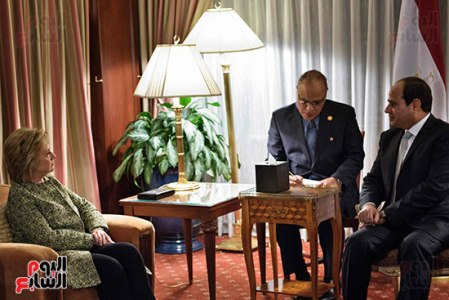
30525Al-Sisi’s meeting with Clinton in New York (image: Al-Yawm Al-Sabi’, Egypt, September 20, 2016)

MB Official, Independent Journalists: Clinton Is Better Than The Racist Trump

Conversely, an MB official, as well as journalists for the independent daily Al-Shurouq, which tends to be critical of the regime, expressed distaste for Trump and support for Clinton.

In response to the claim by Trump’s advisor that, if elected, he would promote legislation in the U.S. to designate the MB a terrorist organization, MB official Gamal Heshmat said that there was a great deal of similarity between Trump and Al-Sisi, because both of them “rely… on spreading fear among their people in order to justify the actions of violence, exclusion and takeover in which they believe and which they employ with [great] confidence under the pretext of fighting terror and promoting stability!”[14]

Dr. Osama Rushdi, an official in the Construction and Development party, the political branch of Al-Gama’a Al-Islamiyya, said that “it will be a great disaster if Trump becomes the U.S. president,” adding that he is “a racist and fascist” and threatens all Muslims, whereas Clinton is more rational. [15]

Al-Shurouq Editor: Trump Is An Enemy Of Mankind; Clinton Is A True Head of State

The independent daily Al-Shurouq published two articles against supporting Trump. The daily’s editor, ‘Imad Al-Din Hussein, wrote in a September 26 article that Trump was an “extremist and racist” and even “an enemy of most of mankind,” and that Clinton was the better candidate due to her experience. He wrote: “Which of the two would be better for Egypt as U.S. president, Hillary Clinton or Donald Trump?… Among many in Egypt, there is a widespread belief that a Trump victory would be better for us, since he promised to include the Muslim Brotherhood on the list of designated terrorist [organizations], while the Democratic Clinton opposes the June 30 revolution [i.e., Mursi’s ouster]. This impression might be partially true, but people forget that Trump is also an enemy of most of mankind, as he is an extremist and a racist, and repeatedly says that if elected, he would expel the Arabs and Muslims from the U.S. [These] extremist statements have not stopped since the beginning of his election campaign. Likewise, his victory would be the greatest of gifts for ISIS and for all the extremists in the region and in the world, because it would give them the best excuse of all for their extremism.

“It is true that Clinton was not enthusiastic about the June 30 revolution, but she is a true head of state. She is not a demagogue or a racist, and carefully weighs every word she says, as she spent eight years in the White House alongside her husband, president Bill Clinton, and for years was secretary of state during Obama’s first term. Conversely, Trump is rash, a radical extremist, and lacks any political experience.

“So which of the two is better for Egypt, Trump or Clinton? If Trump wins, we will temporarily gain a few nice slogans, but in the long run we will lose much, as Arabs and Muslims, if he implements his slogans. If Clinton wins, she may be somewhat reserved towards us, but not as much as Obama, and our relationship might stabilize in the long term…

“Therefore, those who think a Trump victory means a total reversal [of the U.S. position on Egypt] are deluding themselves. We must remember, for example, that every presidential candidate courts the Jewish lobby and promises to transfer their country’s embassy to Jerusalem, but that [when the time comes] they don’t, because of their interests vis-à-vis the Arab world.”[16]

Former Egyptian MP: Trump “Will Contribute To The World Becoming A Hell”; Hillary Is The Lesser Evil

The second Al-Shurouq article, also published on September 29, was by former Egyptian MP Mustafa Al-Naggar. He contended that Trump was no less dangerous for the world than Nazism and fascism, and condemned those who express support for him in Egypt, calling them extremist right-wing elements that pose a danger to Egypt itself. He wrote: “Under the influence of Ikhwanophobia [fear of the Muslim Brotherhood], the U.S. elections have become a new arena of schism in Egypt, for accusations of treason, and for classification by position on the candidates.

“It is no exaggeration to say that in recent days, and especially after the first televised debate, there is a sense [among Egyptians] that this election is not about the U.S., but about Egypt. There has been a resurgence of the tumultuous debate that is characterized by illogic, to the point where Hillary Clinton is described as a member and supporter of the Muslim Brotherhood. One of the lies [going around] is that Clinton is grooming an American woman who is of Pakistani descent and a Pakistani Muslim Brotherhood member [referring to Huma Abedin] to become secretary of state!…

“In general, it is odd that some in Egypt support Trump, the man who undoubtedly represents the worst of modern American extremism. He repeatedly spews racism in its ugliest form, and most of his positions clash with humanism and the values of tolerance and coexistence with which the world has come very far and from which there is no retreat…

“It is therefore foolish to argue that this despicable racist will combat extremism and terrorism. On the contrary, he will greatly contribute to the world becoming a hell. Therefore, his existence will justify the rise of terrorism, deepen the concept of the clash of civilizations, and inflame religious animosity among the peoples…

“Trump threatens not only the U.S., but the entire world. The rise of Trumpism on the global level effectively recreates messages of hate and the rise of the extreme right, evoking the era of Nazism and Fascism in Germany and Italy that led the world to bloody wars that claimed millions of lives. Who wants that again?

“In effect, the U.S. is not run by a single person, but by enormous institutions of decision-makers. However, the election of an extremist and racist president, who will appoint an administration that shares his mentality, will cause many problems for America and for the world.

“This does not mean that Hillary Clinton is an angel who will do good for the world and Arab countries. But a choice between two bad things does not mean choosing the better one, but choosing the lesser evil. We have no voice in the U.S. presidential race. But we hope that the Americans will throw out the preachers of hatred and the racists, and send a message to the world that they oppose the insane campaign on which Trump and his ilk are leading them…

“[In order to cure] the delusions of the Trump supporters in Egypt, there is first a need for psychological treatment, and [only] then rational and ideological refutation. This group of extremists in Egypt that reflects the rise of a secular right wing is no less dangerous than the religious right. We must deal with it by disproving and dismantling the terminology of this message, and by making the public aware of its risks and consequences for Egypt…”[17]

Other Articles: Trump And Clinton Are Equally Bad

Also published in the Egyptian press were some articles claiming that Trump and Clinton would be equally bad for Egypt. Tarek Fahmy, a professor of political science at the American University in Cairo, told the Al-Yawm Al-Sabi’ daily that America is choosing between bad and worse and that there was essentially no difference between the two candidates in terms of foreign policy.[18]

Mursi ‘Atallah, the former board chairman of the Al-Ahram Foundation, wrote on September 21 that the debate about which is better, Clinton or Trump, was boring since both of them hate Arabs more or less to the same degree. He wrote: “As happens every four years, the Arab analysts and intellectuals are preoccupied with finding an answer to the traditional question: Which is better, an American president from the Democratic party or from the Republican party? The public has wearied of the recurring scenes of this boring play that repeats every four years. Even if the protagonists of this play are different, nothing in the discourse is, not even one single line.

“There is no difference between Reagan and Carter or Hillary Clinton and Donald Trump. The Republicans and the Democrats are two sides of the same coin.

“If the Republican candidate Donald Trump presents himself as an openly hostile enemy of the Arabs and Muslims, there are those who forget that Hillary Clinton harbors no less hostility and hatred [towards them] than Trump, but only softens it outwardly…”[19]


* Y. Graff is a research fellow at MEMRI; H. Varulkar is Director of Research at MEMRI.


[1] Al-Masri Al-Yawm (Egypt), September 22, 2016.

[2] Cnn.com, washingtonpost.com, Al-Ahram (Egypt), September 21, 2016.

[3] Al-Masri Al-Yawm (Egypt), September 20, 2016.

[4] Al-Watan (Egypt), September 20, 2016.

[5] Cnn.com, September 22, 2016.

[6] Al-Ahram (Egypt), April 2, 2015, October 1, 2015, October 29, 2015.

[7] Al-Masri Al-Yawm (Egypt), September 26, 2016.

[8] Masralarabia.com, September 27, 2016.

[9] Al-Ahram (Egypt), September 23, 2016.

[10] Al-Yawm Al-Sabi’ (Egypt), September 21, 2016.

[11] Al-Ahram (Egypt), September 25, 2016.

[12] Al-Ahram (Egypt), October 7, 2016.

[13] Al-Watan (Egypt), September 28, 2016.

[14] Rassd.com, September 20, 2016.

[15] Rassd.com, September 20, 2016.

[16] Al-Shurouq (Egypt), September 26, 2016.

[17] Al-Shurouq (Egypt), September 29, 2016.

[18] Al-Yawm Al-Sabi’ (Egypt), September 28, 2016.

[19] Al-Ahram (Egypt), September 21, 2016.
America’s “Arab Spring”

November 3, 2016

America’s “Arab Spring”, Gatestone InstituteNonie Darwish, November 3, 2016

Americans have a choice: they can either keep on empowering Islam, and helping extremist Muslims infiltrate into the American system — even as there is a resolution in the House of Representatives to shut down all criticism of Islam — or they can end the gamble of the current administration, which seems bent on changing America forever by allowing the worldwide empowerment of Islam. They can continue the Islamist “Arab Spring” revolution to change “America as we know it” or preserve the freedoms of the American republic.

********************************

President Obama appears to have been told that if all these secular dictators could be brought down, a magnificent Arab Spring would blossom. This was, it seems, precisely the goal of the Muslim Brotherhood: to get America’s help to topple the dictatorships — then mostly military and secular — but then to replace them with themselves, Islamists.

After Egypt took down the Muslim Brotherhood, the goal of establishing the Islamic Caliphate in Egypt simply moved to Syria, the only Arab nation where a secular Muslim leader had survived the Arab Spring.

Promoting Islam also seems to have been a major factor in Obama’s equation for America. Secretary of State Hillary Clinton followed suit, hosting several closed-door conferences on “Defamation of Religion,” to suppress free speech and internationally criminalize any criticism of Islam with fines and prison. She would rather blame terrorism on free speech than on the violent tenets of Islam.

This escalating subversion should be reason enough for all Western democratic countries permanently to part company with the United Nations. Its history of corruption is neither new nor surprising, or that it is run anti-democratic “club of dictators” whose interests are opposite to ours.


The goals of U.S. President Barack Obama in the Middle East ended the rule of most of the “secular” Arab leaders in the area. His views may have come, partly at least, from propaganda on why Muslim people supposedly lacked freedom there. Obama appears to have been told that if all these secular dictators could be brought down, a magnificent Arab Spring would blossom.

This was, it seems, precisely the goal of the Muslim Brotherhood: to get America’s help to topple the dictatorships — then mostly military and secular — but then to replace them with themselves, Islamists.

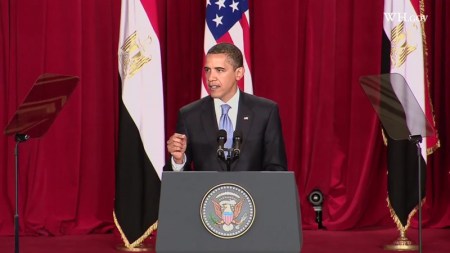
The goals of the Muslim Brotherhood happened to be in tune with Obama’s goals in the Middle East. Obama’s first major presidential speech took place in Cairo before a large number of Islamic sheikhs and members of the Muslim Brotherhood. They were empowered and given legitimacy by Obama. A scorned Egyptian President Hosni Mubarak did not attend; thus, with the blessing of the United States, the Muslim Brotherhood’s rise to power in Egypt was begun.

2017Obama’s first major presidential speech, on June 4, 2009, took place in Cairo before a large number of Islamic sheikhs and members of the Muslim Brotherhood. They were empowered and given legitimacy by Obama. A scorned Egyptian President Hosni Mubarak did not attend; thus, with the blessing of the United States, the Muslim Brotherhood’s rise to power in Egypt was begun. (Image source: White House)

Today, ordinary Egyptians link the ascendancy of the Muslim Brotherhood directly to the Obama administration. Cairo was about to become the capital of the new Islamic Caliphate if Egyptians had not, after a year, come out in the millions to stop it.

The Obama administration did not appear happy with the counter-revolution, and the rise to power of Egypt’s current president, General Abdel Fattah al-Sisi, and began doing everything it could to thwart it.

Egypt was back to square one: a military dictatorship that it had once convinced the West was the cause of its oppression.

America’s “Arab Spring” adventure — to topple secular dictators to bring about democracies — did not exactly work as planned. Bringing freedom and democracy to the Middle East failed miserably, but the tyranny of the Caliphate, which had been the goal of the Muslim Brotherhood in the first place, was building. After Egypt took down the Muslim Brotherhood, the goal of establishing the Islamic Caliphate in Egypt simply moved to Syria, the only Arab nation where a secular Muslim leader had survived the Arab Spring.

Promoting Islam also seems to have been a major factor in Obama’s equation for America. Before Obama started to implement his promise to “change America as we know it,” he first had to change the Middle East as they knew it. Many of the changes over which he presided were in harmony with the goals of the Muslim Brotherhood. Its motto is: “Allah is our objective; the Prophet is our leader; the Quran is our law; Jihad is our way; dying in the way of Allah is our highest hope.”

But while the Muslim brotherhood has been made illegal in Egypt, the Obama administration still refuses to label the Muslim Brotherhood a terrorist organization. Under Obama, Islam became untouchable, not open to any kind of criticism. He even claimed that “Islam has been woven into the fabric of our country since its founding.”

Secretary of State Hillary Clinton followed suit, and hosted several closed-door conferences in Washington and London on “Defamation of Religion,” to suppress free speech and internationally criminalize any criticism of Islam with fines and prison.

Even in a recent debate, Clinton stated, “Islam was always part of American history — even since the Revolutionary War.”

She would rather blame terrorism on free speech than on the violent tenets of Islam.

Only a person from the Middle East could understand the immense value of such a gift to the goals of Islamic jihadists in America.

It is unfortunate that many Americans apparently still do not know that Islamists rewrite history in order to claim that any land they wish to conquer was originally Islamic or founded by Muslims — even though historically Islam did not exist until seventh century, hundreds of years after Judaism and Christianity.

Today, Muslims have re-written their history books to claim that Muslims originally built the ancient Jewish Biblical sites, and the United Nations Educational, Scientific and Cultural Organization (UNESCO) has bowed to the wishes of Qatar and the Organization of Islamic Cooperation (OIC) — a bloc of 56 Islamic nations plus “Palestine” — to back up this fiction. UNESCO recently passed resolutions obscenely declaring ancient Jewish Biblical monuments — such as Hebron’s Cave of the Patriarchs, Rachel’s Tomb in Bethlehem and Jerusalem’s Temple Mount, home of the great ancient Jewish Temples — Islamic sites.

Which country will be next? This escalating subversion should be reason enough for all Western democratic countries permanently to part company with the United Nations. Its history of corruption is neither new nor surprising, or that it is run anti-democratic “club of dictators” whose interests are opposite to ours.

Jihadists today are stating that they also have a claim over Italy, Greece, and Spain — and now America. Obama and Hillary Clinton actually just solidified such claims for future Muslim history books about who actually built America.

Americans have a choice: they can either keep on empowering Islam, and helping extremist Muslims infiltrate into the American system — even as there is a resolution in the House of Representatives to shut down all criticism of Islam — or they can end the gamble of the current administration, which seems bent on changing America forever by allowing the worldwide empowerment of Islam. They can continue the Islamist “Arab Spring” revolution to change “America as we know it” or preserve the freedoms of the American republic.

It has recently become clear through WikiLeaks that the American system is indeed rigged and that Washington DC has turned into a swamp; or more accurately an “Arab Spring” swamp.

Egypt, on a much smaller scale, had to face such a choice in 2012-13, between life under the values of the Muslim Brotherhood or a life under a sliver of hope for a democracy, which Islam, under its laws, can never allow.

Both Egyptians and the West sorely need to understand that Islamic law, sharia, does not permit anything other than an Islamic government under the rule of Islamic law. Consequently, only military force can stand against sharia tyranny. The Muslim Brotherhood had proven once again that the only way out of Islamic theocracies is through military dictatorships.

A head-on collision over the future of America is underway. Many Americans still do not understand the magnitude of what is at stake, but many Islamists do: they are lying in wait, hoping to return to their budding Caliphate.

El-Sissi against the Arab world

October 31, 2016

El-Sissi against the Arab world, Israel Hayom, Dr. Reuven Berko, October 31, 2016

(How different would the situation be now if Obama, Clinton et al had supported Sisi’s “coup” rather than Morsi and the Muslim Brotherhood? — DM)

The attitude of the Arab Gulf states toward Egypt under President Abdel-Fattah el-Sissi is a good example of the insanity of considerable parts of the Arab world, whose twisted suicidal reasoning is unclear to many people outside it.

Given the American wipeout in the Middle East, leaders of the Persian Gulf states are very well aware that the only support they can expect against the expected Iranian aggression on the Arabian Peninsula comes from Egyptian military might. Nevertheless, megalomania, hypocrisy, double talk, and in particular a divisive and violent radical Islamist agenda are leading the Arab leaders to saw off the very branch they sit on.

The competition for hegemony, a tangle of conflicting economic and political interests and defensive manipulations, along with drives for expansion and survival, are leading the Gulf states to arm and fund the radical Sunni terrorist movements in Syria and Iraq to check the growth and terrorism of Shiite Iran, whose military provocations and threat to the Sunni Arab Gulf states is increasing.

But in effect they are encouraging Islamic terrorism in Egypt.

Turkey and Qatar have not accepted the loss of former President Mohammed Morsi and the Muslim Brotherhood, and have not relinquished their dream of an Islamic empire. The Saudis, because of their money, reject Egypt as the “Arab mother state.” Mistaken U.S. policy confers transient status on el-Sissi’s regime. All of Egypt’s attempts to ingratiate itself with Saudi Arabia — the military guarantees, the delegations, and the gifts of the Tiran and Sanafir islands — failed to do the trick.

There is an Arab proverb that says, “Starve your dog so he will obey you.” While battling Iran, the Gulf states are inciting for el-Sissi to be ousted while supplying stingy amounts of money and fuel just to humiliate him and keep him “alive,” beaten, and needy — a thug who can attack Tehran for them. While the Al Jazeera network presents the Egyptian president as a sex criminal, an agent of Iran, Israel, and America, a corrupt official who sells weapons to the Houthi rebels in Yemen, the Egyptian government is vulnerable to incitement and terrorism from the Muslim Brotherhood and their protectors in the Gulf (Al Jazeera), flooding, monstrous demographics (thanks to the Islamic ban on birth control), inflation, shortages of fuel, sugar, rice and raw materials, as well as the threat of the water level in the Nile River dropping and a hit to its $55 billion tourism industry.

To encourage his suffering, restive, exposed-to-incitement people, el-Sissi told them that he lived for a decade with nothing in the refrigerator other than a bottle of water. In response, the Saudi king mocked him, delayed shipments of fuel and visas to Saudi Arabia for Egyptians and made threats that el-Sissi would fall, like then-President Hosni Mubarak. In response to the intra-Arab scheming, el-Sissi invited the Russians to conduct a joint military exercise and recently voted against the Arabs — and with Iran, Russia and Syria — in the U.N. Security Council on a solution to the Syrian crisis, knowing that the fall of Syrian President Bashar Assad and the success of the Islamists would make him the next target. If the Gulf states don’t change their policy soon, they’ll wind up getting a refrigerator full of explosives from him.

Egyptian general who oversaw destruction of Gaza tunnels assassinated

October 23, 2016

Egyptian general who oversaw destruction of Gaza tunnels assassinated, Jerusalem Post, Jacob Wirtschafter, October 23, 2016

(The Obama administration again complains that “good” counterterrorism – the type that CAIR and other Islamist groups like – “requires political reform that gives all legitimate stakeholders in the Middle East a voice in their governance, including peaceful Islamist parties.” Three cheers for CAIR, the Muslim Brotherhood and their friends. — DM)

siani-tunnel

A top Egyptian officer was gunned down in front of his home north of Cairo just after dawn Saturday in another sign of the increasing conflict between the government and its opponents – both armed and unarmed.

The Lewaa Al-Thawra (Revolution Brigade) claimed responsibility for the assassination of Major Adel Ragaai, head of the Egyptian Ninth Amour Division – the unit charged with destroying the tunnels running between Egypt and the Gaza Strip.

“Major Adel Ragaai was killed in front of his house in Obour City (25km. northeast of Cairo) as he was leaving for work,” said army spokesman Brigadier General Mohamed Samir. “Two bullets pierced his head.”

The Brigade made its debut in August with an ambush on a police checkpoint in Sadat City – an attack that killed two and injured five others, including two civilians.

Ragaai’s wife, Samia Zein Al-Abdeen, is a defense correspondent for the state-owned daily Al-Gomouria.

The newspaper quotes Al-Abdeen as saying she hurried outside when she heard a burst of gunfire from a private vehicle as it sped down their suburban street.

“From the discourse in their statements and the music in their propaganda videos it’s clear Lewaa Al-Thawra is closer in orientation to the Muslim Brotherhood than Islamic State,” said, Abdullah Kamal, an independent expert on jihadist groups in Egypt.

Ragaai’s death is the first political assassination of a military figure since former President Mohamed Morsi was removed from office by Egypt’s military in 2013.

Since that year, the Egyptian military has destroyed more than one thousand smuggling tunnels, a key lifeline for what remains of the private sector in the Gaza strip.

The tunnels also serve as a conduit for a busy cross-border arms trade that provides revenue and ammunition for the Palestinian Islamist group Hamas.

Ragaai oversaw a massive operation that began last year to dig a canal parallel to the Rafah border, flooding the frontier with sea water which seeps into the tunnels, preventing their use. Hamas officials in the town of Rafah complain that Gaza’s limited fresh water aquifer is being rendered undrinkable as well.

Ragaai ‘s assassination was preceded by an attack on security personnel in nearby Al-Arish Friday.

The Interior Ministry said two police officers were killed as their vehicle ran over an improvised explosive device.

But security officials were eager to point out that they are on the offensive in the pocket of the northern Sinai where most incidents of Islamist violence are concentrated.

“Our forces killed 21 terrorists, destroyed over twenty of their hideouts and were able to locate and disable 16 IEDs before harm came to our men,” said an Interior Ministry spokesman.

The battle against the Muslim Brotherhood has intensified in Egypt’s courts as well.

Cairo’s Court of Cassation rejected an appeal Saturday by the ousted former president Morsi against a 20-year prison sentence for a 2012 incident that the state charges led to the deaths of 10 people in clashes outside the Ittihadiya Presidential Palace.

The Ittihadiya case is one of several indictments still pending against Morsi which include charges of espionage on behalf of Qatar and of organizing a jailbreak in conjunction with Hamas.

Last week, Attorney General Nabil Sadek obtained arrest warrants for an undisclosed number of Muslim Brotherhood members in Nasser City, charging them with “forming cells that planned to collect sugar from the Egyptian market and engaging in economic sabotage.”

Egypt’s Central Agency for Public Mobilization and Statistics reports that annual inflation is the highest it’s been in nine years and foodstuffs ranging from sugar to baby formula to cheese have become scarce on the shelves as suppliers are unable to find foreign currency to pay for the products.

An intensified American critique of the Egyptian security state’s battle against the Brotherhood is adding to the headaches of the top brass in Cairo.

Tom Malinowski, Assistant Secretary of State for Democracy, Human Rights, and Labor, told a forum at the Washington Institute for Near East Policy on Friday that “the worst counter-terrorism strategy ever invented is Egypt’s mass incarceration of thousands of peaceful activists and opposition supporters right alongside the most hardcore terrorists.”

“We need to cooperate with countries in the region, including with Egypt, to share information about terrorist groups and plots so we can stop attacks before they happen,” Malinowski added. “But it is important that we not confuse good counter-terrorism cooperation with good counter-terrorism.”

“The former is necessary, but a finger in the dike. The latter – effective counter-terrorism — is what prevents the flood. It requires political reform that gives all legitimate stakeholders in the Middle East a voice in their governance, including peaceful Islamist parties.”

Clinton Backed Egypt’s Muslim Brotherhood Regime

October 13, 2016

Clinton Backed Egypt’s Muslim Brotherhood Regime, Washington Free Beacon, Bill Gertz October 13, 2016

U.S. Secretary of State Hillary Rodham Clinton before her departure to Egypt's coastal city of Alexandria in Cairo, Egypt, July 15, 2012. Clinton on Sunday urged Egypt to commit to "a strong, durable democracy" that protects all citizens, hoping to appeal both to supporters of the popularly elected Islamist president and minorities fearful of being repressed under their new government. (AP Photo/Brendan Smialowski, Pool)

U.S. Secretary of State Hillary Rodham Clinton before her departure to Egypt’s coastal city of Alexandria in Cairo, Egypt, July 15, 2012. (AP Photo/Brendan Smialowski, Pool)

Secretary of State Hillary Clinton in 2012 called the election of Egypt’s Islamist Muslim Brotherhood leader a “milestone” for Egyptian democracy and offered covert police and security help, according to declassified State Department documents.

A nine-page document, once-labeled “Secret,” listed talking points for Clinton’s meeting with newly-elected Egyptian President Mohamed Morsi on July 14, 2012. The talking points said Morsi’s election was a key step toward popular democracy in the strategic North African state.

“We stand behind Egypt’s transition to democracy,” the heavily-redacted Clinton talking points state, adding that the only way to maintain a strong Egypt is “through a successful transition to democracy.”

The first key objective of the meeting was for Clinton to “offer our congratulations to Morsi and to the Egyptian people for this milestone in Egypt’s transition to democracy.”

Clinton then was meant to offer Morsi American technical expertise and assistance from both the U.S. government and private sector to support his economic and social programs.

Clinton’s talking points also included an offer of secret assistance to help Morsi “upgrade and reorient Egypt’s police force toward serving the needs of a democratic people.” The offer included sending a team of U.S. police and security experts to Egypt as part of a “framework of cooperation” that would be carried out “quite discretely.”

Also, the talking points reveal Clinton was ready to help launch an Egyptian-American Enterprise Fund, a private sector initiative of U.S. and Egyptian investors to help Egyptian businesses. The fund was to be launched with $60 million and would later involve Congress adding $300 million over five years.

The fund was created in September 2012.

Many pro-democracy Egyptians who had taken to the streets as part of the 2011 revolution that ousted long-time U.S. ally Egyptian President Hosni Mubarak viewed U.S. support for Morsi as a betrayal and part of a U.S. strategy of backing the Muslim Brotherhood in the region.

The meeting between Clinton and Morsi took place two months before terrorists in neighboring Libya attacked a U.S. diplomatic compound and CIA facility, killing four Americans, including U.S. Ambassador to Libya Christopher Stephens.

A second State Department document revealed that Deputy Secretary of State Thomas R. Nides wrote to Morsi on Sept. 24, 2012 seeking collaboration with the Egyptian leader on Syria and Iran.

“It was a honor to meet with you in Cairo,” Nides wrote in the letter. “We share the goal of growing our markets and increasing trade, as well as a desire for a stable, secure and peaceful region. As I said when we met, the United States also remains committed to helping Egypt address regional issues, including Syria and Iran.”

Both documents reveal that the State Department under Clinton had little understanding of the Islamist threat posed by the Muslim Brotherhood and its branches.

Andrew C. McCarthy, former assistant U.S. attorney in New York who prosecuted Islamist terrorism cases, said Clinton backed the Muslim Brotherhood over the Egyptian military, stating it was imperative that power be turned over to the winner of the election.

“The defining mission of the Muslim Brotherhood is the implementation of sharia,” McCarthy said. Sharia is Islamic law that critics say is antidemocratic and contrary to fundamental rights and freedoms

The documents were released under a Freedom of Information Act request seeking information on the Obama administration’s secret 2011 Presidential Study Directive-11, or PSD-11.

The directive, according to officials familiar with its contents, outlined how the administration would seek to support the Muslim Brotherhood around the world despite the Islamist supremacist organization providing the ideological underpinning for jihadist terrorism for both al Qaeda and its successor, the Islamic State.

U.S. backing for Morsi’s Muslim Brotherhood regime in Egypt was derailed by the Egyptian military a year after the meeting. Morsi, the first democratically elected head of state in Egyptian history, was ousted in a coup after he had sought to consolidate power by granting himself unlimited authority in what pro-democracy critics called an Islamist coup.

Egyptian military leaders arrested Morsi on July 3, 2013, after protesters took to the streets to oppose his rule. Abdel Fattah al-Sisi headed a military government and was later elected president.

The Muslim Brotherhood is an international organization founded in 1928 that adopted as its motto “Allah is our objective; the Prophet is our Leader; the Quran is our law; Jihad is our way; dying in the path of Allah is our highest hope.”

The leaders of the Brotherhood in September 2010 declared jihad, or holy war against the United States and Israel, six months before the Arab Spring uprisings in North Africa and the Middle East.

Clinton’s backing for Arab Spring states was guided by PSD-11 and produced ongoing disasters in the region, namely in Libya and Syria.

U.S. intervention in Libya ousted dictator Moammar Gadhafi but left the oil-rich state in turmoil. It is now viewed as a failed state and safe haven for several Islamist terror groups.

Syria’s civil war helped spawn the emergence of the Islamic State in 2014.

In a section on Israel, Clinton’s talking points expressed appreciation to Morsi for assertions that Egypt would continue to abide by international treaties and obligations.

“Maintaining peace with Israel is a fundamental shared interest and critical for Egypt’s ability to address its economic challenges and enjoy international support as it consolidates its democracy,” the talking points stated. “We may not have a common view, but we do have a common interest.”

The CIA also covertly backed the Muslim Brotherhood in Egypt, according to Egyptian news outlets. In December 2013, the news website Al Bashayer published audio recordings of a CIA delegation that met with Muslim Brotherhood Deputy Khayrat al Shatir and Brotherhood official Isam al Haddad at the U.S. Embassy in Cairo on Jan. 8, 2013.

The CIA asked the Muslim Brotherhood leaders to open a back channel to al Qaeda “to secure the safe exit of U.S. troops” from Afghanistan.

Additionally, another news outlet, Al-Marshad al Amni, reported that Maj. Gen. Abd-al-Hamid Khayrat, former deputy chief for Egyptian State Security Investigations said the CIA in January 2013 “asked for the help of the MB in Egypt to facilitate… the withdrawal from Afghanistan.” The Muslim Brotherhood agreed to become a “bridge” between the U.S. government and al Qaeda, Khayrat said.

The reports triggered widespread conspiracy theories in post-Morsi Egypt that the CIA was collaborating with Morsi and the Muslim Brotherhood to destabilize Egypt.

The Clinton talking points about the transition to democracy were reflected in a briefing given by a State Department official to reporters the day before the 2012 meeting. The covert police assistance was not mentioned.

A day after the meeting, Clinton stated in remarks at the U.S. Consulate in Alexandria, Egypt, that she told Morsi the success of his presidency and Egypt’s success “depends upon building consensus across the Egyptian political spectrum and speaking to the needs and concerns of all Egyptians—all faiths, all communities, men and women alike.”

Retired Army Lt. Col. Joseph Myers, a former DIA official and specialist on terrorism, said the documents show the endorsement and support of the Muslim Brotherhood government in Egypt was “a fools errand and shows a disastrous strategic naivety.”

“The whole policy initiative to support a Muslim Brotherhood government anywhere is another example of a total policy failure of Secretary Clinton,” Myers said.

“But it also raises deeper questions of who in our government is advising and influencing such reckless and dangerous policies that show no fundamental comprehension of the threat we face from radical Islamic jihad,” he added. “Or worse these advisers precisely understand what they are doing to U.S. policy and Secretary Clinton could not.”

Abbas to Arab Leaders: Go to Hell!

September 27, 2016

Abbas to Arab Leaders: Go to Hell!

by Khaled Abu Toameh

September 26, 2016 at 5:00 am

Source: Abbas to Arab Leaders: Go to Hell!


  • Abbas and Fatah leaders in Ramallah claim that Egypt, Saudi Arabia, Jordan and the United Arab Emirates (the “Arab Quartet”) are using and promoting Abbas’s rival, Mohamed Dahlan, in order to facilitate their mission of rapprochement with Israel.
  • Many Palestinians were surprised to see veteran Palestinian official Ahmed Qurei, a former Palestinian Authority (PA) prime minister and one of the architects of the Oslo Accord, come out in favor of the Arab plan, which basically envisions ousting Abbas from power.
  • This, and not Israeli policy, is Abbas’s true nightmare. After all, he knows that without Israel’s presence in the West Bank, his regime would have long fallen into the hands of Hamas or even his political rivals in Fatah.
  • The “Arab Quartet” plan shows that some Arab countries are indeed fed up with Abbas’s failure to lead his people towards a better life. These states, which have long been politically and financially supportive of the Palestinians, have had enough of Abbas’s efforts to secure unending power — at the direct cost of the well-being of his people.

In his speech last week before the United Nations General Assembly in New York, Palestinian Authority (PA) President Mahmoud Abbas trotted out his usual charges against Israel, citing “collective punishment,” “house demolitions,” “extrajudicial executions” and “ethnic cleansing.” However, Abbas’s thoughts seem to be elsewhere these days. He is facing a new challenge from unexpected parties, namely several Arab countries that have come together to demand that he reform his ruling Fatah faction and pave the way for the emergence of a new Palestinian leadership.

Yet this was not included in the UN speech. Indeed, why would Abbas share with world leaders that his Arab brothers are pressuring him to introduce major reforms in Fatah and end a decade-long power struggle with Hamas that has resulted in the creation of two separate Palestinian entities in the West Bank and Gaza Strip.

Abbas, his aides admit, is today more worried about the “Arab meddling” in the internal affairs of the Palestinians than he is about “collective punishment” or “settlement activities.” In fact, he is so worried that he recently lashed out at those Arab countries that have launched an initiative to “re-arrange the Palestinian home from within” and bring about changes in the Palestinian political scene.

The Arab countries behind the initiative — Egypt, Saudi Arabia, Jordan and the United Arab Emirates — are being referred to by many Palestinians as the “Arab Quartet.”

In an unprecedented critique of these countries, Abbas recently declared:

“The decision is ours and we are the only ones who make decisions. No one has authority over us. No one can dictate to us what to do. I don’t care about the discomfort of Washington or Moscow or other capitals. I don’t want to hear about these capitals. I don’t want the money of these capitals. Let’s free ourselves from the ‘influence’ of these capitals.”

Although he did not mention the four Arab countries by name, it was clear that Abbas was referring to the “Arab Quartet” when he was talking about “capitals” and their influence and money. Abbas’s message: “How dare any Arab country tell me what to do, no matter how wealthy and influential it may be.” Abbas sees the demand by these Arab countries for new Palestinian leadership, unity and reforms in Fatah as “unacceptable meddling in the internal affairs of the Palestinians.”

So what exactly is it in the new Arab initiative that has so enraged Abbas, to the point that he is prepared to place at risk his relations with four of the Arab world’s preeminent states?

According to reports in Arab media outlets, the “Arab Quartet” has drafted a plan to “activate the Palestinian portfolio” by ending the dispute between Abbas’s Fatah and Hamas. The plan also calls for ending the schism within Fatah by allowing some of its expelled leaders, including Mohamed Dahlan, to return to the faction. The overall aim of the plan is to unite the West Bank and Gaza Strip under one authority and end the state of political anarchy in the territories controlled by the Palestinian Authority and Hamas. The “Arab Quartet” has even formed a committee to oversee the implementation of any “reconciliation” agreements reached between Fatah and Hamas and Abbas and his adversaries in Fatah. According to the plan, if such an agreement is not reached, the Arab League will intervene to “enforce reconciliation” between the rival Palestinian parties.

When Palestinian Authority President Mahmoud Abbas addressed the UN General Assembly on Sept. 22, 2016, he did not share with world leaders that his Arab brothers are pressuring him to introduce major reforms in his Fatah faction, and allow some of its expelled leaders, including Abbas’s rival Mohamed Dahlan (inset), to return.

Abbas’s main concern is not a “reconciliation” with Hamas. In fact, he has repeatedly expressed his readiness to form a unity government with Hamas and end the dispute with the Islamist movement. In recent weeks, there has even been renewed talk of Fatah-Hamas talks in Qatar to achieve “unity” and “reconciliation” between the two rival parties. Rather, it is the attempt to coerce Abbas into reconciling with Dahlan that is really getting to the PA president. In the view of a source close to Abbas, he (Abbas) would rather make peace with Hamas than “swallow the cup of poison” of patching things up with Dahlan.

Abbas harbors a very particular dislike for Dahlan. Until five years ago, Dahlan was a senior Fatah official who had long been closely associated with Abbas. Once, Abbas and Dahlan, a former security commander in the Gaza Strip, formed an alliance against Yasser Arafat, the former president of the PA. But the honeymoon between Abbas and Dahlan came to an end a few tears ago after the Abbas and his lieutenants in Ramallah began suspecting that Dahlan has ambitions to replace or succeed Abbas. At the request of Abbas, Dahlan was expelled from Fatah and accused of murder, financial corruption and conspiring to overthrow Abbas’s regime. From his exile in the United Arab Emirates, Dahlan has since been waging a campaign against the 81-year-old Abbas, accusing him and his two wealthy sons of running the PA as if it were their private fiefdom.

Such is Abbas’s contempt for Dahlan that last week he reportedly instructed the PA authorities to ban Dahlan’s wife, Jalilah, from entering the Gaza Strip. Jalilah runs and funds a number of charities in the Hamas-controlled Gaza Strip. Her activities are seen by Abbas as an attempt to build power bases for her husband and pave the way for his return to the political scene. Abbas’s decision to ban her from entering the Gaza Strip came following reports that she and her husband were planning to organize and fund a collective wedding for dozens of impoverished Palestinian couples. The funding, of course, comes from the United Arab Emirates, whose rulers have been providing the Dahlan couple with shelter and money for several years.

When Abbas says that he “does not want the money” of certain Arab capitals, then, he is referring to the United Arab Emirates and Saudi Arabia. He strongly suspects that these two wealthy countries are investing funds in Dahlan as part of a scheme to replace him and pave the way for the emergence of a new Palestinian leadership. For Abbas, who has refused to name a deputy or promote a potential successor, this is a very serious threat to his autocratic rule and a “conspiracy” by outside parties against him and his Palestinian Authority leadership.

Abbas and Fatah leaders in Ramallah are convinced that the “Arab Quartet” members are actually planning to pave the way for promoting “normalization” between the Arab world and Israel — all at the expense of the Palestinians. They claim that the four Arab countries are using and promoting Dahlan in order to facilitate their mission of rapprochement with Israel. These countries have reached the conclusion that as long as Abbas and the current PA leadership are around, it would be very difficult to initiate any form of “normalization” or peace treaties between Arab countries and Israel. The PA leadership’s position has always been that peace between the Arab countries and Israel should come only after, and not before, the Israeli-Palestinian conflict is resolved.

According to Palestinian political analyst Mustafa Ibrahim:

“The plan of the Arab Quartet prepares for the transitional post-Abbas era and negotiations for peace between Arab countries and Israel. The plan is designed to serve the interests of Arab regimes more than ending divisions among the Palestinians. The goal is to eliminate the Palestinian cause and find an alternative to President Abbas.”

This analysis reflects the views of Abbas and his veteran Palestinian Authority leaders in Ramallah, who continue to be extremely wary of any talk about succession in the PA leadership.

Interestingly, the “Arab Quartet” initiative for now seems to have divided Palestinian officials, with some welcoming it, and others rejecting it.

Criticizing Abbas and the Fatah leadership for coming out against the plan, Hassan Asfour, a senior Fatah official and former PA minister of state, urged Abbas to reconsider his “impractical, irrational and hasty” decision to dismiss the initiative of the four Arab countries. Asfour pointed out that Abbas’s recent criticism of these countries was “harmful” and “unjustified.” Abbas’s close aides have retorted by claiming that Asfour was a political ally of Dahlan and therefore has a clear agenda.

Many Palestinians were surprised to see veteran Palestinian official Ahmed Qurei, a former PA prime minister and one of the architects of the Oslo Accord, come out in favor of the “Arab Quartet” plan, which basically envisions ousting Abbas from power. Abbas’s close advisors claim that Qurei has joined Dahlan in his effort to bring about regime change in Ramallah.

Dahlan, for his part, has launched his own initiative by calling for an “expanded” gathering of Palestinian factions in Cairo, to discuss ways of bringing about real change in the Palestinian political arena. Thus, Dahlan has moved from behind-the-scenes activities to topple Abbas to public moves. And in this he enjoys the political and financial backing of at least four important Arab countries that would also like to see an end to the Abbas era. This is the first time that a senior Palestinian official has openly challenged the PA leadership with the support of Arab countries. It is predicted that at least 600 people will attend the Dahlan-sponsored conference in the Egyptian capital. The PA leadership is now threatening to retaliate against anyone who attends the conference by cutting off their salaries. This will only deepen the crisis in Abbas’s Fatah and yield yet more infighting.

Abbas undoubtedly had these thoughts in mind when he addressed the UN General Assembly — the new Arab “conspiracy” to replace him with Dahlan, or someone else. This, and not Israeli policy, is Abbas’s true nightmare. After all, he knows that without Israel’s presence in the West Bank, his regime would have long fallen into the hands of Hamas or even his political rivals in Fatah.

The “Arab Quartet” plan shows that some Arab countries are indeed fed up with Abbas’s failure to lead his people towards a better life. These states, which have long been politically and financially supportive of the Palestinians, have had enough of Abbas’s efforts to secure unending power — at the direct cost of the well-being of his people. It will not take long before we see whether these Arab countries, now mocked by Abbas, will succeed in ridding the Palestinians of leaders who lead them toward nothing but ruin.

Egyptians meet with US officials to try to mend relations after Obama’s support for Muslim Brotherhood

September 24, 2016

Egyptians meet with US officials to try to mend relations after Obama’s support for Muslim Brotherhood, Jihad Watch,

The Obama administration has been reluctant to accept the legitimacy of President Abdel Fattah al-Sisi after he assumed power following the removal of his Muslim Brotherhood predecessor, Mohamed Morsi.

The Washington Times has exposed Obama’s backing of the Muslim Brotherhood (MB), which Obama attempts to justify as “a moderate alternative to more violent Islamist groups like al Qaeda and the Islamic State.” Hillary Clinton also paid “an official visit” to Egypt’s Muslim Brotherhood President Mohamed Morsi when he first took power, and offered him the “strong support” of Washington.

The motto of the Muslim Brotherhood states:

“Allah is our objective. The Prophet is our leader. The Qur’an is our law. Jihad is our way. Dying in the way of Allah is our highest aspiration.”

In 2015, al-Sisi visited a Coptic Cathedral and later called for a religious revolution toward a modern reformation of Islam and stated “it’s inconceivable that the thinking that we hold most sacred should cause the entire Islamic world to be a source of anxiety, danger, killing and destruction for the rest of the world.”

Sisi has rightly declared about Obama:

You left the Egyptians. You turned your back on the Egyptians, and they won’t forget that.

In addition to Obama’s failing Egypt, he is also failing Americans. Obama’s own administration has ties to the Muslim Brotherhood, illustrating the harmful direction in which the American president has led the country into, particularly considering the MB’s stated plan and strategy to turn North America into an Islamic caliphate:

“The process of settlement is a ‘Civilization-Jihadist Process’ with all the word means. The Ikhwan [Muslim Brotherhood] must understand that their work in America is a kind of grand jihad in eliminating and destroying the Western civilization from within and ‘sabotaging’ its miserable house by their hands and the hands of the believers…”

sisi-obama

“Egyptian Dignitaries and American Foreign Policy Experts Meet to Restore Strained Diplomatic Ties After Obama”, by Dustin Stockton, Breitbart, September 21, 2016:

NEW YORK – Egyptian media leaders and distinguished members of the Egyptian parliament met with members of the American media and foreign policy community Tuesday to discuss how to mend the relationship between the United States and Egypt.

The Obama administration has been reluctant to accept the legitimacy of President Abdel Fattah al-Sisi after he assumed power following the removal of his Muslim Brotherhood predecessor, Mohamed Morsi.

Popular Egyptian media personality and host of American Pulse, Dr. Michael Morgan, organized the event, featuring several American foreign policy experts, including representatives from the London Center for Policy Research. The event gave these foreign policy experts a chance to meet with over one hundred prominent Egyptians, including members of parliament, leading media figures, government officials, and businessmen.

“The dinner was in honor of Egypt the country, and to try to strengthen the relationship between the Egyptians and Americans,” Dr. Morgan said. “After the downfall that has happened over the last eight years between the United States and Egypt [during] Barack Obama’s presidency, we hope that America will turn it’s face back to Egypt.”

Event organizers provided Breitbart News with unrestricted, on-the-record access to participate in the dialogue on a wide range of issues, including the ramifications of the United States presidential election on America’s relationship with Egypt, challenges in the Middle East, and the Egyptian government’s efforts to maintain peace and stability after more than five years of turmoil.

Members of the Egyptian delegation lambasted Hillary Clinton, a major figure in the demise of U.S.-Egyptian relations, after Egyptian President El-Sisi met with both Clinton and Republican presidential nominee Donald Trump on Monday.

London Center for Policy Research Vice President of Strategic Initiatives and Operations Tony Shaffer argued that Egypt is critical to any solution addressing current conflicts in the Middle East. Shaffer and the London Center for Policy Research have proposed the formation of an “Arab NATO,” led by Egypt and Egyptian President El-Sisi. The concept would use Egyptian credibility and respect from both Western and Muslim countries to bring together a coalition of Arab nations to enforce borders and settle disputes in the Middle East.

For the past five years, Egypt’s diplomatic relationship with the U.S. has been significantly strained.

In 2011, Egyptian protesters successfully deposed President Hosni Mubarak following three decades of rule. After Mubarak’s removal, the Muslim Brotherhood’s Mohamed Morsi became president and began to implement hardline Islamist policies. Under Morsi and the Brotherhood, Egypt’s government began to increasingly behave like an oppressive Islamist theocracy. Then-Secretary of State Hillary Clinton paid Morsi an official visit, lending legitimacy to the Muslim Brotherhood regime.

In 2013, millions of Egyptians again took to the streets to protest the tyranny of the Muslim Brotherhood and President Morsi. The Egyptian military, led by General Abdel Fattah El-Sisi, stepped in to remove Morsi and the Muslim Brotherhood…..

Obama was quoted as saying, “while we want to sustain our relationship with Egypt, our traditional cooperation cannot continue as usual…”

General El-Sisi blasted the actions of the Obama administration in an interview with theWashington Post saying, “You left the Egyptians. You turned your back on the Egyptians, and they won’t forget that.”…

In 2015, President El-Sisi called for a “religious revolution” from inside Islam to destroy “extremism.”

Members of the Egyptian delegation were hopeful that President Obama’s replacement could open the door to closer collaboration between the two natural allies.

Sinai attacks decline as Egypt’s fight against IS yields results

August 29, 2016

Sinai attacks decline as Egypt’s fight against IS yields results Through targeted bombings on Islamic State’s Jabal Hilal stronghold, Egyptian military deals strong blow to terror group’s capabilities

By Avi Issacharoff

August 29, 2016, 2:51 pm

Source: Sinai attacks decline as Egypt’s fight against IS yields results | The Times of Israel

Smoke rises after a house was blown up in a military operation in Egypt’s Sinai peninsula on November 20, 2014. (Abed Rahim Khatib/Flash90)

There has been a steady and significant decline in terror attacks carried out by the Islamic State in the Sinai Peninsula in recent months, according to both Egyptian and Israeli sources.

Get The Times of Israel’s Daily Edition by email
and never miss our top stories
  Free Sign up!

Though the Islamic State’s armed activities continue apace in the northeast triangle framed by the Israel, Gaza and Egypt borders, there have been fewer terror attacks on the Egyptian army, with a smaller number of casualties than last year, and the attacks have been less ambitious than those IS carried out in 2014 and 2015, as a result of the group’s weakened force and diminished weapons supply.

The Egyptian military’s operations in the central Sinai Peninsula and a series of airstrikes in the Jabal Hilal region — a terrorist-controlled area — have dealt a powerful blow to IS’s military capabilities, the sources said.

For the past few years, Jabal Hilal has been the stronghold of the extremist group in the peninsula, mostly due to its topography.

The region’s extensive cave system — it is considered the “Tora Bora of the Sinai,” an allusion to the rugged region of Afghanistan that Taliban and al-Qaeda fighters made into a bastion against the United States — has made it the preferred destination for IS, the current iteration of the Ansar Bayt al-Maqdis group.

Three months ago, toward the end of May, the Egyptian military spokesperson, Col. Muhammad Samir announced the killings of “88 armed members of the jihadist group in central and northern Sinai.”

May’s large-scale aerial campaign not only took out nearly 100 IS operatives, it also injured hundreds more, dozens of them seriously. In addition to the human casualties, the bombings destroyed the group’s weapons storage facilities and ammunition caches, which had been kept hidden for years.

Essentially, the “logistic front” of the Islamic State in Sinai was destroyed, the sources said.

Around the same time, Egyptian President Abdel-Fattah el-Sissi also discussed the actions against IS, which focused on Jabal Hilal, an area that is seen as particularly problematic. According to Sissi, there had been a significant victory in the fight against terror. However, he clarified, the state of emergency for Egypt would continue.

An image taken from a video clip released by the Sinai affiliate of the Islamic State group on August 1, 2016. (MEMRI)

An image taken from a video clip released by the Sinai affiliate of the Islamic State group on August 1, 2016. (MEMRI)

Earlier this month, the Egyptian military announced another achievement, the execution of Abu Duaa al-Ansari, the presumed commander of the Islamic State in Sinai, formerly known as Ansar Bayt al-Maqdis.

According to the military’s statement, the series of bombings south of el-Arish — the provincial capital of the Sinai — in which al-Ansari was killed came as the result of precise intelligence. During the bombings, a number of weapons storehouses were destroyed and some 45 operatives were killed.

Illustrative: Egyptian security forces in the Sinai, in July 2013. (Mohamed El-Sherbeny/AFP)

Illustrative: Egyptian security forces in the Sinai, in July 2013. (Mohamed El-Sherbeny/AFP)

Throughout 2015, dozens of Egyptian soldiers were killed by IS, with the worst attack taking place during the month of Ramadan in simultaneous assaults on a number of Egyptian military outposts near the town of Sheikh Zuweid that left over 50 dead.

Since the July 1, 2015 attack, however, the Egyptian military’s intelligence has improved. In addition, security collaboration and cooperation with Israel has continued.

Recently, Egypt has made a number of significant gestures in the diplomatic realm, including a rare meet-up between its foreign minister and Prime Minister Benjamin Netanyahu, that testify to the closeness of the two sides.

‘Al-Ahram’ Columnist: Despite Al-Sisi’s Call For Revolution In Religious Discourse, Al-Azhar Scholars Continue On Their Extremist Path

August 24, 2016

‘Al-Ahram’ Columnist: Despite Al-Sisi’s Call For Revolution In Religious Discourse, Al-Azhar Scholars Continue On Their Extremist Path, Memri, August 24, 2016

(Please see also, Dr. Ahmed al-Tayeb: Meet the World’s ‘Most Influential Muslim’ — DM)

Recently, articles have been published in the Egyptian press attacking Al-Azhar, Egypt’s supreme religious authority, on the grounds that its scholars are not doing enough to implement the call of Egyptian President ‘Abd Al-Fattah Al-Sisi to “revolutionize” religious discourse, but instead continue to cultivate extremism. Two particularly harsh articles were penned by Ahmad ‘Abd Al-Tawab, a columnist for the official daily Al-Ahram. He wrote that one reason for the recent spate of attacks on Copts[1] is Al-Azhar’s extremist curricula, which poison people’s minds. He added that, despite ostensibly welcoming Al-Sisi’s call to reform the religious discourse, Al-Azhar has in fact done nothing to realize this call. [2] The following are excerpts from his articles:

29678Al-Azhar inner courtyard (Image: Muslimheritage.com)

Al-Azhar’s Poisonous Curricula Are Responsible For Attacks On Copts; Al-Azhar Accuses Anyone Who Disagrees With It Of Heresy

In his first article, ‘Abd Al-Tawab wrote: “[Let me say,] without beating about the bush, that the Al-Azhar institutions have not taken a single serious step in response to President Al-Sisi’s call for a religious revolution.[3] [Here is] one example of this strange state of affairs. The state collects taxes from all its citizens, Muslims and Copts, which join its other revenues that benefit both Muslims and Copts. These funds pay for various public [services], among them education, which includes Al-Azhar and its institutions and university. [Yet Al-Azhar’s] students are taught using poisonous curricula that harm the tax payer more than anyone else, and especially the Copts! In other words, society pays to train, educate and cultivate a group [of graduates] that hates society and is hostile to it and attacks it as it pleases! To this very day, Al-Azhar, with its curricula, continues to teach its students to level accusations of heresy at anyone who disagrees with them and to define the construction of churches as a crime. In some of the classes [taught at Al-Azhar], it is stated that churches should be banned in [all] countries that the early Muslims conquered by the force of arms, including Egypt. In addition,[students] are taught that anyone who does not pray – or even prays without first performing the ritual ablutions – must be killed, and the crime of his murder can be taken lightly.

“Some researchers and intellectuals make an effort to inform the public of these frightening facts, among them [Egyptian lawyer and Islamic researcher] Ahmad Abdu Maher. He points out that Al-Azhar scholars have accused him of heresy while they refuse to accuse ISIS of heresy.[4] In fact, some Al-Azhar scholars have [even] said that participating in the [international] coalition to fight ISIS is treason against Allah and His Messenger.

“Hence, it is a mistake to say that the attacks currently taking place against Copts in Minya and elsewhere are the acts of individuals [and not part of a larger phenomenon]. [Al-Azhar] students will continue to study  until they attain a certificate or a license to preach at a mosque, and then they will spread what they learned among the worshipers.

“Nearly two years have passed since the President’s call [for a religious revolution], which was [ostensibly] welcomed by the Al-Azhar scholars. But time proves that they [merely pretended to] show flexibility, so that the wave would pass [over them] quietly. This underscores the importance of forming a national committee to handle this task, which can include Al-Azhar scholars as long as they are not a majority that will take over [the committees’] decisions. Otherwise we will be swept into further waste of time and effort and enable extremism to increase even more.”[5]

Al-Azhar Is Not Helping To Promote Al-Sisi’s Religious Revolution

In his second article,  ‘Abd al-Tawab discussed Al-Sisi’s meeting with Al-Azhar Sheikh Al-Tayeb following the uniform sermon crisis,[6] and repeated his claim that, despite ostensibly welcoming Al-Sisi’s call to reform the religious discourse, Al-Azhar has in fact done nothing to promote this cause. He wrote: “There is a need, even a crucial need, for this revolution [as part of] the effort to institute a constitution that lays the foundations for a modern state. [This must be done] by strengthening the freedoms and defending them, including the freedom of worship, of scientific research, of literary and artistic creativity, etc., and also by strengthening all the international treaties to which Egypt is signatory.

“Al-Azhar’s clerics were quick to welcome the president’s call for a [religious] revolution, but this was never translated into action on the ground. In fact, for more than two years [Al-Azhar’s] activity has been in the opposite direction: it has mercilessly attacked anyone with a differing opinion without hesitating to use the weapon of accusations of heresy, or to file lawsuits that placed several people behind bars, and this based on laws that are assumed to require amendment as soon as possible in order to adapt them to the new constitution.”

“The hoped-for change [in the religious discourse] will not be achieved by means of a breakthrough in combatting extremist ideology on the internet. That is a waste of time and effort [because it is an attempt to] treat the symptoms and the outcomes [of extremism] instead of focusing on the right things – such as [reforming] the curricula that still contain horrifying expressions, improving the teachers and adapting them to the spirit of the times, dismissing extremists from senior positions, and enforcing the [state] law instead of [holding] traditional reconciliation [sessions with the Copts]…”[7]

Endnotes:

 [1] Recently there has been an escalation in attacks on Copts in Egypt, especially in the rural governorates of Minya and Beni Suef, and mainly due to rumors that Copts are using private homes in various villages as churches.

[2] In a third article about Al-Azhar, ‘Abd Al-Tawab criticized its involvement in Egypt’s foreign policy, after Al-Azhar Sheikh Ahmed Al-Tayeb met with Egypt’s new ambassadors. Al-Ahram (Egypt), August 18, 2016. Also noteworthy was an article byAl-Ahram columnist Muhammad Al-Dasuqi, who likewise wrote that this institute was not reforming the religious discourse (Al-Ahram, Egypt, June 20, 2016), and an article was by journalist Khaled Al-Montasser, who wrote in Al-Watan on June 24, 2016 that Al-Azhar was delaying the publication of a comprehensive paper on the renewal of religious discourse written by senior Al-Azhar scholar Dr. Salah Fadl. Al-Watan also published a series of articles about corruption in Al-Azhar’s institutions. See Al-Watan (Egypt),  August 3, 2016; July 13, 20, 27, 2016; June 8, 15, 22, 29, 2016, May 4, 11, 25, 2016; April 13, 20, 2016.

[3] Al-Sisi called for a “religious revolution” in a December 2014 speech. Even before this he endorsed the call made by Mansour Adly, who served as interim president of Egypt before Al-Sisi’s election, to “renew the religious discourse.” See MEMRI Special Dispatch No. 6114, Egyptian Columnists On Al-Sisi Regime’s Campaign For ‘Renewal Of Religious Discourse’ As A Way Of Fighting Terrorism, July 23, 2015.

[4] On Al-Azhar’s refusal to call ISIS heretical, see MEMRI Special Dispatch No. 5910, Al-Azhar: The Islamic State (ISIS) Is A Terrorist Organization, But It Must Not Be Accused Of Heresy, December 21, 2014.

[5] Al-Ahram (Egypt), July 25, 2016.

[6] On this affair, see MEMRI Special Dispatch No. 6556, Egypt’s Al-Azhar Opposes Ministry Of Religious Endowments Plan For Uniform Friday Sermon, August 4, 2016.

[7] Al-Ahram (Egypt), August 6, 2016. “Traditional reconciliation” refers to extra-judicial “community justice meetings” that have been used to affect a reconciliation between Muslims and Copts following clashes between the communities. Many Copts, as well as others in Egypt, have protested this practice, claiming that it is used as a way to avoid prosecuting Muslims for violence against Copts or to persuade the Copts to forgo their legal rights. See for example Al-Ahram (Egypt), July 9, 2016; Al-Yawm Al-Sabi’ (Egypt), July 27, 2016; copticsolidarity.org, August 8, 2016; dailynewsegypt.com, May 29, 2016. The “Egyptians against Discrimination” rights group recently held a demonstration in front of the prosecutor general’s office in Cairo in which they protested these reconciliation meetings and accused the state of “conspiring” with the perpetrators of attacks on Copts. Al-Ahram (Egypt), August 16, 2016; Al-Wafd (Egypt), August 15, 2016.

Stunning: Egyptian Foreign Minister says Israel’s treatment of Palestinians not ‘terrorism’

August 24, 2016

Stunning: Egyptian Foreign Minister says Israel’s treatment of Palestinians not ‘terrorism’, American ThinkerThomas Lifson,, August 24, 2016

It is an article of faith in the Arab world that Israel is guilty, guilty, guilty of terrorizing the poor Palestinians, which is why Jews deserve to be terrorized worldwide.  The origins of violence lie exclusively on the Jews, too.  So Arabs and all Muslims have a duty to defend their brothers and sisters by acts of extreme cruelty against Israelis in particular, and Jews in general.

This dogma is extremely important because it avoids any scrutiny of Koranic and other scriptural incitements of violence – even genocide – against Jews. I thus serves a dual purpose. And as a result, it must remain unquestioned.  And for decades, there has been rhetorical solidarity on this point.

Until now.

The fall of the Muslim Brotherhood in Egypt and its replacement by the anti-MB regime of General Sisi, along with the spread of chaos in the Arab world has changed matters. Meanwhile, Israel is quietly building itself into a tiny superpower, its high tech economy and rapid development of offshore gas and onshore fracking making it a global economic power, able to finance a high tech military.

As a result, a stunning break with the past happened, beyond the notice of our mainstream media. The Jerusalem Post reports:

Egyptian Foreign Minister Sameh Shoukry said on Sunday that Israel’s actions against Palestinians does not constitute terrorism, eliciting an angry response from a Hamas spokesman who said Egypt’s top diplomat is blind.

Shoukry’s comments came during a Q&A session with students held at the Egyptian Foreign Ministry, where he was asked why Palestinians children killed in the conflict with Israel were not considered victims of terrorism.

“When looking at this issue, it can be defined as a ‘regime of force,’” the Egyptian media quoted Shoukry as saying. He said there was no evidence to link Israel to terrorist organizations.

“There is nothing that leads to this conclusion,” he said.

Shoukry added that Israel’s history has made it very sensitive to security issues, and as a result tightens control over its territory and border crossings to ensure its security.

The reaction has not been favorable among other Arab regimes. In public, at least. Speaking from Qatar, a major Clinton Foundation donor (and recipient of questionable favors):

Husam Badran, a Hamas spokesperson in Qatar, slammed the Egyptian foreign minister in a Twitter post, saying, “He who does not see the crimes of the Zionist occupation as terrorism is blind.”

The Egyptian cozying up with Israel is far ahead of public opinion there. It is inconceivable to me that Shoukry made these comments without first discussing them with Saudi Arabia, Egypt’s primary financial backer.

Tectonic plates are shifting in the Arab world, with some pragmatic leaders realizing that the primary problems of Arabs are created by themselves, and Israel has much more to offer as a friend than as a mortal enemy.

Hat tip: Clarice Feldman