Posted tagged ‘Egypt’

Egypt Sisi Islamic Reformer ISIS Terrorism

February 17, 2015

Egypt Battles ISIS and Sharia Supremacism

by Andrew C. McCarthy

February 16th, 2015 – 9:50 am

via Egypt Sisi Islamic Reformer ISIS Terrorism | Ordered Liberty.

How does Egypt differ from Saudi Arabia and Qatar? Two ways: (1) It was not invited to join President Obama’s ballyhooed “coalition” of Arab Muslim states fighting against ISIS, and (2) it is actually fighting against ISIS.

Obama, of course, has aligned himself with the anti-American, anti-Western and anti-Semitic Muslim Brotherhood, which, like ISIS, wants to impose sharia globally. Thus the State Department continues to host and consult with the Brotherhood about the future of Egypt, even though the Brotherhood has been outlawed as a terrorist organization – the government it dominated having been ousted from power after millions of Egyptians took to the streets to demand its removal.

Meanwhile, the new government of President Abdel Fattah el-Sisi, who was elected by a wide margin after the Brotherhood was cashiered, is taking the fight to ISIS – including cooperating with Israel in the Sinai, where ISIS is working with Hamas (the Brotherhood’s Palestinian branch), as Caroline Glick detailed last week, here.

Moreover, the New York Times reports that Egypt is conducting airstrikes against ISIS’s new operations base in Libya (the country that Islamists have destabilized and largely overrun thanks to President Obama’s decision to help Islamists overthrow the Qaddafi regime). Unlike the former Brotherhood government that freed jihadist leaders and abetted the persecution of Coptic Christians, Sisi’s government is attacking the jihadists to avenge ISIS’s savage murder of Egyptian Christians. The Times’ David Kirkpatrick notes that:

The Egyptian military said on Monday that it had carried out two rounds of airstrikes in Libya in retaliation for the beheading of more than a dozen Egyptian Christians by a branch of the Islamic State extremist group there.

In a statement Monday morning, the Egyptian military said that it had conducted airstrikes at dawn against training camps and arms depots of the Islamic State group in Libya, but it did not provide further details. The Foreign Ministry said that Egyptian warplanes had struck Derna, a town in eastern Libya that is a hub of Islamist militancy.

* * * * * * *

In a televised address late Sunday night, President Abdel Fattah el-Sisi of Egypt vowed that his country would take action to avenge the killings.

“Egypt preserves the right to respond, with the appropriate manner and timing, in order to carry out retribution on those killers and criminals who are stripped of the most basic of human values,” Mr. Sisi said.

The Egyptian military said in a statement issued around 8:30 a.m. that the dawn strikes were “retribution and response to the criminal acts of terrorist elements and organizations inside and outside the country.”

“We stress that revenge for the blood of Egyptians, and retribution from the killers and criminals, is a right we must dutifully enforce,” the statement said. Egyptian state television showed footage of F-16s taking off in the dark as the statement was read on the air.

* * * * * * *

Egypt’s air assault came less than 12 hours after the main Islamic State group released a video online that appeared to show fighters from the group’s self-proclaimed Tripolitania Province beheading more than a dozen Egyptian Christians.

The Christians were among the thousands of Egyptians who routinely travel across the border to Libya to find work in its oil-rich economy, forging a deep connection between the two neighboring states. About 20 Egyptian Christians disappeared around the coastal city of Surt weeks ago, and last month the Tripolitania Province released a picture showing that it had captured them.

As Roger Simon and Ray Ibrahim have recounted, Sisi, a devout Muslim, began this year by admonishing Islam’s most influential scholars at al-Azhar University that Islam must reform – that it must, in his words, have a “religious revolution.” He was not simply making the fatuous but oft-repeated claims that Islam is innately peaceful and predominantly practiced in moderation. He was imploring sharia jurists to reject unambiguously both violent jihadism and, crucially, the scripturally-rooted ideology that fuels this terrorism:

It’s inconceivable that the thinking that we hold most sacred should cause the entire umma [Islamic world] to be a source of anxiety, danger, killing and destruction for the rest of the world. Impossible!

That thinking—I am not saying “religion” but “thinking”—that corpus of texts and ideas that we have sacralized over the years, to the point that departing from them has become almost impossible, is antagonizing the entire world.

So here we have what American officials have always said we’ve desperately needed: A respected Muslim leader of a vitally important Muslim country who is courageously opposing – in word and deed – the jihadists and their ideology. And what is the president of the United States doing? He is denying them the support they need and driving them into the arms of Vladimir Putin.

Besides remaining miffed that Egypt has outlawed the Brotherhood, Obama is busy helping Iran become a nuclear power – even as Iran-backed terrorists seize Yemen and target Israel. So Russia has moved in, pledging to aid economically strapped Cairo in both fighting terrorists and building a nuclear power industry.

If President Obama did not have a disastrous foreign policy, he’d have no foreign policy. Our Islamic allies in combating “violent extremism” are not sharia-supremacists like the Muslim Brotherhood and the regimes in Saudi Arabia and Iran. Our ally is Egypt.

Update: PJ Media’s Patrick Poole catches al-Jazeera — the jihadist propaganda arm hosted by President Obama’s “coalition” partner, Qatar — recycling old pictures of dead children to make it look like they were killed by Egypt in the retaliatory strikes against ISIS.

State Dept: ‘We Can Not Kill Our Way’ To Victory Against the Islamic State

February 17, 2015

State Dept: ‘We Can Not Kill Our Way’ To Victory Against the Islamic State, Washington Free Beacon via You Tube, February 17, 2015

(When will Obama give the Islamic State, et al, ObamaCare? — DM)


“Extremist” Islam is not extreme.

February 13, 2015

“Extremist” Islam is not extreme, Dan Miller’s Blog, Dan Miller, February 13, 2015

(The views expressed in this article are mine and do not necessarily reflect those of Warsclerotic or its other editors. — DM)

“Extremist” Muslims believe that the Koran and the Hadith must be taken literally and that Sharia law, rather than “man made” law, must control everyone. Secular Muslims seem to disagree or not to be very interested. “Extremist” Roman Catholics believe that birth control, abortion and pre-marital sex are sinful and oppose governmental support for them. Secular Roman Catholics seem to disagree or not to be very interested. 

“Extremist” Muslims are “literalist,” because they believe that the Koran is the word of Allah as faithfully transcribed by Mohamed, his messenger, and that there is no room for interpretation. The many conflicting verses in the Koran present a problem.

Rather than explain away inconsistencies in passages regulating the Muslim community, many jurists acknowledge the differences but accept that latter verses trump earlier verses. Most scholars divide the Qur’an into verses revealed by Muhammad in Mecca when his community of followers was weak and more inclined to compromise, and those revealed in Medina, where Muhammad’s strength grew. [Emphasis added, footnotes omitted.]

Classical scholars argued that anyone who studied the Qur’an without having mastered the doctrine of abrogation would be “deficient.” Those who do not accept abrogation fall outside the mainstream and, perhaps, even the religion itself.  [Emphasis added.]

Islamist literalism coupled with abrogation now has temporal, and often fatal, consequences for non-Muslims as well as for “apostate” Muslims because, as Mohammad grew stronger, his words became stronger and more violent toward apostates and other non-believers.

According to an article titled “What is Islam?” Revisited by Father James V. Schall, S.J., posted at Catholic World Report on January 8th,

Islam considers itself the only true religion. It has a “narrative” of itself that all branches of Islam hold, although they differ somewhat on how it is to be achieved. [Emphasis added.]

. . . .

In the Quran, there is no mention of the Trinity or Incarnation, except explicitly to deny them. It is blasphemy to believe in them, as well as to question anything connected with the Quran. Allah intends the whole world to observe the Sharia, the Muslim legal code, observing its letter. As soon as it can, this law is imposed in every Muslim land or smaller community, even in democratic states. No distinction between Islam and the state exists. Everyone is born a Muslim. If he is not a Muslim, it is because his parents or teachers corrupted him. It is impossible to convert from Islam to another religion, without grave, often lethal, consequences. [Emphasis added.]

It is not against the Quran to use violence to spread or enforce Islamic law. Those Islam conquers, even from its beginnings till now, it either kills, forces conversion, or imposes second class citizenship. The Islamic State, now so much to the forefront, seems to have the correct understanding of what the Quran intends and advocates.  [Emphasis added.]

. . . .

Dialogue is looked upon as a sign of weakness unless it can be used to further Muslim goals. In the case of the killings that Coren lists, if they are looked upon as legitimate means, there is no need either to talk about them or to cease their presumed effectiveness in spreading Islam. One cannot really appeal to the Quran to cease these killings, as there is ample reason within it to justify them as worthy means. Had it not been possible to justify these means in the Quran, the whole history of Islam would be different. Indeed, it probably never would have expanded at all. [Emphasis added.]

Similarly, “extremist” Christians can be characterized as “literalist” because they believe, for example, that Jesus was literally conceived immaculately and literally ascended bodily into Heaven. These views now have no deadly temporal consequences for Christians or anyone else.

As for the crusades and the inquisition, which Obama used to try to divert our attention from Islam,

Obama - crusades

Islam is the only religion the textual core of which actively and unequivocally defames other religions.

Blasphemy

Soon after Muslim gunmen killed 12 people at Charlie Hebdo offices, which published satirical caricatures of Muslim prophet Muhammad, the Organization of Islamic Cooperation (OIC)—the “collective voice of the Muslim world” and second largest inter-governmental organization after the United Nations—is again renewing calls for the United Nations to criminalize “blasphemy” against Islam, or what it more ecumenically calls, the “defamation of religions.”

To ban “defamation” of Islam —  in reality to ban accurate factual analyses of its core tenets — is to engage in jihad via lawfare with the help of non-Islamic nations, including Obama’s America, while violent Islamic jihad against all religions except “true” versions of Islam continues apace.

Yet the OIC seems to miss one grand irony: if international laws would ban cartoons, books, and films on the basis that they defame Islam, they would also, by logical extension, have to ban the entire religion of Islam itself—the only religion whose core texts actively and unequivocally defame other religions, including by name. [Emphasis added.]

For example,

Consider Christianity alone: Koran 5:73 declares that “Infidels are they who say God is one of three,” a reference to the Christian Trinity; Koran 5:72 says “Infidels are they who say God is the Christ, [Jesus] son of Mary”; and Koran 9:30 complains that “the Christians say the Christ is the son of God … may God’s curse be upon them!”

. . . .

[T]he Christian Cross, venerated among millions, is depicted—is defamed—in Islam: according to canonical hadiths, when he returns, Jesus (“Prophet Isa”) will destroy all crosses; and Muhammad, who never allowed the cross in his presence, once ordered someone wearing a cross to “throw away this piece of idol from yourself.” Unsurprisingly, the cross is banned and often destroyed whenever visible in many Muslim countries.

Reforming Islam

Egyptian President al-Sisi — who appears to be a fairly secular Muslim — told Muslim clerics in Cairo on New Years Day (on or about the date when Mohamed’s birthday is celebrated) that Islam needs to be reformed, substantially. He “accused Islamic thinking of being the scourge of humanity—in words that no Western leader would dare utter.” Following his address,

Sisi went to the St. Mark Coptic Cathedral during Christmas Eve Mass to offer Egypt’s Christian minority his congratulations and well wishing. Here again he made history as the first Egyptian president to enter a church during Christmas mass—a thing vehemently criticized by the nation’s Islamists, including the Salafi party (Islamic law bans well wishing to non-Muslims on their religious celebrations, which is why earlier presidents—Nasser, Sadat, Mubarak, and of course Morsi—never attended Christmas mass). [Emphasis added.]

(Under the Coptic calendar, Christmas falls on January 7th.)

Obama, who continues to oppose al-Sisi and recently met with supporters of the Muslim Brotherhood, ignored al-Sisi’s words and deeds. So did a spokesperson for His State Department which, in January

met with a delegation aligned with the Egyptian Muslim Brotherhood . . . . It is understood that the group, which included a leading Brotherhood-aligned judge and a Muslim Brotherhood parliamentarian, discussed their ongoing efforts against the current Egyptian government of President Abdel Fattah el-Sisi. [Emphasis added.]

El-Sisi came to power after he deposed the Muslim Brotherhood’s Islamist government in a popularly backed coup. After only one year of Muslim Brotherhood rule, 15 million people came out onto the streets demanding an end to their rule.

The Muslim Brotherhood’s stated goal is the recreation of an Islamic caliphate, although they follow a policy of the gradual implementation of sharia law. [Emphasis added.]

The Muslim Brotherhood, and “extremist” Islam in general, are Obama’s friends and advisers. They are also now the largest and most destructive enemies of western civilization; Obama assists them at every opportunity.

Meanwhile, a Muslim Brotherhood affiliate, Hamas, is busily training thousands of youth to attack Israel, the only free and democratic nation, as well as the only outpost of western civilization, in the Middle East.

On February 10th, a Jordanian columnist wrote, consistently with President al-Sisi’s remarks, that

“The escapism that mainstream Islam has nothing to do with those atrocities does not hold water anymore because Wahabism and Islam have become indistinguishable. To understand the crisis of Muslims today, one has to remember that Wahabism exists in several textbooks containing the alleged sayings of the Prophet Mohammad, or books of  ‘Hadith,’ revered by so many. What we must confront is the undeniable fact that it is from many stories found in these books that the unprecedented cruelty of groups such as the so-called Islamic State and Jabhat Al-Nusra emanates. [Emphasis added.]

. . . .

“There is obviously a propensity towards eliminating ‘the other’ imbedded deep within Wahabist ideology. It is not only foolish to deny this fact, it is also dangerous, for we would be covering the cancerous tumour with a bandage. What we cannot deny is that many of the Wahabist textbooks are the same operating manuals that Islamist butchers use to justify their savagery. For example, very few people know that while [the Jordanian pilot] Muath was being set on fire in that macabre video, the voiceover was a recitation of an Ibn Taymiyah fatwa deeming the incineration of unbelievers a legitimate act of jihad. Ibn Taymiyah is not some obscure scholar on the fringe of Sunni Islam. In the Sunni world, he is universally venerated with the title ‘Sheikh of Islam,’ elevating him to an almost infallible clerical status. [Emphasis added.]

“If we really want to defend Islam as a religion of mercy, if we really want to be believed when we proclaim the innocence of this religion, we need to do more than just repeat this meaningless mantra about us having nothing to do with [ISIS]. We have to muster the courage to identify the specific texts that actually defame Islam, denounce them and permanently cleanse Islamic tradition of them.” [Emphasis added.]

Until “extremist” Islam reforms itself, as al-Sisi (and a few other Muslims) contend that it  must, Islam in all of its manifestations will remain an existential threat to what’s left of western civilization. If Islam manages to reform itself Obama — who considers Islam to be just peachy now — will, once again, be shown to have been on the wrong side of history.

Nuclear Iran

Unfortunately, Obama’s place on the wrong side of history may become apparent long before Islam is reformed, when Iran gets (or is permitted to keep) and uses “the bomb.” Iran, and perhaps Obama, have availed themselves of the Islamic doctrine of taqiyya, which

allows Muslims to have a declared agenda, and a secret agenda (Jihad, slaughter, and mayhem) during time of weakness, this is called Taqiyya.” To put it in simpler words, it is the “art” of deception, or more correctly, of deceiving non-Muslim infidels. [Emphasis added.]

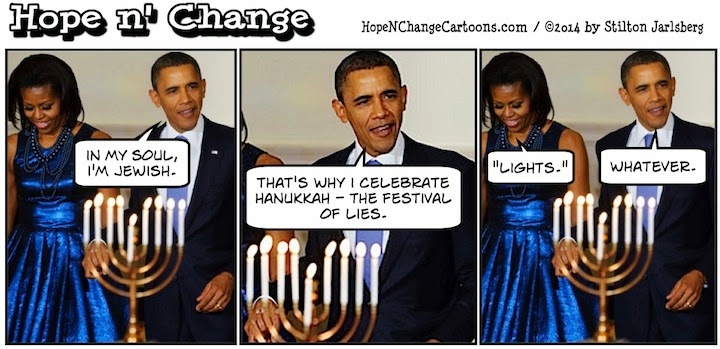
Barack Mitsvah

As noted in a Gatestone Institute article titled Iran speeding to nuclear weapons breakout, Prime Minister Netanyahu is a lone voice crying in the wilderness.

[H]e is one of the two world leaders in the West telling the truth, warning of what is to come (Geert Wilders of the Netherlands is the other). This burden of responsibility for his people (how many of us wish our leaders had even a bit of that?) has earned him only the venom of the Obama  Administration, who see him as trying to spoil their strategy of leading by procrastination. [Emphasis added.]

It is also becoming increasingly clear that the Obama Administration’s policy consists of running after Iran, in order to concede everything it wants, just to be able wave a piece of paper not worth the ink on it, claiming there is “a deal.” Iran, for its part, would probably prefer not to sign anything, and most likely will not. Meanwhile, both sides continue strenuously to claim the opposite. [Emphasis added.]

Iran seems likely to get and use, or to keep and use, nuclear weapons by virtue of the essentially bilateral Iran – US nuclear negotiations. Please see also The Iran scam continues, which I wrote in January of last year. The situation has worsened since then, with substantial concessions to, and few if any of significance by, Iran.

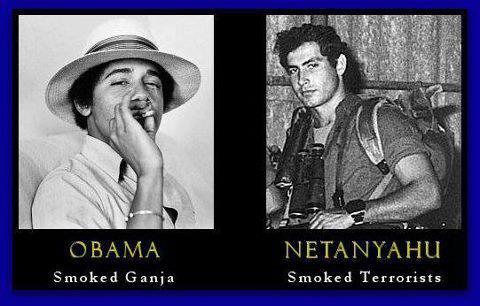
Obama and Netanyahu

The U.S. concessions have, in part, been in exchange for Iran’s “help” in defeating the Islamic State and hence becoming the major power in the Middle East.

Iran would be the hegemon of the Middle East. Some states would ‎accept Tehran’s authority, striking deals and kowtowing in order to survive. Europeans would ‎accommodate Iran, based on its control of the flow of Gulf oil. Israel and Saudi Arabia, nations ‎that Iran’s rulers have threatened to wipe from the map, would be left to fend for themselves.‎ [Emphasis added.]

. . . .

Doran cites evidence that in the first year of Obama’s first term, there were more ‎White House meetings on Iran than any other national security concern. Detente with Iran was ‎seen as “an urgent priority,” but the president “consistently wrapped his approach to that priority ‎in exceptional layers of secrecy” because he was convinced that neither Congress nor the ‎American public would support him.‎ [Emphasis added.]

A year ago, Doran further reports, Benjamin Rhodes, a member of the president’s inner ‎circle, told a group of Democratic activists (unaware that he was being recorded) that a deal with ‎Iran would prove to be “probably the biggest thing President Obama will do in his second term ‎on foreign policy.” He made clear that there would be no treaty requiring the Senate’s advice and ‎consent.‎ [Emphasis added.]

The president believes that “the less we know about his Iran plans, the better,” Doran ‎concludes. “Yet those plans, as Rhodes stressed, are not a minor or incidental component of his ‎foreign policy. To the contrary, they are central to his administration’s strategic thinking about ‎the role of the United States in the world, and especially in the Middle East.” ‎ [Emphasis added.]

Obama’s plans may well blow up in His face and, of greater importance, ours. Iran, particularly with the help of Russia and North Korea, will be able to do it. Here is a

short animated film being aired across Iran, [which] shows the nuclear destruction of Israel and opens with the word ‘Holocaust’ appearing on the screen, underneath which a Star of David is shown, Israel’s Channel 2 reported on Tuesday.

Don’t worry; be happy

Obama what me worry kid

Here’s the Revolting Truth from Andrew Klavan, which debunks everything bad ever said about Obama. Sort of.

Oh. And He’s not a narcissistic jerk either.

ALL of My policies are the best ever

ALL of My policies are the best ever

4-Star Admiral Slams Obama: Muslim Brotherhood Infiltrated All Of Our National Security Agencies

February 11, 2015

4-Star Admiral Slams Obama: Muslim Brotherhood Infiltrated All Of Our National Security Agencies, You Tube, January 28, 2015

During a press conference on how to combat radical Islamic extremism, Admiral James A. “Ace” Lyons (U.S. Navy, Ret.), former Commander-in-Chief, U.S. Pacific Fleet, stated that under the leadership of Barack Obama the Muslim Brotherhood have infiltrated all of the National Security Agencies of the United States. Furthermore, Lyons said that Obama is deliberately unilaterally disarming the military and spoke to the need for the new GOP controlled congress and Military leaders to stand up to the administration and uphold their oaths.


Iran’s Moves in the Middle East and Why You Should Care.

February 10, 2015

Iran’s Moves in the Middle East and Why You Should Care, The Watchman via You Tube, February 10, 2015


Egypt Under Al-Sisi: An Interview with Raymond Stock

February 9, 2015

Egypt Under Al-Sisi: An Interview with Raymond Stock, Middle East Forum, February 8, 2015

by Jerry Gordon
The New English Review
February 2015

The introduction to this interview has been abridged.

To discuss Egypt’s prospects under the Abdel Fattah al-Sisi government, we invited back Dr. Raymond Stock whom we had interviewed in November 2012. (See: No Blinders About Egypt Under Muslim Brotherhood ). Stock is a Shillman/Ginsburg Writing Fellow at the Middle East Forum and a former Assistant Professor of Arabic and Middle East Studies at Drew University. He spent twenty years in Egypt and was deported by the Mubarak regime in 2010. He is writing a biography of 1988 Egyptian Nobel laureate in literature Naguib Mahfouz (1911-2006) for Farrar, Straus and Giroux and is a prolific translator of his works.

……………………..

“[The Muslim Brotherhood] has deeply bonded with the highest levels of the Obama administration, which uncritically backed its creation of an elected, one-party dictatorship under Morsi.

“Unlike Morsi and the MB, who worked covertly with the terrorists in Sinai, al-Sisi wholeheartedly supports the peace with Israel.”

Egypt is now in an informal alliance with Israel, the United Arab Emirates and Bahrain to confront Iran. That alliance is compromised, however, by recent moves from Egypt’s Gulf partners to mend fences with Iran as a result of their feeling exposed by Washington’s alarming pivot toward Tehran at the expense of its traditional Sunni clients.

“Obama’s leftist, rather Edward-Saidian worldview … sees indigenous anti-Western forces such as the Islamists to be the benignly natural and legitimate consequence of American and European policies during the colonial era and the Cold War.”


********************

Jerry Gordon: Ray Stock thank you for consenting to this interview.

Raymond Stock: Thank you for inviting me back.

Jerry Gordon: Egyptian President al-Sisi started 2015 with two dramatic moves- his New Year’s speech at al-Azhar University and Christmas greetings at a Coptic church with Pope Tawadros II present. What were the messages he conveyed to Muslim clerics, Coptic Christians and the world?

Raymond Stock: At al-Azhar, President al-Sisi was saying it is not merely an extremist interpretation of Islam that is threatening the world with global jihad, but ideas that are at the core of the mainstream, orthodox understanding of the religion–and that this would require a “religious revolution” to change.

At the Coptic Cathedral, he urged Egyptians not to define themselves by their religion, be it Christian or Muslim, but by the fact that they are Egyptians–a rejection of Islamism, which defines national identity in purely religious terms.

To the world, he was saying that Islam as it is being taught and practiced by its leading religious scholars has given birth to a globally destructive ideology which is now threatening us all.

Moreover, he wants to launch a movement within Islam to save the religion from itself, that is, before it tears itself apart completely and the rest of the world destroys it in self-defense.

And he challenged the clerics to take the lead in that effort by openly re-examining their own teachings and source materials for interpreting Islam.

Gordon: Al-Sisi has cracked down on press freedoms in Egypt and brought to trial three Al Jazeera correspondents. What in your view prompted that?

Stock: Though no libertarian, it is hard to say if al-Sisi himself has had anything to do directly with the suppression of press freedom, though it is happening on his watch. Going back to Pharaonic times, Egypt’s state institutions, the oldest in the world, and its political culture, have little tradition of respecting civil liberties. Some periods have been worse than others–the worst was actually under Gamal Abdel-Nasser in the 1950s and ’60s, when many thousands of political prisoners were sent “behind the sun” to camps in the Western Desert.

Al-Sisi is still so popular, the public so widely disgusted with the unending social and political chaos since the 2011 revolution, and so alarmed by the terrorist insurgency waged by the Islamists, that probably a majority of news editors and perhaps also of reporters have decided to support him completely and to oppose his critics automatically. At this point it is hard to find any clear connection with al-Sisi himself to this consensus, enshrined in a declaration by several hundred key media figures a few months ago. However, certainly if he didn’t like it he could well speak up against it–yet he hasn’t so far.
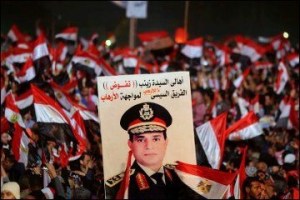
948Pro-Sisi demonstrators celebrate the third anniversary of Mubarak’s overthrow, January 2014.

Last summer he publicly regretted the imprisonment of the three Al Jazeera journalists, saying he wished they had been deported instead. Citing his belief in an independent judiciary, he refused to intervene in the legal process. Now that they are being retried after winning on appeal, we’ll see if he pardons and deports them should they be convicted again.

Gordon: Following, al-Sisi’s ouster of President Morsi and crackdown on Muslim Brotherhood leaders, what has happened to the movement in Egypt?

Stock: Though deservedly banned as a terrorist group, its top leaders in jail and the rest driven underground or abroad, it is far from dead and remains a threat to the Egyptian state and society. Its refusal to accept the June 30 popular revolution (far larger than the one that overthrew Mubarak), parental bonds to Hamas, financial support from Qatar and wealthy Gulf donors (and possibly Iran), partnership with the Salafis and ideological affinity and outreach to groups like al-Qa’ida and Islamic Jihad have served it well in retaining its base while gaining sympathy–especially internationally.

Though all these factors–plus its horrendous behavior in power–have greatly alienated the majority of Egyptians, they are for the most part also its greatest assets for the future, if they can only survive the current storm. As they have shown in several major periods of repression in the past–the most severe being under Abdel-Nasser–they only need to endure until there is successor to al-Sisi, who may decide to restore the MB to political legitimacy as a means of fighting al-Sisi’s remaining political allies. (Anwar al-Sadat, for example, freed the MB activists from prison to combat the surviving members of Abdel-Nasser’s coterie.) Such a situation could put them in striking distance of taking power again.

Meanwhile, the MB has global headquarters in Istanbul and London, is very influential in Europe, and has enormously increased its penetration at the federal, state and local levels all over the US. As part of this, it has deeply bonded with the highest levels of the Obama administration, which uncritically backed its creation of an elected, one-party dictatorship under Morsi. Obama evidently seeks to help the MB to return to power in Egypt—as shown, for example, by the State Department’s recent hosting of a conference of MB allies at Foggy Bottom, though it may take a while. Al-Sisi probably only has a year or two to turn the economy around before he risks another uprising.

The goal of the terrorist insurgency is to discourage foreign investment and stifle the stimulus provided by major government projects such as the new second channel to the Suez Canal to aid the recovery from the last four years of chaos. This, they hope, will pave the way for new popular upheaval which they hope to manipulate if not lead.

Gordon: Has the Islamic State supplanted the Salafist and Muslim Brotherhood movements?

Stock: In a sense, yes, but the situation is actually quite complex. Ideologically, IS—like al-Qa’ida–is an extension of the Salafist movement and the MB (itself established as a Salafi organization in the Salafi library in Ismailiya, Egypt in 1928). IS, because of its uncompromising Islamist purity, harshness, brutality and its dramatic seizure of so much territory in Iraq and Syria, coupled with its incredibly savvy use of social media, has largely eclipsed all of its predecessors in recruitment of fighters to the Middle East. It also outpaced all of them in its creation of lone wolves and sleeper cells in Europe, America and elsewhere.
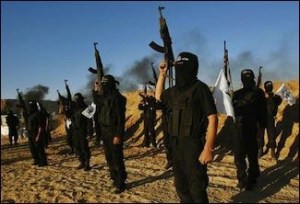
949Ansar Bayt al-Maqdis pledged allegiance to the Islamic State (IS) group last year.

That includes Egypt, where the MB-and-AQ aligned Ansar Bayt al-Maqdis (ABM) organization is responsible for most of the attacks in the country over the past two years. ABM, along with its allies controls much of North Sinai and has declared its allegiance to IS. The MB, as noted, still retains a very strong base, as does the Salafi al-Nour Party which has pragmatically allied itself with Al-Sisi. The appeal of IS may frustrate their ability to draw younger members–yet it is far from clear that IS will do any better in the long run. So have many of the Islamists in Libya, the eastern half of which IS now controls, and may soon run Tripoli as well. The stunning success of IS provides further inspiration to groups like Boko Haram, which has overrun much of northeastern Nigeria and has recently spread into Cameroon, as well as al-Shabaab in Somalia. IS also now has a presence in southern Afghanistan and beyond. Unless it is destroyed militarily in the very near future–which is virtually impossible so long as Obama is President–IS threatens every state with a significant Muslim population, as well as the West, which is its ultimate target.

Gordon: Al-Sisi has propounded a doctrine of stability for Egypt. What is it and has he succeeded since his election?

Stock: I would say that if al-Sisi truly has established such a doctrine for stability, it would consist of the following:

    1. Anti-Islamism—i.e. a more limited role for Shariah (which is nonetheless still enshrined in the new constitution, yet no longer to be interpreted by the clerics at al-Azhar, but by the government, whose authority and much of its outlook is secular, not religious;
    2. Electoral democracy though with somewhat limited civil liberties, to satisfy both the demand for popular sovereignty and for an end to the endless chaos–strikes and demonstrations (and skyrocketing crime) since the fall of Mubarak in 2011, and to limit the public role of the Islamists, who are at war with Egypt; and
    3. An independent foreign policy—one that still seeks to maintain the traditional alliance with the U.S. and the West, but is not afraid to go elsewhere as needed.

Obama’s backing of the Islamists and his cutting of aid for the past two years have driven al-Sisi to radically diversity Egypt’s sources of funding and investment from abroad, including for the first time military aid. For more than three decades, Egypt’s military assistance came almost exclusively from Washington, though that is now being surpassed by multi-billion dollar arms deals from Moscow and even to an extent from Beijing, funded by al-Sisi’s backers in the Gulf. That puts the Egyptian-American alliance and its principal benefits—the more than thirty-five year peace with Israel, our priority access to the Suez Canal (now being expanded with a second channel but without US investment), and vital cooperation on security issues—seriously at risk.

Gordon: Some analysts have said that in the wake of the Arab Spring the old order of regional autocracies has re-emerged in an alliance against the Muslim Brotherhood. What is your view and especially in the case of Egypt’s North African neighborhood?

Stock: That depends on the country: in North Africa, King Mohammed VI is still in power, but the Muslim Brotherhood has won more seats than the other parties in parliament, a situation echoing that in Jordan, though it is less precarious at present. Algeria, still recovering from the savage Islamist bloodbath after the Army’s annulment of elections in January 1992, was least affected of all the states in the region by the Arab Spring. (Perhaps the only major result there was the lifting of the State of Emergency that had prevailed for nearly two decades, in February 2011.) Tunisia, where the Arab Spring began in December 2010, threw out its MB-affiliate controlled government in a popular movement backed by the army—in a situation that rather echoed the one in Egypt, and late last year elected a new secularist plurality in parliament and a new secularist president, Béji Caїd Essebsi.

In Libya, the feeble central government that we helped install by foolishly removing the vicious, eccentric but cooperative Col. Mu’ammar al-Qaddafi has predictably collapsed. Yet a new secularist-dominated government was elected last June 25 and a pro-secularist remnant of the Qaddafi era, General Khalifa Haftar, for the past year has been at war with the Islamist militias that have been the real powers since 2011. Haftar also wants to destroy the Libyan iteration of the Muslim Brotherhood, root and branch, especially after it launched an armed uprising in eastern Libya following Morsi’s ouster in Egypt in 2013. As a result of this chaos, generated by our own needless—or at least, badly botched–intervention in the Arab Spring, the U.S. now has no effective presence in Libya. The security vacuum prompted Egypt and the United Arab Emirates to cooperate in launching air strikes near Tripoli last summer in support of Haftar’s forces. IS and other Islamist organizations are now infiltrating weapons and fighters into Egypt from Libya, threatening the country’s—and the region’s—stability.

In the Eastern Arab world, Egypt’s principal allies now are Saudi Arabia and the UAE, who together immediately pledged 12 billion dollars in aid after Morsi’s removal, and have given billions more since. All of it and more is desperately needed to compensate for the depletion of Egypt’s hard currency reserves, loss of foreign investment and near-destruction of the once lucrative tourist industry that have all continued since the January 25th Revolution against Hosni Mubarak. Both the Saudis and the Emiratis oppose the MB and Hamas, who—along with Egypt under Morsi—are clients of their Gulf rival, Qatar. America’s annual, mainly military package of $1.5 billion seems trifling in comparison (unless viewed cumulatively since it began in 1979). Still, it will be difficult to switch to mainly Russian or Chinese systems–much as the latter may be based on hacked American designs–after so many years of absorbing Yankee equipment and training.

Gordon: What is the emerging change in Egypt’s relations with Israel, both geo-political and economic?

Stock: Unlike Morsi and the MB, who worked covertly with the terrorists in Sinai, al-Sisi wholeheartedly supports the peace with Israel. He has greatly increased security cooperation with the Jewish state—which had been endangered in the 2011-12 transition and during the Morsi era—to levels exceeding those under Mubarak. Again, even more than Mubarak, who loathed them too, al-Sisi sees the MB, Hamas and their Islamist allies as threats to Egypt as well as Israel. Likewise, he sees Iran—with whom Morsi sought a rapprochement—as Egypt’s greatest strategic adversary in the region.

As a result, Egypt is now in an informal alliance with Israel, the United Arab Emirates and Bahrain to confront Iran. That alliance is compromised, however, by recent moves from Egypt’s Gulf partners to mend fences with Iran as a result of their feeling exposed by Washington’s alarming pivot toward Tehran at the expense of its traditional Sunni clients.

Meanwhile, though overall Israel-Egypt trade remains minimal (as it had through the decades of cold peace under Mubarak and afterward), energy-strapped Egypt may soon be importing natural gas from Israel’s newly-developed Tamar Reservoir in the Mediterranean. Given that Israel used to import natural gas from Egypt via a pipeline shared with Jordan (repeatedly sabotaged physically as well as assailed legally in Egypt since the fall of Mubarak), that is a remarkable turnaround indeed.

Gordon: What triggered Qatar’s re-opening of relations with Egypt despite the former’s support of Hamas and the Brotherhood?

Stock: The main factor was probably al-Sisi’s logical desire to stay in step with the policy of Egypt’s current primary foreign donors and investors, the Arab states in the Persian Gulf. After freezing relations with Qatar due to its support for Hamas and the MB, and perhaps also AQ and IS (the latter only early on?), and the universal irritant of Doha-based Al Jazeera, the members of the Gulf Cooperation Council (GCC), especially Saudi Arabia and the United Arab Emirates, decided last summer to repair the rift, apparently in face of the increasing U.S. tilt toward Iran. The U.S. tried to bypass al-Sisi by turning to Qatar and Turkey—both of whom Cairo had shunned for their support of Islamists and their criticism of Morsi’s ouster—as intermediaries with Hamas in the Gaza conflict last summer.

Ironically, that move may have done more to damage relations with Washington than with either Doha or Ankara, who probably could not be totally excluded in any case, given their closeness to Hamas. Yet those two regional rival countries’ desire to cut out Cairo, the historic mediator between the Palestinians, Israel and the West, did aggravate the Egyptians enormously, to be sure.

Qatar has taken some token steps to distance itself from the MB, like deporting several MB leaders who had taken refuge there. But Qatar apparently continues to finance them in their new home in London, and few believe the change is more than cosmetic. Thus the warming with Egypt and even within the GCC may not long endure.

Gordon: Why has the US Administration maintained an arm’s length relationship with al-Sisi subsequent to the ouster of Morsi?

Stock: It is no doubt due to Obama’s leftist, rather Edward-Saidian worldview, which sees indigenous anti-Western forces such as the Islamists to be the benignly natural and legitimate consequence of American and European policies during the colonial era and the Cold War—for which he has apologized repeatedly. He also has a positive, nostalgic view of Islam, given that he was born of a Muslim father and having apparently been raised as one by his step-father during his early childhood in Indonesia, and seems to project this image onto radical groups like the MB who cleverly pose as moderates. He is thus surrounded by numerous pro-Islamist advisers, as well as those who simply take a naïve view of groups like the MB, Hamas and Hizbollah–and even the Taliban (not a new position, but one now getting attention in the news).

It also means that he denies the common Islamist ideology of all those groups as well as AQ and IS, or even any connection of their beliefs to Islam. This, despite their being made up entirely of Muslims, that they base their ideology and tactics on the Qur’an, Hadith and other key Islamic texts, and that they have a very wide appeal in the global Islamic community. This is even more bizarre if you compare his statements and those of his aides about this question to those of al-Sisi—a Muslim leader of a majority Muslim country—at the seat of Sunni Islam’s highest authority, al-Azhar, on New Year’s Day. One of them, Obama, is willfully blind; the other, al-Sisi, with devastating clarity, identifies the problem as coming from within the very heart of Islam.

On a personal level, Obama does not take kindly to those who cross him. Just look at his relationship with Congress, and with Benjamin Netanyahu, while ignoring his own transgressions against those he thinks are transgressing against him. He regarded al-Sisi’s patriotic overthrow of Morsi–whom he had bolstered with more and more aid even as the MB leader became more and dictatorial–at the demand of more than twice as many Egyptians as those who voted for Morsi, as a personal affront as well as ideological heresy. He has since punished al-Sisi and the Egyptian people who rejected his chosen savior of their destiny accordingly. That may have softened a bit recently, due to the need to find Arab allies to fight IS, but that is not a serious effort: the default position is against al-Sisi and for the MB.

Gordon: Given your Egyptian sojourn does al-Sisi have both the domestic and international support to implement his agenda?

Stock: Domestic, yes—all but a quarter to a third of the country wants him to succeed. But internationally is another story. Al-Sisi’s greatest enemy is not the MB, or even IS, but the president of the United States. When the State Department invited key figures from the pro-MB alliance of groups to a major conference in Washington this week, he was signaling his desire (and only Obama sets our foreign policy) to overthrow al-Sisi—just as his invitation to the leaders from the banned MB to sit in the front row of his Cairo speech in 2009 signaled that he wanted to remove Mubarak. So U.S.-dependent international institutions and allies may not be too supportive of al-Sisi.

The only possible silver lining for Egypt is, ironically (given our historic alliance), really a great problem for our country, if one values its role of global leadership since World War II. That is, Obama has done so much to destroy America’s standing with the rest of the world that even our closest allies no longer fear to stray, and may yet not follow his wishes regarding al-Sisi. Tragically, on many issues, that may be better for us all until Obama leaves office. For the heading he has set leads directly to hell, a destination that many countries, thanks to in large part to his policies, have already seen (and Syria and Libya have already become)–good intentions (by his lights) notwithstanding.

Gordon: Dr. Stock many thanks for this highly informative interview.

Stock: You’re most welcome.

Qatar, Egypt on a collision course

February 9, 2015

Qatar, Egypt on a collision course, Israel Hayom, Dr. Reuven Berko, February 9, 2015

This anti-Egypt agenda, which seems to be shared by Turkey, is fueled by the desire to realize the dream of installing a Sunni Islamic empire, all while undermining moderate Arab regimes and giving a nod to Iran, as a way of covering all bases — just in case.

******************

Qatar and Egypt are at odds, and the attempts by the late King Abdullah of Saudi Arabia to facilitate a reconciliation between them have failed.

Qatar’s relentless efforts to overthrow Egyptian President Abdel-Fattah el-Sissi’s regime and reinstate the Muslim Brotherhood to power are evident from the programs airing on the Doha-controlled Al-Jazeera television network, and from the publication of doctored wiretaps featuring the Egyptian president and his advisers, who allegedly “stole” Egypt away from the Muslim Brotherhood and the “holy” Mohammed Morsi.

This anti-Egypt agenda, which seems to be shared by Turkey, is fueled by the desire to realize the dream of installing a Sunni Islamic empire, all while undermining moderate Arab regimes and giving a nod to Iran, as a way of covering all bases — just in case.

Egypt’s decision to outlaw the Muslim Brotherhood has resulted in increased incitement by Qatar as well as in an escalation in terrorist attacks in Egypt and Sinai. Egyptian intelligence has linked the latest series of attacks to Ansar Beit al-Maqdis, an offshoot of the Islamic State group, as well as to Hamas’ Izzedine al-Qassam Brigades. Hamas and the Izzedine al-Qassam Brigades are very much Qatar’s “babies,” and their involvement in these terrorist attacks has prompted Egypt to outlaw both.

In response, Al-Jazeera has begun portraying Izzedine al-Qassam Brigades’ operatives, who have denounced Sissi as a traitor to Islam and Arabs everywhere, as heroes fighting for the liberation of “Palestine.” The Qatari television station has also been obsessively covering the riots and unrest instigated by the Muslim Brotherhood to undermine the regime, intimidate foreign investors, and reverse the image of stability Sissi’s government is trying to convey to the world.

The airing of secret wiretaps, on which Sissi is heard mocking the wealthy Persian Gulf states, at this time seeks to pit Cairo against the Gulf states, ahead of the World Economic Forum on the Middle East, which is scheduled to convene in Sharm el-Sheikh, in Egypt, in late February, and where Egypt will lobby for aid.

Sissi’s assertion about the current situation in the Middle East is correct: Sunni Arab states are being offered as sacrifice to Iran, which is pursuing its nuclear endeavors uninterrupted. These states understand that Egypt’s stability is a prerequisite for their own national security, and therefore aiding Cairo is a favor that could only work to their advantage.

At the end of the day, in a reality where Iran poses an existential threat to other Arab countries, pointing to the emir of Qatar as a leader drowning in gold while millions of Egyptians go hungry — as heard on the wiretaps — may prove to be a double-edged sword, which may end up striking Qatar itself.

U.S. Seen in Middle East as Ally of Terrorists

February 4, 2015

U.S. Seen in Middle East as Ally of Terrorists, The Gatestone InstituteKhaled Abu Toameh, February 5, 2015

Many Egyptians and moderate Arabs and Muslims were shocked to hear that the U.S. State Department recently hosted a Muslim Brotherhood delegation. They were equally shocked when an EU court decided to remove Hamas from the bloc’s list of terror groups.

“Just two days after the controversial visit, the Brotherhood called for a war against their fellow Egyptians.” — Linda S. Heard, Middle East Expert, Gulf News.

“The Muslim Brotherhood is seeking to return to the political arena through the American door and terrorist attacks. The U.S. policy appears to be devious and unreliable.” — Ezzat Ibrahim, columnist, Al Ahram.

“[Ousted Egyptian President] Mohamed Morsi, before his election, described these Jews as descendants of apes and pigs. In English, the Muslim Brotherhood says one thing and in Arabic something completely different.” — Mohamed Salmawi, Egyptian columnist

While the Egyptian government has been waging war on the Muslim Brotherhood and other Islamic radical groups, the U.S. Administration and some Europeans are continuing to hamper efforts to combat terrorism.

Many Egyptians and moderate Arabs and Muslims were shocked to hear that the U.S. State Department recently hosted a Muslim Brotherhood delegation. They were equally shocked when an EU court decided to remove Hamas from the bloc’s list of terror groups.

The State Department’s hosting of the Muslim Brotherhood leaders has outraged Egypt’s President Abdel Fattah Sisi, who has been waging a relentless war against the organization over the past year.

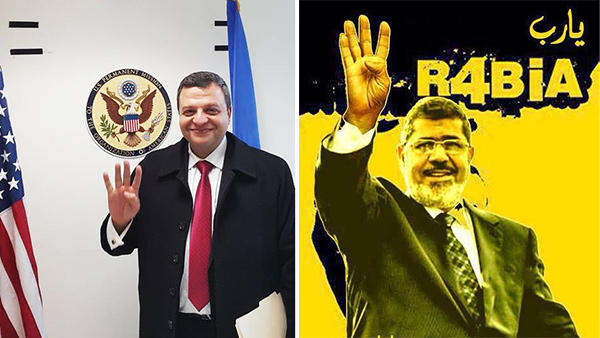
One member of the delegation, Muslim Brotherhood judge Waleed Sharaby, posed for a picture while at Foggy Bottom, as he held up the organization’s four-finger “Rabia” sign. (The gesture is named for Cairo’s Rabia Square, where counter-demonstrations backing ousted Egyptian President Mohamed Morsi — who is from the Muslim Brotherhood — took place in August 2013.)

919While being hosted by the State Department on a visit to Washington, Muslim Brotherhood judge Waleed Sharaby (left) flashed the organization’s four-finger “Rabia” sign. At right, ousted Egyptian President Mohamed Morsi (from the Muslim Brotherhood) displays the Rabia sign.

“If the White House is out to offend some of its closest Arab allies and is intent on heightening their suspicions, it’s succeeded,” wrote Middle East expert Linda S. Heard. “If there’s a plot, then it’s unfolding,” she added. “Just two days after the controversial visit, the Brotherhood called for a war against their fellow Egyptians.”

A statement issued by the Muslim Brotherhood said, “It is incumbent upon everyone to be aware that we are in a process of a new phase, where we summon what is latent our strength, where we recall the meanings of jihad and prepare ourselves, our wives, our sons, our daughters, and whoever marched on our path to a long, uncompromising fight, and during this stage we ask for martyrdom.”

The Egyptian government condemned the hosting of the Muslim Brotherhood officials by the State Department. Egyptian Foreign Minister Same Shoukry denounced the State Department’s move, saying, “The Muslim Brotherhood is not a political party, but according to the Egyptian law, which must be respected, it is designated as a terrorist organization.”

The timing of the meeting between State Department officials and Muslim Brotherhood leaders could not have been worse for many Egyptians — it took place shortly after Islamist terrorists killed 31 soldiers and wounded 45 others in a series of attacks on Egypt’s Sinai Peninsula.

Although the Islamic State terror group took credit for the attacks, Sisi held the Muslim Brotherhood responsible. “Egypt is waging a war against the strongest clandestine group over the past two decades,” he said. “This organization has secretive arms, secretive thoughts and secretive forums.”

Egyptian columnists and newspaper editors have also attacked the U.S. Administration for its ties with the Muslim Brotherhood.

“The U.S. Administration is continuing to jeopardize its relations with Egypt by appeasing Muslim Brotherhood,” remarked columnist Ezzat Ibrahim. “The Muslim Brotherhood is seeking to return to the political arena through the American door and terrorist attacks. The U.S. policy appears to be devious and unreliable.”

Another Egyptian columnist, Mohamed Salmawi, launched a scathing attack on the U.S. Administration; he accused it of deception and double standards. He said that the meeting between U.S. officials and Muslim Brotherhood leaders exposes the U.S. Administration’s deceptive policy toward Islamic terror groups.

“The U.S. Administration says it is combating these groups at home while it is supporting them abroad,” Salmawi wrote. “This meeting has grave indications because it shows that Washington has not abandoned its policy of double standards toward Islamic terrorism.

Salmawi also took issue with the U.S. Administration for turning a blind eye to the hypocrisy and double talk of the Muslim Brotherhood. “One of the leaders of Muslim Brotherhood, for example, told the world that he welcomes the Jews of Israel,” he added. “But this same leader announced in front of the Egyptian people that they should march in the millions to liberate Jerusalem from the occupation of the Jews. [Ousted President] Mohamed Morsi, before his election, described these Jews as descendants of apes and pigs. In English, the Muslim Brotherhood says one thing and in Arabic something completely different.”

Said Lindawi, a prominent Egyptian international affairs expert, said that the meeting of the Muslim Brotherhood leaders with State Department officials means that the Obama Administration has given the organization a green light to carry out terrorist attacks against Egypt.

“The U.S. Administration has refused to recognize the Muslim Brotherhood as a terror group,” hesaid. “The Americans continue to insist that the Muslim Brotherhood is not responsible for the terrorist attacks in Egypt.”

By embracing the Muslim Brotherhood, the U.S. Administration has sent the wrong message to moderate Arabs and Muslims. This is a message that says that Washington believes that there are good terrorists and bad terrorists.

Judging from the angry reactions of Egyptians, it has become obvious that most moderate Arabs and Muslims no longer see the U.S. as an ally in the war against Islamic terror groups. What is even more disturbing is that they view the U.S. as an ally and friend of the terrorists.

Foreigners, Diplomats Warned to Leave Egypt or Be Targeted for Jihad

February 3, 2015

Foreigners, Diplomats Warned to Leave Egypt or Be Targeted for Jihad, Washington Free Beacon, February 3, 2015

Mideast Egypt MorsiIn this Friday, Aug. 2, 2013 file photo, Supporters of Egypt’s ousted President Mohammed Morsi hold a large Egyptian national flag as chant slogans against Egyptian Defense Minister Gen. Abdel-Fattah el-Sissi outside Rabaah al-Adawiya mosque / AP

An Islamist organization sympathetic to the Muslim Brotherhood is warning all foreigners and diplomats to flee Egypt by the end of February or face becoming “a target by the Revolutionary Punishment Movement,” according to a recent warning posted online by a Brotherhood-affiliated site and read live on television by one of its broadcast organs.

The statement issues a threat to “all foreign nationals,” “all foreign companies,” and all “embassy foreigners, diplomats, and ambassadors,” ordering them to leave Egypt by the end of the month or face violent attacks, according to an independent translation of the Arabic statement.

Foreign travelers also are warned to “cancel their trips” and told “they are not welcome to Egypt during these difficult days.”

The warning comes just a week after Brotherhood leaders and allies were hosted for a meeting at the State Department, which drew fierce criticism from the Egyptian government.

It also follows a similar statement by the Brotherhood urging its supporters to prepare for a “long, uncompromising jihad” in Egypt.

The latest threat was issued by an anti-government group identifying itself as “The Youth of the Revolution.” The statement was published late last week on a Brotherhood-affiliated Facebook page and also read on a Brotherhood-affiliated television station operating out of Turkey.

“After the successive meetings with revolutionaries in the squares, we decided with all the Revolutionary Punishment Movement the following,” the statement reads.

“All embassy foreigners, diplomats, and ambassadors, are given a deadline until Feb. 28 to leave the homeland,” it states.

“All foreign nationals, from all foreign, Arab, and African nationalities and all employees with companies working in Egypt [must] leave the country immediately,” it says. “This deadline will end on Feb. 11, 2015, and after that they will be a target by the Revolutionary Punishment Movement.”

Foreign companies “working in Egypt” are instructed to leave by Feb. 20, “withdraw their licenses in Egypt and end their work, otherwise all their projects will be targets by revolutionaries.”

The revolutionary youth group also instructs any country supporting the government of Egyptian President Abdel Fattah al-Sisi to withdraw its backing.

Like the Brotherhood, the “The Youth of the Revolution” does not recognize al-Sisi as the rightful Egyptian leader and seeks to reinstall as president ousted Brotherhood ally Mohamed Morsi.

“All countries supporting the coup and assisting it monetarily and politically must immediately cease from any support to the coup within a month from this statement otherwise all their interests in the Middle East will be exposed to severe attacks that will have dire consequences,” the group warns.

Following the Washington Free Beacon’s initial report on the meeting between the State Department and Brotherhood-aligned leaders, the Egyptian foreign minister lashed out at the Obama administration, calling its policies “incomprehensible.”

State Department spokeswoman Jennifer Psaki was forced to admit that she initially misled reporters about the meeting.

Psaki claimed that the trip was organized and funded by Georgetown University, a claim the university denied when contacted Monday by the Free Beacon.

Psaki was forced to correct the record at a briefing Monday with reporters.

“Unfortunately, I didn’t have the accurate information on one small piece. The meeting was set up by the Center for the Study of Islam and Democracy, a nonprofit. So the visit was not funded, as you know, by us or the U.S. Government, but it was also not funded by Georgetown,” Psaki said.

However, she continued to defend the decision to meet with the delegation.

When asked by a reporter, “is the building comfortable with continuing to do business with this center, this group,” Psaki responded, “Yes. Yes.”

Terrorism analyst and reporter Patrick Poole said Brotherhood offshoots such as this youth group have become increasingly violent as the Egyptian government continues its crackdown on the Brotherhood and terrorist groups.

“For a year and a half we’ve seen these Brotherhood youth cadre offshoots grow increasingly violent, whether it is the ‘Molotov Movement’, ‘Revolutionary Punishment Council’, or whatever name they operate under this month,” Poole said. “Initially it was targeting police and military personnel, then violence at the universities and civilian areas. So it’s no surprise now that they’re going after foreigners.”

Brotherhood leaders have quietly endorsed this violent rhetoric, he said.

“The Brotherhood leadership, the vast majority of which is now either in prison or in exile, has nurtured this culture,” Poole said. “They train for it and justify it in their indoctrination curriculum. And as the call for a new phase of all-out jihad published on the Brotherhood’s official website last week indicates, this latest threat of violence can be seen as a direct response to what the leadership openly called for just days before.”

Calls to Kill Pres. Al-Sisi and Egyptian Journalists on Turkey-Based Muslim Brotherhood TV Channels

February 3, 2015

Calls to Kill Pres. Al-Sisi and Egyptian Journalists on Turkey-Based Muslim Brotherhood TV Channels, MEMRI TV via You Tube, January 30, 2015

(Please see also Egypt’s fight, America’s apathy. — DM)

In this compilation of video clips from Muslim Brotherhood TV channels, various Egyptian clerics and commentators call to kill Egyptian President Abd Al-Fattah Al-Sisi and the journalists who support him. Cleric Salama Abd Al-Qawi said, on Rabea TV, that anyone who killed Al-Sisi would be doing a good deed, cleric Wagdi Ghoneim told Misr Alan TV that “whoever can bring us the head of one of these dogs and Hell-dwellers” would be rewarded by Allah, and commentator Muhammad Awadh sai, on Misr Alan TV, that the punishment for the “inciting coup journalists” was death. The programs aired on January 10 and 26, 2015.