Posted tagged ‘Egypt’

Egypt’s secular culture minister ruffles Salafi feathers

October 7, 2015

Egypt’s secular culture minister ruffles Salafi feathers, Al-MonitorRami Galal, October 6, 2015

(Building a secular Muslim state in a region dominated by Islamists is difficult and takes time, as Egypt and Al-Sisi are learning. — DM)

helmiEgypt’s newly appointed Culture Minister Hilmi al-Namnam appears on the Egyptian talk show 25/30, Nov. 11, 2014. (photo by youtube.com/ONtv)

CAIRO — On Sept. 19, a new Egyptian Cabinet, headed by Prime Minister Sherif Ismail, was sworn in before President Abdel Fattah al-Sisi. Among the new ministers is the journalist Hilmi al-Namnam, who holds the culture portfolio. The appointment of Namnam, a secularist, has sparked controversy among Egyptian Salafis and aroused opposition in Saudi Arabia. Such Saudi writers and intellectuals as Jamal Khashoggi, editor-in-chief of Al-Arab News Channel, object to Namnam’s appointment because he opposes Wahhabi Salafism, the religiopoliticial movement that originated in the Nejd region of the Saudi kingdom.

Muhammad ibn Abd al-Wahhab founded what became the Wahhabi movement in the 18th century. In 1744, Wahhab allied with Muhammad ibn Saud, emir of the Nejd and founder of the first Saudi state, to increase followers of the Quran, Sunnism and the words and actions of the Salaf, the first three generations of Muslims. In doing so, they sought to purify Islam of misguided practices negatively affecting the Islamic essence of unity and various forms of heresy.

Immediately after Namnam assumed the culture portfolio, a video of him from July 2013 went viral. In it, Namnam stated, “The political Islam current must leave the political game completely, especially the Salafist Nour Party, which is more dangerous than the Muslim Brotherhood.” He compared the Nour Party to a “whore who extorts her husband if he doesn’t fulfill her demands by escorting someone else.” Namnam also said, “We lie when we say Egypt is a naturally religious country. It is high time we said Egypt is a naturally secular state.”

The Nour Party came in second in the 2012 parliamentary elections. Among its positions at the time were prohibitions on electing women and Copts, saluting the flag and singing the national anthem. The party altered these platforms, however, after lending its stamp of approval in 2013 to the June 30 revolution, although most of its leading figures waivered over what course to take.

On Sept. 19, Shaaban Abdel Aleem, a member of the Nour Party’s board, requested information on the selection criteria used for appointing the new ministers. On the same day, Khashoggi, who is close to Saudi decision-makers, commented on Namnam’s appointment via Twitter. “For whoever is planning mutual cultural exchanges with our brothers in Egypt, the following piece of information could be useful: Namnam is not only a critic of Wahhabism, but abhors it and blames it for all his country’s catastrophes,” Khashoggi tweeted. In a separate tweet, he wrote, “Honestly, for the sake of relations between Saudi Arabia and Egypt, and due to the nature of the regime there, Egypt should not appoint a minister like Namnam, who has taken it too far in offending the kingdom.”

Namnam responded that evening in a phone call to “Al-Ashera Masaa,” a show on Dream TV, saying, “I did not say Wahhabism was the mother of vices. These are not my words, but I am against terrorist groups in general.” He added that he had criticized “attempts to export Wahhabism to Egypt,” but that he “respects the kingdom’s choices, just as the kingdom’s writers should respect Egypt and Egyptians’ choices.”

Khashoggi immediately replied, again on Twitter, writing, “Egypt’s minister of culture claims he respects Wahhabism, but admits that he is against exporting it to Egypt. I would like to tell him that Wahhabism cannot be exported. It is a pillar of the Egyptian revolution and is represented by emblematic figures like the followers of Sheikh Muhammad Abduh.” The Islamic jurist Abduh, an Egyptian, is a founder of Islamic modernism. He spearheaded the movement at the end of the 19th century, beginning of the 20th century to counter intellectual and cultural stagnation and revive the Islamic nation in line with the times.

Khashoggi argued, “Salafism preceded the Muslim Brotherhood in Egypt, as there was the Ansar al-Sunna al-Muhammadiyah group, which remains the oldest reformist Islamic organization in Egypt and the world.” Ansar al-Sunna al-Muhammadiyah seeks absolute unity and the rejection of superstitions and cults. It began in Cairo’s Hadara Mosque in 1926. Many Al-Azhar scholars and Salafist preachers were welcoming of it.

On Oct. 2, tensions escalated when Namnam said during an interview on the Sada al-Balad channel that he was ready to be “martyred to spare Egypt from turning into a caliphate state.” He added that secularism is not the adversary of Islam, as some claim. “Every moderate Muslim is necessarily secular. But, not every secularist is a Muslim,” he said.

The following day, Yasser Borhami, deputy leader of the Salafist Call, implored Sisi to intervene and forbid Namnam from making such statements, which he said contradict the constitution given that Sharia is the primary source of legislation.

Nour Party leader Younes Makhyoun entered the fray Oct. 3, asserting that Namnam should remain impartial or be dismissed. “The person [Sisi] who appointed this minister must oblige him to respect the constitution,” he stated.

Sayyed Mustafa, deputy chair of the Nour Party, told Al-Monitor, “The party did not look into Namnam’s old opinions, because they stem from personal freedom. Each person has the right to believe whatever they wish. But he must realize that he is the minister of culture for 90 million Egyptians. The Ministry of Culture should represent all currents, not just one, be it secular or nonsecular.” He added, “As a minister handling a political portfolio, Namnam must take into consideration Egypt’s foreign relations in general and brotherly relations in particular, like those it shares with Saudi Arabia.”

Zubeida Atta, former dean of Helwan University’s faculty of arts and a member of the Supreme Council of Culture, has a different perspective on the issue. “The concept of secularism that Namnam called for is not a heretical one. It relies on the use of education and its application in countries to improve them and ensure their civil aspects, instead of mixing religion with political life. The latter [mixing of the two] would send Egypt down a sectarian abyss that would threaten its existence,” she told Al-Monitor. “The Nour Party demanded clarifying the selection criteria of ministers. I demand clarifying the criteria that allow such a religious party to participate in political life and in parliamentary elections.”

As for the rumblings from the Gulf, Atta asserted, “Egypt does not dare suggest a Saudi Arabian minister for a certain ministry in the kingdom or criticize a current minister in the Saudi Arabian regime, because this is an internal Saudi Arabian matter. Why is Khashoggi, among others, allowing himself to interfere in the appointment of a minister in the Egyptian Cabinet?”


Progressivism: Easing the Way to Mass Murder

September 26, 2015

Progressivism: Easing the Way to Mass Murder, American ThinkerKenneth Levin, September 26, 2015

The progressive creed as it relates to foreign policy, and as represented most notably by our Progressive-in-Chief, President Obama, holds that the impact of United States behavior in the world has largely been negative. It casts American foreign policy as a variation on European colonialism: exploitative, indifferent to the peoples subjected to American attention and intervention, and inexorably engendering anti-American sentiment among those peoples.

The translation of this comprehension of the world into a progressivism-informed foreign policy has had the effect of making the world safer for mass murder.

President Obama has offered apologies for past American policy to Europeans, to Arabs and the Muslim world more broadly, to the peoples of Central and South America. Various media outlets have noted that, according to a 2011 Wikileaks publication, only a negative response by the Japanese government prevented Mr. Obama from going to Hiroshima in September, 2009, and offering apologies for America’s atomic bomb attack on the city.

But whatever the President’s erstwhile intentions vis-a-vis Hiroshima, the broader focus of his apologetics has been on those nations and peoples that are hostile to America. His key foreign policy syllogism, and that of America’s progressive camp, is that anti-American sentiment is essentially a product of American abuses and that American self-reform and accommodation, a kinder, gentler United States, will bring an end to current hostility and engender a new comity between this nation and its long-time victims.

Most of the world’s nations offer their citizens at best very limited rights. Some authoritarian regimes have close relations with the United States; others are hostile to the United States. One might think that progressives would object to despots of whatever sort and aspire to the liberation of populations from such governments.

But that is not case. The progressivist pattern, rather, is to oppose despotic regimes with which this nation has had positive relations but to be sympathetic and accommodating towards those that have viewed us as the enemy — that view being congruent with progressive orthodoxy.

Moreover, the advocates of genuine democratic reform in closed societies of either sort, pro- or anti-American, are essentially given short shrift. Such advocates typically look to the United States as a model for their aspirations, and that is sufficient to alienate, and preclude any hoped for support from, the progressive camp. Within pro-American authoritarian regimes, American progressives reserve their sympathy primarily for anti-regime forces that likewise look to America as the source of their respective nations’ ills and seek to replace those in power with a despotism of their own, a despotism with an anti-American stamp.

In Latin America, a number of democracies have in recent decades been subverted by left-wing populists who gained power at the ballot box and then proceeded to dismantle their nations’ democratic institutions with, for example, measures against competing parties, a free media and an independent judiciary. The pattern was established by Hugo Chavez, who became president of Venezuela in 1998, and was followed by, among others, Evo Morales in Bolivia and Rafael Correa in Ecuador. The new despots commonly justified their anti-democratic measures as necessary to counter the supposed nefarious aims of parties domestic and foreign, among which the United States is commonly trotted out as key bogeyman.

Obama and his administration displayed a notable sympathy for Chavez and have likewise done so for his emulators. The victims — among media figures or political opponents — that suffered at the hands of the post-democratic strongmen have enjoyed no such sympathy. Amazingly, when President Manuel Zelaya of Honduras likewise sought to undo his nation’s democracy and consolidate his personal control of the country but had his subversion of Honduras’s constitution blocked by the nation’s parliament and courts, the Obama administration backed Zelaya, attacked the “coup” that pushed him from power, and sought his reinstatement.

All of these populist despots were supported, of course, by Castro’s Cuba, which remains the chief example of anti-democratic leftism in Latin America both in terms of its longevity and in terms of its record of thousands murdered and myriad more imprisoned among those who have dared to take issue with the island’s dictatorship. But here, too, the progressive camp, and the Obama administration, have chosen to look upon the regime’s anti-American cant sympathetically, to see the proper way forward as American reform and cultivation of the Castros, and to close their ears and eyes to the regime’s victims.

But this progressivist cultivating of despotic forces which have only their anti-Americanism to recommend them takes on an even more sinister hue — indeed, much more sinister, in terms of the slaughters perpetrated by such forces and essentially ignored by American progressives — in the arena of the Muslim Middle East.

Virtually from its inception, the Obama administration has demonstrated support for the Muslim Brotherhood. The Brotherhood, founded in 1928 and closely linked to the Nazis during World War II, has consistently promoted an anti-American, anti-Western and anti-Semitic agenda. Its offshoot, Hamas, openly declares its dedication not only to the murder of all Israel’s Jews but of all Jews worldwide. Yet the Obama administration has appointed American Muslims associated with the Muslim Brotherhood to government posts and even as liaisons with federal law enforcement and security agencies and the military, and Brotherhood associates have been frequent guests at the White House.

Obama intervened to provide Brotherhood leaders prominent audience placement for his 2009 Cairo speech in which he apologized for America’s past role in the Middle East and sought more generally to propitiate the Arab and broader Muslim world. The President subsequently undercut pro-American Egyptian strongman Hosni Mubarak when the so-called “Arab spring” exploded in Egypt. He helped force Mubarak from office, and, as in Latin America, rather than support moderate, democratically oriented, groups in Egyptian society in the shaping of an alternative to Mubarak (including groups that consisted of Muslims and Coptic Christians working together for a democratic Egypt), threw his support behind the Brotherhood. One expression of this was the administration’s pushing for quick elections, which provided less time for challengers to the Brotherhood — the best organized political group in Egypt — to mount effective campaigns.

The election in June 2012, did bring the Brotherhood to power, with Mohamed Morsi as president and with the White House’s blessing. In the ensuing months, which saw increased murderous Brotherhood assaults on Egypt’s Coptic Christians — more than ten percent of the population and the Middle East’s largest Christian community — as well as Brotherhood cultivation of its Hamas protégés, the Obama administration continued to offer its support. (The only high profile criticism of Morsi came in the wake of the rarest of events, a New York Times front page, above-the-fold piece on Muslim anti-Semitism, in this instance a newly revealed Morsi anti-Semitic diatribe recorded some years earlier. On this occasion, the White House finally felt obliged to break from its typical indulgence of the Brotherhood and its leaders by releasing some comment condemning Morsi’s remarks.)

The Brotherhood ultimately lost popular favor, in large part because of its failure to address Egypt’s economic ills. But Egyptians were also put off by Morsi’s pursuit of the Brotherhood’s Islamist agenda. As, for example, The Economist noted

“… [I]n power the Brotherhood began to abandon its previous caution regarding its foes. Mr Morsi appeared to dismiss secular opponents and minorities as politically negligible. Instead of enacting the deeper reforms that had been a focus of popular revolutionary demands, such as choosing provincial governors by election rather than presidential appointment, or punishing corrupt Mubarak-era officials, the Brothers simply inserted themselves in key positions…

“When nearly all the non-Islamist members of a body charged with drafting a new constitution resigned in November 2012, the Brothers brushed the problem aside. Mr Morsi issued a snap decree rendering him and his constitution-writers immune from court oversight. This was when his popularity started to slide…

“The Brothers pushed through a hastily drafted constitution to a national referendum despite angry criticism from all other parties, and the referendum went Mr Morsi’s way. But his high-handedness lost him a crucial part of the electorate…”

But, again, none of this seemed to dampen Obama’s enthusiasm for Morsi and the Brotherhood, and when the Egyptian army under Abdel Fattah al-Sisi deposed Morsi in July, 2013, with wide popular support, the White House condemned the coup and dismissed its popular backing and the transgressions of the Morsi regime that generated that support. For much of the subsequent two years, the administration has given the pro-American al-Sisi the cold shoulder. Its withholding of military grants and sales to Egypt — only recently softened to some degree — has pushed al-Sisi to renew Egypt’s long dormant military links with Russia.

Before its victory in Egypt, the country where the Muslim Brotherhood had been most successful in gaining power had been Sudan, where its members made up a large part of the government following the 1989 coup d’état by General Omar Hassan al-Bashir. Bashir, who still rules Sudan, led a genocidal campaign against the black and non-Muslim — Christian and animist — population of southern Sudan over many years, until that region successfully seceded and established its independence. He currently continues a campaign of mass murder and displacement of the Muslim — but, again, black rather than Arab — population of Darfur. Bashir is under indictment by the International Criminal Court for genocide in Darfur.

President Obama, during his 2008 campaign as well as in earlier speeches, promised to act against the Darfur genocide. But he has done nothing, even as the slaughter, displacement and suffering continue. On the contrary, the Obama administration has reached out to Bashir. In addition, consistent with the Sudan government’s wishes and despite the horrible consequences for the people of Darfur, the administration appears to be supporting the downsizing of the UN peacekeeping mission in Darfur. Once again, for President Obama, appeasing anti-American entities such as the Muslim Brotherhood, an appeasement consistent with progressive orthodoxy, trumps supporting the victims of those entities.

Obama’s favorite Middle East leader has long been, according to various sources, Turkey’s Recep Tayyip Erdogan. Turkey is, of course, a NATO member and remains so even under Erdogan’s Islamist regime. It is not openly anti-American. But Erdogan has clearly turned away from the West, has developed close ties with the Muslim Brotherhood and has sought to establish himself as the leading figure in a Middle East and broader Muslim world dominated by Islamist policies that emulate those of the Brotherhood.

Having notably described democracy as like a streetcar from which one exits upon reaching one’s destination, Erdogan has done much to undermine Turkish democracy. He has essentially dismantled the nation’s independent judiciary, closed down opposition media and arrested journalists — with Turkey having more journalists incarcerated than either China or Iran — and engineered his Islamist camp’s infiltrating and seizing control over other Turkish institutions, both public and private.

Erdogan was an enthusiastic supporter of the Muslim Brotherhood’s rise to power in Egypt, is reported to have cried over the downfall of Morsi and the Brotherhood, and some months ago declared that he still regards Morsi rather than al-Sisi as Egypt’s president. He remained silent over and apparently indifferent to the Brotherhood’s slaughter of Egyptian Christians both before and during its period in power.

Erdogan likewise supports the Brotherhood offshoot Hamas in its genocidal war against Israel and has, through statements by him and leaders of his party and through his party-controlled media, whipped up domestic anti-Israel and anti-Jewish sentiment. He has opened Turkey as a refuge for members of both Hamas and the Egyptian Brotherhood, and attacks on Israelis, such as the kidnapping and murder of three Israeli teenagers last year, have been orchestrated by senior Hamas agents in Turkey.

Yet none of this seems to have shaken President Obama’s enthusiasm for the Turkish leader. On the contrary, Erdogan’s turning from the West and embracing an agenda close to that of the Brotherhood has, once more consistent with the president’s progressive world view, rendered him worthy of the administration’s propitiation.

Obama’s reaching out to the Iranian mullahs virtually from the moment of his taking office in 2009 is likewise in line with his progressivist comprehension of foreign hostility to the United States as a response to past American transgressions. Following from this, his path to ending the hostility lay in breaking from that past, offering mea culpas for it, and cultivating new policies of understanding and comity.

More particularly, the CIA’s involvement in the overthrow of Iranian Prime Minister Mossadegh in 1953 (which in fact at the time had the support of Iran’s religious establishment) and America’s subsequent ongoing support for Shah Reza Pahlavi are construed as the source of Iranian enmity and the history for which the President seeks to apologize and atone.

The popular uprising that followed the disputed reelection of President Mahmoud Ahmadinejad in June, 2009, led to the regime’s killing of dozens of protesters and the arrest and reported torture and rape of thousands more. Protesters urged the outside world, particularly the United States and President Obama, to support them, but Obama refrained even from offering significant verbal support, apparently not wanting to do anything that might undermine his outreach to the mullahs.

In the ensuing years, torture, including rape, and murder of political prisoners, among them suspected student critics of the regime culled in raids on Iranian universities, have been an ongoing fact of life in Iran. So, too, have been the imprisonment and execution of homosexuals and individuals accused of religious crimes, and abuses targeting members of the embattled Baha’i community and elements of Iran’s ethnic minorities, who represent more than fifty percent of the nation’s population.

But on all of this the Obama administration has been essentially silent as it has pursued its policy of winning over the apocalyptic Iranian theocracy through accommodation and concessions. That policy culminated this summer in the agreement on the Iranian nuclear program, which provides Iran with a path to nuclear weapons and even offers American aid to Iran in defending its nuclear program against sabotage and attack.

Nor has the administration let Iran’s role in killing Americans in Lebanon, Saudi Arabia, Afghanistan and Iraq, and Iran’s assertions of never compromising in its enmity towards America, interfere with Obama’s agenda of pursuing its progressivist fantasies of peace with Iran through accommodation. Nor has the mullahs’ genocidal anti-Semitism, including their openly and repeatedly declared determination to destroy Israel, or their arming and training of Hezb’allah and Hamas to pursue Israel’s annihilation, led to the administration’s wavering from its course. On the contrary, the nuclear agreement appears to offer Iran protection against any Israeli attempt to derail the Islamo-fascist theocracy’s development of nuclear weapons. It also promises to soon provide the regime with tens of billions of dollars in previously embargoed funds, which has already translated into Iran’s embarking on a massive acquisition of advanced warplanes and other major weapons systems from China and Russia and its promising enhanced military aid to Hezb’allah and its other terrorist allies for use in pursuit of Israel’s destruction.

But the off-handedness regarding existential threats to Israel, and regarding as well myriad instances of wholesale human rights abuses, including mass slaughter by those the Obama administration has sought to propitiate, is apparently due to such matters being regarded as of no great consequence when measured against the central international dynamic as construed by progressivism. Administration indifference to the fact of some of those hostile regimes and non-state entities — the objects of American cultivation — having dismantled working democracies or having strangled incipient democratic movements derives from the same worldview. All their various crimes are mere epiphenomena, at most secondary, and potentially an unwelcome distraction, when measured against what is comprehended as the essential world-shaping dynamic: hostility towards America whose roots lie in past American abuses, and an end to hostility and creation of a more peaceful world through American contrition and accommodation.

In this way, Obama’s, and the progressive camp’s, comprehension of reality and playing out of that delusional “reality” on the world stage inexorably makes the world safer for the crimes, including mass murder, of the anti-American forces that are the object of progressivist propitiation.


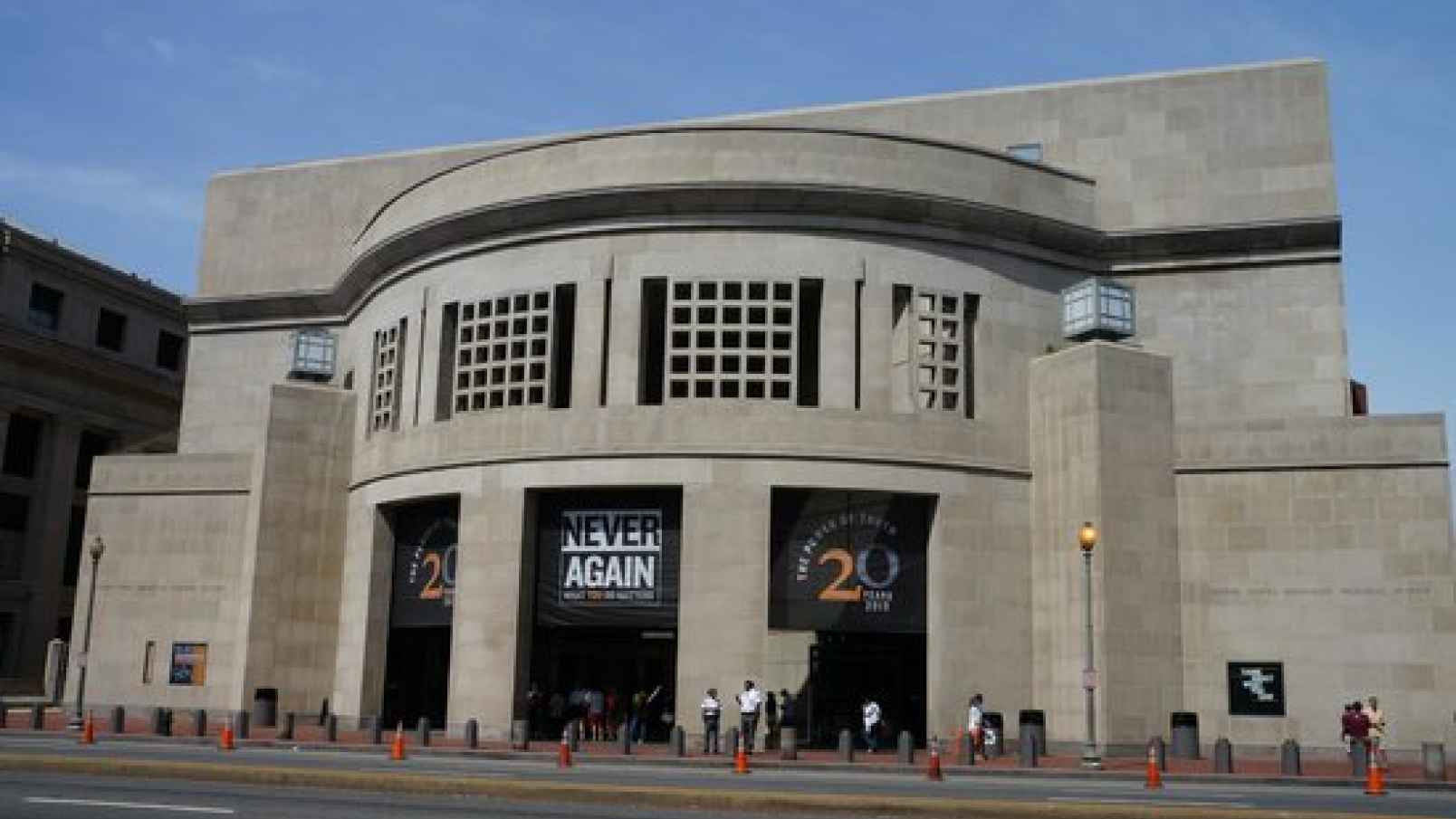
The Holocaust Museum defends Muslim Brotherhood Nazis

September 25, 2015

The Holocaust Museum defends Muslim Brotherhood Nazis, Front Page Magazine, Daniel Greenfield, September 25, 2015

united-states-holocaust

Despite the constant threats to destroy the Jewish State, Iran is also rated at low risk. Instead the Holocaust Museum claims that the real threat of genocide is in Egypt which is “experiencing a mass killing episode perpetrated by the current regime against the Muslim Brotherhood and oppositionists.”

***************************

The United States Holocaust Memorial Museum was tainted from the start.

Carter created the President’s Commission on the Holocaust to pander to the Jews after endorsing a PLO state. Then Carter complained that there were too many Jews on the Commission. One of the Jews he was complaining about was a Presbyterian with a German last name, but he was too bigoted to care.

The Museum hit a new low when the Clinton administration pressured its chairman to invite Arafat, a protégé of Hitler’s Mufti who had been trained to kill Jews by a former Nazi officer. It hit an even lower low when it brought in John K. Roth who had compared Israel to the Nazis.

Now the Holocaust Memorial Museum has rolled out an “Early Warning Project” to warn of the risk of mass killings and genocide.

According to the “Project,” Israel is not at risk of genocide. Its risk assessment is lower than the UK or Panama. If another Holocaust happens, it’s more likely to take place in London or Brazil. (But the EWP also claims that America and New Zealand are at a higher risk of mass killings than Cuba even though the Castro regime, unlike New Zealand Prime Minister John Key, actually engaged in mass killings.)

Despite the constant threats to destroy the Jewish State, Iran is also rated at low risk. Instead the Holocaust Museum claims that the real threat of genocide is in Egypt which is “experiencing a mass killing episode perpetrated by the current regime against the Muslim Brotherhood and oppositionists.”

Jews don’t face genocide in the Middle East. The Nazi-influenced Muslim Brotherhood does. Muslim Nazis are the real victims of a new Holocaust.

The Muslim Brotherhood was allied with Hitler. It distributed Arabic translations of Mein Kampf. Hitler’s Mufti, Haj Amin al-Husseini, who headed the Muslim Brotherhood’s affiliate in Israel, had personally met with Hitler, encouraged the extermination of the Jews and visited the gas chambers at Auschwitz.

The Mufti had preached genocide, encouraging Muslims to “get rid of this dirty race… Kill the Jews, burn their property, destroy their stores” making him one of the earlier promoters of BDS.

Five years after the Holocaust, Sayyid Qutb, the Muslim Brotherhood’s leading thinker, wrote a pamphlet titled, “Our Struggle with the Jews”.  Qutb’s Muslim Brotherhood had been heavily influenced by Nazi Germany and the title and theme were deliberate echoes of Hitler’s Mein Kampf.

Qutb claimed that the Jews were the source of all evil. Like Hitler, he insisted that there was a struggle for world domination, except instead of a struggle between Aryans and Jews, it was a struggle between Muslims and Jews. He echoed Hitler’s claims that the Jews had invented sex and materialism and blamed them for everything from the Sunni-Shiite split to the fall of the Ottoman Empire.

The intellectual leader of the Muslim Brotherhood even insisted that Hitler had been an instrument of Allah to punish the Jews. The claim was recently repeated by Sheikh Qaradawi, the Brotherhood’s current Qutb, who said, “Throughout history, Allah has imposed upon the [Jews] people who would punish them for their corruption. The last punishment was carried out by Hitler. By means of all the things he did to them – even though they exaggerated this issue – he managed to put them in their place. This was divine punishment for them. Allah willing, the next time will be at the hands of the believers.”

The “believers” are the Muslims. As opposed to the unbelievers who are everyone else. The Muslim Brotherhood likes what Hitler did to the Jews, but it wants to carry out the next Holocaust on its own.

Or as Qaradawi put it, “count their numbers and kill them down to the very last one.”

If the Holocaust Memorial Museum’s Early Warning Project were really concerned about “genocide” in Egypt, it might have noted the Muslim Brotherhood attacks on Christians and churches.

It might have spoken up when video emerged of the Muslim Brotherhood’s former Egyptian president, Mohammed Morsi, urging his followers “to nurse our children and our grandchildren on hatred for them: for Zionists, for Jews.”

Egyptian children, “must feed on hatred; hatred must continue,” he said. “The hatred must go on for Allah and as a form of worshiping him.”

The Early Warning Project might have noted that the charter of the Muslim Brotherhood affiliate in Gaza, the terrorist group Hamas, states, “The Day of Judgment will not come about until Muslims fight the Jews”.  And Hamas is doing its best to advance that date.

But instead the front page of the Holocaust Museum focuses on Syrian refugees. The piece on the Muslim migrants invading Hungary begins with the statement that, “In the 1930s, the world watched as Nazi Germany forced its beleaguered Jewish population to leave their homes.”

The piece is written by a Syrian who served as the Holocaust Museum’s Director of Special Events.

The Holocaust Museum has spent a good deal of time on Syria. It even hosts a paper describing the Muslim Brotherhood’s Sheik Moaz al-Khatib as “a well-respected, moderate Sunni cleric”. It leaves out his statement that Saddam Hussein’s positive legacy was “terrifying the Jews”.

The Museum obsesses over false Muslim claims that they are being persecuted by Buddhists in Burma and Hindus in India. It takes the time to visit Syria, but not Sderot. It puts up photos of Syrians, but not Jewish families murdered by members of genocidal Islamofascist terrorist organizations.

Despite all the propaganda, the Muslim Rohingya illegal aliens in Burma are not being exterminated. Muslim terror against Jews in Israel however is part of an ongoing campaign of genocide.

Hassan al-Banna, the founder of the Muslim Brotherhood, warned, “If the Jewish state becomes a fact, and this is realized by the Arab peoples, they will drive the Jews who live in their midst into the sea.”

“Kill the Jews wherever you find them,” the Mufti of Jerusalem had proclaimed. “Allah is with you.” Hamas declares that, “Killing Jews is worship that draws us close to Allah”.

There was a reason why Adolf Eichmann, the architect of the Holocaust, turned for sympathy to the Muslim world. “You 360 million Mohammedans to whom I have had a strong inner connection since the days of my association with your Grand Mufti of Jerusalem. You, who have a greater truth in the surahs of your Koran. I call upon you to pass judgment on me.”

The Holocaust Museum’s Early Warning Project is ignoring Muslim genocide aimed at Jews while promoting the bizarre myth that the Muslim Brotherhood is at risk of genocide. It couldn’t be any stranger if the Holocaust Museum had begun insisting that Neo-Nazis face genocide in Germany.

“Either this place will be a sanctuary, or it will be an abomination,” Elie Wiesel had said of the museum.

It did not take long for the United States Holocaust Memorial Museum to become an abomination. From its early days, a museum dedicated to teaching about the evil of the Final Solution instead became a platform for promoting the newest attempt to solve the “Jewish problem” with the Two-State Solution.

Now it approaches the final phase of the left’s Post-Holocaust Anti-Semitism where Muslims are transformed into Jews so that Jews may be transformed into Nazis to justify another Holocaust.

After all this time, the Holocaust Museum has decided that the Nazis were the real victims.

Egypt’s War on Terrorism Bears Fruit

September 24, 2015

Egypt’s War on Terrorism Bears Fruit, Gatestone InstituteKhaled Abu Toameh, September 23, 2015

  • Egyptian President Sisi’s war against the smuggling tunnels will undoubtedly weaken Hamas and other radical groups in the Gaza Strip. Sisi should be commended, rather than criticized, for his courageous actions against Islamist terrorists, both in the Gaza Strip and in Sinai.
  • Sisi’s actions will benefit not only Egyptians, but also many Palestinians who are opposed to Hamas and radical Islamist groups.
  • When the Egyptians destroy a Hamas tunnel, that is called “war on terrorism.” But when Israel destroys a tunnel, that is condemned as an “act of aggression.” This moral slithering is why it is important for the international community to stand behind Sisi’s relentless war on radical Islam.
  • Without such backing, Islamists will continue to pose a major threat not only to Israel, but to many Arabs and Muslims who oppose Hamas, Islamic State and Islamic Jihad.
  • The environment of the Gaza Strip is the last thing that Hamas cares about. Hamas did not think about damage to the environment or to agricultural fields when it used those fields, as well as populated areas, as launching pads for attacking Israel.

Egypt began this week flooding smuggling tunnels along their border with the Gaza Strip with water from the Mediterranean Sea — a move being condemned by Hamas and other Palestinian factions as a “disturbing nightmare.”

The Egyptian army’s move is another sign of President Abdel Fattah el-Sisi’s determination to destroy the tunnels that were used to smuggle weapons, people and merchandise from Sinai to the Gaza Strip and the other way around.

This act is also a sign of Sisi’s resolve to pursue his military campaign against Islamist terror groups that are waging war against the Egyptian authorities in Sinai. The Egyptians are convinced that Hamas and other Palestinian groups have been providing aid to the terror groups in Sinai.

Since the beginning of the year, dozens of Egyptian soldiers and police officers have been killed in a spate of terror attacks launched by Islamist groups in Sinai.

Earlier this week, Egypt’s Interior Ministry announced that terrorists shot dead an Egyptian general in Sinai. In another similar shooting a few days earlier, a terror group killed General Khaled Kamel Osman.

The decision to pump water into the smuggling tunnels is seen as a severe blow not only to the terror groups in Sinai, but also to Hamas, Islamic Jihad and other Palestinian factions inside the Gaza Strip.

1259Seawater covers parts of the ground where Egypt has been pumping water into smuggling tunnels along the border with Gaza. (Image source: Al Jazeera video screenshot)

Judging from the reaction of the Palestinian groups, it is clear that they are in a state of hysteria as they see their tunnels collapsing one after the other.

In a statement published in the Gaza Strip, Palestinian groups, including Hamas, denounced the flooding of the tunnels as a “disturbing nightmare” for the Palestinians. The factions appealed to the Egyptian authorities to “stop this despicable crime against the Palestinian people and their environment.”

“The Palestinian people are surprised by the Egyptian move, which will tighten the blockade on the Gaza Strip, destroy vast areas of agricultural land and harm those living near the border (with Egypt),” the statement said.

Initially, Hamas leaders did not take the reports about flooding the tunnels seriously. Some Hamas leaders, in fact, first thought that these were rumors designed to scare them and other Palestinian groups in the Gaza Strip.

But when Hamas leaders woke up on September 13 to discover that the Egyptians had begun pumping water into the smuggling tunnels, they could not believe what they were seeing.

Hamas spokesman Sami Abu Zuhri announced that his movement asked the Egyptians to stop flooding the tunnels with seawater. “We hope that the Egyptians will comply with our demand,” Abu Zuhri said. “This measure is completely unacceptable and poses a threat to many families living alongside the border.”

Sources in the Gaza Strip noted this week that the Egyptian move has thus far proven to be effective and successful. They said that since being flooded with water, several tunnels have collapsed.

It is worth noting that despite its outrage, Hamas has stopped short of issuing threats against Egypt in response to the flooding of the tunnels.

Hamas’s response would have been different had it been Israel that was flooding the tunnels with water. But Hamas knows very well that it would not be a good idea to mess with the Egyptian authorities and President Sisi.

During the past two years, the Egyptians have destroyed hundreds of smuggling tunnels along their border with the Gaza Strip. Nevertheless, Hamas did not dare launch one terror attack against Egypt.

Hamas is now pretending that it is concerned about the damage to the environment that is caused by the flooding of the smuggling tunnels. But the truth is that the environment of the Gaza Strip is the last thing that Hamas cares about.

Hamas did not think about damage to the environment or to agricultural fields when its men fired thousands of rockets at Israel in the past few years. In fact, Hamas used these fields, as well as populated areas, as launching pads for attacking Israel.

Hamas is interested only in one thing: preserving its rule in the Gaza Strip. The tunnels that are now being destroyed by the Egyptians were used by Hamas to smuggle all types of weapons into the Gaza Strip. Hamas warlords are also believed to have earned millions of dollars from the smuggling industry during the past few years.

Sisi’s war against the smuggling tunnels will undoubtedly weaken Hamas and other radical groups in the Gaza Strip. The Egyptian president should be commended, rather than criticized, for his courageous actions against Islamist terrorists, both in the Gaza Strip and in Sinai.

Sisi’s actions will benefit not only Egyptians, but also many Palestinians who are opposed to Hamas and radical Islamist groups. Israel also stands to benefit from Sisi’s war against Hamas. The destruction of the tunnels means fewer weapons used by Hamas to attack Israel.

However, Israel still has good reason to be worried about Hamas’s plans and intentions.

While Sisi is busy flooding the tunnels on the border with Egypt, Hamas continues to dig new ones on the border between the Gaza Strip and Israel.

It is no secret that Hamas has also managed to rebuild many of the terror tunnels that were used to infiltrate gunmen into Israel during last year’s military confrontation between the two sides. Hamas is planning to use these tunnels in the future, to dispatch its men to kill as many Israelis as possible.

The Israelis have thus far been monitoring the situation very closely and have refrained from attacking the tunnels. That is because Israel is keen on maintaining the unofficial truce with Hamas that was reached in the aftermath of last year’s war, known as Operation Protective Edge.

There is not much that Israel can do at this stage other than hope that Sisi will continue with his measures to undermine Hamas. Any attempt by Israel to flood a Hamas tunnel will most likely spark an international outcry and bring condemnations from the United Nations. In addition, such a move on the part of Israel is likely to trigger a violent response from Hamas — one that could lead to another war.

When the Egyptians destroy a Hamas tunnel, that is called “war on terrorism.” But when Israel destroys a tunnel, that is condemned as an “act of aggression.” This moral slithering is why it is important for the international community to stand behind Sisi’s relentless war on radical Islam. Without such backing, the Islamists will continue to pose a major threat not only to Israel, but to many Arabs and Muslims who oppose Hamas, Islamic State and Islamic Jihad.

Why the Iran nuclear deal will mean war

September 8, 2015

Why the Iran nuclear deal will mean war, Front Page Magazine, Daniel Greenfield, September 8, 2015

mars-mushroom-562873

Iran . . . is not looking for a deterrent weapon against its neighbors. With the fall of Saddam, it faces no serious threat of invasion by Sunni forces. Today its nuclear program can have no other purpose except to expand its power and territory while forcing the United States out of the region. Nuking Israel would help seal its right to rule over the Muslim world while intimidating its enemies.

********************

Like a snake oil salesman trying to move a gallon of lies by promising that it’s either buy the bottle or die, Obama sold the Iran deal as the only alternative to war. In fact the deal is a certain road to war.

Or as Churchill said, “You were given the choice between war and dishonor. You chose dishonor, and you will have war.” Before long, the British and French were facing Czech tanks redesignated as Panzers that had been seized as part of the Nazi spoils of appeasement.

When Obama claimed that the Iran nuclear deal was the only alternative to war, he was lying in more ways than one. The United States has already been dragged into Iran’s war for control of Iraq. That war was one of the levers that Iran exploited to get its way on its nuclear program. Iran also came close to dragging us into its war in Syria and we are hovering on the edge of being dragged into Yemen.

Iran and ISIS have done a thorough job of carving up entire countries into Shiite and Sunni blocs. And there’s no sign that this Islamic realignment of the Sykes Picot borders is going to stop. If the process continues, the scale and scope of the war will expand and transform the region away from nation states.

Everyone will have a choice between backing a Sunni ISIS or a Shiite ISIS. Obama chose the Shiite ISIS.

This would be happening even without the deal, but Iran’s victory and Obama’s appeasement will speed up the process. Russia is blatantly joining the Shiite military coalition as part of Tehran’s victory celebration. And the Russians aren’t there just to protect Assad, but to push America out of the region. As areas of operations overlap, there will be incidents. And Obama will back off once again.

But it’s not just about Syria. Iran promised its Russian and Chinese backers that they will benefit from a major regional realignment. Nations allied with the US will be overthrown or suppressed. And once that process really gets underway and will begin to threaten oil supplies, even a Democrat won’t be able to stay out. But by then America will have little credibility, few allies and major strategic disadvantages.

The real test won’t be in Syria. It has already come and gone in Yemen. It will probably come in Bahrain. Bahrain has a majority Shiite population and is the home of the Fifth Fleet. During the Arab Spring the Saudis put down Iran’s “civilian” uprising in Bahrain using tanks. The next time, it won’t be that easy for the House of Khalifa or the House of Saud. If there’s one thing that Iran knows it’s how to arm and train insurgencies and this time around its bid for a takeover of Bahrain will have Russian backing.

Iran’s Islamic Front for the Liberation of Bahrain played a significant role in the Arab Spring protests under the umbrella of political Islam and human rights organizations. Iran’s ideal game plan would be for its front groups to win Western political backing for a takeover the way that the Muslim Brotherhood did in Egypt. Turning over Bahrain to admirers of the Iranian Revolution would seem insane, but so was turning over Iran to Khomeini or Egypt to Al Qaeda’s parent Muslim Brotherhood organization.

The Saudis have had to consider the possibility that Obama, Hillary or Biden would back Iran over the Saudis in Bahrain as they did in Iraq and Yemen. And they have been making their own plans.

Some months after Iran’s Ahmadinejad visited Cairo and met with the Muslim Brotherhood’s Morsi, the Saudis reversed the Qatari-Obama coup that had put the Muslim Brotherhood in power. As the deadline for last year’s negotiations with Iran approached, the Saudis began dumping oil to hurt Russia and Iran. A similar Saudi move against Iran had helped bring on the Islamic Revolution. The Saudis probably don’t expect to undo that disaster, but they were hoping to offset any Obama-backed Iranian recovery.

Instead of fighting to keep sanctions in place, the Saudis were instead poisoning the well.

Whether he understood it or not, by signing off on Iran’s Shiite bomb, Obama was also signing off on an Egyptian-Saudi Sunni bomb. Israel’s nuclear capability was tacitly understood as a defensive weapon of last resort that would not trigger a regional arms race. Genocidal military invasions of Israel came to an end and any weapons remained under wraps.

Iran however is not looking for a deterrent weapon against its neighbors. With the fall of Saddam, it faces no serious threat of invasion by Sunni forces. Today its nuclear program can have no other purpose except to expand its power and territory while forcing the United States out of the region. Nuking Israel would help seal its right to rule over the Muslim world while intimidating its enemies.

A Middle Eastern MAD with Iranians and Saudis in a nuclear standoff would be bad enough, but both powers have a long history of using terrorists to do their dirty work. And the transfer of nuclear materials to terrorists is a lot harder to track than ICBM launches.

Iran and Saudi Arabia getting the bomb won’t be the end. It will only be the beginning. A decade ago, Iran had already funneled a billion dollars into helping Syria get its own nuclear reactor. A nuclear Iran will expand its points of proliferation to the Shiite regime in Baghdad, to Hezbollah in Lebanon and any other Shiite allied states it can set up. The Saudis will expand their own nuclear capabilities to their GCC allies and Egypt so that instead of two nuclear powers, there may be as many as ten nuclear nations.

Imagine the Cold War in miniature with a lot more proliferation and Jihadists with nukes on both sides.

That is what the Iran nuclear deal really means. Every Sunni kingdom will be glaring out from under its own nuclear shield as petty tyrants keep one finger on the populace and the other on the button. A single popular uprising could see nuclear weapons in the hands of Al Qaeda or ISIS.

On the other side, Iran will be aggressively expanding its influence while engaging in escalating naval confrontations with America and its allies. It’s possible that Obama, Biden or Hillary will be able to run away fast enough to avoid a war, but they won’t be able to avoid the resulting economic chaos. And the war will follow them home as Muslim countries have a history of settling their scores by aiming at more “legitimate” non-Muslim targets. That is how 9/11 happened as part of a Saudi power struggle.

And if the United States stays, our people will be trying to keep the peace in a region gone nuclear where American bases will be prime targets for Iran and its terrorist allies. The United States will retaliate against a nuclear strike directly from Iran, but what if it comes from one of the Hezbollahs?

The question isn’t whether there will be a war. It’s how bad the war will be.

That is what Churchill understood and Chamberlain didn’t. While Churchill had fought in Afghanistan against the forerunners of the Taliban, Chamberlain had run family businesses. He saw the military as an unnecessary expense and war as something that could be negotiated away. Churchill knew better.

We are up against something similar today.

The Middle East has exploded before. It will explode again. All we’ve been doing is keeping the lid on. Obama’s surrender means that we won’t control how that explosion happens, but it won’t stop us from getting dragged in anyway once the bombs start going off.

Obama’s advisers have told him to outsource American foreign policy to Tehran. And that’s what he did. Turning over your power to your enemy won’t make him your friend. It won’t stop a war.

It will make the war much worse.

The Fiction of Political Islam

September 2, 2015

The Fiction of Political Islam, The Gatestone InstituteBassam Tawil, September 2, 2015

  • To this day, the Obama administration mourns the fall of Egypt’s Islamist President Morsi, and turns a cold shoulder to forward-looking President el-Sisi, who is (sometimes) trying to take Egypt into the 21st century and extricate Egypt from its economic and societal crisis.
  • Muslim Brotherhood terrorism against the Egyptian regime is a perfect example of how this “political movement” is in reality a terrorist movement whose objective is the violent overthrow of Egypt’s government. The White House, fully aware of the facts, continues hosting senior Muslim Brotherhood officials and shows them respect during consultations about the American Islamic community and U.S. policy in the Middle East.
  • Events in Sinai prove there is no such thing as “political Islam.” There is a radical Islamist leadership that represents itself to the gullible West as “moderate,” preaches violence from mosques, cloaks itself in ideological-religious tradition, and employs Islamist terrorists to attack civilians and Egyptian government targets.
  • It is hard not to conclude, looking at President Obama’s record (ignoring protesters of 2009 in Iran; “I’ve got a pen, and I’ve got a phone”; the dictatorial way the Iran deal is bypassing the democratic process) that in his heart-of-hearts, he is far more committed to supporting extremist Islamist regimes — whether the mullahs of Iran or the Muslim Brotherhood — than to supporting democracy, individual freedoms or human rights.
  • The Europeans are more aware of the situation but woke up too late. As hundreds of thousands of migrants from Muslim lands continue to pour over Europe’s open borders, there is little doubt that radical Islam is poised to take over the West. Islamic communities and terrorist cells continue to mushroom throughout the cities of Europe.
  • The world is beginning to understand that the catastrophes of the Middle East have nothing to do with the resolution of the Palestinian issue but are caused by the innate homicidal tendencies of the Arab rulers and the regional Islamist terrorist organizations.

Hamas is in trouble. Its relations with Egypt are going from bad to worse, and the influx of money, primarily from Qatar, Saudi Arabia and the mosques in the Western world — where charity (zakat) was collected to finance anti-Israel terrorism — has dwindled to almost nothing. So has the flow of arms and explosives from Iran, Libya, Sudan and Lebanon. The resulted is the weakening of Hamas rule in the Gaza Strip, making it ever more difficult for Hamas to continue its ongoing subversion of the Palestinian Authority (PA) in the West Bank and its non-stop attempts to overthrow President Mahmoud Abbas to take over the West Bank and establish there the sort of Islamic emirate it established in the Gaza Strip.

Hamas’s military buildup was halted when the President Mohamed Morsi’s radical Muslim Brotherhood regime in Egypt was toppled and General Abdel Fattah el-Sisi was elected President. Morsi, it will be recalled, strangely received support from President Obama until he was ousted. The Obama administration supported him despite Morsi enabling for the flow of money and arms to Hamas in Gaza to continue unhampered through the tunnels in the Sinai Peninsula. The weapons were used not only to attack Israel, but also to sabotage peace talks between Israel and the Palestinians and, indirectly, to attack the Palestinian Authority.

The Islamist terrorism festivities ended when President el-Sisi clamped down on the Islamists in Egypt, destroyed the tunnels and sealed Egypt’s border with Gaza. Since el-Sisi has been president of Egypt, Muslim Brotherhood rule has ended and the tunnels have been destroyed. It is hard to fathom why, to this day, the Obama administration mourns the fall of the Islamist Morsi administration and turns a cold shoulder to forward-looking el-Sisi, who is (sometimes) trying to take Egypt into the 21st century and extricate Egypt from its economic and societal crisis.

Since el-Sisi has been in power, money and arms no longer flow through the tunnels into the Gaza Strip; instead they began to flow in the opposite direction, from the Gaza Strip into Egypt’s Sinai Peninsula. Since the Muslim Brotherhood and its affiliated terrorist organizations, Hamas among them, have not accepted defeat, there has been an increase in terrorist attacks targeting the Egyptian regime both inside the country proper and in the Sinai Peninsula. The terrorist campaign receives ongoing support from the Izz al-Din al-Qassam Brigades, Hamas’ military-terrorist wing, and the ISIS-affiliated Ansar Bayt al-Maqdis. Both continuously attack the Egyptian police and army in the Sinai Peninsula, murder Egyptian officials and target Egyptian institutions.

The endless terrorist campaign in Egypt has proven yet again that the claim of a political Islam, separate from the terrorist organizations, is simply a lie. Muslim Brotherhood terrorism against the Egyptian regime is a perfect example of how the “political movement” tries to represent itself as dealing only with the da’wah [proselytizing], while in reality it is a terrorist movement whose objective is the violent overthrow of el-Sisi’s administration. The White House, fully aware of the facts, continues hosting senior Muslim Brotherhood officials and shows them respect during consultations about the American Islamic community and U.S. policy in the Middle East.

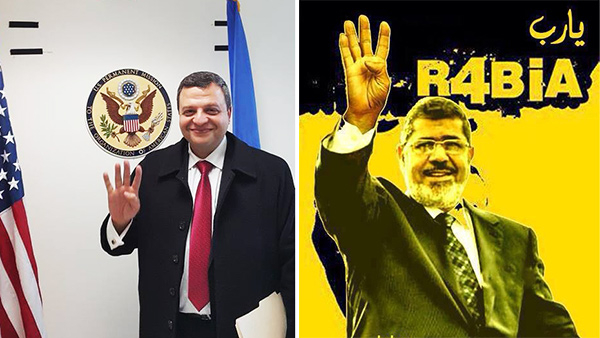
919 (1)While being hosted by the State Department on a visit to Washington in January 2015, Muslim Brotherhood judge Waleed Sharaby (left) flashed the organization’s four-finger “Rabia” sign. At right, ousted Egyptian President Mohamed Morsi (from the Muslim Brotherhood) displays the Rabia sign.

The events in the Sinai Peninsula prove there is no such thing as “political Islam.” There is a radical Islamist leadership that represents itself to the gullible West as “moderate,” preaches violence from the mosques, cloaks itself in ideological-religious tradition, and employs a hard core of Islamist terrorists to carry out attacks on civilians and Egyptian administration targets.

In the meantime, the real victims are the Egyptians. The Muslim Brotherhood’s terrorism has paralyzed Egypt’s tourist industry, as foreigners fear to visit Egypt’s antiquities. And now there are terrorist threats to the New Suez Canal, a project initiated and carried out under the leadership of General Sisi to turn both banks of the two canals into an international logistics, commercial and industrial area.

The Islamists’ plans are clear. First, they want to leverage violence, murder and countless Egyptian army casualties into establishing an autonomous terrorist enclave in the Sinai Peninsula. Then they will try to overthrow the Egyptian government and reinstate an Islamist Muslim Brotherhood regime headed by Morsi. That is exactly what their offshoot, Hamas, did in the Gaza Strip when it liquidated Palestinian Authority officials and established an Islamic emirate. The writing on the wall is still illegible as far as the U.S. government is concerned. Or else the Obama administration is still in the thrall of extremist Islam and its Muslim Brotherhood leaders. The two main ones are Turkey’s Recep Tayyip Erdogan, who has just called new elections so that he can try again to acquire enough seats in parliament to amend Turkey’s constitution to award himself a one-man Sultanate, an absolute dictatorship-for-life to go along with his new palace. The other is Mohamed Morsi, whom Obama apparently is still backing.

It is hard not to conclude, looking at the U.S. president’s record (ignoring the protesters of 2009 in Iran; “I’ve got a pen, and I’ve got a phone” and the dictatorial way the Iran deal has been short-circuited to bypass the democratic process) that in his heart-of-hearts, he is far more committed to supporting extremist Islamist regimes — whether the mullahs of Iran or the Muslim Brotherhood — than to supporting democracy, individual freedoms or human rights.

The Europeans are more aware of the situation but unfortunately woke up too late. As hundreds of thousands of migrants from Muslim lands continue to pour over Europe’s open borders, there is little doubt that radical Islam is poised to take over the West. Islamic communities and terrorist cells continue to mushroom and gather strength throughout the cities of Europe.

From the beginning of the wave of attacks in Egypt, senior Egyptian security officials threatened Hamas. Egypt warned Hamas to stop training, arming and sending its terrorists to collaborate with ISIS operatives in attacks against the Egyptian army. Hamas steadfastly denies any involvement, even as it continues collaborating with ISIS against Egypt.

As far as Hamas is concerned, destroying the Egyptian army is essential, because its continued actions along the Rafah border and in Sheikh Zuweid in the northern Sinai Peninsula prevent Hamas from acquiring money and stockpiling weapons to fight Israel, which weakens its subversion against Mahmoud Abbas and its plans to take over the West Bank.

Despite profuse denials, at the end of August 2015, four operatives from Hamas’s military-terrorist wing, the Izz al-Din al-Qassam Brigades, were taken off a bus by armed Egyptians on the way from Rafah through the Sinai Peninsula to Cairo. Hamas immediately accused Israeli intelligence of responsibility and warned the Egyptian authorities that “the abduction of its operatives will not go unpunished.”

In response, Dina Ramez, a co-host on Egypt’s official TV station, called Hamas out on its lies and denials of its terrorist activities in the Sinai Peninsula against the Egyptian regime. She asked Hamas, “If you are not involved in terrorism, what were your senior Izz al-Din al-Qassam Brigades operatives doing in Sinai?” and called them “cockroaches.”

Sources in Hamas called her a “whore,” and called Egypt a loser country defeated by Israel, using a peace treaty to sell Palestine to the enemy. Was that really the way to thank Egypt for everything it has done for the Palestinians, sacrificing its army and soldiers for us? It is a sad situation for the Palestinians and for our leadership.

What have we Palestinians gained from Hamas’s military actions against Egypt? What have we gained from our solidarity with Islamist organizations fighting against Assad in Syria, or joining organizations such as the “Palestinian Liberation Army” fighting for Assad? Why are we killing each other in the Ain al-Hilweh refugee camp? Why do we refuse everything the Israelis offer us?

Anyone who remembers history remembers the ungrateful path trodden by the Palestinians against the Kingdom of Jordan, when our leaders, headed by Arafat, tried in 1970 to overthrow King Hussein, despite the refuge Jordan offered us during the catastrophes of the Nakba in 1948 and the Naksa in 1967. Then we did the same thing in Lebanon, to where we fled from Jordan. The PLO relocated its headquarters to Beirut, and went on to turn Lebanon into a terrorist country and the lives of the Lebanese into a nightmare. If the Israelis had not invaded Lebanon in 1982, and forced the PLO to relocate to Tunisia (where its behavior was also criminal), the Palestinians definitely would have destroyed Lebanon.

The Middle East is in chaos, and Palestinian factionalism and ingratitude continue to inflame the dissolution of the Arab states and the internal Palestinian division between Hamas in Gaza and the Palestinian Authority in the West Bank.

The world is beginning to understand that the catastrophes of the Middle East have nothing to do with the resolution of the Palestinian issue, but are caused by the innate homicidal tendencies of the Arab rulers and the regional Islamist terrorist organizations.

The only person left who believes the Israeli-Palestinian nonsense is President Barack Obama, even though he is witness to the murders, rapes, beheadings and the millions of refugees, next to which the Palestinian issue is an old, irrelevant and very tired joke.

Egypt sends Assad secret arms aid, including missiles, with Russian funding

August 30, 2015

Egypt sends Assad secret arms aid, including missiles, with Russian funding, DEBKAfile, August 30, 2015

( Given that Egypt is heavily reliant on Saudi funding as well as the absence of any other news source beyond “Debka,” I find this article worthy of a generous helping of salt. – JW )

Egyptain_missile_in_Zabadani_25.8.15

Egyptian President Abdel-Fatteh El-Sisi has begun supplying Bashar Assad with arms, including missiles, after concluding a secret deal with Russian President Vladimir Putin and his consent to pick up the tab, DEBKAfile’s military and intelligence sources reveal. The first batch of short-range Egyptian-made surface missiles has reached the Syrian forces fiercely battling rebels for weeks for the recovery of the strategic town of Zabadani without breaking through (See picture showing missile with Egyptian factory markings.) 

It is not clear if the Egyptian missiles have also been passed to the Hizballah forces fighting with the Syrian army, considering that El-Sisi and Hizballah are at daggers drawn.

Our sources also reveal that the Egyptian arms consignments are freighted from Port Said to the Syrian port of Tartus by Ukrainian cargo vessels. These ships are today the most popular means of transport for clandestine and Black Market arms freights across the Mediterranean and Adriatic Seas.

Sums and quantities are yet to be determined, but Western intelligence sources report that Ukrainian vessels called in at Egyptian ports at least three times from July 22 to Aug. 22 and sailed off to Syria laden with weapons.

It is a deal that may affect the fate of the Assad regime from five, often conflicting, perspectives:

1. By providing Assad with an additional source of weapons, Cairo is reducing his dependence on Iran. This suits the Syrian ruler very well at this time, because he is fully aware of Tehran’s latest steps to draw Gulf rulers and Moscow into supporting a plan for ending the Syrian war, by installing a provisional government in Damascus and so easing his exit.

2. A certain parting-of-the ways has developed between Moscow and Tehran on how to terminate the Syrian conflict. By sending Assad arms, Cairo  casts its vote for Moscow’s perspective in preference to Tehran’s.

3. El-Sisi is now diametrically opposed on Syrian policy to the GCC led by Saudi Arabia and the United Arab Emirates who are patrons of the rebel movement dedicated to toppling Assad.

4. He is also on the opposite side to Israel and Turkey. Israel backs the rebels fighting in southern Syria to create a barrier against the encroachment of Hizballah and Iranian Al Qods Brigades up to its northern border and the Golan. Turkey and the US have reached terms on Syrian policy. Saturday, Aug. 30, Turkish jets carried out their first air strikes in Syria against the Islamic State, as part of its deal with the US.

5. The Russian-Egyptian understanding on the Syrian question is a signpost that clearly marks the way to deepening military and strategic relations between Moscow and Cairo.

Taking the lead on a resolution of the Syrian question, the Kremlin staged a discussion last Tuesday, Aug. 18, with three Arab visitors: Jordan’s King Abdullah, UAE Crown Prince Sheikh Mohamed bin Zayed Al Nahyan and the Egyptian president. It was led by Mikhail Bogdanov, Deputy Foreign Minister in charge of Middle East Affairs, and followed by individual tête-à-têtes between Putin and each visitor in turn.

The Russian and Egyptian leaders did their best, according to DEBKAfile’s Moscow sources, to draw the Jordanian and UA rulers over to their pro-Assad policy, or at least accept common ground for a measure of cooperation. In effect, Putin and El-Sisi were out to convince Jordan and the US to back away from the Syrian rebel cause and the Saudi line. Their future actions may indicate how far they succeeded.

Resolving the Syrian war is not the silver bullet for stopping ISIS

August 29, 2015

Resolving the Syrian war is not the silver bullet for stopping ISIS, DEBKAfile, August 29, 2015

(Please see also, Pentagon Not Targeting Islamic State Training Camps. — DM)

jISIS_mobile_defense_of_SVBIED_8.15ISIS “mobile defense SVBIED” in action in Iraq

President Obama may likewise offer King Salman all sorts of assistance for standing up to ISIS, but he will find no buyers in Riyadh for his failed policy of reliance on Saudi Arabia’s rival, Iran, for liquidating the Islamist threat looming against the oil kingdom from neighboring Iraq.  Neither is US aid much use for stemming the tide of pro-ISIS radicalism spreading among young Saudi men.

As matters stand today, therefore, the Islamic State faces no tangible threat – even if Iran does go ahead and achieve a nuclear bomb.

**************************

The war to stop the Islamic State in Iraq and the Levant (ISIS) has entered a dark tunnel. And with it the bottomless conflicts in Syria, Yemen, Libya and Iraq. The search for a ray of light moves next week from Moscow to Washington, when Saudi King Salman Bin Abdulaziz makes his first visit as monarch for talks with President Barack Obama.

The three worried Arab rulers received in the Kremlin Tuesday, Aug. 25, by President Vladimir Putin could only talk in circles: Egyptian President Abdel-Fatteh El-Sisi,is  embattled on three fronts, Sinai, his border with Libya and Cairo; Jordan’s King Abdullah II – is wedged between two wars; and UAE Crown Prince Sheikh Mohamed bin Zayed Al Nahyan, has sent his army to fight the Yemen insurgency alongside Saudi Arabia.

For them, resolving the Syrian conflict looked like the silver bullet, the key to ending all their troubles. But whichever Russian or Iranian plans and ideas they considered for a way forward, they were all forced to come back to the same impasse. Even Putin and Obama can’t get around or ignore two solid facts:

1. In the year since the US built an international coalition for fighting ISIS, the brutal Islamists have not been cut down; they have instead been empowered to seize more turf outside their Iraqi and Syrian conquests, such big oil fields in Libya, an ascending threat to Egypt and big plans for Lebanon.

2. A major letdown has followed on the high hopes reposed in Iran. The nuclear deal negotiated with the six world powers – and the elevated regional status conferred on Iran – hinged closely on US expectations that Tehran would put up effective military resources for tackling ISIS.

But the Revolutionary Guards, the popular Syrian and Iraqi forces the Guards established,and  the Afghan and Pakistani Shiite militias they imported – none have proved a match for ISIS and jihadi tactics.

In Syria, ISIS stands fast, unthreatened in the terrain, towns and oil fields they have captured, in the past year – excepting only on fringe fronts, where they have been forced back by local Kurdish rebel fighters.

Hizballah is a big part of the disappointment. It was supposed to serve as a bulwark against ISIS invading eastern Lebanon from Syria. Instead, these Lebanese Shiite fighters, allies of Assad’s army, are bogged down in a bitter battle for the strategic Syrian town of Zabadani, after failing to breach Syrian rebel defenses in forays from the south, the north or the center.

The door is therefore open for the Islamist State to march into Hizballah’s strongholds in the Lebanese Beqaa valley and head north to the port of Tripoli for a foothold on the Mediterranean.

Whether Bashar Assad stays or goes, which might have made a difference at an early stage of the Syrian insurgency, is irrelevant now that his army and allied forces are in dire straits.

In Iraq, the forces fighting ISIS are equally stumped. The jihadis are in control of a deadly string of  strategic towns, Ramadi, Faluja, the refinery city of Baiji, Mosul, and most of the western province of Anbar, including Haditha which commands a key stretch of the Euphrates River.

Here, too, the Islamist terrorist army’s lines remain intact, unbroken either by the undercover Jordanian Special Forces campaign 200 km inside Anbar, albeit backed by US and Israeli military and intelligence assistance; by the “popular mobilization committees” set up by the Iranian general Abu Mahdi al-Muhandis, deputy of the Al Qods chief Qassem Soleimani, or less still by US-trained Iraqi army units.

This week, the impasse spurred two combatants into chilling escalations:

— Iran began shipping its solid propellant missile, Zelzal-3B (meaning “earthquake”), across the border into Iraq, in the hope that this powerful projectile, with a range of 250km , would give the Revolutionary Guards their doomsday weapon for tipping the scales against ISIS.

— The Islamists, for their part, embraced a new tactic, known in the west as “SVBIED mobile defense.” Scores of armed vehicles are packed tight with hundreds of tons of explosives and loosed against military convoys on the move and static enemy positions and bases.

This tactic quickly proved itself by killing the 10th Iraqi Division’s chief, deputy and its command staff, as well as the deputy chief of Iraqi forces in Anbar.

In Moscow last week, Putin offered his three Middle East guests Russian nuclear reactors, arms, joint pacts for fighting terror and assorted ideas for the future of Bashar Assad. But he too had no practical proposals for bringing the Islamic State down.

President Obama may likewise offer King Salman all sorts of assistance for standing up to ISIS, but he will find no buyers in Riyadh for his failed policy of reliance on Saudi Arabia’s rival, Iran, for liquidating the Islamist threat looming against the oil kingdom from neighboring Iraq.  Neither is US aid much use for stemming the tide of pro-ISIS radicalism spreading among young Saudi men.

As matters stand today, therefore, the Islamic State faces no tangible threat – even if Iran does go ahead and achieve a nuclear bomb.

Iran Deal: A Potential Kiss Of Death For Liberalism In The Middle East’

August 28, 2015

Iran Deal: A Potential Kiss Of Death For Liberalism In The Middle East’, MEMRI, August 27, 2015

In a July 19, 2015 article on Al-Ahram’s English-language website titled “Iran Deal: A Potential Kiss of Death for Liberalism in the Middle East,”[1]Egyptian blogger and political commentator Nervana Mahmoud criticized the claim made, inter alia, by U.S. President Barack Obama and others in his administration, that the nuclear deal with Iran will strengthen moderate elements in that country.[2] Rather than promote liberals, she writes, the deal will only vindicate Iran’s current theocratic leadership by ending Iran’s isolation. It will also, she stresses, send a message to other authoritarian regimes in the region that the U.S. is likely to overlook their crackdown on dissidents, while encouraging Islamist movements to emulate Iran by embracing extremism.

Ms. Mahmoud goes on to accuse the Obama administration of promoting “illiberalism” by defining as moderate “any group, entity, or state willing to show pragmatism and cooperation with the United States, regardless of that state’s intolerant actions on the ground.”

24629Nervana Mahmoud (Image: Nervana1.org)

“For The Iranian Mullahs, The Nuclear Deal Is An Indirect Acknowledgment From The West That Their Anti-Modernity Model Is Viable And Successful”

“After 12 years of diplomatic proposals and 20 months of tough negotiations, theocratic Iran and world powers have reached a nuclear deal that, regardless of its potential advantages, is undoubtedly a victory for smart illiberalism and a potential kiss of death for the prospect of liberal, pluralistic democracies in the Middle East.

“Both illiberal Shi’a and Sunni Islamists and illiberal non-Islamist autocrats could receive an enormous boost from the deal.

“A few years ago, against all advice, I visited the Islamic Republic of Iran. To my surprise, I found a vibrant nation, with many liberal youth yearning for freedom and democracy. Those youth may now celebrate the lifting of sanctions and the end of isolation, but it is doubtful the nuclear deal will bridge the deep divide between them and their theocratic rulers.

“For the Iranian Mullahs, the nuclear deal is an indirect acknowledgment from the West that their anti-modernity model is viable and successful. U.S. President Barack Obama may be genuine in his hopes that Iran will abandon its ‘path of violence and rigid ideology’ following this ‘historic agreement,’ but his hopes may turn out to be no more than wishful thinking.

“The regime – now less isolated–has less incentive to couple its agreed abandonment of its nuclear program with an abandonment of what it sees as successful ideology than ever before.”Many commentators have pointed out that the deal could not have come at a worse time for the Arab world. With open sectarian tension in many Arab countries, a strong Islamic Iran will only inspire other political Islamic groups to try to match up to the Mullahs.

“Iran’s regional influence in Lebanon, Iraq, Syria, and Yemen will only prompt a counter-movement by forces that share an underlying belief in Islamism, but differ in its sectarian interpretation. Since 1979, Sunni Islamism has learned one important lesson from Iran: ‘Yes, we can’ -– a slogan the Islamists touted quietly, long before Obama uttered those words in 2008.

“Arab Islamists saw theocratic Iran as a perfect model for fulfilling their dream of ruling Muslim societies. The new nuclear deal will add two more lessons, and liberal democracy is not one of them– defiance and lobbying in Washington…

“Last Saturday, Ahrar Al-Sham, an Islamist Sunni insurgent group fighting in Syria, published an article in the Washington Post claiming to believe in ‘a moderate future for Syria.’ Charles Lister, a visiting fellow at Brookings, scrutinized their claim: ‘Ahrar Al-Sham has been one of the most consistent military allies of Al-Qaeda affiliate Jabhat Al-Nusra.’ The publication of the article in itself indicates how some people in the corridors of power in Washington are willing to buy Ahrar’s narrative.

“The implication for Syria could not be more serious. Syria will continue to be torn between two mutually exclusive Sunni versus Shi’a forces; many of them are radical, ruthless, and undemocratic. Somehow, the Obama administration seems to see no problem in embracing both…’However, tacitly embracing radical Shi’a militias’ fight against radical Sunni groups such as the Islamic State (ISIS), while pretending that other radicals such as Ahrar Al-Sham are moderate, does not seem to be a sound strategy.”

“It Is Dangerous For The U.S. To Empower Illiberalism In A Region That Suffers Mainly As A Consequence Of Its Illiberal Players”

“In Egypt, neither the removal of Hosni Mubarak nor the ousting of Muhammad Mursi has produced a liberal democracy. Moreover, a significant section of the Muslim Brotherhood, despite its antipathy to Shia Islamism, has started to view the Iranian model as the way forward to regain power.

“They wrongly attribute their failure to run the country during Morsi’s tenure to what they describe as their ‘reluctance to embrace revolutionary politics.’ The Mullahs’ violent ejection of their opponents in 1979 is seen as ‘a model.’ In addition, the Muslim Brotherhood and its supporters will continue to lobby in Washington, hoping that its projection of an Iranian–style defiance will convince the Obama Administration to exert pressure on the leadership in Cairo to change its posture toward the group.

“On the other hand, many among President Abdel Fattah El-Sisi’s supporters will use Iran as a pretext to justify more crackdown on opponents, and argue that world powers, which are willing to lift sanctions against the Iranian regime, despite 36 years of ruthless rule, have no moral ground on which to judge Egypt.

“In his speech in Cairo in 2009, President Obama advocated tolerance, respect for minorities, and religious freedom. He also said elections alone do not constitute a true democracy.

“Now, as Hisham Melhem, Bureau Chief of the Al Arabiya News Channel in Washington, has pointed out, ‘after almost six and a half years of trying to shape events in the Middle East, President Obama has very little to show for it except the nuclear deal with Iran.’ More alarmingly, the American president seems to have lowered the bar, and is now willing to accept a softer definition of moderation to include any group, entity, or state willing to show pragmatism and cooperation with the United States, regardless of that state’s intolerant actions on the ground.’

“There are intrinsic reasons behind the metastasizing sectarian and ethnic conflicts that followed the failed Arab awakening. It is unreasonable to expect the United States to ‘fix’ the region; however, it is dangerous for the U.S. to empower illiberalism in a region that suffers mainly as a consequence of its illiberal players. It would be a pity if President Obama went down in the history books as the man who fumbled with the West’s anti-illiberalism alarm button, and embraced the enemies of liberalism in the Middle East.”

_____________________

Endnotes:

[1] English.ahram.org.eg, July 19, 2015.

[2] See for example Obama’s interviews in Al-Sharq Al-Awsat (Aawsat.net, ,May13, 2015) and with National Public Radio (Npr.org, April 7, 2015).

Egypt bids for two advanced French helicopter carriers – counterweight to the Iranian navy

August 27, 2015

Egypt bids for two advanced French helicopter carriers – counterweight to the Iranian navy, DEBKAfile, August 27, 2015

mistral-_Saint-Nazaire_western_France_May_25_2015Mistral carriers at Saint-Nazaire shipyard

Egypt is in advanced negotiations with France for two highly advanced French Mistral class assault-cum-helicopter carrier ships that were originally destined for the Russian Navy. DEBKAfile’s military and intelligence sources report that this deal, if it goes through, will substantially beef up the regional lineup of the Saudi, Egyptian and Israeli navies. The new vessels would enable it to contest Iranian naval challenges in the Mediterranean, the Red Sea and the Persian Gulf, and alter the balance of strength between the opposing sides.

Saudi Arabia and the United Arab Emirates have given presidents Abdel-Fatteh El-Sisi and Francois Hollande pledges to fund the transaction at $800 million per carrier.

The Mistrals will join the missile ships of Saudi Arabia, Egypt and Israel and six Dolphin submarines which, according to foreign sources, are capable of firing nuclear-tipped ballistic missiles. Their delivery comes at a time of strengthening strategic ties among Egypt, Saudi Arabia, the UAE and Israel.

The Egyptian navy stands to own the most advanced warships of any Middle East power. The French vessels may also be used as aircraft carriers, because their decks are designed to carry fighter jets as well as helicopters. The only nations maintaining this type of vessel in the region are outsiders – the US, which deploys a Wasp class helicopter for marines; Russia, the ageing Moskva class copter carrier, and France.

Originally ordered from France by the Russian Navy, the pair of Mistrals was never delivered owing to the sanctions the European Union imposed on Moscow after the Ukraine invasion.

It is a multi-purpose warship, able to accommodate 16 “European Tiger” four-bladed, twin-engined attack helicopters, four large landing craft for dropping 450 marines on shore, 70 armored vehicles, including 14 heavy AMX Leclerc assault tanks.

These figures are flexible. If necessary, the French carriers can handle an expanded complement of 900 marines and 40 tanks. It is also a command ship geared to maintain communications with military forces located anywhere in the world. It also carries a 69-bed field hospital. The Mistral has a maximum speed of 18 knots and maximum range of 20,000 miles.