Posted tagged ‘Donald Trump’

Worrying signs in Democratic platform

June 27, 2016

Worrying signs in Democratic platform, Israel Hayom, Zalman Shoval, June 27, 2016

Israel and its allies in the Democratic Party cannot afford to be complacent in light of the prevailing trends in the drafting committee.
*************

As is the case every four years before U.S. presidential elections, Israelis try to figure out which candidate will be better for Israel. The answer is often: Whoever is elected.

This does not mean that both presumptive nominees, Hillary Clinton and Donald Trump, are identical political twins. What it does mean is that candidates’ rhetoric on the campaign trail usually has little impact on their overall policy once they become president. In any case, it is not wise for Israelis to speak out on such issues. And in any event, such talk has no bearing on the election’s outcome.

But this should not prevent us from discussing the official party platforms, which are updated ahead of each election. Israelis will find it hard to stay ambivalent about the emerging Democratic platform in light of its clauses dealing with the Israeli-Palestinian conflict. Although the new platform will only be formally adopted at the Democratic National Convention in July, the new language introduced over the weekend on Israel-related issues makes it abundantly clear that the party is distancing itself from its traditional pro-Israel stance.

This trend was evident in 2012 as well, when the Democratic Platform Drafting Committee removed a clause mentioning Jerusalem as Israel’s capital — only to have it reinserted following pressure by party leaders. This time the very nature of the drafting committee underscores the negativity toward Israel. Five members of the committee were appointed by Vermont Senator Bernie Sanders and six were appointed by former Secretary of State Hillary Clinton (and four more were appointed by the Democratic National Committee).

But what matters more is not the proportion of pro-Sanders members in the committee, but their identities. They include James Zogby, a leading pro-Arab activist; U.S. Representative Keith Ellison (D-Minn.), a Muslim; and Dr. Cornel West, a professor with provocative views on Israel who has embraced the boycott, divestment and sanctions movement and has come out against the Israeli “occupation.”

The Clinton campaign is fully aware of the electoral damage an anti-Israeli platform could inflict on her candidacy, not to mention the financial fallout on her fund-raising efforts, even if the platform is described as “balanced.” This is why her allies took pains to make sure the drafting committee hears out expert testimony from the likes of Dennis Ross, who served as a Clinton’s Middle East adviser, and former key Democratic lawmakers, but this did not sway the hard-core Sanders loyalists. Sanders has been invigorated by his impressive campaign against Clinton, while Clinton has had to deal with very low favorability ratings.

Thus, Sanders has had the upper hand in the ideological arm twisting, even though Clinton’s supporters have gone out of their way to describe the new language as a compromise that does not depart from the party’s traditional stance. They explained that it was designed to help party unity.

But here are the facts. Ellison, who represents Sanders on the committee, and Rep. Luis V. Gutierrez from Illinois, who represents Clinton, wrote a joint statement calling on party delegates to adopt the new language on Israel during the convention. They published it on left-wing organization J Street’s blog. Gutierrez recently returned from a trip to Israel and the Palestinian Authority organized by a pro-Palestinian group.

“Israelis today live in fear of acts of terror that can turn peaceful marketplaces and neighborhoods into scenes of violence and horror,” the two warned in their statement. “Palestinians struggle under an unjust occupation that deprives them of the rights, opportunities and independence that they deserve.” The statement made no mention of Palestinian incitement, of the Palestinians’ unwillingness to hold talks without preconditions, of Hamas, or of the real reasons behind the century-old conflict.

The committee has yet to publish its views on Jerusalem, but judging from how things have recently unfolded, keeping the 2012 language on the city is anything but guaranteed.

Some play down the importance of party platforms, and sometimes this dismissive approach has merits, including in Israel. Having said that, Israel and its allies in the Democratic Party cannot afford to be complacent in light of the prevailing trends in the drafting committee.
Why we must support Donald Trump

June 27, 2016

Why we must support Donald Trump, American ThinkerCarol Brown, June 27, 2016

I supported Ted Cruz during the primaries and struggled mightily with Donald Trump (and in many ways, still do). But I will vote for Trump in November because as intrigued as I was early on by the NeverTrump movement, it’s clear these folks (who stand on soap boxes of personal integrity) are putting self before country.

David Horowitz and Daniel Greenfield of Front Page Magazine are two conservatives among many who have been covering the urgent need to get behind Trump. Writing in forceful and eloquent ways, they are sounding the alarm, pointing out critical differences between Trump and Clinton. Most recently Horowitz wrote:

Barack Obama delivers nuclear weapons and $150 billion to America’s mortal enemy in the Middle East…

But when Donald Trump insinuates the president is a man of uncertain loyalties, Republican leaders back away from him. When Trump proposes fighting “radical Islam,” securing America’s borders, stopping unvetted immigration from Muslim terrorist states, surveilling mosques, and scrutinizing the families of terrorist actors, Republicans join Democrats in denouncing him, or take an uncomfortable distance or maintain a silence that leaves him to fend for himself. [snip]

…Democrat betrayers of America are on the attack, while Republican leaders who claim to be patriots are on the run…This is the sad state of the Republican forces in retreat in an election campaign that will decide the fate of our country.

The threat of Islam, terror, and open borders drives home the fact that without national security, all else is moot. And on this front alone, Donald Trump’s views are dramatically different from Hillary Clinton’s. The gap between Trump and Clinton on national security is so wide it is one that might one day save your life. Or mine. Or the lives of Republicans who will not vote for Trump because, you know: integrity. As if casting a vote that helps ensure that a criminal, socialist, Islamist sympathizer gets to plop herself down in the oval office in order to continue the destructive and downright evil work of the past eight years is an act brimming with integrity.

To those whose delicate sensibilities are offended by Trump, I ask: Are your sensibilities not offended by Clinton? Because if they’re not, then you should register as a Democrat. And if they are, then the reality is that it will be Clinton or Trump.

Choose one. “Conscientious objector” is an adolescent cop-out. Our nation is at war (albeit a one-sided one we refuse to fight). All adults are needed on deck.

As Daniel Greenfield wrote concerning those who are committed to abandoning our presumptive nominee and helping to “usher in eight years of left-wing rule” that embraces “positions well to the left of Obama”:

Political campaigns can get ugly and Trump’s style is, at times, to get as nasty as possible, but it’s a sign of misplaced insider priorities to allow personal animus to matter more than the war against the left. It’s not unreasonable for some conservatives to be angry at Trump and his tactics. It is unreasonable to let that anger turn into a petulance that would let the left rule the nation for another eight years.

So to those holier-than-thou conservatives who refuse to vote for Donald Trump because their personal integrity will not allow them to do so, I say: If you want more jihad, don’t vote for Trump and help Hillary win. If you want to be sure our borders remain open, don’t vote for Trump and help Hillary win. And if you want the next president to be someone who got Americans killed and then lied about it, don’t vote for Trump and help Hillary win. And when Hillary Clinton is sworn in as the next president, you can pat yourself on the back, know you did the right thing, and raise a glass to your integrity, which will have served your ego but not the nation.

The primaries are over. Whatever happened, happened. Whatever rude, obnoxious, manipulative behavior Trump engaged in is in the past. Voting for him doesn’t mean you condone such behavior, you support everything he has expressed, you trust him implicitly, or that you even like the guy. It means you understand what’s at stake and have the maturity to move beyond your own ego in order to be a true patriot.

We either have a shot at a future or we don’t.

Trump gives America a chance to survive. And maybe even do better than that.

Why Brexit Is More Entrance Than Exit

June 26, 2016

Why Brexit Is More Entrance Than Exit, PJ MediaRoger Kimball, June 26, 2016

(The petition for a new referendum poll was apparently a scam.

The BBC, The Mirror, France 24, The Telegraph, Manchester Evening News, The Guardian… all reported on the bogus petition.

But they got punked. The poll was manufactured by 4Chan and Anonymous hackers who loaded up the signatures with fake names from The Vatican, Ghana, North Korea and elsewhere. [Emphasis in original — DM]

The petition fit the meme, so it deserved and got no fact-checking — DM)

Pop psychologists tell us that grief proceeds through five stages: denial, anger, bargaining, depression, and acceptance. Have been blindsided by the stunning victory of Brexit on Thursday,  members of the camp of  the Remainders are now vibrating somewhere between anger and bargaining. This followed hard on a brief period of stunned denial that often expressed itself as gulping incredulity. As the psychiatrist Theodore Dalrymple observed in City Journal,

For a long time, Britons who wanted their country to leave the European Union were regarded almost as mentally ill by those who wanted it to stay. The leavers didn’t have an opinion; they had a pathology. Since one doesn’t argue with pathology, it wasn’t necessary for the remainers to answer the leavers with more than sneers and derision.Even after the vote, the attitude persists. Those who voted to leave are described as,ipso facto, small-minded, xenophobic, and fearful of the future. Those who voted to stay are described as, ipso facto, open-minded, cosmopolitan, and forward-looking.

At this point it is not clear exactly when the Brits will formally invoke Article 50 of the Treaty on European Union and officially begin the withdrawal negotiations. But Thursday’s vote made Britain’s congé in the most stinging and public manner.

As of this writing, early Sunday morning, the Remainders have yet to take that rebuke on board. They have, however, moved firmly from denial to white hot anger, as the movement to invalidate the referendum by holding a second referendum attests. As of last night, a petition demanding that Parliament force a new referendum had attracted some 2 million signatures.

The fatuousness of that effort is as patent as it is contemptible. Back in 2009, Barack Obama smugly observed that “elections have consequences.” Thursday’s vote was a non-binding referendum, not an election, but it most assuredly has consequences, as (for example) the immediate announcement by David Cameron, the prime minister, that he would soon be resigning demonstrates.

I expect that the Remainders will soon abandon the petition and move on to more circuitous, backroom maneuvers to subvert or nullify the will of the people. It is at that point, when the delayers and dispensers of red tape arrive with their megaphones, that we’ll know that the bargaining stage has been definitively reached. (I am no psychologist, but my observation is that most people, even if they  do progress through the five stages described, do not entirely leave behind the earlier stages. There generally persists, I believe,  a bit of denial and more than a bit of anger.)

Fraser Nelson, editor of The Spectator, put his finger on one of the most extraordinary features of the Brexit phenomenon: that the vote turned out the way it did despite the Establishment’s mobilization of every resource at its command against it. “Never,” he wrote in an article for The Wall Street Journal,  “has there been a greater coalition of the establishment than that assembled by Prime Minister David Cameron for his referendum campaign to keep the U.K. in the European Union.”

There was almost every Westminster party leader, most of their troops and almost every trade union and employers’ federation. There were retired spy chiefs, historians, football clubs, national treasures like Stephen Hawking and divinities like Keira Knightley. And some global glamour too: President Barack Obama flew to London to do his bit, and Goldman Sachs opened its checkbook.And none of it worked. The opinion polls barely moved over the course of the campaign, and 52% of Britons voted to leave the EU. That slender majority was probably the biggest slap in the face ever delivered to the British establishment in the history of universal suffrage.

I’d say that 52%  is closer to “decisive” than “slender,” but Nelson’s point is well taken. The Remainders threw everything they had into this campaign, but it availed them nothing. The British people don’t like what the commissars in Brussels have been doing to their country. What is euphemistically called “immigration” — really, it is a sort of invasion – was part of the story, but only a part. Remainders seized on immigration as the motivating issue because it was easy to weaponize and use it to castigate those who favored Brexit as troglodytic nativists and reactionaries.

As I noted yesterday, the Brexit vote was less an “anti-Europe” vote than a positive assertion of freedom. Indeed, it was by accentuating the positive, by underscoring Brtain’s native strengths and potential, that Brexiteers like Boris Johnson were able to give affirmative voice to the people’s disenchantment. The unease that many Brits felt under the regulatory yoke of the EU is felt by many other people, including many Americans.

As has been often pointed out, that unease helps to explain the success of Donald Trump.  Would that Trump had a scintilla of the insight and affirmative spirit of Brexiteers like Boris Johnson, Dan Hannan,Michael Gove, and Nigel Farage.  Despite desperate howls to the contrary, the campaign these men waged triumphed not because of what they were repudiating but what they were saying Yes to. Sure, the campaign involved a No to officious interference by corrupt and unaccountable officials across the channel. But the main course was Yes: Yes to freedom, Yes to individual responsible, Yes to deciding for ourselves how we will govern ourselves.

There’s a moral here for politicians, and for political pundits.  It’s unclear, however, whether many people are bothering to read the script.

Joe Biden to China: Curb North Korea or Japan Can Go Nuclear ‘Virtually Overnight’

June 26, 2016

Joe Biden to China: Curb North Korea or Japan Can Go Nuclear ‘Virtually Overnight’, Breitbart, Frances Martel, June 24, 2016

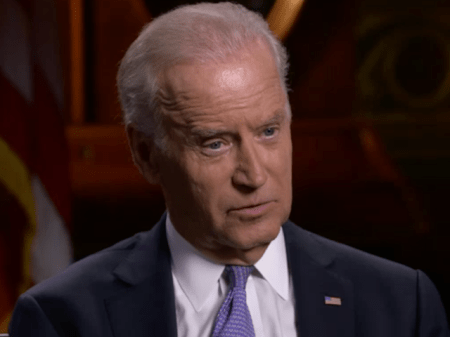
Joe Biden

Vice President Joe Biden warned China that the Japanese government may acquire nuclear weapons “virtually overnight” if the threat from North Korea becomes too grave, urging Beijing to do more to curb Pyongyang’s belligerence.

The Vice President’s comments echo those of presumptive Republican presidential nominee Donald Trump, who warned that Japan and South Korea acquiring nuclear weapons “is going to happen anyway” in controversial remarks issued in March. Japanese government officials and media responded to Trump’s comments much more severely than they have to Biden’s.

“What happens if Japan, who could tomorrow, could go nuclear tomorrow? They have the capacity to do it virtually overnight,” Biden told PBS host Charlie Rose in an interview broadcast Monday. He explained that he made this warning to Chinese President Xi Jinping personally while discussing the deployment of a Terminal High Altitude Area Defense (THAAD) system in South Korea to protect from a North Korean attack, a move that China has condemned vocally.

“When I tell President Xi, you have to understand we got a guy up there in North Korea who is talking about building weapons that can strike, nuclear weapons strike the United States and not only Hawaii and Alaska, but… the mainland of the United States,” he told Rose. “And I say, so we’re going to move up our defense system, and he says no, no, no, wait a minute, my military thinks you’re going to try to circle us.”

Biden suggested that China, a fellow communist country, “has the single greatest ability to influence North Korea.”

Japan has issued a tepid response to the remarks, with Japanese Deputy Chief Cabinet Secretary Hiroshige Seko telling reporters Friday that Japan simply “can never possess nuclear weapons.” Japan remains the only nation in the world to experience a nuclear weapon attack.

In March, Trump stated that both Japan and South Korea were likely to develop nuclear capabilities due to their access to advanced technology. “It’s going to happen, anyway. It’s only a question of time. They’re going to start having them, or we have to get rid of them entirely,” he said, suggesting that, should the move be inevitable, the United States should do more to curb its defense expenses in Asia protecting wealthy nations.

In response, Foreign Minister Fumio Kishida stated that Japan having nuclear capabilities was “impossible,” and national newspaper Asahi Shimbun described national leaders as responding with “bewilderment and unease.

The government of North Korea has behaved with extreme belligerence in 2016, beginning the year with the detonation of what they claimed was a hydrogen bomb and repeatedly launching missiles towards Japan (all have failed to reach their targets). Most recently, North Korea tested what are believed to be two Musudan ballistic missiles, with one reaching the greatest height the nation has yet to achieve on a test.

China responded to the new test by calling for North Korea to “act with caution and refrain from taking actions that may elevate tension on the Korean peninsula.” China recently backed expanded UN sanctions on North Korea, but has condemned U.S. and South Korean defense buildups in response to Pyongyang, claiming that the also put Beijing in the line of fire.

While China has kept its criticism of North Korea tepid and remained its largest trade partner, the volume of that trade has declined significantly. Imports from North Korea dropped 12.6 percent between May 2015 and May 2016, while exports to North Korea fell 5.9 percent in the same time period.

Brexit – Backlash from mass migration and ISIS

June 25, 2016

Brexit – Backlash from mass migration and ISIS. DEBKAfile, June 24,2016

BREXIT_23.6.16

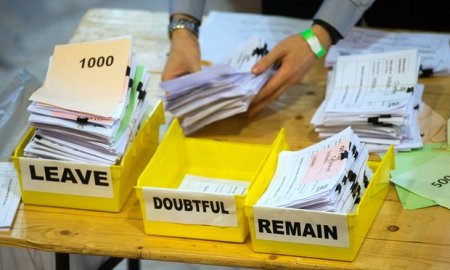
In a historic referendum, millions of British citizens voted Thursday, June 23, to leave the European Union after 43 years by a margin of 52 to 48 percent. Many were undoubtedly moved into approving this pivotal step by three seismic world events:

1. The mass migration flowing into Europe from the Middle East and Africa under the EU aegis. Forebodings in the UK were fueled by figures released a week before the referendum showing an influx of 330,000 migrants to Britain in 2015.

2. The war on the Islamic State which poses a peril which most Western governments avoid addressing by name as World War III in the making.

3. The inability of those governments, beyond empty words, to grapple with the war on ISIS or cope with the  mass of migrants expected to beat on the gates of Western societies for many more hard years.

Many Americans and Europeans are dissatisfied and resentful of President Barack Obama’s approach to the war on ISIS, which is to dismiss the enemy as a minor band of fanatics and thus, rather than a war against Islam. Neither do they accept German Chancellor Angela Merkel’s magnanimous invitation to take refugees in – 1.5 million in two years – as her country’s moral responsibility.

This popular disgruntlement has thrown up such antiestablishment figures as Donald Trump in the US and Boris Johnson in Britain and contributes to the rise of far right-wing movements and extremist violence on both continents.

Those two leaders, though different in most other ways, owe much of their popularity to the pervasive fear in their countries that surging immigration will forever alter the fabric of their societies.

Such social upheaval is the result of a trap deliberately set for the West by two Muslim leaders: ISIS “caliph” Abu Bakr al-Baghdadi, and Turkish President Tayyip Reccep Erdogan.

Al-Baghdadi conceived the idea of flooding the western world with waves of immigrants from Africa and the Middle East as a way to achieve three targets:

a) To change the composition of the population of Western countries by expanding the Muslim increment.

b) To plant networks of ISIS terrorists in the West.

c) To boost ISIS Middle Eastern arms, people and drugs smuggling networks as the organization’s main source of income. Migrants are willing to pay an average of between 5,000 and 10,000 dollars to reach the West even though they know that many never make it alive.

Al Baghdadi made up for the revenue shortfall caused by the US bombing of ISIS-held oil fields and money reserves by pushing over a new wave of immigrants.

President Erdogan’s motives are quite different.

He allowed the waves of immigrants to pass through Turkey on their way to the US and Europe – just as for years, he allowed Western jihadists joining ISIS to reach Siria via Turkey – because he was consumed with the desire to punish the US, namely, the Obama administration, for refusing to back up his hegemonic aspirations in the Middle East; Europe was punished for denying Turkey EU membership year after year.

The victory of Boris Johnson’s “leave” campaign – in the face of Obama’s personal championship of Prime Minister David Cameron’s bid to keep his country in, supported by the Democratic presumptive nominee Hilary Clinton – was a loud and clear signal for politicians running in future elections in the West, including the US presidential vote in November.

Republican candidate Donald Trump’s call to stop Muslim immigration into the US until proper screening measures are in place may sound like an unformed idea, but no other US politician has dared put it on the table, or directly challenge the hollow words and self-righteous hypocrisy of Obama and Clinton on the issues of terror, wars in the Middle East and mass immigration. This alone gives Trump a popular edge in widening circles in the USA over his rival.

Trump is not likely to lose votes either by his pledge to rebuild NATO for leading the West in the war against Islamic terror.

During the five months up until the US presidential election, the West can expect more large-scale ISIS terror coupled with dramatic events in the wars raging in at least seven countries  – Iraq, Syria, Lebanon, Jordan, Egypt, Libya and Afghanistan. Refugees in vast numbers will continue to batter down the doors of countries that are increasingly unable and unwilling to accept them.

Wars in general and religious wars in particular, have throughout history thrown up massive shifts of population displaced by violence, plague, falling regimes, famine and economic hardship.

The year 2016 will go down as the year in which Middle East crises spilled over into the west, bringing social change and far-reaching political turmoil in their wake.

And this is only the beginning.

Neocons Endorse Hillary as the US Party of Empire Is Finally Revealed

June 24, 2016

Neocons Endorse Hillary as the US Party of Empire Is Finally Revealed, The Daily Bell, June 24, 2016

hillary-clinton-war

Kagan and Hillary are actually agents of empire. They are facilitators of globalism and will use the military apparatus of the US to advance their goals.

The quarrel Kagan and others really have with The Donald is that he has stated his discomfort with Kagan’s style of empire building.

**************************

Exclusive: Prominent GOP Neoconservative to Fundraise for Hillary Clinton  A prominent neoconservative intellectual and early promoter of the Iraq War is headlining an official campaign fundraiser for Hillary Clinton next month, Foreign Policy has learned. -FP


The husband of State Dept. political agitator Victoria Nuland is raising money for Hillary.

According to Foreign Policy, Robert Kagan, co-founder of the Project for the New American Century, is going to speak at Hillary’s fundraiser in DC’s Logan Circle neighborhood, July 21.

Foreign Policy states that this marks a shift in the Clinton campaign because it seems she is now willing to associate with high level Republicans who are determined to ruin Trump’s chances of becoming president.

Mr. Kagan and Victoria Nuland sit near the heart of a certain kind of global authoritarianism that will use any tool to sustain itself and expand its presence.

Nuland was a central figure in the forceful political transition in Ukraine. As co-founder of the Project for the New American Century, Kagan helped orchestrate the US response to 9/11. Some might think he actually had a hand in 9/11, though there has never been any evidence offered that he had.

No doubt his vision helped supporte the advent of Homeland Security and other bureaucratic and intelligence entities that have fundamentally changed the way the US operates, and not for the better.

More:

According to an invite obtained by FP, the “event will include an off-the-record conversation on America’s continued investment in NATO, key European allies and partners, and the EU.”

“I feel comfortable with her on foreign policy,” Kagan told the New York Times in 2014. “If she pursues a policy which we think she will pursue it’s something that might have been called neocon, but clearly her supporters are not going to call it that; they are going to call it something else.”

Basically, Kagan is calling Hillary a fellow neocon, at least when it comes to foreign policy.

But Kagan’s solidarity with Hillary doesn’t extend to Obama whom he has criticized, according to the article, for not being more forceful in Syria or more confrontational with Russia.

Kagan wants more defense spending and in a New Republic Cover story entitled “Super Powers Don’t Get to Retire,” he supported an aggressive, global U.S. diplomatic and military presence.

His views are much different than Trump’s, though supposedly they belong to the same party.

What we have here is a situation where the Democratic nominee is a good deal more attuned to an important Republican than the putative GOP presidential candidate.

The problem here is really one of labels. Kagan and Hillary are actually agents of empire. They are facilitators of globalism and will use the military apparatus of the US to advance their goals.

The quarrel Kagan and others really have with The Donald is that he has stated his discomfort with Kagan’s style of empire building.

Ironically, as Hillary shares Kagan’s point of view, the two have more in common with each other than Kagan has with Trump.

This is the real schism of American politics. And because of Trump, it cannot be papered over anymore.

Trump has certainly been a polarizing influence. One could even say he has forced truthfulness onto the political scene.

The real political struggle in the US remains between empire and small-r republicanism.

The party system itself is an inchoate mess. The most powerful political party, the Party of Empire embodied by Kagan, is hidden inside both parties without a name.

Conclusion: It is the Party of Empire that has been in  charge in the US since World War II. And this nameless party sees Trump as a threat. He has so polarized the electoral process that real alliances have now had to emerge. They are much different than what one might expect.

Populist Anger Upends Politics on Both Sides of the Atlantic

June 24, 2016

Populist Anger Upends Politics on Both Sides of the Atlantic, New York TimesJune 24, 2016

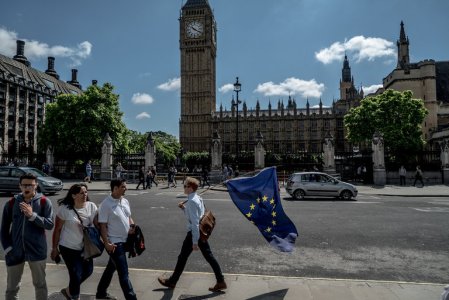
25europe-web2-master768Outside the Houses of Parliament in London on Friday. Credit Andrew Testa for The New York Times

Time and again, the European Union has navigated political crises during the past decade with a Whac-a-Mole response that has maintained the status quo and the bloc’s lumbering forward momentum toward greater integration — without directly confronting the roiling public discontent beneath the surface.

“There is a very widespread rejection of politics everywhere. There is a similar mood in the United States, an antipolitical sentiment.”

***************************

LONDON — From Brussels to Berlin to Washington, leaders of the Western democratic world awoke Friday morning to a blunt, once-unthinkable rebuke delivered by the flinty citizens of a small island nation in the North Atlantic. Populist anger against the established political order had finally boiled over.

The British had rebelled.

Their stunning vote to leave the European Union presents a political, economic and existential crisis for a bloc already reeling from entrenched problems. But the thumb-in-your-eye message is hardly limited to Britain. The same yawning gap between the elite and mass opinion is fueling a populist backlash in Austria, France, Germany and elsewhere on the Continent — as well as in the United States.

The symbolism of trans-Atlantic insurrection was rich on Friday: Donald J. Trump, the presumptive Republican presidential nominee and embodiment of American fury, happened to be visiting Britain.

“Basically, they took back their country,” Mr. Trump said Friday morning from Scotland, where he was promoting his golf courses. “That’s a good thing.”

25europe-web4-master675Donald J. Trump, the presumptive Republican presidential nominee for president, arriving at his Trump Turnberry resort in Scotland on Friday. Credit Jeff J Mitchell/Getty Images

Asked where public anger was greatest, Mr. Trump said: “U.K. U.S. There’s plenty of other places. This will not be the last.”

Even as the European Union began to grapple with a new and potentially destabilizing period of political uncertainty, the British vote also will inevitably be seized upon as further evidence of deepening public unease with the global economic order. Globalization and economic liberalization have produced winners and losers — and the big “Leave” vote in economically stagnant regions of Britain suggests that many of those who have lost out are fed up.

Brexit Vote Has Huge Ramifications for U.S. Politics

June 24, 2016

Brexit Vote Has Huge Ramifications for U.S. Politics, PJ MediaRoger L Simon, June 23, 2016

(Amen! — DM)

roger_brexit_article_banner_6-17-16-1.sized-770x415xc (1)

A bubble has broken, but it isn’t a stock bubble. It’s a human bubble consisting of elites who seek to govern in a manner not all that distant from Comrade Lenin, just hiding under a phony mask of bureaucratic democracy. They’ve taken a big body blow from the citizens of England. Churchill would be proud.  Time for America to follow suit.

***********************

News flash: The revolt against elites is real in the UK and America and it’s only getting started. Maybe there will always be an England.

In a surprise, Leave won the Brexit referendum on whether to stay in the European Union by an equally surprising amount. British sovereignty won. David Cameron lost. Jeremy Corbyn lost. The EU lost. Bureaucrats lost. Angela Merkel lost. Barack Obama lost. Globalism lost. Authority figures almost everywhere lost. And, most of all, unlimited immigration lost.

So what happened to the vaunted British betting market that is almost invariably correct and was predicting by 80 percent a Remain victory? Or all those recent polls that were tilting Remain?

Answer: Those same elites had convinced each other they would win and therefore convinced the usual suspects—media, pollsters and, sadly, financial markets—that they were right. They were wrong. Watching them now on the BBC they still cannot comprehend  what has happened. The peasants have revolted—oh no, oh no. There must be some mistake. Didn’t they get the memo? The sky would fall if they left the EU.

Earth to elites: Citizens of truly democratic countries don’t want unlimited immigration into their countries by people who couldn’t be less interested in democracy. They also don’t want to be governed by the rules and regulations of faceless bureaucrats whose not-so-hidden goals are power and riches for themselves and their friends. Simple, isn’t it?

This vote is of immense help to Donald Trump if he is smart enough to seize it properly and doesn’t bobble the ball. Many, probably most, Americans feel exactly the same as their brothers and sisters across the pond. They despise the same elites and want to save their country. Trump, now fortuitously in Scotland (I know—they voted Remain, but not in the numbers they were supposed to), should show his support. The  UK is America’s closest ally.  We should be the first to extend a hand, negotiate free trade, etc., and get her rolling again.

That most elite of presidents, Barack Obama, who opened his morally narcissistic mouth supporting the Remain side and warning the British people, as he is wont to do, that there would be “consequences” if they voted to leave the EU, is in no position to do anything, even if he wanted to.  And he doesn’t.

Hillary Clinton is so elitist she practically defines the term. She was probably up all night figuring out what to do about the situation. I have a suggestion—move to Brussels.

Meanwhile, Trump should take up the gauntlet for the U.S. and the UK now. Why wait? Act like the president—we could use one.  Donald has a natural ally in the leading Leave spokesperson conservative Boris Johnson. The two men are said to be similar and in many ways they are.

Long live the Anglosphere. Remember the Magna Carta and all that. This is a day truly to celebrate, even if stock markets are crashing around the world. They’ll come back. Look on it as a buying opportunity. A bubble has broken, but it isn’t a stock bubble. It’s a human bubble consisting of elites who seek to govern in a manner not all that distant from Comrade Lenin, just hiding under a phony mask of bureaucratic democracy. They’ve taken a big body blow from the citizens of England. Churchill would be proud.  Time for America to follow suit.

But don’t get cocky.  This is only one small victory—a non-blinding referendum—but make no mistake about it, still a victory after all.  Just follow the instructions of Sir Winston and “never, never give up.”  Yes, I know the quote is falsely attributed, but it’s good advice nevertheless.

ainston

Stop Talking Like Progressives

June 23, 2016

Stop Talking Like Progressives, Front Page MagazineBruce Thornton, June 23, 2016

(Even better, stop being progressives. — DM)

yan

Every drop in the polls or bit of blunt talk from Donald Trump ignites another explosion of Trump Derangement Syndrome from Republican pundits and politicians. And every time such Republicans open their mouths, they strengthen the perception that they are an out of touch elite having more in common with the Democrats with whom they share the same university credentials and tony zip codes. So they confirm the very suspicions that have driven much of Trump’s support.

It doesn’t help that too many Republicans use the same loaded language and share the same assumptions of the progressives. For example, the Wall Street Journal’s Bret Stephens wrote a whole column on the historical parallels with the 1930s, linking Trump to Italian fascism. In the Washington Post, the Brookings Institute’s Robert Kagan explained “this is how fascism comes to America.” More recently, NRO’s Jay Nordlinger meditated on whether the “F-word” applies to Trump, and concluded, “I’m not sure.”

The remoteness of the chance that America could move that far right leaves the topic of Trump’s fascistic tendencies a mere device for tarring Trump with the fascist brush. Everyone knows that “fascist” is the left’s favorite insult, and its use depends on massive ignorance of historical fascism, the differences between authoritarian and fascist regimes, and the distinctions between Italian fascism and German Nazism. But it’s an effective smear, at once tainting the target with the excesses of Nazism, but containing little content other than the speaker’s ideological dislike of whatever he is branding “fascist.” It should be a tenet of conservativism to respect the integrity of language and history, and not to indulge the linguistic dishonesty that defines progressive propaganda.

Then there’s the flap over Trump’s remarks about the judge who is hearing the suit over Trump University. House Speaker Paul Ryan, currently the lodestar of anti-Trump Republicans, called Trump’s charges that the judge might be biased toward him “the textbook definition of a racist comment.” Sure it is, if your “textbook” is the Progressive Lexicon of Orwellian Smears.

Ryan elevated his dudgeon because Trump correctly said the judge is a Mexican. The Trumpophobes all cried “Gotcha” and smugly pointed out that the judge was born in Indiana. But they are as ignorant as Ryan is about how the children of immigrants self-identity. I have lived all my life amidst people descended from immigrants from a dozen different countries, and they all call themselves “Mexican” or “Portuguese” or “Italian” or “Armenian” when asked about their origins. Nobody thinks they mean they are citizens of those countries or were necessarily born there.  Someone who calls himself “Scots-Irish” isn’t claiming dual citizenship in Scotland and Ireland. This episode reminded us once again that the “comprehensive immigration reform” Republicans who dream of flipping the Hispanic vote know very little about the daily reality of immigration in America whether legal or illegal––confirming the beliefs of Trump supporters that the Republicans can’t be trusted on immigration policy.

As bad as that was, though, calling Trump’s comment “racist” is just validating the progressives’ distortion of that word to serve their political and ideological interests. It’s as stupid as calling Trump’s ban on Muslim immigration “racist,” as though Islam is a race instead of a religion. There’s only one valid definition of “racism”: the belief that every member of a “race” isby nature immutably inferior to members of another race. Or, to use the Darwinian jargon of the progressives’ intellectual ancestors in the twenties and thirties, people “unfit” for survival. Since then the left has turned the word into an all-purpose smear used against anyone who disagrees with their politicized, self-serving analysis of race relations in America or any topic involving the Third World. Now anything and everything is “racist,” even simple statements of fact, such as black males commit nearly half of the murders in the U.S. For Ryan to use the word this way validates this corruption of language, and to Trump supporters it is just another example of how the Republican “establishment” is too ideologically cozy with the Democrats.

Or consider Paul Ryan’s recently announced resurrection of his 2014 anti-poverty plan. More significant than the proposals, which recycle the usual “work not welfare” generalities, is something Ryan said three months ago. He apologized for distinguishing between “makers and takers,” and admitted that he was “callous” and “oversimplified and castigated [low-income] people with a broad brush.” Ryan may have made such comments out of political calculation, an attempt to distance himself from Mitt Romney’s “47%” comment that many believed contributed to his and Ryan’s defeat in 2014. If so, it didn’t work. The progressive commentariat and Democrats alike have blasted the plan as a “new spin on a bad deal,” as Democrat House minority whip Steny Hoyer put it. Ryan doesn’t seem to get that the Dems are like Auric Goldfinger: they don’t expect Republicans to talk, they expect them to die.

But whatever his intention, the apology is a textbook example of the Republican “preemptive cringe,” the ceding to the left of too many of their questionable assumptions, and adopting the same maudlin rhetoric and groveling. Ryan’s proposals on “poverty” illustrate this bad habit.

First, Ryan should acknowledge that the “poor” are a statistical artifact, comprising all those people whose incomes fall below about $24,000 for a family of four. Ignored is the value of non-cash subsidies and benefits: food stamps, school meals, Section 8 housing subsidies, welfare, Medicaid, Obamacare subsidies, and Social Security Disability payments, just a few of the 80 means-tested programs funded by redistributing wealth through federal taxes, and by massive debt and deficits. Nor does the government’s data take into account the off-the-books economy, which in the U.S. amounts to nearly 10% of GDP, a low estimate. I’ve know many people over the years who were statistically poor and received benefits. Most of them worked at tax-free cash jobs like childcare, and some were engaged in illegal activities like dealing drugs.

That’s why Ryan’s “work not welfare” paradigm is so weak. People may be “poor,” but they’re not stupid. If they can work part-time in the cash economy and still receive numerous government benefits, why should they work and earn less? That’s partly why the workforce participation rate is at 62%, a 40-year low. We have 11 million illegal aliens, in part because citizens don’t want or need to work crappy jobs when they can work in the informal economy and still receive government benefits. And that also explains why the statistical poor consume nearly twice their cash income, and enjoy a level of material existence that would be considered opulent in the Third World. We are the first civilization in history to turn obesity into a disease of poverty.

Anyone who wants to talk about poverty, then, has to start with how we define the poor, and address what constitutes a reasonable level of material existence. But that never happens, because the progressives need “poverty” as one of those Alinskyite “good crises” that progressives must “never let go to waste.” They use the word as a rhetorical cudgel, evoking the pathos of Dickensian London to coerce people into giving even more money to government anti-poverty programs that have squandered $20 trillion since 1965 without budging the percentage of people deemed poor. A genuine conservative would start with defining words precisely, looking at the reality of people’s lives, and sorting out social injustice from bad personal decisions.

Finally, and most disturbing, is Ryan’s endorsing the progressive assumption that the federal government has the responsibility to deal with problems best addressed by the states, municipalities, and civil society. He seems to have forgotten Reagan’s quip, “The nine most terrifying words in the English language are: I’m from the government and I’m here to help.”  Even worse is that Ryan seems to think that a properly designed government program can create morals, ethics, character, and virtues like hard work. This has been a central conceit of the progressives for over a century, and it is flat wrong. As even Ryan acknowledges, increased government involvement in people’s lives weakens character and virtue by creating perverse incentives that reward not being virtuous. But the solution is not to adjust another government program, but to get the government out of the way and eliminate the “moral hazard” of exempting people from personal responsibility.

Harping on Trump and tweaking government programs are distractions. Ryan and all Republicans must talk more about the biggest problem we face domestically–– a centralized, bloated federal government devouring more and more of the country’s wealth, hocking our children’s future, and eroding our freedom, all in order to create legions of electorally reliable Democrat functionaries and clients. Yet too many Republicans and conservatives have accepted the unconstitutional premise of progressivism––that the federal government should “solve problems.” Trump has skillfully created the perception that Republicans are on the same page as Democrats, and that he represents an alternative to this “rigged” duopoly.

Republicans and conservative critics of Trump need to stop talking like progressives and start confronting the people with the disastrous fiscal trajectory of the federal Leviathan. A good start is to restore the integrity of our language.

Presidential Campaign Changes

June 23, 2016

Presidential Campaign Changes, Gingrich Productions, Newt Gingrich, June 22, 2016

Monday’s hot political news was Cory Lewandowski’s departure as manager of the Trump campaign.

The news media focused immediately on the change as if it was a sign of failure by Trump.

In fact, the transition in the Trump campaign was natural and had a clear precedent in the career of the most famous conservative president.

Ronald Reagan’s replacement of John Sears with Bill Casey in 1980 was very similar to what happened this week.

Sears was a widely respected professional who had dominated the Reagan campaign.

Heading into the first primaries, Sears was convinced that Reagan should run above the crowd. In polls, Reagan was clearly the frontrunner. Furthermore, Reagan had almost beaten President Ford in 1976.

Based on these assumptions, Sears kept Reagan from participating in a debate in Iowa. Iowans were unimpressed. As Lyn Nofziger, Reagan’s long-time aide (who Sears had forced out of the campaign) quipped, “Sears wanted to run a Rose Garden strategy, but he didn’t have the Rose Garden”.

Iowa voted for George H. W. Bush in the caucuses and gave Reagan a stinging defeat in a state where his radio career had begun and where he felt very comfortable as a midwesterner.

The Iowa defeat crystallized a discomfort that had been growing for Nancy and Ronnie. They decided that they had to replace Sears.

For two weeks, Reagan drove his own campaign. He knew that New Hampshire voters loved retail, face-to-face politics, so he criss-crossed the state with an aggressive schedule. He also took on both Bush and the moderator in a debate, which contrasted his strength with Bush’s perceived timidity.

On primary day, Reagan dismissed Sears before the results were in. He was confident that he needed a new team leader if he was going to win.

Reagan did not turn to another professional consultant to run the campaign.

Instead, he recruited Bill Casey. Casey was a very successful corporate lawyer. In World War II, he had been a leader in the OSS (Office of Strategic Services, a precursor to the CIA) fighting Nazis behind the lines in Europe. He had been chairman of the Securities and Exchange Commission.

Casey managed the political consultants who implemented the daily campaign. His great strength was the ability to see the forest and not just the trees. He could keep Reagan focused in the big picture.

Months later, in the August before the general election, the Reagan team hit another rough patch and Casey and Reagan had to spend several weeks getting the campaign focused and stabilized.

Reagan went on to beat President Jimmy Carter in the largest electoral defeat of any incumbent president in American history.

This week, Trump faced a similar challenge to Reagan. His campaign manager, Corey Lewandowski, had been much more successful than John Sears. In fact, any analysis of the current situation has to start with an acknowledgment of the stunning, almost unimaginable, success of the Trump-Lewandowski team.

No candidate before Trump has launched his or her first campaign by beating 16 other candidates (many of them seasoned elected officials).

No other Republican has won as many votes in the primaries as Trump.

No candidate has relied on social media and minimized paid advertising on the scale Trump has achieved.

No candidate but Trump has created issues that resonated with millions of Americans who were desperate for someone authentic with the guts to say what they believe.

In every one of these remarkable achievements, Lewandowski was Trump’s aide and implementer.

Victory in the nomination process, however, forces a profound change in a presidential campaign.

The primaries were state-by-state events that could be managed in sequence with intense focus. The campaign plane could be the center of both deciding and implementing the campaign.

The general election, on the other hand, is a very different challenge.

All fifty states and D.C. are engaged simultaneously.

The Democrats will throw massively greater human and financial resources into the fight.

The news media will shift into a relentlessly anti-Trump attack mode.

The unions, left-wing activist groups and left-wing billionaires will all pile on.

Even on the Republican side, the need to communicate with hundreds of other Republican leaders is overwhelming compared to the primaries.

Lewandowski’s strengths in the nominating process became weaknesses in the general election.

Trump recognized that a bigger, more professional system had to be built.

Like Reagan, he made a difficult and necessary decision. This is a big step toward winning the general election.