Posted tagged ‘Department of State’

Patrick Kennedy, Hillary Clinton’s Fixer

October 19, 2016

Patrick Kennedy, Hillary Clinton’s Fixer, Power LinePaul Mirengoff, October 19, 2016

Patrick Kennedy, the State Department official who tried to get the FBI to change email classifications in exchange for helping the FBI meet its staffing needs in Bagdhad, is what they used to call a “fixer.” A fixer is not quite the same thing as a henchman. Cheryl Mills played that role at the Clinton State Department.

Kennedy has been a fixer in both Democratic and Republican administrations. But until Hilary Clinton came to Foggy Bottom, there’s no evidence that Kennedy needed to fix things corruptly.

The Clintons corrupt everything they touch, so it’s not surprising that as Hillary’s State Department fixer, Kennedy went to corrupt lengths. In the case of the FBI negotiations, the Bureau either needed extra personnel in Baghdad or it didn’t. If it didn’t, Kennedy should not have offered to help the FBI. If it did, he should have helped the FBI unconditionally.

Baghdad is not some way station; it is at the center of American foreign policy and national security concerns. For Kennedy to condition his assistance in obtaining extra U.S. personnel in that hot-spot on a favor for a presidential candidate is deplorable. And, as argued below, it’s clear that he did this in concert with Hillary Clinton.

The FBI negotiation is just one example of Kennedy trying to fix things for Clinton. Steve Hayes reminds us of another.

It was Kennedy who helped Cheryl Mills select Clinton-friendly members and staff for the State Department’s Administrative Review Board (ARB). Clinton would later use the findings of the ARB as the key component of her defense on Benghazi. However, as Hayes says, the in-house State Department investigation of those attacks was hardly independent:

The chairmen acknowledged under congressional questioning that they had advised Clinton and her team about potentially problematic witnesses before congressional hearings, provided an advanced copy of their final report to several top Clinton staffers, allowed [Cheryl] Mills to edit the report, and even briefed Clinton for two hours on their findings before they were made public.

In this instance, Kennedy wasn’t just fixing things for Hillary, he was fixing them for himself. Kennedy was at fault for the poor security at Benghazi. Gregory Hicks, the State Department’s charge d’affaires in Libya, testified before Congress that “given the decision-making that Under Secretary Pat Kennedy was making with respect to Embassy Tripoli and Consulate Benghazi operations, he has to bear some responsibility” for the Benghazi terror attack.

As Clinton’s fixer, it was only natural that Kennedy assist the Clinton Foundation. The Washington Examiner reports that Kennedy was involved in pushing plans for a new $177.9 million embassy in Norway in 2011 over the apparent objections of diplomatic officials in Oslo. Norway’s government has donated between $10 million and $25 million to the Clinton Foundation, donor records show.

“Yes” to $177.9 million for an diplomatic officials didn’t want; “no” (absent help for the Clinton campaign) to two FBI agents in Baghdad. And “no” to beefed up security in Benghazi.

Kennedy also helped fix it so that Brian Pagliano, the man in charge of Hillary’s home-brew email server, got a job at the State Department. A State Department official told the FBI:

Around the time of Clinton’s onboard transition, Patrick Kennedy, Undersecretary of State for Management, suggested [redacted] interview Brian Pagliano, who served on Clinton’s. . .presidential campaign. [Redacted] and [Redacted] interviewed Pagliano, who had an MBA form the University of Maryland. After interviewing Pagliano [Redacted] agreed he would be a good fit for [Redacted] team. Pagliano was subsequently hired on to DoS in a Schedule C position, and was tasked with assisting mainly with cost recovery planning and researching DoS technical enhancement opportunities.

(Emphasis added)

Kennedy claims he had no knowledge that Clinton was using a private email server. However, he exchanged dozens of emails with Secretary Clinton’s private email address. In fact, he emailed Clinton at two private addresses: HDR22@clintonemail.com andhr15@att.blackberry.net.

Kennedy’s official job at the State Department isn’t fixer, it is Undersecretary of State for Management. As such, he oversees the department’s compliance with federal records laws. Clinton’s use of a private email server undermined the department’s ability to comply with federal records laws. Kennedy knew from his own correspondence with Clinton that she was using private email for State Department business.

All of this is clear. The remaining question is whether Kennedy sought to have the FBI help Clinton’s position in the email scandal on his own or, instead, at the behest of Clinton.

It seems unlikely that Kennedy would do this something this risky — the FBI could have gone public immediately with Kennedy’s quid pro quo offer — without sign off from the party he was serving. However, we need not speculate. The timing of events demonstrates Clinton’s involvement in Kennedy’s efforts.

As John pointed out, quoting FBI memos, prior to the end of the conversation between Kennedy and the key FBI man on the classification issue, “KENNEDY asked whether the FBI or STATE would conduct the public statements on the matter.” The FBI man “advised KENNEDY that the FBI would not comment publicly on the matter.”

Safe in the knowledge (dutifully provided by Kennedy) that the FBI would not be commenting, Hillary Clinton promptly met the press, a rare event, “to deny having sent classified emails on her private email server.”

Thus, when Kennedy tried to influence the FBI, via a quid pro quo, to help the Clinton campaign, he was no rogue fixer. He was a fixer working closely with Hillary Clinton, as he had in the past.

As President, Bill Clinton needed not just an ordinary fixer but a “Secretary of Sh*t” (John Podesta filled that job for a time). As President, Hillary Clinton will need at least one. Patrick Kennedy is perfect for the role.

State Department: Sailor Who Mishandled Classified Information Would Be ‘Held to Account’

October 18, 2016

State Department: Sailor Who Mishandled Classified Information Would Be ‘Held to Account’, Washington Free Beacon via YouTube, October 18, 2016

State Dept claims “no discussion” of quid pro quo regarding Clinton email, calls charge ‘insulting’

October 17, 2016

State Dept claims “no discussion” of quid pro quo regarding Clinton email, calls charge ‘insulting’, Washington Free Beacon via YouTube, October 17, 2016

(Please see also, Clinton Associate Tried to Bribe FBI to Bury Hillary Email Permanently. — DM)


What Should Americans Be Talking About?

October 17, 2016

What Should Americans Be Talking About? Gatestone Institute, Judith Bergman, October 17, 2016

Should Americans uphold the Judeo-Christian values, which have governed Western civilization until now? Or should they quietly allow the defeat of those values by a false liberalism — false, because it is anything but liberal — which will allow values, such as that of Islamic sharia religious law to settle over the United States? Will people willingly surrender their own culture in order to avoid becoming victims of intimidation?

Worse, these policies often come in the seemingly benign-sounding terms of “diversity”, “multiculturalism”, “peace”, “anti-racism”, and “human rights”; but are often used in an Orwellian way to mean their own opposites. “Diversity” means, “It is great to look different so long as you think the same way I do” and is also an acceptance of Islamic values. “Anti-racism” often means, in a racist way, anti-white or anti-Jew. “Human rights” now means a political agenda. “Peace” is used to mean the destruction of Israel. “Multiculturalism” means any culture except the Judeo-Christian one — regardless of whether that culture supports denigrating women, slavery, flogging, amputating limbs, murdering gays and the intolerance of all other religions and cultures. These inversions of language are having devastating consequences not only on university campuses, but also throughout the U.S. and abroad.

“The process of settlement is a ‘Civilization-Jihadist Process’ with all [that] the word means. The Ikhwan [Muslim Brotherhood] must understand that their work in America is a kind of grand jihad in eliminating and destroying the Western civilization from within and ‘sabotaging’ its miserable house by their hands and the hands of the believers…” — Muslim Brotherhood, 1991.

The question of whether to submit to these policies, as Europe is doing, or to uphold freedom, as Israel is doing, has arrived in the United States. The choice Americans make will immeasurably affect not just the US, but, despite sounding melodramatic, the future of Western civilization.

For the American voter, issues of immense urgency to the survival of the free world — such as individual freedom, dispassionate enquiry and freedom of speech and thought, which we dangerously have come to take for granted — are being derailed by crude language and behavior, when Americans need to be paying attention to serious threats to the United States, its allies and to the values of the West.

Internationally, these threats come from Iran, Russia, China, North Korea, and countless terrorist groups.

Domestically, they appear in the form of massive corruption — financial and otherwise — that is visibly hollowing out American institutions, such as the FBI (the failure to follow investigative procedure, followed by calls for FBI Director James Comey’s resignation); the Department of Justice (the “Fast and Furious” gun-walking scandal, and the Attorney General meeting with a former president whose wife is under investigation); the State Department (email leaks are still yielding up evidence of collusion between the Clinton Global Initiative and the State Department under Hillary Clinton); the IRS (targeting conservative non-profits, and raiding the businesses of private citizens, who disagree with policy); the Environmental Protection Agency’s attempt to acquire power over every puddle in America) and the Executive branch in the “I have a pen and I have a phone” president’s dealings with Iran.

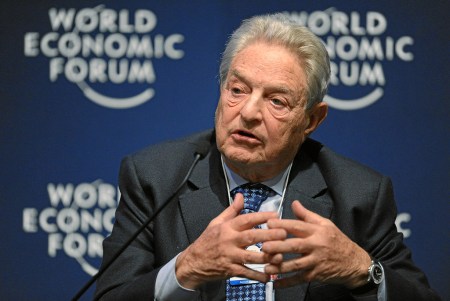
There have also been attempts by outsiders to incite racial and religious anarchy. The entrepreneur George Soros, for example, donated $33 million to turn events in Ferguson, Missouri from a local protest into chaos.

1952There have been attempts by outsiders to incite racial and religious anarchy. The entrepreneur George Soros, for example, donated $33 million to turn events in Ferguson, Missouri from a local protest into chaos. (Image source: World Economic Forum)

Instead of helping Americans to create a safer, more prosperous way of life, the Ferguson events destroyed a community, devastated small business owners, and eroded security, the rule of law, and any hope for a better future. Who benefits? Creating chaos embeds a political dependency: rather than helping people to climb out of poverty, it keeps them voting for politicians to “rescue” them.

Jews and Israel are also targeted — often, regrettably, by other Jews, who appear naïvely to hope that they will thereby “immunize” themselves from attacks on Jews. Recently, for example, an article accused the U.S. Republican presidential election campaign of “significantly enhancing the presence of antisemitism in the public arena.”

Seriously?

While “conservative” radicals, such as white supremacists do exist, they are not even close to overtaking the mainstream discourse. That space, rather, seems to have been filled in the last decades by self-described “liberals” who now seem to dominate it to such a degree that the Dean of Students at the University of Chicago, John Ellison, felt obliged to write a letter warning prospective applicants not to expect a “safe space.” “Conservative” radicals are not the ones hunting down Jews — “liberals” and Islamists are victimizing and shutting them out.

Ironically of course, the liberals have not yet figured out that the agendas of these two groups are incompatible (as in gender equality); perhaps they are trying to “immunize” themselves, too.

Public debate in the US, particularly in the next few weeks, really needs to be about choosing what policies would actually improve the lives of Americans. Should they uphold the Judeo-Christian values, which have governed Western civilization until now? Or should they quietly allow the defeat of those values by a false liberalism — false, because it is anything but liberal — which will allow values, such as that of Islamic sharia religious law to settle over the United States? Will people willingly surrender their own culture in order to avoid becoming victims of intimidation?

American university campuses, which should proudly be championing debate of all ideas, have instead been rife with antisemitism for years, mostly because a “thought police” obsessed with identity politics — another way of saying my race, religion, skin color or sexual proclivity is good, yours is not — has overtaken campuses and turned them into embittered war-zones. It is postmodern Stalinism.

Worse, these policies often come in the seemingly benign-sounding terms of “diversity”, “multiculturalism”, “peace”, “anti-racism”, and “human rights”; but are often used in an Orwellian way to mean their own opposites. “Diversity” means, “it is great to look different so long as you think the same way I do” and is also and acceptance of Islamic values. “Anti-racism” often means, in a racist way, anti-white or anti-Jew. “Human rights” now means a political agenda. “Peace” is used to mean the destruction of Israel. “Multiculturalism” means any culture except the Judeo-Christian one — regardless of whether that culture supports denigrating women, slavery, flogging, amputating limbs, murdering gays and the intolerance of all other religions and cultures. These inversions of language are having devastating consequences not only on university campuses, but also throughout the U.S. and abroad.

The glue that brings “liberals” and Islamists, such as the Muslim Students Association (MSA) in the US (a front[1] for the Muslim Brotherhood), together in a common cause is the goal of eradicating Israel — of course always only under the euphemisms of “helping Palestinians” and “Peace,” even though Jihadi camps for children were organized first by Palestinians.

A 1991 official document authored by the Muslim Brotherhood outlines its strategic goals for civilizational jihad in North America. It depicts the Muslim Brotherhood’s plans for civilization jihad in the United States stating:

“The process of settlement is a “Civilization-Jihadist Process” with all [that] the word means. The Ikhwan [Muslim Brotherhood] must understand that their work in America is a kind of grand jihad in eliminating and destroying the Western civilization from within and “sabotaging” its miserable house by their hands and the hands of the believers… [W]e must possess a mastery of the art of “coalitions”, the art of “absorption” and the principles of “cooperation.”

The question of whether to submit to these policies, as Europe is doing, or to uphold freedom, as Israel is doing, has arrived in the United States. The choice Americans make will immeasurably affect not just the US, but, despite sounding melodramatic, the future of Western civilization.

________________-

[1] In a 1991 official document authored by the Muslim Brotherhood, outlining its strategic goals for civilizational jihad in North America, the Muslim Students Association was mentioned as “one of our organizations and the organizations of our friends”, that is, a front group for the Muslim Brotherhood. The document was entered as evidence in the 2008 Holyland Terror Funding Trial.


Democrats’ organized-crime ring will do anything to maintain power and stay out of prison

October 2, 2016

Democrats’ organized-crime ring will do anything to maintain power and stay out of prison, Washington Times, L. Todd Wood, October 1, 2016

(Reason number 2,587 not to elect Hillary. — DM)

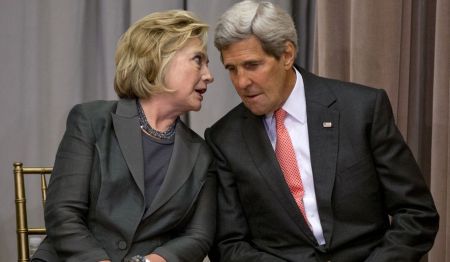
hillandkerrySecretary of State John Kerry speaks with former Secretary of State Hillary Rodham Clinton during the groundbreaking ceremony for the U.S. Diplomacy Center, Wednesday, Sept. 3, 2014, at the State Department in Washington.

When the end came for Russian President Boris Yeltsen, as the Russian economy was crumbling and there was no support left for his leadership in the Duma, one of his main concerns was protecting himself and his family from prosecution for corruption. That is why he appointed Vladimir Putin, an extremely loyal subordinate whom he could trust with his secrets, someone who would not immediately contact prosecutors and hound his family even after he died.  Someone who would not go after the money secreted away in the Caymans.  Someone who would let sleeping dogs lie. 

This is exactly the situation we have with the current political environment in the United States as the 2016 election season nears its conclusion. 

The party in power has shown itself to be nothing more than a massive organized-crime syndicate that has used the levers of power to persecute the political opposition and line its pocketbooks and bank accounts with the taxpayers’ money.  From John Kerry sending millions to his daughter’s non-profit, to Hillary Clinton shaking down the State Department’s clients for money, to public employee unions spiking their pensions, the corruption is complete across all levels of the Democratic Party and their hold on the executive branch.

But I think this rabbit hole goes much deeper.  We are now into corruption that damages the national security of the United States in an existential way.

Every day there is a new “secret” deal revealed where the Obama administration betrayed America with its desire to give the world’s real Islamic State, the Islamic Republic of Iran, the nuclear bomb, along with hundreds of billions in dollars, secretly flown to Tehran in the dead of night.

Hillary Clinton sold 20 percent of America’s uranium to the Russians for money.

The appeasement and downright enabling of the Islamic jihadist agenda by this administration will be written about in the history books.  I suspect, when the cover is taken off the rabbit hole, we will be astounded with what has actually been given away, leaked, stolen and ripped off by Obama and his minions.

This is why they are so scared of Trump.  This is why they are fighting tooth and nail.  This is why they don’t want to give up power and let the American people find out what has really gone on.  This is why the federal Department of Homeland Security is pushing the states to let it “advise and assist” in the electoral process.

I hope President Trump will prosecute the illegality he finds when he takes office.  To not do so would be a travesty of justice and set the precedent for the end of the Republic.

Of course, Obama may pardon all the main offenders but the crime syndicate is huge.  He can’t pardon everyone.  We at least have to find out what happened even if the key players don’t go to jail.

Hillary cannot be allowed into the White House.  This time she will take much more than the furniture.

Obama operatives stripped Judicial Watch of ‘media’ status, overcharged for FOIA requests

September 30, 2016

Obama operatives stripped Judicial Watch of ‘media’ status, overcharged for FOIA requests, Washington Times

(But how could that be?

Oh well. — DM)


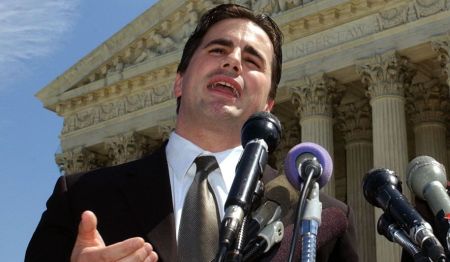
tomfitton_c0-46-1253-776_s885x516“This is what we put up all the time from the agencies,” said Judicial Watch President Tom Fitton. (Associated Press)

Political operatives within the Obama administration wrongly punished conservative legal group Judicial Watch, stripping it of “media” status and trying to force it to pay higher fees for its open records requests, the General Services Administration inspector general said in a letter released Thursday.

The GSA botched several high-profile open records requests, delaying them for months while political appointees got involved, Inspector General Carol F. Ochoa said. The findings were released while the administration was facing charges of slow-walking open records requests for Hillary Clinton’s emails, as well as other requests.

In the case of Judicial Watch, the order to strip it of media status came from political operatives with long ties to Democratic causes — and even from the White House.

The inspector general said the decision came at the behest of Gregory Mecher, a former Democratic campaign fundraiser who at the time was liaison to the White House. He is married to Jen Psaki, a longtime spokeswoman with the Obama administration and its election campaigns.

Ms. Ochoa said stripping Judicial Watch of media status violated several agency policies and things got worse when the GSA denied an appeal by the group.

The same person who ruled on the initial request also ruled on the appeal, “contrary to GSA procedures,” the inspector general said.

Judicial Watch ended up suing over the request, the agency finally agreed to waive all fees and even ended up paying Judicial Watch $750 as part of the settlement.

Tom Fitton, president of Judicial Watch, questioned the agency’s decision to fight a losing case that ended up costing it money.

“It’s outrageous but not surprising. Welcome to our world. This is what we put up with all the time from the agencies,” he said.

President Obama promised an era of transparency when it came to open records requests under the Freedom of Information Act, which is the chief way for Americans to pry loose data from the federal government.

Despite the president’s exhortations, the government is increasingly fighting requests, forcing the public to file lawsuits to look at information.

Last year, the administration spent $31.3 million to fight FOIA cases — more than twice the $15.4 million the administration spent in 2008, the final year under President George W. Bush.

The GSA has not been one of the major offenders, reporting no FOIA legal spending in 2015 and just $11,000 a year in 2014 and 2013, when it faced Judicial Watch’s lawsuit and paid the $750 settlement.

That doesn’t mean the agency has been operating cleanly. In a 2010 letter, a previous inspector general said the agency botched a request seeking information about GSA communications with House Minority Leader Nancy Pelosi and two other Democrats.

White House officials got involved and further delayed the request, the inspector general said.

Ms. Ochoa said in her letter that she found three bungled cases in the five years since that 2010 investigation. A 2013 request for records mentioning Donald Trump — now the Republican presidential nominee — took 242 days, five times the average. A 2012 request seeking information on GSA bonuses was blocked for 515 days.

The Judicial Watch request, though, was the most striking.

The group was trying to get a look at a goofy video produced by the agency’s New York office on company time and using company resources. The GSA at the time was facing fierce criticism from Capitol Hill for having wasted money on lavish conferences with questionable team-building activities such as the video.

Judicial Watch asked to be treated similar to a member of the media, which would mean an exemption from fees. Two weeks earlier, Judicial Watch was approved for the media exemption.

But ahead of the GSA request, Mr. Mecher, the political appointee with ties to the White House, requested that Judicial Watch’s status be re-examined, investigators said. Elliot Mincberg, a lawyer with deep Democratic ties who was on loan to the GSA at the time, issued a determination rejecting Judicial Watch as a media requester.

Ms. Ochoa said the justification for that was weak — a page from a Justice Department guide that predated the current law governing the definition of media. Mr. Mincberg “did not conduct any independent legal research” about the 2007 law, and that “shows a lack of due diligence,” Ms. Ochoa concluded.

The GSA then failed to follow its own procedures in its denial letter — despite internal misgivings — and again in mishandling the appeal, Ms. Ochoa wrote.

“Why are White House liaisons involved in our FOIA request?” said Mr. Fitton, the Judicial Watch president.

Mr. Mecher, who is now a top congressional staffer in the office of Rep. Joseph P. Kennedy III, did not respond to an email seeking comment on his role.

Mr. Mincberg said in an email that he “performed a relatively minor task” at Mr. Mecher’s request but declined to elaborate, saying he was acting at the time as an attorney for the agency and would need its approval to speak more.

Mr. Mincberg had been lent to the GSA as a FOIA troubleshooter — though his arrival was met with skepticism. Ms. Ochoa reported that one senior lawyer emailed a colleague saying, “This will not end well.”

Later, Mr. Mincberg would run into trouble at the Department of Housing and Urban Development, where he was a senior attorney.

In 2014, that department’s inspector general cited him for obstructing an investigation into the deputy secretary. Mr. Mincberg was accused of withholding information from investigators, appearing to coach witnesses and, during one interview, threatening to bring charges against the investigators themselves.

GSA spokeswoman Ashley Nash-Hahn did not respond to specific questions about Mr. Mincberg or Mr. Mecher, but insisted that her agency had improved its handling of FOIA requests. She said the agency has a new tracking system and increased training and coordination.

“With these improvements, GSA accelerated its processing time from an average of 21 days for simple requests and 63 days for complex requests in fiscal year 2013 to 12 days for simple requests and 46 days for complex requests last fiscal year,” she said.

Judicial Watch is fighting a series of court cases to get a look at Mrs. Clinton’s emails from the State Department and has other cases pending against the CIA, the Pentagon, the Justice Department and the IRS.

A case against the Homeland Security Department, in which Judicial Watch argued that the department regularly obstructed its requests, was dismissed Thursday.

Judge Richard J. Leon, sitting in U.S. District Court for the District of Columbia, ruled that delays for Judicial Watch’s requests weren’t enough to prove that Homeland Security was violating its policies.

Judicial Watch points to no fact or statement to establish why the requests were delayed or how the delays were the result of an either formal or informal DHS policy or practice to violate FOIA’s requirements, rather than an inevitable but unintended delay attributable to a lack of resources,” the judge wrote.

State rushed Clinton documents to Dems but withheld from Republicans

September 9, 2016

State rushed Clinton documents to Dems but withheld from Republicans, Washington Examiner, Sarah Westwood, September 8, 2016

Rep. Mark Meadows, R-N.C., blasted the State Department on Thursday for moving quickly to provide a requested email from Hillary Clinton’s server to Democrats on the House Oversight Committee while stonewalling requests from Republicans and the public.

During a hearing about the agency’s handling of Freedom of Information Act requests, Meadows questioned why the State Department handed over an email chain between Colin Powell and Clinton just five days after Rep. Elijah Cummings, the committee’s top Democrat, and seven other minority members asked for it while ignoring a FOIA request for that same email since 2014.

“We try to the best of our ability to respond to committees of Congress,” said Patrick Kennedy, undersecretary for management at the State Department, in defense of his agency’s treatment of records requests.

“It is with unbelievable speed when it fits the narrative that you want to do,” Meadows argued.

The email in question showed Powell had advised Clinton on ways to skirt security rules when using a personal device for official communications as he said he did during his tenure.

Meadows said the State Department has engaged in “a slow walk when [a request] comes from the chairman,” citing numerous letters from Rep. Jason Chaffetz, chairman of the Oversight Committee, that have collected dust at the agency.

Kennedy argued it would be “physically impossible” for the State Department to produce all of Hillary Clinton’s emails before the election given the high volume of FOIA requests pending before the agency.

But many of the media outlets and watchdog groups fighting for records began pursuing those documents years before Clinton launched her presidential bid.

The Associated Press, for example, first asked for Clinton’s official schedules in 2010. Meadows and Chaffetz demanded to know why the agency has said it will struggle to provide thousands of pages of her schedules by November despite having six years to process that request.

New ISIS Military Commander Was Trained by State Department as Recently as 2014

September 7, 2016

New ISIS Military Commander Was Trained by State Department as Recently as 2014, PJ MediaPatrick Poole, September 6, 2016

(Do we do an equally “thorough” vetting of Islamist “refugees?” — DM)

vetted-ally

Given these repeated instances, one might begin to question the quality of the U.S. government’s vetting capabilities.

****************************

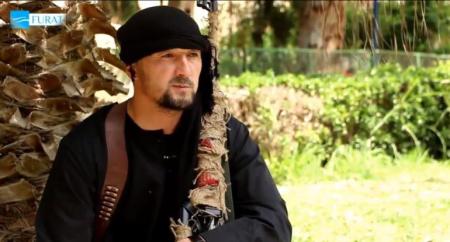
Gulmurod Khalimov, the new ISIS military commander whom the U.S. just days ago announced a $3 million bounty for, was trained by the State Department in an anti-terror program as recently as 2014 while serving in the security service of Tajikistan.

He replaces former ISIS commander Tarkhan Batirashvili, aka Umar al-Shishani, who was also trained by the United States as part of the Georgian army and who ISIS claimed was killed fighting in Iraq this past July.

The State Department confirmed Khalimov’s U.S.-provided training to CNN in May 2015:

“From 2003-2014 Colonel Khalimov participated in five counterterrorism training courses in the United States and in Tajikistan, through the Department of State’s Diplomatic Security/Anti-Terrorism Assistance program,” said spokeswoman Pooja Jhunjhunwala.The program is intended to train candidates from participating countries in the latest counterterrorism tactics, so they can fight the very kind of militants that Khalimov has now joined.

A State Department official said Khalimov was trained in crisis response, tactical management of special events, tactical leadership training and related issues.

Unironically, the State Department spokeswoman said that Khalimov had been appropriately vetted:

“All appropriate Leahy vetting was undertaken in advance of this training,” said spokeswoman Jhunjhunwala.

At that time, Khalimov appeared in a video threatening the United States:

“Listen, you American pigs: I’ve been to America three times. I saw how you train soldiers to kill Muslims,” he says.Then, he threatens, “we will find your towns, we will come to your homes, and we will kill you.”

Khalimov and Batirashvili are hardly the first terrorist leaders operating in Syria to have been trained by the United States.

In August 2014, the Washington Post reported that fighters who had been trained by Western forces, including the U.S., in Libya had found their way to terror groups at the beginning of the Syrian conflict:

Some European and Arab intelligence officials also voiced their worries and frustration about what they call the mistakes the United States has made in handling the uprisings in Arab states. “We had, in the early stages, information that radical groups had used the vacuum of the Arab Spring, and that some of the people the U.S. and their allies had trained to fight for ‘democracy’ in Libya and Syria had a jihadist agenda — already or later, [when they] joined al Nusra or the Islamic State,” a senior Arab intelligence official said in a recent interview. He said that often his U.S. counterparts would say things like, “We know you are right, but our president in Washington and his advisers don’t believe that.” Those groups, say Western security officials, are threats not only in the Middle East, but also in the United States and Europe, where they have members and sympathizers.The official’s account has been corroborated by members of the Islamic State in and outside the Middle East, including Abu Yusaf, the military commander. In several interviews conducted in the last two months, they described how the collapse of security during Arab Spring uprisings helped them recruit, regroup and use the Western strategy — to support and train groups that fight dictators — for their own benefits. “There had [also] been … some British and Americans who had trained us during the Arab Spring times in Libya,” said a man who calls himself Abu Saleh and who only agreed to be interviewed if his real identity remained secret.

Abu Saleh, who is originally from a town close to Benghazi, said he and a group of other Libyans received training and support in their country from French, British, and American military and intelligence personnel — before they joined the Al Nusra Front or the Islamic State. Western and Arab military sources interviewed for this article, confirmed Abu Saleh’s account that “training” and “equipment” were given to rebels in Libya during the fight against the Gadhafi regime.

Abu Saleh left Libya in 2012 for Turkey and then crossed into Syria. “First I fought under what people call the ‘Free Syrian Army’ but then switched to Al Nusra. And I have already decided I will join the Islamic State when my wounds are healed,” the 28-year-old said from a hospital in Turkey, where he is receiving medical treatment. He had been injured during a battle with the Syrian Army, he said, and was brought to Turkey with false documents.  “Some of the Syrian people who they trained have joined the Islamic State and others jabhat al Nusra,” he said, smiling. He added,“Sometimes I joke around and say that I am a fighter made by America.”

This problem of a terror “boomerang” also goes back to the Bush administration, as seen when Islamist rebels took over a large portion of Mali in 2013.

As the Financial Times reported:

To the dismay of the US, junior Malian officers trained as part of $620m pan-Sahelian counter-terrorism initiative launched in 2002 to help four semi-desert states resist Islamic militancy took part in a coup in March last year. Others among them defected to the Tuareg revolt that eventually led to a coalition of Islamist militias, allied with Algerian militants from al-Qaeda in the Islamic Maghreb, capturing the northern two-thirds of Mali.Potentially, these US-trained officers are now using US counter-insurgency know-how against France’s intervention force.

“It is a great failure,” says Dr Berny Sèbe, an expert in Franco-African relations at the University of Birmingham. “Some of them defected. Others organised a coup.”

In two of the three other Sahelian states involved in the Pentagon’s pan-Sahelian initiative, Mauritania and Niger, armies trained by the US, have also taken power in the past eight years. In the third, Chad, they came close in a 2006 attempt.

And back in Syria, as I’m chronicled repeatedly here at PJ Media, “vetted moderate” forces armed and trained by the U.S. have defected to ISIS and Al-Qaeda.

July 7, 2014: U.S. ‘Vetted Moderate’ Free Syrian Army Brigades Surrender Weapons, Pledge Allegiance to Islamic StateNov. 2, 2014: U.S.-Armed ‘Vetted Moderate’ Syrian Rebel Groups Surrender, Defect to Al-Qaeda

Nov. 24, 2014: More Defections of ‘Vetted Moderate’ Free Syrian Army Rebels to ISIS

Dec. 2, 2014: US-Backed Syrian Rebels Ally with al-Qaeda in South, Surrender CIA-Supplied Weapons in the North

Sept. 22, 2015: Report: U.S.-Trained, ‘Vetted Moderate’ Syrian Rebel Leader Defects to Al-Qaeda, Turns Weapons Over to Terror Group

Given these repeated instances, one might begin to question the quality of the U.S. government’s vetting capabilities.

Clinton Turned Away High-Level Chinese Defector to Assist Beijing Leaders

September 6, 2016

Clinton Turned Away High-Level Chinese Defector to Assist Beijing Leaders, Washington Free Beacon, September 6, 2016

FILE - In this Oct. 21, 2008 file photo, then Chonqing city police chief Wang Lijun speaks during a press conference in Chongqing, southwestern China. A Chinese court sentenced the former police who exposed a murder by a Chinese politician's wife to 15 years in prison Monday, Sept. 24, 2012, in a decision that sets the stage for China's leadership to wrap up a seamy political scandal and move ahead with a generational handover of power. (AP Photo/File) CHINA OUT

FILE – In this Oct. 21, 2008 file photo, then Chonqing city police chief Wang Lijun speaks during a press conference in Chongqing, southwestern China.  (AP Photo/File) CHINA OUT

Former secretary of state Hillary Clinton turned away a high-ranking Chinese defector who sought political asylum after the communist police chief sought refuge in a U.S. consulate in southwestern China four years ago.

Critics say Clinton’s handling of the defection of Wang Lijun, a close aide to a regional Communist Party leader, was a blunder and lost opportunity for U.S. intelligence to gain secrets about the leaders of America’s emerging Asian adversary.

Instead of sheltering Wang and granting him political asylum, Clinton agreed to turn him over to Chinese authorities in Beijing, and claimed he was not qualified for American sanctuary because of his past role as a police chief accused of corruption.

However, the defector’s case highlights Clinton’s policy of seeking to preserve U.S. ties with China’s communist leadership instead of pursuing much-needed intelligence gathering on China at a time when Beijing is emerging as an increasingly threatening power.

Clinton defended the betrayal of Wang in her 2014 memoir, Hard Choices. The former secretary and current Democratic presidential nominee revealed in the book that the U.S. government agreed to keep secret all details of Wang’s sensational defection attempt in order to help Beijing’s Communist rulers avoid public embarrassment over a major internal power struggle and high-level corruption scandal months ahead of then-Chinese leader Hu Jintao’s transfer of power to current supreme leader Xi Jinping.

Details of the mishandling of the Wang defection have been kept secret by the Obama administration, and Clinton’s version of events were contradicted by U.S. officials and the official Chinese account. Instead of gaining long-term access to a valuable defector with inside knowledge of Chinese strategy and policies, Clinton contacted the Chinese government in Beijing and allowed security officials to take Wang into custody outside the U.S. consulate some 30 hours after he entered the property in a daring bid to flee China for the United States.

Weeks later he was charged with “defection” and other crimes, and in September 2012 he was sentenced to 15 years in prison—a lighter sentence than normal based on information he disclosed about his boss, regional Party chief Bo Xilai, the rising senior Communist leader who was later imprisoned for corruption.

Bo was a member of China’s 25-member Politburo Central Committee, a former commerce minister, and former mayor of the northern city of Dalian. He was said to be on track to become part of the nine-member Politburo Standing Committee, the collective dictatorship that is the ultimate authority in China.

Critics say Clinton’s mishandling of the defection raises questions about her handling of China issues and national security affairs in general. She has touted her tenure as secretary of state as a key element of her bid for the presidency.

Intelligence and foreign policy experts said the main problem with the Wang case was the failure of American officials to keep the defection secret from Chinese authorities.

Clinton, the State Department, and the Obama administration in general have regarded such operational secrecy as a nuisance and impediment to their work. Under President Obama, the administration suffered unprecedented leaks of intelligence and foreign policy information, notably from Wikileaks, which disclosed more than 250,000 State Department cables. Clinton also compromised secrets by using a private email server that the FBI believes likely was compromised by foreign spy services that intercepted data from her insecure email system.

Recently disclosed emails from Clinton’s private server reveal the Wang Lijun defection was discussed in communications with aides, raising the possibility that the Chinese could have learned of her internal discussions of the case if they had obtained access to the email server.

“The FBI did find that hostile foreign actors successfully gained access to the personal email accounts of individuals with whom Clinton was in regular contact and, in doing so, obtained emails sent to or received by Clinton on her personal account,” an FBI report states.

Had the defection remained secret, intelligence agencies could have conducted a clandestine “exfiltration” operation to spirit Wang out of the country, current and former intelligence officials said.

Clinton supporters dismissed criticism of the handling of Wang and said his dash to the U.S. consulate was calculated not as an attempt to flee China but to avoid capture by an opposing Communist political faction in Chongqing, and to alert Beijing leaders to Bo’s corruption and illegal activities.

Intelligence windfall on PRC leaders missed

Diplomats at the State Department also were opposed to helping the defector because of Clinton policies that sought to avoid actions that might upset Chinese leadership transitions. The diplomats, as with past transitions of power since the 1980s, argued that new Chinese leaders will produce hoped-for political reform and evolution away from the communist system.

But intelligence and foreign policy analysts say Clinton’s failure to grant asylum or temporary refuge to Wang squandered an opportunity to gain secrets from inside the closed world of China’s Communist leadership structure—intelligence needed in fashioning a U.S. response to China’s increasing aggression in Asia.

“Clinton and Obama do not see the world in geostrategic terms,” said Kenneth E. deGraffenreid, a former White House intelligence director under President Reagan. “Clinton had no sense of the reality of the Communist regime they were dealing with.”

DeGraffenreid, who also was deputy national counterintelligence executive in the George W. Bush administration, said defectors like Wang should be assisted when they can provide valuable secrets.

“Wang would have been pure gold from an intelligence standpoint, given the paucity of sources inside the Chinese government,” he said, adding that Wang’s links to a Chinese political faction should not have disqualified him for asylum or sanctuary.

Defector had documents and cash

Events surrounding the police chief’s dramatic defection resemble the plot of a spy novel. It began in early February 2012, days after Wang informed his boss on Jan. 28 that Bo’s wife, Gu Kailai, had been involved in the poisoning death of British businessman Neil Haywood in a Chongqing hotel room two months earlier. Days later, Wang was fired as chief of the Public Security Bureau in Chongqing, as the police service is called, but remained in his post as vice mayor.

Then three of Wang’s subordinates were placed under investigation, and Wang, because of his contacts in the police, learned that Bo was plotting his death by having him arrested and killing him during what he would say was an escape attempt. Discovery of the plot set in motion Wang’s plan to defect. He slipped free from a Chongqing security surveillance team and drove to the American consulate in Chengdu, several hours west in neighboring Sichuan province.

Wang was able to enter the consulate secretly on Feb. 6, 2012. He was carrying documents and a suitcase containing several hundred thousand dollars in cash, according to officials familiar with the case. He also made several telephone calls while inside.

According to the Chinese court record of the case, Wang initially discussed issues related to environmental protection, education, and science and technology with American diplomats. After the initial exchange, he then explained that he feared for his life and “asked the United States to provide shelter for him, and filled out an application for political asylum,” according to the official Xinhua news agency report on the trial.

American diplomats at the consulate, including intelligence personnel, were unable to keep Wang’s defection secret. The consulate employs several Chinese nationals who are used as informants by the local Chinese security services.

Whether through informants or communications intercepts from within the consulate, within hours Chinese security services learned Wang was inside. Police quickly were dispatched to surround the consulate, including at one point armed Chinese police from Chongqing that were loyal to Bo, the regional Party leader who was desperate to capture Wang. Later, the Chongqing police were replaced by local Chengdu security personnel.

Wang revealed that Bo and his wife, like most senior Party leaders, had amassed illicit fortunes through corruption. However, most details involved the murder of the British businessman, expatriate Neil Haywood, who was involved in financial activities related to Bo and his family and ran afoul of Bo’s wife.

“The stuff he revealed was lurid,” said one former official close to the case.

In addition to information about Bo, Wang told American diplomats he had information regarding the inner workings of the secretive Chinese leadership. Wang claimed to have internal Party and government documents but did not make them available to the consulate interviewers. He suggested the documents were being used as leverage and that he would arrange for their release if captured by the Chongqing police.

Asylum request turned down

Between Feb. 6 and Feb. 7, Wang’s appeal for asylum was turned down by officials in Washington, a decision that led Wang to seek a deal with Beijing authorities.

State Department spokesmen would not say if Clinton made the decision to reject Wang’s asylum request, citing a policy of not discussing asylum issues. State Department spokeswoman Victoria Nuland in Washington and U.S. Embassy Beijing spokesman Richard Buangan both insisted Wang left the consulate of his own volition.

Wang had decided that without political asylum or consulate refuge his sole resource was to bargain with Beijing authorities in exchange for protection from Chongqing police.

Clinton in her memoir and in earlier public remarks sought to portray Wang as corrupt, thuggish, and brutal, an assessment analysts say could be applied to most Chinese police and security officials.

Wang was known as an aggressive fighter of organized crime, first in northeastern Liaoning province and later in Chongqing where he targeted China’s notorious Triad gangs. The private intelligence firm Stratfor reported that the Triads at one point put out a $1 million contract on his life.

“Wang Lijun was no human rights dissident, but we couldn’t just turn him over to the men outside; that would effectively have been a death sentence, and the cover-up [of Bo’s corruption] would have continued,” Clinton wrote in the book. “We also couldn’t keep him in the consulate forever.”

The U.S. Embassy in Beijing in 1989 harbored Chinese dissident Fang Lizhui for over a year when the astrophysicist took refuge there after the military crackdown on unarmed protesters in Tiananmen Square.

Clinton made no mention of Wang’s formal asylum request and instead wrote that consulate officials asked the defector what he wanted before giving him up to Beijing security officials. “We reached out to the central authorities in Beijing and suggested that he would voluntarily surrender into their custody if they would listen to his testimony,” she wrote.

The former secretary of state also stated she did not realize the significance of Wang’s offer to defect or the impact it would have. Additionally, she ordered complete secrecy surrounding the case to help Chinese leaders avoid a scandal during a major leadership transition in the coming weeks.

“We had no idea how explosive his story would prove or how seriously Beijing would take it,” she wrote. “We agreed to say nothing about the matter and the Chinese were grateful for our discretion.”

The “enormous scandal” that followed Wang’s arrest and his disclosures about Bo “shook confidence in the Communist Party’s leadership at a sensitive time,” Clinton wrote, adding that Hu Jintao “badly wanted a smooth transition, not a national furor over official corruption and intrigue.”

Clinton falsely says defector not qualified

Earlier, Clinton said during remarks to Chatham House, a British think tank, that Wang “did not fit any of the categories for the United States giving him asylum.” She said he “had a record of corruption, of thuggishness, brutality” and was “an enforcer for Bo Xilai.”

But a State Department document from 2010 contradicts her assertion. The document, labeled “secret,” outlines in detail how officials at U.S. diplomatic outposts should handle foreign nationals who seek to defect. The foreign nationals are called “walk-ins” and can provide valuable intelligence.

“Walk-ins (1) may be sources of invaluable intelligence; (2) pose numerous security challenges; and (3) may need protection,”states the cable, made public by Wikileaks. “Improper handling of walk-ins can put them and post personnel at risk and result in the loss of important intelligence.”

The document lists all categories of potential defectors expected as walk-ins, including “members of the national police and the military,” as well as “political party officials.”

Wang held several senior positions in Chongqing, including deputy Communist Party chief; deputy chief, party chief, and head of Chongqing police, and vice mayor.

Instead of asylum, Clinton could have helped Wang by authorizing “temporary refuge” at the consulate, but that option also was rejected.

The walk-in handling procedures call for making sure walk-ins are not false defectors sent by foreign intelligence services. They also call for keeping all requests for asylum or temporary refuge secret.

“If a walk-in is of intelligence interest, the case will be handled by the Intelligence Community (IC) once that interest is established, and reporting on the case will occur in IC channels,” the document states.

The instructions also give diplomatic officials wide latitude in dealing with defectors, and call for limiting support if supporting the defector endangers diplomatic personnel.

It could not be learned if Wang was handled as an intelligence defector, but from Clinton’s comments it appears he was not.

However, the CIA gained some valuable data from Wang that is useful for conducting operations in China’s difficult intelligence environment. Chinese security services are known to employ large human and technical surveillance operations against foreign officials.

White House wanted defector thrown out

During the 30 hours Wang stayed inside the consulate, senior Obama administration officials at the White House also intervened. National Security Council staff officials and officials within the office of Vice President Joe Biden were worried that the attempted defection would upset Biden’s upcoming meeting in Washington with then-Vice President Xi Jinping on Feb. 14.

Biden aides, including national security adviser Antony Blinken, viewed the Wang defection as potentially derailing the Xi visit. The aides wanted the State Department to resolve the defector case quickly although it could not be learned if they pressed Clinton to turn Wang over to Beijing officials.

Wang was convicted during a secret trial in a Chinese court in Chengdu on Sept. 24, 2012, of the crime of defection—a charge rarely made publicly in China—for fleeing to the consulate. He also was convicted of abuse of power, bribe-taking, and for helping cover up the murder of Heywood.

The court in Chengdu where the secret trial was held was told that Wang was “a state functionary who knew state secrets,” confirming his successful defection would have been valuable for the United States.

DeGraffenreid, the former White House intelligence director, said American intelligence in the past accepted Soviet defectors who were implicated in criminal activities during their intelligence careers. They include former KGB Gen. Oleg Kalugin, who defected in the 1990s, and Ion Pacepa, a Romanian intelligence chief who defected in 1978.

“The point is we’re not putting these people in for the Nobel Peace Prize,” deGraffenreid said. “We’re trying to find people with insider knowledge. My category for defectors is can we get good intelligence. If that standard is not in [the Obama administration’s] manual, they ought to put it in.”

Exfiltration difficult but not impossible

Intelligence analysts said the difficulties of getting Wang secretly out of China were large but not insurmountable.

Once Chinese security agents had surrounded the consulate, the most likely course of action would have been to get Wang safely out of the diplomatic outpost to another secure location. From there, the CIA could have mounted an operation to provide transit out of the country, operations CIA officers in the past have been trained to carry out.

Another option would have been secretly to assist Wang in getting out of the consulate safely, and then helping him use his own skills and resources to get out of China with a promise of asylum at any U.S. diplomatic post in the region he was able to reach.

John Tkacik, a former State Department official who specialized in China affairs, said exfiltration became impossible once Chinese security was alerted to Wang’s presence at the consulate.

“Wang’s intelligence value was known immediately to the consulate, and Wang’s proffer of information on the murder of a British man by an extremely high-ranking Chinese official apparently was leverage to convince the U.S. consuls that he was worth the effort,” Tkacik said.

The diplomats appear to have hesitated in eliciting even more valuable information from Wang over concerns that getting him out of the country was hopeless, and that prolonged temporary refuge of a senior Communist Party cadre would have severely strained U.S.-China diplomatic relations prior to an upcoming U.S.-China summit, he said.

“In hindsight, the summit was a waste of effort, and China continued to antagonize both the U.S. and America’s allies for the next four years,” he said. “So, if the U.S. had managed to pry more intelligence from Wang over the ensuing weeks, whatever was gleaned would have been a net benefit.”

Continued U.S. government secrecy surrounding the case does not provide any gain for the United States since Wang is now in prison for 15 years, Tkacik added.

Clinton campaign spokesmen did not return emails seeking comment.

Peter Navarro, economics professor at University of California Irvine and adviser to Republican presidential nominee Donald Trump on Asia, said Clinton failed to properly handle the defection.

“The mishandling of the attempted defection of Wang in 2012 reveals either an incompetence on the part of Hillary Clinton as secretary of state or further evidence of the propensity of both Bill and Hillary Clinton to subjugate U.S. interests to the interests of China’s ruling communist party,” Navarro said.

“At a minimum, Wang should have been given temporary refuge status and been debriefed to determine whether his plea met the appropriate criteria for asylum — and what critical information he could have shared.”

Navarro said the fact that the Clinton campaign team refuses to comment on the case “puts another brick in Hillary’s stone wall approach to her failures.”
Eric Trump questions Clintons’ enormous wealth: ‘What product were they selling?’

September 2, 2016

Eric Trump questions Clintons’ enormous wealth: ‘What product were they selling?’ Washington TimesS.A. Miller, September 2, 2016

Republican presidential nominee Donald Trump’s son Eric Trump questioned Friday how Democratic nominee Hillary Clinton and former President Bill Clinton became enormously wealthy running a charity, which has become the focus of the campaign’s allegation of pay-to-play corruption while she was secretary of state.

“The question I always ask is, what product were they selling? If we make a buck, we sold a bottle of wine or an apartment, or we sold a hotel room. What product were they selling to make $150 million,” Mr. Trump said on Fox News’ “Fox & Friends.”

Host Ainsley Earhardt suggested: “Favors? The government?”

“Of course,” responded Mr. Trump, who works on the campaign for his billionaire businessman father.

“This is the leadership we have in this country. Somebody sets up a foundation. They pocket hundreds of millions of dollars. They say they come out of the White House ‘dead broke.’ Now they are worth $150 million,” he said.

Mrs. Clinton famously claimed that they were “dead broke” when they left the White House in 2001.

Mr. Trump was citing a high estimation of the Clinton’s wealth. Other estimates peg their net worth at a combined $111 million, with Mr. Clinton worth approximately $80 million and Mrs. Clinton worth just over $30 million.

“It’s just so so sad,” Mr. Trump said. “People in this country work so hard and sometimes they are not able to achieve because of the policies that these politicians put in place and look what they do.”

The Clinton Foundation has become a focus of questions about potential conflicts of interest while Mrs. Clinton served as secretary of state. The charity accepted donations from foreign entities with interests in State Department policy.

The lines between Mrs. Clinton’s agency staff and the work of the Clinton Foundation also were sometimes blurred.

Some of Clintons’ wealth came from generous speaking fees paid to Mr. Clinton by foreign entities while his wife was secretary of state. His usual fee of $150,000 climbed higher while his wife was in office, including a $500,000 fee paid by a Russian investment bank with links to the Kremlin and a $550,000 fee paid by a Chinese business group for a speech in Shanghai.

After she left the State Department in 2013, Mrs. Clinton started collecting $200,000 speaking fees, mostly from trade groups and Wall Street banks, according to an analysis by the Associated Press.

Financial disclosures showed that the post-State Department speeches earned Mrs. Clinton nearly $22 million.

As secretary of state, she earned $186,600 a year. In her prior role as a U.S. senator from New York, her annual salary started as $145,100 in 2001 and rose to $169,300 in her final year in 2008.