Posted tagged ‘Department of State’

Taliban Surpasses Islamic State as World’s Most Prolific Terrorist Group

June 7, 2016

Taliban Surpasses Islamic State as World’s Most Prolific Terrorist Group, BreitbartEdwin Mora, June 6, 2016

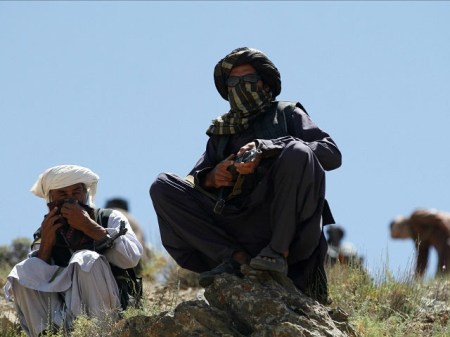
taliban-fighters-afghanistan-associated-press-640x480AP Photos/Allauddin Khan

Taliban jihadists replaced their Islamic State (ISIS/ISIL) counterparts as the world’s chief perpetrators of terrorist attacks last year, with 1,093 individual attacks, according to the U.S. Department of State’s Country Reports on Terrorism 2015.

However, ISIS’s 931 terrorist attacks in 2015 wTaliban jihadists replaced their Islamic State (ISIS/ISIL) counterparts as the world’s chief perpetrators of terrorist attacks last year, with 1,093 individual attacks, according to the U.S. Department of State’s Country Reports on Terrorism 2015.ere reportedly much deadlier than those carried out by the Taliban, resulting in 6,050 deaths compared to the 4,512 fatalities linked to the Taliban, notes the State Department’s annual reports, a congressionally mandated analytical and statistical review of global terrorism.

ISIS replaced the Nigeria-based Boko Haram as the terrorist group responsible for the most fatalities in 2015. Boko Haram was responsible for 491 terrorist attacks last year resulting in 5,450 deaths. Boko Haram is treated as a separate terrorist group as its logistics are independent of ISIS, despite the group pledging allegiance to Islamic State caliph Abu Bakr al-Baghdadi last year.

In 2015, ISIS was also responsible for causing more injuries (6,010) and taking more hostages (4,759) than any other terrorist group.

On Sunday, three Taliban jihadists attacked an Afghan court, killing seven people including “a number of prosecutors and judges,” the terrorist group announced, according to CNN.

“The attack triggered a shootout with Afghan security forces that lasted 1 1/2 hours,” adds the news network. “At least 23 people were wounded.”

The Taliban has stepped up an increasingly violent insurgency since President Obama and NATO ended their combat mission in Afghanistan in December 2014. Afghan civilians and security forces have since suffered a record number of casualties at the hands of the terrorist group.

Five terrorist groups were identified by the State Department as being responsible for the most terrorist attacks in 2015: the Taliban (1,093); ISIS (931); Boko Haram (491); the Communist Party of India-Maoist (343); and the Kurdistan Workers’ Party, PKK, (238).

“A total of 270 groups and organizations were identified as perpetrators of terrorist attacks, including 78 organizations that had not previously been identified as perpetrators in the Global Terrorism Database,” reports the State Department. “The number of newly identified perpetrator organizations declined in 2015 from more than 100 in 2014.”

“The biggest surprise was the removal of the Somali group al-Shabaab from the top-five list of perpetrators, that outfit having been responsible for the third-most attacks in 2014,” notes The Atlantic magazine. “The new addition to the 2015 list was the Kurdistan Workers’ Party (PKK), which has re-committed to the use of political violence in a significant way, increasing the number of attacks from 47 to 38 and noncombatants killed from 12 to 287.”

Iraq was the location of the highest numbers of total attacks, deaths, and people injured and kidnapped.

Overall, “the number of attacks in which victims were kidnapped or taken hostage declined in 2015; however, the number of kidnapping victims and hostages increased,” notes the Department of State (DOS) assessment. “This was primarily due to an increase in the number of attacks involving exceptionally large numbers of victims.”

The total number of terrorist attacks across the globe last year dropped by 13 percent, from 13,482 in 2014 to 11,774, and total fatalities by 14 percent, from 32,763 to 28,328.

“This was largely due to fewer attacks and deaths in Iraq, Pakistan, and Nigeria. This represents the first decline in total terrorist attacks and deaths worldwide since 2012,” notes DOS evaluation, adding, “In several countries, including Afghanistan, Bangladesh, Egypt, the Philippines, Syria, and Turkey, terrorist attacks and total deaths increased in 2015.”

There was also a slight decrease in the number of countries where terrorist attacks took place, from 95 in 2014 to 92 last year.

“Although terrorist attacks took place in 92 countries in 2015, they were heavily concentrated geographically,” declares DOS. “More than 55% of all attacks took place in five countries (Iraq, Afghanistan, Pakistan, India, and Nigeria), and 74% of all deaths due to terrorist attacks took place in five countries (Iraq, Afghanistan, Nigeria, Syria, and Pakistan).”

“Of the 28,328 people killed in terrorist attacks in 2015, 6,924 (24%) were perpetrators of terrorist attacks,” it adds. “Perpetrators were killed intentionally in suicide attacks, accidentally while attempting to carry out attacks, or by security forces or victims responding to attacks. This is an 11% increase in the number of perpetrator deaths, compared to 2014.”
State Department Funds Televised Call for Boycotting Israel; The New York Times Is Amused

June 7, 2016

State Department Funds Televised Call for Boycotting Israel; The New York Times Is Amused, Algemeiner, Ira Stoll, June 6, 2016

Palestinian-riots-300x244Palestinian rioters. Photo: Wikipedia.

The State Department is using American taxpayer dollars to finance Palestinian Arabs celebrating violent attacks on Israelis and advocating a boycott of Israel and the division of its capital city.

Where’s the outrage?

Not in the New York Times, which treats the topic as subject for a light-toned feature article about what it describes as a Palestinian “reality television show.”

The show features contestants who “run” for the job of Palestinian president. TheTimes article reports that “the three finalists all had similar platforms: Boycott Israel. Designate East Jerusalem as the capital of Palestine.”

Later, the Times reports, almost in passing, that the television program “broadcast on the Maan satellite network to large audiences in Gaza, the West Bank and elsewhere in the Arab world — was funded mostly by a State Department grant.”

The dollar amount of the grant is unreported by the Times. Also unreported by the Times is what the members of Congress who hold the spending power under the Constitution think about the idea of having taxpayer money used to broadcast, across the Middle East, calls to boycott Israel.

An NBC news article on the program quoted one of the contestants celebrating the role of women in the “revolution and resistance — they were throwing stones.” The NBC article also included a contestant’s call for a “’right of return,’ or the right for Arabs driven from their communities in 1948 when the State of Israel was established to go back.” Never mind that some of those Arabs left of their own free will or at the urging of neighboring Arab states, or that their “return” would, as a practical matter, be a way of destroying the Jewish state.

The Algemeiner did what the New York Times did not do, which is contact a major American Jewish organization for its view on the wisdom of spending taxpayer dollars to spread this message.

The president of the Zionist Organization of America, Morton Klein, told The Algemeiner that he found the State Department funding for the television program “astonishing,” and “shocking.” He said that if the State Department were found to be funding an Israeli television program advocating extremist views, there would be an uproar. In this case, however, “not a peep — the only peep is from Ira Stoll.”

“Where is the media and Congress screaming about this?” Mr. Klein asked.

It’s a good question, and one in which the Times shows a disappointing lack of interest in answering, or even in asking.

State Dept.: Hezbollah, Islamic State Maintain Presence in Latin America

June 7, 2016

State Dept.: Hezbollah, Islamic State Maintain Presence in Latin America, BreitbartEdwin Mora, June 6, 2016

Hezbollah-Getty-640x480Getty Images

WASHINGTON, D.C. —The U.S. Department of State (DOS) has determined that Venezuela, which has refused to cooperate with the United States’ antiterrorism efforts in Latin America for nearly a decade, remains a “permissive environment” that promotes ideological and financial support for terrorist organizations, namely Iran’s Lebanese proxy Hezbollah.

Although the “primary threats” to the Western Hemisphere stem from left-wing guerrillas known as the Revolutionary Armed Forces of Colombia (FARC) and the National Liberation Army (ELN), the Islamic extremist groups Shiite Hezbollah, also spelled Hizballah, and Sunni Islamic State (ISIS/ISIL) also maintain a presence across the region, according to DOS’ Country Reports on Terrorism 2015, a congressionally mandated assessment of terrorism activities across the world authored by DOS.

The assessment declares:

South America and the Caribbean also served as areas of financial and ideological support for ISIL and other terrorist groups in the Middle East and South Asia. In addition, Hizballah continued to maintain a presence in the region, with members, facilitators, and supporters engaging in activity in support of the organization. This included efforts to build Hizballah’s infrastructure in South America and fundraising, both through licit and illicit means.

[…]

There were credible reports that Venezuela maintained a permissive environment that allowed for support of activities that benefited known terrorist groups… [including] Hizballah supporters and sympathizers.

Moreover, the DOS evaluation highlights the Tri-Border Area (TBA) between Paraguay, Brazil, and Argentina, in addition to Peru, as regions where Hezbollah was operating last year.

“Illicit activities within the TBA remained potential funding sources for terrorist organizations, most notably Hizballah,” it says, adding, “The Tri-Border Areas of Argentina, Brazil, and Paraguay remained an important regional nexus of arms, narcotics, pirated goods, human smuggling, counterfeiting, and money laundering — all potential funding sources for terrorist organizations.”

The TBA border region has long been a hotbed for Hezbollah members.

In its terrorism reports, the DOS also points out that Peruvian authorities in 2014 arrested a Lebanese national and his wife, a U.S-Peruvian citizen, for suspected links to Hezbollah, adding that “there were residue and traces of explosives” in their apartment.

Hezbollah, along with other terrorists and criminals in Latin America, are known to use networks that support illicit activities, such as trafficking drugs, wildlife, bulk cash, weapons, humans, in addition to illegal logging and mining.

The DOS released its assessment Thursday, a day after the U.S. military declared the region’s illicit trafficking networks as one of the greatest security threats facing the United States.

Gen. John Kelly – former commander of U.S. Southern Command (SOUTHCOM), which oversees military activities in Latin America and the Caribbean – warned last year that jihadist groups like ISIS could exploit the illicit networks in the region to infiltrate the United States, adding that Hezbollah is already using known routes to traffic drugs and other contraband.

Although Hezbollah is believed to be the most prominent jihadist group in Latin America and the Caribbean due to Iran’s enduring presence in the region, Gen. Kelly warned in March 2015 that a small number of Sunni extremists are actively “radicalizing  converts and other Muslims in the region and also provide financial and logistical support to designated terrorist organizations within and outside Latin America.”

Pentagon and DOS have recently revealed that between 100 and 150 people from Latin America and the Caribbean have traveled to the Middle East to engage in jihad on behalf of ISIS, without specifying the names of any of the countries in the region.

According to the Department of State, some people from Trinidad and Tobago, as well as Argentina, are believed to have joined ISIS in the Middle East.

“More than 70 nationals of Trinidad and Tobago are believed be fighting with ISIL in Syria,” reports DOS, adding, “It is possible small numbers of Argentine citizens may have sought to travel to Syria and Iraq to join ISIL,” without providing any specific figures.

DOS also mentioned an ISIS-related arrest in Brazil involving a money laundering group accused of moving $10 million-plus and having social media ties to the jihadist group.

Iran’s growing presence in Latin America is believed to be facilitated by Venezuela.

“The International Development Bank, a subsidiary of the Development and Export Bank of Iran, continued to operate in Venezuela [in 2015] despite its designation in 2008 by the U.S. Treasury Department under E.O. [Executive Order] 13382 (‘Blocking Property of Weapons of Mass Destruction Proliferators and their Supporters’),” mentions the DOS assessment.

Justin Siberell, acting coordinator for counterterrorism at the State Department, briefed reporters Thursday about the 2015 Country Reports on Terrorism, stressing that the enduring presence in the region of leading state sponsor of terror Iran continues to trouble the United States.

“I think Iran’s presence in the Western Hemisphere and its support for groups that might be engaged in facilitation or operational planning is a continued concern,” Siberell told reporters.

Nevertheless, he added, “I don’t think we’ve seen an increase in 2015 in Iran’s activity in the Western Hemisphere, but it remains a high priority for us.”

Scrubbing Texts is Nothing New for Team Obama

June 4, 2016

Scrubbing Texts is Nothing New for Team Obama, Power LinePaul Mirengoff, June 4, 2016

In a post called “On the Iran deal, lies upon lies,” I discussed the deletion by the State Department from an archived video of an exchange in which spokeswoman Jen Psaki effectively admitted that the administration lied about its nuclear negotiations with Iran. Summarizing the situation better than I did in my post, Jake Tapper explains:

There was a first lie told to us about the secret talks between Iran and the Obama administration. We’ll call that lie number one. Now Jen Psaki acknowledged lie number one later that year, 2013. But then someone removed that acknowledgement from the official video. Let’s refer to the scrubbing as lie number two. And then, three weeks ago, we were lied to again, with the whole glitch thing. We’ll call that lie number three.

The Algemeiner reminds of two past instances of record scrubbing — the kind of dishonesty evinced in what Tapper calls “lie number two” — by the Obama administration (it also cites a couple of examples from previous Democratic administrations). In both prior cases, as with the Psaki deletion, the Obama administration tampered with words in order to promote a false narrative on important matters of foreign policy and national security.

Team Obama did this so recently that when I first read about the Psaki deletion, I thought we might already have written about it. Just two months ago, during a meeting with President Barack Obama at the White House, French president Francois Hollande used the term “Islamist terrorism” when referring to the recent Islamic State terrorist attacks in Europe. As Scott noted here, someone at White House deleted this language from the official White House video.

As it initially did with the Psaki deletion, the White House official claimed there had been a “technical issue” that “led to a brief drop in the audio.” However, he could not explain why the alleged technical problem occurred at the precise moment that the words “Islamist terror” were spoken or how the glitch managed to correct itself in time for Hollande’s next words.

Hollande’s words were inconsistent with the Obama narrative on terrorism, which somehow seeks to deny that the terrorism plaguing the world is “lslamist.” Therefore, the words had to go.

Two years earlier, the White House famously edited the Benghazi talking points. Among other edits, someone changed the characterization of the violence from “attacks” to “demonstrations” before the document was given to Susan Rice for peddling on the major television networks.

Who made the change? When asked this question by Bret Baier, former National Security Council spokesman Tommy Vietor replied “I don’t remember. . . .Dude, that was like two years ago.”

When asked the corresponding question about the Psaki deletion, State Department spokesman John Kirby gave the same answer, minus “dude” and “like.”

The original version of the talking points contradicted then-operative Obama narrative on terrorism, which held that Obama had essentially conquered it. Therefore, the words had to go.

In the case of the latest scrubbing, Psaki’s statement to James Rosen contradicted the Obama narrative on the Iran nuclear talks, which claimed they were prompted by the election of a “moderate” Iranian president. It also constituted an admission that the administration wasn’t always truthful about its negotiations. Therefore, the words had to go.

Obama’s foreign policy is predicated on a series of lies: the terrorists have been largely vanquished; they are not “Islamist;” the Iranian regime has significantly moderated; the Iran deal was prompted by Iranian moderation, rather than the desire to deal with the regime Obama however radical it may be.

No wonder the truth so often must be scrubbed.

On the Iran Deal, Lies Upon Lies

June 2, 2016

On the Iran Deal, Lies Upon Lies, Power LinePaul Mirengoff, June 2, 2016

(Here’s a video of a portion of a State Department press conference during which the Department spokesperson tries to wiggle out of explaining what happened, why, how, by whom it was ordered and how often that sort of deception occurs.

— DM)

The State Department acknowledged today that an archived video of a December 2, 2013 press briefing was intentionally edited to remove a portion of a conversation about the Iran nuclear talks. Previously, the Department had tried to blame the removal on a “glitch.”

The deleted segment of the briefing featured Fox News reporter James Rosen asking then-State Department spokeswoman Jen Psaki whether the Obama administration had lied about having secret talks with Iran in 2011. Psaki essentially admitted that it had.

Rosen inquired, “Is it the policy of the State Department, where the preservation or the secrecy of secret negotiations is concerned, to lie in order to achieve that goal?” Psaki responded, “James, I think there are times where diplomacy needs privacy in order to progress. This is a good example of that.”

The start date of the Iran nuclear negotiations is back in the spotlight because of a New York Times Magazine piece in which Ben Rhodes admitted that the Obama administration “largely manufactured” a narrative for the Iran deal in order to garner support for it. A key element of the manufactured narrative was that negotiations began in 2013 with the election of a “moderate” Iranian president.

It looks like the State Department tried, by editing the video, to cover up the administration’s lie about when Iran negotiations commenced (together with the admission that it is willing to lie), and then lied again by claiming that the cover up was the product of a glitch.

The State Department now says the edit was the result of a request made three years ago. It was just under three years ago that the “moderate” was elected, thus laying the basis for Obama’s claim that negotiations with Iran should proceed. At that point, or a bit earlier when it looked like a “moderate” might win, it would be important for Team Obama to scrub what in effect was an admission that negotiations were already under way long before election.

Who requested the scrubbing? The State Department claims not to know. It says that officials “tried” to determine who ordered the edit, “but it was three years ago and the individual who took the call [to edit the tape] just simply doesn’t have a better memory of it.”

Jen Psaki, who made the admission that needed to be deleted, is an obvious suspect. She denies responsibility.

Will the State Department launch an investigation? No, it will not. Current spokesperson John Kirby says:

There were no rules governing this sort of action in the past, so I find no reason to press forward with a more formal or deeper investigation. What matters to me — and I take it seriously — is our commitment to transparency and disclosure.

The Obama State Department just can’t stop lying.

Shia Militia Leader Explodes Over Possibility of U.S. Support for Kurdish Forces

April 30, 2015

Shia Militia Leader Explodes Over Possibility of U.S. Support for Kurdish Forces, Center for Security PolicyKyle Shideler, April 30, 2015

In the United States, the Obama Administration finds itself on the same side of the argument as Moqtada Al-Sadr, opposing the bill to permit arms for Kurdish forces.

******************

Shia leader Moqtada Al-Sadr, head of the Jaish al-Mahdi (JAM), issued a stark denunciation of the U.S. Defense Bill currently in front of the U.S. House of Representatives this week, threatening to fight U.S. interests both in Iraq and overseas, in the event that the bill passed.

Al Sadr opposes the bill, because it would authorize the direct transfer of military aid to Kurdish Peshmerga and Sunni tribal forces in order to fight the Islamic State, outside of the direct control of the central government in Baghdad.

“The U.S. House of Representatives intends to pass a draft law on Iraq making each sect independent from the other, and this will be the beginning of Iraq’s division,” Sadr said in a statement. If the U.S. passes such law, “then we will be obliged to lift the freeze on the military wing which is tasked with (fighting) the American side, to start hit the U.S. interests in Iraq and even abroad possibly,” Sadr warned.

Al Sadr’s JAM was one of the primary Shia militia forces used by Iran during Operation Iraqi Freedom, and responsible the deaths of numerous American fighting men and women. Iraq has primarily leaned on the use of Shia militias, operating under the rubric of the Popular Moblization Forces, but many of the 30,000+ militia fighters operate under direct command and control from the Iranian Islamic Revolutionary Guards Corps.

The Baghdad government, which is heavily supported by Iran, has also vocally opposedthe measure:

We will reject the arming of the Peshmerga directly by the US,” Iraq’s Defense Minister Khalid Al-Obeidi, told Rudaw on Thursday.

Kurdish forces have repeatedly complained that aid designated for use by their forces has repeatedly been redirected by the Baghdad government to Shia militias, some of whom are responsible for sectarian war crimes. Kurdish forces have also expressed concern over the entry of Shia forces into areas viewed by the Kurds as traditionally Kurdish, such as Kirkuk.

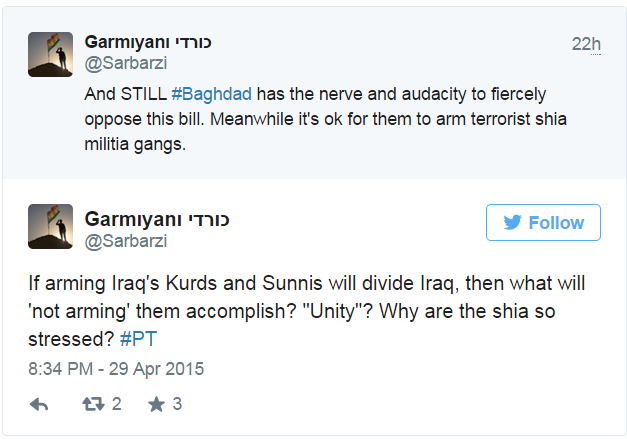
Supporters of the Peshmerga took to twitter to complain about the double standard:

garmiyani-tweet

In the United States, the Obama Administration finds itself on the same side of the argument as Moqtada Al-Sadr, opposing the bill to permit arms for Kurdish forces. As State Department Spokeswoman Marie Harf confirmed yesterday:

QUESTION: Yes. Do you have any comment about this draft resolution at the Armed Services Committee that calls for the recognition of the Sunni fighters and the Kurdish Peshmerga forces as a country, and so they can be – directly receive aid and weapons from the U.S., not through the central government?

MS HARF: I saw that. I saw that. And to be very clear: The policy of this Administration is clear and consistent in support of a unified Iraq, and that we’ve always said a unified Iraq is stronger, and it’s important to the stability of the region as well. Our military assistance and equipment deliveries, our policy remains the same there as well, that all arms transfers must be coordinated via the sovereign central government of Iraq. We believe this policy is the most effective way to support the coalition’s efforts.

So we look forward to working with congress on language that we could support on this important issue, but the draft bill, as you noted, in the House – this is very early in the process here for the NDAA – as currently written on this issue, of course, does not reflect Administration policy.

By opposing the direct arming of Sunni and Kurdish forces (and the Kurdish forces in particular), the administration is continuing a policy arc in the region that continues to serve the interests of the Iranians because it creates a dynamic where the only viable players are either Sunni jihadists (whether Islamic State, or in the case of Syria, Al Qaeda-linked groups such as Jabhat al-Nusra), or Iranian-backed forces, such as Assad and the Shia militias operating in Iraq, who are no less committed enemies of the United States.  Bringing supplies directly to Kurdish forces will give the United States a third option to positively affect the outcome of events in Iraq without requiring the modus vivendi with the Iranians.