Excerpts: Donald Trump at NRA shows how he’ll defeat Clinton, Western Free Press via YouTube, May 20, 2016
FULL: Donald Trump at Morning Joe, May 20, 2016- ‘Would you consider Sanders as your running mate?’ May 20, 2016
(Spoiler alert: The question about Sanders as Trump’s VP choice comes at the tail end of the interview, and Trump’s answer was that Sanders should run as an independent. The interview is wide-ranging and deals with foreign policy, China, Mexico, the Islamist threat, the terrorist attack on EgyptAir and a bunch of other stuff. — DM)
A fractured Democratic Party threatens Clinton’s chances against Trump, Washington Post, David Weigel, May 18, 2016
(How many disappointed Sanders supporters will vote for Trump in the general election? — DM)
When Sen. Bernie Sanders of Vermont took the stage this week after falling short in the Kentucky primary, supporters of Hillary Clinton wondered whether he would finally soften his tone and let her move on to a general election against Donald Trump.
They didn’t have to wonder for long.
Sanders credited Clinton’s victory to “a closed primary, something I am not all that enthusiastic about, where independents are not allowed to vote.” He commanded the Democratic Party to “do the right thing and open its doors and let into the party people who are prepared to fight for economic and social change.” And then he promised that he’s staying in the race until the convention. “Let me be as clear as I can be: We are in ’til the last ballot is cast!”
The performance prompted cheers across a crowd of about 8,000 in Carson, Calif., highlighting the mistrust and alienation that Sanders’s most ardent fans feel about Clinton, the Democrats and their “rigged” system. Yet the whole spectacle also sent shudders through those supporting Clinton, who are growing increasingly irritated by Sanders’s ever-presence in the race — and nervous that he is damaging Clinton.
All of it seems to have come to a head in recent days, as bitterness on both sides has boiled over and prompted new worries that a fractured party could lead to chaos at the national convention and harm Clinton’s chances against Trump in November. Two realities seem to be fueling it all: The nomination is, for all intents and purposes, out of Sanders’s reach yet his supporters are showing no signs of wanting to rally behind Clinton.
“If you lose a game that you put your heart and soul into, and you lose squarely, you can walk off the court and shake someone’s hand and say, ‘Well done,’ ” said Rep. Diane Russell, a Maine legislator and Sanders supporter. “If you don’t feel like the game was working fairly, it’s hard to do that.”
On the other side is this view: It’s also hard to win a general election with a protracted, divisive primary battle that won’t go away. “The way he’s been acting now is a demonstration of why he’s had no support from his colleagues,” said former Massachusetts congressman Barney Frank.
Sanders supporters are crying “fraud” over delegate selection and threatening to sit out the election. They have promised to press their case to the convention floor. It happened in 2008, in the final throes of Clinton’s failed bid against Barack Obama. What remains unclear is whether this year’s divisions will go deeper or longer.
An explosive weekend convention in Nevada, where Sanders supporters turned on the state party chairwoman for overruling their challenges and seating Clinton delegates, exposed the depth of the acrimony. In his statements since then, Sanders has made no attempt to heal it.
Sanders is also keeping his supporters riled up by making what many Democrats view as an unrealistic, and even dishonest, view of his candidacy, given Clinton’s large lead in delegates.
“There are a lot of people out there, many pundits and politicians, they say Bernie Sanders should drop out, the people of California should not have the right to determine who the next president will be,” he said at Tuesday’s rally, insisting that the state had enough pledged delegates to put him over the top.
Increasingly, Sanders’s most passionate supporters claim that the primary has been rigged. A Reddit user’s chart comparing the first wave of exit polls with Clinton’s stronger-than-expected performances has been circulated — most famously by Sanders surrogate and actor Tim Robbins — as evidence of election fraud.
Clinton’s 16-point victory in New York is explained by the state’s onerous registration rules and by the still-unexplained purge of Brooklyn voter rolls. Anyone questioning her lead of three million votes can find solace in a CounterPunch article titled “Clinton Does Best Where Voting Machines Flunk Hacking Tests.”
“Do these people read newspapers?” said Bob Mulholland, a California superdelegate and Clinton supporter who has accused Sanders supporters of harassing his peers. “Are they reading some chain email with bogus numbers? I hold Sanders somewhat responsible for this, because he comes across on TV as a very angry old man, riling people up.”
As Kentucky slid away from Sanders on Tuesday, some of his supporters saw a culprit in Alison Lundergan Grimes. The secretary of state and 2014 candidate for U.S. Senate, a longtime supporter of Clinton, even went on CNN to declare Clinton the winner.
“Hillary doesn’t even care anymore,” wrote one Sanders supporter, tweeting a link to a story about alleged fraud in Kentucky.
“Yet another state we would’ve won if everyone could vote,” another supporter wrote on Reddit.
“Better watch out for illegal conduct by Grimes since she said electing Clinton is more important than doing her job,” tweeted another.
The evidence for the last claim was a video clip from a rally with Clinton and Grimes, where the secretary of state said she was “not only here to do my job” but also to back her candidate. It was cut and distributed by America Rising, a conservative opposition research firm adept at finding wedges between Clinton and the left.
As Sanders has fallen behind Clinton, more conservatives have looked for ways to exploit the angst. On Tuesday morning, Fox News sent a morning-show host to the streets of New York to ask voters if the primary had been rigged for Clinton. Dan Backer, the conservative attorney and treasurer of the pro-Trump Great America PAC, has egged on Sanders supporters on Facebook with pep talks like “Bernie will win the most primaries and can still take the most pledged [elected] delegates while narrowing the total vote gap.” Trump has also announced a kind of snarky solidarity with Sanders, telling voters and Twitter followers that the senator should bolt the party over his foul treatment.
“Bernie Sanders is being treated very badly by the Democrats — the system is rigged against him,” Trump tweeted Wednesday morning. “Many of his disenfranchised fans are for me!”
The Sanders campaign has endorsed none of this — but it hasn’t tamped it down. Sanders’s sympathetic response to the Nevada convention fracas angered the state and national party, with DNC Chairwoman Debbie Wasserman Schultz comparing the worst scenes there to the violence at Trump rallies. Asked if there had been any actual fraud in the primaries, Michael Briggs, Sanders’s spokesman, suggested that the Democratic Party’s infrastructure had been sabotaged in a way that hurt one candidate.
“Most state parties tried to do a good job,” he said, “but often they are short on resources and there are institutional impediments to a fair process, like super-early registration, party-switch deadlines, closed primaries, complicated party registration rules, bad voter lists.”
Sanders himself has made harder-to-argue cases against the Democratic primaries. The truncated debate schedule struck supporters of both candidates as unfair, something the party seemed to acknowledge by tacking on more of them in March and April. Although Clinton is on track to win a majority of pledged delegates, Sanders has suggested that early support for Clinton among superdelegates, the party leaders and elected officials who get an automatic convention vote but are not bound by their state’s popular vote created a barrier no candidate could scale.
“It is absurd that you had 400 establishment Democrats on board Hillary Clinton’s campaign before anybody was in the race,” Sanders told MSNBC’s Rachel Maddow in an interview last week. “That stacks the deck in a very, very, unfair way for any establishment candidate, and against the wishes of the people.”
At the same time, Sanders and his supporters argue that superdelegates should consider bolting Clinton and backing him, based on polls that show him leading Trump as her favorables sink. That irritates Clinton supporters on two levels: by suggesting that the voters got it wrong and by dismissing the judgment of the sort of elected leaders whom any president would need to pass an agenda.
“If you believe you represent the people, and the people are uncooperative with your goal of winning, you have to find some explanation,” said Frank, whose appointment to the DNC rules committee sparked anger from Sanders’s supporters. “Look — I understand you have some disagreements, but does the overwhelming view of the black leadership, LGBT leadership, women’s leadership — does that count for nothing?”
As they contemplate Sanders’s “contested contest” at the Philadelphia convention, Clinton supporters think warmly back to 2008. By the time those primaries concluded, as many as 40 percent of Clinton voters said they could not support Barack Obama. The most dedicated PUMAs (Party Unity My A–) became TV stars; the vast majority of Clinton holdouts eventually went for the ticket. While Clinton’s favorable rating with Sanders supporters has been falling, many of his endorsers think that can be reversed.
“I want people to see this as a fair process, because I’m not in the ‘Bernie or Bust’ camp,” said Russell, the Sanders supporter from Maine. “I love this campaign, but I love my country more. And I tell the ‘Bernie or Bust’ people, if you’re angry at the end of this, you’re not going to take it out on the DNC. You’re going to take it out on the most vulnerable people — the ones we are fighting for.”
Renegade Jew Backlash, Front Page Magazine, David Horowitz, May 19, 2016

Reprinted from Breitbart.
According to the Internet Webster synonyms for renegade are “defector” and “deserter.” I applied the term to Kristol because of his efforts to launch a third party campaign to block the nominee of his party, split the conservative vote, and ensure the election of a Democrat whose party had provided a path to nuclear weapons to the Jews’ mortal enemy (and America’s as well).
***************************
I have been accused of being a provocateur all my life – when I was a leftist in the 60s proclaiming (God help me) that Vietnam was the fulfillment of the American dream; when I left the left declaring that, “the beginning of political morality is anti-Communism;” when I said that identity politics “owed more to Mussolini than to Marx;” when I opposed reparations for slavery 137 years after the fact because it was “bad for blacks and racist too;” and when I organized “Islamo-fascism Awareness Weeks on a hundred college campuses across the country. Now I have provoked a firestorm on the Internet through a Breitbart article that called Bill Kristol a “renegade Jew.”
According to the Internet Webster synonyms for renegade are “defector” and “deserter.” I applied the term to Kristol because of his efforts to launch a third party campaign to block the nominee of his party, split the conservative vote, and ensure the election of a Democrat whose party had provided a path to nuclear weapons to the Jews’ mortal enemy (and America’s as well). I picked the emotional term “renegade” because I wanted to shock Kristol and his co-conspirators into realizing the gravity of their actions.
However, I had no idea that this would provoke the reaction it did. A veritable tsunami of attacks were directed at Breitbart and myself from Kristol’s supporters on the “neo-conservative” right and from die-hard enemies of the Republican nominee in all political quarters. Even the Anti-Defamation League, which had once attacked me over my anti-reparations campaign) chimed in, calling the title of my piece “inappropriate and offensive.” This was actually pretty mild considering others were denouncing it as “disgraceful” and “an anti-Semitic slur.”
How by the way is the characterization “anti-Semitic slur” even possible? Are Jews immune to defecting from causes? When I publicly repudiated the radical cause, thirty years ago, the first attack on me appeared in the Village Voice under the title, “The Intellectual Life and the Renegade Horowitz.” It was written by Paul Berman, who years later became a somewhat chastened radical himself. Berman’s attack stung me – as I hoped my charge would sting Kristol and cause him to reconsider his course. But the epithet didn’t bother anybody but me. My current critics would stigmatize me not only as a defector from the conservative cause but as a double agent who never really left the left. After my Breitbart article appeared, Commentary editor (and Kristol relative) John Podhoretz sent me a one-line email: “Once a Stalinist always a Stalinist,” while Commentary writer Jonathan Tobin in a piece titled “Breitbart ‘Renegade Jew’ Disgrace,” suggest: “You can take the boy out of the Bolsheviks but you can’t take the Bolshevik out of the boy.”
Like many of the attacks on Trump, these squalid responses with their flimsy intellectual content call to mind a famous remark of Lionel Trilling’s, made more than 60 years ago. Conservatives, he wrote, did not “express themselves in ideas but only in action or in irritable mental gestures that seek to resemble ideas.” It is not that Kristol or his defender Tobin haven’t had worthy and defensible ideas. They have. But this makes it even sadder to see the flimsy arguments they trot out to discredit Trump and to defend Kristol’s indefensible campaign. Criticisms of Trump’s personal attacks on his Republican rivals are reasonable. But not when they fail to take into account the 60,000 political ads that were aired by those same rivals whose purpose was to destroy him. (The ads were not, should anybody have missed them, about policies and issues.)
I have no quarrel with people who have doubts about what Trump would do if elected. It is the task of the candidate to allay those doubts. For reasonable critics Trump’s announcement of his prospective Supreme Court nominees should be important steps along the way. My quarrel is not with Trump skeptics, but with the effort to nullify the vote of the Republican electorate – a politically active and informed, and conservative segment of that electorate. Kristol’s third party effort exudes an elitist contempt for the will of the people, which is particularly unbecoming in a crowd that prides itself on being “constitutional conservatives.”
Finally, I am disturbed by the failure of the nullifiers to consider the perils of the choices our country now faces. For the life of me I cannot understand how my friends in the conservative movement cannot have qualms about derailing the candidacy of the Republican Party’s pro-Israel, pro-military, pro-American nominee, and electing the candidate of a party that has built its foreign policy around making Islamist Iran the number one power in the Middle East, providing its jihadists with a path to nuclear weapons, putting $150 billion into their terrorist war chest and turning a blind eye to their circumvention of international restrictions so that they can build ballistic missiles capable of destroying the Jewish state and causing incalculable damage to the United States.
Dems Seek Quicker Admission of Syrian Refugees Despite Terrorism Concerns, Washington Free Beacon, Natalie Johnson, May 18, 2016
 Syrian refugee family in eastern Lebanese town / AP
Senate Democrats sent a letter to President Obama Wednesday pressing the administration to accelerate the admission process for Syrian refugees to settle in the United States.
Obama vowed last year that the U.S. would resettle up to 10,000 individuals seeking haven from the Syrian civil before September, but according to Reuters only 1,736 refugees have been admitted.
27 senators, including the No. 2 Democrat Sen. Dick Durbin of Illinois and Sen. Bernie Sanders (I, Vt.), signed the letter urging the Obama administration to “devote the necessary resources to expeditiously and safely resettle Refugees from Syria.”
“We are deeply concerned about the slow pace of admissions for Syrian refugees in the first seven months of the fiscal year,” the senators wrote in the letter obtained by Reuters.
The letter arrived three weeks after Director of National Intelligence James Clapper said that the Islamic State terrorist group has “taken advantage” of the migrant crisis in Europe, advising E.U. nations to maintain awareness.
One of the suicide bombers who conspired in the November Paris attacks that killed 130 people entered Greece using a fake Syrian passport posing as a refugee. He then traveled the same route fleeing migrants use to make his way into Western Europe.
The revelations have ignited criticism from Republicans who contend that the president’s plan would lead to similar attacks in the U.S. without a stringent vetting process in place.
More than 30 governors have called on the U.S. to halt the refugee resettlement program and have tried implementing restrictions to prevent them from entering their states. Only one of those states was home to a Democratic governor.
The Democratic signatories demanded in their letter that the administration provide specific details as to how the nation would carry through on its vow to resettle the remaining 8,264 Syrians during the next five months.
“Other nations, including ours, can and should do much more,” the senators wrote.
The U.S. has so far resettled more than 6,000 refugees from Myanmar and more than 5,000 from Iraq.
[M]ight we make Trump the precedent-shattering break from historical practice? We very well might, for the simple reason that only someone who is genuinely an outsider—a way outsider in every way—like Trump stands a chance of restoring some semblance of sensible government. One can imagine a President Trump governing like “President Dave” in the movie from the mid-1990s, and saying “Why do we have 55 federal job training programs? How about eliminating at least two-thirds of them?” Rinse and repeat. In other words, what is required is a disposition much different than Ross Perot’s risible slogan of “getting under the hood and fixin’ it.”
************************
I recant none of my previous criticisms of Trump’s unsuitability to be president, but the case that he—and he alone—has an unprecedented opportunity to disrupt (in the right ways) the crisis of American government today deserves to be understood. The most sophisticated, though perhaps sophistical, case comes from our friends at the Journal of American Greatness, though even they admit that they may be reading more into Trump than is there. (And c’mon Decius, no one who uses the term “noetic heterogeneity” is going to get a job in the Trump Administration.)
I have a simpler case, and, unusual for me, it doesn’t require any classical metaphysics. I keep coming back to the curious fact that so many Bernie Sanders voters (almost half in West Virginia) say they will vote for Trump if Bernie doesn’t get the nomination. This can’t be because they think Trump is a socialist. And I doubt the dislike of Hillary sufficiently explains it either.
I think the explanation lies in this chart:
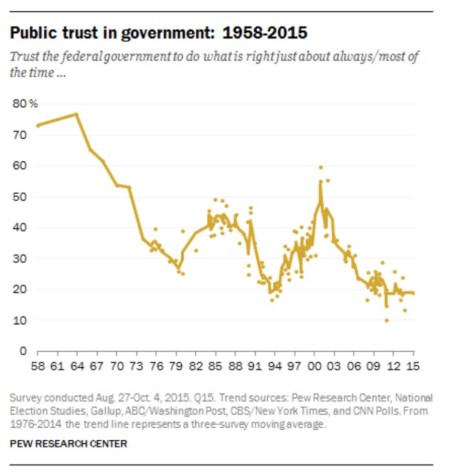
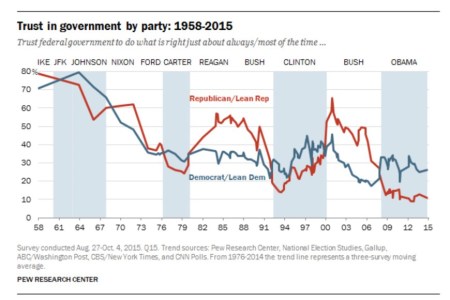
This trend is well-known among public opinion survey monkeys, and it is worth observing several things. First, the overall decline in public confidence in the competence of the federal government. Second, notice the two places where the trend reverses—during the Reagan years, and right after 9/11, when President Bush and the national government was wholly focused on its chief responsibility: defending the nation. Third, it is conspicuous that there has been no upturn at all under Obama. You’d think he could expect some bump even from a weak economy. If you break down this data by party (see next chart) you can see that Obama doesn’t even get much of a bump up from Democrats.
Finally, look at public opinion about the government from this point of view, which finds that 79 percent of Americans—four out of five—are frustrated or angry with the federal government.

Some observations. First, you’ll note in the first chart that back in the early 1960s, public confidence in the federal government was fairly high, even though liberals told us that the Eisenhower years were dreadful, etc. As James Q. Wilson once pointed out, in 1960 what most people had in front of them was a government that had successfully accomplished some large things: it had won a World War in short order; it had educated millions of troops who came home from that war through the G.I. Bill; it has begun the interstate highway system, an eminently practical undertaking. California built a huge water project (for people back then—imagine that) and other things.
In those days, the government wasn’t trying to solve poverty, promote self-esteem, heal our souls, etc. It[s pretty easy to see that public confidence in the federal government began its long term decline exactly when the government became incompetent at foreign and domestic policy simultaneously. Liberalism has never recovered from this. But neither has the Republican Party ever achieved much serious reform. And the quagmire of the Iraq War under Bush deprived Republicans of an example of the one thing they were supposed to be able to do better than Democrats. (Yes, the surge worked, and we prevailed before Obama threw it away. But it cost too much and came too late to stave off the political damage to Republicans.)
Meanwhile, what do liberals want to build today? No new dams or highways, but high speed rail that no one will ride and urban transit systems (like DC’s Metro) that they can’t maintain. A health care system that remains hated by a majority of Americans. An airport security system that everyone knows is a costly joke. Need I go on? Liberals and the media would like everyone to think that people are disgusted with “gridlock” in Washington (which is only liberal code for saying conservatives should unilaterally disarm so government can do even more things). I don’t think that’s it at all. I think a majority are disgusted with an incompetent government. The mode of public conversation about the federal government is contempt, not frustration that it isn’t doing even more.
Most of the leading candidates of both parties talk about “reform,” but mostly offer mere tinkering. Republicans offer tax cuts; Democrats offer more free stuff. Neither is credible any more. Which brings us to Trump. His difference from the political class is obvious, and has been widely remarked upon, so I won’t repeat that part of the story. Bottom line: we reached a point of such bipartisan disgust with the government that someone like Trump looks like the only kind of person who could conceivably take it on.
One more key political fact, though: We have never elected someone with no prior experience in public office at all to the presidency. (I count being supreme commander of Allied armies in WWII—Eisenhower—as experience in public office. Ditto Grant, etc.) Only once has a major party ever nominated someone from the business world with no experience in public office: Wendell Willkie in 1940. He was a very credible figure, and might have won in the absence of the growing shadow of war.
So might we make Trump the precedent-shattering break from historical practice? We very well might, for the simple reason that only someone who is genuinely an outsider—a way outsider in every way—like Trump stands a chance of restoring some semblance of sensible government. One can imagine a President Trump governing like “President Dave” in the movie from the mid-1990s, and saying “Why do we have 55 federal job training programs? How about eliminating at least two-thirds of them?” Rinse and repeat. In other words, what is required is a disposition much different than Ross Perot’s risible slogan of “getting under the hood and fixin’ it.”
Does Trump understand the nature and magnitude of the problem, and thereby his extraordinary opportunity? I’m doubtful, but he just might kindof, sortof grasp it in his instinctual, elemental way. And his very brashness might be just the kind of approach to accomplishing a few things.
You can find the extensive background to the three charts shown here from the Pew Research Center.
Anti-Americanism is the Foreign Policy of Fools, Front Page Magazine, Daniel Greenfield, May 13, 2016

The New York Times profile of Ben Rhodes, Obama’s foreign policy guru, had plenty of shocking moments from his attempt to cover up Iran’s abduction of US sailors to his blatant gloating over the stupidity of the journalists whom he manipulated into spreading his lies in support of the Iran deal.
But the larger revelation is also simpler. Ben Rhodes knows next to nothing about foreign policy. He has no idea whether Iran will get nukes and couldn’t care less whether it’s moderate or not. He’s a failed fiction writer whose goal is “radically reorienting American policy in the Middle East in order to make the prospect of American involvement in the region’s future wars a lot less likely”.
That’s another way of describing a foreign policy built on isolationism.
Obama’s interviews are liberally spiced with contempt for the Europeans, whose foreign policy he adopted, and even former Islamist allies like Turkey are being treated with disdain. He despises both traditional US allies such as the UK and Israel, but he also has little use for the enemies, such as Russia and the Sunni Islamists, whom he tried to court. About the only enemy nation he still likes is Iran.
The first wave of Democratic backlash to the Iraq War was to champion diplomacy over military intervention. But diplomacy without intervention proved toothless. All that’s left now is a warped isolationism in which the US still pays the bills, signs all sorts of meaningless international accords that compromise our interests, but completely abandons its leadership role as a world power.
Rhodes sneers at the reporters whom he manipulated as knowing nothing. And he’s right. But he also doesn’t know anything. The condition is typical of an American left which has no foreign policy. It only has an anti-American domestic policy which it projects internationally without regard to its relevance.
The Iran deal had to happen to defeat “neo-conservatives”, the “war lobby” and whatever other leftist boogeyman was lurking around the premises. The men and women doing the defeating, like Rhodes, had zero interest in what was actually happening in Iran or what its leaders might do with nuclear weapons. They would tell any lie to help sell the deal because they were fighting a domestic battle of narratives. Iran wasn’t a real place. It was a fictional counter in a domestic ideological battle.
This problem did not begin yesterday.
Senator Ted Kennedy’s infamous letter to the Soviet leadership was seen as treasonous. But as a practical matter it revealed that an aspiring president had no interest in the USSR except to use it in a domestic battle against Reagan. Democrats had similarly supported and then turned against the Iraq War over domestic politics. Not only had they backed the removal of Saddam Hussein in the past, but Obama’s regime change in Libya showed that they did not believe any of their own critiques of regime change or unilateral intervention. Their foreign policy was based entirely on a domestic agenda.
Earlier generations of Democrats did have a comprehensive foreign policy based on ideas. It might be wrong, but it did exist. The Clinton-Kerry generation was very interested in talking about foreign policy, but viewed it purely in terms of opposing the Vietnam War as a critique of American power.
They had no other ideas to offer and it showed.
Without the Cold War, the Clinton era reduced foreign policy to multilateral diplomacy that existed to resolve conflicts and prevent genocide. But diplomacy proved useless in Rwanda and Bosnia. So Clinton ignored the former and used ruthless force casually for the latter. Meanwhile his foreign policy couldn’t process the rise of Al Qaeda and the growing threat of Islamic terrorism which led inevitably to 9/11.
Hillary Clinton is offering up a freezer fresh version of the same thing. The policies that failed her badly in Syria, Libya and across the Middle East are the only foreign policy offerings that she has for sale.
Bill Clinton had no foreign policy. Like Obama, he viewed foreign policy in terms of his domestic conflicts with Republicans. He tried to engage diplomatically while retreating militarily. His botched intervention in Yugoslavia had strong similarities to Obama’s disastrous intervention in Libya.
And a Clinton was behind both.
Hillary Clinton took the Secretary of State position to build up credibility for a presidential run. The invasion of Libya was a platform to take her to the White House. Libya did not matter to her. While the State Department blew through fortunes to finance her self-promotion, the Benghazi mission lacked basic security. Even the Jihadists who were hired on to provide security weren’t getting paid.
And that led to the murder of four Americans.
It’s a short distance from Ted Kennedy trying to figure out how he could use Soviet officials to undermine Reagan and become president to Hillary Clinton seeing regime change in Libya as a campaign commercial right down to the punchy media-friendly slogan, “We came, We saw, He died.”
Democratic foreign policy is animated by political careerism and the conviction that American power is the problem. Beyond that lies a deep and abiding ignorance of the actual conflicts and issues abroad.
The left’s reflexive anti-Americanism makes it easy to be ignorant while appearing knowledgeable. It allows the conflation of domestic policy critiques with foreign policy by blaming America for everything. Anything that doesn’t fit into the neat anti-American box can be waved away with some clichés about the importance of global communication, global poverty, trade policies, global warming and reform.
Democrats didn’t have to understand Iraq. They just had to know it was Bush’s fault. First it was Bush I’s fault for not removing Saddam Hussein, as Democrats and the media instead he should have. Then it was Bush II’s fault for removing Saddam, which Democrats and the media had now decided he shouldn’t have. But blaming Bush I and II didn’t actually teach them anything about Iraq. And so they had no idea what to do about it.
Bill Clinton ricocheted from bombing Iraq to trying to trying to ignore it. Obama followed the same course, first trying to ignore it and then bombing it. Neither of them understood anything about Iraq. While Obama still boasts of having gotten Iraq right, that’s because no one reminds him that back in the Senate he was insisting that Iraqis would achieve a political solution once American soldiers had left.
The political solution they achieved was a bloody civil war culminating in ISIS.
But Obama’s understanding of Iraq was limited to blaming America for its problems. He didn’t know anything else and he didn’t feel that he had to.
The rise of ISIS happened because Democrats didn’t feel they had to know anything about Iraq except that it was Bush’s fault. When Bush tried to get Assad to cut off the flow of Al Qaeda terrorists into Iraq, leading Democrats, including Pelosi and Kerry, rushed to support Assad against President Bush.
That flow of terrorists from Syria into Iraq eventually became the basis for ISIS.
It’s no wonder that Obama has never been able to come up with a working plan for Syria. Blaming Bush is not a plan. And it’s a particularly bad plan in this case.
Anti-Americanism, like most prejudices, is a license for ignorance. By embracing a prejudice against their own country, Democrats have lost any skill at foreign policy that they once had. Instead of learning anything about the world, they resort to the easy answer of turning away from the confusing problems of other countries to blame them all on us. Anti-Americanism is the only foreign policy that they need.
Anti-Americanism is the foreign policy of fools. It’s not smart power. It’s ignorance and prejudice with a dictionary.
Trump Derangement Syndrome, Front Page Magazine, David Horowitz, May 12, 2016

I don’t think I speak for myself alone when I confess utter bewilderment at the number of conservatives – among whom I count long-term friends – who seem to have lost their marbles when assessing the presidential candidacy of Donald Trump.The Wall Street Journal’s Bret Stephens, to take one example that can stand for many, is an astute analyst – in my view one of the best political commentators writing today. Yet he is the author of this opening paragraph in Monday’s paper, which leaves me scratching my head, and embarrassed for my friend: “The best hope for what’s left of a serious conservative movement in America is the election in November of a Democratic president, held in check by a Republican Congress. Conservatives can survive liberal administrations, especially those whose predictable failures lead to healthy restorations—think Carter, then Reagan.”[1]
I can’t think of anything that is right about these sentences. The president’s first business is the nation’s security. Did Reagan really repair the damage that Carter did? It is true that he pulled the nation back from Carter’s policies of appeasing our enemies and disarming our military. But he failed to retrieve Carter’s greatest foreign policy disaster. It was Carter who brought down America’s ally, the Shah of Iran, and brought the Ayatollah Khomeini back from exile, thereby transforming Iran into the first jihadist state, and America’s deadliest enemy. Neither Ronald Reagan nor both George Bushes could undo that.
Could a Republican Congress – assuming that there would be a Republican Congress if Trump lost – hold a Democratic president like Hillary Clinton “in check”? How did that work out during the destructive reign of Barack Obama? With Republican majorities in the House and Senate Obama had no real problem in becoming the first American president to build his legacy around a policy that can fairly be described as treasonous – providing a path to nuclear power and ballistic missile capability to an Iranian regime that is our nation’s mortal enemy, has already murdered thousands of Americans, and is ruled by religious fanatics who have made no secret of their determination to destroy us.
Bret Stephens and an all-too-prominent cohort of inside-the-beltway conservatives want to turn the presidency over to Hillary Clinton “to save conservatism.” What can this mean? Have they forgotten who Hillary Clinton is? As Secretary of State she was the foreign policy captain in an administration that abandoned Iraq, thereby betraying every American and Iraqi who gave his or her life to keep that benighted country out of the hands of the terrorists and Iran (not that any Republican had the temerity to say so). ISIS is as much her godchild as Barack Obama’s. In creating the vacuum that ISIS filled Hillary was only carrying on the Democratic foreign policy tradition that Jimmy Carter inaugurated of sacrificing America’s security to pie-eyed internationalist delusions. As Secretary of State Hillary Clinton supported the overthrow of an American ally in Egypt and its replacement by the Muslim Brotherhood, the fountainhead of al-Qaeda and ISIS. She colluded in the overthrow of an American ally in Libya – a country posing no threat to the United States – thereby turning it into a base for ISIS and al-Qaeda. It was Hillary who was behind the gunrunning scheme to al-Qaeda rebels in Syria that led to the Benghazi disaster. She denied Ambassador Stephens – her American pawn in Benghazi – the security he requested in order to cover Obama’s retreat in the war on terror (it was election time), and then lied about his murder and that of three American heroes to the American people, to the mothers and fathers of the dead heroes, and to the world at large. According to the official version she approved insulting the prophet Mohammed was the problem not the terrorist onslaught that she and Obama had helped to unleash. Now we have learned that she willfully violated America’s Espionage Act, resulting in tens of thousands of her emails, classified and unclassified falling into the hands of the Russians and other adversary powers, and leading to how many future American casualties we can only guess.
This is the president that Bret Stephens and Bill Kristol and George Will think would be better for conservative values and conservative concerns than Donald Trump, a man who has raised an admirable family (a character-reflecting feat his detractors always overlook) and whose patriotism in the course of a long public life has never been in question. Nonetheless, it is Hillary Clinton – this serial liar, this traducer of the nation’s trust, this corrupt taker of $600,000 speaking fees and multi-million dollar gifts from foreign governments while acting as Secretary of State –this wretched individual who in their eyes is “survivable” should she become president.
And what isn’t survivable? “What isn’t survivable is … a serial fabulist, an incorrigible self-mythologizer, a brash vulgarian, and, when it comes to his tax returns, a determined obfuscator.” I blush for my friend making these charges, first because they are sins common to most politicians (with admittedly less flair than Donald Trump) and second because of the reason he gives for why they should matter: “Endorsing Mr. Trump means permanently laying to rest any claim conservatives might ever again make on the character issue.”
The character issue! Oh yes, that vital conservative weapon. And how did the use of it actually work out when it was put before the entire nation? Approaching the end of Clinton’s second term, Republicans made a political season out of his bad character and actually managed to impeach him for abusing women and lying to a grand jury. But when it was over, there wasn’t a pundit or pollster around who didn’t think that Bill Clinton would have an odds on chance of being elected to a third term in 2000 if the 22nd Amendment had allowed him to run.
This is not serious stuff, yet it is being peddled by first-rate conservative intellects and the fate of our nation may yet hang on it. The greatest obstacle to a Republican victory in November is the fratricidal war now being waged by the “Never Trump” crowd against the only person who might prevent the disaster awaiting us if the party of Obama and Kerry and Hillary and Sharpton prevails in November.
Their Trump hysteria notwithstanding, I still have the highest regard for the intellects of Bret Stephens and George Will and their comrades-in-arms. But I am hoping against hope that they come to their senses before it is too late.
Clueless Republicans Don’t Realize It’s the Democrats Who Have the Problem, PJ Media, Roger L. Simon, May 10, 2016

I’m a bit perplexed with the continued resistance of so many of my right-wing brothers and sisters to Donald Trump. If it’s just his brash style and vulgar taste, his preference for glittery gold over brushed nickel or flat black for his bathroom fixtures, I could understand it. I’m a flat black guy myself. But it’s so much more than that.
The latest “betrayal” is that Trump admitted his tax plan was negotiable Imagine that—a tax plan being negotiated between the administration and Congress! Never heard of that before…. oh, wait.
Never mind that the Trump plan, even negotiated, would be considerably lower than just about any on offer and well within the parameters of conventional GOP proposals. (Now be honest—who would you rather have negotiating for you, Donald Trump or Paul Ryan? Who do you think would get a better result?) Nevertheless The Donald, in the opinion of the cognoscenti, once more has shown himself to be a feckless character not worthy of support—and the Republican gulf widens.
Or so we’re supposed to believe, even though he has the nomination completely nailed down, signed, sealed and delivered, everything but set in bronze.
Meanwhile, to almost everyone’s surprise, the Democrats are still fighting, their internal enmity growing as Comrade Bernie wins primary after primary, sometimes by large majorities, and Lady Hillary clings to her super delegates like a three-year-old to a blanket. What happens if she loses California? According to West Virginia exit polls, a full third of Democratic primary voters are ready to defect to Trump. In the latest poll of swing states, Donald is already ahead of Clinton in Ohio and neck-and-neck in Florida and Pennsylvania. And the big show is just getting started.
It is the Democrats, not the Republicans, that have the problem, but you wouldn’t know it if you watched, say, The Kelly File or had your Internet perpetually wired to National Review or The Weekly Standard, where the writing is as elegant as the thinking, these days, is often fuzzy. The Democrats are fighting a real war of ideas, disreputable though those ideas may be, while the Republicans fight a status war among themselves, a battle over control, not, except in the margins, over ideology.
Am I wrong? Remind me again where Trump, at least currently, is not a conservative? Taxes, check. Deficit, check. Immigration, check. Sanctuary cities, check. Strong defense, check. Supreme Court, check. Veterans, check. Common core, check. Iran deal, check. Israel, check. Healthcare, check. Pro-life, check…. Oh, yes, Planned Parenthood. He thinks the part of that operation that treats cervical cancer is okay. What a sin.
But…but…but… he has those whacky ideas on NATO and nuclear weapons and trade.
Are they so whacky? Other nations maybe should pay the part of NATO they contracted to. And the Japanese and South Koreans themselves have been talking about building nukes. Wouldn’t you after eight years of Obama? And then trade, who would doubt it could have been negotiated better, considering how our foreign policy deals have been negotiated?
And of course there’s the matter of Muslim immigration. He wants that restricted for now. So do most Americans, according to polls. Again, this is the opening point of a negotiation. Who knows where it will end? But no one, other than the extreme left, would like to see the Syrian refugees pouring in. Trump will have the public on his side in preventing it.
As I said, the real problem is with the Democrats. They are the ones in true disarray and are likely to remain so through their convention. This is a huge gift to the Republicans if they can only suck it up, shelve their egos, get together and take advantage of it. It doesn’t matter whether you are a neocon, a social con, a libertarian, a financial con or just a plain con. Ideology is so last year. (Well not completely, but it doesn’t have to be on the front burner all the time, does it?) Just do it.
Indiana Trump, Israel Hayom, Boaz Bismuth, May 6, 2016
 Republican presidential candidate Donald Trump | Photo credit: AP
“I was born for the storm, and a calm doesn’t suit me.” These words were uttered by Andrew Jackson, the seventh president of the United States, but could easily have come out of the mouth of presumptive Republican presidential candidate Donald Trump.
Indiana set the tone this week: The state, which is better versed in motor races than presidential races, demonstrated that Trump is the man Republican voters want. The Indiana primaries also showed that Democratic candidate Hillary Clinton is in real trouble, even if — as expected — she is nominated by her party.
In the Midwestern state’s primaries, it turned out that American citizens are not necessarily dreaming of seeing Clinton in the Oval Office. She is not whetting the Democrats’ electoral appetite, as the unexpected success of Senator Bernie Sanders (Vermont) in Indiana and 18 other states proves.
In Indiana, the gun for the real race went off: Clinton versus Trump. Yes, Trump. The man who put egg on the faces of pundits worldwide, even here in Israel; the man who became his party’s presumptive nominee before reaching the minimum of 1,237 delegates necessary to guarantee his candidacy for president. You can argue with the Republican voters, but they are the ones who decide.
Since the Indiana primaries, experts, pundits, and members of the GOP establishment, which produced former presidents Ronald Reagan and Abraham Lincoln, have changed their tune, falling in line with the winner. On their Twitter accounts, they expressed a unified opinion — in the end, when a serious decision has to be made, Trump is preferable to Clinton.
A little over two months from now, the Republican convention will take place in Ohio. It looks like those who did not want Trump as the party’s candidate could see him win the presidency in November.
Clinton is marking time. Trump, on the other hand, keeps moving up. The man whom many called “Mr. 30%” has risen to 50% within weeks. It happened just when he was expected to hit a bump in the road, just when his opponents, Texas Senator Ted Cruz and Ohio Governor John Kasich joined forces to stop him.
Trump’s leaps and bounds this past month defeated all expectations. Since the primaries in New York, his home state, Trump has won in five northeastern states — Connecticut, Maryland, Pennsylvania, Rhode Island, and Delaware. On Tuesday, he managed a victory in Indiana and with the statistics of a real winner — between 50-60% support.
The wind went out of the sails
America is watching the finance stag from New York galloping on and cannot understand how it happen. Why did no one foresee this phenomenon? Why, when Trump declared his candidacy last June, did everyone treat it like a gimmick? The answers can be found in the eight years of U.S. President Barack Obama’s terms in office. Despite the efforts of his supporters to present the 44th U.S. president as a success story, his administration has been a failure, due mainly to the expectations that he himself created. From a president who wanted to change America and the rest of the world along with it, Obama turned into a president who mostly changed America, but not the world. And if so, not for the better.
Many Americans today think that the president, to a large extent, stole their country from them. Rationality has given way to emotions: They do not think in terms of numbers — unemployment percentages, inflation, deficit, GDP; they think about values — country, military, family. They are finding it hard to believe that their America, a superpower that once led the world, has changed its face and suddenly become just another country. A country that “leads from behind,” as Obama himself put it in the Libya campaign, and does so willingly.
That is not the American dream — but it might be the American nightmare. Once, even an immigrant to the U.S. from Asia, Europe, or Africa was asked to conform to American values. In the age of Obama, the immigrants learned that the U.S. may try to conform to them. Good? Bad? What is certain is that this isn’t the American spirit. And it might be the reason we were reminded this week of Andrew Jackson, considered one of the most successful American presidents. Although controversial in his time, he won the presidential election twice and captured the hearts of the masses. Jackson was not the establishment’s choice — the elite despised him — but the people voted for the hero general. And in America, the people are sovereign.
Jackson’s and Trump’s stories are very different, but there are similarities. Jackson was also very crude on one hand and popular on the other; like Trump, the establishment did not want him and in 1824 even managed to negate his presidency and hand it over to John Quincy Adams. The fact that Jackson won more votes and electorates did little to help, but Jackson — a hero of wars against the English and the Indians, won the next two election campaigns. Today, his image graces the U.S. $20 bill.
The seventh U.S. president was not one of the founding fathers, but he is still associated with many of the values America is proud of today: honor, independence, world recognition of America’s status and role, the importance of military service, the right to bear arms (under the Second Amendment of the Constitution), and of course courage, which includes willingness to die for the flag and for the safety of one’s family.
All these, if you like, are values attributed to the time of Jackson’s presidency, but also characterize Trump’s agenda. The former’s tradition has become the latter’s promise.
If America had not drifted so far away from Jackson’s legacy during Obama’s presidency, Trump’s promises might not have hit a soft spot with American voters. But luckily for the billionaire, the things he is saying hit home with the voters even if, like Jackson, they stand out for their crudeness.
A gentleman to the enemy
Let’s get back to Indiana. Time and again, reports said that this would be the decisive primary, and it was. This primary made Trump the party’s de facto nominee, and Cruz decided to pack it in.
Cruz, like General Custer, stood bravely to the last. Indiana was his last stand. After his losses in New York and the other northeast states, he was still trying to steal the show when he named Carly Fiorina his running mate. That nomination will remain on paper only.
Cruz, a fundamentalist Christian, was expected to win in Indiana, a state with a high percentage of religious voters. Two weeks ago, he even signed an agreement with Ohio Governor John Kasich, in which the latter agreed to support him in the fateful vote. In practice, the polls predicted a painful loss for Cruz, and turned out to be completely correct.
The last day of Cruz’s campaign was marked by mutual mudslinging with Trump. First, the finance baron from New York said in an interview to Fox News that Cruz’s father, Rafael, had ties to Lee Harvey Oswald, who assassinated U.S. President John F. Kennedy in 1963. He was repeating a very problematic report from the National Inquirer tabloid, which had run a picture that showed Cruz Sr. and Oswald allegedly handing out flyers praising Cuban dictator Fidel Castro.
Cruz Jr., who was deeply hurt by the remarks, called Trump a “pathological liar” and other choice names. That did not prevent Trump from commending Cruz after the latter’s loss in Indiana. There, another facet of the billionaire’s personality came out — that of a true gentleman.
Meanwhile, Cruz has yet to endorse Trump, and could still cause him some headaches at the convention given the number of delegates he won before suspending his candidacy. In theory, he could try to enlist superdelegates, who are not committed to voting for a certain candidate, but it looks like Trump’s path to the Republican nomination is paved. Nine states have yet to hold primaries, and he does not need more than 50% of the remaining delegates to win the party nomination. California (with 172 delegates), New Jersey, and West Virginia are already in his pocket. In effect, the nomination is his.
Even Republican Party Chairman Reince Priebus tweeted that Donald Trump would be the party’s presidential candidate, and that “we all need to unite and focus on defeating @Hillary Clinton.”
Indiana also proved what a CNN poll revealed on the eve of the election: 84% of voters already see Trump as the Republican presidential candidate, and 85% see Clinton as the Democratic candidate. No one is ruling out the possibility that the Republican convention in Cleveland could go over quietly, while the Democratic convention in Cleveland winds up being stormy. Who would have believed in February that such a scenario was even possible?
But even if a Rasmussen Institute poll showed Trump beating Clinton in the general election (41% to 39%), all other national polls are predicting a victory for the former secretary of state. Still, Clinton is in trouble. The victories of her rival Sanders are keeping him in the race, which shows that she has to take the left flank of the Democratic Party into consideration.
Centrist Democrats are threatening to go over to Trump or not vote. Clinton is not Sanders fans’ cup of tea. It will be hard for her to run after and sweep up his army of supporters. In Indiana, 70% of young Democrats voted for Sanders, and Independent voters preferred him as well.
One thing is clear — there are no rules and no logic in the 2016 U.S. presidential elections. All preexisting concepts have collapsed. The Indiana primary, for example, buried the notion that religious and conservative voters follow a one-dimensional agenda. We also learned that American voters from both parties are looking for a candidate with unconventional ideas. Thorough, boring plans are greeted with suspicion, whereas someone who floats a simple, catchy idea will get the voters’ support.
National honor above all
Something happened in Indiana. It was the first time Trump had won more than 50 percent of the votes in a state not considered his home court. Another barrier fell.
“It won’t be easy to beat Trump in November,” said Senator Bob Casey (D-Pennsylvania), a man with a keen political sense. He believes that Clinton will win the nomination at the convention, but will have a hard time in the western states “among Reagan Democrats, who live in cities that still haven’t recovered from the [2008] economic crisis and are hostile toward Washington and the [political] establishment.”
In 2012, when Trump was first discussed as a possible presidential candidate, his chance of winning was one in 80. In 2015 his chances improved to one in 50, and now he is the de facto Republican candidate. Have we already said “moving ahead by leaps and bounds”? Clinton has another problem: It is very difficult for a candidate from one party to win after a president from that same party has been in office for two terms. Take the victory of George Bush Sr. in 1988, after Reagan’s second term in office. But we are not there yet. Most Americans start to take an interest in the elections only around September, after the primaries are over, and much could change by then. Trump and Clinton are expected to duke it out; it will not be a clean fight, and their televised debates should air after the kids are in bed. Trump has lots of skeletons in his closet, but Hillary has graveyards, and everything is about to come out. It is time to tune in.
Meanwhile, before the election, Trump should read the excellent biography of Andrew Jackson. Obviously, he will have to start thinking about a running mate, and former presidential hopeful Florida Senator Marco Rubio’s name came up more than once this week.
Aside from Jackson’s legacy, the billionaire must have thought about the words of fifth U.S. President James Monroe, who said, “National honor is a national property of the highest value.” Trump understands that well. America used to be something, and he wants it to be that way again.




 anneinpt
 artaxes
 danmillerinpanama
 davidking1530
 Peter Hofman
 Joseph Wouk
 Peter
Peter Louisiana Steve
 WarSclerotic
Recent Comments