Posted tagged ‘Defense of Israel’

Should Israel and its Arab neighbors form an alliance against Iran?

September 3, 2015

Should Israel and its Arab neighbors form an alliance against Iran? The Hill, Eli Verschleiser, September 3, 2015

Could a nuclear deal with Iran accomplish more than decades of diplomacy in the Middle East and, rather ironically, create new alliances between Israel and Arab neighbors?

That’s a key question as we gear up for the battle on Capitol Hill over President Barack Obama’s controversial pact with Tehran to limit uranium enrichment in return for lifting of sanctions. Critics say the agreement paves the way for a double reward of Tehran— a huge influx of cash and an eventual, unfettered path toward nuclear arms.

Neither the Saudis, the Kuwaitis, nor the United Arab Emirates or for that matter any of the other Persian Gulf states are too excited about the prospect of a nuclear-armed Iran. The role of Iran in the conflicts in Iraq and Syria, and the rise of Islamic State terror and the Muslim Brotherhood, have become a much bigger problem for Arab leaders than the tired conflict with Israel. Those countries have a Sunni majority, while Persian Iran is led by rival Shia Muslims.

Iran, of course, is also a major oil rival for the Gulf States and became more powerful following the fall of Saddam Hussein’s Iraq.

The Saudis have been publicly moderate on the deal but said to be privately angry over it. Epitomizing the old Middle East adage that the enemy of my enemy is my friend, the Saudis were reported to have offered Israel the ability to use their airspace to strike at Iran. This is a crucial step in keeping a military option on the table as it would save time and fuel if such a strike were necessary. “The Saudi authorities are completely coordinated with Israel on all matters related to Iran,” a European official was quoted as saying in an Israeli TV report.

Clearly momentum for alignment with Israel in some form is building.

“To all those who think the Persian state, and the regime of the Rule of the Imprudent… the dictatorial fascist Persian regime which controls it, is a friendly country, whereas Israel is an enemy country, I say that a prudent enemy is better than an imprudent one.”

Those words were written by Abdallah Al-Hadlaq in the official newspaper of Kuwait, Al-Watan.

It is not the first time the author has expressed support for ties with Israel. As far back as 2009 he called on his government and other Gulf states to put aside their differences with Jerusalem and forge an alliance against Iran.

But the fact that his column was published in a government daily in a country without full press freedom speaks volumes.

“The state of Israel and its various governments have waged more than five wars with the Arabs, yet never in the course of these wars did Israel think to use its nuclear weapons against its Arab enemies,” Al-Hadlaq wrote. “Conversely, if the Persian state, with its stupid, rash and fascist regime that hides behind a religious guise, ever develops nuclear weapons, it will not hesitate to use nuclear bombs against the Arab Gulf states in the first conflict that arises.”

Were the Saudis to show leadership in rallying other Sunni-led states against Iran it could have a significant impact on a new order in the Middle East.

Furthermore the new coalition could collectively work wonders to get rid of ISIS, as Jordan’s King Abdullah recently declared in a CNN interview that the war against ISIS ‘is our war’. The Iranian nuclear threat and the ISIS threat can top the agenda in this new coalition.

“Iran does have enough politico-military and economic potential to counter-balance Saudi led “Sunni” states in the Middle East and beyond,” wrote Salman Rafi Sheikh in an essay for the magazine Eastern Outlook last March. “It is precisely for this very reason that Saudi Arabia’s anxiety about an agreement has fueled a flurry of intense diplomacy in recent days to bolster unity among “Sunni” states in the Middle East in the face of “shared threats”, especially those emanating from Iran.”

Rafi Sheikh, a research-analyst of International Relations and Pakistan’s foreign and domestic affairs, noted that “this deal is most likely to send political jolts across the entire Middle Eastern political landscape, with Saudi Arabia and Israel standing as the most sensitive areas to bear its shocks; and as such, are most likely to clutch their hands into an alliance against Iran, and by default, against the US ambitions as well.”

There is great potential for Saudi Arabia’s King Salman to rally Gulf states as well as Turkey, Egypt and Jordan to stand up to an Iran that will only become more emboldened with the huge influx of post-sanctions billions and new political bona fides that will make Tehran bolder.

Increased security cooperation as Iran bides its time for an eventual bomb –after the agreement period, or in the worst-case scenario, in violation of the agreement — may eventually lead to more nuclear proliferation in the region.

Will that mean a nuclear pact between Israel and its former enemies? That will be a fascinating development that could never have been imagined even a decade ago.

And it will truly be a sad irony if, after nearly 70 years of a solid relationship between the United States and Israel, the Jewish state had to turn to despotic regimes with little or no human rights to solidify its security position, feeling far less than confident that Washington has its back than it has in the past.

However this may simply be the beginning of an Arabic Israeli accord where both groups can begin to understand and accept each other.

Kerry Promises Israel, Saudis Money In Wake of Iran Nuclear Deal

September 2, 2015

Kerry Promises Israel, Saudis Money In Wake of Iran Nuclear Deal, Washington Free Beacon, , September 2, 2015

U.S. Secretary of State John Kerry takes a drink during a news conference after the closed-door nuclear talks with Iran, in Vienna, Austria, Monday, Nov. 24, 2014. Facing still significant differences between the U.S. and Iran, negotiators gave up on last-minute efforts to get a nuclear deal by the Monday deadline and extended their talks for another seven months. The move gives both sides breathing space to work out an agreement but may be badly received by domestic sceptics, since it extends more than a decade of diplomatic efforts to curb Iran's nuclear prowess. (AP Photo/Ronald Zak)  (AP Photo/Ronald Zak)

“No amount of conventional weapons can neutralize the threat posed by the mullahs acquiring nuclear weapons,” the [congressional] source said. “This type of appeasement is a slap in the face to our closets allies and a wink-wink to the dictators in Tehran.”

****************

Secretary of State John Kerry on Wednesday moved to reassure Congress that Israel and America’s Gulf State allies would be fully taken care of in the wake of the Iran nuclear deal, which Kerry acknowledged would not stop Iran’s support for terrorism, according to a letter sent by the secretary of state to lawmakers.

Just moments after the White House secured enough votes to override a congressional veto of the Iran deal, a letter from Kerry appeared in the inboxes of congressional offices across Capitol Hill.

Kerry admits that, despite the deal, Iran will continue to back terrorist groups across the globe and promises to boost military support and funding to Israel and Gulf states such as Saudi Arabia, according to a copy of the letter obtained by the Washington Free Beacon.

The letter comes in response to concerns among lawmakers, Israel, and other Gulf region allies that the nuclear accord will boost the Islamic Republic’s support for terrorism, while leaving traditional U.S. allies on the defense.

“Important questions have been raised concerning the need to increase security assistance to our allies and partners in the region and to enhance our efforts to counter Iran’s destabilizing activities in the region,” Kerry writes. “We share the concern expressed by many in Congress regarding Iran’s continued support for terrorist and proxy groups throughout the region, its propping up of the Assad regime in Syria, its efforts to undermine the stability of its regional neighbors, and the threat it poses to Israel.”

The Obama administration, Kerry claims, is under “no illusion that this behavior will change following implementation of the JCPOA,” or Joint Comprehensive Plan of Action.

“The president has made clear that he views Israel’s security as sacrosanct, and he has ensured that the United States has backed up this message with concrete actions that have increased US military, intelligence, and security cooperation with Israel to their highest levels ever,” the letter states.

Kerry then goes on to outline the ways in which the Obama administration will enhance security cooperation with Israel and Gulf State allies.

Israel, for instance, will be the first country in the region to get a U.S.-made next-generation F-35 fighter aircraft in 2016.

An additional $3 billion in U.S. aid also will go to secure Israel’s missile defense programs, such as the Iron Dome system. The administration also stands ready “to enhance” funding to next-generation missile defense systems, such as Arrow-3 and David’s Sling.

The administration, Kerry writes, recently “offered Israel a $1.89 billion munitions resupply package that will replenish Israel’s inventories and will ensure its long-term continued access to sophisticated, state of the art precision guided munitions.”

The administration will additionally work to secure a new 10-year “Memorandum of Understanding” with the Jewish state that “would cement for the next decade our unprecedented levels of military assistance,” Kerry writes.

Kerry also proposes to collaborate with Israel on “tunnel detection and mapping technologies to provide Israel new capabilities to detect and destroy [terrorist] tunnels before the could be used to threaten Israeli civilians.”

President Barack Obama has further proposed to Prime Minister Benjamin Netanyahu that the two governments “begin the process aimed a further strengthening our efforts to confront conventional and asymmetric threats.”

Gulf States, such as Saudi Arabia and the United Arab Emirates (UAE), also will benefit from increased arms shipments and new security deals, according to Kerry.

The administration is “working to expedite the delivery of capabilities needed to deter and combat regional threats, including terrorism and Iran’s destabilizing activities in the region,” Kerry writes.

In July, for example, the administration notified Congress of new arms sales to Saudi Arabia and the UAE “that will provide long-term strategic defense capabilities and support for their ongoing operations,” the letter states.

Another goal is to strengthen ballistic missile defense capabilities in the region. This goal, Kerry says, “is a strategic imperative and an essential component to deterring Iranian aggression against any GCC member state.”

One senior Congressional aide who received the letter said that it is a clear attempt by the administration to placate regional fears about the deal.

“Let’s not be fooled about what the letter represents. This desperate move to placate Israel and our Gulf partners is a tacit acknowledgment that Iran will expand its international terror regime thanks to the nuclear agreement,” the source said. “If this is such a good deal, why does the administration feel compelled to immediately offer arms packages as compensation to our regional allies?”

“No amount of conventional weapons can neutralize the threat posed by the mullahs acquiring nuclear weapons,” the source said. “This type of appeasement is a slap in the face to our closets allies and a wink-wink to the dictators in Tehran.”

Israel Navy’s defense of Mediterranean gas fields hinges heavily on upgraded Barak and intelligence

September 2, 2015

Israel Navy’s defense of Mediterranean gas fields hinges heavily on upgraded Barak and intelligence, DEBKAfile, September 2, 2015

noble_energyIsraeli elite unit practices defense of gas field

The Israeli Navy Wednesday, Sept. 2, staged a defensive exercise, which centered on the elite Shayetet 13 unit silently and smoothly driving off the terrorists who had “captured the Yam Tethys Mediterranean gas field, off the coast of the southern Israeli port of Ashkelon. This demonstration and the weapons used exposed but a small part of the IDF’s scope and capabilities. The key, say our military experts, is intelligence – strategic and tactical – for early warning of enemy plans of attack and its actions in real time – whether by sabotage or long-range missile or drone.

Navy commander Brig. Ram Rotberg, leading a tour of military correspondents, outlined the potential threats addressed by the latest defense doctrines. They include the Russian Yakhont anti-ship missile which is in hands of Hizballah and the Syrian army, with a range of 300 km, a speed of 2 mach and the ability to cruise as low as ten meters, way under most radar systems, with a payload of 300 kg of explosives.

Another is the Iranian Ababil drone, believed to have been upgraded with navigation capabilities and the ability to carry tens of kilos of explosives. Iran is also ceaselessly developing new missiles and rockets, some of which are no doubt being supplied to the Lebanese Hizballah and the Palestinian Hamas.

The counter-measures and weapons unveiled in the Navy drill Wednesday were as follows:

1. The Barak 8 multi-purpose seaborne missile defense system (sea-to-sea, sea-to-air, sea-to-coast and sea-to-missile) has been upgraded to offer the gas rig the same sort of protection as Iron Dome provides on land. It is designed to intercept surface to sea missiles, ballistic missiles with GPS guidance systems and primitive rockets. It is 4.5 meters long, weighs 275 kg, has a speed of two mach, and effective range of around 100 km and carries a 75 kg payload of explosives.

Last year, a Barak 8 was reported to have intercepted a Russian Yakhont during a war game.

2.  A system of sensors installed on and below the sea’s surface to detect terrorists attempting to climb onto the gas rigs, and an active-passive obstacle field around the installation.

3. UAV’s and spy balloons will be on 24/7 patrol over the gas rigs.

4. Additional missile systems are available or in the works for supplementing the current defenses. They include Rafael’s Spyder surface-to-air missiles and David’s Sling.

Mikulski pushes Obama’s Iran nuke deal over the top in Senate

September 2, 2015

Mikulski pushes Obama’s Iran nuke deal over the top in Senate, The Hill, Jordain Carney, September 2, 2015

(“Mikulski added that in the wake of the Iran deal, the United States must ‘reaffirm our commitment to the safety and security of Israel.'”  Commitments from Obama are, at best, ephemeral.  Israel can rely only in herself. — DM)

mikulskibarbara03022015getty_1

Mikulski was one of 11 remaining undecided Democrats. Opponents needed all 11 to buck Obama and vote against the deal if they were going to be able to block it in the Senate.

*********************

Sen. Barbara Mikulski said on Wednesday that she will support President Obama’s nuclear deal with Iran, all but ensuring the agreement will survive an attack in the Senate.

“No deal is perfect, especially one negotiated with the Iranian regime,” the Maryland Democrat, who is retiring after her current term, said in a statement. “I have concluded that this Joint Comprehensive Plan of Action is the best option available to block Iran from having a nuclear bomb. For these reasons, I will vote in favor of this deal.”

Mikulski’s decision hands President Obama a needed foreign policy win after a months-long lobbying effort by administration officials to shore up support for the agreement.

Democrats have rallied around the deal since leaving town in August, giving Obama the 34 senators he needs to back the agreement and uphold a veto of a potential resolution of disapproval.

Mikulski was one of 11 remaining undecided Democrats. Opponents needed all 11 to buck Obama and vote against the deal if they were going to be able to block it in the Senate.

She said that while reviewing the deal she focused on a handful of questions, including whether it blocks Iran from getting a nuclear bomb, what sanctions would be lifted and if a better alternative could be reached if Congress rejects the deal.

Republicans have argued that the Obama administration could force Iran back to the negotiating table, but Mikulski said on Wednesday that the two alternatives to the deal were either more sanctions against Iran or military action.

“Maintaining or stepping up sanctions will only work if the sanction coalition holds together. It’s unclear if the European Union, Russia, China, India and others would continue sanctions if Congress rejects this deal. At best, sanctions would be porous, or limited to unilateral sanctions by the U.S.,” she said, adding that the “military option is always on the table for the United States.”

Mikulski, as well as undecided Sen. Ben Cardin (D-Md.), have been under intense pressure from opponents of the deal and pro-Israel advocates to reject the Iran nuclear agreement.

She tried to preempt some of their criticism on Wednesday, touting her support for Israel and noting that she considered how the deal would affect the country.

“I have been an unabashed and unwavering supporter of Israel. I have persistently supported the sanctions that brought Iran to the table,” she said. “With the horrors of the Holocaust in mind, I have been deeply committed to the need for a Jewish homeland, the State of Israel, and its inherent ability to defend itself.”

Mikulski added that in the wake of the Iran deal, the United States must “reaffirm our commitment to the safety and security of Israel.”

The Fiction of Political Islam

September 2, 2015

The Fiction of Political Islam, The Gatestone InstituteBassam Tawil, September 2, 2015

  • To this day, the Obama administration mourns the fall of Egypt’s Islamist President Morsi, and turns a cold shoulder to forward-looking President el-Sisi, who is (sometimes) trying to take Egypt into the 21st century and extricate Egypt from its economic and societal crisis.
  • Muslim Brotherhood terrorism against the Egyptian regime is a perfect example of how this “political movement” is in reality a terrorist movement whose objective is the violent overthrow of Egypt’s government. The White House, fully aware of the facts, continues hosting senior Muslim Brotherhood officials and shows them respect during consultations about the American Islamic community and U.S. policy in the Middle East.
  • Events in Sinai prove there is no such thing as “political Islam.” There is a radical Islamist leadership that represents itself to the gullible West as “moderate,” preaches violence from mosques, cloaks itself in ideological-religious tradition, and employs Islamist terrorists to attack civilians and Egyptian government targets.
  • It is hard not to conclude, looking at President Obama’s record (ignoring protesters of 2009 in Iran; “I’ve got a pen, and I’ve got a phone”; the dictatorial way the Iran deal is bypassing the democratic process) that in his heart-of-hearts, he is far more committed to supporting extremist Islamist regimes — whether the mullahs of Iran or the Muslim Brotherhood — than to supporting democracy, individual freedoms or human rights.
  • The Europeans are more aware of the situation but woke up too late. As hundreds of thousands of migrants from Muslim lands continue to pour over Europe’s open borders, there is little doubt that radical Islam is poised to take over the West. Islamic communities and terrorist cells continue to mushroom throughout the cities of Europe.
  • The world is beginning to understand that the catastrophes of the Middle East have nothing to do with the resolution of the Palestinian issue but are caused by the innate homicidal tendencies of the Arab rulers and the regional Islamist terrorist organizations.

Hamas is in trouble. Its relations with Egypt are going from bad to worse, and the influx of money, primarily from Qatar, Saudi Arabia and the mosques in the Western world — where charity (zakat) was collected to finance anti-Israel terrorism — has dwindled to almost nothing. So has the flow of arms and explosives from Iran, Libya, Sudan and Lebanon. The resulted is the weakening of Hamas rule in the Gaza Strip, making it ever more difficult for Hamas to continue its ongoing subversion of the Palestinian Authority (PA) in the West Bank and its non-stop attempts to overthrow President Mahmoud Abbas to take over the West Bank and establish there the sort of Islamic emirate it established in the Gaza Strip.

Hamas’s military buildup was halted when the President Mohamed Morsi’s radical Muslim Brotherhood regime in Egypt was toppled and General Abdel Fattah el-Sisi was elected President. Morsi, it will be recalled, strangely received support from President Obama until he was ousted. The Obama administration supported him despite Morsi enabling for the flow of money and arms to Hamas in Gaza to continue unhampered through the tunnels in the Sinai Peninsula. The weapons were used not only to attack Israel, but also to sabotage peace talks between Israel and the Palestinians and, indirectly, to attack the Palestinian Authority.

The Islamist terrorism festivities ended when President el-Sisi clamped down on the Islamists in Egypt, destroyed the tunnels and sealed Egypt’s border with Gaza. Since el-Sisi has been president of Egypt, Muslim Brotherhood rule has ended and the tunnels have been destroyed. It is hard to fathom why, to this day, the Obama administration mourns the fall of the Islamist Morsi administration and turns a cold shoulder to forward-looking el-Sisi, who is (sometimes) trying to take Egypt into the 21st century and extricate Egypt from its economic and societal crisis.

Since el-Sisi has been in power, money and arms no longer flow through the tunnels into the Gaza Strip; instead they began to flow in the opposite direction, from the Gaza Strip into Egypt’s Sinai Peninsula. Since the Muslim Brotherhood and its affiliated terrorist organizations, Hamas among them, have not accepted defeat, there has been an increase in terrorist attacks targeting the Egyptian regime both inside the country proper and in the Sinai Peninsula. The terrorist campaign receives ongoing support from the Izz al-Din al-Qassam Brigades, Hamas’ military-terrorist wing, and the ISIS-affiliated Ansar Bayt al-Maqdis. Both continuously attack the Egyptian police and army in the Sinai Peninsula, murder Egyptian officials and target Egyptian institutions.

The endless terrorist campaign in Egypt has proven yet again that the claim of a political Islam, separate from the terrorist organizations, is simply a lie. Muslim Brotherhood terrorism against the Egyptian regime is a perfect example of how the “political movement” tries to represent itself as dealing only with the da’wah [proselytizing], while in reality it is a terrorist movement whose objective is the violent overthrow of el-Sisi’s administration. The White House, fully aware of the facts, continues hosting senior Muslim Brotherhood officials and shows them respect during consultations about the American Islamic community and U.S. policy in the Middle East.

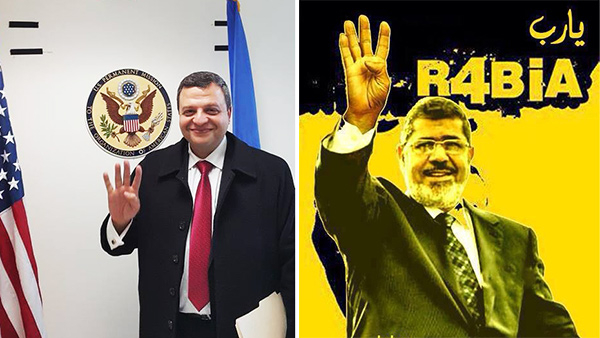
919 (1)While being hosted by the State Department on a visit to Washington in January 2015, Muslim Brotherhood judge Waleed Sharaby (left) flashed the organization’s four-finger “Rabia” sign. At right, ousted Egyptian President Mohamed Morsi (from the Muslim Brotherhood) displays the Rabia sign.

The events in the Sinai Peninsula prove there is no such thing as “political Islam.” There is a radical Islamist leadership that represents itself to the gullible West as “moderate,” preaches violence from the mosques, cloaks itself in ideological-religious tradition, and employs a hard core of Islamist terrorists to carry out attacks on civilians and Egyptian administration targets.

In the meantime, the real victims are the Egyptians. The Muslim Brotherhood’s terrorism has paralyzed Egypt’s tourist industry, as foreigners fear to visit Egypt’s antiquities. And now there are terrorist threats to the New Suez Canal, a project initiated and carried out under the leadership of General Sisi to turn both banks of the two canals into an international logistics, commercial and industrial area.

The Islamists’ plans are clear. First, they want to leverage violence, murder and countless Egyptian army casualties into establishing an autonomous terrorist enclave in the Sinai Peninsula. Then they will try to overthrow the Egyptian government and reinstate an Islamist Muslim Brotherhood regime headed by Morsi. That is exactly what their offshoot, Hamas, did in the Gaza Strip when it liquidated Palestinian Authority officials and established an Islamic emirate. The writing on the wall is still illegible as far as the U.S. government is concerned. Or else the Obama administration is still in the thrall of extremist Islam and its Muslim Brotherhood leaders. The two main ones are Turkey’s Recep Tayyip Erdogan, who has just called new elections so that he can try again to acquire enough seats in parliament to amend Turkey’s constitution to award himself a one-man Sultanate, an absolute dictatorship-for-life to go along with his new palace. The other is Mohamed Morsi, whom Obama apparently is still backing.

It is hard not to conclude, looking at the U.S. president’s record (ignoring the protesters of 2009 in Iran; “I’ve got a pen, and I’ve got a phone” and the dictatorial way the Iran deal has been short-circuited to bypass the democratic process) that in his heart-of-hearts, he is far more committed to supporting extremist Islamist regimes — whether the mullahs of Iran or the Muslim Brotherhood — than to supporting democracy, individual freedoms or human rights.

The Europeans are more aware of the situation but unfortunately woke up too late. As hundreds of thousands of migrants from Muslim lands continue to pour over Europe’s open borders, there is little doubt that radical Islam is poised to take over the West. Islamic communities and terrorist cells continue to mushroom and gather strength throughout the cities of Europe.

From the beginning of the wave of attacks in Egypt, senior Egyptian security officials threatened Hamas. Egypt warned Hamas to stop training, arming and sending its terrorists to collaborate with ISIS operatives in attacks against the Egyptian army. Hamas steadfastly denies any involvement, even as it continues collaborating with ISIS against Egypt.

As far as Hamas is concerned, destroying the Egyptian army is essential, because its continued actions along the Rafah border and in Sheikh Zuweid in the northern Sinai Peninsula prevent Hamas from acquiring money and stockpiling weapons to fight Israel, which weakens its subversion against Mahmoud Abbas and its plans to take over the West Bank.

Despite profuse denials, at the end of August 2015, four operatives from Hamas’s military-terrorist wing, the Izz al-Din al-Qassam Brigades, were taken off a bus by armed Egyptians on the way from Rafah through the Sinai Peninsula to Cairo. Hamas immediately accused Israeli intelligence of responsibility and warned the Egyptian authorities that “the abduction of its operatives will not go unpunished.”

In response, Dina Ramez, a co-host on Egypt’s official TV station, called Hamas out on its lies and denials of its terrorist activities in the Sinai Peninsula against the Egyptian regime. She asked Hamas, “If you are not involved in terrorism, what were your senior Izz al-Din al-Qassam Brigades operatives doing in Sinai?” and called them “cockroaches.”

Sources in Hamas called her a “whore,” and called Egypt a loser country defeated by Israel, using a peace treaty to sell Palestine to the enemy. Was that really the way to thank Egypt for everything it has done for the Palestinians, sacrificing its army and soldiers for us? It is a sad situation for the Palestinians and for our leadership.

What have we Palestinians gained from Hamas’s military actions against Egypt? What have we gained from our solidarity with Islamist organizations fighting against Assad in Syria, or joining organizations such as the “Palestinian Liberation Army” fighting for Assad? Why are we killing each other in the Ain al-Hilweh refugee camp? Why do we refuse everything the Israelis offer us?

Anyone who remembers history remembers the ungrateful path trodden by the Palestinians against the Kingdom of Jordan, when our leaders, headed by Arafat, tried in 1970 to overthrow King Hussein, despite the refuge Jordan offered us during the catastrophes of the Nakba in 1948 and the Naksa in 1967. Then we did the same thing in Lebanon, to where we fled from Jordan. The PLO relocated its headquarters to Beirut, and went on to turn Lebanon into a terrorist country and the lives of the Lebanese into a nightmare. If the Israelis had not invaded Lebanon in 1982, and forced the PLO to relocate to Tunisia (where its behavior was also criminal), the Palestinians definitely would have destroyed Lebanon.

The Middle East is in chaos, and Palestinian factionalism and ingratitude continue to inflame the dissolution of the Arab states and the internal Palestinian division between Hamas in Gaza and the Palestinian Authority in the West Bank.

The world is beginning to understand that the catastrophes of the Middle East have nothing to do with the resolution of the Palestinian issue, but are caused by the innate homicidal tendencies of the Arab rulers and the regional Islamist terrorist organizations.

The only person left who believes the Israeli-Palestinian nonsense is President Barack Obama, even though he is witness to the murders, rapes, beheadings and the millions of refugees, next to which the Palestinian issue is an old, irrelevant and very tired joke.

Meet the Iran Lobby

September 1, 2015

Meet the Iran Lobby, Tablet MagazineLee Smith, September 1, 2015

In part, Parsi and NIAC’s relative anonymity is the work of a White House that would rather pretend that there is no Iran Lobby, in accordance with the standard Beltway wisdom that a “lobby” is any group of people who advocate things that you are opposed to (lobbies that advocate things you are for are known as “supporters”). But the White House surely knows better, in part because so many friends and graduates of the Iran Lobby now staff key Iran-related government posts. The White House’s Iran desk officer, Sahar Nowrouzzadeh, for example, is a former NIAC employee. NIAC’s advisory board includes two former U.S. diplomats, Thomas Pickering, a former ambassador to Israel, and John Limbert, who was held hostage by the revolutionary regime in 1979. 

Most important, of course, Parsi found common cause with a White House that believed the same things he did: The United States and Iran should be closer, and all that was preventing rapprochement was Israel and AIPAC. “NIAC didn’t really need to write their talking points anymore,” said Dai. “Because they were coming from the White House.

***********************

Trita Parsi, the Iranian-born émigré who moved to the United States in 2001 from Sweden, where his parents found refuge before the Islamic Revolution, should be the toast of Washington these days. As I argued in Tablet magazine several years ago, Parsi is an immigrant who in classic American fashion wanted to capitalize on the opportunity to reconcile his new home and his birthplace. And now he’s done it: The founder and president of the National Iranian American Council (NIAC), the tip of the spear of the Iran Lobby, has won a defining battle over the direction of American foreign policy. The Joint Comprehensive Plan of Action not only lifts sanctions on Iran, a goal Parsi has fought for since 1997, but also paves the way for a broader reconciliation between Washington and Tehran across the Middle East.

In Washington, to have the policies you advocate implemented with the full backing of the president counts as a huge victory. Winning big like this means power as well as access to more money, which flows naturally to power and augments it—enhancing reputations and offering the ability to reward friends and punish enemies. And yet, Parsi (who declined comment for this story) has got to be frustrated that very few in the halls of American power—either in government or in the media—are celebrating the Iran lobby for its big win. It seems the only thing people can talk about is the big loser in this fight over Middle East policy—the pro-Israel lobby, led by AIPAC. It’s as if Parsi and NIAC had nothing to do with the Obama Administration’s decision to move closer to Iran while further distancing itself from Israel.

“It’s a huge win for NIAC,” said one Iranian-American analyst who requested anonymity. “Every other part of Iranian-American advocacy—from the Mujahedin-e Khalq, to the washed-up old monarchists—is useless, and then in comes Trita and he’s slick, presentable, and knows how to build an impressive network.” So, why is the rise of the Iran Lobby both Washington’s biggest and also its least-heralded success story of the past six years?

In part, Parsi and NIAC’s relative anonymity is the work of a White House that would rather pretend that there is no Iran Lobby, in accordance with the standard Beltway wisdom that a “lobby” is any group of people who advocate things that you are opposed to (lobbies that advocate things you are for are known as “supporters”). But the White House surely knows better, in part because so many friends and graduates of the Iran Lobby now staff key Iran-related government posts. The White House’s Iran desk officer, Sahar Nowrouzzadeh, for example, is a former NIAC employee. NIAC’s advisory board includes two former U.S. diplomats, Thomas Pickering, a former ambassador to Israel, and John Limbert, who was held hostage by the revolutionary regime in 1979. Past speakers at NIAC leadership conferences include Joe Biden’s National Security Adviser Colin Kahl, and the White House’s Middle East Director Rob Malley. Other past speakers from the political realm include: Robert Hunter, former U.S. ambassador to NATO; PJ Crowley, State Deptartment spokesperson under Hillary Clinton; Hans Blix, former director general of the IAEA. Other reputable names include figures like Aaron David Miller from the Wilson Center, Robert Pape from the University of Chicago, and Suzanne Maloney from the Brookings Institution.

Indeed, the impressive roster of speakers at NIAC events is evidence of Parsi’s assiduous cultivation of friendly contacts, both here and in Iran. The biggest NIAC booster in academia is the author of The Israel Lobby himself, Harvard University’s Steven Walt. The in-house portion of Parsi’s network also includes public intellectuals, like Iranian-American authors Hooman Majd and Reza Aslan, as well as figures from Iranian business concerns, like Atieh Bahar, who are reportedly close to the Iranian regime, especially former President Akbar Hashemi Rafsanjani.

According to a deeply informed video series posted earlier this month by Iranian-American activist Hassan Dai, Parsi has partnered with Atieh Bahar since the very beginning of his career as an Iran lobbyist in order to promote a pro-trade agenda, which of course will inevitably help the regime. (In 2008, Parsi sued Dai, claiming he had “defamed them in a series of articles and blog posts claiming that they had secretly lobbied on behalf of the Iranian regime in the United States.” The U.S. District Court for the District of Columbia found in 2012 the work of NIAC, which wasn’t registered under the Foreign Agents Registration Act, “not inconsistent with the idea that he was first and foremost an advocate for the regime.”) “Parsi believed that what stood between U.S.-Iran trade and dialogue,” said Dai, “was AIPAC.”

NIAC not only modeled itself after AIPAC, Dai said, it waged a crusade against it. “Back in 2004 Parsi gave a talk to European ambassadors saying that Israel and AIPAC stood between better relations between the United States and Iran. That turned into his dissertation at Johns Hopkins and later his [2007] bookTreacherous Alliance: The Secret Dealings of Israel, Iran, and the US.”

As it happens, Parsi was able to tap into a pool of support for his ideas. According to NIAC’s financial statement, the majority of the organization’s money comes from community support, while a portion comes from foundations, like the Ploughshares Fund, which has spent lots of money to influence U.S. policy toward Iran—“millions of dollars,” according to Michael Rubin writing for Commentary, “to pro-administration groups to support whatever Iran deal came out of Vienna.”

Most important, of course, Parsi found common cause with a White House that believed the same things he did: The United States and Iran should be closer, and all that was preventing rapprochement was Israel and AIPAC. “NIAC didn’t really need to write their talking points anymore,” said Dai. “Because they were coming from the White House.”

To push through the Iran deal, the White House, including the president himself, waged a brutal campaign against the prime minister of Israel and the pro-Israel community, even, some have argued, accusing JCPOA opponent Sen. Chuck Schumer of dual loyalty. Parsi, some of whose anti-Israel sentiments have previously been documented, followed suit. Most recently, he suggested that the Associated Press had printed an Israeli forgery of an IAEA agreement with Iran that allowed the Islamic Republic to self-inspect its Parchin military base. When AP reporters and others on Twitter challenged Parsi’s absurd allegation slandering a trusted Western news source, the Iran lobby chief backed down—but not before he’d put his obsession with Israel and Jewish power on full display.

NIAC, whose direct expenditure of a little over a million dollars is a tiny fraction of AIPAC’s Iran deal campaign budget, won because it was aligned with the White House. And instead of boasting and posturing about his power and top-level access, as AIPAC is wont to do, Parsi understood his role. Like J Street, NIAC was cast to play second banana to the President’s star turn and stay close to the White House and make the case to journalists and other intellectuals who weren’t already sold on the idea of rapprochement with Iran—and on the idea that Israel is a big problem for the United States.

The paradox is that Parsi deserves lots of credit for his victory, but he can’t cash his checks too publicly—because the American public doesn’t like Iran. Which in turn points up a major difference between the pro-Israel lobby and the pro-Iran lobby—both of which, I want to add, contrary to critics on both the left and the right, make entirely legitimate use of the American democratic system to advocate for their respective points of view.

Where NIAC differs from AIPAC is in its relation to American public opinion. AIPAC has never been about selling access to the Israeli economy: In fact, AIPAC piggy-backed on the huge well-spring of affection that the American public has for Israel in order to establish itself as a power in Washington. If Americans want to invest in an IT firm in Herzliya, or a gift shop in Tzfat, donating money to AIPAC is unlikely to be of much help: They’re free to take their chances and fight through the red tape. Nor is it clear that pursuing exciting economic opportunities in Israel has ever been a particular motivating force for pro-Israel activism. The pro-Israel lobby never sold anything except the opportunity for Americans—Jews, evangelical Christians, and mainstream Democrats and Republicans alike—to feel even better about supporting something they already felt good about, for personal, ethnic, ideological, religious, sentimental, and other such reasons.

The pro-Iran lobby on the other hand has no real base of popular support in America: Many Iranians in America are in fact deeply opposed to the regime in Tehran, and see NIAC as a regime tool. What NIAC has to offer instead, like the Saudi lobby before it, is access, which is a big reason why Parsi has been fighting sanctions for nearly two decades. For an Iran Lobby to have any heft, it needs to be able to deliver the goods to its supporters. With sanctions, the Iran Lobby has been largely crippled, because it has very little to offer: It was able to accumulate the power it has now only because the Administration clearly signaled its desire to do business with Iran, thereby offering NIAC supporters at least some mathematical expectation of a future payout. Now, if the JCPOA gets through Congress, that payout is likely to be tremendous, as the Iran Lobby will be able to help broker access to anything and everything in Iran—from industry, to schools, to opportunities for journalists and academics, etc.—which will in turn make NIAC and the Iran Lobby that much more powerful.

One of the chief ironies of the ongoing debate over the Iran deal is that both defenders and detractors of a supposedly all-powerful “Israel Lobby” have been wasting their breath over an entity that has notably failed to affect U.S. policy on a single issue of major concern over the entire course of Obama’s 6-year Presidency—a record of unmitigated failure that would clearly condemn it to the black hole of Beltway irrelevance if not for the bizarre imaginative hold, and political utility, of the myth of a powerful conspiracy of Jews who secretly rule the planet. Or perhaps it’s not an irony at all. Some of the loudest detractors of the “Israel Lobby” are in fact paid staffers and partisans of the Iran Lobby—an entity that, unlike the Israel Lobby, has succeeded in radically altering U.S. foreign policy, with the help of the President and his advisors. Seen from a certain angle, the Iran Lobby has pulled off the neat trick of using the specter of the Israel Lobby to shift U.S. policy away from Israel and toward Iran—while actually succeeding at the same dark arts that it blames the Jews for employing. The Iran lobby used a combination of lobbying, donations, propaganda, and back-door personal connections to top policy-makers to radically alter American foreign policy, and align the United States with an oppressive authoritarian regime that is destabilizing the Middle East.


Rocket from Gaza follows IDF-Palestinian clash in West Bank town of Jenin

September 1, 2015

Rocket from Gaza follows IDF-Palestinian clash in West Bank town of Jenin, DEBKAfile, September 1, 2015

Palestinian rocket fire from the Gaza Strip put southern Israel on red alert before dawn Tuesday. Sept 1 in the wake of a major clash that erupted in the West Bank refugee camp of Jenin Sunday night. The circumstances of that episode are not entirely clear. Israel playing the Jenin encounter down, whereas the Palestinians are presenting it as “the biggest battle of the third initifada.” An Israeli soldier and five Palestinians were injured.

It began, DEBKAfile’s military sources report, when a large combined force of the IDF, Shin Bet and Police Special Operations, riding in dozens of vehicles, entered the Jenin camp Monday night to round up Islamic Jihad and Hamas terrorist suspects. In the Al-Hadaf district, they surrounded the homes of Bassam Al-Saeedi, reputed Jihad chief on the West Bank, and Majdi Abu al-Hejja, a local Hamas military arm operative.

At some point, Israeli rocket fire badly damaged Al-Saeedi’s house.

The IDF sources say it was a single small rocket, without explaining why it was fired. The IDF spokesman first reported “a heavy exchange of fire” around the building. Early Monday, the word “heavy” was dropped from the briefing to reporters and finally, there was no reference to any exchange of fire at all.

The Palestinians claim that the Jihad leader was not at home at the time of the raid and so escaped his pursuers.  But there is no word on either side about the fate of any occupants of building and whether any were killed.

Did the IDF decide to knock the building down in response to gunfire coming out of it? Or was it a warning to the Islamic Jihad and other Palestinian terrorist groups to halt their latest spate of violence or lose their homes?

Another mystery is how Bassam Al-Saeedi came to be away from home, confounding the information reaching the Shin Bet? Did he get a tip-off of the impending Israeli raid for his arrest?

If armed Palestinian groups on the West Bank have taken to posting spotters outside their areas to forewarn them of approaching Israeli forces, this would ratchet up their operational tactics to the military level observed by fellow Hamas and the Islamic Jihad groups in the Gaza Strip.

While Bassam Al-Saheedi escaped arrest, the Hamas operative Majdi Abu al-Hejja and his brother were captured and taken away for interrogation.

In weighing in heavily for a preventive detention operation against suspected terrorist leaders Sunday night, Israeli security chiefs were almost certainly acting on a decision to avert any possible terrorist action for  disrupting the opening of the school year Monday, Sept. 1. The level of Palestinian violence on and from the West Bank and Jerusalem has risen sharply in recent weeks.

Thirteen years ago, at the peak of the Palestinians’ Second intifada, Israel launched a major assault on the Jenin refugee camp. Thirteen Israeli soldiers were lost in this major battle on April 5, 2002. Since then, the refugee camp has claimed to hold the flag of armed Palestinian resistance to Israel and its army. Security forces arriving there to detain suspects routinely come under a hail of rocks and firebombs. However, the current clash of arms represented a sharp escalation in the Israeli-Palestinian confrontation on the West Bank.

Iran Unveils Advanced Radars

August 30, 2015

Iran Unveils Advanced Radars, Israel DefenseAmi Rojkes Dombe, August 30, 2015

(Have the new systems been deployed? How long can Israel wait to attack Iran’s nuke sites? — DM)

New Iranian radar

Among of the unveiled products were the upgraded model of the Keyhan (Cosmos) radar, ground-based radar jamming systems and a domestically-made IFF (Identification, Friend or Foe) system.

***********************

A number of Iran’s homegrown air defense systems, including upgraded radars and electronic warfare equipment, were unveiled on Saturday.

One of the unveiled products was the upgraded model of the Keyhan (Cosmos) radar, a long-range radar that uses mixed frequencies to identify small flying objects, and is suitable for detecting large number of aerial targets in the electronic warfare.

In addition, a variety of ground-based radar jamming systems were unveiled. The jamming systems, which have been connected to the country’s integrated air defense network, are employed for electronic countermeasures in the fight against aerial threats.

A domestically-made IFF (Identification, Friend or Foe) system was also unveiled. Commander of Khatam al-Anbia Air Defense Base Brigadier General Farzad Esmaili said the system can distinguish friendly forces from the enemy by detecting 100 targets simultaneously.

A number of other Iranian radars, including Bina, Nazir and Talash were also put on display in the exhibition.

Evidence mounts that soon-to-be flush Iran already spurring new attacks on Israel

August 28, 2015

Evidence mounts that soon-to-be flush Iran already spurring new attacks on Israel, Fox News, August 27, 2015

An unsettling surge in terrorism by Iranian proxies has many Israelis convinced the release to Tehran of tens of billions of dollars in frozen funds is already putting the Jewish state in danger.

In recent days, rockets have rained down on Israel from Gaza in the south and the Golan Heights to the north, Israeli forces foiled a bomb plot at the tomb of biblical patriarch Joseph, and Gaza-based terrorist groups that also have a presence in the West Bank have openly appealed for aid on Iranian television. Israeli officials fear the terrorist activity is spiking as groups audition for funding from Tehran, which is set to receive the long-frozen funds as part of its deal to allow limited nuclear inspections. They say the international focus on Iran’s nuclear ambitions has left its more conventional methods of attacking regional adversaries unaddressed.

“The nuclear context is just one aspect of the negative Iranian activities in the region,” Emmanuel Nahshon, senior Israeli Foreign Ministry spokesman, told FoxNews.com. “We can see the demonstration of this on a daily basis in Syria, in Yemen, and in Iraq. We see it also when we see the [Iranian] support of Hezbollah and other groups who operate against Israel.”

Last month, National Security Adviser Susan Rice admitted that some of the money due to be released as part of the deal negotiated by the U.S. led P5+1 “would go to the Iranian military and could potentially be used for the kinds of bad behavior that we have seen in the region.”

Aside from the soon-to-be-released billions, Iran’s finances will also be strengthened by the easing of trade embargoes that have seen a horde of major international business – many from P5+1 countries – rushing to sign lucrative deals with the ayatollahs. Earlier this week, British Foreign Minister Philip Hammond scoffed at the fears of Israel and many Arab countries in the Middle East, saying the deal would “slowly rebuild their sense that Iran is not a threat to them.” Less than 24 hours later, the spokesman for Iran’s top parliament member said, “Our positions against [Israel] have not changed at all; Israel should be annihilated.”

If that remains Iran’s intention, terror groups Hezbollah, Hamas, and Palestinian Islamic Jihad are showing a renewed eagerness to continue as its proxies. Four rockets apparently fired by the PIJ from Syria into northern Israel last week – two into the Golan Heights and two more into the Upper Galilee – were the first such attacks since the start of Syria’s bloody civil war more than four years ago. Israel responded with targeted missile strikes, including one which hit a car killing “five or six PIJ terrorists.”

On Aug. 18, Iranian state TV broadcast images of a new, 2.5-mile tunnel leading from Gaza into Israel. Dug by the Fatah-linked terror group the Al Aqsa Martyrs Brigade, and seemingly competing with arch-rivals Hamas for a share of the imminently unfrozen Iranian funds, the terrorists made an unabashed appeal for more cash. In a segment translated by Palestinian Media Watch, the terror group’s representatives said, “This is why we are asking [for money]… especially [from] Iran, which is a known long-time supporter of the resistance and the Palestinian cause.”

On Tuesday, Israeli officials revealed that a joint Israeli internal security and military operation thwarted a potentially lethal bomb attack planned by the Islamic Jihad on visitors to Joseph’s Tomb in Shechem in the Palestinian-controlled West Bank, the resting place of the biblical figure revered by Jews, Christians and Muslims alike.

The pace of attacks, as well as the diversity of their perpetrators, has prompted speculation that terrorist groups are competing for Iranian funding, and trying to show they are capable of giving Tehran bang for its buck. The terrorist groups however operate on budgets that are tiny given the scale of Iran’s financing capability.

“The amount that Iran gives Hezbollah is not very much – around $200 million – not even 1 percent of Iran’s budget last year,” Meir Javedanfar, an Iranian-born Israeli expert on the region who writes at www.middleastanalyst.com, told FoxNews.com. “If you want to stop Iranian support of Hezbollah you would need to have inspectors on the ground in Syria and Lebanon, the most dangerous of places, checking Hezbollah’s arsenal, bank accounts, bases, and Syrian bases which Hezbollah uses. I don’t see any UN force, or anyone else volunteering to do that.”

Egypt bids for two advanced French helicopter carriers – counterweight to the Iranian navy

August 27, 2015

Egypt bids for two advanced French helicopter carriers – counterweight to the Iranian navy, DEBKAfile, August 27, 2015

mistral-_Saint-Nazaire_western_France_May_25_2015Mistral carriers at Saint-Nazaire shipyard

Egypt is in advanced negotiations with France for two highly advanced French Mistral class assault-cum-helicopter carrier ships that were originally destined for the Russian Navy. DEBKAfile’s military and intelligence sources report that this deal, if it goes through, will substantially beef up the regional lineup of the Saudi, Egyptian and Israeli navies. The new vessels would enable it to contest Iranian naval challenges in the Mediterranean, the Red Sea and the Persian Gulf, and alter the balance of strength between the opposing sides.

Saudi Arabia and the United Arab Emirates have given presidents Abdel-Fatteh El-Sisi and Francois Hollande pledges to fund the transaction at $800 million per carrier.

The Mistrals will join the missile ships of Saudi Arabia, Egypt and Israel and six Dolphin submarines which, according to foreign sources, are capable of firing nuclear-tipped ballistic missiles. Their delivery comes at a time of strengthening strategic ties among Egypt, Saudi Arabia, the UAE and Israel.

The Egyptian navy stands to own the most advanced warships of any Middle East power. The French vessels may also be used as aircraft carriers, because their decks are designed to carry fighter jets as well as helicopters. The only nations maintaining this type of vessel in the region are outsiders – the US, which deploys a Wasp class helicopter for marines; Russia, the ageing Moskva class copter carrier, and France.

Originally ordered from France by the Russian Navy, the pair of Mistrals was never delivered owing to the sanctions the European Union imposed on Moscow after the Ukraine invasion.

It is a multi-purpose warship, able to accommodate 16 “European Tiger” four-bladed, twin-engined attack helicopters, four large landing craft for dropping 450 marines on shore, 70 armored vehicles, including 14 heavy AMX Leclerc assault tanks.

These figures are flexible. If necessary, the French carriers can handle an expanded complement of 900 marines and 40 tanks. It is also a command ship geared to maintain communications with military forces located anywhere in the world. It also carries a 69-bed field hospital. The Mistral has a maximum speed of 18 knots and maximum range of 20,000 miles.