Posted tagged ‘China’

Joe Biden to China: Curb North Korea or Japan Can Go Nuclear ‘Virtually Overnight’

June 26, 2016

Joe Biden to China: Curb North Korea or Japan Can Go Nuclear ‘Virtually Overnight’, Breitbart, Frances Martel, June 24, 2016

Joe Biden

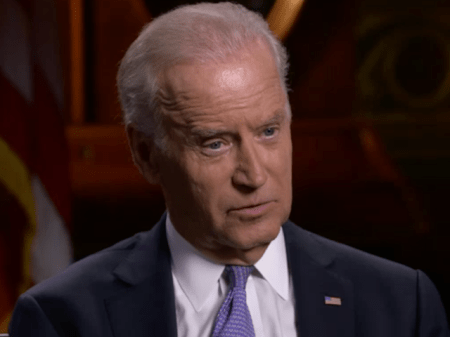
Vice President Joe Biden warned China that the Japanese government may acquire nuclear weapons “virtually overnight” if the threat from North Korea becomes too grave, urging Beijing to do more to curb Pyongyang’s belligerence.

The Vice President’s comments echo those of presumptive Republican presidential nominee Donald Trump, who warned that Japan and South Korea acquiring nuclear weapons “is going to happen anyway” in controversial remarks issued in March. Japanese government officials and media responded to Trump’s comments much more severely than they have to Biden’s.

“What happens if Japan, who could tomorrow, could go nuclear tomorrow? They have the capacity to do it virtually overnight,” Biden told PBS host Charlie Rose in an interview broadcast Monday. He explained that he made this warning to Chinese President Xi Jinping personally while discussing the deployment of a Terminal High Altitude Area Defense (THAAD) system in South Korea to protect from a North Korean attack, a move that China has condemned vocally.

“When I tell President Xi, you have to understand we got a guy up there in North Korea who is talking about building weapons that can strike, nuclear weapons strike the United States and not only Hawaii and Alaska, but… the mainland of the United States,” he told Rose. “And I say, so we’re going to move up our defense system, and he says no, no, no, wait a minute, my military thinks you’re going to try to circle us.”

Biden suggested that China, a fellow communist country, “has the single greatest ability to influence North Korea.”

Japan has issued a tepid response to the remarks, with Japanese Deputy Chief Cabinet Secretary Hiroshige Seko telling reporters Friday that Japan simply “can never possess nuclear weapons.” Japan remains the only nation in the world to experience a nuclear weapon attack.

In March, Trump stated that both Japan and South Korea were likely to develop nuclear capabilities due to their access to advanced technology. “It’s going to happen, anyway. It’s only a question of time. They’re going to start having them, or we have to get rid of them entirely,” he said, suggesting that, should the move be inevitable, the United States should do more to curb its defense expenses in Asia protecting wealthy nations.

In response, Foreign Minister Fumio Kishida stated that Japan having nuclear capabilities was “impossible,” and national newspaper Asahi Shimbun described national leaders as responding with “bewilderment and unease.

The government of North Korea has behaved with extreme belligerence in 2016, beginning the year with the detonation of what they claimed was a hydrogen bomb and repeatedly launching missiles towards Japan (all have failed to reach their targets). Most recently, North Korea tested what are believed to be two Musudan ballistic missiles, with one reaching the greatest height the nation has yet to achieve on a test.

China responded to the new test by calling for North Korea to “act with caution and refrain from taking actions that may elevate tension on the Korean peninsula.” China recently backed expanded UN sanctions on North Korea, but has condemned U.S. and South Korean defense buildups in response to Pyongyang, claiming that the also put Beijing in the line of fire.

While China has kept its criticism of North Korea tepid and remained its largest trade partner, the volume of that trade has declined significantly. Imports from North Korea dropped 12.6 percent between May 2015 and May 2016, while exports to North Korea fell 5.9 percent in the same time period.

Cartoons of the Day

June 10, 2016

H/t Freedom is Just Another Word

Bernie and Hillary


H/t Vermont Loon Watch

red-lines


H/t Vermont Loon Watch

wedding

US ‘provocations’ may force China to declare air defense zone in S. China Sea

June 1, 2016

US ‘provocations’ may force China to declare air defense zone in S. China Sea – report Published time: 1 Jun, 2016 10:28

Source: US ‘provocations’ may force China to declare air defense zone in S. China Sea – report — RT News

© AFP

Beijing is reportedly planning to launch an air defense identification zone (ADIZ) in the South China Sea, the timing of which will depend on US “provocations.” Billions of dollars of trade passes annually through the area, which is subject to rival claims.

A source close to China’s People’s Liberation Army (PLA) told the South China Morning Post daily that security conditions in the region, namely the US military presence, would define the timing of the ADIZ declaration.

“If the US military keeps making provocative moves to challenge China’s sovereignty in the region, it will give Beijing a good opportunity to declare an ADIZ in the South China Sea,” the source told the newspaper.

The country’s Defense Ministry told the South China Morning Post in a written statement that it was “the right of a sovereign state” to designate an ADIZ.

Read more

A ship of Chinese Coast Guard in the South China Sea © Nguyen Minh

“Regarding when to declare such a zone, it will depend on whether China is facing security threats from the air, and what the level of the air safety threat is,” the ministry wrote.

In November 2013, Beijing set up an ADIZ in the East China Sea, causing an immediate backlash from Tokyo, Seoul and Washington. It covered the Diaoyu Islands, which Tokyo controls and calls the Senkakus.

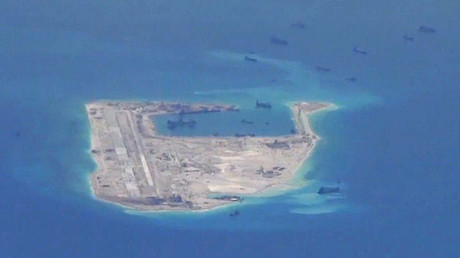
Tensions have run high between Washington and Beijing over a reclamation project in the South China Sea, where China has built artificial islands. Beijing has various territorial disputes in the area – which is rich in deposits of natural resources – with Brunei, Malaysia, the Philippines, Taiwan and Vietnam.

To bolster its claim over the disputed territory, Beijing has been rapidly setting up defense installations in the area. The US Navy is actively opposing the Chinese initiative, deploying additional warships to the disputed zone and conducting maneuvers near the Chinese artificial islands. It has also flown over them, using the “freedom of navigation” principle as justification.

Beijing has called the US involvement in the dispute the “greatest” threat to the region.

Read more

Chinese dredging vessels are purportedly seen in the waters around Fiery Cross Reef in the disputed Spratly Islands in the South China Sea in this still image from video taken by a P-8A Poseidon surveillance aircraft provided by the United States Navy May 21, 2015. © U.S. Navy

“We urge them to stop stirring up a storm in a teacup and stop sowing seeds of discord so as to maintain peace and stability in the South China Sea, which conforms to the common interests of all parties,” Yang Yujun, spokesman for the Ministry of National Defense (MND) said at a briefing, China Military Online reported.

Last month Beijing asked the US to stop its surveillance activities near China after two of its fighter jets carried out what the Pentagon labeled an “unsafe” intercept of a US military reconnaissance aircraft over the South China Sea.

The incident added fuel to the fire in the already tense relations between the two countries.

“What needs to be pointed out is that the US always likes to distort facts and draw media attention to the distance between the military aircraft of the two sides. But in essence, the root cause for security hazards and potential accidents in the air and at sea between China and the US is the long term, large-scale and frequent close-in reconnaissance activities against China by the US military vessels and aircraft,” a Chinese Defense Ministry spokesman said.

The petroyuan is the big bet of Russia and China, by Ariel Noyola Rodríguez

May 27, 2016

The petroyuan is the big bet of Russia and China by Ariel Noyola Rodríguez After the economic sanctions that the United States and the European Union imposed against Russia, Moscow and Beijing put together an imposing energetic team that has radically transformed the world oil market. In addition to increasing their interchange of hydrocarbons exponentially, both oriental powers have decided to put an end to the domination of the dollar in fixing the prices of the black gold. The petroyuan is the instrument of payment of strategic character that promises to facilitate the transition to a multipolar monetary system, a system that takes various currencies into account and reflects the correlation of forces in the current world order.

| Mexico City (Mexico) | 20 May 2016

Source: The petroyuan is the big bet of Russia and China, by Ariel Noyola Rodríguez

In place of humiliating Russia, the “economic war” that Washington and Brussels had promoted was counterproductive, since it only contributed to fortify the energy team between Moscow and Beijing. We recall that in May of 2014 the Russian company Gazprom agreed to supply gas to China up to 38 billion cubic meters annually during three decades (starting in 2018) through the signing of a contract for 400 billion US dollars with the China National Petroleum Corporation (CNCP) [1].

At the present time both powers coordinate the work of an ambitious plan of strategic projects that include the construction of gas and oil pipelines as well as the combined operation of refineries and large petrochemical complexes. Without proposing to do so, the coming together of Moscow and Beijing has produced deep changes in the world oil market in favor of the Orient, dramatically undermining the influence of Western petroleum companies.

Even Saudi Arabia, that until recently was the principal supplier of petroleum to the Asian giant, has been undermined by Kremlin diplomacy. While from 2011 the petroleum exports of Saudi Arabia to China were growing at a rhythm of 120 thousand barrels per day, those of Russia grew at a velocity of 550 thousand barrels per day, that is to say, almost five times more rapidly. In fact, in 2015 the Russian companies managed to overcome the sales of petroleum from the Saudis four times: Riyadh had to conform with being the second provider of crude to Beijing in May, September, November and December [2].

It is worth noting that the countries that make up the European core have also seen their share of the market diminished in the face of the Asian region: Germany, for example, was supplanted by China at the end of 2015 as the greater buyer of Russian petroleum [3]. In this way, the great investors operating in the world oil market can hardly believe how, in a few months, the principal purchaser (China) became the favorite client of the third major producer (Russia). In accord with the Vice-President of Transneft (the Russian company charged with the implementation of national oil pipelines), Serge Andronov, China is disposed to import a total volume of 27 million tones of Russian petroleum during 2016 [4].

The Russian-Chinese energy alliance is proposed to go longer. Moscow and Beijing have made their interchanges of petroleum a channel of transition towards a multipolar monetary system, that is to say, a system that is no longer based on the dollar alone, but takes into account various currencies and above all, that reflects the correlation of forces in the current world order. The economic sanctions imposed by Washington and Brussels drove the Russians to eliminate the dollar and the euro from their commercial and financial transactions, since otherwise, they would be too exposed to suffer sabotage in the moment of realizing buying and selling operations with their principal trading partners.

For this reason, from mid-2015, the hydrocarbons that China buys from Russia are paid in yuans, not in dollars, information that has been confirmed by high executives of Gazprom Neft, the petroleum branch of Gazprom [5]. This has lead to the use of the “people’s currency” (‘renminbi’) in the world oil market and at the same time allows Russia to neutralize the economic offensive launched by the United States and the European Union. The underpinnings of a new financial order supported by the petroyuan is emerging: the Chinese money is preparing to become the axis of commercial exchanges of the Asian-Pacific region with the principal petroleum powers.

JPEG - 32 kb
© David Manrique

Toda Russia realizes its interchanges of petroleum with China in yuans, in the future the Organization of the Petroleum Exporters Countries (OPEC) will do the same if China demands it. Or will the cult of Saudi Arabia for the dollar make them lose one of their principal clients? [6] Other geoeonomic powers have already followed the path of Russia and China, since they have understood that in order to establish a more balanced monetary system, the “de-dollarization” of the world economy is a priority.

No less important is that after the fall of oil prices, more than 60% (from mid-2014), the Chinese banks have become a decisive financial support for the joint energy infrastructure works. For example, to establish as soon as possible the Russian-Chinese gas pipeline “Force of Siberia”, Gazprom requested from the Bank of China a five-year loan for an amount equivalent to 2 billion euros this past month of March [7]. This is the greatest bilateral credit that Gazprom has contracted with a financial institution to date. Another example is the loan that China gave Russia some weeks ago for a total of 12 billion US dollars for the Yamal LNG project (for liquefied natural gas) in the Arctic region [8]. Obviously, the foreign policy of Russia in energy have not lost any strength due to isolation, on the contrary, it is now enjoying its best moments, thanks to China.

In conclusion, the hostility of the leaders of the United States and the European Union against the government of Vladimir Putin has precipitated the strengthening of the Russian-Chinese team that at the same time has only increased the weight of the Orient in the world market of hydrocarbons. The great bet of Moscow and Beijing is the petroyuan, the strategic instrument of payment that brings with it a challenge to the dominion of the dollar in the fixing of prices for black gold.

Ariel Noyola Rodrígue


FULL: Donald Trump at Morning Joe, May 20, 2016- ‘Would you consider Sanders as your running mate?’

May 20, 2016

FULL: Donald Trump at Morning Joe, May 20, 2016- ‘Would you consider Sanders as your running mate?’ May 20, 2016

(Spoiler alert: The question about Sanders as Trump’s VP choice comes at the tail end of the interview, and Trump’s answer was that Sanders should run as an independent. The interview is wide-ranging and deals with foreign policy, China, Mexico, the Islamist threat, the terrorist attack on EgyptAir and a bunch of other stuff. — DM)

https://www.youtube.com/watch?v=B36FldQmVq4

Chicago College Council Backs BDS for Israel, Not China

May 12, 2016

Chicago College Council Backs BDS for Israel, Not China, Front Page Magazine, Daniel Greenfield, May 12, 21016

bds_original

Some students at the University of Chicago set out to prove that divestment resolutions aren’t about human rights, but hating Jews. They proved their point quite easily with a China divestment resolution.

Last week, some students at University of Chicago, where I attend, proposed a resolution to our College Council to divest from Chinese weapons manufacturers, in protest of China’s severe human rights abuses and its long-standing occupation of Tibet.

Members of the council were quick to condemn the resolution, and for good reason. The members noted it was political, and disrespectful to Chinese students. Other members noted that Chinese students should be given time to respond to the presenters with a counter-presentation. One representative even suggested that the College Council issue an apology to Chinese students for even considering the resolution. The resolution was tabled indefinitely.

Curiously, when a few weeks earlier the same College Council passed a nearly identical resolution condemning Israel, no one suggested an apology. These same representatives argued why it was their moral imperative to condemn Israel. They were determined to push this through at all costs, and despite requests, they didn’t even offer the other side an opportunity to present.

Over the past few weeks I have been told that Jews “don’t count” as a minority. I have been accused of using anti-semitism to justify oppression. All I want to know is why my campus doesn’t treat anti-semitism with the same rigor with which it treats any other forms of bias.

When Jews stood before the council, and asked that it recognize the Jewish right to self-determination, a basic right for all people, people in the room laughed. One representative noted that “If we were to affirm the right to Jewish self-determination … it takes away from the intent of the resolution”.

Students in the room that day called us racists and murderers and “apartheid supporters”, for even thinking we, as Jews, could have a voice in the discussion over the one small state we call our own. A Jewish student was chided “You are racist and you are against me and my family’s existence”. It was uncivil, and unproductive, but the council-members did not once that day condemn the personal nature of these attacks, or defend the rights of the opposition to make their case.

At one point, a student questioned the presenters, members of Students for Justice in Palestine (SJP), about their organization allegedly holding a moment of silence for Palestinians who were killed while trying to murder Jewish Civilians. One of the presenters confirmed the moment, then responded without missing a beat “Palestinians have a right to honor their martyrs”.

If the killing of any other ethnic group had been celebrated, the University would make grief counselors available. It would send out mass emails of condemnation. They would suspend the organization responsible, and possibly the students involved in it. The organization would certainly not have any credibility to present to the student government. Since the victims were Jews though, their celebration of murder went unchallenged. The representatives never even brought the issue up.

On the third slide of the presentation in favor of the resolution, presenters claimed that voting against the resolution would mean “maintaining a system of domination by Jews”.

Now this is taking place at the same time that sombreros are considered racist and Trump chalkings are denounced as hate crimes. But celebrating the murder of Jews is always okay.

Of the members of the College Council at the University of Chicago, Peggy Xu backed BDS for Israel but was offended by the idea of holding China accountable. Michael Meng also aggressively pushed the campaign against the Jewish State. Michael Meng very predictably opposed the China BDS resolution.

And Peggy Xu has announced that she’s running again because, “My time in SG has been simultaneously enlightening, difficult, and incredibly fulfilling, and it would be an honor to continue advocating for an SG that is inclusive, equitable, and responsive to student needs.” I’m not sure what’s equitable and inclusive about hating Jews.

Moments like these make it clear that this is not about human rights. It’s about using colleges as a forum for tribal hatreds, in this case legitimizing the expression of anti-Semitism.

Seymour Hersh Says Hillary Approved Sending Libya’s Sarin To Syrian Rebels

May 2, 2016

Seymour Hersh Says Hillary Approved Sending Libya’s Sarin To Syrian Rebels Tyler Durden’s picture

Submitted by Tyler Durden

on 05/01/2016 22:00 -0400

Source: Seymour Hersh Says Hillary Approved Sending Libya’s Sarin To Syrian Rebels | Zero Hedge

Authored by Eric Zuesse via Strategic-Culture.org,

The great investigative journalist Seymour Hersh, in two previous articles in the London Review of Books (“Whose Sarin?” and “The Red Line and the Rat Line”) has reported that the Obama Administration falsely blamed the government of Syria’s Bashar al-Assad for the sarin gas attack that Obama was trying to use as an excuse to invade Syria; and Hersh pointed to a report from British intelligence saying that the sarin that was used didn’t come from Assad’s stockpiles. Hersh also said that a secret agreement in 2012 was reached between the Obama Administration and the leaders of Turkey, Saudi Arabia, and Qatar, to set up a sarin gas attack and blame it on Assad so that the US could invade and overthrow Assad.

“By the terms of the agreement, funding came from Turkey, as well as Saudi Arabia and Qatar; the CIA, with the support of MI6, was responsible for getting arms from Gaddafi’s arsenals into Syria.”

Hersh didn’t say whether these ‘arms’ included the precursor chemicals for making sarin which were stockpiled in Libya, but there have been multiple independent reports that Libya’s Gaddafi possessed such stockpiles, and also that the US Consulate in Benghazi Libya was operating a “rat line” for Gaddafi’s captured weapons into Syria through Turkey. So, Hersh isn’t the only reporter who has been covering this. Indeed, the investigative journalist Christoph Lehmann headlined on 7 October 2013, “Top US and Saudi Officials responsible for Chemical Weapons in Syria” and reported, on the basis of very different sources than Hersh used, that:

“Evidence leads directly to the White House, the Chairman of the Joint Chiefs of Staff Martin Dempsey, CIA Director John Brennan, Saudi Intelligence Chief Prince Bandar, and Saudi Arabia´s Interior Ministry.”

And, as if that weren’t enough, even the definitive analysis of the evidence that was performed by two leading US analysts, the Lloyd-Postal report, concluded that:

“The US Government’s Interpretation of the Technical Intelligence It Gathered Prior to and After the August 21 Attack CANNOT POSSIBLY BE CORRECT.”

Obama has clearly been lying.

However, now, for the first time, Hersh has implicated Hillary Clinton directly in this ‘rat line’. In an interview with Alternet.org, Hersh was asked about the then-US-Secretary-of-State’s role in the Benghazi Libya US consulate’s operation to collect weapons from Libyan stockpiles and send them through Turkey into Syria for a set-up sarin-gas attack, to be blamed on Assad in order to ‘justify’ the US invading Syria, as the US had invaded Libya to eliminate Gaddafi. Hersh said:

That ambassador who was killed, he was known as a guy, from what I understand, as somebody, who would not get in the way of the CIA. As I wrote, on the day of the mission he was meeting with the CIA base chief and the shipping company. He was certainly involved, aware and witting of everything that was going on. And there’s no way somebody in that sensitive of a position is not talking to the boss, by some channel”.

This was, in fact, the Syrian part of the State Department’s Libyan operation, Obama’s operation to set up an excuse for the US doing in Syria what they had already done in Libya.

The interviewer then asked:

“In the book [Hersh’s The Killing of Osama bin Laden, just out] you quote a former intelligence official as saying that the White House rejected 35 target sets [for the planned US invasion of Syria] provided by the Joint Chiefs as being insufficiently painful to the Assad regime. (You note that the original targets included military sites only – nothing by way of civilian infrastructure.) Later the White House proposed a target list that included civilian infrastructure. What would the toll to civilians have been if the White House’s proposed strike had been carried out?”

Hersh responded by saying that the US tradition in that regard has long been to ignore civilian casualties; i.e., collateral damage of US attacks is okay or even desired (so as to terrorize the population into surrender) – not an ‘issue’, except, perhaps, for the PR people.

The interviewer asked why Obama is so obsessed to replace Assad in Syria, since “The power vacuum that would ensue would open Syria up to all kinds of jihadi groups”; and Hersh replied that not only he, but the Joint Chiefs of Staff, “nobody could figure out why”. He said, “Our policy has always been against him [Assad]. Period”. This has actually been the case not only since the Party that Assad leads, the Ba’ath Party, was the subject of a shelved CIA coup-plot in 1957 to overthrow and replace it; but, actually, the CIA’s first coup had been not just planned but was carried out in 1949 in Syria, overthrowing there a democratically elected leader, in order to enable a pipeline for the Sauds’ oil to become built through Syria into the largest oil market, Europe; and, construction of the pipeline started the following year. But, there were then a succession of Syrian coups (domestic instead of by foreign powers – 195419631966, and, finally, in 1970), concluding in the accession to power of Hafez al-Assad during the 1970 coup. And, the Sauds’ long-planned Trans-Arabia Pipeline has still not been built. The Saudi royal family, who own the world’s largest oil company, Aramco, don’t want to wait any longer. Obama is the first US President to have seriously tried to carry out their long-desired “regime change” in Syria, so as to enable not only the Sauds’ Trans-Arabian Pipeline to be built, but also to build through Syria the Qatar-Turkey Gas Pipeline that the Thani royal family (friends of the Sauds) who own Qatar want also to be built there. The US is allied with the Saud family (and with their friends, the royal families of Qatar, Kuwait, UAE, Bahrain, and Oman). Russia is allied with the leaders of Syria – as Russia had earlier been allied with Mossadegh in Iran, Arbenz in Guatemala, Allende in Chile, Hussein in Iraq, Gaddafi in Libya, and Yanukovych in Ukraine (all of whom except Syria’s Ba’ath Party, the US has successfully overthrown).

Hersh was wrong to say that “nobody could figure out why” Obama is obsessed with overthrowing Assad and his Ba’ath Party, even if nobody that he spoke with was willing to say why. They have all been hired to do a job, which didn’t change even when the Soviet Union ended and the Warsaw Pact was disbanded; and, anyone who has been at this job for as long as those people have, can pretty well figure out what the job actually is – even if Hersh can’t.

Hersh then said that Obama wanted to fill Syria with foreign jihadists to serve as the necessary ground forces for his planned aerial bombardment there, and, “if you wanted to go there and fight there in 2011-2013, ‘Go, go, go… overthrow Bashar!’ So, they actually pushed a lot of people [jihadists] to go. I don’t think they were paying for them but they certainly gave visas”.

However, it’s not actually part of America’s deal with its allies the fundamentalist-Sunni Arabic royal families and the fundamentalist Sunni Erdogan of Turkey, for the US to supply the salaries (to be “paying for them”, as Hersh put it there) to those fundamentalist Sunni jihadists – that’s instead the function of the Sauds and of their friends, the other Arab royals, and their friends, to do. (Those are the people who finance the terrorists to perpetrate attacks in the US, Europe, Russia, Afghanistan, Pakistan, India, India, Nigeria, etc. – i.e., anywhere except in their own countries.) And, Erdogan in Turkey mainly gives their jihadists just safe passage into Syria, and he takes part of the proceeds from the jihadists’ sales of stolen Syrian and Iraqi oil. But, they all work together as a team (with the jihadists sometimes killing each other in the process – that’s even part of the plan) – though each national leader has PR problems at home in order to fool his respective public into thinking that they’re against terrorists, and that only the ‘enemy’ is to blame. (Meanwhile, the aristocrats who supply the “salaries” of the jihadists, walk off with all the money.)

This way, US oil and gas companies will refine, and pipeline into Europe, the Sauds’ oil and the Thanis’ gas, and not only will Russia’s major oil-and-gas market become squeezed away by that, but Obama’s economic sanctions against Russia, plus the yet-further isolation of Russia (as well as of China and the rest of the BRICS countries) by excluding them from Obama’s three mega-trade-deals (TTIP, TPP & TISA), will place the US aristocracy firmly in control of the world, to dominate the 21st Century, as it has dominated ever since the end of WW II.

Then, came this question from Hersh:

“Why does America do what it does? Why do we not say to the Russians, Let’s work together?”

His interviewer immediately seconded that by repeating it, “So why don’t we work closer with Russia? It seems so rational”. Hersh replied simply: “I don’t know”. He didn’t venture so much as a guess – not even an educated one. But, when journalists who are as knowledgeable as he, don’t present some credible explanation, to challenge the obvious lies (which make no sense that accords with the blatantly contrary evidence those journalists know of against those lies) that come from people such as Barack Obama, aren’t they thereby – though passively – participating in the fraud, instead of contradicting and challenging it? Or, is the underlying assumption, there: The general public is going to be as deeply immersed in the background information here as I am, so that they don’t need me to bring it all together for them into a coherent (and fully documented) whole, which does make sense? Is that the underlying assumption? Because: if it is, it’s false.

Hersh’s journalism is among the best (after all: he went so far as to say, of Christopher Stephens, regarding Hillary Clinton, “there’s no way somebody in that sensitive of a position is not talking to the boss, by some channel”), but it’s certainly not good enough. However, it’s too good to be published any longer in places like the New Yorker. And the reporting by Christof Lehmann was better, and it was issued even earlier than Hersh’s; and it is good enough, because it named names, and it explained motivations, in an honest and forthright way, which is why Lehmann’s piece was published only on a Montenegrin site, and only online, not in a Western print medium, such as the New Yorker. The sites that are owned by members of the Western aristocracy don’t issue reports like that – journalism that’s good enough. They won’t inform the public when a US Secretary of State, and her boss the US President, are the persons actually behind a sarin gas attack they’re blaming on a foreign leader the US aristocrats and their allied foreign aristocrats are determined to topple and replace.

Is this really a democracy?

Argentina shoots & sinks Chinese trawler for alleged illegal fishing (VIDEO)

March 16, 2016

Argentina shoots & sinks Chinese trawler for alleged illegal fishing (VIDEO)

Published time: 16 Mar, 2016 18:37

Source: Argentina shoots & sinks Chinese trawler for alleged illegal fishing (VIDEO) — RT News

© Ruptly

Thirty-two sailors from a Chinese trawler were dramatically rescued off the coast of Argentina after the South American country’s coast guard pursued and sank ‘Lu Yan Yuan Yu 010’ for allegedly fishing illegally using banned fishing reel equipment.

Nationalist greed, as opposed to environmental protection, was the motivation of Argentina’s Naval Prefecture (PNA) when it chased and scuttled the ‘slow boat from China’ after observing it trawling inside the exclusive economic zone off Puerto Madryn, according to Argentinian officials.

“The vessel was hailed over radio and both visual and audio signals were sent to make contact. However, the vessel turned off its fishing lights and proceeded to flee towards international waters without responding to repeated calls over various frequencies,” the coastguard statement said. “The ship performed maneuvers designed to force a collision with the coastguard, putting at risk not only its own crew but coastguard personnel, who were then ordered to shoot parts of the vessel.”

The PNA is believed to have fired the first warning shots when the fishing vessel resisted attempts by the Argentines to board it.

China’s Foreign Ministry claimed the boat had been “chased for hours” before being sunk and says it has made “urgent representations” to Argentina in a bid to have an investigation launched.

This is not the first time Chinese trawlers have fallen foul of Argentina’s maritime patrols.

Back in 2012, two fishing vessels were detained for allegedly engaging in illegal squid fishing within the South American nation’s exclusion zone.

U.S. Navy Sends Carrier Strike Group to South China Sea

March 5, 2016

U.S. Navy Sends Carrier Strike Group to South China Sea

BY:
March 4, 2016 10:29 am

Source: U.S. Navy Sends Carrier Strike Group to South China Sea – Washington Free Beacon

The U.S. Navy sent a small fleet of ships to the South China Sea in recent days as tensions continue to escalate over China’ territorial claims.

The Navy Times reported that the Pentagon has sent the nuclear-powered aircraft carrier USS John C. Stennis, two destroyers, two cruisers, and the 7th Fleet flagship to the South China Sea, according to military officials. The report came on the heels of Defense Secretary Ash Carter’s warning to China that the country refrain from “aggressive” actions in the South China Sea.

“China must not pursue militarization in the South China Sea,” Carter said during a speech in San Francisco Tuesday. “Specific actions will have specific consequences.”

When asked about those consequences, Carter mentioned that the U.S. had increased its deployments to the Asia-Pacific region and that it would spend $425 million on exercises and training with countries in the region over the next few years who feel threatened by China.

The cruisers Antietam and Mobile Bay are currently present in the South China Sea, the former conducting a “routine patrol” independent of the Stennis, officials said. The destroyers Chung-Hoon and Stockade are also in the region along with the USS Blue Ridge, the command ship for the 7th Fleet, which is en route to the Philippines.

Tensions have escalated in the disputed waters since reports last month that China deployed a surface-to-air-missile system to Woody Island, one of the Paracel Islands, which is claimed by China, Taiwan, and Vietnam.

The move led Adm. Harry Harris, the commander of the U.S. Pacific Command, to tell lawmakers in February that China is “militarizing” the South China Sea.

U.S. warships have sailed near disputed islands in the region in recent months, asserting their freedom to navigate through international waters, actions that have sparked criticism from China.

In a statement reported Friday, a spokesperson for China’s legislature rejected claims that it was militarizing the South China Sea and instead accused the U.S. of doing so.

“The accusation [that China is militarizing the region] can lead to a miscalculation of the situation,” Fu Ying, the spokesperson, said at a press briefing, according to the South China Morning Post. “If you take a look at the matter closely, it’s the U.S. sending the most advanced aircraft and military vessels to the South China Sea.”

“The U.S. has made it clear that it will deploy 70 per cent of its navy to the Asia-Pacific region under its strategy of pivoting to Asia. The U.S. has stepped up military moves with its alliances and its military presence in the Asia -Pacific region. Isn’t this militarization?” she continued.

North Korea’s Nuclear Missile Threat: Very Bad News

February 29, 2016

North Korea’s Nuclear Missile Threat: Very Bad News

by Peter Pry and Peter Huessy

February 29, 2016 at 5:30 am

Source: North Korea’s Nuclear Missile Threat: Very Bad News

  • A careful technical reading of the DoD report clearly confirms that North Korea can strike the U.S. mainland with nuclear missiles right now. But the casual or non-expert reader can get the false impression that President Obama was right to assert that there is no nuclear missile threat from North Korea.
  • Given this overwhelming evidence of North Korea’s ability to strike the U.S. mainland, how strange that most major news outlets have never reported that North Korea already has nuclear-armed missiles that can strike the U.S.
  • The DoD report was inexplicably silent about North Korea’s current nuclear and missile capability, which could kill millions of Americans in an EMP attack — as warned by both the 2004 and 2008 Congressional EMP Commission reports.
  • The EMP Commission and the authors of this article believe that North Korea tested what the Russians call a Super-EMP weapon.
  • It is time to stop wishful thinking — that everything is fine, that diplomacy will work — and to face reality.
  • Space-based missile defenses will offer a realistic prospect of rendering nuclear missile threats obsolete, thus neutralizing the growing nuclear missile threats to the U.S. from North Korea, Iran, China, and Russia.

The mainstream media and their stable of “experts” consistently underestimate North Korea’s missile and nuclear weapon capabilities. The gap between how the media report on the North Korean nuclear missile threat and the reality of the threat has become so wide as to be dangerous.

In the aftermath of North Korea’s latest nuclear test on January 6, 2016, for instance, and its launch of a mock satellite on February 7, 2016, the American people were told that North Korea has not miniaturized a nuclear warhead for delivery by missile nor could the missile strike the U.S. with any accuracy.

Mirren Gidda, for example, writing in Newsweek, inexplicably claims “International experts doubt that North Korea has manufactured nuclear weapons small enough to fit on a missile.”

Yet this commonplace assertion that North Korea does not have nuclear-armed missiles is simply untrue.

Eight years ago, in 2008, the CIA’s top East Asia analyst publicly stated that North Korea had successfully miniaturized nuclear warheads for delivery on its Nodong medium-range missile. This capability indicates that the Nodong is able to strike South Korea and Japan, or, if launched off a freighter, even the United States.[1]

In 2009, European intelligence agencies at NATO headquarters also told the media that North Korea’s Nodong missiles were armed with nuclear warheads.[2]

In 2011, the Director of the Defense Intelligence Agency (DIA), Lt. General Ronald Burgess, testified before the Senate Armed Services Committee that North Korea has weaponized its nuclear devices into warheads for arming ballistic missiles.[3]

And as it turned out, North Korea achieved a long-range missile capability to strike the U.S. at least as early as 2012, according to testimony of administration officials before Congress. North Korea’s accomplishment occurred a bare two years outside of the fifteen-year “safe” window promised by the CIA in 1995.

In February and March of 2015, former senior national security officials of the Reagan and Clinton administrations warned that North Korea and Iran should be regarded as capable of delivering by satellite a small nuclear warhead to make an EMP attack against the United States.

In numerous articles that should have made media headlines — by Dr. William Graham (President Reagan’s Science Advisor, Administrator of NASA, and Chairman of the Congressional EMP Commission), Ambassador R. James Woolsey (President Clinton’s Director of Central Intelligence), Ambassador Henry Cooper (former Director of the Strategic Defense Initiative), and Fritz Ermarth (former Chairman of the National Intelligence Council) — have gone largely ignored by much of the media.[4]

On April 7, 2015, at a Pentagon press conference, Admiral William Gortney, Commander of North American Aerospace Defense (NORAD), responsible for protecting the U.S. from long-range missiles, warned that the intelligence community assesses North Korea’s KN-08 mobile ICBM could strike the U.S. with a nuclear warhead.

And on October 8, 2015, Gortney again warned the Atlantic Council: “I agree with the intelligence community that we assess that they [North Koreans] have the ability, they have the weapons, and they have the ability to miniaturize those weapons, and they have the ability to put them on a rocket that can range the [U.S.] homeland.”[5]

Given this overwhelming evidence of North Korea’s ability to strike the U.S., how strange that network and cable television and most major news outlets have never informed the American public that North Korea already has nuclear-armed missiles that can strike the United States.

Just weeks prior to North Korea’s fourth illegal nuclear test of an alleged hydrogen bomb on January 6, 2016, and prior to North Korea’s second successful orbiting of a satellite a month later, the Department of Defense (DoD) finished, in late 2015, a report to Congress. The report, which was not released to the public prior to the recent 2016 North Korean tests, appeared to be low-balling the North Korean nuclear missile threat.

The DoD report — finally released on February 12, 2016 — acknowledges that North Korea does indeed have a mobile ICBM: the KN-08. It is armed with a nuclear warhead that “likely would be capable” of striking the U.S. mainland, but “current reliability as a weapon system would be low” because the KN-08 has not been flight-tested.

Such hedging language about the KN-08 echoes repeated past assurances by the Obama Administration to the American people that North Korea does not yet have a miniaturized nuclear missile warhead, and cannot deliver on its threats to strike the United States.

The earlier DoD report from 2015 had also downplayed the North Korean nuclear missile threat by comforting readers that, “The pace of its progress will also depend, in part, on how much aid it can acquire from other countries.” Yet the DoD report is replete with evidence that North Korea is in fact receiving copious aid from Russia and China — including Golf-class ballistic missile submarines and an SS-N-6 submarine-launched ballistic missile from Russia.

Kim Jong Un, the “Supreme Leader” of North Korea, supervises the April 22 test-launch of a missile from a submerged platform. (Image source: KCNA)

The DoD report from 2015 also acknowledges that North Korea is developing another system for a nuclear strike on the U.S., delivered by satellite; but also notes that the system currently lacks “a reentry vehicle.” However, a nuclear EMP attack delivered by satellite requires no reentry vehicle.

In short, the DoD report was inexplicably silent about North Korea’s current nuclear and missile capability, which, if used, could kill millions of Americans in an EMP attack — as warned by both the 2004 and 2008 Congressional EMP Commission reports.

A careful technical reading of the DoD report clearly confirms the very bad news that North Korea can strike the U.S. mainland with nuclear missiles right now. But the casual or non-expert reader can get the false impression from the report, as no doubt was intended, that President Obama was right to assert that there is no nuclear missile threat from North Korea. As one newspaper article on the DoD report declared in its headline, “Pentagon: North Korea Lacks Technology For Anti-U.S. Nuclear Strike.”

When not downplaying the missile and nuclear developments in North Korea, media reports tended to also discover benign North Korean motives for their missile and nuclear tests or technical arguments designed to lessen their import. One BBC report quoted Andrea Berger, for instance, from the Royal United Services Institute in London, who assured everyone that North Korea “wants a peace treaty with the USA” but “seems to believe that it will not be taken seriously until it can enter talks on this issue with sizeable military strength.”

The New York Times also echoed other analyses, claiming, “Although North Korea can learn much about the technology to build ballistic missiles from satellite launches, putting a satellite into orbit does not guarantee an ability to deliver a nuclear warhead on an intercontinental ballistic missile.”

The New York Times then further diminished the North Korean threat by commenting, “North Korea has never tested a ballistic-missile version of its Unha-series rockets. [And] after four nuclear tests by the North, Western analysts were still unsure whether the country had mastered the technology to build a warhead small enough to mount on a long-range missile” or “survive the intense heat while re-entering the atmosphere, as well as a guidance system capable of delivering a warhead close to a target.”[6]

North Korea’s H-Bomb

The dominant media assessment of North Korea’s nuclear test also followed the same “minimalist” pattern as its coverage of North Korea’s satellite-launch missile test.

The most common assumption by critics downplaying North Korea’s test was that the bomb was no more than 10 kilotons in strength and thus not anywhere near as advanced as a hydrogen bomb, as the North Korean’s claimed, nor appreciably different from previous North Korean tests.

Again, the conventional wisdom missed the real news. Let us explain.

Henry Sokolski, of the National Proliferation Education Center (NPEC), and Dr. Peter Vincent Pry, the Executive Director of the Congressional EMP Task Force, a former top staffer on the House Armed Services Committee, a former CIA analyst, and the co-author of this essay, both said “Not so fast.”

First, U.S. intelligence on North Korea is not perfect. Second, the test could very well have been what is known as a “boosted fission weapon” (which such experts as former Secretary of the Air Force and Reagan’s Deputy National Security Adviser Tom Reed believes it was),[7] rather than a primitive fission atomic bomb.

Remember, the U.S. and other intelligence services have not detected uranium or plutonium (A-Bomb fuels) in any of the North Korean tests, but they have detected tritium (H-Bomb fuel) in at least one. A boosted weapon could explain this anomaly.

One Rand analyst also thinks the test might have been of a boosted fission weapon, and uses a different seismic model that gives a test yield of 50 kilotons (KT) and not the 6-10 KT reported by South Korea and widely used by press reporting on the issue.

What Sokolski implies is that North Korea may be getting help from Russia or China, a possibility that changes the framework of how we in the U.S. have traditionally approached and dealt with proliferation of nuclear weapons, particularly the possible sophistication of nuclear threats from aspirant states.

If North Korea and Iran are getting help from Russia or China, as retired U.S. Northcom Commander General (Retired) Charles Jacoby agrees they are,[8] and do not have to rely only on their indigenous capabilities, their nuclear and missile programs at any time could be more advanced than is commonly thought. There is also the possibility that such advanced technology could be sold to other rogue regimes or by all of them to each other.

North Korea could, in fact, already have the H-Bomb. Everyone assumes that the North Korean test was not an H-Bomb because the seismic signal indicates that the yield was too low for an H-Bomb.

But North Korea could very well have conducted a “decoupled” nuclear test. In a decoupled test, the nuclear explosion is in a large cavern filled with shock-absorbing materials to reduce the seismic signal and conceal the true yield of the test. North Korea would not need help from Russia or China to do a decoupled test. It is both easy and well within North Korea’s capabilities.

A decoupled test could reduce the seismic signal by more than 10-fold. Thus, a test that looks like 10 kiloton yield in the seismic signal could have had a yield of 100 KT. Also, a 50 KT seismic signal could really have been a 500 KT test. Such high yields are in H-Bomb territory.

Alternatively, North Korea could be testing only the primary or first stage of a much more powerful two-stage H-Bomb.

In the last decades of the Cold War this is what the U.S. did to comply with the Threshold Test Ban Treaty (TTBT). The U.S. rarely tested its H-Bombs to full yield — both to comply with the TTBT and because if anything went wrong with a warhead, the problem would most likely be in the first stage.

After the July 1974 Threshold Test Ban Treaty (TTBT)[9] between the USA and the USSR, the U.S. never tested a nuclear weapon of more than 150 kilotons. Most tests were far below the 150 kiloton level and many were below 10 kilotons. And the U.S. has not tested to any yield in the past twenty years because component testing suffices even for America’s most powerful nuclear weapons.

Can the U.S. get away with this because its scientific knowledge is so much better than that of other nations? Russia, China, Britain, and France are not testing their H-Bombs either, as such testing is not necessary to be confident the bombs work. Israel developed the H-Bomb without testing it. South Africa was on the way to doing so, without testing, when it dismantled its arsenal under pressure from the Reagan administration.

Pakistan and India claim to have tested H-Bombs; many of the “instant experts” dismissing the North Korean threat, however, also insist Pakistan and India are not being truthful because the test yields were like North Korea’s recent test, also supposedly “too low.”

Most “experts” cannot believe that North Korea and Pakistan could duplicate what the superpowers have done and reinvent the H-Bomb. None appears to remember that critical design information for thermonuclear weapons was leaked by a magazine, The Progressive, when it published the article. “The H-bomb Secret.”[10]

The Carter administration, losing its case in the U.S. Supreme Court, objected to, but failed to stop, its publication. And “The H-Bomb Secret” is but just one example of copious critical design information for nuclear weapons that has been leaked, stolen, or foolishly declassified.

The EMP Commission and the authors of this article believe that North Korea tested what the Russians call a Super-EMP weapon. It better explains all the data.

Super-EMP Nuclear Warhead

The EMP Commission warned in its 2004 report, that “Certain types of relatively low-yield nuclear weapons can be employed to generate potentially catastrophic EMP effects over wide geographic areas, and designs for variants of such weapons may have been illicitly trafficked for a quarter-century.”

A Super-EMP weapon is designed to produce gamma rays, not a big explosive yield. So a Super-EMP weapon is consistent with all the North Korean tests, including low yield tests, such as the first 3 KT test, and two other suspected North Korean tests. Those were sub-kiloton yet also showed evidence of traces of tritium.

Because a Super-EMP weapon is low-yield, and not designed for blast effects, it can be easily tamped when tested. That possibility could account for America’s inability to detect any plutonium or uranium from North Korea’s tests.

One design of a Super-EMP weapon, of Russian origin, is virtually a pure fusion weapon, so that after an explosive test, there would be little or no plutonium or uranium to detect. As a Super-EMP weapon is, essentially, a very low-yield H-Bomb, it would be consistent with North Korea’s claim.

North Korea’s two successful satellite launches — of the KSM-3 in 2012 and the KSM-4 in 2016 — both look like tests of a Fractional Orbital Bombardment System (FOBS). The FOBS, a Soviet-era secret weapon, would, like a satellite, launch a warhead into low-earth orbit. The FOBS could therefore disguise a nuclear EMP attack as a peaceful space launch. It would conceal the intended target because its flight path masked that information. FOBS would also have allowed the Soviets to attack the United States from over the South Pole, the opposite direction from which U.S. early-warning radars and missile-interceptors, under the North American Aerospace Defense Command (NORAD), are oriented, both during the Cold War and today.[11]

North Korea’s KSM-3 satellite orbits the Earth at precisely at the right trajectory and altitude for making a surprise nuclear EMP attack on the United States — practicable only if the North Koreans have a warhead small enough for delivery by satellite, as a Super-EMP warhead would be.

North Korea has also flown a Nodong medium-range ballistic missile (MRBM) over Japan at an altitude consistent with a potential EMP attack.

Russian experts, one Chinese military commentator, and South Korea’s military intelligence all claim that North Korea has Super-EMP warheads. If we follow the rules for “all sources analysis,” this data should not be ignored.

In November 1999, the North Korea Advisory Group of the U.S. Congress reported that they were convinced that North Korea was developing nuclear weapons, despite the 1994 Agreed Framework deal with the United States, under which North Korea promised to not build such weapons. At the time, the Clinton Administration claimed no such work was being done by the North Koreans.[12] Yet we now know the Advisory Group was right, and the Clinton Administration wrong.

Implications for the Nuclear Missile Threat from Iran

The late Israeli Prime Minister Yitzhak Rabin warned us that it was a terrible mistake to hold talks with North Korea in Beijing in 1994 in an effort to persuade North Korea to stop missile exports to the Middle East.[13]

Rabin said that instead of trying to solve the problem, “North Korea tried to fool Israel. North Korea demanded $1 billion to stop the sales.” At the same time, according to Rabin, North Korea received hundreds of millions of dollars from Iran to produce missiles with longer ranges, threatening not only America’s Middle East allies but allies elsewhere, once the North Koreans received financial help from Iran’s mullahs.

The bottom line is that North Korea and Iran are strategic partners who cooperate on missile technology and probably nuclear technology. As both receive help from Russia and China, it is time to stop wishful thinking — that everything is fine, that diplomacy will work — and to face reality.

North Korea has nuclear-armed missiles that threaten the U.S. mainland — right now. Defending our homeland from that threat is an imperative, including protecting our full electrical grid, other critical infrastructures and of course our cities. And if North Korea has such a capability, how close is Iran to such weaponry?

The mainstream media must face these facts and start reporting that North Korea has nuclear-armed missiles that threaten the United States — right now. Defending the homeland now, including its critical electrical grid, from a nuclear EMP attack is imperative.

What should the United States therefore do?

First, the President should declare that a nuclear EMP attack on the United States is an existential threat to the American people and would warrant an all-out retaliatory response.

The President should prevent North Korea from further developing its long-range nuclear missile capabilities and capabilities to perform EMP attacks. The U.S. could surgically destroy — on the launchpad — any North Korean space-launch vehicle (SLV) or long-range missile prior to launch, or shoot down any SLV or long-range missile launch, including North Korea’s KSM-3 and KSM-4 satellites.

The administration should also provide support to, and work in close consultation with, the newly re-established Congressional EMP Commission. Their primary goal should be to protect DoD assets, military critical infrastructures, and the civilian electric grid that provides 99% of the electric power needed to sustain DoD power-projection capabilities.

The Congress also should immediately pass the Critical Infrastructure Protection Act (CIPA), which passed the House unanimously and now awaits action in the Senate. CIPA empowers the Department of Homeland Security to work with the utilities, State governments and emergency planners at all levels of government, to develop plans to protect and recover the national electric grid and other civilian critical infrastructures from an EMP attack.

Finally, the next President should revive President Ronald Reagan’s vision of the Strategic Defense Initiative (SDI) and develop and deploy space-based missile defenses. Space-based missile defenses will offer a realistic prospect of rendering nuclear missile threats obsolete, thus neutralizing the growing nuclear missile threats to the United States from North Korea, Iran, China, and Russia.

Dr. Peter Vincent Pry is Executive Director of the EMP Task Force on National and Homeland Security, a Congressional Advisory Board, and served in the Congressional EMP Commission, the Congressional Strategic Posture Commission, the House Armed Services Committee, and the CIA. Peter Huessy is President of Geostrategic Analysis, Senior Defense Consultant to the Mitchell Institute of the Air Force Association, and teaches nuclear deterrent policy at the US Naval Academy.


[1] Interview with CIA East Asia Division Chief Arthur Brown by Ruriko Kubota and Yosuke Inuzke, “DPRK Has Produced Small-Type Nuclear warheads,” Sankei Shimbun, Tokyo: October 1, 2008.

[2] “Spy Agencies Believe North Korea Has Nuke Warheads,” Agence France Presse, March 31, 2009.

[3] Lt. General Ronald Burgess, Director, Defense Intelligence Agency, “Worldwide Threat Assessment: Statement before the Committee on Armed Services, U.S. Senate,” Washington, D.C.: March 14, 2011 and “North Korea Nukes Might Fit On Missiles, Aircraft,” Global Security Newswire: NTI, March 14, 2011.

[4] “Experts: Iran Now A Nuclear-Ready State, Missiles Capable Of Hitting US” Newsmax (February 1, 2015); “When Iran Goes Nuclear,” Washington Times (March 2, 2015), and Ambassador Henry Cooper and Dr. Peter Vincent Pry, “The Threat To Melt The Electric Grid,” Wall Street Journal (April 30, 2015); Ambassador Henry Cooper, “North Korea’s H-Bomb–And Iran’s?” Family Security Matters (January 12, 2016).

[5] Admiral William Gortney, Commander, North American Aerospace Command, “Protecting the Homeland,” remarks at the Atlantic Council, October 7, 2015.

[6] The New York Times apparently does not understand that an EMP strike delivered with a nuclear warhead does not re-enter the atmosphere nor is accuracy particularly an issue. Detonated thirty to seventy kilometers high roughly over the center of the eastern seaboard of the United States would be sufficient; and “Why Does the New York Times So Hate Missile Defense?“, Gatestone Institute, June 11, 2013.

[7] Personal Conversation with Secretary Tom Reed by Peter Huessy, February 9, 2016 at the Institute of World Politics.

[8] Author’s Conversation with General (Retired) Charles Jacoby at Real Clear Defense forum on ballistic missile defense issues, February 9, 2016.

[9] Treaty between the United States of America and the Union of Soviet Socialist Republics on the Limitation of Underground Nuclear Weapon Tests (and Protocol Thereto) (TTBT). BUREAU OF ARMS CONTROL, VERIFICATION, AND COMPLIANCE Signed at Moscow July 3, 1974. Entered into force December 11, 1990.

[10] United States of America v. Progressive, Inc., Erwin Knoll, Samuel Day, Jr., and Howard Morland, 467 F. Supp. 990 (W.D. Wis. 1979), was a lawsuit brought against The Progressive magazine by the United States Department of Energy (DOE) in 1979. A temporary injunction was granted against The Progressive to prevent the publication of an article by activist Howard Morland that purported to reveal the “secret” of the hydrogen. Though the information had been compiled from publicly available sources, the DOE claimed that it fell under the “born secret” clause of the Atomic Energy Act of 1954.

[11] In Air Power Australia, “The Soviet Fractional Orbital Bombardment System Program“, Technical Report APA-TR-2010-0101 by Miroslav Gyurosi, January 2010.

[12] North Korea Advisory Group, Report to the Speaker, November 1999.

[13] The talks between Israel and North Korea were held in June 1993; see NTI-Jerusalem Post 18 Dec 1994, page 2, Rabin: “Earlier Talks with North Korea over missiles were a Major Mistake.”