Posted tagged ‘China’

A Big Blast in North Korea, and Big Questions on U.S. Policy

September 9, 2016

A Big Blast in North Korea, and Big Questions on U.S. Policy, New York Times

GENEVA — North Korea’s latest test of an atomic weapon leaves the United States with an uncomfortable choice: stick with a policy of incremental sanctions that has clearly failed to stop the country’s nuclear advances, or pick among alternatives that range from the highly risky to the repugnant.

A hard embargo, in which Washington and its allies block all shipping into and out of North Korea and seek to paralyze its finances, risks confrontations that allies in Asia fear could quickly escalate into war. But restarting talks on the North’s terms would reward the defiance of its young leader, Kim Jong-un, with no guarantee that he will dismantle the nuclear program irrevocably.

For more than seven years, President Obama has sought to find a middle ground, adopting a policy of gradually escalating sanctions that the White House once called “strategic patience.” But the test on Friday — the North’s fifth and most powerful blast yet, perhaps with nearly twice the strength of its last one — eliminates any doubt that that approach has failed and that the North has mastered the basics of detonating a nuclear weapon.

Despite sanctions and technological backwardness, North Korea appears to have enjoyed a burst of progress in its missile program over the last decade, with experts warning that it is speeding toward a day when it will be able to threaten the West Coast of the United States and perhaps the entire country.

“This is not a cry for negotiations,” said Victor Cha, who served in the administration of President George W. Bush and now is a North Korea expert at the Center for Strategic and International Studies in Washington. “This is very clearly a serious effort at amassing real nuclear capabilities that they can use to deter the U.S. and others.”

Mr. Cha said the usual response from Washington, Seoul and Tokyo — for another round of sanctions — was not likely to be any more successful at changing the North’s behavior than previous rounds. That means Mr. Obama’s successor will confront a nuclear and missile program far more advanced than the one Mr. Obama began grappling with in 2009.

Mr. Obama has refused to negotiate with the North unless it agrees first that the ultimate objective of any talks would be a Korean Peninsula without nuclear arms. But Mr. Kim has demonstrated, at least for now, that time is on his side. And as he gets closer to an ability to threaten the United States with a nuclear attack, and stakes the credibility of his government on it, it may be even more difficult to persuade him to give up the program.

 In a statement Friday, Mr. Obama condemned the North’s test and said it “follows an unprecedented campaign of ballistic missile launches, which North Korea claims are intended to serve as delivery vehicles intended to target the United States and our allies.”

“To be clear, the United States does not, and never will, accept North Korea as a nuclear state,” he said.

Many experts who have dealt with North Korea say the United States may have no choice but to do so.

“It’s too late on the nuclear weapons program — that is not going to be reversed,” William Perry, the defense secretary under President Bill Clinton during the 1994 nuclear crisis with North Korea, said in August at a presentation in Kent, Conn. The only choice now, he argued, is to focus on limiting the missile program.

Yet the latest effort to do that, an agreement between the United States and South Korea to deploy an advanced missile defense system in the South, has inflamed China, which argues the system is also aimed at its weapons. While American officials deny that, the issue has divided Washington and Beijing so sharply that it will be even more difficult now for them to come up with a joint strategy for dealing with the North.

China has been so vocal with its displeasure over the deployment of the American system that Mr. Kim may have concluded he could afford to upset Beijing by conducting Friday’s test.

Fueling that perception were reports that a North Korean envoy visited Beijing earlier this week.

“North Korea almost certainly sees this as an opportunity to take steps to enhance its nuclear and missile capabilities with little risk that China will do anything in response,” Evans J.R. Revere, a former State Department official and North Korea specialist, said in a speech in Seoul on Friday.

The breach between China and the United States was evident during Mr. Obama’s meeting with President Xi Jinping last week. “I indicated to him that if the Thaad bothered him, particularly since it has no purpose other than defensive and does not change the strategic balance between the United States and China, that they need to work with us more effectively to change Pyongyang’s behavior,” Mr. Obama said, referring to the Terminal High Altitude Area Defense system, as the advanced missile defense project is known.

But Mr. Obama noted that sanctions had failed at having much effect. That is largely because the Chinese have left open large loopholes that have kept the North Korean economy alive and, by some measures, enjoying more trade than anytime in years.

In a recent paper, two researchers concluded that sanctions so far “have had the net effect of actually improving” North Korea’s procurement capabilities for its weapons program. To evade sanctions, the North’s state-run trading companies opened offices in China, hired more capable Chinese middlemen and paid higher fees to employ more sophisticated brokers, according to Jim Walsh and John Park, scholars at M.I.T. and Harvard respectively.

The sanctions, Mr. Cha noted, “are supposed to inflict enough pain so the regime comes back to the negotiation table, and that’s clearly not working; or it’s supposed to collapse the regime until it starves, and that’s not working either.”

“Unless China is willing to cut off everything, which they don’t appear willing to do, the sanctions may be politically the right thing to do and a requisite response, but they are not the answer to the problem,” he said.

That means the choices facing Mr. Obama’s successor will be stark. One option is to choke off all trade, in part by telling banks that conduct transactions with North Korea that they will be shut out of dealing in dollars around the world — an effective tactic against Iran before last year’s nuclear deal. But that would enrage the Chinese, and probably cut into cooperation on other issues.

At the same time, an attempt to intercept all shipping could quickly escalate into a full-blown conflict, something neither Mr. Obama nor the South Koreans and Japanese have been willing to risk.

On the other hand, reopening negotiations, which Donald J. Trump has indicated he is willing to consider, could mean paying North Korea again to freeze nuclear activities that the Bush administration and the Clinton administration had already rewarded them for stopping years ago.

The nuclear program dates back to Mr. Kim’s grandfather, Kim Il-sung, the country’s founder, who emerged from the Korean War more than 60 years ago mindful that the United States had considered using nuclear weapons in that conflict and determined to get his own arsenal.

The missile program also has a long history, mostly to deliver conventional arms. But now the two are converging, as the North races to develop a weapon small, light and durable enough to be launched into space and survive re-entry into the atmosphere.

The explosive energy unleashed during the test on Friday, estimated at 10 to 12 kilotons of TNT, was nearly twice that of the North’s last test, conducted in January, said Yoo Yong-gyu, a senior seismologist at South Korea’s National Meteorological Administration.

And the fact that North Korea’s fifth test came only eight months after its fourth is another indication that it is making fast progress toward fitting its ballistic missiles with nuclear warheads, said Choi Kang, a senior analyst at the Asan Institute. The North had waited about three years between each of its previous tests.

North Korea’s advances have unnerved its neighbors in South Korea and Japan, and Mr. Trump’s suggestion that the two nations should pay more for the United States to defend them has not helped.

In both South Korea and Japan, a small but increasingly vocal minority hasbegun to advocate developing nuclear weapons to counter the North instead of relying on the United States.

Cheong Seong-chang, a senior analyst at the Sejong Institute in Seongnam, south of Seoul, argued that a South Korean nuclear program might distract the North from its efforts to build a long-range missile capable of delivering a nuclear warhead to the mainland United States.

“If South Korea arms itself with nuclear weapons, North Korea will regard the South Korean nuclear weapons, not the distant American nukes, as the most direct threat to its security,” Mr. Cheong said.

Clinton Turned Away High-Level Chinese Defector to Assist Beijing Leaders

September 6, 2016

Clinton Turned Away High-Level Chinese Defector to Assist Beijing Leaders, Washington Free Beacon, September 6, 2016

FILE - In this Oct. 21, 2008 file photo, then Chonqing city police chief Wang Lijun speaks during a press conference in Chongqing, southwestern China. A Chinese court sentenced the former police who exposed a murder by a Chinese politician's wife to 15 years in prison Monday, Sept. 24, 2012, in a decision that sets the stage for China's leadership to wrap up a seamy political scandal and move ahead with a generational handover of power. (AP Photo/File) CHINA OUT

FILE – In this Oct. 21, 2008 file photo, then Chonqing city police chief Wang Lijun speaks during a press conference in Chongqing, southwestern China.  (AP Photo/File) CHINA OUT

Former secretary of state Hillary Clinton turned away a high-ranking Chinese defector who sought political asylum after the communist police chief sought refuge in a U.S. consulate in southwestern China four years ago.

Critics say Clinton’s handling of the defection of Wang Lijun, a close aide to a regional Communist Party leader, was a blunder and lost opportunity for U.S. intelligence to gain secrets about the leaders of America’s emerging Asian adversary.

Instead of sheltering Wang and granting him political asylum, Clinton agreed to turn him over to Chinese authorities in Beijing, and claimed he was not qualified for American sanctuary because of his past role as a police chief accused of corruption.

However, the defector’s case highlights Clinton’s policy of seeking to preserve U.S. ties with China’s communist leadership instead of pursuing much-needed intelligence gathering on China at a time when Beijing is emerging as an increasingly threatening power.

Clinton defended the betrayal of Wang in her 2014 memoir, Hard Choices. The former secretary and current Democratic presidential nominee revealed in the book that the U.S. government agreed to keep secret all details of Wang’s sensational defection attempt in order to help Beijing’s Communist rulers avoid public embarrassment over a major internal power struggle and high-level corruption scandal months ahead of then-Chinese leader Hu Jintao’s transfer of power to current supreme leader Xi Jinping.

Details of the mishandling of the Wang defection have been kept secret by the Obama administration, and Clinton’s version of events were contradicted by U.S. officials and the official Chinese account. Instead of gaining long-term access to a valuable defector with inside knowledge of Chinese strategy and policies, Clinton contacted the Chinese government in Beijing and allowed security officials to take Wang into custody outside the U.S. consulate some 30 hours after he entered the property in a daring bid to flee China for the United States.

Weeks later he was charged with “defection” and other crimes, and in September 2012 he was sentenced to 15 years in prison—a lighter sentence than normal based on information he disclosed about his boss, regional Party chief Bo Xilai, the rising senior Communist leader who was later imprisoned for corruption.

Bo was a member of China’s 25-member Politburo Central Committee, a former commerce minister, and former mayor of the northern city of Dalian. He was said to be on track to become part of the nine-member Politburo Standing Committee, the collective dictatorship that is the ultimate authority in China.

Critics say Clinton’s mishandling of the defection raises questions about her handling of China issues and national security affairs in general. She has touted her tenure as secretary of state as a key element of her bid for the presidency.

Intelligence and foreign policy experts said the main problem with the Wang case was the failure of American officials to keep the defection secret from Chinese authorities.

Clinton, the State Department, and the Obama administration in general have regarded such operational secrecy as a nuisance and impediment to their work. Under President Obama, the administration suffered unprecedented leaks of intelligence and foreign policy information, notably from Wikileaks, which disclosed more than 250,000 State Department cables. Clinton also compromised secrets by using a private email server that the FBI believes likely was compromised by foreign spy services that intercepted data from her insecure email system.

Recently disclosed emails from Clinton’s private server reveal the Wang Lijun defection was discussed in communications with aides, raising the possibility that the Chinese could have learned of her internal discussions of the case if they had obtained access to the email server.

“The FBI did find that hostile foreign actors successfully gained access to the personal email accounts of individuals with whom Clinton was in regular contact and, in doing so, obtained emails sent to or received by Clinton on her personal account,” an FBI report states.

Had the defection remained secret, intelligence agencies could have conducted a clandestine “exfiltration” operation to spirit Wang out of the country, current and former intelligence officials said.

Clinton supporters dismissed criticism of the handling of Wang and said his dash to the U.S. consulate was calculated not as an attempt to flee China but to avoid capture by an opposing Communist political faction in Chongqing, and to alert Beijing leaders to Bo’s corruption and illegal activities.

Intelligence windfall on PRC leaders missed

Diplomats at the State Department also were opposed to helping the defector because of Clinton policies that sought to avoid actions that might upset Chinese leadership transitions. The diplomats, as with past transitions of power since the 1980s, argued that new Chinese leaders will produce hoped-for political reform and evolution away from the communist system.

But intelligence and foreign policy analysts say Clinton’s failure to grant asylum or temporary refuge to Wang squandered an opportunity to gain secrets from inside the closed world of China’s Communist leadership structure—intelligence needed in fashioning a U.S. response to China’s increasing aggression in Asia.

“Clinton and Obama do not see the world in geostrategic terms,” said Kenneth E. deGraffenreid, a former White House intelligence director under President Reagan. “Clinton had no sense of the reality of the Communist regime they were dealing with.”

DeGraffenreid, who also was deputy national counterintelligence executive in the George W. Bush administration, said defectors like Wang should be assisted when they can provide valuable secrets.

“Wang would have been pure gold from an intelligence standpoint, given the paucity of sources inside the Chinese government,” he said, adding that Wang’s links to a Chinese political faction should not have disqualified him for asylum or sanctuary.

Defector had documents and cash

Events surrounding the police chief’s dramatic defection resemble the plot of a spy novel. It began in early February 2012, days after Wang informed his boss on Jan. 28 that Bo’s wife, Gu Kailai, had been involved in the poisoning death of British businessman Neil Haywood in a Chongqing hotel room two months earlier. Days later, Wang was fired as chief of the Public Security Bureau in Chongqing, as the police service is called, but remained in his post as vice mayor.

Then three of Wang’s subordinates were placed under investigation, and Wang, because of his contacts in the police, learned that Bo was plotting his death by having him arrested and killing him during what he would say was an escape attempt. Discovery of the plot set in motion Wang’s plan to defect. He slipped free from a Chongqing security surveillance team and drove to the American consulate in Chengdu, several hours west in neighboring Sichuan province.

Wang was able to enter the consulate secretly on Feb. 6, 2012. He was carrying documents and a suitcase containing several hundred thousand dollars in cash, according to officials familiar with the case. He also made several telephone calls while inside.

According to the Chinese court record of the case, Wang initially discussed issues related to environmental protection, education, and science and technology with American diplomats. After the initial exchange, he then explained that he feared for his life and “asked the United States to provide shelter for him, and filled out an application for political asylum,” according to the official Xinhua news agency report on the trial.

American diplomats at the consulate, including intelligence personnel, were unable to keep Wang’s defection secret. The consulate employs several Chinese nationals who are used as informants by the local Chinese security services.

Whether through informants or communications intercepts from within the consulate, within hours Chinese security services learned Wang was inside. Police quickly were dispatched to surround the consulate, including at one point armed Chinese police from Chongqing that were loyal to Bo, the regional Party leader who was desperate to capture Wang. Later, the Chongqing police were replaced by local Chengdu security personnel.

Wang revealed that Bo and his wife, like most senior Party leaders, had amassed illicit fortunes through corruption. However, most details involved the murder of the British businessman, expatriate Neil Haywood, who was involved in financial activities related to Bo and his family and ran afoul of Bo’s wife.

“The stuff he revealed was lurid,” said one former official close to the case.

In addition to information about Bo, Wang told American diplomats he had information regarding the inner workings of the secretive Chinese leadership. Wang claimed to have internal Party and government documents but did not make them available to the consulate interviewers. He suggested the documents were being used as leverage and that he would arrange for their release if captured by the Chongqing police.

Asylum request turned down

Between Feb. 6 and Feb. 7, Wang’s appeal for asylum was turned down by officials in Washington, a decision that led Wang to seek a deal with Beijing authorities.

State Department spokesmen would not say if Clinton made the decision to reject Wang’s asylum request, citing a policy of not discussing asylum issues. State Department spokeswoman Victoria Nuland in Washington and U.S. Embassy Beijing spokesman Richard Buangan both insisted Wang left the consulate of his own volition.

Wang had decided that without political asylum or consulate refuge his sole resource was to bargain with Beijing authorities in exchange for protection from Chongqing police.

Clinton in her memoir and in earlier public remarks sought to portray Wang as corrupt, thuggish, and brutal, an assessment analysts say could be applied to most Chinese police and security officials.

Wang was known as an aggressive fighter of organized crime, first in northeastern Liaoning province and later in Chongqing where he targeted China’s notorious Triad gangs. The private intelligence firm Stratfor reported that the Triads at one point put out a $1 million contract on his life.

“Wang Lijun was no human rights dissident, but we couldn’t just turn him over to the men outside; that would effectively have been a death sentence, and the cover-up [of Bo’s corruption] would have continued,” Clinton wrote in the book. “We also couldn’t keep him in the consulate forever.”

The U.S. Embassy in Beijing in 1989 harbored Chinese dissident Fang Lizhui for over a year when the astrophysicist took refuge there after the military crackdown on unarmed protesters in Tiananmen Square.

Clinton made no mention of Wang’s formal asylum request and instead wrote that consulate officials asked the defector what he wanted before giving him up to Beijing security officials. “We reached out to the central authorities in Beijing and suggested that he would voluntarily surrender into their custody if they would listen to his testimony,” she wrote.

The former secretary of state also stated she did not realize the significance of Wang’s offer to defect or the impact it would have. Additionally, she ordered complete secrecy surrounding the case to help Chinese leaders avoid a scandal during a major leadership transition in the coming weeks.

“We had no idea how explosive his story would prove or how seriously Beijing would take it,” she wrote. “We agreed to say nothing about the matter and the Chinese were grateful for our discretion.”

The “enormous scandal” that followed Wang’s arrest and his disclosures about Bo “shook confidence in the Communist Party’s leadership at a sensitive time,” Clinton wrote, adding that Hu Jintao “badly wanted a smooth transition, not a national furor over official corruption and intrigue.”

Clinton falsely says defector not qualified

Earlier, Clinton said during remarks to Chatham House, a British think tank, that Wang “did not fit any of the categories for the United States giving him asylum.” She said he “had a record of corruption, of thuggishness, brutality” and was “an enforcer for Bo Xilai.”

But a State Department document from 2010 contradicts her assertion. The document, labeled “secret,” outlines in detail how officials at U.S. diplomatic outposts should handle foreign nationals who seek to defect. The foreign nationals are called “walk-ins” and can provide valuable intelligence.

“Walk-ins (1) may be sources of invaluable intelligence; (2) pose numerous security challenges; and (3) may need protection,”states the cable, made public by Wikileaks. “Improper handling of walk-ins can put them and post personnel at risk and result in the loss of important intelligence.”

The document lists all categories of potential defectors expected as walk-ins, including “members of the national police and the military,” as well as “political party officials.”

Wang held several senior positions in Chongqing, including deputy Communist Party chief; deputy chief, party chief, and head of Chongqing police, and vice mayor.

Instead of asylum, Clinton could have helped Wang by authorizing “temporary refuge” at the consulate, but that option also was rejected.

The walk-in handling procedures call for making sure walk-ins are not false defectors sent by foreign intelligence services. They also call for keeping all requests for asylum or temporary refuge secret.

“If a walk-in is of intelligence interest, the case will be handled by the Intelligence Community (IC) once that interest is established, and reporting on the case will occur in IC channels,” the document states.

The instructions also give diplomatic officials wide latitude in dealing with defectors, and call for limiting support if supporting the defector endangers diplomatic personnel.

It could not be learned if Wang was handled as an intelligence defector, but from Clinton’s comments it appears he was not.

However, the CIA gained some valuable data from Wang that is useful for conducting operations in China’s difficult intelligence environment. Chinese security services are known to employ large human and technical surveillance operations against foreign officials.

White House wanted defector thrown out

During the 30 hours Wang stayed inside the consulate, senior Obama administration officials at the White House also intervened. National Security Council staff officials and officials within the office of Vice President Joe Biden were worried that the attempted defection would upset Biden’s upcoming meeting in Washington with then-Vice President Xi Jinping on Feb. 14.

Biden aides, including national security adviser Antony Blinken, viewed the Wang defection as potentially derailing the Xi visit. The aides wanted the State Department to resolve the defector case quickly although it could not be learned if they pressed Clinton to turn Wang over to Beijing officials.

Wang was convicted during a secret trial in a Chinese court in Chengdu on Sept. 24, 2012, of the crime of defection—a charge rarely made publicly in China—for fleeing to the consulate. He also was convicted of abuse of power, bribe-taking, and for helping cover up the murder of Heywood.

The court in Chengdu where the secret trial was held was told that Wang was “a state functionary who knew state secrets,” confirming his successful defection would have been valuable for the United States.

DeGraffenreid, the former White House intelligence director, said American intelligence in the past accepted Soviet defectors who were implicated in criminal activities during their intelligence careers. They include former KGB Gen. Oleg Kalugin, who defected in the 1990s, and Ion Pacepa, a Romanian intelligence chief who defected in 1978.

“The point is we’re not putting these people in for the Nobel Peace Prize,” deGraffenreid said. “We’re trying to find people with insider knowledge. My category for defectors is can we get good intelligence. If that standard is not in [the Obama administration’s] manual, they ought to put it in.”

Exfiltration difficult but not impossible

Intelligence analysts said the difficulties of getting Wang secretly out of China were large but not insurmountable.

Once Chinese security agents had surrounded the consulate, the most likely course of action would have been to get Wang safely out of the diplomatic outpost to another secure location. From there, the CIA could have mounted an operation to provide transit out of the country, operations CIA officers in the past have been trained to carry out.

Another option would have been secretly to assist Wang in getting out of the consulate safely, and then helping him use his own skills and resources to get out of China with a promise of asylum at any U.S. diplomatic post in the region he was able to reach.

John Tkacik, a former State Department official who specialized in China affairs, said exfiltration became impossible once Chinese security was alerted to Wang’s presence at the consulate.

“Wang’s intelligence value was known immediately to the consulate, and Wang’s proffer of information on the murder of a British man by an extremely high-ranking Chinese official apparently was leverage to convince the U.S. consuls that he was worth the effort,” Tkacik said.

The diplomats appear to have hesitated in eliciting even more valuable information from Wang over concerns that getting him out of the country was hopeless, and that prolonged temporary refuge of a senior Communist Party cadre would have severely strained U.S.-China diplomatic relations prior to an upcoming U.S.-China summit, he said.

“In hindsight, the summit was a waste of effort, and China continued to antagonize both the U.S. and America’s allies for the next four years,” he said. “So, if the U.S. had managed to pry more intelligence from Wang over the ensuing weeks, whatever was gleaned would have been a net benefit.”

Continued U.S. government secrecy surrounding the case does not provide any gain for the United States since Wang is now in prison for 15 years, Tkacik added.

Clinton campaign spokesmen did not return emails seeking comment.

Peter Navarro, economics professor at University of California Irvine and adviser to Republican presidential nominee Donald Trump on Asia, said Clinton failed to properly handle the defection.

“The mishandling of the attempted defection of Wang in 2012 reveals either an incompetence on the part of Hillary Clinton as secretary of state or further evidence of the propensity of both Bill and Hillary Clinton to subjugate U.S. interests to the interests of China’s ruling communist party,” Navarro said.

“At a minimum, Wang should have been given temporary refuge status and been debriefed to determine whether his plea met the appropriate criteria for asylum — and what critical information he could have shared.”

Navarro said the fact that the Clinton campaign team refuses to comment on the case “puts another brick in Hillary’s stone wall approach to her failures.”

Obama will bypass Senate, ratify Paris climate accord himself during trip to China: report

August 29, 2016

Obama will bypass Senate, ratify Paris climate accord himself during trip to China: report, Washington TimesValerie Richardson, August 29, 2016

(Another Obama Iran scam of the U.S. Constitution. — DM)

Asia_Obama_Trade.JPEG-a71e9_c0-0-4826-2813_s885x516In this file photo taken Nov. 30, 2015, President Barack Obama meets with Chinese President Xi Jinping in Le Bourget, France. A trade deal that is a centerpiece of Obama’s efforts to counter Chinese influence in Asia . . . .

President Obama is prepared to enter into the Paris climate accord as early as this week even though Republicans have insisted that the pact must be ratified by the Senate, according to a report out of China.

The South China Morning Post reported that Mr. Obama and Chinese President Xi Jinping are “set to jointly announce their ratification” of the ambitious international climate-change pact on Friday, two days before the start of the 11th G-20 Summit in Hangzhou, Zhejiang.

“There are still some uncertainties from the U.S. side due to the complicated U.S. system in ratifying such a treaty, but the announcement is still quite likely to be ready by Sept. 2,” an unnamed source told the English-language newspaper.

In addition, “[s]enior climate officials from both countries worked late into the night in Beijing on Tuesday to finalise [sic] details,” said the article, citing “sources familiar with the issue.”

The Thursday report touched off alarm among foes of the Paris Agreement, which calls for nations to reduce their greenhouse-gas emissions with the aim of holding global temperatures to an increase of “well below” 2 degrees Celsius from pre-industrial levels.

Myron Ebell, director of the free-market Competitive Enterprise Institute’s Center for Energy and Environment, described the report as “curious because ratifying treaties in the United States requires a two-thirds vote of the Senate.”

“In China’s Communist Party dictatorship, ratification merely requires their Maximum Leader to say, ‘So be it,’ ” said Mr. Ebell, who flagged the article, adding, “Lo and behold, the president of the United States can ratify a treaty in the same way as China’s Maximum Leader. He merely has to say the magic words, ‘So be it.’ “

Sen. James Inhofe, chairman of the Senate Environment and Public Works Committee, has warned other nations that without Senate approval, the agreement will “soon become another stack of empty promises on global warming.”

“I want to make sure international participants are warned now that the president’s commitment lacks the support of his own government and will fail,” Mr. Inhofe said in an April 12 statement.

He delivered his broadside shortly before Secretary of State John Kerry participated in a United Nations ceremony on Earth Day to sign what he described as the “historic” Paris agreement. Participating nations are required to sign and ratify the agreement.

U.N. Secretary General Ban Ki-moon called last month on international leaders to “accelerate” the ratification process after countries were slow to jump aboard.

The accord takes effect after ratification by 55 nations responsible for at least 55 percent of global emissions, but so far only 23 nations covering 1.1 percent of emissions have signed and ratified the pact, according to the “ratification tracker” maintained by Climate Analytics.

The group’s analysts expressed concern last month that the “window of opportunity” for ratification is “closing fast,” but that there have recently been “positive developments.”

“Many countries, led by the two biggest emitters, China and the United States, have signaled their intent to ratify by the end of 2016, leaving just four countries and 1.72% of global emissions needed for it to become official,” the Climate Analytics analysis said.

The Obama administration has maintained that the Paris Agreement is not a legally binding treaty and therefore does not require Senate ratification, while Republicans have insisted that it does.

“One can only speculate how the administration plans to ratify the agreement without approval of the Senate,” the Science and Environmental Policy Project said in a Sunday statement. “But given the disregard the administration has demonstrated toward Congress and the Constitution, such speculation is fitting.”

The China Test

August 26, 2016

The China Test, Washington Free Beacon, August 26, 2016

U.S. Secretary of State Hillary Clinton, left, prepares to shake hands with China's Vice President Xi Jinping during a meeting at Diaoyutai State Guesthouse in Beijing, Thursday, May 3, 2012. (AP Photo/Jason Lee, Pool)

U.S. Secretary of State Hillary Clinton, left, prepares to shake hands with China’s Vice President Xi Jinping during a meeting at Diaoyutai State Guesthouse in Beijing, Thursday, May 3, 2012. (AP Photo/Jason Lee, Pool)

TOKYO—Anyone paying even passing attention to the news from East Asia knows that the rise of China has taken a bad turn in recent years, and that our closest allies in the region feel threatened by the increasingly belligerent policies of President Xi. It’s not clear, however, that even well informed Americans realize how dire the situation is. It’s time they paid better attention, because China’s lawless pursuit of resources and territory is coming to resemble nothing else so much as the behavior of the Japanese empire before World War Two—a disconcerting comparison I have heard more than once from analysts and government officials here, where I have been traveling with a group of journalists and policy experts on a trip arranged by the country’s Ministry of Foreign Affairs.

Xi’s strategic vision holds that much of the western Pacific—the area within the so-called “first island chain” that stretches south from the Japanese archipelago through the Philippines and Malaysia, and which includes the Yellow Sea, the East China Sea, and the South China Sea—is effectively a Chinese lake. The other sovereign countries that border this critical part of the world reside, in this view, within a Chinese version of Putin’s “near-abroad.” They must be taught to accept Chinese hegemony, and interlopers like the United States must be compelled to retreat to the “second island chain,” which stretches south from Japan through the Mariana Islands, which include Guam.

This deeply illiberal vision isn’t just talk. China is taking step after aggressive step to turn it into a de facto reality. In the East China Sea, China in 2013 declared an Air Defense Identification Zone that includes Japan’s Senkaku islands—a small chain to which China laid a belated claim after undersea natural resources were discovered nearby in the seventies. The U.S. government does not take a position on which country exercises sovereignty over the islands, but has made clear that because the islands are under Japanese administrative control, America is obligated to join its ally Japan in defending them.

Since the air defense zone has been declared, incursions by fleets of Chinese fishing boats—some of which appear to be crewed by ad hoc Chinese maritime militiamen—accompanied by armed vessels of the Chinese coast guard have skyrocketed in number. In the first week of this August alone, there were 18 intrusions into Japan’s territorial waters around the Senkakus by Chinese coast guard vessels, according to figures provided by the Japanese government.

In the South China Sea, Beijing has been more aggressive, seizing disputed islands and reefs, expanding its footprint with land reclamation projects, and building military installations atop the artificial terrain. Having learned a lesson by declaring an air defense zone in the East China Sea before they had the capacity to enforce it, the Chinese have held off with that step in this region. But that won’t last if China proceeds as expected with seizing and building a military facility atop Scarborough Shoal, an uninhabited piece of key terrain that, once built up, will complete a triangle of such installations in the area. After that, an enforceable air defense zone would likely be declared, assets of the U.S. military would operate at greatly increased risk, and Chinese ballistic missile submarines would sail with a lowered threat of U.S. monitoring, armed with missiles that could strike the U.S. mainland.

Everywhere that China is operating, affairs trend in the wrong direction for a rules-based international order. China’s goal is hegemony in the western Pacific. Once the U.S. is forced from the region and China’s neighbors have accommodated Beijing, it is not too hard to imagine that the People’s Republic will look to seize Taiwan.

Such developments are still in the future, but the coming year will be especially dangerous. Even though the Chinese military cannot yet defeat America in a conflict, China’s politburo is about to undergo a reshuffle. The possible instability incentivizes Chinese leaders to be provocative, in order to harness nationalist sentiment and stave off domestic threats to the regime. Moreover, the Chinese are very much aware that the Obama administration has little appetite for confrontation, and also that a new president, if tested aggressively shortly after taking office, could easily fail her exam.

The good news is that it is still not too late for China to be stopped without a war. The bad news is that this result will require unfaltering American resolve and leadership. Though America’s friends in the region have been pleased with the idea of the so-called “rebalancing” of U.S. military forces to reinforce assets in the Asia Pacific, they have been dismayed by how long it has taken the Obama administration to get serious about the Chinese test—and are worried that the White House itself still may not be serious enough to pass it. That President Obama has been considering declaring a policy of “No First Use” for America’s nuclear weapons dismays even the current leaders of Japan, who guide a country with a deeply ingrained anti-nuclear tradition but one that also relies on the U.S. nuclear umbrella for its survival.

China has a habit of testing American presidents soon after they take office. George W. Bush faced the issue of an American surveillance plane being forced down on Hainan Island in 2001, and Obama had to deal with an attempt by Chinese ships to block the passage of the U.S.S. Impeccable in international waters in 2009. The next president will certainly face another provocation in 2017, and a robust menu of responses must be planned now, before the crisis arrives.

There is a long list of American policies that stop short of armed action but that could also impose pain on the Chinese government and—most importantly—cause it to lose face before its own population, a matter of great concern to Chinese leaders. These could include U.S. recognition of Japan’s sovereignty over the Senkakus and allowing American general officers to travel to Taiwan, which is currently forbidden in an effort to avoid offending Beijing.

Most importantly, the next president must be prepared to draw the line on Chinese territorial expansions, none of which can now be rolled back, but which cannot be allowed to grow. A bold move worth considering is informing China that any effort to reclaim land on Scarborough will trigger a U.S. blockade of the shoal.

If the new administration passes its test and succeeds in deterring the Chinese from further expansionism in the short term, its long term strategy should focus on strengthening the network of America’s regional allies, building up their militaries, and encouraging them to work with one another—a devilishly complex task given the difficult and painful historical disputes among these countries. All of this will be difficult, and some of it quite risky, but the cost of inaction will be the dismantling of the international liberal order and its replacement by a new age of empires. The next American president will decide what the future holds.

Prepare for possible ‘war on water’ over South China Sea tensions, Beijing tells citizens

August 3, 2016

Prepare for possible ‘war on water’ over South China Sea tensions, Beijing tells citizens

Published time: 3 Aug, 2016 11:33

Source: Prepare for possible ‘war on water’ over South China Sea tensions, Beijing tells citizens — RT News

© Guang Niu / Reuters

The Chinese defense minister has warned the tense situation in the South China Sea poses the threat of a direct confrontation and has called on the military, police and general population to be ready to defend the country’s territorial integrity.

Chang Wanquan made the statement while inspecting military installations in China’s eastern coastal Zhejiang Province, state news agency Xinhua reported, without giving the timing of the comments.

The seriousness of the national security situation should be recognized, particularly when it comes to threats posed at sea, Chang said.

The Chinese military, law enforcement and citizens must be ready for mobilization in the event of a “people’s war at sea,” he added.

The general public should be educated about national defense issues because national sovereignty and territorial integrity are at risk, according to the minister.

Chang’s statement comes amid unprecedented tensions over the disputed islands in the South China Sea, where Beijing has been building airstrips and military installations on reclaimed reefs and islands in waters also claimed by a number of other Asian states.

The US Navy has dispatched warships and military planes to the immediate proximity of the disputed islands, claiming it has done so to ensure the principles of freedom of navigation in international waters. Washington has been also involved in a number of military drills in the region.

Beijing has slammed the naval and aerial displays by the US as provocations, and reinforced installation on the islands with anti-ship missile and air-defense complexes.

China’s 2.3 million-strong People’s Liberation Army (PLA) is “fully confident and capable of addressing various security threats and provocations,” Chang said last weekend while addressing a summit dedicated to the 89th anniversary of the PLA’s founding.

On Tuesday, China’s Supreme Court issued a regulation reaffirming the jurisdiction of national courts over the country’s territory, including the 200-nautical-mile exclusive economic zone (EEZ). It warned citizens and foreigners alike of criminal liability for violations such as illegal fishing or killing endangered wildlife in the zone.

“People’s courts will actively exercise jurisdiction over China’s territorial waters, support administrative departments to legally perform maritime management duties, equally protect the legal rights of Chinese and foreign parties involved and safeguard Chinese territorial sovereignty and maritime interests,” the regulation stated.

Any fishing boats refusing to leave Chinese waters or caught fishing illegally there more than once in a year are subject to a fine, while the crew could be given a prison term of up to one year.

Foreigners who feel their rights have been violated by the Chinese authorities are free to deliver their claims to Chinese courts, the ruling said.

Hey guest, welcome to RT! Si

ASEAN Deals Blow to U.S., Nixes Mention of South China Sea Ruling

July 26, 2016

ASEAN Deals Blow to U.S., Nixes Mention of South China Sea Ruling

BY:
July 25, 2016 5:02 pm

Source: ASEAN Deals Blow to U.S., Nixes Mention of South China Sea Ruling

A group of Southeast Asian countries handed China a diplomatic win on Monday by no longer pursuing a U.S.-backed proposal to reference in a joint statement the recent international court ruling against Beijing’s contested maritime claims in the South China Sea.

The ten-member Association of Southeast Asian Nations, or ASEAN, made its decision after the Philippines dropped its appeal to mention the ruling amid protest from Cambodia, China’s closest ally in the regional organization.

ASEAN requires all of its decisions to be made by consensus, and Cambodia’s refusal to support mentioning the July 12 tribunal ruling left the bloc deadlocked over the weekend before the Philippines withdrew its request to mention the arbitration case. That shift ended the debate and dealt a blow to U.S. Secretary of State John Kerry, who urged ASEAN earlier Monday to mention it.

The Chinese government has refused to comply with the Permanent Court of Arbitration’s ruling in The Hague, Netherlands, that nullified its territorial and maritime claims to virtually the entire South China Sea. Beijing refused to participate in the proceedings brought by the Philippines.

Kerry “urged ASEAN to reach consensus and issue a joint statement on the arbitral tribunals recent ruling on the South China Sea” during a meeting with Laos’ Foreign Minister Saleumxay Kommasith, according to State Department spokesman Mark Toner.

Several nations–including Brunei, Indonesia, Malaysia, the Philippines, Taiwan, and Vietnam–claim territory in the South China Sea. Roughly $5 trillion in shipping trade passes through the waterway annually.

China’s claims to the vital trade waterway has become a point of contention among ASEAN members.

“We remain seriously concerned about recent and ongoing developments and took note of the concerns expressed by some ministers on the land reclamations and escalation of activities in the area, which have eroded trust and confidence, increased tensions and may undermine peace, security and stability in the region,” the ASEAN communique said.

Obama Threatens China with Susan Rice Visit

July 25, 2016

Obama Threatens China with Susan Rice Visit, Front Page Magazine, Daniel Greenfield, July 25, 2016

rice

Smart move.

It’s easy to threaten China with war. But threatening China with a Susan Rice visit has to be Defcon 2 at least. The only thing worse would be a John Kerry visit.

U.S. National Security Adviser Susan Rice will urge Beijing next week to avoid escalation in the South China Sea when she makes the highest-level U.S. visit to China since an international court rejected its sweeping claims to the strategic waterway.

I’m sure China will be very impressed by the incompetent lackey of a lame duck impotent administration. At least more so than until now.

With less than six months remaining of President Barack Obama’s tenure, Rice’s broader mission in her July 24-27 trip is aimed at keeping overall ties between the world’s two largest economies, which she called “the most consequential relationship we have,” on track at a time of heightened tensions. “I’ll be there to advance our cooperation,” she said.

The United States is also using quiet diplomacy to persuade claimants like the Philippines, Indonesia and Vietnam not to move aggressively to capitalize on The Hague ruling, U.S. officials have said.

China has responded to the ruling with sharp rhetoric. But a senior official said, “So far there has not been precipitous action” and Washington was hoping confrontation could be avoided.

“We are not looking to do things that are escalatory,” another senior U.S. official said. “And at the same time we don’t expect that they (the Chinese) would deem it wise to do things that are escalatory.”

So this is actually appeasement with the appearance of courage. That’s typical of Obama Inc. With the legal basis for resisting China’s occupation established, Obama has dispatched Susan Rice to warn smaller countries to bow to China, just as her boss is doing.

Humor | China builds artificial island in middle of Pearl Harbor

July 13, 2016

China builds artificial island in middle of Pearl Harbor, Duffel Blog, July 13, 2016

pearl-harbor-aerialA satellite photo showing the nearly complete island. (Google Maps images.)

“Secretary of State Kerry has assured me his office is working on a ‘sternly worded’ note,” Harris said. “We are exploring every avenue to make it clear to China that we are not okay with this.”

********************

HONOLULU — China has claimed a key new territory in its efforts to expand its reach in the Pacific region this week, building an artificial island inside Pearl Harbor, Hawaii.

The presence of Chinese dredging crews on a shoal in the middle of the U.S. Navy’s Pacific Fleet headquarters was first reported to Naval Intelligence in early February. But the information was not shared with the Chief of Naval Operations, the Secretary of Defense, or the State Department because the Chief of Naval Intelligence was not told about it because he doesn’t actually have a security clearance.

Adm. Harry B. Harris, Commander in Chief, Pacific, says the Navy is “cautiously optimistic” that China will stand down.

“Secretary of State Kerry has assured me his office is working on a ‘sternly worded’ note,” Harris said. “We are exploring every avenue to make it clear to China that we are not okay with this.”

“They have to respect our 12 mile limits, and we’d better not catch them doing any fishing.”

China’s construction of artificial islands has come under intense scrutiny following this week’s decision by the Permanent Court of Arbitration in The Hague to reject China’s claims to the South China Sea, Vietnam, the Philippines, and most of Australia’s wine-producing regions.

China was also trying to claim it owned San Francisco, Los Angeles, and New York City, since it had put forth a copyright claim on the name “Chinatown.”

Cdr. Liam Phillips, commanding officer of the USS Gabrielle Giffords, says his crew is ready to “circle the encroaching island impotently” until CINCPAC “can assemble a freedom of navigation operation — essentially, a large group of ships that everyone hopes won’t get shot, but kind of hopes they do, too.”

A spokesman for China’s Navy could not be reached for comment, since he was too busy taking photographs of women on the beach from what is being called Panda Harbor.


Tribunal rules there’s no legal basis for China’s claims in South China Sea

July 12, 2016

Tribunal rules there’s no legal basis for China’s claims in South China Sea, Associated Press via Fox News, July 12, 2016

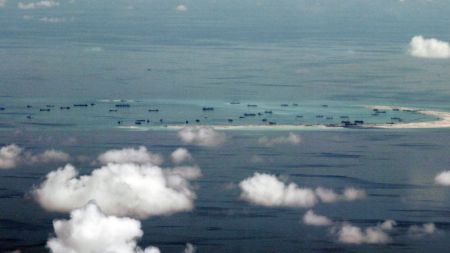
South China SeaFILE – This May 11, 2015, file photo, shows land reclamation of Mischief Reef in the Spratly Islands in the South China Sea. (AP)
 

A tribunal ruled in a sweeping decision Tuesday that China has no legal basis for claiming much of the South China Sea and had aggravated the seething regional dispute with its large-scale land reclamation and construction of artificial islands that destroyed coral reefs and the natural condition of the disputed areas.

Ruling on a variety of disputes the Philippines asked the tribunal to settle between it and China, the five-member panel unanimously concluded that China had violated its obligations to refrain from aggravating the dispute while the settlement process was ongoing.

The tribunal also found that China had interfered with Philippine petroleum exploration at Reed Bank, tried to stop fishing by Philippine vessels within the country’s exclusive economic zone and failed to prevent Chinese fishermen from fishing within the Philippines’ exclusive economic zone at Mischief Reef and Second Thomas Shoal.

The Philippines, which sought the arbitration ruling, welcomed the decision, and China rejected it outright.

“The Philippines strongly affirms its respect for this milestone decision as an important contribution to ongoing efforts in addressing disputes in the South China Sea,” Foreign Secretary Perfecto Yasay said in Manila.

He pledged to pursue a peaceful resolution of his country’s territorial disputes with China.

China’s state Xinhua news agency said China “does not accept or acknowledge” the tribunal or the ruling. China has long maintained that the tribunal did not have jurisdiction over the dispute.

The ruling is binding on both countries under a U.N. treaty that both have signed, but there is no policing agency or mechanism to enforce it.

The tribunal said that any historic rights to resources that China may have had were wiped out if they are incompatible with exclusive economic zones established under a U.N. treaty.

It also criticized China for building a large artificial island on Mischief Reef, saying it caused “permanent irreparable harm” to the coral reef ecosystem and permanently destroyed evidence of the natural conditions of the feature.

China drafted its so-called nine-dash line to demarcate its claims to virtually the entire South China Sea. Manila brought the case because China’s claims infringe upon its own 200-mile exclusive economic zone.

The dispute centers on waters through which an estimated $5 trillion in global trade passes through each year and are home to rich fishing stocks and a potential wealth of oil, gas and other resources. The ruling comes as the U.S. has ramped up its military presence in the region.

However a new Philippine leader who appears friendlier to Beijing could also influence the aftermath of the ruling.

China, which boycotted the case, summoned its demobilized sailors and officers for training drills in exercises that apparently started just days ago.

The People’s Liberation Army Daily newspaper said on social media late Monday that Chinese navy reserves have been called up to perform “functional tasks.” The post followed online rumors that reservists in central Chinese provinces were called up for an unspecified mission from July 10-22.

In the Philippines, more than 100 left-wing activists marched to the Chinese Consulate in metropolitan Manila, yelling, “Philippine territory is ours, China get out.” They called their campaign to push China out of the South China Sea, “CHexit” or “China exit now.”

Vietnam, meanwhile, accused Chinese vessels of sinking a Vietnamese fishing boat in disputed waters. Nguyen Thanh Hung, a local fisheries executive in the central province of Quang Ngai, said two Chinese vessels chased and sank the Vietnamese boat around midday Saturday as it was fishing near the Paracel islands. The five fishermen were rescued by another trawler around seven hours later.

China has argued that the tribunal has no jurisdiction and says it won’t accept the ruling. It has insisted that bilateral talks between Beijing and other claimants is the only way to address the dispute.

Findings of the tribunal are binding on the parties, including China. But the court — without police or military forces or a system of sanctions at its disposal — can’t enforce its ruling, so its potential impact remains unclear.

‘Price to pay for US’: Beijing ready to confront Washington if it intervenes in S.China Sea dispute

July 5, 2016

Price to pay for US’: Beijing ready to confront Washington if it intervenes in S.China Sea dispute

Published time: 5 Jul, 2016 11:58 Edited time: 5 Jul, 2016 12:06

Source: ‘Price to pay for US’: Beijing ready to confront Washington if it intervenes in S.China Sea dispute — RT News

© China Daily / Reuters

Beijing must prepare to make the US “pay a cost it can’t stand” if it intervenes in the South China Sea dispute by force, a state newspaper editorial has warned, days before a court at The Hague rules on the territorial row between China and the Philippines.

The American military build-up in the South China Sea, including the deployment of two carrier strike groups, comes in defiance of China’s vital interests and represents “a direct threat to national security,” the state-run Global Times said in strongly-worded editorials in its Chinese and English editions on Tuesday.

Beijing should accelerate developing its strategic deterrence capabilities to contain the United States, the newspaper added.

https://twitter.com/globaltimesnews/status/750157270969876480/photo/1?ref_src=twsrc%5Etfw

“Even though China cannot keep up with the US militarily in the short-term, it should be able to let the US pay a cost it cannot stand if it intervenes in the South China Sea dispute by force.”

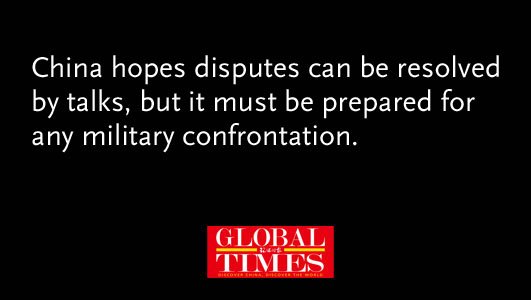
China is a peaceful country that welcomes dialogue on the disputed region, the influential newspaper wrote, “but it must be prepared for any military confrontation.”

The Global Times is believed to have close ties with the government as it operates under the auspices of the Communist Party’s official newspaper, the People’s Daily.

The Tuesday editorial went online a week ahead of a ruling by the International Court of Arbitration in The Hague on the South China Sea dispute between China and the Philippines. In 2013, the Philippines filed a complaint with the court, asking it to rule on who owns the Spratly Islands, which lie at the heart of economically important shipping routes in the area.

China sees the ruling – which is due to be announced on July 12 – as “posing more threat to the integrity of China’s maritime and territorial sovereignty,” the Global Times stated, claiming “the arbitration becomes nothing but a farce.” Beijing has said it will not recognize the ruling.

https://twitter.com/RT_com/status/747539561824268288/photo/1?ref_src=twsrc%5Etfw

The Spratly Islands, or Spratlys, comprise more than 750 islets, atolls and reefs, and lie off the coastlines of Vietnam, the Philippines, Taiwan, Malaysia, Brunei and China, with all the claimants having their own national names for the archipelago.

China runs military drills near Paracel Islands

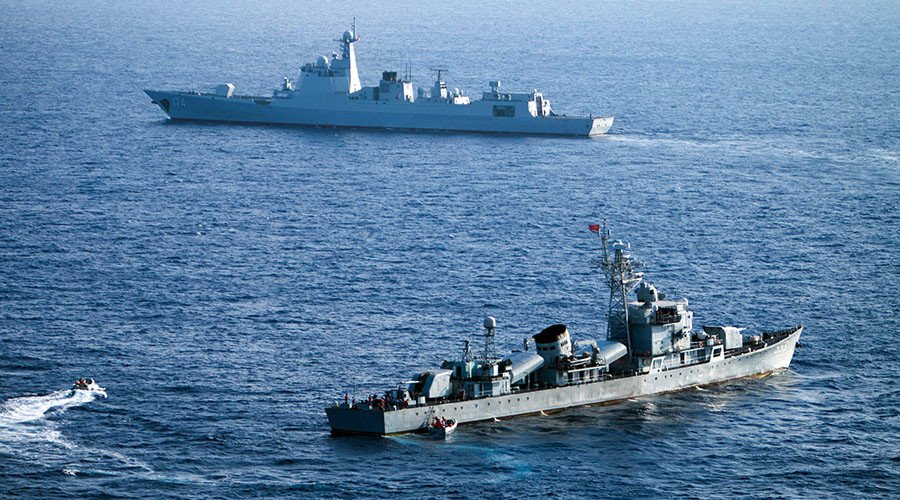
Prior to The Hague court’s ruling, Beijing announced it will conduct a routine naval exercise covering an area east of China’s Hainan Island all the way up to and including the Paracel Islands (known as Xisha in Chinese), another disputed area. The drill will run from Tuesday to July 11, and will involve two Chinese guided-missile destroyers, the Shenyang and Ningbo, as well as a frigate, the Chaozhou, according to the People’s Daily.

The exercise has sparked fears across the region, but “could be regarded as a countermeasure” to the US efforts “to press China militarily and politically,” the Global Times’ editorial said.

Over the past few years, Beijing has reclaimed several atolls and built up military installations on the group of disputed islands in the South China Sea. Washington has accused China of “aggressive behavior” in the region, sending warships to enforce what it calls freedom of navigation in international waters.

China’s President Xi Jinping says Beijing has no plans to attack anyone, but will continue its policy of active defense.