Posted tagged ‘Arab nations’

Our World: The anti-peace administration

August 12, 2015

Our World: The anti-peace administration, The Jerusalem PostCaroline B. Glick, August 11, 2015

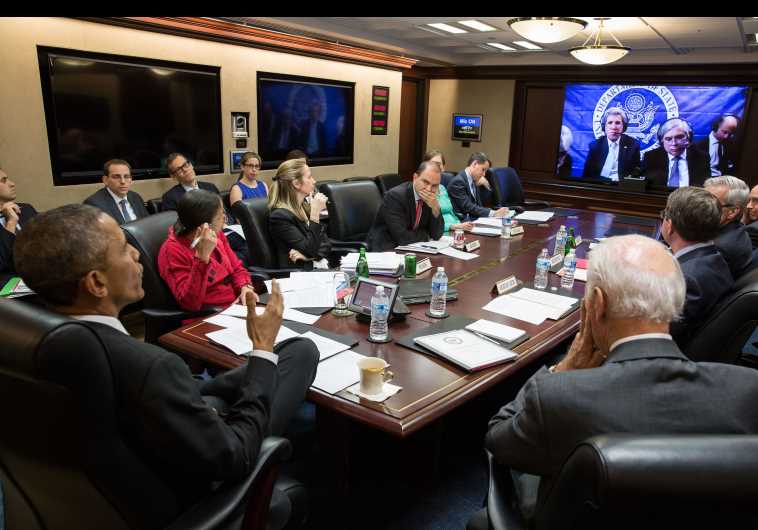
ShowImage (9)President Barack Obama, Vice President Joe Biden, and White House aides receive an update from Secretary of State John Kerry and Secretary of Energy Ernest Moniz via teleconference in Lausanne. (photo credit:WHITE HOUSE)

The US has striven to achieve peaceable relations between the states of the Middle East for nearly 70 years. Yet today, US government is disparaging the burgeoning strategic ties between the Sunni Arab states and Israel.

In a briefing to a delegation of visiting Israeli diplomatic correspondents in Washington last week, a senior Obama administration official sneered that the only noticeable shift in Israel-Arab relations in recent years is that the current Egyptian government has been coordinating security issues “more closely” with Jerusalem than the previous one did.

“But we have yet to see that change materialize in the Gulf.”

If this is how the US views the state of Israel’s relations with the Arabs, then Israel should consider canceling its intelligence cooperation with the US. Because apparently, the Americans haven’t a clue what is happening in the Middle East.

First of all, to characterize the transformation of Israeli-Egyptian relations as a mere question of “more closely” coordinating on security issues is to vastly trivialize what has happened over the past two years.

Before then Egyptian defense minister Abdel Fattah el-Sisi overthrew the US-backed Muslim Brotherhood regime headed by Muhammad Morsi in July 2013, there was a growing sense that Morsi intended to vacate Egypt’s signature to the peace deal with Israel at the first opportunity. Just a month after Morsi ascended to power in January 2013, the Muslim Brotherhood began threatening to review Egypt’s continued commitment to the peace treaty.

The main reason Morsi did not cancel the peace deal with Israel was that Egypt was bankrupt. He needed US and international monetary support to enable his government to pay for imported grain to feed Egypt’s destitute population of 90 million.

During his year in power, Morsi used Hamas as the Brotherhood’s shock troops. He embraced Iran, inviting president Mahmoud Ahmadinejad to visit Cairo in February 2013.

If Morsi were still in power today, with its $150 billion in sanctions relief Iran would have been in a position to support Egypt’s economy. So it is possible that if Morsi were still president, he would have felt he had the financial security to walk away from the peace treaty.

In happy contrast, under Sisi, Israeli-Egyptian ties are closer than they have ever been. Just last week Egyptian diplomats told Al Ahram that Israel’s support was critical for building administration support for Sisi.

Over Ramadan, Egyptian television broadcast a pro-Jewish mini-series.

Israel is closely working with the Egyptians on defeating the growing threat of Islamic State, Hamas and other Islamic terrorist groups waging a bloody insurgency against the regime in Sinai.

Last summer, it was due to the close coordination between Sisi and Israel that the US failed to force Israel to accept Hamas’s cease-fire terms, as those were represented by the Islamist regimes of Qatar and Turkey.

In part due to Israel’s critical support for Sisi’s government, and in part owing to their opposition to Iran’s rise as a regional hegemon armed with nuclear weapons, Saudi Arabia, the UAE and Jordan have all joined Egypt in viewing Israel as a strategic partner and protector.

Last year Saudi Arabia together with the UAE and Jordan supported Israel and Egypt in opposing Hamas and its American, Turkish and Qatari defenders. Had it not been for this massive Arab support, it is very likely that Israel would have been forced to accept the US’s demands and grant Hamas control over Gaza’s international borders.

In June, as negotiations between the US and the other five powers and Iran were moving toward an agreement, the Council on Foreign Relations in New York hosted a meeting between then incoming Foreign Ministry director general Dore Gold and retired Saudi General Anwar Eshki, a former advisor to the Saudi ambassador to the US. The two revealed that over the previous 18 months, they had conducted five secret meetings to discuss Iran.

Although President Barack Obama harangued Israel in his speech at American University last Wednesday, claiming that the Israeli government is the only government that has publicly opposed his nuclear deal with the Iranians, Monday US congressmen now shuttling between Egypt and Israel told Israeli reporters that Egypt opposes the nuclear deal.

As for the Gulf states, according to the US media, last week they told visiting US Secretary of State John Kerry that they support the nuclear deal.

Kerry addressed his counterparts in the Gulf Cooperation Council.

But the fact is that the only foreign minister who expressed such support was Qatari Foreign Minister Khaled al-Attiyah. To be sure, Attiyah was charged to speak for all of his counterparts because Qatar holds the GCC’s rotating chairmanship. But given that Qatar has staked out a pro-Iranian foreign policy in stark contrast to its neighbors and GCC partners, Attiyah’s statement is impossible to take seriously without the corroboration of his colleagues.

As for Qatar’s statement of support, Qatar has worked for years to cultivate good relations with Iran. It might have been expected therefore that Attiyah’s endorsement of the deal would have been enthusiastic. But it was lukewarm at best.

In Attiyah’s words, Kerry promised that the deal would place Iran’s nuclear sites under continuous inspections. “Consequently,” he explained, “the GCC countries have welcomed on this basis what has been displayed and what has been talked about by His Excellency Mr. Kerry.”

The problem of course is that Kerry wasn’t telling the truth. And the Arabs knew he was lying. The deal does not submit Iran’s nuclear sites to a rigorous inspection regime. And the GCC, including Qatar, opposes it.

In his briefing with Israeli reporters, the high-level US official rejected the importance of the détente between Israel and its Arab neighbors because he claimed the Arabs have not changed their position regarding their view of a final peace deal between Israel and the Palestinians.

But this is also nonsense. To be sure, the official position of the Saudis and the UAE is still the so-called Arab peace initiative from 2002 which stipulates that the Arabs will only normalize relations with Israel after it has ceded Jerusalem, Judea, Samaria and the Golan and allowed millions of foreign-born Arabs to freely immigrate to the shrunken Jewish state. In other words, their official position is that they will only have normal relations with Israel after Israel destroys itself.

But their official position is no longer their actual position. Their actual position is to view Israel as a strategic ally.

The senior official told the Israeli reporters that in order to show that “their primary security concern is Iran,” then as far as the Arabs are concerned, “resolving some of the other issues in the region, including the Palestinian issue should be in their interest. We would like to see them more invested in moving the process forward.”

In the real world, there is no peace process. And the Palestinian factions are fighting over who gets to have better relations with Iran. Monday we learned that PA leader Mahmoud Abbas wishes to visit Iran in the coming months in the hopes of getting the money that until recently was enjoyed by his Hamas rivals.

Hamas for its part is desperate to show Tehran that it remains a loyal client. So today, no Palestinian faction shares the joint Israeli-Saudi-Egyptian interest in preventing Iran from becoming a nuclear armed regional hegemon.

The administration showed its hand in that briefing with the Israeli reporters last week. For all their talk about Middle East peace, Obama and his advisors are not at all interested in achieving it or of noticing when it has been achieved.

The day after the deal

August 9, 2015

The day after the deal, Israel Hayom, Prof. Eyal Zisser, August 9, 2015

(Please see also, Russia and US woo Saudis to help save Assad – albeit putting Israel and Jordan in danger from S. Syria.– DM)

[Soleimani] wanted Russia and Iran to agree on the division of the Middle East in a way that would serve their clients in the region (among them, Assad) and check their joint enemies (the Islamic State). After figuring that out, they probably moved on to the next topic: how to marginalize America in the region. As a means to both ends, Russia will continue to serve as Assad’s protector (despite his many crimes), all the while providing Iran with international backing. But above all it will send arms to Iran, to the Syrian regime, and if needed, to Hezbollah.

***********************

Over the weekend it transpired that Maj. Gen. Ghasem Soleimani, the commander of Iran’s Quds Force, had visited Moscow two weeks ago and met with President Vladimir Putin. The Quds Force, in case you forgot, is in charge of the Iranian Revolutionary Guards’ clandestine operations (including terrorism). The Quds Force is responsible for providing aid to Hezbollah and Hamas as well as to Syrian President Bashar Assad and the Houthi rebels in Yemen. In light of his direct involvement in terrorism, the international community imposed sanctions on Soleimani, including travel restrictions.

Only last week, at a hearing on Capitol Hill, U.S. Secretary of State John Kerry vowed that the U.S. will make sure the sanctions on Soleimani would stay in effect and that the Obama administration would counter Iran’s efforts to destabilize the Middle East. But no one takes Kerry seriously anymore. While Kerry continues to engage Iran’s unimportant Foreign Minister Mohammad Javad Zarif, the real wheeling and dealing is actually in Moscow.

Soleimani did not go to Moscow because he had tickets to the Bolshoi. Rather, he arrived because he wanted to discuss “the day after the nuclear deal” with Putin. Namely, he wanted Russia and Iran to agree on the division of the Middle East in a way that would serve their clients in the region (among them, Assad) and check their joint enemies (the Islamic State). After figuring that out, they probably moved on to the next topic: how to marginalize America in the region. As a means to both ends, Russia will continue to serve as Assad’s protector (despite his many crimes), all the while providing Iran with international backing. But above all it will send arms to Iran, to the Syrian regime, and if needed, to Hezbollah.

The Russians, unlike the Iranians, don’t consider Israel to be an enemy state. But as a famous Russian official once said: “When you chop wood, chips fly.” Israel has become the latest chip — the collateral damage. Soleimani’s visit is just the tip of iceberg. It shed light on the not-so-secret deals that are being negotiated in the wake of the “Vienna nuclear agreement.” Europe, as usual, is focused on profit and its corporate executives are already traveling in droves to Tehran to ink deals. There are also political deals Iran wants to secure, which are as important for Tehran. Their price, however, will be measured in blood rather than in euros or dollars.

No one in the Middle East, it seems, is keen on parsing each and every provision in the nuclear deal. Nor is there an attempt to see whether, in the grand scheme of things, it is will have been a worthwhile endeavor some 10 or 15 years from now, when its key elements expire. In this region, what counts is the way this agreement is perceived here and now — and what really matters to people is the way it is portrayed in the media. Under that criteria, Iran is the victor and America is the vanquished, because it caved to Iran. The deal, according to how the media has portrayed it, is a crushing political blow to Israel and the moderate Arab states, led by Saudi Arabia.

This knockout victory will likely produce a new Iranian-American partnership. At the very least, the two nations will mend fences. This will alienate many of Washington’s clients, who will have to look elsewhere for a more reliable ally. Egypt and the Saudis have already realized this and turned to Russia for aid and arms, figuring it would be more trustworthy than the “staff of this broken reed” (Isaiah 36:6).

Saudi Arabia is reportedly sending feelers to see if there is a deal to be had with Russia and Iran. Under the terms of the proposed deal, Saudi Arabia would withhold aid to the Syrian rebels if Iran ends its rogue presence in the state. Such a deal would secure Assad a victory over the insurgents, or a least ensure his regime survives.

The ongoing developments have caused panic, but not over the rising clout of Iran and Russia. The White House, it seems, is fretting over the possibility that Congress may vote against the Iran deal and further tarnish Obama’s image.

Russia and US woo Saudis to help save Assad – albeit putting Israel and Jordan in danger from S. Syria

August 9, 2015

Russia and US woo Saudis to help save Assad – albeit putting Israel and Jordan in danger from S. Syria, DEBKAfile, August 9, 2015

Lavrov_Kerry_and_al-Jubeir-_Doha_3.8.15Lavrov, Kerry, Al-Jubeir at Doha

[N]either Israel nor Jordan has been co-opted to this big power initiative, as though they are not concerned. However, both have a big stake in Saudi Arabia’s next decisions. If Riyadh is won over by US-Russian blandishments and goes back on its decision to boycott Assad, the Saudi-Israeli-Jordanian effort to support Syrian rebel control of southern Syria will fall apart. This will open up both countries to new perils on their  northern borders.

************************

Building on the nuclear accord signed in Vienna last month, the Obama administration has been in close communion with Moscow and Tehran on regional moves to save the Assad regime, as the key to their next regional policies, including a united front against the Islamic State.. Saudi Arabia and its Gulf partners are being assiduously wooed to join the new alignment being set up for this purpose. The live wire in getting them all together is Omani Foreign Minister Khalid bin Mohamed Al-Attiyah, the secret broker who brought Iran and the United States to the negotiating table for a nuclear accord. This was first reported in the last DEBKA Weekly.

Wednesday, Aug. 7, Obama threw out his first hint on this development: “The window has opened a crack for us to get a political resolution in Syria, partly because both Russia and Iran, I think, recognize that the trend lines are not good for Assad,” he said. “Neither of those patrons are particularly sentimental; they don’t seem concerned about the humanitarian disaster that’s been wrought by Assad and this conflict over the last several years, but they are concerned about the potential collapse of the Syrian state. And that means, I think, the prospect of more serious discussions than we’ve had in the past.”

The US president then affirmed more strongly in a CNN interview Sunday, Aug. 9:  “Is there the possibility that having begun conversations around this narrow issue [the nuclear accord with Iran] that you start getting some broader discussions about Syria, for example, and the ability of all the parties involved to try to arrive at a political transition that keeps the country intact and does not further fuel the growth of ISIL and other terrorist organizations? I think that’s possible,” Obama said. “But I don’t think it happens immediately.”

The administration and its prospective partners are united by the will to destroy ISIS – in its Syrian stronghold, for starters – but are divided on much else, DEBKA file reports. And so the process is moving forward in careful steps.

Their initial focus is on Syria, the bloody battleground which in less than five years has left at least 300,000 dead and more than 10 million people homeless.

The plan the group started out with in the last ten days was a swap as simple as it was ruthless: Saudi Arabia and the United Arab Emirates would slow their assistance to Syrian rebel groups, against whom President Bashar Assad’s army and allies would hold their fire; Iran, for its part, was to start withdrawing its support from the Yemeni Houthis insurgents.

The informal truce in Syria would be the stage for the Assad regime and rebel groups to start discussing a new government with room for opposition parties. The Islamists of the Islamic State and Al Qaeda’s Nusra Front would not be invited.

In Yemen, Tehran would cut back on the arms and intelligence which have enabled the Houthi insurgents to stand up to the combined forces of Saudi Arabia, the UAE and Egypt. The pro-Western Yemeni President Abd Rabo Mansour Hadi would be restored to his palace in Sanaa and invite the insurgent leader, Abdu Malik Al-Houthi, to discuss his partnership in a new government.

This deal was tantamount to a joint US-Russian guarantee of Bashar Assad survival in power in return for a Tehran-Riyadh compact for Hadi’s reinstatement in Sanaa.

These arrangements were debated back and forth in exchanges, some semi-secret, among the leading actors for most of July. The visit to Riyadh of the Syrian intelligence chief Maj. Gen. Ali Mamlouk was set up by Moscow as a major push forward.

The plan was for the entire enterprise to be brought out in the open and sealed in Doha, Qatar, Tuesday, Aug. 3 at a conference attended by US Secretary of State John Kerry, Russian Foreign Minister Sergey Lavrov, Saudi Foreign Minister Adel Al-Jubeir and other top Gulf diplomats.

Iranian Foreign Minister Mohammed Javad Zarif was not there. But he put a strong oar into the proceedings by calling in at Muscat, Oman the day before the conference and subsequently on Friday Aug. 7. Assad also kept his hand in by sending his foreign minister Walid Moallem to Tehran and Muscat last week.

But then, at Doha, just as the package was ready to unveil, the Saudi foreign minister pulled away and blew it up with two provisions: a) Riyadh would not countenance Bashar Assad being allowed to stay in office, and: b) Saudi Arabia would not do business with any representative of the Assad regime.

This put a large spoke in the main wheel of the initiative and also scuttled some of the secondary plans depending on it.

But by then, a lot was happening in the Yemeni and Syrian war arenas:

1. Saudi and UAE armored forces had landed in Aden and were closing in on the Yemeni capital, Sanaa. The Houthi rebels, trained and armed by Iran, were forced to retreat without negotiations on their future role in government.

2. Syrian rebel leaders, sensing the approaching betrayal, sent a secret delegation to Tehran to discuss terms for opening negotiations with Assad. They too were left at sea about the deals in play among Washington, Moscow, Tehran and Riyadh over their future.

Saturday, Aug.8, the Russians, egged on by the Americans, set about winning Riyadh into the fold, Foreign Minister Al-Jubeir was invited to pay a visit to Moscow Tuesday, Aug. 11, for talks about the Syrian conflict and the war on the Islamic State.

Refusing to accept that the new initiative had been grounded in Doha, Moscow presented the visit as continuing the ongoing dialogue on the issues raised at that encounter.

DEBKAfile’s military and intelligence sources note that neither Israel nor Jordan has been co-opted to this big power initiative, as though they are not concerned. However, both have a big stake in Saudi Arabia’s next decisions. If Riyadh is won over by US-Russian blandishments and goes back on its decision to boycott Assad, the Saudi-Israeli-Jordanian effort to support Syrian rebel control of southern Syria will fall apart. This will open up both countries to new perils on their  northern borders.

Nuclearizing Iran, Sabotaging Arabs

August 6, 2015

Nuclearizing Iran, Sabotaging Arabs, The Gatestone InstituteBassam Tawil, August 6, 2015

(Please see also, Obama’s Strategy Of Equilibrium. — DM)

  • Obama’s solution? To let Iran have legitimate nuclear bombs in a few years, along with intercontinental ballistic missiles to deliver them to the U.S. — or perhaps from America’s soft underbelly, South America, where Iran has been acquiring uranium and establishing bases for years. Or perhaps launched from submarines off America’s coast, which would make the identity of the attacker unknowable and a response therefore impossible. Incredibly, America’s politicians do not even seem to seem to be concerned about that.
  • We have just sacrificed Sunni stability for American ideology: empty slogans fed to us by clueless, if well-meaning, American officials.
  • As we watched one stable Arab regime fall after another, we have allowed ourselves to be destroyed from within by these bungling diplomats — from America, Europe, China and Russia. Instead of keeping our eyes on the real threat, we exhausted ourselves in wasteful, unending battles against the Jews — meanwhile letting the Iranian menace slip out of sight.
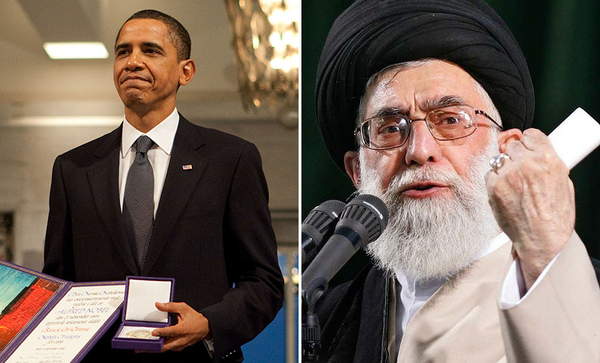
  • Obama really does deserve a Nobel Prize, but it should have been awarded by the Ayatollah Khamenei, the Supreme Leader of Iran, in gratitude for America’s surrender.

“Nation building” seems to have fallen into disrepute in the West, but it should not. It is vitally important — as the successes of Germany, Japan and South Korea attest.

Over the past few years, in our foolishness, we in the Middle East swallowed the deceptive bait of “democracy” dangled before us, even though we knew that it could not, in the misguided way it was presented, be implemented in the Middle East.

The idea was superb, but here in the Middle East, possibly in being impatient to “get credit” before the diplomats’ term of office were over, no one ever took the time to establish the institutions of democracy — equal justice under law, freedom of speech, property rights, the primacy of the individual rather than the collective, separation of religion and state — to show us in the Middle East how democracy actually operates, and to allow those institutions to take rootbefore ever holding an election.

So eager were Western leaders to take credit right away that they refused “let the rice bake.” Had the West introduced democratic elections to Japan and South Korea (where they eventually worked brilliantly) in the same way it muscled democracy into Iraq, it would never have taken root in those countries either. Had the Germans had been asked to vote right after World War II, they would most likely have reelected the Nazis — that was what they knew. It took seven years to re-educate the public to understand and accept a Konrad Adenauer.

What seems clear is that we have sacrificed Sunni stability for empty slogans — and for clueless, if well-meaning, American officials. As we watched one stable Arab regime fall after another, we allowed American ideology to destroy us from within. Instead of keeping our eyes on the real threat, we exhausted ourselves in wasteful, unending battles against the Jews — meanwhile letting the Iranian menace slip out of sight.

If we try to look at the positive side of the Iran nuclear agreement, it is just possible that Obama looked at the Sunni Arab states, fractured and at each other’s throats, and at the ruthless terrorist groups gaining ground in the expanding battle zones, and decided that we were too fractious for the U.S. to protect.

Sunni states such as Saudi Arabia, Qatar and Turkey have been worsening the situation in the Arab world by funding Sunni terrorist organizations, thereby putting it on a course of complete chaos. Despite Arab wealth and power, we have been dealing almost exclusively with the marginal issue of Palestine and the Jews, to excuse our inability to be effective in giving U.S. President Barack Obama what he really needs: regional stability.

Obama sees Iran and its terrorist organizations, which are all unified, organized and obedient, opposing the Sunni Arabs. Obama may be betting on Iran to bring order to the Middle East.

Imagine if we and our fundamentalist Sunni terrorist organizations had actually focused on stopping the Iranians in Syria, Iraq, Lebanon and Yemen. Imagine if we had abandoned, even momentarily, the dream of the Muslim Brotherhood (what the West calls “political Islam”) ruling the world. Imagine if we had stopped our stupid, useless acts of hatred, and could instead have focused on our common enemy, Iran. Our situation now would be immeasurably better. We would not be deviating from the teachings of Muhammad, because first we have to focus on the near enemy and then on the distant one. Iran is nearer and more dangerous than Europe and the United States, so Iran should have been — and still should be — the first Sunni target. We might have led Obama to adopt a different approach than allowing Iran to acquire a nuclear bomb in ten years or sooner — but we did not, because of our weakness and distraction with marginal “causes.” Thus Obama, from a desire to stabilize the Middle East, seems to be betting on the strong horse, Iran.

The truth, however, may be somewhat different. It is entirely possible that Obama, who won the Nobel Peace Prize, is employing a policy of “divide and conquer.” In the U.S., instead of trying to improve how children in the inner cities are being educated, he has been busy stoking racial and economic conflict. The Arabs are becoming increasingly suspicious that he is a historic “divide and conquer” manipulator. He may deliberately be creating fitna (civil strife) in the Arab world by whipping up conflict with Iran, so that America will one again look like the big power-broker — but at the expense of the Arabs.

We Arabs are expert conspiracy theorists, and interpret every political agenda as a hidden plot, but one only has to look at the Obama administration’s fawning support for the Muslim Brotherhood in Turkey and Egypt, and how America supported the fall of Mubarak, and it immediately becomes obvious that the U.S. is trying to manipulate the fate of the Arabs.

Anyone following America’s rejection of, and now only reluctant support for, the reformist regime of Egyptian President Abdel Fattah el-Sisi understands that the Americans prefer what they consider “backward Arabs”: those controlled by regressive Islam.

That is the reason we see Obama’s policies as backing both the Sunni Muslim Brotherhood and the theocrats in Iran. The ideologies of both the Muslim Brotherhood and Iran’s mullahs would lead to most dangerous and regressive fate of both Sunni and Shiite Muslims around the world, as well as Americans at home — and these are the Muslims most loved by the current American administration. Or maybe, as many of us say here on the street, Obama is just trying to “get even” with the West and bring it to its knees, for being white, “imperialist” and non-Muslim. Obama’s solution? To let Iran have legitimate nuclear bombs in a few years, with the intercontinental ballistic missiles to deliver them to the U.S. — or perhaps from America’s soft underbelly, South America, where Iran has been acquiring uranium and establishing bases for years. Or perhaps launched from submarines off America’s coast, which would make the identity of the attacker unknowable and a response therefore impossible. Incredibly, America’s politicians do not even seem to seem to be concerned about that.

Obama really does deserve a Nobel Prize, but it should have been awarded by the Ayatollah Khamenei, the Supreme Leader of Iran, in gratitude for America’s surrender.

1190Perhaps President Obama’s Nobel Prize should have been awarded by the Ayatollah Khamenei, the Supreme Leader of Iran, in gratitude for America’s surrender.

Obama’s Strategy Of Equilibrium

August 6, 2015

Obama’s Strategy Of Equilibrium, Middle East Media Research Institute, Yigal Carmon and Alberto M. Fernandez, August 5, 2015

(The conflict between Shiite and Sunni factions has been going on since shortly after the death of Mohamed. Obama is not likely to bring reconciliation. — DM)

This article will analyze the strategy of creating an equilibrium between Sunnis and Shiites as a means to promote peace in the Middle East. It will examine the meaning of the strategy in political terms, how realistic it is, and what its future implications might be on the region and on the United States.

“It is worth noting that the first Islamic State created in the Middle East in the last 50 years was not the one created in the Sunni world in 2014 and headed by Abu Bakr al-Baghdadi.” Rather, it was the Islamic Republic of Iran created in 1979 by Ayatollah Ruhollah Khomeini and currently ruled by his successor, Supreme Leader Ali Khamenei, who maintains – even following the Iran deal – the mantra “Death to America,” continues to sponsor terrorism worldwide, and commits horrific human rights violations.

********************

Introduction

In an interview with Thomas Friedman of The New York Times (“Obama Makes His Case on Iran Nuclear Deal,” July 14, 2015), President Obama asked that the nuclear deal with Iran be judged only by how successfully it prevents Iran from attaining a nuclear bomb, not on “whether it is changing the regime inside of Iran” or “whether we are solving every problem that can be traced back to Iran.” However, in many interviews he has given over the last few years, he has revealed a strategy and a plan that far exceed the Iran deal: a strategy which aims to create an equilibrium between Sunnis and Shiites in the Muslim world.

President Obama believes that such an equilibrium will result in a more peaceful Middle East in which tensions between regional powers are reduced to mere competition. As he told David Remnick in an interview with The New Yorker, “…if we were able to get Iran to operate in a responsible fashion…you could see an equilibrium developing between Sunni, or predominantly Sunni, Gulf states and Iran in which there’s competition, perhaps suspicion, but not an active or proxy warfare” (“Going the Distance,” January 27, 2014).

In discussing the Iran deal, the President recalled President Nixon negotiating with China and President Reagan negotiating with the Soviet Union in order to explain the scope of his strategy for the Middle East and the Muslim world. President Obama seeks, as did Presidents Reagan and Nixon with China and the Soviet Union, to impact the region as a whole. The Iran deal, even if major, is just one of several vehicles that would help achieve this goal.

This article will analyze the strategy of creating an equilibrium between Sunnis and Shiites as a means to promote peace in the Middle East. It will examine the meaning of the strategy in political terms, how realistic it is, and what its future implications might be on the region and on the United States.

The Meaning Of The Equilibrium Strategy In Political Terms

Examining the strategy of equilibrium requires the recollection of some basic information. Within Islam’s approximately 1.6 billion believers, the absolute majority – about 90% – is Sunni, while Shiites constitute only about 10%.  Even in the Middle East, Sunnis are a large majority.

What does the word “equilibrium” mean in political terms? In view of the above stated data, the word “equilibrium” in actual political terms means empowering the minority and thereby weakening the majority in order to progress toward the stated goal. However, the overwhelming discrepancy in numbers makes it impossible to reach an equilibrium between the two camps. Therefore, it would be unrealistic to believe that the majority would accept a policy that empowers its adversary and weakens its own historically superior status.

Implications For The Region

Considering the above, the implications of the equilibrium strategy for the region might not be enhancing peace as the President well intends; rather, it might intensify strife and violence in the region. The empowered minority might be persuaded to increase its expansionist activity, as can be already seen: Iran has extended its influence from Lebanon to Yemen. Iranian analyst Mohammad Sadeq al-Hosseini stated in an interview on September 24, 2014, “We in the axis of resistance are the new sultans of the Mediterranean and the Gulf. We in Tehran, Damascus, [Hizbullah’s] southern suburb of Beirut, Baghdad, and Sanaa will shape the map of the region. We are the new sultans of the Red Sea as well” (MEMRITV Clip No. 4530). Similarly, in a statement dedicated to the historically indivisible connection between Iraq and Iran, advisor to President Rouhani Ali Younesi stressed that, “Since its inception, Iran has [always] had a global [dimension]; it was born an empire” (MEMRI Report No. 5991).

In view of this reality, this strategy might create, against the President’s expectations, more bitterness and willingness on the part of the majority to fight for their status. This has already been realized; for example, when Saudi Arabia intervened in Yemen after facing the Houthi/Shiite revolution, which it perceived as a grave danger to its survival, and created a fighting coalition within a month to counter it. Similarly, Saudi Arabia has previously demonstrated that it regards Bahrain as an area where any Iranian attempt to stir up unrest will be answered by Saudi military intervention. According to reports, Saudi Arabia has been supporting the Sunni population in Iraq, and in Lebanon, a standstill has resulted because Saudi Arabia has shown that it will not give up – even in a place where Iranian proxy Hizbollah is the main power. Hence, the strategy of equilibrium has a greater chance of resulting in the eruption of regional war than in promoting regional peace.

Implications For The United States

Moreover, this strategy might have adverse implications for the United States and its interests in the Sunni Muslim world: those countries that feel betrayed by the strategy might, as a result, take action against the United States – hopefully only politically (such as changing international alliances) or economically. These countries might be careful about their public pronouncements and might even voice rhetorical support to U.S. policy, as the GCC states did on August 3, but the resentment is there.

Realpolitik Versus Moral Considerations

The analysis presented here is based on principles of realpolitik: in politics, one does not align with the minority against the majority. However, sometimes other considerations take precedence. Morality is such an example: the Allies could not refrain from fighting Nazi Germany because it was a majority power – ultimately, they recognized the moral obligation to combat the Third Reich. However, with regard to the Middle East, the two adversaries are on equal standing: the Islamic Republic of Iran is no different than the Wahhabi Kingdom of Saudi Arabia. President Obama and Secretary Kerry would be wrong to think that Mohammad Javad Zarif, the sophisticated partygoer in New York City, represents the real Iran. Zarif, his negotiating team, and President Rouhani himself, all live under the shadow and at the mercy of the Supreme Leader, the ayatollahs, and the IRGC.

“It is worth noting that the first Islamic State created in the Middle East in the last 50 years was not the one created in the Sunni world in 2014 and headed by Abu Bakr al-Baghdadi.” Rather, it was the Islamic Republic of Iran created in 1979 by Ayatollah Ruhollah Khomeini and currently ruled by his successor, Supreme Leader Ali Khamenei, who maintains – even following the Iran deal – the mantra “Death to America,” continues to sponsor terrorism worldwide, and commits horrific human rights violations.

Analysis: Arabs see US-trained anti-Islamist force as only fit to ‘play paintball’

August 6, 2015

Analysis: Arabs see US-trained anti-Islamist force as only fit to ‘play paintball’, Jerusalem PostAriel Ben Solomon, August 6, 2015

ShowImage (7)AN ISIS member rides on a rocket launcher in Raqqa in Syria two months ago. (photo credit:REUTERS)

The deal with Iran and the cooperation with Iranian forces against Islamic State, include “Shi’ite militias that are no less criminal.”

*********************

The Arab world perceives the dramatic failure of the small US-trained Syrian rebel force as a further indication that it cannot be a reliable ally against the Iran led Shi’ite axis.

A US defense official, who spoke to Reuters on condition of anonymity, said on Tuesday that at least five Syrian rebels it has trained are believed to have been captured by the Nusra Front.

That followed an attack by the Nusra Front on Friday thought to have killed one member of the so-called “New Syrian Forces,” in what would be their first battlefield casualty.

The incidents underscore the extreme vulnerability of the New Syrian Forces, a still tiny group estimated to number less than 60, who only deployed to the battlefield in recent weeks.

The Pentagon is far behind on its goals to train around 5,000 fighters a year.

Kirk Sowell, principal of Uticensis Risk Services, a Middle East-focused political risk firm, who closely follows Arab media summed it up this way on Twitter: “Pentagon: Arab media are laughing at you.”

Sowell posted a broadcast by pro-opposition Orient News, which expressed astonishment as to why the US would send in a force of only 50 to 60 fighters to help destroy Islamic State.

Aymenn Jawad al-Tamimi, a fellow at the Middle East Forum who closely follows Islamist opposition groups in Syria and Iraq, told The Jerusalem Post that “for many Sunni Arabs and Syrian Sunni Arab rebels in particular, this train-and-equip program has had no credibility from the outset.”

This is because the notion of fighting Islamic State while ignoring regime forces does not make sense for them, said Tamimi.

“US policymakers’ sense of reality on the ground is seriously in question with the apparent failure to anticipate a clash with the Nusra Front, which has a notable presence in the Azaz district into which the force of 50-60 men was inserted,” he continued.

Since the US has targeted Nusra Front in air strikes it is not surprising that the group would view a US backed group as a threat, he said.

Middle East researcher Ali Bakir, who also writes for Arab publications, told the Post on Wednesday that “no one in the Arab world takes this program seriously; I mean you would need around 50 to 60 people to play paintball but definitely not to fight Islamic State.”

“There is a profound general perception in the Arab world that the Obama administration is no less responsible than Iran and Russia in the Syrian crisis,” he said.

The deal with Iran and the cooperation with Iranian forces against Islamic State, include “Shi’ite militias that are no less criminal.”

This situation is increasingly seen in the Arab world as siding with the Shi’ites at the expense of the vast majority of Muslims, he asserted.

The US administration is more concerned about not jeopardizing the Iran deal than helping the Syrian people, Bakir added.

Nuclear Iran: Is the U.S. Really Suicidal?

July 27, 2015

Nuclear Iran: Is the U.S. Really Suicidal? The Gatestone InstituteBassam Tawil, July 27, 2015

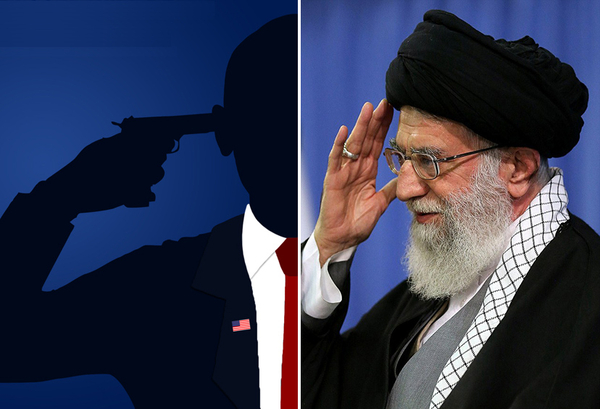
  • No wonder Iran’s Supreme Leader sent around a tweet of Obama pointing a pistol at his own head. Iran’s forcing itself on the rest of the world is a central part of Khomeini’s Islamic Revolution.
  • The Ayatollahs’ wish has long been finally to defeat the divided Arabs, and then to move on to defeat Israel, and then the grandest prize of all — the “Great Satan,” the United States.
  • Worse, apparently a “side deal” — classified for the Americans but not for Iran — enables Iran to provide its own soil samples to the International Atomic Energy Agency (IAEA), to which it has been lying for decades. Even still worse, the parties to the agreement are required to help Iran protect its nuclear facilities should anyone try to attack them or sabotage them — including, presumably, any disenchanted signatories.
  • Iran will have been rewarded for having violated the Nuclear Non-Proliferation Treaty, and been given a red carpeted fast track to complete its nuclear bomb.

If Obama and the others who signed the catastrophic nuclear agreement with Iran on the eve of Laylat al-Qadr, the Eve of Destiny, a few days before the end of the Ramadan fast, had studied a little history, they would know that the Battle of Qadisiyyah in 636, in which the Persians suffered a disastrous defeat at the hands of the Arabs, has not yet ended. They would know that Islam had, in fact, been imposed on the Sassanid Empire by force, and that, in protest, the Persians adopted Shi’a Islam, a form of the religion that deviated from and changed the Islam of the Arabs, as a way of rebelling and continuing the fight.

If the West had studied that important event in Islamic history, they would understand they were enabling Iran to achieve a nuclear bomb and accelerate the national religious war between us, the Arabs, and the Shi’ite Iranians. For Iran’s mullahs, the showdown is meant to be apocalyptic.

In that respect, the agreement signed by the American-led powers with Iran’s rulers is a milestone along the path they have been praying for. The Ayatollahs’ wish has long been finally to defeat the divided Arabs, currently at their weakest point since the beginning of the so-called Arab Spring, and then to move on to defeat Israel, and then grandest prize of all: the “Great Satan,” the United States.

The Shi’ite regime of the Ayatollahs in Iran and their proxies are united. And, since the fall of the Shah, they are, sadly, also radical. Between their terrorist wings and influence in the Middle East and abroad, the Ayatollahs are refreshingly open about their determination to defeat the Arabs and achieve religious and national hegemony. Iran’s forcing itself on the rest of the world is a central part of Khomeini’s Islamic Revolution.

U.S. President Barack Obama has harmed us Arabs by abandoning his own red lines — against the emphatic advice of his own military advisors — to accept an agreement that in reality gives the Shi’ites open permission to build nuclear weapons at our expense and, more insanely, to allow Iran intercontinental ballistic missiles (ICBMs) that could reach America.

Worse, apparently a “side deal” — classified for Americans but not for Iran — allows Iran to provide its own soil samples to the International Atomic Energy Agency (IAEA), to which it has been lying for decades. In other words, having the cat guard the milk.

Still worse, the parties to the agreement are required to help Iran protect its nuclear facilities should anyone try to attack them or sabotage them — including, presumably, any disenchanted signatories. No wonder Iran’s Supreme Leader sent a tweet of Obama pointing a pistol at his own head.

1172On July 25, 2015, Iran’s Supreme Leader (right) sent a tweet of Obama pointing a pistol at his own head.

If we try to look at the positive side of the agreement, it is just possible that Obama looked at the Sunni Islamic states, fractured and at each other’s throats, and at the ruthless terrorist groups and all the other battle zones gaining ground, and decided that we were too fractious for the U.S. to protect.

Now, one minute before the Iranians would have collapsed under the weight of the economic sanctions, the U.S. has given them a new lease on life, and, supported by the arrival of billions of dollars, is enabling them to return to their broad international terrorist activities and continue developing their nuclear weapons and the ICBMs on which to mount them.

Not only Iran will profit, but also the Turks, the Chinese and the Russians, who have already jumped at the chance to shore up Iran and themselves, both economically and militarily.

America will be now marginalized, as will its allies. What is in store for America is obvious to anyone listening to the hate speech of Iran’s Supreme Leader Ayatollah Ali Khamenei. He keeps promising that he will continue fighting against America and Israel, and that Iran will neither stop its nuclear development nor surrender.

Instead of lifting the sanctions, the United States should be increasing them.

When Iran joins the global energy market and strengthens its control of the Gulf maritime route, we, the Arabs, will quickly collapse. The recent visits of the Saudi Arabia foreign minister to American and the American Secretary of Defense to Israel did not help. As the arms embargo and sanctions are lifted, money will begin pouring into Iran. Missiles will be developed that will be capable of reaching first Israel and the Sunni Arab states, then Europe and then the United States. Global terrorism will mushroom. Iran will secretly complete its nuclear project ahead of schedule.

Since the agreement forbids agencies affiliated with America, and now apparently “foreigners,” from visiting Iran’s nuclear installations, the arms industry of Islamic Republic will flourish, and Iran will have been rewarded for having violated the Nuclear Non-Proliferation Treaty, and will be given a red carpeted fast track to build a nuclear bomb.

Iran Bombshell: It Will Inspect Itself

July 24, 2015

Iran Bombshell: It Will Inspect Itself, Center for Security Policy, Fred Fleitz, July 24, 2015

I am glad that Senator Risch ignored the Obama administration’s ridiculous demand to treat the side deal as a classified matter. One has to ask, Classified from whom? Certainly not for Iran, since it is a party to the agreement. I believe Obama officials insisted the deal was classified in order to keep knowledge of it from the American people, and possibly from Middle Eastern states such as Israel and Saudi Arabia that oppose the agreement.

***********************

This week brought the stunning news that Senator Tom Cotton (R., Ark.) and Representative Mike Pompeo(R., Kan.) had discovered, during a meeting with IAEA officials, the existence of secret side deal between the IAEA and Tehran — a side deal that will not, like the main nuclear agreement, be shared with Congress. So critics of the agreement were understandably eager to hear an explanation from Secretary of State John Kerry when he and other senior administration officials testified before the Senate Foreign Relations Committee yesterday.

The hearing produced a new bombshell: In its investigation of Iran’s past nuclear-weapons-related work, the IAEA will rely on Iran to collect samples at its Parchin military base and other locations.

As a former intelligence analyst experienced in the collection of environmental samples for investigations of weapons of mass destruction, I found this allegation impossible to believe when I heard Senator James Risch (R., Idaho) make it yesterday morning.

In his questioning of administration witnesses, Risch said:

Parchin stays in place. Now, does that sound like it’s for peaceful purposes? Let me tell you the worst thing about Parchin. What you guys agreed to was [that] we can’t even take samples there. The IAEA can’t take samples there. [Iranians are] going to be able to test by themselves! Even the NFL wouldn’t go along with this. How in the world can you have a nation like Iran doing their own testing?

. . . Are we going to trust Iran to do this? This is a good deal? This is what we were told we were going to get when we were told, “Don’t worry, we’re going to be watching over their shoulder and we’re going to put in place verification[s] that are absolutely bullet proof”? We’re going to trust Iran to do their own testing? This is absolutely ludicrous.

The issue became even more interesting when Senator Robert Menendez (D., N.J.), who learned about the side deal from Risch’s question, had the following exchange with Kerry:

Menendez: “Is it true that the Iranians are going to be able to take the samples, as Senator Risch said? Because chain of custody means nothing if at the very beginning what you’re given is chosen and derived by the perpetrator.”

Kerry: “As you know, senator, that is a classified component of this that is supposed to be discussed in a classified session. We’re perfectly prepared to fully brief you in a classified session with respect to what will happen. Secretary Moniz has had his team red-team that effort and he has made some additional add-ons to where we are. But it’s part of a confidential agreement between the IAEA and Iran as to how they do it. The IAEA has said they are satisfied that they will be able to do this in a way that does not compromise their needs and that adequately gives them answers that they need. We’ve been briefed on it, and I’d be happy to brief you.”

Menendez: “My time is up. If that is true, it would be the equivalent of the fox guarding the chicken coop.”

The revelation that Iran will collect samples concerning its own nuclear-weapons-related activity makes the whole agreement look like a dangerous farce. This is not just an absurd process; it also goes against years of IAEA practice and established rules about the chain of custody for collected physical samples.

Senator Risch suggested in his remarks that the IAEA would remotely monitor the Iranians’ taking of samples by video. But even if there were a reliable way to ensure that Iranian “inspectors” were carefully monitored, took samples from locations identified by the IAEA, and provided these samples directly to IAEA officials, the process would still be a sham, since it would still place unacceptable limitations on IAEA inspections. To be meaningful, IAEA inspectors must have unfettered access to suspect facilities and be free to take samples anywhere, using whatever collection devices they choose. Only by collecting samples at locations and with methods that Iranian officials may not have anticipated can inspectors reliably find possible evidence of nuclear-weapons-related work that Iran tried to clean up.

That the Obama administration would agree to let Iran collect its own samples at Parchin (where explosive testing related to nuclear-warhead development reportedly took place) and other sites is consistent with reports that surfaced in June (and about which I wrote National Review articles on June 15 and June 17) that Kerry had offered to let Iran off the hook for past nuclear-weapons-related work. Iranian supreme leader Ali Khamenei reportedly rejected this offer as being insufficiently generous.

Remember also that Kerry told reporters on June 16: “We’re not fixated on Iran specifically accounting for what they did at one point in time or another. We know what they did.” Kerry walked back this comment, but I believe it represented part of the Obama administration’s negotiating strategy in the Iran talks.

The Obama administration claims that the Iran–IAEA side deal is a confidential and bilateral arrangement reached between IAEA officials and Tehran, and says that it has been briefed on the deal but not seen its actual language. As I wrote here on July 23, I find this impossible to believe, since the apparent arrangement so clearly reflects Secretary Kerry’s attempt last month to make concerns about Iran’s past nuclear-weapons-related work go away.

I am glad that Senator Risch ignored the Obama administration’s ridiculous demand to treat the side deal as a classified matter. One has to ask, Classified from whom? Certainly not for Iran, since it is a party to the agreement. I believe Obama officials insisted the deal was classified in order to keep knowledge of it from the American people, and possibly from Middle Eastern states such as Israel and Saudi Arabia that oppose the agreement. I also believe that Congress would not know about this matter at all if IAEA officials had not told Senator Cotton and Congressman Pompeo about it.

Possibly making the situation worse, Fox News analyst Monica Crowley said in a tweet yesterday that there are additional side deals. Omri Ceren, managing director of the Israel Project, a nonprofit advocacy organization, e-mailed me yesterday, writing that “the Israelis are saying there will be several more.”

These new developments indicate that not only did the Obama administration negotiate a nuclear deal with Iran that was worse than anyone outside the Obama administration knew only a few days ago, but it also tried to shield a sham inspections process from congressional review, in violation of the law. The entire nuclear agreement is not just a bad deal; it is a deal that now displays the bad faith of the Obama administration toward Congress and the American people. The secret side agreements are yet another compelling reason for a large bipartisan majority in Congress to reject the dangerous nuclear accord with Iran.

Op-Ed: Obama’s Deception Set Off a New Era

July 22, 2015

Op-Ed: Obama’s Deception Set Off a New Era, Israel National News, Dr. Joe Tuzara, July 22, 2015

Not surprising, the Obama administration considers both the US and Israel to be key threats to peace in the world.

**********************

President Barack Obama’s strange self-delusion for Iran to become a more “formidable regional power” has already triggered an undeclared new era for nuclear proliferation in the Middle East.

Despite this established ignominy of an emboldened Iran strengthened by Obama’s naive policies at the expense of Israel and Sunni Arab allies, the White House suggestion that they “sought to pursue diplomacy to prevent Iran from obtaining a nuclear weapon that could set off a nuclear arms race” is based on fantasy.

Whichever way they try to spin it, Obama’s rhetoric that the deal “cut off every pathway to nuclear weapons, prevented a nuclear arms race in the Middle East” doesn’t match reality.

The deal explicitly acknowledges that Iran is gaining benefits no other state would gain under the Non-Proliferation Treaty (NPT). In terms of its nuclear development, instead of dismantling Iran’s nuclear program, that program is now protected.

Such a deal, one that allows a leading state sponsor of terror to retain the ability to develop nuclear weapons, threaten Israel, continue their hegemonic ambitions and support for terrorism is a historic nadir of the Obama presidency.

As Obama’s secret letter to Ayatollah Khamenei makes clear, securing the deal simply legitimizes Tehran, a de facto regional US ally standing on the threshold of a nuclear weapon.

It is a shame that the Obama administration’s total capitulations were made in areas that were supposed to prevent Iran from acquiring nuclear weapons. The fake Iran deal does confirm Israeli and Sunni Arab Muslims fears that they can no longer depend on the Obama administration to protect their vital national security interests.

Even worse, Obama had given up on its stated goals of preventing Iran from obtaining a nuclear weapon and his dumb promise to fight a bad deal while underwriting the expansion of Iranian hegemony unquestionably was not just only reckless but cynical.

As it turned out, “détente” with Iran is the main goal of the Obama’s pretend diplomacy. In essence, Obama’s “appeasement” is not diplomacy and his secret back-channel negotiations with the fanatical, corrupt and Machiavellian terrorist regime is treason.

The moment Obama become an advocate for the “Islamic State of Iran” that enjoys the benefits of no real verification regime and no real consequences for serial violations of UN nuclear weapons resolutions, he has lost all credibility to govern our great nation. Similarly, when Obama negotiated away Israel’s existence, he became the real enemy of Israel.

Not surprising, the Obama administration considers both the US and Israel to be key threats to peace in the world. Given that Obama has done all it can to [prevent an Israeli preemptive strike, from leaking Israeli attack scenarios to denying Israel air space over Iraq, the fact that he] coordinated with the Iranian regime –and attempted to cut off weapons shipments to Israel in the midst of its war with Iranian proxy terror group Hamas, his statements about the strength of this deal carry no weight at all.

On the other hand, Obama’s flawed perspective and deception on a grand scale significantly risks the collapse of 50 year US alliance structure in the Middle East, contravenes 70 years of US nonproliferation policy and endangers 45 years of a landmark international treaty (NPT) whose objective is to prevent the spread of nuclear weapons and weapons technology.

Quite unfortunately, the Iran deal set a dangerous precedent that allows rogue states and radical fundamentalist elements in particularly issuing veiled threats to quickly go nuclear. With Iran getting active on the borders of Egypt and Saudi Arabia, those regimes would be foolhardy not to attempt to develop a nuclear capacity –especially given that Obama has shown there are no detriments to doing so.

Equally disturbing, Obama has given all the Sunni Arab Gulf countries the pathways to build civilian nuclear energy programs with possible military dimensions.

Ironically, Obama has created a major void allowing an opening for many potential benefits, that it holds for Russia. In the last six months, Russia has struck three significant nuclear deals with long-time US Middle East allies: Egypt, Jordan and Saudi Arabia.

An unnamed sources told the Al Arabiya TV network that Saudi Arabia and Russia agreed to build 16 nuclear reactors that Russia would play a significant role in operating. France became the first country to sign feasibility studies to build two nuclear reactors in Saudi Arabia potentially worth more than $10 billion.

Now we all know that Sunni Arabs will not sit idly as the world’s largest state-sponsor of terror becomes a nuclear-threshold state. The regional powers know this. Saudi Arabia has already said it will “match the nuclear capabilities Iran is allowed to maintain,” and it is an open secret that the Saudis have a nuke on the shelf in Pakistan.

The Center for Strategic and International Studies (CSIS) also noted that “the Arab Gulf states have acquired and are acquiring some of the most advanced and effective weapons in the world.”

One of many unintended outcomes of the nuclear talks is the emergence of covert Saudi and Gulf State alliance with their former archenemy, Israel. The Saudis and the Israelis have had five “secret” meetings to discuss common defense and intelligence issues related to Obama’s policy of strengthening Iran economically while permitting the terror state to become a potential nuclear power with a breakout capacity that is unknowable.

Tehran’s shocking nuclear bravado aside, the Middle East is going to experience another historic moment with the visit of Saudi Prince Talal bin Waleed  to Israel in what could be the most significant move toward peace between the Arabs and Israelis since Egypt’s Anwar Sadat’s iconic trip to Israel.

Saudi Prince Talal denounced the growing waves of anti-Semitism in the region and praised Israel as the region’s sole democratic entity. Calling for Muslims in the Middle East “to desist from their absurd hostility toward the Jewish people,” the prince went on to announce that Saudi King Salman bin Abdulaziz Al Saud has instructed him to open a direct dialogue with Israel’s intellectuals in pursuit of amicable ties with all of Israel’s Arab neighbors.

Amid the despair in the region generated by Obama’s Iran policy, this could be the most promising breakthrough  toward peace between Arabs and Israelis.

In arrogantly thinking he alone could decide the future of the Middle East, Obama has unleashed the unintended consequences that frequently shape great events: in this instance for the betterment of all the peoples of the Middle East but ultimately to the detriment of America’s interests.

Now, the moment of decision had finally come, Israelis must accept the risks and unintended consequences of preventive war rather than wait until Iran’s nuclear bombs are built.

Either way, for as long as the highly imperfect Iranian accords have not been ratified or rejected by Congress, a preemptive strike of Iran’s nuclear facilities is not an option.

Unless, Iran’s magical collaboration with the Obama administration ends up restocking its Iranian proxies with sophisticated radars and weapons from Russia, China and the United States, or facing the imminent threat of a nuclear attack- Israel will not hesitate  to deploy the “Samson option”.

And as long as the imminent proxy wars in the Golan Heights, Sinai Peninsula, Gaza or Lebanon remain conventional, Israel’s response would remain reciprocally non-nuclear.


Into the fray: Iran- Reaping the storm that Barack sowed…

July 18, 2015

Into the fray: Iran- Reaping the storm that Barack sowed…, Jerusalem PostMARTIN SHERMAN,July 16, 2015

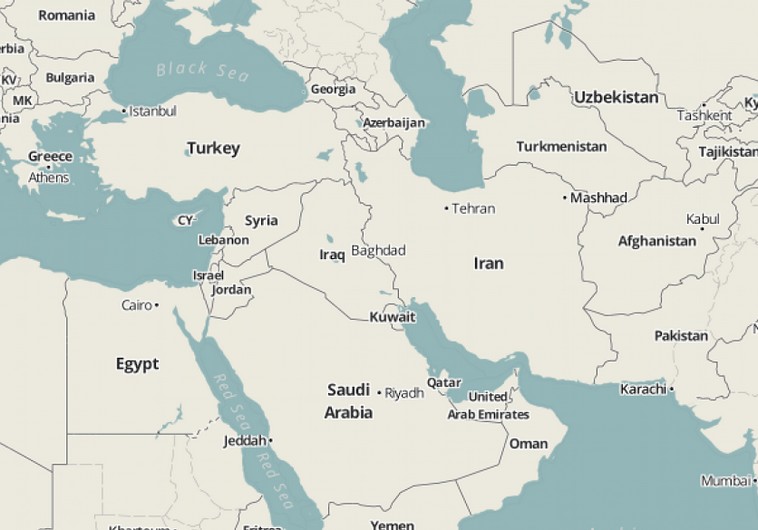
ShowImage (3)Map of Middle East. (photo credit:Courtesy)

It is through this Islamo-philic prism that the Obama administration’s attitude to, and execution of, its foreign policy must be evaluated – including its otherwise incomprehensible capitulation this week on Iran’s nuclear program.

********************

Obama is the first US president who genuinely conceives of Islam as not inherently opposed to American values or interests.

You’re absolutely right that John McCain has not talked about my Muslim faith – Barack Hussein Obama to ABC’s George Stephanopoulos, September 7, 2008

I also know that Islam has always been a part of America’s story Barack Hussein Obama, Cairo, June 4, 2009

Islam has always been part of AmericaBarack Hussein Obama, the White House, August 11, 2010

Islam has been woven into the fabric of our country since its founding Barack Hussein Obama, the White House, February 18, 2015

Barack Hussein Obama is the first US president who is explicitly and overtly unmoored, both cognitively and emotionally, from the moorings of America’s founding Judeo-Christian cultural heritage, and who genuinely conceives of Islam as not inherently opposed to American values or American interests.

A question of cultural affinity?

It is through this Islamo-philic prism that the Obama administration’s attitude to, and execution of, its foreign policy must be evaluated – including its otherwise incomprehensible capitulation this week on Iran’s nuclear program.

Almost two years ago, I wrote a column titled, “Will the West withstand the Obama presidency?” (11/28/2013). In it I warned: “For anyone who understands that the US Constitution is not a Shari’a-compliant document…

it should be alarmingly apparent that the Obama incumbency is a dramatic and disturbing point of inflection in the history of America and its Western allies… whose political practices and societal norms are rooted in Judeo-Christian foundations in a cultural rather than in any religious sense.”

There is little alternative explanation to account for the metamorphosis that has taken place in how the US has approached resolving the impasse with Tehran, as starkly laid out by two former secretaries of state, Henry Kissinger and George Shultz.

In a Wall Street Journal opinion piece, “The Iran Deal and Its Consequences” (April 7), they note that the negotiation has been turned “on its head.” As they point out: “For 20 years, three presidents of both major parties proclaimed that an Iranian nuclear weapon was contrary to American and global interests – and that they were prepared to use force to prevent it. Yet negotiations that began 12 years ago as an international effort to prevent an Iranian capability to develop a nuclear arsenal are ending with an agreement that concedes this very capability.”

Risible inspection mechanism

Even before the specifics of the risible inspection mechanism, which one Israeli minister aptly described as “worse than worthless,” Kissinger and Shultz laid out the difficulties that would render any extended inspection endeavor ineffective: “In a large country with multiple facilities and ample experience in nuclear concealment, violations will be inherently difficult to detect.”

With considerable prescience, they warn: “Devising theoretical models of inspection is one thing. Enforcing compliance, week after week, despite competing international crises and domestic distractions, is another. Any report of a violation is likely to prompt debate over its significance – or even calls for new talks with Tehran to explore the issue.

Envisaging the problems likely to arise in enforcing any agreement, they caution: “Compounding the difficulty is the unlikelihood that breakout will be a clear-cut event.

More likely it will occur… via the gradual accumulation of ambiguous evasions. When inevitable disagreements arise over the scope and intrusiveness of inspections, on what criteria are we prepared to insist and up to what point? If evidence is imperfect, who bears the burden of proof? What process will be followed to resolve the matter swiftly?”

Reminiscent of taqiya?

But even without the daunting generic difficulties described by Kissinger and Shultz, the inspection mechanism provided for in the nascent deal make a mockery of Obama’s contention (July 14): “… this deal is not built on trust; it is built on verification,” and, “Because of this deal, inspectors will also be able to access any suspicious location… [They] will have access where necessary, when necessary.”

One can hardly imagine a more grossly misleading representation of the deal – so much so that it is difficult not to find it strongly reminiscent of the Muslim tactic of taqiya (the religiously sanctioned deception of non-Muslims).

Indeed, immediately following the announcement of the agreement, Ben Rhodes, Obama’s deputy national security adviser, made a stunning admission to CNN’s Erin Burnett. Starkly contradicting the president’s contention of “access where necessary, when necessary,” Rhodes conceded, “We never sought in this negotiation the capacity for so-called anytime, anywhere,” which is diametrically opposed to the impression he conveyed in April this year when queried on this issue.

You couldn’t make this stuff up

For as it turns out, it provides the Iranians with ample warning of impending inspections on any suspected violation, and ample ability to forestall the definition of any given suspicious event as a possible violation.

Thus in the case of a suspected infringement in any undisclosed (to the international community) site, the Iranians will have at least 24 days’ notice. Moreover, inspectors will not be able to conduct surprise visits but will be required to “provide Iran the basis for such concerns and request clarification.” No kidding!!! But wait, there’s more.

If Iran’s explanations do not adequately assuage international concerns, inspectors “may request access to such locations” to make sure no illicit activity has occurred. But first they need to “provide Iran the reasons for access in writing and will make available relevant information.” You can’t make this stuff up.

But here’s the kicker: Should the Iranians and the inspectors prove unable to “reach satisfactory arrangements,” Tehran will resolve any concerns “through necessary means agreed between Iran and the IAEA.” If there is still no agreement two weeks after the initial inquiry is filed, the crisis will be resolved by vote in the so-called Joint Commission – consisting of the six world powers, a representative of EU and – wait for it – Iran.

Like warning drug dealers of a bust

Astonishingly, nearly all the decisions of the Joint Commission, tasked with overseeing/ administering the implementation of the deal, are to be made by consensus – which in effect gives Iran veto power over them. In the case of inspection access, it is sufficient for two of its eight members (say China and Russia) to abstain for Iran to block any decision it dislikes.

It is thus difficult to dispute Benjamin Netanyahu’s characterization of the deal during his address in the Knesset when he likened it to giving drug dealers notice of an impending raid: “It’s like giving a criminal organization that deals drugs a 24-day warning before inspecting its drug lab.”

But worse – the deal requires the international inspectors to expose the sources of intelligence that lead to the detection of the possible infringement – thereby virtually ensuring the termination of their effectiveness.

As Netanyahu remarked: “The agreement also requires the world powers to… show Iran the very intelligence for which they want to conduct the inspections in the first place.”

It is possible that all this could be nothing more than mind-boggling incompetence and blatant lack of foresight? Or are these glaring loopholes the reflection of intent.

Devil not in details

After all, the more you think about the unenforceable, unverifiable agreement just concocted in Vienna, the more implausible it seems. As Alan Dershowitz points out in a Jerusalem Post opinion piece this week, “The devil is not so much in the details as in the broad outlines of this deal.”

Rather than the detailed minutiae of the deal, it is its deeply flawed overall structure that makes it so difficult to comprehend – unless the motives for its conclusion are reexamined.

For unless one is imbued with the child-like naiveté to believe that the tyrannical clergy who head the totalitarian theocracy in Tehran, on seeing their defiant intransigence vindicated and having vast additional resources placed at their disposal, will suddenly change their worldview, the picture of emerging realities is decidedly bleak and bewildering.

The spectacle unfolding before us is almost incomprehensible by any rational criterion.

Virtually the entire developed world, led by the only superpower on the planet, has for all intents and purposes conceded a legitimized path to weaponized nuclear status for a fanatical fundamentalist regime, ideologically bent on the destruction of America and its allies, and a major proliferator of terrorism, committed to attaining regional hegemony at the expense of relatively pro-Western governments.

Despite dwarfing Iran in terms of military might, economic wealth, physical size and population, Tehran’s interlocutors have provided it with vast resources to enormously enhance its nefarious pursuits across the region and beyond.

The New Middle East: Conflicts on steroids

The ominous consequences are not difficult to foresee.

As Ariel Ben Solomon, the Post’s Middle East correspondent, wrote in a recent report, “Iran deal to see Middle East conflicts go on steroids,” “A stronger Iran will translate into a more robust Hezbollah in Lebanon, Houthi movement in Yemen, and Shi’ite forces in Iraq and Syria, and increasing sectarian strife fueled by Shi’ite minorities or Iranian agents throughout the Arab world.” (July 16) There is precious little reason for believing any other outcome is plausible.

In a July 15 interview, New Jersey Democrat Sen. Bob Menendez lamented another aspect of the deal, relating to easing restrictions on conventional weapons to Iran: “When you lift the arms embargo to a country that is the major sponsor of… terrorism in the world and is already destabilizing the region in Yemen, Lebanon, Syria [and] Iraq, to give them – after they are going to get $100 billion-150b. in economic relief – the opportunity to buy conventional weapons and improve their missile technology doesn’t seem to me to be in the national interest of the United States.”

The intriguing question is, of course, does this seem to President Obama to be in the national interest of the United States? And if so, why so? If so, how so?

‘No alternative’: A mindless mendacious mantra

The almost Pavlovian response of the apologists for the Iran deal is that its critics have not offered a feasible alternative. This is a claim – for want of a better word – so feeble that it barely merits a response.

As Sen. Menendez points out: “We never tested the proposition that dismantling elements of Iran’s illicit nuclear infrastructure was possible. It is pretty hard for me to believe that the world powers, sitting on one side of the table, the five permanent members of the Security Council plus Germany and the European Union looking at the Iranians… suffering under staggering sanctions… and falling oil prices couldn’t get a deal that eliminated some of that infrastructure.”

Rebutting John Kerry’s claim that such a goal was achievable only in “a world of fantasy,” Menendez retorted, “I don’t know that that is a ‘world of fantasy.’ Isn’t it possible with all the world on one side of the table, and Iran reeling with economic challenges, that you couldn’t have done better as relates to eliminating that nuclear infrastructure.”

Of course if the underlying assumption is that alternatives are only feasible if Iran deigns to accept them, then the apologists may be right. However, if the rationale were not to accommodate the ayatollahs, but to coerce them, the alternative is clear: Enhanced sanctions backed by the credible threat of military action aimed at destroying Iran’s nuclear facilities and their attendant infrastructure.

Arab arms race or Arab client states

But despite the overwhelming preponderance of power in their favor, the US and its Western allies seem to have forsworn the use of force, or even the credible specter thereof. As Kissinger and Shultz remark: “The threat of war now constrains the West more than Iran.”

This will clearly have a devastating impact on both friend and foe in the region.

It will destroy the confidence of US allies who will therefore be compelled to either acquire their own appropriate arsenals, as they can no longer rely on America for their security, or to become compliant client states of a hegemonic Iran.

For Iran it sends an equivocal message that it can violate the terms of the deal with impunity – for if what it encountered at Vienna is all the West can throw at it, what does it have to fear? There can be little doubt that what happened in Vienna this week has shredded America’s standing in the Middle East.

Some might even suspect that that was the purpose of the exercise.