Posted tagged ‘Arab nations’

Arab Foreign Ministers Discuss Blocking U.S. Embassy Move to Jerusalem

March 6, 2017

Arab Foreign Ministers Discuss Blocking U.S. Embassy Move to Jerusalem, BreitbartDeborah Danan, March 6, 2017

(There have been credible reports that, when PM Netanyahu met with President Trump, he asked Trump to delay his largely symbolic move of the American embassy to Jerusalem because an otherwise likely and more important agreement with the Arab nations on combatting Iran’s involvement in their spheres of influence could well be jeopardized. — DM)

JACK GUEZ/AFP/Getty Images

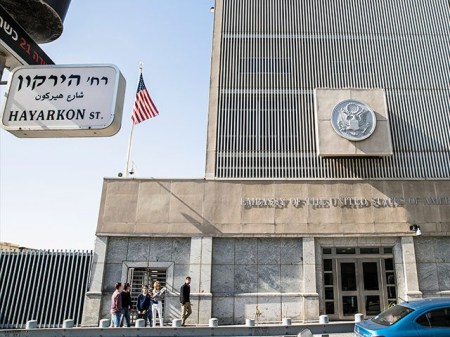
TEL AVIV – Ahead of the Arab League Summit later this month, foreign ministers of member states gathered in Cairo on Sunday and Monday to discuss how to prevent President Donald Trump from going through with his promise to move the embassy from Tel Aviv to Jerusalem, the Hebrew news site nrg reported.

The “Palestinian issue,” along with the embassy move to “occupied Jerusalem,” were among 28 items on the agenda, according to a press release from the Arab League’s Deputy Secretary-General Ahmed Bin Hali.

In January, the League’s Assistant Secretary-General for Palestinian Affairs Said Abu Ali urged Trump to “reconsider” the embassy move or else the U.S. will be in danger of losing its status “as an objective sponsor of the peace process.”

Bin Hali said that another item to be discussed by representatives of member states is the “Arab League’s plan to curb the proliferation of weapons of mass destruction in the Middle East.” He added that ahead of the summit in Jordan on March 23, the representatives will discuss the terrorism spreading in the Arab world, and the role of Turkey and Iran in regional conflicts.

Bin Hali also told reporters that Iran’s meddling in other states’ affairs must be stopped and that the member states of the Arab League must view this, as well as Tehran’s nuclear aspirations, as a shared interest. According to Bin Hali, the lack of a “unified stance” on the part of Arab world was its biggest problem.

He said that despite efforts to that end, “there are still Arab officials who remain divisive and who seek to provoke tension in relations between Arab states.”

“We are all in the same boat. We are all affected by the regional security issues and therefore we must work towards resolving our internal strife,” he added.

‘Abd Al-Rahman Al-Rashed: We Must Form ‘Arab NATO’ To Confront Iran

February 22, 2017

‘Abd Al-Rahman Al-Rashed: We Must Form ‘Arab NATO’ To Confront Iran, MEMRI, February 22, 2017

In February 2017, prominent Saudi journalist ‘Abd Al-Rahman Al-Rashed, the former editor of Al-Sharq Al-Awsat and former director of Alarabiya TV, published two articles calling to take a firm position vis-à-vis Iran and even form an “Arab NATO” to confront the alliance Iran has formed with Iraq and Syria.

The following are excerpts from the articles, as published in English by Al-Sharq Al-Awsat and Alarabiya, respectively:

alrashed‘Abd Al-Rahman Al-Rashed (image: alarabiya.net)

In one article,[1] Al-Rashed criticized the claim that U.S. President Donald Trump’s declarations against the Iran agreement strengthen the radicals there. He argued that Iran’s belligerence since the signing of the agreement proves that openness and flexibility towards it, like the policy pursued by Obama, only encourage it to escalate its aggression. He added that the radical camp in Iran has controlled the country since the Islamic Revolution, while the moderate camp is merely a front used to encourage the West to be lenient with Iran. Hence, policy towards Iran should be firm:

“Nothing happened during three decades to prove that there’s real competition between radicals and moderates inside the [Iranian] ruling command. Major events rather confirmed that the authority was in fact under the control of the radicals, while moderates were just front men. President Hassan Rouhani and his FM Zarif both represented the moderates and they succeeded [in] winning over the administration of former president Barack Obama. They also managed to convince the administration that lifting sanctions and encouraging Iran’s openness were [in] the interest of moderate figures, the region and the whole world.

“Once again, evidence suggested this assumption was wrong. [The] Iranian leadership became more aggressive than ever and for the first time since the establishment of the Islamic Republic, the regime dared to expand its military activity outside its borders. It is currently participating in and funding four wars outside of Iran. All of this was possible due to the nuclear deal that paved the way for better relations, trade and activity and kept silent over Iran’s threats to the region.

“Trump’s extremist rhetoric is a natural outcome of the disappointment [that] prevailed [in] Washington due to Iran’s behavior after signing the deal. Things will keep on getting worse unless a strict international position against Iran’s adventures is taken and unless Iran is forced to end the chaos it is funding in the region and the world.

“Those familiar with the Iranian regime’s [actions] cannot believe the excuses being made by Iran’s allies which stipulate that being lenient with Iran [may cause it to have a] positive [attitude to] the rest of the world. The nature of the regime in Tehran is religious with a revolutionary ideology. It has a political agenda that has not changed much since it attacked the American embassy in Tehran and held diplomats hostage [in 1979]. The same logic leads us to conclude that Iran will dominate [by] using power via its proxies and militias across the region and [by] encouraging and supporting the rebellious behavior of certain local parties in neighboring countries.

“Iran has not changed much since it announced it plans to export revolutions to the world. The only change that happened is that its financial and military situations improved a lot thanks to the nuclear deal it signed with the West.”

In another article,[2] Al-Rashed wrote that Iran has exploited the political vacuum that formed in the region in recent years, as well as the Obama administration’s policy, including the nuclear agreement with it, to expand its influence in Iraq, Syria and Yemen. In light of this, he advised: “Military cooperation, under any umbrella, is a good idea and a necessary step, especially if expanded beyond [military cooperation]. Establishing an alliance to confront Iran is an essential balance to respond to its military alliance that includes Iraq and Syria.

“Iran also cooperates with Russia and the latter has a military base in Iran. The Russians strongly participate in the war in Syria alongside this Iranian alliance. Tehran has strengthened its alliance by bringing armed militias from Pakistan, Iraq, Lebanon and other countries into Syria and they are fighting there under its banner. Iranian forces, in the guise of ‘experts,’ are fighting in Iraq and to some extent manage the conflict there. Therefore, establishing an Arab NATO… remains a natural reaction to Iran’s ‘Warsaw Pact.'”


[1] For the Arabic version of this article see: Al-Sharq Al-Awsat (London), February 12, 2017; for the English version see: english.aawsat.com, February 13, 2017. The English text has been lightly edited for clarity.

[2] For the Arabic version of the article see: -Sharq Al-Awsat (London), February 20, 2017; for the English version see: alarabiya.net, February 21, 2017. The English text has been lightly edited for clarity.

An empty condemnation

February 9, 2017

An empty condemnation, Israel Hayom, Dr. Ephraim Herrera, February 9, 2017

It appears that the Judea and Samaria Settlement Regulation Law is not of paramount interest to the Muslim world. But make no mistake, that has nothing to do with any great love for Israel there. The Sunni Arab world, currently embroiled in a bloody war with the Shiite world led by Iran and its proxies — Syria, under President Bashar Assad and Hezbollah — is well aware of the unofficial alliance with Israel.

Israel has been providing Jordan and Egypt with intelligence to aid their fight against the Islamic State group, and according to unofficial sources, the Israeli military is also helping Cairo battle the Islamic State’s affiliate in Sinai. Reuters recently reported that Jordan, too, was receiving Israeli help in its fight against the Islamic State and other Islamist insurgents on its borders.

***********************

Turkey, Egypt, Jordan and the Arab League as a whole condemned the Judea and Samaria Settlement Regulation Law passed by the Knesset on Monday. Arab League Secretary General Ahmed Aboul-Gheit described the law as cover for stealing Palestinian land. A Jordanian minister warned it would cause an escalation in violence and undermine any chance of a two-state solution. Turkey lambasted the law, claiming it gave “approval to the construction of settlements on the private property of the Palestinians.” It would appear that the law poses a threat to regional stability, but is that really the case?

Turkish Tourism Minister Nabi Avci voiced his country’s opposition to the legislation during a visit to Israel, but as expected, he was not recalled to Turkey. Nor was the Israeli ambassador to Turkey summoned for clarification nor did the Turkish denunciation make headlines in Turkish news outlets.

The same thing took place in other Arab countries. Egyptian Foreign Minister Sameh Shoukry slammed the law, but there was no mention of it on the home page of the website of the state-owned Al-Ahram newspaper or on the home page of the popular Egyptian website Al-Youm al-Sabia.

The London-based Asharq Al-Awsat, which is funded by the Saudi royal family, focused on the response from Yasser Abed Rabbo, a senior aide to Palestinian Authority President Mahmoud Abbas, who said that though the Palestinians were losing their lands, they would not petition international courts out of fear of reprisals from the U.S. and Israel. Even the Qatari-owned Al Jazeera, one of the largest Arabic news organizations, did not cover the new law on the home page of its website.

It appears that the Judea and Samaria Settlement Regulation Law is not of paramount interest to the Muslim world. But make no mistake, that has nothing to do with any great love for Israel there. The Sunni Arab world, currently embroiled in a bloody war with the Shiite world led by Iran and its proxies — Syria, under President Bashar Assad and Hezbollah — is well aware of the unofficial alliance with Israel.

Israel has been providing Jordan and Egypt with intelligence to aid their fight against the Islamic State group, and according to unofficial sources, the Israeli military is also helping Cairo battle the Islamic State’s affiliate in Sinai. Reuters recently reported that Jordan, too, was receiving Israeli help in its fight against the Islamic State and other Islamist insurgents on its borders.

Furthermore, news of economic ties between Saudi Arabia and Israel have recently begun to surface. The Saudi kingdom fears the growing power of its Persian neighbor and is well aware that Israel could potentially become play an important role in its defense. So it’s no wonder that there have been no reports of protests in Muslim countries against the settlement regulation law.

Productive cooperation between Israel and Muslim nations, open or clandestine, is the best remedy for the 1,000-year-old Islamic hatred of Jews, which has depicted them as pigs, monkeys, and the lowest and most evil of creatures after the devil himself. That same radical Islam has become a threat to the Muslim countries, Egypt, Jordan and Lebanon, as it views borders between Muslim countries as heresy against Islamic law.

Yes, it is radical Islam that has been raging in Syria, Iraq and Libya, inciting the death of hundreds of thousands of people and the displacement of millions more. It has brought devastation, famine, poverty, torture and the exile of millions of Muslims who are attempting to escape the Islamic inferno.

The European countries who were quick to condemn the Israeli law have turned a blind eye to the Syrian genocide and the only apartheid regime in the region — which is perpetrated by the Palestinians, who forbid Jews from living in areas under their control. These days it is no wonder that the European countries are paying the price for their ineffectuality in dealing with Islamist movements in the form of the swarms of the Muslim refugees amassing in their streets.

On Boycotting Radical Islamic Nations

January 31, 2017

On Boycotting Radical Islamic Nations, Gatestone InstitueNonie Darwish, January 31, 2017

The interviewer seemed shocked to hear that I do not have any Arab or Muslim friends who are protesting President Trump’s ban, and that many immigrants of Islamic origin support the ban and are fed up and embarrassed by what jihadists are doing.

The lesson America needs to know is that the West is not doing Muslims a favor by constantly treating them as children who should be shielded from reality. They hungry for the truth: that their educational system and mosque preaching are full of incitement, are abhorrent, hate-filled and the foundation upon which violent jihad is built.

Muslims need to know that the world does indeed have a justifiable and legitimate concern about Islam and actions done in the name of Islam by Muslims.

Muslims need to look at themselves in the mirror and see the world from the point of view of their victims. Instead, the West is sacrificing its culture, values, laws, pride and even self-respect.

It might compassion that leads the West to take in millions of Muslim refugees but it is reckless compassion. Do Westerners question the motivation of Islamic theocracies as to why ultra-rich Arab nations are sending us their refugees but taking in none?

Some “tough love” is urgently needed if Muslims are to be motivated to change and reform.

Early this morning an Arabic radio station in the Middle East called asking my opinion about President Trump’s ban on refugees and citizens of seven Muslim nations. The radio host, who sounded angry over the ban, was a Christian Arab. She was surprised to hear that I supported the ban and think that it should have taken place the day after 9/11.

She then asked me if I knew any Arab American activist who was against the ban because she wanted to interview someone against the ban. She seemed shocked to hear that I do not have any Arab or Muslim friends who are protesting the ban, and that many immigrants of Islamic and Middle East origin support the ban and are fed up and embarrassed by what jihadists are doing.

She said that all she sees on CNN and other channels are riots that portray almost all Americans supporting Muslims and against Trump. I am upset over the success of the leftist propaganda all over the Middle East. It brings back memories of the life of the hate indoctrination and misinformation I lived under for most of my life.

What would Muslim countries do to the West, I asked, if 19 American terrorists flew airplanes into Arab capitals and their government and military headquarters? What did she think Arabs would do if every week or so American terrorists would conduct synchronized killing sprees all over the Muslim world, gunning Muslims down, blowing them up with homemade pressure cookers, ramming into crowds with trucks? There was silence.

She then started calming down and said that of course she is against terrorism, “but”. I asked: “Do you see what jihad did to your Christian community in the Middle East?” She was silent for a minute, then it occurred to me that she might be afraid to continue the conversation because her bosses were probably Muslims.

I was sure she was going to hang up on me, but to my surprise she asked me to please hold. Then she was back, live from the studio, and started interviewing me and asked the same questions on air. I poured my heart out in Arabic to the Arab listeners.

The lesson here is that Arabs are hungry to hear the truth; this Arab station, instead of rejecting these ideas, ended up putting them on air. The lesson America needs to learn is that the West is not doing Muslims (especially the reformists) a favor by constantly treating them as children who should be shielded from reality.

Muslims need to know that the world does indeed have a justifiable and legitimate concern about Islam and actions done in the name of Islam by Muslims. Muslims need to look at themselves in the mirror and see the world from the point of view of their victims. Instead, the West is sacrificing its culture, values, laws, pride and even self-respect. Muslim culture needs a wake-up call telling them that, sooner or later, non-Muslim nations will close their doors to any kind of Muslim immigration if the jihad culture continues. That will also be a strong message to Muslims already in the West who still believe in jihad.

2256President Donald Trump signs an executive order restricting immigration, January 27, 2017. (Image source: Reuters video screenshot)

The Muslim people are hungry for the truth: that their educational system and mosque preaching are full of incitement, abhorrent, hate-filled and the foundation upon which violent jihad is built. The Islamic commandment to do jihad sacrifices Muslim men, women and children to kill and get killed.

As long as the West continues its appeasement of Islamic jihad, Islam will never reform and the West will lose. So far, the West has continued to extend a lifeline to the religion of Islam; a religion for which the number one enemy is the truth, and which struggles to suppress the truth.

It might be compassion that leads the West to take in millions of Muslim refugees, but it is reckless compassion. Why isn’t Saudi Arabia taking refugees temporarily until things settle down in Syria and Iraq? Do Westerners question the motivation of Islamic theocracies, as to why ultra-rich Arab nations are sending us their refugees but taking in none?

Who is really benefiting from the policy of appeasement, the acceptance of Sharia-stricken theocracies and their jihadist, hate-filled education? Some “tough love” is urgently needed if Muslims are to be motivated to change and reform.

Saudi Journalist to Palestinians: Armed Resistance to Israel is Futile, Arab World Has Lost Interest in Your Cause

January 28, 2017

Saudi Journalist to Palestinians: Armed Resistance to Israel is Futile, Arab World Has Lost Interest in Your Cause, AlgemeinerBarney Breen-Portnoy, January 26, 2017

hamas-2Hamas fighters. Photo: Wikimedia Commons.

The Palestinian cause is “no longer a top priority” for the Arab world, a Saudi journalist declared earlier this month.

In an article published by the Saudi daily Al Jazirahnewspaper — and translated by the Middle East Media Research Institute (MEMRI) — Muhammad Aal Al-Sheikh wrote that the reliance of radical Palestinian groups on armed resistance “constitutes a kind of political suicide that only political ignoramuses [can] condone.”

According to Al-Sheikh, a two-state solution to the Israeli-Palestinian conflict is the sole option “that can be demanded and which enjoys the support of most of the international community.”

What the Palestinians, Al-Sheikh went on to say, “need to understand is that the Arabs of today are not the Arabs of yesterday, and that the Palestinian cause has lost ground among Arabs. This cause is no longer a top priority for them, because civil wars are literally pulverizing four Arab countries, and because fighting the ‘Islamic’ terrorism is the foremost concern that causes all Arabs, without exception, to lose sleep. It is folly to ask someone to sacrifice [tending to] his own problems and national interests in order to help [you solve] your own problems.”

“All I can say to my Palestinian brethren is that stubbornness, contrariness, and betting on the [support of] the Arab masses are a hopeless effort, and that ultimately you are the only ones who will pay the price of this stubbornness and contrariness,” he concluded.

In recent years, Israel has been quietly developing ties with the Sunni-Arab axis in the Middle East – including Saudi Arabia. In his September address to the UN General Assembly, Israeli Prime Minister Benjamin Netanyahu said that in addition to Egypt and Jordan, which already have signed peace treaties with the Jewish state, “Many other states in the region recognize that Israel is not their enemy. They recognize that Israel is their ally. Our common enemies are ISIS and Iran. Our common goals are security, prosperity and peace. I believe that in the years ahead we will work together to achieve these goals.”

The factors of a U.S. embassy in Jerusalem

January 18, 2017

The factors of a U.S. embassy in Jerusalem, Center for Security PolicyJacub Gorski, January 17, 2017

President-elect Trump’s recently announced plans to have the incoming U.S. ambassador to Israel live in Jerusalem. The Jerusalem Embassy Act of 1995 already recognizes Jerusalem as the capital of Israel and instructs the executive branch to move the embassy or file a national security waiver. With the U.S ambassador to Israel living in Jerusalem what would be the implications for the region if the U.S. moved its embassy to the city as well?

Critics warn that moving the embassy to Jerusalem will spark international protests and cause more instability in the region. Secretary John Kerry warned that “you would have an explosion, an absolute explosion” in the Middle East. The head of the Palestinian Authority (PA) Mahmoud Abbas in a letter to Trump wrote that moving the embassy will “have destructive consequences on the peace process, the two state solution and the safety and security of the region.”

By “explosion” Secretary Kerry probably means an increase in the frequency and strength of Islamic terrorist attacks on the Israelis, Arab states cutting off relations with the U.S. and Israel, or Israel’s neighbors declaring war on the country.

Israel suffered Hamas rocket attacks in the past and is currently undergoing a wave of terror perpetrated by Palestinians. It is the stated goal of the Palestinian terrorists to attack Israel. In its charter Hamas promises to wage jihad against the country and the Israeli Defense Minister suspects that the organization is trying to develop new offensive capabilities in order to do so. So Israel will probably continue to see a spike in terrorist attacks regardless of whether the U.S. moves its embassy to Jerusalem.

Arab states will likely issue condemnations if the U.S. moves its embassy, but they would not cut off ties with America or Israel. Middle Eastern regimes need U.S. help in fighting ISIS and finance their own military operations. Given Arab dependence on U.S. aid it is unlikely they would want to jeopardize their relations with Washington over an embassy.

There is no fear of Arab economic boycotts because Israel’s neighbors have maintainedsanctions on the country for decades.

Also, given Israel’s success in the Six Day and Yom Kippur Wars and the subsequent military strength the Arab states are unlikely to ever declare war on the country.

Israel’s neighbors need its help in countering the growing Iranian influence in the region. With Iran and Hezbollah giving military aid to the Assad regime, Israel’s Sunni neighbors might want to consider possible cooperation with Tel-Aviv. In a move that might signal cooperation, the former intelligence chiefs of Saudi Arabia and Israel held a public meeting. If the Arabs want Israeli help then they are unlikely to jeopardize their already fragile relations over the U.S. embassy.

Despite Abbas’ warnings, moving the U.S. embassy to Jerusalem could make the peace process easier. It would send a clear message to the PA that the U.S. considers Jerusalem to be part of Israel. Instead of having our embassy located in Jerusalem U.S. issue waivers that have delayed the move. To the PA this probably looks like America wavering in its support to Israel because the U.S. is failing to keep up its promise. Moving the embassy will send a message that Washington keeps its promises and does not waiver in support of its allies.

Resistance Axis Opponents Enraged At Photos Of Qods Force Commander Qassem Soleimani In Aleppo: The Photos Are Proof Of Iranian Expansion In Syria, Are Reminiscent Of Nazi Generals Strolling Through Cities They Destroyed

January 5, 2017

Resistance Axis Opponents Enraged At Photos Of Qods Force Commander Qassem Soleimani In Aleppo: The Photos Are Proof Of Iranian Expansion In Syria, Are Reminiscent Of Nazi Generals Strolling Through Cities They Destroyed, MEMRI, January 4, 2017

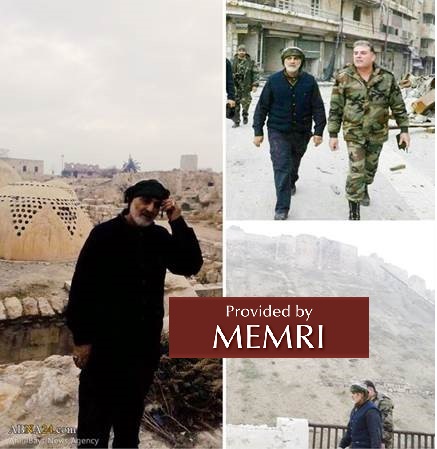
Several days after the Syrian regime and its allies retook eastern Aleppo, one of the Syrian opposition’s main remaining strongholds, with siege and heavy bombardment, the Iranian press published photos of Qassem Soleimani, the commander of Iran’s Qods Force, which is part of the Islamic Revolutionary Guard Corps (IRGC), as he toured the ruined city, including the medieval citadel at its center.

The photos enraged opponents of the resistance axis, which is headed by Iran and the Syrian regime. They perceived the photos as proof that Aleppo is now occupied by Iran and a signal that Iran is also aiming to occupy other cities in Arab countries, particularly in the Gulf. Articles in the Arab press, especially in the Gulf, called Soleimani a “modern-day Hitler,” and argued that the world is not stopping him, just as it had not stopped Hitler and other mass murderers in modern history.

6728aSoleimani tours Aleppo (Qasemsoleimani.ir, December 16, 2016)

Following are excerpts from major reactions in the Arab press to the photos of Soleimani in Aleppo:

Iran Is Signaling Its Intent To Occupy More Cities In The Middle East

Hamad Al-Majed, a Saudi columnist for the London-based daily Al-Sharq Al-Awsat, wrote: “The well-known photo of the Gen. Qassem Soleimani arrogantly walking the empty streets of Aleppo that his forces destroyed and whose residents they killed and expelled… is a massive propaganda message that Iran has leaked to the media, and holds within it thousands [more] messages. It is as if Soleimani, a military peacock arrogant over his victories, is muttering: ‘Yesterday we liberated Baghdad and the other Iraqi cities, and after that Sana’a [in Yemen], and after that we took over Beirut [in Lebanon], and today we are liberating Aleppo. It is only a matter of time before [we] dismantle the other cities in Syria, and then, sooner or later, you will see me strolling through the rubble of other Arab cities in the Middle East…”[1]

‘Ali Al-Husseini, a columnist for the Lebanese daily Al-Mustaqbal, which is affiliated with pro-Saudi and anti-Assad elements in Lebanon, wrote: “Two days ago, the Iranian expansion plan was revealed, [which has now] reached Aleppo after [reaching the Syrian cities of] Al-Qusayr, Al-Zabadani, and Madaya, [occupied by Hizbullah]. [What revealed this plan was] IRGC [Qods Force] commander Qassem Soleimani, who emerged strolling the neighborhoods of Aleppo that reek of destruction, witnessed the killing of children, and are littered with the bodies of dead residents. There is no doubt that this was a painful picture for residents of the city…

“With the aid and assistance of [Afghani, Pakistani, and Iraqi] mercenaries, Soleimani yesterday stepped on the body parts and in the blood of Aleppo residents, and also on the emotions of its orphaned children. This photo birthed, in their souls, a desire for vengeance, and a dream to return [to Aleppo] with fire in their eyes…”[2]

Arabs Should Awaken And Act – Because Iran Poses A Danger To The Gulf States

Saleh Al-Sheikhi, a columnist for the Saudi daily Al-Watan, called on Arabs to awaken and act, in light of what is perceived as an Iranian takeover of yet another Arab city. He wrote: “Two days ago, I stood for nearly an hour, no less, looking at the photo of Iranian commander Qassem Soleimani strolling through the streets of Aleppo – which are no longer streets but ruins and piles of rubble. I struggled, no less, to put out of my mind my visions of Soleimani’s false dreams about strolling through cities in the Gulf [countries]… I searched out society’s reaction to this shocking photo, and what I found was sad: [Instead of reactions to this photo, I found reactions to] Sheikh ‘Abdallah Al-Suwailem, [who,] with all the esteem in which I hold him and his colleagues, has launched an argument that is out of place, with his statement that a sexual relationship between family members who are prohibited from marrying each other is less [grave] than abandoning [the commandment] of prayer. This [statement of his] opinion triggered thousands of debates, tweets, recriminations, gossip, and widespread debates that preoccupied the public.

“Qassem Soleimani is strolling through Syria with his eye on the other Arab capitals – while Sheikh ‘Abdallah Al-Suwailem is arguing with the public on the issue of abandoning morning prayers and sexual relations between relatives who may not marry! If we do not act now and feel our important national responsibility, then when will we act?”[3]

Soleimani Is A “Modern-Day Hitler”; The World Is Not Stopping Him – Just As It Did Not Stop Hitler At The Time

Some resistance axis opponents called Soleimani a “modern-day Hitler,” and argued that the world is not acting to help the Syrian people, just as it did not act to help victims of other massacres throughout modern history. Lebanese MP Muhammad Kabbara, of the Al-Mustaqbal party, stated: “History will show that what happened in Aleppo has surpassed the myths of the Nazi crematoria. The coming generations will never forget that the Persians, Russians, and the Assad regime were the ones who conducted massacres in Aleppo. They will never forget the sight of the modern-day Hitler, Qassem Soleimani, touring, and gloating over, the ill-fated neighborhoods of Aleppo in the company of an officer from Assad’s [army].”[4]

Amr Hamzawy, a former Egyptian MP and a columnist for the London-based daily Al-Quds Al-Arabi, wondered: “Why does the world leave the Syrian people on its own to be massacred by the dictator Bashar Al-Assad, and by Russia and Iran, which sponsor him? Because our evil world only knows how to massacre the weak while turning them into the perpetual victims of criminals and tyrants…

“Any serious action to save Syrians from slaughter would be contrary to the norm in our world, [which kept silent in light of] the massacres of Armenians and Jews in Europe; the extermination of 27 million in the former Soviet Union during WWII, [and] the dropping of two atomic bombs on Japan on the pretext of ending World War II… Any true effort by those who monopolize the industries of weapons, killing, and bloodshed to stop the Syrian massacre would be a bizarre deviation from their past policy and conduct.

“In the late 1930s, didn’t the governments of Britain, France, and the Soviet Union make it possible for the Nazis to spread murder and destruction across several parts of Eastern Europe to avoid a fight, and out of concern for their own interests? Didn’t Hitler emerge due to global disregard for his first crimes, and [didn’t] U.S. neutrality cause him to carry out further attacks and crimes?… Don’t the photos of Nazi generals in areas destroyed by their weapons in Soviet cities… remind you of the photos of Soleimani in Aleppo a few days ago?…”[5]


Endnotes:


[1] Al-Sharq Al-Awsat (London), December 20, 2016.

[2] Al-Mustaqbal (Lebanon), December 18, 2016.

[3] Al-Watan (Saudi Arabia), December 19, 2016.

[4] Al-Mustaqbal (Lebanon), December 18, 2016.

[5] Al-Quds Al-Arabi (London), December 20, 2016.

The issue is Israel’s existence

December 28, 2016

The issue is Israel’s existence, Israel Hayom, Dr. Ephraim Herrera, December 27, 2016

The current phase is no less dangerous: diplomatic, legal and public relations warfare against Israel — a variety of initiatives aiming to present it as an immoral, apartheid, “illegal” country that must be denounced. Lest we delude ourselves: The goal of the public diplomacy war is the collapse of the Jewish state. International pressure demanding that Israel return  to the June 4, 1967, borders is understood as the first stage, not the last. PA President Mahmoud Abbas has consistently declared that he will never recognize the State of Israel as the state of the Jewish people. And that he will never surrender the right of return for Palestinian refugees.

******************************

The U.N. resolution on Israeli settlements is perceived throughout the entire Muslim world as a giant victory and a historic achievement for the rights of Palestinians. Indeed, the resolution, which “will not recognize any changes to the 4 June 1967 lines, including with regard to Jerusalem, other than those agreed by the parties through negotiations,” renders negotiations pointless because the international community rejects outright any Israeli legitimacy over any land beyond the lines drawn before the Six-Day War. In other words: Israel must withdraw from the Jewish Quarter, from Jerusalem’s new neighborhoods and from all of Judea and Samaria.

The common denominator in the Palestinian reaction — whether Fatah, Hamas or Islamic Jihad — is that this victory has to be leveraged, with vigor. A Palestinian Authority spokesman said actions must be taken to isolate Israel in the international arena, and called on the international community to take the necessary steps to implement the resolution ratified by the United Nations. The PA foreign minister called for actions that would put an end to the “Judaization” of Judea and Samaria. Other mouthpieces noted the need for legal action against Israelis for war crimes.

From the onset of Israel’s creation, the Muslim world without exception has sought to exterminate the Zionist entity. Its initial efforts focused on classical armed conflict: from the War of Independence to the Lebanon War, the enemies’ armies suffered staggering defeats, even if exacting from us a painful price. From the mid-1980s, the Muslim world shifted to a different strategy: intifadas. Here, too, Israel paid a heavy price, but was able to withstand the threat. For years now, calls for another intifada in Judea and Samaria and among Israeli Arabs have fallen on deaf ears. The third wave of terrorism, which is still ongoing, has introduced a new method of resistance: lone-wolf attackers, armed with knives or behind the wheel of a careening vehicle, seeking to terrorize the civilian population. However, a series of measures implemented by Israel’s security forces, alongside quick and effective action by civilians at the scene of attacks, have suppressed the phenomenon significantly.

The current phase is no less dangerous: diplomatic, legal and public relations warfare against Israel — a variety of initiatives aiming to present it as an immoral, apartheid, “illegal” country that must be denounced. Lest we delude ourselves: The goal of the public diplomacy war is the collapse of the Jewish state. International pressure demanding that Israel return to the June 4, 1967, borders is understood as the first stage, not the last. PA President Mahmoud Abbas has consistently declared that he will never recognize the State of Israel as the state of the Jewish people. And that he will never surrender the right of return for Palestinian refugees.

The heated argument between the Israeli Left and Right overlooks the essence of the problem: The issue is not the territories but the very existence of the State of Israel. It is imperative that Israel find effective ways to counter this new type of warfare, which is no less an existential threat than classic wars, intifadas and knives.

Palestinians: The ‘Wall of Shame’

November 28, 2016

Palestinians: The ‘Wall of Shame’, Gatestone InstituteKhaled Abu Toameh, November 28, 2016

“The equation facing the Palestinian factions is clear: Hand over the terrorists and there will be no wall. The Palestinians have proven that they are unable to take security matters into their own hands in this camp.” — Lebanese security official.

These anti-Palestinian practices are regularly ignored by the international community, including mainstream media and human rights organizations, whose obsession with Israel blinds them to Arab injustice. A story without an anti-Israel angle is not a story, as far as they are concerned

Typically, Western journalists and human rights activists do not even bother to report or document cases of Arab mistreatment of Arabs. This abandonment of professional standards is why apartheid laws targeting Palestinians in several Arab countries are still unknown to the international community.

The Lebanese authorities also say that they decided to build the wall after discovering several tunnels in the vicinity of Ain al-Hilweh, used to smuggle weapons and terrorists into and out of the camp.

The new wall will not solve the real problem — namely the failure to absorb the refugees and grant them citizenship. Palestinians living in Arab countries are denied citizenship (with the exception of Jordan) and a host of basic rights.

Now is the time for the international community to apply pressure to the Arab countries to start helping their Palestinian brothers by improving their living conditions and incorporating them into these countries.

The refugee problem will end the day their leaders stop lying to them and confront them with the truth, basically that there will be no “right of return” and that the time has come for them to move on with their lives


It is no secret that Arab countries have long mistreated their Palestinian brothers and sisters, governing them with inhumane laws and imposing severe restrictions on their public freedoms and basic rights. Building a wall around a Palestinian community to prevent terrorists from entering or leaving, however, has raised the bar on such infringements.

This is precisely what is happening in Lebanon these days. The construction of a security wall around Ain al-Hilweh, the largest Palestinian refugee camp (with a population of nearly 120,000), has drawn sharp criticism from Palestinians and revived memories of the abuse they regularly receive at the hands of their Arab brethren.

The Lebanese authorities say the Palestinians have left them no choice but to build the controversial concrete wall. The Palestinians, they say, refuse to cooperate against terrorists who have established bases within their camps. Yet that problem raises the question: “What has Lebanon done in the past half-century or so to help the Palestinians who fled to that country?” The answer: “Nothing.”

In fact, among all Arab countries, Lebanon has been arguably the worst in its treatment of the Palestinians. Palestinian refugees in Lebanon are denied access to adequate housing and certain categories of employment. According to Amnesty International: “Over half of Palestinian refugees live in decaying and chronically overcrowded camps and discriminatory practices are permitted under personal status laws and nationality laws.”

These anti-Palestinian practices are regularly ignored by the international community, including the mainstream media and human rights organizations, whose obsession with Israel blinds them to Arab injustice. While, every now and then, an organization does publish a report on the misery endured by Palestinians in Arab countries, these bodies rarely follow up on their work, thus creating the impression that they are doing so only for the sake of protocol.

As such, the plight of the Palestinians in many Arab countries continues to be a taboo, as far as the international community is concerned. Typically, Western journalists and human rights activists do not even bother to report or document cases of Arab mistreatment of Arabs. This abandonment of professional standards is why apartheid laws targeting Palestinians in several Arab countries are still unknown to the international community. Even when Western journalists and human rights advocates do hear about these violations, they prefer to look the other way. A story without an anti-Israel angle is not a story, as far as they are concerned.

So what is going on in Lebanon, and why are so many Palestinians furious with the Lebanese authorities?

Until a few years ago, the population of Ain al-Hilweh camp was 70,000. But the influx of refugees fleeing the civil war in Syria, since 2011, has increased the camp population to nearly 120,000. It turns out that many of these new “refugees” are actually terrorists fleeing from Syria and Iraq.

2077A street celebration in Lebanon’s Ain al-Hilweh camp, July 2015. (Image source: Geneva Call/Flickr)

Ain al-Hilweh, like most of the camps in Lebanon, has always been a major headache for the Lebanon. It seems, however, that the Lebanese government has had enough.

For years, the Lebanese authorities, for whom the camp is “off-limits,” have been trying, unsuccessfully, to clean the camp of its hundreds of terrorists.

Lebanese security forces steer clear of the refugee camps in an attempt to avoid friction with the Palestinians living there. This evasion has allowed the camps to become hotbeds for various jihadi groups and terrorists who pose a threat not only to the national security of Lebanon, but to Palestinians themselves and neighboring Arab countries such as Jordan, Egypt and Syria (not to mention Israel).

Alarmed by this heightened threat, the Lebanese authorities recently began building a concrete wall around Ain al-Hilweh, sparking a wave of denunciations from Palestinians. The Palestinians claim that the new wall, which will be completed in 15 months, will turn the camp into a big open-air prison. They refer to it as the “Wall of Shame.” Their main argument is that it is disgraceful that any Arab country would build a wall surrounding a refugee camp at a time when Palestinians are asking the world to condemn Israel for building a security fence to prevent terror attacks against Israelis from the West Bank.

Camp residents claim that the Lebanese authorities have misled them concerning the construction of the wall. According to the residents, the authorities led them to believe that it was to be a small fence on the outskirts of parts of the camp and not a massive concrete wall surrounding the camp.

The Lebanese security authorities have chosen to call the new barrier the “Wall of Protection” — stressing that it is mainly intended to prevent terror attacks against Lebanon and stop the camps from becoming bases for terrorists and criminals. The authorities say that if anyone is to blame for the construction of the wall, it is the Palestinians themselves, who have refused to cooperate with the Lebanese government against the terrorists. “The goal is to prevent terrorists from infiltrating the camp,” explained a Lebanese security official. “The equation facing the Palestinian factions is clear: Hand over the terrorists and there will be no wall. The Palestinians have proven that they are unable to take security matters into their own hands in this camp.”

The Lebanese authorities also say that they decided to build the wall after discovering several smuggling tunnels in the vicinity of Ain al-Hilweh. These tunnels, they say, are being used to smuggle weapons and terrorists into and out of the camp.

Representatives of Ain al-Hilweh and other Palestinians have been holding marathon meetings with Lebanese government officials in the past few weeks to persuade them to halt the construction of the wall. The Palestinians in Ain al-Hilweh are now threatening that if the Lebanese government does not cancel the project, they will seek the intervention of other Arab, and also Western, countries, as well as the United Nations.

Notably, the Palestinian Authority (PA) leadership in the West Bank has not joined in the efforts to persuade the Lebanese government to drop the idea of building a wall around the camp. This avoidance probably springs from the PA leadership and its president, Mahmoud Abbas, being well aware that Ain al-Hilweh and other refugee camps in Lebanon have fallen into the hands of their enemies, namely Hamas, Islamic Jihad, Islamic State and Al-Qaeda.

The “Wall of Shame” appears particularly to bother Hamas leader Khaled Mashaal. Last week, he telephoned a number of Lebanese officials, including Prime Minister Tammam Salam and Parliament Speaker Nabih Berri, to warn about the consequences of the construction of the wall. Mashaal, who is based in Qatar and enjoys a luxurious life most Palestinians can barely dream of, urged the Lebanese government to halt construction if the wall and said that the wall jeopardized the lives of Palestinian refugees and would have “negative repercussions.”

Hamas’s spokesman in Lebanon, Ra’fat Murra, dismissed Lebanon’s security concerns for building the wall. He warned that the wall would turn the camp into an isolated enclave and exacerbate tensions between Palestinians and Lebanese. Murra, however, expressed readiness to cooperate with the Lebanese authorities in apprehending and handing over wanted terrorists who had found shelter inside Ain al-Hilweh.

Protests against the wall reached their peak when hundreds of Palestinians (and some Lebanese) took to the streets of the nearby city Sidon, in southern Lebanon, calling on the government to stop construction immediately. The protesters warned that the wall would further increase tensions between Palestinians and Lebanese, and further reduce the quality of life for the camp residents.

Lebanon may be justified in building a security wall around the Palestinian refugee camp. Without a doubt, Ain al-Hilweh and other camps have become hubs for terror groups and criminals, and Lebanon has every right to combat terrorism. Yet, Lebanon needs to come up with ways to assimilate, rather than alienate, the Palestinians. Furthermore, this is a problem that extends beyond Lebanon’s borders. The same applies to the camps in the West Bank, Gaza Strip and Syria and Jordan.

The continued mistreatment of Palestinians at the hands of Lebanon and other Arab countries is totally unjustified. The new wall, complete with watchtowers, that is being erected around Ain al-Hilweh may stop some terrorists from infiltrating the camp, but it will not solve the real problem — namely the failure to absorb the refugees and grant them citizenship. In point of fact, Palestinians living in Arab countries are denied citizenship (with the exception of Jordan) and a host of basic rights.

Now is the time for the international community to apply pressure to the Arab countries to start helping their Palestinian brothers by improving their living conditions and incorporating them into these countries. Holding Palestinians in refugee camps for more than six decades is deadly counterproductive. The camps become sanctuaries for terrorists who pose a threat to the national security and stability in these Arab countries. There is no reason why a Palestinian living in Lebanon or Egypt or Kuwait should be banned from purchasing his or her own home.

Moreover, Arab states’ lies concerning the return of refugees to former homes inside of Israel, so long a staple fed to the refugees, have far outlived their usefulness. The refugee problem will end on the day their leaders stop lying to them and confront them with the truth, basically that there will be no “right of return” and that the time has come for them to move on with their lives.

If the lies do not end, the day will come when these countries will be forced to place all the refugees behind walls and fences — a move not likely to enhance stability in these countries. Ain al-Hilweh should serve as a wake-up call to all those Arabs who continue to subject Palestinians to apartheid laws and practices.
Israel in Flames

November 28, 2016

Israel in Flames, Front Page MagazineP. David Hornik, November 28, 2016

(Please see also, The real mother. — DM)

haifa-fire-678x326

From Tuesday to Sunday in Israel, over 30,000 acres of natural forests and brush were destroyed in wildfires. The fires also spread to, or were ignited in, cities, towns, and villages. About 180 people were injured, some moderately or seriously.

Sixty thousand residents of Haifa, Israel’s third largest city, had to be evacuated on Thursday as about a dozen neighborhoods were threatened by fire. Around 500 homes in the city were reported to be completely destroyed, with over 1700 Haifa residents unable to return to their homes.

There were also raging fires in the coastal town of Zikhron Yaakov, the Jerusalem area, small West Bank communities, and others.

As a rescue official in the West Bank community of Neve Tzuf described it:

When we entered the town, it looked like a bomb had gone off…. A two-storey building was burning and the one behind it caught fire in a domino effect. Gas tanks were blowing up and all you could see everywhere you looked was fire—giant balls of fire skipping from building to building, to the cars, eating up everything and destroying it. I haven’t seen anything like that in a long time….

By the weekend, security forces had reportedly arrested about 40 people suspected of arson or incitement to arson. Most were Israeli Arabs; a smaller number were West Bank Palestinians.

Although Israeli authorities claimed that a sizable proportion of the fires had been caused by weather conditions of dryness and strong winds, the Jerusalem Post noted that “there were few reports of fires in Jordan, the West Bank or the Gaza Strip, which are subject to the same weather conditions.”

The logical inference is that the number of arson cases was higher than the authorities—perhaps because of an inability to catch all the perpetrators—were acknowledging.

Israeli authorities also claimed that the arsonists were mostly “lone wolf” Palestinian youths, similar to those who engaged in a wave of stabbing and car-ramming attacks that began over a year ago.

Veteran Israeli columnist Dan Margalit, however, cast doubt on the lone-wolf assumption. As he pointed out:

organizing arson requires more time and planning than an individual’s spontaneous decision to take a knife from his kitchen and set out to murder; and…more than one terrorist takes part in the act and the materials are not as readily available.

If they managed to get organized so quickly that it was only a matter of hours between incidents, we must suspect, or at least look into, the possibility that this may have been prepared in advance with briefings from a central official….

Although, as of Sunday evening, there were no reports of a “guiding hand” behind the arsons, it was certainly too soon to rule out the possibility.

During the arson wave—still continuing Sunday evening—Israel has received firefighting assistance from various countries including the United States, Canada, Russia, Greece, Turkey, France, and Spain, as well as Jordan, Egypt, and the West Bank-based Palestinian Authority.

Yet, encouraging as it may be that some of the help came from Arab quarters, in much of the Arab world the arson wave inspired wild joy.

On Twitter in several Arab countries, the third-most trending hashtag was #Israelisburning. Many saw the fires as divine punishment for a proposed Israeli law that would ban mosques from using loudspeakers for prayer calls. Such laws already exist in India, Nigeria, and Egypt.

Yet a Kuwaiti cleric with nearly 8.6 million Twitter followers tweeted: “Allah will burn their hearts,” and added: “He will burn their homes, their money and their cemeteries, because of what they did to the faithful.”

A senior Dubai security official tweeted: “Israel banned the muezzin and caught on fire. Blessed be God.”

Israel’s Ynetnews reported:

Hamas social media pages have posted videos of songs rejoicing about the fires, like one called “Catching Fire.”

Some people posted their hopes that the fires would reach strategic facilities in Israel, like the Haifa Chemicals plants, gas storage facilities across the country, and IDF bases that have large arms depots.

One wrote, “All of Israel’s neighbors must aid it—I suggest they send planes filled with gasoline and rain it down on the burning areas. I want to inhale the smell of barbecue from the Zionists.”

Three points are worth making here.

To about two million mostly hostile Palestinians in the West Bank must be added about a million Israeli Arab citizens—some of whom are loyal, some ambivalent, some hostile and, as the arson wave reveals, potentially dangerous. To those threats must be added terrorist enclaves on Israel’s southern (Hamas), northern (Hizballah), and northeastern (ISIS and others) borders, as well as a strategic threat from Iran. The only reason there is not a constant stream of disaster stories from Israel is that its security and intelligence services work round the clock to preserve its existence. True friends of Israel take account of this reality and do not badger it to take actions it views as making itself even more vulnerable.

Second, while Israel’s security and economic ties with Arab states are constantly deepening, prompting even a reality-attuned leader like Prime Minister Benjamin Netanyahu to speak optimistically of Israel’s growing acceptance in the region, the widespread reaction to the arson wave reveals the ongoing intensity of hatred at least on the popular level. Neither the hatred of the arsonists themselves nor that of their many millions of supporters makes the slightest distinction between the West Bank, where Israel is allegedly an occupying power, and pre-1967 Israel. Haifa, which has a sizable Arab minority, is seen by many as a success story of Jewish-Arab coexistence. Very few in the Arab world, however, appear to take heart from it, instead celebrating the spectacle of thousands of people fleeing their smoldering homes.

Third, as Israeli commentators note, burning thousands of acres of a land, and rejoicing at the burning, would appear incompatible with love of the land. Israelis see themselves as specially attached to the Land of Israel, and as having cultivated it and brought it to a miraculous level of productivity and beauty after millennia of neglect. They believe, though, that they will have to keep living by the gun as long as so many others glorify destruction and death.