While Saudi Arabia remains historically at odds with Israel, their ministers demanded that Tehran be punished for action in Syria, Yemen and developing ballistic missiles.
Defense Minister Avigdor Liberman (L) and Saudi Arabia’s Foreign Minister Adel al-Jubeir address the 53rd Munich Security Conference in Munich, Germany, February 19, 2017. (photo credit:ARIEL HERMONI/DEFENSE MINISTRY/REUTERS)
MUNICH – Saudi Arabia and Israel both called on Sunday for a new push against Iran, signaling a growing alignment in their interests, while US lawmakers promised to seek new sanctions on the Shi’ite Muslim power.
Turkey also joined the de facto united front against Tehran as Saudi and Israeli ministers rejected an appeal from Iranian Foreign Minister Mohammad Javad Zarif for Sunni Gulf Arab states to work with Tehran to reduce violence across the region.
While Saudi Arabia remains historically at odds with Israel, their ministers demanded at the Munich Security Conference that Tehran be punished for propping up the Syrian government, developing ballistic missiles and funding separatists in Yemen.
International sanctions on Iran were lifted a year ago under a nuclear deal with world powers, but Republican senators said at the conference they would press for new U.S. measures over the missiles issue and Tehran’s actions to “destabilize” the Middle East.
Saudi Foreign Minister Adel al-Jubeir called Tehran the main sponsor of global terrorism and a destabilizing force in the Middle East.
He sidestepped a question about Israel’s call for concerted action with Sunni Arab states amid growing speculation that the two countries could normalize relations and join forces to oppose Tehran, much as Turkey has done.
The six Arab members of the Gulf Cooperation Council (GCC), especially Saudi Arabia, accuse Iran of using sectarianism to interfere in Arab countries and build its own sphere of influence in the Middle East. Iran denies the accusations.
“Iran remains the single main sponsor of terrorism in the world,” Adel al-Jubeir told delegates at the conference. “It’s determined to upend the order in the Middle East … (and) until and unless Iran changes its behavior it would be very difficult to deal with a country like this.”
Al-Jubeir said Iran was propping up the government of President Bashar Assad in the Syrian civil war, funding the Houthi movement in Yemen and fomenting violence across the region.
The international community needed to set clear “red lines” to halt Iran’s actions, he said, calling for banking, travel and trade restrictions aimed at changing Tehran’s behavior.
Defense Minister Avigdor Lieberman said Iran’s ultimate objective was to undermine Riyadh, and called for a dialog with Sunni Arab countries to defeat “radical” elements in the region.
“The real division is not Jews, Muslims … but moderate people versus radical people,” Lieberman told delegates.
Turkish Foreign Minister Mevlut Cavusoglu also criticized what he called an Iranian “sectarian policy” aimed at undermining Bahrain and Saudi Arabia.
“Turkey is very much against any kind of division, religious or sectarian,” he said. “It’s good that we are now normalizing our relations with Israel.”
Zarif opened Sunday’s session with the call for dialog to address “anxieties” in the region. This followed a visit by Iranian President Hassan Rouhani to Oman and Kuwait last week to try to improve ties, his first visit to the Gulf states since taking power in 2013.
Asked if Iran’s envisioned regional dialog could include Israel, Zarif said Tehran was looking at a more “modest” approach. “I’m focusing on the Persian Gulf. We have enough problems in this region so we want to start a dialog with countries we call brothers in Islam,” he said.
Zarif dismissed any suggestions his country would ever seek to develop nuclear weapons. When asked about the new U.S. administration’s tough rhetoric on Iran’s role in the region and calls to review the nuclear deal, he said Tehran did not respond well to threats or sanctions.
US Senator Lindsey Graham, a South Carolina Republican, said he and other senators were preparing legislation to further sanction Iran for violating UN Security Council resolutions with its missile development program and other actions.
“It is now time for the Congress to take Iran on directly in terms of what they’ve done outside the nuclear program,” he said.
Senator Christopher Murphy, a Democrat and member of the Senate Foreign Relations Committee, said Washington needed to decide whether to take a broader role in the regional conflict.
“We have to make a decision whether we are going to get involved in the emerging proxy war in a bigger way than we are today, between Iran and Saudi Arabia,” he said.
“We see a president who’s pragmatic and practical, a businessman, problem-solver, a man who’s not an ideologue…”
Days after Trump and Netanyahu talk of regional deal, Adel al-Jubeir says his country ready to stand with others in Arab world ‘to see how we can promote’ a settlement, slams Iranian ‘mischief’
Saudi Arabia’s foreign minister, Adel bin Ahmed Al-Jubeir, speaks on the last day of the Munich Security Conference in Munich, Germany, Sunday Feb. 19, 2017. (Matthias Balk/dpa via AP)
Saudi Arabia’s foreign minister said he is optimistic that Arabs and Israelis can reach a peace deal in 2017.
Speaking four days after US President Donald Trump and Israel’s Prime Minister Benjamin Netanyahu spoke at a White House press conference about the possibilities of a regional peace agreement, Adel al-Jubeir told delegates at the Munich Security Conference on Sunday that the contours of an Israeli-Palestinian accord were clear, and that Saudi Arabia and other Arab states would work to bring it to fruition.
“I believe progress can be made in the Arab Israel conflict, if there is a will to do so,” he said. “We know what the settlement looks like, if there is just the political will to do so. And my country stands ready with other Arab countries to work to see how we can promote that.”
He said the new US administration made him optimistic that this and other regional challenges could be resolved.
“We see a president who’s pragmatic and practical, a businessman, problem-solver, a man who’s not an ideologue,” Jubeir said of Trump. “He wants America to play a role in the world. Our view is that when America disengages, it creates tremendous danger in the worlds, because it leaves vacuums, and into those vacuums evil forces flow.”
US President Donald Trump (right) and Israeli Prime Minister Benjamin Netanyahu shake hands during a joint press conference at the White House in Washington, DC, on February 15, 2017. (Saul Loeb/AFP)
Saudi Arabia shared common goals with Trump, he added. “He believes in destroying Islamic State; so do we,” Jubeir said. “He believes in containing Iran; so do we. He believes in working with traditional allies; so do we.”
In his talk, one of a series of speeches Sunday under the heading “Old Problems, New Middle East?” Jubeir reminded European colleagues who are nervous about the Trump administration that when Ronald Reagan took office in 1981 there was also a lot of concern in Europe, yet Reagan brought stability to the region and ended the Cold War.
The biggest challenge facing the region is Iran, he said, echoing comments made earlier in the day by Israel’s Defense Minister Avigdor Liberman. “Iran remains the single main sponsor of terrorism in the world,” the Saudi minister said. “It’s determined to upend the order in Middle East … [and] until and unless Iran changes its behavior it would be very difficult to deal with a country like this.”
Jubeir said that “Iran is the only one in the Middle East that hasn’t been targeted by Islamic State and al-Qaeda,” implying that there was a relationship between the regime and the terror groups.
The foreign minister also claimed that the the Iranians took advantage of the good will of the P5+1 nations negotiating the 2015 nuclear deal. They “stepped up the tempo of their mischief” while the negotiations were taking place, he said, and continue to do so today.
“I believe that Iran knows where the red lines are if the red lines are drawn clearly, and I believe that the world has to make it clear to the Iranians that there is certain behavior that will not be tolerated, and that there will be consequences,” Jubeir told the conference. “And those consequences have to be in tune with the financial side.”
Jubeir said that extending a hand to Iran would not work. “For 35 years, we have offered Iran our friendship and support,” he said, “and got nothing but death and destruction.”
A report earlier on Sunday claimed that Netanyahu rejected a regional peace plan for the renewal of negotiations toward a two-state solution and recognition of Israel as a Jewish state a year ago.
The proposal was the result of months of negotiations led by then-US secretary of state John Kerry and culminated in a secret meeting on February 21, 2016, between Netanyahu, Kerry, Egyptian President Abdel-Fattah el-Sissi and Jordan’s King Abdullah, according to the Israeli daily Haaretz.
(According to Islamic scholar Merkel, “The Europeans alone could not cope with fighting international Islamist terrorism. We need the strength and the power of the United States of America, and their support.” Somewhat inconsistently with her reference to “international Islamist terrorism,” she observed, “we will be able to convince people that it is not Islam that is the problem, but a falsely understood Islam, and the religious authorities of Islam have to find strong language in order to delineate themselves and distance themselves from this fundamentalist and terrorist [version of] Islam.” Al-Azhar University, “Sunni Islam’s most prestigious university,” was asked to do just that last year by President Al-Sisi and refused. “Now the highest Muslim authority in Egypt has made clear that Al Azhar never had any intention of changing anything, that the ‘religious discourse’ articulated in the Medieval era—one of hostility and violence for the other, in a word, jihad—is the only ‘discourse’ Muslims can accept.” — DM)
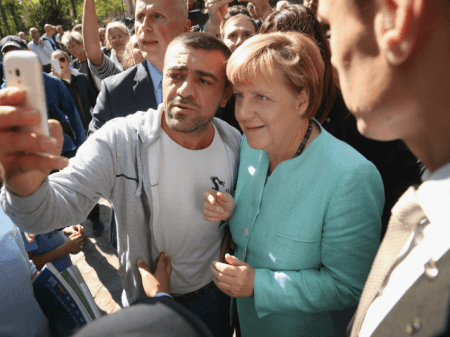
Angela Merkel claims that the European Union still has a “responsibility” to take in more so-called refugees, and pleaded to Islamic governments to help convince people that terrorism has nothing to do with Islam.
The 62-year-old German chancellor began her speech by acknowledging that “the European Union right now is in a very difficult situation due to the result of the British referendum … which is very regrettable”.
While calling on the bloc “to do more to integrate our military capacity”, she also confessed it could not fight terrorism without U.S. president Donald Trump’s assistance.
“Let me address this very openly. The Europeans alone could not cope with fighting international Islamist terrorism. We need the strength and the power of the United States of America, and their support,” she said.
“I say this because the external borders of the European Union, in a way, are the border that actually separates us from Islamist terrorism, and that very much has an influence on Europe.
“So co-operation with the United States of America is most important for us, but what’s also very important to me is that Islamist, Muslim states have been incorporated in this coalition, because I think those countries, first and foremost, have to give a contribution.”
(Video at the link. — DM)
According to Chancellor Merkel, however, working with such states is the only way “we will be able to convince people that it is not Islam that is the problem, but a falsely understood Islam, and the religious authorities of Islam have to find strong language in order to delineate themselves and distance themselves from this fundamentalist and terrorist [version of] Islam.”
“We cannot do this, we Christians,” she said. “It has to be done by the Islamist clergy and by the religious authorities.”
Having claimed that Western institutions have no authority to tackle extremist ideology, however, the chancellor went on to insist that Europe does still have a duty to absorb more migrants.
“We have a responsibility. The European Union has a responsibility to bear, accepting those refugees.
“Just think, Cyprus, after all, is a neighbouring state to Syria, so you see the external borders of the Union are the borders that separate us from those areas where people amass in great numbers … [W]e cannot simply say it’s got nothing to do with us; we have to deal with this issue.”
Cyprus does not in fact share a land border with Syria, being an island nation some 315 miles from the Syrian coast.
In light of the recent flurry of leaks by the so-called “deep state”, which includes such agencies as the NSA and FBI and which last week lead to the resignation of Mike Flynn after a phone recording of his phone conversation with the Russian ambassador was leaked to the WaPo and other anti-Trump publications, an article published on January 12 by the NYT has generated renewed interest. One month ago, the NYT reported that “In its final days, the Obama administration expanded the power of the National Security Agency to share globally intercepted personal communications with the government’s 16 other intelligence agencies before applying privacy protections.”
The new rules significantly relax longstanding limits on what the N.S.A. may do with the information gathered by its most powerful surveillance operations, which are largely unregulated by American wiretapping laws. These include collecting satellite transmissions, phone calls and emails that cross network switches abroad, and messages between people abroad that cross domestic network switches. The change means that far more officials will be searching through raw data. Essentially, the government is reducing the risk that the N.S.A. will fail to recognize that a piece of information would be valuable to another agency, but increasing the risk that officials will see private information about innocent people.
While previously the N.S.A. filtered information before sharing intercepted communications with another agency, like the C.I.A. or the intelligence branches of the F.B.I. and the Drug Enforcement Administration, and furthermore N.S.A.’s analysts passed on only information they deemed pertinent, screening out the identities of innocent people and irrelevant personal information, following passage of Obama’s 11th hour rule, “other intelligence agencies will be able to search directly through raw repositories of communications intercepted by the N.S.A. and then apply such rules for “minimizing” privacy intrusions.”
In other words, what until recently was a trickle of private data captured about US individuals by the NSA with only a handful of people having full, immersive access, suddenly became a firehose with thousands of potential witnesses across 16 other agencies, each of whom suddenly became a potential source of leaks about ideological political opponents. And with the universe of potential “leaking” culprits suddenly exploding exponentially, good luck finding the responsible party.
However, the implications are far more serious than just loss of privacy rights.
According to civil right expert and prominent First Amendement Supreme Court lawyer, Jay Sekulow, what the agencies did by leaking the Trump Administration information was not only illegal but “almost becomes a soft coup”, one which was spurred by the last minute rule-change by Obama, who intentionally made it far easier for leaks to propagate, and next to impossible to catch those responsible for the leaks.
This is his explanation:
There was a sea-change here at the NSA with an order that came from president Obama 17 days before he left office where he allowed the NSA who used to control the data, it now goes to 16 other agencies and that just festered this whole leaking situation, and that happened on the way out, as the president was leaving the office.
Why did the Obama administration wait until it had 17 days left in their administration to put this order in place if they thought it was so important. They had 8 years, they didn’t do it, number one. Number two, it changed the exiting rule which was an executive order dating back to Ronald Reagan, that has been in place until 17 days before the Obama administration was going to end, that said the NSA gets the raw data, and they determine dissemination.
Instead, this change that the president put in place, signed off by the way by James Clapper on December 15, 2016, signed off by Loretta Lynch the Attorney General January 3, 2017, they decide that now 16 agencies can get the raw data and what that does is almost creates a shadow government. You have all these people who are not agreeing with President Trump’s position, so it just festers more leaks.
If they had a justification for this, wonderful, why didn’t they do it 8 years ago, 4 years ago, 3 years ago. Yet they wait until 17 days left.
One potential answer: they knew they had a “smoking gun”, and were working to make it easier to enable the information to be “leaked” despite the clearly criminal consequences of such dissemination.
As this point Hannity correctly points out, “it makes it that much more difficult by spreading out the information among 16 other agencies, if they want to target or take away the privacy rights, and illegally tap the phones, in this case General Flynn, it’s going to be much harder to find the perpetrator.”
Sekulow confirms, noting that back when only the NSA had access to this kind of raw data, there would be a very small amount of people who have access to this kind of data. “But this change in the Obama Administration was so significant that they allowed dissemination to 16 other agencies, and we wonder why there’s leaks.”
The lawyer’s conclusion: “President Obama, James Clapper, Loretta Lynch should be held accountable for this.”
Senator John McCain poured it on for the press at a Munich defense conference Saturday, warning in a veiled attack on President Trump that attacks on the press are a leading danger for democracy. “That’s how dictators are made!” he shrieked. It was rich stuff, given that most of his European listeners do not have the same wide press freedoms found in the states. But more to the point, it was McCain up to his old tricks: Ingratiating himself to the anti-Trump press by playing its champion, in a bid to be the media’s darling.
What stands out here is the hypocrisy of his claims. He’s suddenly concerned about press freedoms and dictators?
Where was McCain when President Obama was systematically violating press freedoms every which way to Tuesday?
Seven examples of Obama’s attacks on a free press spring to mind and not one of them drew any significant criticism from McCain.
Where was McCain when Fox News correspondent James Rosen was illegally followed around by Obama’s Department of Justice in 2013 over a story he published on North Korean activities? It was a clear-cut example of reporters just doing their jobs, even as someone in government was leaking the story, but Team Obama went after Rosen with the Espionage Act.
Where was McCain when CBS investigative reporter Sharyl Attkisson’s computer was being taken over and hacked in late 2012 by what were almost certainly Obama agents over her Benghazi scandal reporting? She described the still-unresolved incident in her book Stonewalled (which ought to give another clue about the Obama record on press freedoms) but her story about the computer hacking, which included planting classified documents and keystroke changings, certainly was disturbing. We didn’t hear much from McCain.
Where was McCain when New York Times reporter James Risen was threatened with prosecution if he did not reveal his sources? Risen certainly thought Obama was acting like a dictator in a recent interview. McCain, not so much.
Where was McCain when Obama illegally wiretapped the communications systems of the Associated Press in 2013 bid to find out its sources? Nowhere to be found.
Where was McCain when Fox News was singled out for criticism by President Obama? This event was not only a blast at the outfit but highly inappropriate collaboration with Media Matters, which made Fox News its bugbear.
And where was McCain when Obama’s spokesman John Kirby attacked a RT News correspondent at a 2016 White House press conference who asked an uncomfortable question on Syria, questioning its legitimacy as a press outfit? If the Russian state-funded press agency was that illegitimate, explain to us why it had a press pass issued by the White House at all? We heard nothing about it from McCain.
The Obama list is quite long, and that is not surprising. Obama was a socialist and socialists of all stripes have a long record of suppressing freedom of the press, subordinating its expression to the interests of an all-powerful state and its dictator. McCain found nothing wrong with that when Obama was playing that game and undercutting the press in what seemed to be pretty oppressive and downright illegal behavior. Breitbart News has another list of problems here. But when Trump, three or four weeks into his presidency, calls out some fake news on Twitter, suddenly we have a dictator descending.
President Trump sent his “A Team” to Europe to demonstrate America’s commitment to NATO. Homeland Security Secretary John Kelly, Defense Secretary Jim Mattis, and Vice President Mike Pence all traveled to a major conference in Munich for that purpose.
However, key European officials, along with honorary European John McCain, used the occasion to vent over Trump. Apparently, the Europeans would rather grandstand to their domestic audiences and demonstrate their moral superiority than bolster the alliance by establishing decent relations with the new U.S. president.
The worst venting came from German Defense Minister Ursula von der Leyen. The Washington Post reports that she “hammered” Trump (without mentioning his name).
Von der Layen said: “We must pursue finding a reliable coexistence with Russia together instead of going over our partners’ heads in a bilateral relationship.” But the U.S. is entitled to conduct its own diplomacy with Russia. And the new president is certainly entitled to take a fresh look at how best to deal with the Russians, just as Barack Obama did.
Speaking of the Russian reset, did Obama and Hillary Clinton pre-clear it with Germany and our other NATO allies? If not, then Trump, who has yet to settle on a comprehensive Russia policy, would break no new ground by going “over our partners’ heads.” If so — if Germany signed-off on the reset — then Trump would be well-advised not to take advice on Russia from the Germans.
In response to Trump’s call for NATO members to meet their financial commitment to the alliance, von der Layen tried to change the subject:
Burden is a matter of funding, of money, but sharing the burden is also much more than what can be expressed in euros and in dollars. To share a burden is to first of all share the principle to stand up for one another. Without exception.
According to the Washington Post, Germany would need to double its defense expenditures to meet its commitments to NATO. Anyone can talk a good game about “standing up for one another,” but a country that lags this far behind on its commitments isn’t truly standing up for its alliance partners.
Having told the U.S. how to conduct diplomacy and explained the deep meaning of burden sharing, Von der Layen then told us how we must fight:
[The alliance must be] bound by human dignity in all it does. This leaves no room for torture. It means avoiding civilian casualties at all costs.
I don’t think we need a lecture from Germany, of all countries, on how to conduct ourselves in war time. The German defense minister should explain how a country could ever win the kind of wars America has been fighting and “avoid[] civilian casualties at all costs.”
As for “torture,” there are likely to be situations in which only enhanced interrogation can avoid civilian casualties. In those cases, such methods are a way to avoid these casualties at a reasonable cost.
I’m a fan of NATO. Yet, the value of allies who wants to fight wars as von der Leyen says she does must be questioned.
The answer, I think, is that we’ll do the dirty work for Germany and others while they posture, but hopefully pay a bit more. That isn’t burden sharing by any reckoning, but it’s reality — unless arrogance like von der Leyen’s completely sours Trump on NATO.
A Yakhont missile at a Russian air show in 1997 (photo credit: CC BY-SA, JNO, Wikimedia Commons)
The Lebanese terror group Hezbollah is said to have obtained advanced Russian-made anti-ship missiles, potentially threatening Israeli gas fields in the Mediterranean Sea and the Israeli Navy’s ability to operate in the area, according to a report published Sunday
Hezbollah’s possession of the Yakhont missiles was revealed by unnamed Western intelligence officials over the weekend at the Munich Security Conference, where world leaders and defense ministers are meeting to discuss major security issues,” according to a report in the Hebrew daily Yedioth Ahronoth. The reports did not reveal in what forum the revelations were made.
If true, Hezbollah’s possession of the missiles would represent a serious threat to Israeli interests in the Mediterranean; endangering both Israeli commercial vessels sailing in shipping lanes off the Lebanese coast and the ability of Israeli Navy ships to operate in and around Lebanese waters.
Most significantly, the missiles would give Hezbollah the ability to strike Israel’s gas production platforms in the Mediterranean, a threat Israel reportedly intends to counter by installing maritime versions of the Iron Dome missile defense system on naval vessels, as part of the Israeli Navy’s efforts to secure the country’s natural gas fields.
An aerial view of the Israeli ‘Tamar’ gas processing rig 24 km off the Israeli southern coast of Ashkelon. Noble Energy and Delek are the main partners in the oil field, October 11, 2013. (Moshe Shai/FLASH90)
Israeli security officials have previously said that advanced missiles such as the Yakhont falling into the hands of Hezbollah would constitute the crossing of a red line, and Israel is said to have targeted at least two shipments of Yakhont systems in 2013 from Syria to Hezbollah. Syria, one of Russia’s closest allies has of a large arsenal of the advanced anti-ship missiles.
Since the start of the Syrian civil war in 2011, a number of airstrikes have been attributed to Israel, reportedly targeting convoys advanced weapons to Hezbollah, as part of Israel’s policy to prevent the group from acquiring “game-changing” arms, in particular anti-aircraft systems, chemical weapons and other advanced weaponry such as the Yakhont.
In 2014, then defense-minister Moshe Ya’alon denieda report published in The Wall Street Journal alleging Hezbollah was in possession of at least 12 Yakhont systems, saying that Israel believes the Shiite terror group “does not have the missiles.”
During the 2006 Lebanon War, Hezbollah successfully struck an Israeli naval warship off the coast of Lebanon using a Chinese made C-802 anti-ship missile, killing four sailors.
The attack on the naval vessel surprised Israeli security officials, with an IDF officer telling the Haaretz daily at the time that “we were under the impression that we were operating beyond the range of missiles.”
On Thursday, Hezbollah leader Hassan Nasrallah boasted that Israel was surprised then and would be surprised again in any future conflict. “In 2006 you had intelligence of our ammunition but you were astonished with what you saw after figuring out that you didn’t have enough information. You will be surprised with what we are (now) hiding which could change the course of any war,” he said
The Yakhont, which was a reported range of up to 300 kilometers (186 miles), would give Hezbollah a significant upgrade over the C-802, which can reach up to a distance of 110 kilometers (68 miles).
From the perspective of a poor migrant, the cash Sweden gives to all who come seems a lot of money, without working a single day to get it. This makes Sweden a paradise for the migrants of the world who do not want to work. The Swedish taxpayer pays for this party.
Recently, the city of Malmö bought 268 apartments, so newly arrived migrants would have a roof over their head. But at the same time, Swedish citizens in Malmö have to wait more than three years in line to rent an apartment.
While Swedish taxpayers are forced to fund all these benefits for migrants, the migrants do not have to adapt to the Swedish way of living.
In 2015, the proportion of rapes where the police actually found the suspect was 14%. In 86% of the rapes, the rapist got away.
It needs to become clear that the responsibility for becoming integrated into Swedish society rests entirely on the newly-arrived migrants. Migrants who do not receive a residence permit must go home or somewhere else.
In 2016, Sweden received 28,939 asylum seekers. Sweden is a predominantly Christian country in northern Europe, and yet most asylum seekers to Sweden came from three Muslim countries in the Middle East: Syria (5,459), Afghanistan (2,969) and Iraq (2,758). Why is it that people from these three Muslim countries choose to cross Europe to come to Sweden? What is it that Sweden offers that attracts people from the other side of the world?
It is not the major metropolises in Sweden that attract these people. 56% of Sweden’s land area is covered by forest. Besides the Swedish capital Stockholm, there is no Swedish city with more than 1 million inhabitants. Sweden’s average annual temperature is around 3°C (37.4°F), so it is not the weather that attracts tens of thousands of people from Muslim countries to Sweden.
What Sweden provides is economic and social benefits for all who come. Sweden is a country where the state pays newly-arrived migrants to encourage them to enter the community and seek jobs. If you receive a residence permit as a refugee, quota refugee or person with “subsidiary protection,” you get up to $35 (308 SEK) a day, five days a week, if you participate in a so-called “establishment plan.” So, the newly arrived migrant does not even have to work to get this money; the only thing he or she needs to do is to accept the help that the Public Employment Service provides. The newly-arrived migrant receives an “establishment allowance” (etableringsersättning) during his first two years in Sweden. After two years, the migrant is still entitled to all the benefits of the Swedish welfare state.
The migrants who receive this kind of establishment allowance can also get a supplementary establishment allowance (etableringstillägg) if they have children. They will get $91 a month (800 SEK) for each child under the age of 11, and $170 (1500 SEK) for each child who has reached the age of 11. A newly-arrived immigrant can get this supplementary establishment allowance for three children at most. If a newly-arrived immigrant has more than three children, then only the three oldest children count. The newly arrived immigrant can receive a maximum of $509 dollars (4500 SEK) a month through this supplementary establishment allowance.
So, if somebody lives in poverty in an Arab country and has several children, there is every reason to try to get a residence permit in Sweden. From the perspective of a poor migrant, that seems a lot of money to cash in, and one does not have to work a single day to get it. This makes Sweden a paradise for the migrants of the world who do not want to work. The Swedish taxpayer pays for this party.
If you accept the help of the Public Employment Service and start looking for a job, as a newly arrived migrant, you will also get help to pay the rent. If a newly arrived migrant has a rent of $396 (3500 SEK), the state pays $192 (1700 SEK). This is called the housing allowance (bostadsersättning).
It is not, however, only newly-arrived migrants with residence permits that receive economic and social benefits. Migrants who do not have residence permits also receive economic and social benefits. Since July 2013, immigrant children who live illegally in Sweden have the right to go to school.
In addition, also since July 2013, illegal immigrants have the right to state-funded health care, dental care, contraception counseling, and maternity care, as well as care in case of abortion. The illegal immigrant is also entitled to transportation to and from health care facilities, and also an interpreter. All children, in fact, who are living illegally in Sweden are offered the same health care and dental care, and under the same conditions, as children who are Swedish citizens.
The strange thing is that illegal immigrants pay lower fees for their medical and dental care than Swedish citizens pay. This is something that has upset many Swedish senior citizens, as 355,000 Swedish senior citizens live below the European Union’s poverty line. It is not certain that these senior citizens can afford dental care at all, while at the same time, illegal immigrants receive dental care by paying a fee of $6 (50 SEK). In Malmö, Sweden’s third largest city, the children of illegal immigrants receive full income support, and illegal migrants who have children have their entire rent paid by the municipality.
Since January 1, 2016, Sweden also has a law that offers children free medication. This law also applies to children seeking asylum in Sweden and children in Sweden illegally.
Children who come to Sweden and receive a residence permit further have the right to a “survivor pension” (efterlevandepension) if their parents have died. If the parents have never worked or lived in Sweden, the child will receive $167 (1477 SEK) per month, or $335 (2954 SEK) per month, if both parents are deceased. This is paid by the Swedish Pension Agency (Pensionsmyndigheten).
These are just some of the economic and social benefits that both legal and illegal migrants receive as soon as they set foot on Swedish soil.
So, if you live in an African country and want your child to go to school, Sweden will provide free education for your children, whether you have permission to stay in Sweden or not. If you are sick and cannot afford to go to the hospital, Sweden will provide free health care, whether you have the right to be in Sweden or not.
Recently, the city of Malmö bought 268 apartments with the taxpayers’ money, so newly arrived migrants would have a roof over their heads. But at the same time, Swedish citizens have to wait more than three years in line to rent an apartment in Malmö. The reason that people from Syria, Afghanistan and Iraq cross the entire European continent to come to Sweden is because Swedish politicians have given them every reason to come. From the day that a newly arrived migrant enters Sweden, the authorities at all levels of government throw money at him, with access to free health care and education. Why shouldn’t he come? Sweden’s current policies offer a free ticket to a better life for all poor migrants who come to Sweden, and the Swedish taxpayer foots the bill.
While migrants get all these benefits, there are not many obligations. Sweden is a multicultural society. This means that many of the migrants do not feel any loyalty to the Swedish culture, but retain their own culture within Swedish society. While Swedish taxpayers are forced to fund all these benefits for illegal and legal migrants, the migrants do not have to adapt to Swedish way of living. Instead, the Swedes not only have to pay for the migrants, but also seem required to adapt to them.
Screenshot from a government-sanctioned video propagating “new Swedes will claim their space, bringing their culture, language and habits, and it’s time to see this as a positive force” and “old [native] Swedes have to integrate as well” in this new reality.
Meanwhile, Sweden has a critical shortage of police officers, which means that it is easy to commit crimes and get away with them. If one would, against all expectations, get caught, the punishment in Sweden is not harsh. If someone is convicted of rape, he would be incarcerated from two to six years. In 2015, the proportion of rapes where the police actually found the suspect was 14%. This means that in 86% of the rapes, the rapist got away. The police could simply not do their job because lack of resources and poor leadership.
Many might say that it is racist to associate migrants with sexual crimes. The Swedish police published a report in June 2016 which gave a status report of sexual abuse. In the report, one can read the following quote:
“In cases where the crimes were carried out by offenders in a larger group in public places and in public swimming pools the perpetrators have been mainly youngsters who have applied for or have recently received asylum in Sweden.”
Although Sweden has a more restrictive immigration policy than the liberal migration policy it had before the migration crisis began, Sweden continues to have a welfare and integration policy towards newly arrived immigrants that functions as a magnet and draws less-educated immigrants to Sweden. Those who come to Sweden seem to be seeking a country that provides many entitlements but not many obligations. People seeking success go to the UK, Canada or the United States, while it often appears as if people who want to break the rules choose to come to Sweden.
As long as Sweden gives migrants all these benefits and demands so little back, Sweden will be the ideal country for the world’s opportunists and freeloaders. The benefits of immigration, such as a well-educated workforce, economic growth and increased entrepreneurship, will not contribute to Sweden, because through its welfare and integration policies Sweden is attracting migrants who are either unwilling or unable to make an effort.
According to Eurostat figures from 2015, the unemployment rate among foreign nationals in Sweden was 20.1 percent, while Swedish citizens had an unemployment rate of 5.7 percent. Only three other countries in the European Union — France, Spain and Greece — had a higher unemployment rates among their foreign nationals than Sweden.
Among foreign nationals who were citizens of a non-EU country, Sweden had an unemployment rate of 29.3 percent. Only two other countries in the European Union — Spain and Greece — had a higher figure than Sweden. If you look at the unemployment rate among Sweden’s own citizens, Sweden has EU’s second-lowest unemployment rate.
Many would say that this might indicate that there is discrimination in the Swedish labor market. A major investigation (Långtidsutredningen 2015) by the Swedish Ministry of Finance, published in 2015, made the assessment that the Swedish labor market mainly rewards individuals’ skills, and as a whole does not seem to be characterized by ethnic discrimination. The investigation also made the assessment that in many instances, persons who are born outside Sweden and have higher education from their countries of birth, need further education in Sweden to become established in the Swedish labor market.
The problem therefore is not discrimination; it is that migrants who come to Sweden lack the proper education to enter the Swedish labor market.
A restrictive immigration policy is not enough for Sweden. As long as Sweden has all these benefits for illegal immigrants and newly-arrived migrants, the most opportunistic and sometimes the most unmotivated migrants will make every effort to come.
Migrants who stay in Sweden even though they do not have permits should not be rewarded. Migrants should not get paid because they are accepting support from the government to find jobs. These kinds of benefits need to be phased out and eventually eliminated.
It needs to become clear that the responsibility for becoming integrated into the Swedish society rests entirely on the newly arrived migrants. Migrants who do not receive a residence permit should go home or somewhere else. If this does not happen, it could lead to a crisis for the Swedish welfare state and the social rights of the Swedish people. Many Swedes would say that this welfare crisis has already begun.
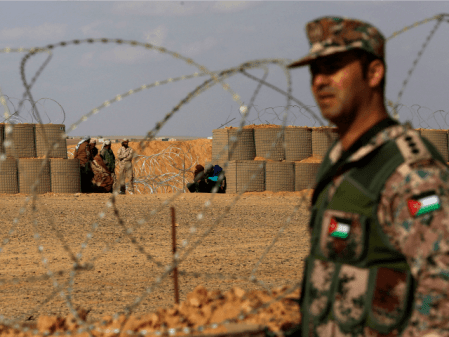
TEL AVIV — There is fear that further advances by the Syrian army, assisted by the Iran-backed Hezbollah and elite Iranian troops, may turn the Israel-Jordan-Syria border area into an Iranian proxy base, an Arab intelligence officer said.
“It’s not so much the possibility that it happens, but the prospects of an Israeli retaliation if Iranian forces come near its border,” he said. “Israel made it clear, publicly and behind the scenes, that it would not tolerate Hezbollah and Revolutionary Guards’ presence along its border.”
“Iran has exploited the campaign against Nusra Front and the Islamic State to take root in the border area,” he said. “Jordan and Israel too would like to see these organizations out, but not to the point that Hezbollah and Iran fill the void.”
Lately, Israel and Jordan have cooperated closely on the matter, he stated. “Israel knows that Jordan needs to act against extremist elements but both want to prevent Iran from taking advantage of it.”
“It is also in [Syrian President Bashar] Assad’s best interest to keep the Iranians out,” the official contended. “True, he has stated that the Golan Heights would be liberated by force, and he relies heavily on Hezbollah and Iran. But at some point he’d wish to rule over his own border areas, which is something Jordan can live with. But not Iran.”
He added that the Iranian Revolutionary Guards tried several times in the past to gain a foothold in Jordan. “But these cells were unveiled and dismantled before they became operational.”
He added that the joint operation room of the Syrian opposition groups has become almost completely inactive.
“Its activity has been dramatically reduced,” he said of the operation room. “There are no more operational and tactical plans and directives. The world wants first and foremost to remove the jihadist threat, but the elements in the region believe that the jihadi threat will be replaced by an Iranian one.”
He said that Jordan has rebuffed Iranian proposals to increase economic cooperation despite the financial dire straits in which the Kingdom finds itself. “They want to prevent Iran from having any kind of foothold in the kingdom.”







 anneinpt
 artaxes
 danmillerinpanama
 davidking1530
 Peter Hofman
 Joseph Wouk
 Peter
 Louisiana Steve


Recent Comments