French Elections: Emmanuel Macron, a Disaster

Posted May 1, 2017 by danmillerinpanama
Categories: Anti-Zionism, Antisemitism, Emmanuel Macron, European Union, French elections - May 7, Islamic invasion, Islamisation, Islamist terror attacks, Marine Le Pen

Tags: , , , , , , , ,

French Elections: Emmanuel Macron, a Disaster, Gatestone Institute, Guy Millière, May 1, 2017

In the next election, in 2022, Catholic France may well see a Muslim candidate run — and win.

******************

Anti-West, anti-Israeli and anti-Jewish diatribes were delivered to enthusiastic crowds of bearded men and veiled women. One hundred and fifty thousand people attended.

Emmanuel Macron promised to facilitate the construction of mosques in France. He declared that “French culture does not exist” and that he has “never seen” French art. The risk is high that Macron will disappoint the French even faster than Hollande did.

On the evening of the second round of elections, people will party in the chic neighborhoods of Paris and in ministries. In districts where poor people live, cars will be set on fire. For more than a decade, whenever there is a festive evening in France, cars are set on fire in districts where poor people live. Unassimilated migrants have their own traditions.

Paris, Champs Elysees, April 20, 8:50 pm. An Islamic terrorist shoots at a police van. One policeman is killed, another is seriously wounded.

The terrorist tries to escape and shoots again. The policemen kill him. One hour later, the French Ministry of Interior reveals his name and his past. His name is Karim Cheurfi. He is a French Muslim born in an Islamized suburb of France. In 2003, he was sentenced to twenty years in prison for the attempted murder of two policemen. He was released before the end of his sentence. In 2014, he targeted a policeman and was sentenced again. And released again. In March, the police were informed that he was trying to buy military-grade weapons and that he contacted a member of the Islamic State in Syria. An inspector discovered that he had posted messages on jihadist social media networks expressing his willingness to murder policemen. The police searched his home and found several weapons and a GoPro video camera similar to the one terrorists use to film their crimes. The police and members of the French justice system did not think they had sufficient evidence place him under surveillance.

The Champs Elysées attack clearly shows that the French justice system is lax regarding dangerous people and that the French police pay only limited attention to suspects who are communicate with terrorist organizations and who seem to be hatching terrorist projects.

This terrorist attack summarizes everything that is broken in terms of security in France today.

Men with a profile similar to that of Karim Cheurfi have, in recent years, been responsible for most of the terrorist attacks in France and Belgium: Mohamed Merah, who killed three Jewish children and the father of two of them in Toulouse in 2012; Mehdi Nemmouche, who attacked the Brussels Jewish Museum in 2014 ; the Kouachi brothers, who committed the Charlie Hebdo massacre in 2015; Amedy Coulibaly, who murdered four Jews in the Saint Mandé grocery Kosher store Hypercacher; Samy Amimour and others who maimed and murdered 130 innocent people in the Bataclan theater in November 2015; Mohamed Lahouaiej Bouhlel, who drove a truck into the crowd in Nice in July 2016, killed 86 people and wounded many others, and, among others, those who beheaded a priest in Normandy a few weeks after the attack in Nice.

The successive French governments under the presidency of François Hollande showed themselves to be appallingly weak and impotent.

A climate of fear has overtaken the country. Attendance at theaters has declined. The particularly targeted Jewish community — two-thirds of the attacks in France in the last five years targeted Jews — feels abandoned. When a Jewish cemetery was vandalized on March 30 in Waldwisse, eastern France, neither the media nor the political leaders reacted. A week later, in Paris, a Jewish woman, Sarah Halimi, was tortured and then thrown out of a window by a non-radicalized Muslim, simply because she was Jewish: the French media and political leaders, with the exception of the courageous MP Meyer Habib, also did not react. A silent gathering below the window was organized by some leaders of the Jewish community. Only Jews came; they were greeted by anti-Semitic insults by Arab Muslims in the neighborhood. The implantation of radical Islam in the country is intensifying. The annual meeting of “Muslims of France” (the new name of the French branch of the Muslim Brotherhood), took place on April 14-17 in Le Bourget, ten miles north of Paris. Anti-West, anti-Israeli and anti-Jewish diatribes were delivered to enthusiastic crowds of bearded men and veiled women. One hundred and fifty thousand people attended.

Economically, France is in terrible shape. The unemployment rate remains above 10%. Nine million people are living below the poverty line –14% of the population. Economic growth is stagnant. Government spending accounts for 57% of GDP — 13% more than in Germany, France’s main economic competitor in Europe.

Month after month, polls shows that the French population is anxious, angry, immensely disappointed with current French policies. François Hollande ends his term with a popularity rating close to zero. He was so rejected and discredited that he decided not to run again for the presidency.

The first round of the French presidential election took place in this context, and one could expect that the French population would reject everything that looks like François Hollande’s policies and choose a new direction for the country.

That is not what happened; quite the opposite.

Benoit Hamon, the Socialist Party’s candidate, suffered a disastrous blow and received a mere 6% of the vote. Jean-Luc Mélenchon, a far-left candidate who left the Socialist Party a few years ago and who supported Hollande in 2012, received a much higher score: 19% of the vote. He is an admirer of Hugo Chavez, Fidel Castro, and the late Palestinian leader, Yasser Arafat. Immediately after the anti-Semitic Islamic attack in Saint Mandé, he claimed that “Jewish extremism is more dangerous than Islamic extremism”. That statement did not hurt him.

Above all, Emmanuel Macron, a candidate close to Hollande won the race and will be elected President on May 7. He was Hollande’s senior economic advisor for more than two years, and the main architect of Hollande’s failed economic policies. He then became Minister of the Economy, Industry and Digital Affairs, and held that post until he entered the presidential race.
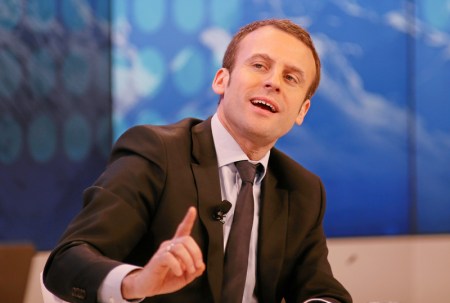
Emmanuel Macron, then Minister of the Economy, Industry and Digital Affairs of France, at the Annual Meeting 2016 of the World Economic Forum in Davos, Switzerland, January 22, 2016. (image source: World Economic Forum/Michele Limina)

Most of Macron’s speeches are copies of the speeches Hollande made during his 2012 presidential campaign. What is known of Macron’s positions on most subjects show that they are the same position Hollande had during the last months of his mandate.

Throughout the campaign, Macron virtually never spoke about the danger of Islamic terror; when he did, he used words even weaker than those used by Hollande. After the Champs Elysees attack on April 20, he said: “imponderable” events had occured, and they “will be part of the daily life of the French in the years to come”. The next day, when asked what he would do to prevent other killings, he said that he could not “devise a plan to fight terrorism overnight”.

When he speaks about the economy, he sounds like Hollande: he uses vague terms, such as the need for more “social mobility” and “success for all”. He insists that he will maintain all the sclerosis dear to so many, such as the compulsory 35-hour workweek or the legal age for retirement: 62. He said that he would leave the almost-bankrupt retirement system the way it is. He promised additional regulations aimed at “saving the planet” and, in a classically socialist way, tens of billions of euros of government “investments” supposed to finance “ecological transition” and “public services”.

Sometimes, he makes remarks so dismaying that even Hollande would not have said them. In Algeria, in the presence of the National Liberation Front representatives, an organization that came to power by terrorism and massacring hundreds of thousands of “harkis” (Algerians who had chosen France), he said that the French presence in Algeria was a “crime against humanity“, and later promised to facilitate immigration from the Arab world and from Africa to France by preserving an “open and welcoming” France. He promised to facilitate the construction of mosques in France. He declared that “French culture does not exist ” and that he has “never seen” French art.

He quite often has shown that he is a political novice and that it is his first election campaign. He stumbled upon the words of his speeches and admitted to those listening to him that he did not understand the meaning of the sentences he had just read, which showed that he had not read what was written for him before reading it to the public.

How to explain his success in these conditions?

The first explanation lies in the moderate right candidate’s elimination. François Fillon had a credible and coherent program for the country’s recovery, but he could hardly speak about it. His campaign was quickly engulfed in a fake jobs scandal. He presented himself as an impeccable candidate: he appeared not so impeccable. A book recently published revealed that the scandal was meticulously orchestrated from a “shadow Cabinet” in the Elysee Palace. Fillon was never able to recover from it. His excuses were weak and contradictory. He confirmed his weakness by announcing his unconditional support for Macron immediately after the first round results were published. For the first time in more than fifty years, the moderate right will not have a candidate in the second round of a French presidential election. Showing their own weakness, most of the moderate right leaders followed Fillon example and decided to support Macron.

The second explanation for Emmanuel Macron success lies in a very elaborate communication strategy.

Emmanuel Macron continuously benefited from François Hollande support and most of the last five years socialist ministers, but an allegedly neutral and apolitical political structure was created for him. It was called En marche! (“On the Move!”). The socialist ministers who joined him rallied On the Move!, and remained silent. Francois Hollande only announced his full support very late in the race. The communication strategy could work because Emmanuel Macron received the support of left-wing billionaires whom he helped when he was Minister of Economy, and who have close relations with the powers that be: Pierre Bergé, Xavier Niel and Patrick Drahi. These people also own most France’s mainstream media and were able to carry out strong media campaigns in support of Macron. No candidate in the French presidential election history has been on the cover of so many magazines and newspapers. Emmanuel Macron also enjoys main French investment banks support: he is a graduate of the Ecole Nationale d’Administration, which trains all senior civil servants and almost all French politicians since it was established in 1945 and, before joining Francois Hollande, he had a career in a financial institution.

The third explanation for Emmanuel Macron’s success is that the communication campaign in his favor has been largely devoid of any political content, just like On the Move. He was presented as a young man, embodying the “future”, a “renewal”, a “hope”, a “change”. For most of the campaign, Emmanuel Macron had no program. His program was only published on the internet six weeks before the election. The text is often meaningless. Fear is defined as a “daily anguish”. It says that France must offer “opportunities” and Europe must be a “chance”. Emmanuel Macron told socialists he is a socialist, then said that he is not a socialist at all when he addressed other audiences. Opinion polls have shown that many of those who voted for him in the first round were unaware of his proposals on any topic.

Those who designed Emmanuel Macron’s campaign took a lot of inspiration from Barack Obama’s 2008 presidential campaign, and the result shows that they were right.

The result is also very distressing, because it shows that a massive communication campaign can be effective, even if it is full of empty words and seems to considers voters as idiots. Emmanuel Macron’s campaign effectiveness is also due to the fact that in France, virtually no media is likely to contradict what is said in the mainstream media: the French economy is a very state-based economy in which creating and sustaining media independence from the government and from government subsidies is almost impossible.

The second round of the French presidential election will take place on May 7. Emmanuel Macron will face the only remaining candidate, populist Marine Le Pen.

During the entire campaign, she was almost the only one to speak clearly about the Islamic terrorist threat (François Fillon did, too, but more discreetly) and to offer credible solutions to fight it. She was the only one to speak of the rise of radical Islam in France and to denounce the Muslim Brotherhood gathering at Le Bourget. She was the only one to stress the increasing perils resulting from uncontrolled immigration, and the risk of French culture disappearing. She was also the only one to mention the demographic change that occurs in France and in Europe because of the new migrants. She was the only one to denounce the Islamic anti-Semitism that relentlessly kills Jews in France. Unfortunately, she has a nearly Marxist economic program, close to that of Jean Luc Melenchon. She is the leader of the National Front, a party founded by her father, an anti-Semite, Jean-Marie Le Pen; although she has excluded her father and virtually all her father’s anti-Semitic friends from the National Front, she is nonetheless the party leader and is regarded as her father’s daughter.

Marine Le Pen and the National Front will be used as scarecrows to urge voters to rally massively behind Macron, in the name of a “Republican front” against “fascism.” The strategy was developed thirty years ago by the French left, under President Francois Mitterrand. It has always worked, and in a few days, it will work again.

Macron now has the support of the entire Socialist party, and the support of virtually all other politicians. He also has the support of all French Muslim organizations. The rector of the Great Mosque of Paris said that Muslims must “massively vote” for him. The Jewish community leaders also rallied on behalf of Macron. On May 7, he will likely get more than 60% of the vote.

Most will not be based on the support for a project; the risk is high that Macron will disappoint the French even faster than Hollande did. The French may quickly discover that he is just a man chosen by the French left to preserve an unsustainable status quo a little longer, and a member of the self-appointed élites who do not care about ordinary people’s problems, who consider that terrorist acts are “imponderable events”, and who believe that national identities can melt in a no-border globalized world. When the French discover who Macron is, there will be nothing they can do to change what they voted in.

The risk to France in the next five years will probably be painful for the French. According to the Police, more than 12,000 radicalized Muslims live in the country and most of them are not under surveillance. The Police do not have the means to do more than they currently are doing, and Macron does not seem to care. The justice system is in the hands of judges who appear lenient to terrorists, and Macron seems to accept it. The flow of migrants will not stop, and Macron apparently does not intend to do anything about that. More and more, Muslims segregate themselves from French society in expanding Islamist mini-states.

Nothing Macron proposes can reverse the decline of the French economy and French society. Terror attacks will undoubtedly occur. Jews and others will undoubtedly be killed. Riots and discontent will undoubtedly take place.

On the evening of the first round of the election, there were riots in Paris and Nantes. On the evening of the second round of elections, people will party in the chic neighborhoods of Paris and in ministries. In districts where poor people live, cars will be set on fire. For more than a decade, whenever there is a festive evening in France, cars are set on fire in districts where poor people live. Unassimilated migrants have their own traditions.

In the next election, in 2022, Catholic France may well see a Muslim candidate run — and win.

Former Jordanian Culture Minister: No Problem With U.S. Moving Embassy To West Jerusalem

Posted May 1, 2017 by danmillerinpanama
Categories: Abbas meets Trump, Peace process, Trump and Israel, Two state solution, U.S. Embassy, West Jerusalem

Tags: , , , , ,

Former Jordanian Culture Minister: No Problem With U.S. Moving Embassy To West Jerusalem, MEMRI, May 1, 2017

In an April 30, 2017 article titled “Unpopular Statements,” Tareq Al-Masarwa, Jordan’s former culture minister and a senior columnist for the government daily Al-Rai, wrote that the U.S. can move its embassy to West Jerusalem[1] because the Palestinians and Arabs do not claim that part of the city. He called on the Arabs to face reality in light of the fundamental changes that have occurred in the Arab world in the last few years, and discard illusions of victory and fairytales about resistance.

The following are excerpts from his article:[2]

Tareq Al-Masarwa (image: Ahkelak.net)

“The Americans can move their embassy to the new [part of] Jerusalem [i.e. the western part] without sparking any serious rage among the Arabs. This is for the simple reason that the Palestinians and Arabs demand the Old City [of Jerusalem] – which they lost in the 1967 war, known as the Six Day War – as the capital of their state. I have not heard anyone demanding the 1948 part of Jerusalem [i.e., West Jerusalem], neither Hamas, the PLO nor anyone else.

“There is talk about U.S. President [Donald] Trump visiting the region [soon], including the hotspots of Israeli-Palestinian tension. Although the man is known for the promises he made before and after the elections, he can play the game of ‘Jerusalem the capital [of Israel]’ without causing awkwardness for [either] U.S. policy or his allies…

“I do not mean to seem like a spoil-sport. The U.S. president will meet Abu Mazen [Mahmoud ‘Abbas on May 3, 2017] and this meeting is meaningful, despite everything that is said about [Trump] constantly changing his mind according to his whim. The Palestinian president will demand a demilitarized state, to exit securely alongside Israel. The [late Palestinian] president Yasser Arafat also agreed at some point to the formula of ‘administrative autonomy’ in return for [permission to] return to Palestine. The Israeli occupation, [for its part,] has already come to terms with all the characteristics of the Palestinian state, except for the aspect of changing its basic designation [i.e., calling it a state rather than an authority or an autonomy].

“Today many things have changed, and much water has passed under the bridge, as the saying goes. It’s time to face the bitter reality. Who thought that the Syria disaster would enter its seventh year, that Iraq would [have to] borrow money to pay the salaries of its civil servants, that an Arab war would rage in Yemen, and that Libya would return to the state it was in before King Idris unified its three provinces?

“[King] ‘Abdallah II managed to revive the [Arab League] summit on the Dead Sea and to strike a pact of Arab cooperation in this region. It’s time to face reality as it is, without the illusion of victory and the fairytales about resistance, for we are not in the best of situations.”

________________________

[1] Senior journalist ‘Abd Al-Rahman Al-Rashed made similar statements in Al-Sharq Al-Awsat. See MEMRI Special Dispatch No. 6764, Prominent Saudi Journalist: West Jerusalem Is Part Of Israel; Moving The U.S. Embassy There As Part Of Overall Peace Agreement Could Herald The End Of The Israeli-Palestinian Conflict, January 31, 2017.

[2] Al-Rai (Jordan), April 30, 2017.

Why China ‘urgently’ recruiting Korean-Chinese interpreters for town near North Korea

Posted May 1, 2017 by danmillerinpanama
Categories: China and North Korea

Tags:

Why China ‘urgently’ recruiting Korean-Chinese interpreters for town near North Korea, Korea Times, Park Si-soo, May 1, 2017

(Please see also, Krauthammer: U.S. does have cards to play against North Korea. Might China be preparing for reunification with North Korea instead of an invasion? — DM)

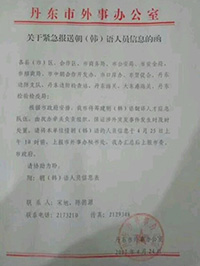
A Chinese government document ordering the town of Dandong to recruit Korean-Chinese interpreters. / Captured from the Oriental Daily

A Chinese town near the border with North Korea is “urgently” recruiting Korean-Chinese interpreters, stirring speculation that China is bracing for an emergency situation involving its nuclear-armed neighbor.

The Oriental Daily, a Hong Kong-based news outlet published the story on Apr. 27, including a photo of a Chinese government document ordering the town of Dandong to recruit an unspecified number of Korean-Chinese interpreters to work at 10 departments in the town, including border security, public security, trade, customs and quarantine.

The document did not specify the reason behind the unusual, large-scale recruiting. But experts and local citizens said the move indicated that China was bracing for a possible military clash between the United States and North Korea.

This might trigger a huge exodus of North Koreans to border towns in China.

Whether this dismal scenario will become a reality is largely up to North Korea’s leader Kim Jong-un.

U.S. President Donald Trump has repeatedly warned that the world’s superpower will strike North Korea’s nuclear facilities if Kim proceeds with a sixth nuclear test or test fires an intercontinental ballistic missile.

The Dandong administration also has ordered its officials to work rotating night shifts since April 25, according to South Korea’s news agency Yonhap.

Meanwhile, China has dismissed reports that it has sent 150,000 additional troops to its border with the North.

Half of Prominent Jihadis Tied to “Non-Violent” Islamism, New Study Shows

Posted May 1, 2017 by danmillerinpanama
Categories: Islamist organizations, Islamist radicalization, Islamist terror attacks, Non-violent Islamists

Tags: , , ,

Half of Prominent Jihadis Tied to “Non-Violent” Islamism, New Study Shows, Investigative Project on Terrorism, April 30, 2017

(Please see also, MEF Sues DHS for Hiding Information on Its Funding of Islamists. — DM)

Purportedly non-violent Islamist groups not only serve as potential incubators for radicalization and violence – they also continue to engage in violent incitement, encouraging others to carry out terrorist attacks.

********************************

Half of the prominent jihadists profiled in a new study by The Centre on Religion & Geopolitics had ties to supposedly non-violent Islamists prior to joining terrorist organizations.

The study’s authors – Mubaraz Ahmed, Milo Comerford, and Emman El-Badawy – explore pathways to militancy among 100 prominent figures within the wider Salafi-Jihadi movement. The individuals examined derive from the Middle East and Africa, across multiple generations. Some of the findings suggest that membership or ties to non-violent Islamist organizations can be associated with an individual’s trajectory towards violence and terrorism.

51 percent of the terrorists under study were previously connected to Islamist groups that claim to be non-violent, including “bodies that are not necessarily political activist organizations but form a functioning arm of existing Islamist groups, such as youth wings, student associations, and other societies.” Since membership in Islamist groups is often secretive and sometimes prohibited in various Middle Eastern countries, the authors acknowledge that the proportion of jihadists with Islamist affiliations are likely higher.

Some of the case studies explored in the report include Djamel Zitouni, the leader of the Armed Islamic Group who was previously a member of an Islamist organization that supposedly eschewed violence – the Islamic Salvation Front (FIS). Senior Al-Qaeda leaders, including Abdullah Azzam and Abu Ayyub al-Masri, were involved with or direct members of the Muslim Brotherhood before turning to violent jihad.

One in four of the jihadists examined had ties to the Muslim Brotherhood or its affiliated groups.

Another interesting finding shows that 65 percent of the sample had been imprisoned at some point throughout their lives, some of whom served time before engaging in violent jihad. There has been growing concern for years about Islamist radicalization of potential terrorist recruits in prisons worldwide.

The study shows that personal networks are critical in the formation and development of the global Salafi-jihadi movement.

“Our data links the leaders of Jabhat al-Nusra and ISIS today to the forefathers of the movement through people they met in prison, at university, and on the battlefield,” write the authors.

Purportedly non-violent Islamist groups not only serve as potential incubators for radicalization and violence – they also continue to engage in violent incitement, encouraging others to carry out terrorist attacks.

For example, on Wednesday, a senior Muslim Brotherhood member, ‘Izz Al-Din Dwedar, called for an “intifada” targeting Egyptian embassies around the world, in a Facebook post translated by The Middle East Media Research Institute (MEMRI).

In protest of death sentences handed to members of the Brotherhood in Egypt, Dwedar suggested for violent action on May 3.

Egyptians abroad should “protest [outside] Egyptian embassies and lay siege to them, and steadily escalate [their actions], up to and including raiding the embassies in some countries, disrupting their work and occupying them if possible, in order to raises awareness to our cause,” wrote Dwedar.

MEF Sues DHS for Hiding Information on Its Funding of Islamists

Posted May 1, 2017 by danmillerinpanama
Categories: Countering violent extremism, Department of Homeland Security, Middle East Forum, Obama administration, Obama and Islamists, U.S. courts

Tags: , , , , ,

MEF Sues DHS for Hiding Information on Its Funding of Islamists, Middle East Forum, May 1, 2017

(Is the “deep state” again the problem? The Department of Justice should confess judgment and agree to the release of all pertinent records following a diligent but prompt search. — DM) 

In July 2016 then-DHS Secretary Jeh C. Johnson assured lawmakers that CVE grant applicants would be carefully vetted.

“The CVE program should be canceled altogether,” said Sam Westrop, director of MEF’s Islamist Watch project. “And guidelines should be put in place to make sure that extremist groups like MPAC never receive taxpayer money to counter extremism.”

*************************************

Philadelphia – May 1, 2017 – The Middle East Forum has filed a lawsuit against the Department of Homeland Security (DHS) to secure the release of documents related to the Obama administration’s Countering Violent Extremism (CVE) grant program.

The grant program, which began last year, is intended to assist “efforts at the community level to counter violent extremist recruitment and radicalization to violence,” but MEF was concerned about U.S. Islamist groups – themselves radicals – receiving CVE funds. Indeed, grant recipients have included the Muslim Public Affairs Council (MPAC), an organization with ties to the Muslim Brotherhood and a long history of sanitizing Islamist terrorism.

On January 10, MEF filed a detailed Freedom of Information Act (FOIA) request with DHS seeking documents about the selection criteria and specific decisions in awarding CVE grants. The request indicated that the documents are mostly located at the DHS Office for Community Partnerships (OCP), headed by George Selim.

Having failed to receive even a response to its request within the 20-day period mandated by law, MEF contacted DHS. Finally, on March 23, DHS FOIA officer Ebony Livingston informed us that the request had been routed to the Federal Emergency Management System (FEMA), which found no pertinent records.

On April 26, MEF filed a lawsuit alleging that DHS violated the law by not only failing to produce the documents, but failing even to conduct a search for the documents.

The complaint, prepared by attorney Matt Hardin, a specialist in FOIA litigation, seeks injunctive relief compelling DHS “to search for and produce all records in its possession responsive to plaintiff’s FOIA request.”

“We filed a detailed FOIA request, specifying the documents we were looking for and where they likely were,” said MEF Director Gregg Roman. “DHS not only failed to produce the documents, it failed even to conduct a search and closed our case without bothering to tell us. This is not just unacceptable but illegal.”

The case has been assigned to Judge Royce C. Lamberth of the United States District Court for the District of Columbia. It bears noting that Judge Lamberth previously handled FOIA litigation concerning former Secretary of State Hillary Clinton’s emails.

“The CVE program should be canceled altogether,” said Sam Westrop, director of MEF’s Islamist Watch project. “And guidelines should be put in place to make sure that extremist groups like MPAC never receive taxpayer money to counter extremism.”


The Middle East Forum, a Philadelphia-based think tank, is dedicated to defining American interests in the Middle East and protecting America from Islamist threats. It achieves its goals through intellectual, activist, and philanthropic efforts.

Democrats vs. Free Speech

Posted May 1, 2017 by danmillerinpanama
Categories: Academia and freedom of speech, Academia and the left, Democrats, Freedom of speech

Tags: , , ,

Democrats vs. Free Speech,  Power Line, John Hinderaker, April 30, 2017

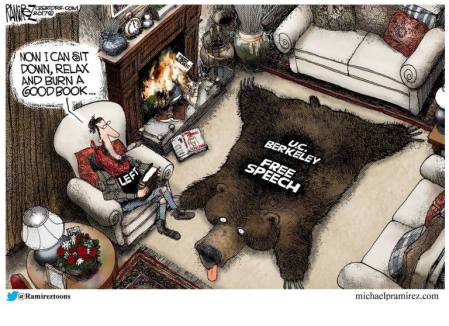
It’s happening all across the country, not just at bastions of photo-fascism like Berkeley and Middlebury. The University of Arkansas one of many recent instances. Wherever Democrats predominate, they enforce orthodoxy. I seriously believe they would shut us all up, if they could get away with it.

The way Michael Ramirez portrays Berkeley goes for the entire Left. Click to enlarge:

“Now I can sit down, relax, and burn a good book.” Heh.

MKO Seeking to Provoke US to Attack Iran: Ex-CIA Officer

Posted April 30, 2017 by danmillerinpanama
Categories: Iran scam, Iran's enemies, Iranian nukes, Iranian resistance, Israeli intelligence, JCPOA

Tags: , , , , ,

MKO Seeking to Provoke US to Attack Iran: Ex-CIA Officer, Tasnim News Agency, May 1, 2017

(Please see also, Iran’s Nuclear Weapons Program: On Course, Underground, Uninspected. — DM

TEHRAN (Tasnim) – A former military intelligence officer with the CIA said MKO works closely with the Israeli spy agency Mossad, noting that the terror group is seeking to create a “false narrative” about Tehran’s nuclear program in a bid to provoke the US to attack Iran.

“MKO (Mojahedin-e Khalq Organization, also known as MEK) works closely with the Israeli intelligence service Mossad and is also supported by many pro-Israel American former and current officials as well as congressmen. It has frequently surfaced documents, laptops and false information produced by the Israelis to convince the public that Iran is seeking a nuclear weapon and is cheating on the agreement to limit its nuclear research program. Its ultimate objective is to create a false narrative that would encourage the United States to attack Iran, killing Americans and Iranians but serving Israeli foreign policy objectives…,” Philip Giraldi told the Tasnim news agency.

Philip Giraldi is a former counter-terrorism specialist and military intelligence officer of the United States Central Intelligence Agency (CIA) and a columnist and television commentator who is the Executive Director of the Council for the National Interest, a group that advocates for more even handed policies by the US government in the Middle East.

Following is the full text of the interview.

Tasnim: The terrorist group Mujahedin-e Khalq Organization (MKO) recently claimed that the Islamic Republic is violating the 2015 nuclear agreement between Tehran and world powers by secretly conducting research on nuclear weapons components at the Parchin military site in Iran. The spokesman for the Atomic Energy Organization of Iran (AEOI) strongly dismissed the allegations by the terrorist group against Tehran’s nuclear program, saying the claims are of no value for the Islamic Republic. What is your take on this? What is behind such allegations?

Giraldi: MKO works closely with the Israeli intelligence service Mossad and is also supported by many pro-Israel American former and current officials as well as congressmen. It has frequently surfaced documents, laptops and false information produced by the Israelis to convince the public that Iran is seeking a nuclear weapon and is cheating on the agreement to limit its nuclear research program. Its ultimate objective is to create a false narrative that would encourage the United States to attack Iran, killing Americans and Iranians but serving Israeli foreign policy objectives. Iran does not, in fact, threaten either Israel or the United States.

Tasnim: It seems that the new US administration has breathed new life into the terrorist group. Republican US Senator John McCain praised the head of the MKO, in a recent meeting in the Albanian capital, Tirana. What do you think? What is terror group looking for under Trump?

Giraldi: I fear that the Trump administration, which has already warned Iran several times and is currently undertaking a policy review, will prove to be extremely hostile to Iran. Some congressmen like McCain and Lindsey Graham will be part of this process, using fabricated information provided by MKO to make a case that Iran must be treated as an enemy and dealt with accordingly. This propaganda is also coming directly to Washington from Saudi Arabia as well as Israel.

Tasnim: As you know, more than 17,000 Iranians, many of them civilians, have been killed at the hands of the MKO in different acts of terrorism including bombings in public places, and targeted killings. Why do Saudi Arabia, US, and certain European countries continue to support the anti-Iran terror group despite its heinous crimes?

Giraldi: MKO has also killed Americans and was until four years ago on the list of US recognized terrorist organizations. That MKO has killed many thousands of innocent Iranians is not reported in the western media, so no one knows about it. Those who support MKO do so because they believe it to be a legitimate opposition group to the Iranian government, which is a cause that they support. They fail to recognize that it continues to use terror as a weapon and that it operates as a cult that actually brainwashes and even kills its followers when they step out of line. It is a useful tool for the Iran haters.

Mosul quietly fills with Iran-backed Shiite militias using battle for revenge on Sunnis

Posted April 30, 2017 by danmillerinpanama
Categories: Iran and Iraq, Iranian proxies, Iraq war, Islamic State, Kurds, Mosul, Shiite militia, Shiite vs Sunni

Tags: , , , , , , ,

Mosul quietly fills with Iran-backed Shiite militias using battle for revenge on Sunnis, Washington Times, Seth J. Frantzman, April 30, 2017

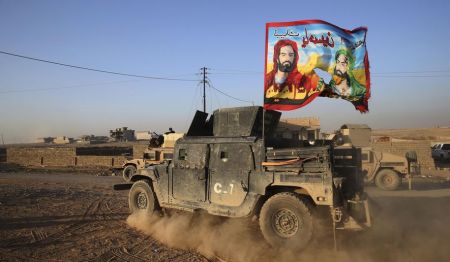
An Iraqi Special Forces vehicle displays a Shiite flag bearing the likeness of Imam Hussein and Imam Ali with Arabic words reading “At your service Hussein” in Mosul, Iraq. State

HAMAM AL-ALIL, Iraq — The road to Mosul is littered with the detritus from almost three years of war: burned M1117 armored vehicles, sandbagged berms and trenches from defensive positions once manned against Islamic State fighters, houses pancaked by airstrikes. The long supply line of the Iraqi army stretches through villages, with bulldozers, camouflaged trucks and temporary base camps.

Particularly noticeable are the frequent checkpoints manned by young armed men. But the fighters often aren’t from the Iraqi army or the Federal Police, but are members of various Iran-supported Shiite militias in the Hashd al-Shaabi, or Popular Mobilization Units.

While taking part in the U.S.-backed assault on the Islamic State group’s last major stronghold in Iraq, many of these units fly flags celebrating Shiite religious figures such as the Imam Hussein, and some have posters of Iran’s supreme leader, Ayatollah Ali Khamenei.

Life in those areas under control of the Shiite militias provides a window into Iran’s influence and the sectarian tensions that still dog Iraq as the campaign for Mosul enters its seventh grinding month.

A tour of these areas shows that Shiite militias and Iran have been empowered in the fight and that Iraq remains a state even more divided along religious and ethnic lines.

The battle for Mosul, once a city of more than 2 million residents, began in mid-October. In a lightning assault in 2014, the Islamic State, a radical Sunni Muslim group, took the city, expelled Christians and massacred Shiite and other minorities, and dynamited shrines and archaeological sites as part of its Salafi policy. When the Iraqi army began its campaign last fall, Mosul’s population had been reduced to around 1 million people.

Complicating the battle has been the presence of thousands of fighters allied with the Popular Mobilization Units. Composed of numerous militias that answered a 2014 fatwa by Iraqi Grand Ayatollah Ali al-Sistani to fight the Islamic State, the units have many leaders with shadowy pro-Iranian pasts.

Qais Khazali was a follower of Shiite cleric Muqtada al-Sadr, who attacked U.S. troops in Karbala in 2007 and now runs the Asa’ib Ahl al-Haq militia. Hadi al-Amiri, leader of the Badr Organization, fought alongside Iran’s Revolutionary Guard Corps during the Iran-Iraq War of the 1980s. Abu Mahdi al-Muhandis, leader of the Kata’ib Hezbollah militia, also fought with the Iranians in the 1980s.

In December, the PMU was incorporated as an official paramilitary force of the Iraqi government. But fears remain that its role in northern Iraq will inflame tensions with Sunni Arabs and the Kurdish population.

In an October speech, Mr. Khazali called the battle for Mosul the “revenge for the killing of Hussein.” He was referring to a historic killing that Shiites blame on Sunnis and tying it to the modern sectarian war with the Islamic State.

“If they exact widespread revenge against the Sunnis and expel them, this might create a conducive environment for ISIS to come back,” Kawa Hassan, director of the Middle East and North Africa Program at the Brussels-based EastWest Institute, told a European Parliament hearing in November.

Quietly expanding

The worst fears of mass revenge killings and expulsions have not been realized in or around Mosul to date. Instead, Shiite militias are more quietly extending their presence and visible control in a new part of the country, as a tour of the region repeatedly demonstrates.

Driving out of the Kurdish autonomous region from Irbil, the closest major city to Mosul, one leaves the Kurdish flags behind and immediately enters the uncertain terrain of militias. In the Christian town of Hamdaniyeh, the Nineveh Plains Protection Units, a Christian militia paid by and affiliated with the PMU, guards the entrance and exit. Its members are relaxed and friendly. Most of them live in the Kurdish region, where they fled the Islamic State and have only recently returned.

After Hamdaniyeh, the road crosses hillocks and fields with long-dilapidated chicken coops and the militias are from a Shabak unit. The Shabak are a local minority, some of whom are Shiite and recently joined the PMU’s Badr Organization.

For some Shabak and Iraqi Christians, the PMU are liberators. Last year, the PMU released a video showing the church bells of Mosul ringing again, sending the message that they would liberate the city from the Islamic State and make it safe for Christians. Militia members hand out “Imam Hussein” flags to children in local hamlets.

But in some Sunni Arab villages, there is obvious fear of the militia members who wander the streets, rifles over their shoulders, peering into mud-caked compounds.

Leaving the Shabak behind, the road skirts the ruins of the ancient Assyrian city of Nimrud, which Islamic State fighters blew up in 2015. A floating pontoon bridge over the Tigris is all that connects the western and eastern sides today. Airstrikes have demolished the old bridges.

The pontoon bridge is in such bad shape that it washed out during flooding in April and took days to repair. Civilians trod this road, and Iraqi nongovernmental organizations bring food to some of the estimated 160,000 civilians who have fled the battle of Mosul for refugee camps.

One car flying a white flag drove by with a corpse in the back, transported for burial across the river.

But each civilian vehicle, often packed with people, must pass a strict checkpoint on both sides. The checkpoint stops are tense. Soldiers and militia members ask where the Arab passengers are from and check the cargo. They are looking for Islamic State fighters. A Shiite flag with the sketch of a sword dripping blood flutters on the bridge.

As the road from the Tigris nears Mosul, it merges with a large highway that runs to Baghdad and the presence of the militias appears to thin out. The Iraqi army and Federal Police take the lead at checkpoints. Many vehicles of the Iraqi armed forces display Shiite flags, but the militias are not playing an official role in the battle for the city — only in rural areas around it.

A massive new United Nations camp at Hamam al-Alil is largely unoccupied. A giant sign by the PMU indicates that Shiite militias control access to the camp and claim they are “confirming the [safety]” of the camps and will provide aid equally.

The Shiite militias know that they are viewed by many with suspicion and are accused of discrimination and sectarianism. When a reporter tries to enter an older part of the Hamam al-Alil camp, militia members wearing black balaclavas and masks with skulls on them block the way.

Civilians in these neighborhoods have transitioned from Islamic State rule to another form of religious rule, with militarized checkpoints controlling their movements. A young man who fled one of these villages when the Shiite arrived and now lives in a reformatory in Irbil said the Shiite militias don’t belong in his Sunni village or northern Iraq.

In many ways, civilian life has an air of normalcy — even in Mosul with the sound of gunfire in the background. Women in black abayas wait for food to be distributed. Men stand around smoking, observing. Children play, some with visible burns from the war.

Most of these people have lived with years of war. Since the 1980s and particularly since 2003, they have witnessed rounds of violence. In January 2008, for instance, the city was hit by more than a dozen attacks a day, including improvised explosive devices, car bombs and shootings.

By contrast, life under the Islamic State was relatively peaceful for many pious Sunnis, many of whom greeted the takeover warmly in 2014.

“This too shall pass,” seemed to be the overall feeling in and around Mosul. Saddam came and went, then the Americans, the jihadis, the Americans, the Islamic State and now the Shiite militias. If Shiite militias continue to hoist flags over Sunni mosques in the city and the militias continue to man dozens of checkpoints in the rural countryside, then it is likely only a matter of time before insurgent attacks begin again.

How Trump turned media’s hatred of him into an asset

Posted April 30, 2017 by danmillerinpanama
Categories: Fly-over states, Media and Trump, Trump and media, Trump Derangement Syndrome

Tags: , , ,

How Trump turned media’s hatred of him into an asset, American Thinker, Thomas Lifson, April 30, 2017

Last night’s White House Correspondents Association Dinner may have marked the end of an era.  The plaintive claim of the president of the group, “We are not fake news,” revealed the sadness and fear that underlie the mainstream media’s precarious position.

President Trump has largely eroded America’s trust in the national political media during his first few months in the White House, according to a new poll.

On the eve of Trump’s 100th day in office, a new national poll by Morning Consult finds that more voters trust the president than the reporters covering his administration on a daily basis.

Thirty-seven percent of voters believe the White House has been more forthright than the media, versus 29 percent who favor the press. Another 34 percent were unsure or had no opinion.

This comes after more than a year of sustained attacks on Trump. It has come to the point that the viciousness of the attacks on the sitting POTUS are counterproductive, weakening trust in the media, instead of the object of their scorn. Sadness is one response, but another one is escalation. Consider the viciousness of the remarks of the chosen headliner of the WHCA dinner: a purported comedian named Hassan Minaj, who is said to be a celebrity on Comedy Central.

During his monologue, comedian and “The Daily Show” correspondent Hasan Minhaj said that he was explicitly told not to go after the absent President Trump or the administration – but if true, he certainly ignored the marching order. (“You were not told that,” White House Correspondents’ Association president Jeff Mason appeared to say off-screen.)

“I would say it’s an honor to be here, but that would be an alternative fact. No one wanted to do this, so of course it lands in the hands of an immigrant. No one wanted this gig,” said Minhaj. “Don Rickles died just so you wouldn’t ask him to do this gig.”

There were jokes about Russia: “The leader of our country is not here. That’s because he lives in Moscow, it’s a very long flight.” Jokes about how the press should hope Trump keeps golfing: “The longer you keep him distracted, the longer we’re not at war with North Korea.” Jokes about how it’s a good thing Trump didn’t attend the dinner: “He’s done far too much bombing this month.”

He also took some shots at the Trump administration, including Sean Spicer, whose “go-to move when you ask him a tough question is denying the Holocaust.” And Mike Pence, who wasn’t there because there were women in attendance who were ovulating. “Good job ladies, because of you, we couldn’t hang out with Mike Pence,” he said. He noted that Jeff Sessions RSVP’d “no,” which is “his second-favorite ‘n’ word.”There were also the requisite jokes about the media – how CNN calls everything “breaking news”; how if he bombs his monologue, MSNBC’s Brian Williams will say he did a stunning job; how Fox News’s Bill O’Reilly’s $25 million exit package is the “only package he won’t force a woman to touch.”

Toward the end, Minhaj’s tone changed – he reflected on the surreal feeling of the entire evening (“I feel like I’m a tribute in ‘The Hunger Games,’ and if this goes poorly, Steve Bannon gets to eat me.”) and turned serious, marveling that because we live in a democracy, a first generation Indian-American Muslim can get on the White House correspondents’ dinner stage and make fun of the president.

“Surreal” doesn’t begin to describe what was going on. With the glittery assemblage alternately praising itself and accusing the Trump administration of hideous behavior (N-words, living in Moscow), while President Trump was with a huge crowd of supporters in a distinctly non-glamorous setting, there was an element of Versailles as the sans coulottes were building their barricades in the streets of Paris. Except that the sans coulottes and their leader hold the reins of power, and the media has only their diminished (and still shrinking) level of trust among the citizenry.

I think that once again Salena Zito has captured a reality that eludes most of her colleagues in the media:

 Dennis Dixon didn’t vote for Donald J. Trump. For the first time in his 46 years, the self-described “moderate Midwestern Republican” sat out a presidential election because he was less than thrilled with both major candidates. “I wrote in John Kasich,” he says, with a trace of humor. (snip)

“If he [Trump] continues to stick to his guns and do what he is doing, I’d vote for him if he ran again,” Dixon says.

He may not have liked the candidate but he is “enjoying the heck out of his presidency.”

What he likes about Trump is his determination on certain issues, “but he is also willing to show flexibility when it counts. That is the kind of outside non-politician behavior that attracted a lot of voters to him.”

He also is frustrated by the way the national press treats Trump in comparison to President Obama: “They really do not give him a fair shake.”

In fact, some of that perceived bias impacts how Dixon views Trump: Instead of pushing him away from the president, he is more intrigued by him.

Dixon’s opinion defies the conventional wisdom of national news outlets, which still seem unable to grasp that Trump’s supporters aren’t going anywhere for the moment and that they view his approach to the presidency as successful.

The media certainly couldn’t believe there are Dennis Dixons out there — voters who didn’t support candidate Trump but are now pleased by his outsider approach to governing. Enough to even consider voting for him in the future. The idea that someone could go from a Trump skeptic to having an open mind about his presidency is unheard-of in their circles.

Certainly they have done enough to make every newscast, written report, blog post or tweet a breathless condemnation of every step he takes. They are shocked at how unconventional he is, while people who voted for him are shocked the political class still doesn’t understand that’s exactly why they voted for him.

Like the driver of a car stuck in snow, the Trump-hating media are spinning their tires, which is melting the snow next to the treads, and thereby diminishing any traction available. The faster the wheels spin, the more water is generated, preventing any traction at all.

The media does not know how to ease off the accelerator. To extend the metaphor of a carin snow, they need some grit to place under their wheels. Salena Zito knows where such grit may be found: outside the glitter of New York, Washington, Los Angeles and San Francisco.  And the only way to put that grit under the tires would be to understand the thoughts and feelings in flyover country well enough to have actual empathy for the proles who don’t get to hobnob with bejeweled and begowned celebrities that hate people who don’t share their views.

Ethnic Slaughter in Bangladesh

Posted April 30, 2017 by danmillerinpanama
Categories: Bangladesh, Human rights, Media, Muslim majority countries

Tags: , , ,

Ethnic Slaughter in Bangladesh, Gatestone Institute, Arnab Goswami, April 30, 2017

(According to Wikipedia, ” Bangladeshis include people of different ethnic groups and religions. Bengalis, who speak the official Bengali language, make up 98% of the population.[2][3] The politically dominant Bengali Muslims make the nation the world’s third largest Muslim-majority country.” — DM)


Last year, the police themselves set fire to about 3,000 houses of minority people.

Most recently, the Bangladesh Army killed Romel Chakma, an indigenous student leader. He was only 18 and had one eye. The government forced the media to bury the news.

What is most perplexing is the silence of the international media and so-called humanitarian organisations.

The Bangladesh government at present is carrying out atrocities against religious and ethnic minorities. Some foreign organisations helped me to flee to safety in Germany after nine of my colleagues were hacked to death by extremists.

Unfortunately, all the minorities of the country are not as fortunate. Last year, the police themselves set fire to about 3,000 houses of minority people. Most recently, the Bangladesh Army killed Romel Chakma, an indigenous student leader. He was only 18 and had one eye. The army decided to pour Kerosene over his dead body and set it on fire.

Romel Chakma. (Image source: Arnab Goswami’s Blog)

The government forced the media to bury the news. It is different in Bangladesh; nobody cares about minority people anyway.

What is most perplexing is the silence of the international media and so-called humanitarian organisations. Please let the world know about the realities in Bangladesh.

This is an article on the murder. It contains the links to the murder news covered.

I know this will not be a popular news, but it is important news. People need to know it.

Arnab Goswami is a Bangladeshi blogger in exile in Germany.