Next Up to Tear Down: Stephen Foster

Posted October 15, 2017 by danmillerinpanama
Categories: Erasing American history, Stephen Foster

Tags: ,

Next Up to Tear Down: Stephen Foster, PJ MediaMichael Walsh, October 15, 2017

(AP Photo/Keith Srakocic)

Is this the country you want to live in, Real Americans?

****************************

Stephen Foster was America’s first great songwriter and until about five minutes ago his songs were part of the cultural heritage of every Real American. But because some of their lyrics refer to “darkies” and are written in black dialect (common, by the way, in songs written by both black and white Americans throughout the late 19th century and well into the Tin Pan Alley days), they must go onto the ash heap of history — along, of course, with any statues of the man:

Among the more two dozen people who spoke Wednesday evening before the city’s Art Commission Wednesday, most wanted the Stephen Foster statue along the Oakland stretch of Forbes Avenue to be taken down or moved somewhere less visible. But few speakers were as hostile as Billy Hileman.

“You should melt the metal part down and recoup a little bit of [money],” said the educator and veteran activist during the hour-long hearing. “And then maybe make gravel out of the pedestal.” That drew laughter from a crowd of more than 60, but Mr. Hileman choked up moments later. “Obviously I can’t speak for people of color,” said Mr. Hileman, who is white, “but I can speak for me. I’m tired of being a part of this.”

What a fatuous ninny. Almost half a century ago, when I was a young music critic in Rochester, N.Y., I predicted in print that someday radicals would want to dig up the corpses of the politically incorrect dead (we didn’t use that term then, but the sentiment was already around) and hang them. Tearing down their statues and erasing them from history is the next best thing.

More than anybody else, Foster put a distinctively American music on the map; his songs had great appeal not for any inherent “racism” (blacks are always treated sympathetically) but because they captured the beauty and spirit of the still-young country. Here, for example, is his setting of a scene from Shakespeare’s Romeo and Juliet — the common man at that time loved Shakespeare and could quote him, and the King James Bible, by heart — a duet called, “Wilt Thou Be Gone, Love?”


And here is the ineffable “Jeanie with the Light Brown Hair,” as sung by John McCormack, along with Caruso the greatest tenor of his day:


Finally, no Foster primer would be complete without one of his last songs — he died in 1864 at the age of 37 — the immortal “Beautiful Dreamer.”


Tear those down, you fascists. Meanwhile the destructive work of the Frankfurt School continues apace:

Yesica Guerra, the city’s public art and civic design manager, said that nearly half of 126 written comments sent to the commission favored either relocating or removing the statue. Only a quarter favored leaving it where it is. Other options include providing signage to contextualize the work.

It was surprising so many people were in favor of removing the statue,” said Brittany Felder, an African American woman. She and other law students at the University of Pittsburgh had talked among themselves about their concerns, she said, but “I don’t think we had a chance to gauge [public sentiment] before.”

“Public sentiment that has spoken the loudest and the most has been on the removal of the statue from a public location,” Mr. Peduto said earlier in the day.

Is this the country you want to live in, Real Americans?

Benjamin Netanyahu Full One on One Explosive Interview With Maria Bartiromo (10/15/2017)

Posted October 15, 2017 by danmillerinpanama
Categories: Netanyahu on Trump's actions re Iran scam, Netanyahu on Trump's decertification of JCPOA

Tags: ,

Benjamin Netanyahu Full One on One Explosive Interview With Maria Bartiromo (10/15/2017) via YouTube

What is Really Uniting the Palestinians?

Posted October 15, 2017 by danmillerinpanama
Categories: Hamas - Palestinian Authority reconciliation, Hamas and PA - partners in elimination of Israel

Tags: ,

What is Really Uniting the Palestinians? Gatestone Institute, Bassam Tawil, October 15, 2017

The “reconciliation” deal is not meant to advance any peace process or to persuade Hamas to stop terrorism. Nor is it designed to rally Palestinians behind Abbas and Fatah. This is an agreement that paves the way for Abbas and Hamas to become equal partners. Hamas is right: Why should it allow Abbas to sign a peace agreement with Israel once he has agreed to sit with Hamas when it continues to seek the destruction of Israel? As Hamas’s new partner, Abbas should as of now be held responsible for any terror attack that emanates from the Gaza Strip. Partnership entails accepting responsibility for the actions and rhetoric of your partners.

**************************

Saleh Arouri and Hamas view the “reconciliation” agreement as Fatah moving closer to Hamas and not the other way around….The “reconciliation” agreement requires from Hamas only to dissolve its shadow government in the Gaza Strip. Hamas is not being asked to recognize Israel’s right to exist, or renounce terrorism or lay down its arms. Hamas is not being asked to change its anti-Semitic charter, which openly calls for the elimination not only of Israel but of Jews: “The Day of Judgement will not come about until Moslems fight the Jews (killing the Jews), when the Jew will hide behind stones and trees. The stones and trees will say O Moslems, O Abdulla, there is a Jew behind me, come and kill him. Only the Gharkad tree, (evidently a certain kind of tree) would not do that because it is one of the trees of the Jews.” (related by al-Bukhari and Moslem). (Hamas Charter, Article 7)

The “reconciliation” agreement is clearly a Fatah submission to Hamas and not vice versa. In his accord with Hamas, Abbas has signed onto Hamas’s version of violent “resistance” against Israel and Jews. This is the real meaning of this Abbas-Hamas deal.

Buoyed by the “reconciliation” agreement reached with President Mahmoud Abbas’s Palestinian Authority (PA), Hamas has announced that it seeks to unite all Palestinians in the fight against the “Zionist enterprise.” In other words, Hamas views the agreement as a vehicle for rallying Palestinians behind it toward achieving its longtime goal of destroying Israel.

When Hamas talks about the “Zionist enterprise,” it is referring to the establishment of Israel as the homeland of the Jewish people. Hamas is not only opposed to the existence of Israel on what it and most Muslims perceive as “Muslim-owned” land; it reiterates, at every opportunity, its desire to annihilate Israel.

Those who think that the new “reconciliation” accord will have a moderating effect of Hamas are both blind and deaf to what Hamas itself has been stating both before and after the agreement. One has to give Hamas credit for being clear, honest and consistent about its goal of destroying Israel.

Hours after the latest agreement was signed in Cairo, Saleh Arouri, the newly elected deputy chairman of Hamas’s “political bureau,” stated that his movement’s next step was to work toward uniting all Palestinians against the “Zionist enterprise.”

According to Arouri — an arch-terrorist wanted by Israel for his role in funding and orchestrating terrorism — pursuing the fight against Israel should be the number one priority of all Palestinians, especially in light of the “reconciliation” deal with Abbas and the Palestinian Authority. The well-being of the Palestinians in the Gaza Strip is the very farthest thing from the minds of Hamas and its new partner, the PA.

Arouri, who shuttles between a number of Arab and Islamic countries, does not live in the Gaza Strip. As such, he is not faced with the power outages, lack of medical supplies, and ill-equipped hospitals dealt with on a daily basis by most Palestinians there. Why should he care about the plight of his people when he can afford to stay in five-star hotels in Lebanon, Egypt and other countries?

“We are hoping that we will be able to reach agreement with our brothers in Fatah [Abbas’s ruling faction] and other Palestinian factions on a comprehensive national strategy to confront the Zionist enterprise,” Arouri said in an interview with the Palestinian daily Al-Quds. “It’s not hard for us to find a formula that would bring all factions together. We believe that confronting the Zionist enterprise, with all means, is not only a right, but also the duty of all of us. This does not contravene international law.”

Translation: Arouri, like most Hamas leaders, sees the “reconciliation” accord as an opportunity to advance Hamas’s genocidal agenda against Israel and Jews. He believes that the new partnership with Abbas’s Fatah should incentivize all other Palestinian factions to join forces in the fight against Israel.

More importantly, Arouri and Hamas view the “reconciliation” agreement as Fatah moving closer to Hamas and not the other way around. Here, the Hamas leader is absolutely right. The “reconciliation” agreement requires from Hamas only to dissolve its shadow government in the Gaza Strip. Hamas is not being asked to recognize Israel’s right to exist, or renounce terrorism or lay down its arms. Hamas is not being asked to change its anti-Semitic charter, which openly states:

There is no solution for the Palestinian question except through Jihad. Initiatives, proposals and international conferences are all a waste of time and vain endeavors. (Hamas Charter, Article 13)

The charter also calls for the elimination not only of Israel but of Jews:

The Prophet, Allah bless him and grant him salvation, has said:

“The Day of Judgement will not come about until Moslems fight the Jews (killing the Jews), when the Jew will hide behind stones and trees. The stones and trees will say O Moslems, O Abdulla, there is a Jew behind me, come and kill him. Only the Gharkad tree, (evidently a certain kind of tree) would not do that because it is one of the trees of the Jews.” (related by al-Bukhari and Moslem). (Hamas Charter, Article 7)

All that Hamas is being asked to do is to allow Abbas’s Palestinian Authority government to manage civilian affairs in the Gaza Strip. Hamas, for now at least, will continue to maintain “security control” over the Gaza Strip.

In the new “reconciliation” agreement between Hamas and Fatah, all that Hamas is being asked to do is to allow the Palestinian Authority government to manage civilian affairs in the Gaza Strip. Hamas will continue to maintain “security control” over the Gaza Strip. Pictured: Hamas “security forces” parade their weapons in Gaza City, on July 20, 2017. (Photo by Chris McGrath/Getty Images)

Hence, the “reconciliation” agreement is clearly a Fatah submission to Hamas and not vice versa. Abbas and his Fatah faction went crawling to Hamas because they were afraid of a possible alliance between Hamas and ousted Fatah official Mohammed Dahlan. Hamas played the Dahlan card very cleverly by spreading news that it was about to strike a deal with Dahlan to allow him back into the Gaza Strip, where he would serve as a governor with no security power. Dahlan is based in the United Arab Emirates.

Dahlan’s return to the Gaza Strip would have saved Hamas from its isolation and financial crisis, especially in the aftermath of a series of sanctions imposed by Abbas on the Gaza Strip in a bid to undermine Hamas.

Moreover, through its “reconciliation” accord with Abbas, Hamas is hoping to prevent him from resuming peace talks with Israel. As Arouri clearly stated in the interview:

“We in Hamas do not want to engage in any political process with Israel. We don’t want this and this is not our job. Our role is to pursue the resistance until the occupation is removed from our land. This is our position and it hasn’t changed. With the [Israeli] enemy, there should be no political process. Instead, there should only be resistance.”

For those who are not familiar with Arab terminology and culture, “resistance” is a euphemism for terrorism. For Hamas, resistance means rockets, missiles, suicide bombings and other forms of terrorism against Israel and Jews.

As such, Hamas is hoping that the “reconciliation” agreement will even further endear Fatah to terrorism as an alternative to peace talks with Israel. Hamas sees Abbas’s intention to return to the Gaza Strip as a first step toward abandoning any peace process with Israel in favor of an armed struggle.

Not only does Hamas want Abbas to abandon any political process, it is now warning him that as its new partner, he has no authority to do so. Hamas’s message to Abbas is: As of now, we are partners in “peace” and war. No one is entitled to surprise us by signing a political agreement with Israel that suits the views of one faction over the others. These are the precise words of the Hamas leader, Arouri.

Conclusion: The “reconciliation” deal is not meant to advance any peace process or to persuade Hamas to stop terrorism. Nor is it designed to rally Palestinians behind Abbas and Fatah. This is an agreement that paves the way for Abbas and Hamas to become equal partners. Hamas is right: Why should it allow Abbas to sign a peace agreement with Israel once he has agreed to sit with Hamas when it continues to seek the destruction of Israel? As Hamas’s new partner, Abbas should as of now be held responsible for any terror attack that emanates from the Gaza Strip. Partnership entails accepting responsibility for the actions and rhetoric of your partners.

The bluff of Palestinian “reconciliation” is far from being about peace. Instead, it is about pursuing the fight against Israel and the “Zionist enterprise” — namely, Israel and Jews. In his accord with Hamas, Abbas has signed onto Hamas’s version of violent “resistance” against Israel and Jews. This is the real meaning of the Abbas-Hamas deal.

Bassam Tawil is a Muslim based in the Middle East.

Haley: Trump’s Goal Is to Stop Iran From Becoming ‘the Next North Korea’

Posted October 15, 2017 by danmillerinpanama
Categories: Iran and Middle East, Iran and North Korea, Iranian missiles, Iranian terror network, JCPOA compliance certification, Nikki Haley, Trump and Iran, Trump and Iran scam, U.S. Congress and Iran, U.S. Congress and Iran scam

Tags: , , , , , , , , ,

Haley: Trump’s Goal Is to Stop Iran From Becoming ‘the Next North Korea’, Washington Free Beacon, October 15,2017


U.S. Ambassador to the United Nations Nikki Haley defended President Donald Trump’s stance on the Iran nuclear deal by saying he is trying to keep Iran from becoming “the next North Korea.”

Trump announced Friday he would decertify Iran’s compliance with the nuclear agreement, but he is not fully withdrawing from it. Haley argued that his toughness on Iran is a result of seeing how negotiations with North Korea failed to stop the Kim Jong Un regime from developing a nuclear program.

“Had this been done with North Korea over the past 25 years, we wouldn’t be in this situation,” Haley said on Sunday, referring to Kim’s recent missile tests. “What you see is the president is trying to make sure that Iran doesn’t become the next North Korea.”

ABC host George Stephanopoulos asked Haley if Trump’s decision sent the wrong message to North Korea because it might prevent them from negotiating with the U.S. in the future. Haley, however, said it sends the message that the U.S. will remain vigilant.

“It sends the perfect message to North Korea, which is we’re not going to engage in a bad deal,” she said. “And should we ever get into a deal, we’re going to hold you accountable.”

Haley said Iran’s technical compliance with the International Atomic Energy Agency does not mean it meets the expectations the U.S. has for national security. She cited Iran’s other violations and support for terrorism and advised against complacency in service of keeping the deal.

“What you’re seeing is, everybody is turning a blind eye to Iran and all of those violations out of trying to protect this agreement,” Haley said. “What we need to say is, we have to hold them accountable.”

In another interview Sunday on NBC’s “Meet the Press,” Haley reiterated her point that the joint partners in the Iran deal should not treat it as “too big to fail.”

“When the international community gives Iran a pass for all these things—the ballistic missile testing, the arms sales, their support of terrorism—and they look the other way all in the name of keeping the deal, then you are looking at something that’s too big to fail,” Haley said. “That’s the problem.”

Strategic decisiveness, tactical caution

Posted October 15, 2017 by danmillerinpanama
Categories: Iran - sanctions, Iran nuke inspections, Iran scam termination, Iranian missiles, Iranian nukes, Iranian Revolutionary Guard terrorist designation, JCPOA - renegotiation, JCPOA compliance certification, Trump and Iran, Trump and Iran scam, Trump strategy for Iran, U.S. Congress and Iran, U.S. Congress and Iran scam

Tags: , , , , , , , , , , , ,

Strategic decisiveness, tactical caution, Israel Hayom, Prof. Abraham Ben-Zvi, October 15, 2017

Iran is now facing a three-pronged American challenge: the steps that stem directly from the newly announced Trump Doctrine; new legislation against it; and unilateral action by Trump should Congress fail to enact new legislation, leading to the U.S. withdrawing from the pact.

In one fell swoop, through a single speech, Trump put the ball squarely in Iran’s court.

******************************

When it comes to North Korea, U.S. President Donald Trump has adopted a policy of containment and deterrence, owing to the fact that it presents a general threat.

But when it comes to Iran, things are different. On Friday, Trump unveiled a new doctrine against this component of the Axis of Evil, a doctrine that is based more on red lines and clear thresholds that would trigger American action should they be crossed.

This approach represents a creative blend of strategic decisiveness and tactical caution. The strategic decisiveness rests on his pledge to counter Iran head-on, should the need arise, over its repeated violations of key parts of the 2015 nuclear deal, and over its conduct in the region (including its ongoing ballistic missile program and its continued support for terrorist groups and destabilization efforts).

The tactical caution part is based on his recognition that a potential Iranian-American clash is not necessarily immediate, forceful or even inevitable. In other words, the White House has articulated a gradual process that gives Iranian President Hassan Rouhani a way out by mending his ways before the moment of truth arrives.

Thus, even though the Trump Doctrine is a break from the way the nuclear deal has been implemented so far, Washington will stay in it in order to improve it, hoping that its threats will have a moderating effect on the ayatollah regime. Therefore, Trump’s decision to decertify the agreement doesn’t mean that he is bent on withdrawing from it. He is still going to play by the rules, but his new doctrine presents several powerful deterrent elements.

The first: He has sent a signal to Tehran of what’s to come. Through the newly announced sanctions on the Iranian Revolutionary Guard Corps, which complement other steps the Pentagon has taken in the region to curtail Iran’s destabilizing activity, Iran now knows what’s at stake.

The second: He announced what could be a new, comprehensive and structured mechanism to punish Iran. If and when Congress decides to adopt such a mechanism, it will include a host of steps against the regime, including sanctions that are automatically imposed if Iran violates certain provisions characterized as “red lines” (say, regarding its missile program).

The third: If Congress fails to pass new legislation to punish Iran over the next two months, this will lead to the termination of the agreement as far as he is concerned – with all the consequences that this may entail.

Iran is now facing a three-pronged American challenge: the steps that stem directly from the newly announced Trump Doctrine; new legislation against it; and unilateral action by Trump should Congress fail to enact new legislation, leading to the U.S. withdrawing from the pact.

In one fell swoop, through a single speech, Trump put the ball squarely in Iran’s court.

US Slaps Crippling Sanctions on Iran

Posted October 15, 2017 by danmillerinpanama
Categories: Iranian Revolutionary Guard terrorist designation

Tags:

US Slaps Crippling Sanctions on Iran, Clarion ProjectMeira Svirsky, October 15, 2017

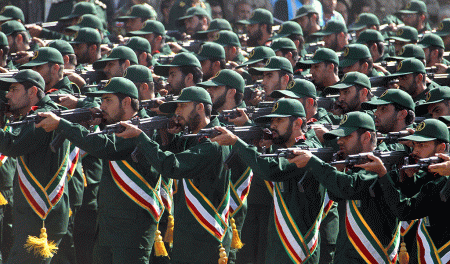
Iranian Revolutionary Guard Corps (Photo: © ATTA KENARE/AFP/Getty Images)

The new designation “freezes the IRGC out of the U.S. financial system” by making doing business with the IRGC (and essentially the entire Iranian military) forbidden.

Also included in the new designation are sanctions against three Iranian companies as well as a Chinese company that does business with the IRGC.

The new sanctions are expected to hit the Iranian economy hard and make other countries reluctant to do business with the IRGC as well, since foreign countries that do business with the IRGC also would be liable to stiff U.S. penalties.

The IRGC owns and controls much of the Iranian economy, from oil production to businesses and manufacturing.

**********************************

Acting on the direction of the Trump Administration, the U.S. Treasury slapped a new terror designation on Iran’s Islamic Revolutionary Guard Corps (IRGC) which will result in crippling new sanctions against the terror arm of the Iranian government.

“I am authorizing the Treasury Department to further sanction the entire Islamic Revolutionary Guard Corps for its support for terrorism, and to apply sanctions to its officials, agents and affiliates,” U.S. President Trump said. “I urge our allies to join us in taking strong actions to curb Iran’s continued dangerous and destabilizing behavior.”

Watch U.S. President Trump’s speech outlining his new Iran strategy

A previous designation enacted in 2007 had only sanctioned the IRGC’s Qods Force, the special forces unit of the Revolutionary Guards responsible for their extraterritorial operations. As noted by the Treasuring Department, the Qods Force provides support to a number of terrorist groups, including Hezbollah, Hamas and the Taliban; the IRGC, in turn, provides material support to Qods Force by providing training, personnel and military equipment for it.

The new designation “freezes the IRGC out of the U.S. financial system” by making doing business with the IRGC (and essentially the entire Iranian military) forbidden.

Also included in the new designation are sanctions against three Iranian companies as well as a Chinese company that does business with the IRGC.

The new sanctions are expected to hit the Iranian economy hard and make other countries reluctant to do business with the IRGC as well, since foreign countries that do business with the IRGC also would be liable to stiff U.S. penalties.

The IRGC owns and controls much of the Iranian economy, from oil production to businesses and manufacturing.

Although the designation — which is based on Executive Order 13224 instituted by the Bush Administration – falls short of designating the IRGC as a foreign terrorist organization. Yet, analysts say the effect in practical terms will be the same.

“I think of it as a distinction without a difference in terms of what the impact will be and how the Iranians are going to read it,” said Suzanne Maloney, deputy director of the foreign policy program at the Brookings Institution and a former State Department adviser on Iran, speaking to Vox.

At a press conference, Secretary of State Rex Tillerson explained the strategy. “There are particular risks and complexities to designating an entire army [as a foreign terrorist organization], so to speak, of a country where that then puts in place certain requirements where we run into one another in the battlefield that then triggers certain actions that we think are not appropriate and not necessarily in the best interest of our military,” he said.

In imposing the new sanctions, Secretary of the Treasury Steve Mnuchin stated, “The IRGC has played a central role to Iran becoming the world’s foremost state sponsor of terror.  Iran’s pursuit of power comes at the cost of regional stability, and Treasury will continue using its authorities to disrupt the IRGC’s destructive activities.

“We are designating the IRGC for providing support to the IRGC-QF (Qods Force), the key Iranian entity enabling Syrian President Bashar al-Assad’s relentless campaign of brutal violence against his own people, as well as the lethal activities of Hezbollah, Hamas, and other terrorist groups. We urge the private sector to recognize that the IRGC permeates much of the Iranian economy, and those who transact with IRGC-controlled companies do so at great risk.”

Iran-backed Iraqi ultimatum to Kurds to leave Kirkuk. First test for Trump’s threat to Rev Guards

Posted October 14, 2017 by danmillerinpanama
Categories: Iranian Revolutionary Guard, Iranian Revolutionary Guard terrorist designation, Iraq - Kurds, Kirkuk, Kurdish fighters, Kurdish independence

Tags: , , , , ,

Iran-backed Iraqi ultimatum to Kurds to leave Kirkuk. First test for Trump’s threat to Rev Guards, DEBKAfile, October 14, 2017

After Trump declared that the entire IRGC was guilty of terrorism, including all its agents and proxies – the Iraqi PMU militia would lay itself open to the definition of terrorists for attacking Kurdish forces, who are America’s frontline military ally in the war on the Islamic State in Iraq and Syria.

All eyes in the Middle East are watching to see how the Trump administration responds to such an attack if it takes place. Its non-response would be interpreted by Tehran as a license for its IRPG to keep going.

******************************

Iraqi Prime Minister Haydar Al-Abadi Saturday night, Oct. 14, gave the Kurdish Peshmerga an ultimatum to surrender the positions in the Kirkuk oil region they have held since pushing ISIS out three years ago, and also cancel the Kurdish Republic’s Sept. 25 independence vote.

The Kurdish troops were given until early Sunday to comply with those demands, in the face of heavily armed troops of the Iraqi army and Popular Mobilization Force (PMU), an arm of the Iranian Revolutionary Guards, massed around Kirkuk.

DEBKAfile’s intelligence sources reveal exclusively that the Iraqi prime minister issued this ultimatum under heavy pressure from al Qods chief Gen. Qassem Soleimani, of the Iranian Revolutionary Guards. He placed the PMU at Abadi’s disposal and any arms he might need for an operation to fight the Kurds, should they defy the ultimatum. They stand against thousands of The KRG fighters deployed around Kirkuk.

Over the weekend, both sides beefed up their military strength in and around Iraq’s northern oil city. Iraq has deployed to Kirkuk the PMU as well as special operations units to face a Peshmerga force of 9,000 fighters.

Just hours before the deadline, a Peshmerga commander on the western front said Kurdish fighters had “taken all the necessary measures” and were “ready for a confrontation” if necessary.

American forces, who maintain a small military team in Kirkuk for carrying messages between the opposing camps, proposed a number of compromises, but they were all rejected by the Iraqi prime minister.

Washington also notified Baghdad that the US would not tolerate military aggression against Irbil, capital of the KRG, Dohuk or Sulaymaniyah, or military incursions of Kirkuk, only a small party of civilian officials.

It is not clear whether Abadi will heed Washington’s directives. However, DEBKAfile’s sources stress that President Donald Trump’s speech Friday night, laying out a new, tough strategy for Iran and its Revolutionary Guards,  lent a potential military clash over Kirkuk a new perspective beyond a local conflict.

After Trump declared that the entire IRGC was guilty of terrorism, including all its agents and proxies – the Iraqi PMU militia would lay itself open to the definition of terrorists for attacking Kurdish forces, who are America’s frontline military ally in the war on the Islamic State in Iraq and Syria.

All eyes in the Middle East are watching to see how the Trump administration responds to such an attack if it takes place. Its non-response would be interpreted by Tehran as a license for its IRPG to keep going.

WIRED: Startup Nations ( Israel & Palestine )

Posted October 14, 2017 by Joseph Wouk
Categories: Uncategorized

Has distorted reality so as to be lefty correct. Nevertheless worth watching for its good analysis of Israel’s tech success.

From WIRED:

With the most tech startups and venture capital per capita in the world, Israel has long been hailed as The Startup Nation. WIRED’s feature-length documentary looks beyond Tel Aviv’s vibrant, liberal tech epicenter to the wider Holy Land region – the Palestinian territories, where a parallel Startup Nation story is emerging in East Jerusalem, Nazareth, Ramallah and other parts of the West Bank, as well as in the Israeli cybersecurity hub of Be’er Sheva. And we will learn how the fertile innovation ecosystem of Silicon Wadi has evolved as a result of its unique political, geographical and cultural situation and explore the future challenges – and solutions – these nations are facing.

Top Pentagon posts are 70 percent vacant as confirmations continue to lag

Posted October 14, 2017 by danmillerinpanama
Categories: Department of Defense, Senate Armed Services Committee, Trump Dept. of Defense nominees

Tags: , ,

Top Pentagon posts are 70 percent vacant as confirmations continue to lag, Washington ExaminerTravis J. Tritten, October 14, 2017

For now, the Pentagon may be fine holding the status quo without the 40 positions filled but the appointees will be needed to implement the agenda of Trump and Mattis.

“If you actually want to make changes, if you want to do things differently … you’ve got to have these political appointees and not just at the top but at all the various echelons,” Spoehr said.

************************

The slow pace of confirming Trump administration nominees shows no signs of abating at the Pentagon as mid-October rolls around and 70 percent of its top posts remain unfilled.

Just 17 of the 57 Pentagon positions that require Senate confirmation have been filled by President Trump’s appointees. That figure has barely budged in two months, leaving the military without a spectrum of leaders who can put the administration’s stamp on policy.

“I think we should be very concerned and informal reports I get from the Pentagon suggest that this is a problem, that this is not just like business as usual over there,” said Thomas Spoehr, the director of the Center for National Defense at the Heritage Foundation.

The White House, which had been slow to name nominees, rolled out three more names this week, including John Rood, a senior vice president at defense giant Lockheed Martin, for undersecretary of defense for policy.

In all, 23 of Trump’s nominees are somewhere in the confirmation pipeline, either named or awaiting action by the Senate, but 17 Pentagon-appointed positions still do not even have candidates named by the president.

The Senate Armed Services Committee, which has purview over vetting Defense Department nominees, has become a major bottleneck for Trump.

Sen. John McCain, R-Ariz., the committee chairman, has said he is holding Army secretary nominee Mark Esper, a top lobbyist for defense contractor Raytheon, and others because he wants the Trump administration to provide information on military operations in Afghanistan and Iraq.

McCain’s committee has not held a confirmation hearing — other than for the reappointment of Joint Chiefs Chairman Gen. Joseph Dunford — since July. Of the 23 nominees somewhere in the confirmation process, 16 of those are currently parked at the Armed Services Committee.

Defense Secretary Jim Mattis and Dunford both testified to Armed Services on Oct. 3 about the situation in Afghanistan.

But the committee, which was out of town along with the rest of the Senate over the past week, had not moved on any nominees. No hearing for Esper had been scheduled by Friday.

Spoehr said McCain and his committee could potentially approve the waiting Trump nominees quickly, vetting four or so per hearing.

For now, the Pentagon may be fine holding the status quo without the 40 positions filled but the appointees will be needed to implement the agenda of Trump and Mattis.

“If you actually want to make changes, if you want to do things differently … you’ve got to have these political appointees and not just at the top but at all the various echelons,” Spoehr said.

Iran, Turkey, & Iraq move to “crush” Kurds, Christians

Posted October 14, 2017 by danmillerinpanama
Categories: Christians, Iran and Kurds, Iraq - Kurds, Kurdish independence, Kurdish state, Turkey and Kurds

Tags: , , , , ,

Iran, Turkey, & Iraq move to “crush” Kurds, Christians, Rebel Media via YouTube, October 14, 2017