It’s time to deploy US ships off North Korea to knock out missiles when they’re launched

Posted October 14, 2017 by danmillerinpanama
Categories: North Korean missiles, North Korean nukes, U.S. Military

Tags: , ,

It’s time to deploy US ships off North Korea to knock out missiles when they’re launched, Fox News, Michael Fabey, October 14, 2017

(Please see also, N.K. missiles mounted on TEL being transported in 3 to 4 regions

The Ohio-class USS Michigan, an 18,000-metric ton submarine, arrived in the South Korean port of Busan Friday. The USS Ronald Reagan also arrived here in South Korea for a joint drill with South Korean military, which will be held in the East and West sea off South Korea from Oct 16 to 20, to prepare for the North’s naval provocations. As many as 40 navy vessels, including the Aegis destroyer and submarines, combat aircrafts, attack helicopters and JSTARS will be deployed for the joint drill. “The North may carry out a simultaneous launch of ICBM and IRBM within a few days in protest against the U.S.’s show of military might,” another source said.

— DM)

North Korea renewed its threat Friday to fire ballistic missiles in the direction of the American territory of Guam, following ominous earlier threats by the rogue regime to launch missiles topped with hydrogen bombs to wipe out cities on the continental United States.

We need to be prepared to defend against new North Korean missile launches – and there is a way to do this short of full-scale war.

One U.S. military option would be to deploy a special team of two or three guided-missile destroyers – ships especially equipped to target, track and shoot down ballistic missiles – to strategic locations off the North Korean coastline. The ships would be positioned outside the 12-mile internationally recognized maritime territorial limit, or at other locations that intelligence indicates would be effective.

Sources intimately familiar with the operations and deployments of those destroyers – and the vast capabilities of their top-secret ballistic missile defense systems – tell me such a plan could work. They say a similar strategy is one of the military options being considered at the Pentagon and at U.S. Pacific Command headquarters in Hawaii. At the very least, this action would increase the costs to North Korea of continuing its missile program.

Erecting what amounts to a destroyer “fence” to contain North Korean missiles and knock them out of the sky might seem like a farfetched scheme. Can a handful of small warships really perform such a huge task?

America’s ballistic missile defense warships are outfitted with systems and weapons that have been proven in rigorous testing, including SM-3 missile interceptors. Since 2002, the Aegis combat system – a powerful weapons system used by the U.S. Navy that utilizes computer and radar technology to find, track and destroy enemy targets – has recorded 35 successful ballistic-missile intercepts in 42 test attempts. And in the last dozen tests, the SM-3s have only missed once.

While U.S. tests of our missile defense system are admittedly choreographed, the characteristics of a targeted ballistic missile in a test situation closely match those of a missile that has been deployed with bad intentions.

Nearly all of the tests pit a single U.S. missile interceptor against a single ballistic missile. Against an actual launch, the Navy could send up numerous interceptors, dramatically increasing its chances for a hit.

Up to now, North Korea has failed to prove it has the capability to launch and control a sufficiently large salvo of missiles to overwhelm a single Aegis ballistic missile defense ship, let alone two or three. Some experts speculate that North Korea, slowed as it is by international economic sanctions, might not develop that capacity until near the end of the decade or beyond.

The U.S. missile destroyers that could be formed into a team and used to knock down North Korean missiles overhead would be those outfitted with the latest version of the four-decades-old Aegis combat system. The newest series of upgrades was certified in January 2015.

All U. S. Navy destroyers and cruisers possess Aegis combat systems, which were first developed to protect ships – especially aircraft carriers – against air threats such as cruise missiles and aircraft.

However, ballistic missile defense requires different sensor settings, algorithms and missiles. Only 40 percent of the U.S. Navy’s Aegis-equipped destroyers and cruisers are designed for ballistic missile defense.

The ballistic missile defense ships depend on SM-3 missile interceptors to blow apart enemy ballistic missiles relatively soon after they enter what’s called flight midcourse, at their most vulnerable point where the atmosphere ends. This starts about 400 miles above the Earth’s surface and extends out to a few thousand miles.

SM-3s have no explosive warhead. Instead they work through sheer force, colliding with the targeted missile with the power of a 10-ton truck traveling 600 miles per hour. For very short-range missiles, SM-2 interceptors can potentially be used. New interceptors, called SM-6s, are being tested that are designed to hit longer-range ballistic missiles later in flight as they descend and re-enter the atmosphere.

Every ballistic missile defense destroyer has the capacity to launch up to 96 missiles. Each ship would have to retain some Aegis capacity for self-defense and that missile number would depend on the mission.

For argument’s sake, assume a destroyer making up part of the “fence” could aim 80 interceptors at a launched North Korean missile. That would mean two ships could unleash a fusillade of 160 missiles and three ships could fire 240. If North Korea were to triple its single-day launch rate, which with sanctions seems extremely difficult, it could possibly send a dozen missiles aloft. In that case, the odds still favor the Aegis interceptors.

Recently North Korea has focused mainly on short- and medium-range missile tests. The North has yet to prove it can launch an intercontinental ballistic missile armed with a payload that can reach the United States, despite its boasts.

If Pyongyang does deploy such missiles and they break though the fence created by U.S. ships and head toward America, the U.S. Air Force could meet them with a total of 36 ground-based interceptors launched from Fort Greely in Alaska and Vandenberg Air Force Base in California. Those interceptors have hit targets in 10 of 18 tests, including the last two in June 2014 and May this year.

To execute such an aggressive plan for an Aegis-ship ballistic missile defense, some parts of which appear to be already in the works, the U.S. would have to place even greater focus on ballistic missile defense missions. American fleet commanders will need to make sure destroyer captains improve their skill in basic seamanship – a proficiency called into question after the Navy recently lost two of its valuable ballistic missile defense destroyers in collisions with commercial ships.

An important step in making the fence operational would be for the U.S. to adopt rules of engagement that allow the Navy destroyers to shoot down North Korean missiles as soon as leave the country’s airspace. Current rules only allow for tracking and monitoring.

If an SM-3 misses, there’s little concern of collateral damage. The interceptor would burn up harmlessly as it reentered the Earth’s atmosphere. Even if an interceptor collided with a nuclear warhead there would likely be no nuclear explosion, experts say.

While North Korea could be counted on to rail at the “recklessness” of an Aegis interceptor taking out one of its missiles, the hornet’s nest would be stirred up far less than in the case of a U.S. invasion of North Korea’s territory or attack on a land target.  In the latter two cases, the North Korean reprisal might be catastrophic, inflicting heavy casualties in South Korea.

If the moment for the destroyer fence to show its capability ever arrives, the U.S. Navy will have to make absolutely certain its missile-killing missiles don’t miss. North Korea would only feel emboldened if its greatest adversary seemed not up to the task of backing up its rhetoric with effective action.

Of course, a destroyer fence is only a short-term fix. North Korea will build more missiles and it’s only a matter of time before more countries acquire such weapons.

In the longer term, the Navy should consider upgrading more ships for ballistic missile defense.  The Navy should also push forward an idea broached by shipbuilder Huntington Ingalls Industries to develop a missile-defense variant of the San Antonio-class amphibious transport dock ship that can be fitted out with a massive strategic antimissile battery of more than 400 interceptors or other missiles.

Similarly, more thought should be given to accelerating testing and deployment of systems that support and enable Aegis. These include the SBX-1 – a huge golf ball-shaped radar dome mounted on an oil platform that can track ballistic missiles – and additional satellites that can be used to track intercontinental ballistic missiles as they travel through space.

With bold use of proven, off-the-shelf missile-defense technology, the U.S. can turn the tables on Pyongyang, neutralizing its strategic missile threat without launching a war. The goal would be to buy enough time for cooler heads to prevail.
Trump refuses to certify the Iran-scam deal

Posted October 14, 2017 by Joseph Wouk
Categories: Uncategorized

God’s speed…


Why There Is No Peace in the Middle East

Posted October 14, 2017 by danmillerinpanama
Categories: Islam and the West, Islamic hatred of others, Islamic history, Islamic honor, Islamic tribalism, Islamist objectives, Islamist victimhood, Middle East, Middle East prospects, Middle East violence, Tribal culture

Tags: , , , , , , , , , ,

Why There Is No Peace in the Middle East, Gatestone Institute, Philip Carl Salzman, October 14, 2017

Many Middle Easterners see the disasters around them, and blame outsiders: “It is the fault of the Jews”; “The British did this to us”; “The Americans are to blame.”[5] Many Western academics and commentators say the same, dignifying this counter-historic theory with the label “postcolonialism.” But given that tribal dynamics were dominant in the region for a thousand years since the foundation of Islam, and thousands of years before that, blaming outsiders for regional dynamics is hardly credible. Nonetheless, “postcolonialists” will claim that pointing to regional culture as the foundation of regional dynamics is “blaming the victim.” We in the West, unlike Middle Easterners, love “victims.” But what if Middle Easterners are victims of the limitations and shortcomings of their own culture?

***********************************

Peace is not possible in the Middle East because values and goals other than peace are more important to Middle Easterners. Most important to Middle Easterners are loyalty to kin, clan, and cult, and the honour that is won by such loyalty.

There was no group and no loyalty above the tribe or tribal confederation until the rise of Islam. With Islam, a new, higher, more encompassing level of loyalty was defined. All people were divided between Muslims and infidels, and the world was divided between the Dar al-Islam, the land of believers and peace, and Dar al-harb, the land of unbelievers and war. Following the tribal ideology of loyalty, Muslims should unite against infidels, and would receive not only honour, but heavenly rewards.

Honour is gained in victory. Losing is regarded as deeply humiliating. Only the prospects of a future victory and the regaining of honour drives people forward. An example is the Arab-Israel conflict, in the course of which the despised Jews repeatedly defeated the armies of Arab states. This was not so much a material disaster for the Arabs, as it was a cultural one in which honor was lost. The only way to regain honor is to defeat and destroy Israel, the explicit goal of the Palestinians: “from the [Jordan] river to the [Mediterranean] sea.” This why no agreement over land or boundaries will bring peace: peace does not restore honor.

We in the West, unlike Middle Easterners, love “victims.” But what if Middle Easterners are victims of the limitations and shortcomings of their own culture?

Living as an anthropologist in a herding camp of the Yarahmadzai tribe of nomadic pastoralists in the deserts of Iranian Baluchistan clarified some of the inhibitions to peace in the Middle East. What one sees is strong, kin-based, group loyalty defense and solidarity, and the political opposition of lineages, whether large or small.[1] This raised the question how unity and peace could arrive in a system based on opposition.

Peace is not possible in the Middle East because values and goals other than peace are more important to Middle Easterners. Most important to Middle Easterners are loyalty to kin, clan, and cult, and the honour which is won by such loyalty. These are the cultural imperatives, the primary values, held and celebrated. When conflict arises and conflict-parties form based on loyal allegiance, the conflict is regarded as appropriate and proper.

The results of absolute commitment to kin and cult groups, and the structural opposition to all others, can be seen throughout Middle Eastern history, including contemporary events, where conflict has been rife. Turks, Arabs and Iranians have launched military campaigns to suppress Kurds. Meanwhile, Christians, Yazidis, Baha’is and Jews, among others, have been, and continue to be ethnically cleansed. Arabs and Persians, and Sunnis and Shiites, each try to gain power over the other in a competition that has been one of the main underlying factors of the Iraq-Iran war, the Saddam Hussein regime, and the current catastrophe in Syria. Turks invaded Greek Orthodox Cyprus in 1974 and have occupied it since. Multiple Muslim states have invaded the minuscule Jewish state of Israel three times, and Palestinians daily celebrate the murder of Jews.

Some Middle Easterners, and some in the West, prefer to attribute the problems of the Middle East to outsiders, such as Western imperialists, but it seems odd to suggest that the local inhabitants have no agency and no responsibility for their activities in this disastrous region, high not only in conflict and brutality, but low by all world standards in human development.

If one looks to local conditions to understand local conflicts, the first thing to understand is that Arab culture, through the ages and at the present time, has been built on the foundation of Bedouin tribal culture. Most of the population of northern Arabia at the time of the emergence of Islam was Bedouin, and during the period of rapid expansion following the adoption of Islam, the Arab Muslim army consisted of Bedouin tribal units. The Bedouin, nomadic and pastoral for the most part, were formed into tribes, which are regional defense and security groups.[2]

Bedouin tribes were organized by basing groups on descent through the male line. Close relatives in conflict activated only small groups, while distant relatives in conflict activated large groups. If, for example, members of cousin groups were in conflict, no one else was involved. But if members of tribal sections were in conflict, all cousins and larger groups in a tribal section would unite in opposition to the other tribal section. So, what group a tribesmen thought himself a member of was circumstantial, depending on who was involved in a conflict.

Relations between descent groups were always oppositional in principle, with tribes as a whole seeing themselves in opposition to other tribes. The main structural relation between groups at the same genealogical and demographic level could be said to be balanced opposition. The strongest political norm among tribesmen was loyalty to, and active support of, one’s kin group, small or large. One must always support closer kin against more distant kin. Loyalty was rewarded with honour. Not supporting your kin was dishonourable. The systemic result was often a stand-off, the threat of full scale conflict with another group of the same size and determination acting as deterrence against frivolous adventures. That there were not more conflicts than the many making up tribal history, is due to that deterrence.

There was no group and no loyalty above the tribe or tribal confederation until the rise of Islam. With Islam, a new, higher, more encompassing level of loyalty was defined. All people were divided between Muslims and infidels, and the world was divided between the Dar al-Islam, the land of believers and peace, and Dar al-harb, the land of unbelievers and war. Following the tribal ideology of loyalty, Muslims should unite against infidels, and would receive not only honour, but heavenly rewards.

Honour is gained in victory.[3] Self-sacrifice in the attempt is lauded, but honour comes from winning. Having lost and being a victim is not an esteemed position in Arab society. Having lost in a political struggle results in loss of honour. This is felt deeply as a loss that should be corrected. Losing is regarded as deeply humiliating. Only the prospects of a future victory and the regaining of honour drives people forward. An example is the Arab-Israel conflict, in the course of which the despised Jews repeatedly defeated the armies of Arab states. This was not so much a material disaster for the Arabs, as it was a cultural one in which honour was lost. The only way to regain honour is to defeat and destroy Israel, the explicit goal of the Palestinians: “from the [Jordan] river to the [Mediterranean] sea.” This why no agreement over land or boundaries will bring peace: peace does not restore honour.

None of this is unknown to Arab commentators, who repeatedly refer to the tribal nature of their culture and society. Of course, today, few Middle Easterners live in tents and raise camels, but villagers and urbanites share the same tribal assumptions and values. According to the Tunisian intellectual Al-Afif al-Akhdar, the Arabs cherish their “deep-culture of tribal vengefulness” and consequent “fixated, brooding, vengeful mentality.”[4] Former Tunisian President Moncef Marzouki has said that “We need an ideological revolution; our tribal mentality has destroyed our society.”

Dr. Salman Masalha, an Israeli Druze literary intellectual, argues:

“The tribal nature of Arab societies is deeply embedded in the past, and its roots date back through Arab history to the pre-Islamic era. … Since Arab societies are tribal in nature, the various forms of monarchies and emirates are the natural continuation of this ingrained social structure in which tribal loyalty comes before all else.”

Mamoun Fandy, an Egyptian-born American scholar, wrote in the Saudi newspaper Asharq Al-Awsat:

“The Arabs, even after the arrival of Islam, were never “ideological” people who sought to develop an intellectual vision of ourselves and the outside world. Instead, we are the people of blood relations and family ties, or “Shalal” as we call it in Egypt. … Despite the fact that Islam was the greatest intellectual revolution in our history, we, as Arabs, have succeeded in adapting Islam to serve the tribe, the family, and the clan. Islamic history began as an intellectual revolution, and as a history of ideas and countries; however, after the beginning of the Orthodox Caliphate, it was transformed into a somewhat tribal state. The State of Islam became the Umayyad State, and after that the Abbasid, the Fatimid, and so on and so forth. This means that we now have a history of tribes instead of a history of ideas. … Has this tribal history, alongside tribal and family loyalties and the priority of blood relations over intellectual relations gone forever after the “Arab spring?” Of course not; what has happened is that the families and tribes have dressed themselves up in the cloak of revolutions in Yemen and in Libya, and in Egypt the opposition consists of tribes rather than concepts.”

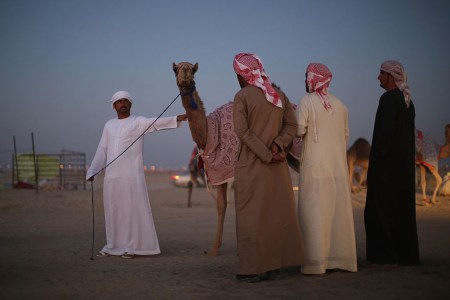
Pictured: Bedouin men in Abu Dhabi. (Photo by Dan Kitwood/Getty Images)

The history of the Middle East, the centuries of tribal wars, and the ongoing fissures in Arab society all testify to the Arab tribal culture and structural opposition. There may have been good reasons to stick with tribal culture and organization in pre-modern times: states and empires were despotic, exploitative, and heavily dependent on slave-labor, and tribal organization gave some people a chance to remain independent. In recent times, with the modern state model, governments in the Middle East have tried to establish states, but these have foundered on tribal loyalties and oppositions, which do not fit with constitutional states. Rulers in the region have all turned to coercion to maintain their positions, making all Muslim states in the region despotic.

Many Middle Easterners see the disasters around them, and blame outsiders: “It is the fault of the Jews”; “The British did this to us”; “The Americans are to blame.”[5] Many Western academics and commentators say the same, dignifying this counter-historic theory with the label “postcolonialism.” But given that tribal dynamics were dominant in the region for a thousand years since the foundation of Islam, and thousands of years before that, blaming outsiders for regional dynamics is hardly credible. Nonetheless, “postcolonialists” will claim that pointing to regional culture as the foundation of regional dynamics is “blaming the victim.” We in the West, unlike Middle Easterners, love “victims.” But what if Middle Easterners are victims of the limitations and shortcomings of their own culture?

Philip Carl Salzman is Professor of Anthropology at McGill University, Canada.


[1] Philip Carl Salzman, Black Tents of Baluchistan, Washington, DC: Smithsonian Institution Press, 2000.

[2] Philip Carl Salzman, Culture and Conflict in the Middle East, Amherst, NY: Humanity Books, 2008.

[3] Frank Henderson Stewart, Honor, Chicago: University of Chicago Press, 1994.; Gideon M. Kressel, Ascendancy through Aggression, Wiesbaden: Harrassowitz, 1996.

[4] Quoted in Barry Rubin, The Long War for Freedom: The Arab Struggle for Democracy in the Middle East (Hoboken, NY: Wiley, 2006), 80-81.

[5] Ayaan Hirsi Ali, Infidel, NY: Free Press, 2007, p. 47.

N.K. missiles mounted on TEL being transported in 3 to 4 regions

Posted October 14, 2017 by danmillerinpanama
Categories: North Korean missiles, North Korean nukes, South Korean military, U.S. Military

Tags: , , ,

N.K. missiles mounted on TEL being transported in 3 to 4 regions, Dong-A-Ilbo, October 14, 2017

South Korean and American intelligence agencies are gearing up for North Korea’s another provocation as the transport and deployment of transporter-erecter-launcher (TEL) has been spotted in three to four regions in North Korea.

According to a government source Friday, a U.S. satellite recently captured images of North Korean ballistic missiles mounted on TEL being transported out of a hangar to somewhere in areas near Pyongyang and North Pyongan Province. Korean and U.S. military officials are keeping an eye on the situation as they view this as a sign of preparation for the launch of a missile comparable to Hwasong-14 inter-continental ballistic missile (ICBM) or Hwasong-12 intermediate-range ballistic missile (IRBM). Another probability is the North might be preparing for the launch of a new Hwasong-13 ICBM (solid engine) that has a longer maximum range than Hwasong-14.

Initially, it was expected that the North will carry out provocative actions on Tuesday, celebrating the anniversary of its ruling party’s foundation. Sources claim that the North will push ahead with another missile provocation in response to the deployment of U.S. carrier strike group and nuclear-powered submarine to the Korean Peninsula.

The Ohio-class USS Michigan, an 18,000-metric ton submarine, arrived in the South Korean port of Busan Friday. The USS Ronald Reagan also arrived here in South Korea for a joint drill with South Korean military, which will be held in the East and West sea off South Korea from Oct 16 to 20, to prepare for the North’s naval provocations. As many as 40 navy vessels, including the Aegis destroyer and submarines, combat aircrafts, attack helicopters and JSTARS will be deployed for the joint drill. “The North may carry out a simultaneous launch of ICBM and IRBM within a few days in protest against the U.S.’s show of military might,” another source said.

PM Netanyahu statement [re President Trump’s decertification of Iran scam]

Posted October 13, 2017 by danmillerinpanama
Categories: Netanyahu and Iran, Netanyahu on Trump's decertification of JCPOA

Tags: ,

PM Netanyahu statement via YouTube, October 13, 2017

Initial Thoughts on Trump’s Iran Speech: Do All Roads Lead to a Pull-out?

Posted October 13, 2017 by danmillerinpanama
Categories: Iran scam termination, Trump and Iran, Trump and Iran scam, U.S. Congress and Iran, U.S. Congress and Iran scam

Tags: , , , ,

Initial Thoughts on Trump’s Iran Speech: Do All Roads Lead to a Pull-out?, Power LinePaul Mirengoff, October 13, 2017

If we take Trump’s speech at face value, it seems to me that all roads lead to terminating the deal. If Congress doesn’t act, Trump says he will terminate the deal.

**********************

President Trump has just given an address that outlines how he plans to proceed against Iran. The two main points are: (1) he will impose new sanctions to punish Iran’s Revolutionary Guard and (2) he will not certify the Iran nuclear deal.

The refusal to certify means that Congress has 60 days to act. Trump is asking it to adopt legislation, apparently already formulated, that would remedy the flaws in the Iran deal.

This legislation would become the basis for attempting, if possible with the help of our allies, to renegotiate (in effect) key terms of the deal with Iran. In the negotiations we would, among other things, try to improve the inspection regime and eliminate the sunset provisions (the ones that allow Iran eventually develop nukes).

Crucially, it seems to me on first analysis, Trump said that if Congress doesn’t act along these lines in 60 days, he will “terminate” the deal. The president thus attempts to light a fire under a Congress which, absent his threat, almost certainly would not act. He also attempts to light a fire under our allies who seemingly have no real desire to renegotiate with Iran.

If we take Trump’s speech at face value, it seems to me that all roads lead to terminating the deal. If Congress doesn’t act, Trump says he will terminate the deal.

If Congress acts, it can’t rewrite the deal. All it can do is formulate demands that, if not met by Iran, will result in termination, assuming Trump follows the hard line he took today.

If faced with congressional action and presidential resolve, Iran might agree to certain minor fixes to the deal. But it’s difficult for me to imagine the regime agreeing, for example, to drop the sunset clause.

Only a restoration of the crippling sanctions once in place would have any hope of achieving this result. But that hope would be faint. In any event, it’s unlikely that we could ever rally our allies to impose the truly crippling sanctions that former president Obama lifted.

If my preliminary analysis is correct, then Trump has taken the first step towards pulling the U.S. out of the Iran deal. He has done more, in other words, than just “splitting the baby” — i.e, satisfying hawks by decertifying and satisfying moderates by not pulling out of the deal or enlisting Congress for that purpose. If we take the speech at face value, we are on the road to pulling out.

The “compromise,” is that we are doing so in a measured way — one that is less easy for Democrats and U.S. allies persuasively to denounce. Trump is enlisting their aid by asking them to participate in a process that, in theory, could improve the deal to the point where the U.S. would stay in it.

In practice, the likelihood of substantially improving the deal seems slight. However, it is reasonable for Trump to give it a try, and reasonable for Democrats and our allies to participate in the effort.

I’ll conclude by saying that Trump’s speech was outstanding. In 20 minutes or so, he laid out the history of Iran’s evil-doing; excoriated the Iran deal Obama agreed to; and laid out his course of action going forward.

Will the administration follow that course or will key members persuade Trump to employ off-ramps? It’s difficult to say, or even to guess who the key members of the administration will be down the road. I’m inclined, though, to think that Trump will follow the course he laid out so solemnly today.

These observations are preliminary ones. I’m sure we’ll have more to say upon further reflection.

Trump designates Iran Revolutionary Guard Corps as a terrorist group, calls for more sanctions

Posted October 13, 2017 by danmillerinpanama
Categories: Iranian Revolutionary Guard terrorist designation

Tags:

Trump designates Iran Revolutionary Guard Corps as a terrorist group, calls for more sanctions, Washington ExaminerJoel Gehrke, October 13, 2017 

(Iran considers designation of the IRGC as a terrorist group as tantamount to a declaration of war. — DM)

As Trump spoke from the White House, the Treasury Department announced it was designating the IRGC as a terrorist entity under a White House Executive Order. That announcement said the group provides “support to a number of terrorist groups, including Hizballah and Hamas, as well as to the Taliban.”

**************************

The Trump administration on Friday designated Iran’s Islamic Revolutionary Guard Corps as a terrorist organization, a move that President Trump followed up with by calling for tougher sanctions against the organization.

“I am authorizing the Treasury Department to further sanction the entire Islamic Revolutionary Guard Corps for its support for terrorism and to apply sanctions to its officials, agents, and affiliates,” Trump said in a White House speech.

“I urge our allies to join us in taking strong actions to curb Iran’s continued dangerous and destabilizing behavior,” Trump added.

“The IRGC has played a central role to Iran becoming the world’s foremost state sponsor of terror,” Treasury Secretary Steven Mnuchin said Friday. “We urge the private sector to recognize that the IRGC permeates much of the Iranian economy, and those who transact with IRGC-controlled companies do so at great risk.”

As Trump spoke from the White House, the Treasury Department announced it was designating the IRGC as a terrorist entity under a White House Executive Order. That announcement said the group provides “support to a number of terrorist groups, including Hizballah and Hamas, as well as to the Taliban.”

Congress Seeks Deadline on Iran Accepting Tougher Nuclear Deal Standards

Posted October 13, 2017 by danmillerinpanama
Categories: Iran - sanctions, Iran - sanctions enforcement, Iran - secret agreements, Iran - self-inspection, Iran - world's worst sponsor of terrorism, Iran and JCPOA, Iran nuke inspections, Iran's undeclared nuke sites, Iranian military sites, Iranian missiles, Iranian nukes, Iranian Revolutionary Guard, JCPOA compliance certification, U.S. Congress and Iran

Tags: , , , , , , , , , , , , ,

Congress Seeks Deadline on Iran Accepting Tougher Nuclear Deal Standards, Washington Free Beacon, October 13, 2017

Rep. Peter Roskam / Getty Images

Roskam’s legislation would mandate that Iran permit unfettered, unannounced, and indefinite access to all of Iran’s contested nuclear sites, including military spots that have been completely off-access to international nuclear inspectors.

Iran opposes such proposals, claiming that its military sites will never been opened to the international community.

*************************************

Congress is set to consider new legislation that would require Iran to accept tough new conditions on the landmark nuclear deal or face a rash of harsh new economic sanctions aimed at thwarting the Islamic Republic’s continued nuclear buildup, according to a draft of new legislation exclusively viewed by the Washington Free Beacon.

On the heels of President Donald Trump’s announcement that he will decertify Iranian compliance with the nuclear agreement, top GOP lawmakers are already working on legislation that would compliment the White House’s announcement and move forward with efforts to harshly penalize Tehran if it does not accept rigid new standards on its nuclear activities within the next six months, according to a copy of draft legislation circulating in the House of Representatives.

The new legislation, spearheaded by Rep. Peter Roskam (R., Ill.), would reimpose all economic sanctions lifted by the former Obama administration as part of the nuclear agreement if Iran refuses to comply with tough new standards restricting its ballistic missile program, arms buildup, and failure to permit access to a range of military sites suspected of engaging in nuclear work.

The legislation also would effectively kill provisions of the nuclear agreement known as sunset clauses. These are portions of the deal that would rollback restrictions on Iran’s advanced nuclear research and weapons buildup within the next five to six years.

Trump, as well as allies in Congress, maintains the original nuclear accord contains several key flaws that permit Iran to cheat on the deal and receive sweetheart bonuses—such as sanctions relief and other assets—despite evidence of multiple violations of the agreement.

Sources who spoke to the Free Beacon about the effort to tighten the deal said that many in Congress would be willing to reimpose all key sanctions on Iran if it does not agree to abide by the stricter enforcement regulations.

“The days of appeasing the Mullah’s every wish and sitting back and watching as the terrorist state goes nuclear are over,” said one senior congressional official intimately familiar with the new proposal. “Congress overwhelmingly opposed Obama’s disastrous deal with Iran. Now’s the time to assert our constitutional responsibility to defend our nation and use all tools of U.S. power to permanently prevent an nuclear armed Iran.”

This new legislation is similar to the policy approach advocated by senior Trump administration officials, such as Secretary of State Rex Tillerson, who told reporters late Thursday the administration is looking to create a parallel nuclear deal that gives Congress a larger role in ensuring Iranian compliance.

These would include “trigger points that are specific to the nuclear program itself, but also deals with things like their ballistic missile program,” according to Tillerson.

Roskam’s new legislation, called the JCPOA Improvement Act of 2017, seeks to do precisely this.

In addition to banning Iran from developing, testing, and operating ballistic missile technology—which was never addressed in the original nuclear agreement – the new legislation would impose even stricter regulations on the amount of nuclear enrichment Iran can legally engage in.

It also would stop Iran from installing advanced nuclear centrifuges that can enrich uranium, the key component in a nuclear weapon, much faster than older versions of this equipment. Under the original nuclear agreement, known as the Joint Comprehensive Plan of Action, or JCPOA, Iran would have been granted the right to operate advanced centrifuges within the next several years.

Congress also is seeking to address Iran’s development of heavy water nuclear reactors that provide a secondary pathway to a nuclear weapon via the use of plutonium, a by-product of such equipment, according to the draft legislation and sources who spoke to the Free Beacon.

The Obama administration had worked to ensure that, under the agreement, Iran retained its right to operate such reactors, despite opposition in Congress and elsewhere. Iran has already inked several deals with Russia to assist in the construction of new light and heavy water reactors, though this new legislation could complicate that matter.

Another key portion of the original agreement that has been vehemently criticized by Trump and congressional allies surrounds caveats that give Iran more than a month before consenting to inspections of its nuclear sites.

Roskam’s legislation would mandate that Iran permit unfettered, unannounced, and indefinite access to all of Iran’s contested nuclear sites, including military spots that have been completely off-access to international nuclear inspectors.

Iran opposes such proposals, claiming that its military sites will never been opened to the international community.

If Iran does not agree to the new restrictions proposed in the legislation, Congress has the ability to reimpose all sanctions that were lifted as part of the original accord. This represents a major new tool for Congress as it works to thwart Iran’s continued military endeavors across the Middle East and its pursuit of advanced new weaponry.

Under the new legislation, any future attempt to rescind these new restrictions would be subject to a vote in the United Nations Security Council, according to the bill.

WATCH LIVE: President Trump announces decision on Iran deal

Posted October 13, 2017 by danmillerinpanama
Categories: Trump and Iran, Trump and Iran scam

Tags: ,

WATCH LIVE: President Trump announces decision on Iran deal, PBS via YouTube, October 13, 2017

Full Text | President Donald J. Trump’s New Strategy on Iran

Posted October 13, 2017 by danmillerinpanama
Categories: Trump strategy for Iran

Tags:

President Donald J. Trump’s New Strategy on Iran, Whitehouse.gov, October 13, 2017

“It is time for the entire world to join us in demanding that Iran’s government end its pursuit of death and destruction.” – President Donald J. Trump

President Donald J. Trump, in consultation with his national security team, has approved a new strategy for Iran. It is the culmination of nine months of deliberation with Congress and our allies on how to best protect American security.

HIGHLIGHTS

Core Elements of the President’s New Iran Strategy

• The United States’ new Iran strategy focuses on neutralizing the Government of Iran’s destabilizing influence and constraining its aggression, particularly its support for terrorism and militants.

• We will revitalize our traditional alliances and regional partnerships as bulwarks against Iranian subversion and restore a more stable balance of power in the region.

• We will work to deny the Iranian regime – and especially the Islamic Revolutionary Guard Corps (IRGC) – funding for its malign activities, and oppose IRGC activities that extort the wealth of the Iranian people.

• We will counter threats to the United States and our allies from ballistic missiles and other asymmetric weapons.

• We will rally the international community to condemn the IRGC’s gross violations of human rights and its unjust detention of American citizens and other foreigners on specious charges.

• Most importantly, we will deny the Iranian regime all paths to a nuclear weapon.

BACKGROUND

The Nature of the Iranian Regime under Supreme Leader Khamenei

• For 28 years, Ali Khamenei has been Iran’s Supreme Leader. Before that, he held the office of President for 8 years. In that time, he has shaped the Iranian regime in his image.

• Khamenei and the IRGC have pursued a steady policy of spreading a revolutionary ideology aimed at undermining the international system and many states by force and subversion. His main enemy and rallying point has been and continues to be the United States of America, which he calls the Great Satan.

• Under Khamenei, Iran exports violence, destabilizes its neighbors, and sponsors terrorism abroad. Within Iran, under Khamenei’s rule the Iranian government has oppressed its people, abusing their rights, restricting their access to the internet and the outside world, rigging elections, shooting student protesters in the street, and imprisoning political reformers like Mir Hussein Musavi and Mehdi Karroubi.

The Threats from the Iranian Regime

• The reckless behavior of the Iranian regime, and the IRGC in particular, poses one of the most dangerous threats to the interests of the United States and to regional stability.

• The Iranian regime has taken advantage of regional conflicts and instability to aggressively expand its regional influence and threaten its neighbors with little domestic or international cost for its actions.

• This occurred most recently following the emergence of the Islamic State of Iraq and Syria (ISIS) from the vacuum created by the Obama administration’s ill-considered withdrawal from the region.

• The full range of the Iranian regime’s malign activities extends well beyond the nuclear threat it poses, including:

o Ballistic missile development and proliferation;

o Material and financial support for terrorism and extremism;

o Support for the Assad regime’s atrocities against the Syrian people;

o Unrelenting hostility to Israel;

o Consistently threatening freedom of navigation, especially in the strategically vital Persian Gulf;

o Cyber-attacks against the United States, Israel, and America’s other allies and partners in the Middle East;

o Grievous human rights abuses; and

o Arbitrary detention of foreigners, including United States citizens, on specious charges and without due process.

The Need for a Comprehensive Strategy

• The previous Administration’s myopic focus on Iran’s nuclear program to the exclusion of the regime’s many other malign activities allowed Iran’s influence in the region to reach a high-water mark.

• Over the last decade and a half, United States policy has also consistently prioritized the immediate threat of Sunni extremist organizations over the longer-term threat of Iranian-backed militancy.

• In doing so, the United States has neglected Iran’s steady expansion of proxy forces and terrorist networks aimed at keeping its neighbors weak and unstable in hopes of dominating the greater Middle East. Recently, the Iranian regime has accelerated the seeding of these networks with increasingly destructive weapons as they try to establish a bridge from Iran to Lebanon and Syria.

• The Trump Administration will not repeat these mistakes.

• The Trump Administration’s Iran policy will address the totality of these threats from and malign activities by the Government of Iran and will seek to bring about a change in the Iranian’s regime’s behavior.

• The Trump Administration will accomplish these objectives through a strategy that neutralizes and counters Iranian threats, particularly those posed by the IRGC.

Countering the IRGC

• Supreme Leader Khamenei’s primary tool and weapon in remaking Iran into a rogue state has been the hardline elements of the IRGC.

• The IRGC’s stated purpose is to subvert the international order. The IRGC’s power and influence have grown over time, even as it has remained unaccountable to the Iranian people, answering only to Khamenei. It is hard to find a conflict or a suffering people in the Middle East that the IRGC’s tentacles do not touch.

• Unaccountable to Iran’s elected leaders or its people, the IRGC has tried to gain control over large portions of Iran’s economy and choke off competition, all the while working to weaken and undermine Iran’s neighbors and perpetuate the chaos and instability in which it thrives.

• The IRGC has armed Bashar al Assad and guided his butchering of his own people in Syria and has cynically condoned his use of chemical weapons.

• The IRGC has sought to undermine the fight against ISIS with the influence of militant groups in Iraq under the IRGC’s control.

In Yemen, the IRGC has attempted to use the Houthis as puppets to hide Iran’s role in using sophisticated missiles and explosive boats to attack innocent civilians in Saudi Arabia and the United Arab Emirates, as well as to restrict freedom of navigation in the Red Sea.

• The IRGC has even threatened terrorist attacks right here at home. Senior IRGC commanders plotted the murder of Saudi Arabia’s Ambassador to the United States, Adel Jubeir, on American soil in 2011. But for exceptional work by our law enforcement and intelligence officers to detect and disrupt this egregious act, the IRGC would have conducted this terrorist attack and assassination in our own capital and would have killed not only a Saudi Arabian diplomat, but a host of other innocent bystanders at a popular restaurant in Washington, D.C.

• The IRGC, which repeatedly displays reckless hostility and disregard for the laws and norms that underpin the international order, threatens all nations and the global economy.

• Our partners in the international community agree with us that the IRGC’s reckless behavior threatens international peace and security. They agree that the IRGC is fanning sectarianism and perpetuating regional conflict. They agree that the IRGC is engaged in corrupt economic practices that exploit the Iranian people and suppress internal dissent, human rights, and Iran’s economic prosperity.

• For all these reasons, we want to work with our partners to constrain this dangerous organization, for the benefit of international peace and security, regional stability, and the Iranian people.

The Iranian Nuclear Program and the Joint Comprehensive Plan of Action

• The Iranian regime’s activities severely undercut whatever positive contributions to “regional and international peace and security” the Joint Comprehensive Plan of Action (JCPOA) sought to achieve.

• Even with regard to JCPOA itself, the Iranian regime has displayed a disturbing pattern of behavior, seeking to exploit loopholes and test the international community’s resolve.

• Iranian military leaders have stated publicly that they will refuse to allow International Atomic Energy Agency (IAEA) inspections of their military sites. These statements fly in the face of Iran’s commitments under JCPOA and the Additional Protocol. Not long ago these same organizations hid nuclear facilities on military sites.

• This behavior cannot be tolerated; the deal must be strictly enforced, and the IAEA must fully utilize its inspection authorities.


