Liberman says Iranian regime ‘living on borrowed time’ 

Posted June 10, 2018 by Joseph Wouk
Categories: Uncategorized

Source: Liberman says Iranian regime ‘living on borrowed time’ | The Times of Israel

Defense minister wants Trump’s Korean denuclearization model implemented with Tehran; on Gaza, he slams ‘hallucinations’ that improving Strip’s economy will halt terror
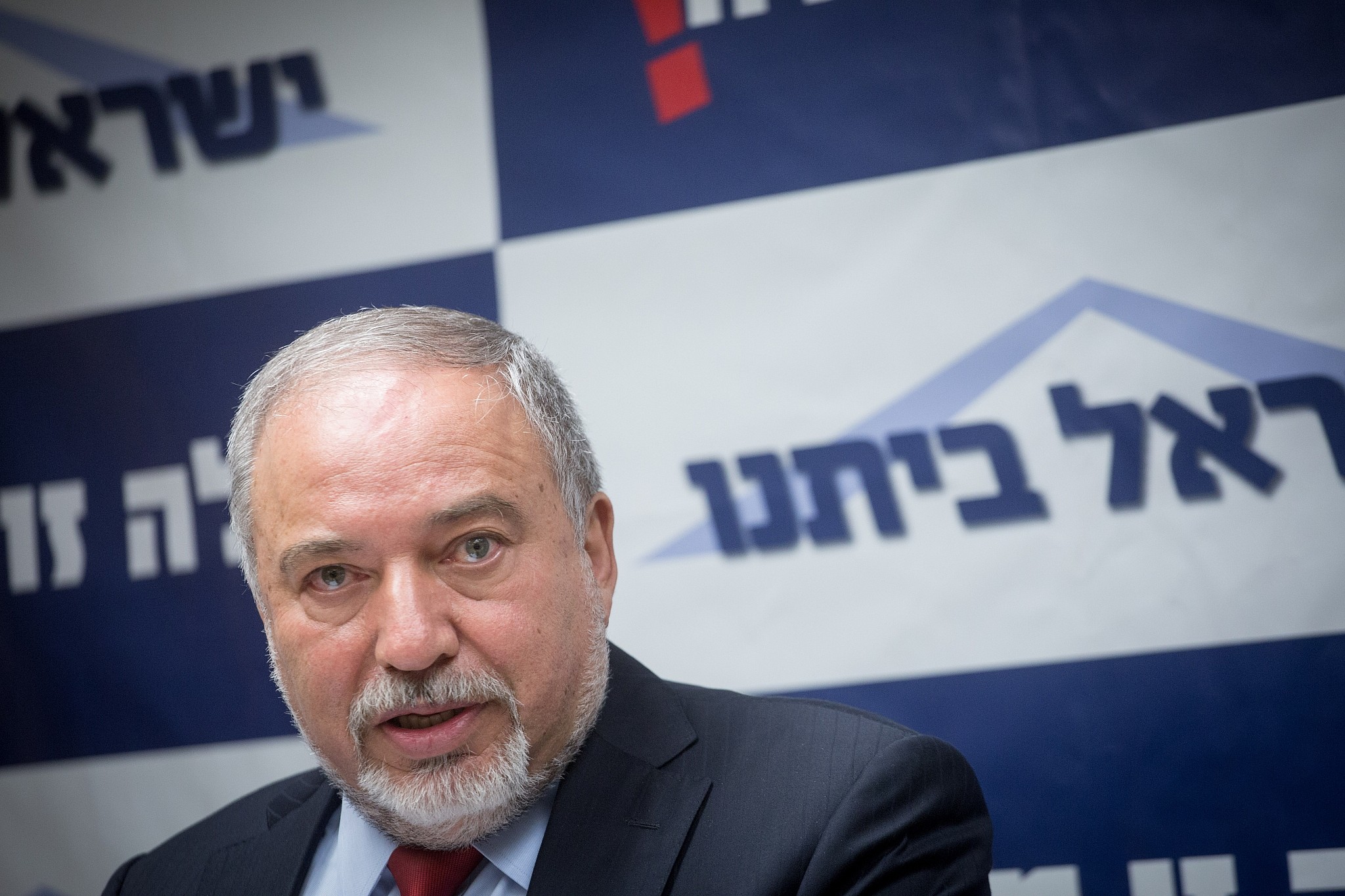
Defense Minister Avigdor Liberman leads a Yisrael Beytenu faction meeting in the Knesset, June 4, 2018. (Miriam Alster/Flash90)

Defense Minister Avigdor Liberman leads a Yisrael Beytenu faction meeting in the Knesset, June 4, 2018. (Miriam Alster/Flash90)

Defense Minister Avigdor Liberman claimed Sunday morning that the Ayatollah regime in Tehran was “living on borrowed time,” expressing his hope that US President Donald Trump’s Korean model of complete denuclearization could be implemented in Iran as wel.

In an interview with Army Radio, Liberman repeated Israel’s position that it is “determined to prevent an Iranian presence in Syria, and we will do everything so that doesn’t happen. The danger on the northern border is serious and real.”

Liberman praised Trump’s demand from North Korea that its nuclear program be completely dismantled, saying “I hope that the model of Korea completely giving up its nuclear program can be implemented in Iran’s case as well.”

However, he continued, “We have seen the opposite — an announcement by Ayatollah [Ali] Khamenei that he has ordered to accelerate the nuclear programs in his country.”

On the internal situation in Iran, he commented that “I am following the turmoil in Iran, and there hasn’t been such turmoil since the Khomeini revolution,” referring to the 1979 Islamic revolution orchestrated by Ayatollah Ruhollah Khomeini.

“If the economic sanctions continue, the Ayatollah regime is living on borrowed time,” he concluded.

Israel has repeatedly vowed it will not tolerate Iran’s military presence in Syria and has carried out airstrikes on targets in the country, including last month in response to Iran’s firing of rockets from Syria at the Golan Heights.
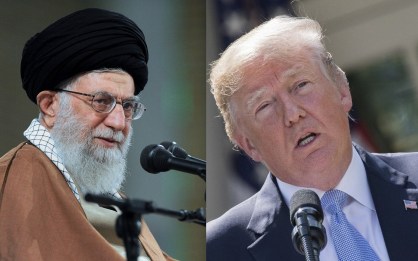
Supreme Leader Ayatollah Ali Khamenei in Tehran (L), US President Donald Trump at the White House (Office of the Iranian Supreme Leader via AP, AFP PHOTO / JIM WATSON)

Israel fears that as the Syrian civil war winds down, Iran, whose forces and Shiite proxies have backed President Bashar Assad, will entrench militarily in the neighboring country and turn its focus on Israel.

‘Improving Gaza’s economy won’t end terror’

Liberman also spoke about the Gaza Strip, claiming that the protests and tensions in the enclave don’t originate from its collapsing economy — as many, including in Israel, have said. He called for an end to the “illusions and hallucinations that improving the economy will end terror.

He spoke with with Army Radio ahead of a security cabinet meeting to discuss the humanitarian crisis in Gaza, which has been cited as a major factor fueling violent clashes on Israel’s border with the Hamas-run Palestinian enclave.

Gaza’s woes have been exacerbated by an ongoing dispute between Hamas and the PA, which has cut the salaries it pays to workers in Gaza and imposed various sanctions, including cutting of payments for electricity supplies to the enclave.

“There are three reasons for the dire humanitarian situation in the Gaza Strip,” Liberman said.

The first, he said, was Palestinian Authority President Mahmoud Abbas, “who one day decided to stop transferring funds to Gaza. Just last week he transferred half of the April salaries.” He was echoing similar criticism made Saturday by Prime Minister Benjamin Netanyahu.

The second reason he cited was Hamas, the terror group ruling Gaza, “which invests millions of dollars on tunnels, and isn’t willing to funnel a single shekel to the education or healthcare systems in the Strip.”

But the primary obstacle to a solution according to Liberman, was Hamas’s objection to returning the Israeli captives in Gaza — civilians Avera Mengistu and Hisham a-Sayed, who both crossed into Gaza of their own accord in 2014 and 2015, and the bodies of IDF soldiers Hadar Goldin and Oron Shaul which were abducted in the 2014 war known in Israel as Operation Protective Edge.

A Palestinian youth uses a slingshot to hurl stones at Israeli forces during clashes near the border with Israel, east of Khan Younis in the southern Gaza Strip on June 8, 2018. (Said Khatib/AFP)

Hamas “can get a generous humanitarian package if it returns the missing Israelis,” Liberman suggested.

Gaza faces a lack of electricity, drinkable water and food. Israel and Egypt maintain a blockade on the Strip which they say is designed to prevent Hamas from importing weapons and other goods that could be used to build fortifications or tunnels.

Four Gazans were killed in clashes at the border Friday, the latest in a series of protests dubbed the “Great March of Return.” The IDF said people used helium-filled balloons to carry explosives, detonated by remote control, in attempts to attack troops.

The defense minister said Hamas doesn’t recognize Israel’s right to exist and therefore will continue with hostilities no matter the situation in Gaza. He claimed that the thousands who protested and clashed with IDF troops on Friday were connected “directly or indirectly” with Hamas and had been left no choice but to attend the demonstration.

“Whoever thinks improving the civilian and economic situation in Gaza will halt the terror kites and the violence, is simply wrong,” he charged. “Enough with all sorts of hallucinations and illusions that improving the economy will end terror.

“The opposite is true — they’ll understand that with use of force and violence they can achieve political goals. To improve the reality in the Gaza Strip, the Hamas regime must be toppled. Whoever wants more than four hours of electricity every day must topple the Hamas regime.”
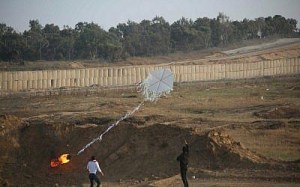
Two Palestinians help fly a ‘fire kite’ from the Gaza Strip into Israeli territory during mass demonstrations along the security fence on June 8, 2018. (Israel Defense Forces)

Liberman said Israel was successfully dealing with the wave of violence, claiming that two thirds of the incendiary kites sent over the border have been intercepted, but vowed to find a better way to eliminate that threat.

“Hamas is trying to drag us to a confrontation and is willing to pay heavy prices,” he said.

“We need to understand that the Israeli people’s morale is crucial — there are kites and fires, and that’s unpleasant, but in the end people continue with their daily lives. We have managed to intercept two thirds of the kites, but no kite should pass and cause a fire,” the defense minister added.

Ministers at Sunday’s cabinet meeting are likely to authorize the use of live fire against Palestinians flying the attack kites and balloons into Israel, Israel Radio reported on Saturday, quoting Public Security Minister Gilad Erdan.

Times of Israel staff contributed to this report.
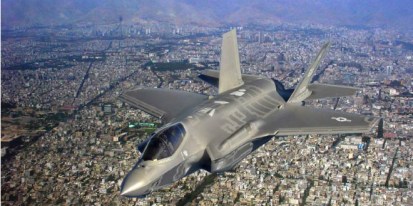
Khamenei Fires Air Force Chief over Israeli F-35 Deep Penetration of Iran’s Sky

Posted June 10, 2018 by Joseph Wouk
Categories: Uncategorized

Source: Khamenei Fires Air Force Chief over Israeli F-35 Deep Penetration of Iran’s Sky – Breaking Israel News | Latest News. Biblical Perspective.

“Moshe spoke to the people, saying, “Let men be picked out from among you for a campaign, and let them fall upon Midian to wreak Hashem’s vengeance on Midian.” Numbers 31:3 (The Israel Bible™)

Iran’s Supreme Leader Ayatollah Ali Khamenei fired Iranian air force commander Brigadier General Farzad Ismaili, who had been in office since 2010, because the latter had hid from him the fact that Israeli F-35 planes had penetrated Iran’s sky, the Kuwaiti daily Al Jarida reported on Saturday.

The newspaper emphasized that it was the original media source that exposed the Israeli raids, which had taken place last March. Al Jarida cited senior Iranian military who said that only following its March report did the intelligence services of the Revolutionary Guards and the Iranian intelligence ministry begin to investigate the case, under direct orders from Khamenei.

According to the newspaper’s investigation, the IAF F-35 “Adir” planes penetrated Iran’s airspace, circled high above Tehran, Karajrak, Isfahan, Shiraz and Bandar Abbas – and photographed Iran’s air defense system.

One of the sources reported that Iran’s air defense system, including its Russian radar, did not detect the entry and exit of the fighter planes, and that Ismaili hid this information from the supreme leader to cover his corps’ failure. However, three weeks ago, Iranian intelligence discovered that the Israeli fighter jets had carried out this sortie as a test of the possibility of an undetected military attack on Iranian outposts and bases, during which they photographed those sensitive bases, evading the Russian S-300 missile system’s radar.

According to Al Jarida, Iranian intelligence received top secret information that the Israeli fighter planes even managed to photograph Iran’s underground bases. Khamenei, who received this information, now suspects a cooperation between Russia and Israel, and that the Russians gave Israel the secret code of the Russian radar in Iran – according to the Kuwaiti newspaper.

Khamenei fired the commander of Iran’s air defense system on May 29, replacing him with his deputy, General Alireza Sabahi-Fard.

Assad denies Russia in on Israeli airstrikes, deal to remove Iran 

Posted June 10, 2018 by Joseph Wouk
Categories: Uncategorized

Source: Assad denies Russia in on Israeli airstrikes, deal to remove Iran | The Times of Israel

Syrian leader says no coordination or even advanced knowledge of attacks, but admits to possible rifts in Damascus-Moscow-Tehran axis

Members of the Russian military stand past a banner showing Russian President Vladimir Putin, right, shaking hands with Syrian President Bashar Assad, at Abu al-Zuhur checkpoint in the western countryside of Idlib province on June 1, 2018. (AFP PHOTO / George OURFALIAN)

Members of the Russian military stand past a banner showing Russian President Vladimir Putin, right, shaking hands with Syrian President Bashar Assad, at Abu al-Zuhur checkpoint in the western countryside of Idlib province on June 1, 2018. (AFP PHOTO / George OURFALIAN)

Syrian President Bashar Assad denied Russia coordinated or even knew in advance about reported Israeli strikes inside his country and downplayed Moscow’s role in determining Iran’s presence there, in an interview published Sunday.

“Russia never coordinated with anyone against Syria, either politically or militarily, and that’s contradiction; how could they help the Syrian Army advancing and at the same time work with our enemies in order to destroy our army,” Assad told the British Daily Mail newspaper.

When pressed on whether Russia knew in advance of airstrikes carried out by Israel, Assad responded “that’s not true, that’s not true, definitely. We know the details.”

Israeli officials have praised their ongoing coordination with Russia amid efforts to push Iranian forces and allied Shiite militias away from the border on the Golan Heights. Israel fears Iran is attempting to gain a foothold near the border to launch attacks against the Jewish state,

Several unconfirmed reports in Israel have claimed Moscow was informed of airstrikes on Syrian and Iranian positions as tensions have risen in recent weeks.

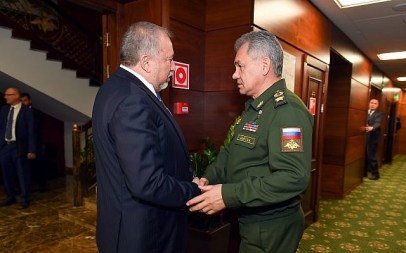
“The State of Israel appreciates Russia’s understanding of our security needs — especially on our northern border,” Israeli Defense Minister Avigdor Liberman told Russian counterpart Sergei Shoigu during a visit to Moscow on May 31 to discuss Syria and Iran. “It is important to continue the dialogue between us and to keep an open line between the IDF and Russian army.”

Defense Minister Avigdor Liberman meets with Russian Minister of Defense Sergei Shoigu, in Moscow, Russia on May 31, 2018. (Ariel Hermoni/Defense Ministry)

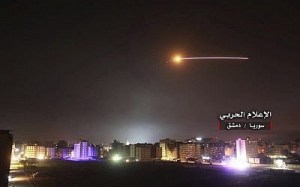
On May 10, Israel unleashed a heavy bombardment against what it said were Iranian military installations in Syria after an Iranian rocket barrage targeting the Golan. It was the most serious military confrontation between the two bitter enemies to date.

This photo provided early Thursday, May 10, 2018, by the government-controlled Syrian Central Military Media, shows missiles rise into the sky as Israeli missiles hit air defense position and other military bases, in Damascus, Syria. (Syrian Central Military Media, via AP)

Israel has been mostly using Lebanon’s airspace to strike targets inside Syria in an apparent move to avoid any conflict with Russia’s warplanes that fly over Syria. Russia has a major air base near Syria’s coast from where warplanes have been taking off to strike at insurgents throughout Syria.

“There is an increasing evidence that shows that Russia has turned a blind eye to Israel’s airstrike in Syria against Iran’s military presence,” said Fawaz Gerges, professor of Middle Eastern politics at the London School of Economics. “This is a direct message that Russia does not want Iran to have a hegemonic position in Syria.”

Russia and Iran have been the main backers of Assad but Moscow also has close relations with Israel whose Prime Minister Benjamin Netanyahu visited Russia several times over the past two years. On one trip last month, he stood close to Putin while attending a massive parade for Russian troops marking victory in World War II.

Russia has been reportedly mediating for Iranian troops and Hezbollah fighters to withdraw from areas close to the Israeli border where Syrian troops are expected to launch an offensive against rebels.

However Assad claimed Russia, which is his biggest backer, was not involved in making decisions about Syria, though he hinted that Moscow and Damascus may not see eye to eye on the issue.

“They never, during our relation, try to dictate, even if there are differences; because there is a war and because there’s high dynamism now in the region, it’s natural to have differences between the different parties, whether within our government or other governments; Russia-Syria, Syria-Iran, Iran-Russia, and within these governments, that’s very natural, but at the end the only decision about what’s going on in Syria and what’s going to happen, it’s a Syrian decision,” he said.

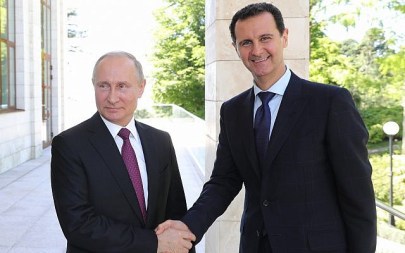
Russian President Vladimir Putin, left, shakes hands with Syrian President Bashar Assad during their meeting in the Black Sea resort of Sochi, Russia, May 17, 2018. (Mikhail Klimentyev, Sputnik, Kremlin Pool Photo via AP)

Calls for Tehran to end its military presence in Syria have been on the rise in recent weeks, hinting at tensions between Moscow and Damascus.

At a meeting with Assad, who visited the Russian city of Sochi last month, Russian President Vladimir Putin noted that a political settlement in Syria should encourage foreign countries to withdraw their troops.

Putin’s envoy for Syria, Alexander Lavrentyev, later commented that the Russian leader’s statement was aimed at the United States and Turkey, along with Iran and Hezbollah. It marked a rare instance in which Moscow suggested Iran should not maintain a permanent military presence in the country.

US Secretary of State Mike Pompeo issued a list of demands last month for a new nuclear deal with Iran, including the pullout of its forces from Syria. Israel has also warned it will not accept a permanent Iranian military presence in Syria.

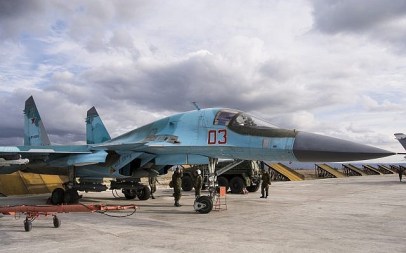
A Russian air force technician reports to a pilot that a Su-34 bomber is ready for a combat mission at Hemeimeem airbase in Syria on January 20, 2016. (AP Photo/Vladimir Isachenkov)

Syrian Deputy Foreign Minister Faisal Mikdad however has said on Russia’s Sputnik news agency that “this topic is not even on the agenda of discussion, since it concerns the sovereignty of Syria.”

During the interview published Sunday Assad seemed to admit the presence of Iranian troops in his country, days after denying there were any there.

“The Russians were invited by the Syrian government, their existence in Syria is a legitimate existence, the same for the Iranians,” he said. He also said Syria was fighting the Islamic State with the help of Russia and Iran.

In an interview on May 31, Assad dismissed reports that Iranians had been killed in recent Israeli airstrikes, saying there were no Iranian fighters in the country.

“We do not have Iranian troops. We never had, and you cannot hide it,” he told the Russia Today news outlet, “Like we invited the Russians, we could have invited the Iranians.”

But he also added in the RT interview that “We have Iranian officers who work with the Syrian army.”

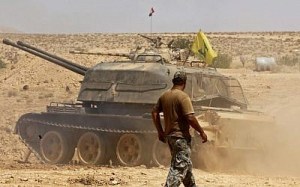
Illustrative image of a tank flying the Hezbollah terror group’s flag seen in the Qara area in Syria’s Qalamoun region on August 28, 2017 (AFP Photo/Louai Beshara)

Tensions in the Syria-Iran-Russia axis came to the fore last week when a Russian force deployment on the Syria-Lebanon border in a Hezbollah stronghold sparked protests by the Lebanese militant group, prompting the force to withdraw from its positions only a day later in a rare sign of tension between the allies.

The Russian move was not expected as Moscow’s military police have been deploying in areas controlled by Syrian government forces and close to insurgent positions. The outskirts of the Syrian town of Qusair where the Russian troops set up three observation positions on Monday have been held by Hezbollah and Syrian troops since 2013, when they drove rebels from the area.

The Russian deployment and subsequent withdrawal shows that as rebels are being defeated in different parts of Syria, frictions could rise between Assad’s main foreign backers — Russia and Iran — and the militias Tehran backs throughout Syria.

“They came and deployed without coordination,” said an official with the so-called “Axis of Resistance” led by Iran, which includes Iran, Syria, Hezbollah and other groups fighting alongside President Bashar Assad’s forces.

“It’s better if they don’t come back. There is no work for them there. There is no Daesh or any other terrorist organization,” the official said, referring to the Islamic State group and other insurgents that the Syrian government and its allies call terrorist organizations. “What do they want to observe?” he asked.

Asked if there is tension between Hezbollah and Russian troops, the official refused to comment, speaking to the Associated Press by telephone from Syria on condition of anonymity because he was not authorized to brief reporters. He said that after the Russian troops left, Syrian forces belonging to the army’s 11th Division replaced them.

In 2013, Hezbollah, an Iranian proxy group, openly joined the Syrian civil war along with Assad’s forces capturing the then rebel stronghold of Qusair in June that year after losing dozens of its battle-hardened fighters.

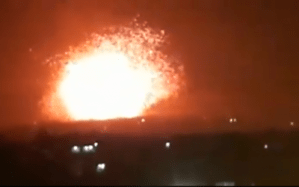
An explosion is seen coming from an army base, allegedly used by Iran-backed militias, outside the northern Syria city of Hama on April 29, 2018. (Screen capture; Facebook)

The Russian deployment outside Qusair came after Israeli warplanes struck the nearby Dabaa air base on May 24, according to Syrian activists who said Hezbollah arms depots were hit. There was no word on casualties.

A top Iranian security official said that Tehran will maintain an advisory role in Syria and continue to support “resistance groups.” The secretary of Iran’s Supreme National Security Council Ali Shamkhani meanwhile told Al-Jazeera TV that as long as Syria faces a “terrorist” threat and Damascus requests its presence, “we will stay in Syria.”

And for his part, Hezbollah leader Sayyed Hassan Nasrallah said in a speech Friday that “if the whole world tried to impose on us a withdrawal from Syria they will not be able to make us leave,” adding that his group would only leave at the request of the Syrian government.

Trump’s Mideast envoy calls for top Palestinian negotiator’s ouster

Posted June 10, 2018 by Joseph Wouk
Categories: Uncategorized

Source: Trump’s Mideast envoy calls for top Palestinian negotiator’s ouster | The Times of Israel

After Saeb Erekat pens a scathing op-ed accusing US of being Israel’s ‘partner in occupation,’ Jason Greenblatt says time has come for ‘other Palestinian perspectives’

US special envoy Jason Greenblatt (L) attends the launch of a project to improve access to wastewater treatment and water for Palestinian farmers, on October 15, 2017, in the West Bank city of Jericho. (AFP Photo/Jaafar Ashtiyeh)

US special envoy Jason Greenblatt (L) attends the launch of a project to improve access to wastewater treatment and water for Palestinian farmers, on October 15, 2017, in the West Bank city of Jericho. (AFP Photo/Jaafar Ashtiyeh)

WASHINGTON — The Trump administration’s envoy in charge of jumpstarting Israeli-Palestinian peace talks called on Sunday for the ousting of the Palestinian Authority’s longtime chief negotiator, Saeb Erekat, accusing him of exacerbating the conflict and impeding progress toward peace, after the latter attacked Washington over its peacemaking role.

“We have heard your voice for decades and it has not achieved anything close to Palestinian aspirations or anything close to a comprehensive peace agreement,” wrote Jason Greenblatt, addressing Erekat directly, in the Israeli daily Haaretz. “Other Palestinian perspectives might help us finally achieve a comprehensive peace agreement where Palestinian and Israeli lives can be better.”

Greenblatt did not mention who he would rather see in the longtime diplomat’s prominent position.

In his op-ed, Greenblatt, Trump’s special representative for international negotiations, was responding to a scathing op-ed Erekat penned for the same newspaper last month, in which he lamented US President Donald Trump’s decision to recognize Jerusalem as Israel’s capital and move the US embassy from Tel Aviv to Jerusalem.

He also castigated the White House for what he characterized as its complicity in Israel’s mistreatment of the Palestinians.

Erekat derided the close relationship between Trump and Prime Minister Benjamin Netanyahu, and contemptuously noted the smiling presence of Jared Kushner and Ivanka Trump at the Jerusalem embassy’s opening just as deadly violence was unfolding at the Gaza border. The column was titled, “Partners in occupation: Trump provides the anti-Palestinian incitement, Israel the bullets.”

For more than 30 years, Erekat has been one of the highest ranking Palestinian officials, frequently leading negotiating efforts with Israel and the United States, going as far back to the 1991 Madrid Peace Conference brokered by former president George H.W. Bush. Most recently, he led the Palestinians in former secretary of state John Kerry’s efforts to solidify an accord, opposite his Israeli counterpart Tzipi Livni.

Erekat is very close to PA president Mahmoud Abbas, whose health has long been questioned. The prospect of Abbas’s death or removal from power has led many Middle East analysts to worry who might replace him, and how that would change the character of the PA.

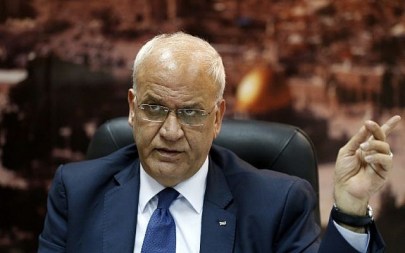
PLO Secretary General Saeb Erekat in his Ramallah office, November 23, 2015. (AFP/Abbas Momani)

Over the last two months, tens of thousands of Gazans have been undertaking weekly “March of Return” protests at the border. Rioters had tried to damage and break the security fence to infiltrate Israel, while others have attacked soldiers with petrol bombs, bombs, rocks and burning tires.

Those clashes reached their most intense level on the same day as the embassy opening on May 14, when Israeli forces killed more than 60 Palestinians, according to the Hamas-run Gaza health ministry — the vast majority members of the Hamas and Islamic Jihad terror groups.

While the protests began organically, Hamas, the Islamist terror group that rules the Strip, seized the demonstrations early on and began orchestrating them.

Erekat’s initial op-ed — to which Greenblatt was responding — came several days after that conflagration.

In his Haaretz piece on Saturday, Greeblatt said that Erekat’s column included claims that were “in many respects simply inaccurate.” He did not go into much detail, other than the Palestinian official’s contention that the embassy move was “part of a US attempt to force an Israeli-written agreement on the Palestinians.”

Greenblatt disputed that characterization. He quoted from Trump’s speech formally recognizing Jerusalem as Israel’s capital last December, in which the president said that, despite the relocation of the diplomatic mission, “the specific boundaries of Israeli sovereignty in Jerusalem are subject to final status negotiations between the parties.”

Trump’s move was highly controversial, eliciting criticism from much of the international community, as well as former US peace negators who argued it would inflame tensions in the region and further compromise America’s capacity to act as a useful-but-flawed broker in peace talks.

Since that decision, PA President Mahmoud Abbas has refused to meet with Trump officials and has said the US can no longer act as an honest mediator in negations between the sides.

Danon: ‘Israel will not sit idly when facing new and old threats’ 

Posted June 10, 2018 by Joseph Wouk
Categories: Uncategorized

Source: Danon: ‘Israel will not sit idly when facing new and old threats’ – Israel News – Jerusalem Post

Israeli ambassador to the UN Danny Danon warned that Israel will not tolerate an Iranian-Hamas effort to bring the Gaza based terrorist group to South-Lebanon.

BY JPOST.COM STAFF
 JUNE 9, 2018 18:59
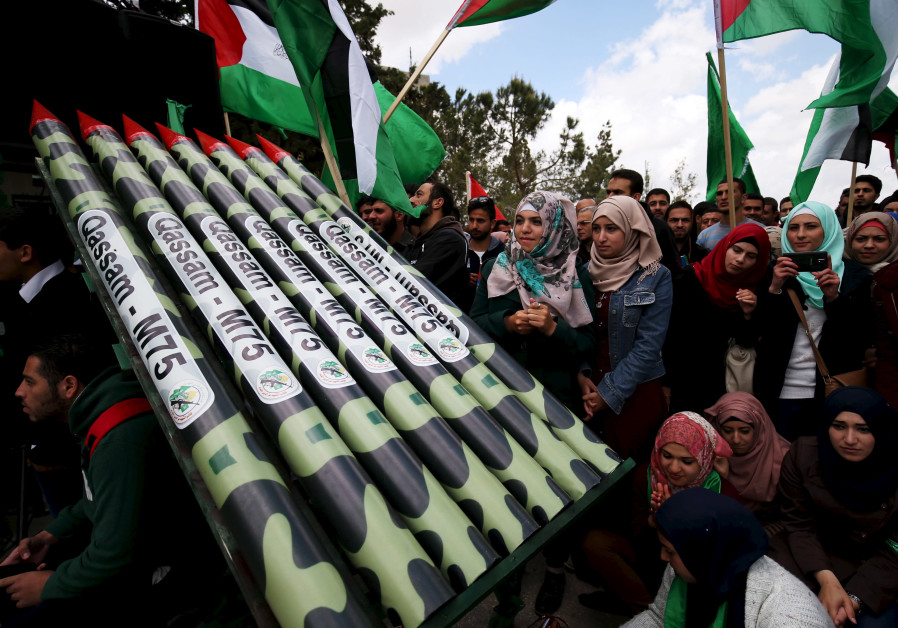
Bir Zeit

Israel claims that Hezbollah is working alongside the Palestinian terror group Hamas to build rocket launching capacities and missile production centers in South-East Lebanon after Hamas was unable to hit Israel with rockets from the Gaza Strip.

Defense Minister Avigdor Liberman warned of such developments in January, saying that “We will not allow [a situation where] on the one hand Hamas talks about the humanitarian crisis [in Gaza] and on the other hand it will try to carry out terrorist attacks from the West Bank or to build terrorist infrastructures in southern Lebanon.”

Israel argues that these attempts are violating UN Security Council Resolution 1701 which ended the Second Lebanese War of 2006.

“The cooperation between Hezbollah and Hamas crosses borders,” said Israeli ambassador to the UN Danny Danon. “The ramifications of the Hamas terror regime in Gaza extend to Lebanon where they are strengthening their relations with Hezbollah with the approval and support of Iran.”

“Israel does not intend to sit idly when facing new and old threats and will do whatever is necessary to protect its citizens,” Danon stated.

Report: Hezbollah is helping Hamas build rocket factories, training camps

Posted June 10, 2018 by Joseph Wouk
Categories: Uncategorized

Source: Report: Hezbollah is helping Hamas build rocket factories, training camps – Arab-Israeli Conflict – Jerusalem Post

Israel requested that the UN intervene to stop cooperation between the two groups.

BY ANNA AHRONHEIM
 JUNE 10, 2018 08:11
Report: Hezbollah is helping Hamas build rocket factories, training camps

Israel has complained to the UN Security Council, saying that Hamas is working with Hezbollah to establish missile factories and training camps in southern Lebanon, the Lebanese newspaper Al Joumhouria reported Saturday.

According to the report, Israel sent a letter to the UN Security Council and General Assembly that included intelligence showing the effort of the two terrorist groups to set up missile factories and training facilities for thousands of Palestinian fighters.

Israel requested that the UN intervene to stop cooperation between the two groups, charging it was a “blatant violation” of UN Security Resolution 1701, which set the terms to end the 34-day Second Lebanon War fought between Israel and Hezbollah in the summer of 2006.

“We are witnessing the implications of the Hamas terror regime in Gaza and now Hamas is strengthening its ties with Hezbollah. With the approval and support of Iran, Hamas is working to establish its capabilities on Lebanese territory as well,” said Israeli Ambassador to the UN Danny Danon.

“The cooperation between Hezbollah and Hamas crosses borders. Israel does not intend to sit idly when facing new and old threats and will do whatever is necessary to protect its citizens,” he stated.

Defense Minister Avigdor Liberman warned of such developments in January, saying Hamas was trying to strengthen its presence in South Lebanon to launch attacks against Israel from there.

“It must be understood that Hamas, which finds it hard to carry out attacks from the Gaza Strip, is currently trying to launch attacks from the West Bank – and is also trying in new arenas, first of all in southern Lebanon, to threaten the State of Israel,” he said, adding that Israel has been following developments in the growing relationship between Hamas and Hezbollah.

“We will not allow on one hand, Hamas talks about the humanitarian crisis [in Gaza] and on the other hand, that it will try to carry out terror attacks from the West Bank or to build terror infrastructures in southern Lebanon,” he said.

The report also said Israel claimed that Hamas Politburo Deputy Chairman Saleh al-Arouri meets with Hezbollah Secretary-General Hassan Nasrallah for military and political coordination and is reportedly in contact with Saed Izai, the head of the Palestinian branch of Iran’s Revolutionary Guard Corps.

In August, Liberman made similar comments when he met with US Ambassador to the United Nations Nikki Haley. He charged al-Arouri with attempting “to boost the relationship between Hamas and Hezbollah… under an Iranian umbrella, and with the assistance of the Revolutionary Guards and [its leader] Qassem Soleimani.”

Arouri led a Hamas delegation to Iran in October, meeting with senior Iranian officials, including international affairs adviser Ali Akbar Velayati and Foreign Minister Muhammad Javad Zarif. Arouri also met with Nasrallah in Beirut in early November, when the two agreed to strengthen their relationship.

Officials have repeatedly voiced concerns over the smuggling of sophisticated weaponry to Hezbollah, which has at least 100,000 short-range rockets and several thousand more missiles that can reach central Israel. In addition to its massive arsenal of rockets and missiles, Hezbollah is able to mobilize close to 30,000 fighters and has flouted its system of tunnels – complete with ventilation, electricity and rocket launchers.

Herb Keinon contributed to this report.
Top US, Russian generals fail to agree on Syrian-Israel, Syrian-Jordanian borders

Posted June 10, 2018 by Joseph Wouk
Categories: Uncategorized

Source: Top US, Russian generals fail to agree on Syrian-Israel, Syrian-Jordanian borders – DEBKAfile

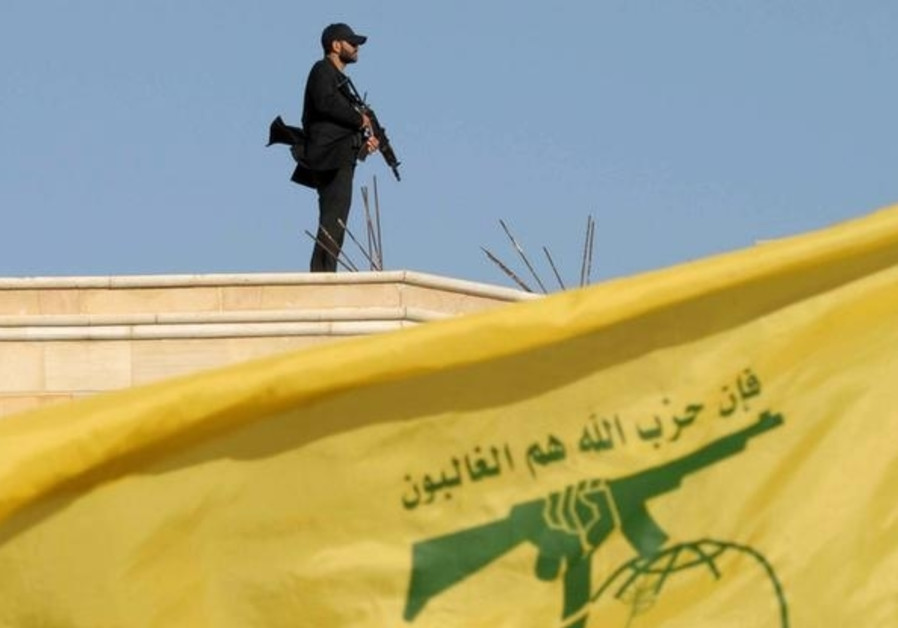
At issue is the presence of Hizballah and other pro-Iranian units in growing numbers – disguised as Syrian troops – opposite Israel’s borders, DEBKAfile’s exclusive sources report.

Under the command of Iranian Gen. Qassem Soleimani, these units are being “absorbed” into the Syrian army as a ploy for supporting claims by Damascus and Tehran that no Iranian troops are present in Syria at all – only “Iranian military advisers.” Russian officers posted in Syria were apparently told not to interfere in this process.

Our military sources find Hizballah units deployed at the Mt. Hermon border town of Al Khadar opposite Israeli outposts, and the pro-Iranian Afghan Shiite militia (Liwa Ahu Fadi al-Abbas) positioned around Qunetra opposite Israel’s Golan border, under the command of Iranian Revolutionary Guards IRGC) officers.

These Hizballah troops are clad in the uniforms of the Syrian army’s 4th and 5th Syrian divisions, while the Afghan militiamen are wearing the uniforms, boasting the insignia, and driving the vehicles, some armored, of the Syrian presidential Republican Guard.

These details expand on DEBKAfile’s first exclusive disclosure of this trick disguise. We broke the story on May 31, a few hours before Defense Minister Avigdor Lieberman was due to meet his Russian counterpart Gen. Sergei Shoigu in Moscow. We revealed then for the first time that Iranian IRGC and Hizballah units in the regions of Quneitra, the Daraa border with Jordan, and Mt. Hermon were all clad in Syrian army uniforms.

This subterfuge was intended to dodge around Israel’s flat objections to their presence in its back yard. Moscow hoped that Washington would buy it.

On Saturday, June 9, the Wall Street Journal repeated DEBKAfile’s discovery of Hizballah fighters disguised as Syrian troops nearing Israel’s border.

The report came after the meeting on Friday, June 8, between Gen. Joseph Danford, Chairman of the US Joint Chiefs of Staff, and Russian General Staff chief Gen. Valery Gerasimov in Helsinki. The two generals discussed their respective military arrays in Syria, the situation in the de-escalation zones along its borders with Jordan and Israel and the military situation in Ukraine.

No communique was issued after the meeting.  DEBKAfile discloses, however, that Gen. Danford showed Gen. Shoigu the intelligence he had received about the Syrian uniform con practiced by Syria and Iran to pretend that the pro-Iranian troops taking up positions along Syrian’s southwestern borders were part of the Syrian army.
According to our information, the two generals parted without reaching a consensus on the military situation in Syria, especially for those border regions.

Five fires in Gaza border communities, terror kites resume

Posted June 9, 2018 by Joseph Wouk
Categories: Uncategorized

Source: Five fires in Gaza border communities, terror kites resume – Israel News – Jerusalem Post

Fires caused by terrorist activity have resulted in road closures in the south.

BY JPOST.COM STAFF, MAARIV ONLINE
 JUNE 9, 2018 17:16
REPORT: As terror kites resume, IAF attacks kite storage in Gaza Strip

Five fires have been reported in and around Kibbutz Nir Am and kibbutz Be’eri during Saturday as the floating of burning terror kites into Israel from the Gaza Strip continues. Unconfirmed Palestinian reports claim the Israeli Air Force attacked locations of terror kite storage in the Gaza Strip.

Four of the fires were extinguished by Firefighters teams but one fire, in kibbutz Be’eri, is still raging.

Further fires were reported along Highway 34, which runs close to the northeast corner of the Gaza Strip, and near Nachal Asaf and HaBesor Stream in the same area.

The highway is currently blocked for traffic between Yad Mordechai Junction and Sderot Western Entrance, Israel Police spokesperson reported.

Police officers are manning the roadblocks and arson terror is suspected.

In addition two fires were reported, in Nachal Asaf in the western Negev and HaBesor Stream in the Northern Negev.

The fires are a continuation of weeks of kite arson coming from Gaza. The IDF has begun operating drones to combat the attacks and protect the farm lands and residents of the south.

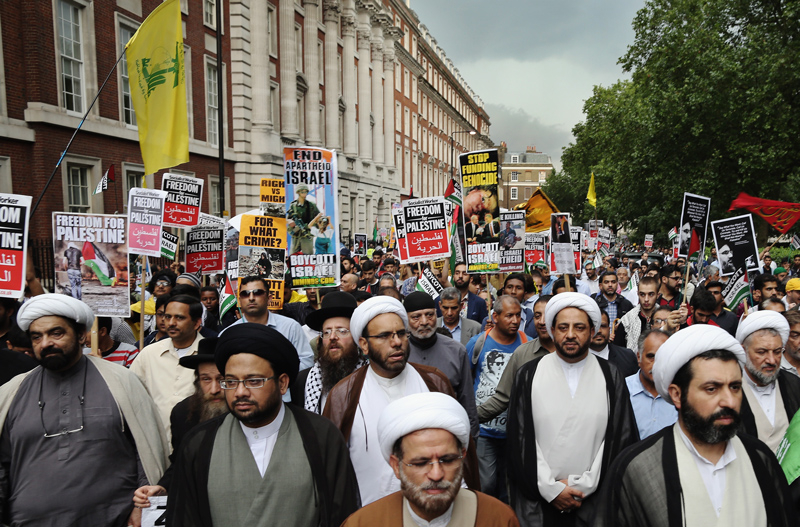
Marching for Terrorism in London? No Problem

Posted June 9, 2018 by Peter Hofman
Categories: Uncategorized

How will next week’s U.S.-North Korea summit impact Iran-Israel issues? 

Posted June 9, 2018 by Joseph Wouk
Categories: Uncategorized

Source: How will next week’s U.S.-North Korea summit impact Iran-Israel issues? – International news – Jerusalem Post

How will all of this impact the Iran nuclear situation and Israeli security?

BY YONAH JEREMY BOB
 JUNE 9, 2018 08:54
Donald Trump and Kim Jong Un

To be even more accurate, we cannot even say with 100% certainty that the meeting will occur, as in the space of only a few days each leader recently seemed to call it off, before calling it back on.

But assuming it happens, what are the most likely outcomes, and how will all of this impact the Iran nuclear situation and Israeli security?

FIRST, ONE needs to dig under the verbiage.

Both Trump and Kim have talked about negotiating “denuclearization.” The ideal US deal would be that desperately poor North Korea gives up all of its nuclear weapons and its ability to produce new ones for an end to sanctions and a massive infusion of foreign aid and business deals. But from a variety of officials’ statements and analysis from pretty much all prior negotiators with Pyongyang, it defines this differently from Washington.

North Korean officials see two possibilities: a bigger deal and a smaller deal.

A bigger deal, assuming no North Korean cheating (a big “if”), means they really do give up all of their nuclear weapons and ability to produce them, but in exchange not just for economic aid, but for a full withdrawal of the US military from the Korean Peninsula and an end to US “interference.”

A smaller deal means the North gives up something undefined in the nuclear arena – maybe some weapons or some shuttering of some of its nuclear weapons productions facilities – but holds on to some of its nuclear capabilities, present or potential. In exchange, Pyongyang gets sanctions removed and the infusion of foreign aid, and the North, South Korea and the US all sign a peace treaty.

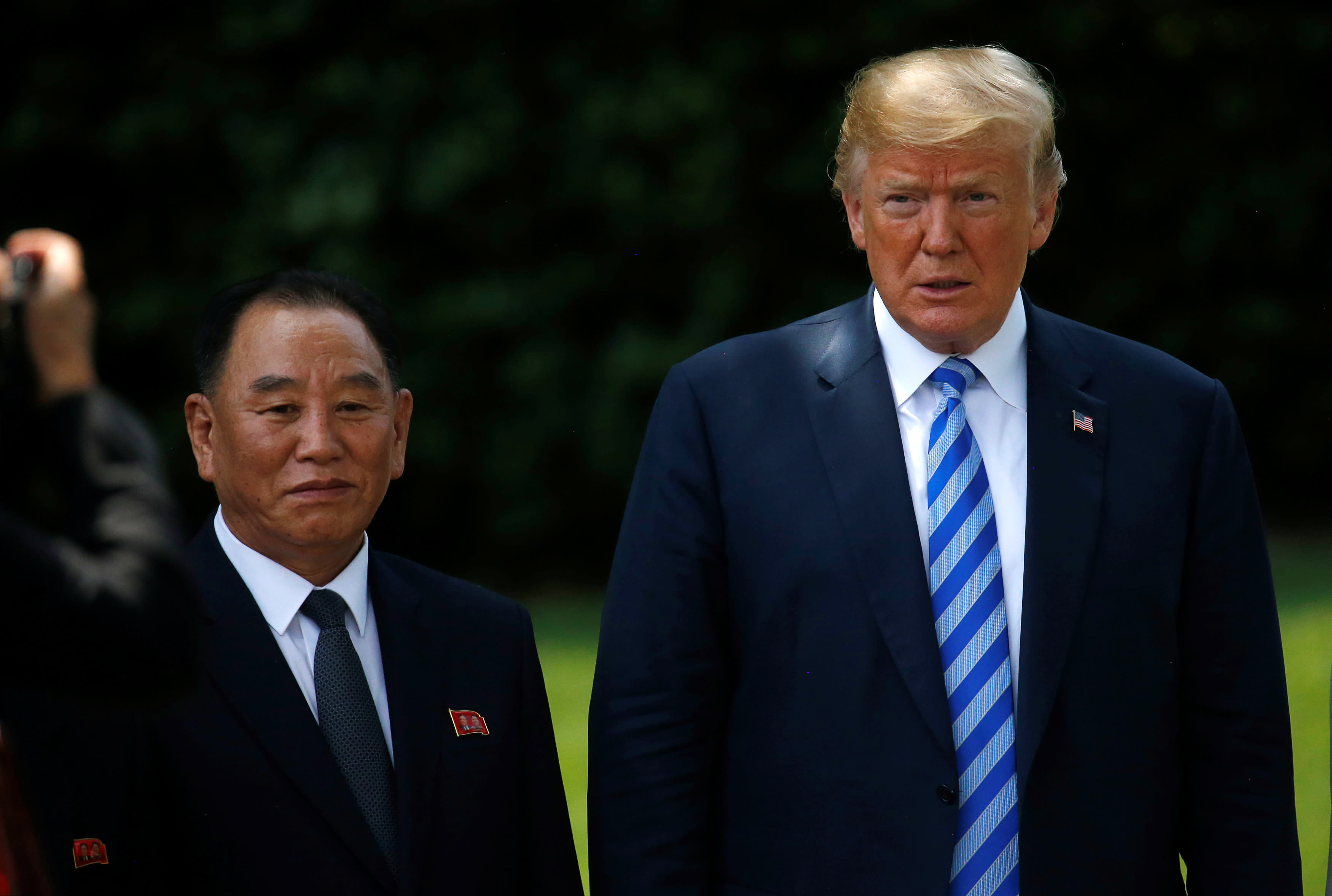
North Korea's envoy Kim Yong Chol poses with US President Donald Trump for a photo as he departs after a meeting at the White House in Washington, US, June 1, 2018 (Reuters/Leah Millis)

North Korea’s envoy Kim Yong Chol poses with US President Donald Trump for a photo as he departs after a meeting at the White House in Washington, US, June 1, 2018 (Reuters/Leah Millis)

But Kim would not have to fully give up all nuclear weapons or all nuclear production facilities (possibly, they would be shuttered, but could potentially be reopened) and the US would not withdraw from the Korean Peninsula.

There is a giant gulf between US and North Korean expectations. US National Security Adviser John Bolton joined the Trump administration largely to enforce a maximum pressure campaign for the North to irrevocably give up all nuclear capabilities, and fast.

His appointment was taken as a sign that Trump was leaning in that direction.

But Bolton has been recently sidelined on the North Korean issue, with US Secretary of State Mike Pompeo pushing him out of a key meeting between a top North Korean official and Trump last week because of his harder-line views.

In addition, Trump said publicly this week that he is no longer using the phrase “maximum pressure,” and Trump is giving Kim the gift of a visit with a US president, and all of the legitimacy that grants, without any significant concession from the North besides a halt to missile tests and promises about the future.

The North also may have dynamited its main underground nuclear test site, but it has a huge range of other nuclear facilities, other spots for testing, and many analysts have said that the site may have already been permanently damaged from overuse.

Furthermore, while Trump threatened briefly to end the summit, he rescheduled it as soon as the North made some public conciliatory statements but, again, without major concessions.

THE US position, then, is very unclear. Will Trump demand full actual denuclearization and within a short time, or will he become more flexible and settle for an eventual peace deal and some concessions on nuclear issues but not all, and over years instead of immediately? And what is likely to come out of the summit? It appears that Trump’s desire to show he is the ultimate deal-maker may overcome his tough bargainer image, which he has used in other areas of the world, such as Iran, and on some global trade issues.

From many prior rounds of negotiation, the North’s public vague statements about denuclearization are likely to devolve into its big and small deal visions.

The US secretary of defense and the US military establishment are dead set against a US military withdrawal from the Korean Peninsula.

That is because even if the North were to give up its entire nuclear weapons program, a major “if,” its conventional missile capacity and army could still pose a massive threat to South Korea and Japan – key US allies.

So the big deal is probably out.

That leaves the small deal. In the best case scenario, in light of Trump wanting a deal, Trump and Kim will make some kind of a vague joint statement about denuclearization, which will mean an eventual peace deal and some nuclear concessions drawn out over years, but not actual denuclearization.

NOW WE come to the Iran nuclear situation and Israel.

If Trump settles for a deal with North Korea, where it either gets to keep some bombs or gives up bombs but shutters nuclear facilities without eliminating them, and it is dragged out over years, and North Korea gets freed of the sanctions toward the beginning – isn’t that the same or worse than the Iran nuclear deal he just left? Would this kind of a weak US-North Korea deal undermine the US’s argument to the world for toughening the Iran nuclear deal? There are obvious differences between the cases.

One could say that the North is a bigger threat than Iran, so it should get a better deal because the threat needs to be averted. Pyongyang has many nuclear weapons and, according to some, a possibility of firing an ICBM to hit the US, whereas Iran at most has the potential to rush toward a nuclear weapon in a few months.

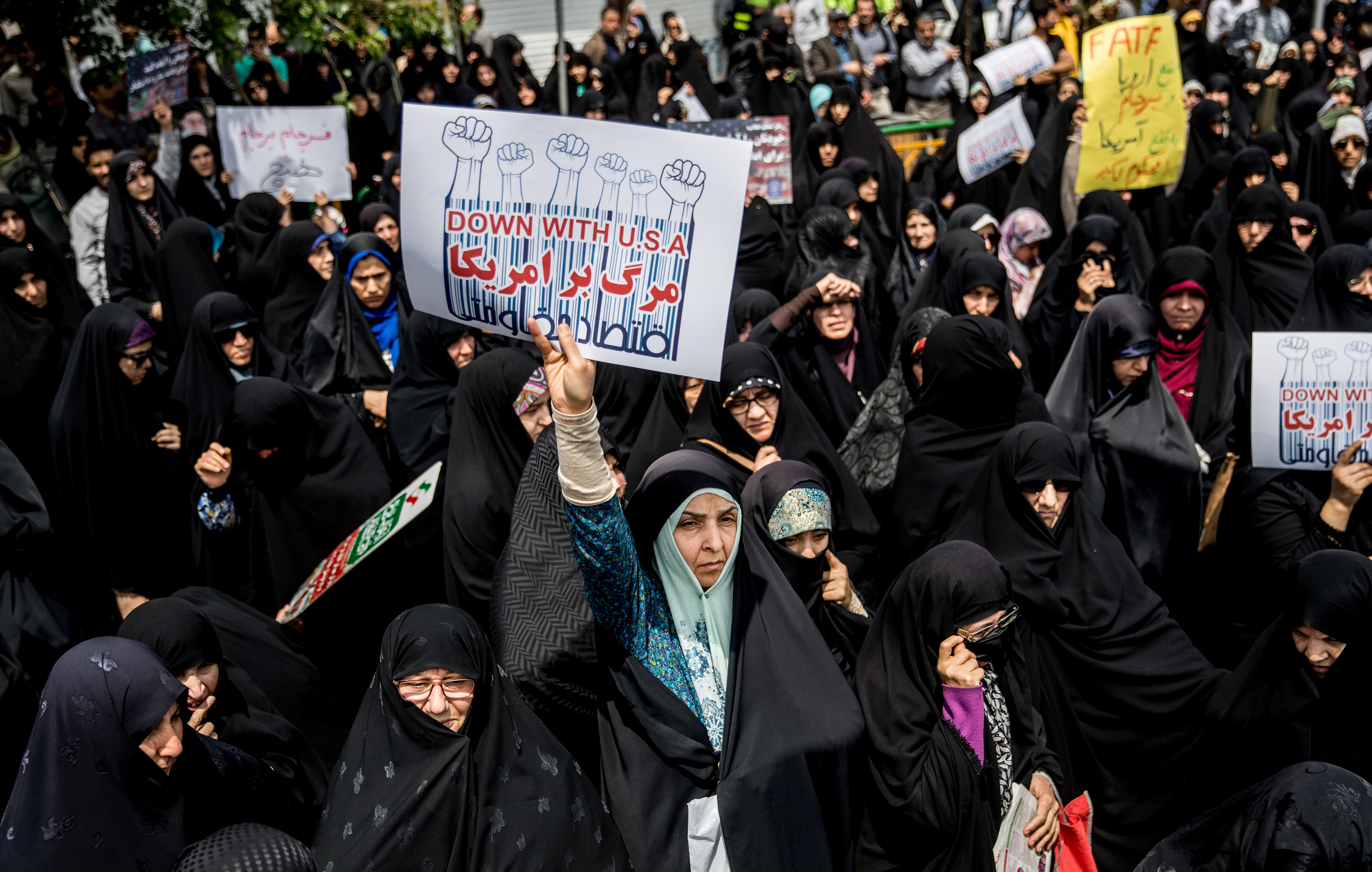
Iranian women gather during a protest against U.S. President Donald Trump's decision to walk out of a 2015 nuclear deal, in Tehran, Iran, May 11, 2018 (Reuters/Tasnim News Agency)

Iranian women gather during a protest against U.S. President Donald Trump’s decision to walk out of a 2015 nuclear deal, in Tehran, Iran, May 11, 2018 (Reuters/Tasnim News Agency)

Taking the opposite tack, one could say that the North is less dangerous than Iran, as Kim mostly seems focused on ensuring his regime-family’s control and survival, whereas Iran is aggressively sponsoring terrorist groups and instability all over the Middle East.

Based on these arguments, the US could say to the Europeans that it is not seeking a stricter double-standard with Iran as opposed to North Korea; rather, the cases are simply different.

Also, if a permanent bar on ballistic missile tests is part of the deal, that could be argued as achieving something that was left out of the Iran deal.

There might also be benefits of getting to learn from the North Koreans what exactly they have done over the years with Iran, Syria and others in the nuclear arena.

But the North does not need to test missiles as much as Iran anymore.

Many analysts feel they are far ahead of Iran in that nuclear area. And Pyongyang may not have to share any past history as part of the deal.

So the US could try to argue why it can be more lenient toward North Korea, but that argument would probably fall on deaf ears.

At the end of the day, the unavoidable consequence of a deal with Kim that only shutters and does not eliminate the nuclear program, while shuttering it over time and offering sanctions relief near the start, will be to undermine the argument for a tougher nuclear deal with Iran.

This could undermine Prime Minister Benjamin Netanyahu’s push for isolating Iran, right when he thought that Trump’s leaving the Iran deal and the Mossad’s spectacular appropriation of Iranian nuclear secrets had given Israel the upper hand in isolating Iran.

The Europeans are already worried about Iran’s threats to pull out of the deal and to escalate its uranium enrichment if the EU demands significant changes from them. Maximum pressure on Iran could fall apart.

There is another scenario. Trump could have his cake and eat it, too.

The Europeans may be angry with the inconsistency in the approaches to Iran and North Korea and may want to keep the Iran deal alive.

But the inescapable reality of US economic pressure may overcome their views of Trump’s move. Put differently, the EU may just follow the money.

In short, from the US perspective, any deal with North Korea, weak or strong, may be preferable to continued verbal sparring, which might unpredictably lead to a nuclear conflict.

Maybe very unexpectedly, Trump would back down on Iran following a deal with North Korea, and Iran would scrupulously follow the nuclear deal for many years to come.

But more likely from the Israeli perspective would be that a weak Trump deal with North Korea will make it harder to get Iran to agree to a tougher nuclear deal, and will put Israel, the US and Iran back on a track toward an escalating conflict.