Is the U.S.-Israel relationship in danger? 

Posted June 9, 2018 by Joseph Wouk
Categories: Uncategorized

Source: Is the U.S.-Israel relatnship in danger? – Israel News – Jerusalem Post

Despite appearances, former senior national security official Elliott Abrams warns that Democrats — and American Jews — are moving away from Israel.

BY HERB KEINON
 JUNE 9, 2018 03:33
Is the U.S.-Israel relationship in danger?

US President Donald Trump has steadfastly backed Israel at the UN, moved the embassy to Jerusalem and withdrawn from the Iranian nuclear deal.

As a result, Prime Minister Benjamin Netanyahu has praised him effusively.

But this, according to Netanyahu critics on the Left both in Israel and the US, is a mistake. They argue that Trump will not be there forever – in fact, he could be turned out of office in just over two years’ time – and that Netanyahu’s embrace of a deeply divisive Republican president will hurt Israel if a Democratic president comes next in line.

But Elliott Abrams, who held senior positions in the White House’s National Security Council under Ronald Reagan and George W. Bush, thinks otherwise.

“You have a party in the United States that is wildly pro-Israel,” Abrams said of the Republican Party. “It would be the sin of ingratitude not to show appreciation. And it is not just Trump, it is the Republicans.”

Abrams, in the country to deliver the keynote address last Tuesday night at the B’nai B’rith World Center-Jerusalem Award for Journalism Recognizing Excellence in Diaspora Reportage, said that his message to Netanyahu would not be to “step back from Trump.”

Rather, he said during an interview in the lobby of the King David Hotel, his message is to Yesh Atid leader Yair Lapid, Zionist Union head Avi Gabbay, and opposition leader Yitzhak Herzog: “You should embrace the Democratic Party; that is your job. The Republicans do not need to be told to be pro-Israel; the Democrats do. Why don’t you do that?”

Abrams, a fellow at the Council on Foreign Relations in Washington, DC, said that there are pro-Israel stalwarts in the Democratic Party, people like California’s Nancy Pelosi, Maryland’s Steny Hoyer, and New York’s Chuck Schumer.

The problem, he said, is that they are all in their sixties and seventies, and there is not an equally ardent pro-Israel cadre among the marquee Democratic names in their thirties and forties.

Turning again to Lapid, Gabbay and Herzog, Abrams said that they all have relationships with Schumer and Pelosi. “But do they have a relationship with the next generation? I don’t know the answer to that. But these are the people who have to go talk to [up-and-coming Democratic leaders] Kamala Harris and Gavin Newsom. That is their job. Their job is not to yell at Netanyahu for being close to the Republicans; their job is to get close to the Democrats.”

That, however, is no easy chore. Poll after poll shows that grassroots support for Israel in the Republican Party outpaces that in the Democratic Party, even though Jews still vote overwhelmingly for Democrats. Abrams said that the polls – both Pew and Gallup – show about a 30-point difference between the parties’ general memberships when it comes to Israel, with the Republicans far more supportive.

ABRAMS CHARACTERIZED this trend as a “problem,” and one for which there is no “magic wand.”

He said that there are two types of Democrats moving away from Israel: Jews and non-Jews.

Regarding the non-Jews, Abrams pointed out that Israel has been governed by a right-of-center government for the last 17 years.

“It is no great shock that such a government will get along better with a Republican rather than Democratic administration,” he said.

“Why is this a problem?” he asked. “Because there is a message sent by Bush and Trump that Israel is terrific. The message sent by [president Barack] Obama was not that Israel is terrific. It was about the need to create daylight; it was that we have a lot of criticism, and that if you are on the Left in the United States, don’t be so enthusiastic about Israel.”

Abrams said that some believe that the situation would improve if there were a left-of center government in Israel. But he has his doubts, and points out that Lapid, Gabbay, Herzog and their supporters were largely supportive of recent IDF action on the Gaza border and in Syria.

“I think that Americans on the Left would be surprised by the defense policies of those parties [Yesh Atid and Zionist Union],” he said. “They are not going to change much [from current defense policies].

So the notion that if there were a center-left government here, the American Left would immediately become pro-Israel, just does not seem to be correct.”

The Bernie Sanders wing of the Democratic Party, which has a decidedly left-wing outlook, is now a significant part of the Democratic Party, Abrams said. “The Left around the world attacks Israel, so why is it shocking that the Left in the United States is part of that?” The challenge, Abrams maintained, is to reach those constituencies that are part of the Democratic Party but are not squarely on the Left, such as Hispanics, Koreans and Indian Americans.

“You are not going to turn the Left pro-Israel,” he maintained.

“But you may be able turn people in the party who are not really on the Left, and who are swing communities.”

He said Israel may have an open door to the Hispanic and Korean communities because they include large numbers of Evangelical Christians, and there are many in the Indian community who are small businessmen and professionals with traditional values, with whom Israel’s arguments may resonate more loudly.

Abrams said that among both Jewish and non-Jewish Democrats, it is unlikely that any one policy change by the government – such as a settlement freeze – would fundamentally change attitudes. If the Netanyahu government would make such a move, and a week later face riots on the Gaza border and use lethal force, “no one would talk about the settlement freeze,” he argued.

THERE IS, however, another layer to the story among Jews inside the Democratic Party moving away from Israel. With them, Abrams said, Israel’s policies toward non-Orthodox streams of Judaism could have an impact in either accelerating or slowing down the erosion of their support.

“To the extent we are talking about Jews, it would help if Israel were more respectful of non-Orthodox parts of the Jewish community,” he said, referring primarily to the conversion issue and the issue of egalitarian prayer at the Western Wall. “This is an old argument, but it does alienate some groups in the Diaspora.”

Asked to identify where he fears this alienation could play out, Abrams said that people might become generally less enthusiastic about Israel, stop traveling here, and stop being pro-Israel activists in their own communities.

Abrams, however, rejected the claim, often made by critics of the government, that Israel’s policies are distancing young Jews from Israel.

“The larger problem is the percentage of the Jewish community that is leaving the Jewish community entirely, and that has nothing to do with Israeli policies,” Abrams said.

This trend has to do with America life, with assimilation and intermarriage, and not one Israeli policy or another. Children of Jewish parents who intermarry, whose spouses do not convert, and who do not raise their children as Jews – their children will leave the Jewish community completely, Abrams said.

“In fact, they already have. The couple has left the Jewish community, and their children will do the same, and this has nothing to do with settlements and occupied territory  – it is an American phenomenon.”

Abrams said that the bigger questions Israelis must ask themselves, however, is what obligations the country now has, since it’s what the US was for the last century, and Europe for a few centuries prior – namely, the center of world Jewish life.

“What responsibilities does that bring?” he asked.

On security matters, he maintained, Israel’s primary obligation is to its own survival.

“But on questions of religion, where you are dealing with Jews across the world, I think Israel has to ask itself what is its relationship – as the center of the Jewish world – going to be to the Diaspora and non-Orthodox Jews in the Diaspora?” Abrams said that he would like to see an Israeli campaign to raise the number of non-Orthodox students in non-Orthodox Jewish schools in the Diaspora, and to do more to promote Hebrew study around the world.

“What if you had places in a variety of locations in the Diaspora where the Israeli government paid people to learn Hebrew?” he said.

“It is an idea.”

If, in the past – when Israel was smaller and much weaker – the question often posed was what is the Diaspora’s relationship and responsibility toward Israel, Abrams now asks the question from the other side.

“Now what is needed,” he said, “is for Israelis to start thinking about their relationship to the Diaspora in the coming decades.”

Symbolic victories – and losses – are important

Elliott Abrams met The Jerusalem Post a day before the Argentinean national team and star Lionel Messi sent much of the country into the doldrums because of their decision not to play an exhibition game here Saturday night.

Nevertheless, what Abrams said about the upcoming visit of Prince William and the move of the US Embassy to Jerusalem resonates loudly in the context of the Argentinean team’s decision.

Prince William’s visit and the US Embassy move are “symbolic victories that send a message of Israel’s “acceptance and permanence,” Abrams said.

“You can live without symbolic victories,” he explained. “But given that there is a global movement against you, these symbolic victories contribute to the cause. Yes, you lived 70 years without the American Embassy in Jerusalem, and without a British Royal, but you are under attack here by Iran, a number of terrorist groups, and by the Left around the world; so you need political victories, symbolic victories, and friends.

“So when these victories come, when you win a song contest, it is better than losing because you are Israeli. And when the royal family comes, it is a big deal. It is better than the royal family refusing to set foot here officially.”

Prince William’s visit and the embassy move help to “normalize” Israel, Abrams argued.

“There is a still an effort to say that Israel is a criminal enterprise, that its creation was an offense, that it is not permanent and not acceptable. And all of these symbolic moves say, ‘No, we reject all of that.’” Abrams cited his mentor George Shultz, a former US secretary of state, as saying in 2003 that the US Embassy needed to move to Jerusalem because “as long as it is in Tel Aviv, it seems as if we are just camping out.”

Asked what Shultz meant, Abrams replied: “It looks as if you are temporary, your presence is temporary, your role in Jerusalem is temporary, so our embassy has to be temporary. So now we are saying, ‘No.’ There are daily attacks on this country’s legitimacy; these victories are not meaningless.”

Unfortunately, then, neither are the losses.

Iran Admits To Facilitating 9/11 Terror Attacks

Posted June 9, 2018 by Peter Hofman
Categories: Uncategorized

Top Iranian official admits for first time Iran aided al Qaeda terrorists

9/11 / Getty Image

BY:

Iran Admits To Facilitating 9/11 Terror Attacks

Iranian officials, in a first, have admitted to facilitating the 9/11 terrorist attacks in the U.S. by secretly aiding the free travel of al Qaeda operatives who eventually went on to fly commercial airliners into the Twin Towers in New York City, according to new remarks from a senior Iranian official.

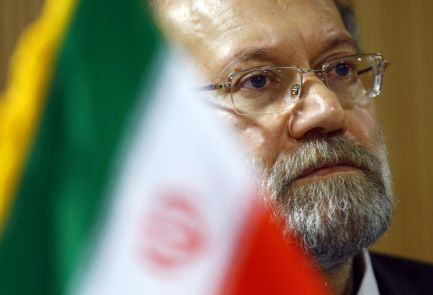
Mohammad-Javad Larijani, an international affairs assistant in the Iran’s judiciary, disclosed in Farsi-language remarks broadcast on Iran’s state-controlled television that Iranian intelligence officials secretly helped provide the al Qaeda attackers with passage and gave them refuge in the Islamic Republic, according to an English translation published by Al Arabiya.

“Our government agreed not to stamp the passports of some of them because they were on transit flights for two hours, and they were resuming their flights without having their passports stamped. However their movements were under the complete supervision of the Iranian intelligence,” Larijani was quoted as saying.

The remarks represent the first time senior Iranian officials have publicly admitted to aiding al Qaeda and playing a direct role in facilitating the 9/11 attacks.

The U.S. government has long accused Iran of playing a role in the attacks and even fined the Islamic Republic billions as a result. The U.S. 9/11 Commission assembled to investigate the attacks concluded that Iran played a role in facilitating the al Qaeda terrorists.

Larijani admitted that Iranian officials did not stamp the passports of the al Qaeda militants in order to obfuscate their movements and prevent detection by foreign governments. Al Qaeda operative also were given safe refuge in Iran.

“The Americans took this as evidence of Iran’s cooperation with al-Qaeda and viewed the passage of an airplane through Iran’s airspace, which had one of the pilots who carried out the attacks and a Hezbollah military leader sitting [next to] him on board, as evidence of direct cooperation with al-Qaeda through the Lebanese Hezbollah,” Larijani was quoted as saying in the May 30 interview, which is gaining traction on social media.

The U.S. government has not formally commented on the interview, but did highlight it in an official tweet from the State Department’s Arabic-only Twitter page.

Netanyahu said to snub EU foreign policy chief, causing her to nix Israel visit 

Posted June 8, 2018 by Joseph Wouk
Categories: Uncategorized

Source: Netanyahu said to snub EU foreign policy chief, causing her to nix Israel visit | The Times of Israel

Amid diplomatic tensions, PM reportedly rejects Mogherini’s request to meet on sidelines of Jerusalem event. Top Israeli source: ‘Her positions are very hostile to Israel’

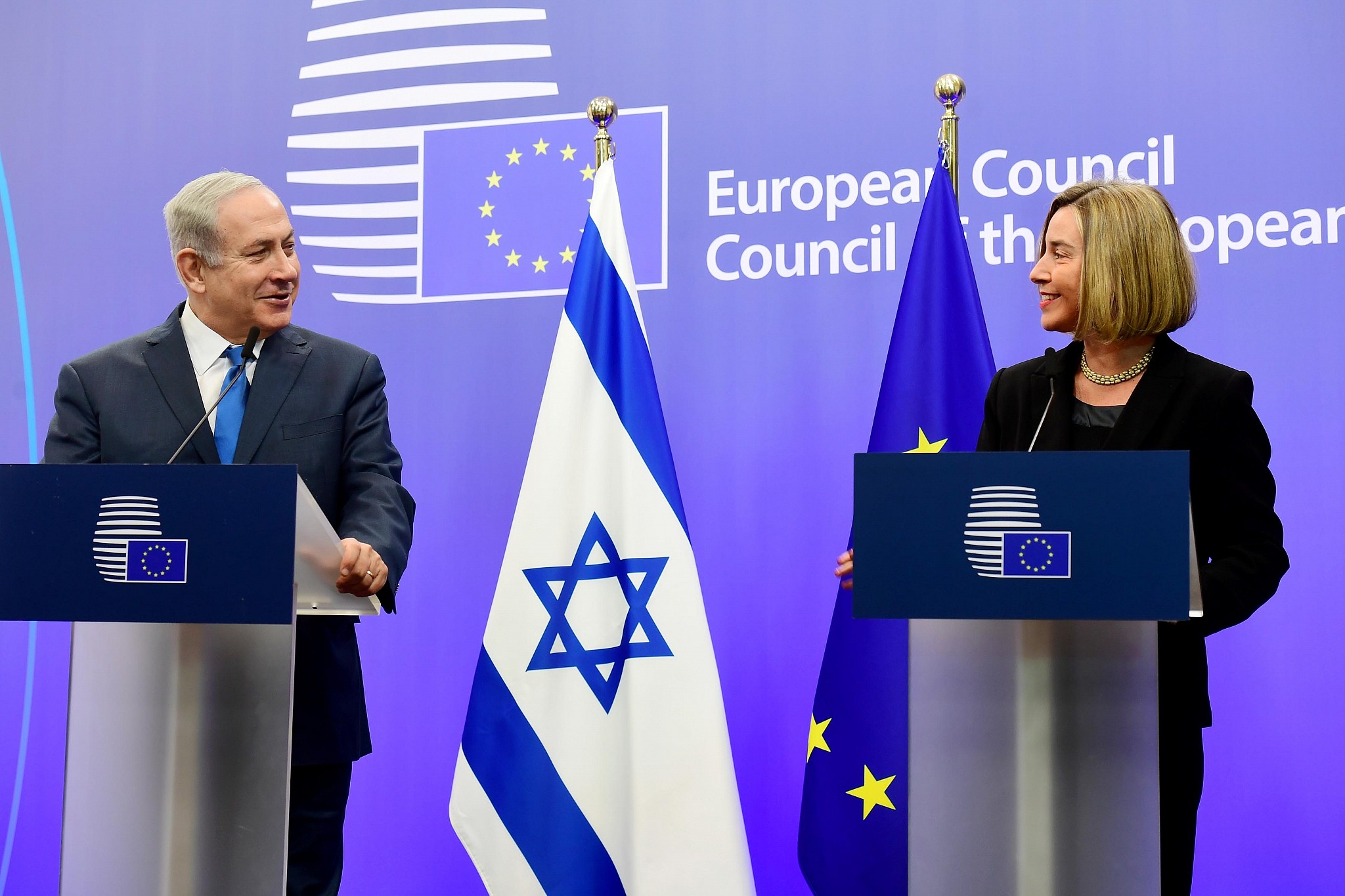
Prime Minister Benjamin Netanyahu (left)  holds a joint press conference with the European Union's foreign policy chief, Federica Mogherini in Brussels, Belgium, October 11, 2017.(Avi Ohayon/GPO)

Prime Minister Benjamin Netanyahu (left) holds a joint press conference with the European Union’s foreign policy chief, Federica Mogherini in Brussels, Belgium, October 11, 2017.(Avi Ohayon/GPO)

Prime Minister Benjamin Netanyahu refused a request by European Union Foreign Policy chief Federica Mogherini to meet in Jerusalem next week, causing her to cancel her planned trip to the country, Hebrew-language news outlets reported Friday.

Mogherini, currently in Jordan, was set to visit the Israeli capital to take part in the American Jewish Committee’s annual Global Forum conference in Jerusalem, which begins Sunday.

But her request to meet with Netanyahu on the sidelines of the conferences was reportedly turned down, leading her to cancel her trip.

A top diplomatic source told Hadashot TV news Mogherini “was invited by the conference” and not by Israeli leaders. “Her positions are very hostile to Israel,” he added.

Israel and the EU have lately been at loggerheads over the IDF’s handling of mass protests and riots on the Gaza border, as well as over the US decision to unilaterally withdraw from the Iran nuclear deal. Israel has also hailed the US relocation of its embassy to Jerusalem last week, a move Europe has rejected and reportedly sought to officially condemn.

Netanyahu has also fiercely condemned the European Union for its policies on Israel, including in hot mic comments last year that saw him lash European Union leaders for their “crazy” treatment of the Jewish state.

EU foreign policy chief Federica Mogherini gives a press conference after an EU-Tunisia Association Council meeting at the EU headquarters in Brussels, on May 15, 2018. (AFP PHOTO / JOHN THYS)

Last month Public Security Minister Gilad Erdan, a top Netanyahu ally, slammed the EU, saying the bloc shouldn’t “get involved in internal Israeli matters,” after it called for an investigation of alleged police brutality against Arabs at a demonstration in Haifa.

And last week the EU lashed out at Israel over its decision to build 2,000 new settlement homes and to demolish a Palestinian Bedouin village in the West Bank, saying it undermines “prospects for a lasting peace.”

Netanyahu toured Europe this week, meeting with leaders from Germany, France, and Britain in a bid to rally support for amending the international nuclear deal with Iran and for pushing Iranian forces out of neighboring Syria.

Report: US sought Saudi oil support before pulling from Iran deal 

Posted June 8, 2018 by Joseph Wouk
Categories: Uncategorized

Source: Report: US sought Saudi oil support before pulling from Iran deal – Israel Hayom

Putin: Russia will stay in Syria as long as it serves its interests 

Posted June 8, 2018 by Joseph Wouk
Categories: Uncategorized

Source: Putin: Russia will stay in Syria as long as it serves its interests – Israel Hayom

Top Iranian official accuses Israel, Saudi Arabia of provoking Middle East chaos 

Posted June 8, 2018 by Joseph Wouk
Categories: Uncategorized

Source: Top Iranian official accuses Israel, Saudi Arabia of provoking Middle East chaos – Israel Hayom

Can and will Iran strike Israel?

Posted June 7, 2018 by Joseph Wouk
Categories: Uncategorized

Source: Can and will Iran strike Israel? – Opinion – Jerusalem Post

Israel today has fewer people and resources than Iraq had in the 1980s, but Iran knows that Israel is a regional power with a formidable military.

BY EHUD EILAM
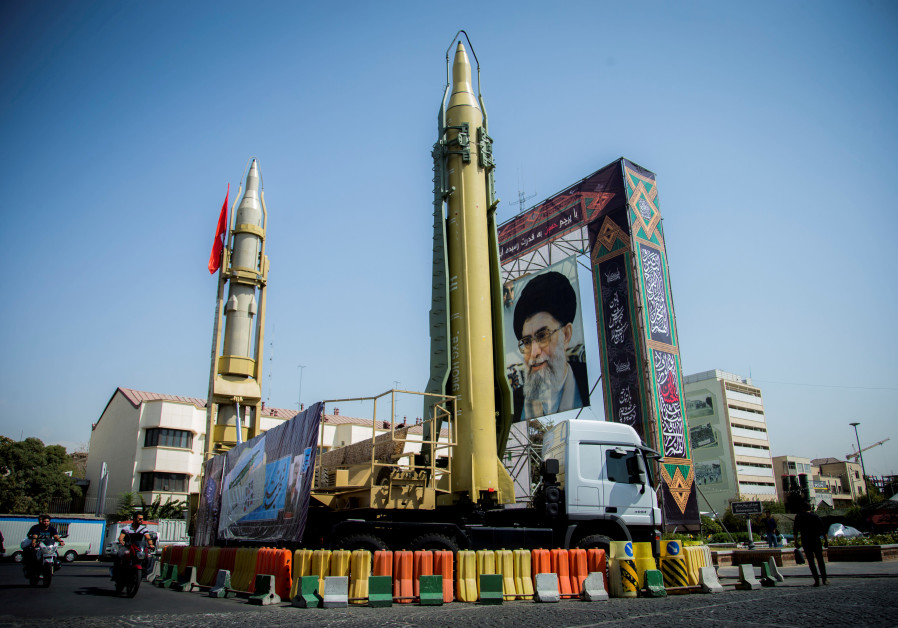
Missiles and a portrait of Iran's Supreme Leader Ayatollah Ali Khamenei in Tehran, Iran

In recent months, Israel bombed Iranian objectives inside Syria several times.

Iran absorbed casualties, serious damage and international humiliation. Iran is eager for revenge, but what can it do? Does Iran want to go to war? Iran still remembers the trauma of the 1980-1988 Iran-Iraq war, which cost Iran dearly.

Israel today has fewer people and resources than Iraq had in the 1980s, but Iran knows that Israel is a regional power with a formidable military.

In the war against Iraq in the 1980s, hundreds of thousands of Iranians were killed. Iran does not want to repeat this grim experience. In the war in Syria, Iran lost about 2,100 troops, a sensitive issue in Iran.

Many Iranians, including those who are against their regime, might separate between their loyalty to their homeland and their severe criticism of the regime. They could support the government, particularly if it seems to them that Iran was attacked and it must retaliate.

Yet as long as the fight between Israel and Iran is contained to Syria, then the Iranian regime will have a problem in mobilizing its people against Israel.

There is already opposition in Iran to their country’s ongoing involvement in Syria, where Iran has invested heavily since 2011 – about $20 billion. This money was taken from the Iranian people, who struggle to make ends meet. The more money Iran pours into Syria, the greater the chance that the Iranian people might not tolerate it anymore and confront their regime. The Iranian aid, aimed at saving their Syrian ally, Bashar Assad, might eventually be one of the reasons for the downfall of the Iranian regime. The Iranian-Israeli collision in Syria could turn out to be an Israeli trap, as part of the Israeli strategic goal: to weaken the Iranian regime, hopefully to topple it.

Iran can hit Israel directly from Iran, with its SU-24, a long-range attack aircraft, but the aircraft might not have the range to reach and return from Israel, which is more than 800 kilometers west of Iran. If the SU-24 can land and refuel in Iraq or even closer to Israel, in Syria, it will be easier for Iran. Yet even then, some and maybe all the SU-24s might be intercepted by the Israeli air force (IAF), which has a very impressive reputation in this field and its forces, aircraft and air defense, are on high alert following the growing tension with Iran.

Iran also has the Shahab-3, a long-range surface-to-surface missile that could hit Israel.

Iran can’t launch hundreds of those missiles at the same time, which will enable the Israeli anti missile system, the Arrow, to intercept them. In spite of that, some Iranian missiles might penetrate. In addition, Israeli aircraft and Special Forces will try to destroy Iran’s bases from which Iran can fire its missiles.

Iran might disperse and hide its launchers in its vast territory of more than 1.6 million square kilometers.

Iran might try to pound military targets, since Israel attacked Iranian military objectives in Syria, but Iran might hit Israel’s population centers. In response Israel might not necessarily bomb Iranian cities, but rather strike key facilities that belong to Iran’s energy industry.

The IAF might even strike Iran’s nuclear sites. It could be another Israeli trap, pushing Iran to attack Israel so the latter will have an opportunity to bomb Iran’s nuclear infrastructure.

The two states might be dragged into a war that will last weeks and maybe more, even if both sides are not interested in that. In such a case, there is a need of a broker, maybe Russia and/or the European Union, since they have ties with both Iran and Israel. Eventually a cease-fire, even if only an unofficial one, could be achieved, since Israel and Iran, like Israel and Hamas, don’t recognize each other. If Iran raises too many demands, Israel might escalate the war in order to convince Iran to end the fight.

Iran might not seek to risk a war. Therefore Iran can try to limit its retribution and exploit its proxies, its favorite mode of action. It can also conduct terrorist attacks worldwide without taking responsibility and/or use its quite advanced cyber capability.

The current stage is part of the long cold war between Israel and Iran, which started in 1979. Iran has several ways to strike its adversary, which in the worst case might lead to a war.

The writer, a national security analyst, formerly worked for the Israeli military.

How Russia angered Iran in Syria and had to pull its troops from the Lebanese border – Israel News 

Posted June 7, 2018 by Joseph Wouk
Categories: Uncategorized

Source: How Russia angered Iran in Syria and had to pull its troops from the Lebanese border – Israel News – Haaretz.com

A rare case of Russia acting out of sync with President Bashar al-Assad’s Iran-backed allies in the war

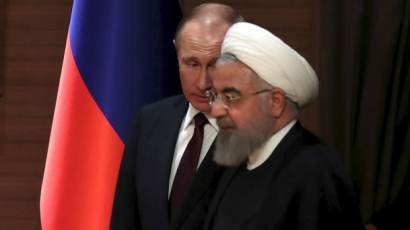
Russian President Vladimir Putin and his Iranian counterpart Hassan Rouhani arrive for a joint news conference after their meeting in Ankara, Turkey April 4, 2018
Russian President Vladimir Putin and his Iranian counterpart Hassan Rouhani arrive for a joint news conference after their meeting in Ankara, Turkey April 4, 2018REUTERS/Umit Bektas

A Russian troop deployment in Syria near the Lebanese border this week caused friction with Iran-backed forces including Hezbollah which objected to the uncoordinated move, two non-Syrian officials in the regional alliance backing Damascus said.

The situation was resolved on Tuesday when Syrian army soldiers took over three positions where the Russians had deployed near the town of Qusair in the Homs region on Monday, one of the officials, a military commander, told Reuters on condition of anonymity.

It appeared to be a rare case of Russia acting out of sync with President Bashar al-Assad’s Iran-backed allies in the war. Iranian and Russian support has been critical to Assad’s war effort.

“It was an uncoordinated step,” said the commander. “Now it is resolved. We rejected the step. The Syrian army – Division 11 – is deploying at the border,” said the commander, adding Hezbollah fighters were still located in the area.

There was no comment from the Russian military about the incident. Russia has faced calls from Israel to rein in Iran in Syria, where Israel has mounted numerous attacks against Hezbollah and other targets it has described as Iran-backed.

“Perhaps it was to assure the Israelis,” said the commander, adding that the move could not be justified as part of the fight against the Nusra Front or Islamic State because Hezbollah and the Syrian army had defeated them at the Lebanese-Syrian border.

The second official said the “resistance axis” – a reference to Iran and its allies – was “studying the situation” after the uncoordinated Russian move.

Russia and Iran-backed forces such as Hezbollah have worked together against the insurgency. Hezbollah deployed to Syria in 2012. The Russian air force arrived in 2015 in support of Assad.

But their different agendas in Syria have become more apparent of late as Israel presses Russia to make sure Iran and its allies do not entrench their military sway in the country.

Turning point

Israel wants Iranian and Iran-backed forces kept away from its border and, more broadly, removed from Syria entirely.

Last month, Israel said Iran’s Revolutionary Guards launched a missile salvo from Syria into the Israeli-occupied Golan Heights. Hezbollah leader Sayyed Hassan Nasrallah said it marked a “new phase” of the war in Syria.

Recent Russian calls for all non-Syrian forces to leave southern Syria have been seen aimed partly at Iran, in addition to U.S. forces based in the Tanf area at the Syrian-Iraqi border.

The town of Qusair was the scene of a major battle in the Syrian civil war in 2013, when Hezbollah fighters played a major part in turning the tide of the conflict in Assad’s favour by defeating rebels.

Some details of the Qusair incident were reported by the Lebanese TV station al-Mayadeen, which is close to Damascus and its regional allies such as Hezbollah. It said the number of Russian forces was small.

A military air base in the same area came under missile attack on May 24. The Israeli military declined to comment on that attack.

Syrian rebel-held areas of southwestern Syria at the frontier with Israel have come into focus since Damascus and its allies crushed the last remaining besieged rebel pockets near the capital. Assad has vowed to recover all Syrian territory.

The United States wants to preserve a “de-escalation” zone that has contained the conflict in southwestern Syria. The zone, agreed last year with Russia and Jordan, has helped to contain fighting in areas near the Israeli frontier.

i24NEWS – Netanyahu says Syria regime ‘no longer immune’ from Israeli retaliation

Posted June 7, 2018 by Joseph Wouk
Categories: Uncategorized

Source: i24NEWS – Netanyahu says Syria regime ‘no longer immune’ from Israeli retaliation

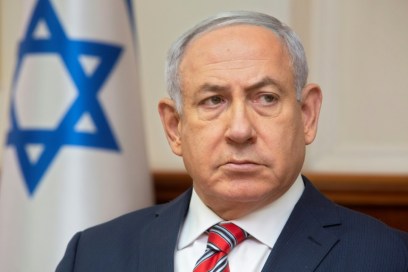
Israeli Prime Minister Benjamin Netanyahu embarks on a three-day European tour in Germany on Monday with strategic differences on Iran set to dominate as leaders attempt to rescue the nuclear deal after US withdrawal
Sebastian Scheiner (POOL/AFP)
Israeli Prime Minister Benjamin Netanyahu on Thursday warned Syrian President Bashar al-Assad  was “no longer immune” from retaliation, while declaring the Iran nuclear deal over after Washington ditched the accord.

Noting that Israel had stayed out of Syria’s protracted civil war, in which Tehran backs Assad, Netanyahu said increasing Iranian encroachment required “a new calculus”.

“He is no longer immune, his regime is no longer immune. If he fires at us, as we’ve just demonstrated, we will destroy his forces,” the Israeli leader said at an event organised by the Policy Exchange think tank in London.

Tensions between Israel and Iran escalated last month when Israel launched an extensive campaign of retaliatory strikes on Iranian-operated bases in Syria, responding to a barrage of rockets and missiles fired by Iran towards the Israeli part of the Golan Heights only hours before.

Even before that, Israel had been blamed for a series of recent strikes inside Syria that killed Iranians, though it has not acknowledged them.

Haaretz reported last year that Israel has struck targets in Syria more than 100 times since the war erupted in 2011, but the latest escalation between Israel and Iran brought further tension to the region.

“Syria has to understand that Israel will not tolerate the Iranian military entrenchment in Syria against Israel,” Netanyahu added.

“The consequences are not merely to the Iranian forces there but to the Assad regime as well,” he said, adding: “I think it’s something that he should consider very seriously”.

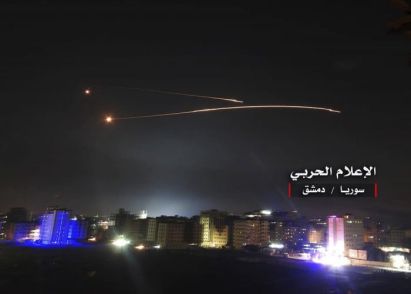
Syrian Central Military Media, via AP
This photo provided early Thursday, May 10, 2018, by the government-controlled Syrian Central Military Media, shows missiles rise into the sky as Israeli missiles hit air defense position and other military bases, in Damascus, Syria.
Syrian Central Military Media, via AP

Netanyahu is on a three-day European tour — visiting Berlin and Paris earlier this week — marked by strategic differences on Iran, as its leaders attempt to rescue the nuclear deal after US withdrawal in May.

He met Wednesday with British Prime Minister Theresa May, who reiterated London’s “firm commitment” to the accord, according to Downing Street.

But the Israeli leader said Thursday “the weight of the American economy” was already dooming “this very bad agreement”.

“It’s a done deal — in the other meaning of the word,” he added, noting companies were already pulling out of Iran under threat of damaging US sanctions.

“You have to choose whether to do business with Iran, or forego doing business with the United States… that’s a no-brainer and everybody’s choosing it effectively as we speak.”

Netanyahu said he had reiterated his dislike for the 2015 deal, which offers sanctions relief in exchange for strict limits on Iran’s nuclear activities.

However, the focus of his discussions in Europe had been on reducing Iran’s presence in Syria, he added.

“I found considerable agreement on that goal.”

At the same time, he criticised his European hosts for an outdated approach to the region.

Netanyahu said Iranian expansion had led to a “realignment” of relations with Arab states in the Middle East who also oppose Tehran — something Britain and western Europe were “evidently not understanding”.

“There is a whole realignment taking place in the Middle East — they’re sort of stuck in the past,” he added, displaying a map of the world with numerous countries highlighted to show Israel’s “expanding diplomatic horizons”.

“I think there’s a west European problem with recognizing that the world is changing,” he said.

-Gaza-

Netanyahu was also asked about the IDF’s approach to the protests in Gaza, where more than 100 Palestinians have been killed since March 30.

“We tried water cannons, we tried tear gas and none worked. Given our record, we probably will figure out something. The last thing we want is violence (or) confrontation. We tried other ways, it doesn’t work. Hamas wants them to die.” Haaretz quoted Netanyahu as saying.

The deadly clashes between the IDF and Palestinian protesters in Gaza caused widespread criticism across the international community due to the high death toll.

With 29 votes in favor, two opposed and 14 abstentions, the UN Human Rights Council voted through a resolution on May 18, calling on the council to “urgently dispatch an independent, international commission of inquiry… to investigate all alleged violations and abuses… in the context of the military assaults on large scale civilian protests that began on 30 March 2018.”

Mahmud Hams (AFP)
Palestinian mourners carry the body of 21-year-old Razan al-Najjar at her funeral after she was shot dead by Israeli soldiers on the border in southern Gaza
Mahmud Hams (AFP)

The resolution was voted through after more than 60 Palestinians were killed in Gaza protests on May 14, the same day that of the US embassy opening in Jerusalem.

Israel argues that the UNHRC has an institutional bias against the Jewish state and pays it disproportionate attention compared to human rights crises elsewhere

Lebanese official: Iran, Hezbollah to stay in Syria until it is ‘free’ 

Posted June 7, 2018 by Joseph Wouk
Categories: Uncategorized

Source: Lebanese official: Iran, Hezbollah to stay in Syria until it is ‘free’ – Israel Hayom