Iraqi protesters set fire to Iran consulate

Posted September 8, 2018 by Joseph Wouk
Categories: Uncategorized

Source: Iraqi protesters set fire to Iran consulate

Angry protesters storm the Iranian consulate in southern Iraq, setting a fire inside amid a wave of demonstrations that have turned deadly in the past few days; demonstrators held two Iraqi employees hostage at a nearby oilfield; 12 protesters have died in clashes with security forces since Monday.

Demonstrators stormed the Iranian consulate in Iraq on Friday, in protest of corruption and misrule by Iraq’s political elite. The angry protesters damaged the consulate’s offices and shouted anti-Iranian slogans while others briefly took workers hostage at a nearby oilfield.

After five days of deadly demonstrations in the southern city of Basra, in which government buildings have been ransacked and set alight, protesters broke in and damaged the consulate’s offices, shouting condemnation of what many perceive as Iran’s sway over Iraq’s political affairs.
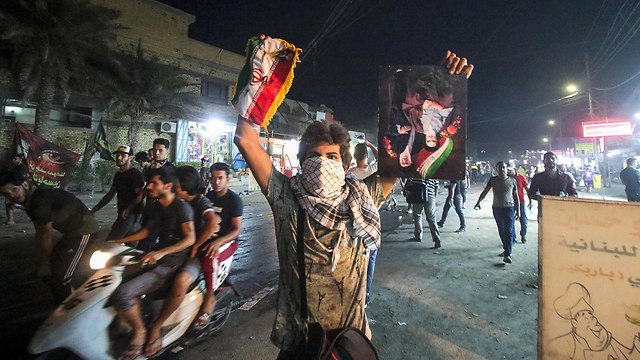
Demonstrators storm the Iranian consulate in Iraq (Photo: AFP)

Demonstrators storm the Iranian consulate in Iraq (Photo: AFP)

The protesters shouted anti-Iranian slogans outside the Iranian consulate, including “Iran, out, out!” before they stormed it and set a fire inside. Smoke could be seen rising from the building. Protesters also burned an Iranian flag.

Security sources said the consulate was empty when the crowd burst in. Iraq’s Foreign Ministry said the storming of the consulate, which it deeply regretted, had nothing to do with protesters’ demands.”The targeting of diplomatic missions is unacceptable and detrimental to the interests of Iraq,” said ministry spokesman Ahmed Mahjoub.

Iran, however, blamed Iraq for failing to protect its embassy and said it expected Baghdad to “identify and punish the attackers quickly,” Bahram Qassemi, the spokesman for the ministry, told journalists, according to state media.

The Iraqi ambassador to Tehran was later summoned to the foreign ministry over the complaints.

Several foreign governments have consulates in the city, including the United States and Russia. In a statement, the US State Department condemned the violence against diplomats and called on “all parties, including security forces and protesters, to uphold the right of peaceful protest and to protect diplomats and their facilities.”

Late in the day some 65 kilometers north-west of Iraq’s second biggest city, another group of protesters entered a water treatment facility linked to the West Qurna 2 oilfield, managed by Russia’s Lukoil.

The protesters held two Iraqi employees hostage for about an hour before leaving the facility peacefully, according to a Lukoil source and a source with Basra’s energy police. Production was not disrupted, a manager at the oilfield said.

The unrest in Basra could have deeper implications for a country that imports most of its food.
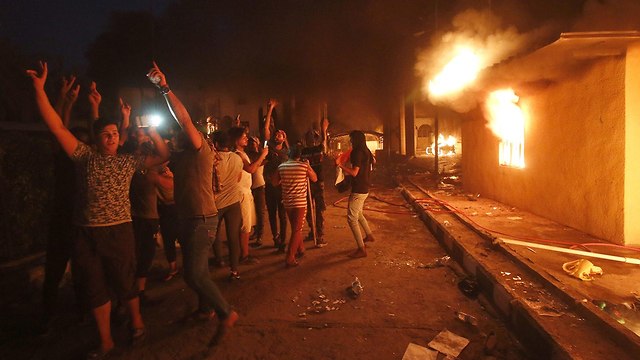
Protesters shouting anti-Iranian slogans  (Photo: EPA)

Protesters shouting anti-Iranian slogans (Photo: EPA)

Since Thursday, protesters have shut Iraq’s only major sea port at Umm Qasr, 60 km (40 miles) south of Basra. It remained shut on Friday, local officials and security sources said, although oil exports, carried out from offshore platforms, have not been affected.

Sweep clean

Residents say they have been driven to the streets by corruption that allowed infrastructure to collapse, leaving no power or safe drinking water in the heat of summer, with protests intensifying on Monday.

Since then at least 12 demonstrators have died in the city of 2 million, mostly in clashes with security forces, as demonstrators torched government buildings and the offices of political parties, whose leaders are all vying to form Iraq’s ruling coalition.

On Friday, two protesters died from gunshot wounds and 39 were wounded, local health and security sources said. A curfew was imposed shortly before 9pm local time, but residents still targeted a building belonging to Iraq’s Popular Mobilization Forces, the grouping of mostly Iran-backed Shi’ite militias.
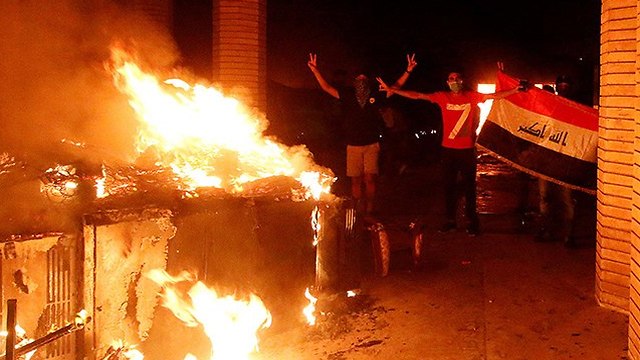
Iraqi protesters set fire to Iran consulate  (Photo: Reuters)

Iraqi protesters set fire to Iran consulate (Photo: Reuters)

The national security council of the Prime Minister of Iraq, Haider al-Abadi, met on Friday and said it was investigating casualties at the protests.

The storming of the consulate came hours after Iraq’s most revered Shi’ite cleric called for a political shakeup in Baghdad and a halt to violence against the protesters.

Ayatollah Ali Sistani, the ultimate authority for devout members of Iraq’s Shi’ite majority who normally holds himself above day-to-day politics, placed blame for the unrest with political leaders and said a new government should be formed, “different from its predecessors.”

Smaller protests also took place on Friday in other cities in Iraq, including Karbala and Baghdad.

New crisis

The unrest has thrust Iraq into a major new crisis at a time when politicians have yet to agree on a new government after an inconclusive election in May. The new parliament finally met on Monday for the first time, but broke up after a day having failed to elect a speaker, much less name the next prime minister.

Parliament’s interim leader summoned lawmakers to an emergency session on Saturday to discuss the unrest.

Leading political figures, embroiled in government formation negotiations in Baghdad, have scrambled to respond to the crisis, condemning rivals for inaction.
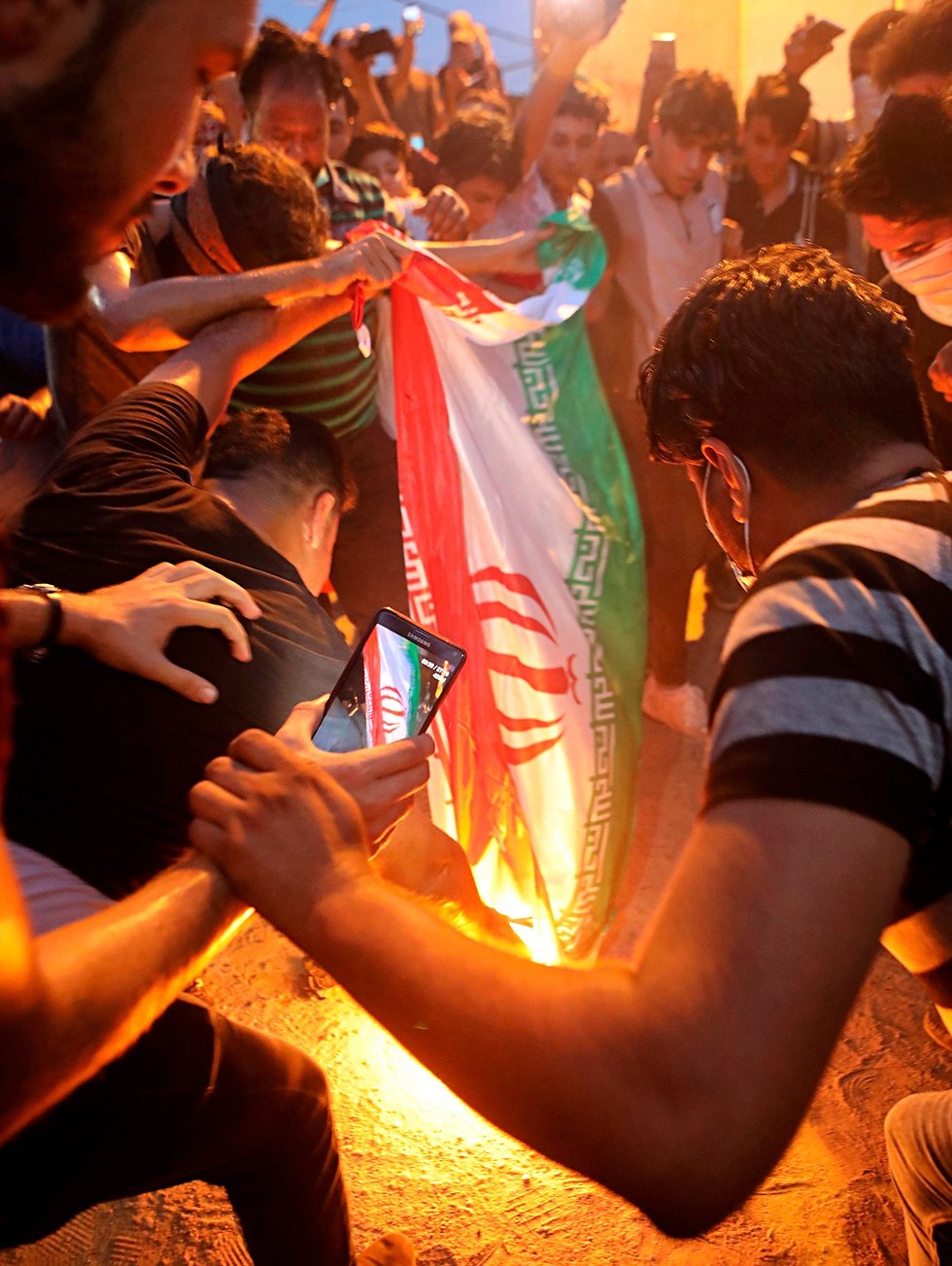
Demonstrations in the southern Iraqi city, Basra (Photo: AP)

Demonstrations in the southern Iraqi city, Basra (Photo: AP)

Iraq’s political factions mainly came together in the past four years during a war against Islamic State. Baghdad’s two most influential allies, Washington and Tehran, also backed the government despite their deep hostility to each other.

But since Islamic State was largely defeated last year, divisions have resurfaced. Shi’ites in the south, where most of Iraq’s oil wealth is produced, say Baghdad politicians have squandered state funds while leaving them desperate.

Moqtada al-Sadr, a populist Shi’ite cleric whose electoral bloc came first in May’s election, said on Twitter that Prime Minister Haidar al-Abadi must release more funds for Basra.

Sadr, the former leader of an anti-American Shi’ite sectarian militia who has reinvented himself as an anti-corruption campaigner, has allied himself with prime minister Abadi.

Their alliance is competing to form a government against a rival bloc backed by Abadi’s predecessor Nuri al-Maliki and the leader of an Iran-backed Shi’ite armed group, Hadi al-Amiri. Amiri called on Abadi to resign over the crisis on Friday.

 

The Trump Doctrine and the end of the ‘new world order’

Posted September 8, 2018 by Joseph Wouk
Categories: Uncategorized

Source: The Trump Doctrine and the end of the ‘new world order’ – International news – Jerusalem Post

Washington has called the ‘instability’ bluff, and it worked, but it has ushered in a multipolar world in its place.

BY SETH J. FRANTZMAN
 SEPTEMBER 7, 2018 19:01
U.S. President Donald Trump waves as he disembarks Air Force One after arriving in Singapore June 10

“Setting fire to the ground,” a “major catastrophe,” bringing “new instability” are the headlines that have greeted Donald Trump’s unorthodox decisions over the past year. Withdrawing from UNESCO, moving the US Embassy, leaving the Iran deal and cutting funding to UNRWA and funding for Pakistan were seen as extreme decisions in the Middle East and around the world. Insofar as there is a “Trump Doctrine,” it has been to call this bluff.

In the mind-set of Trump and his team, the time has come for the United States to move quickly to reverse decades of foreign policy norms, ending the status quo, and ripping up what the previous administrations did.

This is unprecedented. It could be foolhardy, say the many critics of the administration. But so far none of the threatened “chaos” and “instability” has been unleashed. Previous administrations that played it safe and sought to make minor adjustments or shift the needle a few degrees here and there found instability was unleashed regardless of what they did.

On a vast number of foreign policy files that sat awaiting Trump’s team in January 2017, the administration has sought major changes. Most of these major changes have come since December 2017, when the embassy move was announced. That is at least in part because Rex Tillerson was the secretary of state and H.R. McMaster was the national security adviser. Once they got the boot in the spring of 2018, Mike Pompeo took the helm and John Bolton came on as national security adviser.

Is the US now embarked on a radical break with the past and a rapid change in foreign policy? The American school of foreign policy is not inherently incremental and conservative. What is characterized by Trump supporters as a kind of “deep state” of foreign policy experts and the rotating door of the Washington security establishment was not always stagnant. US policy in the republic’s early years alternated widely between lovers of England and lovers of revolutionary France. America sought to challenge European imperialism in the Western hemisphere and moved relatively rapidly into empire building of its own at the end of the 19th century. It famously retreated into isolationism only to emerge in 1945 in the role of anti-Soviet Cold Warrior.

And even in the Cold War the US reversed itself radically from time to time, with Nixon’s trip to China and Reagan’s decision to ramp up the Cold War in the 1980s. George H.W. Bush promised a “new world order” in 1991. He called it the “big idea” in which “diverse nations are drawn together in common course to achieve the universal aspirations of mankind – peace, security, freedom and the rule of law.” He was as much a revolutionary in foreign policy as Trump, where Trump plays the role of the anti-Bush Senior. Trump has likely never studied Carl von Clausewitz, the historic Prussian general whose thinking The Washington Post’s Joel Achenbach once said “haunted the Pentagon, the White House and Capitol Hill.” Neither does Trump seem to have much time for Henry Kissinger’s “world order,” whose views seem to have underpinned 50 years of US policy in one form or another.

THIS LEAVES us, particularly in the Middle East, wondering if the Trump Doctrine is just anti-doctrine, davka for davka’s sake. It appears to be more than that. The team of Bolton, Pompeo and Brian Hook, who handle Iran, and the team of Jared Kushner, Jason Greenblatt and David Friedman, who pioneer Israel-Palestinian policy, have a goal. The goal is to reverse decades of what they see as appeasement.

On Iran the appeasement has taken the form of constantly being enslaved to a paradigm that says the following: Iran is a rational actor (it’s not run by crazy far-right ayatollahs). The Tehran regime dislikes America because of a 1953 coup. We must cultivate moderates and not empower hard-liners. If you don’t give the regime things, then it will empower hard-liners. So give it things and keep it quiet. In this Catch-22 cycle, the more the regime terrorizes the region, the more you have to be nice to it so it won’t be worse.

On the Palestinian file the concept is the following: Palestinians and Israelis need to be brought to the peace table. Until Israel comes to the table, the US must fund the Palestinians’ institutions and make them believe they will get Jerusalem as their capital. America has a responsibility to them because the US supported Israel’s creation and is therefore partly responsible for the chaos that unfolded in the 1948 war when 800,000 Palestinians became refugees. If Palestinians don’t see hope for the future, they will destabilize the region and Israel as well, thus hurting America’s ally. It is in Israel’s best interest to aid the Palestinians and enable their hope.

The Trump Doctrine says this model is nonsense. Step away from the deal, and the other side will come back with a new offer. What Trump’s team either instinctively understands, or plodded into, is that there is a third side to the deal. The third side is Europe. When Trump walked away from the Iran deal, the Iranians wanted to play the bogeyman card and say “Well, now we have a right to nuclear weapons.” But they hesitated because this would force Europe’s hand, and Europe doesn’t want Iran going totally crazy in the region. The bogeyman threat works only when you do it to everyone. But Iran can’t play bogeyman with America and moderate with Europe at the same time. So it’s confused, for the first time in four decades of bogeymanning the region.

Similarly the Palestinian leadership in Ramallah must keep playing the moderate card. The Ramallah leadership is graying and worried about its own future. It can’t unleash the instability that doomsayers predict because instability will result in its overthrow. No Palestinian Spring, Ramallah says. So Ramallah has to get Europe to pick up the tab that Trump walked away from. On cue, Sweden, Germany and other countries are coming to the table.

THE TRUMP administration has forced Europe to do what the EU largely failed to do for 30 years, which is to take a seat at the table. For many years after Bush Sr. brought his new world order, the European powers accepted US leadership and preferred to let the US make mistakes and then critique the US, but not to take the baton and run with it themselves. It is hard to find one major case where the EU led the way on a foreign policy decision since 1990. That is partly Washington’s fault for wanting to muscle in. Europe plays the wise skeptic to Washington’s flailing, from George W. Bush’s “war on terror” to Obama’s promise to “secure the peace” in Berlin in 2008. Europe was rightly skeptical of neoconservatism, WMD and preemption. But it generally went along and got dragged into wars in Iraq and Afghanistan, and then joined the Global Coalition against Daesh.

Since the 1990s the brief period of American global hegemony has withered. Former US ambassador to Moscow Michael McFaul met a mild-mannered man in 1991. “If you had asked me to list 5,000 Russians that might be the next president of Russia, he would not have made this list.” That man was Vladimir Putin. Putin was thinking about a mutlipolar world in the 1990s. I was studying in Russia when he was about to be appointed prime minister by Boris Yeltsin. We thought Russia was Dickensian and cool. But he knew the country could do better and command respect on the global stage. Now he holds court with Turkey and Iran’s president.
For all the anti-Russian rhetoric in the US now, none of those who complain about Putin today did much to stop Russia marching into the Caucuses and into Ukraine, or Syria. Clausewitzians failed. Clausewitz himself probably would have sensed the Russian rising power. The new world order failed. It didn’t restrain Russia or China or Iran or Turkey.

Trump’s policy has made Turkey and Iran think twice. Turkey didn’t expect US sanctions over a jailed pastor. It expected a quiet deal. Iran expected the US to leave Syria and hand over Iraq.

The Trump Doctrine is the end of the new world order. It is its graveyard. It is America’s decision to accept a multipolar world. It has to accept that Turkey, Iran and Russia have run into each other’s arms. It accepts Chinese sovereignty over the islands China built on under Bush and Obama. Trump has birthed a new European policy. The Trump Doctrine tore up decades of foreign policy. What will replace it, relatively quickly, is a new multipolar world.

In the Middle East that may not be a bad thing. For years US hegemony didn’t provide security in the region, because the US was balancing too many interests to confront the multiplicity of threats. A more narrow American policy, tailored to deal with certain types of threats, such as Iran and Islamist extremism, can bolster US allies, rather than balancing all the allies against each other.


IDF to Hizballah: Don’t try and surprise us after withdrawing from Syria – DEBKAfile

Posted September 8, 2018 by Joseph Wouk
Categories: Uncategorized

Source: IDF to Hizballah: Don’t try and surprise us after withdrawing from Syria – DEBKAfile

Intelligence monitors report deepening Hizballah control of Lebanese army forces near the Israeli frontier, raising concerns that the Iranian-backed group is refocusing on Israel as its troops return from the Syrian war. In a briefing to reporters, an Israeli official stressed that in the month-long conflict in 2006, the IDF differentiated between Lebanon state forces and the Hizballah militia. This mistake would not be repeated in another round of fighting, he said. Lebanon the state would be targeted together with any national facilities supporting the war – even if this means “smashing Lebanon.”

Another senior military officer, in a briefing before the New Year festival, noted that Hizballah can now augment the stocks of tens of thousands of rockets and missiles capable of reaching any part of Israel, with its Raduan commando unit, now returned from the battlefields of Syria. Its strategists have charted a plan to seize an Israeli village or IDF post in Galilee. The IDF officer explained that such an action would be more for shock effect than military gain, and the special unit would be quickly destroyed. Hizballah won’t surprise Israel again, the officer said, the IDF is fully prepared for every eventuality.

This week, Israel conducted a large-scale, multiple-unit exercise in the north simulating several Hizballah war scenarios.

The officer then stated: Hizballah has been “deterred for 12 years” and will go to war “only when it has no other option.”  He added: “I don’t see the Iranians kickstarting a Hizballah assault.”

DEBKAfile sums up the doctrine articulated of late by Israel’s generals: Hamas shies against escalation in the Gaza Strip; Hizballah is against war; and Iran is not about to send its proxy into action against Israel. If full deterrence has been achieved on both sides of the two borders, what is the point of Israel’s hectic preparations for the next conflict and the IDF threat to “smash Lebanon?”  Could it be that Israel’s generals are singing in the dark?

After all, there is no guarantee that Tehran will not decide at any moment to send Hizballah into battle against Israel, in reprisal for ramped-up IDF attacks on Iranian military targets in Syria and the Syrian-Iraqi border. In recent weeks, Hizballah has been pulling its troops out of Syria after five years of supporting Bashar Assad’s war against a nationwide insurgency. Hizballah’s vast missile arsenal is supported by troops that are no longer a Shiite militia, but a trained, professional army which has won its spurs in real war combat.
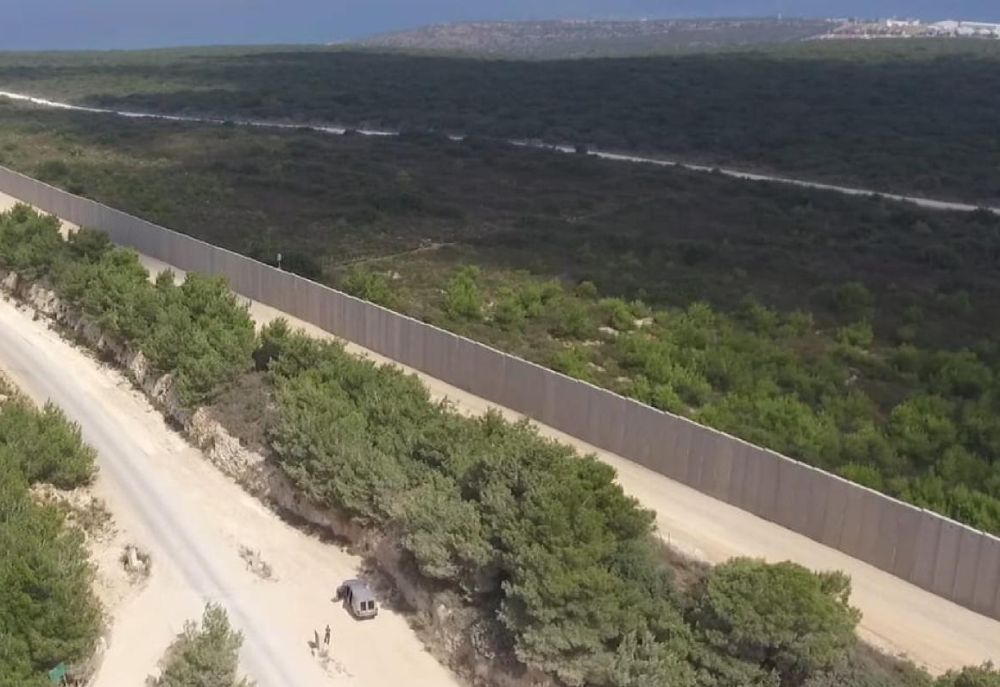
For now, Israel is investing heavily in a defensive wall on its northern frontier with Lebanon twin to the barriers under construction on the Gaza Strip’s land and sea borders.

Brig. Gen. Eran Ofir, Director of IDF border wall projects, reported this week that the first 13km, 9m high section of the 130-km wall guarding the Lebanese border should be finished by the end of the year. This section abuts the small Israeli towns of Rosh Hanikra, Shlomi and Maalot near the Mediterranean coast. The entire $450m project should be completed in two years. The wall is mostly made of concrete with steel mesh sensors and surveillance cameras. Last month, the Lebanese army complained to UNIFIL, the UN peacekeeping force, saying Israeli bulldozers working on the barrier had crossed into Lebanon. UNIFIL spokesman Andrea Tenenti confirmed that since it began in February, all construction had kept to the Israeli side of the Blue Line which marks the frontier.

The small border communities of Rosh Hanikra, Shlomi and Maalot, whose total population is around 50,000, are considered high risk for a Hizballah surprise attack. Even a partial incursion would be hailed as a major strategic feat and confer high kudos on the Shiite terrorist group. Therefore, say DEBKAfile’s military analysts, while the IDF envisions a war that would quickly move onto Lebanese soil, Hizballah sees a future conflict as a another surprise thrust across the border into Israel.


Israeli soldiers sing and dance during 3 hr break from the battle

Posted September 7, 2018 by Joseph Wouk
Categories: Uncategorized

( For the new year, this vid I posted, Check out the 157 comments… – JW )

CC: ENGLISH TRANSLATION OF LYRICS He Who Believes | מי שמאמין Moving video, which occurred yesterday on the outskirts of Gaza, while the soldiers left from battle zones for a rest of three hours. The song they are singing is titled, “THE ONE WHO BELIEVES.” We all pray for the return of all our troops in peace and uninjured. ! עלה קרב

______________________________________________________________________

( Translated lyrics)
Every place, all the time
The old and young has Beautiful and less beautiful days
Among them answers to all the questions
There is one mighty God
He gives us everything in this world
Between darkness to a sun beam
We only need to choose the path
It is known life is a gift
All is expected and is allowed
The one who believes is not afraid
To lose faith
We all have the King of the universe
Who guards us from it all
This nation is a family
One and one more is the secret of success
The nation of Israel will never give up
We will always stay on the map
It is known life is a gift
All is expected and is allowed
The one who believes is not afraid
To lose faith
We all have the King of the universe
Who guards us from it all
בכל מקום, כל הזמן יש לכולנו מגדול ועד קטן
ימים יפים, וגם פחות ובניהם תשובה לכל השאלות
יש אלוהים אחד גדול הוא בעולם הזה נותן לנו הכל
בין אפלה לקרן אור את הנתיב אנחנו רק צריכים לבחור
וזה ידוע החיים הם מתנה הכל צפוי והרשות נתונה
מי שמאמין לא מפחד
את האמונה לאבד
ולנו יש את מלך העולם
והוא שומר אותנו מכולם
העם הזה הוא משפחה
אחד ועוד אחד זה סוד ההצלחה
עם ישראל לא יוותר תמיד על המפה אנחנו נשאר
וזה ידוע חיים הם מתנה
הכל צפוי והרשות נתונה
מי שמאמין לא מפחד
… מצוה גדולה להיות בשמחה להיות בשמחה תמיד מי שמאמין לא מפחד…

Happy New Year !  Shana Tova ! – JW

Posted September 7, 2018 by Joseph Wouk
Categories: Uncategorized

One who believes is not afraid


Rouhani: Israel, US will not achieve their objectives through rebels in Syria

Posted September 7, 2018 by Joseph Wouk
Categories: Uncategorized

Source: Rouhani: Israel, US will not achieve their objectives through rebels in Syria | The Times of Israel

At summit in Tehran with Putin and Erdogan on conflict, Iranian president says US must leave Syria immediately, while Turkish leader calls to prevent ‘bloodbath’ in Idlib

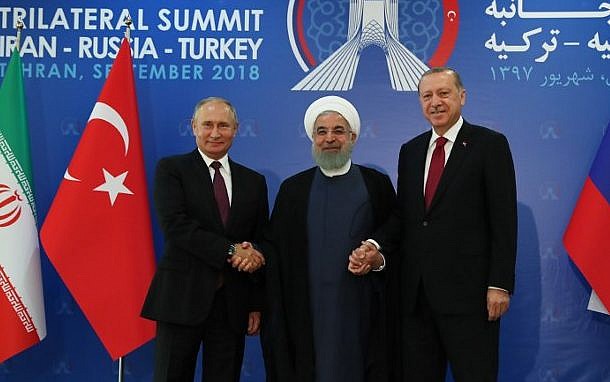
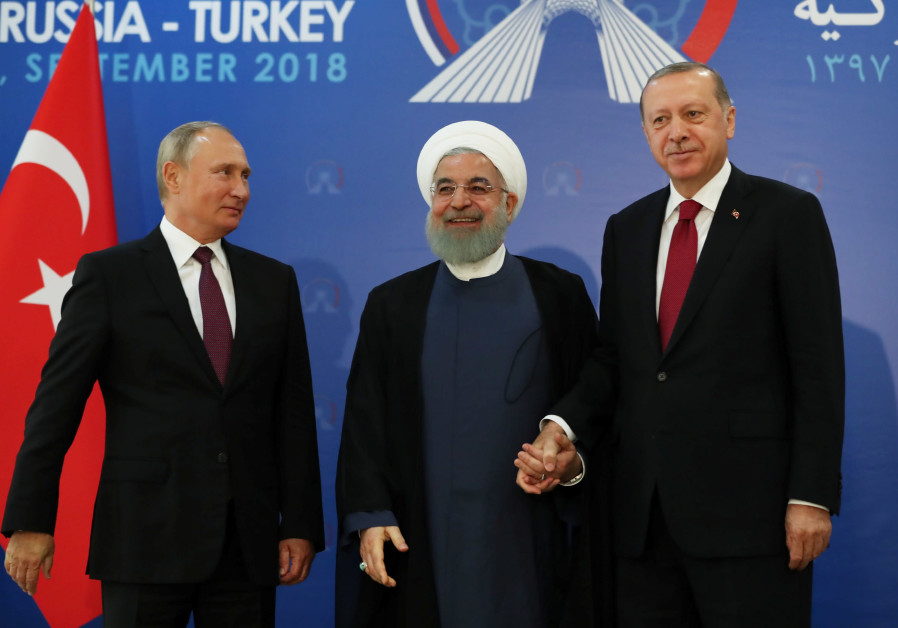
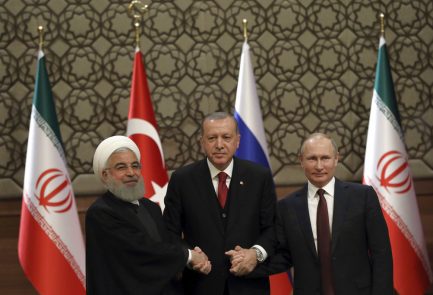
A handout picture taken and released on September 7, 2018 by the Turkish Presidential Press service shows Turkish President Recep Tayyip Erdogan (R) , Iranian President Hassan Rouhani (C) and Russian President Vladimir Putin (L) joining hands  during a trilateral summit in Tehran. (AFP/Turkish Presidency Press Office)

A handout picture taken and released on September 7, 2018 by the Turkish Presidential Press service shows Turkish President Recep Tayyip Erdogan (R) , Iranian President Hassan Rouhani (C) and Russian President Vladimir Putin (L) joining hands during a trilateral summit in Tehran. (AFP/Turkish Presidency Press Office)

Iranian President Hassan Rouhani on Friday said the US and Israel have realized “they will not reach their objectives” by arming Syria’s rebels, as he met with Russian leader Vladimir Putin and Turkish President Recep Tayyip Erdogan for highly-anticipated talks in Tehran to shape the future of Idlib, Syria’s last major rebel bastion.

On Thursday Foreign Policy claimed that Israel had armed Syrian rebels for years to advance its interests in the war-torn nation.

Rouhani demanded an immediate withdrawal by American forces in the country. The US has some 2,000 troops in Syria. He added that “we have to force the United States to leave,” without elaborating.

“The fires of war and bloodshed in Syria are reaching their end,” Rouhani said, while adding that terrorism must “be uprooted in Syria, particularly in Idlib.”

Rouhani warned against a “scorched earth” policy in Idlib province. “Fighting terrorism in Idlib is an unavoidable part of the mission of restoring peace and stability to Syria,” Rouhani told the summit in Tehran.

“But this battle must not cause civilians to suffer or lead to a scorched earth policy,” he added, amid UN warnings of a humanitarian disaster if an offensive goes ahead.

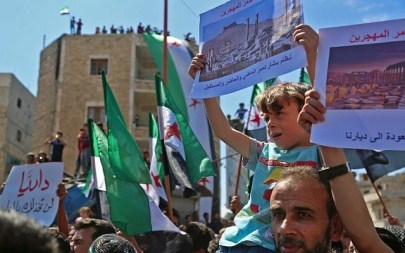
Syrian protesters wave their national flag as they demonstrate against the regime and its ally Russia, in the rebel-held city of Idlib on September 7, 2018. (AFP/Zein Al Rifai)

The Turkish leader also urged the Syrian regime and its allies to avoid a bloodbath, but Putin insisted Damascus as “the legitimate Syrian government has a right and must eventually take under control all its national territory.”

The three countries are guarantors of the Astana process, a track of talks on Syria’s civil war launched after Russia’s game-changing 2015 military intervention that has eclipsed Western-backed Geneva negotiations led by the United Nations.

Erdogan called for a ceasefire to prevent any “bloodbath” in Idlib as Russian airplanes pounded rebel positions in the Syrian province.

“If we can ensure a ceasefire here, this will be one of the most important steps of the summit, it will seriously put civilians at ease,” Erdogan said. “We never want Idlib to turn into a bloodbath,” Erdogan said.

“Any attack launched or to be launched on Idlib will result in a disaster, massacre and a very big humanitarian tragedy.”

Iranian and Russian support for Syrian President Bashar Assad has shored up the Damascus regime, allowing it to regain the upper hand in the seven-year civil war which has claimed some 350,000 lives since 2011.

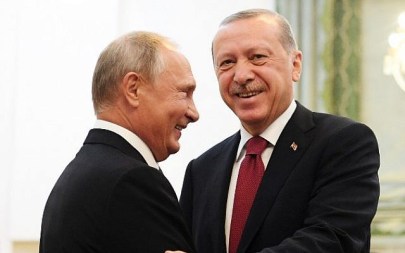
Russia’s President Vladimir Putin (L) shakes hands with his Turkey’s counterpart Recep Tayyip Erdogan during their meeting in Tehran on September 7, 2018 (AFP/Pool/Kirill Kudryavtsev)

Seized from government forces in 2015, Idlib and adjacent areas form the final major chunk of Syrian territory still under opposition control. It is home to some three million people — around half of them displaced from other parts of the country, according to the United Nations.

Putin said it was “unacceptable” to use civilians as a pretext to shield “terrorists” in Syria’s rebel-held Idlib.

He warned militants in Idlib planned “provocations,” possibly including chemical weapons. The Syrian government has been repeatedly accused of using chemical weapons in the long conflict.

Each of the three nations has its own interests in the yearslong war in Syria.

Iran wants to keep its foothold in the Mediterranean nation neighboring Israel and Lebanon. Turkey, which backed opposition forces against Assad, fears a flood of refugees fleeing a military offensive and destabilizing areas it now holds in Syria. And Russia wants to maintain its regional presence to fill the vacuum left by America’s long uncertainty about what it wants in the conflict.

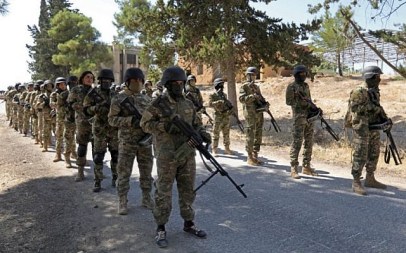
Syrian rebel fighters prepare for an upcoming government forces offensive, in the countryside of the rebel-held northern Idlib province on September 3, 2018. (AFP/Omar Haj Kadour)

Northwestern Idlib province and surrounding areas are home to about 3 million people — nearly half of them civilians displaced from other parts of Syria. That also includes an estimated 10,000 hard-core fighters, including al-Qaeda-linked militants.

For Russia and Iran, both allies of the Syrian government, retaking Idlib is crucial to complete what they see as a military victory in Syria’s civil war after Syrian troops recaptured nearly all other major towns and cities, largely defeating the rebellion against Assad.

A bloody offensive that creates a massive wave of death and displacement, however, runs counter to their narrative that the situation in Syria is normalizing, and could hurt Russia’s longer-term efforts to encourage the return of refugees and get Western countries to invest in Syria’s postwar reconstruction.

For Turkey, the stakes couldn’t be higher. Turkey already hosts 3.5 million Syrian refugees and has sealed its borders to newcomers. It has also created zones of control in northern Syria and has several hundred troops deployed at 12 observation posts in Idlib. A government assault creates a nightmare scenario of potentially hundreds of thousands of people, including militants, fleeing toward its border and destabilizing towns and cities in northern Syria under its control.

Syrian and Russian forces stand guard as civilians enter the Abu Duhur crossing on the eastern edge of Idlib province, on August 20, 2018. (AFP/George Ourfalian)

Naji al-Mustafa, a spokesman for the Turkey-backed National Front for Liberation, said Friday his fighters were prepared for a battle that they expect will spark a major humanitarian crisis.

“The least the summit can do is to prevent this military war,” he said.

Early on Friday, a series of airstrikes struck villages in southwest Idlib, targeting insurgent posts and killing a fighter, said Rami Abdurrahman, the head of the Britain-based Syrian Observatory for Human Rights. Abdurrahman said suspected Russian warplanes carried out the attack.

Turkey also doesn’t want to see another Kurdish-controlled area rise along its border, as it already faces in northern Iraq.

Abbas threatens to sever relations with Israel if it negotiates with Hamas

Posted September 7, 2018 by Joseph Wouk
Categories: Uncategorized

Source: Abbas threatens to sever relations with Israel if it negotiates with Hama – Arab-Israeli Conflict – Jerusalem Post

According to this report, Abbas’s position caused Egypt to place the internal Palestinian reconciliation at the top of its list of priorities and to reject the “calm first” approach.

BY YASSER OKBI/MAARIV
 SEPTEMBER 7, 2018 09:04
Abbas threatens to sever relations with Israel if it negotiates with Hamas

Palestinian Authority President Mahmoud Abbas threatened to sever ties with Israel if the state makes an agreement with Hamas, Palestinian sources told Al Hayat, a London based newspaper on Friday.

According to the report, the sources said that Abbas’s position caused Egypt to place the internal Palestinian reconciliation at the top of its list of priorities and to reject the “calm first” option.

Abbas said that he had met with Shin Bet director Nadav Argaman in early September. Argaman had tried to persuade Abbas not to sabotage the efforts to arrange a settlement between Israel and Hamas and to ensure a Palestinian reconciliation, according to an Israeli source on Monday. According to the report, Argaman told Abu Mazen that this is a historic opportunity and it would be a shame to waste it. 

Because of this change in priories, Hamas might be forced to seek alternatives other than direct talks with Israel towards a calm agreement, including possibly reaching a truce with Israel but having PLO delegate Azzam al-Ahmad sign the agreement.

The sources also said that Hamas sought calm over Palestinian reconciliation because of the unacceptable conditions imposed by the PA, including handing over responsibility for the Gaza Strip.

Hamas has a few other options, but all are difficult for them: disarmament; a total collapse of the social and economic situation in the Gaza Strip; or a popular revolt in Gaza, which will lead to thousands of casualties and war with Israel. Hamas rejected these options and decided that maintaining the status quo of quiet would be the lesser of all evils.

The source said that Hamas rejected the conditions of Fatah and referred to them as impracticable. Other factions such as the Islamic Jihad also rejected the conditions.

Yvette J. Deane translated this article. 


Syria and Russia strike in Idlib as leaders meet in Teheran

Posted September 7, 2018 by Joseph Wouk
Categories: Uncategorized

Source: Syria and Russia strike in Idlib as leaders meet in Teheran – Middle East – Jerusalem Post

Turkish President Tayyip Erdogan warned Turkey can not accept any more refugees, claimed any attack in Idlib would result in a disaster.

BY MAARIV ONLINE
 SEPTEMBER 7, 2018 16:24
Syria and Russia strike in Idlib as leaders meet in Teheran

Syrian and Russian jets struck anti-Assad forces in Idlib on Friday as the leaders of Russia, Iran and Turkey – the three main nations with boots on the ground in the war-torn country – started their summit meeting in Teheran.

The conquest of Idlib will allow Syrian leader Bashar Assad to regain full control of the country and the Teheran summit meeting between Turkish President Tayyip Erdogan, Russian President Vladimir Putin and Iranian President Hassan Rouhani is where the future of Syria is currently being discussed.

Faced with US demands Iranian forces pull out of Syria Rouhani stated it is the US that should withdraw its forces out of Syria. He made it clear that the operations against anti-Assad forces in Idlib will continue until they all leave Syria. Citing Israel alongside the US the Iranian leader claimed the two countries will not achieve their goals by arming the anti-Assad forces.

Erdogan argued his country can not take in any more Syrian refugees and argued that a “rational solution” to the Idlib situation should be reached. Erdogan said it is crucial to maintain Idlib’s current status and argued the US offers support to “terrorist groups” in Syria.

US President Donald Trump warned against a wide-scale operation in Idlib tweeting that “hundreds of thousands might die.” Chariman of the Joint Chief of Staff General Joseph Dunford warned against a large scale Assad-forces attack in Idlib as that might lead to a humaniterian disaster. “I think we all want to avoid that”, he said while visiting Athens earlier this week.

The visit to the Greek capital suggests the US looks to Greece as a potential partner should it need to use US forces to operate in Syria, reported Newsweek.   

The Secretary’s Special Representative for Syria Engagement Ambassador Jim Jeffrey stated on Thursday that American forces will remain in Syria until ISIS is defeated and Iranian forces exit the country.

“Right now (the Syrian government) is a cadaver sitting in rubble with just half the territory of Syria under regime control on a good day,” Jeffrey said.

He also warned that Assad “has no future as a ruler” in Syria, but it was not up to Washington to get rid of him and it would work with Moscow on a political transition.

Trump will chair a U.N. Security Council meeting on Iran during an annual gathering of world leaders in New York later this month. The meeting will focus on Iran’s nuclear program and its meddling in the wars in Syria and Yemen.

France has invited the United States, Jordan, Egypt, Saudi Arabia, Germany and Britain for talks on the sidelines of the U.N. meeting to discuss Syria, Jeffrey said.

US to remain in Syria until Iranian forces withdraw, envoy says 

Posted September 7, 2018 by Joseph Wouk
Categories: Uncategorized

Source: US to remain in Syria until Iranian forces withdraw, envoy says – Israel Hayom

Ayatollah: US, Israel waging media war to weaken Iranians

Posted September 7, 2018 by Joseph Wouk
Categories: Uncategorized

Source: Ayatollah: US, Israel waging media war to weaken Iranians – Israel Hayom