Israelis on Gaza border to use drones to fight incendiary balloons

Posted October 14, 2018 by Joseph Wouk
Categories: Uncategorized

Source: Israelis on Gaza border to use drones to fight incendiary balloons

( If it can also take out small drones, the US desperately nerds it to combat the overwhelming flood of narco drones crossing the border from Mexico daily. – JW )

Startup Aerialax is developing a drone that can detect and intercept incendiary balloons and kites from Gaza; residents hope to purchase one for each town in border area.
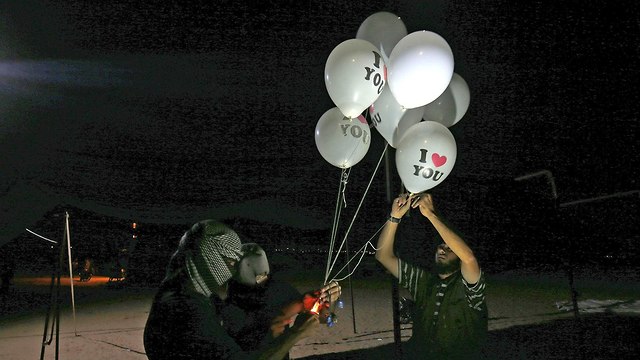
While the IDF is struggling to effectively deal with the terror and destructioncaused by incendiary balloons and kites being flown from Gaza into Israel, Israelis living by the border have decided to lend a helping hand and are now raising funds to purchase aerial drones to fight the phenomenon that has been embittering their lives for the past six months.

Although the IDF is employing a number of means to combat the incendiary balloons and kites, it is not enough for citizens who are suffering from the fires that break out as a result almost daily.


More than NIS 50,000 has been collected in recent days for the purchase and further development of a new interceptor drone.

The drone, operated by a computer program, can detect a flaming balloon or kite aloft and intercept it.

Efforts to combat hostilities from Gaza (Photo: Barel Efraim)

Efforts to combat hostilities from Gaza (Photo: Barel Efraim)

The drone has a metal tip at its front and sharp wings, it is immune to collisions and can reach speeds of 300 km/h.The Aerialax start-up company, owned by an Israeli Noam Kenig, has been developing the drone in Canada.

Noam Kenig with drone (Photo: Mattan Tzuri)

Noam Kenig with drone (Photo: Mattan Tzuri)

“The drone is easy to operate and relatively simple. Our goal is for every community to have such a device, so we can deal with the terror of balloons and kites,” said Alon Alsheikh from Kibbutz Nir Am. “Our goal is to appoint a person in each community who will be trained to operate the drone.”

 (Photo: Mattan Tzuri)

(Photo: Mattan Tzuri)

Over the past six months 11,920 dunams (some 3,000 acres) of farmland and woodland have been burned in fires caused by incendiary kites and balloons flown from Gaza into Israel, according to the KKL. Forests in the Gaza border area saw 1,053 fires that consumed countless of trees. The majority of the conflagrations erupted in the Be’eri forest, which suffered 452 fires, while 353 fires broke out in the Kissufim Forest.

Gazans prepare to launch balloons (Photo: AFP)

Gazans prepare to launch balloons (Photo: AFP)

The Shokeda Forest saw 75 fires, while 31 fires erupted in the Hannun Forest and 29 fires scorched the HaBesor Stream Forest.

The data was provided by KKL’s foresters in the western Negev area, who have been constantly on call over the past six months, arriving at the scene the minute they receive a report about a fire breaking out.

“The nature in the Gaza border area has been severely damaged,” said one firefighter. “I believe that after the rain, the picture will become clearer and we will be able to know what is sprouting anew and what is not. But there is no doubt that this is a severe blow to nature. Places where people used to sit in the shade of the trees are now all scorched earth.”


Off Topic: Tel Aviv court upholds entry ban on US student over BDS support

Posted October 14, 2018 by Joseph Wouk
Categories: Uncategorized

Source: Tel Aviv court upholds entry ban on US student over BDS support – Israel Hayom

( While I hate the idea of excluding students for their opinions, I see no reason to admit anti-Israel activists.  They come only to hurt us.  Not an easy call. – JW )


UN envoy Haley: Israel, Syria to reopen Golan crossing on Monday 

Posted October 14, 2018 by Joseph Wouk
Categories: Uncategorized

Source: UN envoy Haley: Israel, Syria to reopen Golan crossing on Monday – Israel Hayom


Hezbollah uses ambiguity to combat Israeli missile site claims

Posted October 14, 2018 by Joseph Wouk
Categories: Uncategorized

Source: Hezbollah uses ambiguity to combat Israeli missile site claims – Israel Hayom

Hezbollah leader Hassan Nasrallah made no mention of his terrorist organization’s weapons capabilities on Friday in his first speech since Israel claimed the group has a missile-launching facility near Beirut’s international airport.


If Hamas has any sense, it will cease its fire now, PM warns

Posted October 14, 2018 by Joseph Wouk
Categories: Uncategorized

Source: If Hamas has any sense, it will cease its fire now, PM warns – Israel Hayom


Avigdor Liberman: Gaza citizens are being held hostages by Hamas on behalf of Iran 

Posted October 14, 2018 by Joseph Wouk
Categories: Uncategorized

Source: Avigdor Liberman: Gaza citizens are being held hostages by Hamas on behalf of Iran – Arab-Israeli Conflict – Jerusalem Post

Israel last week, began to transfer Qatari funded fuel into Gaza. The United Nations helped with the purchase transaction, which for the first time by-passed the Palestinian Authority.

BY TOVAH LAZAROFF
 OCTOBER 14, 2018 15:23
Liberman: Gaza citizens are being held hostages by Hamas on behalf of Iran

Hamas is holding Gaza residents hostage on behalf of Iran, Defense Minister Avigdor Liberman said in an Arabic Facebook post in which he appealed to Palestinians to overthrow Hamas’ rule of the small enclave.

“I call on you, residents of Gaza: Act against the extremist leadership that has taken you hostage in the service of the Iranian Ayatollahs,” Liberman said.

His works were posted on the “el-Munasek”, the Arabic-language Facebook page of the Coordinator of Government Activities in the Territories, Major General Kamil Abu Rukun.

Liberman explained to the 2 million Palestinians in Gaza that he had halted the transfer of all fuel into the Gaza Stripin direct response to Hamas’ violence against Israel on Friday.

Israel last week, began to transfer Qatari funded fuel into Gaza. The United Nations helped with the purchase transaction, which for the first time by-passed the Palestinian Authority. The PA has handled such transactions in the past.

The Untied Nations and Israel had hoped that the fuel would put a lid on some of the Gaza violence by easing humanitarian conditions in the Strip, where people are living on approximately four hours of electricity a day.

Qatar had agreed to fund six months of fuel purchases for the Gaza Power plant. But on Friday, Palestinian rioters breached the Gaza fence and infiltrated into Israel, approaching an IDF sniper position. The IDF responded to the violent incidents with live fire, killing five Palestinians.

On Sunday Liberman told the Gazan’s in Arabic, ”The State of Israel was prepared to improve the civilian reality in the Gaza Strip, but the decision of the Hamas leadership to use serious violence – especially on the same day in which tankers of diesel fuel were brought into the Gaza Strip – is what brought about the decision to cut off the supply of fuels. All of the responsibility for the deterioration in the humanitarian situation in the Gaza Strip belongs to Hamas and Hamas alone.”


On edge about Iran

Posted October 13, 2018 by Joseph Wouk
Categories: Uncategorized

Source: On edge about Iran | The Times of Israel

Diplomatic measures and economic sanctions are not working; the US and Israel need to find new responses to Iranian aggression

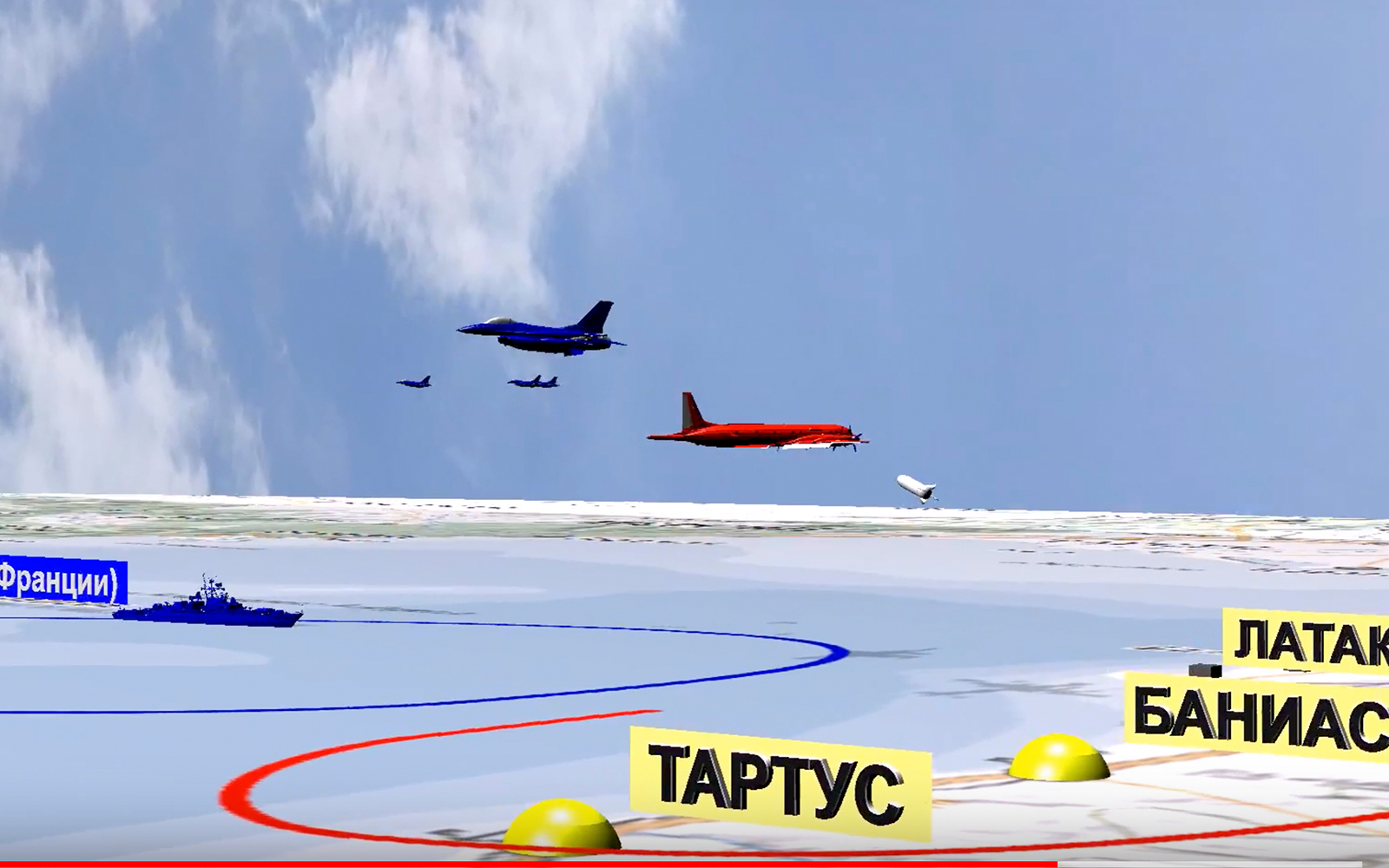
A computer simulation released by the Russian Defense Ministry September 23, 2018, purports to show Israeli jets near a Russian reconnaissance plane, in red, off Syria's coast before it was accidentally shot down by Syria forces responding to the Israeli air strike. (Russian Defense Ministry Press Service via AP)

A computer simulation released by the Russian Defense Ministry September 23, 2018, purports to show Israeli jets near a Russian reconnaissance plane, in red, off Syria’s coast before it was accidentally shot down by Syria forces responding to the Israeli air strike. (Russian Defense Ministry Press Service via AP)

According to the Israel Defense Forces, on September 17th, the Israeli Air Force targeted a facility of the Syrian Armed Forces from which systems to manufacture accurate and lethal weapons were about to be transferred on behalf of Iran to Hezbollah in Lebanon. Anti-aircraft fire from Syrian SAM5 batteries in response to the Israeli strikes resulted in the accidental downing of a Russian Ilyushin-20 aircraft, killing all 15 Russian service members aboard. The incident has led to what has arguably been the biggest strain in Israeli-Russian relations since Russia began military operations in Syria three years ago, despite the fact that it had been Syrian anti-aircraft fire that had downed the Russian Ilyushin. Russian defense officials, such as Russian Minister of Defense Sergei Shoigu and spokesperson of the Russian Defense Ministry Igor Konashenkov were quick to place blame on Israel.

“The Israeli jets used the Russian plane as a cover, thus exposing it to Syrian air defense fire. As a result, the Ilyushin-20, its reflective surface being far greater than that of an F-16, was shot down by a missile launched with the S-200 system,” Konashenkov told Russian news outlet TASS. “We regard these provocative actions by Israel as hostile. As a result of irresponsible actions by the Israeli military, 15 Russian military servicemen were killed. This by no means agrees with the spirit of Russian-Israeli partnership. We reserve the right to a proportionate response,” Konashenkov added.

According to the Defense Ministry in Moscow, the Russian Ilyushin-20 was returning to the Russian Hmeymim airbase in Lataika province when at approximately 11:00 p.m. Moscow time, it disappeared from radar screens. The Russians claim that the plane was over the Mediterranean Sea about 35 kilometers (20 miles) from the Syrian coastline, and that the trace of the Ilyushin-20 on flight control radars disappeared during an attack by four Israeli F-16 jets on Syrian facilities in Latakia province. Syrian state media also presented a similar timeline of events, however, opposition sources reported that on Wednesday, several Syrian soldiers who were involved in the downing of the Russian Ilyushin-20 were arrested and interrogated by members of the Russian military police. A Syrian unit was also reported to have taken part in the arrest.

Israel was quick to respond to Russian claims that it was responsible for the incident, placing blame on the Syrian regime headed by Bashar al-Assad, as well as on Iran and its proxy in Lebanon, Hezbollah. In a phone call between Israeli Prime Minister Benjamin Netanyahu and Russian President Vladimir Putin, Netanyahu emphasized this point, while also expressing regret and condolences for lost lives.

The Israel Defense Forces admitted to targeting a Syrian Armed Forces facility in Latakia, where systems to manufacture lethal weapons were about to be transferred to Hezbollah on Iran’s behalf. Israeli officials stressed that these weapons posed an “intolerable threat.” Israel also launched its own investigation into the incident, one that contradicts the Russian account of events.

According to Israeli officials, at the time of the strike, the Russian plane was not in the area, and by the time that the Syrian SAM missiles were launched, Israel’s fighters were already back in Israeli airspace. The Israeli investigation claimed that Syria’s anti-aircraft batteries fired indiscriminately and that its military did not check whether or not Russian planes were in the air, concluding that, “extensive and inaccurate Syrian antiaircraft fire,” took down the Russian plane.

Despite the rise in tensions, both Russia and Israel have taken steps that reflect their desire to de-escalate the situation. While officials in Moscow and in Russian Defense circles were quick to place unequivocal blame on Israel, Russian President Vladimir Putin took a softer tone, stating: “Here it’s more like a chain of tragic accidental circumstances, because Israel didn’t shoot our plane down. But there’s no doubt, no doubt at all, that we will have to take a serious look at what in fact happened, and our view of this tragedy is set out in the statement issued by the Russian Federation Ministry of Defense, which has been fully agreed with me.” Vladimir Putin promised to further investigate the incident and to take stronger security measures to protect Russian servicemen in Syria.

In his phone call with Vladimir Putin, Benjamin Netanyahu emphasized the importance of continued coordination between Israel and Russia, and offered to send Israel’s Air Force commander to Moscow to debrief the Russian government about the Israeli operation in Syria. “Israel has a strong interest in maintaining the deconfliction line and will want to work with Russia to improve it,” according to Yaakov Amidror.

Comments from the United States Secretary of State Mike Pompeo did not mention Israel, but noted, “Yesterday’s unfortunate incident reminds us of the need to find permanent, peaceful, and political resolutions to the many overlapping conflicts in the region and the danger of tragic miscalculation in Syria’s crowded theater of operations,” and, “Underlines the urgent need to resolve the Syrian conflict and to end Iran’s provocative transit of dangerous weapon systems through Syria, which are a threat to the region.” President Trump remarked that the incident was, “A very sad thing, but that’s what happens.”

Remarks from Hassan Nasrallah, the secretary general of the Hezbollah, claimed that Israel’s real purpose for striking Syria was not to stop the shipments of weapons to Hezbollah, but to degrade Syrian weapons capabilities (with notable regards to missiles). Nasrallah added that, “The Israeli aggression in Syria is intolerable and must be stopped immediately.” Nasrallah also made sure to target the United States in his remarks, stating, “The real enemy of the Middle East is the Americans and their policies. Even Israel is only an actor in the US play.” Most notably, and perhaps most unsurprisingly, Nasrallah emphasized that Hezbollah fighters would not be leaving Syria anytime in the near future.

On September 20, 2018, it was released that Iranian ambassador to the United Nations Gholamali Khoshroo asked in letters to the secretary-general and Security Council for condemnation of Israeli threats against Tehran and to bring Israel’s nuclear program under its supervision. The letter also requested that the United Nation to force Israel to join the Nuclear Non-Proliferation Treaty and bring its nuclear program under supervision of the International Atomic Energy Agency (IAEA), a UN atomic watchdog.

Syrian Foreign Minister Walid Muallem threatened at the UN General Assembly on October 29th to push Israel out of the “occupied Golan Heights,” and accused Israel of supporting terrorist groups operating in Southern Syria. He then affirmed that Syria is determined to liberate the Golan Heights, and appealed for the UN to enforce resolutions that would push Israel back to the pre-1967 border with Syria. Mr. Muallem also called for the immediate removal of US, French, and Turkish forces from Syria.

In the time since the downing of the Russian Illyushin-20, Israel and Russia have maintained a constant dialogue with regards to the incident, and a military delegation headed by Israeli Air Force Commander Maj. Gen. Amikam Norkin was sent to Moscow in an attempt to deescalate the situation. The delegation presented its initial findings of their investigation, which found that Syria, not Israel, was to blame for the downing of the Il-20. The delegation also presented intelligence regarding Iranian efforts to establish a permanent military presence in Syria and to facilitate arms transfers to terror proxies in the region. In the end, the Russians rejected the findings of the investigation conducted by the Israeli Air Force, maintaining their claims that Israeli warnings of an impending airstrike came with too short of a notice (Israel claims 12 minutes in advance, Russia claims less than one minute in advance), and that Israeli fighters used the Russian plane as cover, a claim that Israeli officials have ardently denied. Nevertheless, Moscow still places sole blame on Israel. In addition to this, Moscow has demanded further inquiries and explanations from Israel.

Russian Defense Ministry Spokesman Major General Igor Konashenkov issued a scathing statement directed towards the Israeli military, claiming that, “objective data says that the actions of Israeli pilots, which led to the death of 15 Russian military personnel, point to either lack of professionalism or criminal negligence. This is why we believe that the Russian Il-20 aircraft tragedy is solely the fault of the Israeli Air Force and those who made decisions concerning such actions.” Konashenkov followed, “This is an extremely ungrateful response to all that Russia has done for Israel and the Israeli people recently. The Israeli military command either does not value the current level of relations with Russia or does not control certain military units,” claiming that the IAF’s actions towards the Russian aircraft went, “beyond civilized relations.”

In the wake of heightened tensions, Israeli Defense Minister Lieberman pledged that Israel would continue to operate in Syria to fight Iran. “We will do everything, everything that is required, in order to defend the security of Israeli citizens. On this issue we have no other alternative,” Lieberman remarked. With regards to initial Russian outrage over the event, Lieberman said he understood the anger surrounding the incident, but maintained that the Syrian regime under Bashar Al-Assad, not Israel, was responsible.

While Israel vows to continue strikes against Iran in Syria, the situation has become more complicated with the recent decision by the Russians to supply Syria with advanced S-300 anti-aircraft systems. Russian Foreign Minister Sergey Lavrov stated that the anti-aircraft system “will be devoted to ensure 100 percent security and safety of our men in Syria.” Russian Minister of Defense remarked, “We are confident that these measures will cool hotheads and prevent them from taking thoughtless steps that might put our servicemen in harms way.” While Moscow claims that the system will be under the control of Syrian forces, most agree that it will be the Russians who will have their fingers on the button. Moscow is hoping that the move will compel Israel and other coalitions operating in Syria, such as those lead by the U.S. and Turkey, to consult even more closely with Russia when pursuing their own military objectives, such as to avoid any future incidents. Alexander Sherin, deputy chair of the Russian State Duma’s defense committee stated, “We cannot allow Syrian airspace to be turned into a public thoroughfare.”

The move has faced sharp criticism in Israel, with Benjamin Netanyahu calling it “irresponsible,” and another Israeli official remarking that, “The S-300 is a complex challenge for the State of Israel.” However, the Israeli official added that while Moscow, “made a move, the playing field is very large.” Statements from Israeli officials indicate that Israel remains committed to self-defense and confident in its support from the United States. Israeli Defense Minister Lieberman pledged, “One thing needs to be clear: If someone shoots at our planes, we will destroy them. It doesn’t matter if it’s an S-300 or an S-700.” Israel has reportedly been preparing for the S-300’s deployment for over a decade, and Israel’s new F-35 stealth fighters are capable of evading the system. Nevertheless, the S-300 does pose new challenges to Israeli operations in Syria, and the risk of escalation persists in Israeli-Russian relations. While Netanyahu and Putin have enjoyed positive relations and even what some would call, “friendship,” this does not outweigh rivaling geopolitical interests.

While Russia has attempted to portray the incident as the result of a lack of self-control on the part of the Israeli’s, ultimately, the events of September 17th highlight Russia’s inability to control or otherwise restrain its own proxies. Russia’s embarrassment of this fact is displayed by its frantic attempts to blame Israel for something that it knows their own ally (Syria) is responsible for. Russia and Israel both have an understanding in trying to maintain the deconfliction line. Russia, it should be noted, has acknowledged Israel’s concerns that Iranian forces would look to use Syria as a staging ground for military operations against Israel, as well as to facilitate the transfer of arms to its proxy Hezbollah in Lebanon. Israel has made it abundantly clear that it will tolerate neither.

Vladimir Putin knows that unless he is able or willing to take steps to limit these actions taken by Iran and its proxies, that future incidents like this are not only possible, but also likely. Russia’s only other option is a possible military confrontation with Israel, but as Zvi Magen from the Institute of National Security Studies notes, “Russia is not in a position to be in a conflict with Israel on any level, in any space.” While Russia’s deployment of S-300 systems to Syria is certainly an escalation, it is a calculated one on the part of Vladimir Putin. The deployment of S-300 systems will increase the threat to Israeli planes, but it likely will not drastically change the calculations of Israeli Defense Officials. Israel will continue to strike against Iran and Hezbollah in Syria. Should the S-300 systems manage to pose a significant enough threat to Israeli fighters, Israel will certainly find a way to neutralize them too. Putin is certainly aware of this. If Russia truly wanted to pose a truly significant threat to Israeli pilots, they could have deployed S-400 systems to Syria, but that is not Russia’s intention. Chiefly, the deployment of S-300 systems to Syria is a message: The Russians want to prevent any more friendly-fire incidents (to avoid future embarrassment and escalation), while also playing into Putin’s “strongman” narrative. Putin does not want to appear weak, but knows there is only so much that can be done short of an actual military confrontation.

These events highlight another issue from the perspective of the United States and Israel. Both find themselves in similar circumstances. Despite crippling economic sanctions, the Iranian regime is not curtailing its actions or changing its intentions. In the face of renewed sanctions and the United States withdraw from the JCPOA, Iran continues its destabilizing activity in the Middle East, posing a direct threat to United States interests and Israeli security. It is also clear that while Iran is suffering economically, the regime is no closer to collapse.

Despite Israel having conducted approximately 200 strikes in Syria since 2017, it is clear that Israeli strikes against Iranian positions in Syria alone is not enough to dislodge Iran from Syria, nor is it enough to deter attempts of arms transfers between Iran and Hezbollah. In light of this realization, and the risks entailed in another downing of a Russian plan, the United States and Israel may need to reconsider their response to Iranian aggression. Where diplomatic measures and economic sanctions have failed, the US and Israel must keep open other options against Iran.

It is important to note that the use of new options against Iran will necessarily be viewed as an escalating action. This might lead to an Iranian retaliation. That is why any such action must be strongly coordinated between the United States and Israel. Both must be prepared for any response.

Professor Zaki Shalom is a member of the research staff at the Institute for National Security Studies and the Ashkelon Academic College. He has published extensively on various facets of Israel’s defense policy, the Arab-Israeli conflict, and the role of the superpowers in the Middle East, and Israel’s struggle against Islamic terror. His work has also focused on the study of Israel’s nuclear option, both in historical and contemporary perspectives

Jacob Collier is a research intern at the Institute for National Security Studies in Tel Aviv. He is a recent graduate from Syracuse University’s Maxwell School of Citizenship and Public Affairs, where he earned a BA in Political Science and Global Security Studies.

 

Iran official calls to lobby ‘anti-Trump movements’ to reduce sanctions’ impact

Posted October 13, 2018 by Joseph Wouk
Categories: Uncategorized

Source: Iran official calls to lobby ‘anti-Trump movements’ to reduce sanctions’ impact | The Times of Israel

( The Democrats justifying their violent mob protests must have given him the idea.  Birds of a feather… – JW )

Conservative lawmaker Heshmatollah Falahat-Pisheh says negotiation with factions who oppose the US president could help alleviate economic pressures

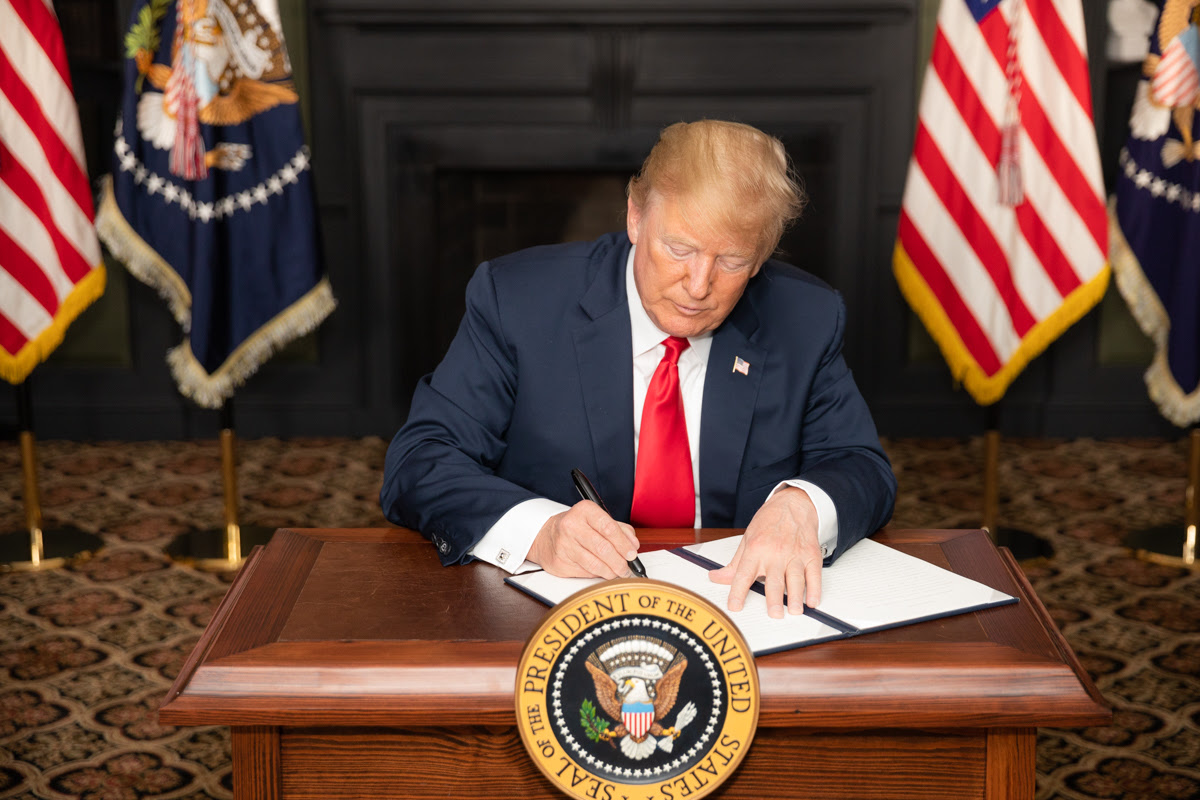
President Donald J. Trump signs an EO on Iran Sanctions in the Green Room at Trump National Golf Club Monday, August 6, 2018, in Bedminster Township, New Jersey. (Official White House Photo by Shealah Craighead)

President Donald J. Trump signs an EO on Iran Sanctions in the Green Room at Trump National Golf Club Monday, August 6, 2018, in Bedminster Township, New Jersey. (Official White House Photo by Shealah Craighead)

TEHRAN — One of Iran’s top foreign policy officials has called for negotiations with “anti-Trump movements” in the US to dampen the impact of sanctions, local media reported Saturday.

“America is not Trump,” said Heshmatollah Falahat-Pisheh, a conservative lawmaker who heads parliament’s influential national security and foreign policy commission, according to reformist newspaper Arman.

“There is a new diplomatic atmosphere for deescalation with America and it is fitting that Iran follows negotiation diplomacy and lobbying anti-Trump movements in America,” he added.

He said this would help alleviate pressure caused by Washington’s “extensive sanction-focused force.”

Anti-Trump supporters rally at the Texas State Capitol on Sunday, July 2, 2017, during an impeachment march in Austin, Texas by anti-Trump supporters in hopes to gain attention and impeach Trump. (Joshua Guerra /Austin American-Statesman via AP)

The US pulled out of the 2015 Iran nuclear deal in May and reimposed punishing sanctions on the country, hoping to pressure Tehran into what President Donald Trump calls a “better deal.”

The US is due to complete the re-imposition of sanctions on November 5, targeting Iran’s oil sector and central bank.

Supreme leader Ayatollah Ali Khamenei has dismissed Trump’s offers to talk as “a dangerous game.”

But Mehdi Motaharnia, a Tehran-based political analyst, described Falahat-Pisheh’s proposal as “very meaningful” since it signifies a potential shift in conservatives’ stance on talking with the US.

“This comes from a conservative whose party members called (Foreign Minister Mohammad) Javad Zarif a traitor for negotiating with the US,” Motaharnia told reformist daily Hamdeli.

“But now we do not see such reactions when the head of national security and foreign policy commission proposes talks,” he added.


Israel, Syria agree to reopen border crossing — US

Posted October 13, 2018 by Joseph Wouk
Categories: Uncategorized

Source: Israel, Syria agree to reopen border crossing — US | The Times of Israel

Nikki Haley says Quneitra junction to open Monday as part of UN peacekeeping efforts, calls for ceasefire accord between countries to be maintained

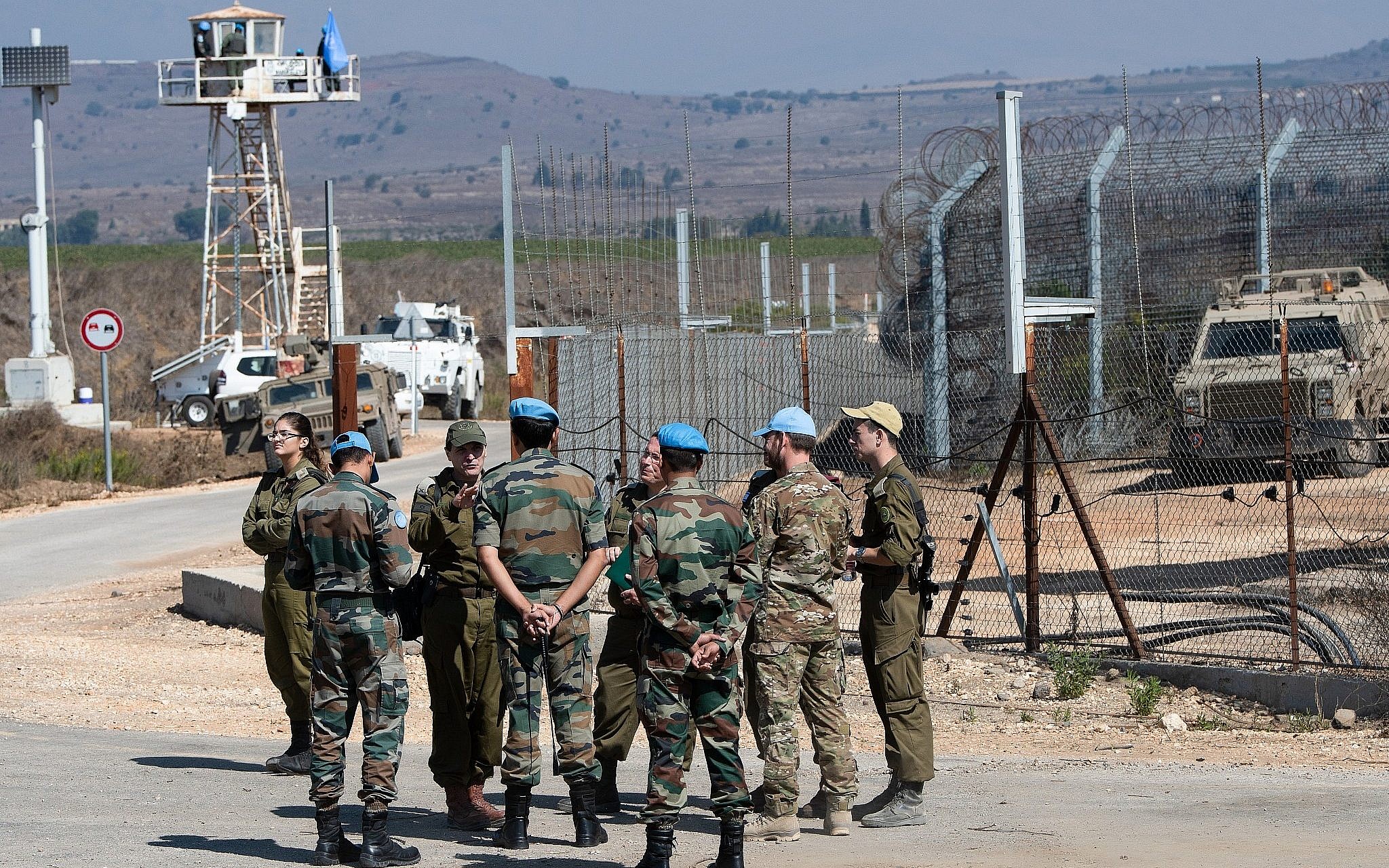
UN peacekeepers and Israeli soldiers are seen on the Israeli side of the Quneitra Crossing between Israel and Syria in the Golan Heights on September 27, 2018. (Basel Awidat/Flash90)

UN peacekeepers and Israeli soldiers are seen on the Israeli side of the Quneitra Crossing between Israel and Syria in the Golan Heights on September 27, 2018. (Basel Awidat/Flash90)

The main border crossing between Israel and Syria will be reopened Monday, US Ambassador to the UN Nikki Haley said, over four years after it was shuttered due to the Syrian civil war.

In a statement Friday welcoming the move, Haley said the decision by Israel, Syria and the United Nations to reopen the Quneitra Crossing was part of the return of UN peacekeepers to the area. She said it would allow them to “step up their efforts to prevent hostilities in the Golan Heights region.”

The UN Disengagement Observer Force, or UNDOF, was established as part of the 1974 ceasefire agreement between Israel and Syria that ended the 1973 Yom Kippur War and created a demilitarized zone along the border.

“We look to both Israel and Syria to provide UN peacekeepers the access they need as well as assurances of their safety. We also call on Syria to take the necessary steps so UNDOF can safely and effectively deploy and patrol without interference,” Haley said in a statement.

She called on both countries to adhere to the ceasefire and “keep any military forces other than UN peacekeepers out of the area.”

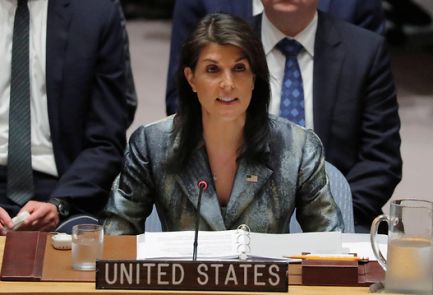
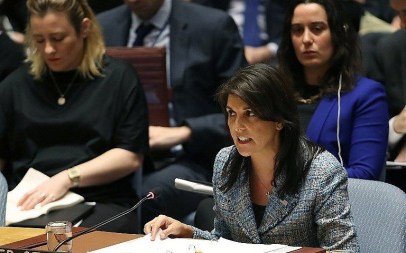
US Ambassador to the UN Nikki Haley speaks at a Security Council meeting on the the situation in Syria at UN headquarters in New York City on March 12, 2018. (Spencer Platt/Getty Images/AFP)

There was no immediate confirmation of the crossing’s reopening from Israel, Syria or Russia, which backs Syrian President Bashar Assad’s regime in the civil war.

The US announcement of Quneitra’s reopening comes just weeks after Israel and Russia both said the necessary steps had been taken to reopen the border crossing.

The reopening of the Quneitra Crossing would restore conditions along the border to their status prior to the Syrian civil war, which broke out in 2011.

The crossing was shuttered in August 2014 following a number of attacks by Syrian rebels, which drove out the United Nations peacekeeping force that controlled the crossing, known as the UN Disengagement Observer Force, or UNDOF.

The peacekeeping force has slowly returned to the border between Israel and Syria in recent months — a move welcomed by Jerusalem.

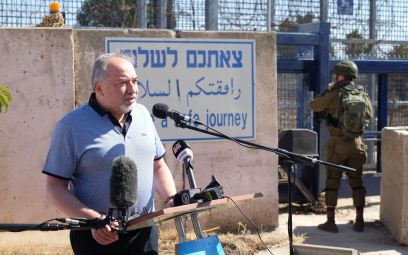
“UNDOF troops have started working and patrolling, with IDF assistance. This shows that we are ready to open the crossing as it was before. The ball is now in Syria’s court,” Defense Minister Avigdor Liberman said at the site last month.

Defense Minister Avigdor Liberman speaks to reporters at the Quneitra Crossing on the Syrian border with the Golan Heights on September 27, 2018. (Judah Ari Gross/Times of Israel)

As Israel and Syria are technically at war, the Quneitra Crossing never saw regular, wide use. However, the local Druze populations in Israel and Syria were permitted, on some occasions, to travel through it to visit family on the other side — inspiring the 2004 movie “The Syrian Bride.” The crossing had also been used to transport apples from Druze orchards in Israel to Syria.

Liberman stressed that Israel was demanding that Syria abide by “every single section” of the ceasefire agreement between them.

The defense minister said the decision to reopen the crossing does not change Israel’s relationship with the Syrian regime or its despotic leader, Bashar Assad, whom the defense minister called a “war criminal.”

Initially, the crossing will mostly serve the UNDOF soldiers, allowing them to pass through for one hour in the morning and one hour in the evening.

Judah Ari Gross contributed to this report.


Nasrallah: Well not play by the enemys rules

Posted October 13, 2018 by Joseph Wouk
Categories: Uncategorized

Source: Nasrallah: Well not play by the enemys rules

Delivering a speech from his hiding place, Hezbollah’s Secretary-General says terror organization refuses to comment on PM Netanyahu’s remarks at the UNAG, which revealed the exact location Hezbollah is hiding its precision-missile factories; adds ‘we exposed Netanyahu’s false allegations regarding the missile factory near Beirut’s airport; urges Arab countries to unite against the US.

Following Netanyahu’s remarks, the IDF released—in an apperent coordinated timing—footage of a precision-missiles factory belonging to Hezbollah, coinciding with the prime minister’s speech delivered on the world’s stage.

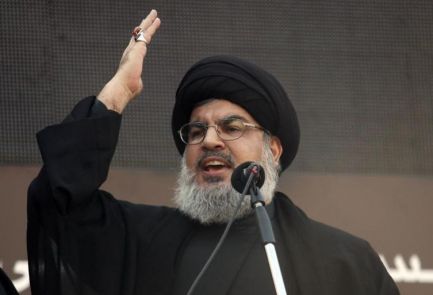
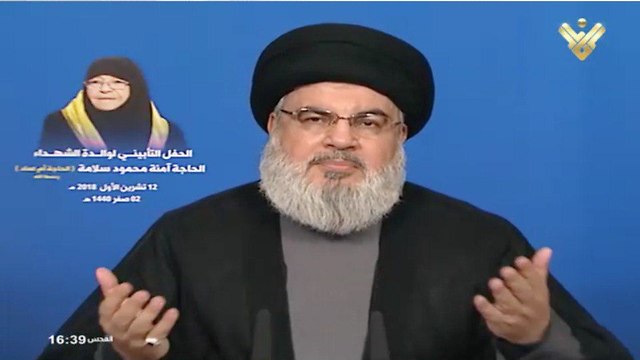
Hezbollah's Secretary-General Hassan Nasrallah

Hezbollah’s Secretary-General Hassan Nasrallah

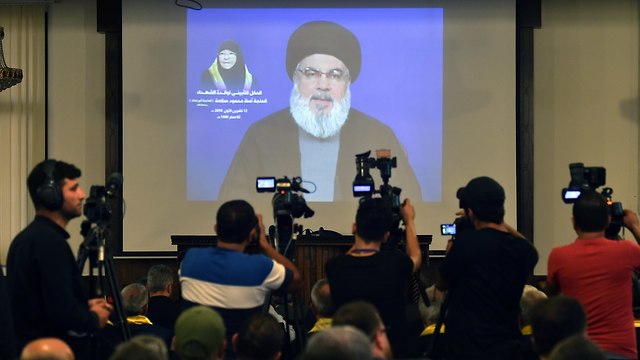
Speaking from his hiding place, Nasrallah delivered a speech marking a week to the death of the mother of Hezbollah’s former military wing chief, Imad Mughniyeh, who was killed 10 years ago in a car explosion.

Nasrallah addressed the footage revealing the exact location of the missile factory, adding,” “I would like to officially confirm that our policy about military issues and the resistance’s abilities is clear.

“Hezbollah is not obligated to provide answers, we are not playing by the enemy’s rules,” he stated.

 (Photo: IDF Spokesperson's Unit)

(Photo: IDF Spokesperson’s Unit)

“We will not give Israel anything for free. We exposed Netanyahu’s false allegations regarding the missile factory near Beirut’s airport.

“The organization will not comment on media publications, and will not hand out information for free, insignificant as it may be,” Hezbollah leader went on to say.

Nasrallah delivering his speech  (Photo: EPA)

Nasrallah delivering his speech (Photo: EPA)

“We refuse to assist our enemy in waging a psychological war against our people and country,” he exclaimed.

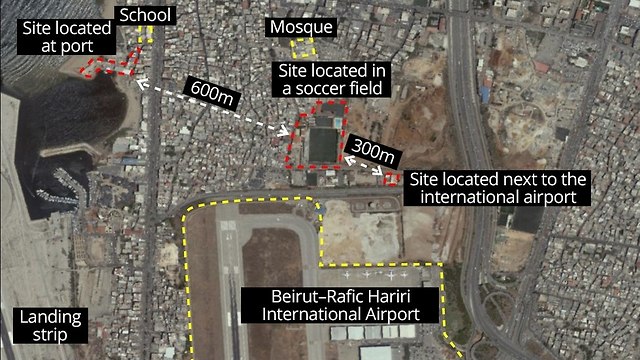
The IDF said Hezbollah also has other sites within and outside of Beirut where its members have been working to create an infrastructure intended to stockpile precision missiles in the future.

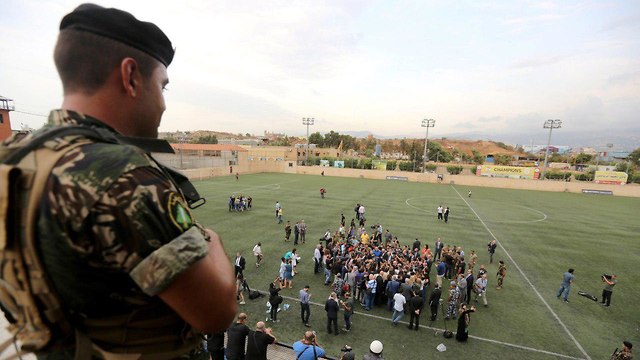
According to the military’s intelligence, one of the sites is located inside a Hezbollah soccer stadium while another is adjacent to the Beirut–Rafic Hariri International Airport.

Lebanese Foreign Minister Gebran Bassil, spoke to foreign ambassadors before taking them on a tour of the area mentioned in the prime minister’s UN speech, where Bassil reiterated that there were “many statements … affirming the possession of precision-missiles by Hezbollah. However, this does not mean that these missiles are present in the vicinity of Beirut airport.” he stressed in an apparent attempt to dismiss Netanyahu’s claims.

Bassil, a political ally of Hezbollah, said Israel aimed to “falsify facts concerning Lebanon and to vocalize lies that carry the seeds of a threat that does not frighten us, and that Netanyahu had used the platform of the UN General Assembly “to justify another aggression on a sovereign country like Lebanon.”

Hezbollah soccer stadium (Photo: Reuters)

Hezbollah soccer stadium (Photo: Reuters)

In addition, Nasrallah slammed the Arab countries cooperating with the United Staes.”US President Donald Trump told the Saudis that without the US they wouldn’t survive a week, forcing them to cooperate. The US is insulting its own allies,” he opined.

“Trump exposed that many Arab states are paying to the US in exchange for their survival.

“Who are you counting on?” Nasrallah asked addressing the Arab states.

“Trump is robbing you under the guise of providing security. He takes your money and insults you on a daily basis,” he vented.

“You have other options, more respectable ones. Sounds of war are being heard in Yemen, Syria, Iran, Bahrain, and for what?” he wondered.

“All the Arab countries should cooperate among themselves,” he concluded

Imad Mughniyeh's mother

Imad Mughniyeh’s mother

Hezbollah blamed Israel for assassinating Mughniyeh in 2008. The Shi’ite terror organization gave extensive coverage to the funeral of the terrorist’s mother and also mentioned his son, Jihad, who was assassinated in 2015 on the outskirts of Quneitra alongside other Hezbollah senior officials as well as a Revolutionary Guards senior advisor in an operation attributed to Israel.

According to Hezbollah-affiliated Media outlets, the terror organization’s senior officials attended the funeral of Mughniyeh’s mother. “She sacrificed a lot for the organizations,” the official said.