Khashoggi case: Vile murder, palace intrigue against crown prince or plot to torpedo US-Saudi ties? – DEBKAfile

Posted October 13, 2018 by Joseph Wouk
Categories: Uncategorized

Source: Khashoggi case: Vile murder, palace intrigue against crown prince or plot to torpedo US-Saudi ties? – DEBKAfile

It could be any or all these, since no one still knows what befell the prominent Saudi journalist Jamal Khashoggi after he disappeared inside the Saudi consulate in Istanbul on Oct. 2.  But the fallout is spreading worldwide, as theories, the wilder the better, flourish around the mystery.
Turkey, whose animosity for the Saudi kingdom is a fact of Muslim politics, leads the pack, Turkish intelligence officials claimed this week to have a video clip showing Saudi agents murdering Khashoggi in the consulate building. They also claimed proof that 15 Saudi agents were involved in dismembering the body and flying its parts to Saudi Arabia after removing the remains in a black van with consular number plates. While grabbing global headlines – especially in US media – Turkey has never shown this clip or any other proof to support its claims. They are steadfastly denied as baseless by Riyadh, which has initiated a joint investigation of the disappearance with Turkey.

President Donald Trump’s national security adviser John Bolton only deepened the mystery when he said on Thursday, Oct. 11, “We need to find out what the facts are, and we need to get this resolved quickly, because if it is another operation, people need to understand that,” He went on to say: “I think the Saudis themselves are being damaged, because we don’t have the facts out.”
What other operation? And by whom?

DEBKAfile’s Saudi experts note that disappearing dissenters to the throne, some of them royals, are not a novelty in Saudi Arabia, Under previous Saudi reigns, even princes were mysteriously snatched from their cushy residences in foreign countries, and never heard of again.
Take the case of Prince Sultan bin Turki, who was abducted in Geneva in 2003 after calling for reforms in the kingdom. Testimony subsequently presented to a Swiss court alleged that he was lured to a rendezvous outside Geneva and drugged when he resisted attempts to put him on a plane for the kingdom. Then, in 2015, another prince, Turki bin Bandar al Saud, a former police chief, was believed to have suffered the same fate in Paris. He left the kingdom over a family inheritance dispute which landed him in prison. After his release, he moved to Paris and from there posted videos in an online campaign for reforms from 2012 until his disappearance and apparent abduction. His whereabouts are still unknown.

Only last year, in November, Lebanese Prime Minister Rafiq Hariri vanished after he was invited to Riyadh by the incumbent crown prince Muhammed bin Salman (MbS). He was only “discovered” and freed after intercession by French President Emmanuel Macron and agreeing to transfer his entire fortune, $7 billion, to the Saudi treasury.  No one knows how many princes and tycoons, arrested on the orders of Prince Muhammed on Nov. 4, 2017 and imprisoned at the Riyadh Ritz-Carlton, are still in custody. Most bought their release by surrendering their assets to the Saudi crown.

Gulf sources maintain that Jamal Khashoggi was never the loudest critic of the House of Saudi he is widely portrayed as being. In some articles in Western publications, he combined mild criticism with occasional praise for the economic and social reforms introduced by the young crown prince. Therefore, the sensational reporting about Saudi intelligence assassins executing Khashoggi on the orders of MbS should be treated with caution, if not a grain of salt. Such reports may in fact precipitate his murder, if he is still alive. He may even have been the victim of a conspiracy by the crown prince’s rivals inside the royal house to show him in a bad light and torpedo his policies.

Turkish President Tayyip Erdogan loathes the Saudi royal family, and the crown prince in particular, and would not be above capitalizing on a putative Saudi operation against Khashoggi for blackening their name. Who knows what bargaining may be afoot – and between whom – before he makes a surprise appearance?  It may be too soon therefore to decide whether the missing journalist is alive or dead.

It is also possible that certain US and Western undercover agencies, dedicated to the downfall of President Donald Trump, jumped on the Turkish bandwagon to undermine the Saudi crown prince and so stigmatize the Trump administration’s alliance with the Saudi royal house – and Jared Kushner’s friendship with MbS in particular.

Maybe, too, Nikki Haley picked up word of the mud flying in that direction and stepped in on Oct. 9, with kind words for the president’s son-in-law apropos of nothing as an unsung “genius” during her parting comments as ambassador to the UN at the Oval Office.
The White House is clearly troubled by the swirling rumors and sent Bolton, Secretary of State Mike Pompeo and Kushner to demand information from the crown prince.

President Trump stated Thursday that US Investigators in Turkey will probe the case of the missing Saudi journalist. “I have to find out what happened,” he said, “We’re being very tough. And we have investigators over there and we’re working with Turkey, and frankly, we’re working with Saudi Arabia. We want to find out what happened.” It isa bad situation, as he said,

Clearly, it is vital to determine if the affair, which threatens serious damage to US-Saudi relations, was deliberately engineered or opportunistically exploited for that purpose.  In jeopardy too is Trump’s “peace plan of the century” for resolving the Israeli-Palestinian dispute and normalizing relations between he Arab world and the Jewish State, in which the Saudis are a key player and with whom Prime Minister Binyamin Netanyahu has cultivated friendly ties. All these questions await answers in the next chapter of the Khashoggi mystery.


Senate passes bill sanctioning Hamas, Hezbollah ‘human shields’ practice

Posted October 13, 2018 by Joseph Wouk
Categories: Uncategorized

Source: Senate passes bill sanctioning Hamas, Hezbollah ‘human shields’ practice – Middle East – Jerusalem Post

The legislation, titled the STOP Using Human Shields Act, was authored and supported by Republican and Democrats.

BY MICHAEL WILNER
 OCTOBER 12, 2018 23:35
Bir Zeit

WASHINGTON — The Senate passed legislation on Friday mandating the government sanction members of Hamas and Hezbollah responsible for using human shields in warfare.

The legislation, titled the STOP Using Human Shields Act, was authored and supported by Republican and Democrats. It now moves to the House of Representatives for consideration.

Various American Jewish groups and Israel advocacy organizations praised the bill’s passage.

“Hamas and Hezbollah are blatantly violating international law by placing their terrorist infrastructure among civilian populations. In any future conflict in Gaza or Lebanon, the lives of innocent civilians will be endangered because of the reckless and illegal behavior of these terrorist organizations,” the American Israel Public Affairs Committee said in a statement.

The Senate also approved a bill that sanctions foreign government agencies, individuals and companies that support Hezbollah financially or militarily.

The Treasury Department is already increasing its pressure campaign on the Iranian proxy organization, based in Lebanon, using existing sanctions tools.


Ex-CIA official: Iran is the primary engine of regional destabilization 

Posted October 13, 2018 by Joseph Wouk
Categories: Uncategorized

Source: Ex-CIA official: Iran is the primary engine of regional destabilization – Israel News – Jerusalem Post

In his first interview with an Israeli journalist, a senior CIA official predicts that the Iranian regime will ultimately fall

BY YOSSI MELMAN
 OCTOBER 13, 2018 01:26
Norman Roule

“Those who argued that the deal would open Iran to the world and encourage it to be a more responsible international player were wrong. They argue that Iran needed more time for this transformation. Perhaps, but how many years do we need to wait for Iran to stop supporting terrorism? If you live in the region and are victims of routine terrorism or missile attacks, it simply isn’t reasonable to endure these threats to your citizens in the hope Iran will change.”

What is the desirable course that has to be taken?

“If Iran wants to help the Houthis, they should send humanitarian aid via the United Nations and not missiles. Iran’s actions have extended the conflicts and exacerbated the tragic suffering of the Yemeni people. Iran supports more than a dozen Shi’ite and Sunni militias and terrorist groups in the region. It has proliferated advanced missile technology. There is no question Iran is the primary engine of destabilization in the region and the international community. This must be stopped and Iran must be compelled to cease its behavior.”

ROULE IS reluctant to talk about himself and feels uneasy about my interest in his family background. In brief, he was a born in a small coal mining town in southeast Pennsylvania to a family, which has always expressed a sense of duty to serve community and country. His family members fought in major American wars during the last century: the two World Wars and the Korean and Vietnam wars. His family upbringing engraved in his mind that he should always fight evil and the bad guys.

He went to a small college to pursue his interests in music but discovered history and the world opened to him. While at college, he was spotted by the CIA and recruited.

He refused to talk about his career in the intelligence community, but from other sources I learned that in his long years of service he worked as an undercover agent, station chief and rose to the senior position of division head in charge of the Middle East (Near East in US jargon). In 2008, he was asked to serve at DNI, which was established in 2005 by President George W. Bush to improve cooperation among the many organs of the US intelligence community. The reorganization was a result of the tragic events of 9/11, which US intelligence agencies failed to detect and stop. In practical terms, he was the senior official responsible for managing US intelligence plans and operations against Iran.

In nearly nine years of service in this capacity, he was witness to how the ties and cooperation between the intelligence communities of Israel and the US were enhanced and upgraded to unprecedented levels. It can be assumed that he was privy at that time to all the most guarded secrets shared by the two countries.

It was reported by international media that the CIA and Mossad carried out joint operations, including the assassination of  Imad Mughniyah, Hezbollah’s master terrorist, and the intelligence agencies of the two nations developed and unleashed malware that damaged Iran’s computers that were linked to its uranium enrichment program and performed other daring operations around the globe.

When I tried to ask him about such operations, his answer was polite but firm. “I will not discuss my past work in the intelligence community,” he said.

Former Mossad chief Tamir Pardo, who knows Roule well, told me that “Norman is a brilliant guy. He knows the Middle East very well. He is a superb analyst and I considered him a true friend of Israel. Every meeting with him was extremely interesting.” After his retirement in September 2017, Roule went into private business and joined UANI.

What do you think of the capture of Iran’s nuclear archive by the Mossad?

“I only know what I read in the media. But the material certainly seems like evidence that Iran was at least keeping open the option for a nuclear weaponization program in the future.”

From your vast experience, what are Iran’s patterns and modes of operation?

“Iran employs what is known as hybrid warfare or gray zone tactics. In Iran, it may be that the Supreme leader will say to his subordinates don’t risk a major conflict, but you can operate aggressively below that level. This allows Iran to move rapidly, unlike in the West where each step involves careful review by policy makers or Congress.”

How is such a model put into practice in the field?

“Iran is deeply involved in Iraq, Syria, Lebanon, and Yemen. Iran’s aggressive actions in the region seem as if it has taken a conventional war and split it into pieces: ground operations and UAV air operations in some countries, naval operations in the Red Sea, and periodic cyber-attacks. Because these actions are divided among so many locations, the West and the United Nations ignore the conflict. But people are dying, nonetheless.”

But hasn’t the international community imposed sanctions on Iran?

“The US and the West have imposed multiple sanctions on Iran for its involvement in terrorism, the bombing of our embassy (in Beirut – Y.M.), and the missile attacks against Saudi Arabia. But these sanctions are not yet at the level that impacts on Iranian decision-making. We may have slowed the operations of Iran and Hezbollah, but we have yet to stop them.”

Maybe it is better to use diplomacy rather than sanctions?

“During the debate on the future of the deal, I believed we should have stayed and worked with our allies to pressure Iran. The US should not be perceived as standing alone against Iran.”

So is Trump wrong in his policy?

“I will not comment on policy. We should remember that President Trump’s objections to the deal are not unique. Many, many congressmen – including Democrats – made these comments during the debate over the nuclear deal. I do believe we need to work with Europe and our other allies, but it isn’t reasonable to allow Europe to continue to delay pressure against Iran. The new sanctions increase pressure against Iran. Iran isn’t a very profitable place for any major business and large corporations cannot justify choosing the difficult, unprofitable and heavily sanctioned Iranian market over the US.”

What is the impact of sanctions on Iran?

“Iran is facing unprecedented simultaneous challenges. These challenges are demographic, economic, ecological, social, and political. Its water shortages are significant, and its infrastructure is very poor. But Iran invited this problem. It chose to send oil to Syria instead of using the funds for its own infrastructure and to assist its civilians. Iran’s generally young population has understandably lost faith in its government and many are leaving. This brain drain is another challenge.”

Is this the reason Iran came to the negotiating table, because it was on the verge of collapse?

“There is no evidence Iran was on the verge of collapse when they came to the table. They were under great pressure and they came to the table to see what deal might be possible.”

It was claimed by Israeli intelligence that Iran was 3-6 months from a bomb?

“According to many press reports, it would be more correct to say that Iran was only a few months from sufficiently highly enriched uranium for a weapon. More work would have been required to build an actual weapon.”

Can you define the purpose of the sanctions? 

“Sanctions must aim at provoking a conversation among Iran’s leaders. What do they prefer: intervention in the region or economic and political stability at home. For this reason, I support a stronger sanctions policy.

“Iran is also facing a succession crisis. Who will replace the Supreme Leader and what sort of revolution will he inherit? This question must trouble the current Supreme Leader very much. The Iranians also face municipal elections in 2020 and a presidential election in 2021. The Iranian people can use these opportunities to try to change their government.

“I believe the regime will eventually fall but its ability to use coercion makes it difficult to predict when that will happen. I do know that when it does occur, no one will be surprised.”


Standing up to the elitist mobs 

Posted October 13, 2018 by Joseph Wouk
Categories: Uncategorized

Source: Column One: Standing up to the elitist mobs – Opinion – Jerusalem Post

Because while Haley was a loyal representative of the administration, she was more than a mouthpiece. She was a leader.

BY CAROLINE B. GLICK
 OCTOBER 11, 2018 22:47
US Ambassador to the United Nations Nikki Haley speaks at UN headquarters in New York

US Ambassador to the United Nations Nikki Haley’s sudden resignation this week distressed a lot of Israelis. On the face of things, the widely felt concern makes little sense. After all, Haley wasn’t a lone wolf in the Trump administration.

Then-president Barack Obama’s anti-Israel UN ambassadors Susan Rice and Samantha Power weren’t free agents when they took hostile actions and made hostile statements about Israel. They were speaking and acting as representatives of their boss, Obama.
Just so, in defending Israel by word and deed, Haley was a loyal representative of the policies of her boss, President Donald Trump.
So why did her decision to resign make so many Israelis anxious?

Because while Haley was a loyal representative of the administration, she was more than a mouthpiece. She was a leader.

Leading in a place like the UN means speaking truth to the most powerful sort of mob – the elite mob.

The UN’s mob mentality doesn’t manifest itself in book burnings and mass rallies. Rather, it expresses itself in a thousand ways – often passive-aggressive – every day in UN institutions.

It isn’t just that Haley was forced to cast the lone nay vote last December, when the other 14 Security Council members (including Britain and France) voted in a favor of a resolution demanding that the US reverse its sovereign decision to move its embassy in Israel from Tel Aviv to Jerusalem, and recognize that Jerusalem is Israel’s capital city.

Every day, the UN shows its mob mentality in its obsessive-compulsive bias against the Jewish state.

Wednesday, for instance, UNESCO passed yet another resolution that pretends the Temple Mount in Jerusalem, the Tomb of the Patriarchs in Hebron and Rachel’s Tomb are Palestinian world heritage sites.

Disgusted by UNESCO’s out-of-control antisemitism, last year the Trump administration announced it would leave the organization at the end of 2018.

Citing UNESCO’s moves in Hebron from last year as the impetus for the US action, Haley said at the time that UNESCO’s politicization was a “chronic embarrassment.”

“Just as we said in 1985 when President Reagan withdrew from UNESCO, US taxpayers should no longer be on the hook to pay for policies that are hostile to our values and make a mockery of justice and common sense, ” she said.

Haley was a leader at the UN because she used her bully pulpit to stand up to the braying mob every day. She put a mirror to the faces of ambassadors from allied and enemy nations alike and told them to be ashamed of themselves for joining, and sometimes leading the mob.

Like all mobs – elite and common – the UN mob rejects facts. They reject rationality and reason in favor of passions and prejudices. The herd mentality of the UN protects tyrannies and renders free nations – first and foremost Israel – perpetually vulnerable. It rejects sovereignty and insists on uniformity of actions that invariably assists the causes of tyrants while harming the interests of free nations – again, first and foremost, Israel – as well as the US.

Haley’s leadership was critical because one of the most overlooked truths in public discourse, whether at the UN or anywhere else, is that telling inconvenient truths to mobs is a vital undertaking. Without people willing to stand up forcefully, and even sometimes brutally, to powerful mobs that uphold falsehoods as truth, the mobs will never change. They will never accept reality, even if it blows up in their faces.

One of the places where a powerful leader like Haley is desperately needed is among Israel’s foreign policy and security elites.

Much has been said over the past several years about the uniformity of the views of Israel’s legal fraternity. State prosecutors and Supreme Court justices have for years been criticized, often bitterly, for their uniform left-wing bias. This bias has made a mockery of the rule of law in Israel where Israeli residents in Judea and Samaria, free market politicians, the IDF and rabbinical authorities know that they will be subjected to biased treatment at the hands of the legal fraternity.

Justice Minister Ayelet Shaked’s recruitment of conservative justices to the Supreme Court is rightly upheld as one of her major achievements in office. But arguably, an equally important accomplishment has been her willingness to speak bluntly to Israel’s legal establishment about their institutional bias and the deleterious impact their bias has had on the Israeli democratic system of governance and the rule of law. Until Shaked came along, no one in a position of real authority was willing to stand before Supreme Court justices and tell them to be ashamed of themselves for their constant assaults on the very foundations of Israeli democracy.

Unfortunately, Israel’s legal fraternity isn’t the only old boys’ mob where people whose views are out of step with the ruling elite are permanently shut out. Israel’s national security fraternity suffers from the same problem.

We see this most dramatically in relation to the Palestinians, although the institutional bias of Israel’s national security community is brought to bear along a spectrum of issues.

The Oslo peace process with the PLO was initiated 25 years ago. It was predicated on the “land for peace paradigm” long championed by the radical left. It failed incontrovertibly 18 years ago when the PLO rejected statehood and peace, instead initiating a massive terror war against Israel in conjunction with Hamas and Islamic Jihad.

Since then, virtually not a day has gone by without another Palestinian terror attack against Israelis. Rather than reach the appropriate conclusion 18 years ago – that the land for peace paradigm was wrong – the security establishment writ large, maintained faith with it. Instead of abandoning the paradigm, they, like the political left, simply updated their marketing practices. Talk of “peace” was out. First it was replaced by “separation.” Then “demography.” Then “democracy.” Then “disengagement.” Then “consolidation.”

We got “long term security arrangements.”

We got “settlement blocs vs. isolated settlements.”

And then we started getting “separation again.”

But the idea was always the same: land for peace.

As for the Palestinians, year in and year out we hear the same things, even as they are repackaged as being pathbreaking.
We are told that we have to “strengthen” Palestinian Authority chief, terror financier and virulent Jew hater Mahmoud Abbas.

Why?

Because he’s a moderate.

We need to invest in the kleptocratic wholly corrupt Palestinian economy.

Why?

Because it’s the way to make the Palestinian people feel a “peace dividend.”

THE FACT that more than $10 billion in international aid and billions more in Israeli aid have been invested in developing the Palestinian economy for 25 years and we’ve never seen a peace dividend, is no reason to stop paying them off.

All that the likes of Saudi Arabia need, to stand at Israel’s side and be part of a “regional solution,” is proof of Israel’s peaceful intentions. So Israel, we are told by the apolitical security experts, needs to make clear that it is leaving Judea and Samaria in whole or part.

The fact that the Arabs never agreed to be part of a regional solution – and wouldn’t even embrace Israel publicly when it was actively engaged in giving land to the PLO – makes no difference to Israel’s national security-experts mob.

The fact that the Arab world is plagued by political instability, which makes it impossible to bank on long-term relations with any Arab regime is also immaterial. Israel needs to give the Palestinians land to convince the Arabs to support us. And they will. We just know they will.

Politically, Israel also needs to act on behalf of the PA. We need to help strengthen it. The fact that 25 years of Israeli and international efforts to “build institutions” in the PA have brought no results beyond instilling Nazi-like Jew hatred in the hearts and minds of the Palestinian public is entirely beside the point.

And then there are the Palestinian security forces. The Israeli security brass says they are the greatest. We need to strengthen them and cooperate even more with them. The fact that dozens of Palestinian security force members have engaged in terrorist attacks against Israel is immaterial. Indeed, it’s irrelevant. So is the fact that Hamas, which those forces fight, constitutes a greater threat to those security services than it does to Israel.

Every few months, these positions are repackaged and presented to the public by a group of retired generals. They tell us to trust them because they were generals in the IDF or senior commanders in the Mossad and Shin Bet. They are professionals. They are apolitical. Zionism is their only agenda.

All criticism against these unbiased, entirely professional, apolitical experts is castigated as politically motivated. Their critics are dismissed as fanatics, or messianics, or right-wing extremists.

LAST WEEK, we saw this process unfold yet again with the launch of yet another “groundbreaking” report about the way “forward” with the Palestinians, produced by Tel Aviv University’s elite Institute for National Security Studies, staffed by retired senior security brass.

The INSS report titled, “A Political-Security Framework for the Israeli-Palestinian Arena” was, we are told, the result of two years of work.

Led by Maj.-Gen. (res.) Amos Yadlin, the INSS’s professional, apolitical researchers met with Americans, Europeans, Palestinians – and Arabs from states without peace with Israel – to talk about the way to move forward with the Palestinians.

And, surprise, surprise, they came up with the same failed “land for peace” plan that the Left has come up with for the last 25 years.
The INSS’s “pathbreaking” report contains no reconsideration of any consistently failed strategic assumptions.

Which brings us back to Haley and the Trump administration she so ably represented.

The INSS “experts” claim that Israel needs to seize the opportunity that the friendly Trump administration affords us to set a new agenda with the Palestinians.

But while this assertion is true enough, the INSS report – like all the reports of security “experts” that preceded it – does no such thing. Instead, the INSS’s wise men and women, with their vast national security experience, tell us that we should use Trump’s time in office to convince the friendliest US administration in history to embrace the policies of the most unfriendly US administrations in the history of US-Israel ties. They advocate convincing Trump to embrace the same policies they have advocated, which have failed consistently for a generation.

Haley’s replacement will likely share her positions on Israel and her criticisms of the UN’s institutional antisemitism, since her successor will also be representing the Trump administration. But it is hard to imagine her replacement will replicate the extraordinary moral leadership she exercised.

This is not because he or she will be less moral, but because, as the mob mentality of Israel’s security brass shows, leaders like Haley – who can effectively stand up to braying mobs of well-heeled elitists – don’t grow on trees.


Foiled Paris bomb plot raises fears that Iran is planning attacks in Europe

Posted October 12, 2018 by Joseph Wouk
Categories: Uncategorized

Source: Foiled Paris bomb plot raises fears that Iran is planning attacks in Europe – Europe – Stripes

Thousands gather in Natnes, France, on Jan. 7, 2015, in a rally at the Place Royale to pay tribute to those injured and killed in an attack in Paris. France, Germany and several other countries, including the U.S. and Israel, are worried that Iran is planning new terrorist attacks in Europe.

FRANCK DUBRAY/ZUMA PRESS/TNSOBY WARRICK | The Washington Post | Published: October 12, 2018

WASHINGTON — On the evening of July 1, police in Bavaria surrounded the rented van of an Iranian diplomat after he pulled over at a gas station on the autobahn. Fearing he might be transporting explosives, the authorities summoned the bomb squad.

The diplomat, based at Iran’s embassy in Vienna, had been under surveillance for some time and was suspected of involvement in a plot to bomb a rally of Iranian dissidents in Paris. Despite his diplomatic status, he was arrested and extradited to Belgium, where two others, suspected of planning to carry out the attack in France, were detained.

The foiled plot has sparked growing anxiety in France, Germany and several other countries, including the United States and Israel, that Iran is planning audacious terrorist attacks and has stepped up its intelligence operations around the world.

Iranian leaders, under pressure from domestic protesters, Israeli intelligence operatives, and the Trump administration, which is reimposing economic sanctions lifted under President Barack Obama, are making contingency plans to strike at the country’s adversaries in the event of open conflict, according to American, European, Middle Eastern and Israeli officials and analysts who spoke on the condition of anonymity to discuss sensitive intelligence.

Iran has assigned different units and organizations to conduct surveillance of opposition figures, as well as Jewish and Israeli organizations, in the United States and Europe, the officials said. The Iranians are preparing what one Israeli official called “target files” of specific people or groups that Iran could attack.

One Middle Eastern intelligence official, speaking on the condition that his name and nationality be withheld, cited a “definite uptick” in the level of activity by Iranian operatives in recent months, adding that the Iranians are “preparing themselves for the possibility of conflict.”

Iran’s reach extends to the United States. In August, the Justice Department arrested two Iranian men, one a dual national with U.S. and Iranian citizenship and the other an Iranian who is a legal U.S. resident, for allegedly spying on behalf of Iran. The pair are accused of conducting surveillance on a Jewish organization in Chicago and rallies in New York and Washington that were organized by the Mujahideen-e Khalq, or MEK, a dissident group that seeks regime change in Iran.

But the case of the Iranian diplomat is the most alarming, officials and analysts said, and has strained Iran’s diplomatic relations with Germany and France. Both countries are trying to hold together a landmark 2015 agreement meant to curb Iran’s nuclear weapons program, which the Trump administration has abandoned.

The diplomat, Assadollah Assadi, has been a high-ranking official in Iran’s embassy in Vienna since 2014, but is also suspected of being the station chief of the Ministry of Intelligence, or MOIS, according to multiple officials from the United States and Europe.

In late June, European intelligence services tracked Assadi as he met with a married couple of Iranian descent living in Belgium and — according to the couple, who spoke to police after their arrest – gave them about a pound of explosive material and a detonator, the officials said.

The couple, Nasimeh Naami and Amir Saadouni, who were both born in Iran, allegedly planned to bomb a huge MEK rally in Paris, attended by thousands of people, including Rudy Giuliani, President Trump’s personal lawyer and a vocal defender of the group, according to French, German and Belgian officials.

European officials said the couple, who are cooperating with authorities, identified Assadi as their longtime handler. Assadi professes not to know them, according to German officials, who said Iranian authorities have claimed he was set up. The Iranian government has said publicly that the plot was fabricated to falsely implicate the regime in terrorism.

A spokesman for the Iranian mission to the United Nations denied that Iran had planned to attack the rally in Paris, calling the allegations “categorically false. And he accused the MEK and Israel of staging the plot “to sabotage Iran-EU relations.”

“The MEK had long been listed as a terrorist group by the EU and the U.S.; it also has a long history of propaganda and false flag operations,” said the spokesman, Alireza Miryousefi.

The State Department removed the MEK from a list of designated terrorist organizations in 2012. The group has publicly denied any involvement in the attempted attack in Paris.

Authorities said that Belgium would take the lead in the case for now, since the couple were arrested and have citizenship there.

French officials have publicly accused Iran’s Intelligence Ministry of planning the attack and have frozen the assets of two suspected intelligence operatives. “This extremely serious act envisaged on our territory could not go without a response,” France’s interior, foreign and economy ministers said in a joint statement. “In taking this decision, France underlines its determination to fight against terrorism in all its forms, particularly on its own territory.”

French police also raided the headquarters of one of the largest Shiite Muslim centers in France, which has links to Iran, according to European officials, and arrested three people.

Belgian officials contend that Assadi, who was surrounded at the gas station while traveling with his wife and two sons, is not protected by diplomatic immunity from prosecution because he was arrested outside Austria.

The case has been closely watched by the Trump administration. Assadi’s arrest “tells you, I think, everything you need to know about how the government of Iran views its responsibilities in connection with diplomatic relations,” White House national security adviser John Bolton told reporters last week. Bolton, a prominent Iran hawk, has been leading Trump administration efforts to place new sanctions on Iran, which he called “the central banker of international terrorism.”

The MOIS has a long history of conducting surveillance operations in Europe, but an attack at a major public gathering in Paris, attended by Trump’s lawyer, would invite massive retaliation from the French and the Americans, prompting some experts to wonder why Iran would take such a risk.

Iran has in the past targeted Iranian dissidents abroad, and Tehran has previously been linked to numerous plots involving Israeli, Jewish and Arab interests in the West. The level of Iranian activity ebbs and flows, sometimes without a discernible reason, according to former U.S. officials and Iran experts.

In the first 15 years after ruler Ayatollah Ruhollah Khomeini came to power, Iranian agents assassinated at least 60 people in four European countries. The most notorious single attack was the 1992 assassination of a Kurdish Iranian dissident leader and three of his colleagues, all shot inside a Berlin restaurant.

Some experts now fear a return to those kinds of bloody operations.

In Germany last year, a Pakistani man was sentenced to four years in prison for scouting out potential targets with links to Israel and Jewish organizations on behalf of the Quds Force, the external operations arm of Iran’s Revolutionary Guard Corps. According to court documents, he had been in touch with his Iranian handlers since at least since 2011. But the “contact intensified” in the middle of 2015, around the same time that authorities believe the couple planning to attack the MEK rally were first contacted by Assadi.

Officials said that Iran has recruited people from Pakistan, as well as from Iraq, Lebanon, Turkey, North Africa and Afghanistan, in order to obscure the country’s role in overseas spying.

A high-level German official said Iran’s aggression inside Europe calls for a tougher response.

“There are clear indications for calling this a case of state terrorism,” the official said of the thwarted Paris attack. But leaders in Germany and France, the official said, “would rather play the danger and level of interference down,” in order to hold together the nuclear deal.

Norman Roule, who served 34 years in the CIA and retired last year as the national intelligence manager for Iran, said the lack of a tougher European response, especially in the wake of Iran’s support of terrorism on the continent, has likely sent a message to Tehran: “You can get away with pretty much anything.”

Roule said that Iran has been testing the limits of European and American resolve for decades. The regime has launched cyberattacks, supported terrorist groups, and, in 2013, plotted to kill the Saudi ambassador to the United States at a fashionable restaurant in Washington – an attack Roule said would likely have inflicted civilian casualties.

All those events saw little tangible response, he said.

“My fear is that Iran may well believe they have yet to reach our red line, and this is a recipe for further attacks,” Roule said.

While U.S. officials have accused Iran’s top leaders of being behind the biggest plots, Iranian intelligence factions have sometimes acted in competition with one another, with little apparent coordination with the country’s ruling clerics, former U.S. officials said. Some think that pattern may be repeating now.

“It is not always the case that a senior [Iranian] official says, ‘Go and do this,’ ” said Matthew Levitt, a former counterterrorism official with the Treasury Department and FBI. “Sometimes initiative – even stupid initiative, even initiative that fails — is smiled upon within this system.”

In light of the operations in Europe and the United States, it’s not clear that the Iranian leadership is in control of its own operatives, said intelligence officials in multiple countries.

One German official said that based on his government’s discussions with Iranian President Hassan Rouhani and Foreign Minister Mohammad Javad Zarif, Iran’s leaders understand that an attack in the heart of Europe could do irreparable damage to their country’s relationship with the remaining signatories to the nuclear deal.

But there is also a parallel power structure in Iran, and as domestic unrest grows and more Iranians die fighting in Iraq and Syria, Iranian hard-liners elsewhere in the government could push for a show of force against the West, the German official said.

The regime has also been humiliated by recent Israeli spying operations that laid bare huge troves of documents about Iran’s nuclear weapons program. Israeli Prime Minister Benjamin Netanyahu has publicly crowed about his spies’ prowess and has pressed for a tougher international response to Iran.

In a speech last month at the United Nations General Assembly, Netanyahu cited the arrest of the two U.S. operatives and the foiled Paris attack as evidence of Iran’s continued support of terrorism in the West, despite the election of more moderate leaders and the nuclear deal.

“If you think that Iran’s aggression has been confined to the Middle East, think again,” Netanyahu said.

An Israeli official said that there is a directive from the top levels of the Iranian government to quickly develop targets, and that the Intelligence Ministry has pushed its operatives to work too fast, leading to mistakes and arrests.

The two Iranian men arrested for spying inside the United States were under surveillance by the FBI for an extended period of time, with their travel inside and outside the country tracked, according to a criminal complaint filed in the case.

The two men also appeared to be pressed for time. The alleged agent with dual Iranian and American citizenship urged his associate, who lived in California, to hand over photographs and other material he’d been gathering for target packages. But the California man “expressed some frustration,” according to the complaint, because he wanted more time to get the materials in order.

“I don’t like to do it this way … I like to have a complete package, meaning that there is no gap in information,” he said.

Mekhennet reported from Berlin. Carol Morello in Washington contributed to this report.

 

Hamas leader: We are trying to reach understandings with Israel

Posted October 12, 2018 by Joseph Wouk
Categories: Uncategorized

Source: Hamas leader: We are trying to reach understandings with Israel

Ismail Haniyeh says negotiations, mediated by Egypt and UN, over potential ceasefire arrangement are still ongoing and emphasizes that group is willing to agree to ‘quiet in exchange for the lifting of the blockade,’ In addition, Hamas releases statement criticizing Palestinian Authority for trying to curb Qatari efforts to supply fuel to Gaza.
Hamas leader Ismail Haniyeh said on Friday that the group is still working with Egypt and the UN in order to “reach understandings” with Israel over a potential ceasefire arrangement.”We are working with a number of parties, including Egypt, Qatar and the United Nations, to reach understandings in order to break the blockade (on the strip),” Haniyeh stressed in a video message at an Islamic conference in Istanbul, Turkey.

Despite recent Hamas statements, indicating that the indirect talks between Israeli officials and the terror group have collapsed, Haniyeh insists the agreement is still possible.

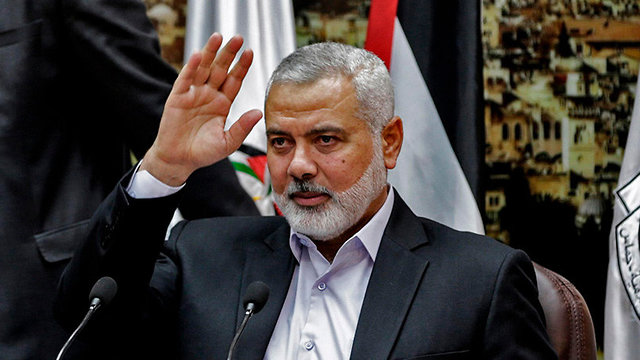
Ismail Haniyeh (Photo: AFP)

Ismail Haniyeh (Photo: AFP)

“It is possible to reach the kind of understandings that would lead to quiet in exchange for the lifting of the blockade,” emphasized Hamas leader, adding that “the quiet does not have to come at a political price or at the expense of the intra-Palestinian reconciliation.”

Haniyeh’s statements come amid international efforts to ease the humanitarian crisis in the strip and avoid a flare-up with Israel.

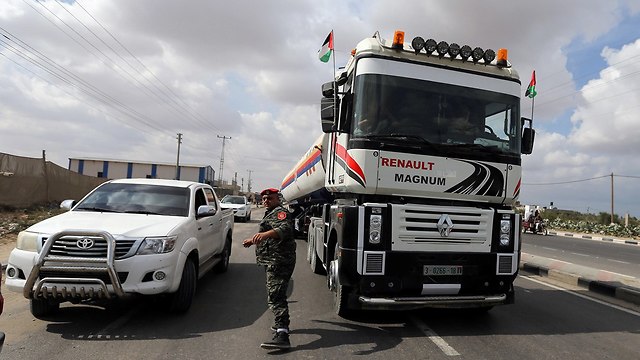
On Tuesday, a truck brought fuel across Israel’s border into the Gaza Strip in what sources said was a Qatari and UN-backed drive to improve the conditions in the enclave and stem the escalation of hostilities.

The shipment was a potential slap to the Western-backed administration of Palestinian President Mahmoud Abbas, which opposed the foreign relief plan, since Gaza is controlled by Abbas’s rival and the Palestinian president has been using economic pressure in order to wrest back control.

Qatari fuel brought to Gaza (Photo: Reuters)

Qatari fuel brought to Gaza (Photo: Reuters)

“The Qatari operation to help Gaza’s power plant was possible due to the UN efforts, despite the threats made by Palestinian Civil Affairs Minister Hussein al-Sheikh to the employees of the Energy Authority, that he would withhold their salaries if they cooperate with the Qatari initiative,” Hamas vented in their official statement.

“The residents of the Gaza Strip must live in dignity, without the blockade, without war and without aggression. Hussein al-Sheikh went as far as to appeal to international institutions and transport companies in an attempt to prevent the entry of Qatari fuel into the Gaza Strip. All of his efforts failed,” the statement exclaimed.

Nevertheless, the Hamas-led border violence still continues. On Friday morning, an incendiary balloon, with Arabic inscription, was found on the side of the road on Sprinzak Street in the central city of Rishon LeZion. The device was neutralized by police sappers without causing any damage. It was the fifth incendiary balloon to land in the Shfela region this week.

Earlier, an incendiary balloon landed in a schoolyard in the Eshkol Regional Council.

The device had been spotted by the school matron during a routing morning inspection. It did not cause fire and was removed by local security personnel before the school day had started.

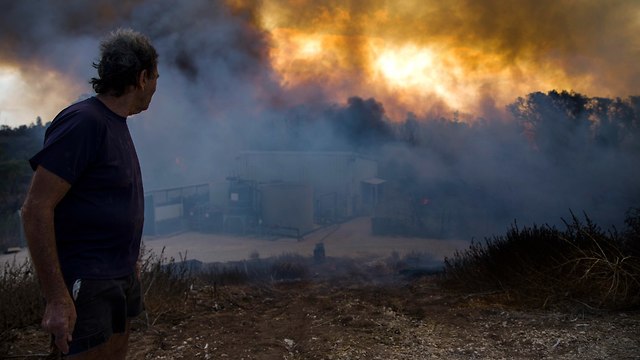
Fire in the Gaza border region (Photo: AP)
Fire in the Gaza border region (Photo: AP)

Head of the Eshkol Regional Council, Gadi Yarkoni, demanded the government put an end to arson terror.

“The alertness of the school matron and the immediate arrival of local security personnel allowed us to neutralize the balloon before the arrival of the students … Eshkol has been dealing with balloon terrorism for over sixth months … we demand that the Israeli government act decisively to put an end to this threat to give our children a sense of security,” Yarkoni vented.

In addition, at least three fires broke out in Kibbutzim Or HaNer and Erez, in the Gaza border region.

Furthermore, a fire had broken out near a railway track in the city of Sderot, prompting the authorities to close Route 34 between Sderot and Kibbutz Yad Mordechai due to a heavy smoke.

Reuters contributed to this story


Iran’s supreme leader orders officials to resolve economic crisis 

Posted October 12, 2018 by Joseph Wouk
Categories: Uncategorized

Source: Iran’s supreme leader orders officials to resolve economic crisis – Israel Hayom


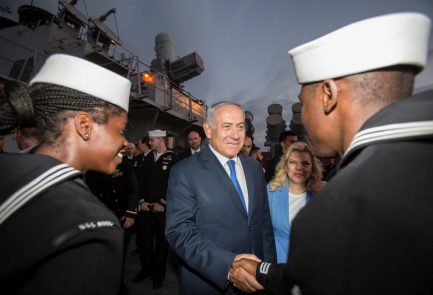
US Navy returns to Israeli port in sign of ‘deep alliance’ 

Posted October 12, 2018 by Joseph Wouk
Categories: Uncategorized

Source: US Navy returns to Israeli port in sign of ‘deep alliance’ – Israel Hayom


Iran plot in Paris ‘lays bare’ terrorist intentions, Pompeo says

Posted October 11, 2018 by Joseph Wouk
Categories: Uncategorized

Source: Iran plot in Paris ‘lays bare’ terrorist intentions, Pompeo says – Middle East – Jerusalem Post

IRAN PLOT IN PARIS ‘LAYS BARE’ TERRORIST INTENTIONS, POMPEO SAYS

Tehran has ‘ramped up’ terror plans, claims State Department paper.

BY MICHAEL WILNER
 OCTOBER 11, 2018 02:37

WASHINGTON – A plot by Iranian officials to bomb a dissident rally in the heart of Paris “lays bare Iran’s continued support of terrorism throughout Europe,” and justifies the Trump administration’s broad reimposition of sanctions on the state, US Secretary of State Mike Pompeo said on Wednesday.

The secretary praised Germany’s decision a day prior to extradite Asadollah Assadi, an Iranian diplomat accredited in Austria, to Belgium, where officials first hatched a plan to trigger explosives at a June 30 rally of the Paris-based National Council of Resistance of Iran (NCRI).

“The scale of this plot, which involved arrests of numerous suspects across Europe – including in Belgium, France and Germany – reminds us that Iran remains the world’s leading state sponsor of terrorism,” Pompeo said. “We support our European allies in exposing and countering the threat that Iranian-backed terrorism poses around the world.”

Last week, France seized assets belonging to Iran’s intelligence services and two Iranian nationals in response to the plot. “An incident of such gravity on our national territory could not go unpunished,” said a joint statement by its foreign, interior and economy ministries.

Two Iranian individuals are already being held in Belgium suspected of involvement in the bomb plot. They were caught in possession of explosive material.

The State Department recently released a glossy 45-page guide to Iran’s “destructive activities,” highlighting its sustained support for terrorism worldwide.

“After a brief lull in the 1990s and early 2000s, Iran has ramped up its active involvement in worldwide terrorist plotting and attacks, with numerous terrorist operations uncovered or disrupted in Europe, North and South America, Africa, and Asia since 2009,” asserts the report, published during the administration’s push for additional pressure on Tehran during the UN General Assembly in New York last month.

“The pace of these activities indicates that Iran remains committed to using terrorism to achieve its objectives and is confident in its ability to operate anywhere in the world,” the report continues. As examples, the paper refers to 17 arrests and searches of Iranian officials linked to terrorism in Bulgaria, Turkey, Bosnia and Herzegovina and Germany – in addition to those arrested in connection to this latest plot – since 2012.

According to State Department officials, the purpose of the paper was to organize the administration’s argument for the resumption of nuclear-related sanctions. US President Donald Trump withdrew from a 2015 nuclear deal with Iran and five world powers last May, arguing the agreement should have demanded Tehran moderate its other malign behavior, including its military activities in Yemen, Syria, Lebanon and Iraq.

Critics of the nuclear deal, including those in Israel, argue that the purpose of Iran’s nuclear program was to provide deterrence and cover for its other destructive activities worldwide. The administration is hoping to make this argument to the five powers– France, Britain, Germany, China and Russia – that have thus far remained in the agreement.

So far, however, these countries have resisted renewed US sanctions, claiming that Iran’s nuclear work should remain decoupled from its other malign activities, including its support for terrorism.

The harshest of Washington’s sanctions, including those on Iran’s oil and gas sector, are scheduled to resume next month.


Israel trying to show that S-300 in Syria did not change balance of powers – expert

Posted October 11, 2018 by Joseph Wouk
Categories: Uncategorized

Source: Israel trying to show that S-300 in Syria did not change balance of powers – expert | Muraselon

Israel will continue air operations against Iranian forces and Lebanon’s Hezbollah group despite Russia’s delivery of S-300 missile systems to Syria, former Russian Ambassador to Damascus and political analyst Alexander Zotov told a roundtable in Moscow on Monday.

“There is a narrative in Israel, among experts, among political analysts and in the media, that is being fueled by statements of Defense Minister [Avigdor] Lieberman and even of [Prime Minister Benjamin] Netanyahu himself, that generally ‘we [Israel] are not going to deviate from our course of responding to any actions by Iran and Hezbollah which present a potential threat to us, and no one and nothing can stop us’,” Zotov said.

“That is why many people in Israel think that there could be some kind of a demonstrative attack, maybe even at an imaginary facility, maybe far away from all those systems being deployed in Syria now, in order to avoid striking any facilities with Russian servicemen, in order to make it look like everything is fine and everything goes according to plan,” he added.

The expert noted Israel should be able to understand how risky it is to carry out such operations without coordination with Russia.

“In the situation when our air defense systems are given to Syria, the responsibility for retaliatory strikes will lie with Syrians, and we will thus get a room for maneuver,” Zotov said. “Because what Syrians do represents a natural right of any country to defend its territory from an outside threat,” he added