Off Topic: Trump, Nazis and US Jewry 

Posted November 18, 2018 by Joseph Wouk
Categories: Uncategorized

Source: Trump, Nazis and US Jewry – Israel Hayom

Isi Leiber

American Jews, who in the past would have united to face a common threat, are now laying the foundations for an unprecedented eruption of violent anti-Semitism.

The U.S. midterm elections took place in an unparalleled atmosphere of hysteria. As in virtually all midterm elections, the ruling party experienced some losses. But, despite predictions of defeat, President Donald Trump was the overall winner.

In this divided nation, the larger cities lean Democratic and middle America is overwhelmingly pro-Trump. Broad respect for the office of the presidency no longer exists. Most voters are either ardent lovers or zealous haters of Trump – with Jews at the forefront of the latter group.

The Republicans lost control of the House of Representatives, but they lost fewer seats than the Democrats did when losing the House in 1994 and 2010. More importantly, the Republicans held their majority in the Senate, giving Trump a free hand in directing foreign policy and appointing conservative judges.

The clear majority of Jewish Americans continued the tradition of voting for the Democrats and have emerged as leaders of the anti-Trump brigade. That many Jews with a liberal tradition oppose Trump’s conservative policies and dislike his aggressive tone is not surprising.

But it is incomprehensible that they shower abuse on him in a Jewish context. The attacks by a wide section of the community, including progressive rabbis, lay organizations such as the Anti-Defamation League and women’s groups, are unprecedented.

Some Jewish leaders even blamed Trump for the Pittsburgh synagogue massacre, claiming that his aggressive political style was responsible for the actions of the lone neo-Nazi anti-Semite who actually did the shooting. Buttressed by the ADL and other Jewish groups, the media claimed that there had been a surge of white nationalist anti-Semitism since Trump was elected, including in their fake figures internet hoaxes not motivated by Jew-hatred.

One thing is clear: American Jews, like every Diaspora community, now need to employ security services at synagogues, schools and community centers.

It is noteworthy that the ever-growing influence of anti-Israel and anti-Semitic elements seeking to radicalize the Democratic Party is rarely mentioned by the liberal press or the ADL. In the midterm elections, a number of Democratic candidates hostile to Israel and Jews won their races, some in districts with significant Jewish populations.

There have been no serious efforts to restrain burgeoning anti-Semitism from anti-Israel groups on college campuses.

There were few complaints when then-President Barack Obama related to Israeli self-defense and Palestinian terrorism as morally equivalent. And there are few complaints now, after it was recently revealed that in 2005, Obama met the radical anti-Semite Louis Farrakhan for a photo op.

The allegations that Trump has contributed to the current polarization of society with his aggressive rhetoric may be true, but that is more than matched by the hysteria from the Democrats.

All this is intensified by the revolution in social media, which provides a platform for promoting racism, violence, and, above all, anti-Semitism. It may be time to review the U.S.’s sacred credo of freedom of expression.

The most obscene aspect of anti-Trump mudslinging is the concerted attempt to portray him as an anti-Semite. This lie, frequently reiterated by progressive rabbis and Jewish lay leaders, has become embedded in the minds of many Democratic supporters.

But this reflects the madness in the air. Trump has a daughter who converted to Judaism and is religiously observant, he has always had Jewish friends and has appointed several Jewish key executives, and after the tragedy in Pittsburgh, he condemned anti-Semitism in a statement that Prime Minister Benjamin Netanyahu could not have expressed better.

Above all, Trump has proved to be the most pro-Israel president ever. He is the first to have reduced funds to the Palestinians that were being used inappropriately. He stopped funding UNESCO when that organization admitted Palestine as a full member, and he told the Palestinians to forget about their claimed right of return to Israel. He warned them that financially rewarding murderers and their families was unacceptable. He moved the U.S. Embassy to Jerusalem, despite enormous pressures. And he was the first to stand up, virtually alone, to promote Israel’s case to the world.

American Jews may hate Trump but to describe him as pro-Nazi qualifies them as collectively crazy.

If accusations that Trump harbors Nazi sympathies are not quashed, middle America, which enthusiastically supports his Israel policies, could unleash their frustrations against the “ungrateful” Jews and then the ADL predictions about anti-Semitism would be realized.

We live in troubled times. Throughout the Diaspora, anti-Semitism is rising dramatically, and now many American Jews seem to be acting like lemmings on a suicide march.

The tragedy is that Israel, which formerly helped maintain Jewish identity for those with limited Jewish education, has now drifted into irrelevancy for large swathes of U.S. Jewry. Unless a massive effort is invested into overcoming Jewish illiteracy, the future seems bleak.

Those concerned with having Jewish grandchildren should now seriously evaluate making aliyah or at least encouraging their children to do so.

Isi Leibler’s website can be viewed at http://www.wordfromjerusalem.com. Email: ileibler@leibler.com.
 

The price of restraint 

Posted November 18, 2018 by Joseph Wouk
Categories: Uncategorized

Source: The price of restraint – Israel Hayom

Uri Heitner

It was 3 p.m., and Israeli news reports broadcast that the terrorist organizations in the Gaza Strip announced that Israel had gotten the message: If the Israel Defense Forces hold fire, there will be quiet.

The commentator explained that this statement should be seen as psychological warfare. Surprisingly though, it seems the Israeli cabinet got the message loud and clear when it agreed to a cease-fire.

This insolence is the direct result of the last eight months, in which Israeli deterrence eroded in a shocking manner. For four and a half years following Operation Protective Edge, residents of the western Negev enjoyed a kind of quiet they had not known since 2000. The deterrence worked.

But on March 30, the Palestinians announced the “March of Return,” an ongoing operation that entails daily attacks on the border fence, the throwing of explosives, Molotov cocktails and grenades toward Israel, incursions into Israeli territory, and the culmination of all these activities: the arson terrorism that has burned Israeli farmlands and forests on an enormous scale.

The Israeli government has chosen to respond to all of this with restraint.

No normal country would allow such an assault on its sovereign territory. Israel should have made it clear from the outset that incendiary kites would be treated like rockets and that the terrorist cells launching them would be destroyed exactly like those that fire rockets at Israel.

But the Israeli government decided to act with restraint, and this restraint has eroded deterrence. The rockets returned. Israel responded to the onslaught and then agreed to a cease-fire – not a comprehensive cease-fire, but one that puts an end to the rocket launches and IDF attacks on Gaza. It is through this response that Israel has sent a clear message to the terrorist organizations: Arson is permissible. Terrorists can set fire to the western Negev as long as they do not shoot rockets at Israel.

Israel’s deterrent value continues to erode. Time after time, we agree to a quasi-cease-fire that is followed by yet another round of fighting. This time, 460 rockets and mortar shells were fired toward communities in Israel’s south over two days last week.

One would have expected the government to act to put an end to this erosion of deterrence. We should have dealt the terrorist organizations a blow that would have delivered loss and destruction on a massive scale and that would have made Hamas beg for a real, comprehensive, long-term cease-fire.

Instead, Hamas set the rules. We were sucked into the fighting, just as we have been in the past.

Prime Minister Benjamin Netanyahu has spoken of his honest desire to avoid a war. Indeed, leaders are expected to do everything in their ability to avoid a war, or at least delay it as much as possible.

But the means to that end is deterrence.

The erosion of deterrence encourages and emboldens the enemy and brings us closer to war. Had we responded to the first incendiary kites as if they were a barrage of rockets, the phenomenon would have been nipped in the bud. The restraint brought us around a thousand rockets in recent months. Hezbollah recognizes this failure, as does Iran. Our restraint in the south could set the north alight too.

Should Israel agree to a cease-fire or reach an agreement with Hamas? Absolutely, but only from a position of strength. And in order to restore deterrence, we should have hit them hard.

USS Truman carrier and strike force bound for waters off Syria amid Russian naval buildup – DEBKAfile

Posted November 18, 2018 by Joseph Wouk
Categories: Uncategorized

Source: USS Truman carrier and strike force bound for waters off Syria amid Russian naval buildup – DEBKAfile

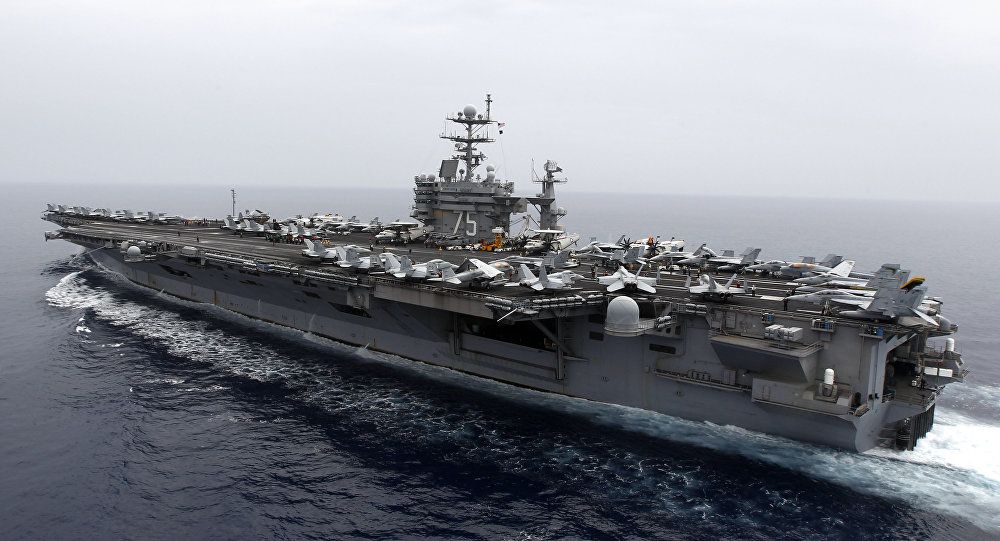
The USS Harry Truman with a strike force of 5 guided missile warships were on their way on Sunday, Nov. 18 to waters off the Syrian coast.

They entered the Mediterranean on Friday, Nov. 16, just as the Russian Middle East fleet wound up a series of search and destroy exercises against enemy submarines and warships. They were led by two Russian guided missile frigates Admiral Makarov and Admiral Essen, armed with Kalibr-NK cruise ship-to-shore missiles. Russia air force helicopters took part in the drills. By week’s end, there were 8 Russian warships in the eastern Mediterranean.

Aboard the Truman are 9 squadrons of Carrier Air Wing fighter bombers . Its strike force consists of the Normandy guided missile cruiser and four guided missile destroyers USS Arleigh BurkUSS Forrest ShermanUSS Bulkeley and USS Farragut.

This US-Russian buildup of sea and air forces opposite Syria has accelerated in preparation for two events, DEBKAfile’s military sources report:

  1. The approaching meeting between Presidents Donald Trump and Vladimir Putin at Buenos Aires on the sidelines of the 26-30 Nov. G20 summit. Since it is assumed in both Washington and Moscow that  the Syria issue will be high on the agenda together with the expanding Iranian presence there, both powers are gearing up for a military event that will tilt the standoff one way or the other.
  2. A possible Israeli air strike against Iranian targets in Syria after a long pause.  The Russians may well decide to use their newly-installed S-300 air defense missiles to shoot down an Israel warplane to get even for the downing of their Il-20 on Sept. 17. For Moscow this is still an open book.


US IS IN SYRIA UNTIL IRANIAN ‘COMMANDED FORCES’ LEAVE

Posted November 18, 2018 by Louisiana Steve
Categories: Iran - Syria war, Iran and Syria, Iraq in Syria

Tags:

The US State Department had not spelled out a clear policy, and the Pentagon didn’t seem to know if removing Iran and Iranian proxies was actually the official stance.

BY SETH J. FRANTZMAN NOVEMBER 18, 2018 Jerusalem Post

Source Link: US IS IN SYRIA UNTIL IRANIAN ‘COMMANDED FORCES’ LEAVE

Bonus Link: The Model of Iranian Influence in Syria

{Bottom line…Iran must go. – LS}

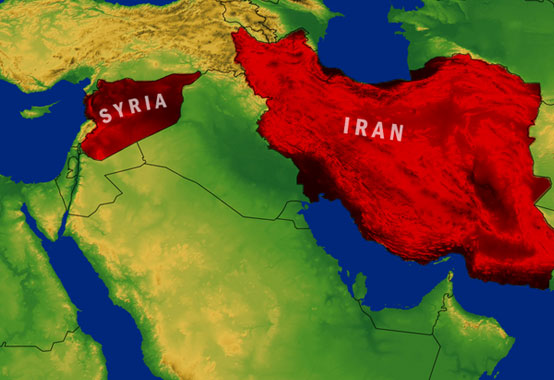
The United States is laying the groundwork for a long-term commitment to eastern Syria that will include “stabilization” after the defeat of Islamic State and also the demand that “Iranian-commanded forces” leave Syria before the US withdraws. Over the last six months, this policy has increasingly crystalized. It was finally spelled out by US special representative for Syria engagement James Jeffrey at the end of last week.

US intervention in Syria to target Islamic State began in September 2014 to stop the extremists from taking the Kurdish city of Kobani. By April 2016, the US support for the Kurdish People’s Protection Units and the Syrian Democratic Forces, the main partner force fighting ISIS, had expanded to include hundreds of US special forces and teams assisting the effort on the ground. The US presence expanded during the battle to liberate Raqqa in the summer and fall of 2017.

Over the summer, rumors and then statements began to emerge that the US presence in Syria would remain until Iran leaves. In September, National Security Advisor John Bolton said, “we’re not going to leave as long as Iranian troops are outside Iranian borders.”

This would include Iranian proxies and militias. But the US-led coalition did not see that as part of their mission. In a press conference on October 2, the spokesman for Combined Joint Task Force, Operation Inherent Resolve was asked about the Iranian issue.

“First and foremost [our mission] is to destroy ISIS,” the spokesman said. “The second is to train local troops to eventually take over. And then for the Geneva process to start working.” A Pentagon Inspector-General report went a bit further.

The US State Department had not spelled out a clear policy, and the Pentagon didn’t seem to know if removing Iran and Iranian proxies was actually the official stance. Instead, a US Assistant Secretary of Defense for International Security Affairs said that the US was “desegregating” efforts against ISIS, from the Iran policy, and that confronting Iran was an “ancillary” or “residual” benefit of having a US footprint in eastern Syria.

Jeffrey told a special briefing in Washington on November 14 that the US policy is the “enduring defeat of ISIS, a reinvigorated and irreversible political process in Syria led by the Syrian people and facilitated by the UN and a de-escalation of the conflict that will include all Iranian-commanded forces departing from the entirety of Syria.”

The US military role in eastern Syria “indirectly helps affect Iran’s malign activities,” he said. The goal is not clear: The Iranian commanded-forces must go. This also means a “fundamental change in Iran’s role in Syria,” which the US says helped fuel ISIS.

The US special representative also said that getting Iran out is not a military goal. That means the US won’t be trying to confront Iran on the ground in the Syrian areas held by the regime.

He also said that Iran’s presence was a threat to US allies and partners, including Israel, Turkey and Jordan. “The Syrian government invited them [Iran] in, we expect the Syrian government to ask them to leave,” he said.

Jeffrey noted that the US presence in Syria is made legally possible by a 2001 law that allows use of military force as part of the war on terror after 9/11. He also says that what the coalition calls “stabilization” is part of a “stage-four aspect to the military, political, diplomatic, and economic efforts” to ensure ISIS is defeated.

Spelling out how the US mission in Syria is in the process of shifting from an anti-ISIS mission, to one that includes using eastern Syria as leverage against the Assad regime and its Iranian allies is important for the region. Over the last several years, the US presence and end-goal in Syria were not clear. What began as a war on ISIS grew as the US found partners in eastern Syria, particularly among the Kurds, who proved effective warriors against ISIS.

Now, as “stabilization” takes place and the defeat of ISIS continues with battles along the Euphrates, Washington is seeking to explain what comes next. It appears that getting Damascus to remove not only Iranian forces but also those proxies and militias commanded by Iran’s Islamic Revolutionary Guard Corps, is the next step.


CIA Believes Saudi Crown Prince Ordered Khashoggi Hit: WaPo – Bloomberg

Posted November 17, 2018 by Joseph Wouk
Categories: Uncategorized

Source: CIA Believes Saudi Crown Prince Ordered Khashoggi Hit: WaPo – Bloomberg

 Updated on 
Saudi Crown Prince Mohammed bin Salman

The CIA has concluded that Saudi Crown Prince Mohammed bin Salman ordered the assassination of journalist Jamal Khashoggi in Istanbul last month, Washington Post reports, citing unidentified people familiar with the matter.

  • The agency examined multiple sources of intelligence, including a phone call that the prince’s brother Khalid bin Salman had with Khashoggi
    • Khalid bin Salman is the Saudi ambassador to the U.S., he’s said to have told Khashoggi to go to the Saudi consulate in Istanbul to retrieve the documents he needed for his planned marriage, and gave him assurances that it would be safe to do so
    • It is not clear if Khalid bin Salman knew that Khashoggi would be killed
    • Khalid bin Salman responded to the Washington Post’s story in a tweet, said the last contact he had with Khashoggi was via text message on Oct. 26, 2017, and that he never spoke to him by phone and never suggested he go to Turkey “for any reason”
  • Fatimah Baeshen, a spokeswoman for the Saudi embassy in Washington, said the ambassador and Khashoggi never discussed “anything related to going to Turkey”: Post
    • Said the claims in CIA’s “purported assessment are false. We have and continue to hear various theories without seeing the primary basis for these speculations”
  • The CIA’s conclusion about MBS’s role also based on agency’s assessment of the prince as the country’s de facto ruler who oversees even minor affairs in the kingdom
    • “The accepted position is that there is no way this happened without him being aware or involved,” according to an unidentified U.S. official familiar with the CIA’s conclusions
  • A spokesperson for the CIA declined to comment to the Washington Post
  • CIA’s conclusion contradicts Saudi Arabia’s public prosecutor, who said the Crown Prince had no knowledge of the mission that led to Khashoggi’s killing


Yemen’s war is a dangerous proxy in Iran’s global battle | TheHill

Posted November 17, 2018 by Joseph Wouk
Categories: Uncategorized

Source: Yemen’s war is a dangerous proxy in Iran’s global battle | TheHill

Yemen’s war is a dangerous proxy in Iran’s global battle
© Getty Images

While the world was fixated on the existential threat of ISIS — a terrorist group that controlled mostly rural territory and had limited, if any, backing by foreign states — the Houthi extremists in Yemen have achieved what their counterparts in Iraq and Syria could only dream of: Domination and destabilization of a country already devastated by poverty, tribal conflict and corruption.

For nearly a decade, the Houthis have controlled large parts of Yemen, including the capital of one the world’s poorest countries. They have erected their own terrorist state architecture in Sana’a and used their base to launch missile attacks not only on Riyadh’s airport but Abu Dhabi’s.

And they’ve done it all with the full backing of Iran’s Revolutionary Guard, which even loaned its Yemeni proteges the Iranian revolutionary slogan: “Death to America, Death to Israel, Curse on the Jews, Victory to Islam.”

Evidence of Iranian military involvement in Yemen has become overwhelming. Last year U.S. officials presented evidence that Iran supplied short-range ballistic missiles to Houthi rebels in Yemen, which then were fired at civilian areas of Saudi Arabia, targeting nationals of various countries. Even U.N. Secretary General Antonio Guterres submitted evidence to the Security Council that Iran was supplying ballistic missiles to Houthi rebels in defiance of U.N. resolution 2231.

But it’s not Sana’a — or even Yemen — that the Houthis and their Iranian paymasters are really interested in. It’s the oil shipping routes in the Red Sea, just off Yemen’s coast, as indicated by the Houthi attack on Saudi oil tankers in July which caused the Saudi kingdom to suspend Red Sea oil shipments, a move that affected the world’s oil markets.

Iran is an ideologically driven state and its end-game is, ultimately, to use its proxy occupation of Yemen to control the global oil supply and weaken its Sunni neighbors.

That is shocking, but what’s worse is that the Houthis are not taken seriously in Western capitals. In fact, many mainstream newspapers and politicians in the Western world have taken a surprisingly favorable tone towards them. Just last week, a number of French members of parliament expressed support for the terrorists in the National Assembly, despite their control of Hodeida causing famine on an epic scale. The propaganda value of anti-Saudi sentiment, currently in vogue in some corridors of Western power, and images of starving children presented without context has allowed some opinion-formers to ignore the bigger picture — that the coalition is in Yemen fighting terrorism at the request of the Yemeni government and in the presence of the U.N.

It is a bigger picture that we can no longer afford to ignore, for the sake of Yemen’s children. Amnesty International has criticized the Houthis for systematically recruiting child soldiers to fight on the front lines of the conflict. And the NGO Yemeni Coalition for Monitoring Human Rights Violations revealed at the U.N. Human Rights Council in Geneva that the Houthis have committed atrocities against thousands of Yemeni civilians, including women and children, who have been victims of illegal executions and death under torture.

This makes it all the more astounding that the leader of the Houthi organisation, Mohammed Ali al-Houthi, was last week able to use the Washington Post to communicate to Western audiences and position himself as a reputable leader.

That is not to suggest we should not strive for peace. But to make peace possible in Yemen, the first step is to recognize the enemy for what it is: a regionally dominant but globally dangerous Iranian proxy acting as a terrorist army.

None of this should surprise us; Iran’s appetite for coordinating terrorist attacks on foreign soil is well-established. A recent U.S. State Department report declared that Iran remains one of the world’s leading state sponsors of terrorism, with funding networks and operational cells working around the world.

And, last month, the Belgian and French governments charged an Iranian diplomat with planning a bomb attack — just the latest in a long line of global Iranian terror complicity going back to the 1983 Beirut attack carried out by the Shiite group Hezbollah, which killed 241 U.S. Marines.

Once we have recognized the enemy for who they are, we need to combine this with a diplomatic strategy leveraging key regional mediators, such as Oman, which are Western allies while also having well-established back channels to Tehran. For years, Iran has been part of the problem; now we need it to be part of the solution.

But none of this can happen with the continuing support of Houthi terror and war crimes. In order to prevent a new Hezbollah coming to pass in Yemen, we must shut down its fundraising and supply lines from Iran and its proxies around the world. Failure to do so would be one of the biggest geopolitical — and humanitarian — failures of our time.

Nathalie Goulet is a member of the Senate of France, representing Orne, Normandy, since 2007; she led a commission investigating jihadist networks in Europe and wrote a report for NATO on the financing of terrorism. Follow her on Twitter @senateur61.


New Iranian rocket smuggled into Gaza could threaten IDF defenses including Iron Dome – DEBKAfile

Posted November 17, 2018 by Joseph Wouk
Categories: Uncategorized

Source: New Iranian rocket smuggled into Gaza could threaten IDF defenses including Iron Dome – DEBKAfile

The Palestinian Islamic Jihad was referring to a new artillery rocket from Iran when its Al-Qods wing claimed to have wrecked the Ashkelon on Tuesday, Nov. 13 with a new weapon.

Neither the IDF spokesman nor any other Israeli official disclosed that at least one of the 470 rockets fired from Gaza into Israel in 48 hours had been supplied by Tehran to its Palestinian proxy with instructions to start using it. Jihad did not name the weapon except to say it had medium range.

However, DEBKAfile sources can identify it as a Falaq-2 with a range of 11km and 333mm caliber, manufactured at the Shahid Bagheri Industries complex which is part of Iran’s aerospace industries. It is designed to destroy defense systems, such as artillery emplacements, Iron Dome batteries, armored force concentrations – whether over ground or in trenches, as well as combat engineering equipment and command centers. The Iranian rocket showed its destructive capabilities in Ashkelon, killing a Palestinian worker and injuring two women. On Thursday, Gen. Mohammed Baqeri, Iran’s chief of staff, gleefully praised “the [Palestinian] victory in the Gaza Strip as turning a new leaf for the resistance. Victories will continue until the Zionist entity is no more,” he crowed.

One of Falaq-2’s advantages is its mobility. It is not launched from stationary batteries, but from any combat 4×4 vehicle or jeep, each of which carries two rockets. The team activates stabilizers on either side of the vehicle before firing. Jihad secretly received the weapon from its Iranian masters two years ago but was only ordered to use it in the latest Palestinian rocket offensive on Israel, thereby enabling Iran to target its first Israeli civilian population.

The deployment of the Iranian Falaq-2 in the Gaza Strip confronts Israel’s security authorities with some hard questions:

  1. How was it smuggled into the Palestinian enclave?
  2. Why didn’t the IDF destroy the Falaq-2 stores in Gaza as soon as they were delivered – or later?
  3. Why didn’t the IDF warn the people living on the Gaza border that their homes faced this deadly threat?
  4. Why didn’t the IDF knock out the teams launching it?
  5. Why does Israel refrain from hitting Iranian targets in the region in retaliation?
  6. Is this why Avigdor Lieberman after quitting as defense minister, warned local leaders on the Gaza border that within a year the threat from Hamas and Jihad would be equal to that of Hizballah?


Hamas Gaza chief to Israel: Don’t test us again, next barrage will hit Tel Aviv 

Posted November 17, 2018 by Joseph Wouk
Categories: Uncategorized

Source: Hamas Gaza chief to Israel: Don’t test us again, next barrage will hit Tel Aviv | The Times of Israel

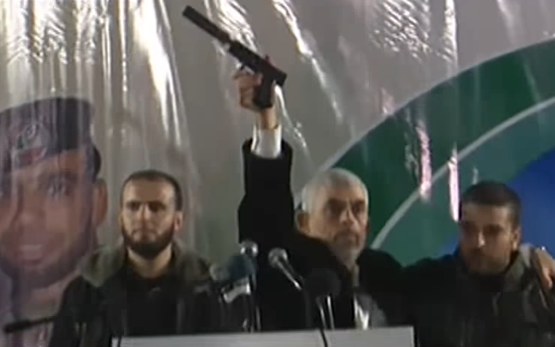
Yahya Sinwa brandishes handgun with silencer he says was taken from Israeli special forces; warns next time IDF troops enter Strip, they’ll return only for ‘thousands of prisoners’

In this November 16, 2018 image, Hamas's Gaza chief Yahya Sinwar holds up a handgun with a silencer he says was captured from Israeli special forces during a firefight in the Gaza Strip on November 11 (YouTube screenshot)

In this November 16, 2018 image, Hamas’s Gaza chief Yahya Sinwar holds up a handgun with a silencer he says was captured from Israeli special forces during a firefight in the Gaza Strip on November 11 (YouTube screenshot)

Hamas’s leader in the Gaza Strip Yahya Sinwar on Friday warned Israel “not to test us again,” saying the next rocket barrage from the territory would target Tel Aviv and other central cities with a potency that would “surprise” Israel.

He also warned that the next time Israeli soldiers entered the Strip, they would only return through a prisoner exchange for “thousands of prisoners.”

Speaking at a ceremony honoring the seven gunmen killed during a firefight on Sunday with Israeli undercover special forces, Sinwar pulled out a handgun with a silencer which he said belonged to one of the special forces troops.

One Israel soldier, identified only as Lt. Col. Mem, was killed and another injured in the fight.

Sinwar mocked Israel for assuming its decision to allow fuel and Qatari funds into Gaza before the latest flareup — as part of Egyptian-mediated efforts to achieve a long-term truce — would prevent his group from launching a large-scale attack against the Jewish state.

“What did the Israeli leadership think when it allowed in fuel and Qatari funds? … That we would sell out our blood for diesel and dollars? They’ve been disappointed, and their goals have failed,” he said.

He said he had spoken to the leader of Hamas’s military wing the Izz ad-Din al-Qassam Brigades, Muhammad Deif. “Deif asked me to say that Tel Aviv and Gush Dan [the greater Tel Aviv area] are next. The first barrage to hit Tel Aviv will surprise Israel.”

Hamas military wing commander Muhammad Deif (courtesy)

Sunday’s raid gone awry led on Monday and Tuesday to an unprecedented barrage of rockets and mortar shells fired by Hamas and other terrorist groups from the Strip that brought the region to the brink of another war.

“Our hands are on the trigger and our eyes are open,” Sinwar said. “Whoever tests Gaza will find only death and poison. Our missiles are more precise, have a greater range and carry more explosives than in the past.”

Following the special forces operation, over 460 rockets and mortar shells were fired at southern Israel over the course of around 24 hours. The Iron Dome missile defense system intercepted over 100 of them. Most of the rest landed in open fields, but dozens landed inside Israeli cities and towns, killing one person, injuring dozens and causing significant property damage.

In response, the Israeli military said it targeted approximately 160 sites in the Gaza Strip connected to the Hamas and Palestinian Islamic Jihad terror groups, including four facilities that the army designated as “key strategic assets.”

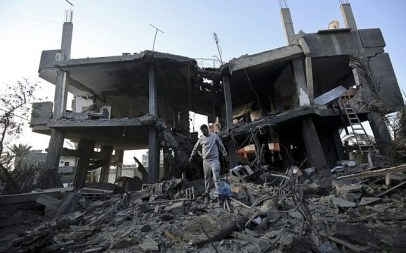
Palestinians walk amidst rubble of a building that was destroyed in an Israeli air strike in Khan Yunis in the southern Gaza Strip on November 13, 2018. (SAID KHATIB / AFP)

The fighting ended on Tuesday after a Hamas-announced ceasefire took effect, though this was not officially confirmed by Israel.

The decision to halt attacks on Gaza was criticized by many in Israel and was cited by Avigdor Liberman in his decision Wednesday to resign as defense minister, a move expected to bring early elections for the Knesset.

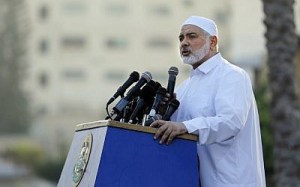
Hamas leader Ismail Haniyeh cheered Liberman’s resignation Wednesday, saying it marked an “admission of defeat” by Israel. Haniyeh also boasted that Hamas “achieved a military victory against this odious occupier in less than a week.

“A military victory occurred with the heroic performance of the Palestinian resistance factions who responded to the occupier’s crime and aggression with a response commensurate with its aggression,” he said.

Hamas terror group leader Ismail Haniyeh delivers a speech on the first day of the Muslim Eid al-Adha holiday in Gaza City, the Gaza Strip, August 21, 2018.
(Anas BABA/AFP)

The Palestinian Islamic Jihad, the second-largest terrorist organization in the Strip, similarly claimed the defense minister’s sudden departure as a victory.

“Behold the political slaughter dealt to leaders of the occupation who aren’t capable of dealing with Gaza,” the organization’s spokesperson said in a statement.

In his resignation, the defense minister decried the decision to accept a ceasefire from Hamas on Tuesday, rather than launch a larger counterstrike, saying it was a “capitulation to terror.”

He brushed off the arguments made by some defense analysts that the government refrained from conducting a campaign against Hamas in Gaza because it preferred to focus the military’s intentions on threats in Iran, Syria and Lebanon. “It’s all excuses,” he said.


Iraq’s president visits Iran weeks after US renews sanctions

Posted November 17, 2018 by Joseph Wouk
Categories: Uncategorized

Source: Iraq’s president visits Iran weeks after US renews sanctions | The Times of Israel

Tehran hoping to maintain billions of dollars in oil exports to its neighbor by establishing free trade zones along border

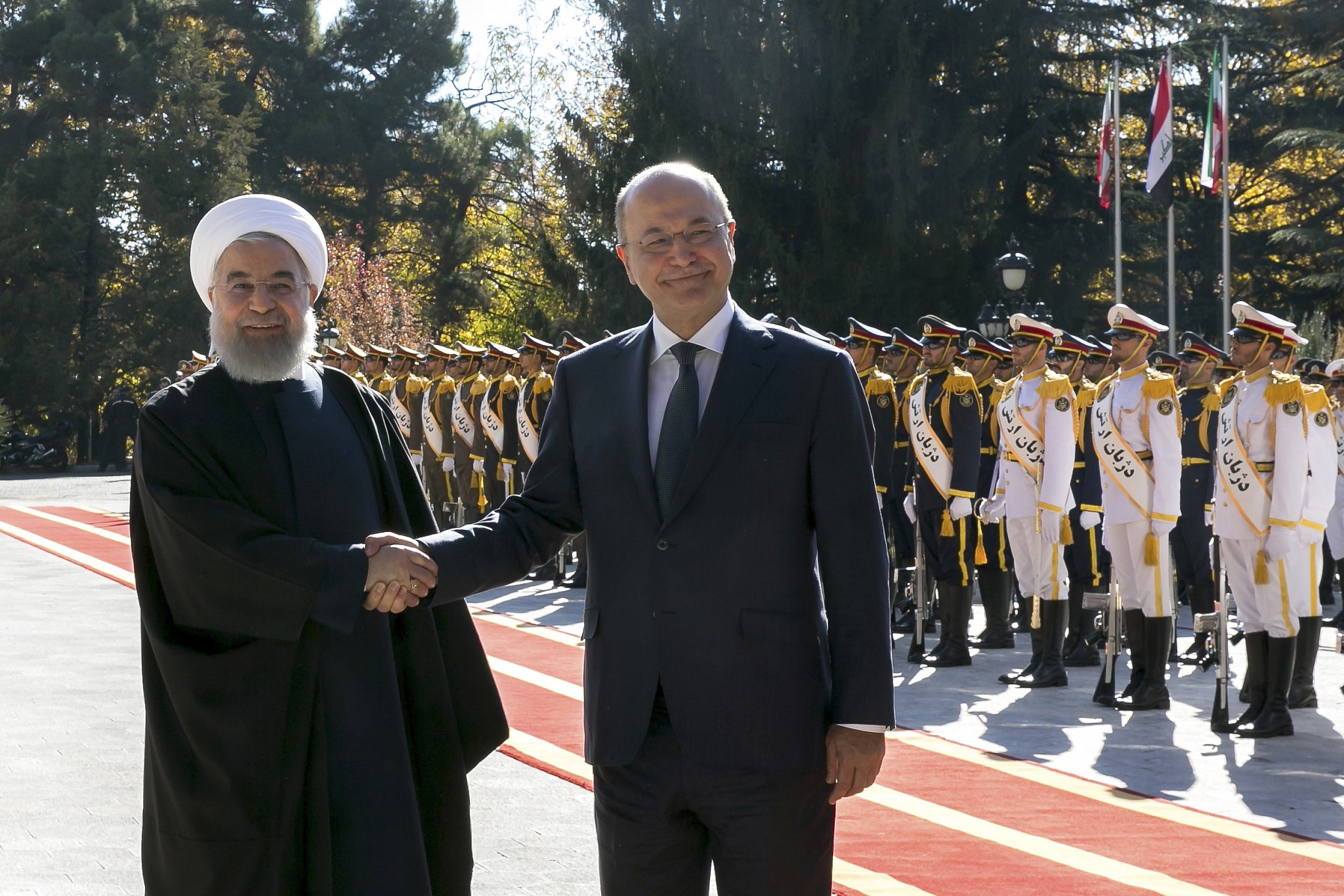
Iraqi President Barham Salih, right, and his Iranian counterpart Hassan Rouhani shake hands during an official welcome ceremony for Salih at the Saadabad Palace in Tehran, Iran, Saturday, November 17, 2018.  (Iranian Presidency Office via AP)

Iraqi President Barham Salih, right, and his Iranian counterpart Hassan Rouhani shake hands during an official welcome ceremony for Salih at the Saadabad Palace in Tehran, Iran, Saturday, November 17, 2018. (Iranian Presidency Office via AP)

TEHRAN — Iraq’s President Barham Salih began a visit to Iran on Saturday, where he pledged to improve relations less than two weeks after the United States restored oil sanctions that had been lifted under the 2015 nuclear deal.

Iran, which has had major influence over Iraq since the 2003 US-led invasion that toppled Saddam Hussein, is hoping to maintain exports to its neighbor despite the renewed sanctions. Iraq is Iran’s second-largest market after China, buying everything from food and machinery to electricity and natural gas.

At a joint briefing after their meeting, Iran’s President Hassan Rouhani said they discussed increasing trade in electricity and oil products and the establishment of free trade zones along the border. He said they also discussed joint oil projects and improving transport links between the two countries.

Trade between the two countries was some $7 billion in 2017, and they have vowed to boost it to $8.5 billion this year. Rouhani said it could eventually reach $20 billion a year.

Salih also pledged to improve ties, and suggested the formation of a “new regional system” including Iraq and Iran, one based on “political integrity, national interests and cooperation between nations and governments.” He did not elaborate.

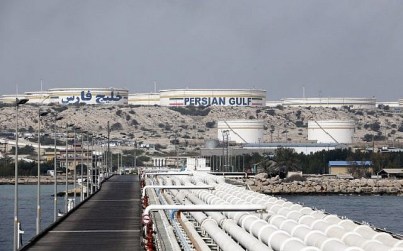
This photo from March 12, 2017, shows an Iranian oil facility on Kharg Island, on the shore of the Persian Gulf. (AFP Photo/Atta Kenare)

President Donald Trump pulled the US out of the 2015 nuclear deal between Iran and world powers in May. United Nations monitors say Iran still abides by the deal, in which it agreed to limit its uranium enrichment in return for the lifting of international sanctions.

Since then, Trump announced what he billed as the “toughest ever” sanctions against Iran, and the country has seen its oil exports plunge and its currency lose more than half its value. The full brunt of the measures came into effect November 5 when the US reimposed oil and banking sanctions.

The US, which provided crucial military support to Iraq in its battle against the Islamic State group, has granted Iraq a 45-day waiver to allow it to continue to purchase gas and electricity from Iran.

Salih said Iraq should not be “a field for struggle between conflicting demands and wills.”


U.S. Counterterror Official: Iran Spends $1 Billion Annually Supporting Terrorism

Posted November 16, 2018 by Louisiana Steve
Categories: Counter-terrorism intelligence, Iran - world's worst sponsor of terrorism, Iran and terror, Iranian terror network, Iranian terrorist funding

Tags:

by TheTower.org Staff | 11.16.18 11:42 am

Source Link: U.S. Counterterror Official: Iran Spends $1 Billion Annually Supporting Terrorism

{This is nothing compared what the rest of us must spend to counter terrorism. – LS}

The United States Coordinator for Counterterrorism said that Iran spends nearly $1 billion annually supporting terrorist groups across the Middle East, Radio Liberty/Radio Free Europe reported Thursday.

Of the total, Amb. Nathan Sales said that Iran gives $700 million to the Lebanon-based terror group Hezbollah; $100 million to Hamas and other “Palestinian terrorist groups;” and unspecified sums to other terrorist organizations.

“Iran is the world’s leading state sponsor of terrorism. It has held that dubious distinction for many years now, and it shows no signs of relinquishing the title,” Sales said.

“Sadly, it is the Iranian people who are forced to pay this price. The resources that Iran uses to fund its global terrorist ambitions are resources that come directly out of the pockets of everyday, average Iranians.”

Reuters reported last week that ordinary Iranians are “increasingly” taking to social media and “pointing fingers at the rich and powerful, including clerics, diplomats, officials and their families,” for living privileged lives while most Iranians are suffering from the poor economy.

In addition, Iranian teachers have gone on a nationwide strike for a second consecutive day demanding from the regime in Tehran better working conditions and higher salaries, one month after their last mass protest. Voice of America reported Wednesday that elementary and high school teachers were protesting outside their offices in at least 27 Iranian cities.

In a related development, Brian Hook, the U.S. Special Representative for Iran, met with Israeli Prime Minister Benjamin Netanyahu on Thursday.

Netanyahu thanked the U.S. for imposing “powerful sanctions against Iran.” The goal of these sanctions, the prime minister asserted, is to take action against “the most aggressive power in the region that has to be rolled back.”

Hook stated that with new sanctions in place, the U.S. is positioned “to really go after all of the revenue streams that Iran uses to fund Hamas and Hezbollah, its missile proliferation, all of the threats to peace and security that Iran presents.” He also thanked Israel for being “a fantastic and committed partner in this endeavor.”

When he announced that the U.S. would pull out of the nuclear deal with Iran this past May, President Donald Trump stated that the U.S. was committed to “efforts to eliminate the threat of Iran’s ballistic missile program; to stop its terrorist activities worldwide; and to block its menacing activity across the Middle East.”

[Photo: U.S. Department of State / YouTube ]