Iran’s Rouhani says US has ‘failed to stop oil exports’

Posted November 19, 2018 by Joseph Wouk
Categories: Uncategorized

Source: Iran’s Rouhani says US has ‘failed to stop oil exports’ | The Times of Israel

President vows his country will not yield to Washington’s ‘psychological war’

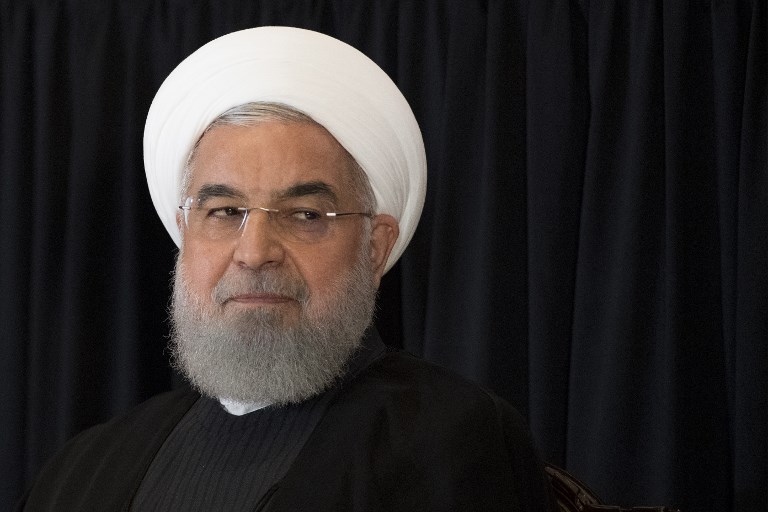
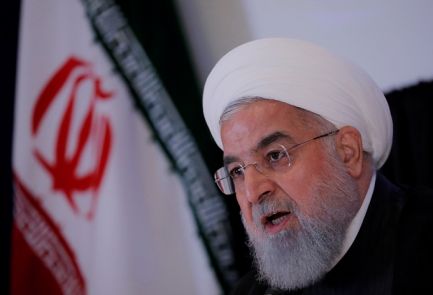
Iranian President Hassan Rouhani speaks during a press conference in New York on September 26, 2018,on the sidelines of the United Nations General Assembly.  (AFP PHOTO / Jim WATSON)

Iranian President Hassan Rouhani speaks during a press conference in New York on September 26, 2018,on the sidelines of the United Nations General Assembly. (AFP PHOTO / Jim WATSON)

Iranian President Hassan Rouhani said Monday that US sanctions would not prevent his country from exporting oil and that Iran would not give in to pressure from Washington.

“America blames us for its failures in the region,” Rouhani said during a speech in the city of Khoy that was broadcast live on television. “We will not yield to this pressure that is part of the psychological war against Iran.”

“They have failed to stop our oil exports,” he said of US sanctions, according to Reuters. “We will keep exporting it.”

US President Donald Trump pulled his country out of the 2015 nuclear deal between Iran and world powers in May. United Nations monitors say Iran still abides by the deal, in which it agreed to limit its uranium enrichment in return for the lifting of international sanctions.

Since then, Trump announced what he billed as the “toughest ever” sanctions against Iran, and the country has seen its oil exports plunge and its currency lose more than half its value. The full brunt of the measures came into effect November 5 when the US re-imposed oil and banking sanctions.


Liberman: Bennett flip-flop shows why Hamas is emboldened 

Posted November 19, 2018 by Joseph Wouk
Categories: Uncategorized

Source: Liberman: Bennett flip-flop shows why Hamas is emboldened | The Times of Israel

Likud welcomes decision by Jewish Home leaders to stay in coalition; opposition parties vow to replace them when elections are held

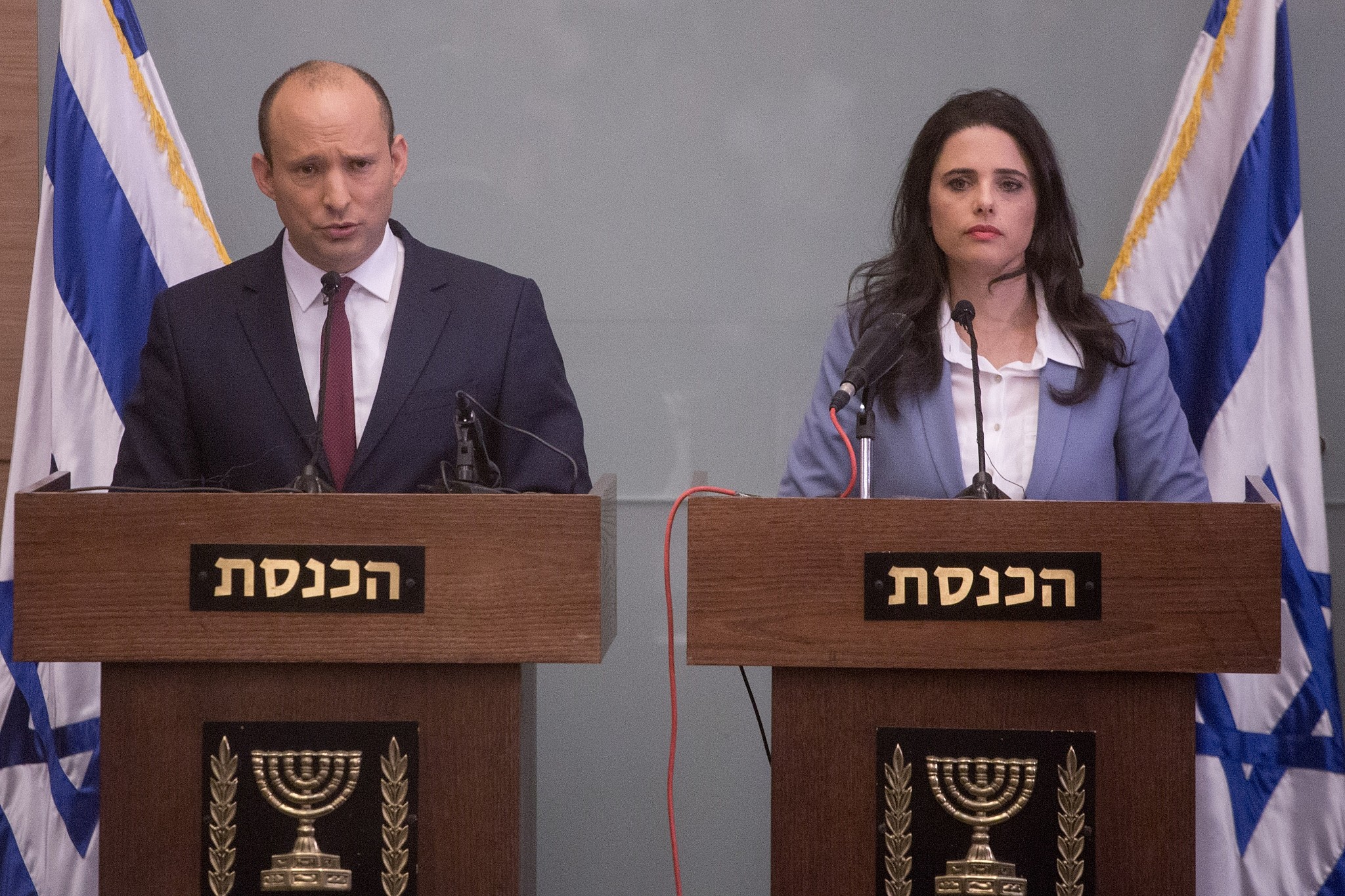
Education Minister Naftali Bennett, left, and Justice Minister Ayelet Shaked deliver a statement during a press conference in the Knesset, November 19, 2018. (Miriam Alster/Flash90)

Education Minister Naftali Bennett, left, and Justice Minister Ayelet Shaked deliver a statement during a press conference in the Knesset, November 19, 2018. (Miriam Alster/Flash90)

Former defense minister Avigdor Liberman said Monday that the decision by leaders of the Jewish Home party to drop their ultimatum and remain in the coalition was emblematic of Israel’s inability to follow through on its military threat against terrorists in the Gaza Strip.

“Now everyone understands why we have lost our deterrence,” Liberman tweeted shortly after Education Minister Nafatli Bennett and Justice Minister Ayelet Shaked announced they would not force early elections over Prime Minister Benjamin Netanyahu’s refusal to make Bennett defense minister in the wake of Liberman’s resignation last week.

Liberman had resigned in protest of what he said was the government’s light-handed treatment of Hamas following a recent deadly flareup with the Gaza Strip. A ceasefire agreement with the terror group was a “capitulation to terror,” he charged during a press conference announcing his resignation.

Before his resignation last week, in which he also pulled his Yisrael Beytenu party out of the coalition, Liberman had for months been sparring with Bennett, with each side accusing the other of soft policies on terror, which, they said, were interpreted as weakness by Hamas.

Rebuffing Bennett’s demand, Prime Minister Benjamin Netanyahu on Sunday declared that he would keep the defense portfolio for himself, and called on his coalition members to not force early elections because Israel is in “one of our most complex periods in terms of security.”

Speaking at a joint press conference with Shaked Monday at the Knesset, Bennett said that he had decided to “stand by the prime minister’s side” despite his ultimatum.

Opposition lawmakers ridiculed Bennett and Shaked, while Likud MKs praised them for their decision.

Opposition leader MK Tzipi Livni of the Zionist Union accused the coalition of using the country’s security situation as political fodder.

“The cynical exploitation of Israel’s security for political gain is something that hasn’t been done for a long time,” she told Ynet. “The truth is that I was hoping we would go to elections, and that we would be the ones leading Israel’s security against the challenges we face”

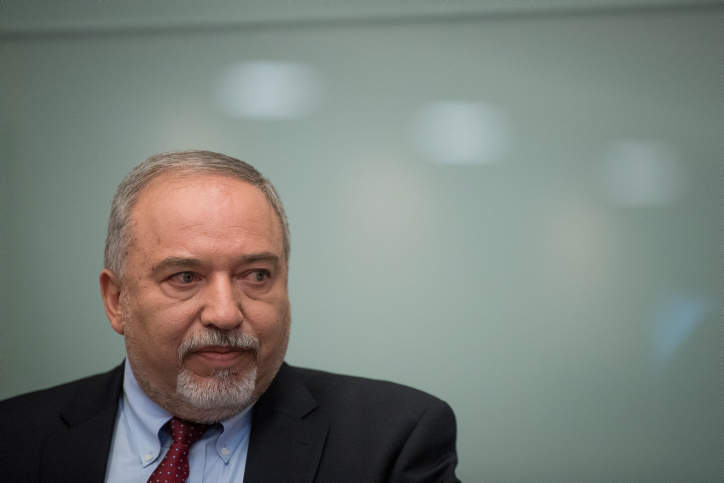
Defense Minister Avigdor Liberman announces his resignation from his office following the ceasefire with Hamas in the Gaza Strip, during a press conference in the Knesset on November 14, 2018. (Yonatan Sindel/Flash90)

Deputy Foreign Minister Tzipi Hotovely (Likud) welcomed the Jewish Home announcement.

“Bennett and Shaked did the right thing, rather than dragging us to an election to the tune of Liberman’s flute, and the national interest has been preserved. Now we should all get back to work,” she tweeted.

Earlier, before Bennett and Shaked’s announcement, Netanyahu attended a Knesset Foreign Affairs and Defense Committee meeting, where he repeated his call to preserve the coalition, a spokesman for the prime minister said in a statement.

“At this sensitive security time, it would be irresponsible to topple the government,” Netanyahu said. “Whether our partners decide to topple the government or not, we will continue to take action to ensure the security of our state and of our people. We will do so sensibly, responsibly and with determination.”

Called to the committee last week following the much-maligned ceasefire deal reached with Hamas after a two-day rocket barrage from the Gaza Strip, Netanyahu was set to address committee members in a closed-door session but took the opportunity to make brief public comments first.

Opposition Leader Tzipi Livni speaks during the plenary session of the opening day of the winter session at the Knesset, on October 15, 2018 (Hadas Parush/Flash90)

The political crisis began Wednesday with the resignation of Liberman over his criticism of the government’s handling of the violence emanating from Gaza. The withdrawal of Liberman’s five-seat Yisrael Beytenu faction reduced the governing coalition to the slimmest 61-seat majority facing 59 in the opposition.

Immediately after the resignation, Bennett demanded the defense portfolio in Liberman’s stead, warning that without it he would withdraw his own eight-seat faction and ensure the toppling of the coalition and new elections.

National elections are due to be held by November 2019.


British foreign minister to make first visit to Iran 

Posted November 19, 2018 by Joseph Wouk
Categories: Uncategorized

Source: British foreign minister to make first visit to Iran – Israel Hayom


Rouhani says Iran to continue oil exports, resist US ‘economic war’ 

Posted November 19, 2018 by Joseph Wouk
Categories: Uncategorized

Source: Rouhani says Iran to continue oil exports, resist US ‘economic war’ – Israel Hayom


‎’We won’t let Hezbollah establish terror infrastructure in the Golan’‎ 

Posted November 19, 2018 by Joseph Wouk
Categories: Uncategorized

Source: ‎’We won’t let Hezbollah establish terror infrastructure in the Golan’‎ – Israel Hayom


Bennett walks back ultimatum, coalition remains intact

Posted November 19, 2018 by Joseph Wouk
Categories: Uncategorized

Source: Bennett walks back ultimatum, coalition remains intact ‎ – Israel Hayom


Jewish Home ministers call off walkout. No snap election. Netanyahu rides out cabinet crisis with expected Gaza move – DEBKAfile

Posted November 19, 2018 by Joseph Wouk
Categories: Uncategorized

Source: Jewish Home ministers call off walkout. No snap election. Netanyahu rides out cabinet crisis with expected Gaza move – DEBKAfile

Education and Justice Ministers, Naftali Bennett and Ayelet Shaked surprised Monday, Nov. 19, by announcing that their Jewish Home party would stay in the government if Prime Minister Binyamin Netanyahu stood by his pledge to reverse the “hesitant and stammering” security policy of the last decade, and switch to a “creative, proactive course for leading the country to victory.”

The two ministers spoke at a special news conference they called in the Knesset, at which they were widely predicted to announce their resignations.

“For the past decade, our soldiers have been held back by one constraint after another and taught to fear the military prosecutor more than the enemy,” Bennett said in a detailed indictment of the Netanyahu government’s security policy. “Hamas and Hizballah became more brazen day by day because they sensed our fear, whereas our enemies no longer feared us,” Bennett said. However, if Netanyahu’s pledge to change course was serious, Jewish Home would not desert the ship of government, but support him as defense minister unconditionally. “The state of Israel is too precious for us to walk away without this test.”

Shaked accused Avigdor Lieberman of handing Hamas a prize by his resignation as defense minister last week, leaving the government with a minuscule majority. “We won’t give the terrorists another gift by running out on the government,” she said. “The Middle East is watching us.” It was evident that the prime minister had pulled the two ministers back from quitting, by assuring them that a security operation “was still unfinished” and their resignations now would be “irresponsible” in national terms.

This development has terminated the government crisis triggered last week by Lieberman’s resignation. Israel’s next move in the Gaza Strip is now tensely awaited. The Palestinian Hamas and Islamic Jihad terrorists ruling the Gaza Strip, who were already celebrating their success in maneuvering Israel into pre-election mode, must now prepare for Israel’s next military operation


Life in Israel under the shadow of Hamas’s rockets

Posted November 19, 2018 by Louisiana Steve
Categories: Hamas, Rocket attacks

Tags:


A picture taken on July 14, 2018 shows Palestinian rockets being fired from Gaza City towards Israel

BY Stephen Daisley NOVEMBER 15, 2018 The Spectator

Source Link: Life in Israel under the shadow of Hamas’s rockets

{Civility under fire…absolutely amazing. – LS}

Midway through coffee a soldier came running in. ‘Tzeva adom!’ ‘Red colour!’ Cups clattered, chairs shrieked across slate floor. There is a calm exodus to an improvised bomb shelter — the cafe’s concrete reinforced bathroom. Soldiers at the front, paramedics behind, civilians at the back. Two dozen faces are lit by the insistent flashes of Red Alert, an app that warns of incoming fire. The foreigners quip nervously, the locals tut at the inconvenience. After a few minutes, the all clear is given and diners return to their lunch. It is 1.02pm and another rocket has just hit Israel. 

We are at Yad Mordechai junction, four kilometres from the 1949 armistice line — the border between Israel and Gaza. This is the second time in 30 minutes that we have had to flee from a Hamas rocket. Both times, a public announcement system sounded: the factual tone announcing ‘red colour’ is deemed less psychologically damaging than constant air raid sirens. Iron Dome, Israel’s anti-ballistic defence shield, took out the first rocket; the second got through and hit a house nearby. Israelis say without the Dome, casualties would be much higher and the government would have no option but to launch another full-scale military offensive against Hamas. 

Scores of injured Israelis have been taken to hospitals in the borderland in recent days. On Tuesday morning, Hamas’s rockets claimed their first fatality this week: Mahmoud Abu Asabeh, a 48-year-old Palestinian working in Israel, was killed when a projectile hit his apartment building in Ashkelon. He leaves behind a wife and five children. The tense ceasefire between Israel and Hamas looks likely to survive Sunday’s botched IDF operation inside Gaza, which cost the life of a senior Israeli officer (named only as ‘Lt. Col. M’) and seven Palestinians. The Israelis’ story is that this was a routine intelligence operation gone wrong but there are reports that this was a botched assassination attempt. 

Wherever the truth lies, Hamas exacted its revenge as always on Israeli civilians, targeting them with hundreds of rockets, and prompting a response that has killed seven Gazans, according to the Palestinian Ma’an News Agency. Israel’s hawkish defence minister Avigdor Liberman resigned on Wednesday, in what is thought to be an act of political positioning ahead of rumoured elections. 

I travelled to Israel this week as part of a delegation of British journalists invited by the country’s ministry of foreign affairs. With the government picking up the tab, I feared that it might be one of those pointless junkets where diplomats spin the usual lines: Israel the Victim, Israel the High-Tech Eden, and Israel the Only Democracy in the Region. Instead, we have been given remarkable access to police, senior diplomats, policy-makers and politicians. Checkpoints, anti-Arab racism, the Nation State Law — nothing has been off limits. They have pushed back, sometimes hard, but there has been little glossing over Israel’s faults. 

This candour is what makes us insist on visiting the Gaza border as scheduled: here is a chance to test all they have told us. Our planned visit to the Kerem Shalom border crossing is now out of the question, a pity because Kerem Shalom is busy. Israel is sending tankers of fuel and trucks with essential supplies into Gaza. After some pushing, our hosts agree to take us as close to the border fence as possible. We rattle down a highway on which all the other traffic is heading in the opposite direction and, after an hour, arrive at Sapir College, just outside Sderot. Sapir has 8,000 students on its roll — 7,000 Jews and 1,000 Arabs or Bedouins — but today the campus is a shell. The authorities shut it down briefly on Tuesday because it is in range of Gaza, before it was reopened. The building is also a literal shell: the college is surrounded by a forbidding concrete barrier designed to look like the walls of the building. 

Inside the education fortress we meet Zohar Avitan, the director of academic studies, who has been at the college since 1977. A lively-humoured man, his jokes are punctuated by a regular lament about the absence of his students. Avitan speaks of them with grandfatherly affection, especially the Bedouin women he says have to sneak out to classes every day lest their husbands find out. Sapir is to him ‘the wondership — the ship of dreams’, where students can find their way in life. 

Before the second intifada, Sapir had a sizeable contingent of Gazan students and ran courses inside the Strip. ‘This was back when we believed in peace,’ Zohar says. He is sad but he is not bitter. His parents, Moroccan Jews, moved to Israel when he was one and the family lived in a 32-square metre house in Sderot. He is proud of his town, recalling how it was known as ‘the Liverpool of Israel’ in the 1980s for producing a succession of chart-topping artists. 

Zohar is old enough to remember before Red Colour, when air raid sirens sounded through every street of his town. In December, a rocket landed outside his house during the Friday night shabbat dinner, blowing in the windows on the family as they prayed and ate. ‘I forgot what to do but my wife shouted at me to get to the shelter,’ he says, adding with a wry grin: ‘When my wife shouts, you listen.’

The 60,000 Israelis who live in communities adjacent to Gaza could be forgiven for holding a siege mentality but everyone we meet launches one-liners faster than Hamas can fire Qassams. Zohar jokes about two colleagues comparing the time they have to reach a bomb shelter. The man, who lives in Sderot, has 20 seconds while a female colleague from Ashkelon has 40. ‘What do you do with all your free time?’ he enquires. Later, when we are running from the second rocket in Yad Mordechai, Zohar assures us: ‘Don’t worry, the college will give you 20 credits in gymnastics for this.’

Zohar has an old man’s impatience for ideology. ‘This question of who started it. He started it; no, he started it. This is the argument of the kindergarten. We cannot live in the past; we have to build the future.’ The Palestinians, he states many times, are not his enemies. He wants one of his students to become manager of the duty free between Gaza and Israel. ‘That day, we’ll throw Toblerones, not missiles’. 

He takes us into central Sderot. It is a town of 24,000 and lies 800 metres from Gaza. Zohar introduces us to the mayor, Alon Davidi, a forty-something religious man and a smooth, easy political operator. He guides us into the municipality’s security command centre with its wall of CCTV screens and bank of telephonists fielding calls from concerned residents. The atmosphere is wire-taut; Red Alert buzzes with every fresh rocket that lands nearby. Davidi breaks the tension by saying he hopes for peace in Sderot — and continued success for the English national football team. 

I ask him about the psychological effects of rocket attacks. Israeli children living in the border communities report markedly higher mental health problems than the rest of the country. Three of Davidi’s children have been diagnosed with post-traumatic stress disorder. The town runs a number of programmes to help youngsters manage anxiety; his children have a therapy pet, a dog called Mocha. It helps them handle the enduring fear of the next barrage. 

Next we arrive at a bakery in the centre of town. A rocket landed the night before and struck a gas canister, incinerating the back of the shop. The stench of carbon attacks the nostrils. The baker is inside, now baking in the front of his shop because he cannot afford not to work. Out the back, insurance assessors fill out their forms, stony-faced. We drive closer still to Gaza, heading to the Black Arrow memorial that commemorates an earlier, more successful Israeli incursion. We can see the tops of Gaza tower blocks on the horizon but soon we are pulled over by the IDF. At first they agree to let us take pictures then lose patience and order us to move on. 

Ten minutes later we turn into Kfar Aza, a kibbutz directly on the border. As we arrive, some of the soldiers there shake their heads. Idiot tourists. A short walk later, we run out of road. Before us stands the electrified border fence. Only its wire mesh, and 50 metres of agricultural land, stand between us and Gaza. The kibbutzniks still farm the land but Hamas is now sending flaming kites to burn the crops, even as the children of Gaza — but not the children of Hamas — struggle to survive on supplies driven in every week by Israel. The same children have no trauma pets, no ship of dreams. Their rulers put them in front of soldiers, not the other way round. Gaza is 50 metres and yet much farther from here.


Iran says it is expanding trade with Iraq despite US sanctions 

Posted November 18, 2018 by Joseph Wouk
Categories: Uncategorized

Source: Iran says it is expanding trade with Iraq despite US sanctions – Israel Hayom


Off Topic:  Trump, Nazis and US Jewry 

Posted November 18, 2018 by Joseph Wouk
Categories: Uncategorized

Source: Trump, Nazis and US Jewry – Israel Hayom

Isi Leiber

American Jews, who in the past would have united to face a common threat, are now laying the foundations for an unprecedented eruption of violent anti-Semitism.

The U.S. midterm elections took place in an unparalleled atmosphere of hysteria. As in virtually all midterm elections, the ruling party experienced some losses. But, despite predictions of defeat, President Donald Trump was the overall winner.

In this divided nation, the larger cities lean Democratic and middle America is overwhelmingly pro-Trump. Broad respect for the office of the presidency no longer exists. Most voters are either ardent lovers or zealous haters of Trump – with Jews at the forefront of the latter group.

The Republicans lost control of the House of Representatives, but they lost fewer seats than the Democrats did when losing the House in 1994 and 2010. More importantly, the Republicans held their majority in the Senate, giving Trump a free hand in directing foreign policy and appointing conservative judges.

The clear majority of Jewish Americans continued the tradition of voting for the Democrats and have emerged as leaders of the anti-Trump brigade. That many Jews with a liberal tradition oppose Trump’s conservative policies and dislike his aggressive tone is not surprising.

But it is incomprehensible that they shower abuse on him in a Jewish context. The attacks by a wide section of the community, including progressive rabbis, lay organizations such as the Anti-Defamation League and women’s groups, are unprecedented.

Some Jewish leaders even blamed Trump for the Pittsburgh synagogue massacre, claiming that his aggressive political style was responsible for the actions of the lone neo-Nazi anti-Semite who actually did the shooting. Buttressed by the ADL and other Jewish groups, the media claimed that there had been a surge of white nationalist anti-Semitism since Trump was elected, including in their fake figures internet hoaxes not motivated by Jew-hatred.

One thing is clear: American Jews, like every Diaspora community, now need to employ security services at synagogues, schools and community centers.

It is noteworthy that the ever-growing influence of anti-Israel and anti-Semitic elements seeking to radicalize the Democratic Party is rarely mentioned by the liberal press or the ADL. In the midterm elections, a number of Democratic candidates hostile to Israel and Jews won their races, some in districts with significant Jewish populations.

There have been no serious efforts to restrain burgeoning anti-Semitism from anti-Israel groups on college campuses.

There were few complaints when then-President Barack Obama related to Israeli self-defense and Palestinian terrorism as morally equivalent. And there are few complaints now, after it was recently revealed that in 2005, Obama met the radical anti-Semite Louis Farrakhan for a photo op.

The allegations that Trump has contributed to the current polarization of society with his aggressive rhetoric may be true, but that is more than matched by the hysteria from the Democrats.

All this is intensified by the revolution in social media, which provides a platform for promoting racism, violence, and, above all, anti-Semitism. It may be time to review the U.S.’s sacred credo of freedom of expression.

The most obscene aspect of anti-Trump mudslinging is the concerted attempt to portray him as an anti-Semite. This lie, frequently reiterated by progressive rabbis and Jewish lay leaders, has become embedded in the minds of many Democratic supporters.

But this reflects the madness in the air. Trump has a daughter who converted to Judaism and is religiously observant, he has always had Jewish friends and has appointed several Jewish key executives, and after the tragedy in Pittsburgh, he condemned anti-Semitism in a statement that Prime Minister Benjamin Netanyahu could not have expressed better.

Above all, Trump has proved to be the most pro-Israel president ever. He is the first to have reduced funds to the Palestinians that were being used inappropriately. He stopped funding UNESCO when that organization admitted Palestine as a full member, and he told the Palestinians to forget about their claimed right of return to Israel. He warned them that financially rewarding murderers and their families was unacceptable. He moved the U.S. Embassy to Jerusalem, despite enormous pressures. And he was the first to stand up, virtually alone, to promote Israel’s case to the world.

American Jews may hate Trump but to describe him as pro-Nazi qualifies them as collectively crazy.

If accusations that Trump harbors Nazi sympathies are not quashed, middle America, which enthusiastically supports his Israel policies, could unleash their frustrations against the “ungrateful” Jews and then the ADL predictions about anti-Semitism would be realized.

We live in troubled times. Throughout the Diaspora, anti-Semitism is rising dramatically, and now many American Jews seem to be acting like lemmings on a suicide march.

The tragedy is that Israel, which formerly helped maintain Jewish identity for those with limited Jewish education, has now drifted into irrelevancy for large swathes of U.S. Jewry. Unless a massive effort is invested into overcoming Jewish illiteracy, the future seems bleak.

Those concerned with having Jewish grandchildren should now seriously evaluate making aliyah or at least encouraging their children to do so.

Isi Leibler’s website can be viewed at http://www.wordfromjerusalem.com. Email: ileibler@leibler.com.