The U.S. first needs to “respect the outcome” of previous talks over the 2015 nuclear deal, Foreign Minister Mohammad Javad Zarif says • Iran will not yield to U.S. economic pressure, he adds • Zarif also says Saudi Arabia stokes tensions in Middle East.
Reuters and Israel Hayom Staff
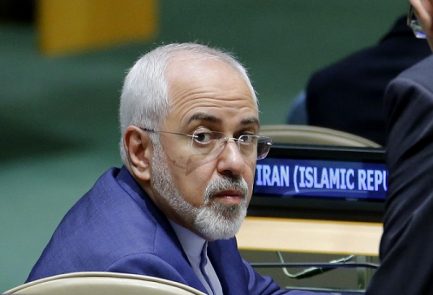
Iranian Foreign Minister Mohammad Javad Zarif at the U.N.
|Photo: Reuters
There is room for Iranian talks with the United States, but the U.S. first needs to “respect the outcome of the talks” the countries have previously held, Iranian Foreign Minister Mohammad Javad Zarif said on Saturday.
Zarif was referring to the 2015 Iran nuclear deal with major powers, from which U.S. President Donald Trump withdrew on May 8, restoring the full force of U.S. sanctions on Iran.
Speaking at the annual Doha Forum, Zarif said that while Iran was feeling the economic pressure of the U.S. sanctions, this would not lead to policy change. He said Iran had survived U.S. sanctions “for the last 40 years” and “will survive for the next 40 years.”
Zarif also accused Saudi Arabia of trying to raise tensions in the Middle East, referring to the conflict in Yemen and the murder of Saudi journalist Jamal Khashoggi at the kingdom’s Istanbul consulate.
Sunni Muslim Saudi Arabia and Shiite Muslim Iran are on opposite sides of several proxy wars in the Middle East.
Iran-aligned Houthi rebels, who control the Yemen capital Sanaa and its main port Hodeidah, have been battling against a Saudi-led Arab coalition seeking to restore the government ousted in 2014.
Hodeidah has been the focus of fighting this year, raising global fears that a battle could cut off supply lines and lead to mass starvation. Yemeni forces backed by the Saudi-led coalition have amassed on the city’s outskirts.
Zarif also said that Russia, Turkey and Iran could announce a Syrian constitutional committee with U.N. Syria envoy Staffan de Mistura before the end of this week.
As part of U.N.-mandated political reforms to end Syria’s war, the country’s constitution is supposed to be reformed and new elections held. However, Syria’s government has rejected U.N. involvement in picking the members of the committee to make the changes, and the process has gone nowhere since January.
“The Palestinian Authority’s incessant incitement has inspired the young terrorists who carried out the latest attacks,” Danny Danon writes to U.N. Security Council • “PA’s declarations of tolerance and peace are nothing but hollow rhetoric,” he says.
Ariel Kahana
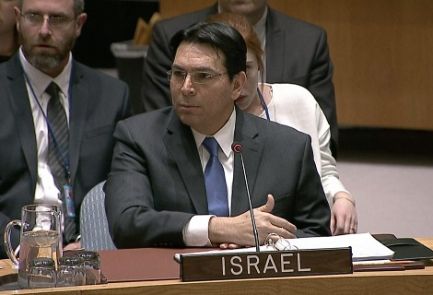
Israeli Ambassador to the U.N. Danny Danon
|Photo: AP
Israeli Ambassador to the U.N. Danny Danon has called on the Security Council to condemn the latest spike in Palestinian terrorism and the Palestinian Authority’s policy of paying stipends to jailed terrorists and to the families of terrorists killed carrying out attacks against Israelis.
”The Palestinian Authority’s incessant incitement campaign has inspired the young terrorists who have carried out recent attacks,” Danon wrote to the U.N. Security Council over the weekend.
“Under Abu Mazen’s [PA President Mahmoud Abbas’] rule, the PA devotes 7% of its annual budget to paying monthly salaries to terrorists and their families, thereby encouraging Palestinians to harm innocent Israelis and proving that its declarations of tolerance and peace are nothing but hollow rhetoric,” Danon wrote.
”Abu Mazen’s activities undermine regional stability and Israel reserves the right to defend its citizens.”
Speaking with Israel Hayom, Danon said, “At the U.N., the Palestinian leaders speak of peace, but in Ramallah, they continue to export terrorism and spread messages of hate and incitement. The State of Israel will reach every terrorist and ensure that justice is served.”
PA President Mahmoud Abbas issues directive mere hours after elite IDF unit demolishes the home of Islam Yusuf Abu Hamid, who killed Staff Sgt. Ronen Lubarsky in May by dropping a marble slab on him • IDF continues crackdown on West Bank terrorists.
Lilach Shoval, News Agencies and Israel Hayom Staff
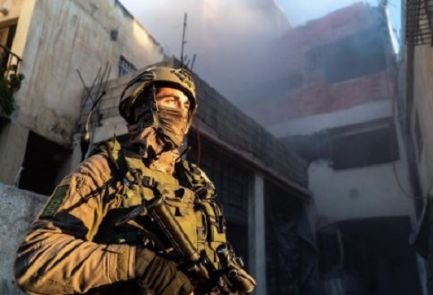
A soldier secures the area where IDF troops prepare to demolish terrorist Islam Yusuf Abu Hamid’s home, Saturday
|Screenshot: IDF / Twitter
Mere hours after the IDF demolished the home of a terrorist who killed an Israeli soldier, Palestinian Authority President Mahmoud Abbas issued a directive to rebuild the home, an official in Ramallah said Sunday.
Abu Hamid was arrested on June 13. His family appealed to the High Court of Justice to prevent the demolition, arguing that razing their home constituted ”disproportionate punitive action.”
Israel demolishes the homes of terrorists as a deterrent measure to dissuade potential terrorists from committing attacks.
IDF troops destroyed Hamid’s home with two controlled explosions in an operation involving dozens of soldiers and military vehicles on Saturday night. The operation was complicated as the home was located in the center of the densely populated camp.
Residents of al-Amari began clashing with the Israeli forces almost immediately, and the troops used crowd control measures to disperse them.
The demolition took place after Prime Minister Benjamin Netanyahu, who is also acting defense minister, ordered the IDF to step up its counterterrorism efforts in the area in the wake of the spike in terrorist attacks across Judea and Samaria in recent weeks.
The IDF has been ordered to demolish terrorists’ homes within 48 hours of the identification of an attacker, and to step up raids and arrests. The Defense Ministry has also decided to revoke the entry permits to Israel granted to terrorists’ relatives and accomplices.
Foreign Ministry: Australia’s decision to open trade office in capital is a step in the right direction • Likud officials: All of Jerusalem is Israel’s eternal capital • Malaysian PM: Jerusalem belongs to Palestine, Australia has no right to divide it.
Eli Leon, Daniel Siryoti, Ariel Kahana, News Agencies and Israel Hayom Staff
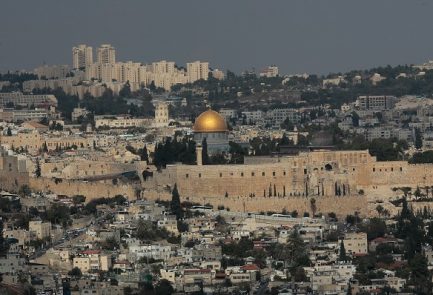
The Old City of Jerusalem with new construction in the background
|Photo: Oren Ben Hakoo
Australia’s announcement over the weekend that it was formally recognizing “west Jerusalem” as the capital of Israel but would not be moving its embassy to any part of the city for now came as a disappointment to many Israelis.
Prime Minister Benjamin Netanyahu has issued no official response either welcoming or condemning the decision.
At least one senior government official told Israel Hayom: “This isn’t an achievement. The opposite.”
However, Foreign Ministry Spokesman Emmanuel Nahshon tweeted on Saturday: “Israel views the decision of the Australian government to open its Trade and Defense office in Jerusalem as a step in the right direction.”
Nahshon added that Israel “congratulated” the government of Australia for its stance on sanctions against Iran and its “pro-Israel position at the U.N. and against anti-Semitism.”
Knesset Speaker Yuli Edelstein criticized the Australian decision, saying that the recognition of west Jerusalem as Israel’s capital “amazed” him.
“All of Jerusalem is our eternal capital, not just a part of it,” Edelstein said.
Science and Technology Minister Ofir Akunis said that Australia’s announcement was welcome, “despite the fact that all of Jerusalem has been the capital of Israel for 3,000 years.”
As well as recognizing west Jerusalem as Israeli, Australian Prime Minister Scott Morrison confirmed his country’s support for a two-state solution to the Israeli-Palestinian conflict that would make east Jerusalem the capital of a future Palestinian state.
Nabil Shaath, an adviser to Palestinian Authority President Mahmoud Abbas, said, “Australia has always been an important country to us, a friendly country, a balanced country.”
Shaath said that balance would be fully expressed when Australia officially recognized “the right of the Palestinians to a Palestinian state of their own with east Jerusalem as its capital.”
Malaysian Prime Minister Mahathir Mohamad said on Sunday that Australia had “no right” to declare a division of Jerusalem, arguing that the city had always belonged to “Palestine.”
“Why are they taking the initiative … to divide [Jerusalem] between the Arabs and the Jews? They have no right,” he said.
Spate of drive-by shootings sparks concerns of copycat attacks, but defense officials believe phenomenon will not spread outside Samaria • As hunt for Givat Asaf killers continues, IDF official says it is “only a matter of time” before they are caught.
Efrat Forsher, Lilach Shoval, Daniel Siryoti and Ariel Kahana
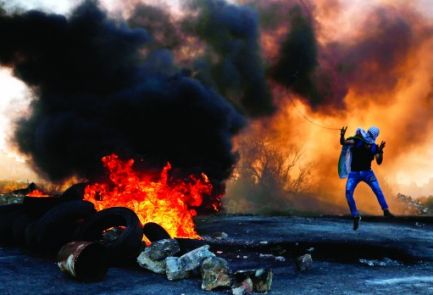
A Palestinian rioter near Ramallah, Friday
|Photo: AFP
Defense officials said over the weekend that the latest wave of terrorist attacks can probably be contained, and that while copycat drive-by shooting attacks are a matter of concern, it is unlikely they will spread outside Samaria.
”It’s only a matter of time before we get our hands on the cell’s members,” one IDF officer said.
A source familiar with the operation told Israel Hayom that military activity was focusing on thwarting future terrorist attacks, protecting Jewish settlements and roads in the region, and conducting raids and arrests.
The recent spate of terrorist attacks has prompted the IDF to increase deployment across Judea and Samaria, setting up 120 roadblocks in the area. Dozens of Hamas members suspected of terrorist activity were arrested across the West Bank over the weekend, the IDF said.
The Diplomatic-Security Cabinet was expected to devote most of its meeting Sunday to the uptick in Palestinian violence.
Prime Minister Benjamin Netanyahu, who is also currently the acting defense minister, has ordered the IDF to expedite the demolition of the homes of the terrorists involved in last week’s attacks, as well as step up military counterterrorism activities across Judea and Samaria.
Meanwhile, Palestinian Authority President Mahmoud Abbas is slated to visit Jordan on Monday, where he will discuss “recent developments in the Palestinian arena” with King Abdullah.
An Israeli defense official told Israel Hayom that Abbas has instructed Palestinian security forces to crack down on the armed factions in the West Bank to avoid further escalations.
As part of these measures, Abbas’ security forces barred Hamas operatives in the West Bank from marking the terrorist group’s 31st anniversary over the weekend.
In the Gaza Strip, which Hamas rules, the event was marked with mass rallies.
Bolstered by its success uncovering Hezbollah’s terror tunnels on the northern border, Israel now wants to leverage the IDF’s operational and intelligence coup by conveying it to the diplomatic arena.
This week, the U.N. Security Council will discuss Israel’s complaint that Hezbollah violated its sovereignty. It is hard to believe the council will pass a resolution condemning Hezbollah or calling for action against it. At most, the member states will express concern over the rising tensions and call on both sides to show restraint.
After all, any connection between the Security Council and the U.N. to peace and security is purely coincidental. Case in point: The U.N. peacekeeping force in southern Lebanon, UNIFIL, did not lift a finger to prevent Hezbollah from digging its tunnels and is generally apathetic to the terrorist organization’s deployment along the Israeli border.
Meanwhile, Israel has also turned to Russia, the new responsible adult in the neighborhood, and even sent a senior military delegation to Moscow last week to debrief the Russians on the operation to eliminate the tunnels. It is safe to assume the Russians were not taken by surprise.
The Russians, unlike the Americans, do not harbor any illusions about the players in the region. However, the Russians have their own interests, which necessitate their embrace of Iran and Hezbollah. Perhaps the Russians will pressure Hezbollah not to provoke Israel, so as not to jeopardize their gains in Syria, but they will continue viewing Hezbollah as a legitimate actor whose existence in Lebanon must accepted as an absolute fact.
The United States, which was quick to condemn Hezbollah publicly, also poured cold water over Israel’s efforts to amplify pressure on Hezbollah by refusing to impose additional sanctions on Lebanon. The Americans believe a distinction must be made between Lebanon and Hezbollah, and that the moderate foundations of Lebanese society should continue to be strengthened in the hope that one day, which will likely never come, these forces will gather the courage to rise up against Hezbollah.
The U.S. insists on continuing to arm the Lebanese army, while rejecting Israel’s claim that Hezbollah has access to its weapons. As a reminder, during the Second Lebanon War in 2006, the U.S. pressured the Israeli government to spare Lebanese government institutions and focus solely on hitting Hezbollah targets. By doing so, Washington prevented Israel from possibly altering perceptions of that war.
The truth is that Lebanon and Hezbollah are not one and the same. The majority of people in Lebanon, and many Shiites as well, oppose the organization, feel threatened by it, and wish someone would do the dirty work for them and pummel it. They mainly hope someone will wipe out Hezbollah’s military power, which first and foremost, beyond Israel, poses a threat to Lebanon itself.
However, Hezbollah’s detractors in Lebanon are irrelevant. Due to its military clout, the organization can force its views and decisions on any national matter, certainly on the ongoing construction of its military capabilities against Israel. The fact is that no one in Lebanon, neither in the government nor in the army, is asked their opinion on whether to dig tunnels and risk a possible clash with Israel.
Finally, beyond everything mentioned above, Hezbollah and the country of Lebanon are symbiotic. In its current iteration, Hezbollah cannot function outside the Lebanese system in which it exists and without the government institutions from which it draws its power. It is not for nothing that the organization has worked to assimilate within the political system and join the Lebanese government as a coalition member. This is the only way it has been able to advocate for the Shiites, who in turn mostly support Hezbollah because they want it to continue fighting for their political interests in the Lebanese system. A weak Lebanon means a weakened Hezbollah, an organization with less capabilities and resources and with credibility problems among the country’s Shiite population.
Anyone desiring stability in the region must focus the pressure on the government in Beirut. It will not be enough to neutralize the threat posed by Hezbollah, but it will help to weaken and deter it.
Eyal Zisser is a lecturer in the Middle East History Department at Tel Aviv University.
Operation Northern Shield, encompassing the IDF’s efforts to uncover and destroy Hezbollah attack tunnels crossing under the Israel-Lebanon border, has been made possible by technological advancements and accurate intelligence gathering.
The operation followed a detailed plan outlined by operational officials, and if the plan is implemented as presented, it will undoubtedly achieve the desired effect. The desired being neutralizing the big surprise that Hezbollah was preparing ahead of its next confrontation with Israel – attack tunnels that would allow it to strike at Israel’s home front.
Hezbollah’s aim was two-fold: to seize Israeli vantage points and stir panic inside Israel, thereby compelling the Israeli military force fighting Hezbollah’s complex attack to turn back. And no less importantly, they sought to take over an Israeli community and abduct as many civilians as possible. Thus, at the end of the war, Israel’s failure would continue to resonate for a long time after the fighting itself ends, because the hostage negotiations would take a long time and would bring Israel to its knees.
The operation currently underway in the north has the power to reverse this threat. Without a winning card up its sleeve, Hezbollah will need to consider its next step carefully. The many missiles (many of them advanced precision missiles) the organization possesses are still its main strength, and its ability to defend southern Lebanon tenaciously has not waned. But without the winning tunnel card, which would have catapulted Hezbollah’s capabilities to a new level, its strength has eroded. This means the organization is more likely to be cautious and less likely to initiate a war in the near future.
Operation Northern Shield raises complicated questions about Israel’s initiative and willingness to enter a war to prevent the threat it sees growing. When it comes to nuclear weapons, the accepted view in Israel – known as the Begin Doctrine, named after the late prime minister Menachem Begin, who implemented it when Israel bombed Iraq’s nuclear reaction in the 1980s – is preventive. The same policy guided former Prime Minister Ehud Olmert in 2007, when he decided to attack the nuclear reactor in Syria.
But when it comes to conventional weapons, Israel has launched a pre-emptive war only once – Operation Kadesh in 1956, when then-Chief of Staff Moshe Dayan launched a mission to keep Egyptian forces from acquiring the capability to overpower the IDF. The operation was a success and bought Israel 11 years of relative calm, at a difficult time when the country was also busy absorbing massive waves of new immigrants and building its economic and military infrastructure.
“Pre-emptive wars” are considered problematic. They are hard to legitimize, because they are by definition “wars of choice.” In other words, sacrificing thousands of lives may not be necessary when the enemy isn’t pounding at the gates. The country’s citizens, like the international community, have a difficult time supporting wars if there is even the slightest possibility it won’t erupt. Thus, for example, Israel allowed Hezbollah to grow exponentially stronger and acquire the best Syrian, Iranian and even Russian-made missiles – and deploy them.
Israel spoke in extremely lofty terms following its unilateral withdrawal from Lebanon in 2000, and after the Second Lebanon War in 2006, but hasn’t done anything to stop Hezbollah’s armament in Lebanon. Only in the chaos of the Syrian civil war, which began in 2011, did Israel decide to use force to prevent the transfer of sophisticated weapons to Hezbollah from Syria and Iran – while its policy of non-intervention in Lebanon persists.
Can this operation – which is currently being carried out strictly from Israeli territory – spark hostilities on the other side of the border? The answer is a resounding yes, whether intentionally or otherwise. But even if the operation remains on Israel’s side of the fence, it could, if Hezbollah’s assets and dignity continue taking a hit, trigger a violent response.
Although the chances of this happening are presently low, this must be the IDF’s working assumption and its war readiness should be adjusted accordingly. This situation, as stated, raises the question: How far the IDF is willing to go to impair Hezbollah’s capabilities? Secondly, should a pre-emptive strike – say a large operation inside Lebanon – be considered after Hezbollah’s tunnels are successfully neutralized? These questions require considerable thought.
IDF says it has lined the tunnel with explosives • Tunnel, in an undisclosed location, exposed as part of Operation Northern Shield, launched Dec. 4 • Israel urges international community to impose sanctions on Hezbollah, Iran’s proxy, over the tunnels.
Lilach Shoval, Associated Press and Israel Hayom Staff
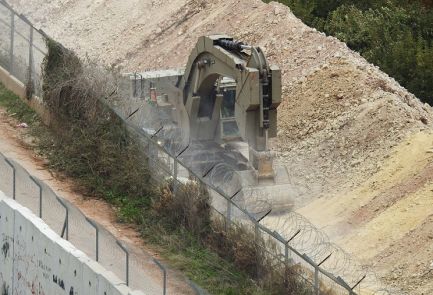
An IDF bulldozer digs near the Israel-Lebanon border
|Photo: Reuters
A fourth Hezbollah terror tunnel breaching Israeli territory from Lebanon has been exposed, the IDF said Sunday.
”Imagine terrorists digging an attack tunnel like this toward your home, hacking away, inch by inch, underground, in order to kill you and your family. Israelis don’t need to imagine. It’s our job to protect them,” the IDF posted on its English-language Twitter page.
The IDF did not disclose the tunnel’s location, saying only that it has lined it with explosives.
The IDF said any Lebanese soldiers or Hezbollah operatives approaching the tunnel on the Lebanese side of the border would do so at their own peril.
Israel has called on the international community to impose new sanctions on Hezbollah, Iran’s regional proxy, in the wake of the tunnels’ discovery.
The IDF said Operation Northern Shield would continue until all Hezbollah tunnels are exposed and neutralized.
The Shiite terrorist group has yet to issue any comment on the operation, but Lebanese President Michel Aoun said that as long as the Israeli operation does not infringe on his country’s sovereignty, it is unlikely to threaten the calm on the border.
”We take this issue – the presence of tunnels at the border – seriously and Israel informed us via the United States that its intentions are not aggressive,” said Aoun, a Hezbollah ally. He added that Israel has pledged to “continue to work” on its territory.
Lebanon too is girding up to counter the US-Israeli UNSC motion condemning Hizballah’s tunnels which is due to be aired on Wednesday, Dec. 19.
The fourth tunnel was unearthed on Sunday. Israel will present evidence of the tunnels violating its sovereignty and providing a gateway for Hizballah to conduct cross-border raids for terror. The US plans to use this evidence for a motion to declare Hizballah a terrorist organization.
However, as a precondition for gaining the votes of all 15 members, the Israeli account must be backed up by UNIFIL’s confirmation. There lies the first rub. It is highly doubtful that the international force’s commander Gen. Stafano De Col, of Italy will provide this confirmation.
The Lebanese government’s strategy designed by President Michel Aoun was outlined in detail by the London-based Arab paper Al-Hayat on Saturday.
These are the high points:
Hizballah tunnel issue goes into diplomatic fog. Hamas relocates terror to West Bank front
None of the tunnels Hizballah is accused of digging for the purpose of terrorism have exits on the Israeli side of the border.
Israeli claims they were excavated as of 2013. Lebanon has proofs that some date back to 2006 and are decrepit and in disuse.
One or two may have reached under the “Blue Line” (which the UN marked out on the border in 2000), but the Lebanese delegation will insist that this is not a significant violation of UNSC Resolution 1701, which terminated the 2006 Israeli-Hizballah war. In contrast, they will point to Israel as committing far more substantial infringements– both in the course of its Operation Northern Shield and beforehand.
UNIFIL has no proof of where the tunnels start (because it has no mandate to enter private homes on the Lebanese side of the border.)
Lebanese sources admit quite openly that President Michel Aoun’s presentation of the Lebanese case to the Security Council is designed to consolidate his cooperation with Hizballah as the dominant force in Beirut for establishing a stable government. A transitional administration is currently in office. Therefore, if the Israeli government had hoped its tunnel operation would loosen the ties the president and Lebanese army maintain with Hizballah, Aoun has turned the tables by using it as a tool for further cementing the partnership.
This is not the only obstacle standing in the way of a UNSC resolution in Israel’s favor. US Security of State Mike Pompeo and Prime Minister Binyamin Netanyahu counted on UNIFIL playing ball with Israel’s tunnel operation – or else, it was suggested, the US would chop its funding. But UNIFIL will have to be counted out.
Excepting Greece alone, which has strong military and economic ties with Israel, all the other governments contributing personnel to UNIFIL are against the Middle East policies the US and Israel pursue and do not share their view of Hizballah as a bad player. Indeed, Italy, France, Germany, Ireland, Austria, Holland and Spain interpret the Israeli tunnel operation as part and parcel of the joint US-Israeli drive against Iran and the US sanctions regime, to which they are opposed.
Italy’s deputy prime minister Matteo Salvini,when he visited Israel, was briefly willing to declare Hizballah “Islamicterrorists” after Israel asked him to use his influence with Gen. Del Col to try and bring UNIFIL in line. But then, the Italian defense ministry issued a statement formally and strongly disavowing Salvini’s declaration, accusing him of placing the Italian troops posted on the Lebanese-Israeli border in harm’sway.
In these circumstances, it is hard to see the proposed US condemnation of Hizballah gaining Security Council approval without running into a veto. At best, the Council will urge both parties to refrain from military escalation on their common border, thereby opening the door for Israel to be directed to discontinue its Operation Northern Shield. It will then be up to the US to apply its veto to kill that motion.
While Israel’s major tunnel operation seemed to be heading for a diplomatic stalemate, the Israeli government and military were caught unawares last week by the Palestinian Hamas initiative to counter-balance its slowdown of violence in the Gaza Strip by inflaming a second terror front in Judea and Samaria, It claimed the lives of two soldiers and a four-day old infant as well as a number of critically injured casualties.
Hamas cells, including some of the perpetrators, are still at large looking for more Israeli victims – even in the face of a heavily reinforced Israeli military presence. This time round the terrorists are plentifully provided with sidearms and vehicles.
And so, while the prime minister and IDF Chief of Staff Lt. Gen. Gady Eisenkot were immersed in the tunnel operation on the northern border and counted on Qatar’s multimillion-dollar gift to the Gaza Strip for pacifying the southern front, the same Hamas switched its attention to the West Bank and opened up a third front.
Maj-Gen. (res.) Gady Shamni, former head of the IDF’s Central Comment, said the spiraling crises had grown out of the “kid gloves” policy with which the IDF and government had greeted months of heightened Hamas aggression from the Gaza Strip.
Syria will adopt a new rule of engagement with Israel now that Russia has taken a tougher and clearer stance on the conflict between Israel and the “Axis of the Resistance”. Henceforth, Damascus will be responding to any Israeli strike. If it damages a specific military target it will reply with a strike against a similar objective in Israel. Decision makers in Damascus said “Syria will not hesitate to hit an Israeli airport if Damascus airport is targeted and hit by Israel. This will be with the consent of the Russian military based in the Levant”.
This Syrian political decision is based on a clear position taken by Russia in Syria following the downing of its aircraft on September 18 this year. In 2015 when the Russian military landed in Syria, it informed the parties concerned (i.e. Syria, Iran and Israel) that it had no intention to interfere in the conflict between them and Hezbollah and that it would not stand in the way of Tel Aviv’s planes bombing Hezbollah military convoys on their way to Lebanon or Iranian military warehouses not allocated to the war in Syria. This was a commitment to remain an onlooker if Israel hit Iranian military objectives or Hezbollah convoys transporting arms to Hezbollah from Syria to Lebanon, within Syrian territory. It also informed Israel that it would not accept any attacks on its allies (Syria, Iran, Hezbollah, and their allies) engaged in fighting ISIS, al-Qaeda and its allies.
Israel respected the will of Moscow until the beginning of 2018, when it started to attack Iranian bases and Syrian military warehouses, though it never attacked a Hezbollah military position. Israel justified its attack against the Iranian base, a military facility called T4, by claiming it had sent drones over Israel. Tel Aviv considered violation of its neighbours’ sovereignty as its exclusive prerogative. Damascus and Iran have responded with at least one confirmed shooting down of an Israeli F-16. Israel started to attack Syrian warehouses, mainly where Iranian missiles were stored. Iran has replaced every single destroyed warehouse with other more sophisticated precision missiles, capable of hitting any objective in Israel.
However, Russia’s neutrality towards Israel in the Levant turned out to be quite expensive. It has lost more than Iran, especially after the downing of its IL-20, and with it, 15 officers highly trained to use the most advanced communication and espionage systems.
Russia then brought to Syria its long-awaited advanced S-300 missiles and delivered them to the Syrian army while maintaining electronic coordination and radar command. The S-300 poses a danger to Israeli jets only if these violate Syrian airspace. Tel Aviv has kept its planes out of Syria since last September but launched long range missiles against a couple of targets.
For many months, the Russian President Vladimir Putin refused to receive Israeli Prime Minister Benjamin Netanyahu. Only through real harassment by the latter did Putin finally accept to briefly meet with Netanyahu over lunch or around the dinner table during a large Summit or meeting of Heads of State, without however accepting any compromise or reconciliation. Russia has now taken a clear position and has no intention of extending its embrace or pardon to Israel. Russia felt that its generosity (by closing its eyes to Israel’s activities in Syria) was neither recognised nor sufficiently appreciated by Tel Aviv.
This week, Moscow agreed to receive an Israeli military delegation led by Major-General Aharon Haliva, following Israel’s insistence on breaking the ice between the two countries. However, Russia’s position is not expected to change in Syria and no Israeli bombing of Syrian or Iranian targets will be tolerated.
According to these sources, “Russia has informed Israel that there are Russian officers present at every Syrian or Iranian military base and that any strike against Syrian or Iranian objectives would hit Russian forces as well. Putin will not allow his soldiers and officers to be struck down by Israel’s direct or indirect bombing”.
Moreover, Russia has given Syria the green light – said the source- to strike Israel at any time if and when Tel Aviv’s planes launch raids against Syrian military targets or launch long-range missiles without flying over Syria (for fear of the S-300 and to avoid seeing its jets downed over Syria or Lebanon).
The source confirmed that Syria – contrary to what Israel claims – now has the most accurate missiles, which can hit any target inside Israel. The Syrian armed forces have received unrevealed long and medium-range missiles from Iran. These operate on the GLONASS system – the abbreviation for Globalnaya Navigazionnaya Sputnikovaya Sistema, the Russian version of the GPS. Thus, the delivery of Iran and the manufacture of missiles inside Syria (and Lebanon) is now complete. Israel, however, claims it has destroyed Syria’s missile capability, including that of the missiles delivered by Iran. According to the source, Damascus controls a very large number of precision missiles, notwithstanding those destroyed by Israel. “In Iran, the cheapest and most accessible items are the Sabzi and the missiles”, said the source.
The new Syrian rule of engagement – according to the source – is now as follows: an airport will be hit if Israel hits an airport, and any attack on a barracks or command and control centre will result in an attack on similar target in Israel. It appears that the decision has been taken at the highest level and a clear “bank of objectives” has now been set in place.
The rules of engagement are changing and situation in the Levant theatre is becoming more dangerous; regional and international confrontations are still possible. The Middle East will not be quiet unless the Syrian war ends—a war in which the two superpowers, Europe, Israel, Jordan, Saudi Arabia and Qatar, have played essential roles. The final chapters have not yet been written.






 anneinpt
 artaxes
 danmillerinpanama
 davidking1530
 Peter Hofman
 Joseph Wouk
 Peter
Peter Louisiana Steve

Recent Comments