Georgia’s newly sworn-in President Salome Zurabishvili says country to discuss possible relocation of Israel embassy • Move follows request from Deputy Foreign Ministry Tzipi Hotovely, who met Zurabishvili and Georgia’s PM and foreign minister on Sunday.
Ariel Kahana
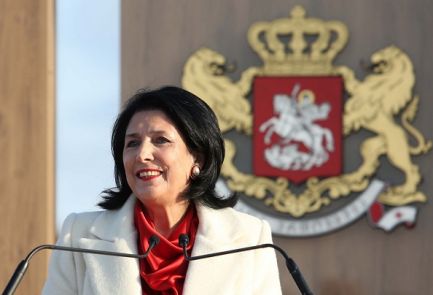
Georgia’s new President Salome Zurabishvili attends her inauguration ceremony in Telavi, Sunday
|Photo: AFP
Georgia is contemplating relocating its embassy in Israel to Jerusalem.
In a meeting with Deputy Foreign Minister Tzipi Hotovely in the country, Sunday, Georgian President Salome Zurabishvili announced she would begin bilateral talks with Israel over the possible transfer of the country’s Israel embassy to Jerusalem.
Hotovely, one of the Israeli officials to attend Zurabishvili’s swearing-in ceremony as prime minister, noted the “deep and long friendship” between the two countries before saying Jerusalem wanted to see Georgia move its embassy to Israel’s capital of Jerusalem.
The two agreed Georgia’s new government would begin to discuss the subject when Georgia’s prime-minister elect takes office in another six months.
Hotovely also met with Georgia’s Prime Minister Mamuka Bakhtadze and Foreign Minister David Zalkaliani at the event.
Australia’s announcement over the weekend that it was formally recognizing west Jerusalem as the capital of Israel but would not be moving its embassy to any part of the city for now came as a disappointment to many Israelis.
On Saturday, Australian Prime Minister Scott Morrison said the country would not move its embassy to Jerusalem until there is a peace settlement between Israel and the Palestinians.
Morrison said Australia would recognize east Jerusalem as Palestine’s capital only after a settlement has been reached on a two-state solution.
“We know everything about the occupation army’s operations, including every move its special forces made,” Hamas leader Ismail Haniyeh says, referring to a deadly Nov. 11 clash • Haniyeh lauds Judea and Samaria terror attacks as “response to occupation.”
Daniel Siryoti, Associated Press and Israel Hayom Staff
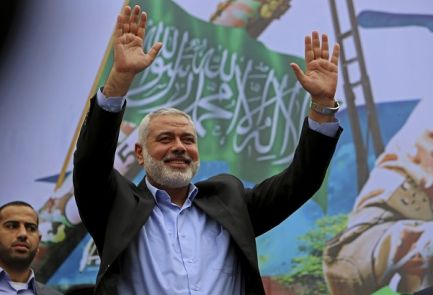
Hamas leader Ismail Haniyeh
|Photo: AP
Some 300,000 Palestinians gathered in Gaza City on Sunday for a rally marking the 31st anniversary of the establishment of Hamas, the terrorist group that rules the Gaza Strip.
Hamas fighters in military fatigues paraded with rockets and heavy machine guns during Sunday’s rally. The group said the large turnout reflects Hamas’ broad support, despite domestic and external challenges.
He called these attacks, in which a number of Israelis were murdered, “a response to the Israeli occupation” and to the anticipated American peace proposal, which Palestinians fear will favor Israel.
Haniyeh also addressed the botched Nov. 11 Israeli operation in southern Gaza, in which an elite IDF officer was killed, saying Hamas has been able to get its hands on “a treasure trove of technological information that sheds light on the Israeli military’s actions in Gaza.”
”We know everything about the occupation army’s operations, including every move its special forces made in Khan Yunis,” he said, referring to the location of the deadly clash.
According to Haniyeh, this information includes the exact time, place and duration of the Israeli forces’ operation in Gaza, as well as information about their tactics and the weapons and technology they used.
The Hamas leader also mocked former Israeli Defense Minister Avigdor Lieberman, who once publicly declared he would eliminate Haniyeh within 48 hours of becoming defense minister. Lieberman served as defense minister for two and a half years before resigning recently in protest of the government’s policy on Hamas.
“The menacing Lieberman, who threatened Gaza and Beirut, has fallen because of the resistance’s determination. Hamas is celebrating 31 years as Lieberman sits at home. Neither he nor [Prime Minister Benjamin] Netanyahu have a home on our land,” Haniyeh said.
He also called on Palestinian Authority President Mahmoud Abbas to meet in Gaza or Cairo to end the longtime internal Palestinian conflict, which erupted when Hamas usurped control of Gaza from Abbas’ Fatah-led government in 2007 in a military coup.
After the State of Israel buried two IDF soldiers and a newborn baby who was murdered before even being granted the right to live, the Israeli military is preparing for more violence.
The question remains, who stands behind the recent escalation? According to a recent report in Yedioth Ahronoth, Hamas, an Iranian proxy, stands behind the recent spike of violence in Judea and Samaria. And according to Palestinian dissident Mudar Zahran, Iran used the Gazan terror groups to lash out at Israel because the Islamic republic needs a diversion from its present predicament due to the increased U.S. sanctions. The question remains, why does Iran seek to target Israel now when Israel just permitted Qatar to transfer $15 million to Hamas?
Iran has suffered immensely from the recent U.S.-imposed sanctions. According to the International Monetary Fund, in the wake of the latest U.S. sanctions, GDP growth in Iran will be -1.5% for 2018. In addition, the IMF projects that the sanctions will cause 40% inflation and a 1.3% increase in unemployment this year. Although eight countries were exempted from Iran’s sanctions on humanitarian grounds, these exemptions are only temporary and would be subject to an immediate reduction of 40% to 50% of Iran’s oil purchase. While all of these statistics are unlikely to hinder Iran from continuing to support both Hamas and Islamic Jihad, Al Arabiya noted that Iran is still hurting, prompting the regime to engage in increasingly repressive measures against their own people and to take further action against Israel.
According to Iranian political theorist Dr. Reza Parchizadeh, “The Iranian regime always exploits Israel’s security weaknesses as a bargaining chip with the U.S. That is why it needs a foothold close to Israel. Whenever the Iranian regime is under pressure from the U.S., it tightens the screws on Israel so the U.S. relents. In the months leading up to the new round of sanctions, Iran was openly threatening Israel with retaliation and annihilation. Abbas Araghchi, the political deputy of the Iranian Foreign Ministry, threatened European countries with terrorism and security problems if they would not try harder to ease the U.S. sanctions. The same thing is with Israel. As soon as the [Iranian] regime is under pressure, it incites Hamas and Islamic Jihad to open fire on Israel. It has probably kept Hezbollah for the next phase of the escalation.”
Mendi Safadi, who heads the Safadi Center for International Diplomacy, Research, Public Relations and Human Rights, added, “After Iran took control of Yemen, Lebanon, Iraq and Syria, it is working to take over Gaza and the Palestinian Authority. It is pouring in a lot of money in order to keep the flames on fire in Gaza and in order to spread it to the PA.” The Gazan terror groups have ample reason to pay attention to instructions given to them by the Iranian regime. According to a Palestinian source, the Iranians are very influential with most of the terror groups in Gaza especially when their paychecks come in.
According to Dr. Mordechai Kedar, a senior lecturer at Bar-Ilan University, “The Iranians paid for the Gaza protests and the arson attacks which they did in our fields, groves and forests. They were behind the kite and balloon terror. They also paid for the Qassam rockets. They sponsored the development of rockets that could surpass the capabilities of Iron Dome.” A press release put out by the Meir Amit Intelligence and Terror Information Center found that when a Gazan anti-tank Kornet missile hit a bus with soldiers inside of it, severely injuring one, the technology was provided by Iran. Yedioth Ahronoth has reported that Iran transfers $100 million per year to Hamas and Islamic Jihad. Both terror groups use the Iranian money to prepare for war against Israel instead of helping their own civilian populations.
According to a Palestinian source, Hamas ultimately agreed to a cease-fire only because it was threatened by Egypt: “It wouldn’t be the Israelis who would wipe Gaza out.” Given this, Hamas is not entirely committed to the cease-fire. Therefore, according to Safadi, even after Hamas agreed to a cease-fire in Gaza, it continues to incite young people and to seek an escalation of violence in Judea and Samaria so that it can justify the funds that it receives from its Iranian masters. Iran wants Israel to suffer particularly to avenge for the suffering that the U.S. has inflicted on the Iranian regime: “Hamas is not acting on its own but is directed by external elements that dictate the agenda.”
By escalating the violence in Judea and Samaria, Iran seeks to sabotage any potential U.S. peace plan before it has a chance to get off the ground. Therefore, Zahran claims that the recent violence that Israel has experienced has everything to do with changes that are happening in the region and the motivation behind it is to provoke Israel into declaring a total war – a trap that, so far, Israel has not fallen for. Given this, Israel can expect more violence in the immediate future.
Rachel Avraham is the president of the Dona Gracia Mendes Nasi Center for Human Rights and a political analyst at the Safadi Center for International Diplomacy, Research and Public Relations.
Consult a map of the Middle East. Locate the Strait of Hormuz, a narrow sea passage separating the Arabian Peninsula from Iran, and connecting the Gulf – whether you call it the Persian Gulf or the Arabian Gulf is a thorny question – to the open oceans beyond.
The Strait of Hormuz is among the world’s most strategic waterways, essential to the health of the global economy. More than a third of seaborne oil shipments and 20 percent of the oil traded internationally pass through it.
The U.S. Navy – specifically the Bahrain-based Fifth Fleet – keeps this sea lane open, frustrating Iran’s rulers who claim it as their private lap pool. They menace American vessels there – though less frequently since Donald Trump replaced Barack Obama in the White House.
Look at the map again. Locate Bab el-Mandeb, another strategic strait. It separates Yemen and the Arabian Peninsula from Africa and guards the entrance to the Red Sea at the northern end of which is the Suez Canal, also a vital chokepoint. Iran’s rulers covet Bab el-Mandeb as well.
Their maritime goals support their hegemonic ambitions. The last thing American leaders should do is help them. Yet a bipartisan majority of senators is working on a resolution that would do exactly that by withdrawing U.S. military assistance to the Saudi-led coalition fighting Iranian-backed Houthi rebels in Yemen.
How did this come about? On October 2, Jamal Khashoggi, a Saudi dissident who for two years had been contributing opinion columns to The Washington Post, was murdered in the Saudi consulate in Istanbul.
The Saudi government has charged 11 individuals in connection with the killing. The Trump administration has sanctioned 17 persons thought to be implicated.
Many members of Congress regard that as woefully insufficient. They believe, as does the CIA, that Crown Prince Mohammed bin Salman, Saudi Arabia’s de facto ruler, ordered the hit – or at least that the buck stops on his desk, or throne or yacht or wherever.
Fair enough but let me state what ought to be obvious: To punish Saudi royals by rewarding Iranian ayatollahs makes no sense.
It is not in the U.S. national interest for the Houthis to prevail in Yemen, thereby allowing Iran’s rulers to expand their empire, threaten Saudi Arabia’s southern underbelly (from which the Houthis already fire missiles at Riyadh), and station forces adjacent to Bab el-Mandeb.
Consider what’s happened in this region over the last few years: Lebanon, for all intents and purposes, is ruled by Hezbollah, Tehran’s proxy. Iranian military forces and mercenary militias have propped up Syrian dictator Bashar Assad. Iranian influence in Baghdad has increased since Obama withdrew American troops in 2011. The clerical regime works closely with Hamas and Palestinian Islamic Jihad in Gaza.
Anyone with a lick of sense understands why preventing the Islamic State group from establishing a Middle Eastern caliphate is in the American national interest. How many licks does it take to grasp that it’s no less imperative to prevent the Islamic republic from achieving the same objective (though the preferable Shia term would be imamate)?
The royal families who rule the United Arab Emirates and Bahrain harbor no illusions about the threat Tehran poses to them. That has been made abundantly clear in conversations I’ve had over recent days with senior officials in both countries, including top officers in the UAE military whose troops are fighting in Yemen.
Commanders with the U.S. Fifth Fleet also made plain why it’s essential to contain – if not roll back – the imperialist and avowedly jihadist Islamic Republic of Iran.
The conflict in Yemen has been devastating for the civilian population. A negotiated solution would be welcome. But the Houthis chant, “Death to America, death to Israel, a curse upon the Jews, victory to Islam,” and according to an Associated Press investigation practice “extreme torture” – including hanging victims “from chains by their wrists or genitals for weeks at a time.”
We may safely conclude that these are not exactly let’s-make-a-deal kind of guys. Can anyone seriously believe that they will be more amenable to compromise if the military pressure on them is eased?
House members, before deciding whether to support whatever resolution the Senate passes, would be well-advised to spend a few minutes studying a map of the Middle East and thinking about what it will mean if the region falls under the boot heel of an oil-rich, jihadist theocracy that intends to become nuclear-armed. (Obama’s deal with Tehran was meant only to delay, not prevent that eventuality.)
There are other ways to punish the Saudis. Or perhaps a better idea: Use this crisis instead to press the Saudis for serious reforms.
Final point: Despots kill dissidents. Always have. Always will.
More than 10 critics of Russian President Vladimir Putin have died in suspicious circumstances. There has been a string of recent Iranian terrorist plots in Europe. And let’s not forget the foiled 2011 Iranian plot to assassinate the Saudi ambassador in a Georgetown restaurant. Meanwhile, both Iran’s rulers and Putin share culpability with Assad for the slaughter of half a million men, women and children in Syria.
In these and many other instances, the so-called international community responded fecklessly. It would not be surprising if the 33-year-old crown prince – who though wealthy and powerful is by no means worldly – had expected the killing of Khashoggi to be treated with similar indifference.
Clifford D. May is president of the Foundation for Defense of Democracies and a columnist for The Washington Times.
Moscow demands that the Lebanese army destroy terror tunnels in its territory regardless of Hezbollah’s culpability in their construction • U.N. Security Council is set to discuss Hezbollah’s terror tunnels during its next session, set for Wednesday.
Israel Hayom Staff
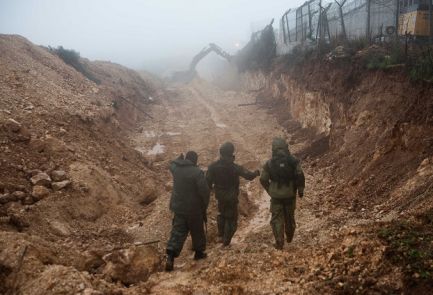
IDF troops near the Israel-Lebanon border during Operation Northern Shield
|Photo: IDF Spokesperson’s Unit
Russia has demanded that Lebanon take action against the network of Hezbollah terror tunnels revealed by Israel under the two countries’ shared border, the London-based Asharq Al-Awsat newspaper reported Monday.
According to the report, Moscow has made it clear to Beirut that the tunnels violate U.N. Security Council Resolution 1701, adopted to end the 2006 war between Lebanon and Israel, and the Kremlin has further demanded that the Lebanese army deal with the tunnels on its territory.
Israel’s counter-tunnel operation, launched on Dec. 4, has so far been very careful not to infringe on Lebanese sovereignty while exposing the tunnels. The reported Russian demand followed a visit to Moscow last week by an Israeli military delegation.
Russian sources told the British publication that the demand was made regardless of Hezbollah’s culpability in digging the underground grid, adding that Russia backs the Israeli operation, known as Operation Northern Shield.
Lebanese President Michel Aoun and Prime Minister Saad Hariri have both downplayed the chances of the Israeli operation leading to any escalation on the border, saying that as long as Israel does not violate Lebanese sovereignty, there would be no reason for fresh hostilities in the sector.
Meanwhile, the U.N. Security Council is poised to discuss Hezbollah’s terror tunnels during its next session, set for Wednesday.
The Israeli Air Force made several passes over the Lebanese-Syrian border on Sunday, Dec. 16, for the first time since the crisis with Moscow erupted in September, DEBKAfile’s military sources report. The flights passed over northern and central Lebanon, although in the past Israeli jets stayed close to the south.
The Russians are conducting an air and sea exercise opposite Syria’s west coast, for which the eastern Mediterranean was placed of-limits. Although the Israeli aircraft stayed clear of this closed area, the distances were small enough to indicate that the IDF must have cleared the flight paths with HQ at the Russian Air Base at Khmeimim near Latakia, which is managing the exercise.
This means that Israel-Russian air force liaison, suspended after the downing of a Russian IL-20, may be up and running again. Just five days ago, a senior Israeli military delegation, led by Maj. Gen. Avraham Haliva, head of the IDF Operations Directorate, spent 24 hours in Moscow in talks with high-ranking Russian officers at the defense ministry and general command.
The Russians said in a short statement that the IDF delegation had briefed them on Israeli’s operation against Hizballah tunnels and discussed coordination with the Russian command in Syria. No statement came from Israel on the visit. However, the renewed Israeli flights over Lebanon indicates that some measure of understanding was reached.
The IAF’s freedom to fly over all parts of Lebanon is now an active component of the IDF’s capacity to deal with Hizballah in the event of a flare-up of hostilities in the course of Operation Northern Shield against its cross-border tunnels. With the prospects fast diminishing of UNIFIL or the Lebanese army undertaking to blow up or seal the tunnels at the Lebanese end, one of the IDF’s options may be to bomb them from the air.
Syria and Hizballah are acting to spike this option with propaganda. Syrian sources have reported that Moscow warned Israel, including the visiting generals, that Russian officers have been stationed at Syrian missile batteries and air bases and if they should come to harm, the Russians would hit back. Another tale asserts that Russian flags have been hoisted over Hizballah bases in Syria.
Mohammad Javad Zarif says US sanctions will have no impact on his country’s policies.
Elad Benari, 16/12/18 03:24
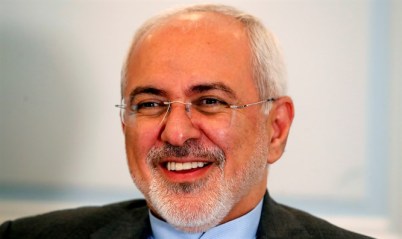
Mohammad Javad Zarif
Reuters
Iranian Foreign Minister Mohammad Javad Zarif said on Saturday that US sanctions will have no impact on the policies of the Islamic Republic at home or abroad, AFP reports.
“It is obvious that we are facing pressure by the US sanctions. But will that lead to a change in policy? I can assure you it won’t,” Zarif was quoted as having told the Doha Forum policy conference in Qatar.
“If there is an art we have perfected in Iran and can teach to others for a price, it is the art of evading sanctions,” he added.
US President Donald Trump withdrew in May from the 2015 nuclear deal between Iran and world powers, which he has said is “the worst deal ever negotiated”.
The US has since imposed two rounds of sanctions on Iran, the latest of which went into effect in early November. Those sanctions aim to reduce Iran’s oil exports to zero in a bid to curb the Islamic Republic’s missile program and regional influence.
Iranian officials have remained defiant in the wake of the American sanctions, with President Hassan Rouhani having said recently that the US “will be defeated” as it has chosen the wrong path in reimposing sanctions on his country.
In Saturday’s comments, Zarif also discussed the Yemen conflict, denying Tehran had ever armed the Houthi rebels battling pro-government forces in the country.
“We have never provided weapons to Houthis,” he said when challenged on what arms it had supplied.
“They have enough weapons, they don’t need weapons from Iran,” Zarif added.
He said there were only “allegations” that Iran had sent weapons to Yemen, whereas there were “facts” that other countries had shipped arms.
“I don’t need to show any evidence about the jets that were flying in Yemen bombing the Yemenis. Those are American-made jets and those are Saudi fighters, I assume, which are piloting those jets,” he claimed, according to AFP.
“If there are allegations about Iranian weapons, there are facts about US weapons, facts about Saudis bombing the hell out of the Yemenis,” he added.
The pro-Assad axis saw great strategic success in 2018 – but Tehran has also suffered failures ■ The state of the Israeli army’s ground forces is a divisive issue Netanyahu will have to address
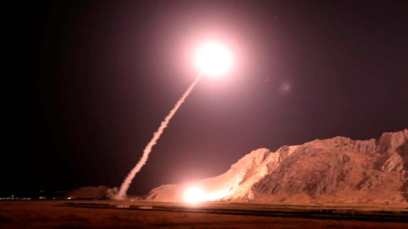
Iranian missile is fired from city of Kermanshah in western Iran targeting the Islamic State group in Syria,AP
Operation Northern Shield, to locate Hezbollah’s tunnels under the Lebanese border, is entering its second week. So far the Israel Defense Forces has reported the discovery of three tunnels, and the excavations are continuing at several other sites along the border. This engineering effort is expected to take more than a month, and even then the army will probably have to make changes regarding preparedness at the border fence.
Benjamin Netanyahu, in his dual role as prime minister and defense minister (among his other ministries), arrived this week for a second visit to the area, where he threatened Hezbollah. (Like when he said in September that if Hezbollah leader Hassan Nasrallah “confronts us, he’ll get a crushing blow that he can’t even imagine.”)
But it was clear that the tour was also for domestic consumption. The prime minister is preparing for Israel’s next general election due within a year, and his frequent meetings with officers and soldiers provide an ideal setting for his journey to the ballot box.
In an article last week on the website Israel Defense, Col. (res.) Pesach Malovany, a former senior official in Military Intelligence, mentions a propaganda film released by Hezbollah in 2014. The organization promised “to free Bi’ina, Deir al-Asad and Majdal Krum,” three Arab villages in the Galilee, and presented an attack plan based on no fewer than 5,000 fighters.
According to the film, the units would progress in four spearheads, from Nahariya in the west to Misgav Am in the east, with a fifth force in reserve. Cover would be provided by a heavy barrage of rockets launched by Hezbollah at the Galilee.
Israeli officials at the time dismissed this as mere psychological warfare. Even now it’s hard to imagine how Hezbollah would be able to transfer so many troops, sometimes underground in relatively narrow and short tunnels, without being discovered. Interestingly, the size of the forces that was mentioned is quite similar to the estimated number of fighters in Hezbollah’s Radwan special forces unit. When you add the tunnels that were recently revealed, it’s easier to understand how Hezbollah is thinking about the next battle.
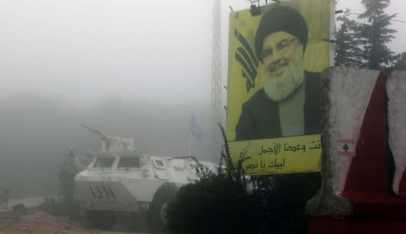
A United Nations Interim Forces in Lebanon (UNIFIL) vehicle patrolling in southern Lebanon on the border with Israel is parked next to a poster showing Hassan Nasrallah, on December 9, 2018. Ali DIA / AF
Hezbollah’s steps are part of a change in Iran’s plans. In recent months Iran’s military intervention in Syria, including the weapons smuggled to Hezbollah in Lebanon, has ebbed due to Russian pressure.
At the same time, Moscow has pressured Israel to go easy on its air strikes in Syria since the Syrians’ accidental downing of a Russian reconnaissance plane in September. This week the Russians finally agreed to receive a military delegation from Israel, headed by the chief of the General Staff Operations Directorate, Maj. Gen. Aharon Haliva, but the IDF is reluctant to state that this signals an end to the crisis.
Amid the difficulties of operating in Syria, Iran is increasing its efforts in the two neighboring countries. In western Iraq it’s deploying long-range missiles that are capable of striking Israel as well. In Lebanon it’s trying to build factories that will let it improve the precision of Hezbollah’s older rockets. These efforts are accompanied by a dispute regarding the Iranian regime’s priorities for investment, in light of increased sanctions by the United States and a protest by everyday Iranians due to the deteriorating economy.
Since the discovery of the tunnels, the General Staff has made sure to clarify that despite the media’s preoccupation with the precision-missile project, Hezbollah apparently has only a few dozen high-precision rockets capable of striking less than 50 meters (160 feet) or so from their target.
The Iranians have yet to achieve the “industrial” capability of a swift conversion to precision missiles in Lebanon. The smuggling of weapons on flights from Iran to Beirut is also being done on a small scale, far smaller than what was tried in the weapons convoys on Syrian soil.
In the north, 2018 saw a major strategic success of the axis that supported the Assad regime in Syria – a renewed takeover of most of Syrian territory and a restabilization of the government. But the Iranians also suffered failures; one is a slowdown of their efforts to entrench themselves militarily in Syria, because of Israel’s strikes in April and May. The other is the exposure of Hezbollah’s tunnel plan.
That doesn’t mean that Qassem Soleimani, the head of the Revolutionary Guards’ Quds force, will lay down his arms in 2019. Israel must assume that Iran will try to attack it on other fronts. At the moment, it seems this will happen in Lebanon, with the precision-missile factories the main issue.
If in the future Tehran believes that it has a reason to attack Israel, perhaps due to American efforts to combat Iran’s nuclear programs and missiles, it’s hard to believe it will leave Hezbollah out, as it did in the confrontation with Israel in Syria this year.
In light of the billions that the Iranians have invested in Lebanon, the day will come when they demand that Nasrallah provide a better return for their money. A senior defense official, in a meeting with his European counterparts, recently said that it will be hard to maintain the quiet in Lebanon for another year.
“We’ll try to neutralize the tunnels and remove them from the equation, but the precision-missile project remains a problem for us,” he reportedly said. “Iran is trying to build a missile system in Iraq and Syria, in addition to the rockets it has already provided to Hezbollah in Lebanon and to Palestinian organizations in Gaza. For us it’s too much; the Iranians have to leave Syria entirely. It’s not enough to keep them 60 or 80 kilometers [50 miles] from the Israeli border.”
Unprecedented challenge
The Israeli rhetoric against Iran in the past decade has focused on the nuclear program. But the 2015 nuclear agreement and the lifting of the sanctions against Iran that ensued (some of which were recently renewed when Washington abandoned the agreement) have clarified the progress of Iran’s other efforts: to develop long-range missiles and increase its influence in the region.
The conventional military threat against Israel has waned with the collapse of the Syrian army and Israel’s closer ties with Egypt. On the other hand, the combined, hybrid threat that Iran is developing from many directions and with many means is a challenge Israel hasn’t faced in the past.
Heavy rocket barrages against civilians and strategic infrastructure, an attempt at a land grab on the border, cyberwarfare and electronic warfare, an option of opening a secondary front in Gaza, the big question of how Russia will behave – all these elements appear in the scenarios that the General Staff has practiced in recent years.
Are the ground forces, which are still partly based on a large contribution by reservists, ready for more extreme scenarios? That’s one subject of the debate with the Defense Ministry ombudsman, Maj. Gen. (res.) Yitzhak Brik. Brik isn’t being attacked for his ungentlemanly style and sweeping statements, but apparently the public slap in the face by his reports has triggered a positive process of investigations in the IDF and at the Knesset Foreign Affairs and Defense Committee.
When the generals stop feeling offended, the army will discover that it’s not a bad idea to investigate itself occasionally. And the managers of large organizations tend to discover that reality is less glamorous than their high opinion of themselves.
In the army, opinions about the ground forces are divided. Have the steps by Chief of Staff Gadi Eisenkot to bring the IDF up to par been sufficient? Some people believe it’s lagging by decades. Eisenkot challenged the political leaders in the summer of 2015 when he published documents on IDF strategy; he tried to force the politicians into a deeper discussion on the army and its future.
In fact, from the few statements by Netanyahu on this question in recent months, it’s clear he envisions an army even more dependent on the air force, technology and intelligence. The ground forces, and the reservist system in particular, are liable to remain far behind. The prime minister, in his role as defense minister, will have to find time to discuss these controversies in depth during the first half of the coming year, when Maj. Gen. Aviv Kochavi takes over as chief of staff.
While Israel continues the operation to destroy the underground terror infrastructure on the border with Lebanon, the locals treat the situation as a spectacle, taking selfies with the IDF soldiers in the background.
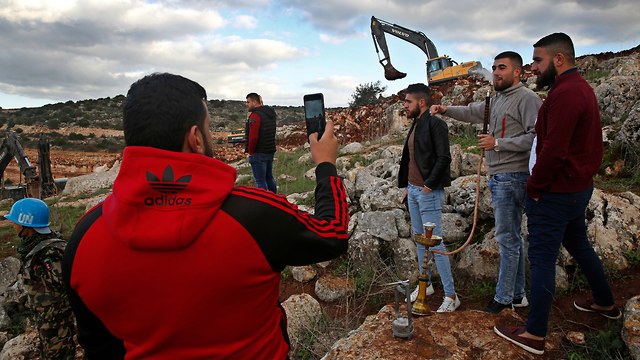
As Israeli military excavators dug into the rocky hills along the frontier with a Lebanese village, a crowd of young Lebanese men gathered to watch.The mood was light as the crowd observed what Israel says is a military operation—dubbed “Northern Shield”—aimed at destroying attack tunnels built by the Lebanese Hezbollah terror group under the border. The young men posed for selfies, with the Israeli crew in the background, as they burned fires and brewed tea to keep warm.
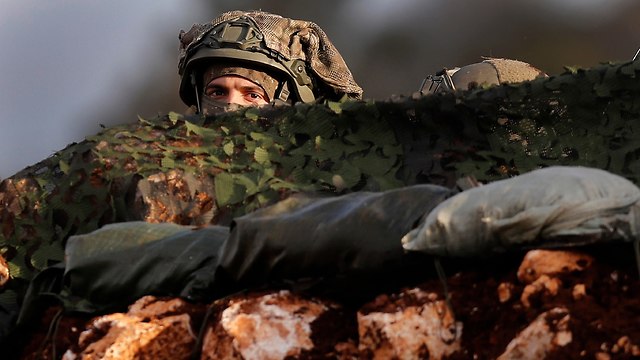
IDF soldiers on Israel-Lebanon border (Photo: AP)
But Lebanese soldiers were visibly on high alert, deploying to new camouflaged posts behind sandbags and inside abandoned homes. About two dozen UN peacekeepers stood in a long line, just ahead of the blue line demarcating the frontier between the two countries technically still at war.The scene highlights the palpable anxiety that any misstep could lead to a conflagration between Israel and Lebanon that no one seems to want.
Underscoring such jitters, shadowy figures appearing across the misty hills of the border village of Mays al-Jabal last weekend sparked panic, and Israeli soldiers fired in the air to warn a Lebanese military intelligence patrol, according to Lebanese reports. Israel said it fired at Hezbollah members who came to the site to dismantle sensors installed to detect tunnels.
Israel’s tunnel search comes at a time when the civil war in neighboring Syria seems to be winding down. The Iranian-backed Hezbollah had sent hundreds of troops to Syria in 2013 to fight alongside the forces of Syrian President Bashar Assad, another friend of Tehran. With Assad’s forces emerging victorious, attention now seems to be returning to the tense Israel-Lebanon border.
Israel said its troops have discovered four tunnels along the frontier—a tactic used by Hezbollah in previous wars—and called on the international community to impose new sanctions on Hezbollah.
UN peacekeepers observe Israeli excavators working near the southern village of Mays al-Jabal (Photo: AP)
The militant group, which fought a bruising but inconclusive war with Israel in 2006, has not commented on the Israeli operation or statements.
Lebanese Prime Minister-designate Saad Hariri said Thursday that neither Israel nor Lebanon wanted to go to war, but said that Israel violates Lebanese airspace and international waters on a regular basis.
He said the Lebanese army “will deal with this issue” after receiving a full report from the UN peacekeeping force, but did not elaborate.
Lebanese villagers take souvenir pictures in front of Israeli excavators in the southern village of Mays al-Jaba (Photo: AP)
The peacekeeping force, known as UNIFIL, has confirmed the presence of tunnels and said it is working with both sides to address the situation in line with UN Security Council resolutions.
In southern Lebanon on Thursday, Lebanese army soldiers observed the frontier in Mays al-Jabal, taking photos of their Israeli counterparts operating only a few meters (yards) away. At times, the Lebanese soldiers asked the young men to move back, away from the frontier.
Lebanese homes and farms are nestled at the bottom of the hill where the operations run from daybreak until sundown. No civilian Israeli homes visible from that tense border.
Ali Jaber, a 21-year-old resident of Mays al-Jabal, said he believes that Hezbollah is more popular after the Syria war, and that this is the reason Israel is now turning to it. “But whoever puts up a shield and is hiding and making fortifications must be scared,” he said.
Hussein Melhem, a 19-year old electrician from the village, came to watch. His cheeks ruddy on a cold but clear day, he covered his head with a tight hood. He alleged that Israel is trying to change the border.
“If they could occupy all of this, they would,” he said, in an apparent reference to Israel’s 18-year military occupation of southern Lebanon which ended in 2000. “But the resistance will prevent them.”
As a seven-year-old in 2006, Melhem and his family left Mays al-Jabal during the war. His village was badly damaged but has since largely recovered and he said he found their home intact.
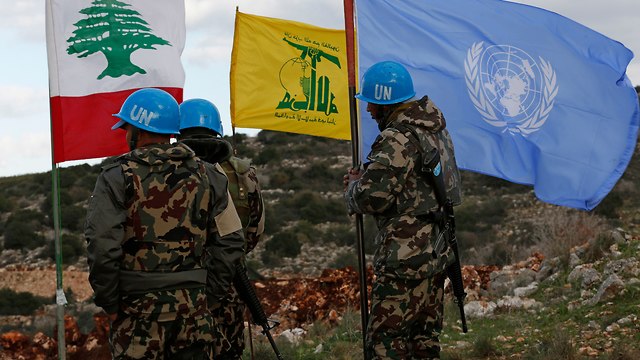
UN peacekeepers hold their flag while standing next to Hezbollah and Lebanese flags along the border (Photo: AP)
It is hard to forget about war in the villages and towns along the frontier. Pictures of Hezbollah fighters who died in the 2006 war, as well as the one raging in neighboring Syria, known locally as the “Sacred Defense,” are everywhere. Posts on town squares boast of defeating Israel or urge the locals to “know their enemy.”
During the Syrian civil war, Israel has frequently carried out airstrikes in Syria against Iranian-allied forces, particularly Hezbollah. Israel says it aims to prevent sophisticated weaponry from reaching Hezbollah, which it considers its most pressing security concern.
In Lebanon, Prime Minister Benjamin Netanyahu’s warnings have raised suspicions that he is also using the tunnel operation as a diplomatic pressure card.
Netanyahu has called for more sanctions against Hezbollah. In a recent visit to the frontier, he warned that if Hezbollah tries to disrupt the search for tunnels, “it will be hit in a way it cannot even imagine.”
In Israel, some newspaper commentators have been critical of the UN peacekeeping force, whose mandate Israel and the United States have unsuccessfully attempted to expand to include “intervention and deterrence.”
About 20 kilometers (12 miles) to the north from Mays al-Jabal, Israeli soldiers are also operating along another frontier to uncover what they suspect is a tunnel location.
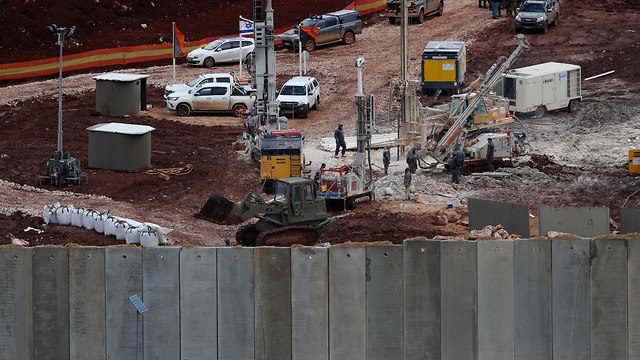
Israeli military equipment works on the Lebanese-Israeli border next to a wall Israel built (Photo: AP)
There, a high concrete wall separates them from the Lebanese village of Kfar Kela. Red-roofed Israeli homes on a hill overlook the diggers, who had cleared peach trees to make room for their work. Lebanese residences, some of them luxury summer homes, sat atop hills hundreds of meters from the wall.
UN peacekeepers and Lebanese army separately patrol the area. Israel began building the wall in 2012, and this section was completed weeks ago. While graffiti covers the older slabs of concrete, water has collected under the newer segment of the wall.
A UN peacekeeping force was working to clear the water after Lebanese residents complained it comes from irrigation drainage from the other side.
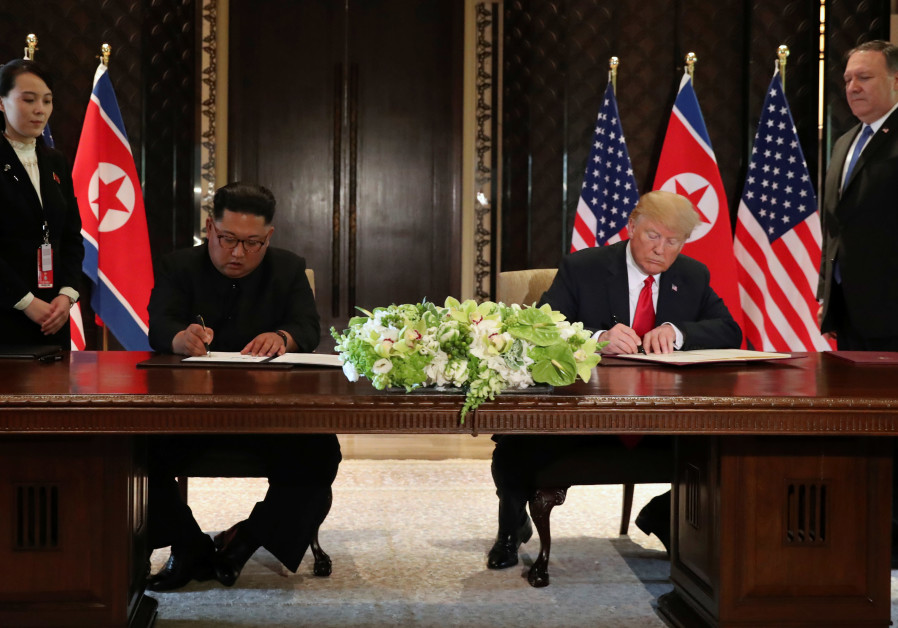
U.S. President Donald Trump and North Korea’s leader Kim Jong Un sign documents that acknowledge the progress of the talks and pledge to keep momentum going, after their summit at the Capella Hotel on Sentosa island in Singapore June 12, 2018.. (photo credit: JONATHAN ERNST / REUTERS)
“Rapid” denuclearization of North Korea is officially dead.
US President Donald Trump announced Friday that he is in “no hurry” in negotiations to get Pyongyang to give up its nuclear program.
A wide range of officials have been saying that US-North Korea nuclear negotiations could have a decisive impact on the nuclear standoff with Iran.
If the US cannot get North Korea to denuclearize, why should Iran agree to new limits to its nuclear program beyond the 2015 nuclear deal?
In many ways, Trump’s shifting position on North Korea, from demanding rapid denuclearization to being in “no hurry,” should be no surprise.
Since Trump’s July summit with North Korean leader Kim Jong-un, Washington’s talks with Pyongyang have stalled, and the North has not taken any serious or systematic concrete steps toward denuclearization, though it did halt missile tests, release the remains of some dead Americans from the Korean War and took some other confidence-building measures.
In early November, North Korea suddenly canceled a scheduled meeting with US Secretary of State Mike Pompeo. US Special Representative for North Korea Stephen Biegun has yet to even meet with North Korean negotiators since his August appointment.
Meanwhile, Pompeo also admitted to the UN Security Council last week that, to date, US sanctions have not succeeded in getting Iran to roll back its nuclear program or ballistic missile testing beyond the 2015 deal’s limits.
In September, Pompeo was still trying to maintain the language of pressing for “rapid” denuclearization, while tossing out 2021 as a decidedly not rapid timeline.
This was after some Trump officials spoke in July of getting full declarations of the North’s nuclear arsenal and of rolling back large portions of its nuclear program within 90 days.
As of Friday, Trump has dispensed with the rhetorical games and admitted that his administration is locked into the same long negotiations game that other administrations have fallen into with North Korea.
Some analysts credit Trump with having a better chance still at resolving the issue by making both the carrots, the heads of state meeting in July, and sticks, a harsher economic pressure campaign than even in the past, stronger than other administrations.
With Iran, even as the Islamic Republic has been hurt economically by the US sanctions snap-back more than expected, its determination to stay within the nuclear deal without any new concessions has been unyielding.
It’s economic support from Asian countries and political support from EU countries appear to be enough to keep it afloat and to give it an opportunity to wait out the Trump administration – at least until 2021.
For Israel, this could mean that while there is more pressure on Iran than during the end of the Obama administration, the nuclear deal may remain solid.
In terms of fears of Iran continuing to improve its ballistic missiles, its advanced centrifuges for enriching uranium and preserving its right to build an industrial-size nuclear program when the nuclear deal expires, it means that Israel may gain no solace from US efforts.






 WarSclerotic
Recent Comments