US Mid-East forces relocate out of Iranian cruise missile range. The IDF begins overhaul – DEBKAfile

Posted October 29, 2019 by Joseph Wouk
Categories: Uncategorized

Source: US Mid-East forces relocate out of Iranian cruise missile range. The IDF begins overhaul – DEBKAfile

The US like Israel has no adequate answer for Iran’s cruise missile and drone warfare. This was the subtext of PM Binyamin Netanyahu’s warning on Monday, Oct. 28, that Tehran is deploying those missiles against Israel in Yemen, as well as Iraq, Syria and Lebanon, at a joint news conference with visiting US Secretary Treasury Steven Mnunchin.

This alarming gap in US and Israeli defenses shot into sight in the Sept. 14, Iranian attack on Saudi oil infrastructure.  It has galvanized the US armed forces into starting to remove sensitive elements out of range, DEBKAfile’s military sources report.

The Saudi operation revealed both Iran’s audacity in going for a major Saudi oil center but also the unexpected accuracy of its weapons, the hitherto unknown ability to strike targets with the precision of 5-10 m, as Netanyahu stressed on Monday.

Iran’s newfound capabilities provided the context for the US Navy’s announcement on Oct. 25 that the USS Abraham Lincoln Carrier Strike Group had been moved out of the Gulf into the Arabian Sea. This move reduced the ability of the F/A-18 fighter-bombers on its decks to barely fly there and back for reaching an Iranian coast target only 800km away. The threat to the mighty US strike group was considered real enough for the US military command to forego keeping all parts of Iran within its sights.
The same rationale has spurred US CENTCOM to start emptying out its air force command posts at the Al-Udeid Air Base in Qatar for relocation at a base in central Saudi Arabia. A direct Iranian hit could cripple US command and intelligence centers in Qatar.

The soothing IDF statement on Monday night that Israel’s counter-missile defense systems were being overhauled for meeting the new menaces was timely. It was also meaningless in as far as providing any assurance that an answer had been found for Iran’s cruise missiles, either by Israel or indeed the United States. After intense cooperation with the US Missile Defense Agency for decades and spending tens of billions of dollars to develop Israel’s four-tier missile defense system, both are suddenly caught short by their vulnerability to Iran’s newest tools of war. Netanyahu’s comments on Monday connected to his earlier disclosure that Israel will have to urgently spend several billion more dollars to meet the new capabilities developed by Tehran.


‘Iran is deploying missiles in Yemen that can strike Israel’

Posted October 28, 2019 by Joseph Wouk
Categories: Uncategorized

Source: ‘Iran is deploying missiles in Yemen that can strike Israel’ – www.israelhayom.com

Prime Minister Benjamin Netanyahu calls on US to stop Iran’s “plunge for everything” in Middle East. US Treasury Secretary Steven Mnuchin promises more sanctions against Tehran.

Iran is deploying precision missiles in Yemen that are capable of hitting Israel, Prime Minister Benjamin Netanyahu said Monday at a press conference with US Treasury Secretary Steven Mnuchin.

According to Netanyahu, Tehran’s ambition is to obtain the capacity to launch a precision strike on any target in the Middle East.

On Monday, Mnuchin pledged to increase economic sanctions against Iran. He says the administration’s “maximum pressure campaign” is halting Iranian aggression.

Mnuchin met Monday in Jerusalem with Netanyahu, who called on Washington to impose additional sanctions to stop what he called Iran’s “plunge for everything” in the Middle East.

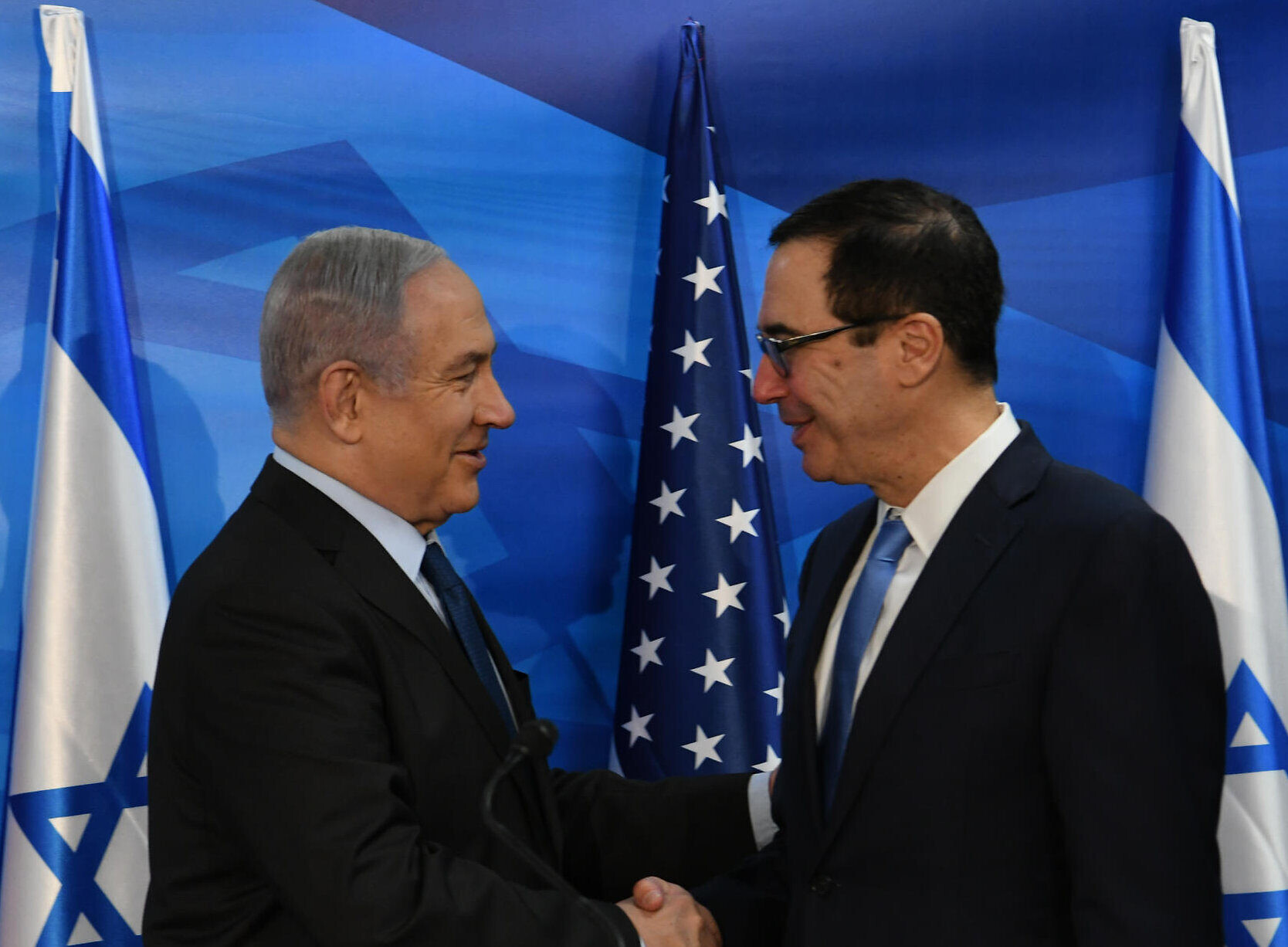
Prime Minister Benjamin Netanyahu gestures while standing next to US Treasury Secretary Steven Mnuchin as they prepare to deliver joint statements during their meeting in Jerusalem, Monday

At a joint press conference, Netanyahu said Iran’s ability to project power in the region “is diminished to the extent that you can tighten your sanctions and make the availability of cash more difficult for them.”

Mnuchin is heading a delegation to the Middle East and India to discuss economic ties and counterterrorism initiatives. He is joined by US President Donald Trump’s senior adviser and son-in-law Jared Kushner, who was to meet with Netanyahu and his key rival, Blue and White party leader Benny Gantz.

Mnuchin says American sanctions aim to force Iran to stop “their bad activities and exporting terrorism, looking to create nuclear capabilities, and missiles.”

Earlier Monday, the International Monetary Fund reported that Iran would need oil priced at $194.6 a barrel to balance its budget next year.

Hurt by tighter US sanctions, Iran – a key member of the Organization of the Petroleum Exporting Countries (OPEC) – is expected to have a fiscal deficit of 4.5% this year and 5.1% next year, the fund said in a report on Monday.

On Friday, international benchmark Brent crude closed trading at just above $62 a barrel.

Iran saw its oil revenues surge after a 2015 nuclear pact agreed with six major powers ended a sanctions regime imposed three years earlier over its disputed nuclear program.

Iran’s economy is expected to shrink by 9.5% this year, compared to a prior estimate of a 6% contraction, the IMF has said, but real gross domestic product (GDP) growth is expected to be flat next year.

Parts of this article were originally published by i24NEWS


Netanyahu: Iran placing missiles in Yemen to attack Israel

Posted October 28, 2019 by Joseph Wouk
Categories: Uncategorized

Source: Netanyahu: Iran placing missiles in Yemen to attack Israel | The Times of Israel

Tehran developing precision-guided munitions ‘that can hit any target in the Middle East,’ PM tells visiting US treasury secretary

Prime Minister Benjamin Netanyahu meets with US Treasury Secretary Steven Mnuchin in Jerusalem, October 28, 2019 (Amos Ben-Gershom/GPO)

Israel will have to up security spending to counter Iran, PM says

Speaking to the Jewish leaders about Israel’s security challenges, which he says come from Iran, Netanyahu says Israel will need to increase the amount of money it spends on arms.

“We have to change our priorities,” he says, noting that the next government will have the difficult task of spearheading efforts to transfer funding from civilian to military purposes.

Standing alongside Netanyahu, US Treasury Secretary Mnuchin pledges to increase economic sanctions against Iran.

He says the administration’s “maximum pressure campaign” is halting Iranian aggression.

Mnuchin is heading a delegation to the Middle East and India to discuss economic ties and counterterrorism initiatives.

He is joined by US President Donald Trump’s senior adviser and son-in-law Jared Kushner.

Mnuchin says American sanctions aim to force Iran to stop “their bad activities and exporting terrorism, looking to create nuclear capabilities, and missiles.”

Off Topic: The tip, the raid, the reveal: The takedown of al-Baghdadi 

Posted October 28, 2019 by Joseph Wouk
Categories: Uncategorized

Source: The tip, the raid, the reveal: The takedown of al-Baghdadi | The Times of Israel

A dramatic 48 hours unfolded from the time US intelligence pinpointed location of wanted Islamic State leader, until Trump triumphantly revealed news of his death

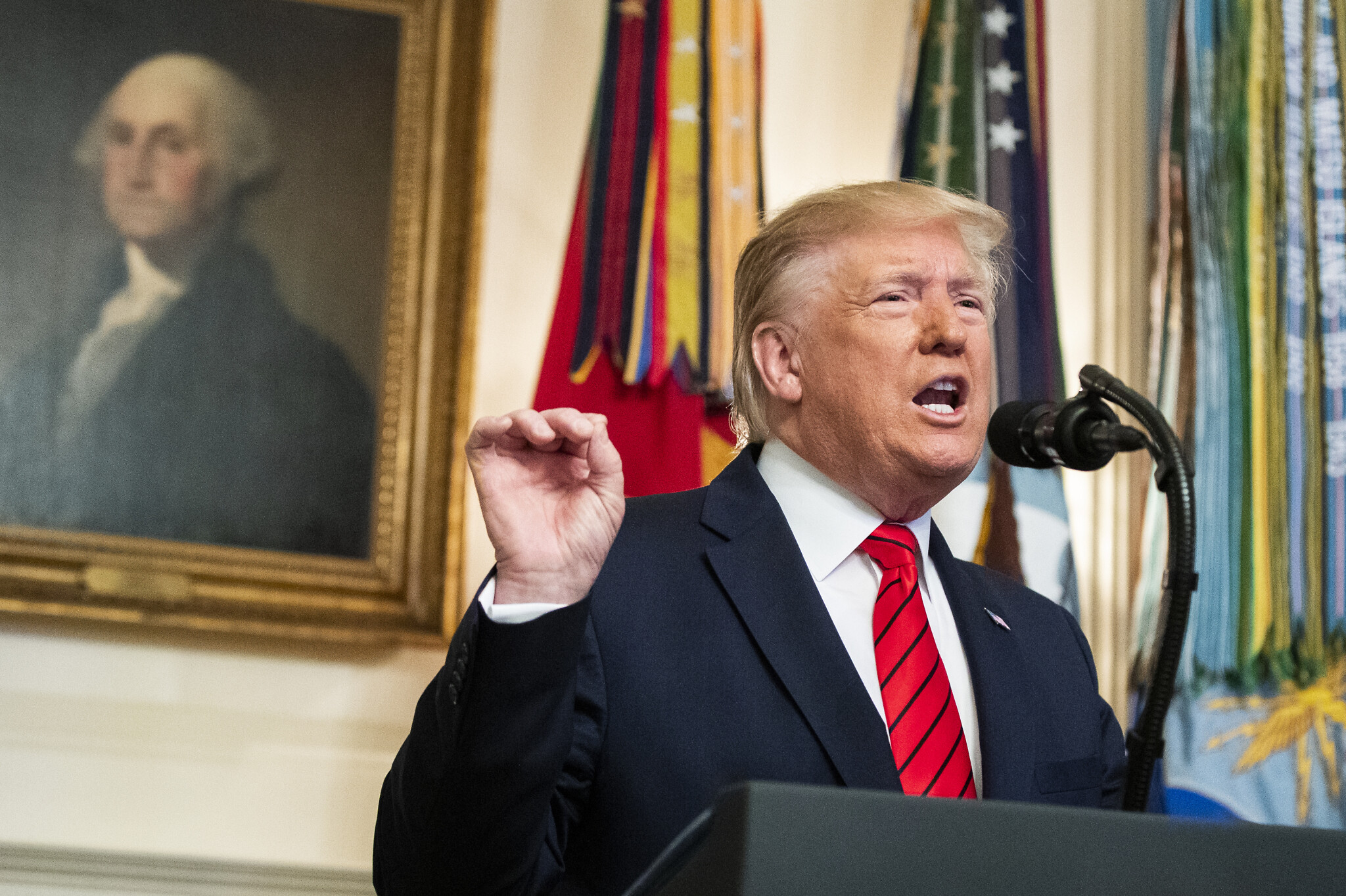
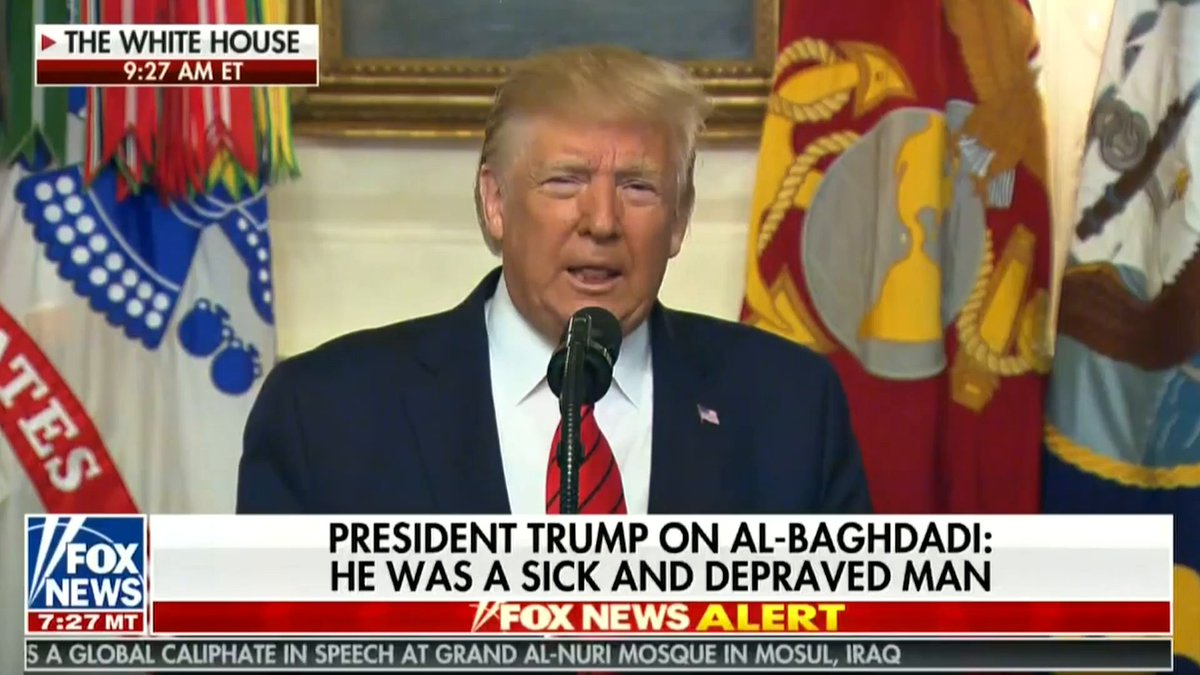
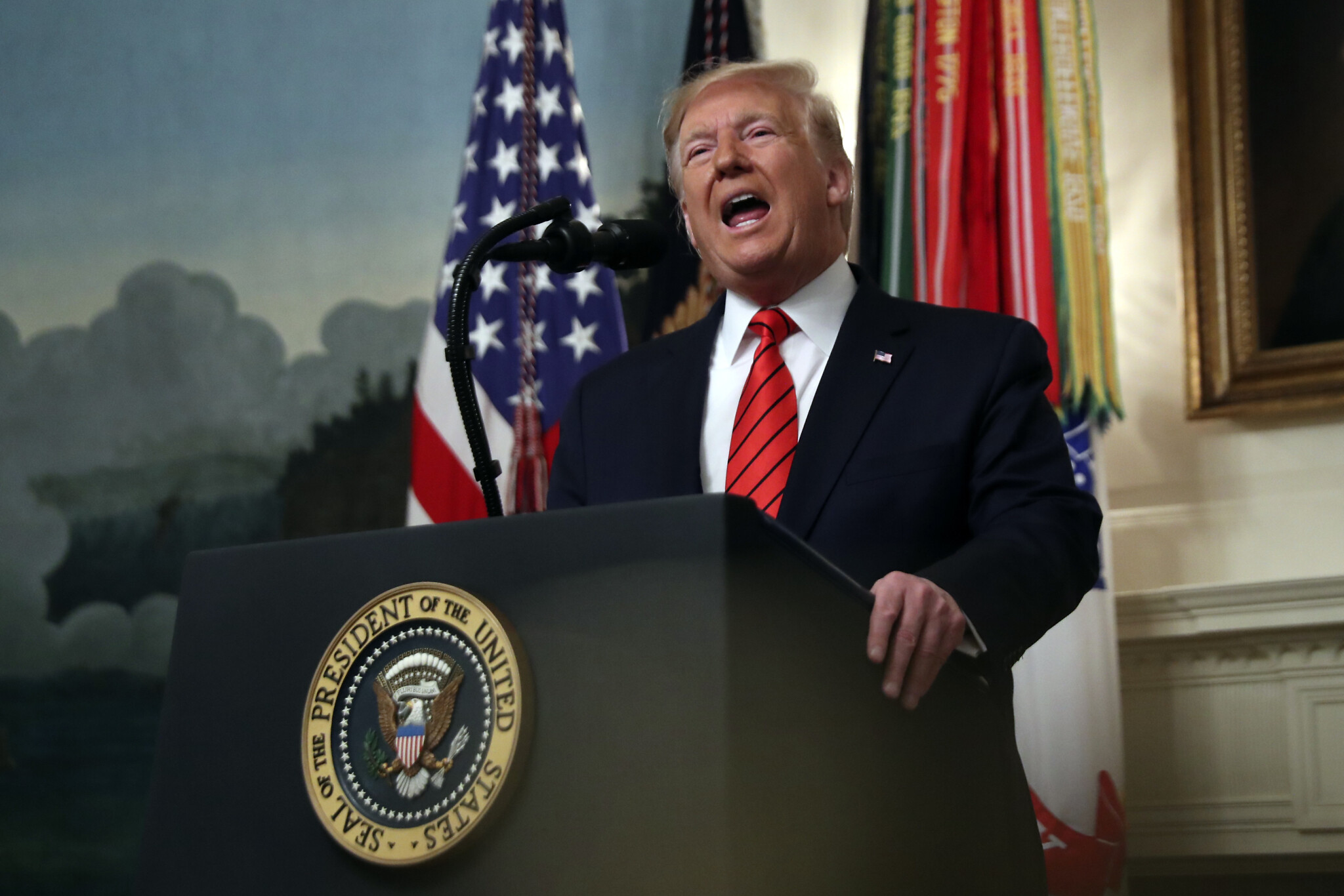
President Donald Trump speaks Sunday, Oct. 27, 2019 in the Diplomatic Room of the White House in Washington, announcing that Abu Bakr al-Baghdadi, the shadowy leader of the Islamic State group who presided over its global jihad and became arguably the world's most wanted man, is dead after being targeted by a US military raid in Syria. (AP Photo/Manuel Balce Ceneta)

President Donald Trump speaks Sunday, Oct. 27, 2019 in the Diplomatic Room of the White House in Washington, announcing that Abu Bakr al-Baghdadi, the shadowy leader of the Islamic State group who presided over its global jihad and became arguably the world’s most wanted man, is dead after being targeted by a US military raid in Syria. (AP Photo/Manuel Balce Ceneta)

WASHINGTON (AP) — The helicopters flew low and fast into the night, ferrying US special forces to a compound where Islamic State leader Abu Bakr al-Baghdadi was hiding in Syria. Half a world away, US President Donald Trump watched the raid in real time via a video link as troops blasted into the hideout and sent the most-wanted terrorist running the last steps of his life.

The daring raid was the culmination of years of steady intelligence-gathering work — and 48 hours of hurry-up planning once Washington got word that al-Baghdadi would be at a compound in northwestern Syria.

The night unfolded with methodical precision and unexpected turns. This reconstruction is based on the first-blush accounts of Trump and other administration officials eager to share the details of how the US snared its top target, as well observations from startled villagers who had no idea al-Baghdadi was in their midst.

A celebration and a two-day scramble

Events developed quickly once the White House learned on Thursday there was “a high probability” that al-Baghdadi would be at an Idlib province compound.

By Friday, Trump had military options on his desk.

By Saturday morning, the administration at last had “actionable intelligence” it could exploit.

There was no hint of that interior drama as Trump headed to Camp David on Friday night to celebrate the 10th wedding anniversary of daughter Ivanka and son-in-law Jared Kushner. Then he was off to Virginia on a brisk fall Saturday for a round at one of his golf courses.

He teed off with Major League Baseball Commissioner Rob Manfred, in town for the World Series, and Sens. Lindsey Graham and David Perdue.

Trump got back to the White House at 4:18 p.m. By 5 p.m., he was in a suit in the Situation Room in the basement of the West Wing to monitor the raid. They named it after Kayla Mueller, an American humanitarian worker abused and killed by al-Baghdadi.

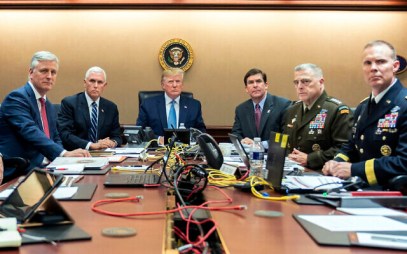
In this photo provided by the White House, US President Donald Trump is joined by from left, national security adviser Robert O’Brien, Vice President Mike Pence, Defense Secretary mark Esper, Joint Chiefs Chairman Gen. Mark Milley and Brig. Gen. Marcus Evans, Deputy Director for Special Operations on the Joint Staff, October 26, 2019, in the Situation Room of the White House in Washington. (Shealah Craighead/The White House via AP)

The rest of Washington had its focus on Game 4 of the World Series about to get underway a few miles away at Nationals Park.

Panic then death

Moments after the White House team had gathered, US aircraft, mostly twin-rotor CH-47 helicopters, took off from Al-Asad air base in western Iraq.

Within hours, al-Baghdadi was dead.

The first inkling that something was afoot came when villagers saw helicopters swooping low on the horizon.

“We went out in the balcony to see and they started shooting, with automatic rifles. So we went inside and hid,” said an unidentified villager. Next came a large explosion — Trump said soldiers blasted a hole in the side of a building because they feared the entrance might have been booby-trapped. Al-Baghdadi fled into a network of underground bunkers and tunnels that snaked through the compound.

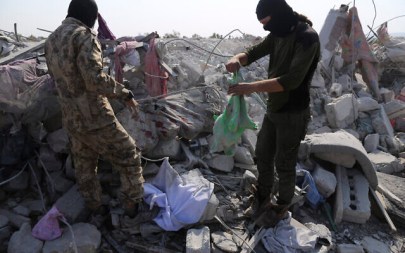
People look at a destroyed houses near the village of Barisha, in Idlib province, Syria, Sunday, Oct. 27, 2019, after an operation by the US military which targeted Abu Bakr al-Baghdadi, the shadowy leader of the Islamic State group. (AP Photo/Ghaith Alsayed)

The stout, bearded militant leader wore a suicide vest and dragged along three children as he fled from the American troops.

Trump, happy to play up the drama, said that as US troops and their dogs closed in, the militant went “whimpering and crying and screaming all the way” to his death.

“He reached the end of the tunnel, as our dogs chased him down,” Trump said. “He ignited his vest, killing himself and the three children.”

It was him

Al-Baghdadi’s body was mutilated in the blast, and the tunnel caved in on him. To get to his corpse, troops had to dig through debris.

“There wasn’t much left,” Trump said, “but there are still substantial pieces that they brought back.”

That’s when the military raid turned into a forensics operation — and the special forces had come prepared.

They had brought along samples of al-Baghdadi’s DNA.

The soldiers who conducted the raid thought the man who fled looked like al-Baghdadi, but that wasn’t enough. Various accounts had heralded his death in the past, only for him to surface yet again.

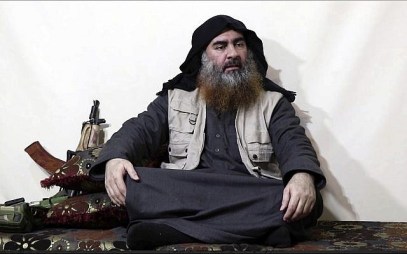
An image made from video posted on a militant website April 29, 2019, purports to show the leader of the Islamic State group, Abu Bakr al-Baghdadi, being interviewed by his group’s Al-Furqan media outlet. (Al-Furqan media via AP, File)

This time there could be no doubt.

Lab technicians conducted an onsite DNA test to make sure and within 15 minutes of his death, positively identified the target.

“It was him,” Trump said.

Al-Baghdadi’s body wasn’t all they retrieved.

Trump said US troops remained in the compound for about two hours after al-Baghdadi’s death and recovered highly sensitive material about the Islamic State group, including information about its future plans.

After the American troops retreated, US fighter jets fired six rockets at the house, leveling it.

The big tease

Trump was so excited he couldn’t contain himself.

He hinted of the successful military operation late Saturday by tweeting obliquely that “something very big has just happened!” White House spokesman Hogan Gidley announced the president would make a “major statement” Sunday morning.

That sent reporters in Washington and the Middle East scrambling, and news organizations soon confirmed that US forces believed they had killed America’s most-wanted man.

It was a measure of the strained atmosphere in Washington that two top Democrats — House Speaker Nancy Pelosi and Rep. Adam Schiff, who heads the House intelligence committee — didn’t get a heads-up from Trump about the operation.

Trump didn’t trust them to keep it secret.

“Washington is a leaking machine,” Trump said. In this case, he said, “there were no leaks, no nothing. The only people that knew were the few people that I dealt with.”

The reveal: The biggest

Trump chose the Diplomatic Room to make his big announcement on Sunday.

In announcing al-Baghdadi’s death, he leaned into comparing the successful operation with the 2011 mission to kill 9/11 mastermind Osama bin Laden.

The White House

@WhiteHouse

Thank you to the service members, military leaders, and agency officials who were critical to the success of this mission.

Embedded video

While bin Laden orchestrated the deadliest militant attack in US history, the killing of al-Baghdadi — who helped the IS group at its height control more than 34,000 square miles of territory in Iraq and Syria — was “the biggest there is,” Trump said.

Reveling in the moment, Trump spent more than 45 minutes speaking and taking questions about the raid.

By late Sunday afternoon, Trump’s reelection campaign was ready to turn the raid into political capital. It sent a text to supporters that said, “Trump has brought the #1 terrorist leader to justice-he’s KEEPING AMERICA SAFE.”


Senators push ruling to end Iran civil nuclear activities 

Posted October 27, 2019 by Joseph Wouk
Categories: Uncategorized

Source: Senators push ruling to end Iran civil nuclear activities – www.israelhayom.com

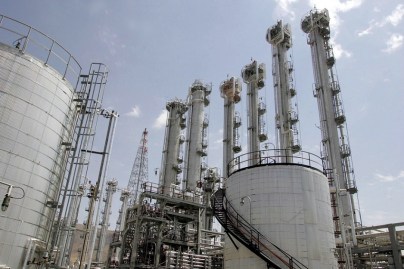
The proposed legislation would end the waivers allowing research at the Arak reactor, underground enrichment facility at Fordow and the Tehran Research Reactor.

US Sen. Lindsey Graham (R-SC) and Sen. Ted Cruz (R-Texas) have introduced legislation to end the temporary waivers to permit countries that are part of the 2015 Iran nuclear deal to conduct civil nuclear projects with the regime.

The two legislators circulated their bill to officials at the Departments of State, Treasury and Energy, Bloomberg News reported on Thursday.

The proposed legislation would end the waivers allowing research at the Arak reactor, underground enrichment facility at Fordow and the Tehran Research Reactor.

The Trump administration renewed the 90-day waivers on July 31. The next deadline is Feb.

Whether they will be extended is unknown.

In August, US Secretary of State Mike Pompeo said about renewing waivers that “The president will make that decision at the appropriate time.”

Recently, Iran has been installing dozens of advanced centrifuges to accelerate uranium enrichment, among other violations of the 2015 deal, according to the International Atomic Energy Agency.

Reprinted with permission from JNS.org.


As Iran grows more audacious, Israel must confront new security reality

Posted October 27, 2019 by Joseph Wouk
Categories: Uncategorized

Source: As Iran grows more audacious, Israel must confront new security reality – www.israelhayom.com

As a consequence of recent American policy, Iran has upped its ante across the region. To prepare for a more brazen Islamic republic, Israel must consolidate a coalition as soon as possible, and mainly rally international legitimacy, to allow it to “go crazy” if need be, even on Iranian soil.

For those lacking a full grasp of the intelligence-operational situation, this could sound familiar: The political-defense echelon is speaking in one voice about the threat posed to Israel by Iran.

The level of alarm varies according to the person speaking, but the underlying message is the same. It doesn’t matter if it’s Prime Minister Benjamin Netanyahu, IDF Chief of Staff Lt. Gen. Aviv Kochavi, or Mossad chief Yossi Cohen (who recently used an event for retired Mossad officials to sound the alarm over the Iranian threat) – all are warning of the looming danger rising against us from the northeast.

This is certainly a strategic development, following several positive years for Israel. The nuclear deal allowed the defense establishment to divert energy and resources to other sectors, mainly toward the endless activity otherwise known as the “campaign between the wars,” whereby Israel has tirelessly sought – overtly and covertly – to tackle two main objectives: preventing the transfer of advanced weapons to Hezbollah, and preventing Iran and its Shiite militia proxies from establishing a foothold in Syria.

This activity, which has produced impressive results, handicapped Iran significantly but didn’t temper its ambitions. Despite the multiple blows to its interests, the commander of the Quds Force of the Islamic Revolutionary Guard Corps, Qassem Soleimani, continued to pursue his interests along the crescent stretching from Yemen to Lebanon, and Gaza.

The hopes that the US withdrawal from the nuclear deal and the sanctions it has imposed on Iran would trigger its economic collapse or at least spur it to abandon its ambitions – have been shattered almost entirely.

In fact, Iran has become even bolder under this pressure. The downing of the American drone and the attacks on Saudi oil fields (along with its slow yet persistent progress on the nuclear track) have not only shown that Tehran isn’t blinking, it is actually upping its ante without hesitation.

Tehran understands: Belligerence pays

This Iranian daring (some would call it brazenness) was strongly bolstered by American policy. The decision not to respond to Iran’s aggression in the Persian Gulf, and the recent troop withdrawal from northern Syria –essentially abandoning their Kurdish ally – demonstrated to Iran that not only does its belligerence come without a price, but also pays.

And this is precisely the reason for the concern in Israel. If in the past there was some sense that the radical axis was weakening, today it’s clear that at this juncture, at least, it is growing stronger. Iran is increasingly audacious in the Gulf, and we can only assume it will act the same against Israel.

If to this point Tehran has refrained from retaliating against Israel’s activities against it, offering only measured responses: Over the past two years Iran attempted to attack Israel four times, compared to a far larger number of Israeli strikes against its assets in Syria – former IDF Chief Gadi Eizenkot noted over 1,000 such strikes between 2017-2018 alone. The current assessment is that moving forward, Iran will retaliate to everything.

The Iranian retaliation could be direct or, more likely, circuitous. From Syria or from Iraq; via terrorist attack, missile fire or drone strike, similar to the one in Saudi Arabia. It appears Israel has good intelligence about Iran’s plans, but it isn’t perfect; Israel’s physical defenses against these potential threats are also solid, but not hermetic.

The operational challenge posed by Iran is significant and requires special preparations in the immediate term. It also means Israel must prepare for the consequences: If it sustains a serious blow, Israel could respond on Iranian soil, and the ensuing skirmish could boil over into a multi-front campaign against Hezbollah, and perhaps elements in Syria and Gaza as well.

We mustn’t view all this as an indication of impending war. Israel can do quite a lot to prevent it: from intelligence-diplomatic efforts; to major preventative action to disrupt Iran’s machinations and exact a steep price; to making Tehran understand that Israel is prepared to go all the way, so that the ayatollah regime knows it will pay dearly if Israel is harmed.

To this end, Israel must consolidate a coalition as soon as possible, and mainly international legitimacy, to allow it to “go crazy” if need be; and it must also raise awareness among the Israeli public that after years of real quiet, the country could be on the precipice of a new security reality.


Kurdish commander: ‘Historic’ Baghdadi op was result of joint intel work with US

Posted October 27, 2019 by Joseph Wouk
Categories: Uncategorized

Source: Kurdish commander: ‘Historic’ Baghdadi op was result of joint intel work with US | The Times of Israel

Turkey also says it coordinated with American military ahead of Syria operation, which is said to have killed leader of Islamic State terror group

A picture taken on October 27, 2019 shows a burnt vehicle near the site where helicopter gunfire reportedly killed nine people near the northwestern Syrian village of Barisha in the province of Idlib near the border with Turkey, where 'groups linked to the Islamic State group' were present, according to a Britain-based war monitor with sources inside Syria (Omar HAJ KADOUR / AFP)

A picture taken on October 27, 2019 shows a burnt vehicle near the site where helicopter gunfire reportedly killed nine people near the northwestern Syrian village of Barisha in the province of Idlib near the border with Turkey, where ‘groups linked to the Islamic State group’ were present, according to a Britain-based war monitor with sources inside Syria (Omar HAJ KADOUR / AFP)

Syria’s top Kurdish commander on Sunday hailed a “historic operation” and joint intelligence work following US media reports that Islamic State chief Abu Bakr al-Baghdadi had been killed during an American raid.

Mazloum Abdi, head of the Kurdish-led Syrian Democratic Forces that was the US’s main local ally in years of battles against the Islamic State group in Syria, said the operation was the result of “joint intelligence work.”

Turkey’s Defense Ministry told the Reuters news agency that Turkish and American military authorities exchanged and coordinated information ahead of the US strike thought to have killed the elusive chief of the Islamic State terror group in the Idlib region of Syria.

Iraqi state television on Sunday broadcast footage of what it said was the site of the raid, with a crater and blood-stained clothing on the ground, Reuters reported. The broadcaster also quoted an terror expert who said Iraqi intelligence agencies had also helped to locate Baghdadi.
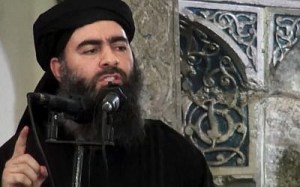
This image made from video posted on a militant website July 5, 2014, shows the leader of the Islamic State group, Abu Bakr al-Baghdadi, delivering a sermon at a mosque in Iraq. (AP/Militant video, File)

The White House announced US President Donald Trump would make a “major statement” Sunday at 9:00 a.m. (1300 GMT), without providing details.

A war monitor said US helicopters dropped forces in an area of Idlib where “groups linked to the Islamic State group” were present.

The helicopters targeted a home and a car outside the village of Barisha in an operation that killed nine people including an IS senior leader called Abu Yamaan as well as a child and two women, the Britain-based Syrian Observatory for Human Rights said.

It was not immediately clear if Baghdadi had been in the area, Observatory chief Rami Abdel Rahman said.

An AFP correspondent outside the village of Barisha in Idlib province saw what appeared to have been a minibus scorched to cinders by the side of the road.

A resident in the area who gave his name as Abdel Hameed said he rushed to the place of the attack after he heard helicopters, gunfire and strikes in the night.

“The home had collapsed and next to it there was a destroyed tent and vehicle. There were two people killed inside,” he told AFP.

‘Historic op’

US media cited multiple government sources as saying Baghdadi may have killed himself with a suicide vest as US special operations forces descended.

He was the target of the secretly planned operation that was approved by Trump, officials said according to US media.

The commander-in-chief of the US-backed Syrian Democratic Forces who have been fighting IS in Syria said the operation came after “joint intelligence work” with American forces.
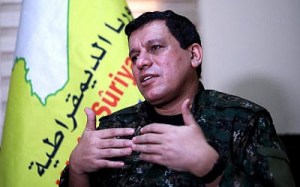
In this photo from January 24, 2019, Mazloum Abdi (Kobani), commander-in-chief of the Syrian Democratic Forces (SDF), speaks with AFP during an interview in the countryside outside the city of Hasakah in northeastern Syria. (Delil Souleiman/AFP)

“A historic operation is successful as a consequence of joint intelligence work with the United States of America,” Mazloum Abdi said on Twitter shortly after the news broke.

From the outskirts of Barisha, an inhabitant of a camp for the displaced also heard helicopters followed by what he described as coalition airstrikes.

They “were flying very low, causing great panic among the people,” Ahmed Hassawi told AFP by phone.

The AFP correspondent said the area of the nighttime strikes had been cordoned off by Hayat Tahrir al-Sham, Syria’s former Al-Qaeda affiliate controlling Idlib.

Long pursued by the US-led coalition against IS, Baghdadi has been erroneously reported dead several times in recent years. In 2017, Russian officials said there was a “high probability” he had been killed in a Russian airstrike on the outskirts of Raqqa, but US officials later said they believed he was still alive.

US officials told ABC News that biometric work was under way to firm up the identification of those killed in the raid.

Two Iranian officials told the Reuters news agency that Tehran was informed by Syrian sources that Baghdadi had been killed.
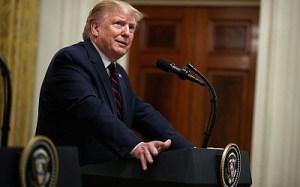
US President Donald Trump speaks during a news conference with Italian President Sergio Mattarella in the East Room of the White House, Wednesday, Oct. 16, 2019, in Washington. (AP Photo/Evan Vucci)

Trump earlier tweeted, without explaining, “Something very big has just happened!”

Baghdadi’s fighters captured a contiguous stretch of territory across Iraq and Syria, including key cities, and in June 2014, it announced its own state — or caliphate.

Baghdadi became the declared caliph of the newly renamed Islamic State group. Under his leadership, the group became known for macabre massacres and beheadings — often posted online on militant websites — and a strict adherence to an extreme interpretation of Islamic law.

But several offensives in both countries whittled down that territory, and in March the US-backed SDF ousted the extremist group from its last patch of territory in eastern Syria.

$25 million reward

Baghdadi — an Iraqi native believed to be around 48 years old — was rarely seen.

After 2014 he disappeared from sight, only surfacing in a video in April this year with a wiry gray and red beard and an assault rifle at his side, as he encouraged followers to “take revenge” for IS members who had been killed.
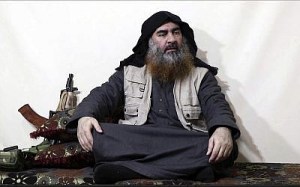
This image made from video posted on a militant website on April 29, 2019, purports to show the leader of the Islamic State group, Abu Bakr al-Baghdadi, being interviewed by his group’s Al-Furqan media outlet. (Al-Furqan media via AP)

His reappearance was seen as a reassertion of his leadership of a group that, while it had lost its physical territory, had spread from the Middle East to Asia and Africa and claimed several deadly attacks in Europe.

But Baghdadi remained on the run. The US State Department posted a $25 million reward for information on his whereabouts.

Under Baghdadi, the State Department said, IS “has been responsible for the deaths of thousands of civilians in the Middle East, including the brutal murder of numerous civilian hostages from Japan, the United Kingdom, and the United States.”

In September, the group released an audio message said to be from Baghdadi praising the operations of IS affiliates in other regions.

It also called on scattered IS fighters to regroup and try to free thousands of their comrades held in jails and camps by the SDF in northeastern Syria.
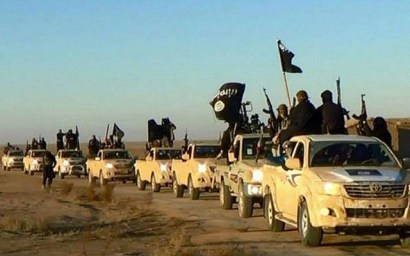
Undated file photo of Islamic State fighters holding up their weapons and waving flags in their convey of vehicles on a road leading to Iraq from Raqqa, Syria. (Jihadist website via AP)

Idlib is controlled by former Al-Qaeda affiliate HTS, and includes the presence of Al-Qaeda-linked fighters from the Hurras al-Deen group as well as IS cells, according to the Observatory.

Baghdadi was born Ibrahim Awwad Ibrahim Ali al-Badri al-Samarrai in 1971 in Samarra, Iraq, and adopted his nom de guerre early on. Because of anti-US militant activity, he was detained by US forces in Iraq and sent to Bucca prison in February 2004, according to IS-affiliated websites.

He was released 10 months later, after which he joined the al-Qaeda branch in Iraq of Abu Musab al-Zarqawi. He later assumed control of the group, known at the time as the Islamic State of Iraq.

After Syria’s civil war erupted in 2011, Baghdadi set about pursuing a plan for a medieval-style Islamic State, or caliphate. He merged a group known as the Nusra Front, which initially welcomed moderate Sunni rebels who were part of the uprising against Syrian President Bashar Assad, with a new one known as the Islamic State of Iraq and the Levant. Al-Qaeda’s central leadership refused to accept the takeover and broke with Baghdadi.

 

Trump says Islamic State chief ‘died like a dog’ 

Posted October 27, 2019 by Joseph Wouk
Categories: Uncategorized

Source: Trump says Islamic State chief ‘died like a dog’ | The Times of Israel

US president confirms Abu Bakr al-Bahgdadi detonated suicide vest during raid, killing himself and three of his children

US President Donald Trump speaks in the Diplomatic Room of the White House in Washington, October 27, 2019. (AP Photo/Andrew Harnik)

US President Donald Trump speaks in the Diplomatic Room of the White House in Washington, October 27, 2019. (AP Photo/Andrew Harnik)

WASHINGTON (AFP) — US President Donald Trump on Sunday said that elusive Islamic State leader Abu Bakr al-Baghdadi was killed, dying “like a dog,” in a daring, nighttime raid by US special forces deep in northwest Syria.

Trump told the nation in a televised address from the White House that US forces killed a “large number” of Islamic State fighters during the raid which culminated in cornering Baghdadi in a tunnel, where he set off a suicide vest.

“He ignited his vest, killing himself,” Trump said.

“He died after running into a dead end tunnel, whimpering and crying and screaming all the way,” Trump said, adding that three of Baghdadi’s children also died in the blast.

Trump said that the raid — which required flying more than an hour by helicopter each way from an undisclosed base — had been accomplished with help from Russia, Syria, Turkey and Iraq.

Special forces “executed a dangerous and daring nighttime raid in northwestern Syria and accomplished their mission in grand style.”

At its height, Islamic State controlled swaths of Iraq and Syria in a self-declared state known as a caliphate, characterized by the brutal imposition of a puritanical version of Islam.

In addition to oppressing the people it governed, Islamic State planned or inspired terrorism attacks across Europe, while using expertise in social media to lure large numbers of foreign volunteers.

It took years of war, in which Islamic State became notorious for mass executions and sickening hostage murders, before the group’s final slice of territory in Syria was seized this March.

The death of Baghdadi comes as a big boost for Trump, whose abrupt decision to withdraw a small but effective deployment of US forces from Syria caused fears that it would give Islamic State remnants and sleeper cells a chance to regroup.

Trump took a storm of criticism, including from his own usually loyal Republican Party.

This image made from video posted on a militant website on April 29, 2019, purports to show the leader of the Islamic State group, Abu Bakr al-Baghdadi, being interviewed by his group’s Al-Furqan media outlet. (Al-Furqan media via AP)

In keeping with his liking for showmanship, Trump had teased the news late Saturday with an enigmatic tweet saying merely that “Something very big has just happened!”

Scorched vehicle

A war monitor said US helicopters dropped forces in an area of Syria’s Idlib province where “groups linked to the Islamic State group” were present.

The helicopters targeted a home and a car outside the village of Barisha in Idlib province, said the Syrian Observatory for Human Rights, which is based in Britain but relies on a network of sources inside Syria for its information.

The operation killed nine people including an IS senior leader called Abu Yamaan as well as a child and two women, it said.

An AFP correspondent outside Barisha saw a minibus scorched to cinders by the side of the road, and windows shattered in a neighbor’s house surrounded by red agricultural land dotted with olive trees.

A resident in the area who gave his name as Abdel Hameed said he rushed to the place of the attack after he heard helicopters, gunfire and strikes in the night.

“The home had collapsed and next to it there was a destroyed tent and vehicle. There were two people killed inside” the car, he said.

From the outskirts of Barisha, an inhabitant of a camp for the displaced also heard helicopters followed by what he described as US-led coalition airstrikes.

They “were flying very low, causing great panic among the people,” Ahmed Hassawi told AFP by phone.

Another resident, who gave his name as Abu Ahmad and lives less than 100 meters away from the site of the destroyed house, said he heard voices “speaking a foreign language” during the raid.

The AFP correspondent said the area of the nighttime operation had been cordoned off by Hayat Tahrir al-Sham, a group dominated by members of Syria’s former al-Qaeda affiliate controlling Idlib.

Between the trees, bulldozers could be seen at the site, clearing out the rubble.

‘Joint intelligence’

Turkey, which has been waging an offensive against the US-backed Syrian Democratic Forces (SDF) in northeast Syria in recent weeks, had “advance knowledge” about the raid, a senior Turkish official said.

“To the best of my knowledge, Abu Bakr al-Baghdadi arrived at this location 48 hours prior to the raid,” the official told AFP.

The commander-in-chief of the SDF, which has been fighting IS in Syria, said the operation came after “joint intelligence work” with American forces.

Trump also said that Iraq had been “very good” over the raid.

He said no US soldiers were wounded, despite “doing a lot of shooting” and “a lot of blasting.” The only US casualty was an injured military dog in the tunnel with the trapped Islamic State leader.

Long pursued by the US-led coalition against IS, Baghdadi has been erroneously reported dead several times in recent years.

$25 million reward

Baghdadi — an Iraqi native believed to be around 48 years old — was rarely seen.

After 2014 he disappeared from sight, only surfacing in a video in April with a wiry gray and red beard and an assault rifle at his side, as he encouraged followers to “take revenge” after the group’s territorial defeat.

His reappearance was seen as a reassertion of his leadership of a group that — despite its March defeat — has spread from the Middle East to Asia and Africa and claimed several deadly attacks in Europe.

The US State Department had posted a $25 million reward for information on his whereabouts.

In September, the group released an audio message said to be from Baghdadi praising the operations of IS affiliates in other regions.

It also called on scattered IS fighters to regroup and try to free thousands of their comrades held in jails and camps by the SDF in northeastern Syria.

LIVE: President Trump Makes Announcement from the White House 

Posted October 27, 2019 by Joseph Wouk
Categories: Uncategorized

ISIS LEADER KILLED,’CRYING, WHIMPERING, SCREAMING’


LIVE: President Trump Makes Announcement from the White House 

Posted October 27, 2019 by Joseph Wouk
Categories: Uncategorized