Source: Ahead of Gantz meeting, PM urges broad unity government for sake of security | The Times of Israel
Netanyahu says coalition must be swiftly formed to make ‘tough decisions’ on military matters
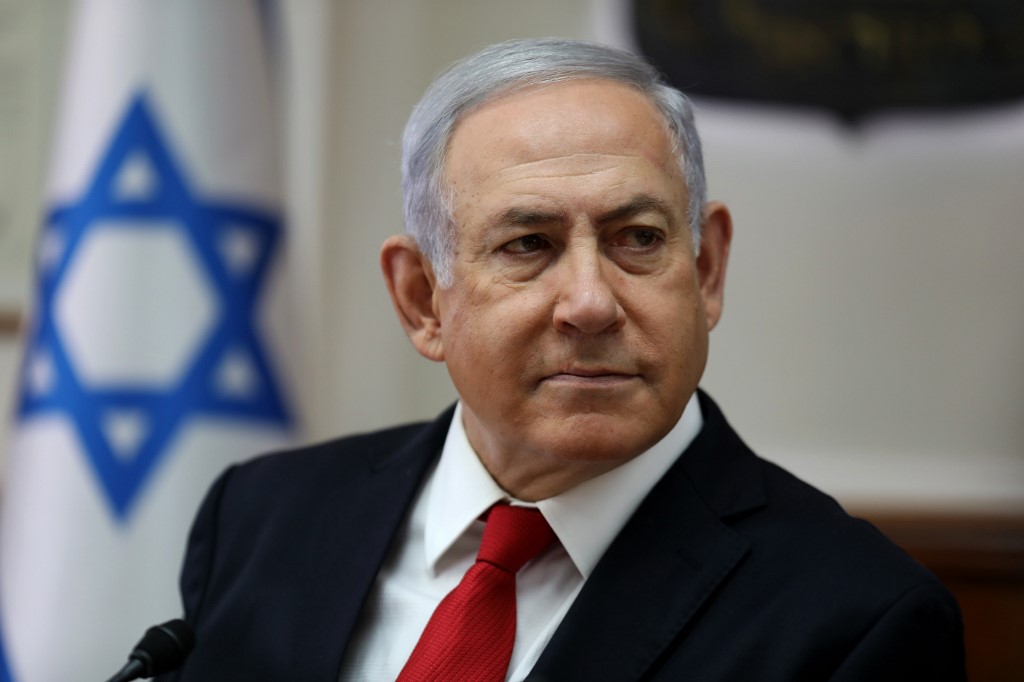
Citing recent warnings by IDF Chief of Staff Aviv Kohavi, Prime Minister Benjamin Netanyahu on Sunday said the possibility of conflict necessitated the swift formation of a broad unity government to respond to security threats.
“The Middle East is again in turmoil,” Netanyahu said during a weekly cabinet meeting in Jerusalem. “Lebanon, Iraq, and Syria are in turmoil, and Iran controls all these areas. We need to make tough decisions that require a broad-shouldered government.”
“Iran’s actions in the Middle East require very difficult decisions. What is said by the chief of staff is not spin — it is a reflection of the situation — so establishing a broad government is a top security issue.”
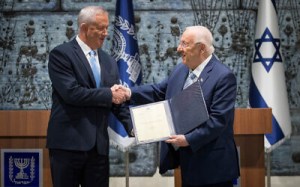
Netanyahu failed to negotiate a coalition following last month’s Knesset election, prompting him to declare that he was unable to form a government and causing President Reuven Rivlin to tap his primary rival Benny Gantz, a former IDF chief of staff who heads the centrist Blue and White Party, to try his hand at bringing together Israel’s disparate political factions.
The prime minister is set to meet with Gantz in Tel Aviv on Sunday, the Likud and Blue and White parties said in a joint statement on Saturday. The meeting will take place Sunday afternoon at the Israel Defense Forces headquarters in Tel Aviv following an invitation by Gantz.
Gantz received the mandate to form a government from Rivlin on Wednesday evening and has already begun speaking with party leaders and sending out invitations to meet to negotiate their potential entry into the Blue and White-led coalition he hopes to establish.
According to reports in the Hebrew media, Gantz could offer Netanyahu a “compromise deal” that would force him to choose between including his religious allies in the coalition and being prime minister first in any premiership rotation deal.
Likud has stressed that Netanyahu is negotiating on behalf of the 55-member bloc of right-wing and religious parties loyal to him, without whom he will not enter a coalition. Blue and White has previously rejected this negotiation position outright.
Netanyahu’s remarks at Sunday’s cabinet meeting came on the heels of Kohavi’s warning last Thursday that Israel is facing a threat of conflict in both the north and the south, forcing the military to rapidly prepare for war.
“In the northern and southern arenas the situation is tense and precarious and poised to deteriorate into a conflict despite the fact that our enemies are not interested in war. In light of this, the IDF has been in an accelerated process of preparation,” Kohavi said.
In a briefing to reporters, the IDF chief said the primary threat facing Israel comes from Iran and its proxies in Lebanon, Syria and Iraq.
“The main strategic threat to the State of Israel lies in the northern arena: with the entrenchment of Iranian and other forces in Syria, and with [the Hezbollah terror group’s] precision missile project,” Kohavi said, referring to an effort by the Iran-backed Lebanese militia to develop highly accurate long-range projectiles.
Israel sees precision-guided missiles as a far greater threat than that posed by Hezbollah’s existing arsenal of more than 100,000 rockets and missiles as the improved projectiles could easily overpower the IDF’s air defense systems and destroy the country’s critical infrastructure, something the terror group would struggle to do with its current arsenal.

The mass anti-government protests engulfing Lebanon and Iraq are strongly infused with resentment of Iran’s influence and Hizballah dominance. Yet both held back on bloody crackdowns.
On Friday, Oct. 25, the ninth day of popular protests in Lebanon, Hizballah leader Hassan Nasrallah warned in a televised speech that they were putting the country at risk of “chaos, economic collapse and civil war.” This was an attempt post factum to justify his first furtive steps to confront the protesters with force. A special new squad of Hizballah officers and fighters, clad in civvies and armed with clubs, were already scuffling with demonstrators on Beirut’s central Riad al-Solh Square that night. Those heavies may be expected to turn up in the thick of rallies in other parts of Lebanon. To motivate his followers, Nasrallah went on to charge that foreign embassies in Beirut had hijacked the protest movement and the CIA was involved.
The protesters were not impressed: “The government must resign, and everything will be OK. All of them means all of them,” they insisted. They were telling Iran’s foremost proxy, Hizballah, as a powerful political player in Lebanon with a cabinet majority, that its head was also on the block.
DEBKAfile’s sources note that the road from clubs to live ammunition is short. Nasrallah is only waiting for the first shot to be fired by a demonstrator before letting his followers loose with live shots for dispersing the demonstrations.
He is following a preset plan of action which has three points:
The resurgence of demonstrations in Iraq on Friday plunged into greater violence that they did in Lebanon, although both are increasingly endangering the main bastions of influence Tehran and its agents have created in Middle East. Those key political and military power centers are shaking and threatening to crumble. This is partly due to the tardy awareness of Tehran and Nasrallah to the force of the street protests sweeping through Beirut and Baghdad. They only woke up when they had spun out of control.
On that same Friday, they were confronted by Iraq’s top religious authority, Grand Ayatollah Ali Al-Sistani, aiming an ultimatum to Baghdad to enact economic reforms and start rooting out corruption, in obedience to the protesters demands. He spoke to the accompaniment of a fresh outbreak of exceptionally violent popular protests in Baghdad and the Shiite towns of the south.
In Baghdad, Basra and Nasiriya and other Shiite towns, hundreds of thousands of marching protesters shouted anti-Iran slogans and burned effigies of Iran’s supreme leader Ayatollah Ali Khamenei. As well as attacking government institutions, for the first time the crowds torched the headquarters of pro-Iranian Iraqi factions and militias. In some places, those militias opened fire on the crowds. Iraq’s Bloody Friday ended with more than 40 dead and some 2,300 injured – and no end in sight.
Source: Hezbollah chief warns of civil war, says Israel exploiting Lebanon protests | The Times of Israel
Terror chief says though the demonstrations began spontaneously they are now being manipulated by domestic and regional rivals; Hezbollah supporters clash with demonstrators
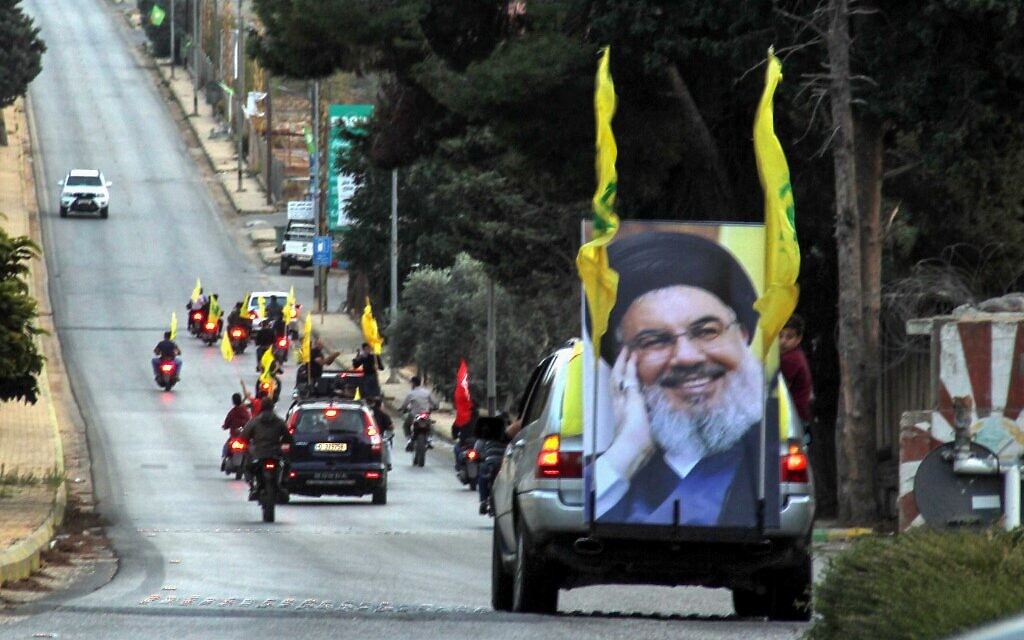
Hezbollah leader Hassan Nasrallah on Friday warned that ongoing massive anti-government protests in Lebanon could plunge the country into civil war, and accused Israel and other countries of working to take advantage of the demonstrations to fuel unrest.
The head of the Iran-backed terror organization spoke as the protests, which initially were triggered by new proposed taxes that followed public spending cuts, dragged on into a ninth day.
Nasrallah said though the protests began as a popular expression of anger against corruption and deepening economic crisis, they were now being exploited by political rivals and international and regional powers who oppose Hezbollah.
“What does it mean that the Israelis get Lebanese among those who are in the Zionist entity to the border to show solidarity with the protests,” he was quoted saying by Hezbollah’s Al-Manar television network. It was not immediately clear what he was referring to. An Iranian-armed proxy, Hezbollah seeks to destroy Israel.
In an unusual move, Nasrallah spoke with a Lebanese flag behind him instead of the Hezbollah banner.
Nasrallah warned Lebanon could descend into civil war, conjuring fear of the country’s war that lasted 15 years and ended in 1990.
“I’m not threatening anyone, I’m describing the situation,” he said. “We are not afraid for the resistance [Hezbollah], we are afraid for the country.”
 Almanarnews English@AlmanarEnglish
#Hezbollah SG Sayyed Hasan #Nasrallah threatens those behind schemes to exploit #Lebanon‘s protests:
Resistance is the most powerful party in the country.
It’s not a problem if you get scared#نصرالله #لنحافظ_عالانجاز
He did, however, praise the protesters for pressuring the government to back away from tax hikes, but reiterated his opposition to the resignation of the cabinet.
“In view of the difficult financial, economic and living situation in the country, in view of security and political tensions that are prevailing in the region … a vacuum will lead to chaos, to collapse,” he said, according to the Reuters news agency.
Hezbollah is a major political player in Lebanon and with its allies holds the majority in the cabinet. It is the only movement not to have disarmed after Lebanon’s 15-year civil war.
Nasrallah also called on his supporters to leave the streets after clashes broke out in Beirut between them and anti-graft protesters.
Unprecedented protests have erupted in some Hezbollah strongholds, but some of its supporters have also taken offense to slogans against their leader.
In the capital’s main square, protesters fell silent to listen to Nasrallah’s speech broadcast on loudspeakers.
As it neared its end, the police moved in to separate Hezbollah supporters from the rest of the demonstrators, an AFP correspondent said.

Before they retreated, Hezbollah backers threw rocks, plastics bottles and branches at the other demonstrators, who responded in kind chanting “Revolution.”
Scuffles also broke out in central Beirut before the speech, when Hezbollah supporters entered the area to reject chants against Nasrallah, who was named by the protest movement as one among the political elite who must leave.
“Nasrallah is more honorable than all of them,” the pro-Hezbollah protesters chanted. They clashed with the protesters who were previously in the square until riot police tried to break up the fight. The incidents came shortly before Nasrallah was due to speak.
Anger has been building among Hezbollah supporters because the protesters named him, along with other corrupt politicians. At least two protesters were injured. The riot police encircled the pro-Hezbollah protesters, who carried batons, separating them from the other protesters.
But tension returned when the protesters moved down the main road, lobbing stones and at one point attacking a TV crew from a station aligned with a Hezbollah rival. Some protesters chanted for calm.
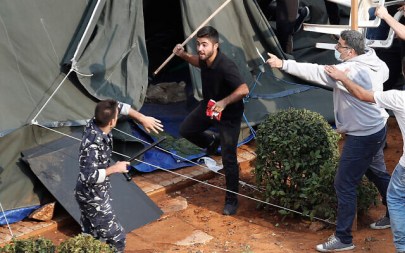
Banks, universities and schools remained closed Friday, the ninth day of nationwide protests, which initially were triggered by new proposed taxes that followed public spending cuts.
The demonstrators — who have thronged towns and cities across Lebanon — have been demanding the removal of the entire political class, accusing many across different parties of systematic corruption.
Numbers have declined since Sunday, when hundreds of thousands took over Beirut and other cities in the largest demonstrations in years, but could grow again over the weekend.
Lebanon’s largely sectarian political parties have been wrong-footed by the cross-communal nature of the protests.
Drawing in Christians and Muslims, Shiite, Sunni and Druze, the street movement has largely been peaceful — evolving into celebrations after nightfall.
Waving Lebanese national flags rather than the partisan colors normally paraded at demonstrations, protesters have been demanding the resignation of all of Lebanon’s political leaders.
“All of them means all,” has been a popular slogan.

In attempts to calm the anger, Prime Minister Saad Hariri has pushed through a package of economic reforms, while President Michel Aoun offered Thursday to meet with representatives of the demonstrators to discuss their demands.
But those measures have been given short shrift by demonstrators, many of whom want the government to resign to pave the way for new elections.
The unprecedented mass protests come amid a deepening economic crisis in Lebanon. The country is one of the world’s most indebted nations, with public debt over 150 percent of the gross domestic product. The protesters accuse the politicians of amassing wealth even as the country gets poorer.
Source: A strike on Israel by an emboldened Iran looms, but may not be imminent | The Times of Israel
IDF seems to have scaled back its operations against Tehran in Syria and Iraq during the Jewish High Holidays, but with their end, the threat of Iranian retaliation returns
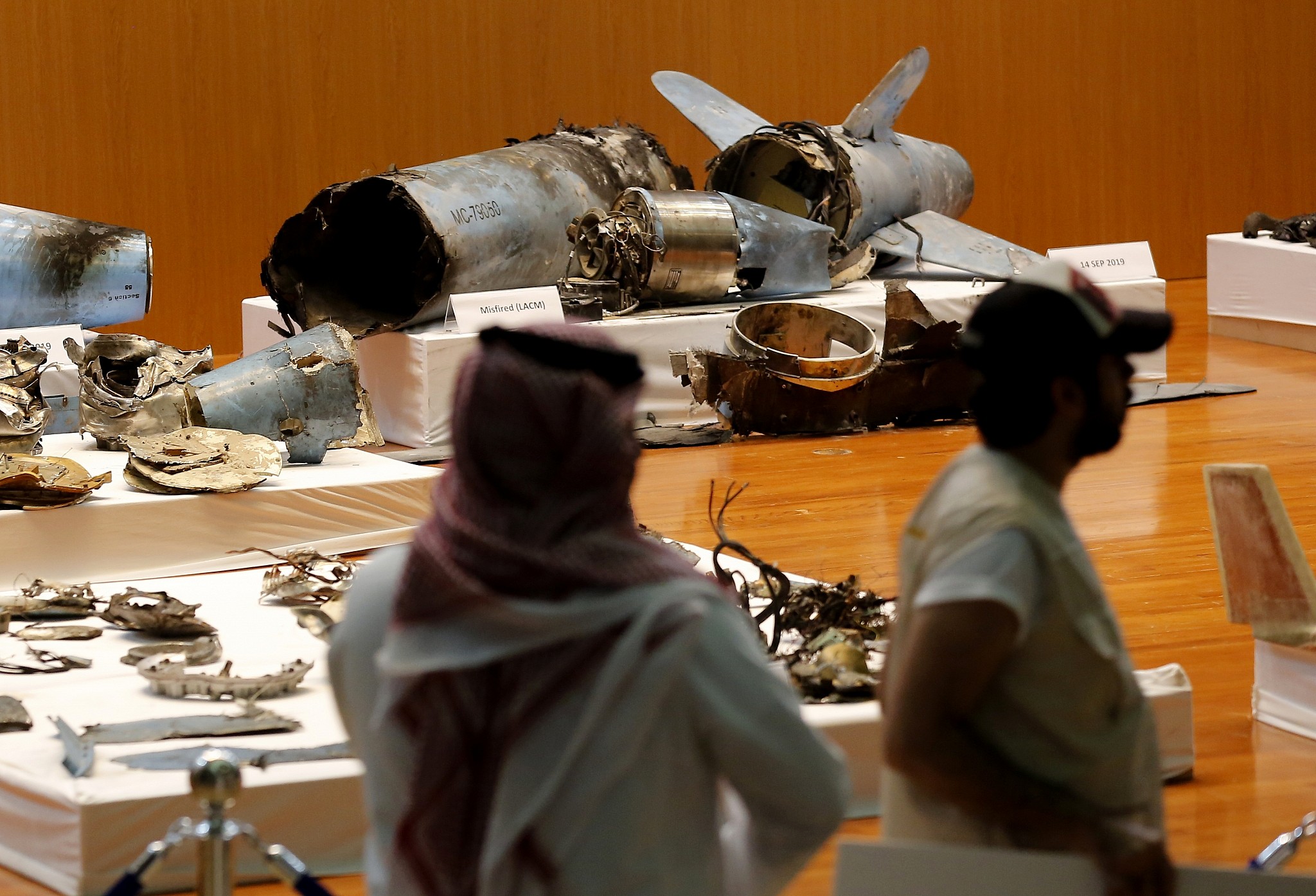
Iran is feeling emboldened, and this has the Israeli military, which regularly bombs Iranian assets in the region, concerned that Tehran will one day respond to these strikes with a cruise missile or drone attack.
In light of these concerns, the Israel Defense Forces appears to have scaled down its operations against Iranian and Iranian-allied forces in the region in recent weeks. (Israel acknowledges conducting strikes against Iranian targets in the region in general, but as a rule does not take responsibility for specific attacks.)
This hiatus appears to have been a bid to cool tensions following a one-day battle between Israel and the Iran-backed Hezbollah terror group on September 1 and an effort by the IDF to ensure that the sensitive period of the Jewish High Holidays — from September 30 to October 21 — passed without conflict.
Indeed there have been no reported airstrikes against pro-Iranian militias in Syria or Iraq since September 28.
The situation is tense and precarious and poised to deteriorate into a conflict
With the end of the Jewish festivals, the military may soon return to its campaign against Iranian entrenchment in the Middle East and with it the threat of Iranian attack.
Such a retaliatory strike by Iran does not appear to be imminent, but does appear to be firmly on the horizon, according to an Israeli Military Intelligence assessment, based on the ongoing operations of Iranian forces and Iranian proxies in Syria and elsewhere in the region, and a general understanding of the modus operandi of Iran and its powerful Quds Force, the branch of the Islamic Revolutionary Guard Corps led by Qassem Soleimani that operates abroad.
Since this summer, Iran has successfully attacked an American drone, international oil tankers and a major Saudi petroleum facility — and faced no serious consequences for these actions.
In addition, the United States has begun actively withdrawing from Syria — both in terms of troops and interest — and from the Middle East in general, a move that would also bolster Iran’s belief that it can act with impunity in the region as its primary enemy is effectively abandoning the main arena of the fight.
This heightened Iranian self-esteem and the threat that it poses to the Jewish state does not bode well for the Israel Defense Forces, which routinely carries out airstrikes against Iranian and Iranian-allied forces throughout the Levant.
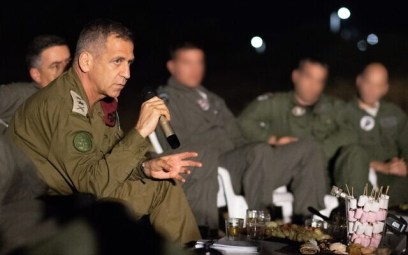
These concerns prompted an unusual warning from IDF Chief of Staff Aviv Kohavi on Thursday that war may be in the offing, as well as a security cabinet meeting suddenly scheduled for next week.
“In the northern and southern arenas the situation is tense and precarious and poised to deteriorate into a conflict despite the fact that our enemies are not interested in war. In light of this, the IDF has been in an accelerated process of preparation,” Kohavi told reporters in a briefing.
The military does not believe that Iran or one of the proxies under the control of Quds Force commander Soleimani will necessarily retaliate to any and every Israeli airstrike, but will likely respond to them eventually as its tolerance for sustaining losses of men and munitions runs out.

This is forcing the IDF to weigh even more seriously the potential cost of an airstrike against an Iranian target compared to the benefit to Israeli national security gained from destroying it.
In the beginning of last year, Israel also faced an emboldened and enraged Iran in Syria. In February 2018, the Islamic Republic launched an armed drone toward northern Israel, which an Israeli Air Force helicopter shot down. In response, the IDF struck dozens of Iranian targets in Syria, including the control center from which the drone was piloted.
In the months that followed, the Iranian regime vowed revenge, and the IDF launched a campaign known as Operation Chess to counter the Islamic Republic’s efforts to retaliate with preemptive airstrikes against Iranian assets in Syria.
This culminated on May 10, 2018, when Iran came through on its threats with a rocket attack against Israeli military posts along the Golan Heights. The rockets failed to hit their targets, according to the IDF. The military retaliated with another round of extensive airstrikes against Iranian targets in Syria.
The IDF believes that its campaign of strikes on Iranian targets in Syria foiled the Islamic Republic’s plans to establish a major base of operations in the country, but nevertheless left Tehran determined to use Syria as part of its war against Israel.
Source: Pentagon chief meets Saudi king after troop deployment, amid Iran tensions | The Times of Israel
US plans to send thousands of soldiers to kingdom upon Riyadh’s request following a drone and missile attack on Saudi oil plants, which Washington blames on Tehran
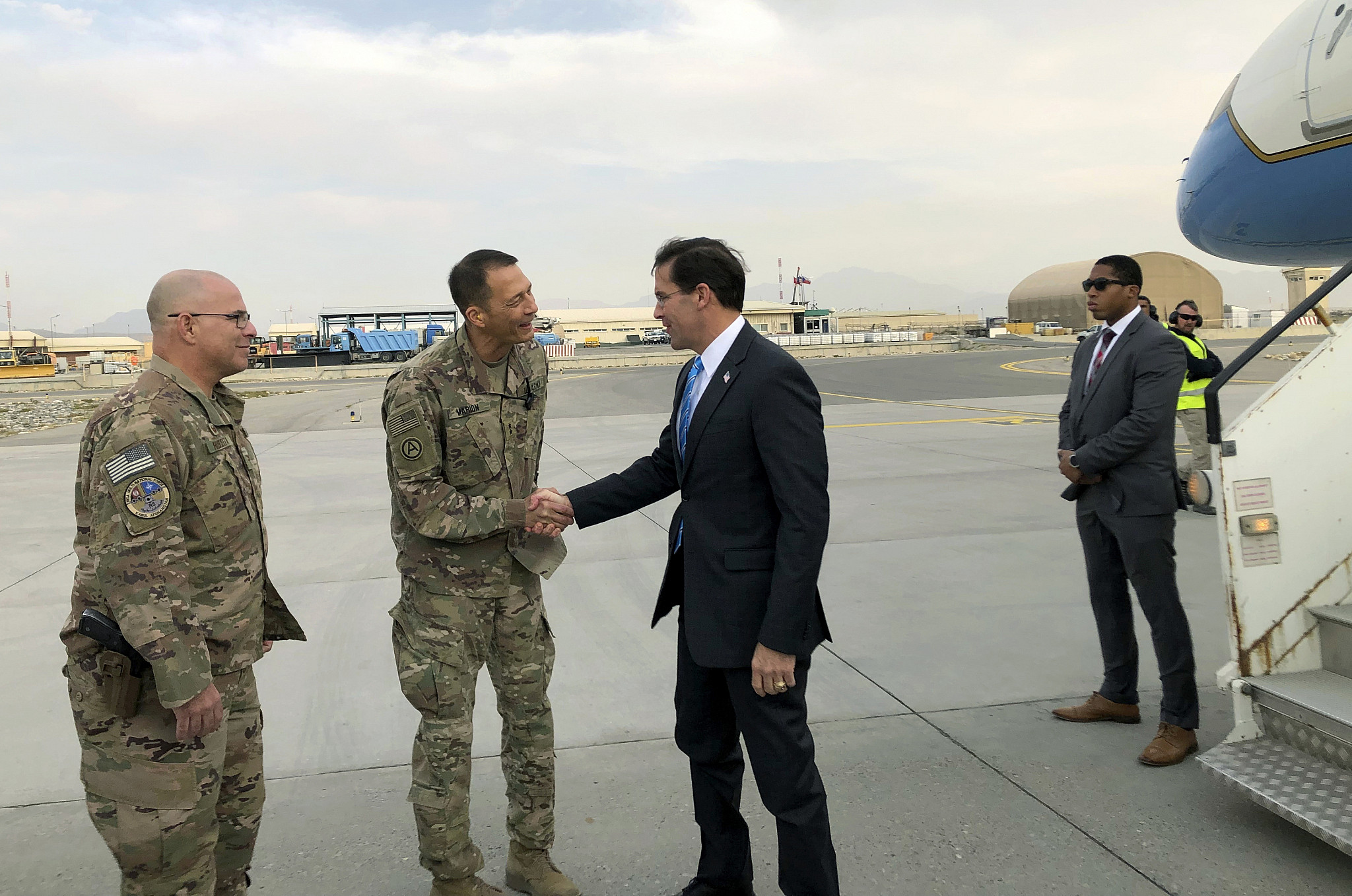
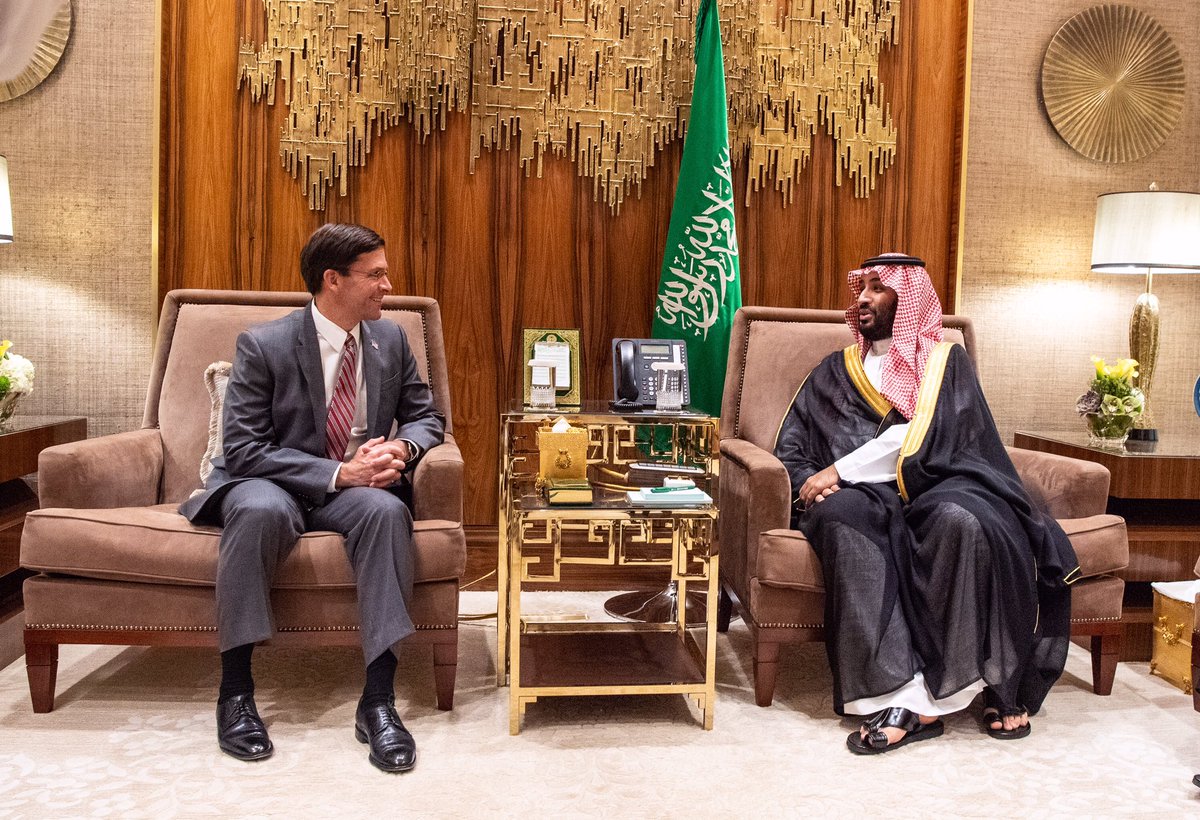
RIYADH — US Defense Secretary Mark Esper discussed “strategic cooperation” with Saudi King Salman Tuesday, days after Washington ordered thousands of soldiers to the kingdom as tensions fester with Iran.
The meeting in Riyadh, where Esper arrived late Monday after an unannounced visit to Afghanistan, also took in defense issues and the current situation in the region, the official SPA news agency said.
The agency later added that Esper had met powerful Crown Prince Mohammed bin Salman, who is also defense minister.
The two discussed “military and defense cooperation,” it said.
On October 11, the Pentagon said it was deploying new US troops to Saudi Arabia after Riyadh asked for reinforcements following a mid-September drone and missile attack on Saudi oil plants, which Washington blames on Iran.
 Secretary of Defense Dr. Mark T. Esper
✔@EsperDoD
I had a very productive meeting this evening with HRH Crown Prince Mohammed bin Salman. We discussed many bilateral issues. Most importantly I wanted to reinforce the U.S. commitment to helping #SaudiArabia defend itself in a time of destabilizing Iranian activity.
Esper has said that two fighter squadrons and additional missile defense batteries were being sent to Saudi Arabia, bringing to about 3,000 the total number of US troops deployed to the kingdom since last month.
The September 14 attack knocked out two major facilities of state oil giant Aramco in Abqaiq and Khurais, roughly halving Saudi Arabia’s oil production.
Washington condemned the attacks as an “act of war” but neither Saudi Arabia nor the United States have overtly retaliated.
Tensions have soared in the Gulf in recent months with a series of attacks on oil infrastructure and tankers, raising fears of war. Iran has denied any involvement.
Source: Israel said bracing for direct cruise missile or drone attack by Iran | The Times of Israel
Security cabinet to meet next week as Army Radio cites sources saying Tehran may respond to strikes against its regional proxies attributed to Israel
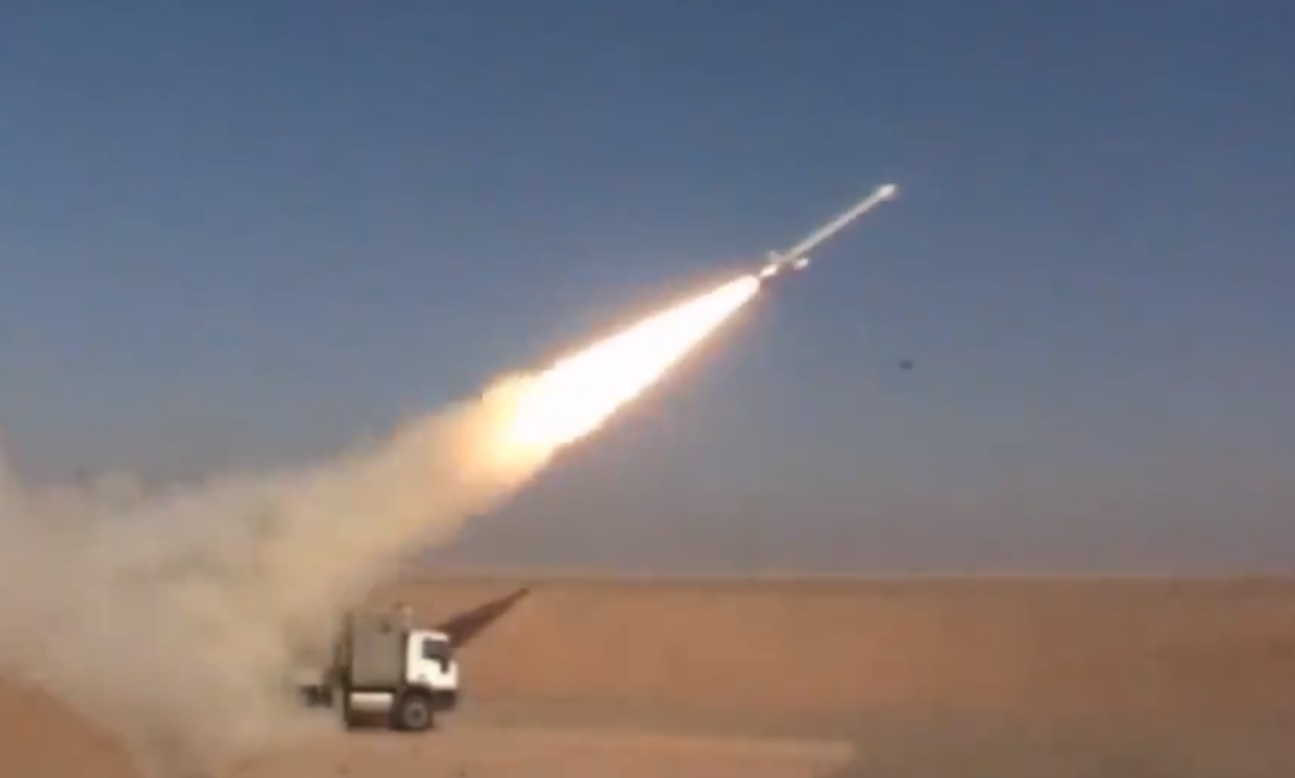
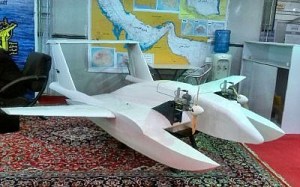
Israel is readying for a direct cruise missile or drone strike by Tehran in response to recent attacks on Iranian regional proxies which have been attributed to the Jewish state, Army Radio reported Tuesday evening.
Unlike ballistic missiles, which usually fly through a high arc on the way to the target, cruise missiles and drones fly at low altitude, making them harder to detect.
The report cited anonymous “Israeli sources,” who said the IDF was already on high alert for the possibility and that the security cabinet will convene for an “unplanned” meeting next Tuesday against a backdrop of tensions with the Islamic Republic.
This would be the second time this month that the high-level security cabinet has convened. On October 6, its members gathered amid cryptic warnings by Israeli leaders of a growing security threat from Iran. That meeting lasted for nearly six hours.
During the meeting, ministers discussed a proposal, being pushed by Prime Minister Benjamin Netanyahu, for a NIS 1 billion ($290 million) project to boost Israel’s air defenses that would place particular focus on defending the country against cruise missile attacks.
Channel 12 at the time cited anonymous officials who believed Tehran may have publicized information about an allegedly foiled “Israel-Arab” plot to assassinate General Qassem Soleimani, the head of the elite Quds Force in Iran’s Islamic Revolutionary Guard Corps, as a pretense to attack Israel.
Both Netanyahu and President Reuven Rivlin have mentioned crucial security needs in recent days as they called for the formation of a broad unity government after the September 17 elections.
Iran appears to have been building up its drone activities and attacks in recent months — in August, Israeli fighter jets carried out airstrikes in Syria to thwart a planned attack on Israel by Iran-backed fighters using armed drones, the Israel Defense Forces said. The Israeli military said its strike targeted operatives from Iran’s Islamic Revolutionary Guard Corps’ Quds Force as well as Shiite militias who had been planning on sending “kamikaze” attack drones into Israel armed with explosives.
In September, a cruise missile and drone attack on Saudi Arabian oil facilities knocked out half the kingdom’s oil production. Although Yemen’s Iranian-backed Houthi rebels claimed responsibility, the US, Britain, France, Germany, and Saudi Arabia have blamed Iran of being behind the attack.
Channel 12 news reported that defense officials who have studied the weapons used in the attack on the Saudi facilities concluded that a similar assault by Iran on Israel, if it came, would likely be launched from western Iraq, where there is a strong presence of Iran-backed militias.
Iran regularly threatens Israel, viewing the country as a powerful enemy allied with the United States and Sunni countries in the region against Tehran and its nuclear ambitions.
Israel has also thwarted Iranian operations in neighboring Syria where its fighters and those of Iranian proxy Hezbollah have been fighting alongside forces loyal to Syrian President Bashar Assad since 2011.
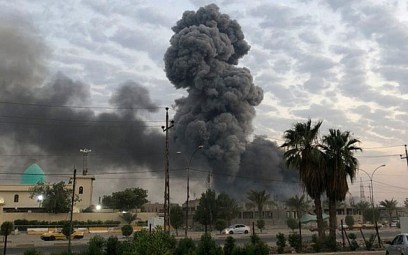
Israel has vowed to prevent Iran’s regional proxy militias from obtaining advanced weapons to use against the Jewish state and has carried out hundreds of air strikes in Syria that it says were to prevent deliver of weapons and to stop Iranian military entrenchment in that country.
Late last month, Iraqi Prime Minister Adel Abdul Mahdi announced that investigations have determined the recent spate of airstrikes targeting powerful Iranian-backed militias in Iraq were carried out by Israel.
The Qatari-funded TV network also quoted him as saying that “many indicators show that no one wants war in the region except for Israel,” according to a translation by the Reuters news agency.
A spokesperson for the Israel Defense Forces declined to comment on the statements from the Iraqi premier, saying “these are reports from foreign media and we do not comment on them.”
Since July, there have been at least nine strikes both inside Iraq and across the border in Syria, targeting the Iran-backed militias, known collectively as the Popular Mobilization Forces, or PMF.
Leaders of the powerful Shiite paramilitary group have repeatedly blamed Israel and by extension its US ally, which maintains more than 5,000 troops in Iraq.
Israel has not confirmed its involvement in the attacks, though Netanyahu has hinted at the possibility that it has struck in Iraq.
Earlier this month, a senior Iranian lawmaker blamed Israel, the United States and Saudi Arabia for an alleged attack on an oil tanker off the Saudi coast and said he would take the complaint to the UN.

Tehran says the Iranian-flagged Sabiti tanker was hit by two separate explosions off the Red Sea port of Jeddah.
Hassan Beigi, a member of the Iranian parliament’s national security and foreign policy commission, claimed without evidence that the US, Israel and Saudi Arabia were alleging the Islamic State jihadist group or Afghanistan’s Taliban for an alleged attack on an oil tanker last week off the Saudi coast and said he would take the complaint to the UN.
Source: Leading Democrats blast Trump over ‘sham ceasefire’ in Syria | The Times of Israel
Pelosi and Schumer say deal with Turkey benefits Islamic State, Assad regime, Russia and Iran; some Republicans also criticize the move
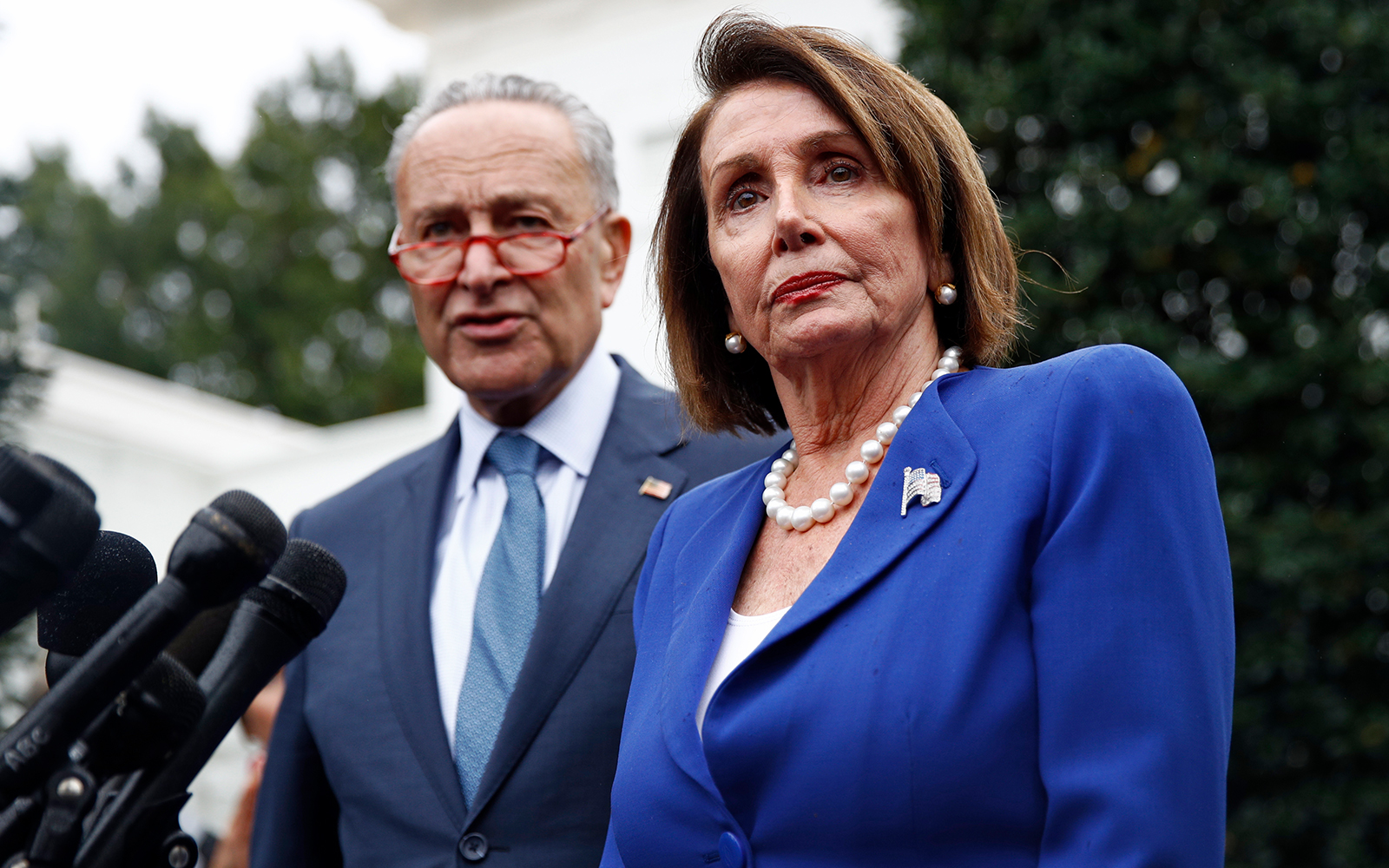
The two top Democrats in Congress on Thursday bashed a five-day truce that the US brokered with Turkey to halt violence on the Syrian border.
House Speaker Nancy Pelosi and Senate Minority Leader Chuck Schumer said the agreement was a “sham ceasefire” that showed that US President Donald Trump is “flailing.”
The US, Turkey and Kurdish forces agreed Thursday to the deal to stop the Turks’ attacks on Kurdish fighters in northern Syria and allow the Kurds to withdraw to roughly 20 miles away from the Turkish border. The arrangement appeared to be a significant embrace of Turkey’s position in the weeklong conflict.
After more than four hours of negotiations with Turkish President Recep Tayyip Erdogan, US Vice President Mike Pence said the purpose of his high-level mission was to end the bloodshed caused by Turkey’s invasion of Syria, and remained silent on whether the agreement amounted to another abandonment of the US’s former Kurdish allies in the fight against the Islamic State.
Turkish troops and Turkish-backed Syrian fighters launched their offensive against Kurdish forces in northern Syria a week ago, two days after Trump suddenly announced he was withdrawing American forces from the area.
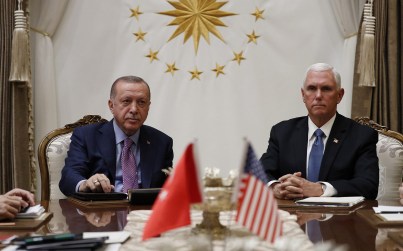
Pelosi and Schumer said Turkey had surrendered nothing while Trump had given Erdogan “everything.”
They said the deal damages American credibility and leaves thousands of Islamic State prisoners in the hands of Turkey and Syria’s government, which they said represents a security threat to the US.
Pelosi and Schumer said the US and its allies “deserve smart, strong and sane leadership from Washington.”
“President Trump unleashed a further escalation of chaos and insecurity in Syria that has left dozens of innocent civilians dead, displaced hundreds of thousands more and invited the resurgence of ISIS. The only beneficiaries of the President’s policies are our adversaries: ISIS, Bashar al-Assad, Vladimir Putin and Iran,” Pelosi and Schumer said in a joint statement.
Next week the House will pass a sanctions package to mitigate the humanitarian consequences of the US withdrawal, the statement read.

Some Republicans also criticized the truce.
Republican Senator Mitt Romney said Trump’s decision to abandon Kurdish allies in Syria “will stand as a bloodstain in the annals of American history.”
The Utah senator took to the Senate floor Thursday to criticize Trump.
“The announcement today is being portrayed as a victory. It is far from a victory,” Romney argued.
He said removing US troops who protected the Kurds “violates one of our most sacred duties. It strikes at American honor.”
Romney said he hopes the truce works but that a deal with Turkey should have been struck before the US pulled its troops out, not afterward.
Republican senator Marco Rubio similarly criticized the cease fire, saying: “Other than giving Kurds a chance to leave so they don’t get slaughtered, it doesn’t sound like a change of any of the other dynamics I’m concerned about.”

Brett McGurk, the former civilian head of the administration’s US-led counter-IS campaign, wrote on Twitter that Thursday’s deal was a gift to the Turks.
“The US just ratified Turkey’s plan to effectively extend its border 30km into Syria with no ability to meaningfully influence facts on the ground,” he wrote, adding that the arrangement was “non-implementable.”
Pence and US Secretary of State Mike Pompeo lauded Thursday’s deal as a significant achievement, and Trump tweeted that it was “a great day for civilization.” But the agreement essentially gives the Turks what they had sought to achieve with their military operation in the first place. After the Kurdish forces are cleared from the safe zone, Turkey has committed to a permanent ceasefire but is under no obligation to withdraw its troops.
In addition, the deal gives Turkey relief from sanctions the administration had imposed and threatened to impose since the invasion began, meaning there will be no penalty for the operation.
During the five-day ceasefire, the United States “will not be implementing additional sanctions,” Pence told reporters.

“Once we have a permanent ceasefire, following the orderly withdrawal of all YPG forces, the United States also agreed to withdraw the sanctions that were imposed on several cabinet officials and several agencies,” Pence said, referring to Kurdish forces in Syria.
Trump was ebullient after the agreement was announced, tweeting that “Millions of lives will be saved!” and asserting that “People have been trying to make this ‘Deal’ for many years.”
He credited his threat of sanctions on Turkey as “tough love” that led the country to agree to a five-day ceasefire in its battle with Kurds in northern Syria.
Talking to reporters in Fort Worth, Texas, on Thursday, Trump said the Kurds are happy with the deal.
He added that he was open to hosting the Turkish leader in Washington.
Speaking to reporters, Turkish Foreign Minister Mevlut Cavusoglu confirmed suspension of the offensive, but rejected the notion that the agreement constituted a ceasefire.

“We are suspending the operation, not halting it,” he said. “We will halt the operation only after [Kurdish militants] completely withdraw from the region.”
“This is not a ceasefire. A ceasefire is reached between the two legitimate parties,” he said.
Ankara has long argued that the Kurdish fighters are nothing more than an extension of the Kurdistan Workers’ Party, or PKK, which has waged a guerrilla campaign inside Turkey since the 1980s and which Turkey, as well as the US and European Union, designate as a terrorist organization.
The Kurdish-led Syrian Democratic Forces said they are willing to abide by the agreement.
“We are ready to abide by the ceasefire,” covering the area from Ras al-Ain to Tal Abyad, SDF chief Mazlum Abdi told a Kurdish TV station.
Trump’s withdrawal of US troops has been widely condemned, including by Republican officials not directly associated with his administration.

Republicans and Democrats in the House, bitterly divided over the Trump impeachment inquiry, banded together Wednesday for an overwhelming 354-60 denunciation of the US troop withdrawal.
Trump has denied that his action provided a “green light” for Turkey to move against the longtime US battlefield partners, or that he was opening the way for a revival of the Islamic State group and raising worldwide doubts about US faithfulness to its allies.
While Erdogan heard global condemnation for his invasion, he also faced renewed nationalistic fervor at home, and any pathway to de-escalation likely needed to avoid embarrassing him domestically.
Pompeo landed in Israel overnight Thursday-Friday after meeting with Erdogan in Ankara for talks with Prime Minister Benjamin Netanyahu aimed at easing Jerusalem’s fears about the US withdrawal.

US Vice President Mike Pence’s announcement in Ankara on Thursday, Oct. 17 that Turkey had agreed to a 120-hour ceasefire surprised only those who credited the consistent misreporting on the “successes” of the week-long Turkish operation against the Kurds of northern Syria. In straight talks with Pence and Secretary of State Mike Pompeo, Erdogan realized that a truce was his best bet for avoiding a debacle.
With them were US national security adviser Robert O’Brien and special Syrian envoy James Jeffrey. Pence announced that the ceasefire was to allow Kurdish forces to retreat from a designated safe zone (agreed between President Donald Trump and Erdogan on Oct. 6) and make way for negotiations towards a permanent end to the conflict. US forces are to facilitate the Kurds’ retreat.
DEBKAfile’s military sources report that Pence handed Erdogan a lifeline. By last Sunday, Oct. 13, his operation was flagging, thwarted by the arrival of Syrian government forces in the Kurdish areas, with Russia military support, while Turkish troops were still poised for attack. This followed a snap deal between the Kurds and Damascus. That deal and the close coordination between Presidents Trump and Vladimir Putin, revealed exclusively by DEBKAfile throughout, left the Turkish president little choice bit to dance again to the tune of Trump administration policy. Otherwise, he and the Turkish army would find themselves up against a broad front of Russia, the Syrian army and the Kurds. Erdogan therefore folded and acceded to Trump’s demand for a provisional truce.
Three inferences may be drawn from Pence’s disclosure that the US would facilitate the Kurds’ retreat:
It therefore remains to be seen how Russian President Vladimir Putin responds to Washington’s truce initiative with Turkey and how US military steps in northern Syria fit in with those of the Russian forces. Pending answers to those questions, Kurdish leaders will not move out of their positions.
Tehran says measure aimed at pressuring European powers to find way around crippling US sanctions imposed after Trump pulled out of nuke deal
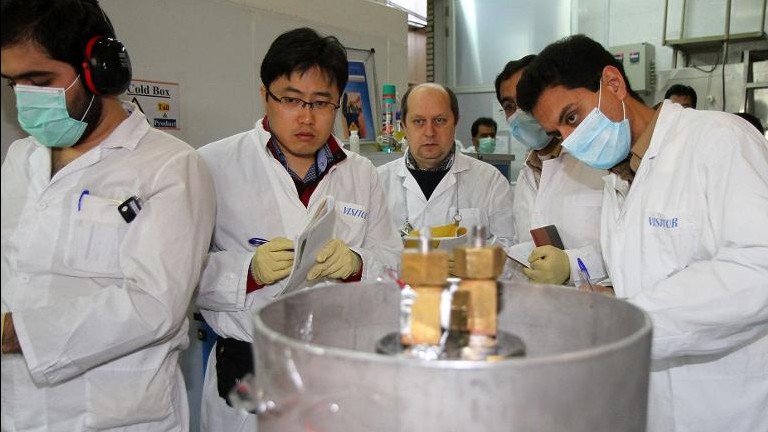
Iran on Wednesday warned that it would start limiting international inspectors’ access to its nuclear sites as it continues to move away from its commitments under the nuclear deal.
Hossein Naghavi-Hosseini, the spokesman for the Iranian parliament’s national security committee, said that Iran was taking the step because “when the other party doesn’t fulfill its commitments, there is no necessity for us to meet our part of commitments.”
“In the fourth step of reducing JCPOA (Joint Comprehensive Plan of Action) commitments, we will probably impose limits on inspections, which means the International Atomic Energy Agency’s surveillance on Iran’s nuclear activities will be reduced,” the Guardian newspaper quoted him as saying.
“Europeans have not honored their part of the commitments and we have not seen any practical step taken by the other side,” he said.
Iran has steadily increased its breaches of the nuclear accord as it pushes its European partners to find a way around US sanctions that have kept it from selling oil abroad and crippled the Iranian economy.
Also Wednesday, France urged Iran to stop violating the accord.
“Iran must abstain from crossing an especially worrying new phase of new measures that could contribute to an escalation in tensions,” French Foreign Ministry spokeswoman Agnès von der Muhll said, according to the Reuters news agency.
She was referring to an announcement last week that Iran plans to start using a new array of advanced centrifuges for enriching uranium.
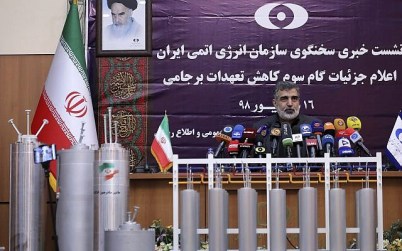
Ali Akbar Salehi, the country’s nuclear chief, told Iranian state TV that an array of 30 IR-6 centrifuges will be inaugurated in the coming weeks.
Under the terms of its 2015 deal — which the US unilaterally withdrew from over a year ago — Iran had committed to not using the array until late 2023.
Salehi also said Iran is now producing up to six kilograms of enriched uranium daily.
“It means we have restored pre-deal” capacity, he said.
In September, Iran inaugurated an array of 20 IR-6 centrifuges that can produce enriched uranium 10 times as fast as the IR-1 that Iran was already using.
Iran is currently enriching uranium to about 4.5%. Prior to the nuclear deal, it only reached up to 20%, which is a short technical step away from the weapons-grade levels of 90%.
Iran denies that it seeks nuclear weapons. Prime Minister Benjamin Netanyahu, who opposed the 2015 deal, insists that Tehran is seeking a nuclear arsenal, and is hiding parts of its program
Regional tensions spiked last month after a drone and missile attack on Saudi Arabia’s largest oil facility that shook global energy markets. The US said Iran was behind the attack. Tehran denied the charge and said any retaliatory strikes by the US or Saudi Arabia could lead to “all-out war.”




 anneinpt
 artaxes
 danmillerinpanama
 davidking1530
 Peter Hofman
 Joseph Wouk
 Peter
Peter Louisiana Steve


Recent Comments