US envoy: Iran has spent $16 billion on militias in Iraq, Syria 

Posted November 1, 2019 by Joseph Wouk
Categories: Uncategorized

Source: US envoy: Iran has spent $16 billion on militias in Iraq, Syria | The Times of Israel

Remarks by Brian Hook come amid growing concern in Israel over potential attack by Tehran in retaliation for efforts to thwart arming of Iranian proxies

Brian Hook, the US State Department special representative for Iran, testifies during a Senate Foreign Relations Committee hearing on US policy toward Iran, October 16, 2019, in Washington. (Tasos Katopodis/Getty Images/AFP)

Brian Hook, the US State Department special representative for Iran, testifies during a Senate Foreign Relations Committee hearing on US policy toward Iran, October 16, 2019, in Washington. (Tasos Katopodis/Getty Images/AFP)

The US envoy for Iran said Thursday that Tehran has funded militia groups in Syria and Iraq to the tune of $16 billion.

US State Department Special Representative for Iran Brian Hook, who made the comments in an interview with Saudi broadcaster Al Arabiya, did not specify over what time period the money was sent.

Iran has longstanding ties to a number of armed Shiite groups in Iraq and was a key backer of the Popular Mobilization Forces, a paramilitary group that fought against the Islamic State jihadist organization.

In Syria, Iran supports militias fighting on behalf of its ally Syrian President Bashar Assad in that country’s civil war.

Tehran also backs other armed factions such as Lebanon’s Hezbollah terror group and the Houthis in Yemen.

In this photo from June 23, 2017, supporters of Iraqi Hezbollah brigades march on a representation of an Israeli flag with a portrait of late Iranian leader Ayatollah Khomeini and Iran’s Supreme Leader Ayatollah Ali Khamenei, in Baghdad, Iraq. (AP Photo/Hadi Mizban, File)

Israel has accused Iran of seeking to place advanced weaponry in Iraq and Syria that could be used to target the Jewish state. On Monday, Prime Minister Benjamin Netanyahu said Iran was trying to launch precision-guided missiles at Israel from Yemen and elsewhere in the region.

On Wednesday, Israeli Air Force chief Amikam Norkin said the military’s multi-tiered network of air defense systems was “on alert” amid a general threat of attack by Iran.

In recent weeks, the military has begun to believe that Tehran intends to eventually retaliate against Israel’s regular airstrikes against its forces and proxies in the region.

Iran appears to have been building up its drone activities and attacks in recent months. In August, Israeli fighter jets carried out airstrikes in Syria to thwart a planned attack on Israel by Iran-backed fighters using armed drones, the Israel Defense Forces said. The Israeli military said its strike targeted operatives from Iran’s Islamic Revolutionary Guard Corps’ Quds Force as well as Shiite militias who had been planning on sending “kamikaze” attack drones into Israel armed with explosives.

Israel has vowed to prevent Iran’s regional proxy militias from obtaining advanced weapons to use against the Jewish state and has carried out hundreds of airstrikes in Syria that it says were to prevent delivery of weapons and to stop Iranian military entrenchment in that country.


Netanyahu: Iran emboldened by lack of response to its attacks

Posted November 1, 2019 by Joseph Wouk
Categories: Uncategorized

Source: Netanyahu: Iran emboldened by lack of response to its attacks | The Times of Israel

After series of strikes attributed to Tehran go unanswered, PM warns ‘threats are popping up’ all over Middle East, says Israel ‘won’t turn the other cheek’

Prime Minister Benjamin Netanyahu speaks during a joint press conference with US Treasury Secretary Steven Mnuchin (not pictured) in Jerusalem October 28, 2019. (Ronen Zvulun/Pool/AFP)

Prime Minister Benjamin Netanyahu speaks during a joint press conference with US Treasury Secretary Steven Mnuchin (not pictured) in Jerusalem October 28, 2019. (Ronen Zvulun/Pool/AFP)

Prime Minister Benjamin Netanyahu on Thursday said Iran was emboldened by the lack of a response to a series of attacks in the Middle East attributed to the Islamic Republic.

Speaking at a ceremony for graduates of the Israel Defense Forces’ officers course, Netanyahu warned of growing threats from Iran and its regional proxies, who he said are working to build up their arsenals.

“The area around us is turbulent and stormy. The threats are popping up in every corner — in Syria, Lebanon, the Gaza Strip and also in Iraq, in Yemen and directly in Iran. Iranian and pro-Iranian forces are working nonstop to arm themselves,” he said.

Netanyahu, who is also defense minister, said Israel would respond harshly to any attempt to harm it, suggesting that other countries’ failure to do likewise was encouraging Iran.

“We’re prepared for the threats and we won’t hesitate to land a tough blow on whoever tries to harm us. Iran’s brazenness in the region is increasing and even getting stronger in light of the absence of a response,” he said.

“But Israel won’t turn the other cheek,” Netanyau added. “Whoever is bent on aggression… will pay a heavy price.”

Netanyahu did not specify whose lack of response was emboldening Iran, but his comments came after a series of attacks in the Persian Gulf on US assets and American allies.

During a trip organized by the Saudi information ministry, workers fix the damage in Aramco’s oil separator at processing facility after the September 14 attack in Abqaiq, near Dammam in the Kingdom’s Eastern Province, September 20, 2019. (AP Photo/Amr Nabil)

In June, US President Donald Trump called off a retaliatory strike after Iran downed an American drone that Tehran said entered its airspace. The US, which denied the drone entered Iranian skies, was later reported to have launched a cyberattack on Iran.

Last month, around half of Saudi Arabia’s oil production capacity was knocked offline due to an attack claimed by the Iranian-backed Houthi rebels in Yemen. There was no response to that attack, which the US, Israel and others also blamed on Iran.

Netanyahu, who has developed close ties with Trump, has not publicly commented on the lack of a US or Saudi response but has emphasized of late that Israel can defend itself.

Visitors look at a Hoveizeh 8 cruise missile at a military show marking the 40th anniversary of Iran’s Islamic Revolution in Tehran, Iran, February 3, 2019. (AP/Vahid Salemi)

Israel is now bracing for a similar assault to the one on Saudi Arabia, which involved armed drones and cruise missiles, with Hebrew media reporting earlier this month that the defense establishment was analyzing the strike on the Saudi oil facilities.

The chief of the Israeli Air Force said Wednesday the military’s multi-tiered network of air defense systems was  “on alert” amid a general threat of attack by Iran.

In recent weeks, the military has begun to believe that Tehran intends to eventually retaliate against Israel’s regular airstrikes against its forces and proxies in the region.

Israel has vowed to prevent Iran’s regional proxy militias from obtaining advanced weapons to use against the Jewish state and has carried out hundreds of airstrikes in Syria that it says were to prevent delivery of weapons and to stop Iranian military entrenchment in the country.


Netanyahu told ministers US can’t be counted on against Iran — report

Posted November 1, 2019 by Joseph Wouk
Categories: Uncategorized

Source: Netanyahu told ministers US can’t be counted on against Iran — report | The Times of Israel

Statement from prime minister Thursday that Iran is growing bolder given lack of US response was public hint at growing unease expressed privately, according to Channel 13 news

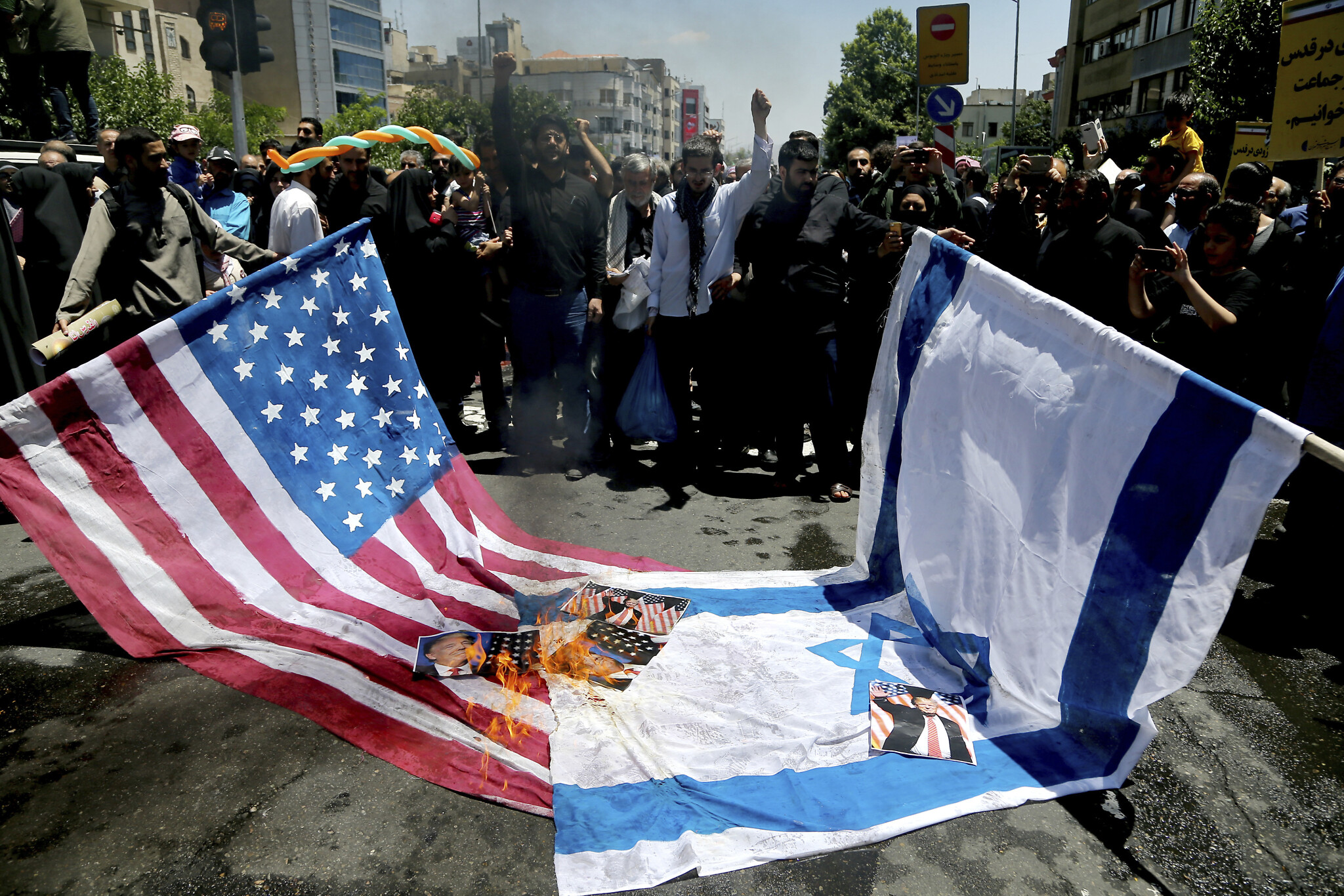
Iranian protesters burn Israeli and US flags in their annual anti-Israeli Al-Quds, Jerusalem, Day rally in Tehran, Iran, Friday, June 8, 2018. (AP/Ebrahim Noroozi)

Prime Minister Benjamin Netanyahu told a group of ministers recently that they should not expect the US to take serious action against Iran for at least the next year, according to a report Thursday.

Netanyahu on Thursday hinted publicly for the first time at unease with Washington’s hesitancy to take action, echoing statements in recent weeks from officials speaking off the record about Iran’s growing boldness.

“Iran’s brazenness in the region is increasing and even getting stronger in light of the absence of a response,” he said at an IDF officer’s graduation ceremony.

Privately, according to a report from Channel 13 news Thursday, he has been more vocal.

Prime Minister Benjamin Netanyahu chairs the weekly cabinet meeting at his office in Jerusalem, Sunday, Oct. 27, 2019. (Gali Tibbon/Pool Photo via AP)

Several weeks ago, Netanyahu told cabinet members in a closed-door meeting that US President Donald Trump would not act against Iran until US general elections in November 2020 at the earliest, according to the report.

The report, which did not cite a source for the information, said Netanyahu told the ministers that in the interim Israel would have to deal with Iran on its own.

Israeli military officials have expressed fears in recent days that Iran is beginning to respond to Israeli attacks on its positions in Syria, emboldened by a perceived lack of resolve from the US, which has signaled its disengagement from the region.

On Wednesday, Air Force Chief Amikam Norkin said Israel’s complete air defense array had been placed on alert to guard against missile or drone attacks from Iran or proxies across the region.

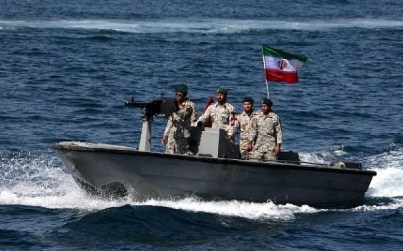
In this file photo taken on April 30, 2019, Iranian military personnel ride in a patrol boat as they take part in the ‘National Persian Gulf Day’ in the Strait of Hormuz (Photo by ATTA KENARE / AFP)

Tensions surrounding Iran have ramped up in recent months, with the US sending extra troops and a warship to the Persian Gulf, but Washington has mostly shied from responding following a series of attacks on oil assets blamed on Iran.

The Iranian downing of a US drone also elicited no military response, with Trump calling back an air strike after planes were already in the air.

US President Donald Trump speaks at the 9th annual Shale Insight Conference at the David L. Lawrence Convention Center, in Pittsburgh, October 23, 2019. (Evan Vucci/AP)

The White House’s decision to pull troops out of northern Syria and abandon Kurdish allies there has also been seen as a sign of Trump’s lack of willingness to engage militarily in the region.

Trump ran on a campaign of “America First” isolationism and has sought to end US military operations abroad to a large degree, announcing troop pullouts from Afghanistan and Syria.


All air defense systems on alert amid Iran attack fears — general 

Posted November 1, 2019 by Joseph Wouk
Categories: Uncategorized

Source: All air defense systems on alert amid Iran attack fears — general | The Times of Israel

Air Force chief says challenge of intercepting missiles becoming more complicated, days after Netanyahu accused Iran of seeking to target Israel with cruise missiles from Yemen

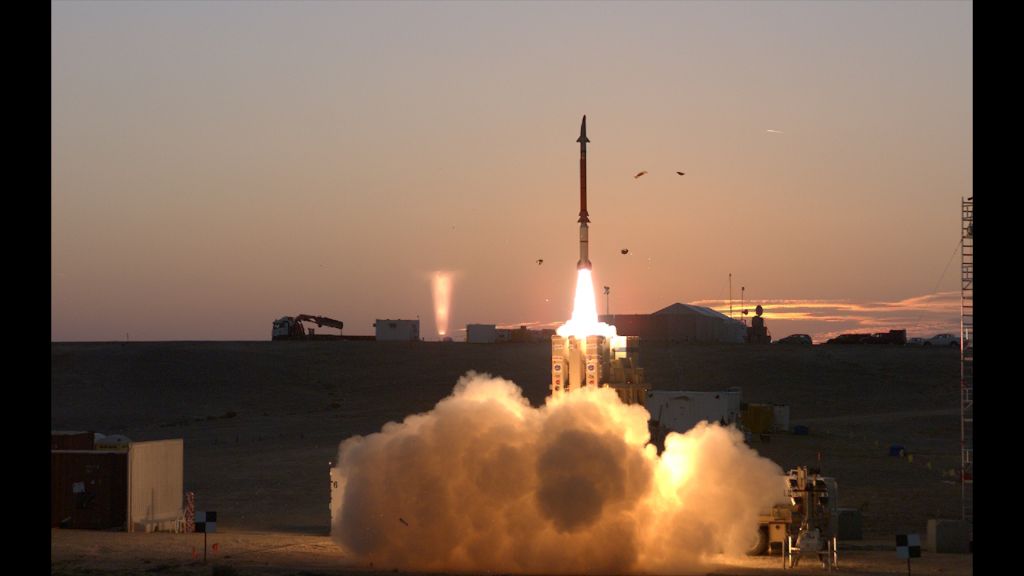
A test of the David's Sling missile defense system. (Defense Ministry)

A test of the David’s Sling missile defense system. (Defense Ministry)

Israeli Air Force chief Amikam Norkin on Wednesday said the military’s multi-tiered network of air defense systems were “on alert” amid a general threat of attack by Iran.

In recent weeks, the military has begun to believe that Tehran intends to eventually retaliate against Israel’s regular airstrikes against its forces and proxies in the region.

The Israel Defense Forces believes this could take the form of a large-scale attack involving cruise missiles and attack drones, similar to the strike on Saudi Arabia’s Aramco petroleum facility that was attributed to Iran.

Earlier this week, Prime Minister Benjamin Netanyahu said Iran intends to attack Israel from Yemen, which may make intercepting such a strike more difficult as the IDF’s intermediate and long-range air defenses are better positioned to shoot down incoming attacks from Israel’s north, rather than from the south.

Israeli Air Force commander Maj. Gen. Amikam Norkin shakes hands with new air defense officers at a graduation ceremony on October 30, 2019. (Israel Defense Forces)

“Even as we speak, Arrow, Patriot, David’s Sling and Iron Dome batteries are on alert,” Norkin said Wednesday night at a graduation ceremony for air defense officers.

The air defense chief was referring to each of the military’s air defense systems, from the Arrow and Patriot systems, which are designed to destroy incoming long-range missiles and aircraft, to the mid-range David’s Sling, and the Iron Dome system, which can shoot down short-range rockets and small drones.

“The challenge of air defense has become more complicated. Joining the threat of missiles and rockets are now attack drones and cruise missiles,” he said.

Unlike ballistic missiles, which usually fly through a high arc on the way to the target, cruise missiles and drones fly at low altitude, making them harder to detect and intercept.

Iran appears to have been building up its drone activities and attacks in recent months. In August, Israeli fighter jets carried out airstrikes in Syria to thwart a planned attack on Israel by Iran-backed fighters using armed drones, the IDF said at the time.

The Israeli military said its strike targeted operatives from Iran’s Islamic Revolutionary Guard Corps’ Quds Force as well as Shiite militias, including the Hezbollah terror group, who had been planning on sending “kamikaze” attack drones into Israel armed with explosives.

Israel has vowed to prevent Iran’s regional proxy militias from obtaining advanced weapons to use against the Jewish state and has carried out hundreds of airstrikes in Syria that it says were to prevent delivery of weapons and to stop Iranian military entrenchment in that country.

Times of Israel staff contributed to this report.


Soleimani takes helm of Iraqi security from prime minister Abdul-Mahdi – DEBKAfile

Posted November 1, 2019 by Joseph Wouk
Categories: Uncategorized

Source: Soleimani takes helm of Iraqi security from prime minister Abdul-Mahdi – DEBKAfile

Desperate to quell the bloody protests spreading through Iraq, Iranian Gen. Qassem Soleimani flew into Baghdad and seized control of its army and security services.

On Wednesday, Oct. 30, a special helicopter carried the Revolutionary Guards Al Qods chief from Baghdad international airport to the capital’s fortified Green Zone. In the prime minister’s office, he found a meeting in progress of military and security chiefs on ways to hold back the resurgent protest that from Oct. 25 had already claimed hundreds of dead and thousands of injured as it raged through Baghdad and the Shiite towns of the south.

Soleimani who swept into the meeting with a party of aides took the chair from Iraqi prime minister Adel Abdul-Mahdi. He then told the commanders gathered there, “We in Iran know how to deal with protests. This happened in Iran and we got it under control.”

It was obvious to the Iraqi officials present that the Iranian general was taking charge, DEBKAfile’s sources report. This was effectively an Iranian coup for the takeover of Iraq’s political and security leadership. This extreme step was intended to hold back the free fall of Tehran’s influence in Baghdad as well as Beirut – under the mounting weight of popular disaffection in Iraq and Lebanon.

In Lebanon, Iran failed to stop Saad Hariri from stepping down as prime minister and bringing down the government. Hariri was useful to Tehran because he was amenable to handing its proxy, Hizballah, a leading role in government and cooperating with Iranian interests in the country. His exit heightened the prospects of the national unity protest movement, demonstrating for more than two weeks, attaining their goal of a non-secular government led by technocrats and free of Iranian/Hizballah mastery. For the Islamic revolutionary regime in Tehran, this would be a crushing loss.

In Iraq, too, Abdul-Mahdi is ready to step down – against Tehran’s wishes. He is only waiting to find a suitable candidate to take over the premiership in an orderly transition.
Iran’s position is therefore reeling in its two key spheres of influence. The emergency brought Soleimani over for hands-on remedies. He appears to have left it too late.


Lebanon’s plunge into civil warfare shakes Iran, Hizballah as Mid East powerhouses – DEBKAfile

Posted October 30, 2019 by Joseph Wouk
Categories: Uncategorized

Source: Lebanon’s plunge into civil warfare shakes Iran, Hizballah as Mid East powerhouses – DEBKAfile

The Hizballah “special forces” battling Lebanese protesters are bound to swap their sticks for live ammo as Lebanon plunges into regime breakup amid a crumbling economy.

Saad Hariri’s resignation as prime minister on Tuesday, Oct. 29, did not of itself greatly impact the declining political situation in Beirut – not only because he was not a strong leader, but because the sustained protest across the country had already cast Lebanon into three major power groupings in which he had no place:
DEBKAfile outlines those groupings:

  1. The ruling caste led by President Michel Aoun and kin who are standing aloof from the turbulence on the streets.
  2. The protesters who have managed to sustain the momentum of their demonstrations into a third week, while also preserving their non-secular national unity of purpose – hitherto unheard of in divided Lebanon – in their fight to be rid of a corrupt ruling administration. This could throw the country into chaos or end in each group reverting to its ethnical-religious roots for civil war.
  3. Hizballah, which is watching its power bases in central government fall apart. While sending his “special forces” to break up the street demonstrations by force, Hizballah’s leader Hassan Nasrallah made the fatal mistake, maybe out of panic, of lining up with the central government targeted by the protest movement. This gave credence to the demonstrators’ demand to remove Hizballah from any new national ruling administration resulting tomorrow from their struggle.

It may be taken for granted that that Lebanon’s various religious and ethnic groups and factions have reacted to the burgeoning power of the street by busily topping up their stores of weapons, ready to set up the lines for defending their communities. The elements of civil war are therefore already being put in place.

Here, Hizballah has the advantage – a paramilitary armed force unmatched by any of its rivals. This Shiite group commands 25,000 men under arms, of whom 6,000 spent six years on the battlefields of Syria, and an arsenal provided by Iran of some 130,000 assorted rockets. No rival group has the slightest chance of prevailing over Nasrallah’s army.

Iran deploys precision-missiles to Yemen for attacks against Israel – TV7 Israel News 29.10.19 

Posted October 30, 2019 by Joseph Wouk
Categories: Uncategorized


Israeli embassies on alert, air defenses adjusted in face of Iran threat 

Posted October 29, 2019 by Joseph Wouk
Categories: Uncategorized

Source: Israeli embassies on alert, air defenses adjusted in face of Iran threat – Israel News – Jerusalem Post

IDF Chief of Staff Lt.-Gen. Aviv Kochavi and Prime Minister Benjamin Netanyahu have warned in recent days of the increased threat posed by the Iran.

BY ANNA AHRONHEIM
 OCTOBER 29, 2019 12:23
Israeli embassies on alert, air defenses adjusted in face of Iran threat

Israel’s Air Force has adjusted its air defenses, and several Israeli embassies around the world have raised their alert level in light of increased tensions from Iran.

According to reports in Hebrew-language media, a series of adjustments were made to IAF air defense systems in light of the fear that Iran might try to carry out an attack using cruise missiles or suicide drones similar to the October attack against Saudi Arabia.

IDF Chief of Staff Lt.-Gen. Aviv Kochavi and Prime Minister Benjamin Netanyahu have warned in recent days of the increased threat posed by the Islamic Republic, which they say is getting bolder and more willing to respond to Israeli attacks on Iranian and Iranian-backed militias and infrastructure.

“Iran wants to develop precision-guided missiles that can hit any target in Israel within 5-10 meters: It’s doing it,” Netanyahu said Monday evening during an event at the Jewish Agency.  “Iran wants to use Iraq, Syria, Lebanon and Yemen as bases to attack Israel with statistical missiles and precision-guided missiles. That is a great, great danger.”

At the event, United States Treasury Secretary Steven Mnuchin added that the US is planning more sanctions to place on Iran in its “maximum pressure campaign.”

While Iran has several rockets which could reach Israeli territory, including the Khoramshahr 2 with a range of up to 2,000 kilometers, it is unclear if they transferred such missiles to Yemen.

According to a report in the online magazine Breaking Defense, Israel has recently upgraded the Barak-8ER system with an extended range to protect against cruise missiles, a land-based configuration of the long-range surface-to-air missile (LRSAM) or the Barak-8 naval air defense system.

Boaz Levy, Israel Aerospace Industries VP and general manager, was quoted in the report as saying that the upgraded version of the Barak-8ER system has enhanced anti-tactical ballistic missile capabilities and will be capable of protecting Israeli cities from cruise missiles.

Able to shoot down enemy aircraft at a range of 90 kilometers, the Barak-8ER is designed to defend against a myriad of short- to long-range airborne threats such as incoming missiles, planes and drones at both low or high altitudes. In July, the Israeli military successfully tested the Barak 8, intercepting a small drone simulating an enemy aircraft.

The system integrates several advanced state-of-the-art systems including a digital radar, a command and control system, tracking radar launchers, interceptors with advanced homing radio frequency (RF) seekers for targets with low radar cross sections and high maneuverability, data link and system-wide connectivity. It is also able to engage multiple targets simultaneously in severe saturation scenarios and can be operated in all types of weather.

In addition to the Barak-8ER, Israel has a comprehensive, protective umbrella able to counter the growing missile threats from its enemies, which includes the Iron Dome designed to shoot down short-range rockets; the Arrow (Arrow-2 and Arrow-3) system which intercepts ballistic missiles outside of the Earth’s atmosphere; and the newly operational David’s Sling missile defense system which is designed to intercept tactical ballistic missiles, medium- to long-range rockets, and cruise missiles fired at a range of between 40 km. to 300 km.

Israel continuously improves the technology behind the country’s anti-missile systems; all systems have gone through upgrades over the past few years.

Israel also has three Patriot system batteries and has used them against suspicious aerial vehicles, including shooting down drones and a Syrian Sukhoi fighter jet that infiltrated into Israel’s northern Golan Heights last year.

Tzvi Joffre contributed to this report.


Is Israel equipped to win a war against Iran? 

Posted October 29, 2019 by Joseph Wouk
Categories: Uncategorized

Source: Is Israel equipped to win a war against Iran? – Israel News – Jerusalem Post

While Israel’s Air Force is strongest in the region, it’s old.

BY ANNA AHRONHEIM
 OCTOBER 29, 2019 16:55
IDF weapons

In an attempt to degrade the Iranian threats, Israel has been carrying out a war-between-wars campaign since 2013 against Iranian and Hezbollah targets. This past year saw the most operational activity in that campaign since it began, on all borders and beyond.

It’s an effective campaign, but the increased instability in the Middle East as well as Iran’s continued work on their long-range precision missile project, has led the IDF to assess that the chances for direct confrontation has gone up significantly.

Despite the fact that Israel’s enemies are not interested in war, the IDF has “increased it’s pace of preparations” for confrontation, IDF Chief of Staff Lt.-Gen. Aviv Kochavi told journalists on Wednesday. “On both the northern and southern fronts the situation is tense and fragile and deteriorate into a confrontation,” he said.

In response, Israel has increased their defenses. The IDF has also published it’s new multi-year plan for the military. The “Momentum” plan aims to make it deadlier, faster and better trained to go up against the threats facing it and plans to procure a significant amount of precision guided missiles and mid-sized drones as well as additional air defense batteries using money from the $3.8 billion a year Israel receives from the United States every year under the 2016 Memorandum of Understanding.

But the heavy cost of the multi-year plan needs a budget in order to pay for the new weapons and defensive systems and with no government sitting in the Knesset, the Finance Ministry has not approved the necessary budget increase.

Israel’s Air Force – while the strongest in the region – needs to procure new fighter jets, helicopters and refueling tankers in order to win a war against a foe over 2,000 kilometers away.
Many of the IAF’s aircraft are between 30-50 years old and a deal to purchase new aircraft has been reported to cost an estimated $11 billion.

First used by the IAF in 1969, the Yas’ur helicopters are the air force’s primary helicopter used regularly to transport soldiers and equipment. While the ageing helicopters have been upgraded with 20 new electronic systems and missile defense, the IAF will still need to replace them by 2025 when they will be over 50 years old.

In March, the annual State Comptroller report recommended that the IAF replacing the ageing aircraft as soon as possible as “prolonging the life of the Yas’ur is liable to endanger human life and may have significant operational implications and substantial maintenance costs.”

The IAF plans to buy some 20 new heavy-lift helicopters—in other words, one squadron—to replace the current CH-53 Sea Stallion squadron at the Tel Nof Base: Lockheed Martin Sikorsky’s CH-53K King Stallion, the same maker of the Yas’ur, and Boeing’s Ch-47F Chinook helicopter.

But, the decision between the two hasn’t been made yet and the longer it takes to sign a contract to replace the Yas’ur, the possibility of a failure in the platform increases.

In parallel to the helicopters, the IAF needs to retain it’s qualitative military edge and modernize an essential squadron of its fighter fleet. Israel’s Air Force is also set to decide on a third squadron of F-35I jets or Boeing’s latest F-15I fighter jets.

The IAF has already received 12 F-35I “Adir” stealth fighter jets built by Lockheed Martin and is expected to receive a total of 50 to make two full squadrons by 2024.

In addition to the fifth-generation F-35I, Israel is in dire need of new fighter aircraft before the current ones reach the end of their life-cycle, something which is creeping ever closer. Most of the IAF’s F-15s are over 30 years old with the majority acquired in the second half of the 1970s and a more advanced squadron of F-15s arrived in Israel in the 1990s.

Israel’s Air Force is leaning towards a mix of both the F-35s and F-15is, allowing the IAF to carry out a number of complex operations, including any possible confrontation with Iran on its borders.

While it is considered one of the world’s most advanced fighter jet, the stealth F-35I aircraft is limited in the weapons they are able to carry as they have to be stored in internal munition boxes in order to maintain a low radar signature.

The F-15I model that Israel is interested in purchasing is able to carry large quantities of various types of munitions, advanced radar systems, and various other upgrades to the earlier models. Since it is not a stealth plane, Boeing has designed its wings to be able to carry additional bombs and missiles.

In addition, the IAF is also leaning towards purchasing the V-22 tilt-rotar aircraft which would allow for special operations.

But if a confrontation breaks out far from Israel’s borders, the IAF will need a refueler for its jets. Many of the current refueler aircraft which are required for long-range missions, the Re’em (Boeing 707) tankers, are nearing the age of 60 and due to their age, Israel has been forced to find replacement parts by dismantling older planes bought from countries like Brazil or online.

While the IAF is said to be considering buying used Boeing 767 commercial aircraft and converting them for airborne refuelling of combat planes, it is also considering Boeing’s KC-46 tanker which has a range of 11,830 km and the capacity to unload some 207,000 pounds of fuel in over 64 different types of aircraft.

The decisions need to be made as soon as possible and to do so, Israel needs to form a government to allow the military to make a proper budget.

There’s no more time to waste.

A comparison by international defense site Global Firepower (GFP) found that Israel’s military slipped below it’s arch-nemesis Iran in the ranking of military powers, coming in at 17 versus 14.

The site allows for one to compare two specific countries against each other, showing military data such as total manpower available, active personnel, total amount of reservists, and total military personnel.  The site also shows the total amount of arms such as aircraft, tanks, naval assets as well as artillery strength.

According to the site Israel’s total military personnel stands at an estimated 615,000 compared to Iran’s 934,000. But Iran’s total population is significantly larger than Israel at 83,024,745 versus Israel’s 8,424,904.

A comparison between Iran and Israel shows that while Iran had a significantly larger naval assets than Israel (398 versus 65), while Israel had far greater tank strength (2,760 versus 1,634) and has some 6,541 armored fighting vehicles compared to Iran’s 2,345. According to the site, the total amount of aircraft between the two countries are close with Israel having 595 versus Iran’s 509.

Iran has been working to bolster the country’s ageing naval fleet and has commissioned its first indigenously developed Fateh-class submarine outfitted with a guided-missile system capable of launching submarine-launched cruise missiles as well as anti-ship missiles and torpedoes.

While Tehran has said that it’s missile program is defensive in nature and provides deterrent capabilities, Israel and the United States have repeatedly warned against Iran’s missile program, claiming that the missiles tested by Tehran are capable of carrying nuclear warheads.

 

Gantz: I’ll always prefer diplomacy to thwart Iran, but all options on the table

Posted October 29, 2019 by Joseph Wouk
Categories: Uncategorized

Source: Gantz: I’ll always prefer diplomacy to thwart Iran, but all options on the table | The Times of Israel

Addressing Jewish Agency leaders, prime ministerial hopeful vows to advance frozen Western Wall agreement and to nurture religious pluralism

Benny Gantz speaking at the Jewish Agency's Board of Governors in Jerusalem, October 29, 2019 (Ofek Avshalom)

Benny Gantz speaking at the Jewish Agency’s Board of Governors in Jerusalem, October 29, 2019 (Ofek Avshalom)

Blue and White Benny Gantz said Tuesday he would always prefer diplomatic means to prevent Iran from acquiring nuclear weapons capability, though he stressed that, if all else fails, “all options are on the table.”

Addressing the Jewish Agency Board of Governors, which this week convened in Jerusalem, the prime ministerial candidate vowed to implement a plan to upgrade a pluralistic prayer platform at the Western Wall that Prime Minister Benjamin Netanyahu’s government had indefinitely frozen. He also promised to embrace Jewish pluralism.

Israel’s security situation is fragile, and the most acute threat remains Tehran’s nuclear ambitions and its regional aggression, Gantz said.

“All options are on the table to prevent a nuclear Iran, though I will always, and we should always, favor diplomacy,” he declared, speaking in English. “But if we have to, then all options [are] on the table. It’s not a slogan. This is real in life. I know what I’m talking about.”

Gantz, a former IDF chief of staff and political novice, has been accused by his political rivals from right-wing parties as having supported the 2015 nuclear deal six world powers struck with the Islamic Republic.

Netanyahu was one of the accord’s foremost critics, saying it enabled Iran to acquire a large nuclear arsenal within a short amount of time.

These issues require less talk — more action. Through diplomatic channels, backchannels and, if needed, operations

In his 15-minute speech, Gantz did not mention Netanyahu by name but hinted that he is talking too much and doing too little about Israel’s security.

“Blue and White is the biggest faction in Israel’s parliament. Our leadership’s 100 years of combined security expertise is unmatched by any other faction in the building,” he said, referring to party leaders and fellow ex-army chiefs Moshe Ya’alon and Gabi Ashkenazi.

“I am very familiar with the needs, risks and responses required,” Gantz continued. “These issues require less talk — more action. Through diplomatic channels, backchannels and, if needed, operations.”

Citing Israel’s many challenges, he called for a “broad liberal unity government” that was stable, responsible, and pragmatic.

In a dig at Netanyahu, who is suspect in three separate corruption cases, Gantz went on to say that Israelis must know that their leadership “is pragmatic and has a steady hand on the tiller for the good of the State of Israel — not for personal legal issues.”

Gantz dedicated a significant part of his speech to Israel-Diaspora relations, vowing that Jerusalem will always back Jewish communities across the globe.

“As a former chief of staff of the IDF, as the political leader tasked with forming the Jewish state’s next government — and above all, as a Jew — I say to our brothers and sisters around the world: Israel stands with, behind you, and where it’s needed, in front of you,” he said.

Over the last decade, the ties between Jews in Israel and elsewhere — which he called the Jews’ “secret weapon” — have begun to deteriorate, Gantz said.

“When I will be the prime minister of Israel I will embrace all streams of Judaism,” he declared to raucous applause from the Jewish Agency delegates. “We are part of an inspiringly colorful mosaic of cultures and traditions. And I will nurture this pluralism.”

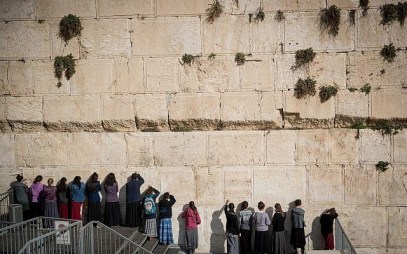
Jewish girls at the pluralistic prayer section at the Western Wall in Jerusalem Old City, January 3, 2018. (Yonatan Sindel/Flash90)

He also promised to “promote the implementation” of a currently frozen agreement to make the Western Wall plaza more accommodating to non-Orthodox streams. “The Western Wall is long enough [for] all of us, together,” he said.

The plan, approved by the cabinet in January 2016, would have seen the establishment of a properly prepared pavilion for pluralistic prayer — as opposed to current temporary arrangements — under joint oversight involving all major streams of Judaism.

Many Jewish organizations, including the Jewish Agency and the Jewish Federations of North America, bitterly denounced the government’s backtracking, threatening to protest until it was reversed.

Netanyahu, however, has consistently rebutted calls to unfreeze the 2016 agreement, citing his ultra-Orthodox coalition partners’ staunch opposition to any move that could be seen as legitimizing pluralistic Judaism.