Iran’s Ayatollah Khamenei renews ban on talks with U.S. – report

Posted November 3, 2019 by Joseph Wouk
Categories: Uncategorized

Source: Iran’s Ayatollah Khamenei renewsan on talks with U.S. – report – Middle East – Jerusalem Post

“America has always borne hostility towards Iran.”

BY SETH J. FRANTZMAN, REUTERS
 NOVEMBER 3, 2019 14:42
Iran's Ayatollah Khamenei renews ban on talks with U.S. - report

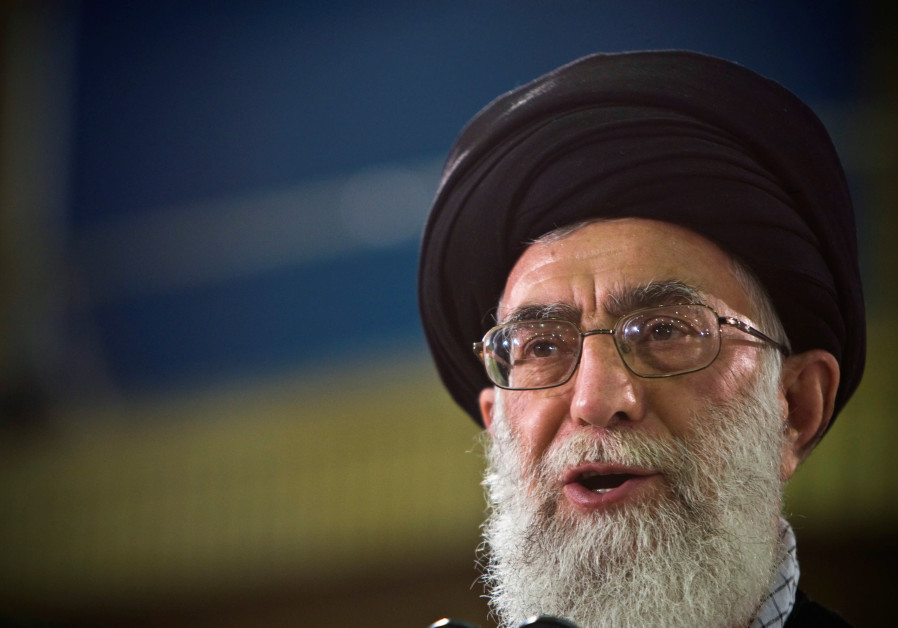
Iran’s Supreme Leader Ayatollah Ali Khamenei sought to prevent negotiations with the US administration of Donald Trump, arguing the Americans will not make any concessions. “Negotiating with the US is futile,” he said Sunday. “Those who believe that negotiations with the enemy will solve our problems are 100% wrong.”

His logic is that the US won’t make concessions. He also said the US wants to bring Iran to the table by forcing it to its knees. “Nothing will reduce sanctions and pressure,” he said. In addition he pointed out that Iran now has precision guided missiles that can travel 2,000km that can hit a target within a meter of accuracy. So why would Iran need to negotiate away its rights to these missiles, he argued.

Relations between the two foes have reached a crisis over the past year after Trump abandoned a 2015 nuclear pact between Iran and world powers under which Tehran accepted curbs to its nuclear program in return for lifting sanctions.

“They are currently saying ‘don’t be active in the region, do not help the resistance [i.e Hezbollah], don’t be in some countries [i.e Syria], and stop your missile defense and production,’” the Ayatollah noted. He said that if Iran bends to these demands then the US will demand Iran become a secular country and let women walk around showing their hair. “American demands will never stop.”

Washington has reimposed sanctions aimed at halting all Iranian oil exports, saying it seeks to force Iran to negotiate to reach a wider deal. Khamenei has banned Iranian officials from holding such talks unless the United States returns to the nuclear deal and lifts all sanctions.

It is a slippery slope for Iran’s regime, if it gives up its missiles, it might have to give up laws trying to control how women dress. It won’t allow the US to trim its air defense or trim its use of the veil. For the supreme leader all are entwined. Khamenei’s comments matter because the Trump administration was rumored to want a meeting with Iran’s President Hassan Rouhani. Now that won’t be in the cards.

Iran has said that it will wait for the next US president. It will not accept any conditions and the US would have to return to the Iran Deal and end sanctions to start any discussion. Iran’s view is that the US has failed in discussions with Cuba and North Korea, so a erratic US administration is not worth dealing with. Anyway, from the regime’s point of view, Iran has been very successful lately in the region.
The anniversary of the seizure of the U.S. embassy shortly after Iran’s 1979 Islamic Revolution is marked in Iran with demonstrations of crowds chanting “Death to America” across the country.

The embassy capture cemented the hostility between the two countries which has remained a central fact in Middle East geopolitics and an important part of Iran’s national ideology. Iran, which accused the United States of supporting brutal policies of its ousted Shah, held 52 Americans for 444 days at the embassy, which it called the Den of Spies.

“The U.S. has not changed since decades ago … it continues the same aggressive, vicious behavior and the same international dictatorship,” Khamenei said.

“America has always borne hostility towards Iran.”


Terror From Gaza 

Posted November 3, 2019 by Joseph Wouk
Categories: Uncategorized


Pentagon releases first video, photos of Delta Force raid on Baghdadi compound 

Posted November 3, 2019 by Joseph Wouk
Categories: Uncategorized

Source: Pentagon releases first video, photos of Delta Force raid on Baghdadi compound | The Times of Israel

Gen. McKenzie says Baghdadi blew up 2 children when he detonated suicide vest; 4 women, 2 men wearing suicide vests killed when refusing surrender; US on alert for ‘retribution’

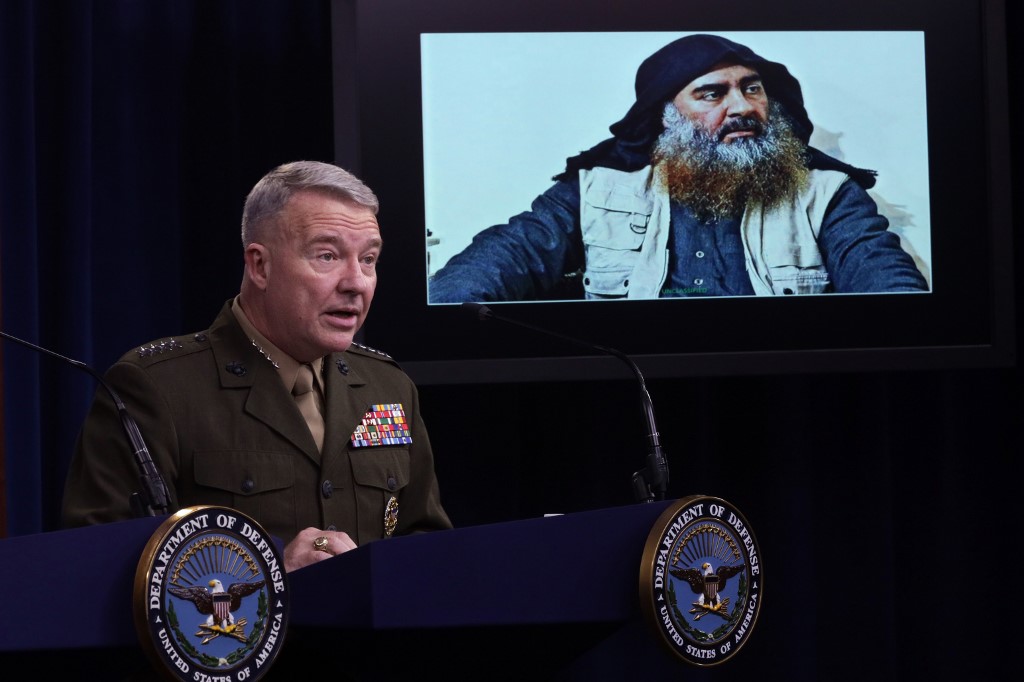
US Marine Corps Gen. Kenneth “Frank” McKenzie, commander of US Central Command, speaks as a picture of Abu Bakr al-Baghdadi is seen during a press briefing October 30, 2019 at the Pentagon in Arlington, Virginia. (Alex Wong/Getty Images/AFP)

WASHINGTON (AP) — The general who oversaw the US raid on Islamic State leader Abu Bakr al-Baghdadi provided the most detailed account yet of the operation Wednesday and said the US is on alert for possible “retribution attacks” by extremists.

Gen. Kenneth “Frank” McKenzie, head of US Central Command, said al-Baghdadi’s remains were buried at sea within 24 hours of his death inside an underground tunnel where he fled as special operations soldiers closed in on him.

The Pentagon released the first government photos and video clips of the nighttime operation, including one showing Delta Force commandos approaching the walls of the compound in which al-Baghdadi and others were found.

Another video showed American airstrikes on other militants who fired at helicopters carrying soldiers to the compound.

Marine Corps Gen. Kenneth “Frank” McKenzie, commander of U.S. Central Command, speaks as a picture of the operation targeting Abu Bakr al-Baghdadi is seen during a press briefing October 30, 2019 at the Pentagon in Arlington, Virginia. (Alex Wong/Getty Images/AFP)

The US also bombed the compound after the soldiers completed the mission so that it would not stand as a shrine to al-Baghdadi.

“It looks pretty much like a parking lot with large potholes right now,” McKenzie said.

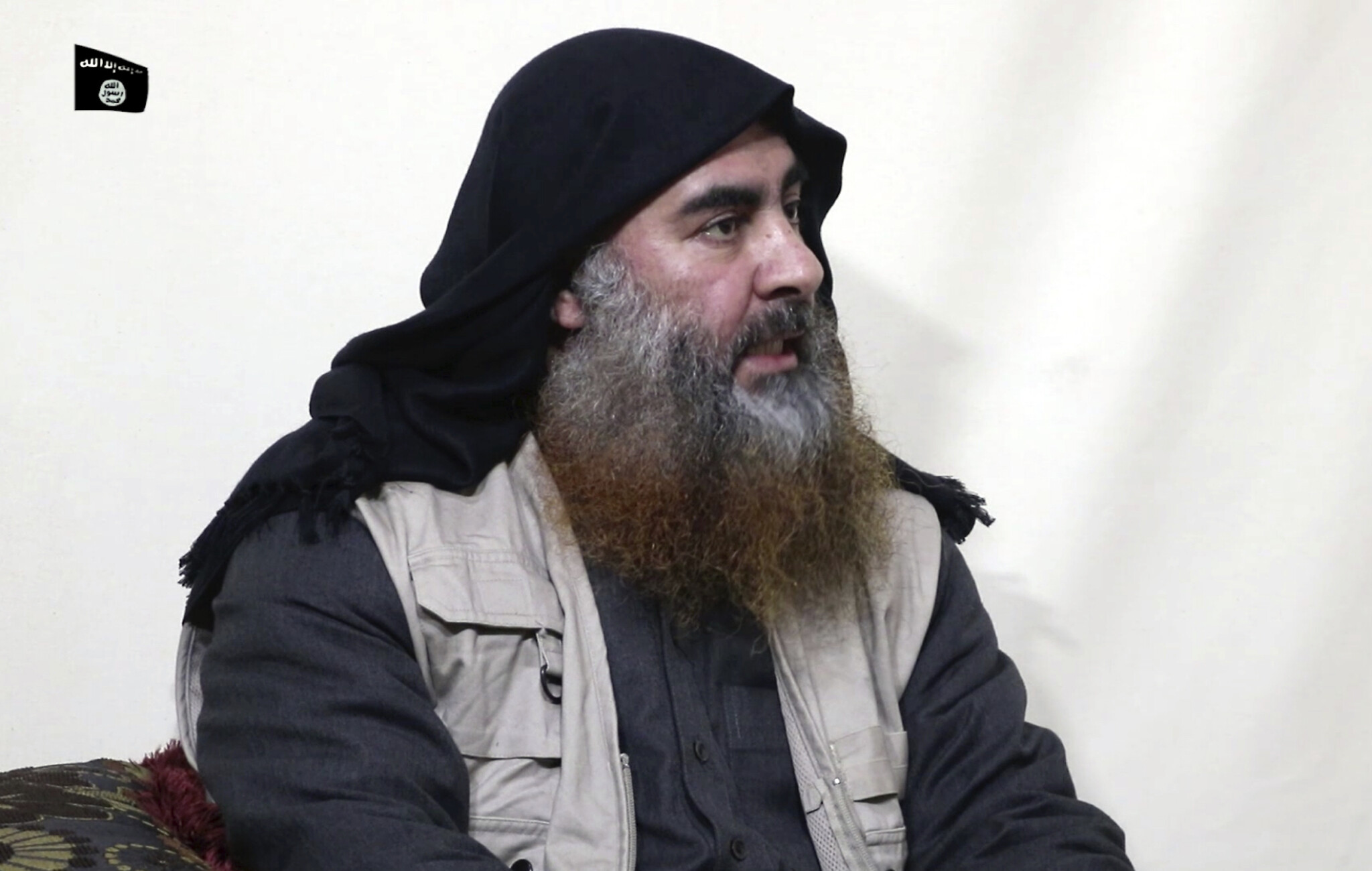
An image made from video posted on a militant website April 29, 2019, purports to show the leader of the Islamic State group, Abu Bakr al-Baghdadi, being interviewed by his group’s Al-Furqan media outlet. (Al-Furqan media via AP, File)

The attacking American force launched from an undisclosed location inside Syria for the one-hour helicopter ride to the compound, McKenzie said.

Two children died with al-Baghdadi when he detonated a bomb vest, McKenzie said, adding that this was one fewer than originally reported. He said the children appeared to be under the age of 12. Eleven other children were escorted from the site unharmed. Four women and two men who were wearing suicide vests and refused to surrender inside the compound were killed, McKenzie said.

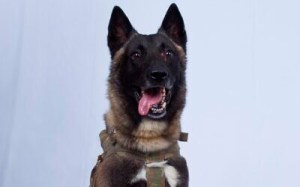
The general said the military dog that was injured during the raid is a four-year veteran with US Special Operations Command and had been on approximately 50 combat missions.

The dog, a male whose name has not been released because the mission was classified, was injured when he came in contact with exposed live electrical cables in the tunnel after al-Baghdadi detonated his vest, McKenzie said. He said the dog has returned to duty.

The military working dog that was injured tracking down Islamic State terror group leader Abu Bakr al-Baghdadi in a tunnel beneath his compound in Syria, in the photo provided by the White House via the Twitter account of US President Donald Trump, after it was declassified by Trump. (White House via AP)

Baghdadi was identified by comparing his DNA to a sample collected in 2004 by US forces in Iraq, where he had been detained.

The US managed to collect “substantial” amounts of documentation and electronics during the raid, McKenzie said, but he would not elaborate. Such efforts are a standard feature of raids against high-level extremist targets and can be useful in learning more about the group’s plans.

Although the raid was successful, McKenzie said it would be a mistake to conclude that the Islamic State has been defeated.

“It will take them some time to re-establish someone to lead the organization, and during that period of time their actions may be a little bit disjointed,” the general said. “They will be dangerous. We suspect they will try some form of retribution attack, and we are postured and prepared for that.”

A working military dog is displayed on a monitor as US Central Command Commander Marine Gen. Kenneth “Frank” McKenzie speaks at a joint press briefing at the Pentagon in Washington, Wednesday, Oct. 30, 2019, on the Abu Bakr al-Baghdadi raid. (AP Photo/Andrew Harnik)

In outlining the operation, McKenzie said al-Baghdadi had been at the compound in Syria’s northwest Idlib province for “a considerable period,” but he was not specific.

He said the raid was briefed to President Donald Trump on Friday, and McKenzie made the decision to go ahead on Saturday morning.

Video of the Abu Bakr al-Baghdadi raid is displayed as U.S. Central Command Commander Marine Gen. Kenneth McKenzie speaks, Wednesday, Oct. 30, 2019, at a joint press briefing at the Pentagon in Washington. (AP Photo/Andrew Harnik)

McKenzie offered no new details about al-Baghdadi’s final moments.

“He crawled into a hole with two small children and blew himself up while his people stayed on the grounds,” he said when asked by a reporter about al-Baghdadi’s last moments and Trump’s description of the Islamic State leader as “whimpering and crying and screaming all the way” to his death.

Other senior Pentagon officials, including Gen. Mark Milley, chairman of the Joint Chiefs of Staff, have said they could not confirm Trump’s description.

Several times this month, President Donald Trump has said he is withdrawing from Syria and that the troops are “coming home.” But, in fact, the US military remains in the country, shifting positions and gearing up to execute Trump’s order to secure Syria’s oil fields — not for the Syrian government but for the Kurds. Trump also has said he wants to “keep” the oil, although it’s unclear what he means.

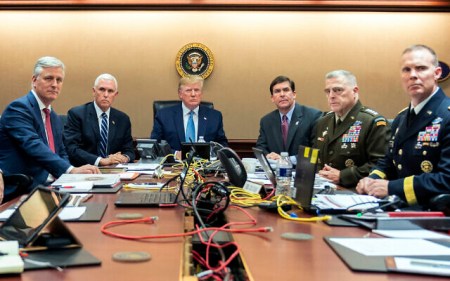
In this photo provided by the White House, US President Donald Trump is joined by from left, national security adviser Robert O’Brien, Vice President Mike Pence, Defense Secretary mark Esper, Joint Chiefs Chairman Gen. Mark Milley and Brig. Gen. Marcus Evans, Deputy Director for Special Operations on the Joint Staff, October 26, 2019, in the Situation Room of the White House in Washington. (Shealah Craighead/The White House via AP)

Earlier Wednesday, the acting homeland security secretary, Kevin McAleenan, told a congressional hearing that US security agencies have been reminded of the potential for al-Baghdadi’s death to inspire his followers to launch an attack “in the immediate aftermath.”

Russell Travers, the acting director of the National Counterterrorism Center, told the same hearing that he does not believe al-Baghdadi’s death will have “much impact” on the organization.

“If there were significant attacks that were in the planning, that planning will continue. It won’t have that much effect,” Travers aid.

Within Syria and Iraq, he added, IS has at least 14,000 fighters.

“That’s an important number,” he said. “Because five, six years ago, when ISIS was at its low point, they were down under a thousand. To us, this tells us the insurgency has a lot of options.”

FBI Director Chris Wray said the biggest concern in the United States was the “virtual caliphate” that inspires Americans to pledge allegiance to IS and commit acts of violence in the group’s name even without traveling to Syria.

Rep. Bennie G. Thompson, a Mississippi Democrat and chairman of the House Homeland Security Committee, said he worries that despite al-Baghdadi’s death, the conditions in Syria “are ripe for ISIS to reconstitute.”


Iraqis focus anger on Iran, as they defy crackdown to hold biggest protests yet |

Posted November 3, 2019 by Joseph Wouk
Categories: Uncategorized

Source: Iraqis focus anger on Iran, as they defy crackdown to hold biggest protests yet | The Times of Israel

Protesters march over an Iranian flag painted on the pavement with a swastika added to it, as many criticize Tehran’s interference

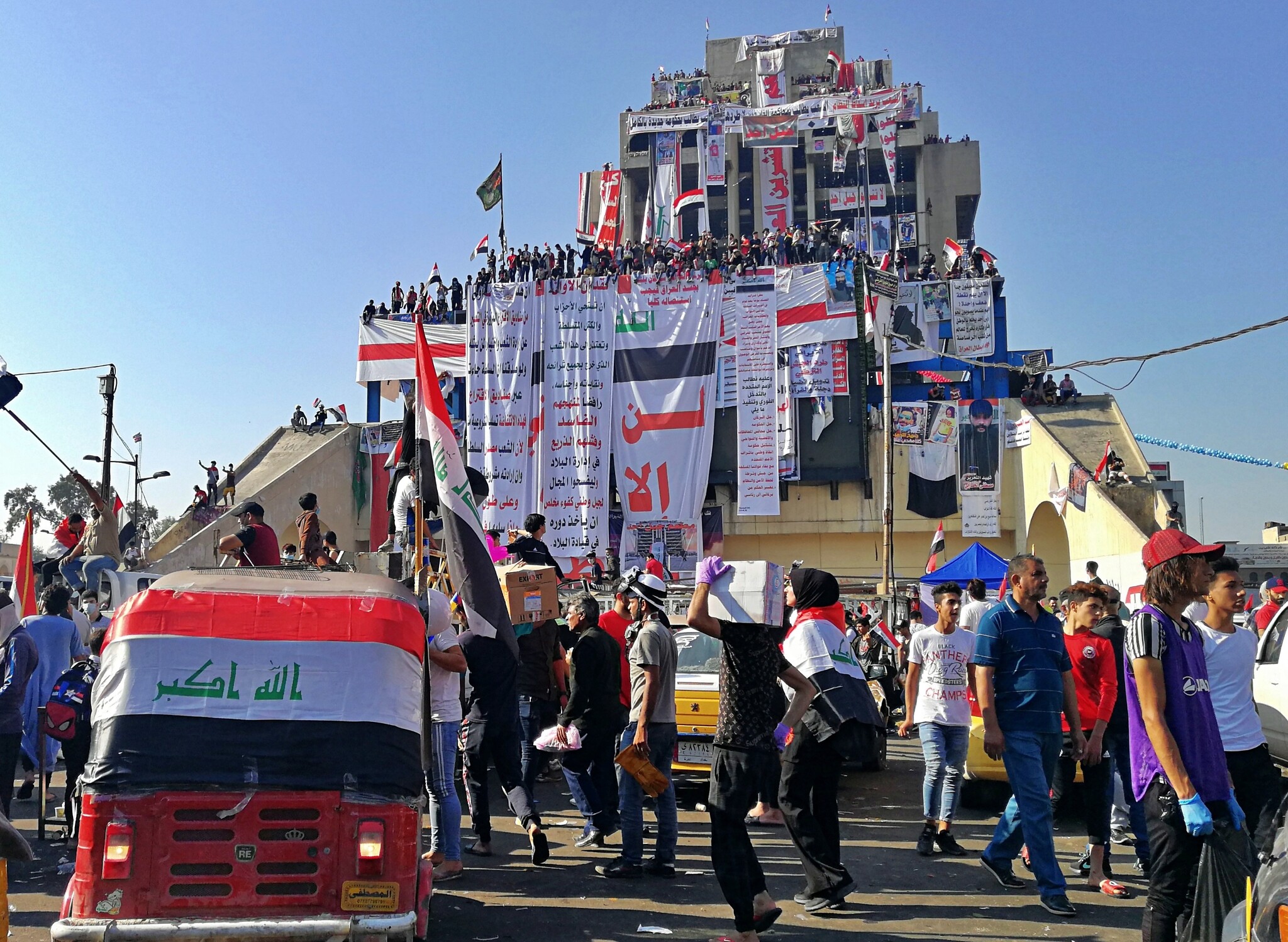
Anti-government protesters gather in Tahrir Square during ongoing protests in Baghdad, Iraq, Friday, Nov. 1, 2019. (AP Photo/Khalid Mohammed)

Anti-government protesters gather in Tahrir Square during ongoing protests in Baghdad, Iraq, Friday, Nov. 1, 2019. (AP Photo/Khalid Mohammed)

BAGHDAD (AP) — Tens of thousands of Iraqis massed in Baghdad’s Tahrir Square on Friday in the biggest demonstrations since anti-government protests erupted a month ago, defying security forces that have killed scores of people and harshly criticizing Iran’s involvement in the country’s affairs.

The square and the wide boulevards leading into it were packed with flag-waving protesters, as security forces reinforced barricades on two bridges leading to the heavily fortified Green Zone, the seat of government. The protesters want sweeping change to the political system established after the 2003 U.S.-led invasion, which they blame for widespread corruption, high unemployment and poor public services.

At least 255 people have been killed in two major waves of protests in the past month, including five who died Friday of wounds sustained earlier, according to security and medical officials who spoke on condition of anonymity because they are not authorized to brief reporters. At least 350 people were wounded Friday as security forces fired tear gas grenades and rubber bullets to drive people back from the bridges.

Many protesters directed their rage at Iran, which emerged as a major power broker after the overthrow of Saddam Hussein and has close ties to powerful political parties and state-backed militias that were mobilized to battle the Islamic State group but have now become an imposing political faction.

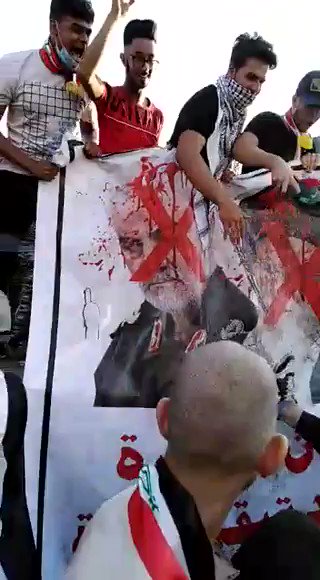
Videos circulated online of a group of protesters holding a poster showing Iran’s Supreme Leader Ayatollah Ali Khamenei and the head of its elite Quds force, Gen. Qassim Soleimani, with their faces crossed out. The video, which showed protesters beating the poster with their shoes, appeared to have been filmed Thursday in Tahrir Square. On Friday, protesters marched over an Iranian flag painted on the pavement with a swastika added to it.

Joseph Sunny@Asylumseeker111

Embedded video

This month’s protests in Iraq and similar demonstrations in Lebanon are fueled by local grievances and mainly directed at the political elite, but they also pose a challenge to Iran, which closely backs both governments. An increasingly violent crackdown in Iraq has raised fears of a backlash by Iran and its heavily armed local allies.

On Friday, a group of about 50 militia supporters showed up at the protest, prompting other demonstrators to chant: “Iran take your hands off, the people don’t want you!”

The militias, known as the Popular Mobilization Forces, said in a statement that they stood with the protesters and were committed to protecting them. But the statement warned of “foreign interests” that it said wanted to sow division in order to cause “internal fighting, chaos and destruction.”

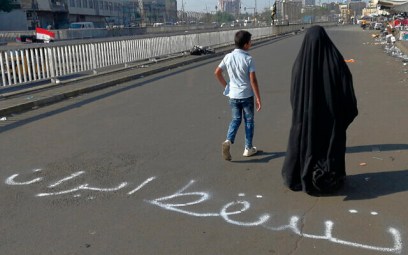
People walk by an Arabic sentence writing on the asphalt reads ‘Down with Iran’ near the site of the protests at Tahrir Square during anti-government ongoing protests in Baghdad, Iraq, Friday, Nov. 1, 2019. (AP Photo/Khalid Mohammed)

The remarks echoed those made by Khamenei and the Iran-backed Hezbollah militant group in Lebanon, which has accused unidentified foreign powers of manipulating the protests.

Iraq’s influential Shiite clerical establishment, which is seen as politically independent, condemned “attacks on peaceful protesters and all forms of unjustified violence,” saying those responsible should be held accountable.

Shiite cleric Ahmed al-Safi, who delivered a Friday sermon on behalf of the clerical leadership, said authorities should not allow “any person or group or biased entity, or any regional or international party” to impose its view on the Iraqi people — an apparent reference to Iran.

The sermon was delivered in the Shiite holy city of Karbala, where masked men suspected of being linked to the security forces opened fire on protesters earlier this week, killing at least 18 people.

In this Thursday, Oct. 31, 2019 photo, mourners and protesters carry the flag-draped coffin of Mohammed Sadiq during his funeral during a demonstration at Tahrir Square in Baghdad, Iraq. Sadiq was killed while participating in the anti-government ongoing protests, his family said. (AP Photo/Hadi Mizban)

Amnesty International says security forces in Baghdad have fired military-grade tear gas grenades directly into the crowds, causing horrific wounds and occasionally lodging the projectiles in people’s skulls. During an earlier wave of demonstrations, snipers shot protesters in the head and chest, with nearly 150 killed in less than a week.

The protesters have called for the resignation of the government and sweeping changes to the political system established after the U.S. invasion, which apportions power among the Shiite majority and Sunnis and Kurds.

Iraq has held regular elections since then, but they have been dominated by sectarian political parties, many of which are close to Iran. The protests have occurred in Baghdad and mostly Shiite southern Iraq, and have been directed against the Shiite-led government. In southern Iraq, demonstrators have attacked and set fire to political party offices.

The protesters accuse their rulers of squandering the country’s oil wealth, pointing to its poor infrastructure and frequent power outages more than 15 years after the overthrow of Saddam and the lifting of international sanctions.

“I was born to be respected, among people who should be respected,” said a protester who identified himself as Abu Sajad. “But as far as we are concerned, we have the worst passport in the world and the worst nationality. We are the No. 1 country when it comes to corruption. We have the second or fourth largest oil reserves but we are a poor nation.”

President Barham Salih said Thursday he would approve early elections once a new electoral law is drafted, expressing support for the protesters but saying reforms would have to be enacted through constitutional means. He said Prime Minister Adel Abdul-Mahdi is willing to resign once political leaders agree on a replacement.

But the process of forming a new government could take weeks or even months, and a Cabinet reshuffle seems unlikely to satisfy the protesters.

Thousands also gathered in the main square of Najaf, another Shiite holy city, late Thursday. Groups of men danced and waved Iraqi flags, while volunteers handed out falafel sandwiches cooked on site.

“This is a great revolution,” said Marwa Ahmed, one of several women in the rally. “We will not give up or back down until our demands are met.”


Russia nixed arms sales to Israel’s enemies at its request, PM’s adviser says 

Posted November 3, 2019 by Joseph Wouk
Categories: Uncategorized

Source: Russia nixed arms sales to Israel’s enemies at its request, PM’s adviser says | The Times of Israel

Ariel Bulshtein also claims Jerusalem reciprocated, canceling deals with Ukraine that were uncomfortable for Moscow

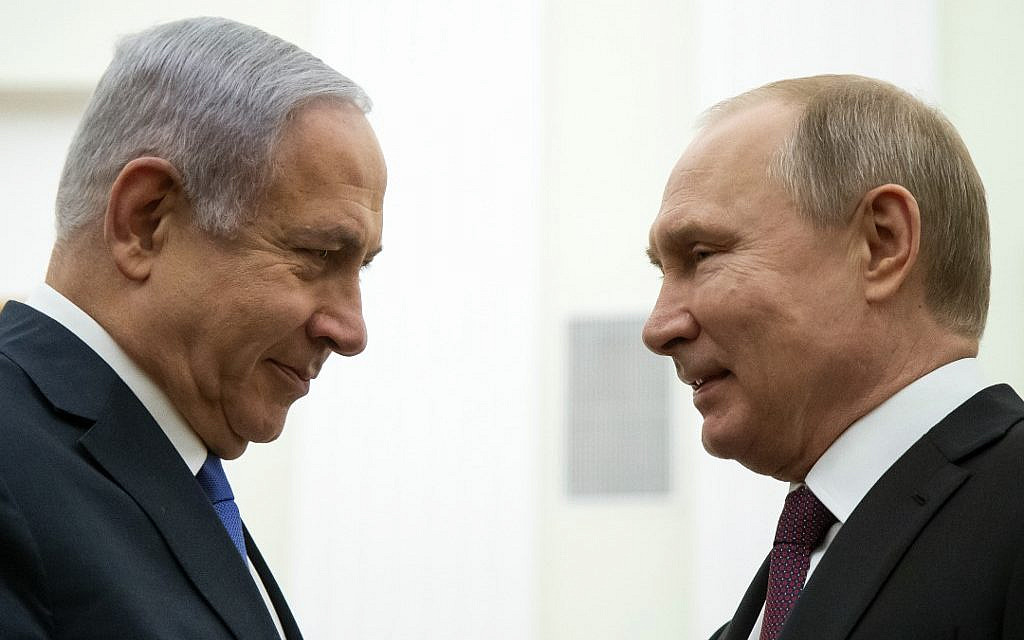
Russian President Vladimir Putin (R) speaks with Prime Minister Benjamin Netanyahu, during their meeting at the Kremlin in Moscow on April 4, 2019. (Alexander Zemlianichenko/POOL/AFP)

Russian President Vladimir Putin (R) speaks with Prime Minister Benjamin Netanyahu, during their meeting at the Kremlin in Moscow on April 4, 2019. (Alexander Zemlianichenko/POOL/AFP)

Russia acquiesced to Israeli requests and canceled certain arms sales to regimes that are antagonistic toward Israel, an adviser to the prime minister said this week, according to the Ynet news site.

In return, he said, Israel canceled arms sales that irked the Russians, including to Ukraine.

“Russia agreed to Israel’s request and, for example, did not provide certain types of weapons to [Israel’s] enemy nations such as Iran, which states at the highest levels its wish to erase Israel off the face of the Earth,” Ariel Bulshtein, who is the prime minister’s adviser for the country’s Russian-speaking community, told Russian paper Izvestia Thursday, according to Ynet.

“Naturally we are unenthusiastic on [Russia] providing modern weapons to such regimes,” he said.

He added that Israel agreed “at least twice, if not more,” to Russian requests not to sell weapons to nations whose relations with Moscow are tense, such as Ukraine.

Bulshtein was appointed to the newly-created post in June, following the failure of Prime Minister Benjamin Netanyahu’s attempts to form a coalition and the announcement of new elections.

Ariel Bulshtein (Courtesy of EAJC)

The move was meant to help Likud’s efforts to siphon votes away from Yisrael Beytenu, the Russian-speaking party led by Avigdor Liberman, whose hard-nosed demands stymied Netanyahu’s efforts to form a coalition in the Knesset. Likud was largely unsuccessful in pulling Russian voters away form Liberman, who went on to increase his strength in the September vote.

Israel has highly sensitive relations with Russia, which has played a central role, alongside Iran, in preventing the fall of the Assad regime in the Syrian civil war. Israel is seeking to prevent Iran from deepening its military presence across the northern border.

Netanyahu has cultivated close ties to Putin, flying frequently to meet with him to discuss regional developments. This July, in a move targeting Israeli-Russian voters ahead of the repeat elections in September, Netanyahu’s Likud party hung a massive picture of the prime minister with Putin on its headquarters in Tel Aviv.

Prior to the election, Netanyahu flew to Russia for talks with Putin in Sochi. Meeting with Putin, the prime minister hailed bilateral relations, saying they have never been better.

Al-Baghdadi and Trump’s Syrian chess board 

Posted November 2, 2019 by Joseph Wouk
Categories: Uncategorized

Source: Al-Baghdadi and Trump’s Syrian chess board – www.israelhayom.com

Trump is not flying blind in Syria. He is implementing a multifaceted set of policies that are based on the strengths, weaknesses and priorities of the various actors.

US President Donald Trump’s many critics insist he has no idea what he is doing in Syria. The assassination of Islamic State leader Abu Bakr al-Baghdadi over the weekend by US special forces showed this criticism is misplaced. Trump has a very good idea of what he is doing in Syria, not only regarding ISIS, but regarding the diverse competing actors on the ground.

Regarding ISIS, the obvious lesson of the al-Baghdadi raid is that Trump’s critics’ claim that his withdrawal of US forces from Syria’s border with Turkey meant that he was going to allow ISIS to regenerate was utterly baseless.

The raid did more than that. Al-Baghdadi’s assassination, and Trump’s discussion of the mass murderer’s death, showed that Trump has not merely maintained faith with the fight against ISIS and its allied jihadist groups. He has fundamentally changed the US’s counterterror fighting doctrine, particularly as it relates to psychological warfare against jihadists.

Following the September 11 attacks, the Bush administration initiated a public diplomacy campaign in the Arab-Islamic world. Rather than attack and undermine the jihadist doctrine that insists that it is the religious duty of Muslims to fight with the aim of conquering the non-Muslim world and to establish a global Islamic empire or caliphate, the Bush strategy was to ignore the jihad in the hopes of appeasing its adherents. The basic line of the Bush administration’s public diplomacy campaign was to embrace the mantra that Islam is peace, and assert that the US loves Islam because the US seeks peace.

Along these lines, in 2005, then secretary of state Condoleezza Rice prohibited the State Department, FBI and US intelligence agencies from using “controversial” terms like “radical Islam,” and “jihad” in official documents.

The Obama administration took the Bush administration’s obsequious approach to strategic communications several steps further. President Barack Obama and his advisers went out of their way to express sympathy for the “Islamic world.”

The Obama administration supported the jihadist Muslim Brotherhood against Egypt’s long-serving president and US ally Hosni Mubarak and backed Mubarak’s overthrow with the full knowledge that the only force powerful enough to replace him was the Muslim Brotherhood.

As for the Shiite jihadists, Obama’s refusal to support the pro-democracy protesters in Iran’s attempted Green Revolution in 2009 placed the US firmly on the side of the jihadist, imperialist regime of the ayatollahs and against the Iranian people.

In short, Obama took Bush’s rhetoric of appeasement and turned it into America’s actual policy.

The Bush-Obama sycophancy won the US no goodwill. Al Qaida, which led the insurgency against US forces in Iraq with Iranian and Syrian support was not moved to diminish its aggression and hatred of the US due to the administration’s efforts.

It was during the Obama years that ISIS built its caliphate on a third of the Iraqi-Syrian landmass, opened slave markets and launched a mass campaign of filmed beheadings in the name of Islam.

In his announcement of al-Baghdadi’s death on Sunday, Trump unceremoniously abandoned his predecessors’ strategy of sucking up to jihadists. Unlike Obama, who went to great lengths to talk about the respect US forces who killed Osama bin Laden accorded the terrorist mass-murderer’s body, “in accordance with Islamic practice,” Trump mocked al-Baghdadi, the murdering, raping, slaving “caliph.”

Al-Baghdadi, Trump said, died “like a dog, like a coward.”

Al-Baghdadi died, Trump said, “whimpering and crying.”

Trump posted a picture on his Twitter page of the Delta Force combat dog who brought about al-Baghdadi’s death by chasing him into a tunnel under his compound and provoking him to set off the explosive belt he was wearing, and kill himself and the two children who were with him.

Trump later described the animal who killed Allah’s self-appointed representative on earth as “our ‘K-9,’ as they call it. I call it a dog. A beautiful dog – a talented dog.”

Obama administration officials angrily condemned Trump’s remarks. For instance, former CIA Deputy Director Mike Morell said he was “bothered” by Trump’s “locker room talk,” which he said, “inspire[s] other people” to conduct revenge attacks.

His colleague, former vice chairman of the Joint Chiefs of Staff retired Admiral James Winnefeld said that Trump’s “piling on” describing al-Baghdadi as a “dog” sent a signal to his followers “that could cause them to lash out possibly more harshly in the wake.”

These criticisms are ridiculous. ISIS terrorists have richly proven they require no provocation to commit mass murder. They only need the opportunity.

Moreover, Trump’s constant use of the term “dog” and employment of canine imagery is highly significant. Dogs are considered “unclean” in Islam. In Islamic societies, “dog” is the worst name you can call a person.

It is hard to imagine that al-Baghdadi’s death at the paws of a dog is likely to rally many Muslims to his side. To the contrary, it is likely instead to demoralize his followers. What’s the point of joining a group of losers who believe in a fake prophet who died like a coward while chased by “a beautiful dog – a talented dog?”

Then there is Russia.

Trump’s critics insist that his decision to abandon the US position along the Syrian border with Turkey effectively surrendered total control over Syria to Russia. But that is far from the case. The American presence along the border didn’t harm Russia. It helped Russia. It freed Russian President Vladimir Putin from having to deal with Turkey. Now that the Americans have left the border zone, Turkish President Recep Tayyip Erdoğan is Putin’s problem.

And he is not the main problem that Trump has made for Putin in Syria.

Putin’s biggest problem in Syria is financial. The Russian economy is sunk in a deep recession due to the drop in global oil prices. Putin had planned to finance his Syrian operation with Syrian oil revenues. To this end, in January 2018, he signed an agreement with Syrian President Bashar Assad that effectively transferred the rights to the Syrian oil to Russia.

But Putin hadn’t taken Trump into consideration.

US forces did not withdraw from all of their positions in Syria last month. They maintained their control over al-Tanf airbase which controls the Syrian border with Jordan and Iraq.

More importantly, from Russia’s perspective, the US has not relinquished its military presence adjacent to Syria’s oil facilities in the Deir ez-Zor province on the eastern side of the Euphrates River. Indeed, according to media reports, the US is reinforcing its troop strength in Deir ez-Zor to ensure continued US-Kurdish control over Syria’s oil fields.

To understand how high a priority control over Syria’s oil installations is for Putin, it is worth recalling what happened in February 2018.

On February 7, 2018, a month after Putin and Assad signed their oil agreement, a massive joint force comprising Russian mercenaries, Syrian commandos and Iranian Revolutionary Guards forces crossed the Euphrates River with the aim of seizing the town of Khusham adjacent to the Conoco oil fields. Facing them were forty US Special Forces deployed with Kurdish and Arab SDF forces. The US forces directed a massive air assault against the attacking forces which killed some 500 soldiers and ended the assault. Accounts regarding the number of Russian mercenaries killed start at 80 and rise to several hundred.

The American counterattack caused grievous harm to the Russian force in Syria. Putin has kept the number of Russian military forces in Syria low by outsourcing much of the fighting to Russian military contractors. The aim of the failed operation was to enable those mercenary forces to seize the means to finance their own operations, and get them off the Kremlin payroll.

Since then, Putin has tried to dislodge the US forces from Khusham at least one more time, only to be met with a massive demonstration of force.

The continued US-Kurdish control over Syria’s oil fields and installations requires Putin to continue directly funding his war in Syria. So long as this remains the case, given Russia’s financial constraints, Putin is likely to go to great lengths to restrain his Iranian, Syrian and Hezbollah partners and their aggressive designs against Israel in order to prevent a costly war.

In other words, by preventing Russia from seizing Syria’s oil fields, Trump is forcing Russia to behave in a manner that protects American interests in Syria.

The focus of most of the criticism against Trump’s Syria policies has been his alleged abandonment of the Syrian Kurds to the mercies of their Turkish enemies. But over the past week we learned that this is not the case. As Trump explained, continued US-Kurdish control over Syria’s oil fields provides the Kurdish-controlled SDF with the financial and military wherewithal to support and defend its people and their operations.

Moreover, details of al-Baghdadi’s assassination point to continued close cooperation between US and Kurdish forces. According to accounts of the raid, the Kurds provided the Americans with key intelligence that enabled US forces to pinpoint al-Baghdadi’s location.

As to Turkey, both al-Baghdadi and ISIS spokesman Abu Hassan al-Mujahir, who was killed by US forces on Tuesday, were located in areas of eastern Syria controlled by Turkey. The Americans didn’t try to hide this fact.

The Turkish operation in eastern Syria is reportedly raising Erdogan’s popularity at home. But it far from clear that the benefit he receives from his actions will be long-lasting. Turkey’s Syrian operation is exposing the NATO member’s close ties to ISIS and its allied terror groups. This exposure in and of itself is making the case for downgrading US strategic ties with its erstwhile ally.

Even worse for Turkey, due to Trump’s public embrace of Erdogan, the Democrats are targeting the Turkish autocrat as Enemy Number 1. On Tuesday, with the support of Republican lawmakers who have long recognized Erdogan’s animosity to US interests and allies, the Democratic-led House overwhelmingly passed a comprehensive sanctions resolution against Turkey.

The al-Baghdadi assassination and related events demonstrate that Trump is not flying blind in Syria. He is implementing a multifaceted set of policies that are based on the strengths, weaknesses and priorities of the various actors on the ground in ways that advance US interests at the expense of its foes and to the benefit of its allies.
 

Israeli aircraft retaliate after terrorists launch 10 rockets on southern communities 

Posted November 2, 2019 by Joseph Wouk
Categories: Uncategorized

Source: Israeli aircraft retaliate after terrorists launch 10 rockets on southern communities – www.israelhayom.com

Friday night attack on Israel saw eight rockets intercepted by the Iron Dome system. One projectile hit a house in Sderot, a town near the border, causing damage but no casualties, police said.

Following a barrage of rockets from the Gaza Strip on Friday, the Israel Defense Forces responded with a wave of pre-dawn airstrikes on the Hamas-ruled enclave.

The Israeli army said it targeted sites belonging to Hamas after Palestinians fired 10 rockets into Israel late on Friday.

Eight of them were reportedly intercepted by the Iron Dome system. One projectile hit a house in Sderot, a town near the border, causing damage but no casualties, police said.

In southern Gaza, medical officials and locals said a small cabin was hit, killing a 27-year-old civilian and wounding two others.

None of the terrorist groups in Gaza claimed responsibility for firing the rockets. The Israeli military said Hamas was ultimately responsible for the attack.

Israel and Hamas have fought three wars over the past decade and tensions are high.


Syria, a global effort in war on terror- Jerusalem Studio 461 

Posted November 2, 2019 by Joseph Wouk
Categories: Uncategorized


Rocket fired from Gaza hits home in Sderot as Iron Dome intercepts 8 others

Posted November 2, 2019 by Joseph Wouk
Categories: Uncategorized

Source: Rocket fired from Gaza hits home in Sderot as Iron Dome intercepts 8 others | The Times of Israel

Two barrages send residents of south running for cover during Shabbat dinner; one woman hurt by fall; IDF strikes terror targets in response

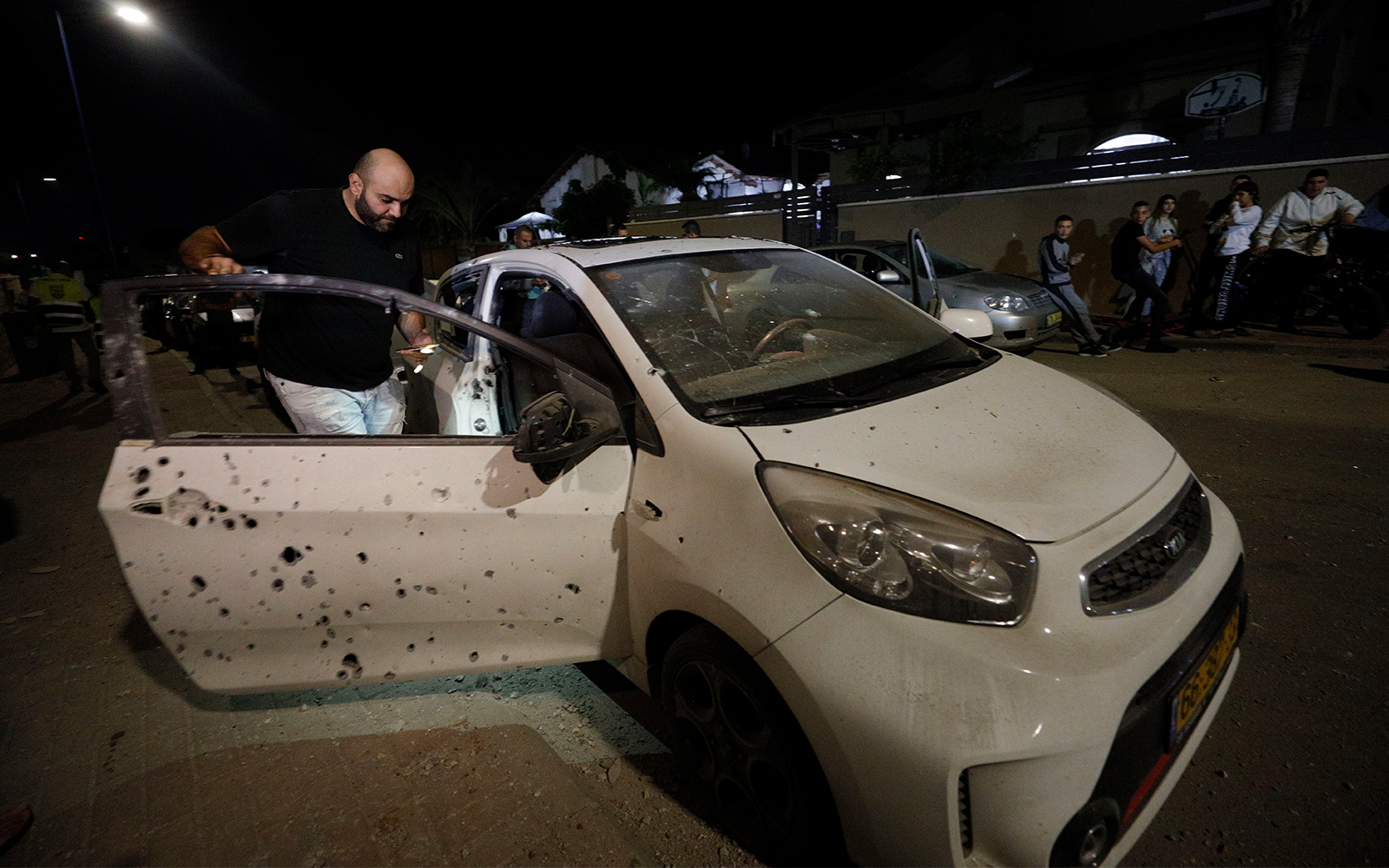
A man checks a car damaged by shrapnel from a missile fired from Gaza into Sderot, Israel, November 1, 2019. (AP Photo/Tsafrir Abayov)

A man checks a car damaged by shrapnel from a missile fired from Gaza into Sderot, Israel, November 1, 2019. (AP Photo/Tsafrir Abayov)

Palestinian terror groups in the Gaza Strip fired 10 rockets into Israel in two separate barrages on Friday night, the army said. One projectile slammed into a house in the town of Sderot, while the Iron Dome system intercepted eight and the tenth fell in open ground.

The army responded several hours later with strikes on several terror targets in Gaza, the Israel Defense Forces said in a statement.

Palestinian media reported that several airstrikes targeted training sites and outposts affiliated with Hamas and other groups.

The Hamas-run Gaza Health Ministry said three men sustained moderate or serious shrapnel wounds from one of the airstrikes.

In the early hours of Saturday, sirens again sounded in Sderot and the village of Ibim. The IDF later attributed the sirens to “non-rocket fire” from Gaza into Israel.

During the earlier barrage, a 65-year-old woman was lightly hurt when she fell while running toward a shelter, medics said. Five people were treated for anxiety.

The attack was one of the largest in recent months and Prime Minister Benjamin Netanyahu, who is also defense minister, was in contact with IDF Chief of Staff Aviv Kohavi and coordinating a response, officials said.

There was no immediate claim of responsibility from Gaza, but Israel routinely holds Gaza’s Hamas rulers responsible for any violence emanating from the Strip.

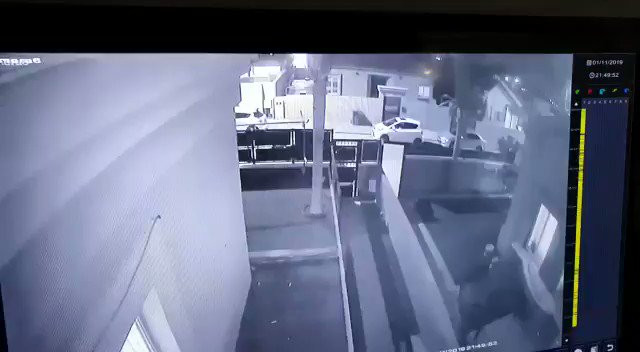
חדשות 13

@newsisrael13

תיעוד נוסף ממצלמת אבטחה של פגיעת הרקטה בבית בשדרות @bokeralmog

(צילום: אלברט אבוחצירא)

Embedded video

Warning sirens had gone off in the town of Sderot and in other Israeli communities along the Gaza border as many families were eating Friday night Shabbat dinner.

The IDF said 7 rockets were fired in that barrage, all of which were intercepted by the Iron Dome system.

About an hour later another three rockets were fired into Israel and Iron Dome intercepted one. One of the rockets hit the home, causing serious damage but no injuries.

“There was a huge explosion,” one of the residents of the house told the Walla news site. “Luckily we were in the shelter; there is a lot of damage.”

The last rocket apparently fell in an open area.

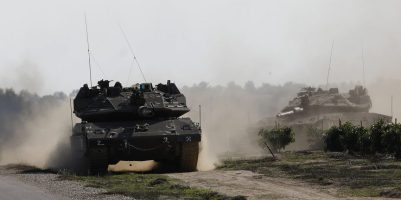
Immediately after the first salvo was fired, an IDF tank shelled a Hamas observation post in Gaza, Palestinian and Hebrew-language media reported.

Israel Defense Forces

@IDF

Embedded video

Yaron Sasson, a spokesman for the Sderot municipality, said there had been no warnings ahead of time.

“This was a complete surprise after a few months of quiet,” he told Israel Radio. “But again we have residents running for bomb shelters during the Friday night Shabbat meal,” he said.

Sasson recommended residents remain close to bomb shelters and said emergency workers were carrying out searches to make sure there were no casualties.

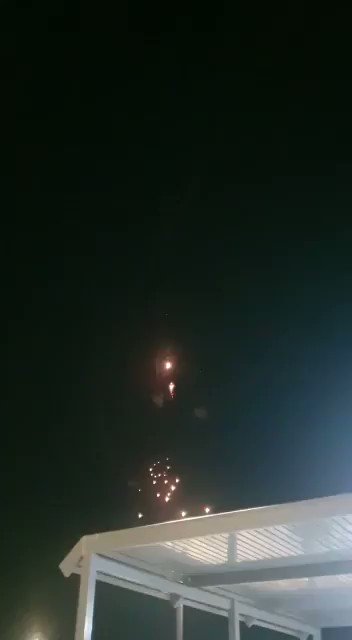
CNW@ConflictsW

A large rocket barrage was fired from the Gaza Strip towards Southern Israel. Multiple Iron dome interceptors were fired

Embedded video

The rocket barrages came a day after a rocket fired from Gaza landed in an open field. There were no reports of injuries or damage in Thursday’s attack.

The Iron Dome air defense system was activated and an interceptor projectile was launched, the army said in a statement, but it apparently missed its target.

The IDF said a tank and fighter jets subsequently launched retaliatory strikes on two Hamas posts in the northern Strip.

The Gaza-based Shehab news agency reported that Israeli security forces fired at a jeep belonging to operatives in the border area, near Beit Lahia.

On Tuesday, Israeli fighter jets shot down a drone that was flying at an “irregular altitude” over Gaza, the IDF said.


Palestinians in Gaza fire 7 rockets into Israel, Iron Dome intercepts 

Posted November 1, 2019 by Joseph Wouk
Categories: Uncategorized

Source: Palestinians in Gaza fire 7 rockets into Israel, Iron Dome intercepts | The Times of Israel

Iron Dome interceptors hit an incoming rocket from the Gaza Strip over the town of Sderot on November 1, 2019 (screencapture/Twitter)

No injuries reported in incident that comes a day after a rocket was fired into Israel, triggering IDF response

Iron Dome interceptors hit an incoming rocket from the Gaza Strip over the town of Sderot on November 1, 2019 (screencapture/Twitter)

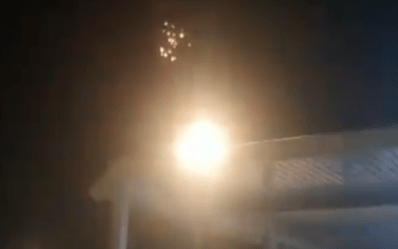
Palestinian terror groups in the Gaza Strip fired a barrage of seven rockets into Israel on Friday evening, all of which were intercepted by the Iron Dome system, the army said.

The attack was one of the largest in recent months and local residents reported hearing several loud explosions, apparently from the interceptions. There were no immediate reports of casualties.

Warning sirens had gone off in the town of Sderot and in other Israeli communities along the Gaza border.

The rocket fire comes a day after one rocket was launched from the Gaza Strip by Palestinian terrorists.

CNW@ConflictsW

 large rocket barrage was fired from the Gaza Strip towards Southern Israel. Multiple Iron dome interceptors were fired

Embedded video

Reports said the rocket landed in an open field. There were no reports of injuries or damage.

The Iron Dome air defense system was activated and an interceptor projectile was launched, the army said in a statement.

The IDF said a tank and fighter jets subsequently launched retaliatory strikes on two posts in the northern Strip belonging to the Hamas terror group, which rules Gaza.

The Gaza-based Shehab news agency reported that Israeli security forces had fired at