‘It’s a trap’: Iran decries IAEA probe into uranium at site flagged by Israel

Posted November 11, 2019 by Joseph Wouk
Categories: Uncategorized

Source: ‘It’s a trap’: Iran decries IAEA probe into uranium at site flagged by Israel | The Times of Israel

Tehran urges UN atomic agency to ‘maintain its vigilance’ as it steps up investigation of Turquzabad site, said by Netanyahu to be ‘nuclear warehouse’
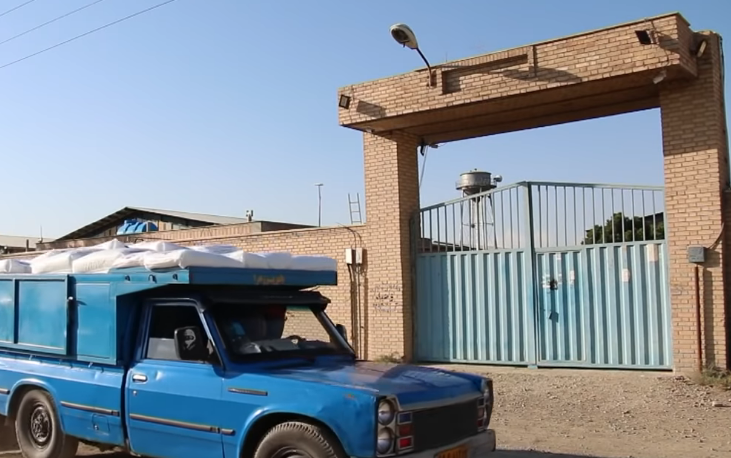
Iran's alleged atomic warehouse in Turquzabad, Tehran. (YouTube screenshot)

Iran’s alleged atomic warehouse in Turquzabad, Tehran. (YouTube screenshot)

Iran on Sunday slammed reports that the UN atomic agency had found traces of uranium at a site flagged by Israel last year as a nuclear development warehouse in Turquzabad.

Bloomberg reported Thursday that a senior International Atomic Energy Agency official had told diplomats in a closed-door meeting in Vienna that the Islamic Republic was “evading attempts to discover the source of manmade and natural uranium particles detected at a warehouse in Tehran.”

The extraordinary meeting of the board of governors was convened by Cornel Feruta, the organization’s acting head, to discuss the latest concerns about Iran’s nuclear program, the report said.

In September, the Reuters news agency reported that traces of uranium had been found at the facility on the outskirts of Tehran that was alleged by Prime Minister Benjamin Netanyahu to be a “secret atomic warehouse.” The IAEA reportedly confirmed that detail last week to member states.

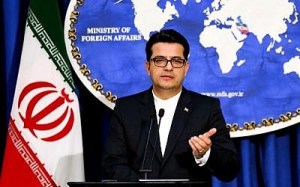
“The Zionist regime and Israel are attempting to re-open … this file,” Iranian Foreign Ministry spokesman Abbas Mousavi was quoted by Reuters as saying Sunday on state television.

“We have announced that this is a trap,” Mousavi reportedly added. “Hopefully the IAEA will maintain its vigilance.”

Prime Minister Benjamin Netanyahu addresses the General Assembly at the United Nations in New York on September 27, 2018, holding up a picture of an alleged Iranian “secret atomic warehouse.” (Timothy A. Clary/AFP)

In a speech last year at the UN General Assembly, Netanyahu revealed the existence of the warehouse in Turquzabad, which he said held “massive amounts” of equipment and material that were part of a secret Iranian nuclear program.

Netanyahu called for the IAEA to inspect the facility and, in July, Israeli television reported that soil samples from the warehouse turned up “traces of radioactive material,” without specifying the type.

Citing two unnamed diplomats, Reuters reported that the material found at the site was determined to be uranium. One of the diplomats, however, said the uranium was not enriched enough to be used for a nuclear bomb.

“There are lots of possible explanations” for why uranium traces were found there, the diplomat said.

The report said it was difficult to determine the origin of the uranium since Iran has not provided answers. It noted it was unclear whether the traces came from material at the site before or after the 2015 international deal was signed to limit Tehran’s nuclear program.

Iran’s failure to explain why uranium was found at the warehouse fueled tensions with the United States, according to Reuters.
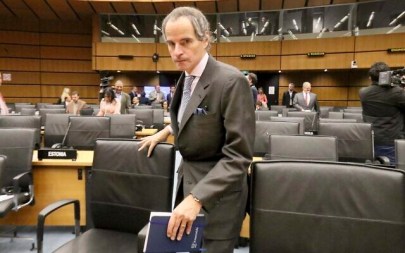
Elected Director General of the International Atomic Energy Agency (IAEA), Rafael Mariano Grossi from Argentina, waits for the start of the IAEA board of governors meeting at the International Center in Vienna, Austria, November 7, 2019. (AP Photo/Ronald Zak)

In September, the Wall Street Journal reported that Iran was obstructing the investigation into the Tehran site identified by Netanyahu. Unidentified diplomats told the newspaper Iran was refusing to provide answers to questions posed by the IAEA, in what was apparently the first instance of Tehran failing to cooperate with inspectors.

The diplomats told the WSJ that the uranium traces were likely remains from Iran’s past experimentation in nuclear weapons development. Iran has denied ever seeking nuclear weapons, though Israeli and Western intelligence strongly dispute those assertions. The diplomats said the material’s existence at the site was unlikely to indicate new work on weapons development, but would be a breach of Iran’s commitment to non-proliferation.

Iran has denied that the site was a nuclear facility or served any secretive purpose. In an initial response to Netanyahu’s UN speech, Iranian state media claimed the warehouse was actually a recycling facility for scrap metal.

US President Donald Trump pulled out of the nuclear accord last year and reimposed stringent sanctions on Iran. Tehran has subsequently taken a number of steps to roll back its commitment to the accord over what it says is a failure by the deal’s remaining signatories to provide economic relief from the sanctions.

Last week, Iran began injecting centrifuges with uranium at the Fordo facility, where it was barred from conducting such work under the nuclear deal.

Agencies contributed to this report.


Trump tells Iran return of missing FBI agent would be ‘very positive step’ 

Posted November 11, 2019 by Joseph Wouk
Categories: Uncategorized

Source: Trump tells Iran return of missing FBI agent would be ‘very positive step’ | The Times of Israel

US president appears to link information on Robert A. Levinson to nuclear issue, also warning Tehran in tweet against further uranium enrichment

In this March 6, 2012, file photo, an FBI poster showing a composite image of former FBI agent Robert Levinson, right, of how he would look like now after five years in captivity, and an image, center, taken from the video, released by his kidnappers, and a picture before he was kidnapped, left, displayed during a news conference in Washington.  (AP Photo/Manuel Balce Ceneta)

In this March 6, 2012, file photo, an FBI poster showing a composite image of former FBI agent Robert Levinson, right, of how he would look like now after five years in captivity, and an image, center, taken from the video, released by his kidnappers, and a picture before he was kidnapped, left, displayed during a news conference in Washington. (AP Photo/Manuel Balce Ceneta)

WASHINGTON — US President Donald Trump on Sunday urged Iran to to return Robert Levinson, an ex-FBI agent who disappeared there in 2007 on an unauthorized CIA mission, saying that “it would be a very positive step.”

“If Iran is able to turn over to the US kidnapped former FBI Agent Robert A. Levinson, who has been missing in Iran for 12 years, it would be a very positive step,” Trump tweeted.

He appeared to link the move to Iran’s recent steps away from the nuclear deal.

“At the same time, upon information & belief, Iran is, & has been, enriching uranium. THAT WOULD BE A VERY BAD STEP!,” he said.

It was not immediately clear what Trump’s intentions were.

Donald J. Trump

@realDonaldTrump

Iran said Saturday it is now enriching uranium to five percent, after a series of steps back from its commitments under the nuclear pact. The deal set a 3.67 percent limit for uranium enrichment but Iran announced it would no longer respect it.

The tweet came on the same day that Iran said  an open Revolutionary Court case involving Levinson “was a missing person” filing, not a sign that the man was being prosecuted.

Foreign Ministry spokesman Abbas Mousavi’s comments come as a new Iranian acknowledgement of the case involving Levinson renewed questions about his disappearance. The US is offering $25 million for information about what happened to Levinson, who disappeared from Iran’s Kish Island on March 9, 2007.

Speaking to journalists, Mousavi said Levinson “has no judicial or criminal case in any Islamic Republic of Iran court whatsoever.”

Abbas Mousavi, spokesman for Iran’s Foreign Ministry, gives a press conference in the capital Tehran on May 28, 2019. (Atta Kenare/AFP)

“It is normal that a case is opened like it’s done for any missing people anywhere in Iran,” Mousavi said.

However, Iran only acknowledged its Revolutionary Court had an open case on Levinson in a filing to the United Nations. The Associated Press obtained a copy of a UN report on the acknowledgement Saturday.

Iran’s Revolutionary Court typically handles espionage cases and others involving smuggling, blasphemy and attempts to overthrow its Islamic government. Westerners and Iranian dual nationals with ties to the West often find themselves tried and convicted in closed-door trials in these courts, only later to be used as bargaining chips in negotiations.

For years, US officials would only say that Levinson, a meticulous FBI investigator credited with busting Russian and Italian mobsters, was working for a private firm on his trip.

In December 2013, the AP revealed Levinson in fact had been on a mission for CIA analysts who had no authority to run spy operations. Levinson’s family had received a $2.5 million annuity from the CIA in order to stop a lawsuit revealing details of his work, while the agency forced out three veteran analysts and disciplined seven others.

Since his disappearance, the only photos and video of Levinson emerged in 2010 and 2011. He appeared gaunt and bearded with long hair, and was wearing an orange jumpsuit similar to those worn by detainees at the US prison at Guantanamo Bay.

Iran for years has offered contradictory statements about Levinson. His family is now suing Iran in US federal court, alleging the Iranian government kidnapped him.

A senior State Department official said the US had not been informed of any change in that position. However, the official, speaking on condition of anonymity due to the sensitivity of the case, said the US had reached out “through intermediaries” to Iran to see if the statement represented a change in Iran’s stance. The official said there had not yet been a response to the inquiry.

The official would not say who the intermediaries are, but US interests in Iran are handled by Switzerland. Successive US administrations have used the Swiss as their main interlocuter with Iranian authorities in cases where Americans have gone missing or been detained in Iran.

Brian Hook, the US special envoy for Iran, has raised Levinson’s case, as well as those of other Americans, with Iranian officials in the past. Robert O’Brien, before becoming Trump’s national security adviser, had made Levinson’s case a priority when he served as the special representative for hostage affairs.


Hangars go up in Israel for hundreds of US F-35s, says another unfriendly Russian Defense Dept “leak” – DEBKAfile

Posted November 11, 2019 by Joseph Wouk
Categories: Uncategorized

Source: Hangars go up in Israel for hundreds of US F-35s, says another unfriendly Russian Defense Dept “leak” – DEBKAfile

Unfriendly leaks relating to Israel, the IDF, its weapons and interaction with the US come from Russian defense department “sources” every few days, causing unease in Jerusalem and the IDF high command. Of late, these anonymous “revelations” have become more hostile with attempts to denigrate the IDF’s image and capabilities.

On Sunday, Nov. 10, Russian military sites claimed that the US Air Force is planning to deploy its F-35 stealth planes in Israel and is building hundreds of hangars which will provide 252,000 sq. m. of space for hundreds of those warplanes. They will be in position to counter the Russian military presence “in Iran and Syria.”

A day earlier, on Saturday, those Russian outlets carried an extensive account of how its [DEBKAfile: elderly] medium-range Tochka tactical missile (codenamed in the West SS-21-Scarab) overpowered Israel’s intermediate air defense David’s Sling’s electronic and guidance systems. According to this account, Tochka overrode the Israeli missile’s self-destruct order when it fell into Syrian military hands and Russian engineers were able to explore and dissect its features.

This story was the sequel to the first account of the incident appearing on those same Russian military sites on Wednesday, Nov. 6, when Russian Deputy Foreign Minister Sergey Ryabkov arrived in Israel for quiet talks with Israeli officials on issues relating to Iran’s nuclear program and Syria.

DEBKAfile’s military sources reiterate that the incident referred to occurred on June 23, 2018 when two IDF David’s Sling missiles were launched at – and missed – Syrian SS-21 missiles over Israel’s Sea of Galilee. Both fell inside Syrian territory. One self-destructed; the second did not. Military sources in Moscow now claim this was due to superior Russian electronic capabilities.

The Ryabkov visit was preceded by an earlier “disclosure” by “Russian army sources,” according to which the joint Russian Navy and Aerospace exercise conducted recently was said to include “cruise missile and heavy artillery fire drills in the eastern Mediterranean opposite the Israeli coast.”

Our sources note that the story did not name the vessel or which part of the Israeli coastline was in range, only that the incident occurred outside Israel’s territorial waters and it had come closer than ever before to Israel’s shores.

So who is responsible for this stream of niggling accounts – which continued unabated even during friendly talks in Jerusalem by a high-ranking Kremlin official? They appear to come from circles in the Russian Defense Ministry, not all of whom approve of Russian President Vladimir Putin’s friendly ties with Israel.


The new FRIENDSHIP between ISRAEL and the ARAB countries

Posted November 11, 2019 by Joseph Wouk
Categories: Uncategorized


Why is the ISRAELI ARMY so POWERFUL 

Posted November 11, 2019 by Joseph Wouk
Categories: Uncategorized


IDF to hold nation-wide drill with new, more specific siren system

Posted November 10, 2019 by Joseph Wouk
Categories: Uncategorized

Source: IDF to hold nation-wide drill with new, more specific siren system – Israel News – Jerusalem Post

The IDF will hold a nation-wide drill with the recently introduced, more specific siren system for the first time from the 26th to the 28th of November between the hours of 9:05 a.m. to 12:35 p.m.

BY TZVI JOFFRE
 NOVEMBER 10, 2019 17:49Rocket siren system in Israel

The IDF will hold a nation-wide drill with the recently introduced, more specific siren system for the first time from the 26th to the 28th of November between the hours of 9:05 a.m. to 12:35 p.m. each day.

The new siren system issues alerts displaying the names of municipalities and/or areas within municipalities. In the old system, general alerts were issued for wider regions with only the name of the region displayed.

The drill will take place in different areas each day and will test sirens, television alerts, internet alerts, radio alerts and the Home Front Command application.

“The Home Front Command sees importance in improving and streamlining the accessibility of alerts to civilians as a way to save lives and therefore calls on citizens to take an active part in the drill, to choose the alert method that is suitable for them, in addition to the siren, and to fill out a public survey that will be publicized on the Home Front Command website and social media,” said the IDF in a press release.

The drill will not require civilians to practice entering secure spaces.


Off  Topic: Omar SLAMMED Over Anti Semitic Tweet… AGAIN?! IMAGINE MY SHOCK 

Posted November 10, 2019 by Joseph Wouk
Categories: Uncategorized


Iran begins building 2nd nuclear power reactor at Busheh

Posted November 10, 2019 by Joseph Wouk
Categories: Uncategorized

Source: Iran begins building 2nd nuclear power reactor at Bushehr | The Times of Israel

In presence of journalists, authorities pour concrete for the base of Russian-funded facility

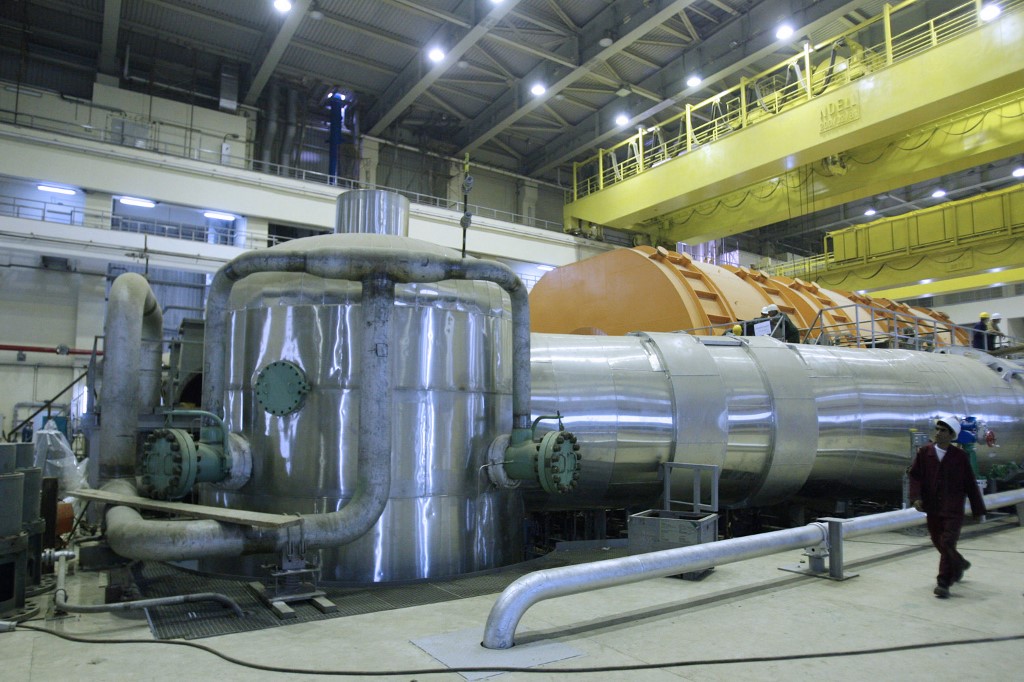
This photo taken on October 26, 2010, shows the inside of reactor at the Russian-built Bushehr nuclear power plant in southern Iran. (HAMED MALEKPOUR/FARS NEWS AGENCY/AFP)

Iran’s state TV reported Sunday that construction has begun on a second nuclear power reactor at its Bushehr plant amid heightened tensions over Tehran’s collapsing nuclear deal with world powers.

Authorities began pouring concrete for the base of the reactor on Sunday in the presence of journalists in Bushehr, some 700 kilometers (440 miles) south of Iran’s capital, Tehran.

Bushehr relies on 4.5% enriched uranium, which Iran is producing in violation of its 2015 nuclear deal. That violation and others come after US President Donald Trump unilaterally withdrew America from the accord over a year ago.

Bushehr’s first reactor came online in 2011 with the help of Russia. This new reactor similarly will be built with Russian help.

Iran said Saturday it is now enriching uranium to five percent, after a series of steps back from its commitments under the nuclear pact. The deal set a 3.67 percent limit for uranium enrichment but Iran announced it would no longer respect it.

“Based on our needs and what we have been ordered, we are currently producing five percent,” Atomic Energy Organization of Iran spokesman Behrouz Kamalvandi told a press conference.

He said Iran has the “capacity to produce five percent, twenty percent, sixty percent, or any percentage” of enriched uranium, a claim often repeated by Tehran.

Uranium enrichment is the sensitive process that produces fuel for nuclear power plants but also, in highly extended form, the fissile core for a warhead.

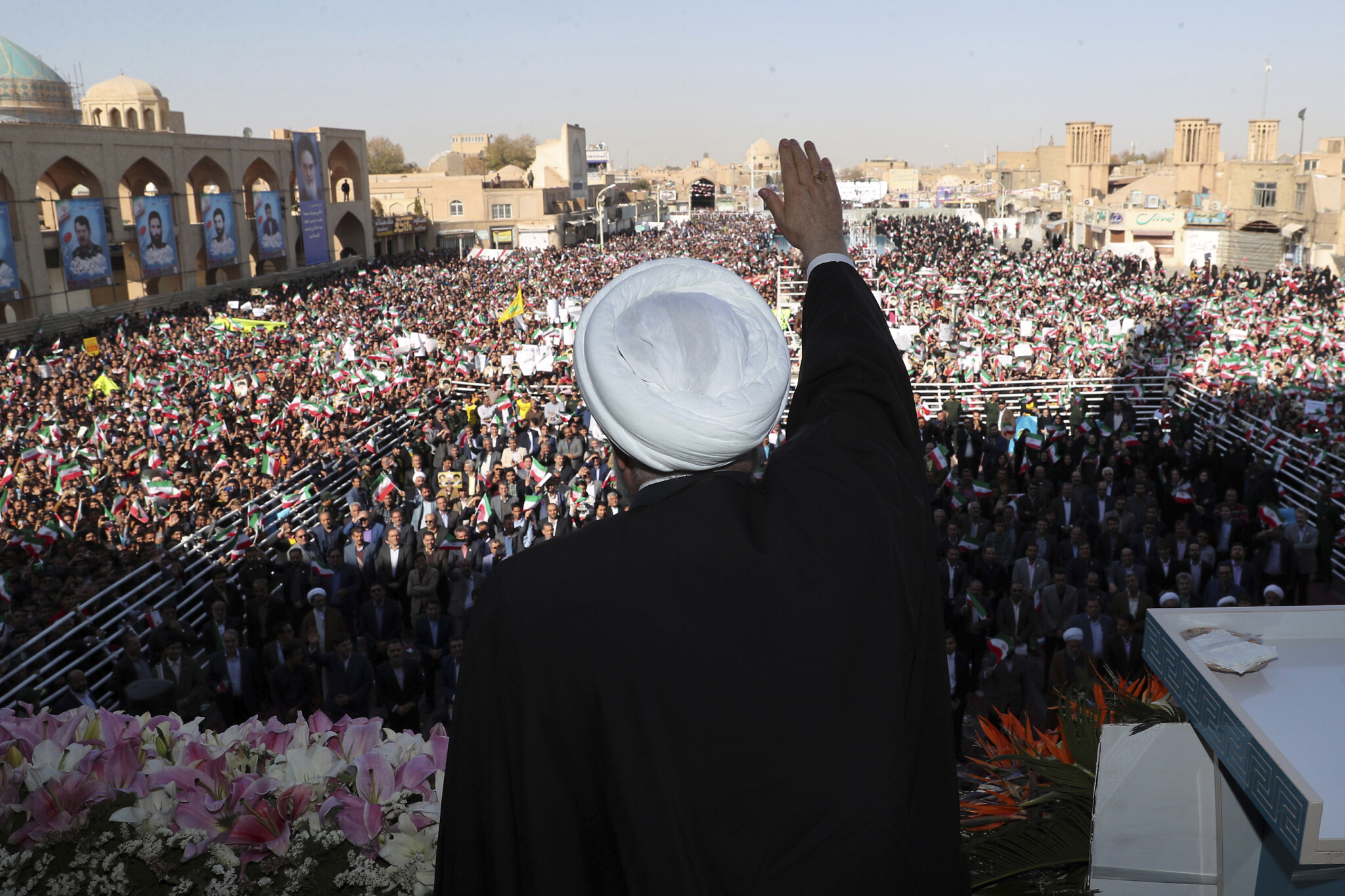
In this photo released by the official website of the office of the Iranian Presidency, President Hassan Rouhani waves to the crowd in a public gathering at the city of Yazd, some 410 miles (680 kilometers) southeast of the capital Tehran, Iran, Sunday, Nov. 10, 2019. (Office of the Iranian Presidency via AP)

The current five percent level exceeds the limit set by the accord but is less than the 20 percent Iran had previously operated and far less than the 90 percent level required for a warhead.

In its fourth step away from the agreement, Iran resumed enrichment at the Fordow plant south of Tehran on Thursday, with engineers feeding uranium hexafluoride gas (UF6) into the plant’s mothballed enrichment centrifuges.

Iran was already enriching uranium at another plant in Natanz.

Tehran emphasizes the measures it has taken are swiftly reversible if the remaining parties to the deal — Britain, China, France, Germany and Russia — find a way to get around US sanctions.

On July 1, Iran said it had increased its stockpile of enriched uranium to beyond a 300-kilogram maximum set by the deal, and a week later, it announced it had exceeded the enrichment cap.

The third move had it firing up advanced centrifuges on September 7 to enrich uranium faster and to higher levels.

Iran said Thursday it had canceled an IAEA nuclear inspector’s accreditation after she triggered an alarm last week at the entrance to the Natanz uranium enrichment plant. The alarm during a check at the entrance to the plant in central Iran had raised concerns that she could be carrying a “suspect product” on her, Iran’s Atomic Energy Organization said in a statement posted online.

Iran alleged that the UN inspector tested positive for suspected traces of explosive nitrates and was therefore denied entry. The International Atomic Energy Agency said it disputed Iran’s account, without elaborating. The IAEA said Thursday that her treatment was “not acceptable.”

The Times of Israel covers one of the most complicated, and contentious, parts of the world. Determined to keep readers fully informed and enable them to form and flesh out their own opinions, The Times of Israel has gradually established itself as the leading source of independent and fair-minded journalism on Israel, the region and the Jewish world.

We’ve achieved this by investing ever-greater resources in our journalism while keeping all of the content on our site free.


 The new FRIENDSHIP between ISRAEL and the ARAB countries

Posted November 10, 2019 by Joseph Wouk
Categories: Uncategorized


Why is the ISRAELI ARMY so POWERFUL

Posted November 10, 2019 by Joseph Wouk
Categories: Uncategorized