Iran Threatens to Turn Tel Aviv, Haifa to ‘Dust’

Posted September 22, 2016 by Peter Hofman
Categories: Uncategorized

Tags: , , , , , , , ,

Iran is again threatening Israel, saying it will “turn Tel Aviv and Haifa to dust” pending mistakes by the “Zionist regime.”

By: Hana Levi Julian

Published: September 21st, 2016

Source: The Jewish Press » » Iran Threatens to Turn Tel Aviv, Haifa to ‘Dust’

Missile Strike’ — a new anti-Israel game launched by Iran.
Photo Credit: FNA

Tehran is back to threatening Israel, this time during a parade marking the anniversary of the 1980 Iraqi invasion of Iran, a war that lasted eight years.

A wide variety of military hardware was on display Wednesday during the parade, which made its way down the main drag in the nation’s capital. Included was the Qadr H missile, which allegedly has a range of 2,000 kilometers.

Long-range ballistic missiles, tanks and the Russian-produced S-300 surface-to-air missile defense system were all in full view as the gala parade was broadcast on state television.

One military truck displayed a banner shown prominently on the broadcast that read:

“If the leaders of the Zionist regime make a mistake, then the Islamic Republic will turn Tel Aviv and Haifa to dust.”

The Iranian Navy showed off 500 vessels, along with submarines and helicopters, at the port of Bandar Abbas on the Persian Gulf.

Iran has tested American mettle more than 30 times so far this year with close encounters in the Gulf between its vessels and those of the United States Navy, according to U.S. officials quoted by Reuters.

Syrian buildup with Druze OC for major Golan op

Posted September 22, 2016 by Joseph Wouk
Categories: Uncategorized

debkafile discloses:  Iran, Hizballah and Syria will henceforth hit back at any Israeli air or artillery strikes against a Syrian target on the Golan. This was decided in high-level three-way consultations in Damascus on Sept. 15, two days after Israeli aircraft attacked the headquarters of Syria’s 90th Brigade at al-Shaar, near Quneitra, after Syrian shells strayed across the border.  

Source: Syrian buildup with Druze OC for major Golan op

DEBKAfile Exclusive Report September 22, 2016, 11:15 AM (IDT)


Six steps by the Assad regime in the last few days, reported by debkafile’s military sources, point to preparations for a massive Syrian army offensive, backed by Hizballah, pro-Iranian Shiite militias and Iranian Rev Guards officers, for clearing the strong rebel presence out of the Syrian Golan.:

1. The arrival in the Quneitra area of the armored brigades of the 4th Division, which is the elite unit of President Bashar Assad’s armed forces and reserved strictly for battles of the highest strategic importance for the regime.

2. The Syrian brigades came with advanced Russian T-90 tanks that were detached from the Aleppo front in the north. Those tanks will be deployed for the first time just 8km from the Israeli border.

3. Hizballah too has contributed its elite fighting unit, the Radwan Force, which has arrived in Quneitra in the last few days to take part in the coming offensive.

4. Also concentrated there are pro-Iranian Shiite militia forces, under the direct command of Iran’s Revolutionary Guard Corps.

5. The Syrian president Assad took the unusual step of appointing a senior Druze officer, Brig. Gen. Osama Zhar a-din, as the Golan front’s new commander. The motive behind this is an attempt to drive a wedge between the IDF troops posted on the Israeli Golan and the Druze inhabiting the local villages, while also sowing discord between the Druze serving in Israel’s armed forces and their Jewish brothers-in-arms.

According to our military sources, the current Syrian and allied lineup just across the border from Israel is not deployed this time to attack Israel, but for a clean sweep of all the Syrian rebel forces holding sectors of the Golan-Israeli border.
The pro-Assad forces are expected to weigh in with artillery shelling and heavy aerial bombing to force the local Syrian population of 140,000 to 160,000 to flee. This scenario would confront Israel and the IDF with the possibility of tens of thousands of Syrian refugees clamoring for sanctuary.

6. Our intelligence sources add that Iran, Hizballah and Syria have decided to henceforth hit back at any Israeli air or artillery strikes against a Syrian target on the Golan. This was decided at high-level three-way consultations in Damascus on Sept. 15, two days after Israeli aircraft attacked the headquarters of Syria’s 90th Brigade at al-Shaar, near Quneitra, in reprisal for the Syrian shells that strayed across the border.
Assad informed his allies that he will not put up with any more Israeli attacks on Syrian regional commands

NY Times: ‘Militant Violence’ Vanishing. Really?

Posted September 21, 2016 by danmillerinpanama
Categories: 2016 elections, Donald Trump, Hillary Clinton, Islamist terror attacks, Media, New York Times

Tags: , , ,

NY Times: ‘Militant Violence’ Vanishing. Really? Clarion Project, Meira Svirski, September 21, 2016

nyslimes(Photo: Wikimedia Commons)

Writing in a joint op-ed yesterday in The New York Times, after a weekend that saw four Islamist terror attacks in the U.S., the mayors of New York City, London and Paris made an astonishing statement:  “In our experience, they wrote, “militant violence is vanishingly rare.”

Only they didn’t write that. A correction appeared today at the end of the article noting that the phrase was added by an editor without the approval of the authors.

In the article, titled “Our Immigrants, Our Strength,” Bill DeBlasio, Sadiq Kahn and Anne Hidalgo, mayors of NYC, London and Paris respectively,  argue that, “Investing in the integration of refugees and immigrants is not only the right thing to do, it is also the smart thing to do. Refugees and other foreign-born residents bring needed skills and enhance the vitality and growth of local economies, and their presence has long benefited our three cities.”

Just to make sure the Times’ readers didn’t get nervous about an influx of refugees, a zealous editor added the sentence about vanishing “militant violence” (code word for Islamist terrorism).

While one can argue the point the authors are making — that “policies that embrace diversity and promote inclusion are successful” (ask voters in Germany who recently gave Chancellor Angela Merkel’s open door policies an enormous thumbs down) — no one can say that “militant violence” in the world is vanishing.

In fact, London’s Mayor Kahn said the day after the NY/NJ bombings that urban dwellers might as well get used to terror attacks, because they are now “part and parcel” of city life.

The Democratically-aligned mainstream media’s desire to shape world events by whitewashing reality or by shockingly adding words, opinions or (in this case) entire sentences to falsify the narrative seems to have gotten out of control this election season.

Consider the following facts (which are not an endorsement of any particular candidate, but rather an indictment of the mainstream media):

When Republican Presidential candidate Donald Trump expressed his support for profiling to weed out terrorists, CNN added the word “racial” to Trumps comments. Headlines on CNN screamed: “Trump says ‘racial’ profiling will stop terror” and “Donald Trump defends racial profiling in wake of bombs.” (Trumps actual words were: “As you know in Israel they profile, they’ve done an unbelievable job — as good as you can do,” Trump said. “And they’ll profile, they profile. They see somebody who’s suspicious, they profile, they will take that person and they’ll check [them] out.”)

When Trump called the bombing in the Chelsea neighborhood of Manhattan a “bombing,” the press blasted him for not calling it an “explosion” in the early stages.” When Democratic presidential candidate Hilary Clinton did the same thing (called out the explosion as a bombing), CNN removed that sentence in her statement.

Speaking on Meet the Press,  NY Times columnist Maureen Dowd said, “My friends won’t even read any — if I do interviews with Trump. They won’t read them. And basically, they would like to censor any stories about Trump and also censor any negative stories about Hillary. They think she should have a total free pass because as she said at that fundraiser recently ‘I’m the only thing standing between you and the abyss.’”

On PBS newsman Bill Moyers’ website, acclaimed journalist Neil Gabler wrote of the media bias against Trump, “Call it partisan bias if you like. I call it journalism.”

Univision and Fusion anchor Jorge Ramos, who is against Trump, advocated that journalists be partial when it comes to covering Trump. “Neutrality is not an option,” he said.

CNN contributor and progressive activist Sally Kohn argued that the atmosphere on college campuses that has prevented those from expressing views that run contrary to the “progressive agenda” is a good thing. Kohn was commenting on tactics such as disruptive protests and hostility from peers and professors. “If they feel like they can no longer speak against positive social change, good,” she said.

A society and its press that makes it its project to distort reality and stomp on the free expression of opinions will end up being tyrannized by those very concepts.

Lack of free speech and expression are the hallmark of fascism and totalitarianism. But before a society gets to that rock bottom, a lot of blood can be shed.

Ironically, today marks the 34th annual International Day of Peace. While the world today is far from attaining international peace, a small step in that direction would be a commitment to honesty and fair play by the media, on college campuses and in our country at large.

Palestinians: “The Mafia of Destruction”

Posted September 21, 2016 by Peter Hofman
Categories: Uncategorized

Tags: , , , , , , , , , ,

Palestinians: “The Mafia of Destruction”

by Khaled Abu Toameh

September 21, 2016 at 5:00 am

Source: Palestinians: “The Mafia of Destruction”


  • Hamas and Palestinian Authority (PA) officials have turned medical care into a business that earns them hundreds of thousands of dollars per year. This corruption has enabled top officials in the West Bank and Gaza Strip to embezzle millions of shekels from the PA budget.
  • In 2013, the PA spent more than half a billion shekels covering medical bills of Palestinians who were referred to hospitals outside the Palestinian territories. However, no one seems to know exactly how the money was spent and whether all those who received the referrals were indeed in need of medical treatment. In one case, it appeared that 113 Palestinian patients had been admitted to Israeli hospitals at the cost of 3 million shekels, while there is no documentation of any of these cases. Even the identities of the patients remain unknown.
  • Hajer Harb, a courageous Palestinian journalist from the Gaza Strip, says she is now facing charges of “slander” for exposing the corruption. She has been repeatedly interrogated by Hamas. The PA regime, for its part, is not too happy with exposure about the scandal.
  • Gaza’s hospitals would be rather better equipped if Hamas used its money to build medical centers instead of tunnels for smuggling weapons from Egypt to attack Israel.

Question: How do Palestinian patients obtain permits to receive medical treatment in Israeli and other hospitals around the world? Answer: By paying bribes to senior Palestinian officials in the West Bank and Gaza Strip. Those who cannot afford to pay the bribes are left to die in under-equipped and understaffed hospitals, especially in the Gaza Strip.

Yet, apparently some Palestinians are more equal than others: Palestinians whose lives are not in danger, but who pretend that they are. These include businessmen, merchants, university students and relatives of senior Palestinian Authority (PA) and Hamas officials, who receive permits to travel to Israel and other countries under the pretext of medical emergency.

Many Palestinians point a finger at the PA’s Ministry of Health in the West Bank. They argue that senior ministry officials have been abusing their powers, in order to collect bribes both from genuine patients and from other Palestinians who only want medical permits in order to leave the Gaza Strip or the West Bank. Thanks to the corruption, many real patients have been denied the opportunity to receive proper medical care in Israel and other countries.

A Palestinian man is transferred to an Israeli ambulance at the Erez crossing between the Gaza Strip and Israel, on his way to an Israeli hospital, July 29, 2014. (Image source: Israeli Foreign Ministry)

This, of course, does not apply to senior Palestinian officials and their family members, who continue to make ample use of Israeli hospitals and other medical centers in Jordan, Egypt, the Gulf and Europe.

Even top Hamas officials enjoy access to Israeli hospitals. In 2013, Amal Haniyeh, the granddaughter of Hamas leader Ismail Haniyeh, was transferred to an Israeli hospital for urgent medical treatment. A year earlier, Haniyeh’s sister, Suheilah, was also brought to an Israeli hospital for urgent heart surgery.

Haniyeh, however, did not need to offer cash to get his daughter and sister medical treatment in Israel. Indeed, some Palestinians are evidently very much more equal than others.

The corruption in the Palestinian health system, both in the West Bank and Gaza Strip, has long been a well-known secret. Palestinians without the right connections and without money to hand over to a senior official or physician are fully aware that they would never be allowed to receive what is called “medical referrals abroad.” The signature of a physician or a senior health official is the most precious merchandise in the West Bank and Gaza Strip. This signature allows patients to receive free medical treatment in Israel and various countries.

The absence of clear regulations to define who is entitled to this privilege have facilitated widespread corruption in the Palestinian health system. Nepotism plays a major role in this form of corruption. The relative of a senior Palestinian official can easily be transferred for treatment in an Israeli, Jordanian or Egyptian hospital, while poor patients from the Gaza Strip can wait months and years before obtaining such permits.

Hamas and PA officials are trading with the lives of Palestinian patients. They have turned medical care into a business that earns them hundreds of thousands of dollars per year. This corruption, in the absence of transparency and accountability, has also enabled top officials in the West Bank and Gaza Strip to embezzle millions of shekels from the PA budget.

Although both the Palestinian Authority and Hamas have vowed to combat this exploitation of Palestinian patients, the Palestinians themselves report no improvement. They say that more than 70% of the cases of medical referrals to Israeli hospitals and abroad have never been documented, and it remains unclear how and where the money was spent.

In 2013, for instance, the PA spent more than half a billion shekels covering medical bills of Palestinians who were referred to hospitals outside the Palestinian territories. However, no one seems to know exactly how the money was spent and whether all those who received the referrals were indeed in need of medical treatment.

The PA maintains that in 2014, more than 54,000 Palestinians from Gaza received medical referrals for treatment outside the Strip. Health officials in the Gaza Strip, however, say they are aware of only 16,382 documented cases of real patients who received such permits.

Between 1994 and 2013, the Palestinian Authority did not ask Israeli hospitals for detailed bills of the medical treatment provided to Palestinian patients. The money is deducted on a monthly basis from tax revenues collected by Israel and later paid to the PA.

The Coalition for Accountability and Integrity (AMAN), a Palestinian group working in the fields of democracy, human rights and good government, to combat corruption and enhance integrity, principles of transparency and systems of accountability in Palestinian society, is one of the few bodies sounding an alarm bell about this abuse.

Last year, AMAN released a report in which it warned against corruption in the Department of Medical Referrals Abroad, which belongs to the PA Ministry of Health. The report pointed out discrepancies in the costs of medical treatment in Israeli and other hospitals, and the actual bills. For example, in one case it appeared that 113 Palestinian patients had been admitted to Israeli hospitals at the cost of 3 million shekels, while there is no documentation of any of these cases. Even the identities of the patients remain unknown.

The AMAN report stated that measures taken by Palestinian health officials to limit nepotism and bribes, and prevent the squandering of public funds, have been insufficient. Physicians, it said, faced pressure from Palestinian Authority officials to issue medical referrals to Israeli hospitals and other hospitals around the world, even to those not in need of them. Some of the cases, the report notes, could have been treated in Palestinian hospitals, and there was no need to transfer them to other hospitals at very high costs.

The PA says that it has asked its Anti-Corruption Commission to investigate the scandal. To date, it remains unclear whether substantive measures have been taken against those responsible for the corruption.

Hamas, for its part, continues to hold the PA responsible for the misery of patients in the Gaza Strip. The Islamist movement claims that the PA government is withholding the issuance of medical permits as a means to punish Palestinians for their support of Hamas.

The truth, however, is somewhat different: health officials in the Gaza Strip who are linked to Hamas have also been exploiting the plight of patients. Hamas is uninterested in this coming to light.

Hajer Harb, a courageous Palestinian journalist from the Gaza Strip, recently prepared an investigative report about the corruption of health officials in the West Bank and Gaza Strip. She has been repeatedly interrogated by Hamas.

Harb says she is now facing charges of “slander” for exposing the corruption. She was told by her interrogators that the decision to summon her for investigation came after a physician in the Gaza Strip filed a complaint against her for “defamation.”

Hamas interrogators demanded that Harb reveal her sources and the identity of those involved in the corruption scandal. “I told them that I am a journalist and I cannot provide them with the identities of my sources without a court order,” she said.

“The prosecution told me that I was facing the following charges: impersonation of another person (they claim I did not reveal my real identity during the investigative report); slandering the Ministry of Health, publishing inaccurate and incorrect information and working with ‘foreign parties’ (by preparing a report for a London-based television station under the pretext that the media organization is not registered with the Press Office in the Gaza Strip).”

In her report, Harb wrote about the middlemen who obtain medical referrals to Israeli and foreign hospitals in return for bribes. She approached one of the middlemen and claimed she wanted to travel from the Gaza Strip to the West Bank to marry a man living there. She wrote that she received a permit to leave the Gaza Strip and receive medical treatment in East Jerusalem’s Al-Makassed Hospital after she paid a bribe to a local physician. She also found several forged medical referrals in the name of the son of a senior Palestinian official in the Gaza Strip, who obtained them in order to complete his studies in the West Bank. Harb further located a man who claimed that he works for the PA’s Preventative Security Service and who boasted that he could get a permit for medical treatment outside the Gaza Strip in return for $200. Another Palestinian bought a medical permit to leave the Gaza Strip and work in a restaurant in Ramallah.

Hamas claims to be combating the corruption of officials who are tampering with the lives of Palestinian patients. In reality, it is busy harassing journalists who speak the truth. The Palestinian Authority regime, for its part, is not too happy with exposure about the scandal.

The Palestinian Journalists Syndicate (PJS), based in the West Bank, condemned Hamas for harassing Harb. But this critique should be seen more in the context of the power struggle between the PA and Hamas, rather than as stemming from a concern for public freedoms.

In a statement, the PJS criticized Hamas for interrogating Harb as a “grave breach of media work and freedom of expression” in the Palestinian territories. The syndicate emphasized the right of journalists not to reveal the identity of their sources, adding that Harb had abided by all moral, legal and professional standards.

Najat Abu Baker, a member of the Palestinian Legislative Council who belongs to PA President Mahmoud Abbas’s Fatah faction, was one of the few politicians in the West Bank who dared to come out against the corruption scandal.

In her words, the corruption in the PA’s Department of Medical Referrals has transformed it into a “real mafia headed by influential figures.” Abu Baker accused the ministry of exploiting the impoverished residents of the Gaza Strip and wasting public funds:

“The issue of medical permits has become a business and the only ones who are paying the price are the patients from the Gaza Strip. Hundreds of these patients who have died are the victims of the ministry’s measures.”

She called for a commission of inquiry into the corruption scandal. She noted that many patients from the Gaza Strip have died while waiting for medical referrals while others, who were not ill, were given the permits thanks to nepotism and bribery.

“The merchants of death are tampering with the fate of our patients. It is time to tell the truth so that we can get rid of the mafia of destruction and end their trade in the lives of our patients.”

The medical permit scandal is yet further proof that Hamas and the Palestinian Authority shamelessly exploit their people for political and financial purposes. The PA leverages its power to issue medical permits in order to pressure Palestinians in the Gaza Strip to turn against Hamas. Its officials sell the permits for cold hard cash. Hamas, which continues to hold the entire Gaza Strip hostage, has its own ideas about how money is well spent. Gaza’s hospitals would be rather better equipped if Hamas used the money it has to build medical centers instead of tunnels for smuggling weapons from Egypt to attack Israel. While medical permits are sold to the highest Palestinian bidder, we ask: What is the going rate for a permit for clarity concerning the behavior of Palestinian leaders?

Khaled Abu Toameh, an award-winning journalist, is based in Jerusalem.

Southern Command: Hamas is ready for the next war

Posted September 21, 2016 by Peter Hofman
Categories: Uncategorized

Tags: , , , , , , , ,

Southern Command: Hamas is ready for the next war Southern Command chief, Eyal Zamir, at a conference for southern residents explained that Hamas is preparing for the next round of fighting.

Arutz Sheva Staff,
21/09/16 13:13

Source: Southern Command: Hamas is ready for the next war – Defense/Security – News –

Zamir and Eizenkot on the border

Gefen Reznik

General of the Southern Command, Eyal Zamir, at a conference for southern residents explained that Hamas is preparing for the next round of fighting.

Zamir emphasized that, “we have no intentions to make the situation worse but we will react to any shot fired with the appropriate level of force.”

Regarding Hamas he said, “unfortunately they are utilizing this quiet period to prepare for the next battle.”

In the conference, the Major-General said, “in the last decade, and since the withdrawal from Gush Katif and the IDF’s exit from the Gaza Strip, we have had three military operations.” He explained that the past two years have been the quietest, relatively, in the past decade, and they are being used to expand settlements around Gaza.

Zamir clarified that the “IDF won’t let terrorist organizations, led by Hamas, harm Israeli citizens. We have no intentions of escalating the situation, but we will react to every hit with the appropriate amount of force.”

“On the idea of trying to lengthen the period of quiet, we are continuing to address the threats below and above ground in order to protect Israel’s citizens and destroy the threats.”

Yesterday an Israeli Air Force fighter jet shot down an unmanned aircraft from the Gaza Strip an army spokesman said.

The unmanned craft, believed to be controlled by Hamas, was detected flying along the Gaza coastline.

Senate May Block $1.15 Billion Arms Sale to Saudis

Posted September 21, 2016 by Peter Hofman
Categories: Uncategorized

Tags: , ,

By: JNi.Media Published: September 21st, 2016

Source: The Jewish Press » » Senate May Block $1.15 Billion Arms Sale to Saudis

The US is planning to sell 153 M1A2 Abrams Main Battle Tank to Saudi Arabia.
Photo Credit: US Army photo by Sgt. Marcus Fichtl, 2nd ABCT PAO, 4th Inf. Div.

The Senate on Wednesday will vote on a joint resolution blocking a $1.15 billion sale of as many as 153 tanks, hundreds of machine guns and additional military equipment to Saudi Arabia, over objections by Republican Senators Rand Paul and Mike Lee and Democratic Senators Chris Murphy and Al Franken to the Kingdom’s handling of the Yemen situation. Senators Paul and Murphy said they think the US needs to rethink its “automatic support” for the Saudis, Reuters reported.

State Department Spokeswoman Elizabeth Trudeau said on Tuesday that she was “very concerned” about reports of Saudi-led coalition warplanes bombing a potato factory in Yemen’s capital Sana, killing 14 people, mostly women. Trudeau would not say, however, whether the US is concerned that its weapons are being used to target civilians.

“We regularly talk to our partners and our allies around the world. You know, civilian casualties are obviously of grave concern to us,” she said.

Backers of the joint resolution told Reuters they want to block the sale of Abrams tanks and other equipment, noting that even if their measure did not pass, a strong Senate vote would send a strong message about US continued support for Saudi Arabia. Senator Murphy even said supporting the Saudi war against Yemen would damage US security.

“If we are helping to radicalize Yemenis against us, we are participating in the slaughter of civilians, and we are allowing extremist groups that have plans and plots against the United States to grow stronger, how can that be in our security interest?” Murphy asked, according to Reuters.

Rahimi’s Al Qaeda handler is based in Quetta

Posted September 21, 2016 by Joseph Wouk
Categories: Uncategorized

Source: Rahimi’s Al Qaeda handler is based in Quetta

DEBKAfile Exclusive Report September 20, 2016, 10:38 PM (IDT)


Ahmad Khan Rahimi who was born 28 years ago n Afghanistan made several trips to his home country and Pakistan between 2011 and 2014. During those trips, he secretly visited Quetta, the capital of Pakistani Baluchistan for covert meetings with Al Qaeda and Taliban commanders, debkafile’s exclusive counterterrorism sources reveal.

They also disclose that Rahimi was taken under the wing of a regular Al Qaeda controller during those visits. He was in contact with this controller, who also runs a number of sleepers in America, when he executed his three bombing attacks over the weekend in New York City and New Jersey.

debkafile was the only publication to link the perpetrator of the New York and New Jersey bombings to Al Qaeda instead of ISIS in its initial report of the attacks on Sept. 18.

Our sources can now add that Rahimi was sent from Quetta to a Taliban camp in the southern Afghanistan town of Kandahar for training in building explosive devices and guerrilla combat tactics in urban environments.

His controller in Quetta put him touch with a Pakistani woman from a Taliban family, whom he married so that he, a naturalized American citizen, could apply for a visa to bring her over to America to reinforce a clandestine Al Qaeda network. This plan fell through when the US authorities denied her application.

Although he was interviewed by FBI agents about his trips, his connection to terrorist leaders in Pakistan did not come to light. Neither did the Kandahar Taliban facility appear to be known to US counterterrorism authorities, although it must be assumed that Ahmad Khan was not the only radicalized westerner trained there.

The claim by Rahimi’s father that he tried two years ago to bring his son’s association with terrorists to the attention of the FBI recalls the case of the Nigerian student Umar Farouk Abdulmutallab who, on Christmas Eve 2009, failed to detonate explosives in his underpants against an American Northwest Airliner.

Then too it was reported that the bomber’s father had tried to warn the FBI about his son but was not heeded
After Rahimi was injured in the shootout with police during his arrest on Sept. 19, blood-splattered papers were found on him which mentioned Anwar al-Awlaki, the American-born Al Qaeda in the Arabian Peninsula (AQAP) leader who, from his base in Yemen, stage-managed more than one terrorist episode before he was killed by a US drone in 2011.

It also turned out that Rahimi deliberately constructed two kinds of bombs to confuse the investigation – the pressure cookers for Manhattan, including the one that blew up and injured 29 people in Chelsea, and pipe bombs in two places in New Jersey.

Given the large amount of forensic information in hand, including Rahimi’s fingerprint on an explosive device, and the gravity of his crime, it is hard to understand why the prosecutors were satisfied with charging him only with attempted murder and second degree counts of possession of a handgun – rather than terrorism.

What John Kerry Probably Told the Saudi Crown Prince

Posted September 21, 2016 by danmillerinpanama
Categories: Human rights, Iran, Kerry, Saudi Arabia, Syrian war

Tags: , , , ,

What John Kerry Probably Told the Saudi Crown Prince, Clarion Project, Elliot Friedland, September 20, 2016

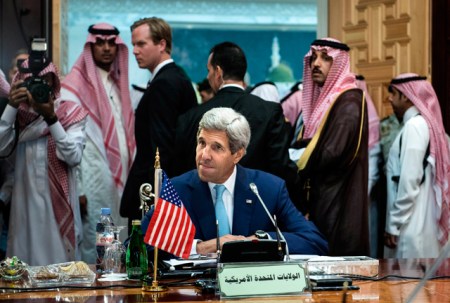
kerry-gulf-states-cooperation-ip_2John Kerry. (Photo: © Reuters)

US Secretary of State John Kerry spoke with Saudi Crown Prince Mohammed bin Nayef at the UN to discuss bilateral ties. Here’s what they might have said to each other.

U.S. Secretary of State John Kerry: Pleasure to see you your royal highness. I have some very important matters to discuss with you and don’t have much time, so I hope you don’t mind if we launch straight into it.

Saudi Crown Prince Mohammed Bin Nayef: No problem at all.

Kerry: Wonderful. The first thing I’d like to ask is about is your human rights violations in Yemen. You guys sure have been killing an awful lot of civilians over there. According to the U.N. humanitarian coordinator your soldiers have killed or wounded at least 10,000 civilians since beginning the campaign in 2015. Do you think you could, you know, dial it back a little bit? Or maybe just be more careful when you’re getting your bomb on?

Nayef: Listen, we’ve bought $110 billion worth of weapons from y’all since Obama took office. That’s a lot of money. If you don’t like the way we do things we’d be happy to take our business elsewhere. China never asks us these sorts of insulting questions about alleged “civilian casualties.” How can you prove they’re not terrorists anyway? Once someone is just mangled chunks mixed with rubble, terrorists and civilians start to get a lot harder to differentiate

Kerry: The U.N. Human Rights Commissioner says you’ve killed two-thirds of the civilians who’ve died in the war. You’ve dropped cluster bombs on civilian areas! You’re using white phosphorus!

Nayef: Cluster bombs and white phosphorus that you sold to us. As I said we’re happy to take our business elsewhere. Do you want us to kill Iranian-backed terrorists or not? You know what they’re like, always hiding in civilian areas like that school for the blind.  We’ll try, but it’s an impossible situation.

Kerry: Ok, ok, I don’t want to upset you. What about Syria. Since 2013, you’ve been the largest foreign backer of rebel militias.

Nayef: I thought you supported the legitimate aspirations of the Syrian people to oust the tyrant Assad?

Kerry: Well in theory, but you were instrumental in founding and funding Jaish al-Islam, the largest rebel group in Syria with 20,000-25,000 soldiers. The thing is that this militia group and many others openly want to establish an Islamist state with sharia governance. We were rather hoping this thing could finish up with a nice Western-style liberal democracy. You’ve spent billions funding rebel groups, but what’s the endgame here? Another repressive Islamist regime? Maybe Assad wouldn’t be so bad after all, you know?

Nayef: Listen up Johnny boy. After all your smack-talk about red-lines and chemical weapons and the thousands of his own people he has killed, 86,000 civilians dead since the start of the war, of which he’s thought to have killed 75%, you want us to swallow keeping that viper as president of Syria? Besides, you have no idea what you’re doing there. CIA-backed militias have reportedly engaged in combat with Pentagon-backed militias!

Unlike you, we’re in it to win, and we’re not going to stop backing the rebels just because they take religion seriously, unlike your godless citizenry.

Kerry: OK, ok. But what about women’s rights in your kingdom? Human Rights Watch has launched the campaign to end your patriarchal male guardianship laws, which keep women trapped in a system of gender apartheid. Will you be acting to repeal those laws and bring Saudi Arabia into the 2st Century?

Nayef: Why? So our women can walk around half naked like they do in America, whoring themselves out to every guy they see, not even caring if they get raped? Clearly you do not understand Islamic values of honor and chastity. I suggest you take a cultural sensitivity course instead of imposing your colonial paradigms of women’s liberation onto our ancient and noble culture.

Kerry: One more thing, could you release imprisoned human-rights activist Raif Badawi? Ten years in prison and 1,000 lashes for writing a blog seems a bit much.

Nayef: No.

Kerry: Ok, well I guess that’s about it then.

Nayef: Thank you for your time, Mr Secretary. I do so enjoy our little chats.

China to Obama: America Forced Norks to get Nukes and Must Negotiate a Deal

Posted September 20, 2016 by danmillerinpanama
Categories: China, Foreign policy, Iran - North Korea, Iran - sanctions relief, Iran scam, Japan, North Korea sanctions, North Korean missiles, North Korean nukes, Obama and China, Obama and Iran scam, Obama and North Korea, South Korea

Tags: , , , , , , , , , , , ,

China to Obama: America Forced Norks to get Nukes and Must Negotiate a Deal, Dan Miller’s Blog, September 20, 2016

(The views expressed in this article are mine and do not necessarily reflect those of Warsclerotic or its other editors. — DM)

In an article titled North Korean Nukes, South Korea, Japan, China and Obama, posted the day after North Korea’s most recent nuke test, September 9th, I contended that China would not honor Obama’s request to make North Korea stop developing and testing nukes. China has remained a faithful ally of North Korea since the end stage of the Korean Conflict and “sees Obama, not as the representative of the world’s greatest power, but as a joke. He has no clout internationally and is a national embarrassment.”  NB: I had hoped to publish this article more than a week ago, but my internet was down or at best intermittent from September 13th until September 19th.)

I was right, but it’s a bit worse than I had thought.

On September 12th, an article was published by Xinhua titled China urges U.S. to take responsibility on Korean Peninsula nuclear issue. Xinhua is

the official press agency of the People’s Republic of China. Xinhua is the biggest and most influential media organization in China. Xinhua is a ministry-level institution subordinate to the Chinese central government. Its president is a member of theCentral Committee of China’s Communist Party.

According to Xinhua,

U.S. Defence Secretary Ashton Carter reportedly called for further pressure on the DPRK last Friday after the country carried out a new nuclear test and said China bears “responsibility” for tackling the problem. [Emphasis added.]

The essence of the Korean Peninsula nuclear issue is the conflict between the DPRK and the United States, spokesperson Hua Chunying said at a press conference. [Emphasis added.]

As a permanent member of the UN Security Council and a close neighbor of the DPRK, China has made unremitting efforts to maintain peace and stability on the Korean Peninsula and safeguard the international nuclear non-proliferation regime, Hua said.

A statement released by the Foreign Ministry of the DPRK Sunday said the United States compelled the DPRK to develop nuclear warheads, and the nuclear threat it has constantly posed to the DPRK for decades is the engine that has pushed the DPRK to this point. [Emphasis added.]

Blindly increasing the pressure and the resulting bounce-back will only make the nuclear issue on the Korean Peninsula “a firm knot,” Hua said, calling for responsibility from all relevant parties.

Hua reiterated that China will remain committed to resolving issues concerning the Peninsula through dialogue to realize long-term peace and stability.

China strongly urges all parties to speak and act cautiously with the larger picture in mind, avoid provoking each other and make genuine efforts to achieve denuclearization, peace and stability on the Korean Peninsula, Hua said.

. . . .

“We have seen the twists and turns in the situation on the Korean Peninsula since the six-party talks have stalled,” Hua said, noting that it proves that simple sanctions cannot solve the issue. [Emphasis added.]

Hua said the security concerns of parties on the Korean Peninsula must and can only be resolved in a way that serves the interests of all parties.

Any unilateral action based on one’s self-interest will lead to a dead end, and it will not help resolve one’s security concerns but will only aggravate the tension, complicate the issue, and make it more difficult to achieve relevant goals, Hua said. [Emphasis added.]

The six-party talks, involving China, the DPRK, the United States, the Republic of Korea (ROK), Russia and Japan, were a multilateral mechanism aimed at solving the Korean Peninusla nuclear issue. The talks began in 2003 and stalled in December 2008. The DPRK quit the talks in April 2009.

“Resuming the six-party talks is difficult, but we cannot give up easily ,” Hua said.

China will continue to keep close communication with relevant parties and call on them to return to the right track of solving issues related to the Korean Peninsula through dialogue and negotiation, the spokesperson said.

China clearly appears to be following the line of Kim Jong-un on why North Korea needs nukes:

The Obama administration cannot engage in successful negotiations with North Korea, for several reasons. They are, in no particular order: Obama will be gone in about four months; Kerry is Obama’s Secretary of State; The Obama-Clinton-Kerry Iran Scam gave the Islamic Republic everything it sought and, at best, left Iran on the highway to nukes. North Korea and Iran are different in at least one major respect: Iran claimed that it did not have nukes and had not tried to develop them; Supreme Leader Khamenei was claimed to have issued a fatwa against the acquisition, development and use of nukes — despite propaganda videos showing how Iran will use nukes against the “great and little Satan.” North Korea has and has tested five nukes. Kim brags about them and threatens to use them.

The nuke threat

38 North is a think tank largely devoted to obtaining and publishing reliable information about North Korea’s nuke and missile programs. An article there by , published on September 12th, concludes:

What are the greatest threats from the rapidly expanding North Korean nuclear program? Left unchecked, Pyongyang will likely develop the capability to reach the continental United States with a nuclear tipped missile in a decade or so. Much more troubling for now is that its recent nuclear and missile successes may give Pyongyang a false sense of confidence and dramatically change regional security dynamics. The likely ability of the DPRK to put nuclear weapons on target anywhere in South Korea and Japan and even on some US assets in the Pacific greatly complicates the regional military picture. That situation would be exacerbated if Pyongyang decides to field tactical nuclear weapons as its arsenal expands and its confidence in its nuclear arsenal grows.

More bombs and better bombs also increase the potential of accidents and miscalculations with greater consequences as the number and sophistication of bombs increase. Rendering the nuclear enterprise safe and secure in case of internal turmoil or a chaotic transition in the North becomes more difficult. We also cannot rule out that a financially desperate leadership may risk the sale of fissile materials or other nuclear assets, perhaps to non-state actors. [Emphasis added.]

So, what to do? The latest nuclear test demonstrates conclusively that attempting to sanction the DPRK into submission and waiting for China to exert leverage over Pyongyang’s nuclear program do not work. Increasing sanctions and adding missile defenses in South Korea to that mix will also not suffice and make China even less likely to cooperate. What’s missing is diplomacy as much as Washington may find it repugnant to deal with the Kim regime.

On September 20th, North Korea announced that it had tested a new long-range rocket engine, suggesting that it “can be used for an intercontinental ballistic missile (ICBM), which is capable, in theory, of hitting targets on the U.S. mainland.” The September 9th nuke test is claimed to have involved “a miniaturized nuclear warhead that could be mounted on a ballistic missile.” How close in North Korea to being able to nuke the U.S. mainland? I don’t know and don’t want to find out by having it happen.

Can diplomacy, even if undertaken by a new administration after Obama leaves office, be successful? Continued sanctions got Iran to engage in negotiations; both Iran and Obama’s America very much wanted the sanctions lifted so that Iran would become an honorable member of the community of nations. There are few if any significant sanctions to lift on North Korea and China will not impose or enforce any; China’s role has been to help North Korea evade sanctions.

In China Won’t Stop Kim Jong-un. The U.S. Must Stand Up to Both of Them, published by Slate Magazine on September 13,  had some perhaps useful suggestions:

[T]he United States should rally the same sort of campaign that revved up the pressure against Iran before those nuclear talks got underway. In other words, the international community should apply sanctions not only against North Korea but also against all institutions that do business with North Korea—an action that would affect some major Chinese banks, which provide it with energy supplies, other goods, and hard currency. [Emphasis added.]

Yes, this would stir tensions in U.S.-China relations; but so do a lot of other actions, many of them instigated by China (for instance, the dodgy territorial claims in the South China Sea), and in this case, any perceptions of American aggression would be offset, to some degree, by a realization—at least by some Chinese officials—that it’s time for Beijing to face up to its problem and reassess its strategic priorities accordingly. (Longtime China-watchers say that some of Xi’s senior comrades have been advocating tougher action against Kim.)

He also suggests that if an end is put to North Korea’s nuclear ambitions and work, America should agree to terminate its no longer necessary THAAD deployments in South Korea and Japan. Further, the next president

should take steps, especially with China, to prevent Pyongyang from deploying a nuclear missile; but if that proves fruitless, he or she should make very clear that North Korea’s use of nuclear weapons—or even a conventional invasion of South Korea (which might be accompanied by a brandishing of nukes to deter anyone from coming to Seoul’s aid)—will be regarded as an attack on the United States and will be dealt with accordingly. There should be no ambiguity about this. Kim Jong-un may be crazy, but his eccentricities have always been in the service of his survival—and he should understand that he’s putting his survival on the line. Daniel Sneider, associate director of Stanford University’s Shorenstein Asia-Pacific Research Center, thinks we should deploy more nuclear-capable aircraft on U.S. bases in Asia to drive this point home fiercely.

It seems worth noting that among the reasons to expect that a Russian-assisted attack on South Korea would be successful, which Kim Il-sung suggested to Stalin in 1950, was that Secretary of State Dean Atcheson had delivered an important address in which he listed the nations to the defense of which America would come if attacked. South Korea was not on the list. As I observed here in November of 2010,

When Kim il-Sung secretly visited Moscow between March 30 and April 25, he assured Stalin that his attack would succeed in three days: there would be an uprising by some two hundred thousand party members and he was convinced that the United States would not intervene. Secretary of State Dean Acheson’s January 12, 1950 speech was persuasive evidence. There, Secretary Acheson had omitted South Korea from a list of nations which the United States would defend if attacked. Stalin gave the go-ahead.

Conclusions

China has encouraged North Korean nuclearization and wants America and her allies, principally South Korea, to cease their “provocations” against the Kim regime. Yet Kim thrives on, and encourages his supporters by, engaging in provocations far more serious and dramatic than anything thus far done by America and South Korea. It seems likely that the North Korean nuke – missile problem will continue until Kim is (a) taken out and (b) replaced with someone less narcissistic and more interested in feeding his people than his ego. Whether such a replacement will emerge is unknown. However, if a Kim clone emerges instead, he seems likely to be more concerned than Kim about his prospects for a long and happy life, even with protection from China.

Should Presidents Have the Power “to Shape Our Children”?

Posted September 20, 2016 by danmillerinpanama
Categories: 2016 elections, Children, Donald Trump, Hillary Clinton, Michelle Obama

Tags: ,

Should Presidents Have the Power “to Shape Our Children”? Front Page Magazine, Daniel Greenfield, September 20, 2016

281-hillary-witch-clinton-940

Creeping totalitarianism creeps up on us. So fewer eyebrows are raised now when Hillary says something like this, “As Michelle Obama said at the Democratic convention, it is about who will have the power to shape our children for the next four years of their lives.”

Michelle Obama did indeed say that. “This election, and every election, is about who will have the power to shape our children for the next four or eight years of their lives.  And I am here tonight because in this election, there is only one person who I trust with that responsibility, only one person who I believe is truly qualified to be President of the United States, and that is our friend, Hillary Clinton”

Children would be better off raised by wolves than shaped by Hillary Clinton.

But elections are not supposed to be about who gets to “shape our children”. They’re how the adult voters select representatives to handle their affairs. Michelle and Hillary’s formula is creepy.

Children are shaped by their parents, not by Hillary Clinton luring small children into her gingerbread house.

But we heard this already from Melissa Harris-Perry on MSNBC, “We have to break through our kind of private idea that kids belong to their parents, or kids belong to their families, and recognize that kids belong to whole communities.”