Archive for the ‘U.S. Congress’ category

A Historic Catastrophe

July 21, 2015

A Historic Catastrophe, Rasmussen Reports, Thomas Sowell, July 21, 2015

[H]e has maneuvered the Republican-controlled Congress into a position where they will need a two-thirds majority in both Houses to prevent his unilaterally negotiated agreement from going into effect — just by not calling it a treaty. 

If he is that savvy at home, why is he so apparently incompetent abroad? Answering that question may indeed require us to “think the unthinkable,” that we have elected a man for whom America’s best interests are not his top priority.

********************

Distinguished scientist Freeman Dyson has called the 1433 decision of the emperor of China to discontinue his country’s exploration of the outside world the “worst political blunder in the history of civilization.”

The United States seems at this moment about to break the record for the worst political blunder of all time, with its Obama administration deal that will make a nuclear Iran virtually inevitable.

Already the years-long negotiations, with their numerous “deadlines” that have been extended again and again, have reduced the chances that Israel can destroy the Iranian nuclear facilities, which have been multiplied and placed in scattered underground sites during the years when all this was going on.

Israel is the only country even likely to try to destroy those facilities, since Iran has explicitly and repeatedly declared its intention to wipe Israel off the face of the earth.

How did we get to this point — and what, if anything, can we do now? Tragically, these are questions that few Americans seem to be asking. We are too preoccupied with our electronic devices, the antics of celebrities and politics as usual.

During the years when we confronted a nuclear-armed Soviet Union, we at least realized that we had to “think the unthinkable,” as intellectual giant Herman Kahn put it. Today it seems almost as if we don’t want to think about it at all.

Our politicians have kicked the can down the road — and it is the biggest, most annihilating explosive can of all, that will be left for our children and grandchildren to try to cope with.

Back in the days of our nuclear standoff with the Soviet Union, some of the more weak-kneed intelligentsia posed the choice as whether we wanted to be “red or dead.” Fortunately, there were others, especially President Ronald Reagan, who saw it differently. He persevered in a course that critics said would lead to nuclear war. But instead it led to the peaceful conclusion of the Cold War.

President Barack Obama has been following opposite policies, and they are likely to lead to opposite results. The choices left after Iran gets nuclear bombs — and intercontinental missiles that can deliver them far beyond Israel — may be worse than being red or dead.

Bad as life was under the communists, it can be worse under nuclear-armed fanatics, who have already demonstrated their willingness to die — and their utter barbarism toward those who fall under their power.

Americans today who say that the only alternative to the Obama administration’s pretense of controlling Iran’s continued movement toward nuclear bombs is war ignore the fact that Israel bombed Saddam Hussein’s nuclear facilities, and Iraq did not declare war. To do so would have risked annihilation.

Early on, that same situation would have faced Iran. But Obama’s years-long negotiations with Iran allowed the Iranian leaders time to multiply, disperse and fortify their nuclear facilities.

The Obama administration’s leaking of Israel’s secret agreement with Azerbaijan to allow Israeli warplanes to refuel there, during attacks on Iran’s nuclear facilities, was a painfully clear sabotage of any Israeli attempt to destroy those Iranian facilities.

But the media’s usual practice to hear no evil, see no evil and speak no evil in the Obama administration buried this news, and allowed Obama to continue to pose as Israel’s friend, just as he continued to assure Americans that, if they liked their doctor they could keep their doctor.

Some commentators have attributed Barack Obama’s many foreign policy disasters to incompetence. But he has been politically savvy enough to repeatedly outmaneuver his opponents in America. For example, the Constitution makes it necessary for the President to get a two-thirds majority in the Senate to make any treaty valid. Yet he has maneuvered the Republican-controlled Congress into a position where they will need a two-thirds majority in both Houses to prevent his unilaterally negotiated agreement from going into effect — just by not calling it a treaty.

If he is that savvy at home, why is he so apparently incompetent abroad? Answering that question may indeed require us to “think the unthinkable,” that we have elected a man for whom America’s best interests are not his top priority.


Islam, Imam Obama, Sir John of Kerry and a great deal for Iran | Part II

July 20, 2015

(The views expressed in this post are mine, and do not necessarily reflect those of Warsclerotic or its other editors. — DM)
Oh what a tangled web we weave, when first we practice to deceive.

Dealing from the Bottom

The current “deal” is based on a long-standing scam

Part I of this series, published on July 14, 2015, pointed out what should be a glaring consistency in the “Joint Comprehensive Plan of Action,” first made available on that date, and the November 24, 2013 Joint Plan of Actionneither provides for any “anytime -anywhere” inspections of Iran’s nuclear weaponization or missile sites. That consistency has been little remarked upon elsewhere.

Secretary Kerry now acknowledges that he never sought such inspections.

Leaving aside the twenty-four day lag between an IAEA request to inspect suspect facilities — which Kerry says is just fine — he claims that we now have a “unique ability” to get the U.N. Security Council to force inspections and reinstate sanctions. However, any effort to do so would almost certainly be vetoed by one or more Security Council members. The permanent members are China, France, Russia, the United Kingdom, and the United States — five of the members of P5+1 which approved the “deal.”

On July 16th, US Under Secretary of State Wendy Sherman said,

“I think this is one of those circumstances where we have all been rhetorical from time to time,” Sherman said in a conference call with Israeli diplomatic reporters. “That phrase, anytime, anywhere, is something that became popular rhetoric, but I think people understood that if the IAEA felt it had to have access, and had a justification for that access, that it would be guaranteed, and that is what happened.” [Emphasis added.]

Kerry also claimed that the massive financial boost for Iran resulting from the lifting of sanctions will not enhance Iran’s support for terrorism.

Speaking to the BBC after the nuclear agreement between Iran and six world powers was reached, Kerry said that the more than $100 billion that Iran is set to receive “is going to make all the difference in the world is just – it’s not true.”

Acknowledging Iran is an international player in wreaking terror across the globe, Kerry said, “What Iran has done for years with Hezbollah does not depend on money.” He similarly stated Iran’s support of the Houthi rebels against the government in Yemen has not “depended on money.” [Emphasis added.]

. . . .

In its most recent report, the State Department wrote, “Iran has provided hundreds of millions of dollars in support of Lebanese Hezbollah in Lebanon and has trained thousands of its fighters at camps in Iran.”

In 2010 alone, State reported “Iran provides roughly $100-$200 million per year in funding to support Hezbollah.”

Secretary Kerry is almost certainly wrong, on that as on other aspects of the “deal.”.

Here’s Megan Kelly’s wrap up.


Iran may reject the “deal.”

There are at least glimmers of hope that Iran may reject the “deal,” unanimously endorsed by the UN Security council today.

A UN Security Council resolution endorsing Iran’s nuclear deal that passed on Monday is unacceptable, the country’s Islamic Revolutionary Guards Corps commander Mohammed Ali Jafari was quoted as saying by the semi-official Tasnim News Agency.

“Some parts of the draft have clearly crossed the Islamic republic’s red lines, especially in Iran’s military capabilities. We will never accept it,” he was quoted as saying shortly before the resolution was passed in New York. [Emphasis added.]

The Iranian Parliament also has problems with the “deal.”

On Saturday, the Fars News Agency reported that the Majlis threatened to reject the agreement’s provision on ballistic missiles, which call for an international embargo on missile technology to be extended for eight years–a significant, last-minute concession by the U.S.

Iran wants unrestricted ballsitic missile development and access to conventional arms dealers abroad.

“The parliament will reject any limitations on the country’s access to conventional weapons, specially ballistic missiles,” said Tehran MP Seyed Mehdi Hashemi.

. . . .

In addition, the nuclear deal says that the Majlis will ratify the Additional Protocol (AP) to the Non-Proliferation Treaty–but it does not say when.

The AP is the key to long-term monitoring of Iranian nuclear research and development by the International Atomic Energy Agency (IAEA). Without approval of the AP, Iran may hide key information about its nuclear activity, and may accelerate advanced centrifuge research immediately when the nuclear deal expires, among other hazards. (Even then, its commitments under the AP will be somewhat voluntary.) [Emphasis added.]

. . . .

[W]hile the interim agreement of Nov. 2013 provided that Iran would ratify the AP within one year, there is no such deadline in the final Iran deal. The AP is merely to be applied “provisionally,” while the Majlis decides whether to accept it or not.

Meanwhile, if the Obama administration has its way, the U.S. Congress will have no opportunity to amend the deal–and will have to accept the lifting of international sanctions regardless of whether legislators accept or reject the agreement. [Emphasis added.]

Iranian leadership’s opposition to the “deal” appears to have come from Iran’s Supreme leader and the Iranian Parliament has the authority to reject the “deal.”

As expected, Ayatollah Ali Khamenei’s reaction to the nuclear deal was utterly different from that of President Hassan Rouhani. Right after the agreement was announced on July 14, Rouhani appeared on state television and praised the outcome. Yet when he and other officials visited Khamenei’s home a few hours later, the Supreme Leader did not say anything about the deal apart from a few lines thanking the negotiators. This reticence signaled to hardliners that they should increase their attacks on the agreement. [Emphasis added.]

America’s Supreme Leader, on the other hand, has been pushing vigorously to force the U.S. Congress to approve it, with no way to change it.


The “deal,” and Obama’s foreign policy in general, are rooted in His affinity for Islam

Obama may or may not be a Muslim. However, He thinks very highly of Islam and deems it the “religion of peace.” It would be ironic were Obama’s Iran “deal” to be rejected by Iran.

As observed in a Jerusalem Post article, with the thrust of which I agree, His affinity for Islam is at the root of His “deal.”

Obama is the first US president who genuinely conceives of Islam as not inherently opposed to American values or interests.

. . . .

It is through this Islamo-philic prism that the Obama administration’s attitude to, and execution of, its foreign policy must be evaluated – including its otherwise incomprehensible capitulation this week on Iran’s nuclear program. [Emphasis added.]

. . . .

The inspection mechanism provided for in the nascent deal make a mockery of Obama’s contention (July 14): “… this deal is not built on trust; it is built on verification,” and, “Because of this deal, inspectors will also be able to access any suspicious location… [They] will have access where necessary, when necessary.”

One can hardly imagine a more grossly misleading representation of the deal – so much so that it is difficult not to find it strongly reminiscent of the Muslim tactic of taqiya (the religiously sanctioned deception of non-Muslims). [Emphasis added.]

Indeed, immediately following the announcement of the agreement, Ben Rhodes, Obama’s deputy national security adviser, made a stunning admission to CNN’s Erin Burnett. Starkly contradicting the president’s contention of “access where necessary, when necessary,” Rhodes conceded, “We never sought in this negotiation the capacity for so-called anytime, anywhere,” which is diametrically opposed to the impression he conveyed in April this year when queried on this issue. [Emphasis added.]

In His capacity as America’s Imam in Chief, Obama has consistently claimed that the “religion of peace” has nothing to do with the Islamic State or with Islamic terrorism (of which he claims there is none) — such as the recent murder of four members of the U.S. Marines and one member of the U.S. Navy — committed in the name of Allah. The Daily Beast has posted some of the terrorist’s writings. They include these statements:

“I would imagine that any sane person would devote their time to mastering the information on the study guide and stay patient with their studies, only giving time for the other things around to keep themselves focused on passing the exam,” Abdulazeez wrote. “They would do this because they know and have been told that they will be rewarded with pleasures that they have never seen.”

This life is that test, he wrote, “designed to separate the inhabitants of Paradise from the inhabitants of Hellfire.”

. . . .

“We ask Allah to make us follow their path,” Abdulazeez wrote. “To give us a complete understanding of the message of Islam, and the strength the live by this knowledge, and to know what role we need to play to establish Islam in the world.” [Emphasis added.]

Obama apparently considers the Islamic Republic of Iran to be Islamic — and therefore peaceful — despite its widespread support for its terrorist proxies. That may explain the credence He gives to Supreme Leader Khamenei’s alleged fatwa preventing Iran from obtaining nukes. Obama and Khamenei have frequently referred to it in support of that proposition, although no text been produced. According to a Washington Post article dated November 27, 2013,

Oddly, the Iranian Web site does not provide the text of the original fatwa — and then mostly cites Western news reports as evidence that Khamenei has reiterated it on several occasions. The fatwa does not appear to be written, but in the Shiite tradition equal weight is given to oral and written opinions.

. . . .

Just about every Alfred Hitchcock thriller had what he called a “MacGuffin” — a plot device that gets the action going but is unimportant to the overall story. The Iranian fatwa thus appears to be a diplomatic MacGuffin — something that gives the Americans a reason to begin to trust the Iranians and the Iranians a reason to make a deal. No one knows how this story will end, but just as in the movies, the fatwa likely will not be critical to the outcome. [Emphasis added.]

Even if one believes the fatwa exists — and will not later be reversed — it clearly appears to have evolved over time. U.S. officials should be careful about saying the fatwa prohibits the development of nuclear weapons, as that is not especially clear anymore. The administration’s statements at this point do not quite rise to the level of  earning Pinocchios, but we will keep an eye on this issue. [Emphasis added.]

An April 6, 2015 article at the Middle East Media Research Institute provides additional information.

In March of this year Obama presented a Nowruz message to the people of Iran citing Khamenei’s alleged fatwa. Here’s a video from the White House.

Here are a few interesting excerpts:

“Our negotiations have made progress, but gaps remain,” he said. “And there are people, in both our countries and beyond, who oppose a diplomatic resolution. My message to you—the people of Iran—is that, together, we have to speak up for the future we seek. [Emphasis added.]

“As I have said many times before, I believe that our countries should be able to resolve this issue peacefully, with diplomacy,” Obama said. “Iran’s Supreme Leader Ayatollah Khamenei has issued a fatwa against the development of nuclear weapons, and President Rouhani has said that Iran would never develop a nuclear weapon. [Emphasis added.]

Isn’t that special! Why, in light of the alleged fatwa, does Iranian television broadcast simulations of nuclear attacks on Israel?

A short animated film being aired across Iran, shows the nuclear destruction of Israel and opens with the word ‘Holocaust’ appearing on the screen, underneath which a Star of David is shown, Israel’s Channel 2 reported on Tuesday.

Khamenei’s Death to America rants are considered an excellent reason to have a “deal.”

Similarly, the Reverend Jeremiah Wright was fond of saying “God Damn America.”

Obama apparently understood Khamenei’s words, but perhaps He didn’t understand Jeremiah’s words.


Conclusions

Elected on a platform of Hope and Change, Obama has brought us many changes; very few, if any, of those changes provide a basis for hope, at least until He has left office. Some will be difficult, if not impossible, even then to ameliorate. During His remaining time in office, He will continue to do His worst to eliminate any vestigial hope we may have. The “deal” with Iran is only one of the many changes for the worse that He has wrought.

Khamenei vs. Rouhani: Projecting Very Different Views on the Nuclear Deal

July 18, 2015

Khamenei vs. Rouhani: Projecting Very Different Views on the Nuclear Deal, World Affairs JournalMehdi Khalaji, July 16, 2015

(If Khamenei reneges on the deal, it will likely be impossible to “snap back” the sanctions. With improved Russian rockets, an attack on Iran’s nuclear facilities will be much more difficult.– DM)

In the United States, the same political body that was in charge of negotiating with Iran is also in charge of implementing the agreement. But in Iran, the president and his negotiators have little authority over foreign policy, the nuclear program, or military activities.

If [Khamenei] decides to stop implementing the deal in the next year or so, he would likely blame the West or the negotiating team for cutting such a deal, as he did in 2003 and 2004. His initial reaction to the new agreement has already sent discouraging signals about Iran’s willingness to comply with its commitments in the long term.

****************

The Supreme Leader’s initial reaction has sent discouraging signals about Iran’s willingness to comply with its commitments in the long term.

As expected, Ayatollah Ali Khamenei’s reaction to the nuclear deal was utterly different from that of President Hassan Rouhani. Right after the agreement was announced on July 14, Rouhani appeared on state television and praised the outcome. Yet when he and other officials visited Khamenei’s home a few hours later, the Supreme Leader did not say anything about the deal apart from a few lines thanking the negotiators. This reticence signaled to hardliners that they should increase their attacks on the agreement.

On July 15, in order to protect himself against these critics, Rouhani told the cabinet that Khamenei was “carefully following up” on the details of the final negotiations and “had meticulous supervision” over the process, to the point where the Supreme Leader “truly undertook much heavier responsibility in this regard” than any other official. But even this did not help him much. On July 14, Rouhani sent Khamenei a letter reporting on the deal’s results, but the Supreme Leader delayed his response by a day in order to show his lack of excitement about it. The letter thanked Khamenei for his “intelligent guidance and perpetual and explicit support to the negotiating team,” who “could successfully implement all policies determined by the Supreme Leader and respect redlines set” by him. Khamenei’s delayed answer — hardly a third as long as the president’s letter — avoided any wording that might indicate his total satisfaction with the accord, his direct role in the negotiations, or his responsibility for the deal. Instead he wrote, “The text needs to be studied carefully and go through the predicted legal process. Then, if it is approved, it needs to be protected against potential violations of the deal by the other party.”

Khamenei also failed to mention who should approve the deal. Rouhani’s team and the hardliners are currently in the midst of a hot dispute about whether that responsibility lies with the Majlis or the Supreme National Security Council. The hardliners insist on parliament, arguing that all international agreements should be adopted by the legislative branch of the government. Yet Rouhani’s team says that only the Supreme Council should review and endorse it. Not coincidentally, the president is the titular head of that council.

SHARP HARDLINER CRITICISM

On July 16, hardliner website Raja News published the third part of an article series titled “Some Aspects of the Deal Which Should Remain Unveiled,” by Ali Akbar Taheri. The article explains how the final deal reached by Rouhani’s negotiating team crosses six different redlines previously set by the Supreme Leader:

  1. Long-term limitations on the nuclear program. Khamenei has said that Iran should not agree to ten-year limitations because “ten years is a lifetime.” According to the article, however, the signed agreement contains at least fourteen Iranian commitments lasting ten or more years (e.g., a twenty-five-year limit on inspections and surveillance over enrichment of mined uranium; a fifteen-year ban on uranium enrichment at the Fordow facility).
  2. Unconventional inspections and access to military facilities. Khamenei has explicitly rejected such measures, but the final agreement allows the International Atomic Energy Agency (IAEA) to conduct surveillance in all factories that enrich mined uranium, among other things. The agency can also ask to inspect military facilities such as Parchin if they deem it necessary.
  3. Limitations on enrichment at Fordow. Khamenei has opposed any such restrictions at the mountain facility, but the final agreement contains several.
  4. Delayed lifting of some sanctions. Khamenei previously insisted that all sanctions be rescinded as soon as the deal is signed, but the agreement indicates that some U.S. congressional sanctions and EU sanctions will not be lifted right away, if at all.
  5. IAEA conditionality. Khamenei has often expressed his distrust of the IAEA and declared that sanctions relief should not be conditioned on Iran’s implementation of the deal. Yet UN sanctions will not be lifted until the IAEA verifies that Tehran has complied with the agreement’s terms.
  6. Limits on centrifuge research. Khamenei has said that no restrictions should be placed on Iran’s nuclear research for the duration of the deal. Yet the agreement includes a ten-year limit on enrichment R&D related to the IR-4, IR-5, IR-6, and IR-8 centrifuges, among other things.

The article also downplays Rouhani’s claim about lifting sanctions related to weapons, noting that “these sanctions would be replaced by limits [imposed on Iran’s weapons trade]…[E]very missile that is able to carry a nuclear warhead would be limited, all Shahab missiles and satellite carriers and so on.” In addition, the article claims that Russian foreign minister Sergei Lavrov said the following: “Russia and China wanted weapons sanctions to be lifted, but despite our support the Iranian team itself agreed to continuation of the sanctions for the next five years!”

On July 16, at an event called “The Beginning of the Math Class” (a sarcastic title indicating that the time of verification has begun), hardline analyst Fouad Izadi criticized the deal from a different angle: “If the U.S. Congress rejects the agreement, America would not be bound to implement it, but if Iran implements the agreement, it will lose all leverage.” Izadi, who is close to the Islamic Revolutionary Guard Corps, went on to claim that in the case of disagreement between Iran and the P5+1, “the arbiter is the UN Security Council,” which means that the United States and other P5+1 members would essentially become the arbiters of their own dispute. “If Iran gets accused of violating the agreement, [these countries] can issue a resolution against it,” he said, but if the United States or another party is so accused, “the Security Council cannot issue a resolution because one of them could just veto it.” He also pointed out that the Majlis should approve the agreement, and that it should condition Iran’s implementation of the deal on U.S. congressional approval, explaining that “the U.S. president will not be in office in nineteen months, and after him the U.S. administration would not be bound by the agreement if Congress disapproves it.”

Also on July 16, the hardline newspaper Kayhan claimed that the largely insignificant financial reaction to the nuclear deal — i.e., no sharp changes in the stock market or exchange rate — shocked those who have been “overexcited” about the negotiations. “People expected the foreign currency rate to drop and the national currency value to go up,” said one article, “and now they ask why the opposite has happened.”

CONCLUSION

In the United States, the same political body that was in charge of negotiating with Iran is also in charge of implementing the agreement. But in Iran, the president and his negotiators have little authority over foreign policy, the nuclear program, or military activities. Instead, those sectors are under the purview of Supreme Leader Khamenei, who is usually reluctant to take any public responsibility for major decisions. Furthermore, he has repeatedly expressed his distrust toward Americans, the West, the UN, and the IAEA. And while he has more or less supported Iran’s negotiators in his public statements, he has clearly sought to distance himself from them as well. If he decides to stop implementing the deal in the next year or so, he would likely blame the West or the negotiating team for cutting such a deal, as he did in 2003 and 2004. His initial reaction to the new agreement has already sent discouraging signals about Iran’s willingness to comply with its commitments in the long term.

The irrelevance of Congress

July 17, 2015

The irrelevance of Congress, Power LineScott Johnson, July 17, 2015

The gambit undermines the Corker bill – to say nothing of American sovereignty – on multiple levels. On a policy level, the UNSCR on its own would compel American action even if Congress rejects the Iran deal. On a political level, the administration intends to take the UNSCR and go to lawmakers while they’re considering the deal and say ‘you can’t reject the agreement because it would put America in violation of international law.’

*********************

Omri Ceren writes to elucidate the unfolding process in the Iran deal brought to us by President Obama. Omni’s message explores the issue I noted yesterday here. This is important. Omni writes:

Lead negotiator Wendy Sherman confirmed for journalists yesterday that the Obama administration will, over the next few days, pursue a binding United Nations Security Council resolution (UNSCR) that will lift sanctions on Iran. The resolution was circulated yesterday by the U.S. and a leaked text is already online [1]. When asked how the move could be reconciled with the 60-day Congressional review period mandated by the Corker legislation, Sherman sarcastically responded that you can’t really say “well excuse me, the world, you should wait for the United States Congress” because there has to be some way for “the international community to speak.” [2]. She noted that at least the UNSCR would have a 90 day interim period before its mandatory obligations kick in.

The gambit undermines the Corker bill – to say nothing of American sovereignty – on multiple levels. On a policy level, the UNSCR on its own would compel American action even if Congress rejects the Iran deal. On a political level, the administration intends to take the UNSCR and go to lawmakers while they’re considering the deal and say ‘you can’t reject the agreement because it would put America in violation of international law.’

The pushback from the Hill yesterday was immediate and furious. Corker: “an affront to the American people… an affront to Congress and the House of Representatives” [3]. Cardin: “it would be better not to have action on the U.N. resolution” [4]. Cruz: “our Administration intended all along to circumvent this domestic review by moving the agreement to the UN Security Council before the mandatory 60-day review period ends” [5]. Kirk: “a breathtaking assault on American sovereignty and Congressional prerogative” [6]. McCarthy: “violates the spirit of the Iran Nuclear Agreement Review Act of 2015, which the President signed into law… inconceivable – yet sadly not surprising” [7].

The Washington Post article [by Karen DeYoung here covers some of those statements and has a bunch of background. The story will develop throughout the day and through the beginning of next week. It’s going to be particularly brutal given that the Corker legislation was created and passed to stop exactly this scenario.

Remember how we got here. The March 9 Cotton letter, signed by 47 Senators, declared that without Congressional buy-in any deal with Iran would not be binding on future presidents [8]. Iranian FM Zarif responded with a temper tantrum in which he revealed that the parties intended to fast-track an UNSCR that would make Congress irrelevant and tie the hands of future presidents: “I wish to enlighten the authors that if the next administration revokes any agreement with the stroke of a pen, as they boast, it will have simply committed a blatant violation of international law”[9]. That created a firestorm of criticism from the Hill [10]. Zarif doubled down from the stage at NYU: “within a few days after [an agreement] we will have a resolution in the security council … which will be mandatory for all member states, whether Senator Cotton likes it or not” [11].

And so Congress responded with the Corker legislation. 98 Senators and 400 Representatives passed the bill with the intention of preventing the Obama administration from immediately going to the U.N. after an agreement and making good on Zarif’s boast. President Obama signed the bill. Now the administration is doing exactly what the legislation was designed to prohibit.

______________________

[1] http://www.scribd.com/doc/271711382/Iran-Deal-Draft-UNSC-Resolution-as-Uploaded-by-Inner-City-Press#scribd
[2] http://www.c-span.org/video/?327147-1/state-department-briefing
[3] http://www.cbsnews.com/news/biden-woos-hill-democrats-on-iran-nuclear-deal/
[4] http://thehill.com/homenews/senate/248228-senators-balk-at-un-action-on-iran
[5] http://www.cruz.senate.gov/files/documents/Letters/20150716_LettertoPOTUSonIranDeal.pdf
[6] http://www.kirk.senate.gov/?p=press_release&id=1474
[7] http://www.majorityleader.gov/2015/07/16/un-not-consider-iran-deal-congress/
[8] http://www.cotton.senate.gov/content/cotton-and-46-fellow-senators-send-open-letter-leaders-islamic-republic-iran
[9] http://www.npr.org/sections/thetwo-way/2015/03/10/392067866/iran-calls-gop-letter-propaganda-ploy-offers-to-enlighten-authors
[10] http://www.thedailybeast.com/articles/2015/03/12/gop-goes-ballistic-over-plan-to-take-the-iran-nuke-deal-to-the-u-n.html
[11] http://freebeacon.com/national-security/zarif-a-few-days-after-deal-un-will-drop-all-sanctions-whether-sen-cotton-likes-it-or-not/

NOTE: Noah Rothman has more here.

The President Holds a Press Conference on the Nuclear Deal with Iran

July 16, 2015

The President Holds a Press Conference on the Nuclear Deal with Iran, The White House, July 15, 2015

(Iran’s centrifuges continue to spin and so does Obama. — DM)


Nuclear deal pushes Israel aside in Washington, raises Iran to leading US partner and ally

July 15, 2015

Nuclear deal pushes Israel aside in Washington, raises Iran to leading US partner and ally, DEBKAfile, July 15, 2015

Benjamin_Netanyahu-Iran_14.7.15Binyamin Netanyahu: Powers gambled on our future

Israeli Prime Minister Binyamin Netanyahu bitterly accused the “leading international powers of gambling our collective future on a deal with the foremost sponsor of international terrorism” – roundly condemning all six world powers who signed the nuclear deal with Iran in Vienna Tuesday, July 14.

President Barack Obama topped the list. Netanyahu pointed out that the president had determined on a deal with Iran at any price before he took office, which is true. Therefore, it had nothing to do with the poor relations between himself and the US President, he said in answer to critics. It was now time for Israeli leaders to set aside differences and pull together, he said. Opposition leader, the Zionist Union’s Yitzhak Herzog, agreed and said he was enlisting for the necessary effort on behalf of Israeli security. Tuesday night he received an update on the situation from the prime minister.

The special security cabinet meeting, called to discuss the ramifications of the nuclear deal, hours after it was signed, unanimously rejected it and declared “this deal does not commit Israel.”

Unfortunately, Israel was never asked for its commitment, any more than the other Middle East powers directly affected by it. The cabinet statement was therefore no more than a meaningless expression of futility, a sensation shared equally by Saudi King Salman and Egyptian President Abdel-Fatteh El-Sisi, in the face of the iron wall Obama and Secretary of State John Kerry have built for Iran in the region.

Both unceremoniously ditched Israel and its Arab neighbors in order to join hands with Iran. By this reshuffle of allies, Washington has created a new geopolitical reality in the region at the expense of its equilibrium.

The US Congress has 60 days to review the nuclear accord and reach a decision. But if Netanyahu had had any hopes of swinging the Senate around to voting down the veto President Obama promised to impose to mullify its rejection, that hope swiftly vanished in thin air. Leading presidential contender Hillary Clinton announced that if she wins the 2016 election she would abide in full by the nuclear accord Obama signed with Iran. This announcement assured Obama of a Senate majority.

The dead end reached by Netanyahu on this issue also symbolizes the end of Israeli’s special standing in Washington as “America’s leading Middle East ally.”

Iran has stepped into this position. There is little point in Israel knocking on the White House door to renew the old understanding and sympathy, as advised by former prime minister Ehud Barak and others. It does not matter who sits in the prime minister’s office in Jerusalem, as matters stand now, he/she will find themselves on the wrong side of that door.

Defense Secretary Ashton Carter will visit Israel next week. But that is only an attempt to soften the blow.

This does not mean that the Obama administration will totally abandon Israel, only that it will no longer enjoy favored status compared with other Middle East nations. By ditching the Arab world, Obama equally dumped the Palestinian issue. This has some advantages for the Netanyahu government, but is not the end of the world for the Palestinians. They, like Arab governments, have the option of seeking an understanding with Tehran, whereas that door is shut tight against Israel.

In this situation, Israel’s quiet understandings with a number of Arab leaders directed at forming a bloc to counter the US-Iran alliance, have no immediate future. When the earth shakes in a major upheaval, each individual is out to save himself and has no time to look around for allies.

In some ways, the Netanyahu government may find relief in being released from the political and strategic constraints bound up in the relationship with the Obama administration, and find the freedom to be more pragmatic and independent in its policy-making.

After all, Israel still has the strongest army and the most vibrant economy in the Middle East. Its leaders must learn to use those huge assets wisely and independently of the Obama administration.

We Should Go to War With Iran, Not Give Them a Peace Deal | PJTV

July 15, 2015

We Should Go to War With Iran, Not Give Them a Peace Deal | PJTV, July 14, 2015


Obama’s Iran Deal Has the Makings of a Catastrophe

July 15, 2015

Obama’s Iran Deal Has the Makings of a Catastrophe, National Review Online via Middle East forum, Daniel Pipes, July 14,2015.  Originally published under the title, “Could the Iran Deal Be the Worst International Accord of All Time?”

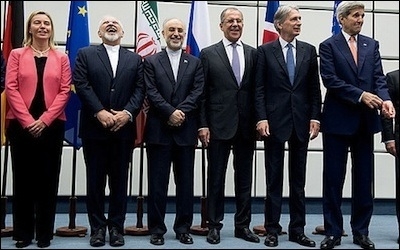
1497Iran’s negotiators (second and third from left) have good reason to be happier than their Western counterparts.

The conduct of the Iran nuclear negotiations has been wretched, with the Obama administration inconsistent, capitulating, exaggerating, and even deceitful. It forcefully demanded certain terms, then soon after conceded these same terms.

*********************

Barack Obama has repeatedly signaled during the past six and a half years that that his No. 1 priority in foreign affairs is not China, not Russia, not Mexico, but Iran. He wants to bring Iran in from the cold, to transform the Islamic Republic into just another normal member of the so-called international community, ending decades of its aggression and hostility.

In itself, this is a worthy goal; it’s always good policy to reduce the number of enemies. (It brings to mind Nixon going to China.) The problem lies, of course, in the execution.

The conduct of the Iran nuclear negotiations has been wretched, with the Obama administration inconsistent, capitulating, exaggerating, and even deceitful. It forcefully demanded certain terms, then soon after conceded these same terms.

Secretary of State John Kerry implausibly announced that we have “absolutely knowledge” of what the Iranians have done until now in their nuclear program and therefore have no need for inspections to form a baseline. How can any adult, much less a high official, make such a statement?

The administration misled Americans about its own concessions: After the November 2013 Joint Plan of Action, it came out with a factsheet which Tehran said was inaccurate. Guess who was right? The Iranians. In brief, the U.S. government has shown itself deeply untrustworthy.

The agreement signed today ends the economic sanctions regime, permits the Iranians to hide much of their nuclear activities, lacks enforcement in case of Iranian deceit, and expires in slightly more than a decade. Two problems particularly stand out: The Iranian path to nuclear weapons has been eased and legitimated; Tehran will receive a “signing bonus” of some US$150 billion that greatly increases its abilities to aggress in the Middle East and beyond.

The United States alone, not to speak of the P5+1 countries as a whole, have vastly greater economic and military power than the Islamic Republic of Iran, making this one-sided concession ultimately a bafflement.

Of the administration’s accumulated foreign-policy mistakes in the last six years, none have been catastrophic for the United States: Not the Chinese building islands, the Russians taking Crimea, or the collapse into civil wars of Libya, Yemen, Syria, and Iraq. But the Iran deal has the makings of a catastrophe.

Attention now shifts to the U.S. Congress to review today’s accord, arguably the worst treaty not just in American history or modern history, but ever. Congress must reject this deal. Republican senators and representatives have shown themselves firm on this topic; will the Democrats rise to the occasion and provide the votes for a veto override? They need to feel the pressure.

Everything you need to know about Obama’s Iran deal

July 15, 2015

Everything you need to know about Obama’s Iran deal, BreitbartBen Shapiro, July 14, 2015

ap_barack-obama_ap-photo13-640x427AP Photo/Andrew Harnik, Pool

The deal the Obama administration cut today with the Iranian terrorist regime signals once and for all that the Obama administration considers both the United States and Israel to be the key threats to peace in the world.

Why else would the American president have lifted sanctions and granted the Iranian mullahs decades of American cover in the face of overwhelming evidence they support anti-Western, anti-Semitic, and anti-Sunni terror across the region and the globe?

President Obama’s statements today about the strength of this deal carry no weight, given that he has coordinated with the Iranian regime – which is responsible for the deaths of hundreds of Americans over the past few years – in Iraq, has allowed them to prop up Bashar Assad in Syria, has allowed them to continue their subjugation of Lebanon, watched in silence as they flexed their muscle in Yemen, and attempted to cut off weapons shipments to Israel in the midst of its war with Iranian proxy terror group Hamas.

Obama wants Iran to be a regional power, because Obama fears Israel more than he fears Iran. The same day that Obama announced his deal, “moderate” Iranian President Hassan Rouhani tweeted, “To our neighbours: Do not be deceived by the propaganda of the warmongering Zionist regime. #Iran & its power will translate into your power.”

Obama’s counting on it.

Obama had one motivation in this deal: he believes that any Western attempt to stop Iran’s nuclear development with force is more dangerous and less moral than Iran’s elevated terror support and even its eventual nuclear development.

America and the West, in Obama’s global worldview, are so dangerous that he wouldn’t even make minor requests of Iran, such as releasing American prisoners, if that meant the minute possibility of actual Western action on the horizon. Obama doesn’t care if Iran is lying. To him, that risk is acceptable when compared with the certainty of Western action, no matter how constrained, against Iran.

Obama consistently posed the choice about his nuclear deal as one between diplomacy and war, as though a military strike against Iran would have precipitated World War III. But this deal is far more calibrated to provoke World War III than any targeted strike by Israel, the United States, or anyone else.

The deal pats itself on the back with wording about ensuring that “Iran’s nuclear programme will be exclusively peaceful,” and how the deal will be a “fundamental shift” in the international community’s relationship with Iran. Then it gets to details. And the devil isn’t just in the details; the devils in Iran wrote them.

The deal “will produce the comprehensive lifting of all UN Security Council sanctions as well as multilateral and national sanctions related to Iran’s nuclear programme, including steps on access in areas of trade, technology, finance and energy.” Those sanctions end on the first day of the deal: “The UN Security Council resolution will also provide for the termination on Implementation Day of provisions imposed under previous resolutions.” The EU “will terminate all provisions of the EU Regulation.”

Money will now move between “EU persons and entities, including financial institutions, and Iranian persons and entities, including financial institutions.” Banking activities will resume abroad. Full trade will essentially resume. After five years, the arms embargo against Iran will end. After eight years, the missile embargo against Iran will end.

The deal explicitly acknowledges that Iran is gaining benefits no other state would gain under the Non-Proliferation Treaty. In terms of its nuclear development, instead of dismantling Iran’s nuclear program, that program is now protected:

Iran will continue to conduct enrichment R&D in a manner that does not accumulate enriched uranium. Iran’s enrichment R&D with uranium for 10 years will only include IR-4, IR-5, IR-6 and IR-8 centrifuges as laid out in Annex I, and Iran will not engage in other isotope separation technologies for enrichment of uranium as specified in Annex I. Iran will continue testing IR-6 and IR-8 centrifuges, and will commence testing of up to 30 IR-6 and IR-8 centrifuges after eight and a half years, as detailed in Annex I.

We have no way of knowing what Iran has done additionally, however, since the deal has no provisions forcing them to turn over information about what they’ve already done. There is no baseline.

So who will implement this deal? A “Joint Commission” comprised of the UK, France, Germany, Russia, China, the United States and Iran is charged with monitoring all developments under the agreement – meaning that all the signatories, all of whom have an interest in preserving a deal they signed, will be the “objective” monitoring agents.

The International Atomic Energy Agency will monitor and verify Iran’s nuclear program. But not everywhere. Only at key nuclear facilities will the IAEA have access – military sites were not included in the deal in any real way – and even then, the process for access is extraordinarily regulated:

74. Requests for access pursuant to provisions of this JCPOA will be made in good faith, with due observance of the sovereign rights of Iran, and kept to the minimum necessary to effectively implement the verification responsibilities under this JCPOA. In line with normal international safeguards practice, such requests will not be aimed at interfering with Iranian military or other national security activities, but will be exclusively for resolving concerns regarding fulfillment of the JCPOA commitments and Iran’s other non-proliferation and safeguards obligations. The following procedures are for the purpose of JCPOA implementation between the E3/EU+3 and Iran and are without prejudice to the safeguards agreement and the Additional Protocol thereto. In implementing this procedure as well as other transparency measures, the IAEA will be requested to take every precaution to protect commercial, technological and industrial secrets as well as other confidential information coming to its knowledge.

75. In furtherance of implementation of the JCPOA, if the IAEA has concerns regarding undeclared nuclear materials or activities, or activities inconsistent with the JCPOA, at locations that have not been declared under the comprehensive safeguards agreement or Additional Protocol, the IAEA will provide Iran the basis for such concerns and request clarification.

76. If Iran’s explanations do not resolve the IAEA’s concerns, the Agency may request access to such locations for the sole reason to verify the absence of undeclared nuclear materials and activities or activities inconsistent with the JCPOA at such locations. The IAEA will provide Iran the reasons for access in writing and will make available relevant
information.

77. Iran may propose to the IAEA alternative means of resolving the IAEA’s concerns that enable the IAEA to verify the absence of undeclared nuclear materials and activities or activities inconsistent with the JCPOA at the location in question, which should be given due and prompt consideration.

78. If the absence of undeclared nuclear materials and activities or activities inconsistent with the JCPOA cannot be verified after the implementation of the alternative arrangements agreed by Iran and the IAEA, or if the two sides are unable to reach satisfactory arrangements to verify the absence of undeclared nuclear materials and activities or activities inconsistent with the JCPOA at the specified locations within 14 days of the IAEA’s original request for access, Iran, in consultation with the members of the Joint Commission, would resolve the IAEA’s concerns through necessary means
agreed between Iran and the IAEA. In the absence of an agreement, the members of the Joint Commission, by consensus or by a vote of 5 or more of its 8 members, would advise on the necessary means to resolve the IAEA’s concerns. The process of consultation with, and any action by, the members of the Joint Commission would not exceed 7 days, and Iran would implement the necessary means within 3 additional days.

Obama and Secretary of State John Kerry wrote into the deal provisions designed to hamstring Congress and local authorities:

If a law at the state or local level in the United States is preventing the implementation of the sanctions lifting as specified in this JCPOA, the United States will take appropriate steps, taking into account all available authorities, with a view to achieving such implementation. The United States will actively encourage officials at the state or local level to take into account the changes in the U.S. policy reflected in the lifting of sanctions under this JCPOA and to refrain from actions inconsistent with this change in policy.

And if Iran cheats, the United States and EU will have to take the matter to dispute resolution rather than re-implementing sanctions, as Obama has lied:

The U.S. Administration, acting consistent with the respective roles of the President and the Congress, will refrain from re-introducing or re-imposing the sanctions specified in Annex II that it has ceased applying under this JCPOA, without prejudice to the dispute resolution process provided for under this JCPOA. The U.S. Administration, acting consistent with the respective roles of the President and the Congress, will refrain from imposing new nuclear-related sanctions. Iran has stated that it will treat such a re-introduction or re-imposition of the sanctions…

Obama is already moving on this front. While calling for an open conversation on the Iran deal, President Obama has already said he will veto any attempts to curb the deal by Congress. So feel free to chat, gang, so long as you don’t attempt to do anything.

In brief, the agreement trades enormous amounts of cash for Iran’s pinkie swear that they will not develop nuclear weapons now, and the blind hope that Iran’s regime will magically moderate over the next five to ten years – a hope made even more distant by the fact that this deal reinforces the power and strength of the current Iranian regime. The West has no interest in holding Iran to an agreement since, to do so, they would have to repudiate the deal they cut in the first place. Anything short of actual nuclear aggression will draw no response from the West. No wonder Prime Minister of Israel Benjamin Netanyahu called the deal a “historic mistake for the world,” explaining:

Far-reaching concessions have been made in all areas that were supposed to prevent Iran from obtaining nuclear weapons capability. In addition, Iran will receive hundreds of billions of dollars with which it can fuel its terror machine and its expansion and aggression throughout the Middle East and across the globe… One cannot prevent an agreement when the negotiators are willing to make more and more concessions to those who, even during the talks, keep chanting: ‘Death to America.’ We knew very well that the desire to sign an agreement was stronger than anything, and therefore we did not commit to preventing an agreement.

So here’s what happens next in the region.

Israel Waits. The chances of an Israeli strike on Iran are now somewhere between slim and none. Obama’s deal prevents Israel from taking action without risking sanctions from the European Union and the United States for endangering this sham deal.

Nothing would make Obama happier than to levy sanctions against the Jewish State – and should Israel act in its own interests, undercutting Obama’s Epitaph Achievement, Obama will react harshly. Israel will be busy enough handling all the Iranian proxies on its borders who will now see cash and resources flow to them, all sponsored by the West.

Hezbollah and Hamas Are Strengthened. Terrorist groups across the Middle East rejoice today, knowing that the money Iran just gained through lifting of sanctions will end up restocking their rocket supply. Hezbollah has already destroyed Lebanon as Iran’s arm; Hamas has already taken over Gaza. Both routinely threaten war on Israel, firing ordinance into Israeli territory.

Now they will not only be emboldened – after all, what happens if Israel retaliates against them, Iran threatens to get involved, and the world, seeking to preserve its newfound magical relationship with Iran, puts pressure on Israel? – they will be empowered. Obama just made the next war between Israel and its terrorist neighbors a certainty.

Saudi Arabia and Egypt Go Nuclear. President Obama came into office touting “America’s commitment to seek the peace and security of a world without nuclear weapons.” Given that Iran is months from a bomb, and that there are no real verification techniques and no real consequences for violation, Iran’s enemies will quickly seek to go nuclear in order to establish a deterrent, not just to Iran’s nuclear capabilities, but to their expanded conventional capabilities.

Iran has the largest active military in the Middle East, along with its massive paramilitary terror groups. They’ve built that in the midst of heavy sanctions. With Iran getting active on the borders of Egypt and Saudi Arabia, those regimes would be foolhardy not to attempt to develop a nuclear capacity – especially given that Obama has shown there are no detriments to doing so. What’s he going to do, threaten Egypt’s General Al-Sisi? He’s been doing that for years already.

Bashar Assad Stays In Power. Remember the time Obama said Syrian dictator Bashar Assad needed to go? That’s not happening anytime soon, given that Assad is Iran’s tool in Syria. When Obama drew a red line against Syria based on Assad’s use of chemical weapons, he apparently meant that Assad should stay forever, and that his sponsor state should be rewarded with billions of dollars in relieved sanctions. No wonder Assad called the deal a “major turning point” in world history, adding, “We are confident that the Islamic Republic of Iran will support, with greater drive, just causes of nations and work for peace and stability in the region and the world.”

Iraq Splits Permanently Between Iran and ISIS. Supposedly, the United States opposed Shia exclusionary policy against Sunnis in Iraq, and blamed such policy for the breakdown of security there. The Iranian Revolutionary Guard has now taken over the southern half of the country; the new Iraqi Prime Minister is an Iranian proxy. Meanwhile, Sunnis, seeking some sort of security against the Iranians and having no secular American-backed regime to rely upon, have been turning in increasing numbers to the barbarians of ISIS. President Obama has made ISIS a permanent feature of the world landscape, and has turned Iraq into an Iranian proxy state, just like Syria and Lebanon.

Iran Will Foray Into Iran [?? — DM], Afghanistan. Iran’s expansionist ambitions have been increased exponentially by this deal. The deal does nothing to demand Iran stop its military activities abroad, of course, which means that their sponsorship of the Houthis in Yemen and terrorist groups in Afghanistan will continue apace. Al Jazeera has even speculated at sectarian unrest in Pakistan.

Obama’s defenders today ask his detractors, “If the deal works, isn’t it a good deal?”

Sure. If the Munich Agreement had worked, it would have been a masterpiece of diplomacy.

But promising a unicorn in a diplomatic negotiation isn’t quite the same thing as delivering one. And delivering billions of dollars, international legitimacy, and a protective shield around a terrorist regime in exchange for that unicorn makes you either a fool or an active perpetuator of that terrorist regime.

Goodnight Vienna (12)

July 13, 2015

Goodnight Vienna (12)Scott Johnson, July 13, 2015

The new Iranian demand to lift the United Nations arms embargo is getting a lot of talk, and probably a bit more than it deserves. It’s not that the concession wouldn’t be devastating – it would light up the region in so many different ways that they’re difficult to catalogue – but it just doesn’t seem possible that the Americans can give ground on this.

*********************

As we remain on the final countdown to the full catastrophe taking place in Vienna, Omri Ceren helps us keep track of the details. In his second email update this morning, Omri draws attention to Andrew Bowen’s Daily Beast column Give the mullahs ballistic missiles?” (quoted below). Omri writes:

The last few hours have been a flurry of bilateral and trilateral meetings – Kerry/Zarif, Kerry/Zarif/Mogherini, Hammond/Lavrov, Lavrov/Zarif, etc – and a full P5+1/Iran meeting will probably take place this evening. That plenary is presumably supposed to serve as something of a final meeting: the negotiators will send the deal text back to the capitals, they’ll get pro forma approval, and in the morning there will be a formal announcement.

In the meantime, the new Iranian demand to lift the United Nations arms embargo is getting a lot of talk, and probably a bit more than it deserves. It’s not that the concession wouldn’t be devastating – it would light up the region in so many different ways that they’re difficult to catalogue – but it just doesn’t seem possible that the Americans can give ground on this. What’s the sales pitch to Congress going to be? “Not only are we giving Iran $150 billion to bolster its military, but we’re also lifting arms restrictions to make it easier for them to buy next-generation cruise missiles they’ll use against the U.S. military and our allies.”

But just for the sake of argument, because some pro-Iran voices have taken to publicly suggesting otherwise, yes of course lifting the arms embargo would detonate American national security:

Rather, the real threat from increased Iranian military might lies elsewhere. The Islamic Revolutionary Guard Corps (IRGC)… does not hesitate to remind the world through its harassment of commercial shipping, military exercises, and frequent rhetoric that it can control or shut the Strait of Hormuz, through which 30 percent of the world’s petroleum supplies passes. Keeping the Strait open depends on the U.S. Navy being able to keep up with effective counter measures against improved Iranian cruise missiles… and so Tehran has invested in weapons such as cruise missiles, mines, submarines, and even swarming armed speedboats to specifically target U.S. naval vulnerabilities… Lifting the conventional arms embargo would allow Russia or China to sell Iran the latest generation cruise missiles and drones, which only increase Tehran’s ability to frustrate or harass America’s protectorate of this vital waterway… Moreover, Iranian ballistic missiles outfitted with Russian or Chinese quality precision-guidance munitions could be devastating for U.S. and GCC naval and air bases if there are further relaxations on Iran’s acquisition of missile technology.

The article is by Andrew Bowen, the Director of Middle East Studies at the Center for the National Interest. He goes on to list several other ways Iran would exploit lifting the arms embargo, including by providing advanced missiles to terror proxies to use against U.S. allies such as Israel and Jordan.

The demand is so delusional that some people are speculating the Iranians just brought it up to gain leverage. Whether that’s true or not, the stunt will make it more difficult for the Obama administration to justify the deal to Congress. If Kerry agrees to drop the arms embargo, it’s difficult to see Congress accepting the agreement. If Kerry gets the Iranians to give up on the the demand, Congress will want to know what he had to trade away to do it.