Archive for the ‘Turkish democracy’ category

Turkey’s Holy War

March 20, 2017

Turkey’s Holy War, Front Page MagazineRobert Ellis, March 20, 1017

(What common interests do Trump’s America and Erdogan’s Turkey have? Are they sufficient to warrant cooperation with Turkey in any area? — DM)

In Islamic eschatology the Mahdi (‘messiah’) plays a prominent role. For the Iranian Shia he is already born and has hidden down a well for over a millennium, waiting for the right time to emerge. Turkish Sunnis already have a candidate, breathing fire and brimstone and ready to purge the world.

At least, so it would seem, to judge from the campaign Turkey’s president Recep Tayyip Erdoğan has waged against unbelievers who have dared to block his plans to become the country’s all-powerful leader. 

On April 16 a referendum will be held in Turkey, where voters can decide on constitutional amendments which will remove all cumbersome checks and balances to Erdoğan’s power. In his campaign to secure a ‘yes’, Erdoğan has admitted he has been planning for such a system since he was mayor of Istanbul in the 1990s. Furthermore, that his plans for an executive presidency will concentrate all power in the hands of one person.

This “Turkish-style” presidential system means Erdoğan will have the power to appoint and dismiss ministers and high-level state officials without the need for parliamentary approval. He will also be able to declare a state of emergency, issue decrees, dissolve parliament and call elections without being held to account. The president will not only be head of state but also head of government – the post of prime minister will be abolished, and in effect the judiciary will be subject to his control.

What is particularly alarming, as the Venice Commission (the Council of Europe’s advisory body) has pointed out, the way the new constitution is configured means the president could stay in office for a potentially unlimited period of time.

The current conflict with Europe derives from Erdoğan’s insistence to extend his referendum campaign to the Turkish diaspora (there are about two and a half million Turks eligible to vote in Turkey in various European countries). However, as not all Turks are Erdoğan supporters, there is the danger of clashes, which could destabilize forthcoming elections in France and Germany, and latest in Holland.

Erdoğan has reacted violently to Germany and Holland’s refusal to allow him and his ministers to hold rallies, accusing Germany of “Nazi methods” and Holland of being “Nazi remnants” and “fascists” as well as “a banana republic.” This may go down well with Erdoğan’s supporters but not in Europe, where relations with Turkey are already strained.

But Erdoğan has stepped up the rhetoric. In a spectacular example of projection Erdoğan has claimed that “the spirit of fascism is running wild on the streets of Europe” and has compared the banning of rallies to the treatment of Jews during the Second World War. Here Erdoğan conveniently ignores that there has been a state of emergency in Turkey since the abortive coup last July, where public assemblies are banned and free speech is stifled. Also the fact that more than 135,000 have lost their jobs and over 140,000 have been detained or arrested in the ongoing purge of the Gülen movement, which has been held responsible for the coup.

Naysayers have been stigmatized as siding with the coup plotters, and the Kurdistan Workers’ Party (PKK) and the Gülen movement have been accused of backing the ‘no’ campaign. A prominent cleric has also branded opponents of the constitutional amendments as “opponents of Islam.”

Turkish foreign minister Mevlut Çavuşoğlu has warned of “holy wars” in Europe and Erdoğan has spoken of a struggle between the cross and the crescent, after the European Court of Justice allowed employers to ban the Islamic headscarf along with other religious symbols. As Turkey is term president of the Organization of Islamic Cooperation (OIC), President Erdoğan also intends to mobilize the OIC against Euro-fascism.

President Trump has not yet formulated a policy against radical Islamic terrorism but until now has left it to his generals to decide policy in the war against ISIL.

Here Turkey plays a key role, especially as Turkish forces in support of the Free Syrian Army (FSA) occupy an area in northern Syria, driving a wedge between two Kurdish autonomous areas. The question is whether the US in its drive to take Raqqa will continue to support the predominantly Kurdish Syrian Democratic Forces (SDF) or agree to cooperate with Turkey. The issue is still open to debate but will not be decided until after Turkey’s referendum in April.

In the meantime, the Trump administration has decided to send Secretary of State Rex Tillerson to meet with Turkey’s leaders at the end of the month. Whether this will be enough to assuage Turkish fears remains to be seen.

The West has finally woken up

March 17, 2017

The West has finally woken up, Israel National News opinion, Dr. Mordechai Kedar, March 17, 2017

Erdogan was insulted personally, as it suddenly appeared that the Dutch have their own will, and even worse, a sense of self-worth! They actually refused to continue their obeisance to the Sultan!

Holland is not alone: Germany, Denmark, Austria and Switzerland do not support Erdogan’s desire to become all-powerful, and have also applied limitations to the arrival of his spokesmen to their territories. Erdogan is now calling for international bodies to punish the Netherlands.

Are we witnessing the beginning of a struggle for the soul of Europe, fought between the newly-strengthened Right and those trying to effect an Islamic takeover? 

Is this the beginning of a change in the process of Europe’s Islamization?

Does Europe have a European future?

*****************************

Holland’s current ruckus with Turkey is only the tip of the European iceberg, most of which is already under water.

Sometimes it’s a good idea to take a step backwards, look at reality from a distance, and see the larger picture, taking in the whole forest rather than just the individual trees. If we attempt to review what has been going on in the world since the British decision to leave the European Union and since Donald Trump’s November 16th election victory, it is just possible that the picture emerging is that of a West beginning the fight against Islam after 8 years of submission disguised by a fragile mask of political correctness.

A not insignificant number of factors add up to a wide and inclusive picture: the fact that it is now permissible to say the words “Islamic terror” in the USA, the attempts to limit Muslim immigration to that country, Trump’s decision to finish off ISIS, the strengthening of rightist parties in Europe, the unsuccessful but serious possiblity that Geert Wilders might have been elected in Holland, the discovery of a gigantic weapons cache in Spain – these are only a small example of the issues that have been part of public discourse over the last few months.

It seems that the West has decided to wake up and shake off the Muslim takeover of the public and political agenda. More and more anti-Islamist phenomena are being seen in Europe and America, those called “Islamophobic” by Muslims and their support groups, who define them as irrationnal fears of Islam and Muslims. Opponents of Islam are not only members of shaven-headed gangs, neo-Nazis, tattoo-covered beer drinkers, but ordinary people, upstanding and honest citizens, who have become seriously anxious about what is happening in Europe and the USA.

They observe the cultural change flooding Europe with troubled eyes, noting the immigrants, many of whom come to live off government benefits, the increase in violence, the abusive and negative attitude towards European women in particular, the damage to the younger generation. The average European is very disturbed by Muslim women’s face-coverings, he sees that custom as a cultural red line. Western culture is based on revealing oneself in interpersonal contacts and covering one’s face contradicts this basic premise. In the West’s perception of things, those who hide their faces are criminals – like bank robbers or murderers with face masks – and this is the reason for the instinctive dislike Europeans have for seeing Muslim women wearing face-coverings in public places.

A good many Europeans have developed intense antagonism towards Islamists because of the behavior of some Muslims, mostly young ones, in the public space: noise, wild driving, male and female Islamic apparel, street prayer, mosque construction, muezzin calls to prayer in the middle of the night, burqinis at the beach and swimming pools, media reports of bigamy and polygamy among the immigrants, honor killings of girls and women, influences on school curricula and the food served to  pupils – and much more. Each one of the items listed above might have passed without making waves, but the combination of all of them draws a worrying impression of an alien culture that is increasingly threatening to overpower the West’s culture and way of life.

What can be observed in Europe and the USA today, is a counter-reaction, perhaps the shaking-up of a Western society which has succeeded in removing the mask of political correctness and has set out to battle this troubling development, in an attempt to recover its Western lifestyle, character and the once dominant public expression of that lifestyle. Will this necessarily lead to violence? Maybe not, but what not a few Muslim immigrants are about to discover is that Western socities are changing their attitudes to Muslim immigration and to Muslim demands whose purpose is the creeping Islamization of the European environment.

Holland as a test case: Enough of Erdogan

The background to what is happening today between Holland and Turkey is to be found in over 400 years of diplomatic relations between the two countries; Holland is one of the largest investors in the Turkish economy; over 2000 Dutch companies function in Turkey; trade between the two countries surpasses 10 billion dollars annually and at least a million Dutch tourists visit Turkey every year. At least 400,000 Turkish citizens, 2.5% of the Dutch population, live in Holland. Sounds good, even great, so far.

But what is happening now is the result of long years of European submission to Erdogan’s outlandish behavior, his impulsivity, crude manners and speech, and his flooding Europe with Syrian refugees and other, mostly Muslim, migrants. The Dutch were the first to protest, but the dispute has spilled over into other European countries.

The last round of bad blood between Turkey and Europe began a few days ago, when Erdogan attempted to send government ministers to Europe to encourage the millions of Turks living in Europe and who have the right to vote in Turkey, to endorse the changes in Turkey’s constitution that will strengthen his position. He intends to turn Turkey into a country where the president is not simply a symbolic figure as Erdogan is supposed to be today, but an executive holding the reins of the legislature, on the lines of the USA.

Holland is going through a process of reflection, one that has strengthened the radical right and its leader, Geert Wilders. A short five years ago, he was considered an untouchable racist, but recently, he became a serious candidate for leadership of the country. The Dutch have realized, somehwat belatedly, that their warm acceptance of Muslim migrants turned their country into a preferred destination, and are turning solidly to the right, trying to backtrack and save their homeland from an ever-growing Islamic invasion.

Despite the tense atmosphere and this growing anti-Islamism, Erdogan – head of an Islamist, Muslim Brotherhood-style party – decided to send his ministers to Holland in order to achieve even more power for himself. Did he go mad? Not at all, he simply doesn’t take Europeans into account in the slightest, has ignored them for years with impunity – after all, they let him get away with whatever he wanted to do from the day he gained power in 2002. The Dutch have decided that they have had enough of this and refused to allow the Turkish ministers to enter Holland and speak to their voters. The ministers’ intention, it should be stressed, was to reach the industrial port city of Rotterdam, which has a Muslim majority.

Erdogan was insulted personally, as it suddenly appeared that the Dutch have their own will, and even worse, a sense of self-worth! They actually refused to continue their obeisance to the Sultan! They refused to allow the plane bringing the Turkish foreign minister to land in Holland and stopped its family minister’s car at the border. They were unimpressed by Turkey’s threats of economic sanctions and the preventing of Dutch airlines from landing on Turkish soil. Erdogan compared them to Nazis and fascists, although Holland was a victim of the Nazis. At this point, the weapon chosen by both sides is that of recalling ambassadors.

Holland is not alone: Germany, Denmark, Austria and Switzerland do not support Erdogan’s desire to become all-powerful, and have also applied limitations to the arrival of his spokesmen to their territories. Erdogan is now calling for international bodies to punish the Netherlands.

Are we witnessing the beginning of a struggle for the soul of Europe, fought between the newly-strengthened Right and those trying to effect an Islamic takeover?

Is this the beginning of a change in the process of Europe’s Islamization?

Does Europe have a European future?

Time will tell, as will elections, but along with the political and public struggle, it is worthwhile for Europeans to consider having children. Without more children, the Europeans are marching proudly towards becoming a museum exhibit.

Written for Arutz Sheva, translated from the Hebrew by Rochel Sylvetsky.

Europe’s ‘Turkish Awakening’

March 14, 2017

Europe’s ‘Turkish Awakening’, Gatestone InstituteBurak Bekdil, March 14, 2017

Europe looks united in not allowing Erdogan to export Turkey’s sometimes even violent political polarization into the Old Continent.

Erdogan clearly rejected Merkel’s mention of “Islamist terror” on grounds that “the expression saddens Muslims because Islam and terror cannot coexist”.

Turkey increasingly looks like Saddam Hussein’s Iraq. An Iraqi government guide refused to discuss politics: “In Iraq half the population are spies… spying on the other half.”

Officially, Erdogan’s Turkey has embarked on a journey toward Western democracy. Instead, its Islamist ethos is at war with Western democracy.

Turkey, officially, is a candidate for full membership in the European Union. It is also negotiating with Brussels a deal which would allow millions of Turks to travel to Europe without visa. But Turkey is not like any other European country that joined or will join the EU: The Turks’ choice of a leader, in office since 2002, too visibly makes this country the odd one out.

Turkish President Recep Tayyip Erdogan, who is now campaigning to broaden his constitutional powers, which would make him head of state, head of government and head of the ruling party — all at the same time — is inherently autocratic and anti-Western. He seems to view himself as a great Muslim leader fighting armies of infidel crusaders. This image, with which he portrays himself, finds powerful echoes among millions of conservative Turks and [Sunni] Islamists across the Middle East. That, among other excesses in the Turkish style, makes Turkey totally incompatible with Europe in political culture.

Yet, there is always the lighter side of things. Take, for example, Melih Gokcek, the mayor of Ankara and a bigwig in Erdogan’s Justice and Development Party (AKP). In February Gokcek claimed that earthquakes in a western Turkish province could have been organized by dark external powers (read: Western infidels) aiming to destroy Turkey’s economy with an “artificial earthquake” near Istanbul. According to this conspiracy theory, the mayor not only claims that the earthquake in western Turkey was the work of the U.S. and Israel, but also that the U.S. created the radical Islamic State (ISIS). In fact, according to him, the U.S. and Israel colluded to trigger an earthquake in Turkey so they could capture energy from the Turkish fault line.

Matters between Turkey and Europe are far more tense today than ridiculous statements from politicians who want to look pretty to Erdogan. The president, willingly ignoring his own strong anti-Semitic views, recently accused Germany of “fascist actions” reminiscent of Nazi times, in a growing row over the cancellation of political rallies aimed at drumming up support for him among 1.5 million Turkish citizens in Germany.

The Dutch, Erdogan apparently thinks, are no different. In a similar diplomatic row over Turkish political rallies in the Netherlands, Erdogan described the Dutch government as “Nazi remnants and fascists”. After barring Turkish Foreign Minister Mevlut Cavusoglu from entering the country by airplane, the Dutch authorities also escorted another Turkish minister out of the country. Quite a humiliation, no doubt. An angry Erdogan promised the Netherlands would pay a price for that.

Dutch police in Rotterdam use batons, dogs and water cannon to control a riot that broke out when pro-Erdogan crowds violently protested the Dutch government’s refusal of entry to Turkish government ministers, on March 11, 2017. The Turkish ministers had planned to address political rallies of Turks in the Netherlands. (Image source: RT video screenshot)

Europe, not just Germany and the Netherlands, looks united in not allowing Erdogan to export Turkey’s highly tense and sometimes even violent political polarization into the Old Continent. There are media reports that the owner of a venue in the Swedish capital, Stockholm, has now cancelled a pro-Erdogan rally, although Sweden’s foreign ministry said it was not involved in the decision.

Europe’s anti-Erdogan sentiment is going viral. Denmark’s prime minister, Lars Loekke Rasmussen, said that he asked his Turkish counterpart, Binali Yildirim, to postpone a planned visit because of tensions between Turkey and the Netherlands. Although Turkey thanked France for allowing Foreign Minister Cavusoglu to address a gathering of Turkish “expats” in the city of Metz, French Foreign Minister Jean-Marc Ayrault called on Turkish authorities to “avoid excesses and provocations”.

None of the incidents that forcefully point to Europe’s “Turkish awakening” happened out of the blue. At the beginning of February, German Chancellor Angela Merkel and Erdogan held a tense meeting in Ankara. Erdogan clearly rejected Merkel’s mention of “Islamist terror” on grounds that “the expression saddens Muslims because Islam and terror cannot coexist”. The row came at a time when a German investigation into Turkish imams in Germany spying on Erdogan’s foes made signs of reaching out to other parts of Europe. Peter Pilz, an Austrian lawmaker, said that he was in possession of documents from 30 countries that revealed a “global spying network” at Turkish diplomatic missions.

At the beginning of March, after Turkey said it would defy opposition from German and Dutch authorities and continue holding rallies in both countries, Austrian Chancellor Christian Kern called for an EU-wide ban on campaign appearances by Turkish politicians.

In response, further challenging Europe, Turkey arrested Deniz Yucel, a Turkish-German reporter for a prominent German newspaper, Die Welt, on charges of “propaganda in support of a terrorist organization and inciting the public to violence.” Yucel had been detained after he reported on emails that a leftist hacker collective had purportedly obtained from the private account of Berat Albayrak, Turkey’s energy minister and Erdogan’s son-in-law.

Erdogan’s propaganda war on “infidel” Europe has the potential to further poison both bilateral relations with individual countries and with Europe as a bloc. Not even the Turkish “expats” are happy. The leader of Germany’s Turkish community accused Erdogan of damaging ties between the two NATO allies. Gokay Sofuoglu, chairman of the Turkish Community in Germany, which is an umbrella for 270 member organizations, said: “Erdogan went a step too far. Germany should not sink to his level”.

The most recent wave of tensions between Erdogan’s Turkey and Europe, which it theoretically aspires to join, have once again unveiled the long-tolerated incompatibility between Turkey’s predominantly conservative, Islamist and often anti-Western political culture and Europe’s liberal values.

Turkey increasingly looks like Saddam Hussein’s Iraq. During my 1989 visit to Iraq a Turkish-speaking government guide refused to discuss Iraqi politics, justifying his reluctance as: “In Iraq half the population are spies… spying on the other half.” Erdogan’s Turkey has officially embarked on a journey toward Western democracy. Instead, its Islamist mindset is at war with Western democracy.

Turkey’s Brain Drain

November 24, 2016

Turkey’s Brain Drain, Counter Jihad, November 23, 2016

lightmosque

The Islamist tyranny from the Erdogan regime is stripping Turkey of many of its best minds.

One of the categories here at CounterJihad is “Colonization by Immigration.”  Normally we are thinking about the effect on cultures and institutions in the West of importing millions from poorly-educated nations with intensely political, radical Islamist cultures.  Today we’re going to talk about another aspect of immigration from the Islamic world, though, which is the way in which it can be used to make the Islamist nations safer for Islamism.

In this case, the immigrants aren’t poorly-educated at all.  They’re the very best that Turkey has to offer.  In forcing them out, President Erdogan is undercutting the future of his nation — but also the danger of the young becoming well-enough educated to see how badly he is leading their country.

Education has been a notable target for the Turkish government since July 15’s coup attempt. Since then, the government has shut down 15 universities and around 1,000 secondary education institutions….

“They fired nearly 3,000 to 4,000 people. If they could, if they had their passports, all of them would leave the country. I believe that nearly all academics that speak fluent English, French or German – those who can continue their work in another language – will leave Turkey within a six-month period.”

We have been following this issue for months here.  Erdogan has been involved in a march against Western values of free inquiry and free expression.  Academics who signed a petition calling for an end to the war crimes against the Kurdish population have been rounded up by his government.

The potential damage of watching Turkey slip further into Islamist tyranny can hardly be overstated.  It certainly includes a threat to the NATO alliance, of which Turkey is a long-time part.

Yet the damage goes beyond the damage that will be suffered by the West.  Turkey’s youth, likewise, are being badly punished in the name of political Islam.  Halil Ibrahim Yenigun, interviewed in by DW, was suspended and then fired from his university.

“Most of us want to return home and pass on our experience to the young people of Turkey. That’s all we wanted to do. Before all this, there were many good academics… [W]e wanted to contribute to the education of young people…. These are people who attended state schools and then studied with taxpayers’ money. They went on to do doctorates overseas. And just as they’ve come back to give back to their country, you pluck them away from contributing to the youth of the nation. This is treason. They’re betraying our country’s future. They’re robbing the young of a good education.”

Perversely, Erdogan is encouraging the emigration of this class in order to make it easier to “colonize” his own universities.  It can be expected that they will become bastions of narrow opinion, and teach lockstep obedience to Erdogan’s personal authority.  At least a generation of young Turks will pay a heavy price for his attempt to romantacize the caliphate.  So too shall all of us who could once look upon Turkey as a friend and ally.

Turkey’s Descent into Islamist Tyranny Deepens

October 31, 2016

Turkey’s Descent into Islamist Tyranny Deepens, Counter Jihad, October 31, 2016

turkey-islamic-1

Turkey’s military forces have just seized the Hagia Sophia, appointing a full-time imam to lead Islamic prayers there after 80 years of it being held as a neutral place for both Christians and Muslims.  The move is symbolic, but shows clearly the designs of Turkey’s Islamist president.

The Turkish government under Recep Tayyip Erdoğan used the abortive coup of this summer to deepen its control over every aspect of Turkish life, but especially the media and education.  Over ten thousand public servants have been purged from the government in recent days, raising the total figure to over a hundred thousand — some 37,000 of whom have been arrested. Erdoğan has pressed the Turkish parliament to reinstate the death penalty so that he can begin disposing of those he has identified as his enemies.

“Our government will take this proposal [on capital punishment] to parliament. I am sure parliament will approve it, and when it comes back to me, I will ratify it…Soon, soon, don’t worry. It’s happening soon, God willing. The West says this, the West says that. Excuse me, but what counts is not what the West says. What counts is what my people say.”

According to CounterJihad’s sources, the detained who are subjected to trial must submit to having all of their conversations with their lawyers recorded whenever the prosecution requests it.  Such recordings are of course admissible as evidence against the client — or the lawyer, if he comes to be considered an enemy of the state from working too hard to defend people already classified as ‘enemies of the state.’

The detained include especially members of opposition media.  The leadership of the Cumhuriyet daily newspaper, which is nearly a century old, were arrested and their laptops seized by the police.  Their paper is not only critical of Erdoğan , but occasionally supportive of the Kurdish minority.  That appears to be grounds for arrest in Turkey now:  even two mayors were seized by order of a Turkish court on suspicion of being sympathetic to Kurdish militants.  In addition to the attacks on the Cumhuriyet daily, 15 Kurdish news outlets have been shuttered by order of the state.  A pro-Kurdish television station was raided by police and forced off the air.

In addition to the media, the state has moved to consolidate control over its system of higher education.  Some 1267 academics who signed a “Peace Petition” last January have been removed from their jobs according to CounterJihad’s sources, and several have been arrested and charged with “terroristic acts” for signing or forwarding that petition.  Our sources tell us that under the new laws, President Erdoğan must personally approve all new university presidents.

At the same time, the Turkish government is pressing NATO to end its naval mission aimed at containing migration flows across the Mediterranean sea.  Turkey claims that the mission is no longer needed, but the siege of Mosul is expected to produce at least a million new refugees in the coming months.  The Russian operations against Aleppo are likewise expected to produce new waves of migrants.

Turkey appears to be using its position within NATO to advance Russia’s interest here, which is to flood Europe with migrants in order to overburden European governments.  That will produce a Europe less able to resist Russian expansion into Eastern Europe.  Turkey and Russia recently signed a major energy deal, clearing the way for at least an economic alliance.  Erd also moved to abandon daylight savings time, a shift that places Turkey in the same time zone as Moscow.  Russia for its part appears to be negotiating a peace between Turkey and Iran on a partition of Iraq, one that would give Turkey greater control over its Kurdish problems.  If Russia succeeds in peeling Turkey off from NATO, it would invalidate the alliance as NATO requires unanimous decisions for all military decisions.

CAIR, Awad Continue Aggressively Shilling for Turkey

September 10, 2016

CAIR, Awad Continue Aggressively Shilling for Turkey, Investigative Project on Terrorism, September 9, 2016

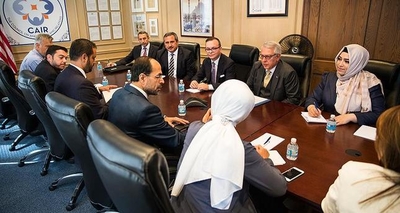
1822Parliamentarians from Turkey’s AK Party meet with CAIR officials earlier this week.

Awad was interviewed by Turkey’s Andolu news agency after this week’s meeting, which he called important in expressing “the support of the Muslim community for democracy and the rule of law in Turkey,” an IPT translation of his remarks shows.

**********************

A delegation from Turkey’s parliament came to Washington this week to make the case for extraditing Fethullah Gülen, an opposition figure living in self-imposed exile in Pennsylvania.

The Turkish government alleges Gülen was behind July’s failed coup attempt and President Tayyip Recep Erdoğan describes his extradition as a “priority.” Gülen denies any role in the coup and U.S. officials have said the Turkish evidence presented so far is not persuasive.

According to a Turkish press account, the delegation’s second meeting was with the Council on American-Islamic Relations (CAIR) and its executive director, Nihad Awad.

CAIR is a tax-exempt charity which presents itself as an American Civil Liberties Union devoted to protecting American Muslims from discrimination in housing, employment and other civil rights.

The visit from the Justice and Development Party (AKP) delegation, however, shows CAIR’s significant emphasis on influencing American foreign policy. CAIR is not a registered lobbying organization and isn’t registered as a foreign agent. Federal law requires registration by people or groups “before performing any activities for the foreign principal.”

CAIR routinely inserts itself into political debates on behalf of foreign entities, including a full campaign aimed at criticizing Israel during the 2009 and 2014 Gaza wars while staying silent about Hamas. Its Detroit director told a rally that being “defenders of the Palestinian struggle” was part of CAIR’s mission.

Awad was interviewed by Turkey’s Andolu news agency after this week’s meeting, which he called important in expressing “the support of the Muslim community for democracy and the rule of law in Turkey,” an IPT translation of his remarks shows.

“We believe in the need for more Turkish visitors and delegations to come to the United States to talk about their experiences and explain their views,” Awad said, “because there is a view against them and a pathological fear of Turkey here. The Turkish government must be aware of the need to employ more efforts to explain what is happening (in) Turkey to American public opinion.”

There’s something pathological at play here, but it isn’t some imaginary fear of Turkey. This is CAIR, an Islamist group created as part of a Muslim Brotherhood network in America, officially rushing to the aid of Turkey’s Islamist and increasingly authoritarian government, a government that itself has been increasingly aligned with the Muslim Brotherhood and Hamas.

In his comments, Awad publicly acknowledges what he advised an official Turkish government delegation in private to get the desired political outcome.

We previously reported on the immediate support American-Islamists organized for Erdoğan’s AKP immediately after the failed coup. While Erdoğan’s dedicated followers inside CAIR may be comfortable with his crackdown on dissent, a recent New York Times editorial hints many U.S. policy leaders are not.

They believe “that Mr. Erdogan’s roundup of coup plotters looks like an attempt to silence any opposition, that Turkey has behaved outrageously in failing to stop conspiracy theories depicting the United States as a co-conspirator in the coup attempt, that Turkey has produced little evidence to warrant Mr. Gulen’s extradition and that Mr. Erdogan’s autocratic behavior is making him an unreliable ally.”

He has proven unreliable in the fight against ISIS, too. He failed to stop the flow of foreign fighters using Turkey as a way-station to join ISIS and places his fight against pro-Western Kurds above the global threat posed by ISIS.

Erdoğan’s post-coup attempt arrest record, along with a media crackdown and allegations of torture, speak for themselves, if that’s what Awad thinks is part of the “pathological fear of Turkey.”

What it has to do with CAIR’s charitable mission is much murkier.

Obama is the Real Turkey in This Scenario

September 6, 2016

Obama is the Real Turkey in This Scenario, Algemeiner, Ruthie Blum, September 6,2016

turkey-turkey

It is typical of Obama to condemn the victims of such a travesty. But to describe the failed coup as a re-affirmation of the Turkish people’s “commitment to democracy and the strength and resilience of democratic institutions inside of Turkey” borders on willful lunacy and blindness.

***********************

US President Barack Obama met with Turkish President Recep Tayyip Erdogan on Sunday at the G-20 summit in China.

Though the purpose of the two-day gathering was for representatives of governments and central banks to discuss policy issues pertaining to international financial stability, the tete-a-tete between Obama and Erdogan on the sidelines of the forum was not about money. It was, rather, a meeting of the minds on a subject close to the hearts of both NATO allies.

With his Cheshire-cat grin and dead eyes, Obama patted his Turkish counterpart on the back and congratulated him on a job well done. Erdogan had not only survived an attempt to oust him, but had quashed it like a true tyrant. Obama could only look on in awe and envy.

Following their little chat, the two leaders addressed the press at the JW Marriott Hotel in Hangzhou.

“By taking to the streets to resist the coup attempt, the Turkish people once again affirmed their commitment to democracy and the strength and resilience of democratic institutions inside of Turkey,” Obama said. “I indicated at the time the unequivocal condemnation of these actions and spoke personally to President Erdogan to offer any support that we might be able to provide in both ending the attempted coup, but also in investigating and bringing perpetrators of these illegal actions to justice.”

One form this help is going to take, Obama hinted, is the possible extradition to Turkey of controversial cleric Fethullah Gulen, whom Erdogan claims orchestrated the failed coup from his home of self-exile in Pennsylvania.

Obama also extended his “deepest condolences” to Turkey’s victims of terrorism, and said that he and his pal “Tayyip” had consented “to continue pursuing a peaceful political transition in Syria.”

Erdogan also made a statement, calling the president of the United States “Barack,” before launching into one of his usual self-serving rants. Typical of a violent Islamist appropriating the moral high ground, the Turkish president agreed that fighting terrorism is of utmost importance. But the “terrorists” to whom he mainly referred were Gulen and the Kurds. Groups like the Muslim Brotherhood and Hamas — which live by the sword, the rifle and the suicide-bomb are just fine, as far as he is concerned.

Obama did not bat an eyelash, however, indicating that the foreign policy of his nearly eight-year administration is firmly intact. And it still involves being on the wrong side of every conflict, while presenting the bad guys in a favorable light. Turkey is but one of many examples.

Let’s start with the failed coup. Erdogan’s paranoia about Gulen is likely unfounded. If any conspiracy theory is in order, it is that Erdogan himself planned the whole thing, in order to strengthen and legitimize his already suffocating stranglehold on the country.

For years prior to the botched attempt, the Turkish president was gradually purging his society of dissent. No institution was exempt from his wrath, with members of the press and academia being placed under a particularly high-powered microscope. Arresting journalists for daring to publish pieces that exposed his behavior was commonplace well before July 15, the date of the coup. But the practice paled in comparison to what has been taking place across Turkey in the weeks since then. Tens of thousands of citizens whom Erdogan deems a threat to his reign of terror have been fired from their jobs, thrown into prison or both. These include people from the military, the police, the judiciary, the political echelon, the media and the universities.

It is typical of Obama to condemn the victims of such a travesty. But to describe the failed coup as a re-affirmation of the Turkish people’s “commitment to democracy and the strength and resilience of democratic institutions inside of Turkey” borders on willful lunacy and blindness. As was the case with the foiled Green Revolution in Iran, when the newly instated administration in Washington watched from afar as the regime in Tehran gunned down protesters trying to extricate themselves from the mullahs dictating their every move, the White House once again simply watched from afar, and let the forces of evil wreak their havoc uninterrupted.

We now fully grasp what Obama was up to in 2009 — a total capitulation to the world’s greatest state sponsor of terrorism, culminating in last year’s signing of the nuclear deal with the ayatollahs. What he has in store for Turkey during his remaining lame-duck tenure in office remains to be seen. But it won’t be good.

This he made clear in his declaration of cooperation with Erdogan on the Syrian front. Referring to a joint “pursuit of a peaceful political transition” in the war-torn country not only made a mockery of the millions of dead and maimed citizens whose plight barely elicits a yawn any more, but served as a signal to Erdogan that he can proceed with the slaughter of America’s Kurdish allies as he sees fit. You know, all in the name of fighting the Islamic State group, the only bogeyman on which there is wide consensus.

Erdogan’s cross-border attack, code-named Operation Euphrates Shield, was launched on Aug. 24 and is still going on. This “peaceful political transition” is being carried out by Turkish planes, tanks and artillery. But Tayyip’s friend Barack — the real turkey in this tale of woe — forgot to mention it.

Biden Gushes to Erdoğan That American People ‘Stand in Awe’ of Turkish ‘Courage’

August 25, 2016

Biden Gushes to Erdoğan That American People ‘Stand in Awe’ of Turkish ‘Courage’ PJ MediaBridget Johnson, August 25, 2016

(Erdogan’s Turkey is a transparently great “democracy” where some have human rights; Obama must be envious. — DM) 

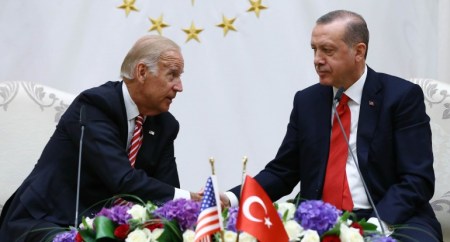
biden erdoganVice President Joe Biden and Turkish President Recep Tayyip Erdogan shake hands after a meeting in Ankara, Turkey, on Aug. 24, 2016. (Kayhan Ozer, Presidential Press Service Pool via AP)

Standing at the side of Turkish President Recep Tayyip Erdoğan during an Ankara press conference today, Vice President Joe Biden tried to soothe relations with the Islamist government by slamming last month’s coup attempt as “a violent betrayal by a small group of folks who were sworn to defend the very people that they say they care and love.”

“The attempted coup went to the heart of who your people are — principled, courageous and committed. And for a people who have struggled so long to establish a true democracy, this was, from my perspective and the president’s perspective, the ultimate affront. So my heart goes out to not just the government, but to the Turkish people,” Biden said.

Biden added it’s “hard for Americans to picture the possibility” of the military trying to overthrow the U.S. government “when they thought the president was on vacation with his family.”

The vice president toured damage to Turkey’s parliament left from the coup attempt.

“I can understand, Mr. President, how some of your countrymen would feel that the world didn’t respond to the existential crisis your country was facing rapidly enough, or with the appropriate amount of solidarity and compassion and empathy,” he continued. “And that’s why, Mr. President — you’ve known me for a while — that’s why I wanted to personally be here, and was asked by the President to personally be here to represent, to tell you and all of your colleagues and your countrymen how very, very, very sorry I am, the president is, the American people are for the suffering and loss you have endured.”

Biden added that “the American people also stand in awe of the way your countrymen respond to the way you respond personally — going on the Internet through, my guess is on Facebook — I’m not sure which vehicle you used — with a portable — or with a cellphone, telling your people to rise up, take back the street, do not let these terrorists, which is what they ended up being, steal their patronage, their — who they are.”

Erdoğan used Facetime during the coup attempt, filming from an unknown location, telling Turks to get into the streets and oppose the coup.

Erdoğan’s purge since the coup attempt has included basically any secular opponent to his Islamist government: more than 40,000 people have been rounded up, from soldiers to jurists to bankers and even teachers and a comedian. Human rights groups have charged that the rule of law has gone out the window as detainees have been kept in makeshift facilities without proper access to legal representation and suffering beatings, rapes and starvation. Erdoğan has also intensified his battle against the free press.

He has also demanded that the U.S. government extradite Fethullah Gülen, a onetime ally of Erdoğan turned opponent who lives in Saylorsburg, Pa.

A senior administration official told reporters this week that Turkey has filed four extradition requests, but none of the charges are coup-related.

“I personally, the president personally, the American people stand in awe of the courage of your people,” Biden gushed during the press conference. “And we understand, Mr. President, the sensitivities the Turkish people feel about international security. That’s why the United States is committed to doing everything we can to help bring justice for all those responsible for this coup attempt while adhering to the rule of law.”

On the extradition request, Biden said he knows “of no other case where as much time is being spent to make sure we find enough data to meet a court standing.”

“I suspect it’s hard for people to understand that as powerful as my country is, as powerful as Barack Obama is as president, he has no authority under our Constitution to extradite anyone. Only a federal court can do that. Nobody else can do that. If the president were to take this into his own hands, what would happen would be he would be impeached for violating the separation of powers,” he added.

Erdoğan said he and Biden “had the opportunity to discuss this failed coup at every extent possible,” once again calling Gülen’s progressive Islam movement a “terrorist organization” and stressing that Gülen “needs to be extradited to Turkey as soon as possible.”

He also demanded that U.S. authorities arrest and detain Gülen and his associates while considering the extradition request, and “I’m confident that the United States will take the necessary measures to cater to our expectations in that regard.”

Erdoğan also snapped at a reporter for using the term Islamic State during a question. “The Islamic State cannot be associated with terrorism. Daesh is a terrorist organization,” he said, using the pejorative Arabic acronym for ISIS. “They are terrorists. Islam is a derivative of the word ‘peace,’ or the prefix ‘peace’ stands for Islam, which is a derivative of Islam. A member of the Islamic faith can never engage in these massacres, in this carnage.”

Turkey’s Tradition of Murdering Christians

July 31, 2016

Turkey’s Tradition of Murdering Christians, Gatestone InstituteRobert Jones, July 31, 2016

(Please see also, Turkey’s Erdogan to US General: ‘Know Your Place’, which deals in large part with the U.S. relationship with Turkey. Turkey is “our” NATO ally and its membership in the European Union is still under consideration. — DM)

♦ Turkey’s countless agreements with Western organizations do not seem to have reduced the hatred for Christians there.

♦ In Turkey, it is “ordinary people” who murder or attack Christians, then the judiciary or political system somehow find a way of enabling the perpetrators to get away with the crimes. Most of these crimes are not covered by the international media and Turkey is never held responsible.

♦ While Muslims are pretty much free to practice their religion and express their views on other religions anywhere in the world, Christians and other non-Muslims can be killed in Turkey and other Muslim-majority countries just for attempting peacefully to practice their religion or openly express their views.

♦ “Multiculturalism,” which is passionately defended by many liberals in the West, could have worked wonders in multi-ethnic and multi-religious places such as Anatolia. But unfortunately, Islamic ideology allows only one culture, one religion, and one way of thinking under their rule: Islam. Ironically, this is the central fact these liberals do not want to see.

On 26 July, the northern French town of Saint-Étienne-du-Rouvray witnessed a horrific Islamist attack: Two Islamic State (ISIS) terrorists killed an 85-year-old priest, Jacques Hamel, in his church during Mass. Two nuns and two churchgoers were taken hostage.

The terrorists, who had pledged allegiance to ISIS and, shouting “Allahu Akbar”, slit the throat of the priest and captured the bloody episode on video, according to a nun who escaped the assault.

Such Islamist attacks might be new to EU member countries but not to Turkey. For decades, so many innocent, defenseless Christians in Turkey have been slaughtered by Muslim assailants.

Christians in Turkey are still attacked, murdered or threatened daily; the assailants usually get away with their crimes.

In Malatya, in 2007, during the Zirve Bible Publishing House massacre, three Christian employees were attacked, severely tortured, then had their hands and feet tied and their throats cut by five Muslims on April 18, 2007.

Nine years have passed, but there still has been no justice for the families of the three men who were murdered so savagely.

First, the five suspects who were still in detention were released from their high-security prison by a Turkish court, which ruled that their detention exceeded newly-adopted legal limits.

The trial is still ongoing. The prosecutor claims that the act “was not a terrorist act because the perpetrators did not have a hierarchic bond, their act was not continuous and the knives they used in the massacre did not technically suffice to make the act be regarded as a terrorist act.”

If the court accepts this legal opinion of the prosecutor, it could pave the way for an acquittal. However, given the many “mysterious” rulings of the Turkish judiciary system to acquit criminals, these killers could also be acquitted by a “surprise” ruling any time.

Ironically, Turkey’s President Recep Tayyip Erdogan said in March that it is necessary to redefine terrorism to include those who support such acts, adding that they could be journalists, lawmakers or activists. There was no difference, he said, between “a terrorist holding a gun or a bomb and those who use their position and pen to serve the aims” of terrorists.

In a country where state authorities are outspokenly so “sensitive” about “terrorism” and “people holding guns,” why are the murderers of Christians not in jail, and why is the prosecutor trying to portray the murders of Christians as “non-terroristic acts”?

Sadly, the three Christians in Malatya were neither the first nor the last Christians to be murdered in Turkey.

On February 5, 2006, Father Andrea Santoro, a 61-year-old Roman Catholic priest, was murdered in the Santa Maria Church in the province of Trabzon. He was shot while kneeling in prayer at his church. Witnesses heard the 16-year-old murderer shout “Allahu Akbar” (“Allah is the Greatest”) during the murder.

After the murder, a 74-year-old priest, Father Pierre François René Brunissen, from Samsun, led the next church service in Santoro’s church, which boasted barely a dozen members. Because no one volunteered to replace Santoro, Father Pierre was instructed to travel from Samsun to Trabzon each month to care for the city’s small congregation.

“This is a terrible incident,” Father Pierre said. “It is a sin to kill a person. After all of these incidents, I am worried about my life here.”

In July, 2006, he was stabbed and wounded by a Muslim in Samsun. The perpetrator, 53, said that he stabbed the priest to oppose “his missionary activities.”[1]

The attacks against the Christian culture in Anatolia continue in modern times — even after Turkey joined the Council of Europe in 1949 and NATO in 1952.

Turkey’s countless agreements with Western organizations do not seem to have reduced the hatred for Christians there. In March, 2007, as the Christian community of Mersin was preparing for the Easter, a young Muslim man with a kebab knife entered the church and attacked the priests, Roberto Ferrari and Henry Leylek.

Mersin, in southern Turkey, is home to Tarsus, the birthplace of Saint Paul, and to several churches dating from the earliest Christian era.

As the Christian roots of Anatolia weakened, so did its bonds with Western civilization. “The attack against the priest is an indicator that Ankara is not ready for Europe,” a Roman Catholic Cardinal and theologian, Walter Kasper, told the Italian newspaper, Corriere della Sera. “There is some amount of tolerance but there is not real freedom. Turkey has to change many things. This change is not about laws. A change of mentality is needed. But you cannot change mentality in one day.”

Bishop Luigi Padovese, Apostolic Vicar of Anatolia, said: “We do not feel safe. I am very worried. Fanaticism is developing in some groups. Some people want to poison the atmosphere and catholic priests are targeted. Anti-missionary films are broadcast on TV channels.”

At a commemorative ceremony for Father Santoro in February, Bishop Padovese said:

“Today, we are asking the question we asked four years ago: Why? We are also asking the same question for all other victims so unjustly murdered even though they were innocent. Why? What was it that they tried to destroy by murdering Father Andrea? Just a person or what that person represented? The aim of shooting Father Andrea was definitely to shoot a Catholic cleric. His being a Father became the reason of his martyrdom.

“The message of Christ on the cross is clear. ‘Father, forgive them, for they do not know what they do.’ Had they known, they would not have done that. It is wrong to extinguish a life to uphold an idea. It is wrong to think that a person who disagrees with us is at fault and should be destroyed. This is the fundamentalism that crumbles a society. For it wrecks coexistence. This fundamentalism — regardless of what religion or political view it belongs to — might win a few battles but it is doomed to lose the war. This is what history teaches us. I hope that this city and this country will turn into a place where people can live as brothers and sisters and unite for the common good for all. Is the Allah of all of us not the same?”

No, unfortunately, the Allah of all of us is not the same.

Just four months later, in June, 2010, it was Padovese’s turn to be murdered. This time the murderer was the Bishop’s own driver for the previous four years. The driver first stabbed the bishop, then cut his throat, while shouting “Allahu Akbar” during the attack.

At the trial, the driver said that the bishop was “Masih ad-Dajjal” (“the false messiah”), then twice in the courtroom he loudly recited the adhan (Islamic call to worship).

1737 (1)Father Andrea Santoro (left), a 61-year-old Roman Catholic priest, and 63-year-old Bishop Luigi Padovese (right), Apostolic Vicar of Anatolia, were two Christian priests murdered in Turkey in recent years.

In the territory where Christians once thrived, even converting to Christianity now creates serious problems.

“New Christians coming from Muslim families are often isolated and ostracized,” writes Carnes. “Turgay Ucal, a pastor of an independent church in Istanbul, who converted from Islam to Christianity said: “Buddhism is okay, but not Christianity. There was a history.”

And this history includes how indigenous Christians in Anatolia have been slaughtered by Muslims. [2]

The total population of Turkey is about 80 million; believers of non-Muslim faiths — mostly Christians and Jews — comprise 0.2%. Nevertheless, anti-Christian sentiment is still prevalent in much of the Turkish society. [3]

There seems to be a pattern: Murders of Christians are committed stealthily in Turkey: It is “ordinary people” who murder or attack Christians, then the judiciary or political system somehow finds a way of enabling the murderers or attackers to get away with what they have done. Sadly, most of these crimes are not covered by the international media, and Turkey is never held responsible.

Turkey, however, signed a Customs Union agreement with the European Union in 1995 and was officially recognized as a candidate for full membership in 1999. Negotiations for the accession of Turkey to the EU are still ongoing.

How come a nation that has murdered or attacked so many Christians throughout history, and which has not even apologized for these crimes, is considered even a suitable candidate for EU membership? Because of the threat of blackmail to flood Europe with Muslims? Turkey will flood Europe with them anyway. There is even a name for it: Hijrah, spreading Islam (jihad) by emigration. Exactly as Muslims have done inside Turkey.

And what kind of a culture and civilization have many Muslims built for the most part in the lands that they have conquered? When one observes the historical and current situation in Muslim-majority countries, what one mostly sees are murders, attacks and hatred: Hatred of non-Muslims, hatred of women, hatred of free thought and an extremely deep hatred of everything that is not Islamic. Many Muslims that have moved to the West have been trying to import political Islam to the free world, as well.

Muslim regimes including Turkey have not achieved civilized democratization that would enable all of their citizens — Muslims and non-Muslims — to live free and safe lives.

While Muslims are pretty much free to practice their religion and express their views on other religions or on atheism anywhere in the world, Christians and other non-Muslims can be killed in Turkey and other Muslim-majority countries just for attempting peacefully to practice their religion or openly express their views.

“Multiculturalism,” which is passionately defended by many liberals in the West, could have worked wonders in multi-ethnic and multi-religious places such as Anatolia. But unfortunately, Islamic ideology allows only one culture, one religion, and one way of thinking under their rule: Islam. Ironically, this is the central fact these liberals do not want to see.

Much of the history of Islam shows that the nature of Islamic ideology is to invade or infiltrate, and then to dominate non-Muslims.

In general, Muslims have never shown the slightest interest in peaceful coexistence with non-Muslims. Even if most Muslims are not jihadis, most do not speak out against jihadist attacks. Many thus appear quietly to support jihadis. That there are also peaceful Muslim individuals who respect other faiths does not change this tragic fact.

That is why non-Muslims in the West have every right to fear one day being exposed to the same treatment at the hands of Muslims. The fear non-Muslims have of Islamic attacks is, based on recent evidence, both rational and justified.

Given how unspeakably non-Muslims are treated in majority Muslim countries, including Turkey, who can blame them for being concerned about the possible Islamization of their own free societies?

Why does Turkey, which seems to hate its own Christians, want to have visa-free access to Christian Europe, anyway?

____________________________


[1] Christianity has a long history in Samsun – as in all other Anatolian towns. As Amisos, in Greek, it was one of the centers of the ancient Greek Pontos region, and helped spread the Christian influence in the region.

“After 1914 the Greek and Armenian populations were to dwindle considerably due to the organized death marches and other methods used by the Turks during the Greek and Armenian Genocides,” according to “Pontos World.”

Decades later, attacks against Christians are still commonplace. In December 2007, another Catholic priest, Adriano Franchini, 65, of Izmir was also stabbed and wounded during the Sunday church service by a 19-year-old Muslim.

Izmir, or Smyrna, was an ecclesiastical territory of the Ecumenical Patriarchate of Constantinople, and one of the Seven Churches of Asia mentioned by Apostle John in the Book of Revelation.

During the Ottoman era, Smyrna hosted one of the largest populations of Greeks and Armenians. Today, there is only a tiny Christian minority in the city. The devastation of the Greek culture in the city peaked during what is commonly known as the “Catastrophe of Smyrna.” The Turkish army destroyed the city in 1922, after the Great Fire of Smyrna. Turkish soldiers murdered many non-Muslim civilians, including dozens of priests and bishops, and forced countless Greek men to join labor battalions. Most Greeks fled their homes in the city to seek shelter in Greece and other states.

“The Great Fire of Smyrna,” wrote the author Ioanna Zikakou, “was the peak of the Asia Minor Catastrophe, bringing an end to the 3,000-year Greek presence on Anatolia’s Aegean shore and shifting the population ratio between Muslims and non-Muslims.”

According to the journalist Tony Carnes:

“Few nations have as rich a Christian history as Turkey. This is where Paul founded some of the earliest churches, including the church at Ephesus. Seven churches in this region were addressed in the Book of Revelation. Those in the early monastic movement found the caves of Cappadocia a near-perfect place to live out lives of prayer.

“But Christianity came under Islamic rule in Turkey in 1453 and steadily declined for centuries; the last 100 years have been the worst. In 1900, the Christian population was 22 percent. Now most experts estimate that there are fewer than 200,000 Christians nationwide, comprising less than 0.3 percent of the population.”

Today, in Islamized Anatolia, the members of the diminutive Christian minority are daily exposed to verbal or physical attacks. Kamil Kiroglu was born and raised in Turkey as a Muslim. At the age of 24, he became a Christian and served in the Turkish Church until 2009. After he became Christian, he was rejected by his family.

On January 8, 2006, Kiroglu was beaten unconscious by five young Muslim men.

“The attack followed church services,” writes the scholar John L. Allen Jr. in his book, The Global War on Christians. “Kiroglu later reported that one of the young men, wielding a knife, had shouted, ‘Deny Jesus or I will kill you now!’ Another reportedly shouted, ‘We do not want Christians in this country!’ As the attackers left, they told a friend of Kiroglu’s that they had left a gift for him. It turned out to be a three-foot-long curved knife, left behind as a further warning against Christian activity.”

“Turkey may be an officially secular state, but sociologically it’s an Islamic society. In general, the greatest threat facing Christians comes not from religiously zealous forms of Islam but from ultranationalists who see Christians as agents of the West, often accusing them of being in league with Kurdish separatists.”

In 2009, Bartholomew I of Constantinople, the Orthodox Christian Church’s Patriarch, said in aninterview with CBS that Turkey’s Christians were second-class citizens and that he felt “crucified” at the hands of Turkish state authorities.

[2] “The annihilation of the non-Turk/non-Muslim peoples from Anatolia started on April 24, 1915, with the arrest of 250 Armenian intellectuals in Istanbul,” wrote the columnist Raffi Bedrosyan.

“Within a few months, 1.5 million Armenians had been wiped out from their historic homeland of 4,000 years in what is now eastern Turkey, as well as from the northern, southern, central, and western parts of Turkey. About 250,000 Assyrians were also massacred in southeastern Turkey during the same period. Then, it was the Pontic Greeks’ turn to be eliminated from northern Turkey on the Black Sea coast, sporadically from 1916 onward.”

Orhan Picaklar, the pastor of the Samsun Agape Church, was kidnapped and threatened by Muslim locals in 2007. He said that people also tried to kidnap his 11-year-old son from his school. His church has been stoned countless times. Ahmet Guvener, the pastor of the Diyarbakir Protestant Church, said he received so many threats that he was awaiting death: “I will give a letter of attorney to a friend of mine. If I die, I want him to take care of my children.”

[3] See the yearly reports of the Association of Protestant Churches about rights abuses against Christians in Turkey.

Turkey: Good News, Bad News

July 28, 2016

Turkey: Good News, Bad News, Gatestone InstituteBurak Bekdil, July 28, 2016

♦ Turkish prosecutors are investigating people who allege on social media that the coup attempt was in fact a hoax.

♦ In a massive purge, the government sacked more than 60,000 civil servants from the military, judiciary, police, schools and academia, including 1,577 faculty deans who were suspended. More than 10,000 people have been arrested and there are serious allegations of torture.

♦ Witnesses told Amnesty International that captured military officers were raped by police, hundreds of soldiers were beaten, some detainees were denied food and water and access to lawyers for days. Turkish authorities also arrested 62 children and accused them of treason.

♦ The good news is that the coup attempt failed and Turkey is not a third world dictatorship run by an unpredictable military general who loves to crush dissent. The bad news is that Turkey is run by an unpredictable, elected president who loves to crush dissent.

In 1853, John Russell quoted Tsar Nicholas I of Russia as saying that the Ottoman Empire was “a sick man — a very sick man,” in reference to the ailing empire’s fall into a state of decrepitude. Some 163 years after that, the modern Turkish state follows in the Ottoman steps.

Turkey, under President Recep Tayyip Erdogan’s rule, was staggering between a hybrid democracy and bitter authoritarianism. After the failed putsch of July 15, it is being dragged into worse darkness. The silly attempt gives Erdogan what he wanted: a pretext to go after every dissident Turk. A witch-hunt is badly shattering the democratic foundations of the country.

Taking advantage of the putsch attempt, the Turkish government declared a state of emergency that will run for a period of three months, with an option to extend it for another quarter of a year. Erdogan, declaring the state of emergency, promised to “clean out the cancer viruses like metastasis” in the body called Turkey. With the move for a state of emergency, Turkey also suspended the European Convention on Human Rights, citing Article 15 of the Convention, which stipulates:

“In time of war or other public emergencies threatening the life of the nation, any High Contracting Party may take measures derogating from its obligations under this Convention to the extent strictly required by the exigencies of the situation, provided that such measures are not inconsistent with its other obligations under international law.”

Before July 15, civil liberties in Turkey were de facto in the deep freeze. Now they are de jure in the deep freeze.

On July 27, the Turkish military purged 1,684 officers, including 149 generals, on suspicion that they had links with Fethullah Gulen, a U.S.-based Muslim cleric who once was Erdogan’s staunchest political ally but is now his biggest nemesis and the suspected mastermind of the coup attempt. On the same day, the government closed down three news agencies, 16 television stations, 23 radio stations, 45 newspapers, 15 magazines and 29 publishers on the same charges. Two days before those actions, warrants were issued for 42 journalists, as a part of an investigation against members of the “Fethullah [Gulen] terrorist organization.”

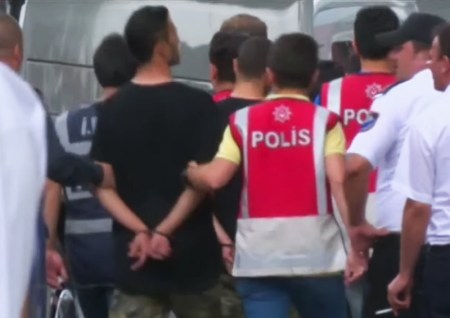
1726Turkish police escort dozens of handcuffed soldiers, who are accused of participating in the failed July 15 coup d’état. (Image source: Reuters video screenshot)

Under the state of emergency, it is dangerous in Turkey even to question whether July 15 was a fake coup orchestrated or tolerated by Erdogan for longer-term political gains. Turkish prosecutors are investigating people who allege on social media that the coup attempt was in fact a hoax. Justice Minister Bekir Bozdag said that: “Anyone who suggests the coup attempt was staged ‘likely had a role’ in the insurrection.” But there is more.

In a massive purge, the government sacked more than 60,000 civil servants from the military, judiciary, police, schools and academia, including 1,577 faculty deans who were suspended. More than 10,000 people have been arrested, and there are serious allegations of torture. Witnesses told Amnesty International that captured military officers were raped by police, hundreds of soldiers were beaten, and some detainees were denied food, water and access to lawyers for days. Turkish authorities also arrested 62 children and accused them of treason. The youngsters, aged 14 to 17, were from Kuleli Military School in Istanbul. The students have reportedly been thrown in jail and are not allowed to speak to their parents.

The witch-hunt is not in the governmental sector only. Several Turkish companies have fired hundreds of personnel suspected of having links with Gulen. Turkish Airlines, Turkey’s national airline, fired 211 employees, including a vice-general manager and a number of cabin crew members.

Sadly, Turks had to choose between two unpleasant options: military dictatorship and elected dictatorship. The good news is that the coup attempt failed and Turkey is not a third-world dictatorship run by an unpredictable military general who loves to crush dissent. The bad news is that Turkey is run by an unpredictable, elected president who loves to crush dissent.