Archive for the ‘Turkey’ category

Merkel Offers Erdoğan The Head of German Comedian In Final Surrender Of Free Speech

April 18, 2016

Merkel Offers Erdoğan The Head of German Comedian In Final Surrender Of Free Speech, Jonathan Turley’s Blog, Jonathan Turley, April 18, 2016

(Another loss for western civilization and another win for the Islamists and the functional equivalent of Sharia law. — DM)

220px-recep_tayyip_erdogan (1)


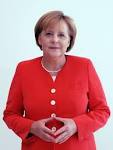
angela-merkel

Chancellor Angela Merkel’s decision to first apologize to authoritarian Turkish President Recep Tayyip Erdoğan for a satirical poem and then approve the prosecution of the comedian is a shocking and chilling disgrace. Merkel, who hails from the former Communist East Germany, has never been a reliable ally to free speech but the crackdown on comedian Jan Boehmermann has shocked the West. Even with the recent rollback of free speech rights in Europe, Merkel’s actions (and the cringing response of ZDF television) has been wake up call for all civil libertarians.

Under German law, Chancellor Angela Merkel’s government had to approve a criminal inquiry. While she said that her government would move to repeal the controversial and little-used Article 103 of the penal code, which concerns insults against foreign heads of state, this would not happen until 2018. The provision (dating back to 1871) on defamation of organs and representatives of foreign states, states:

(1) Whosoever insults a foreign head of state, or, with respect to his position, a member of a foreign government who is in Germany in his official capacity, or a head of a foreign diplomatic mission who is accredited in the Federal territory shall be liable to imprisonment not exceeding three years or a fine, in case of a slanderous insult to imprisonment from three months to five years.

It is a ridiculous law that denies the very essence of free speech. Yet it was used successfully by Shah of Persia against a Cologne newspaper in 1964. It was also sued by hen-Swiss President, Micheline Calmy-Rey to prosecution a Swiss man living in Bavaria after he posted offensive comments Calmy-Rey, on the internet. Despite these outrageous cases, Germany has retained the law.

Moreover, Merkel’s fawning apology to Erdoğan, one of the world’s rising totalitarians, was widely viewed as the final capitulation of Western leaders to the calls for greater censorship and speech regulation.

We have seen the erosion of liberties in Turkey after the election of President Recep Tayyip Erdoğan and his coalition of Islamic parties. Just last month, we discussed the arrest of Mehmet Emin Altunses, 16, who allegedly committed the crime of “insulting” Erdoğan. calling people who use birth control “traitors” and saying Muslims discovered America, you are not allowed to be disrespectful or insulting in discussing Erdoğan. Then there was the prosecution of model and former Miss Turkey Merve Buyuksarac, 26, for criticizing Erdogan for quoting a few lines from a poem called the “Master’s Poem” from weekly Turkish satirical magazine Uykusuz. Erdoğan’s totalitarian measures have earned him the nickname “Buyuk Usta” (the Big Master). Even a joking reference to Gollum and Erdoğan is enough to land you in jail today in Turkey.

Böhmermann will now have to prove that his poem was satire about free speech, rather than a deliberate insult — a bizarre standard since satire is often insulting and insults are part of free speech, particularly with regard to political leaders.

Merkel recently denounced the poem was “deliberately offensive” and ZDF television abandoned both free speech and its presenter in pulling Böhmermann’s weekly satire programme last week.

Despite her public apology and statement, Merkel insisted “The presumption of innocence applies” to Boehmermann.

For his part, Böhmermann used humor to respond to his own government’s persecution and told fans he planned to spend his break studying “freedom of the press and freedom of art in greater detail while traveling through North Korea.” He said that his decision to take a break was intended to allow “the public and the Internet can return to focusing on the important things in life, like the refugee crisis (and) cat videos.”

Merkel needs Turkey to take back refugees and has added $6 billion in aid to her sacrifice of free speech to keep Erdoğan happy.

It is important to note that Merkel is not alone in abandoning free speech. Despite its effort to spin the scandal, ZDF, the German network that airs Neo Magazine Royale, showed no courage or principle in taking the offending poem off the web. It then tried to maintain that it “respects” Böhmermann and will support him in any legal defense against the Turkish government.

We have previously discussed the alarming rollback on free speech rights in the West, particularly in France (here and here and here and here and here and here) and England (here and here and here and here and here and here and here and here and here and here). Much of this trend is tied to the expansion of hate speech and non-discrimination laws. We have seen comedians targeted with such court orders under this expanding and worrisome trend. (here and here).

Merkel has plunged Germany into this rising sea of censorship and criminalized speech. Fortunately, polls show Germans are opposed to her and this appeasement of Erdogan. Perhaps the case will serve to focus Germans and Europeans in general on the diminishing protections for free speech in the West. If nothing else, the attempt to imprison a comedian for insulting an authoritarian leader should capture the dire status of free speech in Europe.

Israel, Turkey, Russia and Egypt

April 17, 2016

Israel, Turkey, Russia and Egypt, Gatestone InstituteShoshana Bryen, April 17, 2016

(A blast from the past:

— DM)

♦ In 2011, the UN Palmer Commission Report found the blockade of Gaza — jointly administered with Egypt — to be legal, and said Israel owed Turkey neither an apology nor compensation.

♦ Lifting the Israel/Egypt embargo on Gaza would empower Hamas, and thereby the Muslim Brotherhood, Iran and ISIS — which would seem an enormous risk for no gain.

Turkish sources assert that Turkish-Israeli governmental relations are about to come out of the deep freeze. But this is a reflection of Turkey’s regional unpopularity and glides over Turkish demands for Israel to end the blockade of Gaza. To meet Turkey’s condition, Israel would have to abandon the security arrangement it shares with Egypt — which has increased Israel’s security and has begun to pay regional dividends. To restore full relations between Israel and Turkey would irritate Russia, with which Israel has good trade and political relations, and a respectful series of understandings regarding Syria. Israel’s relations with the Kurds are also at issue here.

After the 2010 Mavi Marmara flotilla — in which Turkey supported the Hamas-related Turkish organization, the IHH, in its effort to break the blockade of Gaza — Turkey made three demands of Israel: an Israeli apology for the deaths of Turkish activists; a financial settlement; and lifting the Gaza blockade, which Turkey claimed was illegal. The last would provide IHH with the victory it was unable to achieve with the flotilla.

1080 (1)The Turkish-owned ship Mavi Marmara took part in a 2010 “Gaza flotilla” attempting to break Israel’s naval blockade of Gaza, which is in place to prevent the terrorist group Hamas from bringing arms into Gaza. (Image source: “Free Gaza movement”/Flickr)

In 2011, however, the UN Palmer Commission Report found the blockade of Gaza — jointly administered with Egypt — to be legal, and said Israel owed Turkey neither an apology nor compensation. In 2013, at the urging of President Obama and to move the conversation off the impasse, Prime Minister Netanyahu did apologize for the loss of life and agree to discuss compensation. While President Obama was pleased, Prime Minister Erdogan repaid the gesture by denigrating Israel on Turkish television and announcing he would force the end of the blockade. Israel’s condition — that the office of Hamas in Ankara be closed — was ignored.

Nevertheless, in February 2014, Turkish Foreign Minister Ahmet Davutoglu told Turkish television that Israel and Turkey were “closer than ever” to normalizing relations.” In December 2015, it was more of the same. And in February 2016, there was yet another announcement of imminent restoration of government-to-government ties. In March, Kurdish sources said Turkey was demanding weapons from Israel, but that Israel wanted to ensure that Turkey would not use them against Kurdish forces.

Israel finds itself in an odd position — choosing among those who want its cooperation.

Israel and Egypt have come to a deep understanding of the sources of instability and insecurity in Sinai, and the relationship between Hamas in Gaza and its primary sponsor, Iran, as well as ISIS. Former IDF Chief of Staff Benny Gantz told inFOCUS magazine recently:

Coordination between us is very high and very important because we have identical interests. Period. The way to achieve them might look different, but Egypt is a very important country. It is crucial to the world to ensure its stability – progress in the fight against ISIS that is present in Sinai, and protecting the Suez Canal, and other things… They are all good reasons for Egypt to take these responsibilities seriously and do something about the threats. I’m very happy to see what they’re doing. It is a good track.

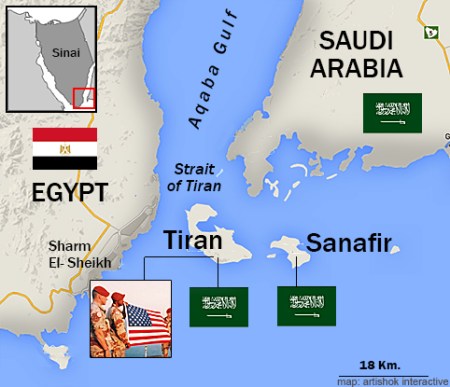
This month, Egypt and Saudi Arabia upgraded relations with Egypt, ceding back to the Saudis two islands that Saudi Arabia had given Egypt in 1950 to help Egypt fight Israel in the Red Sea. According to a report in the Egyptian daily al-Ahram, as reported by the Jerusalem Post, the Egyptian government informed Israel of the parameters of the deal, noting that Riyadh would be obligated to honor all of Egypt’s commitments in the peace treaty with Israel, including the presence of international peacekeepers on the islands and freedom of maritime movement in the Gulf of Aqaba. Israel approved the deal “on condition that the Saudis fill in the Egyptians’ shoes in the military appendix of the peace agreement,” according to Defense Minister Moshe Yaalon.

This makes Saudi Arabia an active partner in the Camp David Accords. And it follows on the heels of the Gulf Cooperation Council (GCC) labeling Hezbollah “a terror organization” without the weasel words the Europeans used to condemn only the “military wing” of the organization.

In the face of these developments, it is hard to imagine a benefit that would accrue to Israel by negating the Israel-Egypt blockade of Gaza on behalf of Turkey.

Russia presents a similar series of circumstances. Relations between Russia and Turkey have taken a nosedive over the Syrian civil war, particularly after Turkey shot down a Russian plane. But even before that, Turkey’s support of Sunni jihadist organizations was a thorn in the side of Russia, which still fears Sunni jihad inside southern Russia.

Russia has goals in Syria and Israel also has requirements. In his inFOCUS interview, former Chief of Staff Gantz noted:

The [Israeli] Prime Minister and Chief of Staff [Gantz’s successor] flew to Russia and had some important of discussions of intentions, deconfliction, and we expressed our interests… stability, preventing terrorist activity… preventing armament that will go from Iran through Syria to Hezbollah, or from Russia to Syria and then to Hezbollah…. People can see what it is that Israel does once in a while when it has to protect itself.

Add to this Israel’s generally good economic and political relations with Russia and, again, it is hard to see the benefit that would accrue to Israel by forging closer relations with Turkey while Russia and Turkey are doing a slow burn.

Turkey is doing a faster burn on the Kurds. Having waged a fierce war against Kurdish separatists in southern Turkey, the Turkish government has taken military action against the Kurds of Iraq and Syria to prevent Kurdish forces from connecting two enclaves — one in Iraq and one in Syria — that could form the geographic beginning of an independent Kurdistan.

Even at the peak of Israeli-Turkish relations, Israel’s support of the Kurds has been a relatively open political secret. Although the Israeli government consistently denies providing weapons, reputable sources suggest, at a minimum, training for Kurdish forces. Most recently, Israel acknowledged buying oil from Kurdish sources in Northern Iraq, and IsraAid, an Israeli humanitarian organization, provided assistance to Kurdish refugees fleeing ISIS. Prime Minister Netanyahu has publicly supported the establishment of a Kurdish state.

For Israel to trade its increasingly important relations with Russia, with Egypt — and thereby with Saudi Arabia — and with the Kurds for Turkish political approval and a promise to buy Israeli natural gas would seem to be a bad deal. For Israel to accompany that with the lifting of the Israel/Egypt embargo on Gaza that would empower Hamas — and thereby the Muslim Brotherhood, Iran and ISIS — would seem an enormous risk for no gain.

Frank Gaffney: Erdogan Transformed Turkey into an ‘Islamist Police State’ That Is No Longer a ‘Reliable NATO Ally’

April 15, 2016

Frank Gaffney: Erdogan Transformed Turkey into an ‘Islamist Police State’ That Is No Longer a ‘Reliable NATO Ally,’ Breitbart, John Hayward, April 15, 2016

Erdogan Breitbart

Center for Security Policy founder and Sen. Ted Cruz (R-TX) foreign-policy adviser Frank Gaffney joined host Stephen K. Bannon on Breitbart News Daily Friday morning to talk about the recent proclamation of “Islamic unity” from Turkish President Recep Tayyip Erdogan, whose country will now assume the chairmanship of the Organization of Islamic Cooperation (OIC) for two years.

Gaffney argued that Erdogan’s statement was actually an example of taqqiya, the Muslim practice of lying for the greater good of the faith, and Erdogan’s true agenda was Islamic supremacism.

“I think what he’s trying to tell us is different from what he’s trying to tell his own people,” Gaffney said of Erdogan’s proclamation. “He’s telling us that he’s all about solidarity, and tolerance, and ecumenicalism, and we all need to pull together, and so on.”

“But the main message he’s been sending to his own people, for something like 13 years now, is Islamic supremacism,” Gaffney continued. “It has nothing to do with [singing] ‘Kumbaya’ with infidels. It is about forcing them to submit, in the classic tradition of sharia.”

He described Erdogan as “Muslim Brotherhood old Islamist who believes, at the end of the day, that he is going to be the new Caliph.”

“He is going to create a neo-Ottoman Empire. And anything that is communicated to the West – in various international fora, or through proclamations, or through other means – is what is known, in the traditions of sharia, as taqqiya – that is, essentially, lying for the Faith. And I think this should be discounted as such,” said Gaffney.

Gaffney explained that it’s not just permitted, but “obligatory,” for followers of the Islamic supremacist doctrine to “dissemble, to deceive the unbeliever, and to use deception as Mohammed did – the perfect Muslim – to triumph over the infidel, and to successfully create conditions under which they will be effectively enslaved, or reduced to a dhimmi status.”

He thought the Turkish president’s carefully crafted message would play well to Western media and government, which are suffused with the endless hope that “there’s a degree of moderation on the part of people like Erdogan, or others in the Muslim Brotherhood movement – the global jihad movement, for that matter.”

“It just ain’t so,” Gaffney argued. “This is a guy who has transformed his country, let’s be clear, from a secular democratic nation – a Muslim one to be sure, but definitely in the secular tradition of Ataturk – into what is now an Islamist police state.”

“Particularly people in the press, who are trying to portray this in the most rose-colored glass mode, should understand what he’s doing to the press in Turkey,” Gaffney stressed. “He’s crushing it, unless it bends to his will.”

He noted that Erdogan is famous for having said “Democracy is like a bus – you take it to your destination, and then you get off.”

“He’s long since gotten off, internally,” Gaffney warned. “We should be under no illusion: he is not aligned with us. He is aligned with the Islamists around the world – with Iran, with China, with Hamas of course. This is a guy who is no longer, in his country, a reliable NATO ally. And that’s the unvarnished and unhappy truth.”

Breitbart News Daily airs on SiriusXM Patriot 125 weekdays from 6:00AM to 9:00AM EST.


Op-Ed: Merkel submits to Erdogan on freedom of expression

April 15, 2016

Op-Ed: Merkel submits to Erdogan on freedom of expression, Israel National News, Giulio Meotti, April 15, 2016

Germany has not tested its freedom of expression so deeply since the saga of Mozart’s Idomeneo in 2006 when the Deutsche Oper Company canceled the opera because there was the severed head of Muhammad in it and that could offend the largest Islamic community in Europe. The director, Hans Neuenfels, then asked: “Where will it all end if we allow ourselves to be artistically blackmailed?”.

The answer came this week with the case of Jan Böhmermann, the famous comedian who mocked Turkish president Recep Erdogan. “What I’m going to read is not allowed” said Böhmermann on ZDF, the German public network. His poetry routine suggests that Erdogan watches child porn movies while he enjoys “repressing minorities and beating up Christians”.

The prosecutor of Mainz, in the Rhineland-Palatinate, received more than twenty complaints from private citizens which forced him to open a case against Böhmermann under paragraph 103 of the Penal Code, which provides three years of imprisonment for insulting a foreign head of state. Chancellor Angela Merkel has condemned the poem, calling it a “deliberate insult” and wanted to phone Turkey’s Prime Minister Ahmet Davutoglu to appease the wrath of Ankara.

Then came Erdogan’s personal complaint against Böhmermann who, according to Deputy Prime Minister Numan Kurtulmus, committed a “grave crime against humanity” and “offended 78 million Turks”, no less. The case could go to the Constitutional Court in Karlsruhe. Not satisfied with imprisoning Turkish journalists, President Erdogan wants to imprison Germans as well.

Three weeks ago, another German video sparked Turkish protests. Meanwhile, the ZDF removed the video of Jan Böhmermann, even before the Turkish protests. If Merkel has sided with the Turks, the German press is united around Böhmermann.

Mathias Döpfner, the editor of the Springer publishing giant, defended the comedian and criticized Merkel, although Döpfner is her supporter: “As written by Michel Houellebecq in his masterpiece on the self-sacrifice of the West: Submission.” Demonstrations were held under the offices of the ZDF in Turkey. Former Finance Minister of Greece, Yanis Varoufakis, commented: “Europe first lost its soul, then lost its sense of humor”.

“Böhmermann is not very brave and this story is bigger than he is” said Henryk Broder, born in 1946 in Katowice, Poland, and today one of the most popular writers of Germany who writes for Die Welt and Bild Zeitung, in an interview with me. “He didn’t show up to withdraw the Grimm Award. I would have been there to say these people: ‘F*** you’”. The German Max Mauff actor was presented at the ceremony with a picture of Böhmermann and the word “missing”.

“Böhmermann behaved like a dhimmi, but we must show solidarity” – continues Broder – “This is a case of governmental interference in the freedom of expression. We face the contradictory policy of Angela Merkel, who said is said in favor of freedom of expression but then takes action against it.

“When the book by Thilo Sarrazin ‘Germany abolishes itself’ appeared in 2010, it was disqualified by Merkel as ‘defamatory’ and ‘not useful’. There is no such thing as ‘good’ and ‘bad’ satire. In communist East Germany it was the party who was left to decide what should be published and this is in Merkel’s DNA, she is a daughter of Eastern Germany.  At that time they called it ‘socialization’. Merkel wants Erdogan to do the dirty work for her on migrants, so she doesn’t want a comedian to spoil relations with Turkey”.

In Turkey, Article 299 of the Criminal Code provides four years in prison for those who insult the President (Can Dündar and Erdem Gül, director and editor in chief of Cumhuriyet, now face a trial). Yesterday Deutsche Welle explained that there are 2,000 pending legal cases involving defamation of Erdogan. The defendants are artists, journalists, academics and cartoonists. The same punishment is now evoked in Germany against a comedian.

The cultural-geographical border of Europe has always been drawn on the Bosphorus and not on the Turkish border. Böhmermann’s case moved that border nearer to Ankara.

Australian Islamist Al-Wahwah Calls to Lead “the Armies of Jihad That Will Conquer Europe, the U.S.”

April 13, 2016

Australian Islamist Al-Wahwah Calls to Lead “the Armies of Jihad That Will Conquer Europe, the U.S.” MEMRI-TV via You Tube, April 12, 2016

https://www.youtube.com/watch?v=OWBhT9hyoHA

According to the blurb following the video,

Speaking on March 6 at a “caliphate conference” in Ankara, Turkey, Ismail Al-Wahwah, spokesman for the Australian chapter of Hizb ut-Tahrir, called upon attendants to lead “the armies of Jihad that will conquer Europe and America.” Wahwah warned the Turkish crowd not to trust America, Europe, and NATO, who are all enemies and whose “hearts are black.” The speech was posted on the Internet by Hizb ut-Tahrir, as well as by the Köklü Değişim magazine, which organized the conference.

Turkey’s Circus in Washington

April 12, 2016

Turkey’s Circus in Washington, Gatestone InstituteBurak Bekdil, April 12, 2016

(Please see also, Germany Moves To Remove Anti-Erdogan Poem And Merkel Calls Turkey To Apologize. — DM)

♦ During his visit to Washington, Turkish President Recep Tayyip Erdogan’s security guards harassed and physically assaulted journalists trying to cover the event; they also forcibly attempted to remove several journalists, although they were on the guest list.

♦ An American reporter attempting to film the harassment received a kick in the chest.

♦ Against this backdrop, Erdogan kept on adding to his own ridicule. “I am not at war with the press,” he said in an interview with CNN International. Then he went on: “We have never done anything to stop freedom of expression or freedom of press.

Turkish President Recep Tayyip Erdogan’s increasing Third-Worldish authoritarianism is taking new turns: it is now visible outside Turkey.

At the same time as Erdogan was heading for Washington for a nuclear security summit, the two journalists who he asserted last year “will pay a heavy price” had to stand trial at a second hearing on charges of espionage and terrorism, and with life sentences hanging over their heads. Their “espionage and terrorism” activity concerned a story they ran in May 2015 detailing how Turkish intelligence was transporting weapons to Islamist fighters in Syria.

“This is a tug of war between Turkish democrats and autocrats,” Can Dundar, one of the “spy/terrorists” told The Wall Street Journal. “The Western world has been supporting Erdogan for years and we were telling them that this was the wrong decision, not only for Turkey, but also for the Western world.”

The case had already turned into a diplomatic row between Turkey and a number of European Union nations, after Erdogan lashed out at the foreign consuls-general who attended the first court hearing in a show of solidarity with the journalists.

Meanwhile, Turkish paranoia around insane claims that the entire world has joined hands to conspire against Turkey’s supreme leader appeared once again. Senior government officials have been slamming Twitter, and claiming it “censored” a hashtag created for Erdogan by removing #WeLoveErdogan from its top trending tweets.

“I’m asking Twitter officials: Who instructed you to remove the #WeLoveErdogan hashtag? Was it a country, a person, a terrorist organization, or someone else?” Justice Minister Bekir Bozdag told reporters just a day before Erdogan arrived in Washington. “I am of the opinion that this is one part of a global operation conducted against our president.”

Apparently, Twitter is not the only conspirator against the Turkish leader. Turkey’s foreign ministry summoned the German ambassador and asked him to remove from the internet a German satire program poking fun at Erdogan, thus causing a diplomatic dust-up with Germany.

The Germans, as every free country would, refused to censor the satire. Ironically, of course, Erdogan’s attempt at censorship spurred a huge surge of online interest in the video, which by March 31 had attracted more than four million views — ten times the program’s usual audience. Once again, Erdogan’s repressive manners turned into self-ridicule.

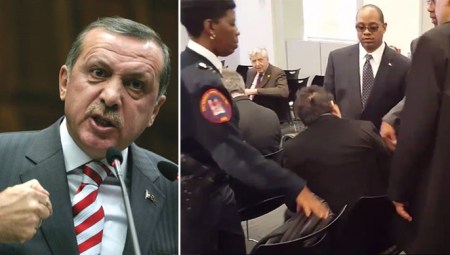
Then came the Turkish circus in Washington. On March 31, Erdogan was scheduled to speak at the Brookings Institution. His security guards harassed and physically assaulted journalists trying to cover the event; they also forcibly attempted to remove several journalists, although they were on the guest list. According to Reporters Without Borders (RSF), the Brookings staff prevented them from ejecting the reporters.

One Turkish journalist, Adem Yavuz Arslan, was kicked out of the building while checking in. A senior Brookings official eventually escorted Arslan back in, but, as Erdogan’s security guards continued to “verbally harass, insult and threaten” him, Brookings had to assign its own security guard to the seat next to him. “Erdogan’s guards are not committing these barbaric acts against independent media on their own,” Arslan told Reporters Without Borders. “I’m pretty confident they have their orders.” But that was not the entire show.

1548When Turkish President Recep Tayyip Erdogan (left) gave a speech at the Brookings Institution in Washington last month, his security guards harassed, threatened and assaulted numerous journalists trying to cover the event. Pictured at right, a police officer steps in to protect a Turkish journalist from Erdogan’s guards

According to press reports, several other journalists were involved in the tussle with Erdogan’s security guards. Another Turkish journalist, Emre Uslu, said that outside the event he was kicked in the leg by Erdogan’s bodyguards and was prevented from attending the speech.

An American reporter attempting to film the harassment received a kick in the chest. The National Press Club was outraged. “We have increasingly seen disrespect for basic human rights and press freedom in Turkey,” the president of the Club, Thomas Burr, said. “Erdogan doesn’t get to export such abuse.”

Against this backdrop, Erdogan kept on adding to his own ridicule. “I am not at war with the press,” he said in an interview with CNN International. Then he went on: “We have never done anything to stop freedom of expression or freedom of press. On the contrary, the press in Turkey had been very critical of me and my government, attacking me very seriously. And regardless of those attacks, we have been very patient in the way we have responded to those attacks.”

As Aykan Erdemir, a former opposition member of the Turkish parliament [now a fellow at the Foundation for Defense of Democracies in Washington], said, Erdogan can be a “toxic asset”: “Heads of state don’t want to be in the same photo with him …”

Erdogan raises price tag for normal ties with Israel: Cairo amity first

April 11, 2016

Erdogan raises price tag for normal ties with Israel: Cairo amity first, DEBKAfile, April 11, 2016

Sinai_TiranSnapir

Turkish president Tayyip Recep Erdogan has raised another large obstacle on the road to Turkish-Israeli reconciliation and normal ties. Saudi King Salman, who is visiting Cairo, confided to his host Egyptian president Abdel-Fatteh El-Sisi that Erdogan had made it clear that he would not finally repair Ankara’s ties with Israel until Sisi came forward to shake his hand, stopped being hostile and turned a new page in their relations.

This is revealed exclusively by DEBKAfile’s Middle East and Cairo sources.

The king sad that by burying the hatchet with Erdogan, Sisi would pave the way to an accord between Ankara and Jerusalem, on which progress has been made in bilateral negotiations. Members of the royal Saudi entourage in Cairo confirmed the threat from Ankara, that if the Egyptian president continues to disapprove of the Turkish ruler and give him a hard time, Ankara would retaliate by raising more impediments to a rapprochement with Israel.

In this regard, Prime Minister Binyamin Netanyahu told the Sunday cabinet meeting on April 10, “Peace with Egypt is stronger than ever before, standing firm against very tough challenges to both nations.” He went on to say, “The ties between Egypt and Israel provide an important buttress for the national security of both nations.”

Netanyahu did not itemize those “challenges,” but DEBKAfile’s sources were informed that he was beaming a message to the Saudi king and Turkish president, that Israel had every confidence in its strategic pact with President El-Sisi holding up against attempts by Erdogan to drive a wedge between Cairo and Jerusalem.

His comments were also meant to encourage the Egyptian leader to withstand undue pressure coming from King Salman and extortions by the Turkish president.

On one of the issues clouding relations between Cairo and Riyadh, the king denied wholehearted Saudi support for the El-Sisi’s archenemy, the Muslim Brotherhood, ousted from power three years ago in a military coup.

The Israeli question came up in relation to the Egyptian presidential decree ceding ownership to Saudi Arabia of the disputed Red Sea islands of Tiran and Sanafir. These islands are  of high strategic value because they control shipping traffic through the Gulf of Aqaba to and from the Israeli port of Eilat and the Jordanian port of Aqaba.

Saudi Foreign Minister Adel al-Jubeir told reporters Sunday night, April 10, that his government would not hold negotiations with Israel on those islands.  The Kingdom’s commitment included accepting the presence of international forces on the islands under the peace treaty of Egypt and Israel, he said.

He was referring to the Multinational Force Observers – mostly Americans – which have maintained a presence on Tiran to monitor Egypt’s commitment to the freedom of Israeli shipping through the Strait of Tiran under their 1979 peace accords.

By this commitment to the international force’s presence “under the peace treaty of Israel and Egypt,” Saudi Arabia publicly extended implicit endorsement for Israel’s first peace treaty with an Arab state 37 years ago.

Turkish Justice: ISIS Walks Free; Peace Activists Jailed

April 10, 2016

Turkish Justice: ISIS Walks Free; Peace Activists Jailed, Gatestone Institute, Uzay Bulut, April 10, 2016

♦ Belonging to ISIS or trafficking in slavery evidently do not constitute serious crimes in Turkey. But signing petitions calling for peace and non-violence, or requesting political equality for Kurds, are unspeakable offenses.

♦ “We are not shocked that the defendants have been acquitted. This lawsuit has become one of the hundreds of other lawsuits in our country in which the criminals have been protected even though the evidence against them is obvious.” — Association of Progressive Women, on the acquittal of six people charged with having ties with ISIS and trading in Yazidi sex slaves.

♦ “Requesting peace has become a crime in this country. The state of Turkey has committed the gravest rights violations against those who struggle for human rights, against the Kurds and against free thought.” — Sebnem Korur Fincanci, President of the Human Rights Foundation of Turkey.

♦ Turkish politics has therefore not been able to go beyond a clash between assorted Islamists whose worldviews are foreign to democratic values, and non-Islamist but still extremely oppressive political parties that operate under the shadow of a tyrannical military, whose worldview is also foreign to democratic values.

Turkey’s “fight” against the Islamic State (ISIS) continues. On March 24, Turkey released seven suspects who had been arrested in a case involving the Turkish branch of ISIS.

Halis Bayancuk, alleged to be the “Emir,” or commander-in-chief, of ISIS, is among the suspects. This was the fourth hearing of the trial known as the “Istanbul ISIS trial.” A total of 96 suspects are on trial. Only seven had been jailed; the others had not. Although those seven were released on March 24 at the end of the hearing, their trial is still ongoing; the final verdict has not been given. All of them are now outside jail, free, and living their lives as they wish.

The indictment prepared by the chief public prosecutor’s office of Istanbul stated that the suspects

“engaged in the activities of the terrorist organization called DAESH [Arabic acronym of ISIS]. The suspects had sent persons to the conflict zones; they applied pressure, force, violence and threats by using the name of the terrorist organization, and they had provided members and logistic support for the group. Ilyas Aydin, the leader [of the ISIS cell], gave verdicts at a so-called sharia court about killing people.”

At the end of the hearing, the seven defendants on trial being ISIS members were released. They left the courtroom shouting “Allahu akbar!” [Allah is the Greatest!”]

This means that all 96 defendants in the ongoing case are walking the streets freely.

Unfortunately, this is not the first case in which the Turkish judiciary has turned a blind eye to ISIS or al Qaeda suspects. The indictment prepared by the prosecutors apparently contains serious accusations and ample evidence, including videos and statements by Bayancuk, also known as Abu Hanzala. In 2014, he was arrested for being the head of the al Qaeda network in Turkey. Some of the accusations directed against him and other al Qaeda suspects were “beheading a Christian priest in Syria, kidnapping a Turkish journalist in Syria and planning an assassination of Barack Obama…”

In a video recording from a camp in Syria, Bayancuk was heard saying: “After we conquer Syria, we will conquer Istanbul, insh’allah, [if Allah wills] and then Turkey.”

In 2014, in another video uploaded on YouTube, Bayancuk said:

“They [ISIS] are our Muslim brethren. And we accept any attack against them as an attack against us. … I am, insh’allah, on the side of my Muslim brothers through my prayers and my support. Whoever attacks our brothers, I consider it an attack against me.

“I ask Allah to reward those in Syria and many other places, who are fighting and striving in the name of jihad, with a state ruled by sharia.”

In July 2014, the affiliates of the Islamist magazine “Tawhid” (“Oneness of Allah”) — known to be close to ISIS — organized a public event in Istanbul where they performed salah (Muslim prayer) together to celebrate the Islamic Ramadan festival.

In July 2015, at a public event was held to celebrate the Ramadan festival, the public prayers were led by Halis Bayancuk who afterwards delivered a speech entitled, “A warning to the heads of the regime of the Republic of Turkey.”

“Those who have faith fight for Allah,” he said, “the kafirs [infidels], however, fight for those who engage in taghut [“idolatry”].

Bayancuk also called on Muslims not to vote in elections because “Whoever is the Creator has the right to rule. … “We do not have guns, bombs or action plans to scare you with, but there is Allah with whom we can scare you.”

In December, 2015, the German public television consortium, ARD, produced a show documenting the slave trade being conducted by ISIS through a liaison office in the province of Gaziantep in Turkey, near the Syrian border.

Some human rights groups in the region filed a criminal complaint, calling for the prosecutors to investigate the allegations and hold the perpetrators to account. One of them was the Gaziantep branch of the Association of Progressive Women (IKD).

All six people, who allegedly have ties with ISIS and have engaged in the sexual slavery of Yazidi women in Antep, were acquitted during the first hearing.

The IKD Association issued a written statement about the ruling:

“We learned yesterday that all of defendants were acquitted at one hearing, in a double-quick trial on January 15.

“We are not shocked that the defendants have been acquitted. This lawsuit has become one of the hundreds of other lawsuits in our country in which the criminals have been protected even though the evidence against them is obvious.

“The indictment of the prosecutor stated that the office in the footage has been found, and that all of the evidence in the news reports have been seized. Six people were caught in the process of investigation but were released after a judicial hearing. Despite all of the evidence at hand, the court acquitted the defendants on the grounds that there was no evidence.”

One cannot know if those allegations were true or not, because no state authority has made any effort to refute the allegations or vindicate themselves.

In December, 2015, two members of parliament from the pro-Kurdish Peoples’ Democratic Party (HDP) — Feleknas Uca and Mahmut Togrul — asked Interior Minister Efkan Ala about the office where ISIS members engage in slavery and sex trade.

Neither the interior minister nor any other government official has made a single statement regarding the motions of the MPs, the footage of the German TV channel or the allegations of the region’s human rights groups.

However, when it comes to academics or activists who demand peace with the Kurds and human rights for all in Turkey, the Turkish judiciary takes a completely different stand.

On January 11, 2016, a group of academics and researchers from Turkey and abroad called “Academics for Peace” signed and issued a petition entitled, “We will not be a party to this crime.” In it, they criticized the Turkish government for its recent curfews and massacres in Kurdish districts, and demanded an end to violence against Kurds and a return to peace talks.

Since then the 1128 signatories of the declaration have been subjected to sustained attacks and threats from the Turkish government and nationalist groups. Four of the academics are now under arrest.

The jailed academics are Esra Mungan, a lecturer in psychology at Istanbul Bogazici University; Muzaffer Kaya, a lecturer at the Department of Social Services at Istanbul Nisantasi University (who after signing the petition was fired from his job); Kıvanc Ersoy, a mathematics lecturer at Istanbul Mimar Sinan University; and Meral Camci, a lecturer of translation and interpreting studies at Istanbul Yeni Yuzyıl University.

On March 24, the same day when ISIS suspects were released in Istanbul, Academics for Peace issued an open letter about the situation of the arrested academics:

“Yesterday, Esra Mungan was taken to another cell which is smaller, filthier, and stuffier for no valid reason. Also, Muzaffer Kaya and Kıvanc Ersoy were transferred to the Silivri Prison.

“One of our lawyers visited the Silivri Prison. Muzaffer Kaya and Kıvanc Ersoy say that they are strictly segregated, they stay alone in the cells for three people, they are not allowed to see each other or any others; all their books were taken from them with the promise that they would be given back later, their rooms are completely empty except for a pen and a notebook, they were searched naked when they were first taken to Silivri and kept naked for twenty minutes which is an utterly dishonoring situation, and that their first request is to stay together in the same cell.”
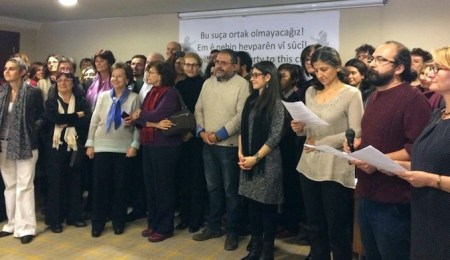
1472In Turkey, signatories of the “Academics for Peace” petition (pictured above) have been subjected to sustained attacks and threats from the Turkish government and nationalist groups. Four of the signatories were arrested. Meanwhile, 96 suspected terrorists currently standing trial on charges of belonging to an ISIS cell in Istanbul are not under arrest, and walk the streets freely.

The academic Meral Camci was fired from her job after signing the petition. A warrant was also issued against her — along with the three other academics — but she could not be interrogated because she was then outside Turkey. She returned to Turkey on March 30 — and was arrested the next day.

In the meantime, Kurdish lawyer Eren Keskin, who is also the vice-president of the Human Rights Association (IHD) and the executive editor of the pro-Kurdish newspaper Ozgur Gundem, has been investigated and banned from traveling abroad on charges of “terrorism propaganda.”

Dr. Sebnem Korur Fincanci, the President of the Human Rights Foundation of Turkey (TIHV), said that Keskin has been one of the key symbols of the human rights struggle in Turkey. “Requesting peace has become a crime in this country. The state of Turkey has committed the gravest rights violations against those who struggle for human rights, against the Kurds and against free thought,” Fincanci added.

The gravest human rights violations are committed against Kurds. The Kurdish town of Silopi was under military siege and attacks from December 14 to January 19, when the curfew was partly removed. Many people were murdered by state security forces, and the town has largely been destroyed.

The Diyarbakir Bar Association and several human rights groups recently went to the town to observe what is left of it. Sidar Avsar, a lawyer with the Diyarbakir Bar Association, reported that the police threatened them: “You know how Tahir Elci was killed, don’t you?” the police had told him.

Tahir Elci, a leading Kurdish lawyer and the head of the Diyarbakir Bar Association, was murdered in broad daylight in the city of Diyarbakir on November 28, 2015.

So, in Europe’s newest “best friend forever,” Turkey, a candidate country for EU membership, those who rape and sell Yazidi women, or have alleged ties with al-Qaeda or ISIS, are set free to walk around with impunity. Belonging to ISIS or trafficking in slavery evidently do not constitute serious crimes in Turkey. But signing petitions calling for peace and non-violence, or requesting political equality for Kurds, are unspeakable offenses. This also demonstrates the tragic fact that Turkey still prefers the Islamic State (ISIS) to Kurds.

Turkey seems bound by traditional misconceptions of what is terrorism and what is not, or who should enjoy free speech and who should not, or be punished for real crimes and who should not.

Turkish politics has therefore not been able to go beyond a clash between assorted Islamists whose worldviews are foreign to democratic values, and non-Islamist but still extremely oppressive political parties that operate under the shadow of a tyrannical military, whose worldview is also foreign to democratic values.

Recent political and judicial developments are further indicators that a third alternative — a Turkish pro-democracy movement to transform Turkey into a diverse, tolerant and pluralistic society — is not on the horizon.
What about the Kurds?

April 10, 2016

What about the Kurds? Israel Hayom, Boaz Bismuth, April 10, 2016

(What’s in it for Israel and what aspects of an agreement would Turkey honor long term? — DM)

Turkey always espoused a policy of zero conflicts. For years Ankara believed this was the best way to enhance its international standing — even at the expense of the United States. Up until recently, Turkish President Recep Tayyip Erdogan had some very lofty aspirations, but something went wrong with his plan. The Turks now find themselves in the middle of a global war of terror, and instead of zero conflicts they have zero friendly neighbors. If that weren’t enough, inside Turkey are millions of refugees and far too many bombings. At this rate, Turkey will also find itself with zero accomplishments.

The emerging Turkish-Israeli reconciliation needs to be put in precisely this context. It’s not easy for Ankara to suddenly be alone in the neighborhood, friendless: The Iranians were never true partners; the bitter enemy Bashar Assad, who had one foot in the grave, received a stay of execution and a new hold on his country from Putin, who became Ankara’s biggest new enemy ever since a Russian spy plane was shot out of the sky.

The Europeans as well, despite agreements in place, are not really partners. This has been especially true since it became apparent that Islamic State terrorist, utilizing the Turkish double game, crossed the Syrian border and eventually into Europe to carry out terrorist attacks.

Of course, reports of oil deals between Turkey and ISIS, exposed by the Russians, have not helped Ankara’s image in the world. If we closely examine Turkey’s extremely opportunistic policies from the past decade, we will see that Ankara has rightfully earned its current predicament.

Of all countries, however, Israel, which for decades has been the victim of Palestinian terrorist organizations, has reason to stand by Turkey in these difficult days.

Although the sides have yet to settle the two issues at the heart of their discord, namely Hamas operating out of Istanbul and the blockade of Gaza, which Ankara wants lifted, it appears Turkey is inclined to close the gaps. That is, of course, unless someone in Ankara believes this is still the time for playing games.

The Counterterrorism Bureau on Friday issued a rare warning, calling on Israelis visiting Turkey to leave the country immediately, and on those planning trips there to postpone them. The Americans, almost simultaneously, issued a similar warning. We can assume that both warnings are based on the same information.

Turkey today is on the defensive against ISIS and the Kurdish PKK. In the past, Turkey acted according to its own set of priorities. While the world saw ISIS as a threat, Turkey saw it as an opportunity to yet again prevent the establishment of an independent Kurdish state.

And this perhaps is the point that Israel needs to ponder, in a Middle East that is not only changing but being reconstructed. From a historical perspective, the Kurds have always stood by our side. We too, in various times throughout history, have stood by them. The Kurds, along with Israel, are the most formidable pro-Western force in the Middle East today. The manner in which they have confronted ISIS in Syria and Iraq (representing the only significant force on the ground) obligates the international community to compensate them.

The question of an independent Kurdistan is undoubtedly a legitimate one, which for some reason or another is being pushed aside. Various parliaments across the globe, among them the French, were quick to recognize Palestine while inexplicably forgetting about Kurdistan.

One of Israel’s main problems in the way of recognizing Kurdish self-determination was its fruitful cooperation with Turkey. The Israeli-Turkish rift could have pushed Israel to consummate something that began in the 1950s in Iraq, and put into practice the axiom stipulating that “the enemy of my enemy is my friend.” And perhaps this is the exact reason that Erdogan, who understands we are living in a changing world, would rather be friends again.

Israelis again advised to leave Turkey without delay

April 8, 2016

Israelis again advised to leave Turkey without delay, DEBKAfile, April 8, 2016

The  counterterrorism bureau in Jerusalem has again warned Israelis visiting Turkey of an “imminent, concrete threat” of a terror attack in Turkey and urged them to leave the country without delay. Meanwhile, they are advised to avoid crowd centers and tourist sites. People with relatives traveling in Turkey should call them to convey this warning.