Archive for the ‘Turkey’ category

Coup-Weary Turkey: Directionless and Insecure

August 8, 2016

Coup-Weary Turkey: Directionless and Insecure, Gatestone InstituteBurak Bekdil, August 8, 2016

♦ The more Ankara feels distant to Washington, the more it will want to feel closer to Moscow.

♦ As Western leaders call on President Erdogan to respect civil liberties and democracy, Erdogan insists he will consider reinstating the death penalty: “The people have the opinion that these terrorists [coup-plotters] should be killed. Why should I keep them and feed them in prisons for years to come?”

Turkey once boasted of having NATO’s second biggest army, equipped with state-of-the-art weapons systems. That powerful army now lacks command: After the failed coup of July 15, more than 8,500 officers and soldiers, including 157 of the 358 generals and admirals in the Turkish military’s ranks, were discharged. The top commanders who were purged had made up 44% of the entire command structure. Prime Minister Binali Yildirim said that the military’s shipyards and weapons factories will be transferred to civilian authority; military high schools and war academies have been shut; military hospitals will be transferred to health ministry; and the gendarmerie, a key force in anti-terror operations, and the coast guard will be tied to the interior ministry.

Those changes leave behind an army in deep morale shock, with political divisions and polarization. Its ranks are suffering not just trauma but also humiliation. The Turks are lucky their country was not attacked by an enemy (and they are plentiful) at a time like this. Conventional war, however, is not the only threat to Turkey’s security. The Turkish army’s worst decline in modern history came at a time when it was fighting an asymmetrical war against Kurdish insurgents inside and outside of Turkey and, as part of a U.S.-led international campaign, the Islamic State (ISIS) in neighboring Syria.

The attempted coup not only quickly discredited the Turkish military but also left the country once again directionless in foreign policy. President Recep Tayyip Erdogan has been slamming his NATO ally, the United States, almost daily. His government big guns have been implying an American hand behind the failed coup by a faction of officers they claim are linked to a U.S.-based Muslim cleric, Fethullah Gulen, once Erdogan’s best political ally. “The putschist [Gulen] is already in your country, you are looking after him. This is a known fact,” Erdogan said, addressing Washington. “You can never deceive my people. My people know who is involved in this plot, and who is the mastermind.”

The White House immediately denied Erdogan’s claim. Deputy Press Secretary Eric Schultz said the U.S. was one of the first countries to condemn the failed coup, and noted that a successful one would have put American troops serving in Turkey at risk. “It is entirely false. There is no evidence of that at all,” Schultz said. “We feel that talk and speculation along those lines is not particularly constructive.” The failed coup has become a Turkish-American dispute — with a military dimension, too.

Erdogan also criticized U.S. General Joseph Votel, who voiced concerns over “the long-term impact” of the coup on the Pentagon’s relations with the Turkish military. According to Erdogan, Votel’s remarks were evidence that the U.S. military was siding with the coup plotters. The Pentagon’s press secretary, Peter Cook, flatly denied that claim: “Any suggestion anyone in the department supported the coup in any way would be absurd.”

Erdogan probably wants to play the tough guy and is slamming Washington day after day not just to look pretty to millions of anti-American Turks but also to pressure Washington in Turkey’s quest to extradite Gulen, presently the biggest snag between the two allies.

But there is another dimension to Erdogan’s ire: He wants to mend fences with Moscow.

Turkey’s relations with Russia were frozen after Nov. 24, when Turkey, citing a brief violation of its airspace along Turkey’s border with Syria, shot down a Russian military aircraft. Russia’s President Vladimir Putting ordered punishing economic sanctions, imposed a travel ban on Russian tourists visiting Turkey and suspended all government-to-government relations. Unable to ignore the damage, a repentant Erdogan conveyed regrets to Putin; the regrets were accepted and the two leaders are scheduled to meet on August 9, when the Turks hope that relations with Russia will be entirely normalized.

Normalization, unfortunately, will not come at the price of Turkish “regrets” alone. For full normalization, Turkey will have to digest the Russian-Iranian-Syrian line in Syria’s civil war — a pact which Turkey has loudly detested ever since civil war erupted in Syria in 2011. This will be another foreign policy failure for Erdogan and an embarrassing U-turn. But the more Ankara feels distant to Washington, the more it will want to feel closer to Moscow.
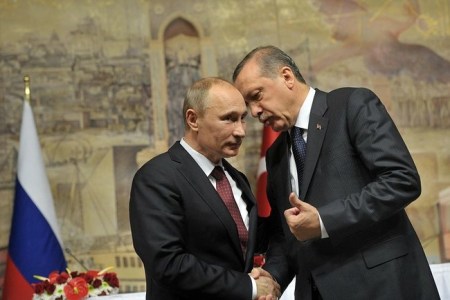
1375Turkish President Recep Tayyip Erdogan is attempting to repair badly damaged relations with Russia, even as he slams his NATO ally, the United States, almost daily, and accuses the U.S. military of supporting the coup attempt against him. Pictured: Russian President Vladimir Putin (left) with Erdogan (then Prime Minister), meeting in Istanbul on December 3, 2012. (Image source: kremlin.ru)

Meanwhile, after the coup attempt, Turkey’s troubled relations with the European Union turned even more troubled. European Commission head Jean-Claude Juncker said that the EU’s deal with Turkey on halting the flow of migrants toward the bloc may collapse. “The risk is big. The success so far of the pact is fragile. President Erdogan has already hinted several times that he wants to scrap it,” Juncker said. It is not just the migrant deal that may entirely suspend Turkey as a candidate country for the EU.

As Western leaders call on Erdogan to respect civil liberties and democracy, Erdogan insists he will consider reinstating the death penalty. “The people have the opinion that these terrorists [coup-plotters] should be killed,” Erdogan said in interview with CNN. “Why should I keep them and feed them in prisons for years to come? That’s what the people say … as the president, I will approve any decision to come out of the parliament.”

Such a move would kill Turkey’s accession process entirely. Federica Mogherini, EU’s foreign policy chief, warned that if Turkey reintroduces the death penalty, it will not be joining the European Union. “Let me be very clear on one thing,” she said; “… No country can become an EU member state if it introduces [the] death penalty.”

The attempted coup not only destabilized NATO’s second largest army and exposed it to the risk of serious operational vulnerabilities; it also left Turkey at risk of engaging in potentially dangerous liaisons with playmates of different kind — Russia and Iran & Co. — at least for now.

A Nuclear-Armed Caliphate?

August 3, 2016

A Nuclear-Armed Caliphate? Front Page MagazineWilliam Kilpatrick, August 3, 2016

nuke turkey

Reprinted from CrisisMagazine.com.

Much has been made of the Islamic State’s claim to the caliphate. But the Islamic State is fast losing ground in Syria and Iraq, and without a territorial claim, its claim to the caliphate is a shaky one. According to some sources, ISIS has already been preparing its followers for the fall of the caliphate.

Meanwhile, an Islamist power with a much better claim to the caliphate has been gathering strength. Whether the failed coup in Turkey was the real thing or whether it was staged, as some have claimed, President Erdogan’s hold over the Turkish nation has been immeasurably strengthened. As a result, he is now one giant step closer to doing what, some say, he has always wanted to do—namely, to re-establish the caliphate.

The last time the Muslim world had a caliphate, it was centered in Constantinople. The Turkish sultan (who was also the caliph) was the head of the Ottoman Empire—an empire that controlled far more territory than ISIS does or is ever likely to. Then in 1923, following the disarray left by the First World War, a secular government under the leadership of Kemal Ataturk came to power in Turkey and abolished the caliphate soon after.

To many in the Muslim world, this was a world-changing catastrophe. It flew in the face of Muhammad’s intention that mosque and state should be united, and it undermined the case for Islamic law. Moreover, the overthrow of the caliphate affected not just Turkey, but all of the Muslim world. In the late 1920s in Egypt, Hasan al-Banna founded the Muslim Brotherhood with the intention of reversing what Ataturk had done. The Brotherhood came close to doing this–at least in Egypt—in 2012 with the election of Mohamed Morsi as president. But Morsi showed his hand too early and was soon deposed by the military under General El-Sisi.

In Turkey, also, it was the military that acted as the guardian of the secular state. And so it remained until the election of President Recep Erdogan in 2002. Even then, Erdogan moved slowly in his efforts to re-Islamize Turkey. He gradually removed top military officers and replaced them with his own men; and he did the same with the police, the judiciary, and other key institutions.

By 2012, some twenty percent of the country’s generals were estimated to be behind bars. Then, with this month’s failed coup, Erdogan moved quickly to arrest some 3,000 members of the military and 3,000 members of the judiciary. In addition, his regime sacked 9,000 workers attached to the Interior Ministry. Within a week of the attempted coup, some 50,000 soldiers, police, judges, civil servants, and teachers had been suspended or arrested.

Erdogan’s power is now nearly absolute—not unlike the absolute power of a sultan. According to some, this has been his goal all along. One indication is that Erdogan has built himself a thousand-room presidential palace that is attended by guards dressed in Ottoman-era uniforms.

If Erdogan does try to establish a caliphate, where does that leave ISIS? Would they go quietly into the dark night of oblivion? Or would they find a place in the new caliphate?

As you may have noticed, alliances in the Middle East are constantly shifting. It’s not inconceivable that ISIS would someday pledge allegiance to a neo-Ottoman caliphate—although such an event might have to be preceded by the demise of their current caliph, Abu Bakr al-Baghdadi. The truth is, Erdogan has been something of a friend and benefactor of ISIS. As Caroline Glick observed in the Jerusalem Post:

Erdogan has turned a blind eye to al-Qaida. And he has permitted ISIS to use Turkey as its logistical base, economic headquarters, and recruitment center. Earlier this year, the State Department claimed that all of the 25,000 foreign recruits to ISIS have entered Syria through Turkey.

Turkey is also the gateway between Syria and Europe. It is through Turkey that the bulk of Muslim migrants flow into Europe. This gives Erdogan enormous leverage over the future of Europe—a continent which is already reeling from a flood of migrants and refugees. How is the leverage applied? In March, the European Union reached a deal with Turkey that would in essence turn Turkey into a buffer zone against further immigration. Here’s how Foreign Affairs summarized the bargain:

Turkey has agreed to act as a giant refugee holding center, keeping the millions of migrants fleeing conflict in the Middle East from reaching Europe and accepting those sent back from Greece. In exchange, the EU will pay Turkey three billion euros on top of the three billion pledged last November to help care for the refugees. It will also speed up the approval of visa-free travel to Europe for Turkish citizens and revive stalled negotiations over Turkey’s accession to the EU.

So Turkey will keep the Syrian migrants out of Europe as long as Turkish citizens are allowed almost unlimited access to Europe through visa-free travel. The net result is that the Islamization of Europe will continue. And, of course, there’s nothing to stop Turkey from opening up the refugee floodgate whenever it sees fit. Turkey’s control of Mid-East migration gives it the upper hand in its dealings with Europe.

The other part of the bargain is the revival of negotiations to admit Turkey to the EU. If Turkey is ever successful in that endeavor, it would spell game-over for Europe. If Erdogan wants to re-establish the caliphate, and if he is so keen on union with Europe, it is likely that he envisions Europe as part of the future caliphate. This is something that the Ottoman sultans dreamed of, but were never able to accomplish. But Erdogan might be able to pull it off. There is now a very large contingent of Turks in Germany who seem to bear more allegiance to him than to Germany. And all over Europe there exists a fifth column of active and potential Islamists ready to be activated. As for the other four columns, it’s worth keeping in mind that Turkey has the second largest army in NATO (the U.S. has the largest). And with many of the generals who coordinated with NATO now in jail, Turkey’s loyalty to NATO is very much in question.

There is one other factor to consider. During and after the coup attempt, Erdogan shut down Incirlik Air Base, which is home to 1,500 American soldiers as well as other NATO troops. The Turkish government cut off the base’s electricity supply, temporarily suspended flights, and arrested the base commander, General Ercan Van. The base reportedly houses 50 nuclear warheads. The bombs are controlled by the U.S. forces in Turkey, but could they by means sudden or gradual fall under the control of Turkey? And if they did, would the U.S. dare to do anything about it?

By many accounts, Erdogan is a true believer who, in his own way, is every bit as fanatical as the ayatollahs in Iran. The man who built a thousand-room palace for himself might well believe that a restored caliphate should possess all the weapons that befit a great world power. With Erdogan’s latest consolidation of power, an already dangerous world just became a lot more dangerous.


Far-right anti-Erdogan protest allowed to go ahead in Cologne on day of demonstrations

July 31, 2016

Far-right anti-Erdogan protest allowed to go ahead in Cologne on day of demons, Deutsche Welle, July 30, 2016

(How “far left” must Germany be when voicing displeasure with Erdogan is deemed “far right”? — DM)

Some three million people of Turkish origin live in Germany, making it the world’s largest Turkish diaspora.

***********************

A court in Münster has given permission for a far-right protest against Turkish President Erdogan to take place on Sunday in Cologne. Erdogan supporters will also be taking to the streets of the western German city.

erdogan protest

A spokesman for the Higher Administrative Court in Münster confirmed on Saturday that it had rejected an appeal by Cologne police to ban an anti-Erdogan demonstration called by the far-right political party Pro NRW for Sunday.

The court upheld an earlier decision by a Cologne court to allow the demonstration to go ahead, despite police fears that violent members of the HoGeSa (Hooligans Against Salafists) group could join in the protest.

The demonstration is to take place under the motto “No tributes to Erdogan in Germany: Stop the Islamist autocrat from the Bosporus” in response to a planned rally by up to 30,000 Erdogan supporters in the city on the same day.

No Erdogan live presentation

The Münster court, which is responsible for administrative disputes, also rejected an appeal by the organizers of the pro-Erdogan demonstration to be allowed to show the Turkish president live on a large screen during the event.

Police have voiced fears that such a presentation could cause participants to become over-excited.

Police in Cologne are planning to deploy 2,300 officers and have six water cannon on hand in case violence does break out at any of the demonstrations planned in the city on Sunday, which also include rallies by leftists and youth organizations affiliated with German parties.

fearÖzdemir warned of an “atmosphere of fear”

Erdogan critics ‘targeted’

In comments carried in the Saturday edition of the “Süddeutsche Zeitung” newspaper, Foreign Minister Frank-Walter Steinmeier called on participants in the pro-Erdogan demonstration to display moderation.

Steinmeier said it was “not permissible” to bring domestic political tensions from Turkey to Germany or to intimidate people with different political views.

The leader of the Greens, Cem Özdemir, also criticized alleged attempts at intimidation ahead of the demonstration, telling newspapers of the Funke media group that critics of President Recep Tayyip Erdogan among Germany’s Turkish community were being targeted.

Özdemir said that demonstrations for or against Turkish leaders had to take place “on the basis of the [German] legal system.”

“An atmosphere of fear must not be created,” he said.

Turkey in turmoil

Sunday’s demonstrations come as Erdogan continues with purges of the army, judiciary, the education system and the media following a failed coup on July 15.

Critics of the president fear that he might be using the coup as an excuse to increase his already tight political grip on the country.

Some three million people of Turkish origin live in Germany, making it the world’s largest Turkish diaspora.

After 10,000 Arrested, it’s Time for the US to End Backing for Islamist Regime

July 23, 2016

After 10,000 Arrested, it’s Time for the US to End Backing for Islamist Regime, Front Page Magazine, Daniel Greenfield, July 22, 2016

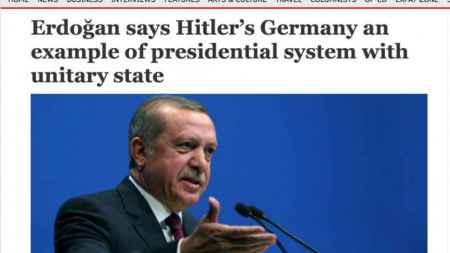
Erdogan Hitler

It’s funny how the media was far more outraged by the supposed attempt by the Turkish military to restore the republic than by the Islamist tyrant’s escalating crackdown which has now seen 10,000 arrested. That’s war crime level detentions. If the Turkish military had done this, they would be screaming their heads off. Yet 10,000 arrests by Islamists, just like the Muslim Brotherhood’s torture and abuses in Egypt, get a pass.

And that has to change.

Turkey is swiftly turning into an actual totalitarian regime with no holds barred.

Turkey entered its second day under a state of emergency as President Recep Tayyip Erdogan signaled that the three-month period approved by parliament may not be enough to complete a purge of those responsible for last week’s failed coup.

Erdogan told Reuters that there’s no obstacle to extending emergency rule, which took effect at 1 a.m. on Thursday and was later endorsed by parliament. It allows the government to issue decrees with the force of law, and detain suspects for longer periods without trial.

And then the emergency rule will just be made permanent and Erdogan will declare himself a sultan. All of this is happening with the complicity of the US and the EU. And I don’t just mean the radical left.

Too few, even Republicans, were willing to come out against the Arab Spring or to back the Egyptian military’s restoration of the government. That’s why Trump’s mention of it in his acceptance speech was important. We should have backed the Turkish military to the hilt. And by “us” I don’t mean Obama, who has never met an Islamist Jihadist he didn’t love, but Republicans and conservatives.

Turkey – Roger Out

July 22, 2016

Turkey – Roger Out, Front Page MagazineCaroline Glick, July 22, 2016

turkey roger out

Originally published by the Jerusalem Post

On Wednesday, NATO Secretary-General Jens Stoltenberg insisted that the purge of thousands in the Turkish military – including a third of the serving generals – did not weaken the military.

Stoltenberg told Reuters, “Turkey has a large armed force, professional armed forces and… I am certain they will continue as a committed and strong NATO ally.”

It would be interesting to know whether the 1,500 US soldiers who have been locked down at Incirlik Air Base along with several hundred soldiers from other NATO countries since the failed coup Friday night would agree with him.

Following the failed coup, the Erdogan regime cut off the base’s external electricity supply and temporarily suspended all flights from the base.

The base commander Gen. Bekir Ercan Van and 11 other service members from the base and a police officer were placed under arrest.

Incirlik is the center of NATO air operations against Islamic State in Syria. It also reportedly houses 50 nuclear warheads. The atomic bombs belong to the US. They deployed to Turkey – under US control – as a relic of the Cold War.

It took US President Barack Obama two years of pleading to convince Turkish President Recep Erdogan to allow NATO forces to use the base at Incirlik. It was only after the Kurdish political party secured unprecedented gains in Turkey’s parliamentary elections last year, and Tayyip Erdogan decided to expand his operations against the Kurds of Iraq and Syria to dampen domestic support for the Kurds, that he agreed to allow NATO forces to use the base.

His condition was that the US support his war against the Kurds – the most effective ground force in the war against Islamic State.

Stoltenberg’s statement of support for Turkey is particularly troubling because Erdogan’s post-coup behavior makes it impossible to continue to sweep his hostility under the rug.

For nearly 14 years, since his AK Party first won the national elections in late 2002, Erdogan and his followers have made clear that they are ideologically – and therefore permanently – hostile to the West. And for nearly 14 years, Western leaders have pretended this reality under the rug.

Just weeks after AKP’s first electoral triumph, the Turkish parliament shocked Washington when it voted to reject the US’s request to deploy Iraq invasion forces along the Turkish border with Iraq. Turkey’s refusal to permit US operations from its territory are a big reason the Sunni insurgency in Iraq was able to organize.

It took the US some two months to take over northern Iraq. By that time, the Ba’athists had organized the paramilitary militias that later morphed into al-Qaida in Iraq and then, following the US withdrawal from Iraq in 2011, Islamic State.

Ever since then, Erdogan has paid lip service, and even assisted NATO and the EU from time to time, when it served his momentary interests to do so. But the consistent trend of his behavior has been negative.

Since taking power, Erdogan has galvanized the organs of state propaganda – from the media to the entertainment industry to the book world – to indoctrinate the citizens of Turkey to hate Jews and Americans and to view terrorists supportively.

This induced hatred has been expressed as well in his foreign policy. Erdogan was the first major leader to embrace Hamas after its electoral victory in the 2006 Palestinian Authority elections. He treated Hamas terror chief Ismail Haniyeh like a visiting monarch when he hosted him shortly after those elections.

During Hezbollah’s 2006 war against Israel, Turkey was caught red-handed as it allowed Iran to move weapons systems to Hezbollah through Turkish territory.

Erdogan has turned a blind eye to al-Qaida. And he has permitted ISIS to use Turkey as its logistical base, economic headquarters and recruitment center. Earlier this year the State Department claimed that all of the 25,000 foreign recruits to ISIS have entered Syria through Turkey.

As for Iran, until Obama engineered the lifting of UN sanctions against Iran through his nuclear deal with the ayatollahs, Turkey was Iran’s conduit to the international market. Turkey was Iran’s partner in evading sanctions and so ensuring the economic viability of the regime. According to a series of investigative reports by Turkish and foreign reporters, Erdogan’s family was directly involved in this illicit trade.

Then there is Europe. For ISIS, Turkey has been a two-way street. Fighters have entered Syria through Turkey, and returned to Europe through Turkey. Turkey is behind the massive inflow of Syrian refugees to Europe.

German Chancellor Angela Merkel tried to cut a deal with Erdogan that would stem the flow. Erdogan pocketed her economic concessions and did nothing to stop the hemorrhage of refugees to Europe.

As for the US, the years of anti-American incitement and indoctrination of Turkish society are now coming into full flower in the aftermath of the coup. Even before the dust had settled, Erdogan was pointing an accusatory finger at Washington.

Insisting that the failed coup was the brainchild of exiled Islamic cleric – and erstwhile ally of Erdogan – Fetullah Gulen, who took up residence in Pennsylvania’s Poconos Mountains 16 years ago – Erdogan demanded that the US immediately put Gulen on an airplane with a one-stop ticket to Turkey.

In the days that followed, the Erdogan regime’s accusations against the US became more and more unhinged. Prime Minister Binali Yildirim said that failure to comply with Erdogan’s extradition demand would be viewed as a hostile act by the US.

And Turkish Labor Minister Suleyman Soylu flat out said that “America is behind the coup,” in a media interview.

In other words, after arresting the base commander and other forces at Incirlik, and while effectively holding US-led NATO forces and 50 nuclear warheads prisoner for the past six days, Turkey is accusing the US of engineering the coup attempt.

But apparently, NATO has decided to try to again sweep reality under the rug, once more. Hence, Stoltenberg’s soothing insistence that there is no cause for worry. Turkey remains a trusted member of the alliance.

This isn’t merely irresponsible. It is dangerous, for several reasons.

First of all, Stoltenberg’s claim that the Turkish military is as strong as ever is simply ridiculous.

A third of the serving generals are behind bars along with thousands of commanders and soldiers, educators, police officers, jurists and judges.

Who exactly can be willing to take the initiative in this climate? Amid at best mixed messages from the regime regarding the war against ISIS, and with the generals who coordinated the campaign with NATO now behind bars, who will maintain the alliance with NATO ? No one will.

The implications of this passivity will be felt on the ground in Turkey as well as in Syria and Iraq.

Thanks to Erdogan’s passive support, ISIS has operatives seeded throughout Turkey. Who can guarantee that they will leave the nuclear weapons at Incirlik alone? Is the US really planning to leave those bombs in Turkey when its own forces are effective prisoners of the regime? And what are the implications of removing them? How can such a necessary move be made at the same time that NATO pretends that all is well with Turkey? Then there is the problem of chemical weapons.

In recent months, ISIS has used chemical weapons in Syria and Iraq. In February, James Clapper, the director of US national intelligence, warned that ISIS is developing a chemical arsenal and intends to use chemical weapons against the US and Europe.

In May it was reported that ISIS is conducting experiments with chemical weapons on dogs and prisoners in labs located in residential neighborhoods in Mosul.

Turkey is a NATO member with open borders to Europe, and the only thing that has prevented ISIS terrorists from bringing chemical weapons to Europe has been the Turkish military and police force. They are now being purged.

Moreover, as Soner Cagaptay reported in The Wall Street Journal this week, Erdogan used out and out jihadists to put down the coup on Friday night and Saturday. He has continued to embrace them in the days that have passed since then.

In so doing, Erdogan signaled that he may well use the post-coup state of emergency to dismantle what is left of Turkey’s secular state apparatus and transform the NATO member into an Islamist state, along the lines of the short-lived Muslim Brotherhood regime in Egypt, which Erdogan enthusiastically supported.

In this climate, it is difficult, if not as a practical matter impossible, to imagine that the military and police will work particularly hard to prevent ISIS terrorists from transporting weapons of mass destruction from Syria to Europe through Turkey.

The Obama administration is partly responsible for the current crisis. Secretary of State John Kerry just agreed to subordinate the US-led anti-ISIS campaign to Russia. In so doing, he made clear that the US will not protect Turkey from Russia. This gives Erdogan little choice other than to strike out a new, far more radical course.

To Erdogan’s own Islamist convictions and US incompetence must be added a third reason to assume the situation in Turkey will only get worse.

As David Goldman has reported in the Asia Times, Turkey is on the brink of economic collapse. Its currency has been devalued by 7 percent just since the failed coup. “With about $300 billion in foreign currency liabilities, Turkish corporations’ debt service costs rise as the currency falls. Stocks have lost more than half their value in dollar terms since 2013,” Goldman warned.

In the current climate, it is hard to imagine Erdogan instituting austerity measures to pay down the debt. So he needs a scapegoat for his failure. The chosen scapegoat is clearly the US.

To make a long story short then, the Turkish military is no longer capable of cooperating in any meaningful way with the US or NATO . Erdogan, never a reliable ally, is now openly hostile.

He is in the midst of committing aggression against NATO forces at Incirlik. And he is embracing Turkish jihadists who are ideologically indistinguishable from ISIS.

The US surrender to Russia means that America cannot protect Turkey from Russia. And Erdogan has chosen to blame American for Turkey’s fast approaching economic doomsday.

Under the circumstances, if NATO takes its job of protecting the free world seriously, it has no choice but to quit with the business as usual routine and kick Turkey out of the alliance, withdraw its personnel and either remove or disable the nuclear weapons it fields in the country.

As for anti-ISIS operations, the US will have to move its bases to Iraqi Kurdistan and embrace the Kurds as the strategic allies they have clearly become.

In the aftermath of the failed coup, Turkey is a time bomb. It cannot be defused. It will go off. The only way to protect the free world from the aftershocks is by closing the border and battening down the hatches.

Egypt blocks U.N. Security Council condemnation of Turkey violence

July 16, 2016

Egypt blocks U.N. Security Council condemnation of Turkey violence, Reuters, July 16, 2016

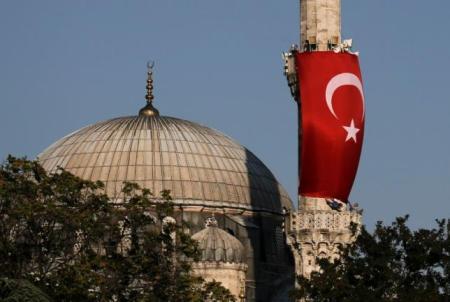
A Turkish flag is seen next to the dome of Hagia Sophia mosque in Istanbul, Turkey, July 16, 2016. REUTERS/Alkis Konstantinidis

A Turkish flag is seen next to the dome of Hagia Sophia mosque in Istanbul, Turkey, July 16, 2016. REUTERS/Alkis Konstantinidis

The United Nations Security Council failed on Saturday to condemn the violence and unrest in Turkey after Egypt objected to a statement that called on all parties to “respect the democratically elected government of Turkey,” diplomats said.

The U.S.-drafted statement also expressed grave concern over the situation in Turkey, urged the parties to show restraint, avoid any violence or bloodshed, and called for an urgent end to the crisis and return to rule of law.

Statements by the 15-member Security council have to be agreed by consensus.

Diplomats, speaking on condition of anonymity, said Egypt argued that the U.N. Security Council was not in a position to determine whether a government had been democratically elected.

Egypt’s mission to the United Nations did not immediately respond to a request for comment.

Turkish forces loyal to President Tayyip Erdogan largely crushed an attempted military coup on Saturday after crowds answered his call to take to the streets in support of the government and dozens of rebels abandoned their tanks.

Egyptian President Abdel Fattah al-Sisi is a former general who overthrew elected President Mohamed Mursi, of the Islamist Muslim Brotherhood, in 2013 after mass protests against Mursi. Turkey provided support for the Muslim Brotherhood in Egypt.

Turkey: Coup Has Failed, Erdogan More Powerful Than Ever

July 16, 2016

Turkey: Coup Has Failed, Erdogan More Powerful Than Ever, PJ MediaMichael Van Der Galien, July 16, 2016

(But please see also, Analyzing Turkey and the threat of lone wolf attacks. — DM)

Turkey coupTurkish soldiers secure the area as supporters of Turkey’s President Recep Tayyip Erdogan protest in Istanbul’s Taksim square, early Saturday, July 16, 2016. (AP Photo/Emrah Gurel)

Izmir, Turkey — It’s a done deal: the military coup has failed. President Recep Tayyip Erdogan and his AK Parti remain in power and vow to take revenge against those behind the coup.

Or, perhaps better said: against those they say are behind it.

Now that the coup has clearly failed, we can conclude that this must have been the most incompetent attempted takeover in Turkey’s troubled history. When part of the military launched their offensive last night (Turkish time), I immediately checked news channels supporting President Erdogan. Surprisingly, none of them was taken over. The only broadcaster who was taken over was TRT Haber, the state news channel. But NTV and other channels supporting Erdogan were left alone.

That was remarkable, but what struck me even more was the fact that these channels — especially NTV — were able to talk to the president and the prime minister. That’s strange, to put it mildly. Normally, when the military stages a coup, the civilian rulers are among the first to be arrested. After all, as long as the country’s civilian leadership are free, they can tell forces supportive of them what to do… and they can even tell the people to rise up against the coup.

And that’s exactly what happened. Both Prime Minister Binali Yildirim and President Recep Tayyip Erdogan called into news programs and told their supporters to go out on the streets and fight back against the soldiers. A short while later, streets in the big cities (Ankara and Izmir) were flooded with Erdogan-supporters, who even climbed on top of tanks. Fast forward a few hours and it was officially announced that the coup had failed, and that Erdogan and his AK Party remained in power. About 1500 soldiers were arrested.

As I wrote on Twitter yesterday, there were three options:

  1. The coup was staged by a small group within the military, which would severely limit their ability to strike.
  2. The coup was staged by the entire military, which meant Erdogan’s chances of surviving politically were extremely small.
  3. The coup was a set-up. Think the Reichstag fire.

The main argument against option number three is that there was some very serious fighting taking place, including massive explosions. Dozens of people have been killed. If this was a fake coup, it probably was the bloodiest one ever. That’s why many people are skeptical about this option, and believe it was just an incompetent attempt at a military takeover.

The general feeling in Izmir — a city with 3 million inhabitants who are generally not pro-Erdogan at all — is that it was a real coup attempt, but that the officers behind it were incredibly amateurish. Friends on the streets and cafés are literally telling me:

It was a real attempt, but they were stupid.

Shortly after the attempted coup, Erdogan and Yildirim immediately blamed a disgraced Islamic scholar, Fethullah Gulen, who now lives in Pennsylvania. Gulen and Erdogan were longtime allies, who shared a dream of Islamizing Turkey, but had a falling out several years ago. Ever since, Erdogan has blamed Gulen for pretty much every problem in Turkey, including a major controversy about cabinet members (including Erdogan, and his family) possibly stealing millions of dollars. In the years after, Gulen became Erdogan’s enemy number one, which is undoubtedly why he’s blamed for yesterday’s coup.

Proof that Gulen is indeed behind it hasn’t been presented, however. In fact, the Gulen group denies any involvement. You could imagine that, if they did support it, they’d call on their followers to support the takeover. They did no such thing.

The same goes for the leaders of Turkey’s official opposition parties. The secular CHP and the nationalist MHP aligned with the AKP to condemn the coup. Some in the West have expressed shock at that: if they’re opposed to Erdogan, why didn’t they support the coup? The answer is, of course, that Turkey has had two military takeovers in the recent past (1960s and 1980s): both were very bloody and absolutely horrendous, not just for the ousted governments, but also for the average Turk. People weren’t allowed to leave their homes, not even to buy food and drinks, and many innocent civilians were rounded up by the military. Once in prison, many of them either died or were severely tortured.

It’s not very strange that even the country’s opposition parties don’t wish a repeat of that. No person in his right mind would.

When the coup was still going on, one Twitter user tweeted this:

This coup attempt, whether it succeeded or failed, ensured Turkey would be more autocratic moving forward.

I’m afraid that Yousef was, and is, right. If the military would’ve succeeded, Turkey would now have been a military dictatorship. Regardless of where you stand on Erdogan, that would’ve meant major changes for the Turkish people. A lockdown would’ve been put in place, people would’ve been imprisoned in their own homes. In fact, I went out at 2 a.m. to a local market to buy as much food, milk, eggs, and so on as I could. I did this because, in past coups, people had to stay indoors for many days. Some people, who couldn’t take care of themselves, actually died from hunger, or so I’ve been told by Turks. After that first phase, the military always rounded up all those they thought were loyal to the former government. Mass imprisonments, torture and killings were everyday events.

In other words, even if you oppose Erdogan, it’s difficult if not impossible to celebrate a military coup.

Of course we now have to see what Erdogan’s government will do. More than 100 soldiers involved in the coup have been killed, military commanders were taken hostage, and Erdogan has vowed revenge. As anyone with even a bit of knowledge of history knows, the crackdowns after a failed coup can be as bad as the crackdown after a successful military takeover. Erdogan already wanted to change Turkey’s constitution and change the system into a so-called presidential system, meaning most if not all power would reside in his office. Nobody doubts that this is exactly what’ll happen now: he’ll draw all power to himself and ignite a major cleansing, possibly not only of the military and police forces, but also in politics itself.

The only possibly conclusion, then, is: no matter what, democracy will suffer a major setback in Turkey. We can only hope and pray that the consequences will be less severe than I fear.

Russian anti-ISIS war from Syria to Caucasus

July 12, 2016

Russian anti-ISIS war from Syria to Caucasus, DEBKAfile, July 12, 2016

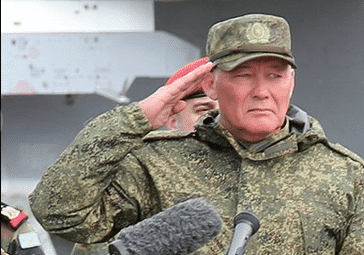
Alexander-Dvornikov-C-in-C-Russian-Syrian-Task-Force

Unimpressed by President Barack Obama’s optimistic assertions about ISIS’ loss of territory and weakening state, the Kremlin judges the counter-terror war to be just beginning. Russian intelligence has found the group to be in full fighting mode and setting up an army of suicide bombers, each team numbering some 20-15 terrorists, ready for strikes in Europe, including Russia, and the Middle East.

************************

In a supreme effort to prevent ISIS suicide units from reaching Russia from Syria, Sergei Shoigu, Russia’s
Defense Minister, has promoted the Russian commander in Syria, Colonel-General Alexander Dvornikov. to an expanded command as head of the South Russia military district. This district covers Russian forces including naval units in the Black and Caspian Seas, the Fourth Air Force Defense Army and Russian bases in Abkhazia, South Ossetia and Armenia.  Gen. Dvornikov will also command tens of ground force divisions, including paratroopers, marines and special coastal defense units.

The fact that the Russian Defense Ministry emphasizes in its announcement that “The decision about the appointment of a new commander of the Syrian operation is pending,” indicates that General Dvornikov will remain in charge of Russian forces in Syria from his new Black Sea HQ. His deputy, Gen.-Lt. Alexander Zhuravlyev, will continue to serve under him in the Syrian arena.

Moscow’s realignment of its military command is taken by DEBKAfile’s military and counter terrorism sources as a step towards becoming the first world power outside the Middle East to recognize and address the trans-frontier, global character of the Islamic peril, a lesson drawn from ISIS suicide attacks in Paris, Brussels, the US, Tunisia Egypt and Turkey

Unimpressed by President Barack Obama’s optimistic assertions about ISIS’ loss of territory and weakening state, the Kremlin judges the counter-terror war to be just beginning. Russian intelligence has found the group to be in full fighting mode and setting up an army of suicide bombers, each team numbering some 20-15 terrorists, ready for strikes in Europe, including Russia, and the Middle East.

This is borne out by the information released in Ankara by Turkish intelligence sources on July 11, showing that since the bombing in Istanbul airport, on June 28, in which 42 people were killed, ISIS has discontinued its passageway through Turkey for suicide terrorists trained in Syria to reach Europe. They are now smuggling terrorists across Azerbaijan, Georgia and Cyprus.

This Turkish announcement has serious implications:

First, that the ISIS’ use of Azerbaijan and Georgia as way stations for its suicide squads points to its presence on the Black Sea coast right up to Russia’s frontier. This region has now passed to the command of  Gen. Dvornikov..

Second, that Turkish intelligence can confirm Russian information about large squads of suicide terrorists gearing up for multiple attacks, some of which are already on-site of their targets, with back-up teams in case the first misses out.

The impending massive invasion of suicide terrorists to Europe and the Middle East was, according to DEBKAfile’s sources, an important item on the agenda of the recent meeting between Yossi Cohen, head of the Israeli Mossad, and Mikhail Yefimovich Fradkov, head of the Russian SVR, that took place on July 1, at the Russian organization’s Yasenevo HQ outside Moscow.

The Case for Kurdish Statehood

July 11, 2016

The Case for Kurdish Statehood, Investigative Project on Terrorism, Noah Beck, July 11, 2016

1691

Why has the West been so supportive of Palestinian nationalism, yet so reluctant to support the Kurds, the largest nation in the world without a state?

The Kurds have been instrumental in fighting the Islamic State (ISIS); have generously accepted millions of refugees fleeing ISIS to the Kurdistan Regional Government (KRG); and embrace Western values such as gender equality, religious freedom, and human rights. They are also an ancient people with an ethnic and linguistic identity stretching back millennia and have faced decades of brutal oppression as a minority. Yet they cannot seem to get sufficient support from the West for their political aspirations.

The Palestinians, by contrast, claimed a distinct national identity relatively recently, are less than one-third fewer in number (in 2013, the global Palestinian population was estimated by the Palestinian Authority to reach 11.6 million), control land that is less than 1/15th the size of the KRG territory, and have not developed their civil society or economy with nearly as much success as the Kurds. Yet the United Nations, the European Union, the Arab League, and other international bodies have all but ignored Kurdish statehood dreams while regularly prioritizing Palestinian ambitions over countless other global crises.

Indeed, in 2014 the UK and Sweden joined much of the rest of the world in recognizing a Palestinian state. There has been no similar global support for a Kurdish homeland. Moreover, Kurdish statehood has been hobbled by U.S. reluctance to see the Iraqi state dismantled and by regional powers like Turkey, which worries that a Kurdish state will stir up separatist feelings among Turkish Kurds.

With an estimated worldwide population of about 35 million (including about 28 million in the KRG or adjacent areas), the Kurds are the fourth-largest ethnic group in the Middle East (after the Arabs, Persians, and Turks), and have faced decades of persecution as a minority in Turkey, Iran, and Iraq.

The 1988 “Anfal” attacks, which included the use of chemical weapons, destroyed about 2,000 villages and killed at least 50,000 Kurds, according to human rights groups (Kurds put the number at nearly 200,000). Several international bodies have recognized those atrocities as a genocide.

The Kurds in Turkey have also suffered oppression dating back to Ottoman times, when the Turkish army killed tens of thousands of Kurds in the Dersim and Zilan massacres. By the mid-1990s, more than 3,000 villages had been destroyed and 378,335 Kurdish villagers had been displaced and left homeless, according to Human Rights Watch.

The drive for Kurdish rights and separatism in Iran extends back to 1918, and – during its most violent chapter – cost the lives of over 30,000 Kurds, starting with the 1979 rebellion and the consequent KDPI insurgency.

A 2007 study notes that 300,000 Kurdish lives were lost just in the 1980s and 1990s. The same study states that 51,000 Jews and Arabs were killed in the Arab-Israeli conflict from 1950 until 2007 (and, because that total includes wars with Israel’s Arab neighbors, Palestinians are a small fraction of the Arab death toll).

Perhaps because of the Kurds’ own painful history, the KRG is exceptionally tolerant towards religious minorities and refugees. The KRG has embraced its tiny community of Jews, and in 2014, the Kurds rescued about 5,000 Yazidis trapped on Mount Sinjar after fleeing attempted genocide by ISIS. Last November, the Kurds recaptured the Sinjar area from ISIS, liberating hundreds more Yazidis from vicious oppression.

The KRG absorbed 1.8 million refugees as of December, representing a population increase of about 30 percent. The KRG reportedly needs $1.4 to 2.4 billion to stabilize the internally displaced people in its territory.

“Most of the refugees [in the KRG] are Arab Sunnis and Shia, Iranians, Christians, and others,” Nahro Zagros, Soran University vice president and adviser to the KRG’s Ministry of Higher Education, told the  IPT. “Yet there is no public backlash from the Kurds. And of course, we have been helping the Yazidi, who are fellow Kurds.”

The Kurdish commitment to gender equality is yet another reason that Kurdish statehood merits Western support. There is no gender discrimination in the Kurdish army: their women fight (and get beheaded) alongside the men. Last December, Kurdistan hosted the International Conference on Women and Human Rights.

The Kurds are also the only credible ground force fighting ISIS, as has been clear since the ISIS threat first emerged in 2014. ISIS “would have totally controlled the Baji oil field and all of Kirkuk had the [Kurdish] Peshmerga not defended it,” said Jay Garner, a retired Army three-star general and former Army assistant vice chief of staff who served during “Operation Provide Comfort” in northern Iraq. “Losing Kirkuk would have changed the entire war [against ISIS], because there are billions of dollars [per] week in oil flowing through there. The Iraqi army abandoned their equipment [while the Kurds defended Kirkuk, which has historically been theirs].”

Masrour Barzani, who heads the KRG’s intelligence services, says that Kurdish independence would empower the Kurds to purchase the type of weapons they need without the delays that currently hobble their military effort against ISIS. Under the present arrangement, Kurdish weapons procurement must go through Iraq’s Shia-led central government, which is also under heavy Iranian influence.

Besides bolstering the fight against ISIS, there are other geopolitical reasons for the West to support Kurdish statehood: promoting a stable partition of Syria, containing Iran, balancing extremist forces in the Middle East, and giving the West another reliable ally in a volatile region.

Now that Syria is no longer a viable state, it could partition into more sustainable governing blocs along traditional ethnic/sectarian lines with Sunni Arabs in the heartland, Alawites in the northwest, Druze in the south, and Kurds in the northeast. KRG leader Masrour Barzani recently argued that political divisions within Iraq have become so deep that the country must transform into “either confederation or full separation.”

Southeast Turkey and northwest Iran also have sizeable Kurdish areas that are contiguous with the KRG, but those states are far from disintegrating, and would aggressively resist any attempts to connect their Kurdish areas to the future Kurdish state. However, the Kurdish areas of former Syria should be joined to Iraqi Kurdistan as a way to strengthen the fledgling Kurdish state and thereby weaken ISIS.

In a recent article, Ernie Audino, the only U.S. Army general to have previously served a year as a combat adviser embedded inside a Kurdish Peshmerga brigade in Iraq, notes that Iran currently controls the Iraqi government and Iran-backed fighters will eventually try to control Kurdistan. He also makes the point that Western support for the Kurdish opposition groups active in Iran would force the Iranian regime to concentrate more on domestic concerns, effectively weakening Iran’s ability to pursue terrorism, expansionism, and other destabilizing activities abroad.

Because the Kurds are religiously diverse moderates who prioritize their ethno-linguistic identity over religion, a Kurdish state would help to balance out the radical Mideast forces in both the Shiite and Sunni camps. The Kurds are already very pro-American, thanks to their Western-leaning values, the U.S.-backed-no-fly zone, and the 2003 toppling of Saddam Husssein that made the KRG possible.

A Kurdish state would also have excellent relations with Israel, another moderate, non-Arab, pro-Western democracy in the region. Israeli Prime Minister Benjamin Netanyahu endorsed Kurdish independence in 2014, and Syrian Kurds – after recently declaring their autonomy – expressed an interest in developing relations with Israel.

By contrast, the Palestinian Authority slanders Israel at every opportunity: Abbas recently claimed in front of the EU parliament that Israel’s rabbis are trying to poison Palestinian drinking water. The Authority raises Palestinian children to hate and kill Jews with endless anti-Israel incitement coming from schools, media, and mosques. Palestinians have also shown little economic progress in the territories that they do control, particularly in Gaza, where Palestinians destroyed the greenhouses that donors bought for them in 2006 and instead, have focused their resources on attacking Israel with tunnels and rockets.

By almost any measure, a Kurdish state deserves far more support from the West. After absorbing millions of Syrian refugees while fighting ISIS on shrinking oil revenue, the KRG is battling a deepening financial crisis. Aggravating the situation, Iraq’s central government has refused – since April 2015 – to send the KRG its share of Iraqi oil revenue. The economic crisis has cost the KRG an estimated $10 billion since 2014.

U.S. Rep. Ed Royce, R-Calif., chairman of the House Foreign Affairs Committee, introduced House Resolution 1654 “to authorize the direct provision of defense articles, defense services, and related training to” the KRG. Fifteen months later, the bill is still stuck in Congress.

Helping the Kurds should be an even bigger priority for the European Union, which absorbs countless new refugees every day that ISIS is not defeated. If the EU were to fund the KRG’s refugee relief efforts and support their military operations against ISIS, far fewer refugees would end up on their shores.


U.S. still gets it wrong on Islamic State

July 1, 2016

U.S. still gets it wrong on Islamic State, Japan Today, Peter Van Buren, July 1, 2016

(An interesting and rather perceptive analysis, quite contrary to Kerry’s position that the suicide attack at the Turkish airport was a sign of desperation. — DM

WASHINGTON — Tuesday’s attacks at Istanbul’s main airport, which appear at this time to be the work of Islamic State, are the latest reminder that the United States should not downplay the group’s rudimentary – yet effective – tactics.

Since the wave of Islamic State suicide bombings in May – killing 522 people inside Baghdad, and 148 people inside Syria – American officials have downplayed the strategy as defensive. Brett McGurk, the Special Presidential Envoy in the fight against Islamic State, said the group “returned to suicide bombing” as the area under its control shrank. The American strategy of focusing primarily on the “big picture” recapture of territory seems to push the suicide bombings to the side. “It’s their last card,” stated an Iraqi spokesperson in response to the attacks.

The reality is just the opposite.

A day after the June 26 liberation of Fallujah, car bombs exploded in eastern and southern Baghdad. Two other suicide bombers were killed outside the city. An improvised explosive device exploded in southwest Baghdad a day earlier.

Washington should know better than to underestimate the power of small weapons to shape large events. After Secretary of Defense Donald Rumsfeld labeled Iraqi insurgents as “dead enders” in 2003, they began taking a deadly toll of American forces via suicide bombs. It was the 2006 bombing of the Shi’ite al-Askari Golden Mosque that kicked the Iraqi civil war into high gear. It was improvised explosive devices and car bombs that kept American forces on the defensive through 2011.

To believe suicide bombings represent a weakening of Islamic State is a near-total misunderstanding of the hybrid nature of the group; Islamic State melds elements of a conventional army and an insurgency. To “win,” one must defeat both versions.

Islamic State differs from a traditional insurgency in that it seeks to hold territory. This separates it from al-Qaida, and most other radical groups, and falsely leads the United States to believe that retaking strategic cities like Fallujah from Islamic State is akin to “defeating” it, as if it is World War Two again and we are watching blue arrows move across the map toward Berlin. Envoy McGurk, following Fallujah, even held a press conference announcing Islamic State has now lost 47 percent of its territory.

However, simultaneously with holding and losing territory, Islamic State uses terror and violence to achieve political ends.

Islamic State has no aircraft and no significant long-range weapons, making it a very weak conventional army when facing down the combined forces of the United States, Iran and Iraq in set piece battles. It can, however, use suicide bombs to strike into the very heart of Shiite Baghdad (and Syria, Jordan, Yemen, and Turkey – as Tuesday’s bombing reminds us), acting as a strong transnational insurgency.

Why does such strength matter in the face of large-scale losses such as Fallujah?

Violence in the heart of Iraqi Shiite neighborhoods empowers hardliners to seek revenge. Core Sunni support for Islamic State grows out of the need for protection from a Shi’ite dominated military, which seeks to marginalize if not destroy the Sunnis. Reports of Shi’ite atrocities leaking out of the ruins of Sunni Fallujah are thus significant. Fallujah was largely destroyed in order to “save” it, generating some 85,000 displaced persons, mirroring what happened in Ramadi. Those actions remind many Sunnis of why they supported Islamic State (and al-Qaida before them) in the first place.

Suicide strikes reduce the confidence of the people in their government’s ability to protect them. In Iraq, that sends Shiite militias into the streets, and raises questions about the value of civil institutions like the Iraqi National Police. Victories such as the retaking of Ramadi and Fallujah, and a promised assault on Mosul, mean little to people living at risk inside the nation’s capital.

American commanders have already had to talk the Iraqi government out of pulling troops from the field to defend Baghdad, even as roughly half of all Iraqi security forces are already deployed there. This almost guarantees more American soldiers will be needed to take up the slack.

Anything that pulls more American troops into Iraq fits well with the anti-American Islamic State narrative. Few Iraqis are left who imagine the United States can be an honest broker in their country. A State Department report found that one-third of all Iraqis believe the Americans are actually supporting Islamic State, while 40 percent are convinced that the United States is trying to destabilize Iraq for its own purposes.

In a country like Turkey, suicide bombings play out in a more complex political environment. Turkey has effectively supported Islamic State with porous borders for transit in and out of Syria, and has facilitated the flow of oil out of Syria and Iraq that ultimately benefits the group. At the same time, however, Turkey opened its territory to American aircraft conducting bombing runs against Islamic State. Attacks in Turkey may be in response to pressure on the nation to shift its strategy more in line with Western demands. Russia (no friend of Islamic State) and Turkey have also recently improved relations; the attack in Istanbul may have been a warning shot reminding Turkey not to get too close.

The suicide bombings – in Turkey and elsewhere – are not desperate or defensive moves. They are not inconsequential, even if their actual numbers decline. They are careful strategy, the well-thought out application of violence by Islamic State. The United States downplays them at great risk.