Archive for the ‘Turkey’ category

“Unity”? About What Exactly?

January 22, 2015

Unity”? About What Exactly? The Gatestone Institute, Jeremy Havardi, January 22, 2015

Meanwhile, Saudi Arabia tried to fool the world by joining France’s “Unity March” for free speech just two days after a young Saudi blogger, Raif Badawi, received the first installment of 50 lashes — out of the 1000 he is to get — “very severely,” the lashing order says. Badawi still has 950 lashes to complete.

Mahmoud Abbas, whose genocidal, jihadi partner, Hamas, was just declared not a terrorist group by the European Union, joined the forefront of the “Unity March” at the same time as a Palestinian human rights groups published a report accusing the Palestinian Authority of “waging war” against university students in the West Bank.

What “Islamophobia” motivated the killing of Jewish customers in a kosher supermarket? What had those victims done to deserve that?

We may like to imagine that this is not Islam, and that the faith promotes peace and nothing else. But the murderers say it is Islam, and they act accordingly.

Much of the media has offered up a context for these killings that is false.

The real story is that despite a few sporadic incidents, there has been no backlash against the Muslim community.

The recent rally for free speech and against the terrorism in Paris initially appeared to have generated a surge of defiance and resolve, not just in France but around the world. People were actually talking about a turning point in the battle against terrorism and radical Islam.

If only it were true.

The reality is that much of the political class and media remain in denial about the events in Paris.

Ban Ki Moon explained that the tragic events had nothing to do with religion. Signing a condolence book for the victims of the attacks, he said: “This is not a country, a war against religion or between religions… This is a purely unacceptable terrorist attack – criminality.”

France’s President François Hollande said that the Charlie Hebdo fanatics had “nothing to do with Islam,” and he was joined in this view by commentators on France24, as well as the German Interior Minister, Thomas de Maizière.

The Guardian’s Jonathan Freedland condemned the actions of a “handful of wicked fanatics against the rest of us.” The implication was that they merely acted in the name of Islam — purely coincidentally, as it were.

In the Daily Mail, Piers Morgan wrote that the perpetrators were “not ‘real’ Muslims” and that this was “not a religious war.” Why he thought he could act as the arbiter on that question is still unclear.

As for President Obama, he has effectively outlawed the term “Islamic terror.”

The United States, in what was widely seen as a snub, was only represented at the rally by the U.S. Ambassador to France, Jane Hartley. Since the President had declared in 2012 that “[t]he future must not belong to those who slander the prophet of Islam” — the implication was that they were not acting purely coincidentally.

There is in those comments a mixture of political correctness, wishful thinking and staggering ignorance. It is understandable and commendable not to lump a majority of law-abiding, patriotic and peaceful Muslims together with their violent counterparts. But calling for “unity” in a march leaves one asking: Unity about what exactly?

To pretend that there is a complete disconnect between Islam and terror is to ignore reality. Jihadis are gaining ideological succour from the tenets of their faith, drawing upon teachings promulgated by imams, including the late Anwar al Awlaki. We may like to imagine that this is not Islam, and that the faith promotes peace and nothing else. But the murderers say it is Islam, and they act accordingly.

To confront this problem properly, the ideological underpinnings of jihad need to be tackled comprehensively at source.

It is not enough to unite against terrorism, as every community must. We need to know what we are uniting for — free speech. And we need to know what we are uniting against — namely the militant war of extremist Islamism.

It is equally inaccurate to describe these jihadis as “lone wolves.” They will have spent time gaining combat experience abroad, perhaps in Yemen, Syria or Iraq, and will have received ideological indoctrination and funding from a network of other jihadis. They are recruits in a theocratic, totalitarian death-cult spread across the planet. It comes in different forms: Boko Haram, which slaughtered 2,000 people in Nigeria the weekend before last; the Taliban, which murdered schoolchildren in Pakistan; Hamas with its genocidal doctrine and many years of bombings, and the Islamic State, which seems busy ethnically cleansing nearly everyone in Syria and Iraq.

The murders in Paris, therefore, were merely the latest salvo in a global confrontation between jihadist Islam and its declared enemies, this time in the West.

Much of the media has offered up a context for these killings that is false. Within hours of the massacre at Charlie Hebdo, the Telegraph led with a feature on the growing problem of “Islamophobia” in France. The Guardian, too, weighed in; one story headlined: “Muslims fear backlash after Charlie Hebdo deaths as Islamic sites attacked”. The Spectator spoke of the killings as an “attack on Islam;” and Robert Fisk in the UK Independent referred to the legacy of the Algerian war as a motive for the attackers. Other news outlets voiced fears of a “backlash” against Muslims in France and elsewhere.

But the real story is that while there have been some sporadic incidents against mosques and Muslim owned businesses in France following the Charlie Hebdo attacks, there has been no backlash against the Muslim community. Muslims across France even joined in the unity rally, an act that would have been impossible were there a climate of widespread public hostility.

The majority of hate crimes in France, as in a number of other countries, affects the Jewish community. It was a Jewish supermarket that was attacked. This does not mean that there will not be attacks — all of them naturally deplorable — against Muslim innocents, only that fears of a major widespread assault seem highly exaggerated. The same fears of widespread attacks against the Muslim community also proved unfounded after the 7/7 London bomb attacks.

Lumping terrorism and “Islamophobia” together ignores the real motivation of the latest killers in France. One of them, Amedy Coulibaly, pledged allegiance to the Islamic State in a video address prior to the supermarket attack. This hardly suggests a rant against perceived intolerance or racism. Invoking racism here also suggests, in a shifting of blame, that we in the West are somehow at fault for the violent behaviour of these Islamist terrorists. What “Islamophobia” motivated the killing of Jewish customers in a kosher supermarket? What had those victims done to deserve that?

Another reason this is no turning point is that the press continues to engage in self-righteous self-censorship. Not one broadcaster — including the BBC, Fox, NBC and CNN — showed any of the Charlie Hebdo images that had been deemed provocative. Those outlets were joined by the Associated Press, which deliberately cropped a photograph of the magazine’s now-dead editor to avoid showing an image of the Prophet Muhammad. In a cringe replicated across almost all of Europe, not one major British newspaper published any of Charlie Hebdo’s satirical images of Islam, and only The Guardian showed the full front cover of the edition that the survivors published after the attack.

Big mistake. These newspapers and broadcasters are denying the public a dispassionate view of what the killers themselves say is causing them to kill. Worse again, by drawing a line against possibly offending Muslims — many of whom seem to have no problem offending Jews and Christians, among others, if not killing them — the media have acted as if there is already in place an unofficial blasphemy law: the terrorists’ key demand.

A violent mob, disastrously undermining Western values, is effectively dictating the boundaries of free speech.

It is all very well to praise Charlie Hebdo as an icon of free speech, but after the riots that followed the publishing of Muhammad cartoons in Denmark’s Jyllands Posten in 2006, Charlie Hebdo was virtually alone in reprinting them, and it was condemned widely for doing so.[1]

Time magazine, in 2011, likened Charlie Hebdo’s reprinting the cartoons as “the right to scream ‘fire’ in an increasingly over-heated theater.” In other words, the “Islamophobic” cartoonists were to blame for their own misfortune. There is a notion permeating Europe, that if you speak out, not only can you can be put on trial — as is the Dutch MP, Geert Wilders[2] — but that it will also, in an Orwellian twist, be your own fault; if you had just kept quiet, nothing unpleasant would be happening to you. Try telling that to the four Jews lying murdered on the floor of the French supermarket. What did they ever say?

Meanwhile, Saudi Arabia tried to fool the world by joining France’s “Unity March” for free speech just two days after a young Saudi blogger, Raif Badawi, received the first installment of 50 lashes — out of the 1000 he is to get — “very severely,” the lashing order says. He was taken after Friday prayers to a public square outside a mosque in Jeddah. His declared “crime” is “insulting Islam,” for writing thoughts such as, “My commitment is to reject any repression in the name of religion… a goal we will reach in a peaceful and law-abiding way.” Badawi still has 950 lashes to complete. If he lives. There is no medical help.

Palestinian Authority President Mahmoud Abbas — whose genocidal, jihadi partner, Hamas, was, in a burst of surrealism, declared not a terrorist group by the European Union — joined the forefront of the Unity March in Paris at the same time as a report was published by a Palestinian human rights group, accusing the Palestinian Authority of “waging war” against university students in the West Bank.
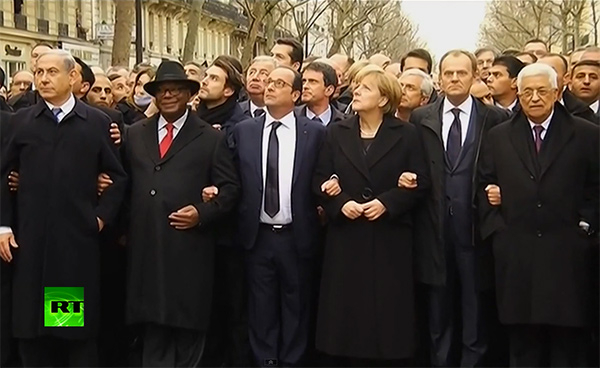
883World leaders link arms at the Paris anti-terror rally on January 11, 2014. Palestinian Authority President Mahmoud Abbas stands at the far right of the front row. (Image source: RT video screenshot)

Turkey, “named the world’s biggest jailor of journalists in 2012 and 2013” according to theWashington Post, was also there. Turkey “ended 2014 by detaining a number of journalists … including Ekrem Dumanli, editor in chief of Zaman, a leading newspaper” with links to an opposition movement.

Meanwhile, between January 8 and January 14, as over three million copies of Charlie Hebdowere selling out and four million more being printed, there was already talk in France of hardening its laws against free speech. So this may not be a turning point either for free speech or against radical Islam. So it may be a while before we can truly say, “Nous sommes Charlie.”

Jeremy Havardi is a historian and journalist based in London. His books include The Greatest Briton, analytical essays on Churchill.


[1] Ezra Levant, who reprinted the cartoons in Canada, was then compelled to appear before the Alberta Human Rights Commission to defend their publication, because of a complaint lodged by Syed Soharwardy of the Islamic Supreme Council of Canada and the Edmonton Council of Muslim Communities.

[2] As also was Lars Hedegaard (for speaking in his own drawing room), Suzanne Winters, Elisabeth Sabaditsch-Wolff, or at the very east need round-the-clock-bodyguards, such asFrench journalist Eric Zemmour, for saying that France might be facing a virtual civil war.

A Sad State of Affairs: The Kerry Record

January 2, 2015

A Sad State of Affairs: The Kerry Record, World Affairs JournalJoshua Muravchik, November/December, 2014

(Kerry likely agrees with Obama as to his quite foreign foreign policies and, equally likely, we are stuck with both at least until Obama leaves the White House.

Kerry I'm an idiot

The most bothersome current aspects of Obama-Kerry foreign policies are the extent to which they trust Iran and how they deal with it and the P5+1 negotiating group. — DM)

John_Kerry_and_Benjamin_Netanyahu_July_2014 (1)

Although Kerry’s anti-American ideology has moderated to some degree from his fiery days as an antiwar leader, he has misrepresented but never repudiated his past. Especially consistent has been his inclination to see the best in America’s enemies, from Madame Binh to Comandante Ortega to Bashar Assad. Israelis were shocked this summer that Kerry came up with a plan molded by Turkey and Qatar to fit the interests of Hamas at their own expense. Had they known him and his record better, they might not have been.

***************

The Gaza war of July and August 2014 occasioned the sharpest frictions in memory between the United States and Israel, highlighted by a cease-fire proposal offered by Secretary of State John Kerry that Israel’s security cabinet rejected unanimously. Kerry’s plan envisioned a seven-day cease-fire, during which the parties would negotiate “arrangements” to meet each of Hamas’s demands about the free flow of people and goods into Gaza and the payment of salaries of Hamas’s tens of thousands of employees. As for Israel’s demands about destruction of tunnels and rockets and the demilitarization of Gaza, these were not mentioned at all, except in the add-on phrase that the talks would also “address all security issues.”

The document cited the important role to be played by “the United Nations, the Arab League, the European Union, the United States, Turkey, [and] Qatar.” Conspicuous by their absence from this list were Israel, Egypt, and the Palestinian Authority. These three had also not been invited to the Paris meetings where Kerry worked on his ideas with leaders of the countries and bodies mentioned.

Barak Ravid, diplomatic correspondent for the liberal Israeli newspaper Haaretz, wrote that the proposal “might as well have been penned by Khaled Meshal [head of Hamas]. It was everything Hamas could have hoped for.” The centrist Times of Israel’s characteristically circumspect editor, David Horovitz, branded Kerry’s initiative “a betrayal.” And left-leaning author Ari Shavit commented that “Kerry ruined everything. [He] put wind in the sails of Hamas’ political leader Khaled Meshal, allowed the Hamas extremists to overcome the Hamas moderates, and gave renewed life to the weakened regional alliance of the Muslim Brotherhood.”

Turkey and Qatar are the mainstays of that alliance and were chosen by Kerry as his principal interlocutors because they are Hamas’s main backers. This brought protests from the Palestinian Authority, led by President Mahmoud Abbas’s movement, Fatah, the secularist rival to Hamas. That group declared that “whoever wants Qatar and Turkey to represent them can emigrate and go live there. Our only legitimate representative is the PLO.”

The shock of Palestinian and Israeli leaders would have been less, however, if they had been more familiar with the record of John Kerry. Spurning America’s friends in pursuit of deals with their nemeses was perfectly in character for the secretary of state. The hallmark of his career has been to denigrate America itself, while supporting the claims of its enemies.

That career began in 1969, when, months after returning from a tour of duty in Vietnam, Kerry sought and received a military discharge so that he might run for Congress. His campaign as a peace candidate sputtered, but his authenticity as a Vietnam vet established him as a presence in the burgeoning antiwar movement. In May 1970, he traveled to Paris for an unpublicized meeting with Viet Cong representatives, and, perhaps at their suggestion, he joined up upon his return with Vietnam Veterans Against the War. VVAW was headed by Al Hubbard, a former Black Panther. Kerry was instantly given a top role, twinning with Hubbard as the public face of the organization.

At a VVAW protest in Washington, DC, in April 1971, Kerry joined other veterans in throwing away their military medals in front of news cameras. The entire demonstration was punctuated by Kerry’s appearance before the Senate Foreign Relations Committee, where he offered dramatic testimony about American atrocities in Vietnam based on accounts heard at a VVAW inquest a few months earlier. He spoke of veterans who said:

They had personally raped, cut off ears, cut off heads, taped wires from portable telephones to human genitals and turned up the power, cut off limbs, blown up bodies, randomly shot at civilians, razed villages . . . poisoned food stocks, and generally ravaged the countryside.

These acts, Kerry emphasized, “were not isolated incidents but crimes committed on a day-to-day basis with the full awareness of officers at all levels of command.”

When, at the behest of aghast senators, the Naval Criminal Investigative Service conducted a formal inquiry into the stories presented at the VVAW inquest, it reported that many of the VVAW witnesses cited by Kerry refused to cooperate, although promised immunity. Others were clearly crackpots, and several swore, and provided witness corroboration, that they had not participated at the inquest at all and had no idea who had appeared in their names. The entire exercise had been inspired and largely engineered by Mark Lane, whose book on the same subject earlier that year had been panned by New York Times columnist James Reston Jr. as “a hodgepodge of hearsay,” while that paper’s book reviewer, Neil Sheehan, who had reported from Vietnam and would soon break the Pentagon Papers, revealed that some of Lane’s “witnesses” had not served in Vietnam. (The political scientist Guenter Lewy documents these events in his 1978 book America in Vietnam.)

In August 1971, four months after his Senate appearance, Kerry made another trip to Paris, to meet with Madame Nguyen Thi Binh, foreign minister of the Viet Cong, this time in full view, for his first exercise in international diplomacy. He returned touting the “peace plan” of the Viet Cong, explaining: “If the United States were to set a date for withdrawal, the prisoners of war would be returned.” Although he frequently accused American leaders of lying, he took the Communist leaders’ statements at face value, asserting that their peace plan “negates very clearly the argument of the president [Nixon] that we have to maintain a presence in Vietnam to use as a negotiating [chip] for the return of those prisoners.”

Kerry’s dismissal of the statements of US leaders as lies and his credulity toward those of the Vietnamese Communists reflected a broader difference in attitude toward the two sides to the conflict. Ho Chi Minh, who had spent long years as a henchman of Stalin’s, serving the Comintern in several countries, was in Kerry’s admiring eyes “the George Washington of Vietnam” who aimed only “to install the same provisions into the government of Vietnam” that appeared in the American Constitution. America, in contrast, had itself strayed so far from those principles that it needed a “revolution” to restore them.

Kerry’s colleagues in VVAW undoubtedly shared this sentiment, and in November 1971, at a conference of its leadership in Kansas, the group considered just how far down the path of revolution it was willing to go. It debated, although ultimately rejected, a proposal to commence a campaign of terrorist violence and assassination of pro-war US senators. When he ran for president in 2004, Kerry denied he had been present at this conclave, but when FBI files secured by the Los Angeles Times under the Freedom of Information Act placed him there, he retracted that denial in favor of the statement that he had “no personal recollection” of it.

Is this plausible? Gerald Nicosia, author of a highly sympathetic history of the antiwar movement, reported, in May 2004, that “several people at the Kansas City meeting recently said to me or to mutual friends that they had been told by the Kerry campaign not to speak about those events without permission.” Why the urgency to cover up? And how would the campaign know who was there, that is, whose silence to seek, if Kerry had no recollection of the meeting? One of Nicosia’s interviewees, John Musgrave, said “he was asked by Kerry’s veterans coordinator to ‘refresh his memory’ after he told the press Kerry was in Kansas City. Not only is Musgrave outraged that ‘they were trying to make me look like a liar,’ but he also says ‘there’s no way Kerry could have forgotten that meeting—there was too much going on.’”

This puts it mildly: the event was memorably raucous, with debates over the proposals for violence and for napalming the national Christmas tree, furious factional fighting, the discovery of eavesdropping bugs in the building leading to a quick move to another location, and above all an angry showdown between Kerry and Hubbard over revelations that the latter had never been in Vietnam. This particular contretemps was punctuated by Hubbard’s dramatically pulling down his pants to show scars he claimed he sustained in Vietnam. The mayhem culminated in Kerry’s announcing his resignation from the group’s executive. And Kerry had “no personal recollection” of being there?

Although Kerry appeared as a speaker for VVAW for about a year following this resignation, he then faded from national view for a decade, climbing the ladder of local and state politics in Massachusetts before winning election to the US Senate in 1984. The Senate, he later said, “was the right place for me in terms of . . . my passions. The issue of war and peace was on the table again.” What put it on the table were the anti-communist policies of President Ronald Reagan, which Kerry deeply opposed. A year earlier, Reagan had ordered the invasion of Grenada, which Kerry scorned as “a bully’s show of force [that] only served to heighten world tensions and further strain brittle US-Soviet and North-South relations.”

In contrast, Kerry ran on a platform of the Nuclear Freeze, a popular movement opposing US plans to counterbalance a large Soviet nuclear buildup over the previous decade. Kerry made sure to score one hundred percent on a test of candidates’ positions presented by a group called Freeze Voter ’84, and he proposed to cut the defense budget by nearly twenty percent, including “cancellation of twenty-seven weapons systems” and “reductions in eighteen other[s],” according to the Boston Globe. He cited his own work with VVAW as a counterpoint: “We were criticized when we stood up on Vietnam. . . . But we’ve been borne out. We were correct. Sometimes you just have to stand and hold your ground.”

In the Senate, he secured a coveted seat on the Foreign Affairs Committee and turned his attention to the fraught issue of policy toward Central America, a small region that had assumed inordinate geopolitical importance by becoming one of the front lines in the Cold War. A Marxist-Leninist party, the Sandinista National Liberation Front, had seized power in Nicaragua and was aiding likeminded movements in El Salvador and other nearby states while the Reagan administration supported anti-Communist guerrillas inside Nicaragua, the so-called “Contras.”

Kerry lent his name to Medical Aid for El Salvador, which gave non-lethal aid to the Communist side in that civil war. On February 16, 1982, an Associated Press story quoted actor Ed Asner, leader of a Hollywood group that raised much of the funding for this project, as explaining that “medical supplies are to be purchased in Mexico and shipped clandestinely to the Democratic Revolutionary Front in El Salvador.” However, the issue of US aid to El Salvador’s anti-Communist government became overshadowed by debate about aid to the Nicaraguan “Contras.”

As the Senate neared a decisive vote, Kerry and Senator Tom Harkin undertook a dramatic maneuver to try to head off approval of the Reagan administration’s request for Contra funding. They flew to Managua, the Nicaraguan capital, for their own summit meeting with the country’s strongman, “Comandante” Daniel Ortega. The results resembled those of his 1971 meeting with Madame Binh. Ortega handed Kerry a “peace plan” according to which the US would first end all aid to the Contras, and the Sandinistas would then initiate a cease-fire and restore civil liberties. Kerry justified undercutting the US government in this way by faulting Reagan’s failure “to create a climate of trust” with the Sandinistas. He, in contrast, offered them trust in abundance, calling Ortega’s plan “a wonderful opening.” He took to the Senate floor to say, “Here, in writing, is a guarantee of the security interest of the United States.”

A year later, in 1986, in another Senate debate on Contra aid, Kerry voiced one of the odder claims about his Vietnam experience. Warning against the slippery slope of military involvement and against the duplicity of our own government, Kerry delivered a floor speech containing this assertion:

I remember Christmas of 1968, sitting on a gunboat in Cambodia. I remember what it was like to be shot at by Vietnamese and Khmer Rouge and Cambodians, and have the president of the United States telling the American people that I was not there; the troops were not in Cambodia. I have that memory which is seared—seared—in me.

The “seared” part was a nice touch, especially in view of the fact that the whole thing had not happened (although Kerry had been repeating the story since as early as 1979). In the course of Kerry’s 2004 presidential campaign, the Swift Boat Veterans for Truth, former crewmen on the type of vessel on which Kerry served who were angered by his antiwar activities, attacked this claim among other aspects of Kerry’s military history. In this case, however, unlike in response to some points raised by Kerry’s detractors, no shipmate of Kerry’s could be found to corroborate his version. Soon, his spokesmen began to hedge. One aide explained that Kerry’s boat had been “between” Vietnam and Cambodia. But the two countries are contiguous: there is no “between,” so another spokesman backed down further, explaining that Kerry had merely been “near” Cambodia.

Then, Douglas Brinkley, who authored a laudatory history of Kerry’s military service, issued another explanation, apparently at the behest of the campaign. On Christmas 1968, the moment of Kerry’s “seared” memory, he was fifty miles from Cambodia, said Brinkley, but his boat “went into Cambodia waters three or four times in January and February 1969.” Oddly, however, Brinkley’s book, which covered those two months in painstaking detail at a length of nearly one hundred pages, even to the extent of locating the sites of battles, made no mention of Kerry’s having crossed into Cambodia. And the campaign soon pulled the rug from under Brinkley by issuing a new claim, namely, that Kerry’s boat had “on one occasion crossed into Cambodia.” Three of Kerry’s shipmates, two of whom were supporting his campaign, categorically denied even this minimized claim.

In that, they are supported by no less a source than Kerry himself, in the form of a journal he kept while on duty. Substantial passages of it are reproduced in Brinkley’s book, and one of them reads:

The banks of the [Rach Giang Thanh River] whistled by as we churned out mile after mile at full speed. On my left were occasional open fields that allowed us a clear view into Cambodia. At some points, the border was only fifty yards away and it then would meander out to several hundred or even as much as a thousand yards away, always making one wonder what lay on the other side.

He was never to learn the answer because this diary entry was from his final mission.

Kerry was of course right to link Central America to Southeast Asia. They were both nodes in the Cold War, the epic struggle that defined international politics for forty years, including the first two decades of Kerry’s political engagement, from the time he returned from Vietnam in 1969 until the Berlin Wall came down in 1989. Whatever the rights and wrongs of America’s entry into Vietnam, or its actions in Central America or elsewhere, Kerry perverted the basic issue of the Cold War, always viewing America’s actions as bellicose and malign, while casting those of the Communists, like “George Washington” Ho Chi Minh, in the most favorable light.

To many, the Cold War’s benign denouement—the fall of the Wall and the USSR’s disappearance into the ash bin of history—vindicated Reagan’s approach, but Kerry appears to have entertained no second thoughts despite these outcomes. When it came to addressing post–Cold War issues, he remained reflexively averse to the exercise of American power. Kerry had lamented as “not proportional” Reagan’s 1986 bombing of Libyan dictator Muammar el-Qaddafi’s residence in response to a Libyan terror attack on US servicemen in Germany. The Middle East was also the scene of the first military showdown after the Cold War, when Saddam Hussein’s Iraq swallowed whole the neighboring state of Kuwait, in 1990. At the time, Kerry opposed the Bush administration’s request for authorization of military action, saying that those “of the Vietnam generation . . . come to this debate with a measure of distrust [and] a resolve . . . not [to be] misled again.” He concluded his Senate speech by reading a passage from an antiwar novel by the American Communist Dalton Trumbo.

With the Cold War’s end, and America’s demonstration of will and strength in driving Hussein’s forces from Kuwait, the defining issue of the 1990s became the wars of Yugoslavia’s dissolution. Here, the prime issue was whether or not to lift an international arms embargo that rendered Bosnia’s Muslims naked before their predators, the well-armed Serbs. As public opinion reacted to news accounts of the grisly results of this imbalance, the Senate voted to lift the embargo, over the objections of Kerry, who helped to lead the opposition.

With the terrorist attacks of September 11, 2001, the American public was awakened from its post–Cold War indifference toward foreign affairs. A fierce patriotism burst forth, and with it a determination to take down those who had attacked us. Thus, preparing for a 2004 presidential bid, Kerry moved to reconfigure his image. The antiwar veteran was suddenly replaced by the military hero, and the Democratic nominating convention was replete with uniforms and military gestures, highlighted by Kerry’s sharp salute to the assemblage while uttering the words, “reporting for duty.” Already, his rejected service medals had miraculously reappeared mounted and framed on his Senate office wall. Asked how that was possible, as he had been photographed throwing them away, Kerry explained that the medals he tossed were not his own but actually belonged to another veteran.

The dramatic reincarnation did not quite come off, as Kerry was dogged by Vietnam veterans, led by fellow Swift Boat crewmen, still furious at how he had blackened their names. And the awkwardness of his transformation was symbolized by his much-ridiculed explanation of his stance on funding the 2003 US invasion of Iraq: “I actually did vote for the $87 billion before I voted against it.”

In his later years in the Senate, Kerry made the issue of Syria his own. He took several trips to Damascus where, according to a June 2011 account in the Wall Street Journal, he “established something approaching a friendship with [Syrian dictator Bashar] Assad.” When Barack Obama came to office, he made Kerry his point man in efforts to improve US-Syrian relations. Kerry put his endorsement on diplomatic proposals he received in Damascus, including an offer by Assad to engineer a Palestinian unity government embracing Fatah and Hamas. The benefits to the US, not to mention Israel, of such unity were not self-evident, but in any event, talks between the two Palestinian factions were already under way, mediated by Egypt, which was closer to Fatah. Why it would be advantageous to switch the sponsorship to Syria, the ally of Hamas, was hard to grasp. Nonetheless, Kerry saw in Assad’s proposal the prospect of “a major step forward in terms of how you reignite discussions for the two-state solution . . . . Syria indicated to me a willingness to be helpful in that respect.” In all, as the Journal put it, “Kerry . . . became . . . Assad’s champion in the US, urging lawmakers and policymakers to embrace the Syrian leader as a partner in stabilizing the Mideast.”

In sum, although Kerry’s anti-American ideology has moderated to some degree from his fiery days as an antiwar leader, he has misrepresented but never repudiated his past. Especially consistent has been his inclination to see the best in America’s enemies, from Madame Binh to Comandante Ortega to Bashar Assad. Israelis were shocked this summer that Kerry came up with a plan molded by Turkey and Qatar to fit the interests of Hamas at their own expense. Had they known him and his record better, they might not have been.

Erdogan’s Egyptian Nightmare

December 30, 2014

Erdogan’s Egyptian Nightmare, The Gatestone InstituteBurak Bekdil, December 30,2014

Erdogan was happy. At least until a few days ago….

Erdogan probably did not know the Emir of Qatar’s next move on the Middle Eastern chessboard.

Turkey aspires to be a regional leader with no, little or problematic dialogue with about a dozen countries in its region.

Back in 2011, everything ostensibly was coming up roses between Turkey and Egypt. In a speech that year, then-Turkish President Abdullah Gul mentioned “…an axis of democracy of the two biggest nations in our region [Turkey and Egypt], from the north to the south, from the Black Sea down to the Nile Valley…”

In September 2011, then-Prime Minister [now President] Recep Tayyip Erdogan found an emotional hero’s welcome at Cairo’s Tahrir Square. Tens of thousands of Egyptians had flocked to the Cairo airport to welcome him. Streets were decorated with posters of Erdogan.

In early 2012, a survey by TESEV, a Turkish think-tank, found that Turkey was the most popular country for the residents of seven Arab countries, including Egypt.

But against that glittering backdrop, this author wrote in June 2011: “For Ankara, Cairo can be the new Damascus until another capital becomes the new Cairo. At that time, Syrian President Bashar al-Assad, Erdogan’s one-time best regional ally, had already become his worst regional nemesis.

The Turkish-Egyptian love affair would, in fact, be quite short-lived.

In August 2013, about a month after General Abdel Fattah el-Sisi in Egypt toppled the Muslim Brotherhood rule of President Mohammed Morsi, Erdogan appeared on TV, reading — in an unusually soft voice — a letter by the Muslim Brotherhood’s Mohamed al-Beltagy. The letter was written to Beltagy’s daughter Asmaa, a 17-year-old girl, who had been killed in Cairo when security forces stormed two protest camps occupied by supporters of the deposed president. Poor Asmaa had been shot in the chest and back.

“I believe you have been loyal to your commitment to God, and He has been to you,” her father wrote in the letter. “Otherwise, He would not have called you to His presence before me.” Erdogan’s tears were visible.

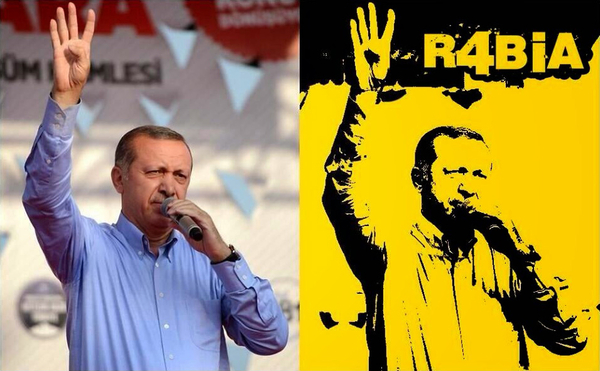
Later, Asmaa became another symbol for Turkish Islamists; Erdogan cheered party fans with the four-finger “Rabia” sign, in reference to his solidarity with the Muslim Brotherhood, and as a sign of his endearment for the unfortunate girl. Even on the playing field, a few footballers made the same sign after scoring.

859In this image, widely circulated in social media, Turkey’s then-Prime Minister [now President] Recep Tayyip Erdogan flashes the Egyptian Muslim Brotherhood’s four-fingered “Rabia” sign.

After the coup in Egypt, when el-Sisi ran for president and won the elections, Turkey’s Erdogan declared them “null and void.” And not just that. Erdogan also said that he did not view el-Sisi as “president of Egypt.” At another time, he said, “Turkey would not recognize the coup regime in Egypt.” Last July, he called el-Sisi “an illegitimate tyrant” and a “coup-maker.”

Meanwhile, neither was Erdogan a “rock star” in Cairo nor was Turkey “the most popular country.” Egyptian non-governmental organizations [NGOs] called on Egyptians and Arabs to boycott Turkish goods and soap operas. Egypt’s intellectuals, writers and businessmen were recommending a break in Egypt’s relations with Turkey because “they were disappointed.” Egypt unilaterally cancelled both visa-free travel for Turkish citizens and a transit agreement for Turkish trucks.

In the anti-el-Sisi campaign, Turkey was not alone. Its only regional ally, Qatar, fully supported Turkey against Egypt’s elected “coup leader.” Erdogan was happy. At least until a few days ago….

In Ankara, Erdogan was all smiles when he offered a red-carpet ceremony to the visiting Qatari Emir Sheikh Tamim bin Hamad al-Thani. Happy to have his best ally as a guest, Erdogan probably did not know the Emir’s next move on the Middle Eastern chessboard.

A few days after al-Thani’s merry visit to Ankara, Qatar announced its determination to thaw ties with Egypt, ending its alliance with Turkey over “Egypt’s illegitimate tyrant.”

“The security of Egypt is important for the security of Qatar … the two countries are linked by deep and fraternal ties,” ran a statement from the office of al-Thani on Dec. 21. It was a real cold shower on Ankara — and Erdogan. The statement had come one day after el-Sisi met in Cairo with a Qatari envoy, suggesting a possible thaw in relations. After the meeting, el-Sisi’s office issued a statement saying, “Egypt looks forward to a new era that ends past disagreements.” Apparently, the Egyptian-Qatari reconciliation had been brokered by Saudi Arabia and, once again, Turkey was the odd one out.

In its immediate vicinity, Turkey does not have diplomatic relations with three countries — Armenia, Cyprus and Syria — and has deeply problematic diplomatic relations with two countries: Israel and Egypt. This situation is not sustainable.

Even Deputy Prime Minister Bulent Arinc has said that Turkey should repair its relations with Egypt. But this is not an easy task. In the unlikely event of a reconciliation, Erdogan’s previous big words on el-Sisi the coup-maker will make him look like a leader shaking hands with an “illegitimate tyrant.”

On Dec. 24, Turkey’s foreign ministry spokesman said that bilateral ties with Egypt could “normalize if the country properly returns to democracy, if the Egyptian people’s free will is reflected in politics and social life.” Meaning, no normalization. The spokesman would not comment on Qatar’s policy change on Egypt.

Turkey aspires to be a regional leader with no, little or problematic dialogue with about a dozen countries in its region. Erdogan’s top advisors have found a nice euphemism for this situation: “precious loneliness.” In reality, it is rather a blend of miscalculation and over self-confidence.

EU Gives Hamas Green Light to Attack Israel

December 22, 2014

EU Gives Hamas Green Light to Attack Israel, Gatestone InstituteKhaled Abu Toameh, December 22, 2014

Although the EU court has said that its controversial decision was “technical” and was not a reassessment of Hamas’s classification as a terrorist group, leaders of the Islamist movement believe that the move will eventually earn them legitimacy in the international arena.

The EU court’s decision represents a “severe blow to the Palestinian Authority and Egypt,” according to Palestinian political analyst Raed Abu Dayer.

Any victory for Hamas, albeit a small and symbolic one, is a victory for the Islamic State, Al-Qaeda, Islamic Jihad, the Muslim Brotherhood and other fundamentalist groups, and causes tremendous damage to those Muslims who are opposed to radical Islam.

Hours before the EU court’s decision was made public, Hamas leader Mahmoud Zahar announced that his movement would never recognize Israel, and that Hamas seeks to overthrow the Palestinian Authority and seize control of the West Bank.

The EU court’s decision also coincided with a rapprochement between Hamas and Iran. Now, the Iranians and other countries, such as Turkey and Qatar, are likely to interpret the EU court’s decision as a green light to resume financial and military aid, including rockets and missiles, to Hamas — not only to Gaza but to the West Bank as well — to support those Palestinians whose aim it is to eliminate Israel.

Less than 48 hours after a top European Union court ruled that Hamas should be removed from the bloc’s list of terrorist groups, supporters of the Palestinian Islamist movement responded by firing a rocket at Israel. The attack, which did not cause any casualties or damage, did not come as a surprise.

Buoyed by the EU court’s ruling, Hamas leaders and spokesmen see it as a “political and legal achievement” and a “big victory” for the “armed struggle” against Israel.

Musa Abu Marzouk, a top Hamas leader, issued a statement thanking the EU court for its decision. He hailed the decision to remove his movement from the terrorist list as a “victory for all those who support the Palestinian right to resistance.”

When Hamas leaders talk about “resistance,” they are referring to terrorist attacks, such as the launching of rockets and suicide bombings against Israel. In other words, Hamas has interpreted the court’s decision as a green light to carry out fresh attacks as part of its ambition to destroy Israel.

The rocket that was fired from the Gaza Strip at Israel only days after the court decision is not likely to be the last.

Although the EU court has said that its controversial decision was “technical” and was not a reassessment of Hamas’s classification as a terrorist group, leaders of the Islamist movement believe that the move will eventually earn them legitimacy in the international arena.

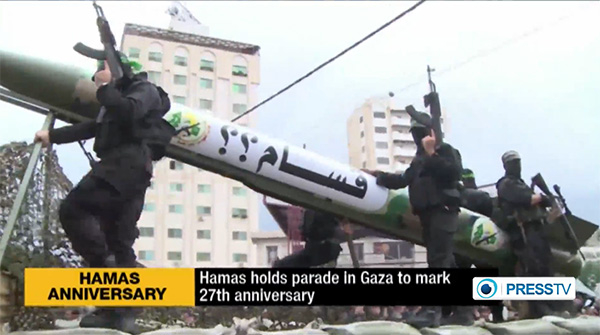
Ironically, the EU court’s decision coincided with Hamas celebrations marking the 27thanniversary of its founding. Once again, Hamas used the celebrations to remind everyone that its real goal is to destroy Israel. And, of course, Hamas used the event to display its arsenal of weapons that include various types of rockets and missiles, as well as drones.

845 (1)Thousands of armed Hamas troops showed off their military hardware at a Dec. 14, 2014 parade in Gaza, marking the organization’s 27th anniversary. (Image source: PressTV video screenshot)

Hours before the EU court decision was made public, Hamas leader Mahmoud Zahar announced that his movement would never recognize Israel. Zahar also made it clear that Hamas seeks to overthrow the Palestinian Authority [PA] regime and seize control over the West Bank.

The EU court’s decision also coincided with increased efforts to achieve rapprochement between Hamas and Iran. Recently, a senior Hamas leadership delegation visited Tehran as part of efforts to mend fences between the two sides. The main purpose of the visit was to persuade the Iranians to resume military and financial aid to Hamas. The visit, according to senior Hamas officials, appears to have been “successful.”

“There are many signs that our relations are back on the right track,” explained Hamas’s Musa Abu Marzouk. “Hamas and Iran have repaired their relations, which were strong before the Syrian crisis.” Relations between Hamas and Iran deteriorated due to the Islamist movement’s refusal to support the regime of Syrian President Bashar Assad.

Now the Iranians are likely to interpret the EU court decision to remove Hamas from the list of terrorist groups as a green light to resume financial and military aid to the movement.

Iran’s leaders recently announced that they intend to dispatch weapons not only to the Gaza Strip, but to the West Bank as well, as part of Tehran’s effort to support those Palestinians who are fighting to eliminate Israel.

Moreover, the EU court’s move will also embolden other countries that provide Hamas with political and financial aid, first and foremost Qatar and Turkey. Oil-rich Gulf countries such as Kuwait, Bahrain, Oman and Saudi Arabia will now face pressure from many Arabs and Muslims to join Qatar, Turkey and Iran in extending their support to Hamas.

The biggest losers, meanwhile, are Palestinian Authority President Mahmoud Abbas and Egypt’s President Abdel Fattah el-Sisi. Over the past few months, the two men have been doing their utmost to undermine Hamas and end its rule over the Gaza Strip.

Abbas has been fighting Hamas by blocking financial and humanitarian aid and arresting its supporters in the West Bank, while Sisi continues to tighten the blockade on the Gaza Strip and destroy dozens of smuggling tunnels along the border with Egypt.

The EU court’s decision represents a “severe blow to the Palestinian Authority and Egypt,” noted Palestinian political analyst Raed Abu Dayer. “As far is Abbas is concerned, the decision grants Hamas political legitimacy and challenges his claim to be the sole legitimate leader [of the Palestinians]. With regards to Egypt, the European court decision calls into question rulings by Egyptian courts that Hamas is a terrorist organization.”

Even if the EU court decision is reversed in the future, there’s no doubt that it has already caused tremendous damage, especially to those Muslims who are opposed to radical Islam.

Any victory for Hamas, albeit a small and symbolic one, is a victory for the Islamic State, Al-Qaeda, Islamic Jihad, the Muslim Brotherhood and other fundamentalist groups around the world.

The decision has left many Arabs and Muslims with the impression that Hamas, after all, is not a terrorist organization, especially if non-Muslims in Europe say so through one of their top courts. Even worse, the decision poses a real and immediate threat to Israel, as evident from the latest rocket attack.

If the Europeans have reached the conclusion that Hamas is not a terrorist organization, then why don’t their governments openly invite tens of thousands of Hamas members and supporters to move to London, Paris and Rome? And they should not forget to ask the Hamas members to bring along with them their arsenal of weapons.

Israel air strikes wiped out Russian hardware for thwarting US no-fly zone plan over Syria

December 10, 2014

Israel air strikes wiped out Russian hardware for thwarting US no-fly zone plan over Syria, DEBKAfile, December 8, 2014

Israeli_jets_of_bombing_two_installations_inside_Syria7.12.14Israel jets bombing Syrian targets

High-ranking American military sources revealed Monday, Dec. 8, that Israel’s air strikes near Damascus the day before wiped out newly-arrived Russian hardware including missiles that were dispatched post haste to help Syria and Hizballah frustrate a US plan for a no-fly zone over northern Syria.

The advanced weapons were sent over, as DEBKAfile reported exclusively Sunday, after Russian President Vladimir Putin learned that the Obama administration and the Erdogan government were close to a final draft on a joint effort to activate a no-fly zone that would bar Syrian air force traffic over northern Syria.

The Kremlin has repeatedly warned – of late in strong messages through back channels – that the establishment of a no-fly or buffer zone in any part of Syria would be treated as direct American intervention in the Syria war and result in Russian military intervention for defending the Assad regime.

According to the US-Turkish draft, American warplanes would be allowed to take off from the Turkish airbase of Incirlik in the south for operations against Syrian warplanes, assault helicopters or drones entering the no-go zone. Thus far, Ankara has only permitted US surveillance aircraft and drones the use of Incirlik for tracking the movements of Islamic State fighters in northern Syria.

The Obama administration was long deterred from implementing a no-fly zone plan by the wish to avoid riling Moscow or facing the hazards of Syria’s world-class air defense system.

But Washington was recently won over to the plan by a tacit deal with Damascus for American jets to be allowed entry to help Kurdish fighters defend their northern Syrian enclave of Kobani against capture by al Qaeda’s IS invaders.

However, the US administration turned down a Turkish demand to extend the no-fly zone from their border as far as Aleppo, Syria’s largest city, over which Syrian army forces are battling rebels and advancing slowly into the town.

The no-fly zone planned by US strategists would be narrow – between a kilometer and half a kilometer deep inside Syria. However Moscow is standing fast against any such plan and objects to US planes making free of Syrian airspace, a freedom they are now afforded over Kobani.

To drive this point home, the Russians delivered a supply of advanced anti-air missiles and radar, whose use by the Syrian army and transfer to Hizballah in Lebanon were thwarted by the Israeli air strikes Sunday.

Moscow reacted swiftly and angrily with a Note to the United Nations Monday accusing Israel of “aggressive action” and demanding “that such attacks should not happen again… Moscow is deeply worried by this dangerous development, the circumstances of which demand an explanation.”

The Assad regime has held back from reacting to past Israeli air raids for preventing advanced weaponry from reaching Hizballah. This time, spokesmen in Damascus warned that their government’s response would be clandestine and cause Israel “unimaginable harm.”

Can President Obama Pass Disraeli’s Test?

December 5, 2014

Can President Obama Pass Disraeli’s Test? American ThinkerKen Blackwell and Bob Morrison, December 5, 2014

(Please see also Reports: Obama Mulling Sanctions on Israel. — DM)

Applying the Disraeli Test to this administration, President Obama’s policies fail on every count. No wonder our present foreign policy seems to stray so far from true American principles and interests.

***************

British Prime Minister Benjamin Disraeli famously said: “The Lord deals with the nations as the nations deal with the Jews.” Winston Churchill was an avid student of Disraeli’s “Tory Democracy” and passed Disraeli’s test easily, as Steven Hayward wrote recently in the Weekly Standard.

This raises a most interesting question: How would President Obama fare on a Disraeli test? His policy toward the Jewish State of Israel leads us to question whether this outstanding student, this graduate of Columbia University and Harvard Law School, could pass a simple, three-question test suggested by one of the Nineteenth Century’s leading statesmen.

President Obama made it a point to skirt around Israel during the entire four years of his first term, while making it his point to go to Turkey, Egypt, and Saudi Arabia in those years.

First, what about Turkey? In 2009, President Obama congratulated that secular republic on its commitment to democratic rule. Turkey is the only member of NATO with a Muslim majority. As such, Turkey’s 50-year alliance with the U.S. and its longtime support for Israel — the only Muslim land in the Near East to give such support — were certainly an important factor worthy of consideration in U.S. foreign policy. But under President Recep Tayyip Erdogan, Turkey has moved farther and farther away from the United States and closer to Russia.

As to Israel, Turkey has become a leading sympathizer of the Hamas terrorist-led regime in Gaza, attempting to run the Israeli blockade of Gaza and charging Israel with violating the human rights of the Arabs of Palestine. Interestingly, while Israel formally supports the idea of statehood for Palestinian Arabs, Turkey denies statehood for its hugeKurdish minority of 20 million. In fact, the Kurds are by far the largest ethnic group in the Mideast denied a state.

Does President Obama hold the Turks to the same standard that he applies to the Israelis? Not at all. He has not begun to press the Turks on Kurdish rights. Until 2000, it was illegal for a person holding Turkish citizenship to identify himself as a Kurd. Contrast this with Israel, where Arabs not only can so identify, they actually sit in the Israeli parliament, the Knesset, as Arabs and form legal Arab political parties.

Now, what of this administration’s view of Egypt? President Obama speedily recognized the Muslim Brotherhood-dominated government in Egypt headed by Mohamed Morsi. Morsi — educated in the U.S. but strongly rejecting American principles of religious liberty and constitutional government — quickly brought Egypt to the brink of chaos. Morsi planned a visit to the U.S. — one eagerly anticipated by the Obama administration — even though Morsi announced he would press the White House to pardon a terrorist.

Morsi wanted Obama to release Sheikh Omar Abdul Rahman, in prison for his part in the first terrorist attack on the World Trade Center. That attack killed seven Americans in 1993.

National Review’s Andrew C. McCarthy provided this stunning profile of Mr. Obama’s obeisance to the Muslim Brotherhood in Egypt.

Reports that the State Department was discussing a transfer of the Blind Sheikh back to Egypt surfaced months ago, in the context of a potential swap for democracy activists the Supreme Council of the Armed Forces was then detaining. The administration then issued a visa to Hani Nour Eldin, a member of the Islamic Group — the Blind Sheikh’s terrorist organization, to which it is a felony to provide material assistance. The purpose was to invite Eldin to, yes, the White House, for consultations with top American national-security officials on prospective relations between the United States and the new, Islamist Egypt. As the administration had to know he would do, he pressed his top agenda item: The United States must return the Blind Sheikh as a “gift to the revolution.”

Fully willing to give hundreds of millions in U.S. aid to Morsi, Mr. Obama promptly yanked that aid when Egypt’s military finally pulled the plug on the Muslim Brotherhood’s misrule in Egypt.

That leaves Saudi Arabia as the final question in Mr. Obama’s “Disraeli Test.” It is illegal for a Jew to live in Saudi Arabia. Any Saudi national who converts to Judaism is beheaded for apostasy. In February, 1945, President Roosevelt appealed to Saudi Arabia’s founding monarch, Abdulazziz, for the Jewish survivors of the Holocaust. Even then, the Saudis were unyielding. FDR, hoping to touch the desert despot’s heart, told him that three million Jews had been murdered in Poland. It was one of the first confirmations by a world statesman of the plight of European Jewry. Abdulazziz’s reaction to this horrific news? There was obviously no need for a Jewish state in the Mideast since there would now be plenty of room for Europe’s surviving Jews — in Poland!

Despite this history of no peace with Israel, no recognition of Israel, no compromise with Israel, President Obama shamefully bowed to the King of Saudi Arabia. No American president had ever bowed to anyone before.

Applying the Disraeli Test to this administration, President Obama’s policies fail on every count. No wonder our present foreign policy seems to stray so far from true American principles and interests.


Is the Islamic State finding refuge in Turkey?

December 3, 2014

Is the Islamic State finding refuge in Turkey? Al-Monitor, Ahmet Insel, December 2, 2014

(Please see also The new Ottoman Emperor. — DM)

According to the Kobani watchers in Caykara [Mahzer] village, Islamic State (IS) forces crossed from Turkey and attacked the Kurdish People’s Protection Units (YPG) forces controlling the Syrian side of Mursitpinar border, crossing from the rear. IS badly wants to capture the crossing.

Did the IS car bomb attack at Mursitpinar Saturday morning [Nov. 29] originate from Turkey? Information provided by official sources about how the attack was carried out is murky. The Mahzer crowd congregating directly behind the Mursitpinar crossing insist the bomb-laden vehicle came from Turkey, broke the lock on the gate and crossed to Syria.

Even more interesting are reports that the presence of IS elements in Turkey is not confined to this attack. People who had to abandon their homes in the Mursitpinar area and settle in nearby villages because of security reasons say IS has been entering the houses they had to abandon.

Egrice [Betke] village is about a kilometer from the border. There are 18 native households plus 12 families that came over from Syria. Native villagers are also hosting a few families who had to evacuate their homes in Etmenek near Mursitpinar in Turkey. If you talk to these people from Etmenek you will hear that IS militants have been crossing the border at will and entering the abandoned buildings and even staying in them. One Etmenek villager said, “My uncle’s house is near my house. Although it is banned, we sometimes go over to our homes and then return here. When I went there last time I saw IS people in my uncle’s house.” Another villager also claimed his house was taken over by IS.

You hear similar accounts from the Caykara-Mahzer crowd who hail from Kucuk Ermenek. Some say Turkish soldiers are at one end of the village and IS militants at the other. We are talking about settlements on the Turkish side around Mursitpinar and its fringes. IS taking over Soil Products Office silos along the border and firing down on YPG forces from [inside] is not the only case of IS militarily violating the Turkish border.

At Egrice village you can see hundreds of cars Kobani refugees were not allowed to bring with them to Turkey. In the same place you also see cattle herds which are not allowed to cross to Turkey because of risk of foot and mouth disease. Villagers say the animals are slowly dying and IS elements frequently come to the car park and take any vehicle they want. Villagers say they send their children to take care of the animals and Turkey has been providing them with animal feed.

On top of the water tower you can see the IS flag. According to refugees from Kobani, the Syrian side of the border, from Mursitpinar to Akcakale, is under the control of IS.

Those who constantly watch the border from Caykara insist that IS had attacked YPG from the rear by crossing the border from Turkey. For them, the lack of intervention by the Turkish military tasked with border security is a sign that Turkey prefers to have IS control the border crossing.

But even more worrying are the allegations that IS people have been freely entering abandoned houses on the Turkish side. There is no need to elaborate what kind of security fears this causes in the region and how it amplifies the distrust felt for security forces. Contradictory statements by senior civil servants and their ignoring of eyewitness accounts only intensify people’s lack of confidence.

As much as it is important to provide a full and clear explanation of the attack at the Mursitpinar crossing, it’s vital to give proper responses to claims that IS militants are freely entering and leaving Mursitpinar and its fringes.


The new Ottoman emperor

December 3, 2014

The new Ottoman emperor, Israel Hayom, Clifford D. May, December 3, 2014

[T]here is mounting evidence that weapons and fighters are crossing from Turkey into Syria, where they are delivered to Islamic State fighters. Turkish officials are turning a blind eye, or maybe even facilitating the traffic. Stolen oil is moving in the other direction, sold to raise cash for Islamic State. Inside Turkey, as well, Schanzer and Tahiroglu write, Islamic State has “established cells for recruiting militants and other logistical operations.” Last weekend, Turkey’s main Kurdish party accused the Erdogan government of allowing Islamic State fighters to attack the Syrian Kurdish town of Kobani from within Turkey.

******************

Turkey should have been part of the solution. Instead it has become part of the problem. The problem, of course, is the spread of jihadism throughout the Middle East, North Africa and beyond.

Turkish policies have been aiding and abetting the Nusra Front, an al-Qaida affiliate; the Islamic State group, which has turned large swaths of Syria and Iraq into killing fields; the Islamic Republic of Iran, still ranked by the U.S. government as the world’s leading sponsor of terrorism and well on its way to becoming nuclear-armed; and the Muslim Brotherhood, including Hamas, the group’s Palestinian branch.

Troubling, too, is the rhetoric we’ve been hearing from Turkish leaders. Turkish Science, Industry and Technology Minister Fikri Isık claimed last week that it was Muslim scientists who first discovered that the earth is round. Two weeks earlier, Turkish President Recep Tayyip Erdogan insisted that Muslim sailors reached the Americas 300 years before Columbus — only to find that well-established Muslims in Cuba had built a beautiful mosque.

Such myth-making might be dismissed as nothing more than attempts to play to Islamic pride. Less easy to excuse is Erdogan’s increasing xenophobia. “Foreigners,” he recently observed, “love oil, gold, diamonds, and the cheap labor force of the Islamic world. They like the conflicts, fights and quarrels of the Middle East.” He added that Westerners “look like friends, but they want us dead, they like seeing our children die. How long will we stand that fact?”

If Turkey were just another tin-pot dictatorship, none of this would much matter. But Turkey is a Muslim-majority (98 percent) republic with a dynamic economy (not dependent on the extraction of petroleum), a member of NATO (making it, officially, an American ally), and a candidate for membership in the European Union (though that possibility now appears remote).

Just three years ago, U.S. President Barack Obama listed Erdogan as one of five world leaders with whom he had especially close personal ties. He regarded the Turkish leader as a moderate, his interpreter of — and bridge to — the tumultuous and confusing Islamic world.

Today, as detailed in a new report by Jonathan Schanzer and Merve Tahiroglu, my colleagues at the Foundation for Defense of Democracies, Erdogan is refusing to allow the American-led coalition formed in August to launch strikes against Islamic State from Turkish soil.

Worse, there is mounting evidence that weapons and fighters are crossing from Turkey into Syria, where they are delivered to Islamic State fighters. Turkish officials are turning a blind eye, or maybe even facilitating the traffic. Stolen oil is moving in the other direction, sold to raise cash for Islamic State. Inside Turkey, as well, Schanzer and Tahiroglu write, Islamic State has “established cells for recruiting militants and other logistical operations.” Last weekend, Turkey’s main Kurdish party accused the Erdogan government of allowing Islamic State fighters to attack the Syrian Kurdish town of Kobani from within Turkey.

The FDD report cites numerous sources alleging that Turkey also has given assistance to the Nusra Front. To be fair: The Turkish government, like the Obama administration, seeks the fall of Syrian dictator Bashar Assad, satrap of the Islamic Republic of Iran. A Turkish official is quoted as saying that Nusra fighters are essential to that effort, adding: “After Assad is gone, we know how to deal with these extremist groups.”

Do they? Hamas is an extremist group and one of its top leaders, Saleh al-Arouri, has been permitted to set up his headquarters in Turkey. In August, Israel’s Shin Bet security agency said it had thwarted a Hamas-led plot to topple Palestinian Authority President Mahmoud Abbas — and that Arouri was behind it. Arouri also claimed responsibility — in the presence of Turkey’s deputy prime minister — for the kidnapping and murder of three Israeli boys in the West Bank early last summer, an act of terrorism that led to the 50-day war between Israel and Hamas in Gaza.

There’s more: credible allegations that Turkey has helped Iran’s rulers evade sanctions; the fact that Turkey imprisons more journalists than any other country; Erdogan’s comparison of Israelis to Nazis (guess which he regards as more “barbaric”); and his pledge to “wipe out Twitter. I don’t care what the international community says. They will see the Turkish republic’s strength.”

To understand what Turkey has become, it helps to know a little about what Turkey used to be. Istanbul was once Constantinople, a Christian capital of the ancient world. In 1453, it fell to the fierce armies of the Ottoman Empire and the Islamic caliphate. Islam’s political and religious leaders soon established the Sublime Porte, the central government of their growing imperial realm.

Almost 500 years later, in the aftermath of World War I, the empire collapsed and the caliphate was dissolved. Modern Turkey arose from the ashes thanks to the leadership of Mustafa Kamal Ataturk, a visionary general who believed that progress and prosperity could be achieved only by separating mosque and state. His goal was to make Turkey a nation, one as modern and powerful as any in Europe.

A century later, the world looks rather different. There are good reasons to believe Europe is in decline and America in retreat (these are disparate phenomena). While it may be delusional to believe that Columbus encountered Muslims in the Caribbean, it is not crazy to believe that, over the decades ahead, fierce Muslim warriors will profoundly alter the world order once more.

Viewed in this light, Erdogan looks like a neo-Ottoman, one who dreams of commanding Muslims — and those who have submitted to them — in many lands. If that’s accurate, the rift between Turkey and the West can only widen.

Erdogan slams US on Syria again, days after Biden visit

December 1, 2014

Erdogan slams US on Syria again, days after Biden visit, Al-Monitor, Week in Review, November 30, 2014

U.S. VP Biden meets with Turkey's President Erdogan in IstanbulUS Vice President Joe Biden (L) meets with Turkey’s President Recep Tayyip Erdogan at Beylerbeyi Palace in Istanbul, Nov. 22, 2014. (photo by REUTERS/Murad Sezer)

Turkish President Recep Tayyip Erdogan calls US “impertinent” on Syria, says West likes seeing Muslim children die; Israel considers extension of Iran nuclear talks as better than a bad deal.

*********************

Turkish President Recep Tayyip Erdogan said on Nov. 26 that he is “against impertinence, recklessness and endless demands” coming from “12,000 kilometers away” (7,456 miles), his latest not-so-veiled rebuke of US policy toward Syria.

Erdogan’s outburst came four days after US Vice President Joe Biden departed Turkey. Biden, the latest in a seemingly endless stream of senior US official visitors to Ankara, spoke of the “depth” of the US-Turkish relationship and how the United States “needs” Turkey. The US vice president praised Turkey’s turnaround, for now, in its ties with Iraq, as reported this week by Semih Idiz, and Turkey’s handling of close to 1.6 million Syrian refugees (the UN High Commissioner for Refugees puts the number at approximately 1.1 million).

Despite the predictable deadening public platitudes, Biden’s visit, like those of other senior US officials, was a flop for the anti-Islamic State (IS) coalition. Erdogan prefers to hold his support against IS as ransom for a US-backed buffer or no-fly zone inside Syria. Not that the Turkish president, or others hawking such a plan, present any “day after” strategies for Syria; explain how a buffer zone or “doubling down” on the Syrian opposition would do anything more than prolong the war and wreck what remains of the Syrian state; lay out how the United States can avoid another Libya or another Iraq (that is, a failed state or a prolonged occupation) if it pursues regime change in Syria; identify where a post-transition stabilization force may come from given the limitations of Syrian rebel forces; or explain why the jihadists would not gain the upper hand in a divided post-Assad Syria with such a weak and fragmented opposition.

Turkey’s unwillingness to combat IS and other terrorist groups stands in contrast with US allies Saudi Arabia, United Arab Emirates, Jordan and Bahrain, as well as Iran, all of whom have concerns about US policy but are nonetheless engaged in combat operations against terrorists in Syria and Iraq.

Bruce Riedel explains how Saudi Arabia, which uncovered an IS-linked cell operating in the kingdom this week, is struggling with managing the threat from IS and its regional rivalry with Iran, but is nonetheless playing a leading role in the anti-IS coalition. Hossein Mousavian points out that among the “ground forces” combating IS, besides US-supported Syrian rebel forces, are the Iraqi and Syrian armies and Hezbollah, which are all backed by Iran. According to Mousavian, Tehran could be ready to do more if a nuclear deal is reached. Ali Hashem reports this week on Hezbollah’s role in Iraq, and Ali Mamouri chronicles the higher profile role that Iran Quds Force leader Qasem Soleimani is playing with Iraqi forces battling IS. Iraqi Kurdistan Region President Massoud Barzani, whose forces are also on the frontlines of the battle against IS, praised Iran’s role, saying in August that “Iran was the first country to provide us with weapons and ammunition” to confront the IS advance toward Erbil. Syrian government warplanes bombed Raqqa, an IS stronghold, on Nov. 25, although the United States accused Syria of killing many civilians in the process. US-led coalition forces also conducted airstrikes against IS forces in Raqqa this week.

Erdogan appears to be the odd man out in the coalition, compared with the actions of the other regional powers, and his policies and statements should raise broader questions about the direction of Turkish foreign policy, including what it means for Turkey’s membership bid in the EU and its role in NATO. Idiz writes that Erdogan appears to be turning his back on Turkey’s EU membership bid. On Nov. 28, the eve of Pope Francis’ visit to Turkey, Erdogan offered the following about Western countries: “Believe me, they don’t like us,” AFP reported him as saying. “They look like friends, but they want us dead — they like seeing our children die. How long will we stand that fact?”

The United States might soon tire of the all-pain, no-gain appeals to Turkey and simply ask Erdogan to pick a side in the US war against terrorists, making clear, as US President Barack Obama recently said, that the United States is not planning to remove Syrian President Bashar al-Assad at this time. Turkey is a critical US ally that must play a constructive role in Syria and the region, but the trends are becoming alarming. The United States, for its part, does not “need” Turkish bases to train anti-IS or anti-Assad rebels, does not “need” Turkish troops in Syria, and certainly does not “need” a buffer or no-fly zone, unless Washington is longing for a quagmire. What the coalition “needs” is for Turkey to crack down, hard, on the terrorist transit, trade and financial networks operating through Turkey into Syria, which have contributed to the rise of these groups over the past three years. Turkey’s intensified efforts at border security and counterterrorism cooperation would be a major contribution to the coalition. It does not seem to be an unreasonable ask, even if Ankara disagrees with the US approach to Assad.

As this column wrote on Nov. 16, it is the prospect of a nuclear deal with Iran, and the potential for regional cooperation with Iran, that is the key to a settlement of many of the region’s problems, including a political settlement in Syria and whether Assad stays or goes: “US interests in both defeating IS and securing a political settlement to end the Syria war depend on Iran’s good offices in Damascus. The United States cannot deal with Assad, but Iran can. Iran, like Washington’s regional allies, has a high tolerance for the spilling of Syrian blood. If the United States wants to deal Iran out in Syria, especially in the context of a bid to oust Assad, then Iran’s card will be to make the awful situation in Syria go from bad to worse. Iran is not necessarily immovable on Assad’s survival. Iran’s four-point plan for Syria includes a decentralization of power away from the Syrian presidency. Iranian officials privately signal that Assad may not be untouchable, under the right conditions, but such conversations — if they are to bear fruit — can only occur with Iran in a spirit of collaboration, not confrontation. Otherwise, Iran will simply hunker down, and the war will go on.”

Israel OK with extension of Iran nuclear talks

The seven-month extension of the P5+1 nuclear talks with Iran has sparked reactions across the region. Laura Rozen reports from Vienna that progress was made as the Nov. 24 deadline approached but observers are still divided on whether this can be turned into a finished deal in the upcoming months.

Ben Caspit writes of the furious diplomatic effort by Israel to fend off what it would consider a bad deal: “Israel has invested enormous amounts of energy in this. Over the past few months, and especially in the last few weeks, Minister of Intelligence Yuval Steinitz, who has coordinated these efforts, has become a ‘frequent flyer,’ plowing through the relevant capitals right and left. And Steinitz wasn’t alone in this. Senior Israeli intelligence officials also made frequent trips abroad to present their colleagues in different relevant capitals with intelligence documents, intelligence per se, and plenty of new information obtained by the Mossad and other Israeli intelligence agencies about the dangers inherent in that ‘bad agreement.’

“As the deadline approached this week, Steinitz intensified his activities, making two more quick visits, to London and to Paris, and meeting with German Foreign Minister Frank-Walter Steinmeier. Steinitz’s message, backed as always with intelligence reports, expert assessments and various analyses: ‘The agreement under discussion is a terrible agreement. It leaves room for huge potential breaches, which means that it is propped up on weak foundations. If those gaps are not sealed, it would be preferable to avoid reaching any agreement whatsoever than to sign the current one.’”

Retired Israel Defense Forces Gen. Michael Herzog writes that Israel views the extension of the talks as the least of all possible evils, “The truth is that Israel’s ability to influence the relationship between Iran and the West has reduced considerably. The credibility of its military option (which still exists) has decreased in the eyes of the United States and Iran, and its tense relationship with US President Barack Obama’s administration makes it difficult to engage in open dialogue between the two country’s top leaders. At this stage, as long as Iran is not hurtling toward the critical nuclear threshold, all that is left for Israel to do is to maintain the hope that Iran will continue to be intransigent, and that the US Congress will continue to play tough.”


A Turkish Quest to “Liberate” Jerusalem

November 13, 2014

A Turkish Quest to “Liberate” Jerusalem, Gatestone InstituteBurak Bekdil, November 13, 2014

Both Turkey’s President Erdogan and its Prime Minister Davutoglu have declared countess times that Gaza and Jerusalem (in addition to Syria, Iraq, Egypt, Somalia, and the Maghreb) are Turkey’s “domestic affairs.”

In truth, there is no mention of any city’s name in the Qur’an.

Turks have a different understanding of what constitutes an occupation and a conquest of a city. The Turkish rule is very simple: The capture of a foreign city by force is an occupation if that city is Turkish (or Muslim) and the capture of a city by force is conquest if the city belongs to a foreign nation (or non-Muslims).

For instance, Turks still think the capture of Istanbul in 1453 was not occupation; it was conquest.

In a 2012 speech, President Recep Tayyip Erdogan (then Prime Minister) said: “Just like Mecca, Cairo and Istanbul are cities of the Qur’an.” In truth, there is no mention of any city’s name in the Qur’an. Never mind.

“Conquest,” Turkey’s top Muslim cleric, Professor Mehmet Gormez, declared in 2012, “is not to occupy lands or destroy cities and castles. Conquest is the conquest of hearts!” That is why, the top Turkish cleric said, “In our history there has never been occupation.” Instead, Professor Gormez said, “in our history, there has always been conquest.” He further explained that one pillar of conquest is to “open up minds to Islam, and hearts to the Qur’an.”

It is in this religious justification that most Turkish Islamists think they have an Allah-given right to take infidel lands by the force of sword — ironically, not much different from what the tougher Islamists have been doing in large parts of Syria and Iraq. Ask any commander in the Islamic State and he would tell you what the jihadists are doing there is “opening up minds to Islam, and hearts to the Qur’an.”

Both President Erdogan and Prime Minister Ahmet Davutoglu have declared countless times that Gaza and Jerusalem (in addition to Syria, Iraq, Egypt, Somalia and the Maghreb) are Turkey’s “domestic affairs.”

This author wrote in this journal on Oct. 30:

In reality, with or without the normalization of diplomatic relations between Ankara and Jerusalem, the Turks have never hidden their broader goals in the Arab-Israeli dispute: that Jerusalem should be the capital of a Palestinian state; and that Israel should be pushed back to its pre-1967 borders. Until then, it will be ‘halal’ [permitted in Islam] for Erdogan to blame Israel for global warming, the Ebola virus, starvation in Africa and every other misfortune the world faces.

As if to confirm this whimsical view, Deputy Prime Minister Yalcin Akdogan has blamed Israel for democratic failings in the Arab world. “Israel works with [undemocratic] regimes and keeps its ship afloat.” So, it is because of Israel that Arab nations have never established democratic culture — before or after 1948; or before or after the Arab Spring revolts. But fortunately, Palestinians have a new “protector.”

From Prime Minister Davutoglu’s public speech on November 7:

Al-Aqsa [mosque in Jerusalem] will one day be liberated. The Israelis should know that the oppressed Syrians have a protector. The oppressed Palestinians too have a protector. That protector is Turkey. Just as Bursa [the Turkish city where he spoke] ended its occupation, the honorable Palestinians, honorable Muslims will end the [Israeli] occupation. Just as Osman Gazi [a sepulchre in Bursa] was liberated, al-Aqsa too will be liberated. Al-Quds [Jerusalem] is both our first prayer direction and has been entrusted with us by history. It has been entrusted with us by Hazrat Omar. The last freedom seen in Jerusalem was under our [Ottoman] rule. Al-Quds is our cause. It is the occupying, oppressive Israeli government that has turned the Middle East into a quagmire.

Echoing that view, President Erdogan said that protecting Islamic sites in the Holy Land is a sacred mission (for his government), and bluntly warned that any attack against the al-Aqsa mosque is no different than an attack on the Kaaba in the holy city of Mecca.

792Spot the difference: In the eyes of Turkey’s political and religious leadership, Istanbul and its Hagia Sophia (once a Greek Orthodox Basilica) were legitimately “conquered” by the Muslim Ottomans, while Jerusalem and its al-Aqsa mosque (built atop the ruins of the Jewish Temples) are illegally “occupied” by Israel. (Images source: Wikimedia Commons)

No doubt, after Gaza, al-Aqsa (and Jerusalem) has become a powerful Turkish obsession, and a treasure-trove of votes, especially in view of Turkey’s parliamentary elections next June. And do not expect the Turkish leadership only to corrupt facts. Plain fabrication is a more favored method. All the same, someone, sometimes, would unwillingly reveal the truth often when trying to corrupt other facts.

Since Davutoglu claimed that “Jerusalem has been entrusted with the Turks by Hazrat Omar,” it may be useful to refresh memories. Hazrat Omar is Omar bin Al-Khattab (579-644), one of the most powerful and influential Muslim caliphs in history. Within the context of “conquest vs. occupation,” he was referenced by the top cleric, Professor Gormez in a 2012 speech:

After Hazrat Omar conquered al-Quds [Jerusalem], he was invited to pray at a church [as there were no mosques yet in Jerusalem]. But he politely refused because he was worried that the [conquering] Muslims could turn the church into a mosque after he prayed there.

Since medieval historical facts cannot have changed over the past two years, the top Turkish ulama [religious scholar], referencing a most powerful Muslim caliph, is best witness that when the Muslims had first arrived in Jerusalem there was not a single mosque in the city. Why? Because Jerusalem was not a Muslim city. Why, then, do Turkish Islamists claim that it is Muslim? Because it once had been “conquered.” Would the same Turks surrender Istanbul to the occupying forces that took the city after World War I because its capture in 1920 made it a non-Turkish city? No, that was not conquest, that was occupation!

Had Messrs Erdogan and Davutoglu been schoolchildren, such reasoning might have been called bullying and cheating.