Archive for the ‘Turkey’ category

Germany’s Appeasement of Radical Islam

September 10, 2015

Germany’s Appeasement of Radical Islam, Gatestone Institute, Vijeta Uniyal, September 10, 2015

  • German, and possibly European, demographics are being set to change forever.
  • “No one knows exactly what actually happens in Islamic classes in German primary schools.” — Abdel-Hakim Ourghi, head of the Faculty for Islamic Theology and Religious Studies at the Freiburg University of Education.
  • In Ourghi’s assessment, conservative Islam, the one dominant in Germany, is incapable of thinking critically about its past.
  • According to the report, the textbooks fail to “confront the problematic verses of Koran.” The curriculum also fails in its most important purpose — integrating Muslims into the German society — as it fails to reconcile the “Islamic faith of the students with the reality of the western society” they are living in.
  • By legitimizing extremist groups such as DITIB within German Muslim society as the sole legitimate representatives of Islam, the German government has marginalized genuine voices of reform and dissent within its Muslim population.
  • These courageous dissident Muslim men and women are left to face threats and intimidation on their own, while the government is busy appeasing the self-proclaimed leaders of the faith.

As Muslim migration is being set to change German, and possibly European, demographics forever, Germany is gearing up for the new challenge — not by integrating and assimilating young Muslims in a free and democratic Western society, but by handing over the religious education of the next generation of German Muslims to Islamist radicals.

Worse yet, German authorities see no problem in doing that.

With Germany predicted to receive 800,000 migrants — mostly Muslims — this year alone, and millions more waiting to cross Europe’s unguarded borders, the Muslim population in Germany is seeing a historic rise from the current figure of nearly 6 million. Several German states including Bavaria, Hesse and North Rhine-Westphalia have introduced Islamic Studies in their public schools. The state of Hesse has become the first in Germany to offer Islamic education in public schools, with religious instruction starting as early as the first grade.

Giving young children religious and moral instruction might sound like a good idea, if not for the content of the newly written Islamic curriculum and the influence of Islamist elements over the recruitment of teachers.

The writing of textbooks is being overseen by the Turkish-Islamic Union for Religious Affairs (DITIB). In an agreement reached between the State of Hesse and DITIB, the organization will play a key role in setting the curriculum, selecting the teachers and monitoring the Islamic religious instruction. The organization is apparently assuming a similar role in several other key German states.

DITIB is the largest Muslim organization in Germany and controls several prominent mosques. The group depends heavily on the Turkish government for its funding, and maintains close ties with Turkish President Recep Tayyip Erdogan’s Islamist party, the AKP.

The newly compiled Islamic curriculum for public schools in Hesse has come under great scrutiny. An independent report conducted by Abdel-Hakim Ourghi, who heads of the Faculty for Islamic Theology and Religious Studies at the Freiburg University of Education, has sharply criticized the curriculum.

According to an article in Die Welt, Ourghi, a prominent Muslim scholar, has been raising concern about the activities of DITIB and other conservative Muslim organizations operating in Germany. “No one knows exactly what actually happens in Islamic classes in German primary schools,” he says. In his assessment, conservative Islam, the one dominant in Germany, is incapable of thinking critically about its past.

According to Ourghi’s report, the textbooks fail to “confront the problematic verses of Koran.” The report also says that the curriculum fails in its most important purpose — integrating Muslims into the German society — as it fails to reconcile the “Islamic faith of the students with the reality of the western society” they are living in.

Confronted with the damning report, Hesse’s Minister of Education and Culture, Alexander Lorz,dismissed the allegations and called the Hesse’s Islamic education a “success.”

Meanwhile, despite Lorz’s stance, young German Muslims from his state keep heading to Syria and Iraq to join the ranks of the Islamic State (ISIS). And despite DITIB’s regular lip service to denouncing the terrorist organization, the Islamic State receives a continuous flow of freshrecruits from DITIB-run mosques.

According to a recent investigative report by the German news magazine, Focus, a DITIB-run Mosque in Cologne is a key base in Germany for Turkey’s intelligence agency, the MIT. The intelligence team not only gathers information on Turkish President Erdogan’s opponents in Germany, but also maintains a local “thug squad” to mete out “tough punishments” to Turkish dissidents in Germany.

1241The Cologne Central Mosque is used as a key base in German for Turkey’s intelligence agency, where they run a local “thug squad” to mete out “tough punishments” to Turkish dissidents in Germany. (Image source: © Raimond Spekking/CC BY-SA 4.0, via Wikimedia Commons)

By legitimizing extremist groups such as DITIB as the sole legitimate representatives of Islam within German Muslim society, the German government has marginalized genuine voices of reform and dissent within its Muslim population.

These courageous dissident Muslim men and women are left to face threats and intimidation on their own, while the government is busy appeasing the self-proclaimed leaders of the faith.

The fruits of liberty enjoyed by Germans today are not Germany’s to squander in the first place. Every bit of this precious freedom was paid for in blood — from the beaches of Normandy to the pavements of the Warsaw Ghetto — often meter-by-meter with bare knuckles and bloody fists.

As if history has come full circle, in the span of less than a century, Germany’s state institutions are folding again at the mere sight of an organized band of fascists.

Egypt sends Assad secret arms aid, including missiles, with Russian funding

August 30, 2015

Egypt sends Assad secret arms aid, including missiles, with Russian funding, DEBKAfile, August 30, 2015

( Given that Egypt is heavily reliant on Saudi funding as well as the absence of any other news source beyond “Debka,” I find this article worthy of a generous helping of salt. – JW )

Egyptain_missile_in_Zabadani_25.8.15

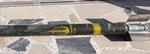
Egyptian President Abdel-Fatteh El-Sisi has begun supplying Bashar Assad with arms, including missiles, after concluding a secret deal with Russian President Vladimir Putin and his consent to pick up the tab, DEBKAfile’s military and intelligence sources reveal. The first batch of short-range Egyptian-made surface missiles has reached the Syrian forces fiercely battling rebels for weeks for the recovery of the strategic town of Zabadani without breaking through (See picture showing missile with Egyptian factory markings.) 

It is not clear if the Egyptian missiles have also been passed to the Hizballah forces fighting with the Syrian army, considering that El-Sisi and Hizballah are at daggers drawn.

Our sources also reveal that the Egyptian arms consignments are freighted from Port Said to the Syrian port of Tartus by Ukrainian cargo vessels. These ships are today the most popular means of transport for clandestine and Black Market arms freights across the Mediterranean and Adriatic Seas.

Sums and quantities are yet to be determined, but Western intelligence sources report that Ukrainian vessels called in at Egyptian ports at least three times from July 22 to Aug. 22 and sailed off to Syria laden with weapons.

It is a deal that may affect the fate of the Assad regime from five, often conflicting, perspectives:

1. By providing Assad with an additional source of weapons, Cairo is reducing his dependence on Iran. This suits the Syrian ruler very well at this time, because he is fully aware of Tehran’s latest steps to draw Gulf rulers and Moscow into supporting a plan for ending the Syrian war, by installing a provisional government in Damascus and so easing his exit.

2. A certain parting-of-the ways has developed between Moscow and Tehran on how to terminate the Syrian conflict. By sending Assad arms, Cairo  casts its vote for Moscow’s perspective in preference to Tehran’s.

3. El-Sisi is now diametrically opposed on Syrian policy to the GCC led by Saudi Arabia and the United Arab Emirates who are patrons of the rebel movement dedicated to toppling Assad.

4. He is also on the opposite side to Israel and Turkey. Israel backs the rebels fighting in southern Syria to create a barrier against the encroachment of Hizballah and Iranian Al Qods Brigades up to its northern border and the Golan. Turkey and the US have reached terms on Syrian policy. Saturday, Aug. 30, Turkish jets carried out their first air strikes in Syria against the Islamic State, as part of its deal with the US.

5. The Russian-Egyptian understanding on the Syrian question is a signpost that clearly marks the way to deepening military and strategic relations between Moscow and Cairo.

Taking the lead on a resolution of the Syrian question, the Kremlin staged a discussion last Tuesday, Aug. 18, with three Arab visitors: Jordan’s King Abdullah, UAE Crown Prince Sheikh Mohamed bin Zayed Al Nahyan and the Egyptian president. It was led by Mikhail Bogdanov, Deputy Foreign Minister in charge of Middle East Affairs, and followed by individual tête-à-têtes between Putin and each visitor in turn.

The Russian and Egyptian leaders did their best, according to DEBKAfile’s Moscow sources, to draw the Jordanian and UA rulers over to their pro-Assad policy, or at least accept common ground for a measure of cooperation. In effect, Putin and El-Sisi were out to convince Jordan and the US to back away from the Syrian rebel cause and the Saudi line. Their future actions may indicate how far they succeeded.

Column One: Obama strikes again

July 31, 2015

Column One: Obama strikes again, Jerusalem Post, Caroline Glick, July 30, 2015

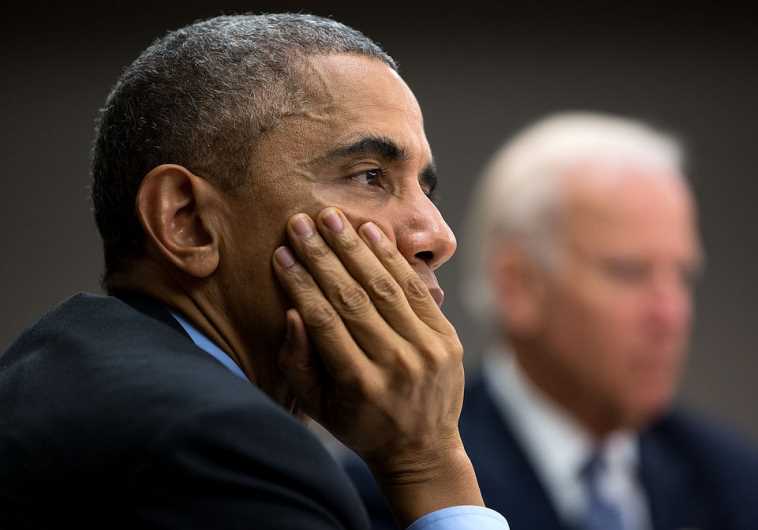
ShowImage (5)US President Barack Obama (L) and Vice President Joe Biden. (photo credit:OFFICIAL WHITE HOUSE PHOTO BY PETE SOUZA)

Most of the antiquities that ISIS plunders in Iraq and Syria make their way to the world market through Turkey. So, too, most of the oil that ISIS produces in Syria and Iraq is smuggled out through Turkey. According to the US Treasury, ISIS has made $1 million-$4m. a day from oil revenue.

Instead of maintaining its current practice of balancing its support for Turkey with its support for the Kurds, under the agreement, the West ditches its support for the Kurds and transfers its support to Turkey exclusively.

************************

While Israel and much of oficial Washington remain focused on the deal President Barack Obama just cut with the ayatollahs that gives them $150 billion and a guaranteed nuclear arsenal within a decade, Obama has already moved on – to Syria.

Obama’s first hope was to reach a deal with his Iranian friends that would leave the Assad regime in place. But the Iranians blew him off.

They know they don’t need a deal with Obama to secure their interests. Obama will continue to help them to maintain their power base in Syria though Hezbollah and the remains of the Assad regime without a deal.

Iran’s cold shoulder didn’t stop Obama. He moved on to his Sunni friend Turkish President Recep Erdogan.

Like the Iranians, since the war broke out, Erdogan has played a central role in transforming what started out as a local uprising into a regional conflict between Sunni and Shiite jihadists.

With Obama’s full support, by late 2012 Erdogan had built an opposition dominated by his totalitarian allies in the Muslim Brotherhood.

By mid-2013, Erdogan’s Muslim Brotherhood- led coalition was eclipsed by al-Qaida spinoffs. They also enjoyed Turkish support.

And when last summer ISIS supplanted al-Qaida as the dominant Sunni jihadist force in Syria, it did so with Erdogan’s full backing. For the past 18 months, Turkey has been ISIS’s logistical, political and economic base.

According to Brett McGurk, the State Department’s point man on ISIS, about 25,000 foreign fighters have joined ISIS in Syria and Iraq. All of them transited through Turkey.

Most of the antiquities that ISIS plunders in Iraq and Syria make their way to the world market through Turkey. So, too, most of the oil that ISIS produces in Syria and Iraq is smuggled out through Turkey. According to the US Treasury, ISIS has made $1 million-$4m. a day from oil revenue.

In May, US commandos in Syria assassinated Abu Sayyaf, ISIS’s chief money manager, and arrested his wife and seized numerous computers and flash drives from his home. According to a report in The Guardian published last week, the drives provided hard evidence of official Turkish economic collusion with ISIS.

Due to Turkish support, ISIS has become a self-financing terrorist group. With its revenue stream it is able to maintain a welfare state regime, attracting recruits from abroad and securing the loyalty of local Sunni militias and former Ba’athist forces.

Some Western officials believed that after finding hard evidence of Turkish regime support for ISIS, NATO would finally change its relationship with Turkey. To a degree they were correct.

Last week, Obama cut a deal with Erdogan that changes the West’s relationship with Erdogan.

Instead of maintaining its current practice of balancing its support for Turkey with its support for the Kurds, under the agreement, the West ditches its support for the Kurds and transfers its support to Turkey exclusively.

The Kurdish peshmerga militias operating today in Iraq and Syria are the only military outfits making sustained progress in the war against ISIS. Since last October, the Kurds in Syria have liberated ISIS-controlled and -threatened areas along the Turkish border.

The YPG, the peshmerga militia in Syria, won its first major victory in January, when after a protracted, bloody battle, with US air support, it freed the Kurdish border town of Kobani from ISIS’s assault.

In June, the YPG scored a strategic victory against ISIS by taking control of Tal Abyad. Tal Abyad controls the road connecting ISIS’s capital of Raqqa with Turkey. By capturing Tal Abyad, the Kurds cut Raqqa’s supply lines.

Last month, Time magazine reported that the Turks reacted with hysteria to Tal Abyad’s capture.

Not only did the operation endanger Raqqa, it gave the Kurds territorial contiguity in Syria.

The YPG’s victories enhanced the Kurds’ standing among Western nations. Indeed, some British and American officials were quoted openly discussing the possibility of removing the PKK, the YPG’s Iraqi counterpart, from their official lists of terrorist organizations.

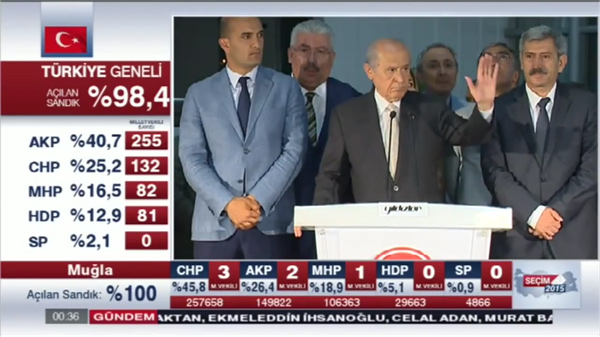
The YPG’s victories similarly enhanced the Kurds’ standing inside Turkey itself. In the June elections to the Turkish parliament, the Kurdish HDP party won 12 percent of the vote nationally, and so blocked Erdogan’s AKP party from winning a parliamentary majority.

Without that majority Erdogan’s plan of reforming the constitution to transform Turkey into a presidential republic and secure his dictatorship for the long run has been jeopardized.

As far as Erdogan was concerned, by the middle of July the Kurdish threat to his power had reached unacceptable levels.

Then two weeks ago the deck was miraculously reshuffled.

On July 20, young Kurdish activists convened in Suduc, a Kurdish town on the Turkish side of the border, 6 kilometers from Kobani. A suicide bomber walked up to them, and detonated, massacring 32 people.

Turkish officials claim that the bomber was a Turkish Kurd, and a member of ISIS. But the Kurds didn’t buy that line. Last week, HDP lawmakers accused the regime of complicity with the bomber. And two days after the attack, militants from the PKK killed two Turkish policemen in a neighboring village, claiming that they collaborated with ISIS.

At that point, Erdogan sprang into action.

After refusing for months to work with NATO forces in their anti-ISIS operations, Erdogan announced he was entering the fray. He would begin targeting “terrorists” and allow the US air force to use two Turkish air bases for its anti-ISIS operations. In exchange, the US agreed to set up a “safe zone” in Syria along the Turkish border.

Turkish officials were quick to explain that in targeting “terrorists,” the Turks would not distinguish between Kurdish terrorists and ISIS terrorists just because the former are fighting ISIS. Both, they insisted, are legitimate targets.

Erdogan closed his deal in a telephone call with Obama. And he immediately went into action.

Turkish forces began bombing terrorist targets and rounding up terrorist suspects. Although a few of the Turkish bombing runs have been directly against ISIS, the vast majority have targeted Kurdish forces in Iraq and Syria.

Moreover, for every suspected ISIS terrorist arrested by Turkish security forces, at least eight Kurds have been taken into custody.

Then, too, Erdogan has called on AKP lawmakers to begin criminalizing their counterparts from the HDP. Kurdish lawmakers, he urged them, must be stripped of their parliamentary immunity to enable their arrests.

As Erdogan apparently sees things, by going to war against the Kurds, he will be able to reestablish the AKP’s parliamentary majority. Within a few weeks, if the AKP fails to form a governing coalition – and it will – then new elections will be held. The nationalists, who abandoned the AKP in June, will return to the party to reward Erdogan for fighting the Kurds.

As for that “safe area” in northern Syria, as the Kurds see it, Erdogan will use it to destroy Kurdish autonomy. He will flood the zone with Syrian Arab refugees who fled to Turkey, to dilute the Kurdish majority. And he will secure coalition support for the Sunni Arab militias – including those still affiliated with al-Qaida – which will be permitted by NATO to operate openly in the safe area.

Already the Kurds are reporting that the US has stopped providing air support for their forces fighting ISIS in the border town of Jarablus. Those forces were bombed this week by Turkish F-16s.

For their part, despite Erdogan’s pledge to fight ISIS, his forces seem remarkable uninterested in rolling back ISIS achievements. The Turks have no plan for removing ISIS from its strongholds in Raqqa or Haskiyah.

The Obama administration is presenting the deal with Turkey as yet another great achievement.

In an interview with Charlie Rose on Tuesday, McGurk explained that the deal was a long time in the making. It began with a phone conversation between Obama and Erdogan last October and it ended with their phone call last week.

In October, Obama convinced Erdogan not to oppose US air support for the Kurds in Kobani and to enable the US to resupply YPG fighters in Kobani through Turkey. In the second, Obama agreed not to oppose Erdogan’s offensive against the Kurds.

Two years ago, in August 2013, the world held its breath awaiting US action in Syria. That month, after prolonged equivocation amidst mountains of evidence, the Obama administration was forced to acknowledge that Iran’s Syrian puppet Bashar Assad had crossed Obama’s self-declared redline and used chemical weapons against regime opponents, including civilians.

US forces assembled for battle. Everything looked ready to go, until just hours before US jets were scheduled to begin bombing regime targets, Obama canceled the operation. In so doing, he lost all deterrent power against Iran. He also lost all strategic credibility among America’s regional allies.

To save face, Obama agreed to a Russian proposal to have international monitors remove Syria’s chemical weapons from the country.

Last summer, the administration proudly announced that the mission had been completed.

UN chemical weapons monitors had removed Syria’s chemical weapons arsenal from the country, they proclaimed. It didn’t matter to either Obama or Secretary of State John Kerry that by that point Assad had resumed chemical assaults with chlorine-based bombs. Chlorine bombs weren’t chemical weapons, the Americans idiotically proclaimed.

Then last week, the lie fell apart. The Wall Street Journal reported that according to US intelligence agencies, Assad not surrendered his chemical arsenal.

Rather, he hid much of his chemical weaponry from the UN inspectors. He had even managed to retain the capacity to make chemical weapons – like chlorine-based bombs – after agreeing to part with his chemical arsenal.

Assad was able to cheat, because just as the administration’s nuclear deal with the Iranians gives Iran control over which nuclear sites will be open to UN inspectors, and which will be off limits, so the chemical deal gave Assad control over what the inspectors would and would not be allowed to see. So, they saw only what he showed them.

Obama has gone full circle in concluding his deal with Erdogan. Since entering office, Obama has sought to cut deals with both the Sunni jihadists of the Muslim Brotherhood ilk and the Shi’ite jihadists of the Iranian ilk.

His chemical deal with Assad and his nuclear deal with the ayatollahs accomplished the latter goal, and did so at the expense of America’s Sunni Arab allies and Israel.

His deal last week with Erdogan accomplishes the former goal, to the benefit of ISIS, and on the backs of America’s Kurdish allies.

So that takes care of the Middle East. With 17 months left to go till Obama leave office, the time has apparently come for the British to begin to worry.

To gratify Tehran and Moscow, new US-Turkish anti-ISIS war campaign in Syria skirts Assad’s forces

July 26, 2015

To gratify Tehran and Moscow, new US-Turkish anti-ISIS war campaign in Syria skirts Assad’s forces, DEBKAfile, July 25, 2015

Tanks_face_IS_at_Syria_25.7.15

Not exactly by chance, the security zone bisects Kurdish territory and holds back Kurdish forces in their assaults on ISIS.

DEBKAfile’s military sources report that a glance at the map betrays an all-out US-Turkish effort not put up backs in Tehran by interfering with Syrian, Hizballah and pro-Iranian militia operations in critical northern Syrian war zones such as Aleppo or give the Syrian rebels a helping hand in the Idlib province.

*********************

After the second successive night of Turkish cross-border bombing attacks on the Islamic State in northern Syria, Ankara and Washington agreed Saturday, July 25, to name the “security zone” covered by a “partial no fly zone” they had declared in northern Syria the “Islamic State free zone.” Click HERE for full-size map!

This name represents a significant US-Turkish concession to Iran of immunity for its allies, Syrian President Bashar Assad and Hizballah, in order to gain Tehran’s cooperation in the campaign Turkey launched against ISIS Friday. Integral to the deal is also a promise to abstain from using the campaign to grant anti-Assad rebel groups any advantages.

This immunity did not extend to the Kurdish Workers Movement (PKK), which were targeted in the course of Turkish air and ground action in and over the new “security zone.” Those warplanes also flew missions Friday night over the PKK bases and logistical facilities in the Qandil Mountains of northern Iraq. The PKK responded Saturday with an announcement that their armistice with Ankara was over. Turkey may consequently expect a recurrence of Kurdish terrorist violence in its cities,DEBKAfile notes.

High-placed sources in Ankara disclosed details of the US-Turkish deal with Iran. US warplanes will have the use of Turkish air bases, and not just the big Incirlik facility, for staging air strikes against ISIS, so long as Syrian targets are avoided. Washington agreed to Ankara using its air and ground operations against ISIS in Syria to drive into the new “security zone” and push toward the east to continue those attacks – eve if they run up against Kurdish forces which are also fighting ISIS.

The security zone’s area covered by a no-fly zone is 90 km wide and 40km deep, running between Mere, a small town 25  km north o Aleppo in the west, to the northwestern town of Jarabulus, which is situated on the west bank of the Euphrates.

Not exactly by chance, the security zone bisects Kurdish territory and holds back Kurdish forces in their assaults on ISIS.

DEBKAfile’s military sources report that a glance at the map betrays an all-out US-Turkish effort not put up backs in Tehran by interfering with Syrian, Hizballah and pro-Iranian militia operations in critical northern Syrian war zones such as Aleppo or give the Syrian rebels a helping hand in the Idlib province.

The combined US-Turkish action moreover greatly supports the Assad-Hizballah war against ISIS gains in Syria and enhances Iranian and Russian influence in Damascus.

US Secretary of Defense Ashton Carter, in Irbil Friday, July 24, assured leaders of the semiautonomous Kurdish Republic of Iraq. “We are trying to build a force through the territory of Iraq, and someday in Syria, that can do what the peshmerga have achieved.”

At the same time, in Syria, the Kurds and their national aspirations look like losing out dramatically in the fallout from the complex US-Turkish partnership for beating ISIS back.

Turkey Uses ISIS as Excuse to Attack Kurds

July 26, 2015

Turkey Uses ISIS as Excuse to Attack Kurds, Gatestone Institute, Uzay Bulut, July 26, 2015

(Please see also, Will Anyone Help the Kurds? — DM)

  • It appears as if the Turkish government is using ISIS as a pretext to attack the PKK (Kurdistan Workers’ Party).
  • Turkey just announced that its air base at Incirlik will soon be open to coalition forces, presumably to fight ISIS. But the moment Turkey started bombing, it targeted Kurdish positions in Iraq, in addition to targeting ISIS positions in Syria.
  • In Turkey, millions of indigenous Kurds are continually terrorized and murdered, but ISIS terrorists can freely travel and use official border crossings to go to Syria and return to Turkey; they are even treated at Turkish hospitals.
  • If this is how the states that rule over Kurds treat them, why is there even any question as to whether the Kurds should have their own self-government?

Turkey’s government seems to be waging a new war against the Kurds, now struggling to get an internationally recognized political status in Syrian Kurdistan.

On July 24, Turkish media sources reported that Turkish jet fighters bombed Kurdish PKK (Kurdistan Workers’ Party) bases in Qandil, in Iraqi Kurdistan, as well as the Islamic State (ISIS) in Syria.

Turkey is evidently unsettled by the rapprochement the PKK seems to be establishing with the U.S. and Europe. Possibly alarmed by the PKK’s victories against ISIS, as well as its strengthening international standing, Ankara, in addition to targeting ISIS positions in Syria, has been bombing the PKK positions in the Qandil mountains of Iraqi Kurdistan, where the PKK headquarters are located.

There is no ISIS in Qandil.

As expected, many Turkish media outlets were more enthusiastic about the Turkish air force’s bombing the Kurdish militia than about bombing ISIS. “The camps of the PKK,” they excitedly reported, “have been covered with fire.”

It appears as if Turkey’s ruling Justice and Development Party (AKP) is using ISIS as a pretext to attack the PKK. Ankara just announced that its air base at Incirlik will soon be open to coalition forces, presumably to fight ISIS, but the moment Turkey started bombing, it targeted Kurdish positions. Those attacks not only open a new era of death and destruction, but also bring an end to all possibilities of resolving Turkey’s Kurdish issue non-violently.

Prime Minister Ahmet Davutoglu announced that

“a second wave operation against Daesh [ISIS] in Syria was started. Just after that, a very comprehensive operation was carried out against the camps of the terrorist organization PKK in northern Iraq. I am glad that the targets were hit with great success. We have given instructions to start a third wave operation in Syria and a second wave operation in Iraq.”

The “great success” of the Turkish military has brought much damage and injury to even Kurdish civilians — including children. The Kurdish newspaper Rudaw reported that two Kurdish villagers in Duhok’s Berwari region were carried to hospital in the aftermath of a Turkish artillery bombardment in the Amediye region. One of the victims was 12 years old. The second victim lost a leg in an airstrike. Four members of the PKK were killed and several others were injured.

Shortly after military operations against the PKK started, access to the websites of pro-Kurdish newspapers and news agencies was denied “by decree of court.” These websites — including Fırat News Agency (ANF), Dicle News Agency (DIHA), Hawar News Agency (ANHA), Ozgur Gundem newspaper, Yuksekova News, Rudaw and BasNews — are still blocked in Turkey.

ISIS, meanwhile, has not so far made any statement regarding Turkey’s so-called bombings of ISIS in any of its media outlets.

Had Turkish military attacked the PKK alone, and not in addition to attacking ISIS, it would probably have received widespread international condemnation. So to add “legitimacy” to its attacks against the Kurdish PKK — whose affiliate Democratic Union Party (PYD) in Syria and its armed wing, the Kurdish People’s Defense Units (YPG) have been resisting ISIS and other Islamist terrorist groups since 2013 — Turkey declared that it will also attack ISIS. This would give it cover for its attacks against Kurdish fighters.

In 2014, Turkey’s President Recep Tayyip Erdogan described the plan he wanted to carry out in Syria and Iraq: “The problem in Syria should be taken into account. Iraq too should be considered similarly. Moreover, there needs to be a solution that will also deal with the Syrian wing [PYD] of the separatist terrorist organization [PKK].”

The AKP government, dissatisfied with the results of last month’s parliamentary elections, also seems to want to hold new elections, to push the mainly Kurdish HDP Party below the required 10% threshold, and thus force them out of parliament. Perhaps the government thinks that bombing the PKK will generate Turkish nationalist enthusiasm that will work in the AKP’s favor to help it regain a majority in early elections.

Apparently, Turkey does not need Kurdish deputies in its parliament. Apparently, the state prefers to slaughter or arrest the Kurds — as it has done for decades. Why hold talks and reach a democratic resolution when you have the power to murder people wholesale?[1]

Sadly, Turkey has preferred not to form a “Turkish-Kurdish alliance” to destroy ISIS. First, Turkey has opened its borders to ISIS, enabling the growth of the terrorist group. And now, at the first opportunity, it is bombing the Kurds again. According to this strategy, “peace” will be possible only when Kurds submit to Turkish supremacism and abandon their goal of being an equal nation.

In the meantime, Mevlut Cavusoglu, Turkish minister of foreign affairs, said that the Incirlik air base in Turkey has not yet been opened for use by the U.S. and other coalition forces, but that it will be opened in the upcoming period.

Kurdish forces, therefore, are the only forces that are truly resisting the Islamic State.

They have been repressed by Baghdad and murdered by Turkey and Iran.

If this is how the states that rule over Kurds treat them, why is there even any question as to whether the Kurds should have their own self-government?

As a result of the ISIS attacks in the region, the Kurdish PKK — as well as its Syrian Kurdish affiliate, Democratic Union Party (PYD) and its armed wing, Kurdish People’s Defense Units (YPG) — have emerged as the America’s most effective battlefield partners against ISIS. Ever since ISIS became a major force in Syria, the U.S. has apparently relied heavily on YPG to stop ISIS from advancing. According to Henri Barkey, a former State Department specialist on Turkey, “The U.S. has become the YPG’s air force and the YPG has become the U.S.’s ground force in Syria.”

* * *

Attacks on the Kurds were already under way last week. On July 20, a bomb attack in the Kurdish town of Suruc (Pirsus) in Turkey killed 32 people during a meeting of young humanitarian activists, who were discussing the reconstruction of the neighboring Kurdish town of Kobane.

1171The scene of the suicide bombing in Suruc, Turkey. An ISIS suicide bomber murdered 32 people and wounded more than 100 others in a July 20 attack on Kurdish humanitarian activists. (Image source: VOA video screenshot)

The blast took place while the activists were making a statement to the press in the garden of a cultural center. At least 100 others, mostly university students, were wounded. (Graphic video of the explosion)

The suicide bomber was identified through DNA testing, according to reports in the Turkish news media. Seyh Abdurrahman Alagoz was reportedly a 20-year-old Turkish university student, recently returned from Syria, and believed to have had ties to ISIS.

Alagoz targeted a meeting 300 secular activists, members of the Federation of Socialist Youth Associations (SGDF), who gathered at a cultural center in the province of Urfa, opposite the Kurdish town of Kobane in Syrian Kurdistan. As part of an effort to rebuild Kobane, they were preparing to provide aid, give toys to the children there and build a hospital, school, nursery, children’s park, library and a memorial forest for those who had lost their lives in Kobane.

“Work on the building of hospitals and schools needs to be done,” Oguz Yuzgec, the co-president of the federation, said before the explosion. “One of the things we will do is to build a children’s park in Kobane. We will name it after Emre Aslan, who died fighting in Kobane. We are collecting toys. We will participate in the construction of the nursery that the canton of Kobane is planning to build. We have the responsibility of helping the nursery function. We need everybody who knows how to draw and can teach children.”

Mazlum Demirtas, a survivor of the attack, said: “The main one responsible for this incident is the state of Turkey, the AKP fascism, the AKP dictatorship. … It attacked us with its gunmen and gangs. Since yesterday, parents have been collecting the dismembered body parts of their children. They are trying to identify the dismembered bodies. This is called fascism, inhumanity and barbarity.”

Pinar Gayip, another survivor of the attack, said in a telephone interview on the pro-government Haberturk TV that, “Instead of helping the wounded, the murderer-police of the murderer-AKP threw tear gas at the vehicles with which we carried the wounded.” She was taken off the air.

All across Turkish Kurdistan, there were protests condemning the massacre and the government’s alleged involvement in it. Police in Istanbul used plastic bullets and water cannonsagainst people who gathered to remember those murdered in Suruc.

The Turkish authorities briefly blocked access to Twitter last Wednesday to prevent the people from viewing photos of the bombing in Suruc. Officials admitted that Turkey had asked Twitter to remove 107 URLs (web addresses) with images related to the bombing; before the ban, Twitter had already removed 50.

Selahattin Demirtas, the co-chair of the pro-Kurdish Peoples’ Party (HDP), said that state surveillance activities were intensive in Suruc, and that the intelligence service was recording the identity of everyone traveling to and from Suruc.

As Demirtas’s own convoy had recently not been permitted to enter Suruc, he emphasized the extent of state surveillance in the town, and said that nobody could argue that someone could have managed to infiltrate the crowd and carry out the suicide attack without state support.

“Today, we have witnessed in Suruc yet again what an army of barbarity and rape, an army that has lost human dignity, can do,” Demirtas said. “Those who have been silent in the face of ISIS, who have not dared even raise their voice to it, as well as the officials in Ankara who threaten even the HDP every day but caress the head of ISIS, are the accomplices of this barbarity.”

In the meantime, Mehmet Gormez, the head of the Turkish Presidency of Religious Affairs (Diyanet), announced on its Twitter account that the perpetrators of the Suruc attack do not have religion.

However, three days before the massacre in Suruc, about 100 Islamists — alleged to be ISIS sympathizers — had performed mass Islamic Eid prayers in Istanbul. They demanded Islamic sharia law instead of democracy. ISIS sympathizers had performed the same Eid prayers at the same place the year before, as well.

Over the border in Syrian Kurdistan, shortly after the blast in Suruc, a suicide bomber detonated a car bomb at a checkpoint in Kobane. Two Kurdish fighters were killed in the explosion, according to Rami Abdel Rahman, director of the Syrian Observatory for Human Rights.

Last month, a deadly blast hit the Kurdish province of Diyarbakir in Turkey, during an election rally of the pro-Kurdish HDP that was attended by tens of thousands of people. Just before the HDP co-chair Selahattin Demirtas was going to speak, two bombs exploded at different places. Four people were killed, and more than 100 people are estimated to have been wounded. One of the wounded, Lisa Calan, 28, a Kurdish art director from Diyarbakir, lost both legs in the explosion.

As the wounded were being carried to hospitals, police used tear gas against people trying to run from the area in panic

The bomber was reported to be a member of ISIS.

* * *

In Turkey, millions of indigenous Kurds are continually terrorized and murdered, while ISIS terrorists can freely travel and use official border crossings to go to Syria and return to Turkey; they are even treated at Turkish hospitals. Emrah Cakan, for instance, a Turkish-born ISIS commander wounded in Syria, got medical treatment at the university hospital in Turkey’s Denizli province in March.

The Denizli governor’s office issued a written statement on 5 March:

“The treatment of Emrah C. at the Denizli hospital was started upon his own application. The procedural acts concerning his injury were conducted by our border city during his entry to our country and they still continue. And his treatment procedures continue as a part of his right to benefit from health services just like all our other citizens have.”

The “compassion” and hospitality that many Turkish institutions have for ISIS members is not even hidden. The silence of the West is mystifying and disappointing.

The U.S. government cooperates with oppressive regimes — including the terrorist regime of Iran, under which Kurds are forced to live — to the detriment of the Kurds, to the detriment other persecuted peoples, and to the detriment of the future of the West.

Many Middle Eastern regimes are ruled by Islamist, often genocidal governments — so there is not much to expect from them in terms of human rights and liberties.

The Kurds need real support, real arms and real recognition. Otherwise, there does not seem to be much difference between the dictatorial, genocidal Middle Eastern regimes and the West, which used to represent democracy and freedom.
_____________________________

[1] The so-called “peace process” was reportedly started in 2012 and through it, Kurds and the Turkish government were to resolve the Kurdish issue through negotiations.)

Jordan launches war on ISIS in Iraq, Turkish warplanes hit ISIS in Syria. US, Israel involved in both ops

July 24, 2015

Jordan launches war on ISIS in Iraq, Turkish warplanes hit ISIS in Syria. US, Israel involved in both ops, DEBKAfile, July 24, 2015

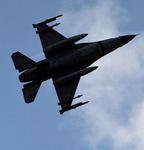
ISIS_24.7.15F-16 warplane in action against ISIS

The Middle East woke up Friday, July 24, to two new full-fledged wars launched by Jordan and Turkey for cutting down the Islamic State of Iraq and the Levant as is forces advanced on their borders. The United States and Israel are involved in both campaigns. Jordanian armored, commando and air forces are already operating deep inside Iraq, while Friday morning, Turkey conducted its first cross-border air strike against ISIS targets in Syria. Clashes between Turkish troops and Islamic fighters erupted at several points along the border. Both governments also conducted mass arrests of suspected Islamists. The Jordanian police picked up ISIS adherents, while 5,000 Turkish police detained 250 Islamist and outlawed Kurdish PKK suspects in Istanbul, Ankara, Izmir and Saniurta. Jordan Friday shut down its only border crossing with Iraq.

Earlier this week, Turkey permitted US warplanes to us the Incirlik air base in the south for bombing missions against ISIS, and Israel handed over to Jordan 16 Cobra combat helicopters and assured Jordan of air force cover for its anti-ISIS operation.

Read more about this new chapter in the war on ISIS in the DEBKAfile report of Thursday, July 23.

In the first publicized Israeli military hardware transaction with an Arab nation, Israel has handed over “around 16 Cobra” combat helicopters in support of Jordan’s war on the Islamic State. This was confirmed Thursday, July 23, by a US official close to the transfer. It was also the first time US-Jordanian-Israeli military cooperation in the struggle against ISIS was publicly disclosed.

“These choppers are for border security,” said the unnamed US official.DEBKAfile’s military and counter-terror sources disclose that the Cobras are needed for a large-scale Jordanian aerial-commando operation launched in the western Iraqi province of Anbar, which borders on the Hashemite Kingdom. This operation is designed to carve out a security belt tens of kilometers deep inside Iraq as a barrier against Islamic State’s encroachment.

Amman approached Washington for combat helicopters to back the operation and was told that the US is short of these items and would turn Israel to pitch in. The US first provided mechanical overhauls for the aircraft before they were incorporated free of charge in Jordan’s existing Cobra fleet.

The transfer was announced while US Defense Secretary Ashton Carter was touring the Middle East. He arrived in Amman Tuesday, July 21,after talks in Israel, and visited Baghdad unannounced Thursday, July 23 for an update on the war on ISIS

The mounting Islamist threat to Jordan is coming now from two directions – the Iraqi province of Anbar and  Syria. ISIS forces have grabbed positions in southern Syria near the intersection of the Jordanian, Iraqi and Syrian borders. They have also moved up to the eastern Syrian town of Abu Kamal on the Iraqi border and, since mid-May, have gradually detached small groups from the captured central Syrian town of Palmyra and quietly built up positions in the south near Jabal Druze.

This buildup has been tracked by US, Jordanian and Israeli surveillance.

The Islamist domestic threat to the Hashemite Kingdom is no less acute. Jihadist sleeper cells have been planted in Jordan ready to strike strategic targets for a reign of terror to coincide with the onset of external Islamic State attacks staged from Iraq and Syria.

Our military sources report that US-Israeli-Jordanian cooperation is channeled through the US Central Command Forward-Jordan from its headquarters north of Amman. It is staffed by US, British, Jordanian, Saudi and Israeli officers working together to defeat ISIS.

Will Anyone Help the Kurds?

July 19, 2015

Will Anyone Help the Kurds?, Gatestone InstituteUzay Bulut, July 19, 2015

  • What does the Turkish army — this flamboyant member of the NATO — want from the small Kurdish village of Roboski?
  • The West should apply pressure on Turkey to act humanely, morally and responsibly towards Kurds and other minorities. We all know that the Obama administration will never do that. But there are thousands of activists, academics, and universities who just turn a blind to the plight of Kurds as if their maltreatment is perfectly normal.
  • There are many “activists” like that. Their universities are filled with events bashing Israel. But if you ask them, they do not even know what is done to Kurds by their Turkish rulers. These activists are either ignorant or hypocritical. Their activism has nothing to do with caring about human beings; it is just about hating the Jews. When Turkey condemns Israel for “committing massacres,” Israelis should start lecturing Turkey about tens of thousands of dead Kurds and about how Turkey still treats them.

During Turkey’s elections on June 7, the pro-Kurdish Peoples’ Democratic Party (HDP) won a great victory by securing 13% of the vote, which allowed its candidates to occupy 80 seats in the 550-seat parliament of Turkey — not all of them are Kurdish, some are Turkish or of other ethnic groups. In any normal country, this would be welcomed by state authorities as a potential way to resolve a huge national issue in a non-violent manner for the benefit of both peoples, Kurds and Turks.

Sadly, Turkey does not seem to be about to do so. The recent incidents in which Ferhat Encu, a Kurdish deputy from the HDP, was threatened, insulted and beaten by Turkish soldiers in the Kurdish village of Roboski (Uludere) in the Kurdish-majority province of Sirnak are another manifestation of that. (Video of the incident: here and here, and here.)

For four months, the Turkish army has blockaded the plateaus in Roboski and banned the villagers from going to those places, Ferhat Encu told Gatestone Institute.

Heavy military reinforcements have also been sent to the village, which borders Iraq’s Kurdistan Regional Government, and this has created tension in the village, said Encu.

In 2011, Turkey’s air force killed 34 innocent civilians, including 17 children, in an airstrike on Roboski. Ferhat Encu lost 11 relatives in the massacre, including his brother Serhat Encu.

Between the 2011 massacre and his election to parliament in June 2015, Ferhat Encu had been detained by the police six times under to various pretexts, and then released.

On June 7, Encu travelled to Roboski, his hometown, to observe what was going on and try to ease tensions.

“Roboski is like an open prison,” he said later. “On 6 July, local people started a 2-day protest to end the ban on travel to the plateaus and stop the military reinforcements to the region. But soldiers shot their long barreled weapons [rifles] at the villagers.

“On July 7, about 20 soldiers intercepted us and threw [tear] gas bombs at our car. Then, a reporter from the newspaper Cumhuriyet, Mahmut Oral, got out of his car, introduced himself and asked them not to throw gas bombs, but they threatened him.

“Then, I got out of the car and I told them I am a [parliamentary] deputy. There were about 5 meters between the soldiers and me. At that moment, a few soldiers started shooting their guns randomly.”

Perhaps, they fired their guns up in the air. They may have done this just to scare him and the journalists, not to kill them. Even if they had killed them, they would have never been held accountable for that. There are lots of gunshots in the video.

Encu said that he told the soldiers they were not being resisted, and asked them to stop shooting.

“But they responded: ‘You are not our deputy. You are the deputy of terrorists, traitors, and marauders. And we represent the honor of the state.’

“Then the commander told me to buzz off and walked up to me — I tried to stop him from hitting me. Then soldiers started shooting their guns again while others battered me.”

Mahmut Oral, a reporter from the newspaper Cumhuriyet, who was present during the confrontation, wrote:

“When we got out of the car, saying that we are journalists, we were manhandled by soldiers and threatened with guns. When the situation got more serious, Encu got out the car but soldiers seized him by the collar and surrounded him. The soldiers told Encu that ‘we are the state here. What deputy? You are a terrorist and marauder.’… They kept insulting the journalists who tried to intervene between Encu and the soldiers… They threatened us with breaking our cameras and shooting us if we do not get back on the car.”

The 2011 Roboski Massacre

On December 28, 2011, Turkish F-16 fighter-bombers launched a five-hour long airstrike on Roboski, killing 34 civilians, including 17 children, some of whom were as young as 12.

The victims had been transporting cheap cigarettes, diesel oil and the similar items into Turkey when the bombing started. The bodies of some of the victims were burned beyond recognition or dismembered.

The AKP government has not provided any written or verbal apology for the massacre. Instead, on December 30, 2011, Erdogan, then prime minister, thanked the Turkish general staff for “their sensitivity towards the issue despite the media.”

Some of the victims froze to death, according to a report by human rights activists, doctors and lawyers; after the massacre, aid was not provided for hours and even ambulances were not allowed to enter the area.

878The funeral procession for the victims of the 2011 Roboski massacre in Turkey.

In May 2012, Prime Minister Erdogan said that whoever was trying to keep the Roboski massacre on the agenda was “the terrorist organization and its extensions.”

In June 2012, when families of the victims and representatives of NGOs came out to commemorate the dead, the police turned water cannons on them.

At first, public prosecutors from Diyarbakir were responsible for the investigation on the Roboski killings. But then, in June 2013, they announced that they were not going to deal with the case due to “lack of jurisdiction,” and forwarded the file to military prosecutors.

In January 2014, the Turkish military prosecutor’s office dismissed the investigation into the Roboski airstrike. The 16-page ruling said that “the staff of the Turkish armed forces acted in accordance with the decisions of the Turkish parliament and council of ministers and with the approval of the general staff.” The ruling also stated that Necdet Ozel, chief of the Turkish military’s general staff, gave the order for the airstrike from his home.

Veli Encu, Ferhat Encu’s brother, said that receiving the ruling by the military prosecutors was like having the 34 victims killed all over again:

“We struggled for two years to bring the perpetrators of the massacre to court, but the state officials did not even send the ruling to our lawyers. We learnt it from TV,” he said. “None of those responsible for the massacre have been removed from their posts. The perpetrators of the massacre are rewarded instead of being punished.”

He added that the government is trying to ban villagers from entering the location of the massacre.

“I and my four friends took a writer to the border as she was going to write a book on the massacre. On our way back, the military officers stopped us. They had about 30 dogs with them. They detained us even though we had not crossed the border. And they gave us a fine of 2,000 Turkish liras for border violation.”

Relatives, including children aged 12 and 13, who tried to go to the site to lay flowers to mark 500 days after the attack, were stopped, given fines or asked to report to the police station for “violating the passport law”.

Zeki Tosun, who lost his son in the massacre, said, “We went there to lay 34 cloves. But they gave us a fine of 3000 Turkish liras for each clove. … Here is like a cage. Every step we take is followed [by the Turkish army]. We are already in custody.”

The victims’ relatives were then brought to trial in court, but acquitted in August 2014.

Meanwhile, no perpetrator of the killings has yet been brought to trial, even as a criminal investigation was carried out against the survivors of the massacre, Davut Encu, Servet Encu and Haci Encu. They were interrogated in January 2012.

* * *

Attacks against this small village continue.

In June 2015, Ferhat Encu told the Bianet News Agency that soldiers had attacked people in Roboski for two days and that people were afraid to go outside.

“Soldiers broke into houses and battered women, detained four people and insulted people. A citizen was injured and the vehicle carrying him had an accident. When soldiers departed, everything calmed down.

“In this morning at 5 o’clock, without a warning, soldiers opened fire and killed villagers’ five mules. If people had been outside at that moment, they would have been killed.”

“I cannot comprehend this savageness. What do they want from Roboski?”

That is the question: What does the Turkish army — this flamboyant NATO member — want from this small Kurdish village?

The answer is that the dehumanization of Kurds in Turkey is so intense and widespread that state authorities cannot stand anything related to the Kurdish existence. Not only a Kurdish election victory — even if this election was for the parliament of Turkey, not of Kurdistan — but also Kurds’ demanding punishment for the perpetrators of a massacre is intolerable to them.

Kurds are not to be members of parliament, not to mention patriotic MPs that struggle for national rights. They are to be assimilated into “Turkishness” or be invisible, and if possible, dead. As the infamous saying of Turkish racists goes, “The best Kurd is a dead Kurd.”

Experience has taught us that in the 21st century, there are two ways of dealing with a national problem.

First, there is the right way — the moral, civilized and democratic way — in which you treat peoples under your rule with respect. When an indigenous people say that they are suffering or that they have complaints about or demands from you, you listen to them, try to understand and come terms with them because you regard them as your equals and you know that this indigenous people have been living in their ancient lands for centuries. Actually, you do not treat them as if they are less than fully human in the first place. And you do not put them through huge grievances.

But even then, a disagreement might emerge. On such on occasion, you also clarify your expectations and want that group to recognize your right to life and liberty, as well. And as civilized parties, you might decide to go separate ways and become good neighbors. But if you want to keep that people inside your borders, you at least recognize the national existence of that people. Whatever political and cultural rights you have, you grant those things to them. This is how political leaders with moral considerations would behave.

But then, there is the traditional Turkish-Islamic or Middle Eastern way: In such a political culture, when indigenous peoples or minority groups have complaints or demands, you instantly crush them with your army. You murder them en masse, deny their existence, torture them as you wish, insult them daily and then call them “terrorists”, “traitors” and “marauders”. And you commit all those atrocities based on one thing: your military power. For that is the only “value” you have.

Kurds entering the Turkish parliament by getting so many votes was a huge victory, and should be cherished as an opportunity for achieving democratic peace in the region.

And Kurds have made it clear many times that they wish to live in peace. Before the elections, Selahattin Demirtas, the co-president of the pro-Kurdish Peoples’ Democratic Party (HDP), said that “whether the HDP enters the parliament or not, we will defend peace.”

But if even becoming MPs and demanding a legal way to resolve the Kurdish issue through dialogue and negotiations cannot provide Kurds with political recognition and national rights, what else are they supposed to do?

Is it not high time that the international community heard of the plight of Kurds and supported them? The US helped to liberate Kosovo. The West should now apply pressure on Turkey to act humanely, morally and responsibly towards Kurds and other minorities.

We all know that the Obama administration would never do that. But there are individuals and organizations outside of Turkey. There are thousands of activists, academics, universities who just turn a blind to the plight of Kurds as if their maltreatment is perfectly normal.

If they are ignorant and unaware of the Kurds and other minorities in the region, we need to educate them, and hope that after they learn the truth, they will “act.” If they still do not care, then they are hypocrites. There are many “activists” like that. Their universities are filled with events bashing Israel. But if you ask them, they do not even know what is going on in Kurdistan and what is done to Kurds by their Turkish rulers. These activists are either ignorant or hypocritical. Their activism has nothing to do with caring about human beings; it is just about hating the Jews. When Turkey condemns Israel for “committing massacres,” Israelis should start lecturing Turkey about tens of thousands of dead Kurds and about how Turkey still treats them.

Establishing a Palestinian Islamist State

June 23, 2015

Establishing a Palestinian Islamist State, The Gatestone InstituteBassam Tawil, June 23, 2015

  • The United Nations’ verdict of guilty to Israel, in its “Schabas Report,” issued yesterday, was written even before the trial began.
  • Only the wide-eyed West still does not believe that Mahmoud Abbas is telling the truth when he assures the Palestinians of his intent to destroy Israel.
  • All public opinion polls in the Palestinian Authority (PA) indicate that if elections were held today, Hamas — whose only openly-stated reason for existing is to destroy Israel — would win in a landslide, as in 2006. Gaza has already been lost to Hamas and perhaps soon to ISIS. All evidence reveals that to establish a Palestinian state now would turn it into an Islamist terrorist entity.
  • Abbas thought that forming a Unity Government with Hamas would give the PA a unified front with which to harvest more money and diplomatic concessions from Europe. But last summer, Abbas was informed of a Hamas murder plot against him.

The Middle East is at it again. At the top of the list, no one, it seems, is even thinking of stopping Iran from acquiring nuclear weapons capability — and by extension at least several other countries in the region, including Saudi Arabia, Turkey and Egypt.

First, It is dangerous enough for any openly expansionist regime, theological or not, to have nuclear weapons; Iran has recently shown itself to be nothing if not expansionist. Second, and, if possible, worse, several of the countries around Iran — who correctly feel in its crosshairs, have already announced that they will be building or buying nuclear weapons as well; and have probably already started. The Islamic State (ISIS) is also rumored to be on the market for a nuclear warhead; you too can apparently buy one for around $400 million. So we shall all have uncontrolled and uncontrollable nuclear proliferation to look forward to.

On top of all that, the Americans and Europeans are rumored to be at it again, pressuring the Palestinian Authority (PA) to renew peace negotiations with Israel. The London-based newspaper, Al-Quds Al-Arabi, recently quoted a senior Palestinian who suggested that the PA Chairman, Mahmoud Abbas, meet with Israeli Prime Minister Binyamin Netanyahu to jump-start the stalled negotiations.

New signs of triggering antagonism between the Palestinians and Israel are also reflected in the Vatican’s recognition of the Palestinian Authority as the State of Palestine, despite the vandalizing of the Church of the Nativity in Bethlehem and other acts that led to the mass-exodus of persecuted Christians from the Palestinian territories, and despite the PA having joined with the terrorist group, Hamas, in the so-called Palestinian National Consensus Government [“Unity Government”]. This union enabled Israel to accuse it of responsibility for the war crimes that really only Hamas committed against Israeli civilians during the last war. At the same time, the tottering Palestinian Authority is trying to delegitimize Israel by accusing it of war crimes in the International Criminal Court (ICC). Neither of these attacks bodes well for either Israel or the PA.

The ICC in The Hague also recently announced that it would unilaterally investigate Israel for alleged war crimes committed in the last clash in the Gaza Strip. This project will not end well for the Palestinians, the Israelis or the politicized “Jim Crow” International Criminal Court. Meanwhile, the Unite Nations’ verdict of guilty, in its “Schabas Report,” issued this week, was written even before the trial began.

The Obama Administration has also increased its pressure on Israel with not-so-subtle threats. Susan Rice and other sources within the US administration openly claimed in early March that, in view of Israel’s “refusal” to make peace, and because of its interpretations of statements made by Netanyahu during this Israel’s elections this year, Washington would not veto unilateral European proposals to establish a Palestinian state.

President, Barack Obama, on May 22, tried to reassure the Jewish community to the contrary and said that he was “an honorary member of the [Jewish] tribe,” but his assurances are suspicious. Obama has earned a reputation for not telling the truth, from blaming the 2012 slaughter of Americans at Benghazi, Libya on a YouTube video (even two weeks after he knew the video was not the reason), to welching on his “red line” commitment when Syria’s government used chemical weapons on its own people.

The Israelis regard the American stance as an anti-Israeli vendetta based on Obama’s personal dislike of both Israel and Netanyahu. Although Netanyahu has said that now might not be the best time for a Palestinian state, he has, in fact, never changed his fundamental policy: that a Palestinian state could potentially be in Israel’s best interests.

What Netanyahu did say, with justification — as hard as it is to admit he was right — is that, given the current regional chaos, establishing a Palestinian state at this time would mean establishing a terrorist state in the West Bank. To do so now would simply lead to what is euphemistically called “further regional destabilization” — namely, war. Recognizing a Palestinian state at this time will also encourage terrorist activities by giving extremist Islamic elements — presently operating throughout North Africa, Yemen, Syria, Lebanon and Iraq — even more territory from which to expand their operations.

This new Islamic extremist land-and-power grab would be similar to that of Hamas after it took over the Gaza Strip, after when Israel unilaterally withdrew in 2005; or the ISIS takeover of Syria and Iraq when the US withdrew or failed to act. Currently, Hamas and ISIS in the Gaza Strip menace the security of both Israel and Egypt.

A new Islamic emirate in the West Bank at this time would also be dangerous for Jordan. Even without an Islamic emirate, Jordan has to cope with waves of refugees, among whom are Islamist terrorist operatives infiltrating the kingdom with the goal of overthrowing the Hashemites and turning Jordan into a territory ruled by ISIS or the Muslim Brotherhood. Given Iran’s efforts to exploit the weakness of Sunni Islam in Syria, Iraq, Yemen, Lebanon and Bahrain, there seems no need for another extremist Islamic arena in Jordan.

Considerable pressure is also now being directed at the Palestinian Authority to renew negotiations with Israel. Some of the pressure comes from former President Jimmy Carter’s possibly well-intentioned but totally counterproductive demand that the Palestinians hold elections.

All public opinion polls in the PA indicate that if elections were held today, Hamas, as in 2006, would win in a landslide.

Unfortunately, many decision-makers in both the United States and Europe view the situation through the lens of Western democracy and practices. The overwhelming Hamas victory in the student council elections at Bir Zeit University, near Ramallah, should have been a wake-up call. Unfortunately, it was ignored.

1042Hamas supporters march during a student council election rally at Bir Zeit University, near Ramallah, on April 20, 2015. The overwhelming Hamas victory in the student council elections should have been a wake-up call to the U.S. and Europe.

Mahmoud Abbas has a dilemma. If elections are held in the Palestinian Authority, and Hamas– whose only openly-stated reason for existing is to destroy Israel — wins, the PA will cease to exist and Israel will be able to avoid the peace process for all time.

If, however, elections are not held, Mahmoud Abbas will continue to rule without international or Palestinian legitimacy. Not only did his four-year term expire six years ago, but at this point, he barely represents the Palestinians in the West Bank.

The almost two million Palestinians on the other side of Israel, in Gaza, are represented almost exclusively by Hamas, with continuing attempted inroads by ISIS. Abbas is thus unable to represent “the Palestinian people” in any serious political process. The proposal for elections is therefore an embarrassment for Abbas, and is generally ignored.

Tragically, to shore up its status locally, the Palestinian Authority in the West Bank has taken a series of hasty, contradictory and dangerous steps. Since the PA’s chance at controlling the Gaza Strip has disappeared forever, the PA, to ensure its own continued survival, coordinates security with Israel to prevent further Hamas subversion in the West Bank.

In the meantime, senior figures in the PLO and the PA compete with Hamas in issuing strident, extremist messages to the Palestinian populace, which is consequently being radicalized — to the point now of supporting Hamas and ISIS.

Mahmoud Abbas and his high-ranking associates, nevertheless, continue to hold formal ceremonies to honor terrorists killed during attacks on Israeli targets.[1] Abbas also continues to commemorate “shaheeds” [those who die in the cause of Islam, often called “martyrs”] who killed dozens of Israeli civilians in suicide bombing attacks. Abbas erects monuments, names town squares after them, and holds sports and chess tournaments in their honor.

On this year’s Nakba Day — “the day of catastrophe,” which commemorated the 67th anniversary of the establishment of the State of Israel — during the May 15 ceremonies, Mahmoud Abbas promised the Palestinian masses that the occupied territories and the Palestinian diaspora would soon be restored to the independent state of Palestine. He also swore that the “resistance” — that is, armed violence and terrorism against Israel — would continue until the goal was achieved: destroying the State of Israel and establishing the Palestinian state on its ruins.

These intentions are not a secret to Israelis. They therefore do not trust his sincerity when he claims he wants “peace.” Only the wide-eyed West still does not believe that Mahmoud Abbas is telling the truth when he assures the Palestinians of his intent to destroy Israel.

The deliberate tension crafted by the Palestinian Authority has, as its only objective, bloodshed — both Palestinian and Israeli. This tactic can usually be seen when the level of violence falls below what the PA finds acceptable. It then trots out the old saw, first coined by the anti-Israeli Islamist sheikh Ra’ed Salah (whose right to free speech is protected by Israeli law), “Al-Aqsa mosque is in danger!”

At the beginning of May 2015, Sheikh Yusuf al-Dayis, the PA Minister of Religious Endowments [Waqf], made headlines in the Palestinian daily, Al-Quds, with the incendiary statement that the fate of the entire Muslim nation hung on the 35 acres of the Temple Mount. He even provided a list of what he claimed were Israeli “attacks” on Al-Aqsa mosque. Sadly for him, visitors to the Temple Mount can see every day the exorbitant security measures taken by the Israelis to protect the site. In point of fact, the record shows that every time the Palestinians want to provoke another pointless round of violence and slaughter, they say, “Al-Aqsa mosque is in danger!” It invariably causes hundreds of casualties on both sides and achieves absolutely nothing.

The last time a mosque actually was damaged was recently, in the Gaza Strip, when Hamas’s security forces removed the holy books, then used three bulldozers to raze a Salafist mosque. Hamas claimed it was in retaliation for an alleged Salafist attack on Hamas “jihad fighters” south of Khan Yunis. Sources in Gaza confirmed that seven Salafist-jihadi operatives were arrested in the mosque, and that Hamas had recently arrested 30 Salafist-jihadi Ansar Bayt al-Maqdis members. Having started terrorism in the Gaza Strip, Hamas is now reaping the result: terrorism there is “going viral.”

All evidence reveals that to establish a Palestinian state now would quickly turn it into an Islamist terrorist entity. Each time governments encourage Islamist movements, or ignore them in the hope that they will attack someone else, these movements have boomeranged into their own backyards and then moved on to their neighbors’. This will be the fate of Syria’s Bashar Assad, who let Hamas and other terrorist groups set up shop in Damascus. Former PA Chairman Yasser Arafat let Hamas into the neighborhood, and the Palestinian people are now being repaid by Hamas. Arafat wrongly assumed that letting Hamas in the door would serve him by forcing Israel to make concessions. Mahmoud Abbas thought that forming a Unity Government with Hamas would give the PA a unified front with which to harvest more money and diplomatic concessions from Europe. But last August, Abbas was informed of a Hamas murder plot against him. “We have a national unity government and you are thinking about a coup against me,” he said to Hamas’s leader, Khaled Mashaal.

The Islamist terrorist enclaves are wholly the fruit of the Muslim Brotherhood doctrine freely being spread around the Middle East and the democratic West. The so-far isolated incidents of bloodshed in Europe, Africa and the United States are just at the beginning stages of a long, bloody campaign to engulf the world.

Gaza has already been lost to Hamas and perhaps soon to ISIS. Libya and Lebanon may follow next. If the West pressures Palestinians and Israel to create a Palestinian state now, the West Bank and Jordan will be sure to follow. Enabling an expansionist Iran to have a nuclear threshold capability will also throw the region into war.

We, the Palestinians who live in the Palestinian Authority and within Israel, have not stopped dreaming of a Palestinian state, but we also witness the chaos around us and are relieved that so far the catastrophe has not harmed us or our families.

Some Palestinian politicians have turned to more extreme rhetoric to find favor with Israeli Arabs, but despite the tendency in Palestinian society towards extremism and terrorism, what is certain is that even if the establishment of the Palestinian state is postponed, most Palestinians hope the West will not make the mistake of permitting Iran to go nuclear. A nuclear Iran will create a nightmare that will make the Nakba look like a coming attraction.

____________________

[1] For recent examples, see: “Fatah glorifies arch-terrorist who planned killings of 125,” May 14, 2015; “PA honors 3 terrorists who lynched two Israeli reservists,” May 11, 2015; “PA sports presents terrorist murderers as role models,” May 4, 2015.

Turkey’s View of Israel

June 9, 2015

Turkey’s View of Israel, The Gatestone InstituteUzay Bulut, June 9, 2015

  • The media’s unethical coverage of the Israel/Palestine conflict seems to be the number one reason why people in Turkey have remained so misinformed and brainwashed about the issue. It is not just anti-Semitism, but also anti-Zionism, that is racist and hateful.
  • The houses and apartments Israelis built in their historic homeland are called “illegal settlements.” But there were no “settlements” before 1967. What, then were the Israelis supposedly “occupying” between 1948 and 1967? Why was the Palestine Liberation Organization (PLO) even then trying to destroy Israel? What did it think it was “liberating”?
  • This “occupation” myth seems, instead, to have a lot to do with the “Islamization” of history and geography. Since the creation of the world, it goes, there has been only one religion: Islam. All our religious teachers have taught us that earlier historical figures were prophets — Isa [Jesus], Musa [Moses], Davut [David] and so on — were Muslims and that the original religions they brought were Islamic. These prophets, we are told, preached the teachings of Allah, but their followers, who came later, distorted their messages, changed the writings in their holy books, and fabricated these fake, untrue religions called Judaism and Christianity. Then Islam came as the last, the perfect and the only true and unchanged eternal word of Allah, which led to Muhammad to this world as a “liberator.”
  • If someone says, “there is a place related to King David and it is a Jewish place,” then a Muslim would say, “Yes, but David was also a Muslim. So this place actually belongs to Muslims.” There is never Islamic invasion; there is only Islamic liberation. If these people truly cared about Palestinian Arabs, they would do their best to stop the incitement and help to achieve a sustainable peace where both Arabs and Jews would be safe.

A large number of the citizens of Turkey, a NATO member, see Israel and the United States as enemies.

A survey conducted recently in Turkey found that nearly half the country’s citizens (42.6%) see Israel as the biggest security threat, followed by the United States (35.5%), and only then Syria (22.1%).

How do they visualize Israel, a country with which they have made several military and trade agreements, as being a security threat? Do they think Israel would ever invade Turkey? Bomb Turkey? Nuke Turkey? This view seems to be based on either religion-induced paranoia caused by Islamic anti-Semitism, or else their understanding of reality has been distorted Nazi-style by Turkish leaders and the media.

The problem is that the false myth of Israel’s being an “occupier” and “troublemaker” has been indoctrinated into the minds of most Turkish children from their early years. Almost all of us — including myself — grew up with an extreme prejudice against Israel. The media’s unethical coverage of the Israel/Palestine conflict — including both the Islamist and Kemalist (secular nationalist) media — seems to be the number one reason why people in Turkey have remained so misinformed and brainwashed about the issue.

Only the intensity of the prejudice changes according to what newspaper or TV channel you follow or what family raises you. Islamic anti-Semitism, even if we might not be aware of it, has a lot to do with this kind of upbringing.

A short scanning of Turkish newspapers and TV channels would also clearly show their continual hateful propaganda against Israel.

No other state or organization has been demonized and delegitimized by the Turkish media to this extent.

Unfortunately, even the media that calls itself “progressive” has bought and reproduced the propaganda that Israel is the “invader” and the “oppressor.” One of their most popular slogans is, “We are not anti-Semitic, but just anti-Zionist.”

Zionism defends the concept that Jews — like any other people — have human rights, and are entitled to live their original Biblical homeland. Although forced out of their land many times, as by the Babylonians or the Romans, they never entirely left it.

If the demand of Jews for equality and independence disturbs anyone, it is due to his own racism — in whatever name he is trying to dress it up — and not to anything the Jews might have allegedly done. It is not just anti-Semitism, but also anti-Zionism, that is racist and hateful.

Every person who comes up with the genius idea of “not being anti-Semitic but just being anti-Zionist” should also offer their idea of what kind of a Jewish state they would like to see or whether they would like to see a Jewish state at all. If it is the political system of Israel they oppose, then they should clarify how their own alternative system would be better than the current one, and what they would do to convince Hamas and the Palestinian Authority to achieve peaceful coexistence with Israel.

They should also clarify why they are so obsessed with Israel, which has the most democratic political system in the Middle East, while autocratic, theocratic, despotic regimes abound in the region.

They might also please explain what makes the non-existent, imaginary “democratic Palestine” preferable to already existing, thriving and democratic Israel.

Mahmoud Abbas’s Fatah is essentially no better than Hamas; just sometimes less violent. The Palestinian Authority (PA), as stated in its charter and “phased plans,” says it prefers to displace Israel diplomatically, through the dictator-controlled United Nations and European governments, and economically through boycotts and sanctions, rather than with missiles.

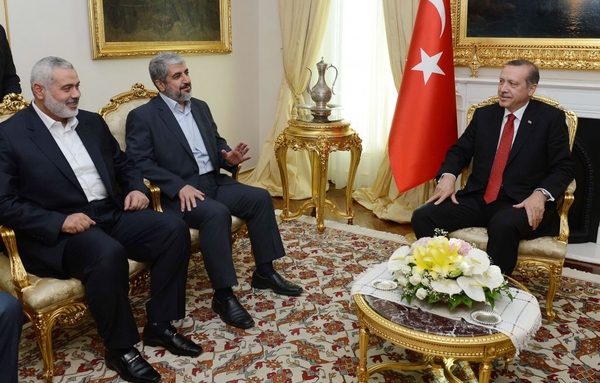
826Turkish President (then Prime Minister) Recep Tayyip Erdogan, right, meeting with Hamas leaders Khaled Mashaal (center) and Ismail Haniyeh on June 18, 2013, in Ankara, Turkey. (Image source: Turkey Prime Minister’s Press Office)

Now that so many Jews are all in one place, the progressives can pretend to themselves that it is “just Israel,” and not “the Jews,” who are the target of their hate. As the former Iranian president Akbar Hashemi Rafsanjani said, Israel, only slightly bigger than the city of Beijing, is a “one-bomb country.”

The progressive media’s representation of Israel as an “occupier” only caters to the genocidal desires of these anti-humanitarian regimes or groups. They never point to Turkey’s occupation of northern Cyprus, China’s occupation of Tibet, or Pakistan’s occupation of Kashmir — not to mention Russia’s recent flamboyant occupations.

For the past 2000 years, Jews have been exposed to unending persecution accompanied by expulsions, forced conversions, mob attacks, pogroms, property confiscations, massacres, and the 1938-45 Holocaust. Attacks against Jews in Europe continue today.

After Jews were forced from their Biblical home into the Diaspora, their lives were painful for centuries. When they were in exile in Europe, they were disposable. Now that they are back home in Israel, they are “occupiers;” again not wanted.

Under Nazi rule, Jews were “illegal,” slaughtered wholesale, tortured with fake “medical experiments” and not even considered fully human.

To end their history of 2000 years of suffering and to finally be free, Jews have returned to their home, Israel.

They have brought their light back to the land and presented gifts to the Middle Eastern peoples that no other nation there has experienced: democracy, tolerance, freedom of speech, human rights — as well as countless medical and technological innovations. This tiny country has produced some of the most brilliant minds in history, and has become the second most educated nation on earth.

What they have done is to build a truly open and productive society on sand dunes and deserts, where even the Muslim citizens, who make up 20% of Israel’s population, have the freedom to say the most horrendous things about anyone they wish, including the prime minister — and they do. In short, even the Muslims in Israel enjoy privileges that in any other country in the region would get them incarcerated.

Israel’s neighbors, however, have not shown much appreciation for these admirable traits — only more jealousy and hatred.

As thanks for the endless good the Israelis bring the region and the world, they are vilified by the anti-Semitic, anti-Zionist, Jew-hating, politically-driven blocs in the Arab countries, Turkey, Europe and the UN, which clearly want to destroy them, on one pretext or another.

The houses and apartments Israelis build in their historic homeland are called “illegal settlements.” But there were no “settlements” before 1967. What, then, were the Israelis supposedly “occupying” between 1948 and 1967? Why was the Palestine Liberation Organization (PLO) even then trying to destroy Israel? What did it think it was “liberating”?

This “occupation” myth seems, instead, to have a lot to do with the “Islamization” of history and geography.

According to Islamic ideology, all history is actually Islamic history and most of the major historical figures were actually Muslims. Islam does not recognize other religions as either genuine or original.

Since the creation of the world, it goes, there has been only one religion: Islam. Others are irrelevant, fabricated by those who came later but went astray. All our religion teachers have taught us that the earlier prophets — Issa [Jesus], Musa [Moses], Davut [David] and so on — were Muslims, and that the original religions they brought were Islamic. These prophets, we are told, preached the teachings of Allah, but their followers, who came later, distorted their messages, changed the writings in their holy books, and fabricated those fake, untrue religions called Judaism and Christianity. Then Islam came as the last, the perfect and the only true and unchanged eternal word of Allah, which led to the coming of Muhammad to this world as a “liberator.”

If someone says “there is a place related to King David and it is a Jewish place,” then a Muslim would say “Yes, but David was also a Muslim. So this place actually belongs to Muslims.”

The Islamization of history leads to the Islamization of geography. All those religious figures were Muslims, so the places in which they resided were also Muslim places. So Muslims never call their invasions “invasions.” They consider them all liberations of former Muslim places. There is never Islamic invasion; there is only Islamic liberation.

This view is the view behind the recent call of Turkey’s President, Recep Tayyip Erdogan, for “Liberating Jerusalem” from the Jews. “Conquest is Mecca,” said Erdogan in a speech in Istanbul on June 1, before millions who were celebrating the 562nd anniversary of the fall of Constantinople. “Conquest is Saladin,” he said, “It is to hoist the Islamic flag over Jerusalem again; conquest is the heritage of Mehmed II and conquest means forcing Turkey back on its feet.”

Erdogan is calling for an invasion of Jerusalem, which basically means a call for death and destruction. He was doing that just prior to the elections, because he knew that such anti-Semitic outbursts will most likely increase the votes of the AKP party.

The biggest problem is that this statement was made by the head of a NATO member.

Why would a Turk or a Muslim want to “liberate” Jerusalem? To turn it into another Muslim land where discrimination and persecution against minorities and all kinds of human rights violations run wild? Turkey does not even treat its own minorities with respect and discriminates against them daily, for instance by not giving the Kurds even the right to be educated in their native language. For what purpose, or based on what right, should Turkish authorities want to rule over Jerusalem?

Do they want to slaughter the Jews just as they slaughtered Christians in 1915, and still deny it even today? Do they want to ban the Hebrew language just as they ban the Kurdish language in Turkey? Do they want to rape Jewish women as they raped Kurdish and Greek Cypriot women during ethnic cleansing campaigns? Do they want to convert Israel’s synagogues and churches into stables as they did those in Turkey? Or do they want to turn Israel’s prisons into centers of torture just as they did in Turkey’s Kurdistan? What on earth could Turkish authorities give to Jerusalem if they could capture it?

These people need to understand and accept the fact that the Ottoman Empire is dead and that none of its former colonies wants it back.

This is not the first time that anti-Semitism is promoted by a Turkish state authority. Anti-Semitism has a very long history in Turkey. Some of the most horrible crimes committed against Turkey’s Jews happened during the 1934 pogrom, when about 15,000 Jews in Thrace were forcibly driven out of their homes. During the pogrom, Jews were boycotted and attacked, their property was looted and burned down, and Jewish women were raped.

Just prior to the outbreak of the 1934 pogrom, Ibrahim Tali Ongoren, the inspector general of Thrace (the highest state official in the region) made a four-week inspection tour of the province. According to Tali Ongoren’s report, “The Jew of Thrace is so morally corrupt and devoid of character that it strikes one immediately.” The Jew, he wrote, possessed a “fawning, deceitful character that hides its secret intentions, always applauds the powerful, worships gold and knows no love of the homeland.”

“The Jews represent a secret danger and possibly want to establish communist nuclei in our country through the workers’ club and it is therefore an indispensable necessity for Turkish life, the Turkish economy, Turkish security, the Turkish regime and the revolution in Thrace and for Turkish Thrace to be able to recover, to finally solve [the Jewish] problem in the most radical way.” [1]

According to the historian Corry Guttstadt, although the 90-page report Ongoren prepared for the government and for the ruling Republican People’s Party (CHP) contained a wide range of topics, he seemed to be, “outright obsessed with the ‘Jewish problem,’ which comes up in nearly every chapter.”

“Tali’s report” Guttstadt wrote, “is laced with the crudest of anti-Semitic stereotypes. This contradicts not only the government’s assertion that anti-Semitism in Turkey was only a fringe phenomenon [Tali was the highest ranking official of the Republic in this region] but must also be considered proof that the expulsion of the Jews from Thrace and from the Dardanelles was in keeping with the state’s objectives, just as foreign diplomats had reported.

“The rights of the non-Muslim minorities were protected by the international Treaty of Lausanne, at least on paper. To circumvent these legal obstacles, The Turkish authorities had apparently opted for the strategy of putting the Jews under such pressure with boycott activities and anonymous threats ‘from the population’ that they would leave the area ‘voluntarily’.

“The period that followed was characterized by further boycott attempts and intimidation in Edirne and even in Istanbul.”[2]

While these crimes against Jews were committed, there was no Jewish state in Israel. But Jew-hatred was clearly rampant.

The main offenders to be held responsible for anti-Semitism in Turkey are the Turkish state authorities. A state that is an EU candidate, as well as a NATO member, is supposed to be a true ally of the West. It is supposed to fight anti-Semitism and promote a peaceful, diverse and pro-Western culture. It is supposed to provide its schoolchildren with a kind of education in which the children will rid themselves off the traditional Jew-hatred and other racism, and embrace at least some humanitarian values that will help them recognize all peoples as equal and worthy of respect.

Sadly, Turkey has done none of that. It has made a record number of military and commercial deals with the state of Israel, but domestically it has systematically propagated anti-Semitism and racism, as well as Turkish-Islamic supremacy, through its institutions and media. As a result of this propaganda, a great number of Turkish people see Israel and the USA as the biggest security threats today.

In Turkey, being Westernized has been restricted to benefiting from the technical and material innovations of the West, but rejecting the social values of the West on grounds that those values would not fit into the Turkish culture. More perplexingly, being politically and socially pro-Western is almost associated with being a “traitor.”

“Israel wants peace. Period,” wrote the journalist Israel Kasnett. “The Jewish people have never held a desire to rule over others and this remains true today. Not only are we ohev shalom [‘lovers of peace’], but we are also rodef shalom [‘active pursuers of peace’].”

Is anyone listening? Are Turks listening? Many, apparently, are not.

Throughout much of the world are bloodbaths and persecution of human beings, but it is only Israel, the sole democracy in the Middle East, that is targeted and singled out for defending itself, and is accused of “occupation.”

To many of the people here in Turkey, the problem does not seem to be whether Israel wants peace, or whether Israel is a democracy, or whether Palestinian Arabs are really suffering, or why. If these people truly cared about Palestinian Arabs, they would do their best to stop the killings and incitement and to help achieve a sustainable peace where both Arabs and Jews would be safe.

But they do not really care about the Palestinians. They do not want peace. They do not want a “two-state solution.” They want to see Jews dead. And they could not care less about how many Arabs will lose their lives in the meantime.

But there is one thing they do not seem to be aware of: Their genocidal Jew-hatred can never strip Israel off its right to self-defense. It can only empower and further legitimize this right.

_______________
[1] Guttstadt, Corry (2013). Turkey, the Jews, and the Holocaust. Cambridge University Press. More slurs include: “Although (the Jews) underwent natural selection as a result of constant mixing with different blood in the last century and have almost entirely lost the physical characteristics specific to Jewry, they have completely retained the typically Jewish fawning, deceitful character that hides its secret intentions, always applauds the powerful, worships gold, and knows no love of the homeland, and have even developed these harmful traits so much further that they could inflict torment on humanity.

“In the Jewish value system, honor and dignity have no place. The Jews of Thrace owe their rise to the destructive effects of the wars on the Turkish population, that is how [the Jews] have become rich and enchanted their influence.

“The Jews of Thrace are intent on making Thrace the equivalent of Palestine. For the development of Thrace, it is of the utmost necessity that this element [the Jews], whose hands are grabbing for all the treasures of Thrace, not be allowed to continue to suck out the Turks’ blood. In the establishment of new military facilities… we must keep our administrative and military activities entirely secret from this element [the Jews].

“Above all, it is essential that this element [the Jews] be neutralized so completely that they cannot engage in spying…”

[2] Guttstadt, Corry (2013). Turkey, the Jews, and the Holocaust. Cambridge University Press.

“In the light of this, it hardly seems coincidental that Tali himself had travelled the entire region until a week before the events erupted and then remained in Ankara during the boycott activities and the threats. It seems that the operations then ‘got out of hand’ locally, with the nationalist mob putting itself in charge in some places and committing looting and acts of violence.

“After the reports of the riots reached the international public, the government was forced to condemn both the events and anti-Semitism in general. In the end, however, the episode achieved, for the most part, the intended goal and largely ‘solved’ the ‘Jewish problem’ in Thrace in the way favored by Tali.”

Turkey: “An End to an Era of Oppression”

June 8, 2015

Turkey: “An End to an Era of Oppression,” The Gatestone InstituteBurak Bekdil, June 8, 2015

  • “We, through democratic means, have brought an end to an era of oppression.” — Kemal Kilicdaroglu, leader of the main opposition, Republican People’s Party (CHP).
  • Erdogan is now the lonely sultan in his $615 million, 1150-room presidential palace. For the first time since 2002, the opposition has more seats in the parliament than the AKP.

For the first time since his Islamist party won its first election victory in 2002, Turkish President Recep Tayyip Erdogan was nowhere to be seen on the night of June 7. He did not make a victory speech. He did not, in fact, make any speech.

Not only failing to win the two-thirds majority they desired to change the constitution, the AKP lost its parliamentary majority and the ability to form a single-party government. It won 40.8% of the national vote and 258 seats, 19 short of the simple majority requirement of 276. Erdogan is now the lonely sultan at his $615 million, 1150-room presidential palace. For the first time since 2002, the opposition has more seats in parliament than the AKP: 292 seats to 258.

“The debate over presidency, over dictatorship in Turkey is now over,” said a cheerful Selahattin Demirtas after the preliminary poll results. Demirtas, a Kurdish politician whose Peoples’ Democracy Party [HDP] entered parliament as a party for the first time, apparently with support from secular, leftist and marginal Turks, is the charismatic man who destroyed Erdogan’s dreams of an elected sultanate. Echoing a similar view, the social democrat, Kemal Kilicdaroglu, leader of the main opposition Republican People’s Party [CHP], commented on the early results in plain language: “We, through democratic means, have brought an end to an era of oppression.”

What lies ahead is less clear. Theoretically, the AKP can sign a coalition deal with the third biggest party, the right-wing Nationalist Movement Party [MHP], although during the campaign, MHP leader Devlet Bahceli slammed Erdogan harshly for the embarrassing corruption allegations against the president. At the same time, a CHP-MHP-HDP coalition is unlikely, as it must bring together the otherwise arch-enemies MHP and HDP.

1098Turkey’s Nationalist Movement Party leader Devlet Bahceli addresses supporters after the release of preliminary election results, June 7, 2015. (Image source: MHP video screenshot)

The AKP management may be planning for snap, or early, polls but there are hardly any rational reasons for it except to risk another ballot box defeat. Parliament may try a minority government, supported by one of the parties from outside government benches, but this can only create a temporary government.

Two outcomes, however, look almost certain: 1) The AKP is in an undeniable decline; the voters have forced it into compromise politics rather than permitting it to run a one-man show, with in-house bickering even more likely than peace, and new conservative Muslims challenging the incumbent leadership. 2) Erdogan’s ambitions for a too-powerful, too-authoritarian, Islamist executive presidency, “a la sultan,” will have to go into the political wasteland at least in the years ahead.

The AKP appeared polled in first place on June 7. But that day may mark the beginning of the end for it. How ironic; the AKP came to power with 34.4% of the national vote in 2002, winning 66% of the seats in parliament. Nearly 13 years later, thanks to the undemocratic features of an electoral law it has fiercely defended, it won 40.8% of the vote and only 47% of the seats in parliament, blocking it from even forming a simple majority.