Archive for the ‘Turkey and Europe’ category

Erdogan’s Neo-Ottoman Plans

November 3, 2016

Erdogan’s Neo-Ottoman Plans, Gatestone Institute, Burak Bekdil, November 3, 2016

“Let us see how your Islamist friend [Erdogan] behaves after crushing the secular establishment.” — The author to a friend, 2004.

To insist on the borders Turkey accepted in the 1923 Treaty of Lausanne “is the greatest injustice to be done to the country and to the nation.” — Turkey’s President, Recep Tayyip Erdogan, October 19, 2016.

Erdogan’s newfound claims seem to refer not only to wish to regain hegemony to the west (Greece) but also about the south (Syria) and the southeast (Iraq). Turkey evidently wishes to be part of an Iraqi- and Kurdish-led offensive against Mosul, controlled since 2014 by the Islamic State of Iraq and Syria (ISIS).

Sipping his ouzo at a café in Athens on a warm afternoon in 2004, a Greek diplomat friend smiled and said:

“You are wrong about Erdogan. He will reform Turkey’s democratic culture, align it with the European Union, strengthen its ties with NATO and pursue a pro-peace policy in this part of the world. Meanwhile he will crush the secular army establishment and Turkey will no longer be a threat to any of its neighbors.”

I said: “Let us see how your Islamist friend [Erdogan] behaves after crushing the secular establishment.”

Twelve years later, I still enjoy our peaceful ouzo sessions with the same Greek friend. But things do not look equally peaceful between Turkey and its neighbors, including Greece.

Speaking at a public rally on October 22, President Erdogan said that “We did not accept our borders voluntarily.” He went on to say, “At the time [when the current borders were drawn] we may have agreed to it but the real mistake is to surrender to that sacrifice.” What does all that mean?

On October 19, Erdogan spoke of Turkey being constrained by foreign powers who “aim to make us forget our Ottoman and Seldjuk history,” when Turkey’s forefathers held territory stretching across Central Asia and the Middle East. His words came at a time when pro-government media was publishing maps depicting Ottoman borders encompassing an area that included Iraq’s second largest city, Mosul, a former Ottoman province.

On the same day, he said:

“[In 1914] Our territories were as large as 2.5 million square kilometers, and after nine years at the time of the Lausanne Treaty it diminished to 780,000 square kilometres…. To insist on [the 1923 borders] is the greatest injustice to be done to the country and to the nation. While everything is changing in today’s world, we cannot see to preserving our status of 1923 as a success.”

Erdogan’s newfound claims seem to refer not only to wish to regain hegemony to the west (Greece) but also about the south (Syria) and the southeast (Iraq). Turkey evidently wishes to be part of an Iraqi- and Kurdish-led offensive against Mosul, controlled since 2014 by the Islamic State of Iraq and Syria (ISIS). Turkey, it appears, would like to be part of the operation primarily to make sure that post-ISIS Mosul is “Sunni enough” and not Shiite.

In Syria, Turkey is targeting Kurds with the help of its allies, the semi-jihadist Islamists under the umbrella force of the Free Syrian Army (FSA). The Turkish military launched its land incursion into Syria on August 24 and has been controlling the area ever since, supporting from behind various Sunni Islamist factions under the SFA. On October 20, one day after Erdogan spoke of the “injustice of the 1923 borders,” the Turkish military said its warplanes bombed U.S.-allied Kurdish fighters in northern Syria.

These bombings took place as Kurdish fighters were advancing against ISIS militants near Afrin, a city about 40 kilometers northwest of Aleppo. Turkey said its attacks killed 160 to 200 Kurdish fighters, but a predominantly Kurdish political party in Turkey, the HDN, said 14 people, including four civilians, were killed.

The move not only exposed the allied campaign against ISIS to unforeseen operational risks but also could create military tensions between Turkey and Syria, the latter supported by Iran and Russia. The Syrian government quickly warned that further Turkish planes in Syrian airspace will be “brought down by all means available.”

On October 22, local sources informed the Syrian Observatory for Human Rights that the Turkish shelling was still continuing on areas controlled by the Syrian Democratic Forces. On that day alone Turkish forces launched more than 200 tank and artillery shells and missiles.

Erdogan’s pro-Ottoman revisionism may appeal to tens of millions of Turks’ newfound pride, to their yearning for their forefathers’ glorious past, and may even come in the form of more votes for the already popular president. But this irredentist sentiment, especially if further supported by military hardware, will only make a turbulent region even more turbulent — including Turkish territory.

1070In 2013, The Economist published on its cover a photomontage of Ottoman Sultan Selim III and Turkey’s then Prime Minister (now President) Recep Tayyip Erdogan, to illustrate Erdogan’s growing autocratic tendencies (left). In 2015, Erdogan himself posed in his palace with the costumed “16 warriors” that guard him, who are meant to represent the 16 polities in Turkic history, including the Mughal empire, Timurid empire and Ottoman empire (right).


Turkey Sets Ultimatum for EU Migrant Deal

August 2, 2016

Turkey Sets Ultimatum for EU Migrant Deal, Gatestone InstituteSoeren Kern, August 2, 2016

(Europe’s assisted suicide. — DM)

♦ Turkey has threatened to back out of an agreement to stem the flow of migrants to the European Union if Turkish nationals are not granted visa-free travel to the bloc by October.

♦ Europe is trapped in a no-win situation. European officials say that although Turkey has fulfilled most of their conditions, it has failed to relax its stringent anti-terrorism laws, which are being used to silence critics of President Erdoğan, especially since Turkey’s failed coup on July 15.

♦ The German newspaper Bild recently reported a confidential plan to house all migrants arriving from Turkey on Greek islands. Public transportation between those islands and the Greek mainland would be cut off to prevent migrants from moving into other parts of the EU.

♦ “No matter how uncouth, how merciless, how unscrupulous Western countries act, they have no chance of keeping the migration flows under control.” — Turkish President Recep Tayyip Erdoğan, quoted by German journalist Wolfram Weimer.

Turkey has threatened to back out of an agreement to stem the flow of migrants to the European Union if Turkish nationals are not granted visa-free travel to the bloc by October.

Although Turkish officials have repeatedly threatened to renege on the March 18 EU-Turkey deal, this is the first time they have set a deadline.

If the EU approves the visa waiver, tens of millions of Turks will gain immediate and unimpeded access to 26 European countries. If the EU rejects the visa waiver, and Turkey retaliates by reopening the migration floodgates, potentially millions of migrants from Africa, Asia and the Middle East could begin flowing into Greece this fall. Europe is trapped in a no-win situation.

The migration deal, which entered into force on June 1, was hastily negotiated by European leaders desperate to gain control over a crisis in which more than one million migrants poured into Europe in 2015.

Under the agreement, the EU pledged to pay Turkey €3 billion ($3.4 billion), grant visa-free travel to Europe for Turkey’s 78 million citizens, and restart accession talks for Turkey to join the bloc. In exchange, Turkey agreed to take back all migrants and refugees who reach Greece via Turkey.

Turkish officials have repeatedly accused the EU of failing to keep its end of the bargain.

In a July 25 interview with the German television broadcaster ARD, Turkish President Recep Tayyip Erdoğan said that Turkey had so far received only €2 million of the promised €3 billion: “European leaders are dishonest,” he said. “We have stood by our promise. But have the Europeans kept theirs?”

The EU insists that the €3 billion must be transferred through the United Nations and other international aid agencies in accordance with strict rules on how the money can be spent: “Funding under the Facility for Refugees in Turkey supports refugees in the country,” the EU said in a statement. “It is funding for refugees and not funding for Turkey.”

In a July 31 interview with the Frankfurter Allgemeine Zeitung, Turkish Foreign Minister Mevlüt Cavusoglu stressed that the Turkish government wants the EU to set a “specific deadline” for lifting the visa requirements: “It can be early or mid-October but we are waiting for an exact date,” he said.

Cavusoglu said that his words are “not a threat,” but added that “if there is no lifting of the visa restrictions, we will be forced to abandon the agreement struck on March 18.”

Under the agreement, European officials promised to fast-track visa-free access for Turkish nationals to the Schengen (open-bordered) passport-free zone by June 30, and to restart Turkey’s stalled EU membership talks by the end of July 2016.

To qualify for the visa waiver, Turkey had until April 30 to meet 72 conditions. These include: bringing the security features of Turkish passports up to EU standards; sharing information on forged and fraudulent documents used to travel to the EU and granting work permits to non-Syrian migrants in Turkey.

European officials say that although Turkey has fulfilled most of their conditions, it has failed to comply with the most important one: relaxing its stringent anti-terrorism laws, which are being used to silence critics of Erdoğan, especially since Turkey’s failed coup on July 15.

European Commissioner Günther Oettinger recently said he did not believe the European Union would grant visa-free travel for Turkish citizens this year due to Erdoğan’s post-coup crackdown.

Turkish authorities have arrested more than 15,000 people in connection with the coup attempt, and at least 60,000 civil servants, teachers, journalists, police officers and soldiers have been fired or suspended from various state-run institutions.

Turkey’s EU accession talks also have run aground after Erdoğan threatened to reinstate the death penalty in Turkey. Oettinger said: “The death penalty is irreconcilable with our order of values and our treaties. No country can become a member state of the EU if it introduces the death penalty.”

Erdoğan has indicated he is no longer interested in EU membership: “We’ll go our way, you go yours,” he said.

Meanwhile, Greek officials report a significant increase in the number of migrants arriving in Greece from Turkey since the coup attempt. Observers say Erdoğan is using the migrant flows to pressure Greece to extradite eight Turkish officers who participated in the coup and fled across the border to Greece. Athens has refused to hand them back.

As the migrant deal unravels, European officials are discussing a “Plan B.” The German newspaper Bild recently reported a confidential plan to house all migrants arriving from Turkey on Greek islands in the Aegean Sea. Public transportation between those islands and the Greek mainland would be cut off to prevent migrants from moving into other parts of the European Union.

The plan, which Bild says is being discussed at the highest echelons of European power, would effectively turn parts of Greece into massive refugee camps for many years to come. It remains unclear whether Greek leaders will have any say in the matter.

The European Union now finds itself in a Catch-22 situation. Large numbers of Muslim migrants will flow to Europe regardless of whether or not the EU approves the visa waiver.

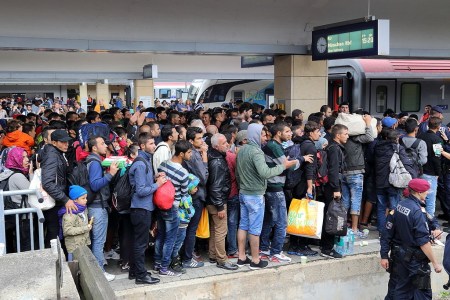
1607 (1)Thousands of newly arrived migrants, the vast majority of whom are men, crowd the platforms at Vienna West Railway Station on August 15, 2015 — a common scene in the summer and fall of 2015. (Image source: Bwag/Wikimedia Commons)

Critics of visa liberalization fear that millions of Turkish nationals may end up migrating to Europe. The Austrian newsmagazine, Wochenblick, recently reported that 11 million Turks are living in poverty and “many of them are dreaming of moving to central Europe.”

Other analysts believe Erdoğan views the visa waiver as an opportunity to “export” Turkey’s “Kurdish Problem” to Germany. According to Bavarian Finance Minister Markus Söder, millions of Kurds are poised to take advantage of the visa waiver to flee to Germany to escape persecution at the hands of Erdoğan: “We are importing an internal Turkish conflict,” he warned. “In the end, fewer migrants may arrive by boat, but more will arrive by airplane.”

In a refreshingly perceptive essay, Wolfram Weimer, a well-known German journalist, wrote that Erdoğan is exploiting Europe’s strategic weaknesses to advance Turkish imperialism and his goal of Islamizing the continent:

“A few days ago Erdoğan said: ‘No matter how uncouth, how merciless, how unscrupulous Western countries act, they have no chance of keeping the migration flows under control.’ In short, he sees mass migration as a political weapon to put Europe under pressure. In diplomatic and military circles, the word that has been circulating for months is ‘migration weapon’ because the Turkish secret service has been deliberately and massively promoting the migration of Muslims to Europe.

“Turkey now earns tremendous amounts of money on all sorts of migration services and has allowed the refugee industry to blossom. At the same time Erdoğan is openly pursuing the Islamization of Europe. With its religious authority Diyanet [a branch of the Turkish government’s Directorate for Religious Affairs that runs hundreds of mosques in Europe], Europe (and especially Germany) are being Islamized in a planned manner; the refugees play a key role, as do mosques, to give a ‘home’ to the faithful in a foreign land.

“Erdoğan’s favorite quote comes from a poem by Ziya Gökalp [1876-1924, a father of Turkish nationalism]: ‘The mosques are our barracks, the minarets are our bayonets.’ Erdoğan sees himself both domestically and internationally as a religious cultural warrior — as the patron saint of Islamist expansion.”

Far-right anti-Erdogan protest allowed to go ahead in Cologne on day of demonstrations

July 31, 2016

Far-right anti-Erdogan protest allowed to go ahead in Cologne on day of demons, Deutsche Welle, July 30, 2016

(How “far left” must Germany be when voicing displeasure with Erdogan is deemed “far right”? — DM)

Some three million people of Turkish origin live in Germany, making it the world’s largest Turkish diaspora.

***********************

A court in Münster has given permission for a far-right protest against Turkish President Erdogan to take place on Sunday in Cologne. Erdogan supporters will also be taking to the streets of the western German city.

erdogan protest

A spokesman for the Higher Administrative Court in Münster confirmed on Saturday that it had rejected an appeal by Cologne police to ban an anti-Erdogan demonstration called by the far-right political party Pro NRW for Sunday.

The court upheld an earlier decision by a Cologne court to allow the demonstration to go ahead, despite police fears that violent members of the HoGeSa (Hooligans Against Salafists) group could join in the protest.

The demonstration is to take place under the motto “No tributes to Erdogan in Germany: Stop the Islamist autocrat from the Bosporus” in response to a planned rally by up to 30,000 Erdogan supporters in the city on the same day.

No Erdogan live presentation

The Münster court, which is responsible for administrative disputes, also rejected an appeal by the organizers of the pro-Erdogan demonstration to be allowed to show the Turkish president live on a large screen during the event.

Police have voiced fears that such a presentation could cause participants to become over-excited.

Police in Cologne are planning to deploy 2,300 officers and have six water cannon on hand in case violence does break out at any of the demonstrations planned in the city on Sunday, which also include rallies by leftists and youth organizations affiliated with German parties.

fearÖzdemir warned of an “atmosphere of fear”

Erdogan critics ‘targeted’

In comments carried in the Saturday edition of the “Süddeutsche Zeitung” newspaper, Foreign Minister Frank-Walter Steinmeier called on participants in the pro-Erdogan demonstration to display moderation.

Steinmeier said it was “not permissible” to bring domestic political tensions from Turkey to Germany or to intimidate people with different political views.

The leader of the Greens, Cem Özdemir, also criticized alleged attempts at intimidation ahead of the demonstration, telling newspapers of the Funke media group that critics of President Recep Tayyip Erdogan among Germany’s Turkish community were being targeted.

Özdemir said that demonstrations for or against Turkish leaders had to take place “on the basis of the [German] legal system.”

“An atmosphere of fear must not be created,” he said.

Turkey in turmoil

Sunday’s demonstrations come as Erdogan continues with purges of the army, judiciary, the education system and the media following a failed coup on July 15.

Critics of the president fear that he might be using the coup as an excuse to increase his already tight political grip on the country.

Some three million people of Turkish origin live in Germany, making it the world’s largest Turkish diaspora.

Turkey’s Tradition of Murdering Christians

July 31, 2016

Turkey’s Tradition of Murdering Christians, Gatestone InstituteRobert Jones, July 31, 2016

(Please see also, Turkey’s Erdogan to US General: ‘Know Your Place’, which deals in large part with the U.S. relationship with Turkey. Turkey is “our” NATO ally and its membership in the European Union is still under consideration. — DM)

♦ Turkey’s countless agreements with Western organizations do not seem to have reduced the hatred for Christians there.

♦ In Turkey, it is “ordinary people” who murder or attack Christians, then the judiciary or political system somehow find a way of enabling the perpetrators to get away with the crimes. Most of these crimes are not covered by the international media and Turkey is never held responsible.

♦ While Muslims are pretty much free to practice their religion and express their views on other religions anywhere in the world, Christians and other non-Muslims can be killed in Turkey and other Muslim-majority countries just for attempting peacefully to practice their religion or openly express their views.

♦ “Multiculturalism,” which is passionately defended by many liberals in the West, could have worked wonders in multi-ethnic and multi-religious places such as Anatolia. But unfortunately, Islamic ideology allows only one culture, one religion, and one way of thinking under their rule: Islam. Ironically, this is the central fact these liberals do not want to see.

On 26 July, the northern French town of Saint-Étienne-du-Rouvray witnessed a horrific Islamist attack: Two Islamic State (ISIS) terrorists killed an 85-year-old priest, Jacques Hamel, in his church during Mass. Two nuns and two churchgoers were taken hostage.

The terrorists, who had pledged allegiance to ISIS and, shouting “Allahu Akbar”, slit the throat of the priest and captured the bloody episode on video, according to a nun who escaped the assault.

Such Islamist attacks might be new to EU member countries but not to Turkey. For decades, so many innocent, defenseless Christians in Turkey have been slaughtered by Muslim assailants.

Christians in Turkey are still attacked, murdered or threatened daily; the assailants usually get away with their crimes.

In Malatya, in 2007, during the Zirve Bible Publishing House massacre, three Christian employees were attacked, severely tortured, then had their hands and feet tied and their throats cut by five Muslims on April 18, 2007.

Nine years have passed, but there still has been no justice for the families of the three men who were murdered so savagely.

First, the five suspects who were still in detention were released from their high-security prison by a Turkish court, which ruled that their detention exceeded newly-adopted legal limits.

The trial is still ongoing. The prosecutor claims that the act “was not a terrorist act because the perpetrators did not have a hierarchic bond, their act was not continuous and the knives they used in the massacre did not technically suffice to make the act be regarded as a terrorist act.”

If the court accepts this legal opinion of the prosecutor, it could pave the way for an acquittal. However, given the many “mysterious” rulings of the Turkish judiciary system to acquit criminals, these killers could also be acquitted by a “surprise” ruling any time.

Ironically, Turkey’s President Recep Tayyip Erdogan said in March that it is necessary to redefine terrorism to include those who support such acts, adding that they could be journalists, lawmakers or activists. There was no difference, he said, between “a terrorist holding a gun or a bomb and those who use their position and pen to serve the aims” of terrorists.

In a country where state authorities are outspokenly so “sensitive” about “terrorism” and “people holding guns,” why are the murderers of Christians not in jail, and why is the prosecutor trying to portray the murders of Christians as “non-terroristic acts”?

Sadly, the three Christians in Malatya were neither the first nor the last Christians to be murdered in Turkey.

On February 5, 2006, Father Andrea Santoro, a 61-year-old Roman Catholic priest, was murdered in the Santa Maria Church in the province of Trabzon. He was shot while kneeling in prayer at his church. Witnesses heard the 16-year-old murderer shout “Allahu Akbar” (“Allah is the Greatest”) during the murder.

After the murder, a 74-year-old priest, Father Pierre François René Brunissen, from Samsun, led the next church service in Santoro’s church, which boasted barely a dozen members. Because no one volunteered to replace Santoro, Father Pierre was instructed to travel from Samsun to Trabzon each month to care for the city’s small congregation.

“This is a terrible incident,” Father Pierre said. “It is a sin to kill a person. After all of these incidents, I am worried about my life here.”

In July, 2006, he was stabbed and wounded by a Muslim in Samsun. The perpetrator, 53, said that he stabbed the priest to oppose “his missionary activities.”[1]

The attacks against the Christian culture in Anatolia continue in modern times — even after Turkey joined the Council of Europe in 1949 and NATO in 1952.

Turkey’s countless agreements with Western organizations do not seem to have reduced the hatred for Christians there. In March, 2007, as the Christian community of Mersin was preparing for the Easter, a young Muslim man with a kebab knife entered the church and attacked the priests, Roberto Ferrari and Henry Leylek.

Mersin, in southern Turkey, is home to Tarsus, the birthplace of Saint Paul, and to several churches dating from the earliest Christian era.

As the Christian roots of Anatolia weakened, so did its bonds with Western civilization. “The attack against the priest is an indicator that Ankara is not ready for Europe,” a Roman Catholic Cardinal and theologian, Walter Kasper, told the Italian newspaper, Corriere della Sera. “There is some amount of tolerance but there is not real freedom. Turkey has to change many things. This change is not about laws. A change of mentality is needed. But you cannot change mentality in one day.”

Bishop Luigi Padovese, Apostolic Vicar of Anatolia, said: “We do not feel safe. I am very worried. Fanaticism is developing in some groups. Some people want to poison the atmosphere and catholic priests are targeted. Anti-missionary films are broadcast on TV channels.”

At a commemorative ceremony for Father Santoro in February, Bishop Padovese said:

“Today, we are asking the question we asked four years ago: Why? We are also asking the same question for all other victims so unjustly murdered even though they were innocent. Why? What was it that they tried to destroy by murdering Father Andrea? Just a person or what that person represented? The aim of shooting Father Andrea was definitely to shoot a Catholic cleric. His being a Father became the reason of his martyrdom.

“The message of Christ on the cross is clear. ‘Father, forgive them, for they do not know what they do.’ Had they known, they would not have done that. It is wrong to extinguish a life to uphold an idea. It is wrong to think that a person who disagrees with us is at fault and should be destroyed. This is the fundamentalism that crumbles a society. For it wrecks coexistence. This fundamentalism — regardless of what religion or political view it belongs to — might win a few battles but it is doomed to lose the war. This is what history teaches us. I hope that this city and this country will turn into a place where people can live as brothers and sisters and unite for the common good for all. Is the Allah of all of us not the same?”

No, unfortunately, the Allah of all of us is not the same.

Just four months later, in June, 2010, it was Padovese’s turn to be murdered. This time the murderer was the Bishop’s own driver for the previous four years. The driver first stabbed the bishop, then cut his throat, while shouting “Allahu Akbar” during the attack.

At the trial, the driver said that the bishop was “Masih ad-Dajjal” (“the false messiah”), then twice in the courtroom he loudly recited the adhan (Islamic call to worship).

1737 (1)Father Andrea Santoro (left), a 61-year-old Roman Catholic priest, and 63-year-old Bishop Luigi Padovese (right), Apostolic Vicar of Anatolia, were two Christian priests murdered in Turkey in recent years.

In the territory where Christians once thrived, even converting to Christianity now creates serious problems.

“New Christians coming from Muslim families are often isolated and ostracized,” writes Carnes. “Turgay Ucal, a pastor of an independent church in Istanbul, who converted from Islam to Christianity said: “Buddhism is okay, but not Christianity. There was a history.”

And this history includes how indigenous Christians in Anatolia have been slaughtered by Muslims. [2]

The total population of Turkey is about 80 million; believers of non-Muslim faiths — mostly Christians and Jews — comprise 0.2%. Nevertheless, anti-Christian sentiment is still prevalent in much of the Turkish society. [3]

There seems to be a pattern: Murders of Christians are committed stealthily in Turkey: It is “ordinary people” who murder or attack Christians, then the judiciary or political system somehow finds a way of enabling the murderers or attackers to get away with what they have done. Sadly, most of these crimes are not covered by the international media, and Turkey is never held responsible.

Turkey, however, signed a Customs Union agreement with the European Union in 1995 and was officially recognized as a candidate for full membership in 1999. Negotiations for the accession of Turkey to the EU are still ongoing.

How come a nation that has murdered or attacked so many Christians throughout history, and which has not even apologized for these crimes, is considered even a suitable candidate for EU membership? Because of the threat of blackmail to flood Europe with Muslims? Turkey will flood Europe with them anyway. There is even a name for it: Hijrah, spreading Islam (jihad) by emigration. Exactly as Muslims have done inside Turkey.

And what kind of a culture and civilization have many Muslims built for the most part in the lands that they have conquered? When one observes the historical and current situation in Muslim-majority countries, what one mostly sees are murders, attacks and hatred: Hatred of non-Muslims, hatred of women, hatred of free thought and an extremely deep hatred of everything that is not Islamic. Many Muslims that have moved to the West have been trying to import political Islam to the free world, as well.

Muslim regimes including Turkey have not achieved civilized democratization that would enable all of their citizens — Muslims and non-Muslims — to live free and safe lives.

While Muslims are pretty much free to practice their religion and express their views on other religions or on atheism anywhere in the world, Christians and other non-Muslims can be killed in Turkey and other Muslim-majority countries just for attempting peacefully to practice their religion or openly express their views.

“Multiculturalism,” which is passionately defended by many liberals in the West, could have worked wonders in multi-ethnic and multi-religious places such as Anatolia. But unfortunately, Islamic ideology allows only one culture, one religion, and one way of thinking under their rule: Islam. Ironically, this is the central fact these liberals do not want to see.

Much of the history of Islam shows that the nature of Islamic ideology is to invade or infiltrate, and then to dominate non-Muslims.

In general, Muslims have never shown the slightest interest in peaceful coexistence with non-Muslims. Even if most Muslims are not jihadis, most do not speak out against jihadist attacks. Many thus appear quietly to support jihadis. That there are also peaceful Muslim individuals who respect other faiths does not change this tragic fact.

That is why non-Muslims in the West have every right to fear one day being exposed to the same treatment at the hands of Muslims. The fear non-Muslims have of Islamic attacks is, based on recent evidence, both rational and justified.

Given how unspeakably non-Muslims are treated in majority Muslim countries, including Turkey, who can blame them for being concerned about the possible Islamization of their own free societies?

Why does Turkey, which seems to hate its own Christians, want to have visa-free access to Christian Europe, anyway?

____________________________


[1] Christianity has a long history in Samsun – as in all other Anatolian towns. As Amisos, in Greek, it was one of the centers of the ancient Greek Pontos region, and helped spread the Christian influence in the region.

“After 1914 the Greek and Armenian populations were to dwindle considerably due to the organized death marches and other methods used by the Turks during the Greek and Armenian Genocides,” according to “Pontos World.”

Decades later, attacks against Christians are still commonplace. In December 2007, another Catholic priest, Adriano Franchini, 65, of Izmir was also stabbed and wounded during the Sunday church service by a 19-year-old Muslim.

Izmir, or Smyrna, was an ecclesiastical territory of the Ecumenical Patriarchate of Constantinople, and one of the Seven Churches of Asia mentioned by Apostle John in the Book of Revelation.

During the Ottoman era, Smyrna hosted one of the largest populations of Greeks and Armenians. Today, there is only a tiny Christian minority in the city. The devastation of the Greek culture in the city peaked during what is commonly known as the “Catastrophe of Smyrna.” The Turkish army destroyed the city in 1922, after the Great Fire of Smyrna. Turkish soldiers murdered many non-Muslim civilians, including dozens of priests and bishops, and forced countless Greek men to join labor battalions. Most Greeks fled their homes in the city to seek shelter in Greece and other states.

“The Great Fire of Smyrna,” wrote the author Ioanna Zikakou, “was the peak of the Asia Minor Catastrophe, bringing an end to the 3,000-year Greek presence on Anatolia’s Aegean shore and shifting the population ratio between Muslims and non-Muslims.”

According to the journalist Tony Carnes:

“Few nations have as rich a Christian history as Turkey. This is where Paul founded some of the earliest churches, including the church at Ephesus. Seven churches in this region were addressed in the Book of Revelation. Those in the early monastic movement found the caves of Cappadocia a near-perfect place to live out lives of prayer.

“But Christianity came under Islamic rule in Turkey in 1453 and steadily declined for centuries; the last 100 years have been the worst. In 1900, the Christian population was 22 percent. Now most experts estimate that there are fewer than 200,000 Christians nationwide, comprising less than 0.3 percent of the population.”

Today, in Islamized Anatolia, the members of the diminutive Christian minority are daily exposed to verbal or physical attacks. Kamil Kiroglu was born and raised in Turkey as a Muslim. At the age of 24, he became a Christian and served in the Turkish Church until 2009. After he became Christian, he was rejected by his family.

On January 8, 2006, Kiroglu was beaten unconscious by five young Muslim men.

“The attack followed church services,” writes the scholar John L. Allen Jr. in his book, The Global War on Christians. “Kiroglu later reported that one of the young men, wielding a knife, had shouted, ‘Deny Jesus or I will kill you now!’ Another reportedly shouted, ‘We do not want Christians in this country!’ As the attackers left, they told a friend of Kiroglu’s that they had left a gift for him. It turned out to be a three-foot-long curved knife, left behind as a further warning against Christian activity.”

“Turkey may be an officially secular state, but sociologically it’s an Islamic society. In general, the greatest threat facing Christians comes not from religiously zealous forms of Islam but from ultranationalists who see Christians as agents of the West, often accusing them of being in league with Kurdish separatists.”

In 2009, Bartholomew I of Constantinople, the Orthodox Christian Church’s Patriarch, said in aninterview with CBS that Turkey’s Christians were second-class citizens and that he felt “crucified” at the hands of Turkish state authorities.

[2] “The annihilation of the non-Turk/non-Muslim peoples from Anatolia started on April 24, 1915, with the arrest of 250 Armenian intellectuals in Istanbul,” wrote the columnist Raffi Bedrosyan.

“Within a few months, 1.5 million Armenians had been wiped out from their historic homeland of 4,000 years in what is now eastern Turkey, as well as from the northern, southern, central, and western parts of Turkey. About 250,000 Assyrians were also massacred in southeastern Turkey during the same period. Then, it was the Pontic Greeks’ turn to be eliminated from northern Turkey on the Black Sea coast, sporadically from 1916 onward.”

Orhan Picaklar, the pastor of the Samsun Agape Church, was kidnapped and threatened by Muslim locals in 2007. He said that people also tried to kidnap his 11-year-old son from his school. His church has been stoned countless times. Ahmet Guvener, the pastor of the Diyarbakir Protestant Church, said he received so many threats that he was awaiting death: “I will give a letter of attorney to a friend of mine. If I die, I want him to take care of my children.”

[3] See the yearly reports of the Association of Protestant Churches about rights abuses against Christians in Turkey.

Turkey – Roger Out

July 22, 2016

Turkey – Roger Out, Front Page MagazineCaroline Glick, July 22, 2016

turkey roger out

Originally published by the Jerusalem Post

On Wednesday, NATO Secretary-General Jens Stoltenberg insisted that the purge of thousands in the Turkish military – including a third of the serving generals – did not weaken the military.

Stoltenberg told Reuters, “Turkey has a large armed force, professional armed forces and… I am certain they will continue as a committed and strong NATO ally.”

It would be interesting to know whether the 1,500 US soldiers who have been locked down at Incirlik Air Base along with several hundred soldiers from other NATO countries since the failed coup Friday night would agree with him.

Following the failed coup, the Erdogan regime cut off the base’s external electricity supply and temporarily suspended all flights from the base.

The base commander Gen. Bekir Ercan Van and 11 other service members from the base and a police officer were placed under arrest.

Incirlik is the center of NATO air operations against Islamic State in Syria. It also reportedly houses 50 nuclear warheads. The atomic bombs belong to the US. They deployed to Turkey – under US control – as a relic of the Cold War.

It took US President Barack Obama two years of pleading to convince Turkish President Recep Erdogan to allow NATO forces to use the base at Incirlik. It was only after the Kurdish political party secured unprecedented gains in Turkey’s parliamentary elections last year, and Tayyip Erdogan decided to expand his operations against the Kurds of Iraq and Syria to dampen domestic support for the Kurds, that he agreed to allow NATO forces to use the base.

His condition was that the US support his war against the Kurds – the most effective ground force in the war against Islamic State.

Stoltenberg’s statement of support for Turkey is particularly troubling because Erdogan’s post-coup behavior makes it impossible to continue to sweep his hostility under the rug.

For nearly 14 years, since his AK Party first won the national elections in late 2002, Erdogan and his followers have made clear that they are ideologically – and therefore permanently – hostile to the West. And for nearly 14 years, Western leaders have pretended this reality under the rug.

Just weeks after AKP’s first electoral triumph, the Turkish parliament shocked Washington when it voted to reject the US’s request to deploy Iraq invasion forces along the Turkish border with Iraq. Turkey’s refusal to permit US operations from its territory are a big reason the Sunni insurgency in Iraq was able to organize.

It took the US some two months to take over northern Iraq. By that time, the Ba’athists had organized the paramilitary militias that later morphed into al-Qaida in Iraq and then, following the US withdrawal from Iraq in 2011, Islamic State.

Ever since then, Erdogan has paid lip service, and even assisted NATO and the EU from time to time, when it served his momentary interests to do so. But the consistent trend of his behavior has been negative.

Since taking power, Erdogan has galvanized the organs of state propaganda – from the media to the entertainment industry to the book world – to indoctrinate the citizens of Turkey to hate Jews and Americans and to view terrorists supportively.

This induced hatred has been expressed as well in his foreign policy. Erdogan was the first major leader to embrace Hamas after its electoral victory in the 2006 Palestinian Authority elections. He treated Hamas terror chief Ismail Haniyeh like a visiting monarch when he hosted him shortly after those elections.

During Hezbollah’s 2006 war against Israel, Turkey was caught red-handed as it allowed Iran to move weapons systems to Hezbollah through Turkish territory.

Erdogan has turned a blind eye to al-Qaida. And he has permitted ISIS to use Turkey as its logistical base, economic headquarters and recruitment center. Earlier this year the State Department claimed that all of the 25,000 foreign recruits to ISIS have entered Syria through Turkey.

As for Iran, until Obama engineered the lifting of UN sanctions against Iran through his nuclear deal with the ayatollahs, Turkey was Iran’s conduit to the international market. Turkey was Iran’s partner in evading sanctions and so ensuring the economic viability of the regime. According to a series of investigative reports by Turkish and foreign reporters, Erdogan’s family was directly involved in this illicit trade.

Then there is Europe. For ISIS, Turkey has been a two-way street. Fighters have entered Syria through Turkey, and returned to Europe through Turkey. Turkey is behind the massive inflow of Syrian refugees to Europe.

German Chancellor Angela Merkel tried to cut a deal with Erdogan that would stem the flow. Erdogan pocketed her economic concessions and did nothing to stop the hemorrhage of refugees to Europe.

As for the US, the years of anti-American incitement and indoctrination of Turkish society are now coming into full flower in the aftermath of the coup. Even before the dust had settled, Erdogan was pointing an accusatory finger at Washington.

Insisting that the failed coup was the brainchild of exiled Islamic cleric – and erstwhile ally of Erdogan – Fetullah Gulen, who took up residence in Pennsylvania’s Poconos Mountains 16 years ago – Erdogan demanded that the US immediately put Gulen on an airplane with a one-stop ticket to Turkey.

In the days that followed, the Erdogan regime’s accusations against the US became more and more unhinged. Prime Minister Binali Yildirim said that failure to comply with Erdogan’s extradition demand would be viewed as a hostile act by the US.

And Turkish Labor Minister Suleyman Soylu flat out said that “America is behind the coup,” in a media interview.

In other words, after arresting the base commander and other forces at Incirlik, and while effectively holding US-led NATO forces and 50 nuclear warheads prisoner for the past six days, Turkey is accusing the US of engineering the coup attempt.

But apparently, NATO has decided to try to again sweep reality under the rug, once more. Hence, Stoltenberg’s soothing insistence that there is no cause for worry. Turkey remains a trusted member of the alliance.

This isn’t merely irresponsible. It is dangerous, for several reasons.

First of all, Stoltenberg’s claim that the Turkish military is as strong as ever is simply ridiculous.

A third of the serving generals are behind bars along with thousands of commanders and soldiers, educators, police officers, jurists and judges.

Who exactly can be willing to take the initiative in this climate? Amid at best mixed messages from the regime regarding the war against ISIS, and with the generals who coordinated the campaign with NATO now behind bars, who will maintain the alliance with NATO ? No one will.

The implications of this passivity will be felt on the ground in Turkey as well as in Syria and Iraq.

Thanks to Erdogan’s passive support, ISIS has operatives seeded throughout Turkey. Who can guarantee that they will leave the nuclear weapons at Incirlik alone? Is the US really planning to leave those bombs in Turkey when its own forces are effective prisoners of the regime? And what are the implications of removing them? How can such a necessary move be made at the same time that NATO pretends that all is well with Turkey? Then there is the problem of chemical weapons.

In recent months, ISIS has used chemical weapons in Syria and Iraq. In February, James Clapper, the director of US national intelligence, warned that ISIS is developing a chemical arsenal and intends to use chemical weapons against the US and Europe.

In May it was reported that ISIS is conducting experiments with chemical weapons on dogs and prisoners in labs located in residential neighborhoods in Mosul.

Turkey is a NATO member with open borders to Europe, and the only thing that has prevented ISIS terrorists from bringing chemical weapons to Europe has been the Turkish military and police force. They are now being purged.

Moreover, as Soner Cagaptay reported in The Wall Street Journal this week, Erdogan used out and out jihadists to put down the coup on Friday night and Saturday. He has continued to embrace them in the days that have passed since then.

In so doing, Erdogan signaled that he may well use the post-coup state of emergency to dismantle what is left of Turkey’s secular state apparatus and transform the NATO member into an Islamist state, along the lines of the short-lived Muslim Brotherhood regime in Egypt, which Erdogan enthusiastically supported.

In this climate, it is difficult, if not as a practical matter impossible, to imagine that the military and police will work particularly hard to prevent ISIS terrorists from transporting weapons of mass destruction from Syria to Europe through Turkey.

The Obama administration is partly responsible for the current crisis. Secretary of State John Kerry just agreed to subordinate the US-led anti-ISIS campaign to Russia. In so doing, he made clear that the US will not protect Turkey from Russia. This gives Erdogan little choice other than to strike out a new, far more radical course.

To Erdogan’s own Islamist convictions and US incompetence must be added a third reason to assume the situation in Turkey will only get worse.

As David Goldman has reported in the Asia Times, Turkey is on the brink of economic collapse. Its currency has been devalued by 7 percent just since the failed coup. “With about $300 billion in foreign currency liabilities, Turkish corporations’ debt service costs rise as the currency falls. Stocks have lost more than half their value in dollar terms since 2013,” Goldman warned.

In the current climate, it is hard to imagine Erdogan instituting austerity measures to pay down the debt. So he needs a scapegoat for his failure. The chosen scapegoat is clearly the US.

To make a long story short then, the Turkish military is no longer capable of cooperating in any meaningful way with the US or NATO . Erdogan, never a reliable ally, is now openly hostile.

He is in the midst of committing aggression against NATO forces at Incirlik. And he is embracing Turkish jihadists who are ideologically indistinguishable from ISIS.

The US surrender to Russia means that America cannot protect Turkey from Russia. And Erdogan has chosen to blame American for Turkey’s fast approaching economic doomsday.

Under the circumstances, if NATO takes its job of protecting the free world seriously, it has no choice but to quit with the business as usual routine and kick Turkey out of the alliance, withdraw its personnel and either remove or disable the nuclear weapons it fields in the country.

As for anti-ISIS operations, the US will have to move its bases to Iraqi Kurdistan and embrace the Kurds as the strategic allies they have clearly become.

In the aftermath of the failed coup, Turkey is a time bomb. It cannot be defused. It will go off. The only way to protect the free world from the aftershocks is by closing the border and battening down the hatches.

Turkey Blackmails Europe on Visa-Free Travel

April 24, 2016

Turkey Blackmails Europe on Visa-Free Travel, Gatestone InstituteSoeren Kern, April 24, 2016

♦ The European Union now finds itself in a classic catch-22 situation. Large numbers of Muslim migrants will flow to Europe regardless of whether or not the EU approves the visa waiver for Turkey.

♦ “If visa requirements are lifted completely, each of these persons could buy a cheap plane ticket to any German airport, utter the word ‘asylum,’ and trigger a years-long judicial process with a good chance of ending in a residency permit.” — German analyst Andrew Hammel.

♦ In their haste to stanch the rush of migrants, European officials effectively allowed Turkey to conflate the two very separate issues of a) uncontrolled migration into Europe and b) an end to visa restrictions for Turkish nationals.

♦ “Why should a peaceful, stable, prosperous country like Germany import from some remote corner of some faraway land a violent ethnic conflict which has nothing whatsoever to do with Germany and which 98% Germans do not understand or care about?” — German analyst Andrew Hammel.

♦ “Democracy, freedom and the rule of law…. For us, these words have absolutely no value any longer.” — Turkish President Recep Tayyip Erdogan.

Turkey has threatened to renege on a landmark deal to curb illegal migration to the European Union if the bloc fails to grant visa-free travel to Europe for Turkey’s 78 million citizens by the end of June.

If Ankara follows through on its threat, it would reopen the floodgates and allow potentially millions of migrants from Africa, Asia and the Middle East to flow from Turkey into the European Union.

Under the terms of the EU-Turkey deal, which entered into effect on March 20, Turkey agreed to take back migrants and refugees who illegally cross the Aegean Sea from Turkey to Greece. In exchange, the European Union agreed to resettle up to 72,000 Syrian refugees living in Turkey, and pledged up to 6 billion euros ($6.8 billion) in aid to Turkey during the next four years.

European officials also promised to restart Turkey’s stalled EU membership talks by the end of July 2016, and to fast-track visa-free access for Turkish nationals to the Schengen (open-bordered) passport-free zone by June 30.

1534Turkish President Recep Tayyip Erdogan (left) has boasted that he is proud of blackmailing EU leaders, including European Commission President Jean-Claude Juncker (right), into granting Turkish citizens visa-free access to the EU and paying Turkey billions of euros.

To qualify for the visa waiver, Turkey has until April 30 to meet 72 conditions. These include: bringing the security features of Turkish passports up to EU standards; sharing information on forged and fraudulent documents used to travel to the EU and granting work permits to non-Syrian migrants in Turkey.

The European Commission, the administrative arm of the European Union, said it would issue a report on May 4 on whether Turkey adequately has met all of the conditions to qualify for visa liberalization.

During a hearing at the European Parliament on April 21, Marta Cygan, a director in the Commission’s migration and home affairs unit, revealed that to date Ankara has satisfied only 35 of the 72 conditions. This implies that Turkey is unlikely to meet the other 37 conditions by the April 30 deadline, a window of fewer than ten days.

According to Turkish officials, however, Turkey is fulfilling all of its obligations under the EU deal and the onus rests on the European Union to approve visa liberalization — or else.

Addressing the Council of Europe in Strasbourg on April 19, Turkish Prime Minister Ahmet Davutoglu said that Turkey has now reduced the flow of migrants to Greece to an average of 60 a day, compared to several thousand a day at the height of the migrant crisis in late 2015. Davutoglu went on to say that this proves that Turkey has fulfilled its end of the deal and that Ankara will no longer honor the EU-Turkey deal if the bloc fails to deliver visa-free travel by June 30.

European Commission President Jean-Claude Juncker has insisted that Turkey must meet all 72 conditions for visa-free travel and that the EU will not water down its criteria. But European officials — under intense pressure to keep the migrant deal with Turkey alive — will be tempted to cede to Turkish demands.

EU Migration Commissioner Dimitris Avramopoulos on April 20 conceded that for the EU it is not a question of the number of conditions, but rather “how quickly the process is going on.” He added: “I believe that at the end, if we continue working like this, most of the benchmarks will be met.”

European officials alone are to blame for allowing themselves to be blackmailed in this way. In their haste to stanch the rush of migrants to Europe, they effectively allowed Turkey to conflate the two very separate issues of a) uncontrolled migration into Europe and b) an end to visa restrictions for Turkish nationals.

The original criteria for the visa waiver were established in December 2013 — more than two years before the EU-Turkey deal — by means of the so-called Visa Liberalization Dialogue and the accompanying Readmission Agreement. In it, Turkey agrees to take back third-country nationals who, after having transiting through Turkey, have entered the EU illegally.

By declaring that the visa waiver conditions are no longer binding because the flow of migrants to Greece has been reduced, Turkish officials, negotiating like merchants in Istanbul’s Grand Bazaar, are running circles around the hapless European officials.

Or, as Turkish President Recep Tayyip Erdogan recently proclaimed: “The European Union needs Turkey more than Turkey needs the European Union.”

The European Union now finds itself in a classic Catch-22 situation. Large numbers of Muslim migrants will flow to Europe regardless of whether or not the EU approves the visa waiver.

Critics of visa liberalization fear that millions of Turkish nationals may end up migrating to Europe. Indeed, many analysts believe that President Erdogan views the visa waiver as an opportunity to “export” Turkey’s “Kurdish Problem” to Germany.

Bavarian Finance Minister Markus Söder, for example, worries that due to Erdogan’s persecution of Kurds in Turkey, millions may take advantage of the visa waver to flee to Germany. “We are importing an internal Turkish conflict,” he warned, adding: “In the end, fewer migrants may arrive by boat, but more will arrive by airplane.”

In an insightful essay, German analyst Andrew Hammel writes:

“Let’s do the math. There are currently 16 million Turkish citizens of Kurdish descent in Turkey. There is a long history of discrimination by Turkish governments against this ethnic minority, including torture, forced displacement, and other repressive measures. The current conservative-nationalist Turkish government is fighting an open war against various Kurdish rebel groups, both inside and outside Turkey.

“This means that under German law as it is currently being applied by the ruling coalition in the real world (not German law on the books), there are probably something like 5-8 million Turkish Kurds who might have a plausible claim for asylum or subsidiary protection. That’s just a guess, the real number could be higher, but probably not much lower.

“If visa requirements are lifted completely, each of these persons could buy a cheap plane ticket to any German airport, utter the word ‘asylum,’ and trigger a years-long judicial process with a good chance of ending in a residency permit.”

Hammel continues:

“There are already 800,000 Kurds living in Germany. As migration researchers know, existing kin networks in a destination country massively increase the likelihood and scope of migration…. As Turkish Kurds are likely to arrive speaking no German and with limited job skills, just like current migrants, where is the extra 60-70 billion euros/year [10 billion euros/year for every one million migrants] going to come from to provide them all with housing, food, welfare, medical care, education and German courses?

And finally, “the most important, most fundamental, most urgent question of all”:

“Why should a peaceful, stable, prosperous country like Germany import from some remote corner of some faraway land a violent ethnic conflict which has nothing whatsoever to do with Germany and which 98% Germans do not understand or care about?”

Turkish-Kurdish violence is now commonplace in Germany, which is home to around three million people of Turkish origin — roughly one in four of whom are Kurds. German intelligence officials estimate that about 14,000 of these Kurds are active supporters of the Kurdistan Workers’ Party (PKK), a militant group that has been fighting for Kurdish independence since 1974.

On April 10, hundreds of Kurds and Turks clashed in Munich and dozens fought in Cologne. Also on April 10, four people were injured when Kurds and Turks fought in Frankfurt. On March 27, nearly 40 people were arrested after Kurds attacked a demonstration of around 600 Turkish protesters in the Bavarian town of Aschaffenburg.

On September 11, 2015, dozens of Kurds and Turks clashed in Bielefeld. On September 10, more than a thousand Kurds and Turks fought in Berlin. Also on September 10, several hundred Kurds and Turks fought in Frankfurt.

On September 3, more than 100 Kurds and Turks clashed in Remscheid. On August 17, Kurds attacked a Turkish mosque in Berlin-Kreuzberg. In October 2014, hundreds of Kurds and Turks clashed at the main train station in Munich.

In an essay for the Financial Times titled “The EU Sells Its Soul to Strike a Deal with Turkey,” columnist Wolfgang Münchau wrote:

“The deal with Turkey is as sordid as anything I have ever seen in modern European politics. On the day that EU leaders signed the deal, Recep Tayyip Erdogan, the Turkish president, gave the game away: ‘Democracy, freedom and the rule of law…. For us, these words have absolutely no value any longer.’ At that point the European Council should have ended the conversation with Ahmet Davutoglu, the Turkish prime minister, and sent him home. But instead, they made a deal with him — money and a lot more in return for help with the refugee crisis.”