Archive for the ‘Trump and Israel’ category

Al Qaeda criticizes Saudi relations with West during President Trump’s visit

May 22, 2017

Al Qaeda criticizes Saudi relations with West during President Trump’s visit, Long War Journal May 22, 2017

Al Qaeda seized on President Donald J. Trump’s recent visit to Saudi Arabia to once again criticize the royal family and call for an uprising.

According to bin Laden, these early Saudi dealings with the West led to the British capture of Palestine and, later on, the establishment of the Israeli state.

Osama bin Laden liked to argue that there is a “Zionist-Crusader” conspiracy against Muslims. His son, Hamza, has continued with these themes, making it one of his central talking points and accusing the House of Saud of being part of it.

****************************

On May 20, al Qaeda’s propaganda arm, As Sahab, released an audio message from Hamza bin Laden. The junior bin Laden follows in his father’s footsteps by blasting the Saudi royal family. His speech is the second part in a series aimed at the House of Saud. Part 1, in which Hamza called for regime change, was released last August.

It’s not clear when Hamza recorded his latest anti-Saudi message. He does not mention President Trump or the American delegation. Instead, he focuses on the early decades of the Saudi dynasty, portraying it as a corrupt regime that serves the interests of the West. Still, al Qaeda undoubtedly wanted to maximize the audience for Hamza’s audio by releasing it during President Trump’s visit.

Then, on May 21, al Qaeda published the 15th issue of its Al Nafir Bulletin (seen below). The one-page newsletter is devoted to Trump’s visit. “The Al Saud rulers and all apostate rulers appear before us today in wasteful ceremonies to offer loyalty and renew their allegiance to the hateful Crusader master of the White House, Trump,” the newsletter reads.

Just hours before Al Nafir was released online, President Trump attended a ceremony with King Salman and Egyptian President Abdel Fatah al-Sissi to commemorate the opening of the Global Center for Combating Extremist Ideology in Riyadh. Unsurprisingly, Al Nafir’s editors criticize the move, arguing that the “rulers” had really committed to building “an apostate army to fight jihad and the Mujahideen in the name of fighting terror and terrorism.” The center will be used “to fight faith, purity, and commitment, under the call to fight extremism, backwardness, and intolerance,” al Qaeda contends.

In Al-Nafir, al Qaeda also argues that the Saudi government should give its money to the people instead of investing it in defense deals and other arrangements with the US. Al Qaeda uses these two issues — the Saudis’ supposed misuse of funds and the creation of the new center — to renew its call for jihad.

“So here are the Crusaders and the apostates, and they have stolen your money, fought your religion, shed your blood, and transgressed against your honor,” Al Nafir reads. “When will you return to your religion and do jihad in the cause of Allah?”

Hamza bin Laden’s critique of Ibn Saud

Al Qaeda has been raising Hamza’s media profile since the summer of 2015, when he was first introduced as a prominent jihadist figure. On May 13, just one week before Hamza’s new anti-Saudi message, As Sahab released another speech from Osama’s heir. In that talk, Hamza provided advice to “martyrdom seekers” living in the West. [See FDD’s Long War Journal report: Hamza bin Laden offers ‘advice for martyrdom seekers in the West’]

In his latest message, Hamza accuses the Saudi government of promulgating a false version of its own history, arguing that “generations have been raised” ignorant of what truly transpired during the first years of the 20th Century, when the House of Saud rose. Bin Laden is keen to undermine King Abdul Aziz bin Abdul Rahman Al Saud’s (Ibn Saud) legacy, portraying him as a witting agent of the British. Only when the proper history is told, Hamza says, will Muslims “understand the magnitude of the injustice brought upon” their country and then work to “restore” their “stolen rights.”

Bin Laden accuses Ibn Saud of working with the British from the beginning, seeking their “approval” before leaving Kuwait (where the Saud family lived) and conquering the city of Riyadh in 1902. Riyadh and large parts of the Arabian peninsula were controlled by Ibn Rashid’s men, who were allied with the Ottoman Empire at the time. Bin Laden says Ibn Saud could only expand his power at the expense of the Ottoman Empire’s allies and he sought assistance from the British to do it. This, from al Qaeda’s perspective, violates Islamic law, as Ibn Saud attacked fellow Muslims while working with the British.

According to bin Laden, the Saudi telling of Ibn Saud’s early conquests omits these “sharia violations,” including the assault on the Ottoman’s ally “to serve the English” and the “unlawful killing of Muslims.”

In the period leading up to World War I, the Ottoman government sought to reconcile the opposing forces inside the Arabian Peninsula. And so a deal was struck between the Ottomans and Ibn Saud, which granted the Saudi patriarch territorial rights in exchange for military cooperation and an agreement to prevent “foreign powers” from expanding their influence in the region. But Ibn Saud broke this agreement as well, bin Laden says, after he again sided with the British. (Ibn Saud’s territory was declared a British protectorate as part of a treaty in 1915.) Ibn Saud moved on the Turks’ main client, Ibn Rashid, despite their previous understanding. In so doing, bin Laden charges, the founder of the Saudi dynasty paved the way for “the English and their allies to occupy the homelands of the Muslims.”

Bin Laden reminds his audience that Captain William Henry Irvine Shakespear, a British emissary, served as Ibn Saud’s military adviser and had “command” of the Muslim forces while organizing “their ranks.” This was part of Britain’s broader “financial and military” support for Ibn Saud. This is all “clear evidence” of English support, bin Laden says, and led to “Crusader hegemony” over the region.

According to bin Laden, these early Saudi dealings with the West led to the British capture of Palestine and, later on, the establishment of the Israeli state.

Osama bin Laden liked to argue that there is a “Zionist-Crusader” conspiracy against Muslims. His son, Hamza, has continued with these theme, making it one of his central talking points and accusing the House of Saud of being part of it.

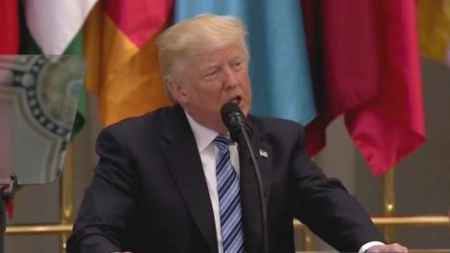
LIVE NOW President Donald Trump Israel Speech & Press Conference w/ Benjamin Netanyahu 5/22/17

May 22, 2017

LIVE NOW President Donald Trump Israel Speech & Press Conference w/ Benjamin Netanyahu 5/22/17 via YouTube

https://www.youtube.com/watch?v=_6-rQnxEj7k


Trump: Iran must disarm militias, never gain nuke

May 22, 2017

Trump: Iran must disarm militias, never gain nuke, DEBKAfile, May 22, 2017

Our military sources add: The issue of the pro-Iranian militias ties in directly with the battlefield confrontation building up in the past fortnight along Syria’s borders with Jordan and Iraq. DEBKAfile reports have disclosed the arrival of American and other Western special operations forces at a key crossing. They were followed this week by Russian elite contingents, who arrived nearby to support a Syrian-Iranian-Hizballah scheme to grab this vitally important border. The Americans are positioned there to prevent Iran from forging a land bridge from Tehran to Syria through Iraq by seizing control of this strategic border.

*********************

“We can declare with one voice that Iran must not be allowed to possess a nuclear weapon ever, ever and must cease training terrorists and militias immediately!’ said US President Donald Trump in a statement he issued at the Israeli president’s residence in Jerusalem on Monday on May 22, shortly after arriving in Israel.

“I come her to affirm that we are not only friends, but allies and will stand together always,” he went on to say and urged: “We must strengthen our cooperation, as we both face common threats from ISIS and other terrorists who foment terrible violence all over the world. Together we can end scores of years of violence,” he said.  Trump, who flew to Israel directly from Riyadh, reported on the strong consensus he found in the Muslim world on the need to stand up together against Iran.

He cited Saudi King Salman in this consensus, adding that the monarch and other Arab rulers feel strongly about the need for peace between Israel and the Palestinians. Many of them, he said, expressed the will to end extremism, after hearing his speech. He also found a growing realization among the Arab and Muslim leaders he met in Riyadh Sunday of “their common cause with Israel under threat from Iran” and a willingness to help in the peace effort.

Trump said he was honored to be in the homeland of the Jewish people. He commended Israel’s commitment to peace and said he looked forward to discussing the process with the Palestinian leader Mahmoud Abbas in Bethlehem Tuesday.

In a throwaway remark to reporters on arrival at the president’s residence, the US president said he had two first-rate envoys working on promoting a peace treaty, and named his special Middle East envoy Jason Greenblatt and the new US Ambassador to Israel, David Friedman. He joked: “If there is no peace, I’ll know whom to blame.”
President Reuven Rivlin said: We can’t wake up with Iran and Hizballah on our border. We want Iran out of Syria, out of Lebanon and away from our borders, and we must move forward to this goal together with America.”

DEBKAfile:  Donald Trump once again rebutted media evaluations of his trip to Israel as a demonstration of friendship without real content. Very shortly after his arrival, he stood up at the president’sl residence in Jerusalem and delivered a string of important policy statements and new revelations:

1. Iran would not be permitted to possess a nuclear weapon.

2, Iran must dismantle the Shiite terrorists and militias.

3. Iran must remove all those same foreign militias from Syria.

4. Iran must evacuate Hizballah forces from Syria and disarm this Lebanese Shiite organization.

5.  The Saudi King Salman had told him first hand of his fervent wish for an Israeli-Palestinian peace. Trump heard the same sentiment from other Arab and Muslim rulers.

Our military sources add: The issue of the pro-Iranian militias ties in directly with the battlefield confrontation building up in the past fortnight along Syria’s borders with Jordan and Iraq. DEBKAfile reports have disclosed the arrival of American and other Western special operations forces at a key crossing. They were followed this week by Russian elite contingents, who arrived nearby to support a Syrian-Iranian-Hizballah scheme to grab this vitally important border. The Americans are positioned there to prevent Iran from forging a land bridge from Tehran to Syria through Iraq by seizing control of this strategic border.

Trump: Israel is the homeland of the Jewish people

May 22, 2017

Trump: Israel is the homeland of the Jewish people, The Jewish Press, Gary Willig, May 22, 2017

Rivlin and Trump Reuters

Rivlin congratulated Trump on his arrival in Israel and said, “We are happy to see that America is back in the area. America is back again … Israel appreciates America’s leadership and your administration in the action you took in Syria.”

Trump congratulated Rivlin and thanked him for his warm hospitality. “I am honored to be in the great State of Israel, the homeland of the Jewish people. I am awed by the beauty and majesty of this sacred and very holy land.”

“This is an amazing country. What you have done, perhaps, has virtually never been done before. I come to this ancient land to reaffirm the enduring friendship between the United States and the State of Israel, and it will always be enduring,” Trump added.

*****************************

US President Donald Trump arrived Monday afternoon at the President’s Residence in Jerusalem and signed the guest book before beginning his working meeting with President Reuven Rivlin.

Rivlin congratulated Trump on his arrival in Israel and said, “We are happy to see that America is back in the area. America is back again … Israel appreciates America’s leadership and your administration in the action you took in Syria.”

“Even during our most difficult times, we have not given up on our dream of living here in peace with our neighbors,” Rivlin added, “Our destiny, Palestinians and Jews, is to live together in this land.”

Trump congratulated Rivlin and thanked him for his warm hospitality. “I am honored to be in the great State of Israel, the homeland of the Jewish people. I am awed by the beauty and majesty of this sacred and very holy land.”

“This is an amazing country. What you have done, perhaps, has virtually never been done before. I come to this ancient land to reaffirm the enduring friendship between the United States and the State of Israel, and it will always be enduring,” Trump added.

Trump addressed threats in the region. “Israel and America face common threats from ISIS and other terrorist groups to countries like Iran, that sponsor terrorism and foment terrible violence.”

He said that Israel and the US would speak with one voice to prevent Iran from obtaining nuclear weapons.

“Most importantly the United States and Israel can declare with one voice that Iran must never be allowed to possess a nuclear weapon — never ever — and must cease its deadly funding, training and equipping of terrorists and militias.”

A Dose of Reality in Riyadh

May 22, 2017

A Dose of Reality in Riyadh, Front Page MagazineBruce Bawer, May 22, 2017

Early on in his speech, Trump addressed his audience as friends and partners; within a few minutes, without pointing a finger, and without abandoning the collegial tone or the complimentary language, made it clear he was lecturing them. He was the boss, the capo di tutti capi, and he was laying down terms. This wasn’t Obama, who naively thought he could change the world with groveling apologies for the West, praise for Islam built on sheer fantasy, and yet another retelling of his own supposedly inspiring personal story – all the while oozing beta-male deference and docility. No; this was a man of power who – never once talking about himself – made expert use of that power, wielding an iron fist in a velvet glove. His message was unmistakable: either set aside this stupid religion (or at least rein it in, and now), join the modern world, and set your people free to dream, hope, create, grow, and prosper. Or else face the consequences. When, at the end, he summed up the assets of the Islamic world, he didn’t even mention Islam: he cited, among other things, its “spirit of enterprise” and ambitious young people. Where Obama had falsely attributed all kinds of past wonders to Islam, Trump imagined an implicitly Islam-free future in which the region could finally enjoy “glorious wonders of science, art, medicine, and commerce to inspire mankind.” 

*****************

On June 4, 2009, Barack Obama went to Cairo and delivered a speech, addressed to the Muslim world, that was full of praise for Islam and apologies on behalf of the West. In the address, entitled “A New Beginning” (“I’ve come here to Cairo,” he explained, “to seek a new beginning between the United States and Muslims around the world”), he called the university at which he was speaking (which, if it were anywhere in the West, would probably not be able to gain accreditation) “a beacon of Islamic learning”; he blamed tensions between the West and Islam largely on Western “colonialism”; he said “Salaam aleikum” and kept referring to “the Holy Koran”; he asserted, in a ridiculous example of hyperbole, that “Islam has always been part of America’s story”; he served up a big wallop of revised history, giving Islam unmerited praise for centuries-old accomplishments in science, architecture, music, art, and medicine and even holding it up as “a model of tolerance and equality” (at one point, he seemed to imply that in some ways women’s rights are more advanced in the Muslim world than in the U.S.); and, with utter predictability, he quoted the the “Holy Koran” out of context, plucking out that favorite verse of all Western apologists that supposedly teaches “that if one kills an innocent, it is as if it he has killed all of mankind.”

And of course, as always, he talked about himself: a descendant of “generations of Muslims” in Kenya; a man who, in his Indonesian boyhood, daily heard the beautiful Islamic call to prayer; a president who had “known Islam on three continents before coming to the region where it was first revealed.” As someone with such intimate ties to the Religion of Peace, asserted Obama, he saw it as part of his job to “fight against negative stereotypes of Islam.” Yes, he spoke about the need to fight terror, but he was quick to maintain that “Islam is not part of the problem” but rather “an important part of promoting peace.” He defended U.S. ties to Israel and recognized the “reality of the Holocaust,” but quickly pivoted to the “suffering” of Palestinians, the “pain of dislocation” they experienced, and the “daily humiliations” of the “occupation” – preaching, in short, to Israel from a Cairo pulpit. He quoted from the Talmud, but was careful not to call it holy. He implied that the histories of the Jews and Palestinians were equally tragic. And he preached to America too, suggesting that when Americans criticize the “choice” of women – and girls (!) – to wear hijab they were disguising their “hostility” to Islam “behind the pretense of liberalism.” Similarly, instead of thundering against the evil of 9/11, Obama apologized for the supposed excesses of some Americans’ responses to that atrocity, saying with nauseating chagrin that “in some cases it led us to acts contrary to our principles and our ideals.” Oh, and he vowed to close Guantánamo “by early next year.”

This Sunday, almost exactly as far into his presidency as Obama was when he gave his Cairo speech, Donald Trump spoke in Riyadh. For some of us, the very prospect of this appearance had been, to put it mildly, dismaying. Trump won the election, after all, largely because of his tough and bracingly realistic talk about Islam. Now, on his first trip abroad as president, he was going to Saudi Arabia. It was bad enough that this was a trip to a Muslim country. But Saudi Arabia isn’t just any Muslim country. It’s the mother of all Muslim countries. It’s the single most backward of them all. It’s a state sponsor of terrorism. It, and members of its royal family, have bankrolled mosques and madrassas and university departments of Middle Eastern Studies throughout the Western world – places that are nothing more than centers of Islamic propaganda. Most of the 9/11 hijackers, as the whole world knows, were Saudis. And the whole point of Trump’s visit to Riyadh was to celebrate a gigantic sale of U.S. arms to the Saudis on the premise that they represent a major bulwark against an even more dire threat, namely Iran. Nor was Trump just addressing the Saudis: also in attendance were the leaders of most of the other Muslim countries on the planet – in other words, a whole boatload of really nasty customers. It was hard not to conclude that Trump, like Obama, was going to try to brown-nose his way into a “new beginning between the United States and Muslims.”

The opening minutes of Trump’s speech certainly did nothing to dispel this expectation. It was gag-inducing to hear him praise the “magnificent kingdom” of Saudi Arabia, “the splendor of your country,” “the grandeur of this remarkable place,” and so on. It was absurd to hear him talk about working together with the ultra-extremist Saudis to eliminate “extremism.”

But then something happened. Even as he continued to serve up the usual glowing rhetoric about Islam being “one of the world’s great faiths,” and to refer to this and that as being “holy,” he made a couple of exceedingly elegant transitions. First, he began mixing the ethereal praise with realistic businessman-type talk about the value of international partnership. “We are not here to lecture, to tell other people how to live, what to do, who to be, or how to worship,” he said. “Instead, we are here to offer partnership” between the West and the Muslim world – a partnership that would bring prosperity to future Muslim generations. But he underscored the fact that in order for such a partnership to work, something would have to change. And it would have to change a lot. The Islamic world, he insisted, had to turn into a place where young Muslims could grow up “innocent of hatred.” And then he spelled out the results of that hatred, presenting first a roll call of some of the “barbaric attacks” on America – 9/11, Boston, San Bernardino, Orlando – and then a list of other places (“Europe, Africa, South America, India, Russia, China, and Australia”) where that hatred has manifested itself.

However delicately he worked his way around to it, it was nothing less than an accusation.

No, he didn’t explicitly charge Muslim leaders with funding terrorism – but he told them, in no uncertain terms, that they needed to cut off funds to terrorists. Nor did he explicitly blame Islam for terror or explicitly call it evil (as much as some of us would have loved to hear him do so) – but he came tantalizingly close to doing so, speaking bluntly about the “vile creed,” the “wicked ideology,” the “craven ideology”, that underlies terror. He did use the word “evil.” And, yes, he spoke of “Islamic” (not “Islamist” or “radical Islamic”) terror. And he made it clear he wasn’t just talking about terrorism – he was talking about Islam itself. He condemned “the oppression of women, the persecution of Jews, and the slaughter of Christians.” He warned: “barbarism will deliver you no glory. Piety to evil will bring you no dignity.”  Yes, “piety to evil.” Even as he continued to make flattering references to Islam, they felt increasingly pro forma, and it became increasingly manifest that he was identifying that religion as the root not just of terror but of all that is primitive and barbaric about that portion of the world in which it is most commonly practiced. In one remarkable passage, he listed a number of wonders of the Arab region of which his listeners should be proud. What was remarkable was that they were all wonders that dated to pre-Islamic times. In short, he was reminding these people that they had a proud history, a proud identity, that predated their prophet and that could, if they wished, help form the foundation of a new, free, forward-looking culture.

Of course, even to express such thoughts, in some Islamic countries, is considered heretical, illegal; but Trump did it in such a masterly way that you could imagine some of these Muslim big shots sitting there trying to figure out whether they should be offended or not.

In fact, it was all quite masterfully done. Early on in his speech, Trump addressed his audience as friends and partners; within a few minutes, without pointing a finger, and without abandoning the collegial tone or the complimentary language, made it clear he was lecturing them. He was the boss, the capo di tutti capi, and he was laying down terms. This wasn’t Obama, who naively thought he could change the world with groveling apologies for the West, praise for Islam built on sheer fantasy, and yet another retelling of his own supposedly inspiring personal story – all the while oozing beta-male deference and docility. No; this was a man of power who – never once talking about himself – made expert use of that power, wielding an iron fist in a velvet glove. His message was unmistakable: either set aside this stupid religion (or at least rein it in, and now), join the modern world, and set your people free to dream, hope, create, grow, and prosper. Or else face the consequences. When, at the end, he summed up the assets of the Islamic world, he didn’t even mention Islam: he cited, among other things, its “spirit of enterprise” and ambitious young people. Where Obama had falsely attributed all kinds of past wonders to Islam, Trump imagined an implicitly Islam-free future in which the region could finally enjoy “glorious wonders of science, art, medicine, and commerce to inspire mankind.”

Yes, it would have been terrific to hear an American president spell out the truth about Islam in a less nuanced, less diplomatic fashion. And it was frankly bizarre to hear Trump, in his closing moments, singling Iran out as uniquely malevolent after having heaped praise on other equally nefarious regimes whose leaders were right there in the room with him. But we critics of Islam have our jobs and Trump has his. Given the occasion and the purpose, this was, even at its worst, an immense improvement over Obama’s Cairo oration, and, at its best, a convincing assertion of authority, a strongly pitched demand for radical transformation, and a perfectly calibrated use of the carrot-and-stick approach.

No, international Islam is almost certainly beyond meaningful reform. But history has shown that it can at least be contained and controlled in ways that give citizens of Muslim-majority countries a certain degree of freedom and that keep to a minimum the scale of violence in the West originating in those countries. (The rampant Islamization of the West, and the concomitant increase in home-grown Islamic terror, are separate questions.) And no, a single speech can’t accomplish much of anything. But Trump’s tough presentation in Riyadh, if followed up by equally tough interactions with our “friends” in that audience, may well get a few things, here and there, moving in welcome directions.

We want peace, not a peace ‘process’

May 22, 2017

We want peace, not a peace ‘process’, Israel Hayom, Boaz Bismuth, May 22, 2017

After 100 years of conflict, this is what we’ve learned: There is no chance to advance toward peace as long as there is no Arab-Palestinian recognition of Israel as the Jewish state. Sadly, the war against us will continue no matter how much we withdraw. This land was never a separate, sovereign entity for any nation other than the Jewish people. Even Jerusalem only became important religiously and historically thanks to the Jews. These are the fundamental conditions for fruitful negotiations. For once, we would also like to hear the Palestinians declare out loud what they would accept as a final offer, one that would end the conflict and after which they would make no more demands.

********************

“I love the people of Israel,” you told me in the Oval Office. Seeing as this wasn’t our first interview — I had already gotten to know you rather well during the campaign — I know you were speaking from the heart, rather than trying to curry favor with me.

I know you are sincere when you say you are committed to the security and future of Israel. You believe the United States and Israel are allies that share common values, and that America must not forsake old friends. Your powerful bond with Israel and the Jewish people was not imposed on you by your position. There are even those who say that your affection for Israel is a family affair.

The commitment and affection between Americans and Israelis is mutual. There is a great deal of love in Israel for the U.S. and its people. Throughout your campaign, Mr. President, you had many supporters here in Israel. Less in the media and more on the street — see? I told you the U.S. and Israel have a lot in common.

Here in Israel, no one burns American flags. Not now and not ever. The American flag is almost as popular here as the Israeli flag. For us, both flags symbolize liberty and hope.

Mr. President, you arrive here from Saudi Arabia with a passion to see Israel and its neighbors make peace. We thank you for this genuine desire and wish you, and us, success in this endeavor. But you must know that the last thing we need is another failed peace process. We are tired of futile diplomacy that only leads to more bloodshed, prompting us to adopt a more sober view regarding the prospects of successful negotiations and tempering our faith in peace. We want peace, not a peace process.

The country of the Jewish people

After 100 years of conflict, this is what we’ve learned: There is no chance to advance toward peace as long as there is no Arab-Palestinian recognition of Israel as the Jewish state. Sadly, the war against us will continue no matter how much we withdraw. This land was never a separate, sovereign entity for any nation other than the Jewish people. Even Jerusalem only became important religiously and historically thanks to the Jews. These are the fundamental conditions for fruitful negotiations. For once, we would also like to hear the Palestinians declare out loud what they would accept as a final offer, one that would end the conflict and after which they would make no more demands.

In Riyadh on Sunday, we heard King Salman talk about the need to combat terrorism and warning of the Iranian threat that is jeopardizing the prospects of regional peace. Israel has been saying this for years. In your speech, you, too, sought to distinguish between good and evil. We need this distinction, after years of politically correct ambiguity.

You noted in your speech the need to combat the extremists; you mentioned Iran, al-Qaida, Hezbollah and Hamas. But this axis of evil claims the opposite: that Israel and the U.S. are responsible for terrorism around the world. College campuses across the U.S. are disgracefully portraying Israel as being responsible for terrorism.

But the sad truth is quite the opposite: For over 100 years, we have been subjected to murderous terrorism in various forms, long before the so-called “occupation.” Terrorism in Israel needs to be treated the same as terrorism anywhere else in the world. All terrorism draws on the same source.

There is no Zionism without Zion

Mr. President, you chose to visit during a festive week. Fifty years ago, Israeli soldiers liberated Jerusalem from foreign rule. It has been 1,835 years since Bar-Kokhba’s fighters entered the destroyed city in 132 C.E. They engraved coins with the words “To the freedom of Jerusalem” and commemorated King David, who made it the eternal city. Jerusalem is Zion. There is no Zionism without Zion. This is the place we yearned to return to for 2,000 years. Now that we have returned, nothing can ever cut out the heart of the Jewish people.

Israel welcomes you with blessings, Mr. President. We wish you a successful visit. We bless your arrival with these words: The Lord gives strength to His people; the Lord blesses His people with peace (Psalms 29:11).

Major US Jewish Organization Lauds Trump’s ‘Refreshing, Honest’ Speech in Saudi Arabia

May 21, 2017

Major US Jewish Organization Lauds Trump’s ‘Refreshing, Honest’ Speech in Saudi Arabia, Algemeiner, May 21, 2017

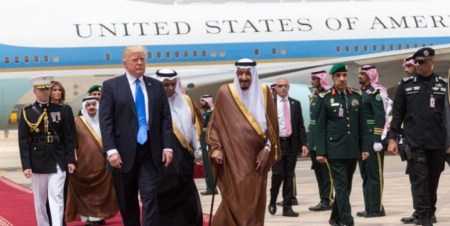
President Donald Trump arrives in Saudi Arabia. Photo: White House

A leading American Jewish advocacy organization praised Donald Trump’s speech to Muslim leaders in Saudi Arabia on Sunday, saying the president had demonstrated “refreshing honesty…in describing the Islamist extremist threat that developed in the Middle East years ago.”

“We agree that the fight against Islamist extremism is a battle between the forces of good and decency, on the one hand, and evil and a death cult, on the other, and that victory depends, above all, on what Arab and Muslim nations do to counter and defeat this violent, deadly scourge,” said David Harris, CEO of the American Jewish Committee (AJC), in a statement.

Trump issued an urgent plea to the leaders of more than 50 Muslim countries to join a “coalition of nations who share the aim of stamping out extremism and providing our children a hopeful future that does honor to God.”

Trump pointed out to his hosts that “in sheer numbers, the deadliest toll has been exacted on the innocent people of Arab, Muslim and Middle Eastern nations. They have borne the brunt of the killings and the worst of the destruction in this wave of fanatical violence.”

Trump pointedly included organizations other than ISIS on his list of terrorist organizations.

“The true toll of ISIS, al Qaeda, Hezbollah, Hamas, and so many others, must be counted not only in the number of dead. It must also be counted in generations of vanished dreams,” Trump declared.

“He could not have been clearer in his description of Hezbollah and Hamas as the terrorist groups they most assuredly are,” the AJC’s Harris added.

Palestinians: Tomorrow’s Secret ‘Day of Rage’

May 21, 2017

Palestinians: Tomorrow’s Secret ‘Day of Rage’, Gatestone InstituteBassam Tawil, May 21, 2017

(Perhaps Prime Minister Netanyahu will arrange for a bit of sightseeing or at least whisper in President Trump’s ear and provide some videos. — DM)

What is really driving this Palestinian hatred of Trump and the U.S.? The Palestinians and the Arabs have long been at war with what they regard as U.S. bias in favor of Israel. What they mean is that U.S. support for Israel stands in their way of destroying Israel.

Abbas is not going to tell Trump about the “Day of Rage” because it flies in the face of his repeated claim that Palestinians are ready for peace and are even raising their children in a culture of peace.

Once again, Abbas is playing Americans and other Westerners for fools. His people remain unwilling to recognize Israel’s very right to exist as a state for Jews. And so, Abbas will talk peace and coexistence while his people organize yet another “Day of Rage.”

Mahmoud Abbas and his Palestinian Authority (PA), preparing to welcome U.S. President Donald Trump to Bethlehem, are seeking to create the impression that their sentiments are shared by their people. Yet many Palestinians are less than enthusiastic about the visit.

It is in the best interests of Abbas and the PA to hide the truth that many Palestinians view the U.S. as an Israel-loving enemy.

While the PA president and his aides attempt to bury that inconvenient fact, they are also doing their best to cover up the truth that many Palestinians have been radicalized to a point that they would rather aim a gun or knife at Israelis than aim for peace with them.

The strongest and most vocal protests against Trump’s visit have thus far come from Ramallah, the de facto capital of the Palestinians.

Ramallah is regularly described by Western journalists as a base for moderation and pragmatism. It is in this city that Abbas and the top PA leadership live and work.

In a statement published earlier this week, the National and Islamic Forces in Ramallah and El-Bireh, a coalition of various Palestinian political and terror groups, called for a “Day of Popular Rage” in the West Bank to protest the imminent presidential visit.

In Palestinian-speak, a “Day of Rage” is a call for intensified violence and terrorism directed mainly against Jews.

The term was formally introduced during the First Intifada, which erupted in late 1987, and consisted of stone and petrol-bomb attacks against Israel Defense Force soldiers and Jews residing in the West Bank and the Gaza Strip.

Similarly, during the Second Intifada, which began in 2000, Days of Rage were associated with suicide bombings, drive-by shootings and other acts of terrorism and assorted crimes perpetrated against Jews living in the West Bank and Gaza Strip, as well as within Israel.

In recent years, Abbas’s Fatah faction and other groups, including Hamas, Islamic Jihad and the Marxist Popular Front for the Liberation of Palestine (PFLP) have used different occasions to urge Palestinians to declare a Day of Rage against Israel.

Generally speaking, such calls come in response to Jewish visits to the Temple Mount — visits that have been taking place since East Jerusalem was liberated from Jordanian occupation in 1967.

The visits were temporarily suspended, however, for security reasons in the first years of the Second Intifada, out of concern for the safety of visitors. It is worth noting that non-Muslims are allowed to tour the Temple Mount, as has been true for the past five decades. The Palestinians, however, are specifically opposed to Jews visiting the site, under the false pretext that Jews are plotting to rebuild their Temple after destroying the Islamic holy sites there. This charge is, of course, another Palestinian blood libel against Jews.

So here we are again. Palestinians are calling for marking Trump’s visit with a Day of Rage (read: heightened terrorism). The statement issued by the National and Islamic Forces in Ramallah and El-Bireh is a clear and direct invitation to Palestinians to take to the streets and mow down Jews.

What is really driving this Palestinian hatred of Trump and the U.S.?

From the Palestinian point of view, were it not for the U.S., the Palestinians and the Arabs would have succeeded long ago in achieving their goal of destroying Israel.

“We reject American bias in favor of Israel,” read the statement. “We call for popular marches and rallies to affirm our people’s adherence to their legitimate rights, including the right of return and self-determination.” The statement also warned against U.S. pressure on Abbas and the PA leadership to return to the negotiating table with Israel.

The so-called “right of return” demanded by Palestinians means the right to flood Israel with millions of Palestinians, in order to create an Arab-majority state where Jews would live as a minority. This would come in addition to the creation of another Palestinian state alongside Israel in the West Bank, Gaza Strip and East Jerusalem.

The Palestinians and the Arabs have long been at war with what they regard as U.S. bias in favor of Israel. What they mean is that U.S. support for Israel stands in their way of destroying Israel. They are saying: Only if Americans would stop supporting Israel financially, militarily and politically, we would be able to remove Israel from the face of the earth.

Neither Trump nor any members of his entourage is likely to notice the latest Palestinian Day of Rage. The strict, unprecedented security measures surrounding Trump’s planned visit to Bethlehem, and the fact that the stop is to last for only for 45 minutes, will make sure of that. Trump will not see Palestinians protesting against his visit. Nor will he see, during his visit, Palestinians closing their businesses and hurling stones and petrol bombs at Jews.

RAMALLAH, WEST BANK – MAY 15: (ISRAEL OUT) Palestinian demonstrators throw stones toward Israeli soldiers during clashes outside of Ofer Prison on May 15, 2012 near the West Bank city of Ramallah. Palestinians mark Israel’s establishment in 1948 with “Nakba” or “catastrophe” day on May 15, to remember the thousands of Palestinians who fled or were expelled during the creation of the Jewish state and the subsequent war. (Photo by Uriel Sinai/Getty Images)

Trump’s Palestinian hosts will do their utmost to disguise many unpleasant truths. For instance, they probably will not mention that Palestinians are taking to the streets to protest his visit as well as to go after Jews. Abbas is not going to tell Trump about the Day of Rage because it flies in the face of his repeated claim that Palestinians are ready for peace and are even raising their children in a “culture of peace.”

The Palestinian Day of Rage during Trump’s visit is a further sign of the increased radicalization among Palestinians and their unwillingness to accept Israel’s right to exist as a state for Jews. Days of Rage are far from contained responses to particular Israeli policies or actions on the ground. The Day of Rage can be traced to the Arab and Muslim world with the establishment of Israel in 1948, and continues to be used by Arabs and Muslims as a tool of terrorism.

In truth, such days are an expression of rage over the presence of Jews in a sovereign state in the Middle East, and of wrath over U.S. support for Israel and of Palestinian support for Hamas, Islamic Jihad and other terror groups. Days of Rage will continue as long as Palestinians continue to believe that Israel can and should be destroyed.

Once again, Abbas is playing Americans and other Westerners for fools. His people remain unwilling to recognize Israel’s very right to exist. And so, Abbas will talk peace and coexistence while his people organize yet another Day of Rage.

Saudi Royals signal the real magnitude of the deal they made with Trump

May 20, 2017

Saudi Royals signal the real magnitude of the deal they made with Trump, American ThinkerThomas Lifson, May 20, 2017

President Trump’s spectacular reception in Riyadh is a signal to the world (and to Saudi subjects, in particular) that big changes are coming. Elderly and frail King Salman ventured out onto the apron in 110 degree heat and actually shook Melania Trump’s hand as she deplaned Air Force One, thereby touching a female infidel.


Perhaps even more important in terms of Saudi daily life, the women in attendance at functions did not wear head coverings and abayas.  The entire nation saw this on television and understands that the fracking-created global oil glut changes everything, that the infidels no longer cower in fear of a cutoff of the oil that Allah granted to the protectors of the holy cities of Mecca and Medina.  The old arguments of the fanatics hold less water.  Change is coming. The King signaled that the restrictions declared by the Wahhabi clergy are no longer the ultimate arbiter of personal behavior, and that Saudis are going to have to start respecting the customs of the infidels.  Something like his handshake gesture can seem trivial, quaint, or even humorous to Americans, but it is very serious business. The role modeling of the women at the highest and most formal level reaches deep into the culture.

It is now clear that the King and his two designated successors (Crown Prince Muhammad bin Nyef and Mohammad bin Salman) have made a deal to liberalize Saudi Arabia. The deal-maker president has told them that there is a price of continued American support.

This would be against the wishes of powerful factions of the Saudi Royal Family (about 5,000 strong), some of whom are closely aligned with (and fund) the radical Wahhabi clergy. For decades, the (principally) Saudi-funded Wahhabis have poisoned the Ummah (the global Muslim community) with their feudal views. Saudi Arabia only became mega-wealthy in the 1950s, and the world’s Muslims were not violently engaged in much jihad. The Wahhabi clergy and the Saudi-funded mosques they brought with them prepared the soil for Al Qaeda at home and abroad.

Make no mistake: there is every possibility that a violent reaction or a coup within the Royal Family if sufficiently provoked. The clergy are important because they preach to the Saudi masses, and could whip them up into an attempt at an overthrow of the corrupt Royals who siphon off so much of Allah’s bounty for their own decadent pleasures, many of them haram. That is why Saudi Arabia has such a large investment in its security forces. The plan is for them to remain loyal in the event of an uprising, but man plans and Allah laughs.

The Royals are in a very delicate position.  The dominant faction, the King and his two designated successors, have to loosen things up gradually, step by step, so as to not put their opponents over the edge into a revolt that would brutally slaughter untold numbers, quite possibly including themselves. Like the mythological frog in a pot of water on the stove, they have to increase the heat very slowly.

They have already agreed to a deal to reward President Trump with a massive arms purchase worth $109.7 billion. That’s jobs and profits. But this aspect of the deal, from the New York Times, is important:

 On the afternoon of May 1, President Trump’s son-in-law, Jared Kushner, welcomed a high-level delegation of Saudis to a gilded reception room next door to the White House and delivered a brisk pep talk: “Let’s get this done today.”

Mr. Kushner was referring to a $100 billion-plus arms deal that the administration hoped to seal with Saudi Arabia in time to announce it during Mr. Trump’s visit to the kingdom this weekend. The two sides discussed a shopping list that included planes, ships and precision-guided bombs. Then an American official raised the idea of the Saudis’ buying a sophisticated radar system designed to shoot down ballistic missiles.

Sensing that the cost might be a problem, several administration officials said, Mr. Kushner picked up the phone and called Marillyn A. Hewson — the chief executive of Lockheed Martin, which makes the radar system — and asked her whether she could cut the price. As his guests watched slack-jawed, Ms. Hewson told him she would look into it, officials said.

Mr. Kushner’s personal intervention in the arms sale is further evidence of the Trump White House’s readiness to dispense with custom in favor of informal, hands-on deal making. It also offers a window into how the administration hopes to change America’s position in the Middle East, emphasizing hard power and haggling over traditional diplomacy.

This is a tangible and personal signal to the factions of the Saudi family represented in the high-level delegation. An Orthodox Jew, married to the favored child of the President (who became a Jew herself) saved them money using his personal connections. Call me suspicious but I think this was carefully planned theatre. You have to see this against the background of the sudden new confluence of interests between Israel and Saudi Arabia, united in opposition to Iran and Arab Radical Islamic terrorists. The two nations already covertly cooperate, a ruse that cannot last forever. Slowly and surely the Saudis have to turn away from the Palestinians and toward an embrace of Israel.  And it turns out that there can be a considerable upside to making peace with Israel and the Jews.

So, where do the Saudis go from here? How do they demonstrate to Trump, the world, and their own subjects that things are changing, and that it is acceptable.

My guess is that a symbolic measure that does not affect anyone in Saudi Arabia would be the next step. An easy one would be to end the prohibition against Israeli civilian airliners flying over Saudi airspace when flying eastward toward India, Thailand, and beyond. Israel’s economic and tourism ties with Asia are large and growing, so this restriction, which adds hours and costs, is an irritant to Israelis, as well as a political statement to the world that Israel is illegitimate.

The fact is that President Trump’s planned nonstop Air Force One flight from Riyadh to Ben Gurion Airport in Israel will be the first publicly-known flight between the two nations. (There is a decent chance that secret flights have taken place because the governments do talk to each other covertly.) So Trump is already liberalizing their aviation restrictions.

Allowing Israeli airliners to fly over Saudi territory would be a good first step toward eventual direct flights, a sign of complete acceptance of Israel as a legitimate nation, which is the only long term solution to peace between Arabs and Jews in the Middle East. It is a long path, but there is no alternative to a step at a time, given the delicate political situation of the Saudi Royals.

It is clear to me that President Trump has made a transformational deal, and that the West has stake in helping it come to fruition.

Reflections on Trump’s First State Visit to the Middle East

May 19, 2017

Reflections on Trump’s First State Visit to the Middle East, The National InterestAhmed Charai, May 19, 2017

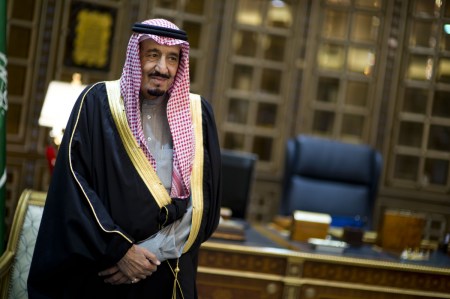
King Salman of Saudi Arabia in 2013. Flickr/Secretary of Defense

The Trump administration, working alongside its Arab allies, should promote moderate or quietist forms of Islam, and not remain neutral on religious matters. This means working with Islamic leaders, many of whom are state-funded imams, to challenge jihad on a religious basis and offer a form of faith shorn of violence.

These strategic insights come together in Morocco, where King Mohammed VI has used his religious role as commander of the faithful to inspire religious leaders to combat jihadism and urge tolerance and peace.

******************************

President Trump is visiting the Middle East. He will travel to Saudi Arabia and Israel, then visit the Vatican. Given the sequence of the first two, some observers speculated that he will attempt to revive the Israeli-Palestinian peace process, perhaps within a broader, regional framework. But different potential outcomes for Arab-Israeli relations, short of a peace settlement, may also be in the offing.

Both Saudi Arabia and Israel have proven themselves to be invaluable partners to the United States in the struggle against ISIS. An American-brokered framework whereby direct cooperation between the two is formalized—rather than a reliance on the United States as an intermediary—may create a framework to broaden the cooperation. Heightened partnership to counter the shared threat of Iran would be an obvious next step. The Trump administration’s new strategy is the creation of a regional alliance, focused on the Gulf countries but also including countries such as Egypt, Jordan and Morocco. A multilateral approach in which Israel plays a more direct and visible role in the coalition would signify a breakthrough. It would bolster confidence among Arab publics that broader cooperation and conflict resolution are warranted.

Donald Trump made the eradication of the Islamic State a priority during his campaign. He has been criticized for his more muscular strategy, as well as the desire to augment intelligence, economic and communications measures to put the screw to the organization.

It seems possible that the president is making a clean break with the Obama administration’s policy of disengagement from the Middle East. For Trump, the rubric of a “war on terrorism” seems to be appealing. Arabs appreciate the fact that, unlikely his predecessor, Trump appears to be recognizing the Shia extremist terror threat as represented by Iran and its proxy militias alongside the widely recognized Sunni jihadist threat.

In the view of this administration, this alliance should function like NATO, as an alliance (perhaps supported by the West) with multiple objectives. The eradication of Islamic State is the main objective, but the containment of Iranian influence in the region is also on the menu.

The use of a massively powerful bomb against the Islamic State in Afghanistan provided a mighty demonstration of strength, but may also have been intended to send a message about the president’s commitment to confront his adversaries with some of the most powerful tools in his arsenal.

But of course, matters are not so simple.

At the geostrategic level, Russia and the pro-Iranian Shia arc cannot be ignored politically. The alliance between the two poses layers of complexity, whereby American and Russian accounts in the Baltic states and vis à vis NATO may be dragged into the diplomatic mix. Moscow cannot be excluded from the equation in any prospective political resolution in Syria. As for Iran, Russia wields heavy influence on its government and its security sector. Trump faces a Twister-like game of challenges in navigating the array of alliances, rivalries and hostilities among the players. Yet his aspiration to eradicate the Islamic State and block Iranian expansion in the region depends on his effective management of these quandaries.

Nor do Trump’s aspirations allow for neglect of the broader counterterrorism challenge beyond military action, intelligence work and even diplomacy. He must wage an ideological war, and challenge extremist strands within Arab and Islamic societies that guarantee the perpetuation of conflict—whatever the outcomes on the battlefield—unless they are addressed.

The Trump administration, working alongside its Arab allies, should promote moderate or quietist forms of Islam, and not remain neutral on religious matters. This means working with Islamic leaders, many of whom are state-funded imams, to challenge jihad on a religious basis and offer a form of faith shorn of violence.

These strategic insights come together in Morocco, where King Mohammed VI has used his religious role as commander of the faithful to inspire religious leaders to combat jihadism and urge tolerance and peace.

King Mohammed VI has demonstrated his commitment to deeper cooperation with neighboring countries by embarking on several state visits and signing an unprecedented number of economic-partnership conventions. He has also expressed support for joint efforts to combat radicalization, and officials from Cote d’Ivoire, Niger, Tunisia, and Guinea have indicated a willingness to train their imams in Morocco.

If Trump is looking for a healthy example of Muslim leaders bringing peace through Islam, Morocco is a good place to start.