Saudi military sources reported Saturday, June 6, that Patriot air defense batteries had intercepted Scud missiles fired by Yemen Houthi rebels against the kingdom’s largest air base at Khamis al-Mushait in the south west. It is from there that Saudi jets take off to strike the Yemeni rebels. DEBKAfile’s military sources report that the Patriot anti-missile systems, which were activated for the first time, were manned by American teams. This was the first direct US military intervention on the Saudi side of the Yemen conflict.
It was also the first time that Houthi rebels or their allies had fired Scud missile into the oil kingdom. Our sources add that the launch was supervised by Hizballah officers. They were transferred by Tehran to Yemen to ratchet up the conflict – although US, Saudi, Yemeni government and Houthi representatives meeting secretly in Muscat Friday agreed to attend a peace conference in Geneva this month.
Nonetheless, through Friday night and Saturday morning, Houthi forces and allied military units kept on battering at Saudi army and National Guard defense lines, in an effort to break through and seize territory in the kingdom’s southern provinces. The insurgents were evidently grabbing for strategic assets to strengthen their hand at the peace conference.
Iran’s supreme leader Ayatollah Ali Khamenei is also juggling his chips on the deteriorating Syrian warfront. In the coming hours, he is widely expected to announce the activation of the mutual defense pact signed between Iran and Syria in 2006, under which each signatory is committed to send military troops if necessary to defend its partner.
Thursday, June 4, Khamenei fired sharp verbal arrows at the Obama administration: “The United States tolerates extremist groups in Syria and Iraq and even helps them in secret,” he charged.
Our military sources add that although various Mid East publications, especially in Lebanon, are reporting that Iran has already sent units in numbers ranging from 7.000 to 15,000 troops to Syria, none have so far landed, except for the Shiite militias brought over at an earlier stage of the Syrian conflict. The expected Khamenei announcement may change this situation.
ISIS was not waiting. Saturday morning, the group issued a warning to the Syrian rebel forces fighting in the south – the Deraa sector of southern Syria near the meeting point of the Jordanian and Israeli borders and the Quneitra sector opposite the Israeli Golan. They were ordered to break off contact with the US Central Command Forward Jordan-CF-J which is located north of Amman, and the IDF operations command center in northern Israel. Any Syrian rebels remaining in contact with the two command centers would be treated as infidels and liable to the extreme penalty of beheading, the group warned.
The impression of ominous events brewing in the regime was rounded off Friday night by an unusual announcement by the Israeli army spokesman that Iron Dome anti-missile batteries had been deployed around towns and other locations in the south, although no reference was made to any fresh rocket attacks expected from the Gaza Strip. DEBKAfile adds: The first batteries were arrayed Thursday night, June 4, at vulnerable points in southern Israel – from the southernmost Port of Eilat on the Gulf of Aqaba to the western Port of Ashdod on the Mediterranean.
The victories against IS in early 2015 have proven ephemeral — or have been nullified by IS gains elsewhere. On Sunday, CIA director John Brennan said on Face the Nation, “I don’t see this being resolved anytime soon.” Assad’s vaunted offensives of February 2015 have fallen short as the regime faced stiff resistance from a wide variety of opposition fighters, including elements from IS. The failure was alarming in part because the campaign was designed and aided by both Hezbollah and the Iranians, two seemingly ascendant Shia powers.
************************
Just a few months ago, analysts and policy-makers were certain that the defeat of Islamic State (IS) forces was simply a matter of time.
Coalition airstrikes would degrade the group’s capabilities and eventually allow Iraqi forces and Kurdish Peshmerga — though discredited by their poor military showing in mid-2014 — to push back the extremists. And indeed, IS fighters were ejected from Tikrit in March 2015 by the Iraqi army and thousands of motivated fighters from Shia militias. In Kobani in northern Syria, IS fighters were defeated by Syrian Kurdish fighters. Elsewhere in the country, the regime of Bashar al-Assad was going on the offensive with help from Hezbollah and advisers from the Iranian Revolutionary Guard.
The Islamic State, however, rose like a phoenix from the ashes of every setback. And today, the situation is not so rosy.
The victories against IS in early 2015 have proven ephemeral — or have been nullified by IS gains elsewhere. On Sunday, CIA director John Brennan said on Face the Nation, “I don’t see this being resolved anytime soon.” Assad’s vaunted offensives of February 2015 have fallen short as the regime faced stiff resistance from a wide variety of opposition fighters, including elements from IS. The failure was alarming in part because the campaign was designed and aided by both Hezbollah and the Iranians, two seemingly ascendant Shia powers.
The Syrian regime’s resources are stretched thin and the rate of desertion among its military is increasing; in short, it is running out of manpower to face the myriad opposition factions in set-piece battles. The Alawites, the sectarian community that dominates the top echelons of the regime, are circling the wagons and building popular militia forces to defend their own turf rather than seeking to re-conquer lost territory — IS now reportedly controls half of Syria — in the eastern and southern parts of the country. The appearance of IS fighters in Palestinian refugee camps on the outskirts of Damascus, along with the fall of Tadmor — the modern city on the site of Palymra — merely intensifies the sense of doom and gloom in Damascus.
The situation in Iraq is just as complicated, something that the Obama administration appears either oblivious to or reluctant to acknowledge. Much of the US strategy continues to hinge on what is increasingly a mirage: a unified, albeit federal, Iraq under the control of Baghdad. Meanwhile, the resilience of IS is greatly enhanced by the ability of its military forces to innovate and adapt faster on the ground than its lackluster opponents.
In light of the constant aerial strikes by the US and its allies, IS has dispersed and made its forces more mobile, no longer presenting dense concentrations of fighting men as it did when it seized Mosul in mid-2014. Instead, when IS seized Ramadi in May 2015, it made use of inclement weather and sent several small units from different directions simultaneously into the city aided by suicide bombers. Moreover, the fact that the group faced ill-equipped and poorly motivated Sunni fighters in and around Ramadi did not do anything for Baghdad’s standing with the country’s already alienated Sunni community, which had pleaded for arms while caught between the unfathomable brutality of IS and revengeful Shia militias.
Many Sunnis are now angling for their own “super-region,” one that would have considerable independence from Baghdad. The problem? In order to have it, the Sunnis would need to first defeat IS. Currently, they’re unable to do so because they lack the resources; despite all the talk from Baghdad and Washington about arming Sunni tribes, Baghdad is not actually keen to do so.
And besides, the Sunnis seem relatively ambivalent about defeating IS. They took an unequivocal stance between late 2006 and 2009, when they joined with the Americans and the Iraqi government to deal the Islamist militants what was then seen as a decisive blow. Now, however, despite Sunnis’ resentment and fear of IS, the Islamists’ existence is seen as a kind of insurance policy against Shia revanchism should Baghdad succeed in retaking the three Sunni provinces of Anbar, Salahuddin, and Ninevah.
The “victory” of the Iraqi government in Tikrit was more propaganda than reality; a few hundred IS fighters managed to inflict considerable damage on the Shia militias that had been mobilized to fight alongside the Iraqi army, then withdrew because they were outnumbered and wished to avoid being surrounded. The IS forces in Tikrit simply felt that they had done enough damage; there was no need to waste further assets in an untenable situation.
Militarily, the Iraqi Shia militias are better motivated and more dedicated than the regular army. Anecdotal information out of Baghdad suggests that Iraqi Shias are wondering whether the government should invest more effort building these forces into an effective and more organized parallel army. Even that parallel army, however, might be reluctant to commit to any significant long-term offensive to reclaim provinces full of “ungrateful” Sunnis.
But the Shia are willing to die to defend what they have, and there is increased sentiment among the Shia in central Iraq and Baghdad, along with the southern part of the country, that they would be better off without the Sunnis. There also exists the belief that the Kurds have more or less opted out of the Iraqi state despite the fact that they maintain a presence within the government in Baghdad. The Shia would seemingly not be sorry to see them exit the government in a deal that would settle as best as possible divisions of resources and territory. However, whether the Kurds would take the plunge and opt for de jure rather than de facto independence is a question that is subject to regional realities — How would Ankara and Tehran react? — rather than merely a matter of a deal between Baghdad and Erbil.
The Islamic State will continue to be a profound geopolitical problem for the region and the international community, and a long battle lies ahead. Syria and Iraq are more or less shattered states; it is unlikely that they will be put back together in their previous shapes. If Assad survives 2015, it will be as head of a rump state of Alawites and other minorities protected by Hezbollah, Iran, and Alawite militias. Shia Iraq will survive, and will possibly dissociate itself from the nettlesome Sunni regions. The Kurds will go their own way step by step. The international community is currently at a loss for how to stem the flow of foreign fighters to the IS battlefields — and even more serious is the growing sympathy and admiration for the group in various parts of the world among disgruntled and alienated youth.
If the US is serious about defeating IS, it needs to take on a larger share of the fight on the ground. This means more troops embedded with regular Iraqi forces in order to bring about better command, control, and coordination. It also means advisors who can continue to train these forces so that they improve over time. If this is not done, the regular Iraqi military will continue to be nothing more than an auxiliary to the more motivated — and pro-Iranian — Shia militias. Currently, militia commanders are giving orders to the regular military; that cannot be good for morale.
If the world is not serious about taking on and defeating IS, we can expect the group to continue to consolidate itself and expand its territory opportunistically. IS does have problems with consolidating its authority over the areas it rules; while it has to fight to maintain its ideological raison d’etre, it also has to provide services for the people over which it holds sway. While the two are not mutually exclusive, doing both becomes a resource and personnel enterprise that the militants may not be able to sustain. Given its own internal ideological and expansionist dynamics, the group’s future hinges on continuing to fight.
This month, the Islamic State celebrates the first anniversary of its self-declared caliphate. The group has little reason to fear it will be the last.
Which way will Obama go now? Will he be another Johnson or a Bush? All signs, alas, point to the former. Thus it is particularly appropriate that to show progress (what used to be known as “light at the end of the tunnel”) the administration is now resorting to the discredited body counts of Vietnam days.
**********************
The Obama White House’s mental synapses must be short-circuiting right now. If the president were a robot (rather than just being a bit robotic), he would by now be repeating over and over: “Does not compute! Does not compute!” Neither of his basic operating assumptions about the anti-ISIS campaign are coming true; in fact, both are being refuted by reality in ways that suggest a fundamental flaw in the underlying mental software.
Assumption No. 1 was that a US air campaign could degrade ISIS and allow its defeat by US allies on the ground. There is no question that the US air campaign has taken a toll. Deputy Secretary of State Tony Blinken just bragged that 10,000 ISIS fighters have been killed since the start of bombing in August. Yet this is hard to square, as Bill Roggio notes at Long War Journal, with previous CIA estimates that ISIS only had 20,000 to 30,000 fighters. If Blinken’s number is right, ISIS should have lost one-half to one-third of its fighters, yet somehow during that time it has actually gained ground in both Iraq and Syria — oh, and estimates of its overall strength have not varied.
This means that either previous CIA estimates were gross underestimates (Roggio believes ISIS had at least 50,000 fighters to begin with) or that it has managed to replenish its losses—or both. Either way, what we are seeing now is what President Lyndon Johnson and Gen. William Westmoreland discovered for themselves in Vietnam: namely that it’s impossible to win a war of attrition against a foe that has a lot more will to fight and suffer losses than you do.
Assumption No. 2 can be summed up as “the enemy of my enemy is my friend.” In both Syria and Iraq, the Obama administration calculated that Iran was the enemy of ISIS — after all, the Iranian regime is Shiite and ISIS is a Sunni organization. Thus the administration has tacitly embraced Iran’s allies — Iraqi Shiite militias and the Syrian regime of Bashar Assad — as the lesser evil in the expectation that they would do for us the dirty work of stopping ISIS. It’s a little hard to square this naïve assumption with the latest news, aptly summed up in a New York Times headline: “Assad’s Forces May Be Aiding ISIS Surge.” There are credible reports that Assad’s air force is making bombing runs in support of an ISIS offensive to capture Aleppo, a major city, from other rebel groups.
Why would Assad do this? Because he wants to reduce the battle in Syria to himself vs. ISIS on the assumption that with such an extremist foe, the rest of the world will be compelled to back him. By contrast, the more moderate rebel forces are viewed as a greater threat to his regime because they are capable of winning greater external backing. Iran is also relatively satisfied to have ISIS in control of Sunni areas in both Syria and Iraq because this gives Tehran the excuse it needs to consolidate its control over Alawite and Shiite areas — and Iran knows that it can’t rule over Sunni areas anyway.
There is nothing particularly novel about this development. There is a long history of reports suggesting deals between Assad and ISIS which range from a non-aggression pact to an agreement to cooperate in selling oil which has been captured by ISIS, while in Iraq it has long been obvious that Iranian militias are more interested in protecting Baghdad and the Shiite south than they are in pushing ISIS out of Mosul or Ramadi. The administration has just chosen to look the other way both in Syria and in Iraq rather than take on board facts that are at odds with its fundamental assumptions.
The Obama administration is now at a turning point in Iraq. It is roughly at the same place where the US was in Vietnam in 1967 and Iraq in 2006. In all those cases, the falsity of the assumptions under which we had been fighting had been revealed. The question was whether the president would execute a change of strategy. LBJ did not really do that, beyond his ineffectual bombing pauses and refusal to provide 200,000 more reinforcements to Gen. Westmoreland. It was left to Nixon and Gen. Creighton Abrams to transform the US war effort. By contrast, in Iraq in 2007 George W. Bush did execute a transformation of his strategy that rescued a floundering war effort.
Which way will Obama go now? Will he be another Johnson or a Bush? All signs, alas, point to the former. Thus it is particularly appropriate that to show progress (what used to be known as “light at the end of the tunnel”) the administration is now resorting to the discredited body counts of Vietnam days.
In Yesterday’s article titled “Arabian Pensinsula Violence Escalates After Second IS Bombing in Saudi Arabia,” we stated that our sources in the region have been reporting back that movement appears to be underway towards targeting westerners – mainly Americans. Specifically, we’ve been informed that the Qods Force may have directed Hezbollah, Kitaib Hezbollah (KH) and the Houthis to begin making plans for conducting William Buckley-style abductions Americans in Iraq, Saudi Arabia and Yemen. Furthermore, reporting from various media outlets have already begun covering the Americans taken hostage by the Houthis and a Hezbollah plot disrupted in Cyprus. None of these are a “coincidence.” Its all by design and timed with the nuclear weapons negotiations. Why do this if the Obama administration is prepared to give them everything without having to sacrifice anything on their end? It all comes down to the fact that the Iranian regime views the US government is weak – and they will be able to be much more “assertive” by escalating their belligerence. Thus far the Obama administration has done nothing to prove otherwise.
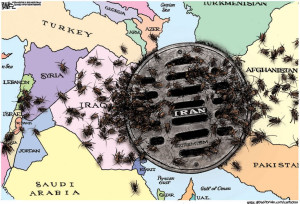
The Middle East roach infestation has originated from Iran – so who will turn on the light to make them scatter?
Source: http://www.ibdeditorials.com/cartoons
We’ve been warning about the Qods Force working to expand their influence in Yemen and model the Houthis after Lebanese Hezbollah. In “Iranian Regime Consolidates Yemeni Gains, Begins Work on Forming Houthi Intel Proxy” we laid out how such work has already been underway. Furthermore, a consistent theme we’ve been touching on in our Arabian Peninsula reporting has been how intelligence collection against US State Department (DoS) personnel and American citizens in the country had dramatically increased with the influx of Hezbollah and Iranian military personnel into the country – so none of this is “new,” although the Obama administration would like to make you think it is, and that the Qods Force doesn’t exercise any control over the Houthis. The inconvenient truth is that they do, and the man calling the shots in the country is Qods Force External Operations Division (Department 400) BG Aboldreza Shahlai.
Check out the following links for additional info on the Qods Force/Houthi/Hezbollah targeting of Americans in Yemen and the greater Arabian Peninsula:
GCC SOF Teams Alerted For Deployment, AQAP Gains Strength and Iran Preps For Attacks Against Saudi Arabia http://isisstudygroup.com/?p=6056
Regarding BG Aboldreza Shahlai, we first introduced him to our readers in our 04 APR 15 article titled, “AQAP and Qods Force Make Their Moves in Yemen as Saudis Struggle to Maintain Coalition.” At the time our sources inside the country had came across information on the presence of a senior Qods Force External Operations Division official had set up shop in the Sadah-area and tasked with overseeing overall operations in the country. We followed this up with an article a month later (“Failed State: Saudi Coaltion Increases Ground Presence as Iran Begins Targeting the Kingdom, US”) revealing his identity. Most westerners have never heard of the guy, but Iranian expats opposed to the regime know all about him. Shahlai was the architect of the Qods Force’s lethal aid program to Shia proxy forces in Iraq during OIF and was also one of the primary planners for the 2007 attack on the Karbala Provincial Joint Coordination Center (PJCC) that killed five US Servicemen. Known as “Suleimani’s Fist,” he holds considerable influence in the Qods Force commander’s inner-circle for advocating “outside the box” solutions to problems – most of which call for directly targeting America and Israel abroad. He was also the mastermind of the plot to assassinate the Saudi Ambassador to the US in New York City that involved his contacts within the Mexican drug cartel known as Los Zetas. His family member Mansur Arbabsiar was the lead-facilitator for the operation. Perhaps more important is Shahlai’s close ties to Abdul Malik al-Houthi and establishment of alternate weapons smuggling routes coming from Africa.
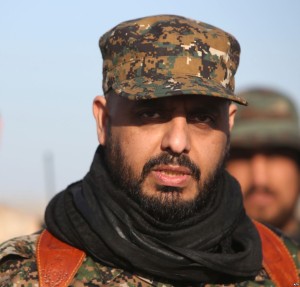
Asaib al-Haq leader Qais al-Khazali worked closely with BG Shahlai during OIF and was a participant in the 2007 attack on the PJCC – he’s now on the front-lines fighting the Islamic State (IS) in Northern Iraq
Source: voanews.com
BG Shahlai’s Yemen assignment is a good indicator that the Iranian regime intends to carry out a campaign targeting American, Israeli and to lesser extent Saudi nationals. With this and Shahlai’s relationship with the Houthis in mind, nobody should be in the least bit surprised that four of our fellow Americans are being held hostage in Yemen. The Houthis have already proven to be very efficient proxies for the Iranians inside Yemen. That said, we will likely see them conducting more operations increasing in complexity and scale within the next 6-9 months across the border into Saudi Arabia itself. They’re already conducting rocket attacks against Saudi border towns and outposts.
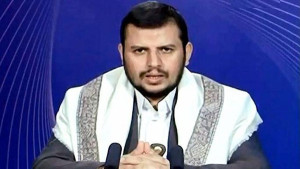
Abdul Malik al-Houthi: Close personal friend to BG Shahlai
Source: al-Arabiya
Its the same situation in Iraq, where we’ve heard from our Baghdad-based contacts reports of an attack being planned by Kataib Hezbollah (KH) targeting the US Embassy. Again, this should surprise no one with the high concentration of Qods Force personnel and proxy forces present inside the country and the capital in particular. We’ve also heard that KH has sympathizers within the Iraqi Security Force (ISF) ranks who are being tapped to assist in the attack. There’s also a considerable anti-air threat in and around BIAP these days coming from both IS and KH fighters. Fortunately, the American forces on the ground are already well aware of this – whether DoS or the Obama administration actually takes the threat serious is another matter entirely.
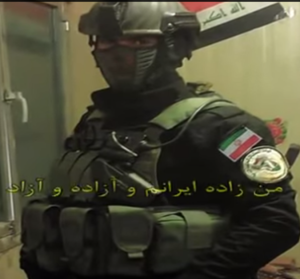
ISOF troopers don’t even try to hide their support of the IRGC-Qods Force Ramazan Corps anymore – a huge red flag for any US military personnel being deployed to Iraq these days
Source: The ISIS Study Group
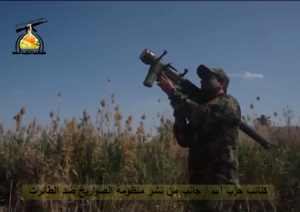
Now why would KH need MANPADs since IS has no Air Force? Perhaps the Qods Force supplied them to KH in order to target someone else?
Source: The ISIS Study Group
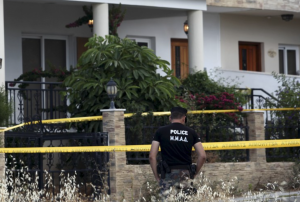
Unfortunately these operations aren’t limited to just the Middle East. Security forces in Cyprus recently arrested a man reportedly involved in a line of Hezbollah operations targeting Israeli interests in Europe. When the Cypriot police arrested him, they also confiscated close to two tons of “suspicious materials” in his basement. Although no additional details on the materials has been made public as of this writing, our source informed us that the materials are for producing explosives (ammonium nitrate was the he saw mentioned). The guy they detained was born in Lebanon but had a Canadian passport, which tends to fit the profile of the kind of personnel Hezbollah’s special operations wing and the Qods Force prefers to recruit into their ranks.
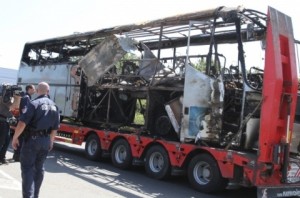
Qods Force and Hezbollah operations have spiked considerably since 2009 with attacks being executed in places like Bulgaria, India and Thailand along with the disrupted plot that was planned for New York City mentioned earlier. Of these, the NYC and Burgas, Bulgaria plots had the direct involvement of BG Shahlai. The telltale signs are how both plots called for using some of his preferred methods of using third parties to do the dirty work and targeting westerners in areas not known for Iranian activity. In fact, the attack in Burgas also involved a Lebanese Arab in possession of Canadian travel documents. The bombings in New Delhi and Bangkok utilized personnel from the IRGC-Qods Force Department 5000 – which is the equivalent to the US Army’s 1st Special Forces Group in that both units are geographically aligned to the Asia/Pacific region.
The 2012 Bombing in Burgas, Bulgaria
Source: Reuters
Bibi Netanyahu was absolutely right to visit America and appear before Congress to air his concerns about the Iranian threat. The events that have occurred over the last few months have added strength to his concerns. Unfortunately, the Obama administration has been downplaying the Iranian threat and the American mainstream media let them get away with it by not holding their feet to the same fire that they did to the Bush administration. Sure, a few American media outlets have finally begun asking some national security questions of substance, but far too many seem to be concerned with covering Bruce Jenner’s hormone therapy and President Obama’s March Madness brackets than they are about things that will have a profound impact on our way of life a lot sooner than people think.
The American media needs to start asking the Obama administration, “why are we seeing such a surge in external operations by the IRGC-Qods Force and their proxies if the current engagement strategy with the Iranian regime is “working,” as they claim?” Indeed members of our staff have worked the Iranian problem-set for some time, but it doesn’t require a whole lot in the way of burning calories to connect the dots between this surge in external operations and the ongoing negotiations over Iran’s nuclear weapons program. Had the media truly cared to search for the truth instead of protect an administration they’ve compromised their journalistic integrity for, they would’ve already put out several articles and investigative specials on the subject. If they want to save face and salvage what’s left of their credibility, then we recommend they do some digging on the current threat to the US Embassy in Baghdad coming from KH and their ISF supporters based in the Green Zone. We can assure you that DoS is fully aware of the threat coming from Shia militias that are now being painted to the American people as “the good guys.”
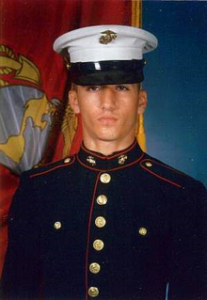
They should also start peppering John Kirby and Marie Harf about the recent counter-terror raid in Cyprus and hammer them about whether the administration ever thought about demanding that the Iranian regime release our citizens in Yemen and US Marine veteran Amir Hekmati during these nuclear weapon talks. We assess that the Qods Force and their proxies are going to continue escalating their actions against our people and our allies for as long as they think they can get away with it. Don’t buy into the Administration’s talk that the regime can’t “control” the Qods Force, because if they say that they’re either lying, extremely ignorant or both. How so? The IRGC as a whole is made up only the most loyal followers of Ayatollah Khameini’s militant ideology. The IRGC-Qods Force are the “most loyal” of those serving in the IRGC – with GEN Suleimani answering only to Khameini. More importantly, the Shia proxy forces won’t take action against the US and its allies unless given authorization to do so by their Qods Force handlers. Make no mistake, this is only the beginning. There will be more attacks coming down the pipe from these guys. Our current national security strategy and foreign policy has set our country on a collision course – is anybody truly paying attention? More importantly, is this administration willing to sacrifice American lives for the appearance of obtaining “peace” with an Iranian regime that has no interest in pursuing normal relations? Something to think about.
Amir Hekmati: Prisoner of Iran
Source: The ISIS Study Group
If you want to know what the Iranian regime is all about, then check out our Inside Iran’s Middle East series:
Hizballah’s General Secretary Hassan Nasrallah frequently brags that his 80,000 missiles can reach any point in Israel. He may have to compromise on this. His masters in Tehran are casting about urgently for ways to save the Assad regime in Damascus and halt the Islamic State’s’ inexorable advance on Baghdad and the Shiite shrine city of Karbala. According to DEBKAfile’s Gulf sources, Iran is eyeing the re-allocation of the roughly 1,000 long-range rockets in Hizballah’s store for warding off these calamities.
Some would be fired from their pads in Lebanon, exposing that country to retaliation, after Beirut rebuffed Hizballah’s demand for the Lebanese army to join in the fight for Assad.
Iran has not so far approved the plan. But if it does go through, Iranian spy drones operating over the war zones would feed with targeting data on ISIS and rebel positions and movements to the Hizballah rocket crews manning the mobile batteries of Fajr-5s – range 400-600 km; Zelzal-2s – range 500 km; Fateh-110s -range 800 km; and Shaheen 2s – 800-900 km.
Discussions in Tehran on this option took on new urgency Thursday, May 28, when White House spokesman Josh Earnest declared that the United States “would not be responsible for securing the security situation in Iraq. Our strategy is to support the Iraqi security forces… back them on the battlefield with coalition military air power as they take the fight to ISIS in their own country,” he said.
Tehran took this as confirmation that the US was quitting the war on the Islamic State in Iraq although the Obama administration’s decision was coupled with a free hand for the Baghdad government to do whatever it must to deal with the peril, including calling on external forces for assistance in defending the country.
In the Iraqi arena, Iran has thrown into the fray surrogate Shiite militias grouped under “The Popular Mobilization Committee.” It is led by Abu Mahdi al-Muhandis, who turns out to be an Iranian, not an Iraqi, and working under cover as the deputy of the Al Qods Brigades Commander Gen. Qassem Soleimani.
This grouping is too shady for President Barack Obama to accept as worthy of US air support. Therefore, the entire anti-ISIS campaign has been dumped in Iran’s lap. Loath to expose its own air force planes to the danger of being shot down over Iraq, Iran is looking at the option of filling the gap with heavy missiles.
In the Syrian arena, Tehran is under extreme pressure:
1. The Assad regime can’t last much longer under fierce battering from the rebel Nusra Front, freshly armed and funded with massive assistance from Saudi Arabia, Qatar and Turkey. To disguise this group’s affiliation with al Qaeda, the Saudis have set up a new outfit called “The Muslim Army of Conquest.” In a few days it was joined by 3,000 Nusra adherents.
2. The Syrian army has lost heart under this assault and many of its units are fleeing the battlefield rather than fighting, with the result that Bashar Assad is losing one piece of territory after another in all his war sectors. Soon, he will be left without enough troops for defending Damascus.
3. Although Hizballah’s leaders proclaim their determination to fight for Assad in every part of Syria, the fact is that the Shiite group is too stretched to support a wide-ranging conflict in Syria and defend its own home base in Lebanon at one and the same time.
4. Tehran is also considering rushing through a defense pact with Damascus to enable Assad to call on Iranian troops to come over and rescue him.
5. Saudi Arabia has singled out leaders of top Hizballah leaders for sanctions. This week, Riyadh impounded the assets and accounts of Khalil Harb and Muhammad Qabalan in Gulf banks. This act was taken in Tehran as a major provocation.
The names don’t mean much outside a small circle in the region. However, Harb is Hizballah’s supreme chief of staff whose military standing is comparable to that of the Iranian Revolutionary Guards commander Gen. Ali Jaafary, while Qabalan is the organization’s senior intelligence and operations officer and responsible for orchestrating Hizballah’s terrorist hits outside Lebanon.
The Iranians are not about to let this affront go by without payback, which could come in the form of missile attacks by Hizballah on Saudi-backed groups in Syria.
Just a week after losing the big Palmyra air base to the Islamic State – and with it large stocks of ammo and military equipment – Syrian military and air units Wednesday, May 27, began pulling out of the big air base at Deir ez-Zour. This was Bashar Assad’s last military stronghold in eastern Syria and the last air facility for enabling fighter-bombers to strike ISIS forces in northeastern Syria and the western Iraqi province of Anbar.
His surrender of the Deir ez-Zour base is evidence that the Syrian president has run out of fighting strength for defending both his front lines and his air bases. He is also too tied down to be able to transfer reinforcements from front to front. He is therefore pulling in the remnants of his army from across the country for the defense of the capital, Damascus.
DEBKAfile’s military sources report that the Islamic State now has in its sights the Syrian army’s biggest air facility, T4 Airbase, which is located on the fast highway linking Homs with Damascus 140 km away.
It is home base for the bulk of the air force’s fighters and bombers. In its hangars are an estimated 32 MiG-25 fighters, as well as smaller numbers of MiG-25PDS interceptors, designed for combat with the Israeli air force, MiG-25RBT bombers-cum-surveillance planes; MiG-25PU trainers, which are routinely used to strike rebel forces in crowded built-up areas, and advanced MiG-29SM fighter jets.
Stationed there too are 20 advanced Su-24M2 bombers, the strategic backbone of the Syrian air force.
T4 Airbase also holds the largest Syrian stocks of guided bombs, air-to-air and air-to-ground missiles.
In the last few hours, air crews have been frantically removing these warplanes from T4 and distributing them among smaller bases in central Syria, at the cost of their operational effectiveness.
In the space of a week, therefore, Bashar Assad has lost three of his major air bases, including Palmyra, where Iranian and Russian air freights had been landing regularly with fresh supplies of ordnance and spare parts for his army.
Our military experts say that this bonanza frees ISIS to cut off the eastern, northern and central regions from the capital, and deprive the Syrian and Hizballah units battling for control of the Qalamoun Mts of air support against rebel and Islamist forces.
If they manage to take T4 as well, the Islamists will be able to prevent US jets from taking off for strikes against them in Syria, or bombing the their forces which have seized long stretches of the fast highway from Homs to Damascus.
Iranian troops in fight to evict ISIS from Baiji refinery
Hassan Nasrallah Saturday, May 23, called his Lebanese Shiite Hizballah movement to the flag, because “we are faced with an existential crisis” from the rising belligerence of the Islamist State of Iraq and the Levant. His deputy, Sheik Naim Qssem, sounded even more desperate: “The Middle East is at the risk of partition” in a war with no end in sight, he said. “Solutions for Syria are suspended. We must now see what happens in Iraq.”
The price Iran’s Lebanese proxy has paid for fighting alongside Bashar Assad’s army for four years is cruel: some 1,000 dead and many times that number of wounded. Its leaders now understood that their sacrifice was in vain. ISIS has brought the Syrian civil war to a new dead end.
This week, a 15-year old boy was eulogized by Hizballah’s leaders for performing his “jihadist duty” in Syria.
Clearly, for their last throw in Syria, the group, having run out of adult combatants, is calling up young boys to reinforce the 7,000 fighting there.
The Syrian president Bashar Assad is in no better shape. He too has run dangerously short of fresh fighting manpower. Even his own Alawite community has let him down. Scarcely one-tenth of the 1.8 million Alawites have remained in Syria. Their birthrate is low, and those who stayed behind are hiding their young sons to keep them from being sent to the front lines.
Assad also failed to enlist the Syrian Druze minority to fight for his regime, just as Hizballah’s Nasrallah was rebuffed when he sought to mobilize the Lebanese army to their cause. This has left Hizballah and the Syrian ruler alone in the battlefield with dwindling strength against two rival foes: ISIS and the radical Syrian opposition coalition calling itself Jaish al-Fatah – the Army of Conquest – which is spearheaded by Al Qaeda’s Nusra Front and backed to topple Assad by Saudi Arabia, Qatar and Turkey.
Nasrallah tried to paint a brave picture of full mobilization to expand the war to all parts of Syria. However, Sunday, May 24, a key adviser to Assad admitted that his regime and its allies were being forced to regroup.
Their forces were withdrawing from the effort to shift the Islamists from the land they have conquered – about three-quarters of Syrian territory – and concentrating on defending the cities, Damascus, Homs and Latakia, home to the bulk of the population, as well as the strategic Damascus highway to the coast and Beirut. Hizballah needed to build up the Lebanese border againest hostile access.
But Syrian cities, the Lebanese border and the highway are still under threat – from Syrian rebel forces.
The Iraqi army, for its part, has been virtually wiped out, along with the many billions of dollars the US spent on training and weapons. There is no longer any military force in Iraq, whether Sunni or Shiite, able to take on ISIS and loosen its grip on the central and western regions.
The Kurdish peshmerga army, to whom President Barack refused to provide armaments for combating the Islamists, has run out of steam. An new offensive would expose the two main towns of the semi-autonomous Kurdish Republic – the capital Irbil and the oil city of Kirkuk – to the depredations of the Islamist belligerents.
A quick scan of Shiite resources reveals that in the space between the Jordan River and the Euphrates and Tigris, Iran commands the only force still intact in Iraq – namely, the Iraqi, Afghan and Pakistani Shiite militias, who are trained and armed by the Revolutionary Guards.
This last remaining fighting force faces its acid test in the battle ongoing to recover Baiji, Iraq’s main oil refinery town. For the first time, Iranian troops are fighting in Iraq, not just their surrogates, but in the Baiji campaign they have made little headway in three weeks of combat. All they have managed to do is break through to the 100 Iraqi troops stranded in the town, but ISIS fighting strength is still not dislodged from the refinery.
The Obama administration can no longer pretend that the pro-Iranian Shiite militias are the panacea for the ISIS peril. Like Assad, Tehran too is being forced to regroup. It is abandoning the effort to uproot the Islamists from central and western Iraq and mustering all its Shiite military assets, such as the Badr Brigade, to defend the Shiite south – the shrine towns of Najef and Karbala, Babil (ancient Babylon) and Qadisiya – as well as planting an obstacle in the path of the Islamists to Iraq’s biggest oil fields and only port of Basra.
The Shiite militias flown in by Tehran from Pakistan and Afghanistan have demonstrated in Syria and Iraq alike that they are neither capable nor willing to jump into any battlefields.
The upshot of this cursory scan is that not a single competent army capable of launching all-out war on ISIS is to be found in the Middle East heartland – in the space between the 1,000km long Jordan and the Euphrates and Tigris to the east, or between Ramadi and the Saudi capital of Riyadh to the south.
By Sunday, May 24, this perception had seeped through to the West. US Defense Secretary Ashton Carter, remarked: “What apparently happened was that the Iraqi forces just showed no will to fight.” The former British army chief Lord Dannatt was more down to earth. Since the coalition air force campaign had failed to stop ISIS’s advance, he said “it was time to think the previously unthinkable” and send 5,000 ground troops to fight the Islamists in Syria and Iraq.
The next day, Monday, Tehran pointed the finger of blame for the latest debacles in Iraq at Washington. Al Qods Brigades chief Gen. Qassem Soleimani was quoted by the English language Revolutionary Guards mouthpiece Javan as commenting: “The US didn’t do a damn thing to stop the extremists’ advance on Ramadi.”
Insanity, craziness or madness is a spectrum of behaviors characterized by certain abnormal mental or behavioral patterns.
Although the definition references “abnormal mental or behavioral patterns” [emphasis added], the behaviors here involved have become increasingly “normal.” Multicultural linguistics are part, but only part, of the problem.
Insane responses to Iran nukes, terrorism support and human rights
As the P5+1 negotiations continue under Obama’s guidance, Iran appears increasingly likely to get or keep nukes. Iran knows Obama.
The Iranian president’s senior advisor has called President Barack Obama “the weakest of U.S. presidents” and described the U.S. leader’s tenure in office as “humiliating,” according to a translation of the highly candid comments provided to the Free Beacon. [Emphasis added.]
. . . .
And with the deadline quickly approaching on talks between the U.S. and Iran over its contested nuclear program, Younesi’s denigrating views of Obama could be a sign that the regime in Tehran has no intent of conceding to America’s demands.
. . . .
“Americans witnessed their greatest defeats in Obama’s era: Terrorism expanded, [the] U.S. had huge defeats under Obama [and] that is why they want to compromise with Iran,” Younesi said.
. . . .
“We [the Islamic Republic] have to use this opportunity [of Democrats being in power in the U.S.], because if this opportunity is lost, in future we may not have such an opportunity again,” Younesi said. [Emphasis added.]
. . . .
The criticism of Obama echoes comments made recently by other world leaders and even former members of the president’s own staff, such as Former Defense Secretary Robert Gates.
Do enough of us, and of perhaps greater importance enough of our “leaders,” know Him as well as Iran does?
The P5+1 negotiations were a scam from the beginning and the scam continues, enhanced by perceived needs to work with the (Shiite) Islamic Republic of Iran to degrade the Sunni (but “non-Islamic”) Islamic State and otherwise to “degrade” terrorism.
The Iranian government is well known for its funding of terrorism. The U. S. Government has long been well aware of it.
The United States State Department describes Iran as an “active state sponsor of terrorism.”[2]US Secretary of StateCondoleezza Rice elaborated stating, “Iran has been the country that has been in many ways a kind of central banker for terrorism in important regions like Lebanon through Hezbollah in the Middle East, in the Palestinian Territories, and we have deep concerns about what Iran is doing in the south of Iraq.”[1]
So is the Obama Administration.
In July 2012, the United States State Department released a report on terrorism around the world in 2011. The report states that “Iran remained an active state sponsor of terrorism in 2011 and increased its terrorist-related activity” and that “Iran also continued to provide financial, material, and logistical support for terrorist and militant groups throughout the Middle East and Central Asia.” The report states that Iran has continued to provide “lethal support, including weapons, training, funding, and guidance, to Iraqi Shia militant groups targeting U.S. and Iraqi forces, as well as civilians,” despite pledging to support the stabilization of Iraq, and that the Qods Force provided training to the Taliban in Afghanistan on “small unit tactics, small arms, explosives, and indirect fire weapons, such as mortars, artillery, and rockets.” The report further states that Iran has provided weapons and training to the Assad regime in Syria which has launched a brutal crackdown on Syrian rebels, as well as providing weapons, training, and funding to Hamas, Palestinian Islamic Jihad, and the Popular Front for the Liberation of Palestine-General Command, among others, and has assisted in rearming Hizballah. [Emphasis added.]
Iran is also remarkable for its failure to provide even minimal human rights. For example, it has been reported that Iran executed more than four hundred people during the first half of 2014. That’s more than two per day.
Despite Iran’s state anti-Semitism, the recent arrest of U.S. journalists, and the continued oppression of women, the Obama administration has been attempting a rapprochement with the Iranian regime. Fending off Iran hawks in Congress and the D.C. punditocracy, the administration has argued for a policy of constructive engagement, pursuing diplomacy over military action to halt Iran’s nuclear program. The execution of two gay men, while it may not be surprising, certainly doesn’t make that “engagement” any easier.
Iran’s cooperation also is seen as essential to managing the chaos in Iraq and the Islamic State. With U.S. airstrikes against the Sunni militants, on-off (now definitely off) support of Iraq’s Shiite (ex-) Prime Minister Nouri al-Maliki, and the possible disintegration of Iraq, this cooperation—or at least not overt opposition—is surely of more strategic importance than the latest human rights abuse. [Emphasis added.]
Iran’s support for terrorism, abysmal violation of even the most basic human rights — and what these Iranian characteristics suggest that Iran is likely to do with its nukes — appear to be deemed of no importance by the P5+1 negotiators.
Domestic terrorism
Terrorism is often labeled “workplace violence,” a “traffic accident“ or just about anything but Islamic. This is from Jihad Watch:
A traffic incident in Jerusalem. Another traffic incident in Canada just a few days ago. Odd coincidence: both drivers were devout Muslims who killed Infidels “in the name of Allah” (as the Canadian bad driver put it). Meanwhile, also in Canada, a mentally ill man shoots up the Parliament building and murders a soldier. And in New York City, a man wielding a hatchet injures several police officers. Another odd coincidence: both the Canadian mentally ill man and the New York hatchet-wielder were also devout Muslims. The father of the former waged jihad in Libya, and the latter called for armed revolt in the U.S. But you must put all of these odd coincidences out of your mind right now. We know that none of this can have anything to do with Islam, and that greasy Islamophobes are the only ones who think otherwise.
“Memo from US Consulate refers to Jerusalem terror attack as ‘traffic incident,’” by Itamar Eichner, Ynet News, October 24, 2014 (thanks to Hamish):
Hours after a Palestinian terrorist drove his car into a crowd waiting at a light rail station in Jerusalem, the US consulate in the city issued a memo referring to the attack as a “traffic incident”.
A three-month-old baby was killed and seven other people were wounded when Abdel Rahman a-Shaludi drove his car across incoming traffic to strike the people waiting at the station. The baby girl, Chaya Zissel Braun, had American citizenship.
The memo was sent to employees of the American consulate, which is based in East Jerusalem. It asks staff to report “any emergency.”
AnneinPT (Israel) provides an actual Associated Press news headline about the “traffic accident.” “Israeli police shoot man in east Jerusalem.”
Here’s how the AP, consistently with its customary reporting on things Israeli, might treat Palestinian rockets thwarted by Israel’s Iron Dome defense system: “Palestinian rockets damaged beyond repair by Israeli counter-measures.”
“Lone wolf” Islamic terrorists are exceedingly rare.
[N]umerous examples show that terrorist actors are almost always part of a network who were involved in recruiting and tasking terrorist activity. As Max Abrahms at Northeastern University has observed:
Since the advent of international terrorism in 1970, none of the 40 most lethal terrorist attacks has been committed by a person unaffiliated with some terrorist group, according to publicly available data from the National Consortium for the Study of Terrorism and Responses to Terrorism, which is funded by the Department of Homeland Security and stored at the University of Maryland. In fact, lone wolves have carried out just two of the 1,900 most deadly terrorist incidents over the last four decades.
So why “lone wolf”? Simply, it was a mechanism promulgated by the CVE [countering violent extremism] industry, with willing cooperation from law enforcement and intelligence officials, to exonerate themselves when a terrorist attack happened. At its core is terror agnosticism: “There is possibly no way to predict who will turn to terrorism, so therefore we can’t be held responsible when it happens. Oh, and give us more money so we can better improve how we won’t be able to predict terror attacks.” [Insert added.]
It’s Islamic terrorism all the way down:
Yet there has been great reluctance to associate terrorist attacks with the “religion of peace.” Here are examples of media and official reactions to the recent terrorist attacks in Canada: “CBC’s Derek Stoffel tweeted: ‘Amid the speculation in the #OttawaShooting in #Canada, it’s important to remember #ISIS hasn’t shown interest in attacks abroad.’” However,
Stoffel should have known that in late September, the Islamic State’s spokesman, Abu Muhammad Al-Adnani, urged Muslims to murder non-Muslims in the West. “Rely upon Allah,” he thundered, “and kill him in any manner or way however it may be. Do not ask for anyone’s advice and do not seek anyone’s verdict.
“The hard-Left Vox reacted to the revelation that Zehaf-Bibeau was a Muslim by dismissing the fact as irrelevant.”
Not to be outdone in multicultural empathy,
In the wake of the shootings in Ottawa, the police chiefs of Toronto and Ottawa wrote to local Muslim leaders, assuring them of their good will and urging Muslims to contact them in case of a “backlash.” These politically correct cops appear to have learned their lesson well: after every jihad attack, Muslims are the victims, and need special reassurances.
Eventually, the Canadian terrorist attacks were labeled “terrorism.” Even the White House called them “despicable terrorist attacks,” without mentioning the words “Islam” or “Islamist.”
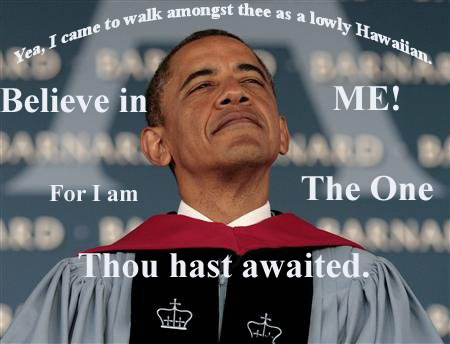
In 2008 we the people elected Obama as “our” President. We did it again in 2012. He was viewed by many as the one for whom they had been waiting.
He was seen as the “God of all things.”
Fortunately, some seem to be recovering from their dementia.
However, all too many are still infected with insanity and continue to be contagious. Here’s a video of James O’Keefe talking with college students about vote fraud:
Vote fraud is apparently good when done for a “good” purpose.
When Obama spoke about Democrats running for reelection appearing to desert but really supporting him, he said
“So this isn’t about my feelings being hurt. These are folks who are strong allies and supporters of me. And I tell them, I said, ‘You know what, you do what you need to win. I will be responsible for making sure that our voters turn out.'” [Emphasis added.]
He may not have intended to encourage voter fraud, but “you do what you need to win” may well have been taken seriously by Obamabots. It has, as a minimum, an unpleasant odor.
How many non-citizens participate in U.S. elections? More than 14 percent of non-citizens in both the 2008 and 2010 samples indicated that they were registered to vote. Furthermore, some of these non-citizens voted. Our best guess, based upon extrapolations from the portion of the sample with a verified vote, is that 6.4 percent of non-citizens voted in 2008 and 2.2 percent of non-citizens voted in 2010. [Emphasis added.]
. . . .
Because non-citizens tended to favor Democrats (Obama won more than 80 percent of the votes of non-citizens in the 2008 CCES sample), we find that this participation was large enough to plausibly account for Democratic victories in a few close elections. Non-citizen votes could have given Senate Democrats the pivotal 60th vote needed to overcome filibusters in order to pass health-care reform and other Obama administration priorities in the 111th Congress. Sen. Al Franken (D-Minn.) won election in 2008 with a victory margin of 312 votes. Votes cast by just 0.65 percent of Minnesota non-citizens could account for this margin. It is also possible that non-citizen votes were responsible for Obama’s 2008 victory in North Carolina. Obama won the state by 14,177 votes, so a turnout by 5.1 percent of North Carolina’s adult non-citizens would have provided this victory margin.
. . . .
We also find that one of the favorite policies advocated by conservatives to prevent voter fraud appears strikingly ineffective. Nearly three quarters of the non-citizens who indicated they were asked to provide photo identification at the polls claimed to have subsequently voted. [Emphasis added.]
With early voting starting Thursday, North Carolina’s election board found 154 ineligible voters on its poll lists — and officials are examining thousands more questionable registrations.
The State Board of Elections said late Tuesday that more than 9,000 additional voters’ names are being checked for legal status. They do not expect to finish checking before early voting starts Thursday.
It’s necessary for Republicans to win outside the “margin of fraud,” and there have already been signs of voter fraud. In Arizona,
A Republican party official in the largest county in Arizona says surveillance tape shows a progressive Hispanic activist blatantly and openly engaging in vote fraud.
. . . .
Between 12:54 and 1:04, LaFaro said, he observed a man wearing a “Citizens for a Better Arizona” T-shirt loudly drop a box containing hundreds of early-voting ballots on a table.
Citizens for a Better Arizona is a progressive group.
The man then began “stuffing the ballot box,” LaFaro said. “I watched in amazement.”
In Chicago, Republican state representative candidate Jim Moynihan’s votes for Republican candidates, including for himself, were registered as having been cast for Democrats. He noticed the problem before pulling the ultimate lever and it was determined that the machine had been “improperly calibrated.” There is no indication in the linked article whether other machines were also “improperly calibrated” or whether any of them were examined to find out. Obviously, voters need to check for whom the machines say they have voted before pulling the lever. How many will bother to do so?
Since voter fraud may be insufficient, President Obama has diligently prevented voters from understanding what He intends to do about immigration soon after the election. Jonathan Turley, Esq., a “liberal” in the old fashioned sense rather than a leftist, wrote this about Obama’s refusal to disclose or even discuss His post-election plans for immigration “reform.”
[Y]esterday [October 23d] White House CBS reporter Major Garrett broke from the mainstream pack and pressed White House Press Secretary Josh Earnest on a report that the Administration has order material for a “surge” of immigration IDs of up to 9 million in one year. Ernest called the questions “crazy” and encouraged everyone not to speculate . . . before the election obviously. [Emphasis added.]
[T]his Administration is openly withholding any information in its plans for unilateral presidential action despite the President’s pledge to take action after the election and before the New Year — only a matter of weeks. It is a cynical decision to prevent voters from being fully informed of the plans in a major policy area. Regardless of how one feels about immigration policies, it should be condemned by people across the political spectrum. [Emphasis added.]
More importantly, the media has to show some independence from the White House in this and other stories. Garrett is one of the few such reporters to press the point. His extraordinary exchange however was not covered by the mainstream press and, once again, the stonewalling on the issue was again dropped. I expect given the record of the White House corp, such questioning from Garrett does seem “crazy.” After all, disclosure of such plans might harm the White House in the upcoming election and only a “crazy” reporter would pursue such a story. [Emphasis added.]
Get your excuses for not voting prepared if you like the status quo:
If you don’t like the status quo, vote and remind your friends to do so as well.
Conclusions
From the P5+1 negotiations with Iran and the failure of our “leaders” even to pause on their path to Iranian nukes due to Iran’s abysmal human rights record, its support for terrorism and the dangers Iran already poses for what’s left of the free and democratic world — and will pose in even greater measure with nukes — to rampant antisemitism to Islamic attacks on and persecution of Christians qua Christians, to domestic Islamic terrorism to voting fraud, far too many are either insane or extraordinarily devious. Those who appear to be insane either do not recognize the nature of our enemies or do not care. Some are perhaps complicit.
As this insidious form of insanity spreads we seem to have no antidote more powerful than reason and common sense, both increasingly rare. Will our enemies have to provide a more effective antidote in the form of an attack on the United States so severe, clear and obvious that insanity can no longer be ignored even by our lunatics?
 US Patriots stationed in Saudi Arabia










 anneinpt
 artaxes
 danmillerinpanama
 davidking1530
 Peter Hofman
 Joseph Wouk
 Peter
Peter Louisiana Steve
 WarSclerotic
Recent Comments